Red Oak Wood Floors: Complete Guide to Pros, Cost, Stains, Finishes & Care
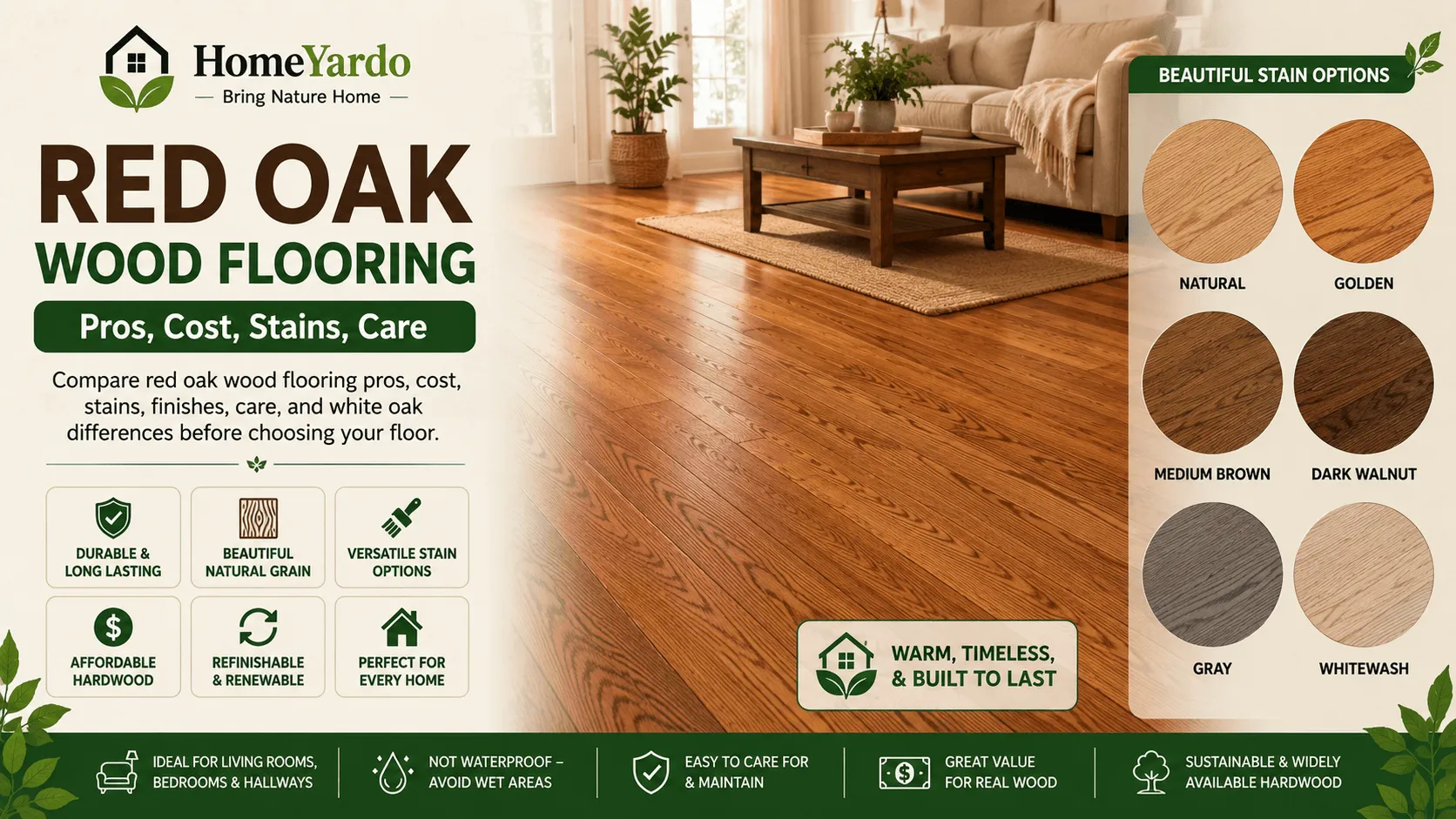
Red oak is one of the most popular hardwood flooring options in homes due to its durability, availability, stain resistance and affordability, which is typically lower than that of some hardwoods. Red oak wood floors are warm in color, have character, and a nice grain pattern for older homes, updated rooms and classic interiors.
The first thing you need to know about red oak is its undertone. May appear as pale tan, golden, pink, salmon, reddish brown or orange, depending on the raw boards, stain, lighting and finish. Older red oak floors often appear dated due to the old amber finishes, not the wood itself.
It discusses types, colors, stains, finish options, maintenance costs, refinishing, and the differences between red oak and white oak flooring and what to inspect when purchasing.
Quick Answer: Is Red Oak Wood Flooring A Good Choice?
Red oak is a good flooring choice for living rooms, bedrooms, hallways, stairs, dining rooms, and many kitchens. It provides a true hardwood appearance, can withstand normal household use and is sometimes refinable to restore the surface.
It’s not waterproof, so bathrooms and wet spaces are typically not ideal. If a light, white oak finish is desired, it also requires stain and finish testing.
| Factor | Summary |
|---|---|
| Best rooms | Living rooms, bedrooms, halls, stairs, dining rooms |
| Main look | Warm color with visible grain |
| Durability | Good for daily residential use |
| Main concern | Moisture and warm undertones |
| Best finish direction | Satin or matte water-based finish for a cleaner look |
Red oak works best when the room is dry, the finish is chosen carefully, and the homeowner accepts normal hardwood care.
| Best For | Avoid For |
|---|---|
| Living rooms | Bathrooms |
| Bedrooms | Wet basements |
| Hallways | Standing water areas |
| Stairs | Exact white oak look |
| Refinishable floors | Zero maintenance expectations |
What Is Red Oak Flooring?
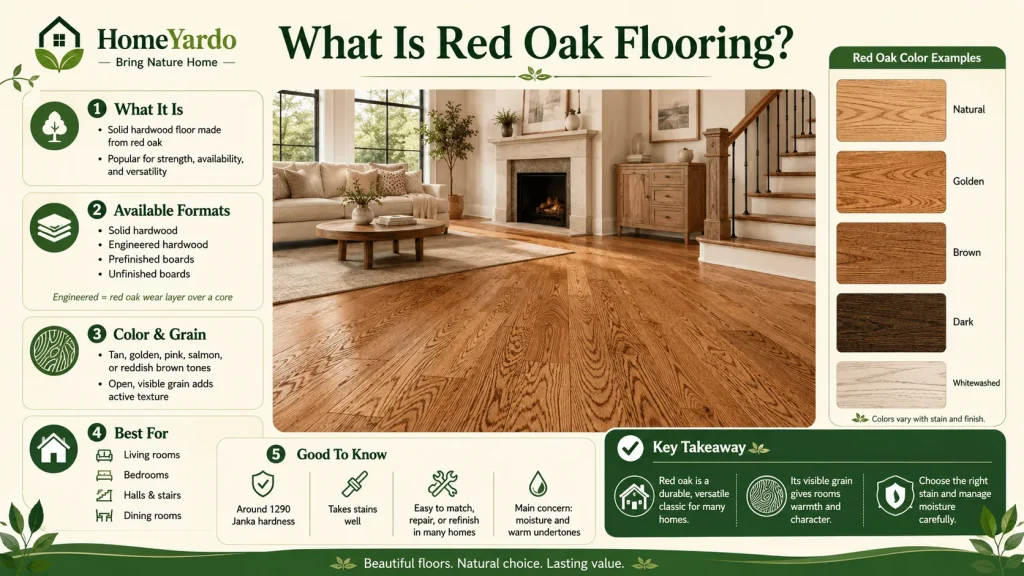
It’s a solid hardwood floor constructed of red oak wood. It is popular in North American residences due to its strength, availability and versatility for various floor styles.
Available in solid hardwood, engineered hardwood, prefinished boards and unfinished boards. Solid red oak is a solid piece of wood while engineered red oak is a red oak wear layer that is layered over a core.
Sapwood of red oak is frequently light brown or tan. The heartwood may be reddish brown, pinkish or warm brown. The grain is open and exposed and provides a dynamic texture throughout the room.
Red oak can be stained natural, golden, brown, dark, whitewashed or lightly toned as it takes a wide variety of stains. Because of its widespread use, red oak hardwood flooring can be matched, repaired or refinished in many older homes.
| Feature | Detail |
|---|---|
| Material | Real domestic hardwood |
| Common formats | Solid, engineered, prefinished, unfinished |
| Main color range | Tan, golden, pink, salmon, reddish brown |
| Grain | Open, visible, active |
| Common hardness | Around 1290 Janka |
| Best rooms | Living rooms, bedrooms, halls, stairs, dining rooms |
| Main concern | Moisture and warm undertones |
The Color Of Red Oak And Main Flooring Characteristics
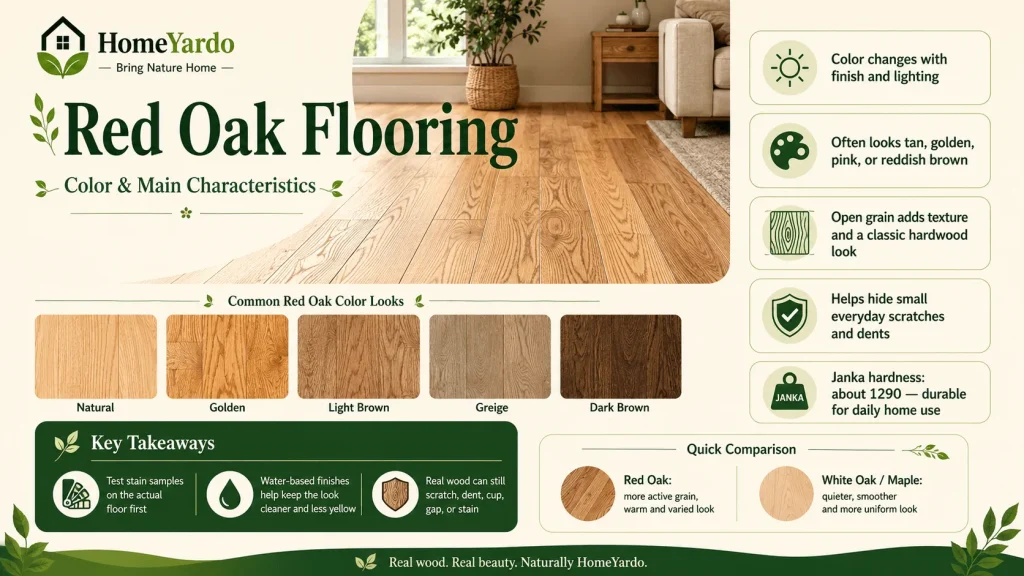
Red Oak is a warm tree. It may appear pale tan in raw boards, golden after finish, pink in some lights, salmon with pale stains, reddish brown with natural depth, or orange with an old oil-based finish that has turned yellow.
The lighting affects the way the floor looks. A stain that appears soft and brown in the showroom could appear pink by a window or yellow when lit by warm indoor lights. Therefore, samples of stains should be tested prior to full finishing on the actual floor or the same batch of boards.
Old red oak floors can appear orange due to an old finish, old polyurethane, sunlight or a high gloss sheen. It can often be minimized by sanding and refinishing.
| Color Family | How It Can Look On Red Oak | Best Finish Direction |
|---|---|---|
| Natural | Warm tan to golden | Clear water-based finish |
| Reddish brown | Traditional oak tone | Satin brown finish |
| Golden | Warm classic floor | Avoid high gloss if a modern look is wanted |
| Light brown | Balanced and soft | Natural or neutral sealer |
| Greige | Updated neutral | Test carefully |
| Gray | Cool but risky | Professional sample testing |
| Whitewashed | Pale and bright | Watch for pink pull |
| Dark brown | Rich and formal | Dark walnut or espresso-style stain |
Appearance And Grain
Red oak is very open grained and shows growth lines. The pattern is more active than white oak, and provides more texture to the floor.
This type of grain can work well in a home with a lot of activity as small scratches, dents and everyday usage are less noticeable against this grain. It also provides red oak with a traditional hardwood look, making it a great choice for traditional, farmhouse, transitional, and casual interior styles.
White oak and maple are good choices for a quiet, smooth, light-colored floor. Those who prefer to see the wood grain often prefer red oak.
Hardness And Daily Wear
Red oak typically has a Janka rating of approximately 1290. White oak is rated approximately 1360; this is slightly more difficult than white oak, but not substantially.
Sometimes as much as the species of wood, finish quality, cleaning practices, rugs, furniture pads, pet nails, and moisture control are important factors. A good finish on a red oak floor will work for day-to-day use in the home.
It remains real wood and may scratch, dent, cup, gap or stain if abused. It should not be installed as tile, vinyl or waterproof flooring.
Red Oak Flooring Benefits

Red oak has remained in demand due to its combination of durability, availability, character and value. This isn’t the most contemporary wood out there, but the correct finish will make it look clean and modern.
It is also suitable for matching old floors. Red oak is a common species in many older homes, and repairs, additions and refinishing projects may be easier than matching a less common species.
| Benefit | Why It Matters |
|---|---|
| Real hardwood | Adds natural wood character |
| Visible grain | Helps small marks blend in |
| Stain friendly | Can be natural, brown, dark, or lightly toned |
| Refinishable | Older floors can often be renewed |
| Widely available | Easier to source for repairs and matching |
| Older home matching | Useful when extending or repairing existing oak floors |
Red oak can also be used in product format. It is available in solid flooring that can be refinished over a long period of time, engineered flooring for added stability, prefinished flooring for quicker installation, and unfinished flooring for custom stain work.
It is available at quality flooring suppliers, provides a true hardwood appearance, can withstand normal household use and is sometimes refinable to restore the surface.
Red Oak Flooring Drawbacks

Red oak is not suitable for all rooms or all design objectives. It is most susceptible to moisture. It should not be placed in standing water and is not suitable for full baths, wet basements or areas where there is continuous moisture.
The second is undertone. Red oak may have pink, red, salmon, golden or orange hues. While these colours aren’t necessarily a bad choice, they do clash with cool gray rooms, bright white kitchens, and pale Scandinavian style rooms.
Light stains should be treated as well. Stain and sealer can pull pink if used on whitewash, gray or natural finishes. High gloss finishes may accentuate scratches, ambering and dated orange tones.
Humidity control is also important. Red oak, like other hardwoods, can swell and shrink during wet and dry seasons. Low humidity in the interior may cause gaps, cupping or movement.
Never use any hardwood as a waterproof material unless there is a clear mention of the use case in the product warranty. Red oak requires the same water precautions as other real wood floors.
Engineered Vs Solid Red Oak Flooring And Other Product Types
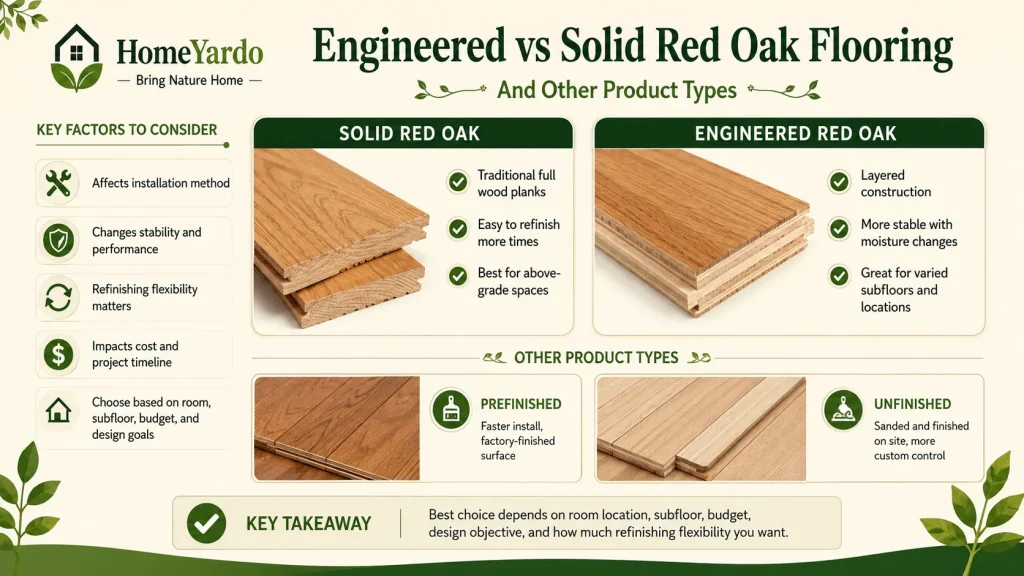
It has an impact on the way it is installed, how stable it is, how easy it is to refinish, how long it takes, the cost, and its performance longevity. There are two primary options: solid and engineered. The second one is prefinished versus unfinished.
Depending on room location, the underlying subfloor, budget, design objective, and the degree of refinishing flexibility desired, product type should be determined.
Main Types Of Hardwood Flooring Red Oak

There are four types of this available: solid, engineered, prefinished and unfinished. For long term refinishing, dry above grade rooms, solid red oak is best. Prefinished and unfinished red oak have primarily different installation times and stain options, but engineered red oak can provide improved stability in approved areas.
| Type | Best For | Main Limitation |
|---|---|---|
| Solid red oak | Long term refinishing and above grade rooms | Not ideal for damp spaces |
| Engineered red oak | Added stability and some approved slab uses | Refinish potential depends on the wear layer |
| Prefinished red oak | Faster installation and factory finish | Harder to custom match old floors |
| Unfinished red oak | Custom stain and seamless site finish | More labor and drying time |
Solid Red Oak Flooring
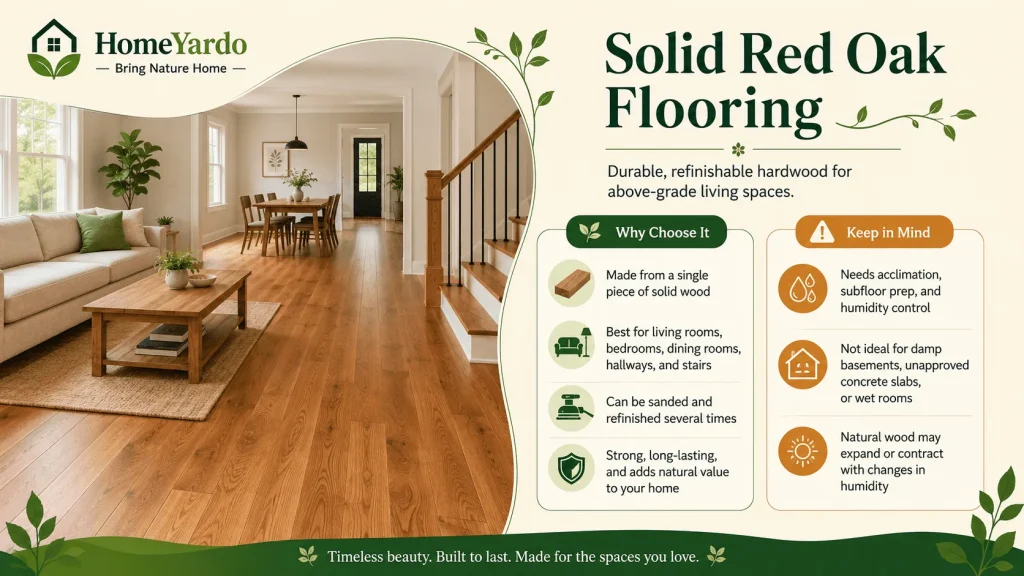
Solid flooring is created from a single piece of solid wood. It is frequently used in above-grade rooms, like living rooms, bedrooms, dining rooms, hallways, and stairs.
The primary benefit is that it can be refinished over time. Solid red oak hardwood floors can be sanded and refinished several times depending on the thickness and floor condition.
Proper acclimation, subfloor preparation, and humidity control are necessary for solid wood. Typically not recommended for damp basements, concrete slabs with no approved method, or rooms where there is regular contact with water.
Engineered Red Oak Flooring

Engineered flooring is made with a red oak wear layer and a multi-layered core. The layered construction can provide improved dimensional stability for some installations compared to solid wood.
May be more suitable for wider plank applications, slab applications or lower-level applications where approved. Approval is important because not all engineered floors are appropriate for all rooms.
Refinishing will be determined by the thickness of wear. A thick wear layer may be sanded; a thin veneer may not. Before thinking that it can be refinished later, always read the product information and warranty.
Should I Choose Prefinished Or Unfinished Red Oak Flooring?
Prefinished and unfinished red oak are both suitable, but work best in different projects. Prefinished boards are boards that are finished in the factory. After installation, unfinished boards are sanded, stained and coated.
| Option | Best For | Watch Out For |
|---|---|---|
| Prefinished red oak | Faster installation, factory finish, less mess | Harder to custom-match old floors |
| Unfinished red oak | Custom stain, seamless site finish, matching existing oak | More labor, sanding, odor, and drying time |
Use prefinished red oak for fast, convenient and factory coated applications. For a custom color, a smooth site-finished surface or to match existing floors, select unfinished red oak.
How To Compare Red Oak Product Listings
At first glance, product listings may appear the same, but there are subtle differences that impact performance, cost, and installation. Look at more than just the price before making your selection.
| Product Detail | Why It Matters |
|---|---|
| Solid or engineered | Affects installation and refinishing |
| Thickness | Affects durability and sanding potential |
| Wear layer | Important for engineered flooring |
| Width | Affects style and price |
| Grade | Controls knots and color variation |
| Finish | Changes durability and maintenance |
| Warranty | Shows product limits and approved use |
| Installation method | Must match the subfloor and the room |
Don’t compare red oak products based on price. A more affordable board might be thinner, narrower, lower grade, or not be used in the room. Make sure to compare the same construction, grade, width, finish and warranties before selecting.
Grades, Cuts, Widths, And Textures
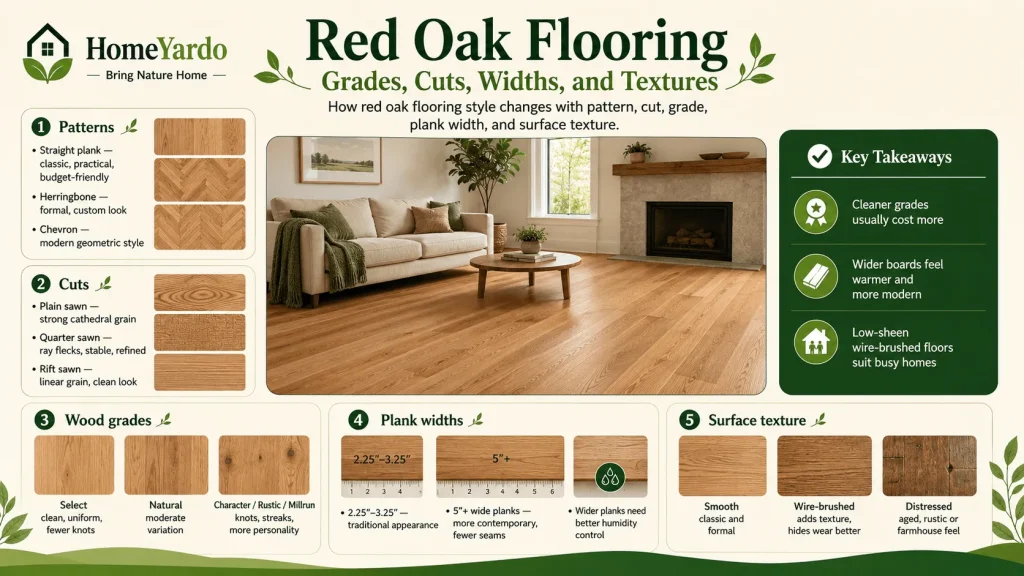
The appearance of red oak after installation will vary based on grade, plank width, cut and surface texture. These details also play a role in the cost, availability and the formal or casual atmosphere of the finished room.
A narrow board, clean select grade, can be classic and orderly. Wider boards can create a more laid back, rustic, and warm look when paired with a character grade.
Patterns
Red oak is typically used in a straight plank configuration, but may also be used in herringbone or chevron configurations when the product and installer are capable of such installation. Straight plank floors are typically the most functional and economical. Herringbone and chevron patterns will give a more custom effect but will typically take longer to lay and need more planning and allowances for waste.
| Pattern | Best For | Watch Out For |
|---|---|---|
| Straight plank | Classic rooms and budget control | Simple look |
| Herringbone | Formal or custom interiors | Higher labor and waste |
| Chevron | Modern geometric design | Needs precise installation |
Cuts
The pattern of the grain on the floor depends on how the log is cut. Most homeowners don’t have to take the time to learn the specifics of lumber cutting, but it is helpful to know the basic appearance when comparing samples.
| Cut Type | Look | Best For |
|---|---|---|
| Plain sawn | Strong cathedral grain | Traditional and casual rooms |
| Quarter sawn | Strawier grain and ray flecks | Classic, stable, higher-end look |
| Rift sawn | Linear grain | Modern or cleaner interiors |
Plain sawn red oak is common and familiar. Rift and quarter sawn boards can look cleaner and more controlled, but they may cost more.
Wood Grades
Select, Natural, Character, Common, Rustic and Millrun are common grades. The names may differ from supplier to supplier, but the concept is generally the same.
The selected grade is cleaner and more uniform and has less color variation and fewer knots. Natural grade has more movement, but is still under control. Character, Common, Rustic or Millrun grades may contain knots, mineral streaks, color changes and more personality.
Cleaner grades are typically more expensive. Homes, cabins, farmhouse areas, and rooms with natural variation can be attractive with character grades.
Plank Widths
Older homes often have narrow red oak strip flooring. Widths like 2.25″ and 3.25″ are great for a traditional appearance and for matching existing floors.
Red oak feels more contemporary with wider planks, which are 5 inches or wider. They reveal more of the grain and provide a more subdued floor plan in a room with fewer seams.
If wider wood boards are used, they will require better humidity control as the seasonal movement may be more apparent. Wider planks may also be more expensive, particularly for cleaner grades or thicker products.
Surface Texture
Smooth red oak has a clean and classic appearance. It is great for formal areas, traditional homes, and modern interior design where a neutral surface is desired.
Wire brished red oak creates texture and emphasizes the grain. Can cover small wear better than a very smooth floor and works well in casual, rustic or transitional rooms.
Distressed red oak has intentional marks and aging. It can be used in a farmhouse or cabin type home, but not in a modern home with a sleek design.
A low-sheen wire-brushed floor can be more effective at concealing wear than a glossy smooth floor for pets, children and busy homes.
Colors And Style Options
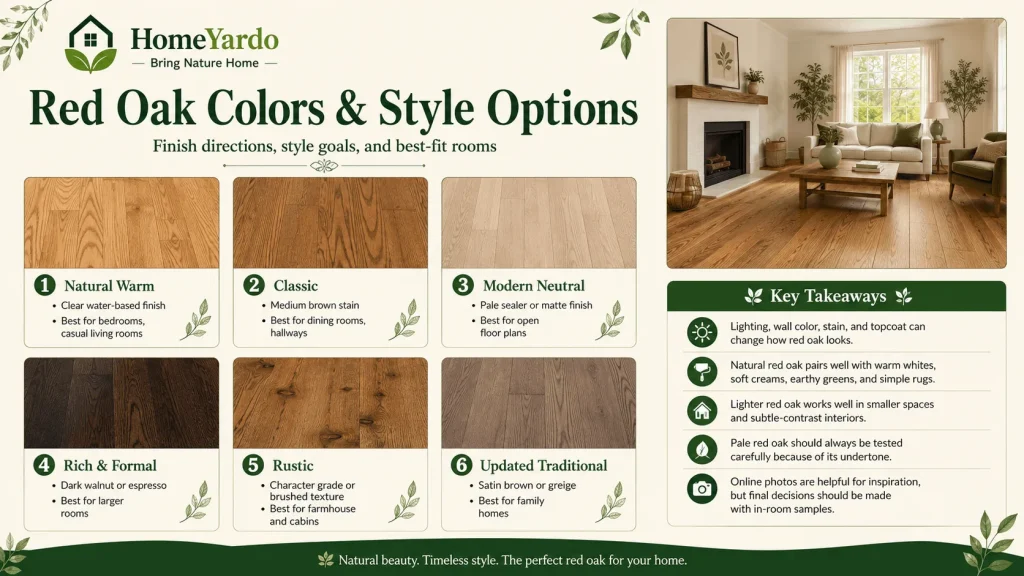
Red oak can be used in a variety of color directions. It can be natural and warm, medium brown and classic, pale and updated, dark and formal, or textured and rustic.
Online pictures are helpful for ideas, but not for the end decision. The same wood can be soft tan or pink or golden depending on the lighting, color of the walls, the grade of the wood, the stain formula, and the topcoat.
| Style Goal | Red Oak Finish Direction | Best Fit |
|---|---|---|
| Natural warm | Clear water-based finish | Bedrooms, casual living rooms |
| Classic | Medium brown stain | Dining rooms, hallways |
| Modern neutral | Pale sealer or matte finish | Open floor plans |
| Rich and formal | Dark walnut or espresso | Larger rooms |
| Rustic | Character grade or brushed texture | Farmhouse and cabins |
| Updated traditional | Satin brown or greige | Family homes |
Natural red oak floors pair well with warm whites, soft creams, earthy greens, traditional furnishings and simple rugs. Lighter red oak is better suited to smaller spaces and more subtle contrasts. The wood has an undertone and this makes pale red oak the most carefully tested.
Best Stain For Red Oak Floors
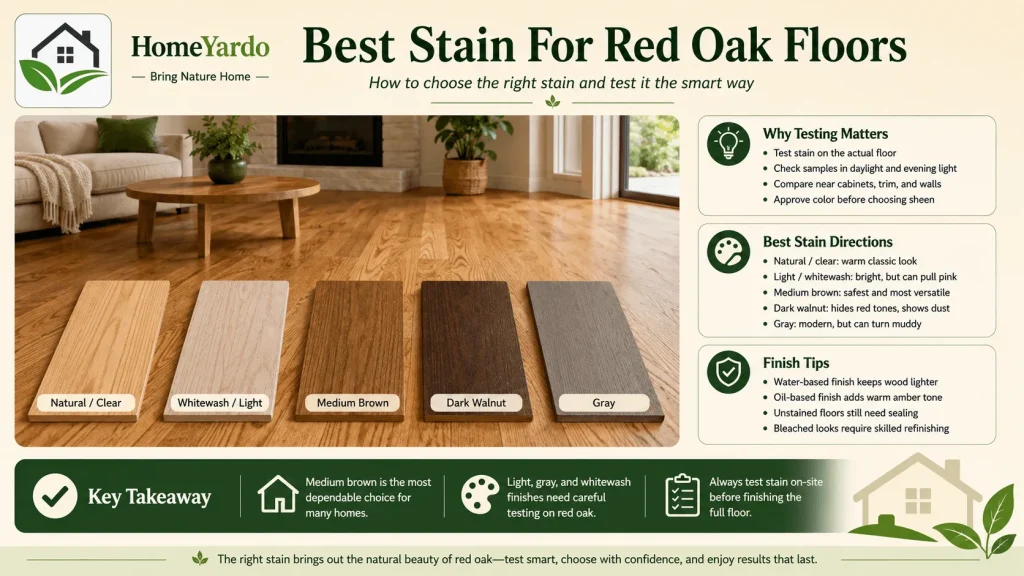
There are several different stains available for red oak, depending on the design objective. Many stains can be used on red oak, but its warm tone will impact the color. A sample may appear white oak on white oak, but be pink or orange on red oak.
Test stain on actual floor, if possible. Examine the sample in the morning light, the afternoon light, and the evening artificial light before approving the whole project.
How To Test Red Oak Stain Samples
The stain test should be conducted on the actual wood, not a showroom board. The color of red oak can vary depending on lighting so a single sample is not necessarily sufficient.
| Step | What To Do |
|---|---|
| 1 | Sand the test area or use matching sample boards |
| 2 | Apply several stain or sealer options |
| 3 | Let each sample dry fully |
| 4 | Check the color in daylight and evening light |
| 5 | Compare samples near cabinets, trim, and walls |
| 6 | Choose the sheen after the color is approved |
A pale stain can look beige in one part of the room and salmon near a sunny window. Testing prevents a full-room finish from becoming too orange, gray, pink, or yellow.
Natural Red Oak Floors
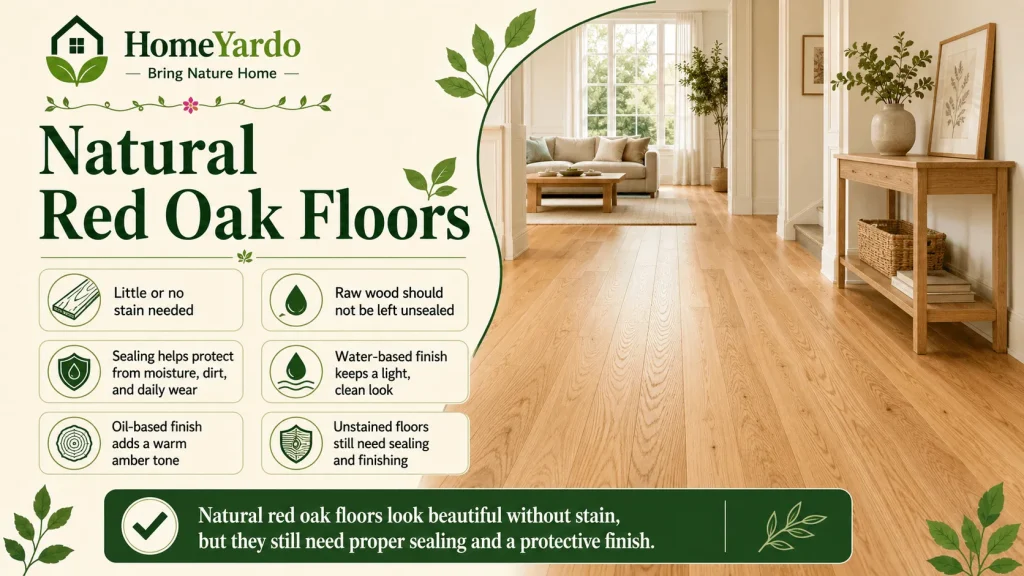
Little or no stain is required on a natural red oak floor, but a protective finish is still needed. Raw wood is not to be left unsealed as it can be damaged by moisture, dirt and daily use.
A water-based finish typically retains the lightness and cleanliness of the wood. An oil-based finish will provide a more golden, warm amber tone and may help to darken gold, red or orange finishes over time.
Red oak floors with no stain typically refer to a floor that doesn’t contain any stain, but it doesn’t necessarily mean that the floor doesn’t have any protective finish. Unstained red oak floors require sealing and finishing to preserve the wood.
Light And Whitewashed Red Oak
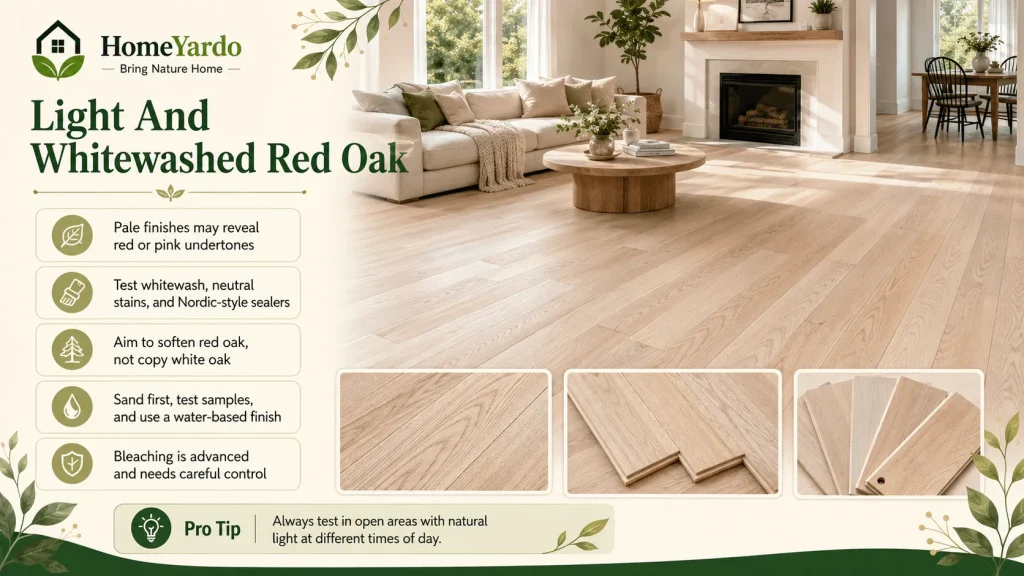
Light and whitewashed red oak might appear bright and updated, but it can be more difficult to control than medium brown or dark stain. Pale finishes can show the red/pink tone.
Care must be taken to test Nordic style sealers, pale neutral stains and whitewash effects. The objective is to have a softer red oak appearance, not a white oak replica.
A professional refinisher may test various stain and sealer combinations and select the best one. This is particularly relevant in open spaces with a visible floor in numerous lighting situations.
If you’re considering lightening the red oak floor in your home, you should begin by sanding the floor, testing samples, using a water-based finish, and setting realistic expectations. Bleaching may be accomplished but is more advanced and requires careful control.
Medium Brown Red Oak
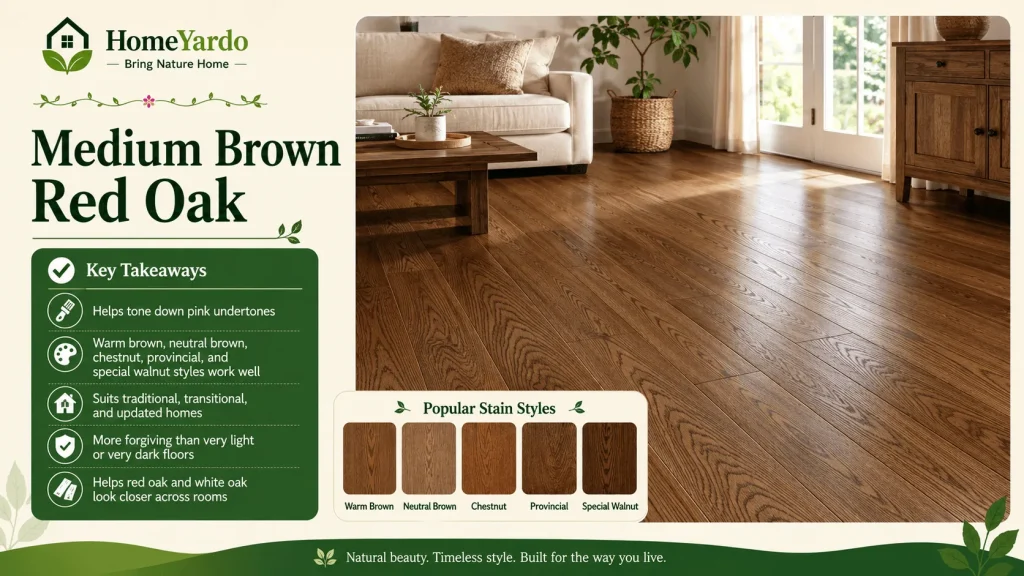
One of the safest and most versatile colors for red oak is medium brown. It can help decrease the pink color without making the floor too dark.
Warm brown, neutral brown, chestnut, provincial style tones or special walnut style tones can work well. These colors work well on traditional, transitional and updated houses.
Medium brown also tends to last longer than very light or very dark floors. It can also help to make red oak and white oak appear closer together than pale stains would, particularly in adjacent rooms.
Dark Red Oak
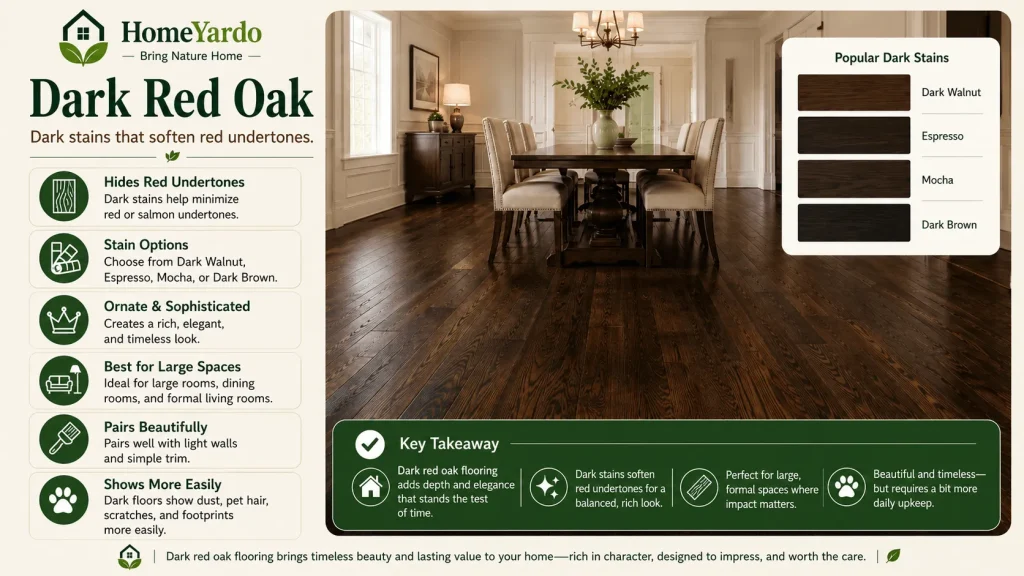
Dark stains like dark walnut, espresso, mocha, or dark brown can cover up red or salmon colored undertones nicely. They give a more ornate and sophisticated appearance.
Dark red oak is suitable for large rooms, dining rooms, formal living rooms and homes with prominent contrast. It complements light walls and simple trim.
The compromise is maintenance. Dust, pet hair, scratches and footprints will be more visible on a dark floor than on a medium brown or natural floor.
Gray Red Oak
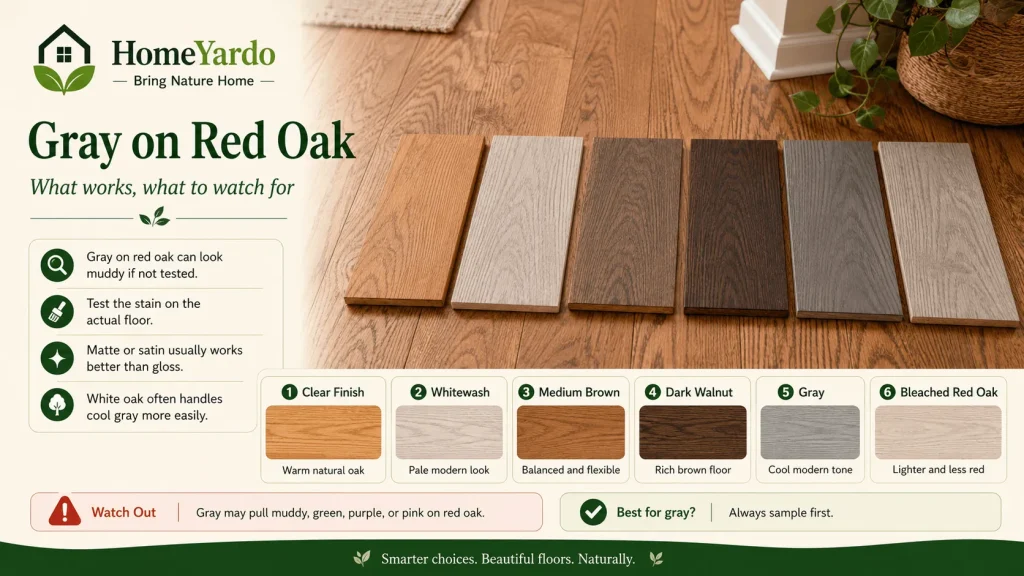
Gray on red oak will work but is one of the more precarious color combinations. If the stain is not tested, the warm undertone of red oak can cause gray to appear muddy, green, purple or pink.
Pale gray and cool neutral colors are typically more manageable with white oak. Red oak can be toned down further, but it requires attention.
A gray tone should be tried on the actual floor and not just from a picture. Matte or satin sheen is typically more successful than gloss.
| Stain Direction | Result On Red Oak | Best For | Watch Out For |
|---|---|---|---|
| red oak floors no stain, with a clear finish | Warm natural oak | Classic light floors | Can deepen red or gold tones |
| Whitewash | Pale modern look | Bright interiors | Can pull pink |
| Medium brown | Balanced and flexible | Most homes | Avoid a high-gloss amber finish |
| Dark walnut | Rich brown floor | Large rooms | Shows dust more |
| Gray | Cool modern tone | Contemporary spaces | Can turn muddy |
| Bleached red oak | Lighter and less red | White oak style goals | Needs skilled refinishing |
How To Make Red Oak Floors Look Modern
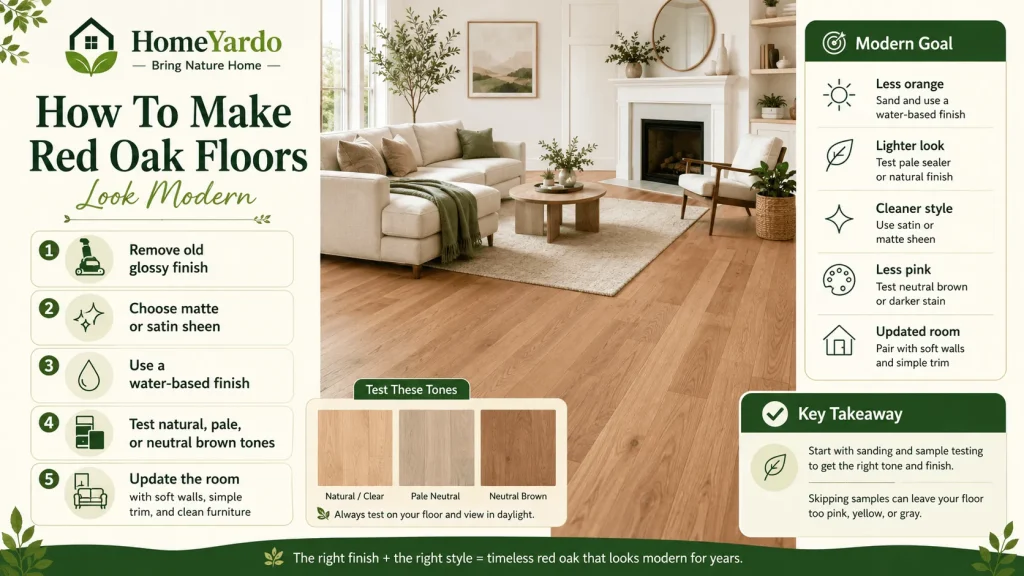
The old glossy finish can be removed from red oak to make it look modern, and the new color is suitable for the room. Many red oak floors are not out of style due to the species. They may appear dated due to the orange amber finish, heavy gloss or any surrounding decor.
A matte or satin sheen is more current than high gloss. A water-based finish will help to keep the wood cleaner and less amber. Neutral brown, natural, pale or carefully tested whitewashed finishes can help to tone down the red.
The room design is also important. Red oak can be updated with simple trim, clean furniture lines, soft white walls, and new rugs to make it look fresh without changing its species.
| Modern Goal | Best Red Oak Choice |
|---|---|
| Less orange | Sand and use a water-based finish |
| Lighter look | Test pale sealer or natural finish |
| Cleaner style | Use satin or matte sheen |
| Less pink | Test neutral brown or darker stain |
| Updated room | Pair with soft walls and simple trim |
A modern red oak project should begin with sanding and sample testing. Skipping samples is the easiest way to end up with a floor that looks too pink, yellow, or gray.
How To Make Red Oak Look Like White Oak
Red oak can be toned down and neutralized, but should not be expected to be exactly like white oak. There is a difference between the grain and the undertone.
White oak is tighter and has a cooler beige, brown or olive tone. Red oak is more grainy and has warmer pink, salmon or reddish colors. A finish will help to mask those differences, but not completely.
For a closer approach to a white oak style, try pale sealers, water-based finishes, soft neutral stains and perhaps bleaching. Medium and dark stains can also help mask the difference between red oak and white oak.
Don’t plant red oak in close proximity to white oak without a transitional plan. The difference can be seen, particularly if light stained. Matching the species is generally a better option than forcing two oak species to look alike when extending floors into another room.
Bleaching Red Oak Floors
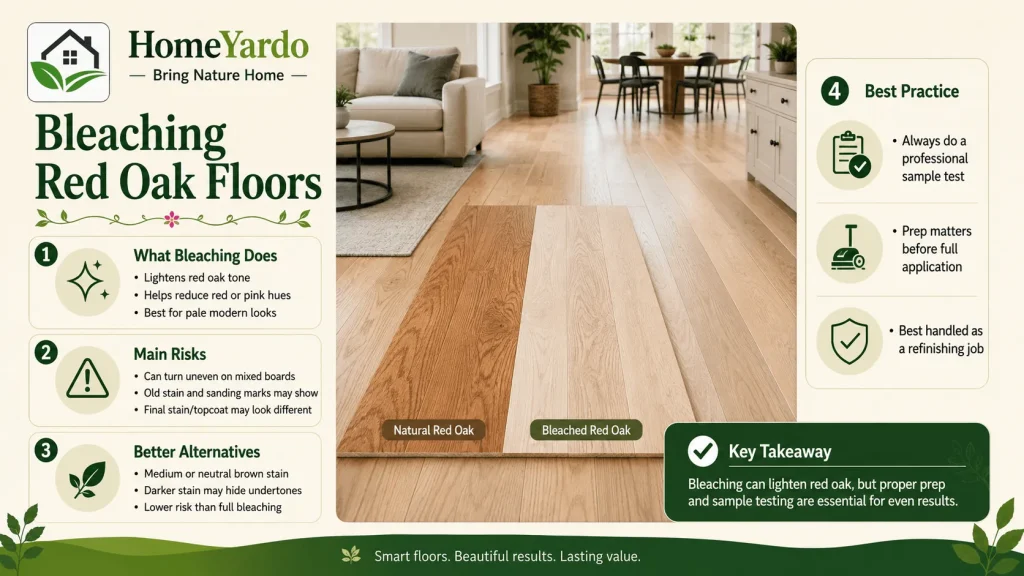
Red oak can be used to add red or pink hues and to lighten the tone of the finish. This is a more advanced stain than basic stains and must be treated with care.
If the floor has mixed boards, old stains, sanding marks or varying absorption levels, bleach may cause an uneven color. It may also impact the appearance of the final stain or topcoat.
Not all bleaching is required. A medium brown, neutral brown or darker stain might be a better choice in terms of the risk of the undertone problem. It is important to have a professional sample test done for pale modern projects before full application.
Those homeowners who wish to bleach red oak floors or make bleached red oak floors should consider it a professional refinishing job. It can help to lighten red oak floors, but may not work perfectly if not prepared properly.
Best Finish For Red Oak Floors
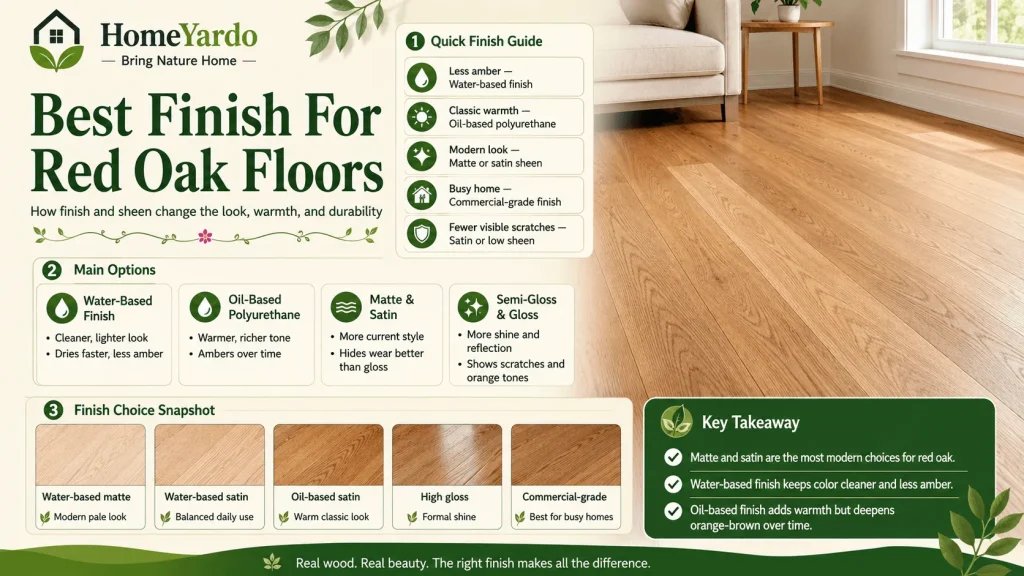
The appearance and protection are affected by finish choice. Depending on the finish system, the same red oak floor can be golden, amber, pale, soft brown or orange.
Sheen also matters. Satin or matte finish tends to be more current and conceals wear better than gloss.
| Finish Goal | Best Direction |
|---|---|
| Less amber | Water-based finish |
| Classic warmth | Oil-based polyurethane |
| Modern look | Matte or satin sheen |
| Busy home | Durable commercial-grade finish |
| Fewer visible scratches | Satin or low sheen |
Water-Based Finish
When a lighter, cleaner or more modern finish is desired, a water-based finish may be more desirable. Typically contains less amber than oil-based polyurethane.
It works well on natural, pale, neutral and matte red oak floors. It is also likely to dry more quickly and may not smell as much, depending on the product.
There is still work to be done in terms of good sanding and preparation. Pink tones and inadequate stain testing will not always be covered with a water-based finish.
Oil-Based Polyurethane
Red oak can be made to look warmer and richer with oil-based polyurethane. Can work well in classic houses and with darker wood colors.
The disadvantage is that they are prone to ambering. Yellow, orange, golden or red colours may darken over time with an oil-based finish. This can be a good option in a warm old-fashioned house but it is seldom a good choice for a light, contemporary style.
Color goal, traffic, cure time and long-term ambering should all be considered in the selection of red oak polyurethane. Oil-based polyurethane can be long-lasting, but it can cause red oak to turn to a warmer orange-brown over time.
Matte, Satin, Semi-Gloss, And Gloss
Matte finish gives a softer, modern look. It will minimize shine and can help to make the floor more casual. Very matte finishes can have smudges or look flat in some houses, so samples are helpful.
Satin is a common choice of finish for red oak. It provides a dim light without being too bright and is suitable for most households. It’s also more tolerant in the presence of a lot of people than high gloss.
Semi-gloss and gloss produce more reflection. They will reveal scratches, dust and amber colors more easily, particularly on older red oak floors.
| Finish Choice | Best For | Watch Out For |
|---|---|---|
| Water-based matte | Modern pale look | Needs strong prep |
| Water-based satin | Balanced daily use | Still shows natural undertone |
| Oil-based satin | Warm classic look | Amber’s overtime |
| High gloss | Formal shine | Shows scratches and orange tones |
| Commercial-grade finish | Busy homes | Higher cost |
Red Oak Vs White Oak Flooring
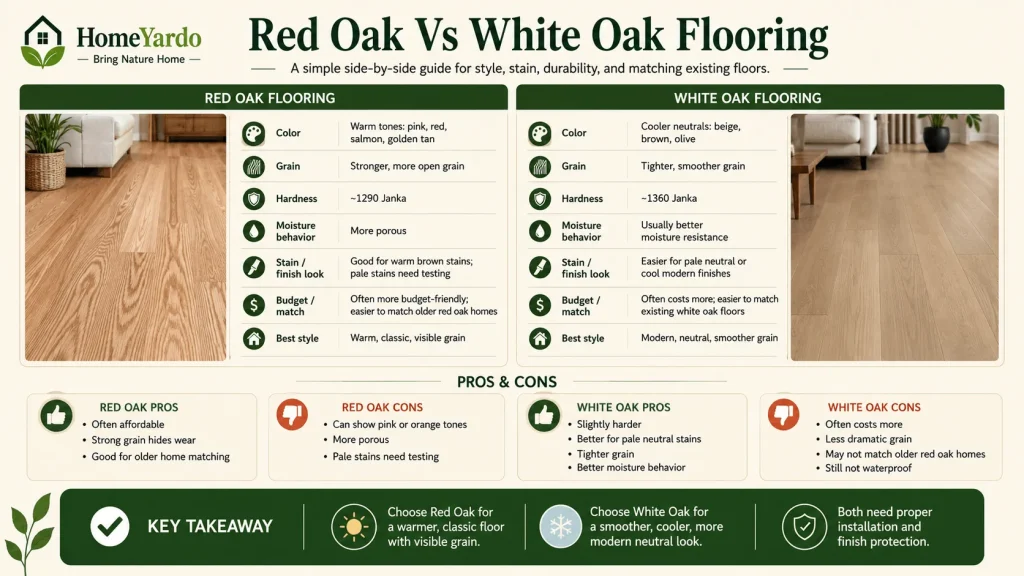
Both red oak and white oak are good hardwood flooring options. The choice will vary based on style preferences, budget, room requirements, stain color, and existing oak flooring.
The red oak is warmer, more open grained and in some cases more readily available for older home matches. White oak is slightly harder, tighter-grained and typically easier to work for pale neutral or cool modern finishes.
When selecting new floors, replacing old floors, or coordinating adjacent rooms, consider a white oak vs red oak comparison.
Key Differences And Factors To Keep In Mind
The primary distinctions include color, grain, hardness, water properties, stain properties, price and matching. Both woods are not waterproof and both require good installation and finish protection.
| Factor | Red Oak | White Oak |
|---|---|---|
| Color | Pink, red, salmon, golden, warm tan | Beige, brown, olive, cooler neutral |
| Grain | Stronger and more open | Tighter and smoother |
| Hardness | Around 1290 Janka | Around 1360 Janka |
| Water behavior | More porous | Usually, better moisture resistance |
| Light stains | Can pull pink | Easier for pale neutral looks |
| Cost | Often budget-friendly, but it varies | Often higher, but it varies |
| Best style | Warm, classic, visible grain | Modern, neutral, smoother grain |
| Existing floor match | Easier when the home already has red oak | Easier when the home already has white oak |
For a warm, classic, grain-rich floor, red oak is often a good fit. For a smoother, cooler, pale modern floor, white oak may be easier to finish.
Red Oak Vs White Oak Flooring Pros And Cons
The pros and cons become clearer when the two species are compared by final goals and room style.
| Red Oak Pros | Red Oak Cons |
|---|---|
| Red Oak Pros | Red Oak Cons |
| Often affordable | Can show pink or orange tones |
| Strong grain hides wear | More porous than white oak |
| Takes many brown stains well | Pale stains need testing |
| Good for matching older homes | Not ideal for cool white oak looks |
For light neutral finishes, white oak is usually easier. For visible grain, warmer color, and older home matching, red oak is often easier.
| White Oak Pros | White Oak Cons |
|---|---|
| Slightly harder | Often costs more |
| Better for pale neutral stains | Less dramatic grain |
| Tighter grain | May not match older red oak homes |
| Better moisture behavior | Still not waterproof |
Red Oak Vs Other Hardwood Flooring
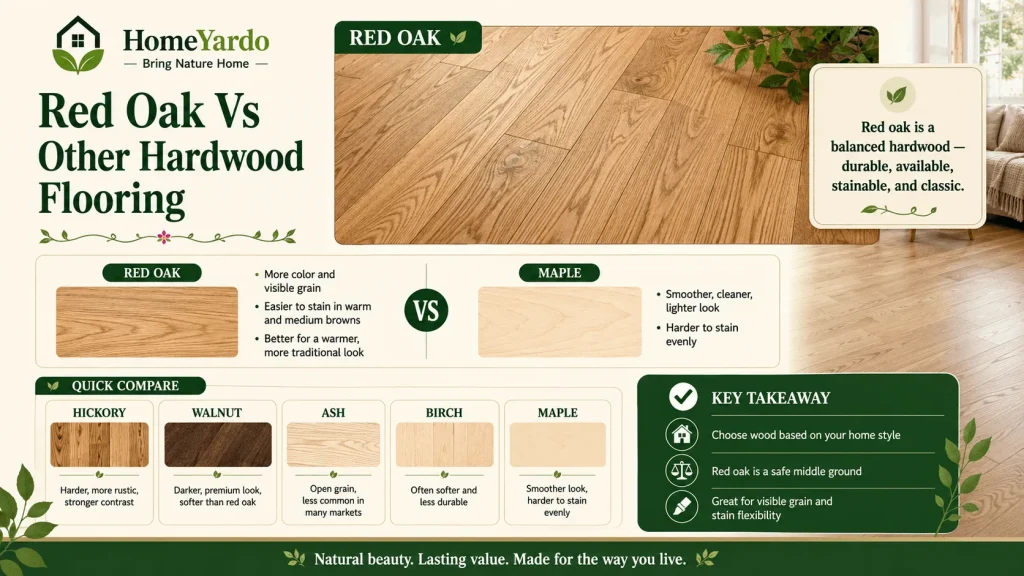
Red oak is a well-balanced hardwood. It is not the toughest wood, the smoothest wood, nor the darkest wood, but it is a durable, available, stainable and classic wood.
Other hardwoods might be more appropriate for certain purposes. Maple has a smoother appearance. Hickory is harder and rustic. Walnut provides a dark, rich look and is easier to work with. In some cases, birch can be cheaper, but it is not as durable.
Red Oak Vs Maple Flooring
Red oak is more colored and has better grain. Maple has a smoother, cleaner appearance.
Red oak can be more easily stained in warm and medium brown. Maple may be more difficult to stain evenly because it has a tighter grain and can exhibit blotching if not prepped properly.
Red oak may be a better choice for a more traditional floor that will give off a warmer tone. If you’re looking for a cleaner, lighter and smoother floor, consider maple.
Red Oak Vs Hickory, Walnut, Ash, And Birch
The various hardwoods result in varying looks and performance. Many buyers fall somewhere in the middle when choosing a red oak, as it is not as hard as hickory or as soft as walnut, and it has a good amount of color variation.
| Flooring Type | Compared With Red Oak |
|---|---|
| Hickory | Harder, more rustic, stronger color contrast |
| Walnut | Darker, premium look, softer than red oak |
| Ash | Open grain is less common in many markets |
| Birch | Often softer and less durable |
| Maple | Smoother look, harder to stain evenly |
Choose the wood based on the home’s style. Red oak is a safe middle ground when the goal is real hardwood, visible grain, and broad stain flexibility.
Red Oak Flooring Vs Laminate Vs Vinyl
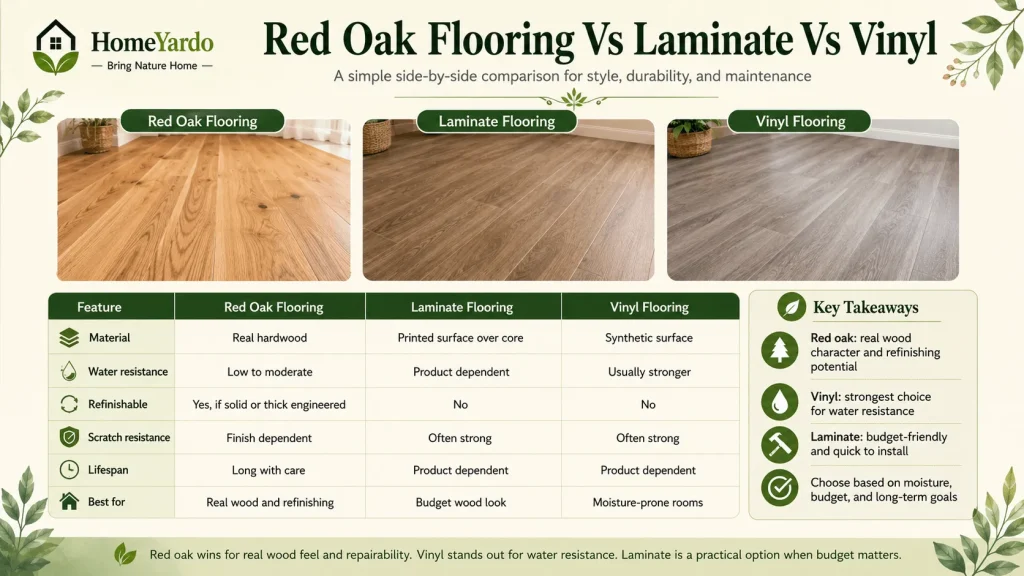
Red oak, laminate, and vinyl serve different needs. Red oak is a real hardwood and can often be refinished. Laminate and vinyl are manufactured floors that may offer stronger water resistance or lower maintenance.
| Feature | Red Oak Flooring | Laminate Flooring | Vinyl Flooring |
|---|---|---|---|
| Material | Real hardwood | Printed surface over core | Synthetic surface |
| Water resistance | Low to moderate | Product dependent | Usually stronger |
| Refinishable | Yes, if solid or thick engineered | No | No |
| Scratch resistance | Finish dependent | Often strong | Often strong |
| Lifespan | Long with care | Product dependent | Product dependent |
| Best for | Real wood and refinishing | Budget wood look | Moisture-prone rooms |
Red oak wins for real wood character, refinishing, repairability, and long-term hardwood feel. Vinyl wins for water resistance. Laminate can win when budget and fast installation matter more than refinishing. For concrete areas where hardwood is not practical, epoxy resin flooring can be a better option because it creates a sealed surface over prepared concrete.
Where Red Oak Flooring Works Best?

Red oak performs best in dry interior rooms with normal traffic. It can also work in kitchens if spills are wiped quickly and the finish is maintained.
Bathrooms and wet basements are poor choices because standing water can damage hardwood.
| Room | Fit For Red Oak | Notes |
|---|---|---|
| Living room | Strong fit | Handles normal traffic |
| Bedroom | Strong fit | Warm and comfortable |
| Hallway | Strong fit | Use runners in heavy traffic |
| Stairs | Strong fit | Classic hardwood choice |
| Dining room | Strong fit | Use chair pads |
| Kitchen | Possible | Wipe spills quickly |
| Basement | Engineered only if approved | Avoid unapproved solid wood |
| Bathroom | Poor fit | Standing water risk |
The best results come from matching the floor type to the room. Solid red oak is better for dry above-grade spaces. Engineered red oak may be better where added stability is needed, if the product is approved. For outdoor surface planning, the porch vs patio guide can help compare spaces where wood flooring is not the right material choice
Red Oak Flooring For Pets, Kids, And Busy Homes

Red oak can work well in homes with pets, children, and regular traffic. Its strong grain helps minor marks blend into the floor pattern.
It is not scratch-proof. Pet nails, dragged chairs, grit, and heavy furniture can still leave marks. A durable finish, satin or matte sheen, rugs, and felt pads can reduce visible wear.
Use this protection checklist for daily wear:
- Trim pet nails
- Use runners in the halls
- Add felt pads under chairs
- Clean the grit near the doors
- Choose satin or matte finish
- Avoid dragging furniture
Dirt acts like sandpaper when walked across a hardwood floor. Entry mats and runners help protect the busiest paths.
Red Oak Flooring Cost
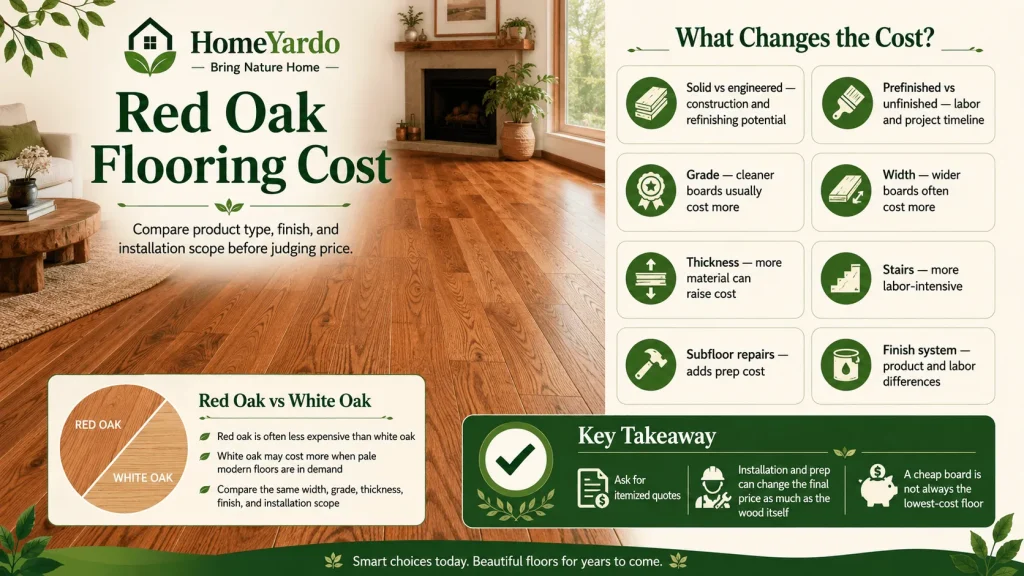
Cost depends on product type, grade, width, thickness, finish, and labor. A simple prefinished product can cost less than a custom site-finished floor with sanding, stain testing, stairs, and subfloor repairs.
Solid versus engineered also affects pricing. Cleaner grades, wider boards, thicker materials, custom stains, and premium finishes can raise the total.
Installation can change the final number as much as the wood itself. Demolition, disposal, subfloor leveling, moisture prep, transitions, stairs, and trim work should be included in the quote.
A good red oak flooring cost comparison should look at the same construction, grade, width, finish, and installation scope. A cheap board is not always the lower-cost floor after prep, warranty limits, or replacement risk are considered.
White And Red Oak Flooring Cost
Red oak is often less expensive than white oak, but pricing changes by region, supplier, grade, plank width, finish, brand, and demand. White oak may cost more when modern pale floors are in high demand.
Labor is usually similar when the floor type and installation method are the same. A fair price comparison should use the same width, grade, thickness, finish, and installation scope.
| Cost Factor | Why Does It Change Price |
|---|---|
| Solid vs engineered | Different construction and refinishing potential |
| Prefinished vs unfinished | Different labor and timeline |
| Grade | Cleaner boards usually cost more |
| Width | Wider boards often cost more |
| Thickness | More material can increase the price |
| Stairs | More labor-intensive |
| Subfloor repairs | Adds prep cost |
| Finish system | Product and labor differences |
Ask for itemized quotes. A low material price can become expensive if the floor needs major prep, custom color work, or difficult stair installation.
Red Oak Flooring Installation Basics

Good installation protects the floor from future movement, gaps, squeaks, and moisture problems. The product must match the room, subfloor, and installation method.
Important basics include acclimation, moisture testing, subfloor flatness, expansion gaps, proper fasteners or adhesive, and following the manufacturer’s instructions. Transitions, vents, trim, and stair nosing should be planned before installation starts.
Nail-down installation is common for many solid hardwood floors. Glue down or floating methods may be used for some engineered products if approved by the manufacturer.
Questions to ask an installer:
- Is this floor approved for this room?
- Is the subfloor dry and flat enough?
- Is the floor solid or engineered?
- How long should the flooring acclimate?
- What finishing system will be used?
- How will stain samples be tested?
- What is the cure time for rugs and furniture?
- What moisture readings were taken?
- Is the warranty valid for this room and subfloor?
- What indoor humidity range is recommended?
- What cleaning products are allowed by the manufacturer?
These questions help prevent problems before the boards are installed or finished.
Refinishing Red Oak Floors
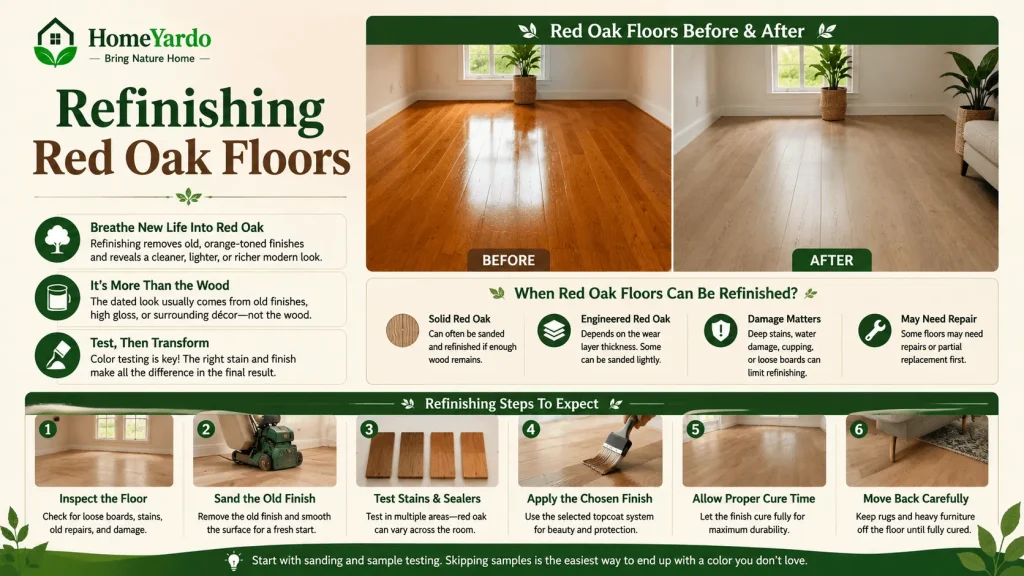
Refinish red oak floors can make old floors look cleaner, lighter, darker, or more current. Many orange-looking red oak floors can be improved because the dated look often comes from an old finish, not the wood itself.
The final result depends on floor thickness, sanding quality, stain testing, and finish choice. Homeowners planning to refinish red oak floors should expect color testing before the full floor is coated.
When Red Oak Floors Can Be Refinished?
Solid red oak can often be sanded and refinished if enough wood remains above the tongue and groove. A professional can check the floor before sanding.
Engineered red oak depends on wear layer thickness. Some engineered floors can be lightly sanded. Others cannot be refinished safely.
Deep pet stains, severe cupping, water damage, loose boards, and previous heavy sanding can limit refinishing options. In some cases, repair or replacement may be needed in damaged areas.
Refinished Red Oak Floors Before And After
Before and after examples are useful because old red oak can change dramatically. A glossy orange floor may become soft brown, natural satin, pale neutral, or rich dark walnut after sanding and finishing.
The biggest visual changes usually come from removing the amber finish, lowering the sheen, and testing a better stain direction. Water-based finishes can help reduce the old yellow or orange effect.
Photos should show the same room before and after, ideally in similar lighting. That makes the color change easier to understand.
Refinishing Steps To Mention
Refinishing usually begins with inspecting the floor. Loose boards, stains, old repairs, and damaged areas should be checked before sanding.
The old finish is sanded off, then stain and sealer samples are tested. Samples should be tested in more than one area because red oak can vary across a room.
Once the color is approved, the floor receives the chosen topcoat system. The floor also needs a proper cure time. Rugs and heavy furniture should not go back too soon because the finish may still be hardening.
Cleaning And Maintenance
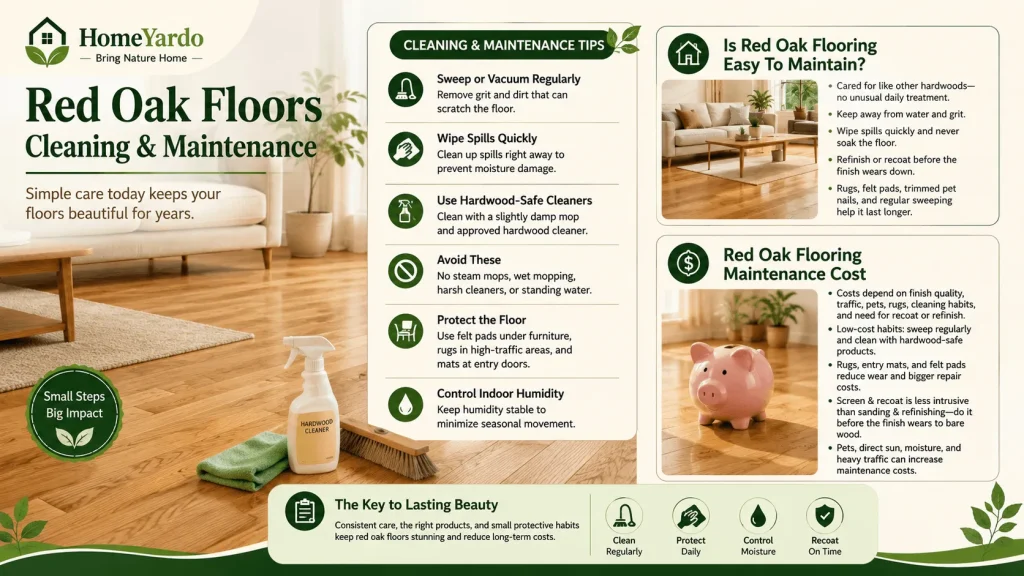
When moisture and grit are controlled, red oak is easy to care for. Little actions have a big impact.
Regularly sweep or vacuum to get rid of grit. Wipe spills quickly. If necessary, use a hardwood safe cleaner and use a slightly damp mop. Do not use steam mops, wet mopping, harsh cleaners, or standing water.
Place felt pads under furniture, use rugs in areas of heavy use, and place mats near entry doors. Maintain a stable humidity indoors to minimize seasonal movement.
Is Red Oak Flooring Easy To Maintain?
Red oak can be cared for like other hardwoods. It requires no unusual daily treatment, but should be kept away from water and grit.
A good finish will help to protect the surface, but the finish requires care. Wipe up spills promptly, do not soak up the floor and re-varnish the floor before it goes bare.
Prefinished coatings can aid with everyday wear, but they will not eliminate the requirement for regular cleaning. Rugs, felt pads, trimmed pet nails and regular sweeping help to keep the floor looking better for longer in busy homes.
Red Oak Flooring Maintenance Cost
The cost of maintenance will vary with the quality of finish applied, the amount of foot traffic, the frequency of cleaning, pets, rugs, and whether the floor requires recoating or a complete refinish.
Low cost habits include routine sweeping and cleaning with hardwood safe products. Rugs, entry mats and felt pads can help to slow down larger work and decrease overall wear and tear.
Generally, a screen and recoat will be less intrusive than sanding and refinishing, but should be completed before the finish is worn down to bare wood. Maintenance costs can be higher due to pets, direct sun, moisture, and heavy traffic.
Red Oak Flooring Lifespan
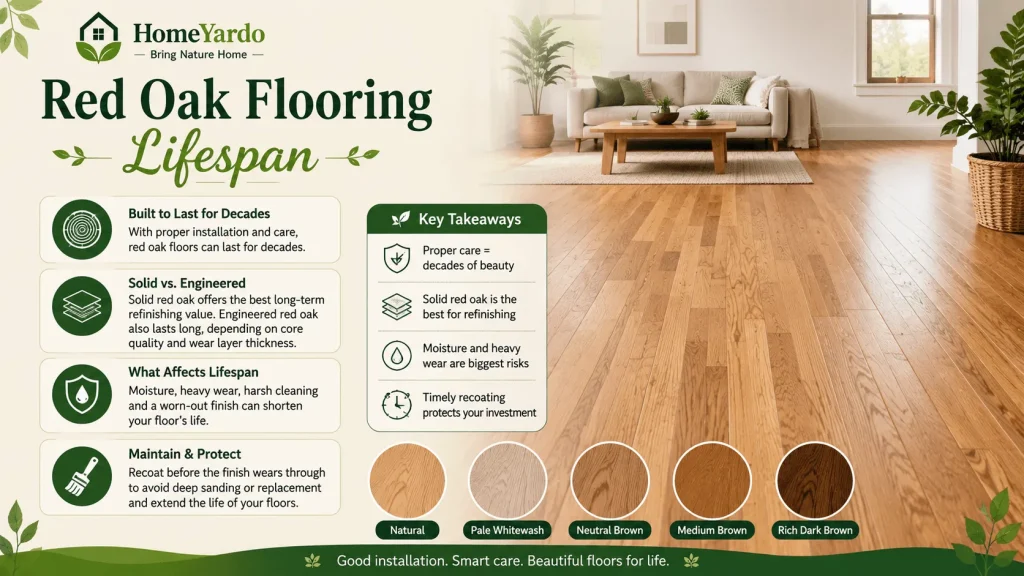
With proper installation and maintenance, it can last for decades. The best long-term refinishing value is solid red oak, with the most usable wood.
Engineered red oak also has a long lifespan; however, the durability is determined by the quality of the core wood, thickness of the wear layer, strength of the finish wood, and environmental conditions.
Floors can be shortened in life due to moisture damage, heavy wear, poor cleaning and worn through finish. If the finish is not completely worn off, recoating before it is worn off can prevent deeper sanding or replacement.
Is Red Oak Flooring Outdated Or Still In Style?

While red oak is still in vogue, certain vintage finishes are not. Oak with a glossy orange-red color can be found in many modern homes.
A satin or matte finish will create a softer and cleaner look to the floor. The natural water-based finishes, neutral brown stains, light tested sealers and dark walnut stains can all refresh the appearance.
The room also has an impact on the floor. Warmth can be enhanced or muted by using wall color, trim, cabinet color, rugs, lighting and furniture.
The old orange gloss is typically the old component. Even without the right finish and room design, red oak can still appear to be current.
Sustainability And Availability

Red oak is a common hardwood tree in North America and is frequently used as a hardwood flooring material in homes. It can be easier to source, repair, and match than other species that are not as common.
Responsible sourcing of domestic hardwood can also help to decrease the need for exotic wood imports. Sustainability-conscious consumers should inquire with suppliers about forestry practices, local sourcing, and certification, if applicable.
Red oak is also found in the forests of eastern North America, which is also why it is often easier to come by than some hardwoods that are imported or less available.
Don’t take all red oak products for granted. It’s not just the supplier; harvesting methods, production and delivery are also important.
Red oak can range from region to region in growth rate, grade and milling quality. Northern red oak may be referred to by some suppliers as being tighter in growth rings or more uniform in colour. If appearance matching is important, request information on the origin of the wood, the grade of the wood and whether sample boards are from the same order as the order.
Red Oak Flooring Buying Checklist

Having a buying checklist helps you to prevent costly errors. The selection of red oak should be based on the room, product type, finish objective and long-term maintenance requirements.
Sample colors in the home before approving. Check them near windows, under lamps, next to cabinets and close to trim.
- Room checked
- Moisture risk checked
- Solid or engineered wood is chosen
- Prefinished or unfinished chosen
- Grade selected
- Width selected
- Stain samples tested
- Finish sheen selected
- Warranty reviewed
- Installer questions prepared
- Maintenance plan understood
A good red oak purchase is not only about picking a pretty board. It is about matching the floor to the room, subfloor, light, style, and care routine. For a faster-curing garage floor finish, polyaspartic garage floor coating may be worth comparing with epoxy instead of using hardwood in a garage.
Red Oak Flooring Reviews: What Homeowners Usually Like And Dislike

Durability, grain, stain flexibility and value are common aspects that are reviewed. Many homeowners appreciate that it is also like real hardwood and can be refinished rather than replaced.
Common complaints tend to be for color, not strength. If the wrong stain or finish is used, red oak can appear too pink, orange, yellow, or old.
| Homeowners Usually Like | Homeowners May Dislike |
|---|---|
| Real hardwood feel | Pink or orange undertones |
| Strong visible grain | Pale stains can be tricky |
| Refinish potential | Not waterproof |
| Good hardwood value | Needs humidity control |
| Works in older homes | Glossy finishes can look dated |
Do not rely only on online reviews or product photos. Order samples, check the warranty, and view the floor color in the home before buying.
Common Mistakes To Avoid
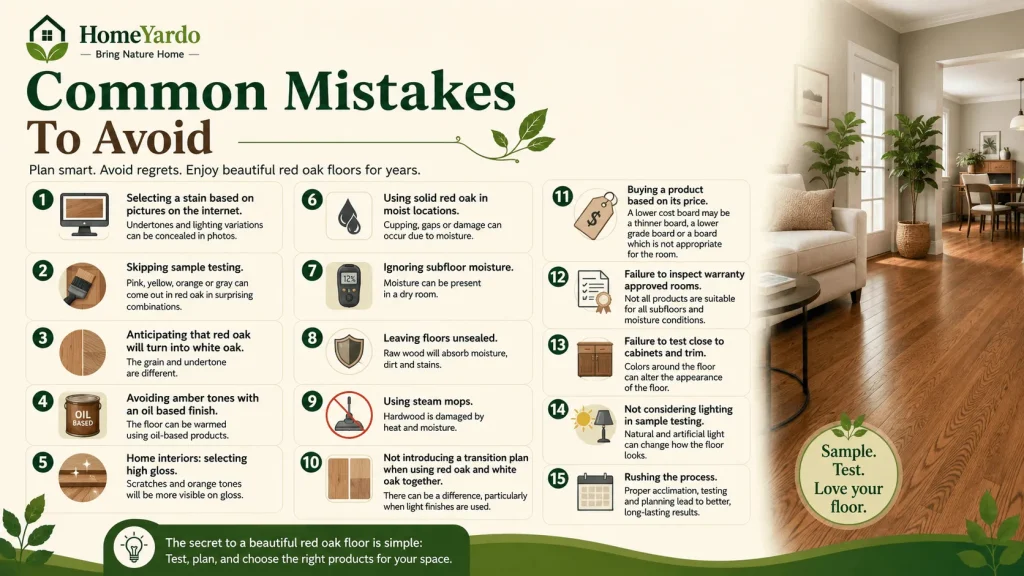
A lot of problems begin before installation or finishing. Planning reduces color disappointment, movement and early wear.
- Selecting a stain based on pictures on the internet. Undertones and lighting variations can be concealed in photos.
- Skipping sample testing. Pink, yellow, orange or gray can come out in red oak in surprising combinations.
- Anticipating that red oak will turn into white oak. The grain and undertone are different.
- Avoiding amber tones with an oil based finish. The floor can be warmed using oil-based products.
- Home interiors: selecting high gloss. Scratches and orange tones will be more visible on gloss.
- Using solid red oak in moist locations. Cupping, gaps or damage can occur due to moisture.
- Ignoring subfloor moisture. Moisture can be present in a dry room.
- Leaving floors unsealed. Raw wood will absorb moisture, dirt and stains.
- Using steam mops. Hardwood is damaged by heat and moisture.
- Not introducing a transition plan when using red oak and white oak together. There can be a difference, particularly when light finishes are used.
- Buying a product based on its price. A lower cost board may be a thinner board, a lower grade board or a board which is not appropriate for the room.
- Failure to inspect warranty approved rooms. Not all products are suitable for all subfloors and moisture conditions.
- Failure to test close to cabinets and trim. Colors around the floor can alter the appearance of the floor.
Final Decision: Who Should Choose Red Oak Flooring?

The red oak is an excellent option for homeowners who wish to have real hardwood, visible grain, good durability and refinishing potential. It also comes in handy when comparing existing floors in older homes.
It might not be ideal for those looking for a waterproof floor, a very smooth grain, or a promise of a pale white oak appearance.
| Choose Red Oak If | Consider Another Option If |
|---|---|
| You want real hardwood | You need waterproof flooring |
| You like visible grain | You want a very smooth grain |
| You want a refinishable floor | You want no maintenance |
| You are updating older oak floors | You need a guaranteed pale white oak look |
| You want a good hardwood value | You are flooring a wet bathroom |
Red oak is best used when it is an integral component of the design plan, rather than being completely covered by the finish.
Conclusion
It’s still a good option due to its durability, availability, refinishability, and versatility of style. May appear classic, warm, rustic or updated based on stain, finish, plank width, sheen and room design.
The most successful outcome occurs when the type of product is selected, stain samples are tested, when necessary, the red oak is compared with the white oak, and clear installation questions are asked prior to work.
Pick red oak if the real hard wood, visible grain and long-term refinishing is more important than waterproof performance or a perfectly pale white oak appearance.
FAQ’s
Yes, it is durable enough for normal residential traffic when it is installed and finished properly. Its visible grain helps small dents and scratches blend into the pattern better than smoother woods. It still needs basic protection from grit, water, dragged furniture, and pet nail damage.
The cost depends on the product type, grade, width, thickness, finish, and local labor. Solid red oak, engineered red oak, prefinished boards, and unfinished boards can all be priced differently. Stairs, subfloor repairs, custom staining, and site finishing can raise the total project cost.
Neither red oak nor white oak is better for every home. Red oak has warmer undertones, stronger grain, and often works well in older homes. White oak is slightly harder, tighter-grained, and usually easier for pale neutral or cooler modern finishes.
Red oak is often more affordable, easier to match in older homes, and has a stronger grain that helps hide small wear. Its downside is that it can show pink, red, or orange undertones. White oak is slightly harder and usually better for pale stains, but it may cost more and has a quieter grain.
Solid flooring can last for decades with proper installation, cleaning, and finish care. It can often be sanded and refinished more than once if enough wood remains. Lifespan depends on traffic level, moisture control, finish quality, product thickness, and maintenance habits.
Medium brown, neutral brown, natural water-based, and darker walnut stains usually work well on red oak floors. These tones can balance the wood’s warm undertone without making the floor look too pink or orange. Pale gray, whitewashed, and very light stains need careful testing before full application.
Yes, many solid red oak floors can be sanded and refinished when the surface becomes worn. Engineered red oak may also be refinished if the wear layer is thick enough. A flooring professional should check thickness, damage, stains, and previous sanding before the work starts.
Clean floors by sweeping or vacuuming grit regularly and wiping spills quickly. Use a hardwood-safe cleaner with a lightly damp mop when needed. Avoid steam mops, wet mopping, harsh cleaners, and standing water because moisture can damage real wood.
It can work well in homes with pets when it has a durable finish and basic protection. Its grain helps minor scratches blend in, but it is not scratch-proof. Trim pet nails, clean grit often, use rugs in busy paths, and choose satin or matte finish for better everyday wear.
Red oak can scratch like any hardwood, but it does not usually look fragile in normal home use. Its strong grain helps small scratches and dents appear less obvious. Furniture pads, rugs, regular cleaning, and a low sheen finish can reduce visible wear over time.
Red oak floors can look modern after sanding away the old glossy amber finish and choosing a cleaner color direction. Water-based finish, satin or matte sheen, neutral brown stain, and carefully tested pale sealers can update the look. Wall color, trim, rugs, lighting, and furniture also affect how current the floor feels.
References
- https://www.hullforest.com/blog/red-oak-flooring-durable-classic-and-rapidly-renewable/
- https://www.houzz.com/photos/query/red-oak-flooring
- https://twentyandoak.com/faq/common-questions/red-oak-vs-white-oak-flooring-5-key-differences
- https://chrissymarieblog.com/red-oak-flooring
- https://lumberliquidators.com/collections/red-oak-hardwood
- https://www.fourgenerationsoneroof.com/refinishing-red-oak-floors-lighter/
- https://wideplankflooring.com/blog/red-oak-vs-white-oak-6-key-differences/
- https://www.miragefloors.com/en-us/red-oak-hardwood-flooring/