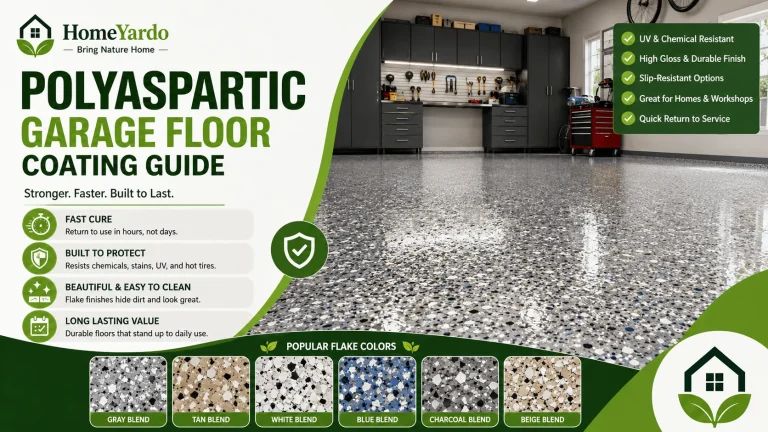
Resin Epoxy Flooring: Complete Guide to Types, Cost, Pros, Cons & Uses

Epoxy resin flooring is a hard floor system comprised of epoxy resin and hardener. It is typically applied to existing concrete surfaces to provide a smooth, durable, and sealed surface.
Applicable in garages, kitchen, basement, workshop, warehouse, showroom, hospital, factory and commercial buildings. The final surface will be glossy, matte, colored, flake textured, quartz-filled, metallic or heavy duty, depending on the system utilized.
The name of the product isn’t the only criterion for a good epoxy floor. Performance is dependent on the concrete condition, moisture content, surface preparation, coating thickness, finish type, topcoat, and cure time. Epoxy can be used to seal concrete to prevent stains, spills, abrasion, and daily wear when installed properly. If not installed properly it can peel, bubble, crack or be slippery in wet areas.
This guide describes how it works, what types of spaces it fits, what factors influence cost and what errors can lead to failure.
TLDR: Is Epoxy Flooring A Good Choice?
It is ideal for dry, solid concrete floors that require a smooth, stain, moisture, chemical, impact and wear-resistant surface.
It is suitable for use in garages, homes, kitchens, warehouses, showrooms, workshops, hospitals, and factories. When choosing the system for heavy traffic, wet areas or commercial areas, slab condition, traffic levels, slip risk, chemical exposure, coating thickness and quality of the topcoat are all factors to consider.
What Is Epoxy Resin Flooring?

It is a protective and decorative floor system consisting of two primary components: epoxy resin and hardener. These components, when combined, form a hard surface that adheres to concrete.
The cured floor can provide a seamless floor without grout lines. This makes it easier to clean than many jointed flooring materials. It can also enhance the look of plain concrete by adding color, shine, texture, flakes, quartz or metallic effects.
Epoxy is one of the types of resin flooring. Polyurethane, MMA, polyaspartic, vinyl ester and hybrid systems are also used in resin flooring. Epoxy is a popular option due to its ability to adhere to concrete and provide a durable surface.
Epoxy can be applied as a thin coat for lighter applications or as a thicker flooring system for heavier applications. Epoxy can be applied to a garage floor, home kitchen, warehouse or factory floor, but these areas do not require the same system.
For a home floor that is used for average foot traffic, a light duty epoxy floor coating might be appropriate. If forklifts, tools, chemicals or heavy loads are involved, heavy duty epoxy mortar/screed may be required.
What Is Epoxy Flooring Made Of?

It is composed of a collection of materials that function as a floor system. The resin and hardener make up the bulk of the floor, and the primer, pigments, broadcast material, flakes, aggregates and topcoats are what give the floor its performance.
Primer, epoxy coating and clear topcoat are the only materials allowed for a simple floor. A more challenging floor can feature crack repair, moisture control, broadcast quartz, anti-slip texture, moisture vapor barrier primer, and high-performance finish coat.
Basic Epoxy Flooring Materials List
Epoxy flooring materials can be components of a typical epoxy system. The final selection of material will depend on the type of flooring, the application and the product system.
| Material | Purpose |
|---|---|
| Epoxy resin | The main liquid base that forms the floor coating |
| Hardener | Reacts with resin and allows the floor to cure |
| Primer | Helps epoxy bond to prepared concrete |
| Pigment | Adds solid color to the floor |
| Decorative flakes | Adds texture, color variation, and grip |
| Quartz or aggregate | Adds strength, texture, and slip resistance |
| Broadcast material | Adds texture, color, grip, or strength depending on flakes, quartz, or aggregate |
| Anti-slip additive | Improves grip in wet or high-traffic areas |
| Topcoat | Protects the surface from wear, stains, and chemicals |
| UV stable topcoat | Helps protect the finish in spaces with stronger sunlight exposure |
| Moisture barrier | Helps manage moisture coming from the slab |
The basic material list describes what is in the floor, but a proper system is dependent on the site. The topcoat of a garage floor might be different from that of a commercial kitchen or factory floor.
Why Material Quality Matters
The bonding, gloss, color stability, chemical resistance, scratch resistance and life are influenced by the material quality. A low-grade coating will appear attractive initially, but will soon wear away with tires, carts, tools or chemical spills.
A garage, where tires, sand and cleaning chemicals are frequently present, may cause a low-grade topcoat to dull more quickly. The incorrect material could also fail even if applied neatly. A smooth decorative coating may not be able to withstand forklift traffic. A thin paint-like product might not be enough to protect a workshop floor.
The selection of good flooring is a system decision. All these factors are combined with resin quality, type of hardener, primer, thickness, topcoat, texture, exposure to the sun and concrete preparation.
How Epoxy Flooring Works

It is used to join a cured resin system to prepared concrete. Coating must have a clean, solid, dry and properly profiled surface to ensure adhesion.
Typically, a full system will include a concrete substrate, surface profile, primer, epoxy base coat, broadcast layer/decorative layer, topcoat and cure time. The different layers all contribute to the appearance, cleanliness and performance of the completed floor.
Concrete Substrate
Most epoxy floors are installed over concrete. It should have the ability to support the coating. Peeling or delamination can occur in weak, dusty, oily, sealed or crumbling concrete.
The concrete is typically cleaned, ground, shot blasted, cracked, and moisture checked before epoxy is applied. Old sealers and weak coatings should be removed. Active cracks must be treated prior to coating.
Epoxy does not adhere to an unprofiled concrete surface if water beads on the old surface. A quality substrate will help epoxy last. Even a good coating product can fail due to a poor substrate.
Primer And Base Coat
The epoxy system is bonded to concrete with the use of a primer. It can also seal pores and minimize pinholes in porous concrete. In certain instances, moisture, porosity or heavy traffic may require special priming of some slabs.
The base coat is the primary color of the epoxy surface. It can be rolled, poured or spread using a squeegee, depending on the system. Base coat may be clear, coloured, self leveling or aggregate filled.
Mixing is important at this point. The right ratio of resin to hardener is required and it must be applied in time.
Decorative Layer And Topcoat
The decorative layer determines the appearance and feel of the floor. These can be in a variety of colors or can be made of quartz, metallic pigments, solid color, aggregate, or terrazzo blends.
Topcoat is used to prevent the floor from being damaged by scratches, stains, chemicals, UV rays and daily use. It may also alter the shine of the finish from shiny to matte or satin. Abrasion resistance or UV resistance may require polyurethane or polyaspartic topcoats.
The topcoat may contain an anti-slip texture in wet areas. For spaces that are exposed to the sun, a more UV-stable finish may be required. In industrial areas, the topcoat should be similar to the traffic, chemicals and cleaning processes.
Types Of Epoxy Flooring
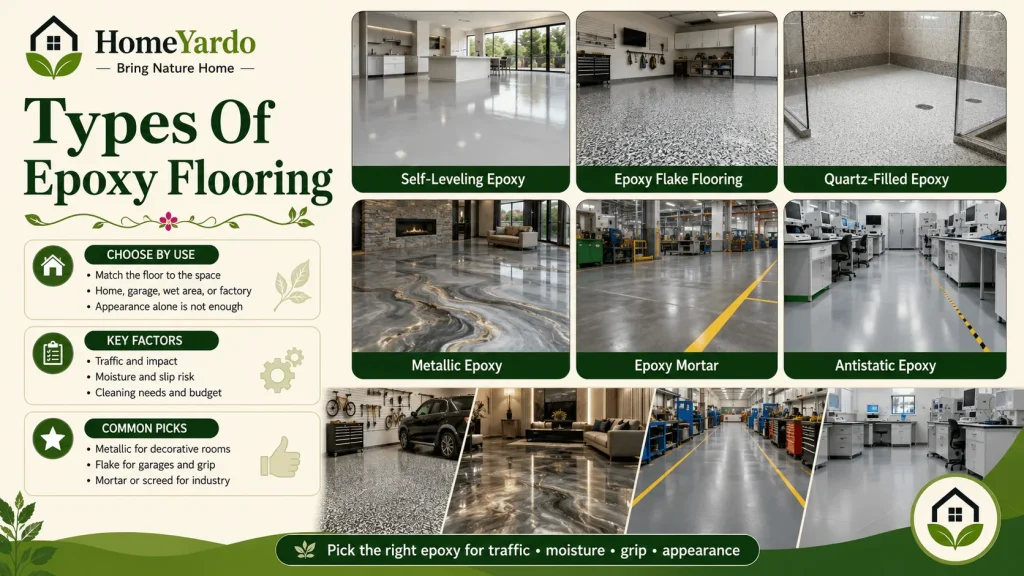
Various epoxy coating systems are appropriate for various spaces. The right kind depends on the traffic, moisture, slip hazards, appearance, chemical exposure, cleaning requirements and budget.
The type of epoxy should be selected not by appearance. The floor should reflect the actual use of the space. A smooth or metallic finish may be required for a decorative home floor. A flake texture and a durable topcoat might be necessary for a garage. Epoxy mortar or screed may be required in a factory for impact and abrasion resistance.
| Type | Best Use | Finish | Main Strength | Limitation |
|---|---|---|---|---|
| Self-leveling epoxy | Showrooms, kitchens, and commercial floors | Smooth and even | Clean look and easy cleaning | Can be slippery if too smooth |
| Epoxy flake flooring | Garages, basements, shops | Textured decorative flakes | Hides marks and improves grip | The finish depends on the topcoat quality |
| Quartz-filled epoxy | Kitchens, hospitals, wet areas | Textured quartz surface | Hygiene and slip resistance | Can feel rougher underfoot |
| Metallic epoxy | Homes, salons, showrooms | Marble-like decorative finish | Strong visual appeal | Harder to repair invisibly |
| Epoxy mortar | Workshops, factories, damaged concrete | Dense, heavy-duty surface | High impact resistance | Higher cost and more labor |
| Epoxy screed | Industrial floors | Thick protective layer | Strong abrasion resistance | Not needed for light use |
| Antistatic epoxy | Labs, electronics, data rooms | Smooth or textured | Helps manage static discharge | Needs specialist installation |
| Epoxy aggregate or gravelled flooring | Walkways, lobbies, textured areas | Decorative textured surface | Slip resistance and design | Cleaning depends on texture |
| Epoxy terrazzo | Airports, malls, schools, public spaces | Polished aggregate finish | Long service life and premium look | Higher installation cost |
Self-Leveling Epoxy

Self leveling epoxy forms a smooth, level surface over concrete. It is used in showrooms, commercial interiors, kitchens, offices and some residential interiors.
It can be used to cover minor surface irregularities but cannot be used to correct poor concrete or slab movement. Slab remains to be cleaned, repaired, moisture checked and surface prepared.
Smooth self-leveling finish is clean and modern. If there is a lot of water or activity, additional texture may be required to minimize slip hazards.
Epoxy Flake Flooring

Epoxy flake flooring is a floor that is finished with decorative vinyl flakes or chips that are broadcast into the epoxy base coat. The flakes provide color variation, texture and a more forgiving surface.
It is widely used in garages, basements, schools, shops, utility rooms, workshops, and more. A flake pattern will conceal small dirt marks, tire marks, dust, and daily wear and tear better than a solid color floor.
The quality of the topcoat is important. A light topcoat will wear out and flake off too soon. A textured topcoat can enhance traction in wet garage entryways.
Quartz Filled Epoxy

It is a coating that incorporates colored or natural quartz aggregate that is broadcast through the coating. It forms a textured surface that offers improved traction over a smooth coating, and it is durable.
It is commonly found in commercial kitchens, hospitals, locker rooms, restrooms, wet zones and places that require hygiene and slip resistance. Under proper sealing, the surface can be cleaned easily.
The texture should be similar to the space. Excessive texture can lead to dirt retention, and insufficient texture can cause slippery conditions in wet areas.
Metallic Epoxy
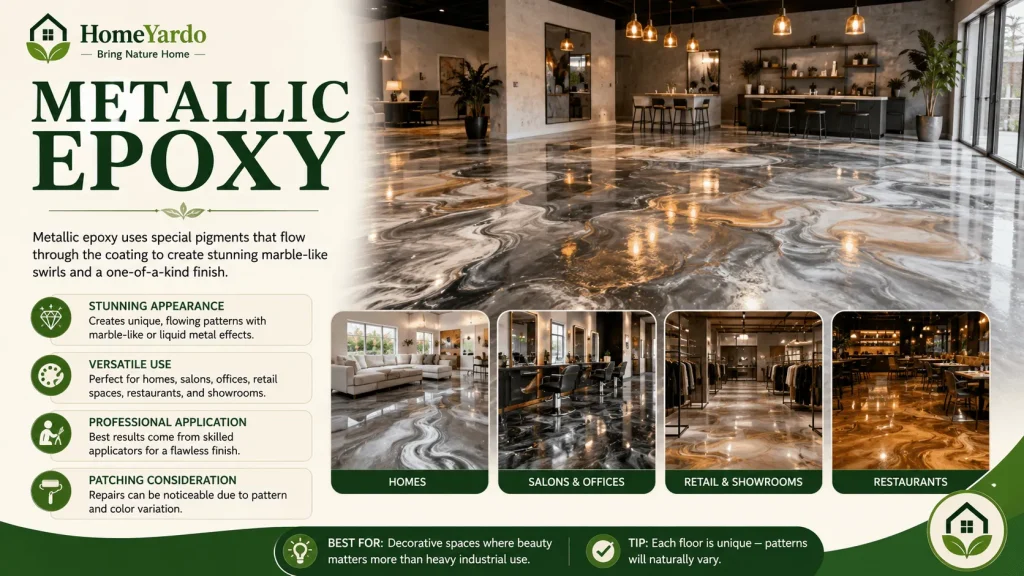
Metallic epoxy is a type of epoxy that incorporates pigments that flow through the coating to give a marble-like or flowing appearance. It is employed in homes, salons, offices, retail, restaurants and showrooms.
It is the appearance that is the main attraction. The colors may vary from floor to floor due to their dispersion during application. It can be used to provide a decorative finish if applied by a competent applicator.
Patching is more difficult to achieve invisibly with metallic floors. This is better suited for situations where the appearance of the repair is more important than heavy industrial use, as there may be a difference in color or pattern.
Epoxy Mortar Flooring

Epoxy mortar flooring is a mixture of epoxy and graded aggregate to produce a dense and strong surface. One of the more challenging epoxy systems.
It is used in factories, workshops, loading areas, repair areas and floors that are subject to impact from tools, machines or heavy equipment. It can also be used to repair broken concrete before a finish is applied.
It typically will cost more than a thin coating, as it requires more material, labor and preparation.
Epoxy Screed

Epoxy screed is a thicker system that is used for tough industrial floors. It is employed in areas where the forces of abrasion, loading, chemical attack and heavy use are greater than usual.
May be appropriate for warehouses, production floors, food processing areas, workshops and mechanical areas. It adds more depth and strength to a simple coating.
This is not typically required for light residential floors. It can increase expenses with no actual gain if it’s used in the wrong location.
Antistatic Epoxy

Antistatic epoxy is used to control electrostatic discharge. It is applied in laboratories, electronics manufacturing, data rooms, clean rooms and other areas where static can cause damage to equipment or pose safety concerns.
This type of floor should be carefully specified. The entire system (primer, conductive layers, and topcoat) must be installed and tested properly.
It is a specialist product and not a general decoration coating.
Epoxy Aggregate Or Gravelled Flooring
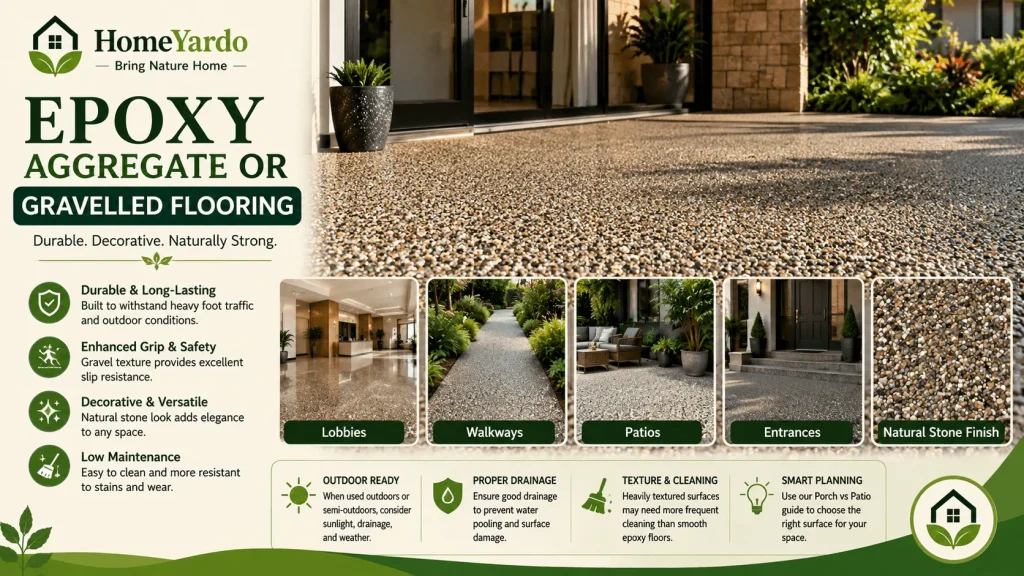
Epoxy aggregate or gravelled flooring is a type of flooring that features a stone, gravel, or aggregate surface. Can be decorative and functional.
Can be installed in lobbies, walkways, patios, entrances and where additional grip is desired. When used outdoors or semi-outdoors, care is required as the floor system can be influenced by sunlight, drainage and weather.
Texture affects cleaning. A surface with a lot of texturing can require more frequent maintenance than an epoxy floor. For outdoor planning, the porch vs patio guide can help decide which surface area needs coating, flooring, or another finish.
Epoxy Terrazzo Flooring
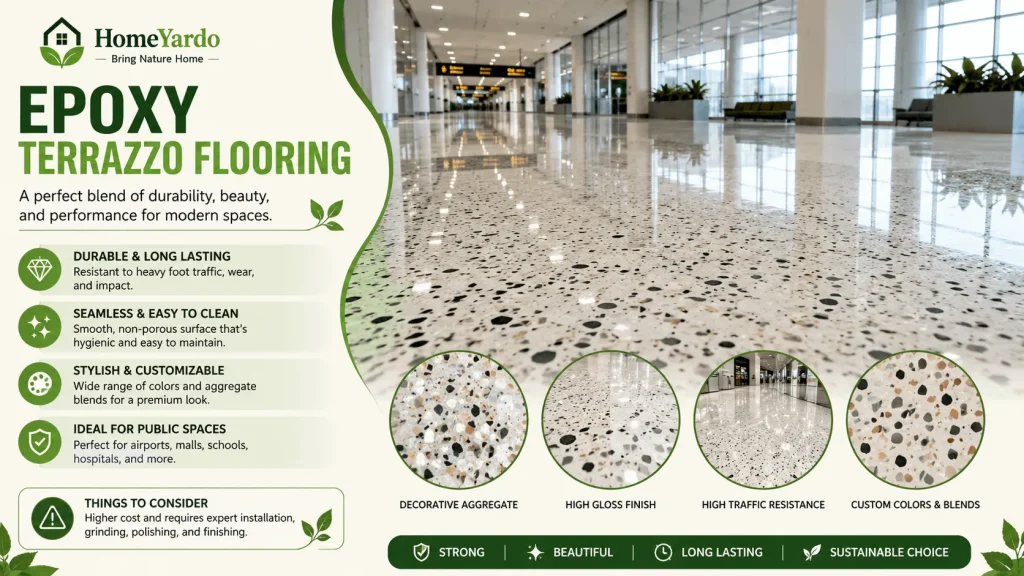
Epoxy terrazzo is a combination of epoxy resin and decorative aggregate which is ground and polished. It is widely used in airports, malls, schools, hospitals, museums and other large public areas.
It provides a high-quality commercial appearance and offers the option to use different colors and blends of aggregates. It can also be used effectively in high-traffic public areas if installed and maintained properly.
The downside is the price. Requires expert installation, grinding, polishing and finishing.
Epoxy Floor Finishes And Design Options

Epoxy floors can be plain, decorative, textured, glossy, matte or very personalized. The finish should be consistent with the desired look and function of the space.
Visible scratches, glare, risk of slipping and cleaning are affected by finish choice. High shine floors can appear bright in a showroom. The matte finish might be a bit understated in a house. A flake or quartz finish might be more suitable in a garage or wet space.
Matte, Satin, And Glossy Finishes
Matte epoxy has a more subdued appearance and will give a lower level of glare. It can be used in homes, offices and any area with a high shine floor that would be too reflective. May require a proper overcoat for cleaning.
Satin finish is in between matte and gloss. It provides a clean look without too much shine. It can be used in commercial and residential areas.
Epoxy is shiny and provides a smooth surface. It’s widely used in showrooms, garages, and decor. Smooth, shiny floors can be more prone to a wet slip hazard and have a higher risk of dust and scratches than textured systems.
Colored And Decorative Epoxy Resin Flooring
Colored epoxy flooring can be produced in solid colors, mixed flakes, quartz textures, metallic designs, terrazzo finishes or limited designs in 3D. Provides greater design flexibility than bare concrete.
Showrooms, clinics, retail stores and offices can all have decorative epoxy flooring that matches the brand colors. It can also be used in homes, salons, reception areas and garage designs.
Performance shouldn’t be forgotten in design. Even a gorgeous floor requires the right grip, topcoat, thickness and substrate preparation.
Anti-Slip Texture Options
Epoxy is smooth but can be slippery when wet. Texture provides traction on garages, kitchens, workshops, ramps, entrances and wet commercial areas.
These include options with quartz broadcast, decorative flakes, grit additives, aggregate, and textured topcoats that will help prevent slipping. More texture means better grip and can make cleaning slower.
The best finish is a combination of grip, cleanliness and appearance.
Epoxy Floor Coating Vs Paint Vs Full Resin Flooring

Epoxy paint, epoxy floor coating and full resin flooring are frequently mistaken for one another. The difference is important because the thickness, durability and best use of each option is different.
Generally, epoxy paint is thinner and more decorative. Epoxy floor coating is more durable and is intended to be used to preserve concrete. Full epoxy is a complete system that can consist of primer, base coat, broadcast material and topcoat.
| Option | Thickness | Durability | Best Use | Main Limitation |
|---|---|---|---|---|
| Epoxy paint | Thin | Light duty | Budget refresh and low traffic areas | Wears faster |
| Epoxy floor coating | Medium | Moderate to strong | Garages, storage rooms, workshops | Needs good prep |
| Full resin flooring | Medium to thick | Strong | Commercial and high-use floors | Higher cost |
| Epoxy mortar | Thick | Very strong | Factories and damaged concrete | More labor |
| Epoxy screed | Thick | Heavy duty | Industrial floors | Not needed for light spaces |
100 Percent Solids Vs Water-Based Vs One-Part Coatings

Epoxy coating labels can also create confusion. Some products are stronger professional systems, while others are light refresh products. Product datasheets should always be checked before choosing.
| Product Type | Strength | Best Use | Limitation |
|---|---|---|---|
| 100 percent solids epoxy | Thick and durable | Garages, commercial floors, industrial floors | Short working time and skills needed |
| Water-based two-part epoxy | Easier application and lower odor | Light to medium-duty spaces | Usually thinner |
| One part epoxy-infused paint | Simple and low cost | Light refresh projects | Limited durability |
A 100 percent solids epoxy can build a stronger surface, but it usually needs more skill and faster work. A water-based two-part epoxy may be easier in lighter spaces. One part epoxy-infused paint is usually the least durable option.
When Epoxy Paint Is Enough
Epoxy paint might be sufficient for a surface that doesn’t see much use, but is more about looks than protection. Can freshen up a concrete floor and provide color at a reduced price.
Do not use for floors subject to vehicle tires, oil, heavy tools, carts, moisture and frequent cleaning. May wear faster than a correct coating.
Epoxy paint should be used only when the floor is not required to have heavy duty performance.
When Epoxy Floor Coating Is Better
Epoxy coating floor is more suitable for concrete that requires a higher level of protection. It can be used in garages, workshops, storage rooms, utility rooms and light commercial buildings.
A good coating generally adheres better, lasts longer and will protect the slab more than paint. It can also help with flakes, color and texture and provide a clear topcoat.
The lifespan is still controlled by surface preparation. A good coating will not adhere if applied over oil, dust, damp concrete, old and weak coating, or smooth and sealed concrete.
When Full Resin Flooring Is Needed
Full resin flooring is more suitable for heavy duty applications. For commercial kitchens, warehouses, factories, hospitals, laboratories, mechanical rooms, and heavy traffic facilities, a thin coating is not enough.
A complete system can consist of a primer, a body coat, broadcast quartz, anti-slip texture, and a performance topcoat. It can be made with the properties of hygiene, chemical resistance, impact resistance, static resistance, and slip resistance.
This type of system is more expensive but may be more appropriate in situations where failure of the floor would pose a safety, cleaning, or business issue.
Epoxy Flooring Benefits

It is popular because it can provide protection for concrete and enhance its aesthetics simultaneously. The best results seem to be obtained when the appropriate system is used in the appropriate space.
Garage, warehouse, hospital and home kitchen all require different performances. The ideal floor is the one that meets traffic requirements, cleaning requirements, moisture requirements, safety requirements, and design requirements.
Durability And Impact Resistance
When properly applied, epoxy can withstand foot traffic, vehicles, carts, tools, and daily usage. Thicker coatings (e.g., epoxy mortar or screed) can be used more intensively than thin coatings.
Epoxy can be used in garages to prevent concrete from being damaged by tire marks, oil spots and surface wear. It is capable of being repeatedly cleaned and used by customers in commercial spaces. Heavy duty systems might be required for machinery, carts, forklifts and impacts in industrial areas.
The durability is related to surface preparation, traffic, system thickness, topcoat quality and proper curing.
Chemical, Oil, And Stain Resistance
Epoxy will outlast bare concrete with respect to many common spills, oils, cleaners and chemicals. This is useful in garages, workshops, laboratories, kitchens, warehouses and manufacturing areas.
The resistance level is determined by the product system. Not all epoxy agents are resistant to all chemicals, so the epoxy that is used should be compatible with the anticipated exposure. Special topcoats or other resin systems may be required for some chemicals.
Oil and stains can be absorbed by bare concrete. Epoxy is used to seal the surface and facilitate cleaning.
Easy Cleaning And Hygiene
Epoxy forms a continuous surface without any grout joints. This can make sweeping and mopping less challenging in many rooms than it would be on tile.
A sealed epoxy floor will help to minimize dusting of concrete. It can also be easier to clean up spills in garages, kitchens, clinics, schools, warehouses and commercial buildings.
Typical cleaning involves sweeping, damp mopping and a mild cleaner. The topcoat can last less than its expected life if harsh acids or abrasive dirt are used.
Design Flexibility
It may be plain, colored, flake, quartz filled, metallic, matte, glossy or terrazzo style. This offers additional design options to concrete.
Flake epoxy can be used in a garage for a clean and functional surface. High gloss or metallic epoxy can be used in a showroom. Quartz texture can be used in a hospital or kitchen for grip & hygiene.
Design should be functional. A pleasingly attractive floor that isn’t slip-resistant, durable or resistant to chemicals may not function properly.
Advantages And Disadvantages Of Epoxy Flooring

It offers great advantages, but is not suitable for every floor. When the concrete is dry, solid, and prepared properly, it can provide a seamless, durable, easy-to-clean surface.
The majority of epoxy problems occur when the slab is wet, the preparation is inadequate, the coating is too thin, or the inappropriate system is selected. Before installing, a balanced decision should be made, taking into account both sides.
| Advantages | Disadvantages |
|---|---|
| Creates a seamless surface with no grout joints | Needs careful surface preparation |
| Resists many stains, oils, and common spills | Can be slippery when wet if the finish is smooth |
| Helps protect concrete from wear and dusting | May yellow or fade in strong sunlight |
| Can be easier to clean than bare concrete or grout based tile | Repairs can be visible after patching |
| Offers many finish options, including matte, gloss, flakes, quartz, and metallic | Moisture from below the slab can cause peeling or bubbles |
| Can suit homes, garages, commercial spaces, and industrial floors | Needs curing time before full use |
| Can improve grip when flakes, quartz, grit, or textured topcoats are used | Poor mixing, weak primer, or rushed installation can shorten lifespan |
Slippery When Wet
Epoxy can be slippery when wet. This is important in kitchens, garages, entrances, ramps, bathrooms and industrial wet areas.
Texture can decrease the risk. Additives such as flakes, quartz, grit or textured topcoats can enhance grip.
The choice of slip resistance should be made prior to installation. It may be more difficult and less uniform to add grip later.
UV Yellowing And Sun Exposure
Certain epoxy floors have a tendency to turn yellow, fade or chalk in intense sunlight. This is more likely to happen in outdoor spaces or rooms that are exposed directly to the sun.
Some spaces may require a UV stable topcoat. Otherwise, a polyurethane, polyaspartic or another resin system might be a better finish.
Typically, epoxy is the most effective type of concrete floor system for indoor use. Care must be taken in selecting products for use outdoors.
Repair Challenges
There can be small epoxy repairs that are visible. It can be difficult to match color, gloss, texture or flake pattern after the original floor has cured.
In some cases, a damaged tile may be able to be replaced in one piece. Sanding, patching, recoating or blending with the surrounding floor is often required for epoxy repairs.
Patch differences can be more noticeable on metallic, flake and colored floors. While proper maintenance decreases the need for repairs, heavy impacts, dragging equipment or improper topcoat can still cause wear.
Moisture And Peeling Risk
Moisture is considered to be one of the primary reasons for the failure of epoxy floors. Water that is flowing from underneath the slab can work against the coating and cause bubbles, peeling or delamination.
Above surface moisture is not below surface vapour. If the coating is not damaged, spills on top can often be cleaned. The bond can be weakened from below by the rising of vapour through the concrete.
Damp concrete, inadequate cleaning, oil contamination, weak concrete or no primer can also decrease bonding. Do not use epoxy on an unprepared surface.
Where Epoxy Resin Works Best?

It can be used in several areas, but its type varies according to the space. Appearance and comfort may be required for a home floor. A garage should be resistant to tire and grip. The factory requires impact resistance and chemical resistance.
The optimal applications are where concrete surfaces require protection, surface cleaning is desired, or a smooth surface is beneficial. The following notes indicate the typical location of epoxy.
Epoxy Flooring For House
Epoxy can be used in-house if the finish is suitable for the space. It’s employed in basements, utility rooms, kitchens, hobby rooms, laundry rooms, garages, and modern interiors.
Solid color, matte, glossy, flake, or metallic epoxy residential flooring is all available options. Epoxy floor for house projects typically requires a combination of aesthetics, cleanability, comfort and slip resistance.
May not be suited for bedrooms or living rooms where soft flooring is desired. Texture should be taken into account in wet areas.
Epoxy Garage Floors
Garages is one of the most common areas where epoxy is found. Vehicles, oil, grease, hot tires, tire marks, tools, moisture, dust and regular cleaning should all be taken care of by the floor.
A good choice of garage flake epoxy is a strong textured topcoat. It hides marks better than a plain glossy coating and may help to increase grip.
The concrete should be well prepared. Garage epoxy can peel due to oil stains, dust, old paint, sealers, or moisture. For a full garage-specific process, the guide on how to epoxy a garage floor explains prep, flakes, topcoats, cure time, and common mistakes in more detail.
Epoxy Kitchen Floor
Seamless and easy to clean, epoxy kitchen floors can be useful. When properly sealed, they can withstand spills, grease and stains.
Self-leveling epoxy or decorative epoxy can be used for residential kitchens. Quartz texture or a slip resistant system is frequently required in commercial kitchens due to the frequent use of water, grease, and frequent cleaning.
The finish shouldn’t be too smooth. Kitchen floors require a combination of cleanability and traction.
Commercial Flooring Epoxy
Retail stores, showrooms, offices, schools, clinics, restaurants, salons and public buildings are all examples of commercial epoxy flooring applications. It can provide a clean look and help to preserve the integrity of the concrete surface from daily wear and tear.
A glossy decorative surface might be required for a showroom. Slip resistance and ease of cleaning may be required in a restaurant’s back area. Durability and ease of maintenance may be required in a school.
Epoxy should be selected for commercial spaces depending on the cleaning schedule, foot traffic, safety requirements and topcoat requirements.
Industrial Epoxy Flooring
Industrial flooring is utilized in factories, warehouses, workshops, mechanical rooms, production zones, chemical storage areas, loading zones, etc.
These floors could be subjected to forklifts, carts, machinery, tools, chemicals, impacts, and repeated cleaning. Sometimes, thin coatings will not suffice. Mortar, screed, quartz or specialist systems may be required.
Industrial epoxy should be selected according to the volume of traffic, chemical exposure, impact hazard, moisture and safety requirements.
Flooring Epoxy Resin Cost

The cost is dependent on the system, surface, design, thickness, labour and location. Coating is significantly cheaper than metallic epoxy, quartz epoxy, terrazzo, mortar or industrial screed.
The lowest price is not necessarily the best. Failure can occur early if the process is not properly prepared, the material is not strong enough or the coating is too thin, or the curing is rushed.
| Epoxy Type | Cost Level | Why Price Changes |
|---|---|---|
| Basic epoxy coating | Lower | Less material and simpler finish |
| Flake epoxy | Medium | Decorative flakes and clear topcoat |
| Self-leveling epoxy | Medium to high | Smoother finish and more material |
| Metallic epoxy | High | Decorative skill and special pigments |
| Quartz epoxy | Medium to high | Broadcast aggregate and durable topcoat |
| Epoxy terrazzo | High | Skilled installation, grinding, and polishing |
| Epoxy mortar or screed | High | Heavy-duty material and labor |
| Moisture barrier system | Added cost | Needed when slab moisture is a risk |
Estimated Price Range
Pricing changes by country, city, floor condition, coating grade, installer, design, and project size. If the article targets Pakistan, the following ranges can be used as general planning estimates.
| Epoxy System | Estimated Price Range | Notes |
|---|---|---|
| Basic epoxy coating | PKR 150 to 250 per sq ft | Depends on floor condition and coating grade |
| Self-leveling epoxy | PKR 200 to 500 per sq ft | More material and surface prep |
| Flake or metallic epoxy | PKR 400 to 850 per sq ft | Decorative finish raises cost |
| Heavy-duty industrial epoxy | PKR 500 to 1,000 per sq ft | Thicker system and stronger materials |
Prices vary by city, floor condition, brand, design, thickness, labor, moisture control, and project size. Floors needing grinding, crack repair, old coating removal, or moisture barrier work usually cost more.
What Affects The Price?
The price will vary according to area size, condition of the concrete, crack repair, grinding, primer, number of coats, thickness of coating, finish design, topcoat, labor and local market.
Preparing a clean, new concrete slab could be less expensive. If your floor has oil, cracks, old coating, water or is uneven, it will require more work. Surface moisture testing, floor grinding, shutdown time for commercial floors and topcoat type may also vary the cost.
Usually, decorative finishes are more expensive than the basic solid coating. Metallic, quartz, terrazzo and custom colors require more skill and material.
Cheap Epoxy Vs Professional Epoxy
While there is an appeal in using the cheaper epoxy, it may not last long if it is not applied properly. Peeling may occur if grinding, primer, or crack repair is skipped or if moisture checks are not performed.
Professional epoxy typically will be more expensive since the installer will prepare the concrete and select the appropriate epoxy system. Prior to quoting, good work is done to explain slab preparation.
If the floor still looks great in the space, then a low price is only useful option.
Long Term Value
When it helps to minimize staining, concrete dust, cleaning problems and surface wear, epoxy can be a long term value. A well-designed system can help keep a garage, warehouse, kitchen, or showroom cleaner.
Value is dependent on the correct match. If there is a thin coating in a heavy-duty area, it could require replacement sooner. A good system can last longer and minimize the need for repairs.
In many instances, the top layer can be recoated at the appropriate time to prolong the life of a floor without the need to completely remove it.
Epoxy Flooring Installation Process

Epoxy installation begins prior to the opening of the coating. The concrete has to be inspected, cleaned, repaired, profiled and prepared for bonding.
Small garage kits are available for do-it-yourself projects, but large floors, damp slabs, commercial projects, decorative finishes and industrial projects typically require professional installation. Product datasheets should be used to direct mixing, application, cure time and safety.
Surface Preparation
Surface preparation is the most important step. The concrete should be cleaned, swept, degreased, washed, dried, repaired and profiled.
Oil, grease, dust, old paint, and sealers can cause bonding problems. Cracks and holes should be repaired prior to coating.
A surface profile can be achieved by grinding, shot blasting or etching. The right approach is dependent on the floor and product system.
Garage Floor Preparation Checklist
Surface preparation prior to epoxy can be one of the most critical factors for the success of garage epoxy. A clean, open concrete profile will provide the coating with a better bonding opportunity.
| Step | What To Check |
|---|---|
| Clear the garage | Remove stored items and protect nearby walls |
| Sweep and vacuum | Remove dust, grit, and loose debris |
| Degrease oil stains | Scrub oil, grease, tire marks, and lubricants |
| Wash the floor | Pressure wash or rinse thoroughly |
| Profile the concrete | Grind, shot blast, or etch if required |
| Porosity test | Water should absorb instead of bead |
| Moisture test | Check for condensation before coating |
| Dry time | Let the slab dry fully before applying epoxy |
This checklist is not intended to replace product instructions. It is a simple pre-treatment for the understanding of the floor’s needs before coating. Before coating a garage floor, check garage door weather stripping because poor sealing can let rain, dust, and outside air reach the concrete near the door.
Moisture Testing
Moisture testing can be used to determine if moisture is emanating from the slab. A moisture movement can occur in the floor even if the surface is dry.
Failure to remove moisture can cause the epoxy to bubble, peel, blister or delaminate. Extra attention should be given to basements, garages, older slabs and ground level concrete.
A plastic sheet test can be used to provide basic condensation risk information to a homeowner; however, professional testing may be required for commercial/industrial or high-risk slabs. Before installing the epoxy floor, a moisture barrier system might be required.
Mixing And Application
The resin and the hardener have to be mixed in the proper ratio. Inadequate mixing may result in soft spots, weak bonding, uneven cure or sticky areas.
Once mixed, epoxy will have a pot life and working time. Installer should pour, roll, squeegee or spread before it starts to thicken.
Back rolling may be used to smooth out the coating. Decorative flakes, quartz or pigment should be added at the appropriate time.
Temperature, Humidity, And Ventilation
Epoxy flow and cure are influenced by temperature and humidity. The coating may not work as intended if the space is too cold, too hot or too humid.
Ventilation is also an important factor when installing. Some products emit strong odors during curing and the work area should be used according to safety instructions on the product label. Product datasheets are the final reference.
Dust, water, foot traffic, pets, children and vehicles should be kept off the floor until the coating is applied.
Curing Time
The curing time is dependent on the product, thickness, temperature, humidity and ventilation. Vehicle traffic or chemical exposure may be delayed until after light foot traffic.
A floor can feel dry before it has been fully cured. If it’s used prematurely, it can leave tire marks, dents, stains or damage to the surface.
There may be different timeframes for light, heavy, vehicle use, and full chemical cure. When parking in a garage, additional time may be required before the vehicles can be parked.
Safety During Installation
The installation of epoxy should be done carefully. Depending on the product, gloves, eye protection, an appropriate mask or respirator, and ventilation might be required.
Children, pets and unprotected persons should not enter the work area until it is safe. Labels directions for mixing, application, cleanup, storage and cure time should be followed.
Any unused material and containers must be treated with care.
Why Epoxy Floors Fail
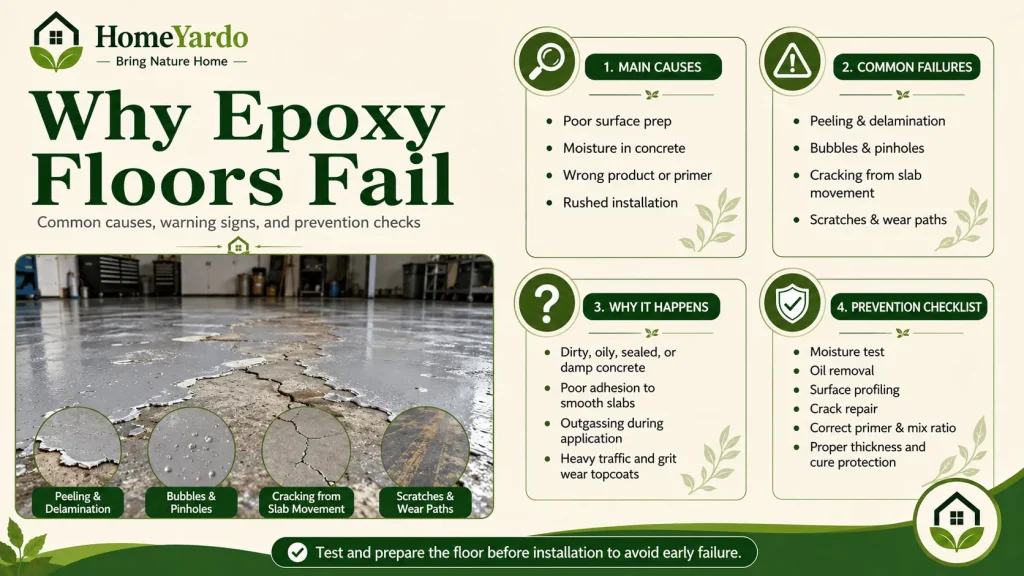
The majority of epoxy floor failures are associated with preparation, moisture, incorrect product selection or rushed installation. A strong coating will not work on poor quality, dirty, oily, sealed, or damp concrete.
By knowing the causes of failure, unnecessary costs and premature repairs can be prevented. It also assists in comparing installers or product systems
Peeling And Delamination
Peeling is caused by loss of adhesion between the epoxy and the concrete. This can be due to moisture vapour, oil contamination, dust, old sealer, weak previous coating, weak concrete, or poor surface profile.
Delamination may also occur in the absence of a primer when one is required. A layer that is placed on top of a smooth, sealed slab could not adhere to it.
Prior to the installation of the epoxy, the floor should be tested and prepared.
Bubbles And Pinholes
Avoid formation of bubbles and pinholes due to air or vapour leaving the concrete during application. This is sometimes referred to as outgassing.
The problem can be exacerbated by porous concrete, moisture, a lack of primer, rapid application or a change in temperature.
Bubbles can be minimized with the use of proper surface preparation, correct timing and primer.
Cracking
Epoxy is firm but it doesn’t prevent active movement in concrete. When the slab cracks under the coating, it may reveal itself through the coating.
The movement of joints and structural cracks requires proper treatment; crack repair before installation helps. Sealing cracks without addressing the underlying issue can result in recurring damage.
Flexible resins or joint detailing may be needed in some cases. Expansion joints should not be filled or coated over without a plan.
Scratches And Wear Paths
Epoxy can scratch or wear in high-traffic zones, especially if grit, sand, dragging metal, wheels, or heavy equipment are present.
The topcoat protects the floor, but it can wear off over time. Walk paths, tire lanes, and work zones may become dull before other areas.
Abrasion-resistant topcoats may be needed where carts, wheels, or grit are common. Regular cleaning and timely recoating help protect the finish.
Failure Prevention Checklist
A few checks before installation can prevent many common epoxy floor problems.
| Checkpoint | Failure: It Helps Prevent |
|---|---|
| Moisture test | Bubbles, peeling, delamination |
| Oil removal | Poor bonding |
| Surface profile | Coating lift and weak adhesion |
| Crack repair | Visible cracking and rough finish |
| Primer selection | Pinholes and weak bond |
| Correct mix ratio | Soft spots and cure problems |
| Right thickness | Premature wear |
| Cure protection | Tire marks and early damage |
Use this as a discussion checklist with the installer before work begins.
Epoxy Flooring Thickness And Materials

Thickness changes by system type. A thin coating is different from a slurry, mortar, or screed. Thicker systems usually handle more abuse, but thickness alone does not guarantee quality.
The floor must match the use case. A decorative home floor does not need the same build as a factory floor.
How Thick Is Epoxy Flooring?
Epoxy thickness can range from a thin coating to a much thicker heavy-duty system. Basic coatings are usually thinner and used for lighter protection.
Slurries, mortars, and screeds are thicker and used where traffic, impact, abrasion, or chemical exposure is stronger. Product specifications should guide the final thickness.
Site conditions also matter. A damp or weak slab can still fail under a thick coating if preparation is poor.
Coating, Slurry, and Mortar Thickness Ranges
The table below gives a simple way to understand flooring thickness categories. One mil equals one thousandth of an inch.
| System Type | Common Thickness Range | Best Use |
|---|---|---|
| Coating | 4 to 30 mils | Light to medium-duty floors |
| Slurry | 30 to 250 mils | Commercial and heavier traffic |
| Mortar | 125 to 250 plus mils | Industrial and high-abuse areas |
The exact specification should come from the product system and the floor condition. Thickness should solve a real performance need.
Best Thickness By Use Case
Homes and light-use spaces may only need a light to medium coating system if the concrete is in good condition. Garages often need a stronger coating or flake system with a durable topcoat.
Commercial spaces may need a slurry or thicker system because of daily traffic and cleaning. Warehouses, factories, workshops, and loading areas may need mortar or screed.
Wet, chemical, or high-impact areas need a system designed for those risks.
Why Thicker Is Not Always Better
A thicker system is not always the better choice. If the slab is damp, dirty, sealed, or weak, even a thick system can fail.
The right primer, surface preparation, topcoat, texture, and product chemistry matter as much as thickness. A well-chosen medium system may perform better than a thick but poorly matched one.
Thickness should solve a real floor problem, not just increase cost.
Is Epoxy Flooring Waterproof And Durable?

It can be water resistant and durable when installed correctly. It can protect the surface from spills, stains, oils, and many cleaning chemicals.
Waterproofing depends on the direction of moisture. Water on top of a sealed epoxy floor is different from vapour coming from below the concrete slab. Concrete cracks can also affect how well the floor resists water over time.
Water Resistance Vs Moisture Vapour
Epoxy can resist spills from above when the coating is intact. That makes it useful in garages, kitchens, basements, workshops, and commercial spaces.
Moisture vapour from below the slab is different. It can push against the coating and cause bubbles, peeling, or bond failure.
A damp slab may need moisture testing and a barrier system before epoxy is installed, especially in basements and ground-level concrete.
Durability In Homes
In homes, epoxy can handle foot traffic, furniture, spills, and routine cleaning. It can work well in kitchens, basements, utility rooms, hobby rooms, and garages.
Texture may be needed in wet areas. Softer flooring may feel better in bedrooms, playrooms, or living rooms.
A residential epoxy floor lasts longer when cleaned regularly and protected from dragging sharp objects. Furniture pads can also help reduce scratches.
Durability In Commercial And Industrial Areas
Commercial and industrial areas place more stress on epoxy floors. Carts, forklifts, chemicals, tools, wheels, impacts, and frequent cleaning can wear down weak systems.
A stronger topcoat, thicker build, quartz texture, mortar, or screed may be needed. Chemical exposure should be matched with the right resin system.
Durability comes from correct specification, not from the word epoxy alone.
Epoxy Vs Other Flooring Options

Epoxy is often compared with tile, bare concrete, polished concrete, polyurethane, resin flooring, and garage tiles. Each option has strengths and limits.
Epoxy is not always better than every flooring type. It is strongest where concrete protection, seamless cleaning, and chemical or stain resistance matter.
| Flooring Option | Main Strength | Main Limitation | Best Fit |
|---|---|---|---|
| Epoxy flooring | Seamless, durable, protective | Needs strong prep and cure time | Garages, commercial, and industrial concrete |
| Tile flooring | Familiar, hard, replaceable pieces | Grout needs cleaning | Kitchens, bathrooms, homes |
| Bare concrete | Low cost and simple | Dusts, stains, and absorbs oil | Temporary or low finish areas |
| Polished concrete | Modern and long-lasting | Less design flexibility than epoxy | Retail, homes, commercial spaces |
| Polyurethane flooring | Flexible and UV stable in many systems | May cost more in some applications | Sun-exposed or thermal movement areas |
| Vinyl flooring | Softer underfoot | Less heat and chemical resistance | Homes and light commercial spaces |
| Garage tiles | Easy to replace | Joints can trap dirt | DIY garage upgrades |
Epoxy Vs Tile Flooring

Epoxy is seamless, so it has no grout joints. That can make it easier to clean in garages, kitchens, workshops, and commercial areas.
Tile can be easier to repair in small sections because damaged tiles may be replaced individually. Epoxy repairs can show differences in color, gloss, or texture.
Tile may suit bathrooms, homes, and spaces where individual repair matters. Epoxy may suit concrete floors needing protection, stain resistance, hygiene, and a joint-free surface.
Epoxy Vs Concrete Floor

Bare concrete can dust, stain, absorb oil, and look unfinished. Epoxy seals the surface and adds color, gloss, texture, or decorative flakes.
Concrete alone may be cheaper, but it is less resistant to stains and spills. Epoxy improves cleanability and surface protection.
Epoxy does not fix weak concrete by itself. Cracks, dusting, oil contamination, and moisture problems should be handled before coating.
Epoxy Vs Polished Concrete

Polished concrete gives a hard, modern finish by grinding and polishing the slab. It keeps the natural concrete look and can last well in many spaces.
Epoxy gives more color, texture, chemical protection, and decorative control. It can also cover concrete with flakes, metallic pigments, or quartz.
Polished concrete may be better where a natural concrete look is preferred. Epoxy may be better where stain resistance, chemical resistance, or seamless color is needed.
Epoxy Flooring Vs Polyurethane

Epoxy is known for its hardness, bonding strength, and chemical resistance. It is often used as a base or body coat over concrete.
Polyurethane can offer better flexibility and UV stability in many systems. It may be used as a topcoat over epoxy or as a separate floor system.
The better choice depends on sunlight, thermal movement, abrasion, chemicals, and the space type. If fast cure time and stronger UV resistance matter, compare this option with polyaspartic garage floor coating before choosing the final garage system.
Resin Flooring Vs Epoxy Flooring

Resin flooring is the wider category. Epoxy is one type of resin flooring.
Other resin flooring systems may include polyurethane, MMA, vinyl ester, polyaspartic, or hybrid systems. Each has different strengths.
Epoxy is often chosen for concrete bonding, hardness, chemical resistance, and protection. Another resin may be better when flexibility, fast cure, UV stability, or extreme chemical resistance matter more.
Garage Epoxy Vs Tiles
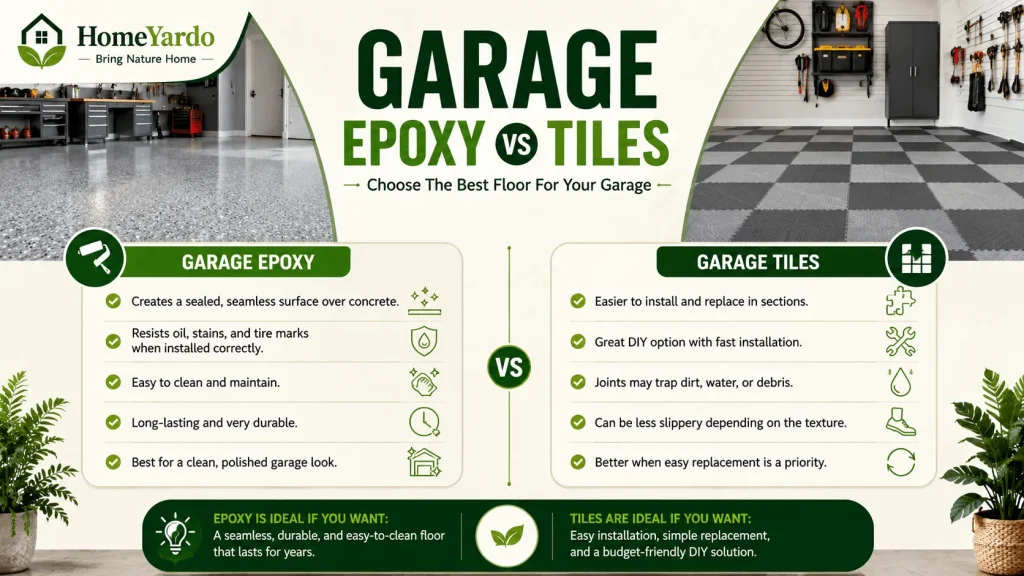
Garage epoxy creates a sealed surface over concrete. It can resist oil, stains, and tire marks when installed correctly.
Garage tiles are easier to install and replace in sections. They can also be a good DIY choice. Their joints may trap dirt, water, or debris.
Epoxy is often better for a seamless, clean garage look. Tiles may be better when easy replacement and fast installation are higher priorities.
Epoxy Floor Maintenance
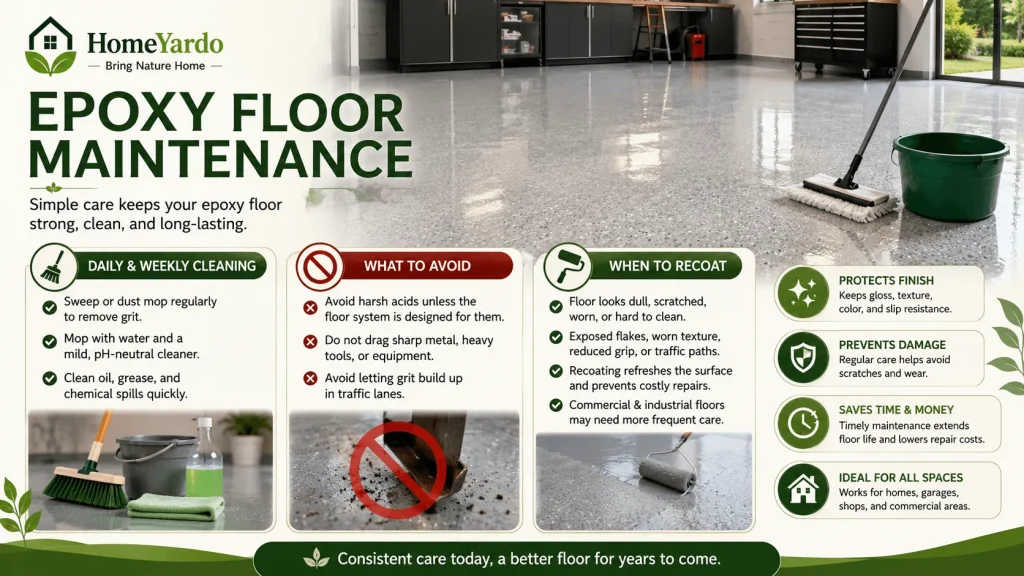
Epoxy floor maintenance is usually simple, but it should not be ignored. Dust, grit, spills, and harsh chemicals can wear down the surface over time.
A good cleaning routine helps protect gloss, texture, color, and slip resistance.
Daily And Weekly Cleaning
Sweep or dust mop regularly to remove grit. Dirt and sand can act like abrasives under shoes, tires, carts, or equipment.
Mop with water and a mild cleaner when needed. A pH-neutral cleaner is usually safer for routine cleaning.
Oil, grease, and chemical spills should be cleaned quickly. Long contact time can damage some coatings.
What To Avoid
Avoid harsh acids unless the floor system is designed for them. Strong cleaners can dull or damage the topcoat.
Do not drag sharp metal, heavy tools, or equipment across the surface. Use mats or pads in high wear zones.
Avoid letting grit build up in traffic lanes. It can scratch the finish and create dull paths.
When To Recoat
Recoating may be needed when the floor becomes dull, scratched, worn, or harder to clean. Exposed flakes, worn texture, reduced grip, visible scratches, or traffic paths are signs that the topcoat is aging.
A recoat can refresh the surface before more serious damage appears. Waiting too long may require more sanding, repair, or resurfacing.
Commercial and industrial floors may need planned maintenance more often than home floors.
When It Is Not The Best Choice
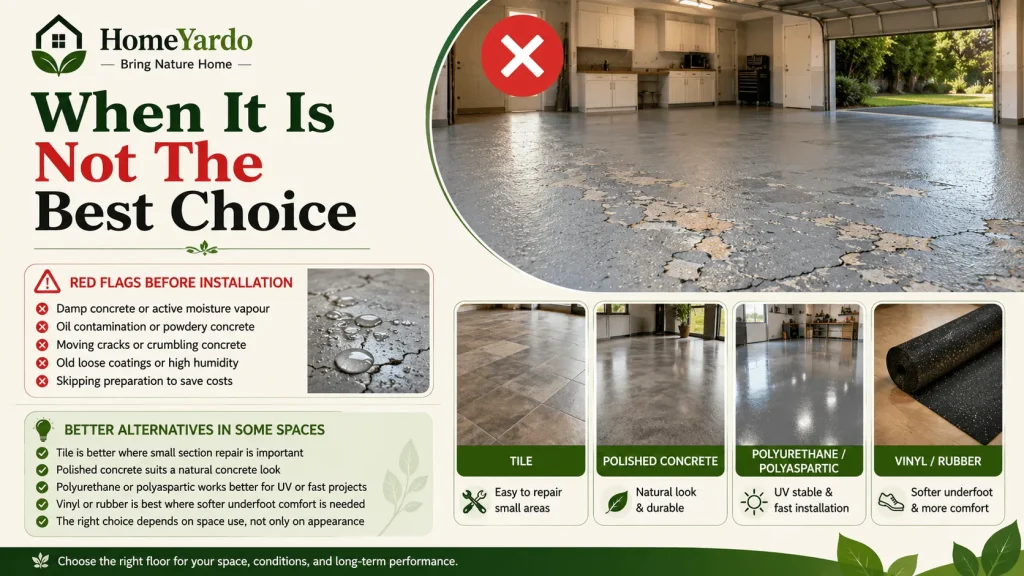
Epoxy is not always the right floor. Some spaces need a softer surface, faster installation, better UV stability, or a flooring system that handles movement differently.
Choosing another material can be smarter when site conditions do not suit epoxy.
Red Flags Before Installation
Red flags include damp concrete, active moisture vapour, oil contamination, crumbling concrete, moving cracks, old loose coatings, and high humidity during application.
Water beading on the surface, oily concrete, powdery concrete, loose old coating, condensation under a plastic sheet, and active cracks all need attention before epoxy is applied.
If preparation is being skipped to save costs, epoxy may not be a good choice.
Better Alternatives In Some Spaces
Tile may be better where a small section repair is important. Polished concrete may be better where a natural concrete look is preferred.
Polyurethane or polyaspartic systems may be better in some UV-exposed or fast-turnaround projects. Vinyl or rubber may be better where softer underfoot comfort is needed.
The right choice depends on space use, not only on appearance.
How To Choose The Best Epoxy Flooring Type
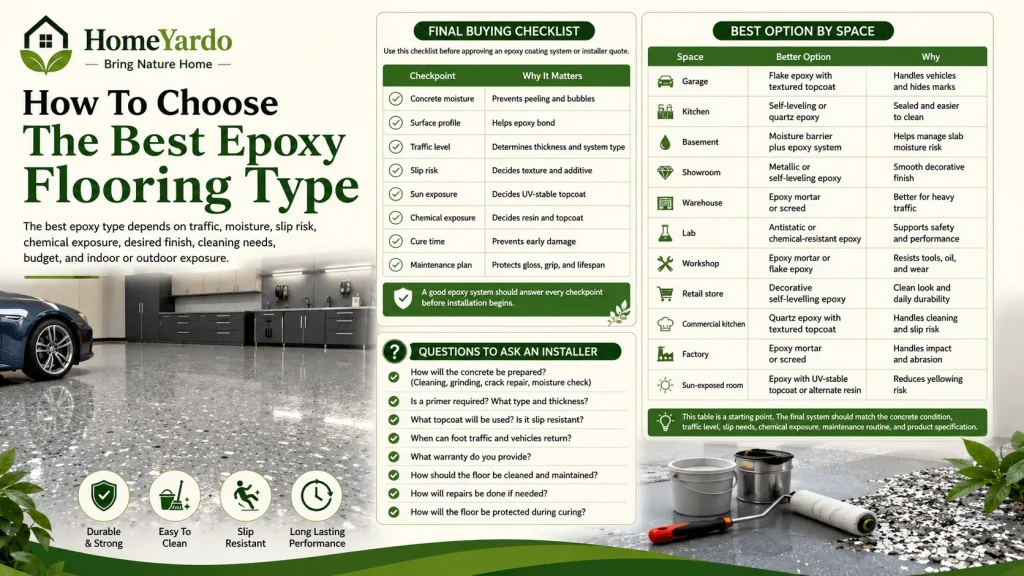
The best epoxy type depends on traffic, moisture, slip risk, chemical exposure, desired finish, cleaning needs, budget, and indoor or outdoor exposure.
A floor in a garage needs different performance from a hospital corridor, showroom, warehouse, or home kitchen. Before choosing, compare the floor condition with the way the space will actually be used.
Final Buying Checklist
Use this checklist before approving an epoxy coating system or installer quote.
| Checkpoint | Why It Matters |
|---|---|
| Concrete moisture | Prevents peeling and bubbles |
| Surface profile | Helps epoxy bond |
| Traffic level | Determines thickness and system type |
| Slip risk | Decides texture and additive |
| Sun exposure | Decides UV-stable topcoat |
| Chemical exposure | Decides resin and topcoat |
| Cure time | Prevents early damage |
| Maintenance plan | Protects gloss, grip, and lifespan |
A good epoxy system should answer every checkpoint before installation begins.
Best Option By Space
The table below gives a simple starting point for matching the epoxy system with the space.
| Space | Better Option | Why |
|---|---|---|
| Garage | Flake epoxy with textured topcoat | Handles vehicles and hides marks |
| Kitchen | Self-leveling or quartz epoxy | Sealed and easier to clean |
| Basement | Moisture barrier plus epoxy system | Helps manage slab moisture risk |
| Showroom | Metallic or self-leveling epoxy | Smooth decorative finish |
| Warehouse | Epoxy mortar or screed | Better for heavy traffic |
| Lab | Antistatic or chemical-resistant epoxy | Supports safety and performance |
| Workshop | Epoxy mortar or flake epoxy | Resists tools, oil, and wear |
| Retail store | Decorative self-levelling epoxy | Clean look and daily durability |
| Commercial kitchen | Quartz epoxy with textured topcoat | Handles cleaning and slip risk |
| Factory | Epoxy mortar or screed | Handles impact and abrasion |
| Sun-exposed room | Epoxy with UV-stable topcoat or alternate resin | Reduces yellowing risk |
This table should be used as a starting point. The final system should match the concrete condition, traffic level, slip needs, chemical exposure, maintenance routine, and product specification.
Questions To Ask An Installer
Inquire about the preparation of the concrete. Cleaning, grinding or profiling, crack repair and moisture checking should be included in a good answer.
Check if a primer is required, the thickness of the primer, the topcoat to be applied, and the slip resistance.
In addition, inquire when the foot traffic and vehicles can be returned, what is guaranteed, how the floor should be cleaned, how the floor will be repaired, and how the floor will be protected during curing.
Conclusion
In certain situations, flooring epoxy is a solid option for concrete floors when it is an ideal system for the space. It can prevent stains, spills, abrasion and wear, and enhance the look of ordinary concrete.
Proper surface preparation, moisture control, thickness and finish, and curing time are all important for the best results. Different epoxy systems are required for homes, garages, commercial properties and industrial floors.
Prior to installation, inspect slab moisture, surface preparation, traffic, finish type, topcoat, and cure time. A good epoxy floor can last longer, clean up easier and work better than a hastily installed or mismatched floor coat.
FAQ’s
It is a floor system made by mixing epoxy resin with a hardener and applying it over prepared concrete. Once cured, it forms a hard, sealed, seamless surface. It can be plain, colored, glossy, matte, flake-textured, quartz-filled, or metallic, depending on the finish.
Epoxy works through a two-part chemical reaction between resin and hardener. The mixture bonds to prepared concrete and forms a protective surface after curing. The floor may include primer, base coat, decorative layer, and topcoat.
A well-installed epoxy floor can last many years. Heavy traffic, chemical exposure, moisture, weak concrete, and poor maintenance can reduce its lifespan. Actual lifespan depends on surface preparation, system thickness, topcoat quality, use, and cleaning routine.
Cost depends on floor size, surface condition, system type, design, thickness, topcoat, and labor. Decorative and heavy-duty systems cost more than basic coatings. Concrete repair, grinding, moisture barriers, custom finishes, and local labor rates can increase the total price.
Main drawbacks include complex preparation, curing time, slipperiness when wet, UV yellowing, repair difficulty, and peeling risk on damp or poorly prepared concrete. Most problems can be reduced by choosing the right system and preparing the slab correctly.
Epoxy can work well in garages, kitchens, basements, and utility rooms. The finish should match the room’s moisture level, slip risk, and design style. It is usually better for practical concrete areas than soft living spaces or bedrooms.
For garages, flake epoxy with a textured topcoat is often a strong choice. For kitchens and utility rooms, self-leveling or quartz epoxy may work better. For basements, moisture testing matters first, and a moisture barrier plus epoxy system may be needed.
Epoxy may show cracks if the concrete underneath cracks or moves. Crack repair and correct substrate preparation reduce this risk. Active structural cracks need proper treatment before coating.
Epoxy paint is usually thinner and better for light use. Epoxy coating floor or full resin flooring is thicker, stronger, and better for demanding concrete floors. A full resin flooring system may include primer, body coat, broadcast material, and topcoat.
Epoxy is seamless and easier to clean because it has no grout joints. Tile can be easier to replace in small sections and may suit areas where individual repairs matter more. The better choice depends on repair needs, moisture, traffic, and desired finish.
Heavy traffic spaces usually need stronger systems such as epoxy mortar, epoxy screed, quartz epoxy, or thicker epoxy floor coating systems. The right choice depends on forklifts, carts, impact, chemicals, cleaning frequency, and the condition of the concrete.
It may improve practical value in garages, basements, kitchens, and utility rooms by creating a cleaner, stronger surface. Poor installation can reduce that value. A well-prepared and well-finished epoxy floor can make a space look cleaner and easier to maintain.
References
- https://chakorventures.com/epoxy-flooring-the-complete-guide/
- https://www.flowcreteasia.com/technical-zone/the-ultimate-introduction-to-epoxy-flooring/
- https://www.ultratechcement.com/for-homebuilders/home-building-explained-single/descriptive-articles/what-is-epoxy-flooring
- https://industrial.sherwin-williams.com/na/us/en/resin-flooring/resources/systems-chemistry/Epoxy-Flooring.html
- https://www.bunnings.com.au/diy-advice/home-improvement/flooring/how-to-epoxy-a-garage-floor
- https://sealbondchemicals.com/epoxy-resin-flooring/