Garage Door Spring Replacement: Cost, Warning Signs & Safety Guide

A garage door spring can help to reduce the weight of the door, which means the opener does not have to lift the entire weight of the door. If a spring has become weak or broken, the door may feel heavy, move unevenly, stop partway open, bang loudly or not open at all.
Care needs to be taken when replacing garage door springs due to the tension that can be held by springs, cables, drums, and brackets. A minor error may cause damage to the door, break the opener or pose a serious safety hazard.
This guide will explain garage door spring replacement warning signs, cost, torsion and extension spring differences, repair vs replacement decisions, DIY risks, cable involvement, spring sizing, lifespan, maintenance and how to select a reliable spring replacement company.
TLDR
- Garage door springs replacement is typically required when the door becomes heavy, crooked, stuck, noisy, or when there is a noticeable gap between the top and bottom of the springs.
- Hands-on spring or cable repair can be hazardous because of the tension in the springs and cables.
- Torsion springs are more expensive than extension springs, but they typically provide smoother motion.
- Extension spring systems should have safety cables.
- The cost varies according to the spring type, door weight, number of springs, cycle rating, labour costs and other parts.
- Self installation of springs and cables can result in injury, unbalanced doors, strain on the opener, and additional repair expenses
Quick Answer: When Does A Garage Door Spring Need Replacement?
Typically, a garage door spring should be replaced when it no longer provides the proper balance. The most frequent symptoms include a loud snapping sound, a noticeable spring gap, a heavy door, loose cables, or an opener that runs but is unable to open the door.
Do not use the opener if the door becomes difficult to move, opens crooked, gets stuck in the middle or opens only a few inches.
Some warning signs are:
- A loud bang/snapping noise from the garage
- The door only opens a few inches.
- The door becomes stuck at half open.The door becomes stuck at 50% open.
- The door is heavy to open by hand
- The spring coil is disconnected from the end of the rod.
- Loose or dangling wires
- A door that is not smooth or level when moving.
- The door remains closed and the opener buzzes or squeals
- The door closes rapidly when it’s closed.
- Rusted, stretched or worn spring
- Failure to use a safety cable on an extension spring system.
| Sign | What It May Mean | Safe Next Step |
|---|---|---|
| Loud bang | Spring may have snapped | Stop using the door |
| The door opens only a few inches | Spring may not be lifting the load | Stop using the opener |
| The door gets stuck halfway | Spring, cable, roller, track, or opener issue | Stop the operation and inspect safely |
| Heavy door | Spring tension may be lost | Do not force the door |
| Visible spring gap | Broken torsion spring | Schedule inspection |
| Loose cable | Spring or cable tension issue | Do not touch the cable |
| Missing safety cable | An extension spring may be unsafe if it breaks | Book a safety inspection |
Safety Warning: Before You Touch The Door
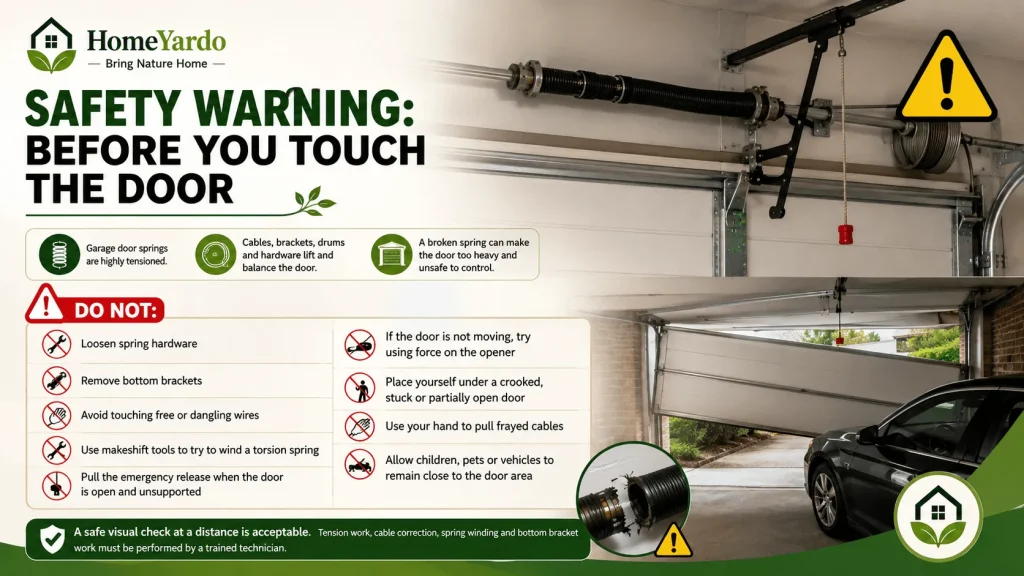
Garage door springs are highly tensioned. Other components that can pose a risk include cables, bottom brackets, drums and spring hardware which all serve to lift and balance the door.
The broken spring is not only a noisy part. It can cause the door to be too heavy to control safely.
Do not:
- Loosen spring hardware
- Remove bottom brackets
- Avoid touching free or dangling wires.
- Use makeshift tools to try to wind a torsion spring.
- Pull the emergency release when the door is open and unsupported.
- If the door is not moving, try using force on the opener.
- Place yourself under a crooked, stuck or partially open door.
- Use your hand to pull frayed cables
- Allow children, pets or vehicles to remain close to the door area
A safe visual check at a distance is acceptable. Tension work, cable correction, spring winding and bottom bracket work must be performed by a trained technician.
What Garage Door Springs Do

Garage door springs are used to balance the weight of the door. Even a standard garage door installed in a home can be challenging or dangerous to open without the assistance of the spring.
The door is opened by the opener, but the rest of the lift is provided by the spring system. If the system functions properly, it will allow the opener to not have to overcome the entire weight of the door.
A well-functioning spring system is important for the door:
- Open smoothly
- Close under control
- Maintain balance while in motion
- Be sure to avoid putting too much pressure on the opener.
- Walk without stumbling, slamming or dragging
If the spring tension is low or has failed, the opener could be working harder than necessary. That strain will impact the motor, gears, chain, belt, rail or travel setting over time.
How Garage Door Springs Work?
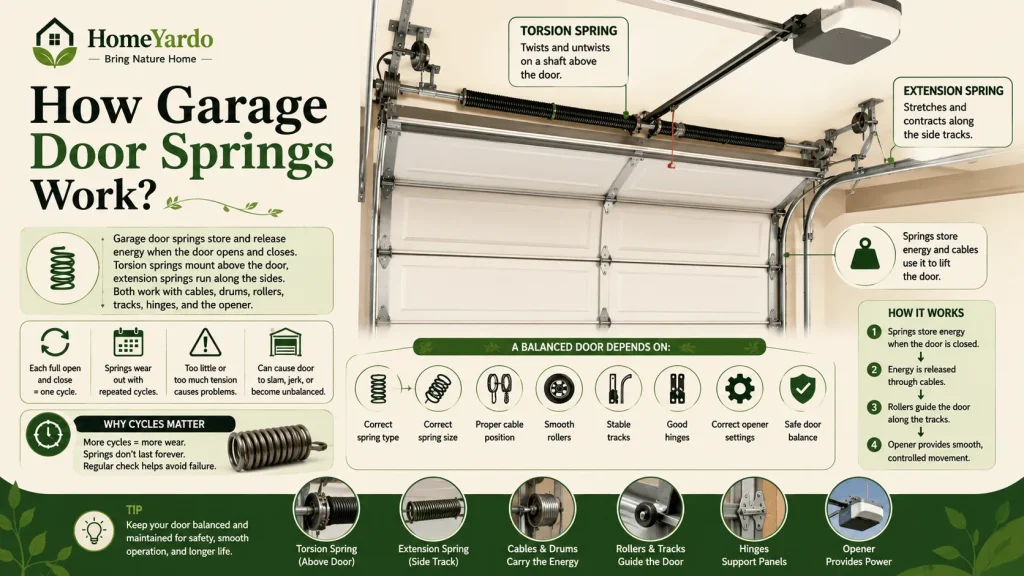
Garage door springs are used to store and release energy when the door opens and closes. The exact movement will vary according to the type of spring.
Torsion springs are springs that twist and untwist on a shaft over the door. The side tracks are fitted with extension springs. Both systems operate with cables, drums, rollers, tracks, hinges and the opener.
The spring’s stored energy is carried by cables to assist in lifting the door. The door is rolled along the tracks with the help of rollers. Too little or too much tension can cause the door to slam, jerk, damage the opener, or cause it to become unbalanced.
Each complete open and close equals one cycle. That’s why the number of cycles is important: springs wear out with repeated use.
A balanced door is based on:
- Correct spring type
- Correct spring size
- Proper cable position
- Smooth rollers
- Stable tracks
- Good hinges
- Correct opener settings
- Safe door balance
Torsion Springs Vs Extension Springs

The majority of garage doors in homes have either torsion or extension springs. The type of spring will impact the cost, safety, lifespan, door balance and replacement process.
There are two types of springs that can lift a garage door: torsion and extension springs. They can be easily distinguished by their position: The torsion springs are above the door, and the extension springs are along the side tracks.
Torsion Springs
Torsion springs are attached to a metal rod above the garage door. They help to open and close the door by applying torque.
It is a standard feature on modern residential doors, heavier doors, insulated doors and double garage doors. Extension springs generally do not offer as smooth a motion or as good a balance as torsion springs.
Torsion springs are more expensive to replace because they must be sized, wound, aligned and balanced to work properly.
Key points:
- Located above the garage door
- Attached to a metal pole
- Twist and relax when doors are moving
- Commonly found on newer and heavier doors.
- Smoother than extension springs, typically
- Typically, this is done by trained technicians
Extension Springs
Extension springs are attached to the horizontal tracks on either side of the garage door. When the door is closed, they stretch; when the door is opened, they contract.
Older or lighter garage doors are likely to have these springs. They typically are less expensive than torsion springs, but they require safety cables. A safety cable is useful to keep the spring in place in case it snaps.
Key points:
- On the side tracks
- Stretch and contract during movement
- It is frequently seen on older systems.
- Typically more affordable
- Need safety cables
- May be dangerous if damaged or if not properly contained.O
The table below makes it easy for homeowners to compare.
| Feature | Torsion Spring | Extension Spring |
|---|---|---|
| Location | Above the door | Alongside tracks |
| Motion | Twists and unwinds | Stretches and contracts |
| Common use | Modern or heavier doors | Older or lighter doors |
| Cost pattern | Usually higher | Usually lower |
| Balance | Usually smoother | Can be less even |
| Safety detail | Shaft, cones, brackets | Safety cable needed |
| Lifespan | Often longer | Often shorter |
Torsion Spring Vs Extension Spring Which Is Better?

Modern, heavier, and high use garage doors are usually better suited to torsion springs than other types of garage door springs as they offer smoother balance and a longer lifespan. In certain instances, such as lighter doors, older installations, low headroom or cost-conscious repairs, extension springs may still be appropriate when the system is in a safe condition.
Torsion springs are often preferred when:
- The door is heavy or insulated
- The door is used many times per day
- Smoother movement is a priority
- The existing setup supports torsion hardware
- Long-term durability matters more than the lowest upfront cost
Extension springs may still make sense when:
- The existing system is already designed for them
- The door is lighter
- The hardware is safe and has safety cables
- The budget is limited
- A technician confirms the current setup is still suitable
Sometimes it’s not necessary to replace extension springs with torsion springs. A technician should verify if the door, track setup, headroom and hardware will accommodate the change.
Signs Of A Broken Garage Door Spring
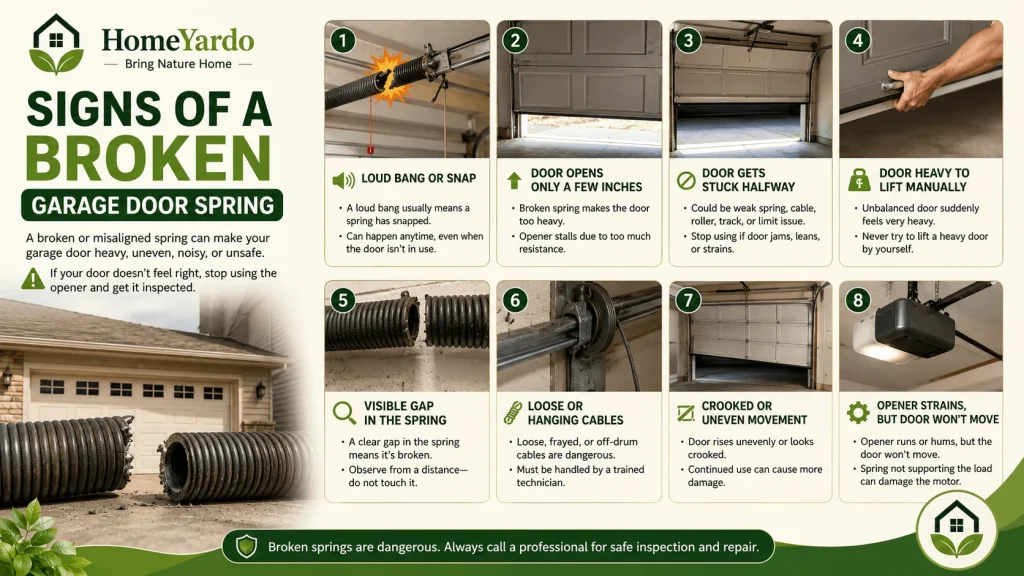
Abnormalities such as opener failures, issues with the cables, damage to the garage door tracks, or garage door roller issues can all be signs of a broken garage door spring or a garage door spring that is out of alignment. The door can still move slightly, but it can become heavy, uneven, noisy or unsafe.
If the door is not feeling right, sounds crooked or moves crookedly, discontinue use of the opener until it is inspected.
Loud Bang Or Snap
A loud bang in the garage usually occurs when a spring snaps in tension. This can happen even if no one is using the door.
A snapped spring can release at any time, causing the door to be too heavy for the opener to lift. When the bang is followed by a heavy door or a visible coil gap, there is a greater risk of the springs failing.
Door Opens Only A Few Inches
If a garage door opens just a few inches, it may be due to a broken spring. The reason many openers stall is the resistance of the door is too high or the system senses too much.
When the resistance is too great, the opener force limit will halt movement. Pressing the opener button over and over can cause the motor and gears to become strained.
Door Gets Stuck Halfway
A garage door stuck halfway may be due to a weak spring, cable problem, roller problem, track obstruction, or travel limit problem with the opener. If the door is also heavy, tilts or moves unevenly, a spring issue is more likely.
If a door is stuck halfway, it can shift or drop. Discontinue use if the door jams, leans or strains during operation.
The Garage Door Heavy To Lift Manually
An unbalanced garage door ought not to be too heavy to move by hand. If the door suddenly seems a lot heavier than usual, the spring may have lost tension or broken.
The springs should be balanced for manual movement to be controlled. Never lift a heavy garage door by yourself.
Visible Gap In The Spring
A broken torsion spring will typically have an opening in the spring. The gap is typically at the point where the spring has broken.
This is one of the most obvious indications of the need for replacement. Observe from afar and refrain from touching or releasing the spring.
Loose Or Hanging Cables
When spring tension is lost, loose cables can result. The cable can be in the vicinity of the track, drum or side of the door.
Cables are attached close to the bottom brackets and can still be taut. Loose cables, frayed cables and cables off the drum must be dealt with by a trained technician.
Crooked Or Uneven Door Movement
If the garage door is uneven, it could be due to a garage door spring or cable imbalance. One side may rise more than the other and the door may appear crooked.
Track, roller, hinge, cable and opener components may become damaged with continued use. If the door is tilting or binding, stop the operation.
Opener Strains, But Door Does Not Move
If the opener runs, hums or pulls, but the door doesn’t move up, the spring may not be working.
The opener should not have to bear the entire weight of the door. If the spring is not supporting the load, parts of the gears and motor can be strained.
Garage Door Spring Repair Vs Replacement

Not all broken garage springs are the same and not all of them can be fixed. Certain spring issues could be lubrication, minor adjustment, cable correction, or associated hardware examination. If the spring breaks, it typically needs to be replaced.
If the spring is squeaky, it doesn’t necessarily mean it has gone bad. If the spring is snapped, the extension spring is stretched, there is a gap between the coils, or the door is very heavy, it is different.
Repair may apply when:
- The spring is dry or has a sound.
- There is a slight imbalance on the door
- A cable requires a check or correction
- Hardware needs lubrication
- After spring service, opener settings should be reviewed.
Replacement is usually needed when:
- The spring is snapped
- A gap is visible on a torsion spring.
- The extension spring is stretched or damaged
- The door is too heavy to lift safely
- The spring is rusty or worn.
- The spring is no longer able to maintain its safe tension.
Before determining whether there is a need for adjustment, repair, or replacement, a technician should go through the entire system.
Replace Garage Door Springs Cost

The cost to replace torsion spring garage door will depend on the garage door type, size, weight, number of springs, labour, garage door cycle rating, and other worn out components. The final quote might also vary if cables, rollers, drums, bearings, brackets, tracks and opener settings require attention.
The national cost guides suggest that the replacement of a spring will cost a few hundred dollars. Some guides provide lower ranges for simple spring replacement, and some add professional installation, spring type, labour, and other work.
Average Cost Range
A professional replacement usually costs a few hundred dollars. The range is generally wide nationally, typically $150-$540, depending on the source, type of spring, door weight, number of springs, and job scope.
Cost guides vary as the prices may include one spring, parts only, basic labour, two springs or full installation by a professional. The best way to do this is to obtain a written quote that shows the breakdown of parts, labour, warranty and any repairs.
Cost By Spring Type
Torsion springs tend to be more expensive than extension springs. They are typically more sensitive to tension set-up and balance testing.
Extension springs can be less costly, but the system needs to be safe with the use of safety cables. When there is no safety cable or it is damaged, that should be fixed during service.
Cost usually increases with:
- Torsion spring systems
- Two spring systems
- High-cycle springs
- Heavy insulated doors
- Spring conversion work
- Cable or drum issues
- Opener adjustment after repair
Cost By Door Size And Weight
Door weight affects spring sizing and replacement cost. A single lightweight garage door does not need the same spring setup as a heavy insulated double door.
Cost may be higher for:
- Double garage doors
- Insulated garage doors
- Wood garage doors
- Carriage-style doors
- Heavy custom doors
- Doors with two spring systems
- Doors with damaged or related hardware
Door type can also matter. Sectional doors are common in residential garages, while tilt-up and roll-up systems may need different hardware, spring types, or labour.
Related Repairs That Can Change Cost
A broken spring can reveal other worn parts. The technician may check cables, drums, rollers, hinges, bearings, tracks, brackets, and opener settings.
Related repairs that may affect the final quote include:
- Cable replacement
- Bearing plate replacement
- Drum alignment
- Safety cable installation for extension springs
- Roller replacement
- Track correction
- Opener force and travel reset
- Sensor check after repair
Related repairs should be shown and approved before work continues. A spring replacement quote should not become confusing or vague halfway through the job.
How To Reduce Spring Replacement Costs
The best way to control costs is to handle spring problems before the door damages other parts. A heavy, noisy, slow, or uneven door should not be ignored.
Practical ways to keep costs clearer include:
- Schedule an inspection when the door becomes heavy, noisy, slow, or uneven
- Replace both springs during one visit when the door uses a two-spring system
- Bundle cable or roller service only if those parts are genuinely worn
- Compare written quotes
- Ask whether the quote includes parts, labour, balance testing, and warranty
- Keep springs lubricated with a garage-door-rated lubricant
- Clear the work area before the technician arrives
The cheapest quote is not always the best value. A clear quote should explain spring type, spring count, cycle rating, warranty, and related work.
Should Both Garage Door Springs Be Replaced?
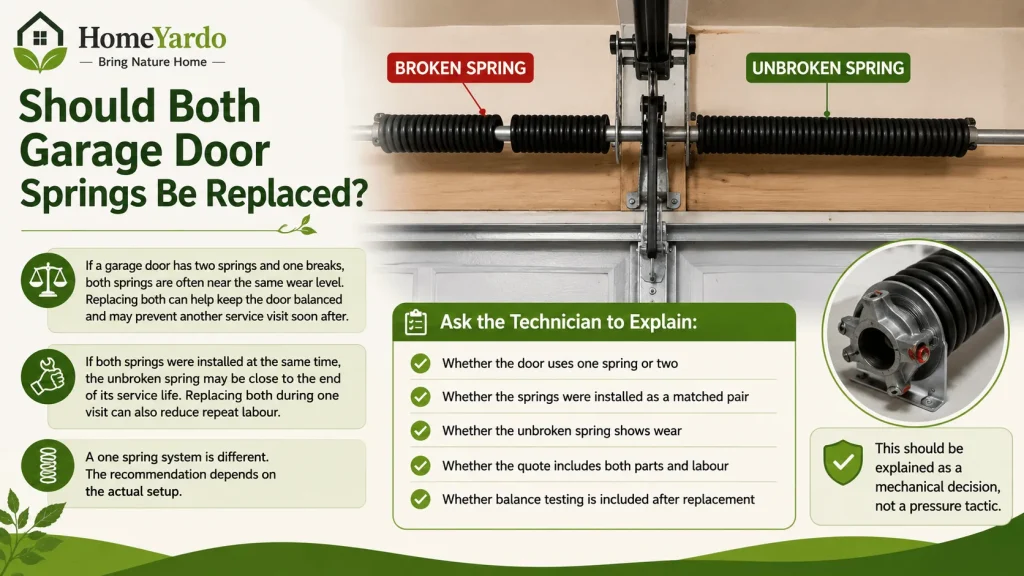
If a garage door has two springs and one breaks, both springs are often near the same wear level. Replacing both can help keep the door balanced and may prevent another service visit soon after.
If both springs were installed at the same time, the unbroken spring may be close to the end of its service life. Replacing both during one visit can also reduce repeat labour.
A one spring system is different. The recommendation depends on the actual setup.
Ask the technician to explain:
- Whether the door uses one spring or two
- Whether the springs were installed as a matched pair
- Whether the unbroken spring shows wear
- Whether the quote includes both parts and labour
- Whether balance testing is included after replacement
This should be explained as a mechanical decision, not a pressure tactic.
Can I Open A Garage Door With A Broken Spring?

It may be possible in some cases, but it is usually unsafe. Without spring support, the door can be too heavy to control.
A broken spring can make the door fall quickly, move unevenly, strain the opener, or cause cables to loosen. If the door is crooked, partly open, or stuck, avoid using it.
If the door is fully closed, avoid lifting it by force. If the door is open, do not pull the emergency release unless the door is properly supported by a trained person. If cables are loose or the door is crooked, treat it as unsafe.
Safe actions include:
- Stop using the opener
- Keep people away from the door
- Do not stand under the door
- Check only from a safe distance
- Do not touch cables or brackets
- Book a spring system inspection
DIY Vs Professional Garage Door Spring Replacement

Many homeowners consider DIY spring replacement to save labour costs. The risk is that springs, cables, brackets, and winding hardware hold strong tension.
A professional replacement costs more upfront, but it reduces the chance of injury, wrong spring sizing, poor balance, cable problems, and opener strain.
DIY mistakes often include:
- Buying the wrong spring size
- Using screwdrivers instead of proper winding bars
- Using the wrong tools
- Overwinding or underwinding a torsion spring
- Touching bottom brackets
- Working under an open door
- Ignoring loose cables
- Skipping balance testing
- Running the opener before the door is balanced
Professional service should include spring identification, spring measurement, door securing, cable inspection, safe replacement, opener reconnection, lubrication, and final testing.
A safety-focused article can explain DIY risk without turning spring tension work into a step-by-step home project.
How To Prepare For A Spring Replacement Visit
A few simple steps can make the visit safer and easier. These steps do not involve touching springs, cables, drums, or brackets.
Before service:
- Move vehicles away from the garage door if safe
- Clear boxes, tools, and storage near the tracks and spring area
- Keep pets and children away
- Note symptoms such as a loud bang, being stuck halfway, a visible gap, a loose cable, or a heavy door
- Make sure the technician can access the opener, outlet, tracks, and spring hardware
Do not try to “help” by loosening parts before the appointment. A technician needs to inspect the system as it is.
How To Install Garage Door Springs And Cables?

Garage door springs and cables work together to lift and balance the door. Springs create a lifting force, while cables transfer that force through drums and attachment points.
This is a professional process overview, not a DIY instruction guide. Cable and spring hardware can hold dangerous tension.
Professional installation usually involves:
| Stage | What Happens |
|---|---|
| Inspection | Spring, cables, drums, and door balance are checked |
| Sizing | The correct spring is matched to the door |
| Securing | The door is stabilised before tension work |
| Spring work | The old spring is removed and a new one is installed safely |
| Safety cable check | Extension spring systems are checked for proper containment |
| Cable check | Lift cables are reset or replaced if needed |
| Opener reconnection | Opener, sensors, force, and travel are checked |
| Lubrication | Moving parts are lubricated after repair |
| Final test | Balance, reversal, noise, and movement are checked |
Springs and cables should be reviewed together because a spring failure can loosen cables or pull them off the drum. Incorrect cable placement can make the door crooked, noisy, or unsafe.
Parts involved may include:
- Torsion spring
- Extension spring
- Cable drum
- Lift cable
- Bottom bracket
- Safety cable
- Roller
- Track
- Door panel
- Opener rail
- Bearing plate
- Hinges
A homeowner can look for loose cables, visible spring gaps, or crooked movement from a safe distance. Do not loosen cable drums, bottom brackets, or spring hardware.
How To Choose Garage Door Spring Size?
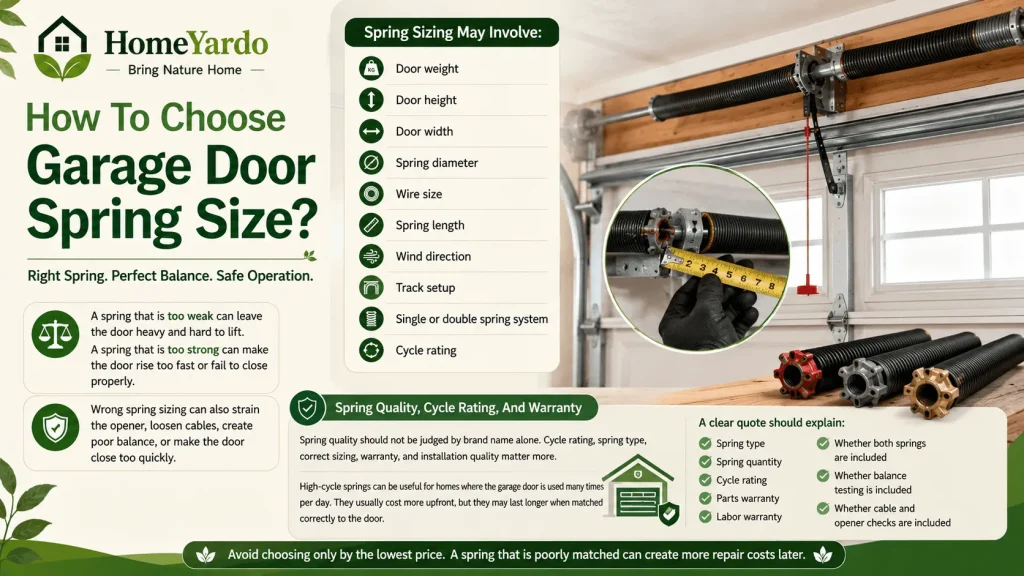
The right garage door spring size depends on the door and the spring system. A spring should not be chosen by guesswork.
Spring sizing may involve:
- Door weight
- Door height
- Door width
- Spring diameter
- Wire size
- Spring length
- Wind direction
- Track setup
- Single or double spring system
- Cycle rating
A spring that is too weak can leave the door heavy and hard to lift. A spring that is too strong can make the door rise too fast or fail to close properly.
Wrong spring sizing can also strain the opener, loosen cables, create poor balance, or make the door close too quickly. If the door was modified, insulated, or repaired in the past, the old spring may not be the best guide.
Spring Quality, Cycle Rating, And Warranty
Spring quality should not be judged by brand name alone. Cycle rating, spring type, correct sizing, warranty, and installation quality matter more.
High-cycle springs can be useful for homes where the garage door is used many times per day. They usually cost more upfront, but they may last longer when matched correctly to the door.
A clear quote should explain:
- Spring type
- Spring quantity
- Cycle rating
- Parts warranty
- Labor warranty
- Whether both springs are included
- Whether balance testing is included
- Whether cable and opener checks are included
Avoid choosing only by the lowest price. A spring that is poorly matched can create more repair costs later.
What Garage Door Spring Do I Need?

The right garage door spring depends on the door weight, door height, current spring system, wire size, spring length, wind direction, and cycle rating.
Copying the old spring is not always enough. The old spring may have been wrong, the door may have been modified, or the door weight may have changed after panel or insulation work.
A technician may check:
- Existing spring type
- Door balance
- Door weight
- Door height
- Track setup
- Cable and drum condition
- Opener force and travel
- Whether the door uses one spring or two
A correct spring should let the door move smoothly, stay balanced, and avoid unnecessary opener strain.
How Many Springs Does A Garage Door Have?
Some garage doors use one torsion spring. Wider or heavier residential doors may use two torsion springs.
Extension spring systems usually have one spring on each side of the door. The number of springs depends on door size, door weight, hardware design, and spring setup.
If one spring breaks on a two-spring system, the pair should be evaluated together. One new spring and one worn spring can leave the door less balanced.
Garage Door Spring Lifespan And Cycle Rating

Garage door springs deteriorate with age. Open and closed cycles both cause wear on the metal.
Lifespan is more than just years. The more often a door is used, the more quickly the springs will wear.
How Long Do Garage Door Springs Last?
Garage door spring life depends on cycle rating, door weight, daily use, rust, lubrication, balance, and spring quality.
One full open and close equals one cycle. A high-use household can use up spring cycles faster than expected.
A standard spring is often discussed around cycle ratings, while high-cycle springs are designed for more frequent use. Actual lifespan still depends on the door, installation, environment, and maintenance.
A door used four times daily reaches more yearly cycles than a door used once daily. That is why two homes with the same spring may not get the same lifespan.
Why Garage Door Springs Break
Most garage door springs break from metal fatigue after repeated cycles. The spring flexes every time the door opens and closes.
Other causes include:
- Rust
- Poor lubrication
- Heavy door load
- Wrong spring size
- High daily use
- Poor door balance
- Temperature changes
- Worn cables or drums
- Older hardware
A broken spring does not always mean poor installation. Springs are wear parts, but poor maintenance, rust, and wrong sizing can shorten their service life.
How Often Should Garage Door Springs Be Replaced?
There is no single replacement schedule for every garage door. Spring replacement depends on cycle rating, daily use, door weight, and system condition.
A lightly used door may keep its springs longer than a high-use door. A two spring system may need both springs evaluated together because both springs often wear at a similar rate.
Inspection is useful when the door becomes noisy, heavy, uneven, slow, or hard for the opener to move.
Garage Door Spring Maintenance

Spring maintenance can help reduce noise and slow wear, but it cannot repair a broken spring. A snapped, stretched, or badly rusted spring needs professional inspection.
Basic maintenance includes:
- Lubricate springs with garage-door-rated lubricant
- Lubricate rollers and hinges where appropriate
- Watch for rust or corrosion
- Listen for squeaking, grinding, snapping, or popping
- Check for loose cables from a safe distance
- Keep tracks clear of debris
- Schedule periodic inspection
- Do not adjust spring tension yourself
- Do not loosen brackets, drums, or cables
A safe visual check every few months can help catch early warning signs. If squeaking continues after lubrication or the door still feels heavy, the spring system should be inspected.
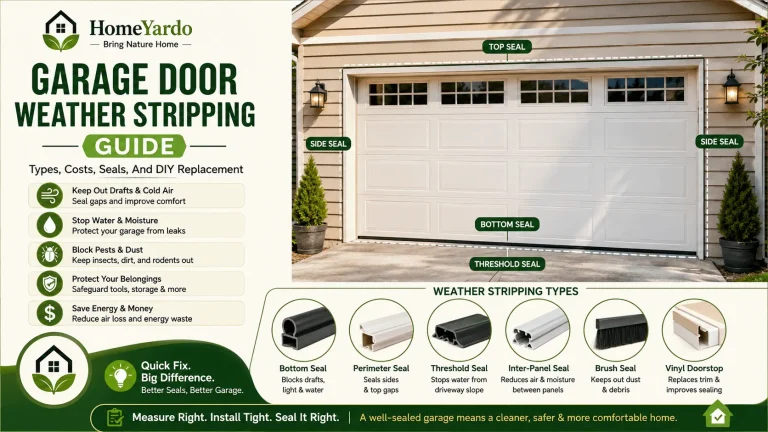
Homeowners often combine spring maintenance with seasonal garage maintenance, including inspecting garage door weather stripping and cleaning the garage floor.
Garage Door Noises That May Point To Spring Problems

Garage door noises can come from springs, rollers, hinges, opener parts, tracks, cables, or loose hardware. One sound does not always confirm one cause.
Door movement matters as much as the sound. A loud bang from a heavy door is more concerning than a mild squeak on a door that still moves smoothly.
Possible noise clues include:
- Bang: broken spring
- Squeak: dry spring, hinge, or roller
- Grinding: roller, track, opener, or spring strain
- Rattle: loose hardware or cable issue
- Pop: spring or hardware shift
- Hum with no lift: opener strain or broken spring
- Slap or whip sound: loose cable or cable movement
Stop using the door if noise comes with crooked movement, heavy lifting, cable looseness, or partial opening.
When Spring Replacement Is Not Enough

If the door, opener, cables, tracks and panels are still in good condition, then the problem can be solved by replacing the spring. If more than one part is worn or damaged, the door might require more than a new spring.
A larger repair review may be needed when there are:
- Damaged panels
- Bent tracks
- Frayed cables
- Worn rollers
- Damaged drums
- Weak opener
- Bad hinges
- Loose bottom brackets
- Rusted hardware
- Door aged 15 to 20 years with several failing parts
Spring replacement is no solution to unsafe tracks, frayed cables, damaged panels or a broken opener. When multiple parts are at the end of their useful life, consider a broad review of the door system in addition to repairs.
How To Choose A Garage Spring Replacement Company

A good spring replacement company would be able to explain the issue, give a price and then look at the spring system before replacing the parts.
Low price isn’t the only thing that matters. Spring work is a matter of safety, balance and sizing.
Look for:
- Provide company name and contact information.
- Estimate in writing prior to work.
- Spring type and quantity quoted in the quote
- Warranty for parts and labour.
- Explanation of spring cycle rating.
- Experience with torsion and extension springs
- Technician training
- Clear inspection process
- Balance testing post replacement
- The force and travel of the opener are checked.
- Real customer reviews
- No ambiguous bait pricing
- No pressure to change unrelated parts without explanation
- Incorporate insurance or licensing (as needed)
- Provide a clear explanation of cable, drum, roller or opener problems.
A competent technician should be able to describe why the spring should be replaced, whether or not both springs should be replaced, and whether any other parts should be taken care of.
Common Mistakes Homeowners Make With Broken Springs

When a spring breaks, it can be a stressful situation, particularly if a car is stuck in the garage. Rushing the guesswork can lead to a more costly or dangerous repair.
Common mistakes include:
- Continuously pressing the opener button
- Attempting to raise a heavy door by one person
- When the door is open, pull the emergency release.
- Touching loose cables
- Estimating the size of a spring
- Replacing a worn spring without inspecting the other springs.
- Don’t ask if the door is spring-loaded or has two springs
- Failure to use a safety cable on extension springs
- Not confirming the final balance and opener testing
- Only accepting the lowest bid
- No space for the technician to work.
The best thing to do is to discontinue use of the door, clean up the area, and get the full spring system inspected.
Conclusion
Replacing the garage door spring is required when the spring is no longer able to hold the garage door up. Some symptoms are a loud bang, a visible gap in the springs, a heavy door, loose cables, uneven door movement, and an opener that strains but doesn’t lift the door.
Cost will vary depending on the type of spring, door weight, number of springs, cycle rating, labour and other repairs. Torsion springs are typically more expensive than extension springs, but they may offer smoother functioning on many contemporary doors.
It is also dangerous to work with DIY spring and cable because the system is tight. Never remove springs, cables, drums or bottom brackets. If the door is stuck, crooked, heavy or unsafe, do not use it and make an appointment to have it properly inspected before further damage is done.
If you’re already preparing the garage, it’s also a good opportunity to inspect the condition of your garage floor coating, especially if the floor shows cracking, stains, or peeling.
FAQ‘s
Door spring replacement cost depends on the spring type, door weight, number of springs, labour, and related repairs. Most professional replacements fall into the few-hundred-dollar range, but the final quote can change if cables, drums, rollers, or opener settings also need work. A written estimate should separate parts, labour, warranty, and any extra repair items.
A broken garage door spring often causes a loud bang, a visible spring gap, a heavy door, a loose cable, or crooked movement. The door may open only a few inches or the opener may run without lifting it. If the door struggles, stop using the opener and check only from a safe distance.
Opening a garage door with a broken spring is usually unsafe because the door may be too heavy to control. The opener can strain, cables can loosen, and the door may drop suddenly if it is unsupported. If the door is stuck open, crooked, or partly lifted, keep the area clear and avoid pulling the emergency release.
Door spring replacement is risky because springs, cables, drums, and bottom brackets can hold high tension. Wrong tools, poor spring sizing, or incorrect tension can cause injury and damage the door. A professional replacement is usually safer because the door is secured, the correct spring is matched, and the balance is tested.
Torsion springs are often better for modern, heavier, or high-use garage doors because they usually provide smoother balance and longer service life. Extension springs can still work well for lighter or older door systems when safety cables are installed. The best choice depends on door weight, hardware, headroom, and the current spring setup.
Most garage door springs break from metal fatigue after repeated opening and closing cycles. Rust, poor lubrication, wrong spring size, heavy door load, and poor balance can shorten spring life. A broken spring does not always mean bad installation because springs are normal wear parts.
Garage door springs store lifting energy, while cables transfer that force to help raise and lower the door. If spring tension fails, the cables may loosen, slip off the drum, or make the door move unevenly. Because cables connect near high-tension hardware, they should not be pulled or reset by hand.
Many standard residential spring replacements can be completed during one service visit. The job may take longer if cables, drums, rollers, bearings, brackets, or opener settings also need attention. A complete repair should include spring replacement, door balance testing, and final opener checks.
Yes, replacing a garage door spring can be dangerous because the spring system holds strong tension. Cables, bottom brackets, winding parts, and drums can also create risk if handled incorrectly. This is why spring replacement is usually safer when done by a trained technician with proper tools.
Some garage doors use one torsion spring above the door, while wider or heavier residential doors may use two torsion springs. Extension spring systems usually have one spring on each side of the door. The number depends on door size, door weight, hardware design, and spring setup.
A garage door stuck halfway may have a weak or broken spring, a cable issue, a roller problem, a track obstruction, or an opener travel setting problem. If the door binds, tilts, or strains, stop using the opener. A stuck halfway door can be unstable, especially if the spring or cable system is failing.
Yes, an injury can happen because springs hold strong tension while helping lift the door. If a spring, cable, drum, or bottom bracket releases suddenly, it can cause cuts, impact injuries, hand injuries, or a falling door. Avoid touching broken springs, loose cables, or spring hardware, and keep the area clear until the system is inspected.
A garage door spring counterbalances the door’s weight so the opener does not have to lift the full load alone. It helps the door open smoothly, close under control, and stay balanced during movement. When the spring weakens or breaks, the door may become heavy, noisy, crooked, or stuck.
Yes, garage door springs wear out from repeated open and close cycles. Daily use, rust, poor lubrication, heavy doors, and poor balance can make them wear faster. A spring may look normal until it suddenly snaps, which is why noise, heavy movement, or uneven travel should not be ignored.
A squeaky garage door spring is not always a sign of failure. It may simply need garage-door-rated lubricant, especially if the door still moves smoothly. Persistent squeaking, rust, heavy movement, a visible gap, or loose cables mean the spring system should be inspected.
A garage door may not open fully because of a broken or weak spring, loose cable, roller problem, track obstruction, or opener travel setting issue. If the opener runs but the door only rises a few inches, the spring may not be carrying the door’s weight. Stop using the opener if the door strains, tilts, or gets stuck.
A garage door spring does not have one universal weight rating because it must be matched to the specific door. Door weight, height, spring size, wire diameter, spring length, and system type all affect how much lifting force is needed. A correctly matched spring counterbalances the door so it can move safely and smoothly.
When a garage door spring breaks, the door can become very heavy, noisy, crooked, or stuck. The opener may run but fail to lift the door, and cables may loosen or slip off the drum. A torsion spring may show a visible gap in the coil, while an extension spring may look stretched or damaged.
A broken garage door spring usually needs replacement, not a simple repair. Because springs, cables, drums, and bottom brackets hold high tension, the safest fix is to stop using the door and have a trained technician replace the spring. Do not loosen spring hardware, pull loose cables, or force the opener.
Replacement usually refers to replacing a torsion or extension spring that has worn out, stretched, rusted, or snapped. The technician matches the spring to the door’s weight and hardware, replaces the failed spring, checks cables, and then tests the door balance. Correct sizing matters because the wrong spring can make the door unsafe.
A loud noise when opening can come from a broken spring, dry hinges, worn rollers, loose hardware, track issues, or opener strain. A sharp bang followed by a heavy door or a visible spring gap often points to spring failure. Stop using the door if the noise comes with crooked movement, loose cables, or partial opening.
Torsion springs sit above the garage door on a metal shaft and twist to help lift the door. Extension springs run along the side tracks and stretch as the door moves. Torsion springs are often smoother and better for heavier doors, while extension springs are common on older or lighter systems and need safety cables.
Double spring replacement usually costs more than a single spring job because the door is wider, heavier, and may use two springs. The final price depends on spring type, cycle rating, labour, door weight, and whether cables, drums, rollers, or opener settings also need attention. A written quote should clearly separate parts, labour, and warranty.
References
- This Old House
- Angi
- Clopay
- Precision Door Service
- DASMA
- Central Oregon Garage Door
- The Spruce
- International Door Association