Bushes Flowering: Best Shrubs For Fragrance, Privacy And Pollinators
Flowering bushes add colour, shape, fragrance, privacy and pollinator activity to a yard. Some provide early flowers in a subdued garden, others continue to flower during the summer, and others offer late colour once the spring garden is over.
The correct one will depend on the location of the shrub. All of the following factors are important prior to planting: sun exposure, mature size, hardiness, soil drainage, bloom season, flower colour, and the level of care required. A small spirea can be planted on a walk, and viburnum or rose of sharon can be planted as a fence plant.
High quality planting is often a hybrid variety of more than one shrub type. Evergreen shrubs provide structure through the year, deciduous shrubs add intense seasonal colour and easy care shrubs help to keep the garden easy to manage.
Quick Answer: Best Flowering Bushes For The Garden Need
No one shrub is right for every yard. It is best to choose the one that matches the light, space, climate, bloom season and maintenance requirements of the mature shrub.
| Garden Need | Best Options | Why They Fit |
|---|---|---|
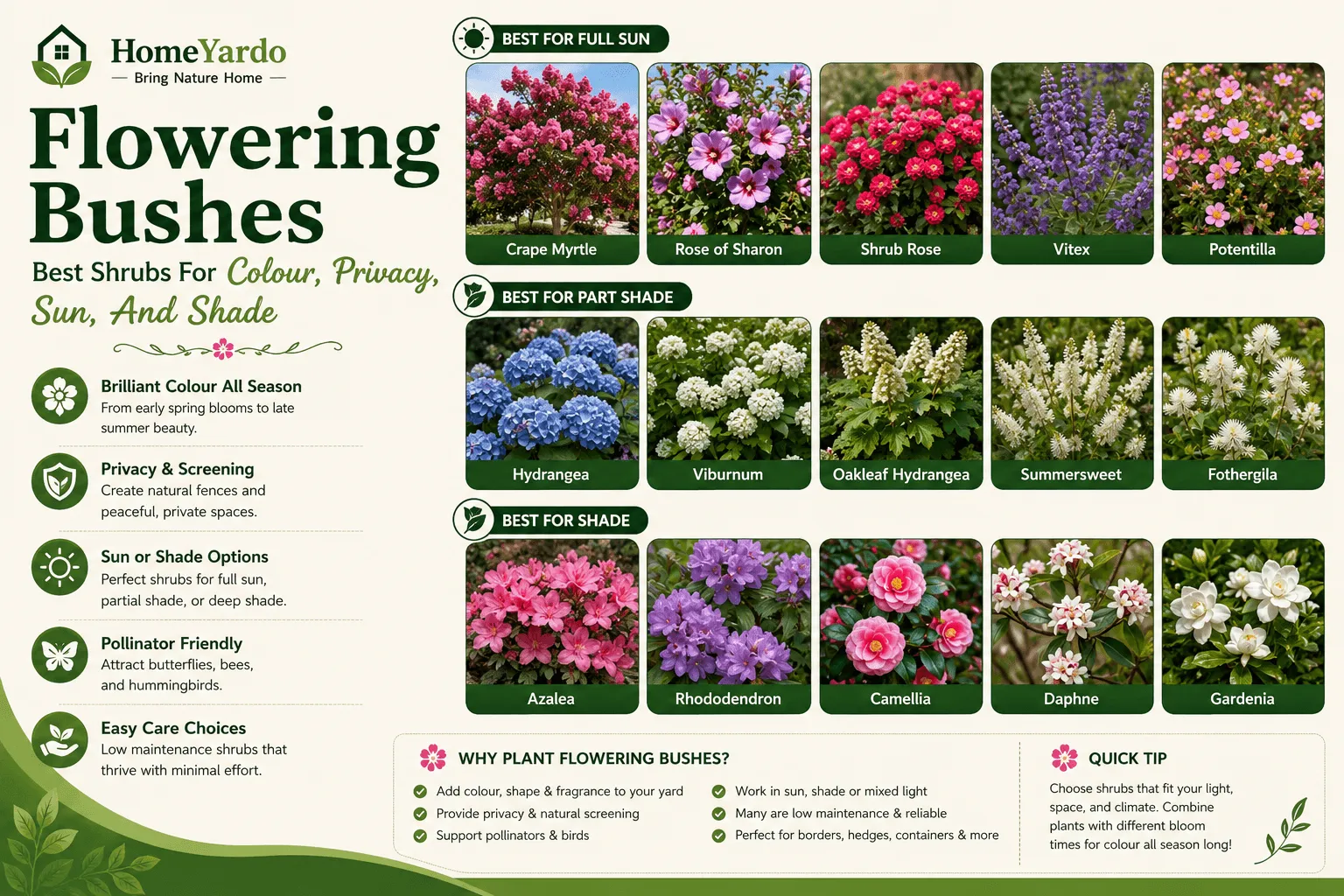
| Full sun | Crape myrtle, rose of Sharon, shrub rose, potentilla, vitex | Strong bloom performance in bright exposure |
| Partial shade | Hydrangea, viburnum, oakleaf hydrangea, summersweet | Good bloom potential with softer light |
| Shade | Azalea, rhododendron, camellia, daphne | Better choices for filtered light |
| Evergreen structure | Camellia, gardenia, rhododendron, Indian hawthorn | Foliage remains useful after bloom season |
| Low maintenance | Spirea, weigela, potentilla, ninebark, abelia | Reliable with modest care once established |
| Privacy hedge | Viburnum, rose of Sharon, camellia, lilac, ninebark | Adds height and seasonal screening |
| White flowers | Hydrangea, mock orange, gardenia, spirea, viburnum | Strong clean color choices for borders |
| Butterflies | Butterfly bush, caryopteris, summersweet, buttonbush, abelia | Nectar rich bloom options |
The combination of two or more shrubs may be more successful than a single shrub planted throughout the yard. Plant one shrub to provide structure, one shrub to provide long summer color, and one smaller plant to soften the front edge of the bed.
What Are Flowering Bushes?

Plants that bear seasonal flowers and have multiple stems are called bushes flowers. Many homeowners use the word “bushes”, and nurseries and garden guides may be using the word “shrubs” for the same group of plants.
They can be compact shrubs full sun or grow to a large tree, evergreen or deciduous, fragrant or not, formal or natural looking. Some of them are planted for their spring flowering, some for summer flowers, and some for their foliage, berries, fragrance or privacy.
Hydrangea, lilac, azalea, camellia, viburnum, spirea, forsythia, weigela, shrub roses, butterfly bush and rose of Sharon are among the common bushes flowering.
Flowering Bushes Vs Flowering Shrubs
“Bush” refers to the common term used in yard and landscaping. The common nursery/horticulture term is “shrub”.
Both are used to refer to plants that grow from several stems from the base and have wood. Tree size is not large, though, unless they are not pruned or grow in a warm climate.
Crape myrtle, serviceberry, dogwood, and vitex are good examples of plants that may grow as large shrubs or small trees. Look at the mature size, mature spread, bloom period and pruning requirements prior to planting.
Evergreen, Deciduous, And Perennial Shrubs
Evergreen flowering bushes for full sun retain their leaves for most of the year. Some of the azalea varieties, gardenia, garden rhododendron, camellia and Indian hawthorn varieties can maintain structure following bloom.
Deciduous shrubs shed their leaves in the winter, but many of them put on better seasonal flowers. Some popular varieties include forsythia, lilac, spirea, hydrangea, mock orange and weigela.
Full sun perennial shrubs regenerate from year to year if planted in an appropriate climatic zone. Many woody plants, such as shrub roses, hydrangeas, viburnums, spireas, and others can be productive for several years when they are suited for the site.
How To Choose The Right Flowering Bush Before Planting

When picking by flower color, often beds are overgrown, flowers are not as strong or vigorous, or pruning is done that could have been avoided. The first step to a better choice is to begin with the site.
Before purchasing, consider the following: sun tolerance, winter hardiness, drainage, mature size, bloom period, watering requirements, and ease of maintenance. Mature width is based on plant tags and nursery descriptions, not pot size.
If the space is small, and a shrub is going to be planted in it, it will tend to flower far better and require far less correction later on if it is a shrub that fits the space naturally.
Match The Shrub To Sun Exposure
Full sun typically is at least 6 hours of direct sunlight daily. The blooms of crape myrtle, shrub roses, potentilla, vitex, lavender and rose of Sharon tend to be best in bright sites.
Hydrangea, viburnum, oakleaf hydrangea, summersweet, fothergilla and itea will thrive in part shade, which may be light morning sun or less direct sunlight.
Shade is not complete darkness. Filtered light may be used for azalea, rhododendron, camellia, daphne and some hydrangeas, but generally fewer flowers are produced in dense shade.
Panicle hydrangea is a more sun tolerant shrubs than most hydrangea varieties, but morning sun and afternoon shade can be beneficial in warmer climates. Spirea is best in full sun and will grow in partial shade.
Check Hardiness Zone And Local Climate
Hardiness zone is used to provide an estimate of winter survival. It can’t capture the effects of heat, humidity, wind, drought, wet winter soil, reflected heat, or exposure to salt.
A shrub that works well in a cool full sun garden may not thrive in the hot afternoon sun next to a wall. In colder climates, a warm climate evergreen might require protection from frost.
Lilac may thrive in colder climates. Gardenia requires warm temperatures, proper soil and regular water. Cistus and ceanothus typically require a mild climate and fairly dry conditions.
Measure Mature Height And Spread
Small flowering shrubs for full sun will typically remain less than 3 feet tall. They are close to paths, low borders, containers and front foundation beds.
Medium shrubs typically reach to 3-6 feet in height. They are suitable for mixed borders, informal hedges and layered planting beds.
Tall flowering bushes full sun can grow 6 feet or more. Viburnum, rose of Sharon, lilac, crape myrtle, mock orange and some hydrangeas require room to avoid clogging windows, gates, driveways and narrow paths.
A young plant can seem innocuous in a pot in a nursery. The size of the mature width determines whether it will look natural or overcrowded at maturity.
Pick Bloom Time And Flower Color Together
A white flowering bush may look perfect in spring, but it may bloom for only a few weeks. Long garden color comes from combining bloom windows.
Use early shrubs such as camellia, witch hazel, daphne, flowering quince, and forsythia for the first color. Add spring and early summer shrubs such as lilac, azalea, mock orange, weigela, spirea, and viburnum.
For summer and late color, use hydrangea, shrub rose, crape myrtle, butterfly bush, rose of Sharon, caryopteris, abelia, and panicle hydrangea. Flower color should support the planting plan, but bloom timing decides how long the display lasts.
Check Safety, Deer Pressure, And Invasive Risk
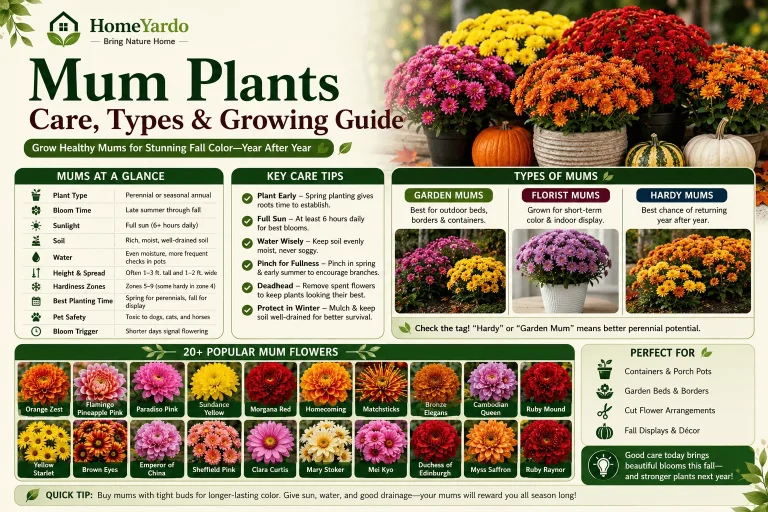
Some attractive shrubs need caution around pets, children, or grazing animals. Azalea, rhododendron, daphne, and mountain laurel should be planted with care where chewing or browsing is likely. Cornell lists azalea, daphne, laurels, and rhododendron among ornamental plants that can affect dogs.
Deer resistant does not mean deer proof. Hungry deer may browse plants they usually avoid, especially during winter or drought.
Some shrubs also need local spread checks. Butterfly bush can be invasive in some areas, and even cultivars marketed as sterile may be regulated differently by location.
Best Choices By Climate Type
Cold winter gardens often do well with lilac, forsythia, spirea, ninebark, viburnum, and panicle hydrangea. These shrubs are useful where winter chill and cold hardiness matter.
Hot southern gardens often use crape myrtle, vitex, abelia, gardenia, Indian hawthorn, and rose of Sharon. These still need correct watering and soil during establishment.
Dry sunny gardens may suit lavender, cistus, ceanothus, potentilla, and Russian sage where drainage is strong. Dry tolerant plants still need water while roots settle.
Woodland edges and filtered shade beds often suit azalea, rhododendron, camellia, summersweet, mountain laurel, and some hydrangeas. Soil acidity, drainage, and root competition matter in these spots.
Best Flowering Shrubs For Full Sun: Season Long Color

A single shrub rarely blooms all year. Season long color comes from combining plants that flower at different times.
Use early bloomers for late winter and spring lift, summer shrubs for the longest flower period, and late season shrubs for pollinators and fall interest.
| Bloom Window | Shrub Examples | Best Use | Notes |
|---|---|---|---|
| Late winter to early spring | Camellia, witch hazel, daphne, flowering quince | Early garden color | Protect sensitive buds from harsh frost |
| Spring | Forsythia, lilac, azalea, viburnum, mock orange | Fragrance and color | Prune many spring bloomers after flowering |
| Summer | Hydrangea, shrub rose, crape myrtle, butterfly bush, potentilla | Long warm season color | Water needs vary by plant and climate |
| Late summer to fall | Rose of Sharon, caryopteris, abelia, panicle hydrangea, beautyberry | Late season interest | Supports pollinators when spring blooms fade |
A well planned border may include one early bloomer, two summer performers, and one evergreen anchor. That gives better value than filling the yard with shrubs that all peak at the same time.
Late Winter And Early Spring Bloomers

Late winter and early spring bloomers bring color before most beds fill out. These shrubs work well near entries, patios, and walkways because their flowers are easy to notice when the rest of the garden is still quiet.
Camellia
- Best for: early flowers and evergreen structure.
- Light: filtered light or morning sun in many climates.
- Bloom time: winter to spring, depending on type.
- Care note: use well drained, acidic soil where possible.
- Watch note: exposed buds can be damaged by harsh frost or wind.
Witch hazel
- Best for: unusual early flowers and winter interest.
- Light: full sun to part shade.
- Bloom time: winter to early spring, depending on type.
- Care note: give it enough room because many types spread wide.
- Watch note: choose the cultivar carefully for flower color and scent.
Daphne
- Best for: fragrance near paths and entries.
- Light: part shade or protected light.
- Bloom time: late winter to spring.
- Care note: needs good drainage and dislikes root disturbance.
- Watch note: plant with care around pets and children.
Flowering quince
- Best for: bold early color.
- Light: full sun for stronger flowering.
- Bloom time: late winter to spring.
- Care note: prune after flowering if shaping is needed.
- Watch note: some types have thorns, so avoid tight walkways.
Forsythia
- Best for: bright yellow spring color.
- Light: full sun to part shade.
- Bloom time: early spring.
- Care note: prune after flowering to protect next year’s buds.
- Watch note: can look messy if squeezed into a small space.
Early viburnum
- Best for: spring flowers, scent, and later berries in some types.
- Light: full sun to part shade.
- Bloom time: late winter to spring, depending on type.
- Care note: check mature size before planting.
- Watch note: not all viburnums are the same size or shape.
Winter jasmine
- Best for: yellow flowers on bare stems.
- Light: full sun to part shade.
- Bloom time: winter to early spring in suitable climates.
- Care note: works well on banks, walls, and loose informal areas.
- Watch note: needs shaping if a tidy form is desired.
Spring And Early Summer Bloomers

Spring and early summer shrubs carry the first full wave of garden color. Many also bring scent, pollinator value, and strong curb appeal.
Lilac
- Best for: fragrant spring flowers.
- Light: full sun.
- Bloom time: spring.
- Care note: prune after flowering if needed.
- Watch note: many lilacs need cold winters and good air movement.
Azalea
- Best for: bright spring color in filtered light.
- Light: part shade or filtered sun.
- Bloom time: spring, with some repeat blooming types.
- Care note: acidic, well drained soil is usually preferred.
- Watch note: toxic if eaten, so use caution around pets and children.
Rhododendron
- Best for: large flower clusters and evergreen structure.
- Light: filtered light or part shade.
- Bloom time: spring to early summer, depending on type.
- Care note: acidic soil and good drainage are usually needed.
- Watch note: avoid hot, dry, exposed locations.
Mock orange
- Best for: white flowers and strong fragrance.
- Light: full sun to part shade.
- Bloom time: late spring to early summer.
- Care note: prune after flowering to manage shape.
- Watch note: needs space because some types become large.
Weigela
- Best for: spring flowers and easy border color.
- Light: full sun to part shade.
- Bloom time: spring, with reblooming forms available.
- Care note: light shaping after bloom keeps it tidy.
- Watch note: flower power is better with enough sun.
Spirea
- Best for: low borders, mass planting, and easy color.
- Light: full sun for strongest bloom, with some part shade tolerance.
- Bloom time: spring or summer depending on type.
- Care note: many types respond well to light pruning.
- Watch note: size varies by species and cultivar, from compact to much larger forms.
Deutzia
- Best for: soft spring flowers and cottage style planting.
- Light: full sun to part shade.
- Bloom time: spring to early summer.
- Care note: prune after bloom if needed.
- Watch note: choose compact forms for small yards.
Ninebark
- Best for: flowers, foliage color, and tough structure.
- Light: full sun to part shade.
- Bloom time: late spring to early summer.
- Care note: works well in mixed borders and informal hedges.
- Watch note: dark foliage types show best color with enough sun.
Fothergilla
- Best for: spring flowers and fall foliage.
- Light: full sun to part shade.
- Bloom time: spring.
- Care note: useful in woodland edge plantings.
- Watch note: prefers soil that does not dry out too harshly.
Summer Blooming Shrubs

Summer blooming shrubs keep the yard colorful after spring flowers fade. Many are useful near patios, fences, and front yard beds because they stay visible through the warmest months.
Hydrangea
- Best for: large flower heads and summer color.
- Light: varies by type; many prefer part shade in warm climates.
- Bloom time: summer to fall.
- Care note: know the hydrangea type before pruning.
- Watch note: panicle hydrangea is more sun tolerant than many others, but soil moisture still matters.
Shrub rose
- Best for: long bloom and classic flowers.
- Light: full sun gives stronger flowering and disease resistance for many roses.
- Bloom time: spring through fall depending on type.
- Care note: water at the base and allow air movement.
- Watch note: some roses need more disease care than others.
Butterfly bush
- Best for: nectar flowers and summer color.
- Light: full sun.
- Bloom time: summer to fall.
- Care note: deadheading may support a cleaner look.
- Watch note: check local rules because butterfly bush can spread in some areas.
Crape myrtle
- Best for: heat, summer flowers, and attractive bark.
- Light: full sun.
- Bloom time: summer.
- Care note: choose the right mature size before planting.
- Watch note: avoid severe topping; choose a size that fits naturally.
Potentilla
- Best for: sunny beds and long seasonal color.
- Light: full sun.
- Bloom time: late spring through summer in many areas.
- Care note: good drainage helps root health.
- Watch note: can look tired in very hot, humid stress if poorly placed.
Abelia
- Best for: small flowers, glossy foliage, and light screening.
- Light: full sun to part shade.
- Bloom time: summer into fall.
- Care note: often needs only light shaping.
- Watch note: evergreen habit depends on climate.
Gardenia
- Best for: fragrant white flowers and glossy leaves.
- Light: morning sun or bright filtered light in many climates.
- Bloom time: late spring to summer, depending on type.
- Care note: acidic soil and steady moisture are helpful.
- Watch note: cold and poor drainage can cause problems.
Vitex
- Best for: heat, blue to purple flower spikes, and pollinator value.
- Light: full sun.
- Bloom time: summer.
- Care note: use where it has room to grow.
- Watch note: may behave like a large shrub or small tree.
Indian hawthorn
- Best for: warm climate evergreen structure and spring flowers.
- Light: full sun to part shade.
- Bloom time: spring, with occasional later flowers in some climates.
- Care note: use in mild regions with good drainage.
- Watch note: not suited to severe winter cold.
Late Summer And Fall Blooming Shrubs

Late summer and fall shrubs prevent the garden from fading too early. They also help pollinators when many spring flowers are gone.
Rose of Sharon
- Best for: late summer flowers and tall screening.
- Light: full sun.
- Bloom time: late summer to fall.
- Care note: give it room along fences or back borders.
- Watch note: seedlings may appear in some gardens.
Caryopteris
- Best for: late blue to purple flowers.
- Light: full sun.
- Bloom time: late summer to fall.
- Care note: useful in sunny borders and pollinator beds.
- Watch note: needs good drainage.
Panicle hydrangea
- Best for: summer to fall flower heads.
- Light: full sun to part shade.
- Bloom time: summer into fall.
- Care note: usually blooms on new wood, so pruning is more flexible than old wood hydrangeas.
- Watch note: moisture stress can reduce performance.
Summersweet
- Best for: fragrant summer flowers and pollinators.
- Light: part shade to sun.
- Bloom time: summer.
- Care note: handles moist soil better than many shrubs.
- Watch note: may spread slowly by suckers in some sites.
Beautyberry
- Best for: fall berries and wildlife interest.
- Light: full sun to part shade.
- Bloom time: small summer flowers followed by berries.
- Care note: use where the berry display can be seen.
- Watch note: grown more for berries than showy flowers.
Smoke bush
- Best for: foliage color and smoky flower plumes.
- Light: full sun.
- Bloom time: late spring to summer, with lasting visual texture.
- Care note: allow space for its rounded shape.
- Watch note: heavy pruning changes its form and bloom display.
Best Sun Loving Flowering Bushes

Full sun sites need shrubs that can handle bright light, heat, and drying winds. Many flowering plants bloom best in the sun, but new shrubs still need steady water while roots establish. For a more focused sunny shrub list, compare shrubs for full sun by heat tolerance, bloom season, mature size, and front yard use.
A sunny bed near pavement, walls, or stone can be hotter than an open lawn bed. In those areas, choose shrubs with heat tolerance and avoid plants that prefer cool, filtered light.
Small Flowering Bushes For Full Sun
Small bushes for full sun work well near walkways, patios, front borders, and low foundation beds. They give color without blocking windows or crowding paths.
Potentilla
- Best for: sunny low borders and long bloom.
- Light: full sun.
- Bloom time: late spring to summer in many areas.
- Care note: needs good drainage.
- Watch note: plant where air moves freely in humid climates.
Spirea
- Best for: low hedges, borders, and mass planting.
- Light: full sun for best flowering.
- Bloom time: spring or summer, depending on type.
- Care note: prune according to bloom time.
- Watch note: size varies by cultivar.
Compact weigela
- Best for: front borders and pollinator color.
- Light: full sun to part shade.
- Bloom time: spring, with some reblooming types.
- Care note: light trimming after bloom helps shape.
- Watch note: choose compact forms for tight beds.
Dwarf butterfly bush
- Best for: containers and sunny pollinator beds.
- Light: full sun.
- Bloom time: summer to fall.
- Care note: deadhead for neatness.
- Watch note: use non invasive or approved cultivars where required.
Caryopteris
- Best for: late season color in sunny beds.
- Light: full sun.
- Bloom time: late summer to fall.
- Care note: use in well drained soil.
- Watch note: may not like heavy, wet soil.
Lavender
- Best for: fragrance, edging, and dry sunny spots.
- Light: full sun.
- Bloom time: late spring to summer.
- Care note: needs sharp drainage.
- Watch note: heavy clay and excess water can cause decline.
Dwarf shrub roses
- Best for: long bloom near paths and patios.
- Light: full sun.
- Bloom time: spring to fall, depending on type.
- Care note: water deeply at the base.
- Watch note: choose disease resistant types where humidity is high.
Dwarf panicle hydrangea
- Best for: compact summer flowers.
- Light: full sun to part shade.
- Bloom time: summer to fall.
- Care note: keep watered during dry spells.
- Watch note: afternoon shade may help in hot regions.
Full Sun Flowering Bushes

Tall and best flowering bushes work well behind smaller plants, along fences, or as informal screens. They need space from windows, walls, and paths.
Rose of Sharon
- Best for: late summer height and privacy.
- Light: full sun.
- Bloom time: late summer to fall.
- Care note: prune in late winter or early spring if shaping is needed.
- Watch note: seedlings may appear around older plants.
Crape myrtle
- Best for: warm climate summer flowers.
- Light: full sun.
- Bloom time: summer.
- Care note: choose dwarf, medium, or tree form before planting.
- Watch note: avoid harsh topping.
Lilac
- Best for: spring fragrance and tall structure.
- Light: full sun.
- Bloom time: spring.
- Care note: prune after bloom.
- Watch note: needs good air movement and often prefers colder winters.
Viburnum
- Best for: spring flowers, berries, and screening.
- Light: full sun to part shade.
- Bloom time: spring, depending on type.
- Care note: check mature size because many become wide.
- Watch note: species and cultivars vary greatly.
Vitex
- Best for: heat and summer flower spikes.
- Light: full sun.
- Bloom time: summer.
- Care note: give it room to grow.
- Watch note: can become tree-like in warm climates.
Panicle hydrangea
- Best for: large summer flower heads.
- Light: full sun to part shade.
- Bloom time: summer to fall.
- Care note: prune in late winter or early spring in many cases.
- Watch note: watering matters during heat.
Mock orange
- Best for: fragrant spring to early summer flowers.
- Light: full sun to part shade.
- Bloom time: late spring to early summer.
- Care note: prune after bloom.
- Watch note: needs space for its natural arching form.
Butterfly bush
- Best for: summer flowers and butterflies.
- Light: full sun.
- Bloom time: summer to fall.
- Care note: deadhead to reduce spent flowers.
- Watch note: check invasive status locally.
Heat And Drought Tolerant Flowering Shrubs

Heat tolerant flowering shrubs help in open yards, dry slopes, curbside beds, and spots with reflected heat. They still need water while roots settle.
Crape myrtle
- Best for: hot sunny climates.
- Light: full sun.
- Bloom time: summer.
- Care note: water new plants deeply.
- Watch note: choose the right mature size.
Potentilla
- Best for: sunny, lower maintenance beds.
- Light: full sun.
- Bloom time: late spring to summer.
- Care note: tolerates leaner sites once established.
- Watch note: avoid soggy soil.
Vitex
- Best for: heat and pollinator interest.
- Light: full sun.
- Bloom time: summer.
- Care note: prune for shape if needed.
- Watch note: not a small shrub.
Lavender
- Best for: dry sunny borders and fragrance.
- Light: full sun.
- Bloom time: late spring to summer.
- Care note: use gritty, well drained soil.
- Watch note: wet roots are a common problem.
Cistus
- Best for: mild dry climates.
- Light: full sun.
- Bloom time: spring to early summer.
- Care note: plant in free draining soil.
- Watch note: poor fit for cold, wet winters.
Ceanothus
- Best for: blue flowers in mild regions.
- Light: full sun.
- Bloom time: spring to early summer.
- Care note: needs drainage and climate fit.
- Watch note: not reliable in harsh winter areas.
Russian sage
- Best for: airy blue purple color in sunny beds.
- Light: full sun.
- Bloom time: summer to fall.
- Care note: use where it can spread slightly.
- Watch note: prefers dry, well drained soil.
Best Flowering Bushes For Part Shade And Shade

Shade friendly shrubs are fewer than full sun options, but several choices can still bloom well. Bright filtered light is usually better than dense shade.
Tree roots can compete with shrubs for moisture and nutrients. A shade shrub may need watering even if the soil looks protected.
Part Shade Flowering Shrubs
Part shade shrubs often do best with morning sun and afternoon protection. These plants can soften side yards, woodland edges, and shaded foundation beds.
Hydrangea
- Best for: large summer flowers in softer light.
- Light: part shade, with type-specific sun tolerance.
- Bloom time: summer to fall.
- Care note: keep soil evenly moist.
- Watch note: pruning depends on hydrangea type.
Viburnum
- Best for: flowers, berries, and mixed borders.
- Light: full sun to part shade.
- Bloom time: spring in many types.
- Care note: allow enough width.
- Watch note: check species before choosing.
Oakleaf hydrangea
- Best for: shade edges, bold leaves, and fall color.
- Light: part shade.
- Bloom time: late spring to summer.
- Care note: give space for its natural form.
- Watch note: avoid heavy pruning at the wrong time.
Summersweet
- Best for: fragrant summer flowers and moist soil.
- Light: part shade to sun.
- Bloom time: summer.
- Care note: useful where soil stays moist.
- Watch note: can slowly spread in some sites.
Fothergilla
- Best for: spring flowers and fall color.
- Light: full sun to part shade.
- Bloom time: spring.
- Care note: plant in soil that does not dry hard.
- Watch note: slow to moderate growth.
Itea
- Best for: arching flowers and fall color.
- Light: full sun to part shade.
- Bloom time: late spring to early summer.
- Care note: handles moist areas well.
- Watch note: may spread by suckers.
Dogwood shrub types
- Best for: flowers, stems, and wildlife value.
- Light: part shade to sun depending on type.
- Bloom time: spring to early summer.
- Care note: choose native or regionally suited types.
- Watch note: some are grown more for stems than flowers.
Flowering Shrubs That Grow In Shade
Shade shrubs need light, drainage, and air movement. Deep, dry shade under dense trees is harder than bright filtered shade.
Azalea
- Best for: spring color under filtered light.
- Light: part shade.
- Bloom time: spring, with some repeat bloomers.
- Care note: acidic, well drained soil is helpful.
- Watch note: toxic if eaten.
Rhododendron
- Best for: large flower clusters and evergreen leaves.
- Light: filtered light.
- Bloom time: spring.
- Care note: protect from harsh afternoon sun.
- Watch note: needs acidic soil and steady moisture.
Camellia
- Best for: evergreen structure and cool season flowers.
- Light: filtered light or morning sun.
- Bloom time: winter to spring depending on type.
- Care note: shelter from drying wind.
- Watch note: flower buds can suffer in exposed frost pockets.
Daphne
- Best for: fragrance near entries.
- Light: part shade.
- Bloom time: late winter to spring.
- Care note: plant once and avoid moving it.
- Watch note: toxic if eaten.
Mountain laurel
- Best for: native-style woodland gardens where suited.
- Light: part shade.
- Bloom time: late spring.
- Care note: acidic, well drained soil is usually needed.
- Watch note: toxic if eaten.
Leucothoe
- Best for: evergreen texture in shade.
- Light: shade to part shade.
- Bloom time: spring.
- Care note: useful in acidic woodland soil.
- Watch note: grown more for foliage than showy flowers.
White Flowering Bushes And Other Color Choices

White flowering evergreen bushes brighten shaded corners, soften foundation beds, and stand out near dark fences. They also work well around evening patios where pale flowers catch low light.
Choose white shrubs by bloom season as well as flower color. A white spring shrub and a white summer shrub give a longer display than one plant that blooms briefly.
Best White Flowering Bushes
White shrubs can feel formal, soft, cottage style, or clean and modern depending on the plant and setting.
White hydrangea
- Best for: large summer flowers.
- Light: part shade to sun, depending on type.
- Bloom time: summer to fall.
- Care note: type affects pruning and sun tolerance.
- Watch note: keep watered during heat.
Mock orange
- Best for: fragrant white spring flowers.
- Light: full sun to part shade.
- Bloom time: late spring to early summer.
- Care note: Prune after flowering.
- Watch note: many types need space.
Viburnum
- Best for: white spring flowers and berries in some types.
- Light: full sun to part shade.
- Bloom time: spring.
- Care note: match species to available space.
- Watch note: not all viburnums stay compact.
Gardenia
- Best for: fragrant white flowers and evergreen leaves.
- Light: morning sun or bright filtered light.
- Bloom time: late spring to summer.
- Care note: acidic soil and steady moisture help.
- Watch note: climate sensitive.
White spirea
- Best for: low borders and spring color.
- Light: full sun for the strongest bloom.
- Bloom time: spring or summer depending on type.
- Care note: Prune after bloom for spring types.
- Watch note: choose compact cultivars for small beds.
White azalea
- Best for: filtered light and spring color.
- Light: part shade.
- Bloom time: spring.
- Care note: acidic soil is usually needed.
- Watch note: toxic if eaten.
White camellia
- Best for: evergreen structure and elegant flowers.
- Light: filtered light or morning sun.
- Bloom time: winter to spring, depending on type.
- Care note: shelter from harsh wind.
- Watch note: buds may brown after a hard frost.
Deutzia
- Best for: soft white spring flowers.
- Light: full sun to part shade.
- Bloom time: spring to early summer.
- Care note: Prune after bloom.
- Watch note: select dwarf forms for tight spaces.
Summersweet
- Best for: fragrant white summer flowers.
- Light: part shade to sun.
- Bloom time: summer.
- Care note: handles moist soil.
- Watch note: can spread slowly.
White flowering ninebark types
- Best for: foliage contrast and white flower clusters.
- Light: full sun to part shade.
- Bloom time: late spring to early summer.
- Care note: use where its natural arching shape fits.
- Watch note: dark leaf color is stronger in the sun.
Pink, Purple, Yellow, Red, Blue, And Orange Flowering Shrubs

Pink shrubs include weigela, azalea, camellia, shrub roses, and hydrangea. They work well in cottage beds, foundation plantings, and mixed borders.
Purple shrubs include lilac, butterfly bush, caryopteris, vitex, and rhododendron. Yellow choices include forsythia, potentilla, and some shrub roses.
Red flowers can come from flowering quince, camellia, roses, and weigela. Blue tones are less common but may come from ceanothus, caryopteris, and some hydrangeas, where the type and soil chemistry allow. Orange flowers are found in some roses, azaleas, and flowering quince types.
Evergreen Flowering Bushes For Year Round Structure

Evergreen bushes give structure after bloom season ends. They are useful near entries, patios, property edges, foundation beds, and winter visible borders.
Evergreen does not mean constant flowers. It means the foliage remains part of the garden when deciduous shrubs are bare.
Best Evergreen Flowering Shrubs
Evergreen shrubs should be chosen carefully because many are climate and soil-sensitive.
Camellia
- Best for: winter or spring flowers and glossy foliage.
- Light: filtered light or morning sun.
- Bloom time: depends on type.
- Care note: acidic, well drained soil is helpful.
- Watch note: protect from drying wind.
Gardenia
- Best for: scent and evergreen leaves.
- Light: morning sun or bright filtered light.
- Bloom time: late spring to summer.
- Care note: needs suitable warmth and soil.
- Watch note: may yellow in poor soil conditions.
Rhododendron
- Best for: evergreen screening and spring flowers.
- Light: filtered light.
- Bloom time: spring.
- Care note: acidic soil is usually needed.
- Watch note: avoid dry exposed sites.
Evergreen azalea
- Best for: spring color and compact structure.
- Light: part shade.
- Bloom time: spring, with some repeat types.
- Care note: mulch lightly to protect roots.
- Watch note: toxic if eaten.
Indian hawthorn
- Best for: warm climate evergreen beds.
- Light: full sun to part shade.
- Bloom time: spring.
- Care note: give good drainage.
- Watch note: poor fit for severe winter cold.
Abelia
- Best for: semi evergreen structure and summer flowers.
- Light: full sun to part shade.
- Bloom time: summer to fall.
- Care note: light shaping is usually enough.
- Watch note: may be evergreen, semi evergreen, or deciduous depending on climate.
Ceanothus
- Best for: blue flowers in mild regions.
- Light: full sun.
- Bloom time: spring to early summer.
- Care note: use well drained soil.
- Watch note: poor fit for cold, wet winters.
Cistus
- Best for: dry mild gardens.
- Light: full sun.
- Bloom time: spring to early summer.
- Care note: Avoid rich, wet soil.
- Watch note: climate sensitive.
Daphne
- Best for: fragrance and evergreen texture.
- Light: part shade.
- Bloom time: late winter to spring.
- Care note: plant in a protected, well drained spot.
- Watch note: toxic if eaten.
White Flowering Evergreen Shrubs
Small white flowering shrubs are useful when clean flowers and year round foliage are both wanted.
Gardenia is one of the most fragrant white evergreen choices for suitable climates. White camellia gives polished flowers and glossy leaves in sheltered spots. White azalea and white rhododendron can brighten filtered light beds when acidic soil is available.
Indian hawthorn can work in warm climates, while choisya may fit mild regions with good drainage. Check the cultivar, mature size, and cold tolerance before planting.
Evergreen Vs Deciduous Flowering Shrubs

Evergreen shrubs give winter foliage, structure, and privacy. They are useful near entries, patios, fences, and places that need coverage after flowers fade.
Deciduous shrubs often give stronger seasonal flowers, fall color, berries, or showy stems. They lose leaves in winter, so they are weaker for year round screening.
A balanced garden usually uses both. Evergreen shrubs act as anchors, while deciduous shrubs bring greater seasonal change.
Low Maintenance And Fast Growing Flowering Bushes
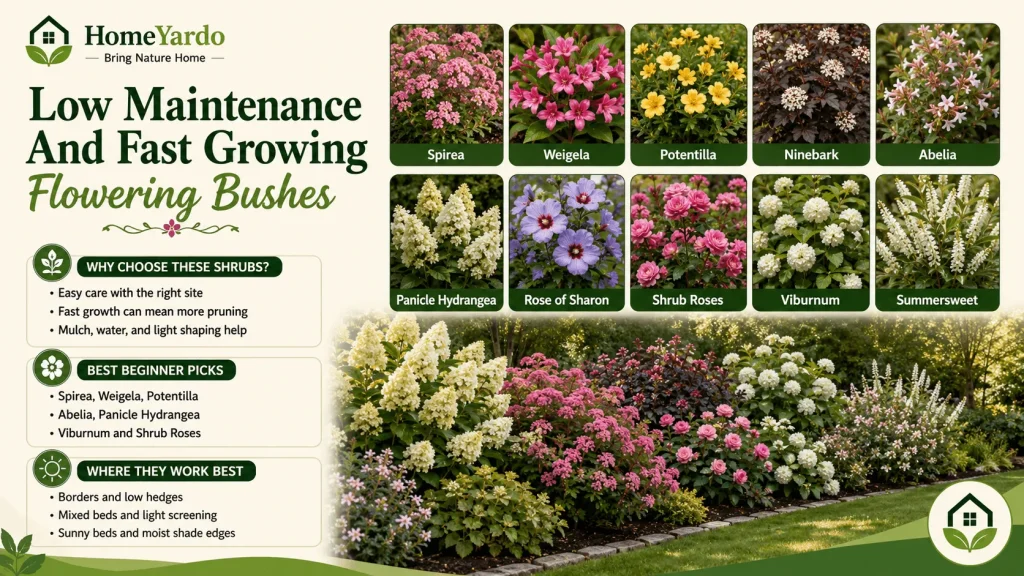
Low maintenance does not equal quick growing! A fast growing shrub can fill a space quickly, but can also require more pruning.
Easy care shrubs do require the correct site, correct planting, mulch, water upon planting, and occasional shaping. The easiest-to-maintain plant is typically the one you don’t have to fit in.
Low Maintenance Flowering Shrubs For Beginners
The shrubs that are suitable for beginners should be forgiving, not too large for the shrub bed, and not too demanding when it comes to pruning.
Spirea
- Best for: easy borders and low hedges.
- Light: full sun for best bloom.
- Bloom time: spring or summer, depending on type.
- Care note: many types are easy to prune.
- Watch note: choose the size carefully.
Weigela
- Best for: spring flowers and mixed borders.
- Light: full sun to part shade.
- Bloom time: spring, with reblooming types available.
- Care note: prune after bloom if needed.
- Watch note: more sun usually means more flowers.
Potentilla
- Best for: sunny, lower care beds.
- Light: full sun.
- Bloom time: late spring to summer.
- Care note: good drainage helps.
- Watch note: avoid wet heavy soil.
Ninebark
- Best for: foliage, flowers, and informal structure.
- Light: full sun to part shade.
- Bloom time: late spring to early summer.
- Care note: useful in mixed borders and hedges.
- Watch note: can become wide.
Abelia
- Best for: light screening and long seasonal interest.
- Light: full sun to part shade.
- Bloom time: summer to fall.
- Care note: light shaping is usually enough.
- Watch note: evergreen habit depends on climate.
Panicle hydrangea
- Best for: large summer flowers with easier pruning.
- Light: full sun to part shade.
- Bloom time: summer to fall.
- Care note: often flowers on new wood.
- Watch note: still needs moisture during heat.
Rose of Sharon
- Best for: tall late season flowers.
- Light: full sun.
- Bloom time: late summer to fall.
- Care note: prune before new spring growth if needed.
- Watch note: may self seed in some gardens.
Shrub roses
- Best for: long bloom and classic flowers.
- Light: full sun.
- Bloom time: spring through fall depending on type.
- Care note: choose disease resistant types.
- Watch note: some roses need more care in humid climates.
Viburnum
- Best for: flowers, berries, and screening.
- Light: full sun to part shade.
- Bloom time: spring in many types.
- Care note: choose by mature size.
- Watch note: not all viburnums are small.
Summersweet
- Best for: shade edges and moist soil.
- Light: part shade to sun.
- Bloom time: summer.
- Care note: useful for pollinator beds.
- Watch note: may spread slowly.
Fast Growing Flowering Shrubs

Shrubs grow rapidly and add height and structure in a new yard where screening is needed as well. Differential planting is more important than low growing shrubs for full sun.
Rose of Sharon
- Best for: quick late season height.
- Light: full sun.
- Bloom time: late summer to fall.
- Care note: space away from windows and paths.
- Watch note: seedlings may need removal.
Forsythia
- Best for: fast spring color.
- Light: full sun to part shade.
- Bloom time: early spring.
- Care note: prune after flowering.
- Watch note: needs room for arching stems.
Butterfly bush
- Best for: fast summer flowers.
- Light: full sun.
- Bloom time: summer to fall.
- Care note: cut back based on local climate and plant health.
- Watch note: check local invasive status.
Weigela
- Best for: fast spring color in sunny beds.
- Light: full sun to part shade.
- Bloom time: spring.
- Care note: light shaping keeps it balanced.
- Watch note: compact forms suit small yards better.
Viburnum
- Best for: structure and screening.
- Light: full sun to part shade.
- Bloom time: spring.
- Care note: choose by mature size.
- Watch note: some types grow large.
Lilac
- Best for: spring fragrance and height.
- Light: full sun.
- Bloom time: spring.
- Care note: remove old stems gradually if needed.
- Watch note: needs air movement.
Mock orange
- Best for: fragrant, quick structure.
- Light: full sun to part shade.
- Bloom time: late spring to early summer.
- Care note: Prune after flowering.
- Watch note: many types need room.
Elderberry
- Best for: flowers, fruit interest, and naturalized areas.
- Light: full sun to part shade.
- Bloom time: late spring to summer.
- Care note: Use in larger spaces.
- Watch note: confirm edible use and cultivar before harvesting.
Longest Blooming And Repeat Flowering Shrubs

May be prolonged into the warm season by a long-blooming shrub, but the length of bloom varies with cultivar, climate, pruning, watering, and deadheading.
With consistent care, sun and air movement, shrub roses can bloom for a considerable amount of time. Potentilla can provide long-lasting colour in sunny beds. In mild winters, Abelia frequently extends the summer into autumn.
Other plants that can add colour to the garden for longer include rose of Sharon, crape myrtle, panicle hydrangea, reblooming weigela, butterfly bush, and caryopteris. No one would say that they bloom throughout the year in a normal garden.
Plant And Forget Does Mean No Care

A low maintenance flowering shrub will still require some attention during its first season. Water thoroughly during root establishment, mulch the root area, and ensure the mulch does not come into contact with the stems.
Don’t plant too deep or too light for the shrub. Having a hardy plant doesn’t make it easy to care if it’s in the shade.
Prune shrubs on a once or twice yearly basis. Search for scab, lack of flowers, poor flowering, overcrowding, damage from browsing and pruning needs.
Flowering Hedges, Privacy Shrubs, And Landscaping Uses

Flowering bushes can be used to frame a path, frame a fence, screen a wall, soften a wall or even provide more privacy for a patio.
Full sun hedge plants require density, height and pruning tolerance. Shrubs must have a compact habit when planted in a walkway. A pot culture container shrub requires a root system that is resistant to pot culture.
What Shrubs Are Good For Privacy Hedge?
Flower hedges are available in formal and informal designs. The natural shape is more appealing than regular clipping in most flowering evergreen hedge plants. For stronger screening, combine flowering shrubs with privacy plants that provide height, density, or evergreen cover outside the bloom season
Viburnum
- Best for: informal privacy and spring flowers.
- Light: full sun to part shade.
- Bloom time: spring.
- Care note: space by mature width.
- Watch note: Evergreen privacy depends on the species.
Rose of Sharon
- Best for: tall summer privacy.
- Light: full sun.
- Bloom time: late summer to fall.
- Care note: Use near fences or back borders.
- Watch note: may not screen in winter.
Camellia
- Best for: evergreen privacy in mild climates.
- Light: filtered light or morning sun.
- Bloom time: winter to spring, depending on type.
- Care note: protect from harsh wind.
- Watch note: climate sensitive.
Lilac
- Best for: fragrant spring screening.
- Light: full sun.
- Bloom time: spring.
- Care note: Prune after bloom.
- Watch note: deciduous, so winter privacy is limited.
Mock orange
- Best for: fragrant informal hedges.
- Light: full sun to part shade.
- Bloom time: late spring to early summer.
- Care note: Prune after bloom.
- Watch note: allow room for arching stems.
Ninebark
- Best for: informal hedges and foliage contrast.
- Light: full sun to part shade.
- Bloom time: late spring to early summer.
- Care note: can be renewed by pruning older stems.
- Watch note: dark foliage is stronger in the sun.
Rhododendron
- Best for: evergreen screening in filtered light.
- Light: part shade.
- Bloom time: spring.
- Care note: acidic soil is usually needed.
- Watch note: not suited to dry exposed sites.
Abelia
- Best for: light screening and long seasonal interest.
- Light: full sun to part shade.
- Bloom time: summer to fall.
- Care note: light pruning after growth flushes.
- Watch note: winter foliage varies by climate.
Best Flowering Bushes For Front Yard Landscaping

Bushes planted in the front yard should be aesthetically pleasing and not obstruct windows or create an obstruction to the front door or impede maintenance. Good varieties include hydrangea, spirea, weigela, dwarf lilac, compact shrub roses, azalea, camellia, compact viburnum and abelia.
Layer for added shape. Shrubs should be taller at the rear, medium at the middle and lower towards the front edge. Pair these shrubs with full sun perennial plants in bright beds to keep colour moving after some shrub flowers fade.
Best Flowering Bushes For Borders And Walkways

Shrubs should be kept in line for borders and walkways and do not overhang foot traffic areas. Spirea, potentilla, lavender, dwarf roses, compact weigela, caryopteris, itea, and small hydrangeas can be effective.
Shared edges can give a natural feel to the path, but do not block mobility by plants. Measure the width of mature plants prior to planting.
Do not plant thorny shrubs near narrow paths, gates, or play areas unless space allows.
Best Flowering Bushes For Containers And Patios

If drainage is good and the pot is large enough, it can be used for small shrubs in containers. Dwarf hydrangea, dwarf gardenia, compact azalea, dwarf spirea, small abelia, compact lavender and dwarf shrub roses are good varieties.
Shrubs in containers dry out quicker than shrubs in the garden. In summer, they might require more watering and in cold regions, they may require some protection for their roots.
Correctly use a container with adequate soil volume and drainage holes. A good potting mix is generally preferable since heavy garden soil can compact in pots.
Best Flowering Bushes For Pollinators And Wildlife

When planted strategically, shrubs can provide support to bees, butterflies, hummingbirds and birds. All of this helps: nectar rich flowers, berries, dense stems, staggered bloom times.
For better wildlife value, plant appropriate species in the plant area and do not plant shrubs that are known to spread vigorously in the local area.
Flowering Bushes That Attract Butterflies
Butterfly friendly shrubs should provide nectar without creating local spread problems.
Butterfly bush
- Best for: butterflies and summer flowers.
- Light: full sun.
- Bloom time: summer to fall.
- Care note: choose approved sterile or non invasive cultivars where needed.
- Watch note: can be invasive in some regions.
Caryopteris
- Best for: late season pollinator flowers.
- Light: full sun.
- Bloom time: late summer to fall.
- Care note: Use in well drained soil.
- Watch note: may struggle in wet soil.
Summersweet
- Best for: fragrant summer flowers and pollinators.
- Light: part shade to sun.
- Bloom time: summer.
- Care note: handles moist soil.
- Watch note: can slowly spread.
Buttonbush
- Best for: wet areas and pollinator interest.
- Light: full sun to part shade.
- Bloom time: summer.
- Care note: works near rain gardens or moist sites.
- Watch note: too large for many small beds.
Abelia
- Best for: long seasonal flowers and light screening.
- Light: full sun to part shade.
- Bloom time: summer to fall.
- Care note: use where a soft arching habit fits.
- Watch note: evergreen habit varies by zone.
Single flowered shrub roses
- Best for: open flowers that pollinators can reach.
- Light: full sun.
- Bloom time: varies by type.
- Care note: choose disease resistant varieties.
- Watch note: double flowers may be less useful for pollinators.
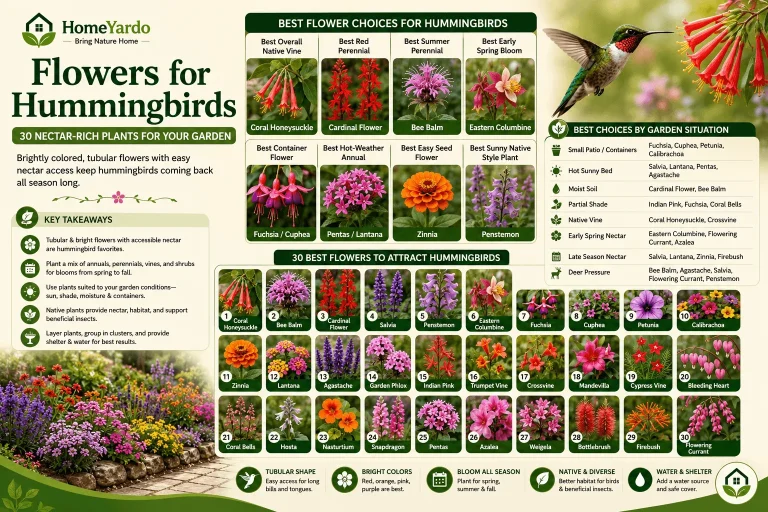
For more nectar rich planting ideas, combine shrubs with flowers for hummingbirds in sunny borders.
Shrubs That Support Birds And Hummingbirds
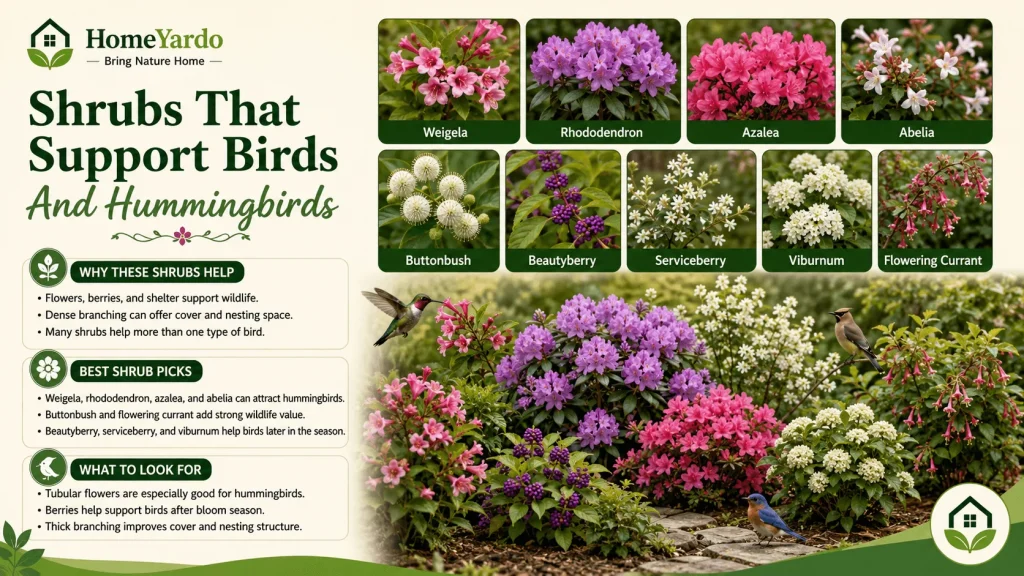
Shrubs can provide birds with flowers, berries, cover or nesting structure.
Weigela, rhododendron, azalea, abelia, buttonbush, beautyberry, serviceberry, viburnum, and flowering currant can all provide wildlife benefits, in varying degrees.
Hummingbirds may be attracted to tubular flowers. Viburnum, serviceberry and beautyberry can provide support to the birds later in the season. Cover can also be formed from dense branching.A mixed border can connect bushes with a wildflower garden for a softer, wildlife friendly layout.
Native And Non-Invasive Shrubs

Often, native or regionally adapted shrubs are better adapted to local soil and rainfall and local insects and wildlife than poorly chosen ornamental shrubs.
Shrub varieties such as native viburnum, summersweet, buttonbush, ninebark, serviceberry, fothergilla, itea, and native dogwood are good choices.
It is still important to consider local plants. What works well in one area may not work in another and can become weak, aggressive, or short-lived. Local extension advice can assist in determining safety.
Flowering Bush Care Guide

Properly planted and managed shrubs will flower more profusely. Care can be very simple but it should be appropriate for the shrub type.
Common issues are related to shallow watering, poor spacing, incorrect pruning time, excessive nitrogen levels and the incorrect selection of shrubs in the wrong light.
| Task | Best Timing | Applies To | Notes |
|---|---|---|---|
| Planting | Spring or fall | Most shrubs | Avoid heat waves and frozen soil |
| Watering | First season and dry spells | New shrubs | Deep watering is better than light daily watering |
| Mulching | After planting and yearly refresh | Most shrubs | Keep mulch away from stems |
| Feeding | Spring if needed | Depends on shrub | Avoid excess nitrogen if blooms are poor |
| Pruning spring bloomers | After flowering | Lilac, forsythia, mock orange, quince | Late pruning can remove buds |
| Pruning summer bloomers | Late winter or early spring | Rose of Sharon, panicle hydrangea, some roses | Depends on species and cultivar |
Good care starts at planting. A shrub placed in the wrong site may never perform well, even with fertilizer and pruning.
When And How To Plant
Many bushes can be planted in the spring or fall. Do not plant in heat waves, drought stress and frozen soil.
Dig a hole broader than the root ball, but not too deep. The crown or root flare should not be buried at the proper depth.
Deep water newly planted areas after establishment. Cover the root area with mulch; avoid mulch in contact with stems to prevent rot.
Watering And Mulching
Watering should be regular for the first year until the shrubs have become established. Deep watering will be more effective than surface splash watering.
Established shrubs vary. Other plants such as hydrangeas, summersweet, may require more moisture or water; lavender, cistus and some dry garden shrubs want drier drainage.
Mulch promotes root protection, reduces moisture fluctuation and minimizes weeds. In most cases, once a year will suffice if the layer remains thin and breathable.
Feeding And Soil Improvement
Compost can help to enhance the texture of the soil and promote root development. It is generally preferable to heavy feeding by not being certain of the soil requirements.
Excess nitrogen may result in excessive foliage at the expense of flowers. Before applying fertilizer, if a shrub is green but not blooming, consider sun, pruning, plant age and water.
A variety of plants, such as azalea, rhododendron, camellia, and gardenia, may require acidic soils. A soil test is more accurate than a guess.
Pruning By Bloom Time
Old wood is the source of the flowers for many spring shrubs. Lilac, forsythia, mock orange and flowering quince are typically pruned post flowering.
A lot of shrubs bloom on new growth in the summer. In late winter or early spring, rose of Sharon, panicle hydrangea, and some shrub roses can be pruned.
Pruning is dependent upon the type of hydrangea. According to Oregon State Extension, panicle and smooth hydrangeas produce flowers on new wood, while other varieties of hydrangeas produce flowers on old wood.
Why Flowering Bushes Do Not Bloom
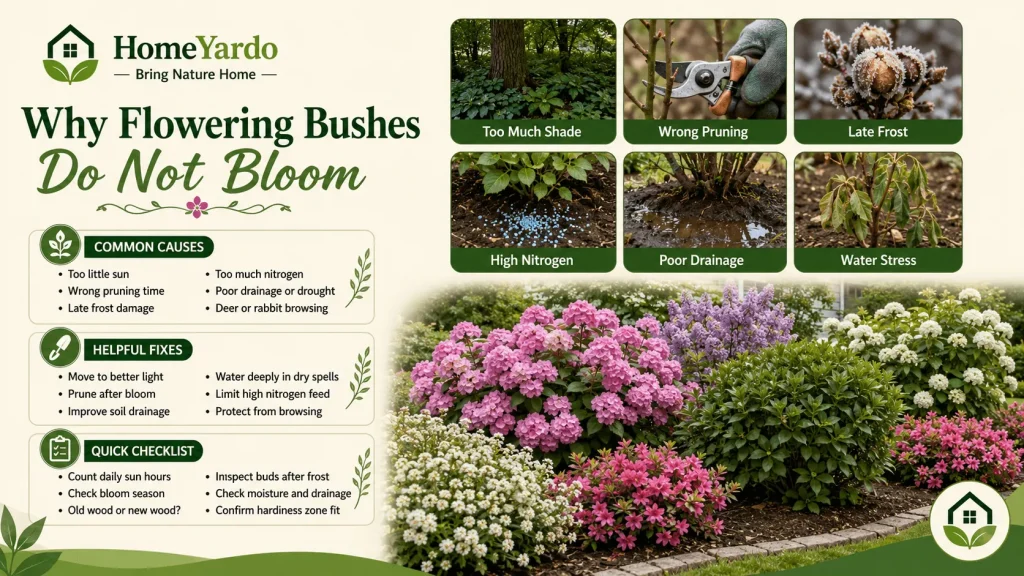
Although an appearance of good health, a flowering bush may yield little or no flowers. Light, pruning, frost, fertilizer, age of plant, water stress, poor drainage, browsing or the wrong cultivar are the most common causes of poor bloom.
The cure depends on the cause. Fertilizer is not a cure-all.
Common Causes
Weak flowering is one of the most frequent causes and can be due to insufficient sunlight. Sun loving flowering shrubs that are planted in shade can produce foliage and little or no flowers.
If the flowers buds are removed by the wrong time of pruning, they cannot be replaced. Winter or early spring pruning can cause damage to spring bloomers since the buds were already formed.
Bud damage from late frost occurs before the bud opens. Also, excessive nitrogen, poor drainage, drought, deer browsing, young plant age and poor climate fit can lead to reduced flowering.
Some helpful solutions are relocating a shrub to a more favorable light, pruning after bloom, limiting high nitrogen fertilizing, enhancing drainage, watering deeply during dry periods, and fencing out browsing when necessary.
Quick Troubleshooting Checklist
Use a simple check before replacing the shrub:
- Count daily sun hours.
- Confirm the expected bloom season.
- Review pruning timing.
- Check whether the shrub blooms on old wood or new wood.
- Inspect buds after frost.
- Check soil moisture and drainage.
- Avoid heavy nitrogen feeding.
- Look for deer, rabbit, pest, or stem damage.
- Confirm the shrub fits the local hardiness zone.
- Check if nearby trees are creating too much shade.
A young shrub may need one full growing season to settle after planting. If the plant is healthy, patience may be part of the solution.
Common Mistakes To Avoid

Problems with shrubs often start prior to planting. It’s easy enough to pick up the most beautiful flower at the garden centre, but it’s failure to find the proper home that will make the difference.
Do not select just on colour. Look at mature height, sun requirements, soil and drainage requirements and pruning requirements first.
Don’t plant tall shrubs near a window or a narrow way. Don’t overlook the shade shrubs in the blazing heat of the afternoon sun, or shade the deep shade shrubs. Don’t over prune the plant, unless you know that it blooms on old wood or new wood.
But fast growing shrubs are not necessarily easy to take care of. They may require regular trimming in small beds. Wherever possible, local alternatives to invasive shrubs should be used.
Conclusion
The ideal flowering bush is the one that is best suited to the location. Before choosing flower color, consider the other factors including sun exposure, hardiness, soil, mature size, season of bloom, and care requirements.
Use shrubs with varying bloom periods for longer color. For structure, use evergreen shrubs, or deciduous shrubs for more robust seasonal flowers; or compact shrubs in areas with limited space.
Begin with 2 to 3 shrubs that are appropriate for the amount of light and space. A smaller, well matched planting will be more successful than a large bed of plants in need of constant correction.
FAQ’s
Hydrangea, viburnum, spirea, lilac, azalea, camellia, and shrub roses are strong choices for many home gardens. The best pick depends on sunlight, mature size, soil drainage, and local climate. For better seasonal color, combine spring bloomers with summer and late season shrubs.
Most shrubs do not bloom all year in a typical garden. Flowers usually appear in seasonal cycles, depending on the shrub and climate. For steady interest, mix spring, summer, and late season bloomers with evergreen shrubs that keep foliage through the year.
Rose of Sharon, forsythia, butterfly bush, weigela, viburnum, and ninebark can grow quickly when planted in the right conditions. Fast growth helps fill new beds and informal screens sooner. Check mature size first, because fast growing shrubs often need more pruning later.
Crape myrtle, shrub rose, potentilla, butterfly bush, vitex, rose of Sharon, and caryopteris are strong choices for sunny gardens. Smaller sunny beds may suit spirea, lavender, potentilla, or dwarf roses. In hot regions, new shrubs still need deep watering while their roots settle in.
Spirea, potentilla, weigela, abelia, ninebark, panicle hydrangea, and shrub roses are often easier to manage. Low maintenance does not mean no care. These shrubs still need correct planting, steady first year watering, light pruning, and enough space to grow naturally.
Butterfly bush, caryopteris, summersweet, abelia, buttonbush, vitex, and single flowered shrub roses can attract butterflies. Shrubs with open, nectar rich flowers are usually more useful for pollinators. Choose non invasive and regionally suitable plants whenever possible.
Water deeply during dry spells, keep mulch over the root zone, and avoid heavy pruning unless the shrub type allows it. New shrubs need closer attention than established ones. Deadheading can help some repeat bloomers look cleaner and keep producing flowers.
Azalea, rhododendron, camellia, daphne, summersweet, and some hydrangeas can grow in partial shade or shaded garden areas. Bright filtered light usually gives better blooms than dense shade. Soil moisture, drainage, and root competition from nearby trees also affect performance.
Camellia, gardenia, rhododendron, evergreen azalea, Indian hawthorn, abelia, and ceanothus can provide flowers along with lasting foliage. They work well near entries, patios, fences, and winter visible beds. Always check zone, soil, and sun needs because many evergreen shrubs are climate sensitive.
Shrub roses, butterfly bush, rose of Sharon, potentilla, abelia, crape myrtle, panicle hydrangea, and caryopteris can bloom for long periods. Bloom time depends on cultivar, weather, watering, pruning, and deadheading. Most gardens still need a mix of shrubs for color across multiple seasons.
Spirea, weigela, potentilla, panicle hydrangea, shrub roses, abelia, and ninebark are good beginner friendly choices. They are easier to grow when matched with the right light, soil, and mature space. Start with a few reliable shrubs instead of crowding the bed too quickly.
References
- https://plants.ces.ncsu.edu/plants/hydrangea-paniculata/
- https://hgic.clemson.edu/factsheet/spirea/
- https://extension.oregonstate.edu/gardening/flowers-shrubs-trees/general-care-hydrangeas
- https://extension.umd.edu/resource/butterfly-bush
- https://poisonousplants.ansci.cornell.edu/dogs/ornamental.html