Succulents for Terrariums: Open vs Closed Glass, Care and Plant Selection
Glass succulents for terrariums require an open, airy, bright, and dry environment in which to thrive. Closed jars, heavy soil, inadequate lighting or over-irrigation are the main factors limiting their success and contributing to root rot, soft leaves, mold or weak stems as a result of moisture accumulation around their roots. An ideal setup includes an open bowl filled with gritty soil mix or a hanging globe.
Small, slow-growing plants will not shade out your grass as quickly. This guide offers 55 plant options as well as comparisons between open and closed glass cacti varieties; soil layers, drainage, watering, light, common errors, cutting tools pest control fixes for fast care fixes.
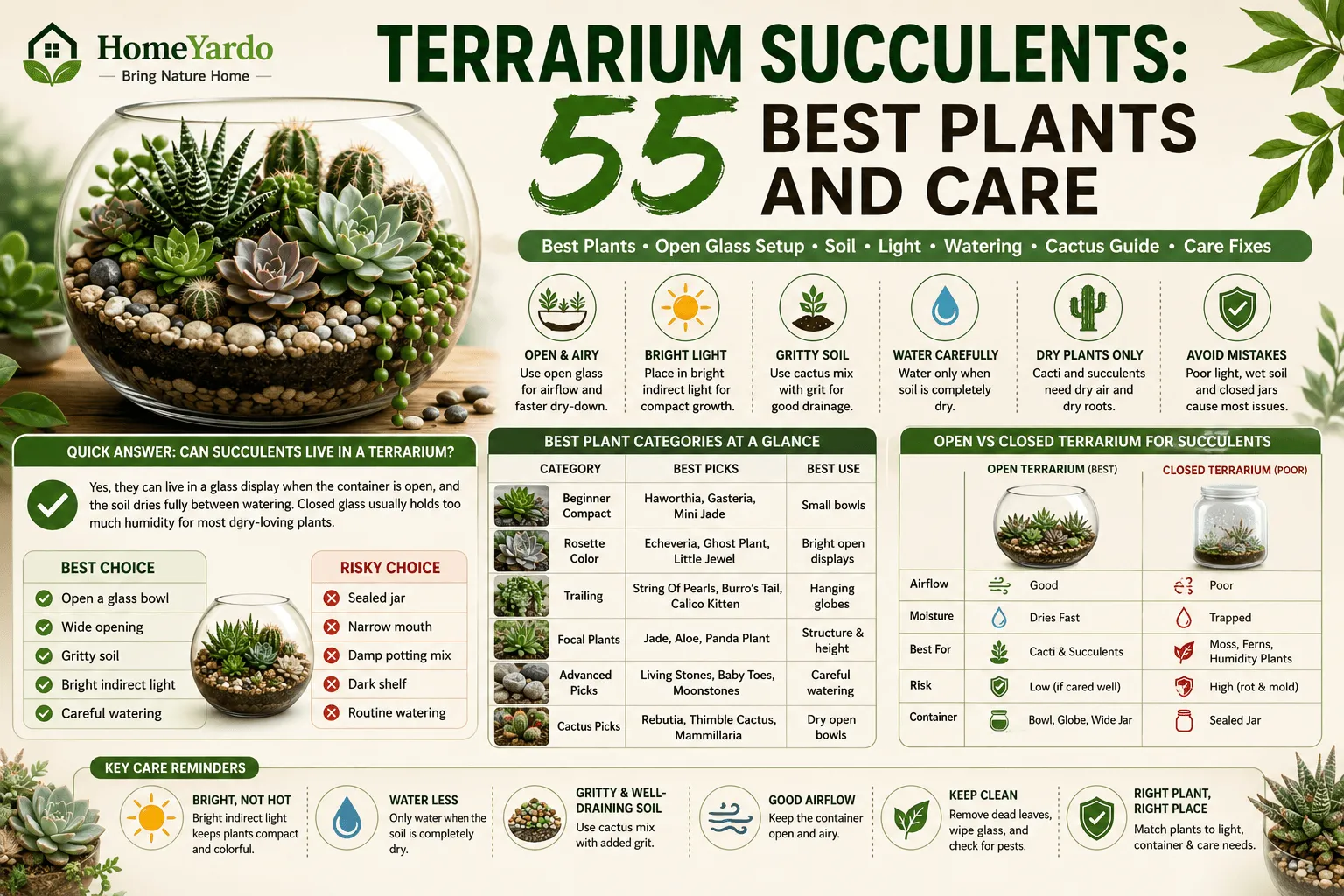
Quick Answer: Can Succulents Live In A Terrarium?
Under normal conditions, these plants should be displayed in an open glass display as long as their soil can dry completely between waterings; otherwise, they will suffer under closed conditions.
Ideal conditions include wide opening, gritty soil, bright indirect lighting and light watering. A glass container will require special care as its contents accumulate within.
| Best Choice | Risky Choice |
|---|---|
| Open a glass bowl | Sealed jar |
| Wide opening | Narrow mouth |
| Gritty soil | Damp potting mix |
| Bright indirect light | Dark shelf |
| Careful watering | Routine watering |
What Are Succulents And What Is A Terrarium?
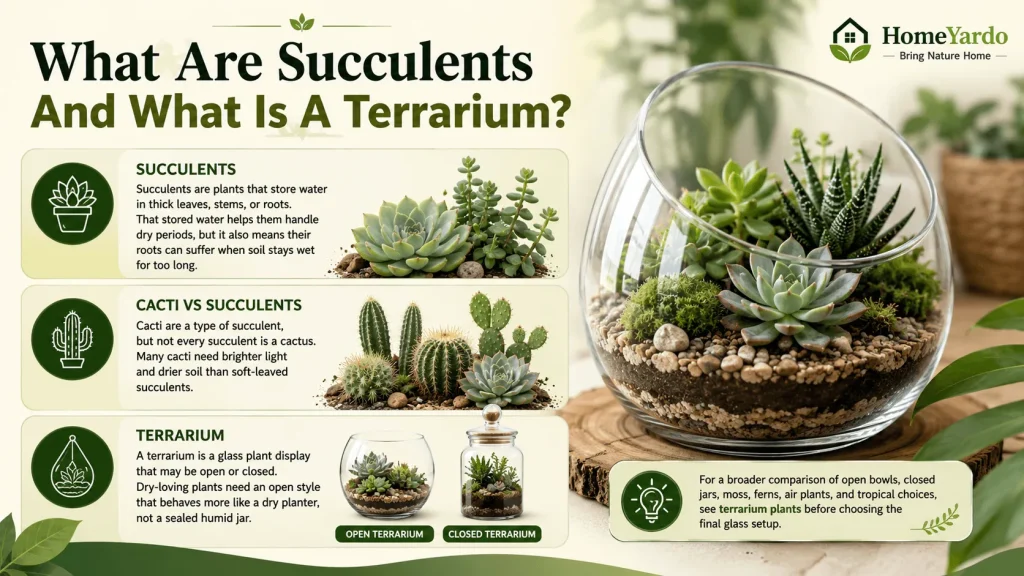
Succulent plants store water in their leaves, stems and trunks in order to survive dry spells but this can lead to root decay if soils become waterlogged.
Cacti are succulents, but not all succulents qualify as cacti. Cacti tend to require more light and less moisture than soft-leaved succulents.
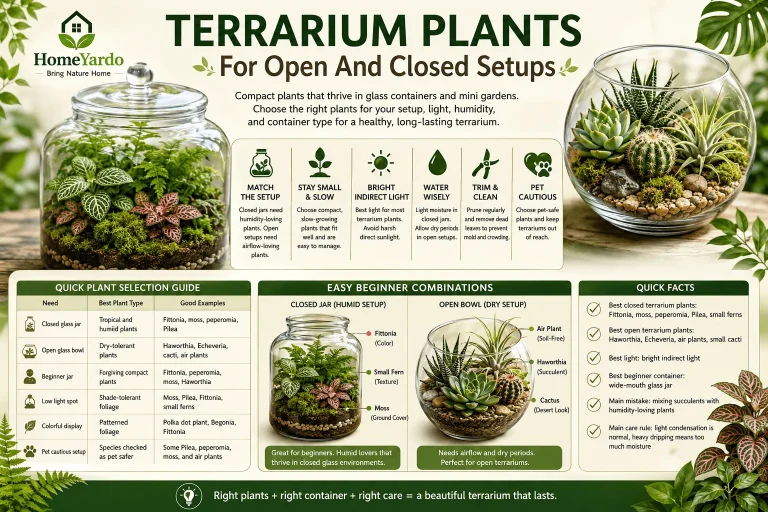
A terrarium is an enclosed plant display in glass containers that can be opened or closed as needed, providing easy maintenance for plant care. Dry-loving species require an open “dry planter” style terrarium rather than humid sealed jars for best results. For a broader comparison of open bowls, closed jars, moss, ferns, air plants, and tropical choices, see terrarium plants before choosing the final glass setup.
Open Terrarium Vs Closed Terrarium For Succulents
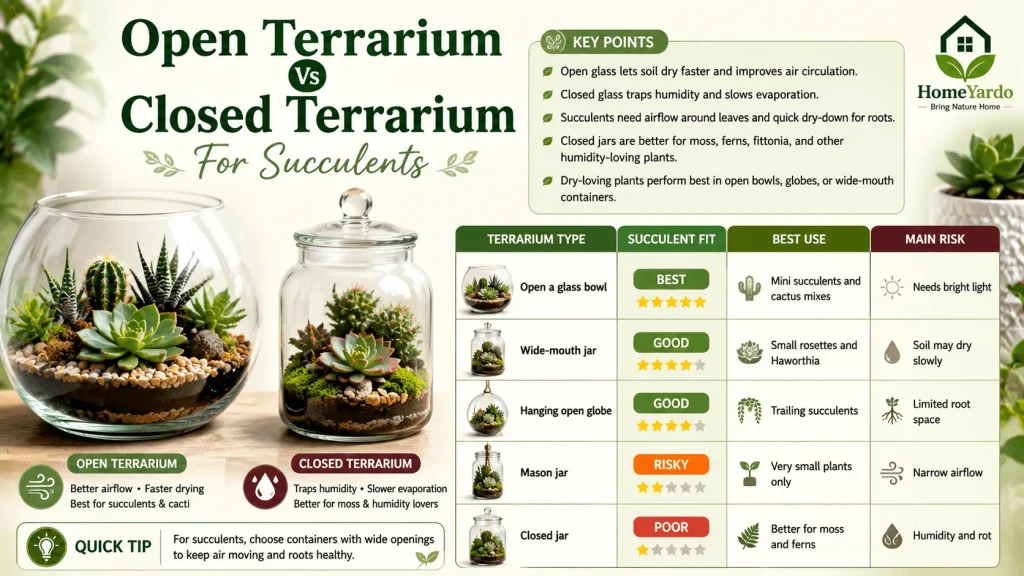
When selecting a container to house succulents, the type will have an effect on air circulation, moisture levels, light levels and root health. An open glass vase will allow soil to dry more quickly while closing one can help retain water and minimize evaporation.
An ideal glass terrarium for succulents should feature an open front. Glass terrariums need fast soil drydown near roots and adequate airflow around their foliage, while closed containers tend to retain too much moisture that leads to overwatering of succulents that thrive in dry-loving species.
Moss, ferns, fittonia and other plants that thrive best under humid conditions – such as moss, ferns and fittonia should be placed in an enclosed jar, while those that prefer dry environments would thrive better in an open bowl or globe-shaped wide-mouth container.
| Terrarium Type | Succulent Fit | Best Use | Main Risk |
|---|---|---|---|
| Open a glass bowl | Best | Mini succulents and cactus mixes | Needs bright light |
| Wide-mouth jar | Good | Small rosettes and Haworthia | Soil may dry slowly |
| Hanging open globe | Good | Trailing succulents | Limited root space |
| Mason jar | Risky | Very small plants only | Narrow airflow |
| Closed jar | Poor | Better for moss and ferns | Humidity and rot |
What Makes A Succulent Good For A Terrarium?
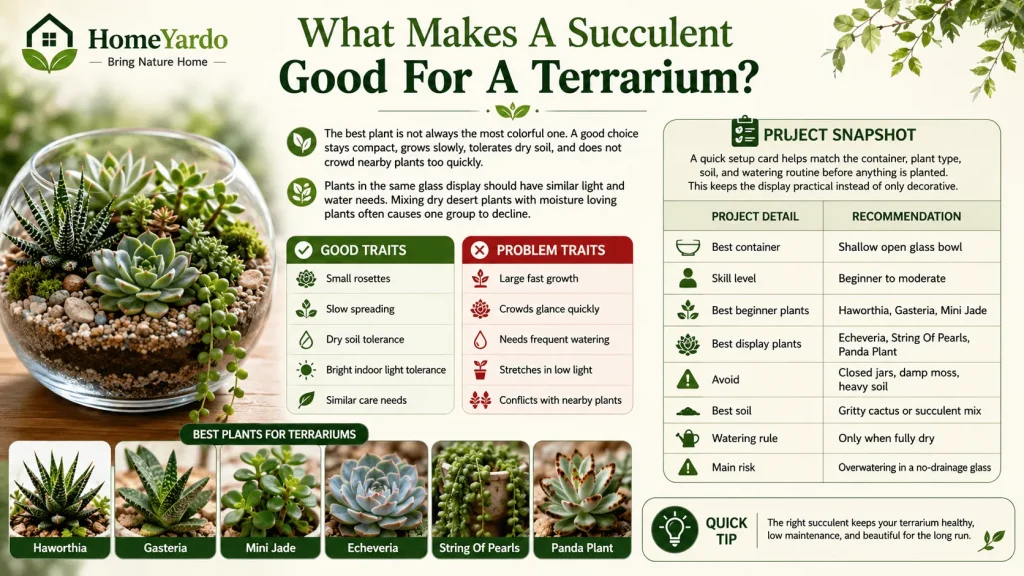
Not every plant should be colorful. An ideal succulent should grow slowly, be easy to control, not encroach too rapidly upon other plants and not require too much water; all plants in one glass should share similar lighting and water needs.
Plants adapted to thrive in water-poor desert environments might not blend as easily, due to competition for water.
| Good Traits | Problem Traits |
|---|---|
| Small rosettes | Large fast growth |
| Slow spreading | Crowds glance quickly |
| Dry soil tolerance | Needs frequent watering |
| Bright indoor light tolerance | Stretches in low light |
| Similar care needs | Conflicts with nearby plants |
Project Snapshot
A setup card that matches the container type, plant type, soil type and the watering schedule before planting.
| Project Detail | Recommendation |
|---|---|
| Best container | Shallow open glass bowl |
| Level of skill | Beginner to moderate |
| Best beginner plants | Haworthia, Gasteria, Mini Jade |
| Best display plants | Echeveria, String Of Pearls, Panda Plant |
| Avoid | Closed jars, damp moss, heavy soil |
| Best soil | Gritty cactus or succulent mix |
| Watering rule | Only when fully dry |
| Main risk | Overwatering in a no-drainage glass |
Best Plant Categories At A Glance
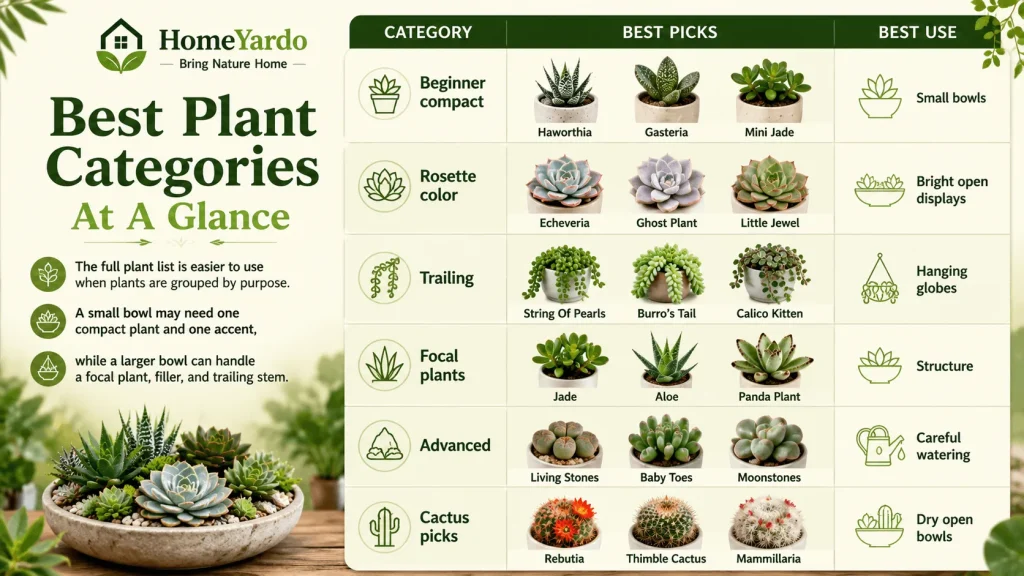
The complete list of plants is more convenient to use if plants are organized by use. For a small bowl, one compact plant and one accent plant is the recommended combination and for a larger bowl, one focal plant, one filler plant, and one trailing plant will do.
| Category | Best Picks | Best Use |
|---|---|---|
| Beginner compact | Haworthia, Gasteria, Mini Jade | Small bowls |
| Rosette color | Echeveria, Ghost Plant, Little Jewel | Bright open displays |
| Trailing | String Of Pearls, Burro’s Tail, Calico Kitten | Hanging globes |
| Focal plants | Jade, Aloe, Panda Plant | Structure |
| Advanced | Living Stones, Baby Toes, Moonstones | Careful watering |
| Cactus picks | Rebutia, Thimble Cactus, Mammillaria | Dry open bowls |
55 Best Plants For Open Glass Displays
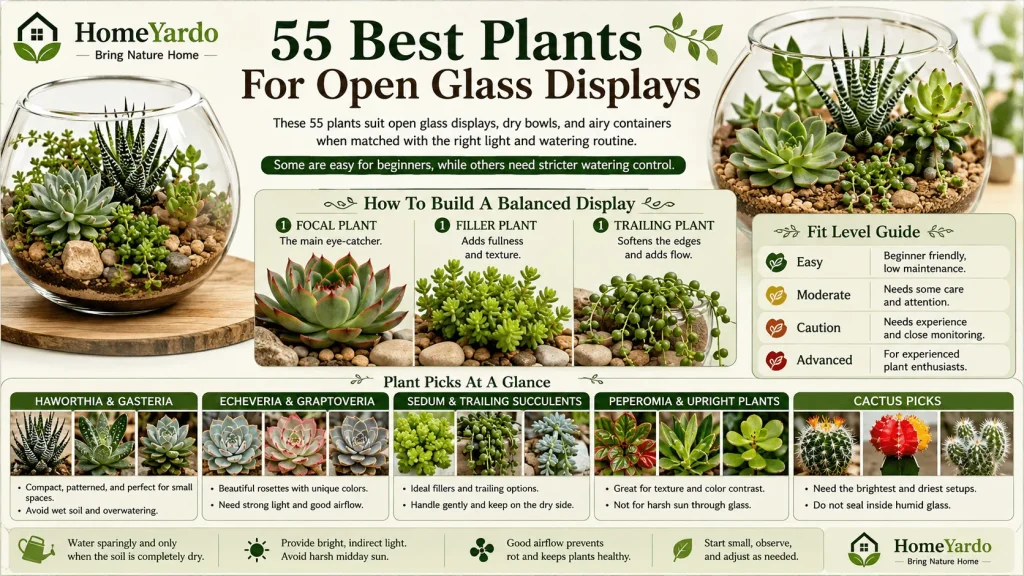
A large number of plants make excellent open displays. There are a lot of plants that do well in open displays. When paired with the proper light and watering, these 55 plants will thrive in open, glass displays, dry bowls, and airy containers.
There are some that are simple for the beginner and others that are more critical for the amount of watering. Before purchase, use the table for a plant picker. For containers with sufficient space, select compact plants first, followed by one focal plant, one filler plant and one trailing plant.
| No. | Plant | Best Use | Fit Level | Main Caution |
|---|---|---|---|---|
| 1 | Zebra Haworthia | Compact texture | Easy | Avoid wet soil |
| 2 | Haworthia Fasciata | Small rosette | Easy | Needs bright indirect light |
| 3 | Fairy Washboard | Patterned foliage | Easy | Slow growth |
| 4 | Haworthia Cooperi | Glassy leaf texture | Moderate | Sensitive to overwatering |
| 5 | Gasteria Bicolor | Upright structure | Easy | Needs dry roots |
| 6 | Gasteria Little Warty | Spotted texture | Easy | Avoid deep shade |
| 7 | Gasteria Glomerata | Tiny containers | Moderate | Needs careful watering |
| 8 | Lace Aloe | Spiky focal plant | Easy | Needs space |
| 9 | Tiger Tooth Aloe | Upright accent | Moderate | Can outgrow tiny bowls |
| 10 | Spider Aloe | Mini focal plant | Easy | Bright light preferred |
| 11 | Echeveria Elegans | Rosette color | Moderate | Stretches in low light |
| 12 | Echeveria Derenbergii | Small rosette | Moderate | Needs good light |
| 13 | Echeveria Agavoides | Strong focal shape | Moderate | Keep leaves dry |
| 14 | Echeveria Perle von Nürnberg | Color contrast | Moderate | Needs strong light |
| 15 | Ghost Plant | Pale rosette | Moderate | Leaves drop easily |
| 16 | Graptoveria Fred Ives | Colorful focal plant | Moderate | Can grow large |
| 17 | California Sunset | Warm color | Moderate | Needs pruning |
| 18 | Golden Sedum | Filler plant | Easy | Needs bright light |
| 19 | Jelly Bean Plant | Color and texture | Easy | Leaves fall if bumped |
| 20 | Burro’s Tail | Trailing edge | Moderate | Very fragile leaves |
| 21 | Sedum Burrito | Soft trailing form | Moderate | Avoid handling |
| 22 | Corsican Stonecrop | Fine groundcover look | Moderate | Can spread |
| 23 | Blue Jelly Bean | Compact filler | Easy | Needs dry soil |
| 24 | Jade Plant | Upright structure | Easy | Can outgrow glass |
| 25 | Mini Jade | Small upright plant | Easy | Prune when needed |
| 26 | String Of Buttons | Vertical texture | Easy | May get leggy |
| 27 | Watch Chain | Fine upright texture | Moderate | Needs airflow |
| 28 | Baby Necklace Vine | Trailing and upright mix | Moderate | Needs bright light |
| 29 | Calico Kitten | Colorful trailing edge | Moderate | Sensitive to excess water |
| 30 | Elephant Bush | Upright filler | Easy | Needs trimming |
| 31 | Mini Elephant Bush | Small bonsai look | Easy | Avoid soggy soil |
| 32 | Panda Plant | Fuzzy texture | Easy | Keep leaves dry |
| 33 | Paddle Plant | Bold leaf shape | Caution | Can outgrow small glass |
| 34 | Copper Spoons | Warm color accent | Caution | Needs strong light |
| 35 | Bear Paw | Soft focal plant | Moderate | Fragile leaf tips |
| 36 | Round Leaf Cotyledon | Sculptural accent | Caution | Needs room |
| 37 | String Of Pearls | Hanging effect | Moderate | Overwatering risk |
| 38 | String Of Bananas | Trailing display | Moderate | Needs bright light |
| 39 | String Of Tears | Fine trailing plant | Moderate | Avoid wet soil |
| 40 | String Of Dolphins | Novel trailing plant | Moderate | Needs airy setup |
| 41 | Ruby Glow Peperomia | Colorful compact plant | Easy | Not for harsh sun |
| 42 | Happy Bean Peperomia | Narrow leaf texture | Easy | Avoid wet base |
| 43 | Sunrise Succulent | Color accent | Moderate | Needs bright light |
| 44 | Crinkle Leaf Plant | Small texture plant | Easy | Avoid leaf wetness |
| 45 | Plover Eggs Plant | Patterned leaves | Moderate | Slow growth |
| 46 | Moonstones | Rounded pastel leaves | Moderate | Leaves mark easily |
| 47 | Little Jewel | Compact rosette | Moderate | Needs dry soil |
| 48 | Baby Toes | Desert novelty plant | Advanced | Easy to overwater |
| 49 | Living Stones | Tiny desert display | Advanced | Strict watering needs |
| 50 | Tiger Jaws | Textured focal plant | Moderate | Needs bright light |
| 51 | Hens And Chicks | Rosette cluster | Caution | Often better outdoors |
| 52 | Cobweb Hens And Chicks | Rosette texture | Caution | Needs bright, airy setup |
| 53 | Moon Cactus | Color accent | Caution | Grafted plant, shorter-lived |
| 54 | Thimble Cactus | Mini cactus texture | Moderate | Needs open, dry glass |
| 55 | Rebutia Cactus | Small flowering cactus | Moderate | Needs strong light |
Ruby Glow Peperomia and Happy Bean Peperomia are succulent-like plants often grown with similar indoor care, but they are not classic desert succulents. Use them in open displays with careful watering and avoid harsh sun through glass.
Cactus picks need the brightest and driest setups in the table. They should not be sealed inside humid glass.
Top 20 Plant Notes For Faster Choice
The table above gives a broad selection of help. These shorter notes make it easier to choose the most useful plants for common indoor glass displays.
| Plant | Why It Works | Best Container |
|---|---|---|
| Zebra Haworthia | Compact, tough, and tolerant of bright indoor light | Small open bowl |
| Haworthia Fasciata | Strong leaf pattern with slow growth | Wide-mouth jar |
| Fairy Washboard | Adds texture without spreading fast | Shallow glass bowl |
| Haworthia Cooperi | Soft translucent leaves suit small displays | Bright open dish |
| Gasteria Bicolor | Upright shape and sturdy growth | Wide-mouth jar |
| Gasteria Little Warty | Spotted leaves add detail in tight spaces | Small open bowl |
| Lace Aloe | Gives a spiky focal shape without a huge size | Medium open bowl |
| Echeveria Elegans | Classic rosette shape for bright displays | Bright open dish |
| Echeveria Derenbergii | Small rosette with neat growth | Shallow open bowl |
| Ghost Plant | Pale color and rosette form add contrast | Bright open dish |
| Golden Sedum | Works as a bright filler plant | Open bowl |
| Jelly Bean Plant | Rounded leaves add color and texture | Small open bowl |
| Burro’s Tail | Creates a soft trailing edge | Wide bowl rim |
| Mini Jade | Gives structure without filling space too fast | Medium open bowl |
| Elephant Bush | Easy upright filler when pruned | Large open dish |
| Panda Plant | Fuzzy texture and slower growth | Open glass bowl |
| String Of Pearls | Strong trailing effect for open globes | Hanging globe |
| Moonstones | Rounded pastel leaves give a sculptural look | Bright open bowl |
| Tiger Jaws | Compact and bold for dry displays | Open desert bowl |
| Thimble Cactus | Small cactus texture for bright dry glass | Dry open bowl |
Best Small Succulents Terrarium That Do Not Outgrow Terrariums
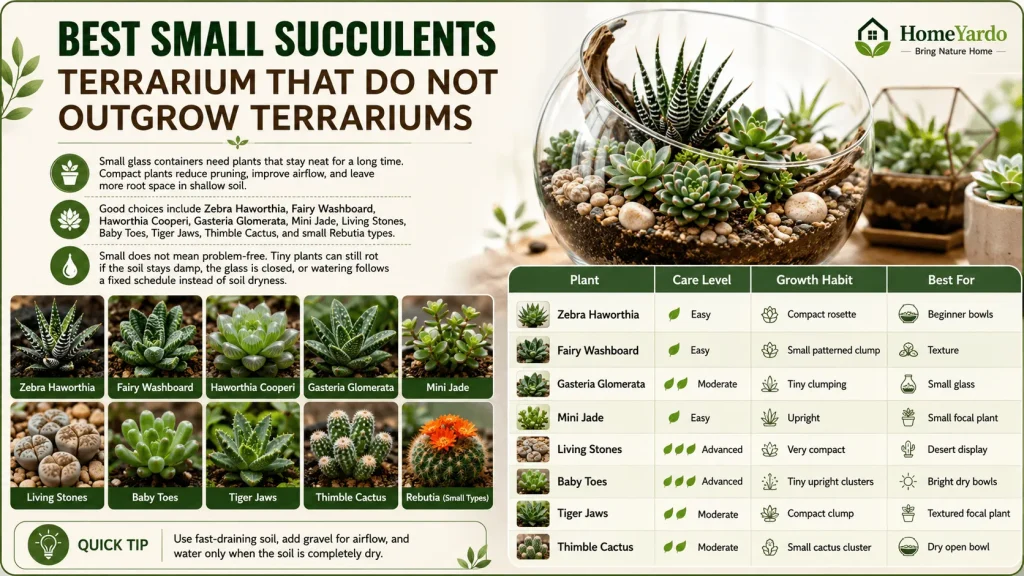
Plants that will require long maintenance are suitable for small glass containers. Compact plants minimize pruning, enhance air circulation, and provide greater root volume in shallow soils.
It is best to use Zebra Haworthia, Fairy Washboard, Haworthia Cooperi, Gasteria Glomerata, Mini Jade, Living Stones, Baby Toes, Tiger Jaws, Thimble Cactus, or small varieties of Rebutia. Small is by no means trouble-free.
Even with small plants, if they are kept moist or the glass is closed, and if they are watered at the same time every day, rather than soil dryness, they will still rot.
| Plant | Care Level | Growth Habit | Best For |
|---|---|---|---|
| Zebra Haworthia | Easy | Compact rosette | Beginner bowls |
| Fairy Washboard | Easy | Small patterned clump | Texture |
| Gasteria Glomerata | Moderate | Tiny clumping | Small glass |
| Mini Jade | Easy | Upright | Small focal plant |
| Living Stones | Advanced | Very compact | Desert display |
| Baby Toes | Advanced | Tiny upright clusters | Bright dry bowls |
| Tiger Jaws | Moderate | Compact clump | Textured focal plant |
| Thimble Cactus | Moderate | Small cactus cluster | Dry open bowl |
Best Rosette Terrarium For Succulents
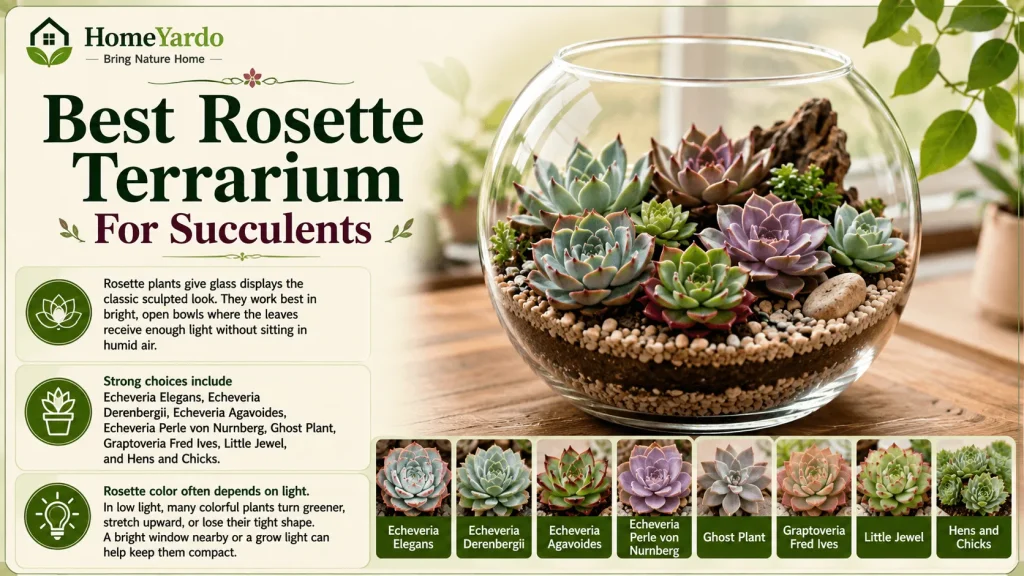
Rosette plants give glass displays the classic sculpted look. They work best in bright, open bowls where the leaves receive enough light without sitting in humid air.
Strong choices include Echeveria Elegans, Echeveria Derenbergii, Echeveria Agavoides, Echeveria Perle von Nurnberg, Ghost Plant, Graptoveria Fred Ives, Little Jewel, and Hens and Chicks.
Rosette color often depends on light. In low light, many colorful plants turn greener, stretch upward, or lose their tight shape. A bright window nearby or a grow light can help keep them compact.
Best Trailing Succulents For Hanging Terrariums
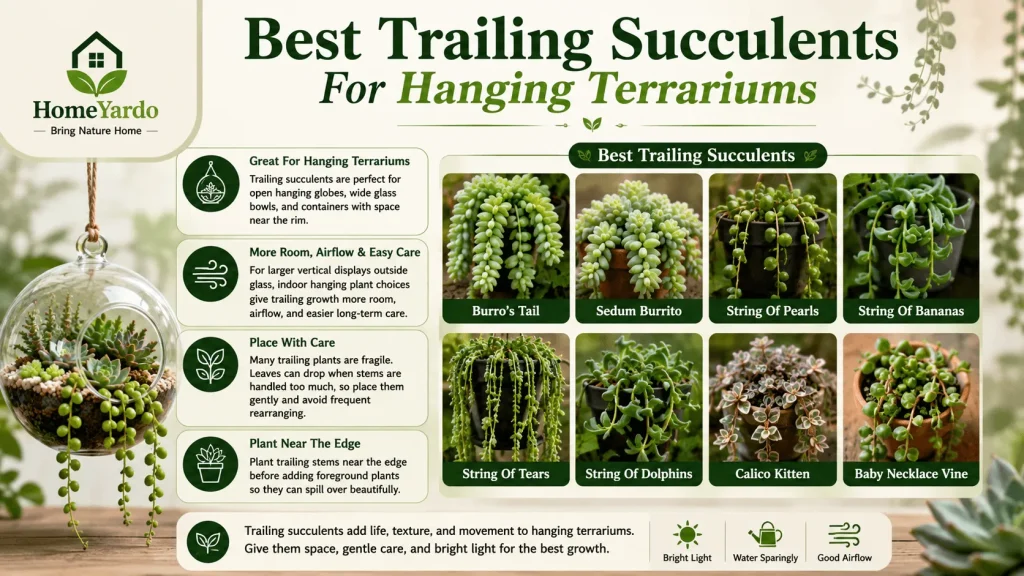
Trailing plants work well in open hanging globes, wide glass bowls, and containers with enough space near the rim. Their stems need room to spill over the edge without staying wet. Their stems need room to spill over the edge without staying wet. For larger vertical displays outside glass, indoor hanging plant choices can give trailing growth more room, airflow, and easier long-term care.
Good trailing choices include Burro’s Tail, Sedum Burrito, String Of Pearls, String Of Bananas, String Of Tears, String Of Dolphins, Calico Kitten, and Baby Necklace Vine.
Many trailing plants are fragile. Leaves can drop when stems are handled too much, so place them gently and avoid frequent rearranging. Plant trailing stems near the edge before adding foreground plants.
Best Upright And Focal Plants
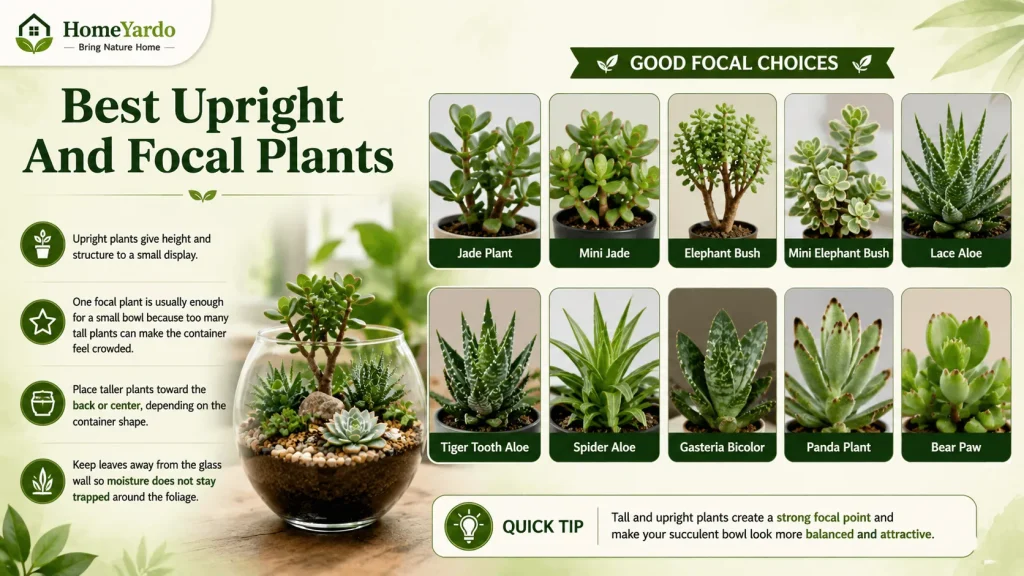
Upright plants give height and structure to a small display. One focal plant is usually enough for a small bowl because too many tall plants can make the container feel crowded.
Good focal choices include Jade Plant, Mini Jade, Elephant Bush, Mini Elephant Bush, Lace Aloe, Tiger Tooth Aloe, Spider Aloe, Gasteria Bicolor, Panda Plant, and Bear Paw.
Place taller plants toward the back or center, depending on the container shape. Keep leaves away from the glass wall so moisture does not stay trapped around the foliage.
Best Color And Texture Choices
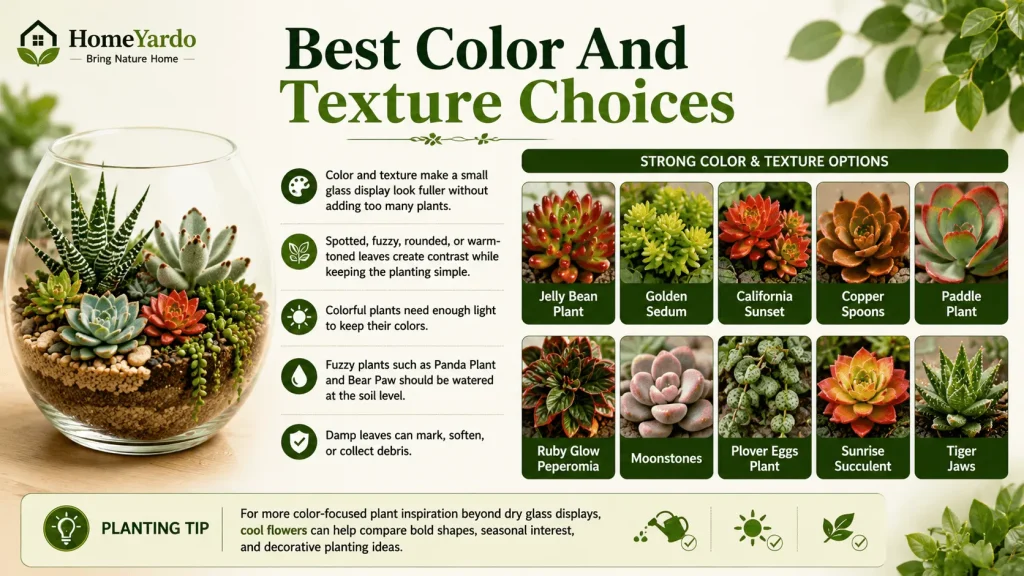
Color and texture make a small glass display look fuller without adding too many plants. Spotted, fuzzy, rounded, or warm-toned leaves can create contrast while keeping the planting simple. For more color-focused plant inspiration beyond dry glass displays, cool flowers can help compare bold shapes, seasonal interest, and decorative planting ideas.
Strong options include Jelly Bean Plant, Golden Sedum, California Sunset, Copper Spoons, Paddle Plant, Sunrise Succulent, Ruby Glow Peperomia, Moonstones, Plover Eggs Plant, and Tiger Jaws.
Colorful plants need enough light to keep their colors. Fuzzy plants such as Panda Plant and Bear Paw should be watered at the soil level because damp leaves can mark, soften, or collect debris.
Advanced Picks For Experienced Growers
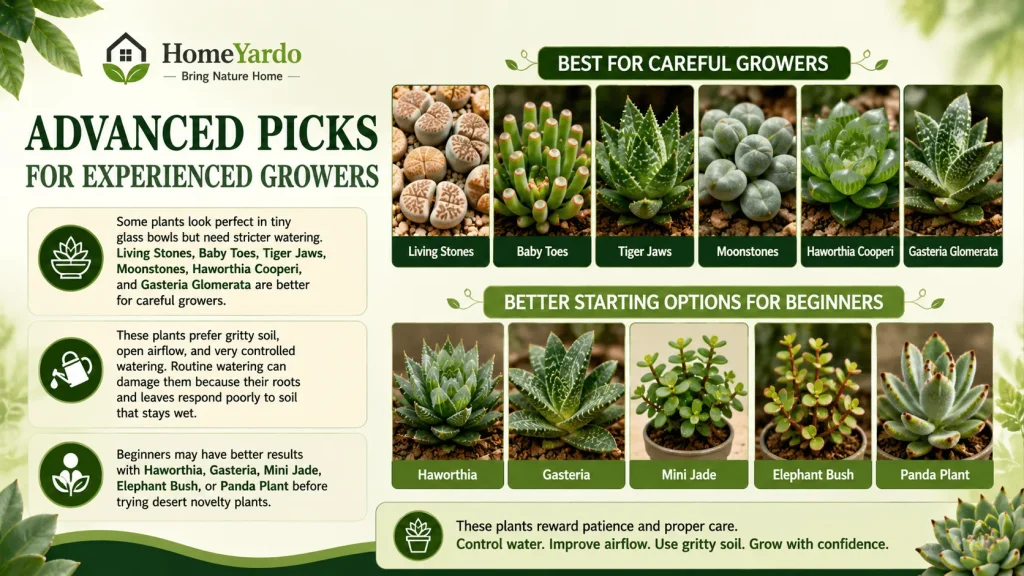
Some plants look perfect in tiny glass bowls but need stricter watering. Living Stones, Baby Toes, Tiger Jaws, Moonstones, Haworthia Cooperi, and Gasteria Glomerata are better for careful growers.
These plants prefer gritty soil, open airflow, and very controlled watering. Routine watering can damage them because their roots and leaves respond poorly to soil that stays wet.
Beginners may have better results with Haworthia, Gasteria, Mini Jade, Elephant Bush, or Panda Plant before trying desert novelty plants.
Cactus Vs Succulents For Terrariums
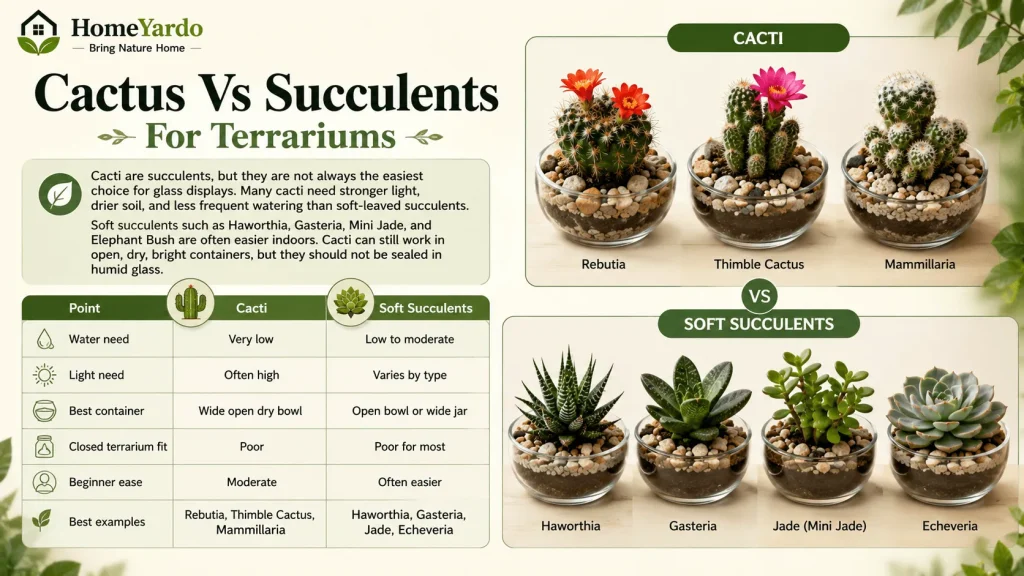
Cacti are succulents, but they are not always the easiest choice for glass displays. Many cacti need stronger light, drier soil, and less frequent watering than soft-leaved succulents.
Soft succulents such as Haworthia, Gasteria, Mini Jade, and Elephant Bush are often easier indoors. Cacti can still work in open, dry, bright containers, but they should not be sealed in humid glass.
| Point | Cacti | Soft Succulents |
|---|---|---|
| Water need | Very low | Low to moderate |
| Light need | Often high | Varies by type |
| Best container | Wide open dry bowl | Open bowl or wide jar |
| Closed terrarium fit | Poor | Poor for most |
| Beginner ease | Moderate | Often easier |
| Best examples | Rebutia, Thimble Cactus, Mammillaria | Haworthia, Gasteria, Jade, Echeveria |
Can You Mix Cactus And Succulents In A Terrarium?
Cacti and soft succulents can grow together when their care needs match. The container should be open, the soil should be gritty, and the location should provide bright light.
Avoid mixing cactus with moss, ferns, fittonia, or any plant that needs steady moisture. Also, avoid placing spiny cacti too close to fragile trailing stems.
Low-light rooms are poor matches for cactus mixes. Use cactus displays only where the container gets strong, safe light without overheating.
| Good Pairing | Why It Works |
|---|---|
| Rebutia and Tiger Jaws | Both prefer bright, dry conditions |
| Thimble Cactus and Living Stones | Desert style, low water |
| Mammillaria and Gasteria | Works in bright open glass if kept dry |
| Moon Cactus and Mini Jade | Decorative, but needs careful light balance |
Terrarium Vs Succulent Planter
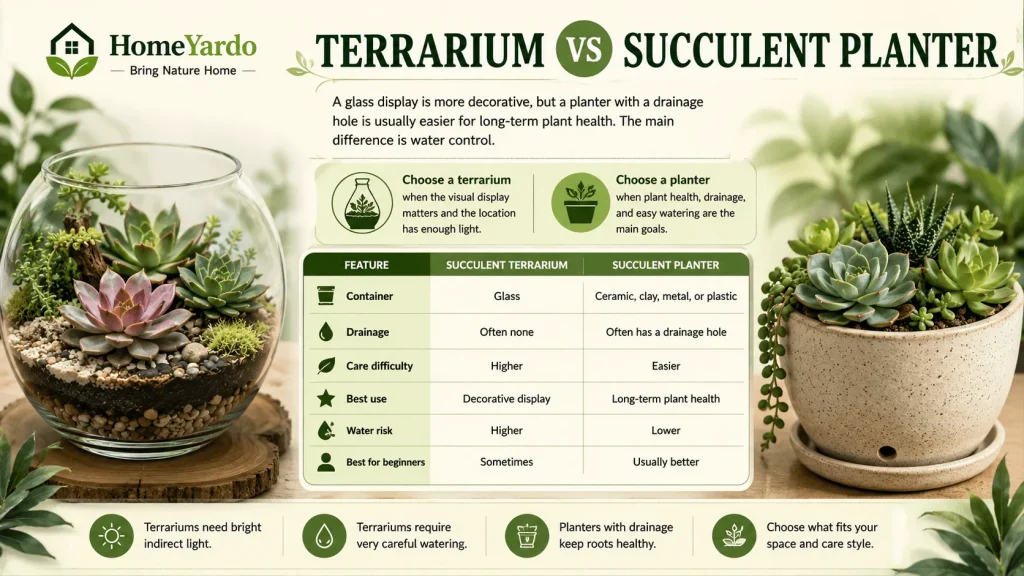
A glass display is more decorative, but a planter with a drainage hole is usually easier for long-term plant health. The main difference is water control.
Choose a terrarium when the visual display matters and the location has enough light. Choose a planter when plant health, drainage, and easy watering are the main goals.
| Feature | Succulent Terrarium | Succulent Planter |
|---|---|---|
| Container | Glass | Ceramic, clay, metal, or plastic |
| Drainage | Often none | Often has a drainage hole |
| Care difficulty | Higher | Easier |
| Best use | Decorative display | Long-term plant health |
| Water risk | Higher | Lower |
| Best for beginners | Sometimes | Usually better |
Best Containers For Succulent Terrariums
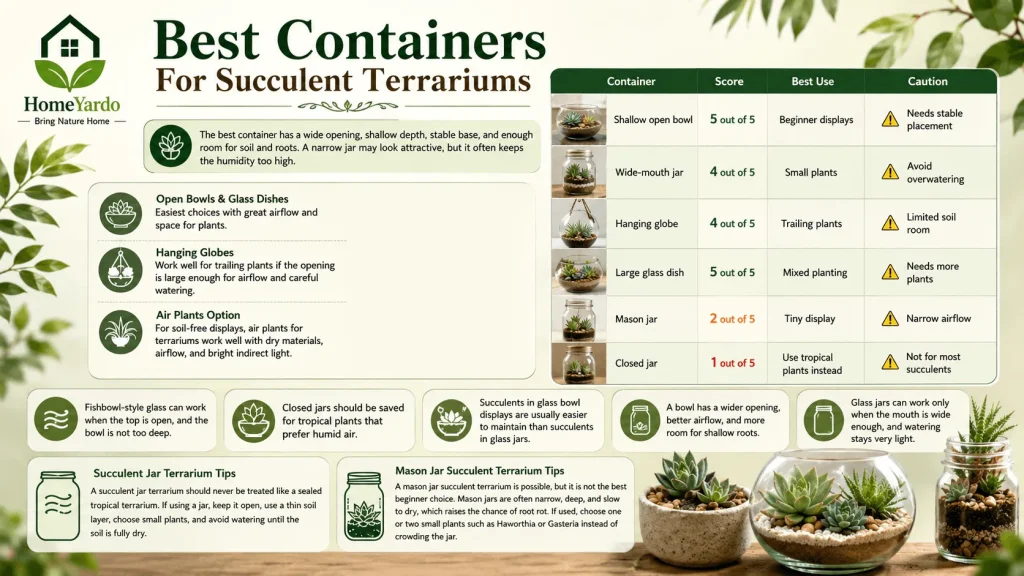
The best container has a wide opening, shallow depth, stable base, and enough room for soil and roots. A narrow jar may look attractive, but it often keeps the humidity too high.
Open bowls and large glass dishes are the easiest choices. Hanging globes work well for trailing plants if the opening is large enough for airflow and careful watering. If a soil-free display is preferred, air plants for terrariums are another open-container option that works well with dry materials, airflow, and bright indirect light.
| Container | Score | Best Use | Caution |
|---|---|---|---|
| Shallow open bowl | 5 out of 5 | Beginner displays | Needs stable placement |
| Wide-mouth jar | 4 out of 5 | Small plants | Avoid overwatering |
| Hanging globe | 4 out of 5 | Trailing plants | Limited soil room |
| Large glass dish | 5 out of 5 | Mixed planting | Needs more plants |
| Mason jar | 2 out of 5 | Tiny display | Narrow airflow |
| Closed jar | 1 out of 5 | Use tropical plants instead | Not for most succulents |
Fishbowl-style glass can work when the top is open, and the bowl is not too deep. Closed jars should be saved for tropical plants that prefer humid air. Succulents in glass bowl displays are usually easier to maintain than succulents in glass jars. A bowl has a wider opening, better airflow, and more room for shallow roots. Glass jars can work only when the mouth is wide enough, and watering stays very light.
A succulent jar terrarium should never be treated like a sealed tropical terrarium. If using a jar, keep it open, use a thin soil layer, choose small plants, and avoid watering until the soil is fully dry.
A mason jar succulent terrarium is possible, but it is not the best beginner choice. Mason jars are often narrow, deep, and slow to dry, which raises the chance of root rot. If used, choose one or two small plants such as Haworthia or Gasteria instead of crowding the jar.
Plants To Use With Caution
Some plants can work in glass, but only when the container is large, open, and bright enough. These plants should not be treated as automatic beginner choices.
Use caution with plants that grow large, need stronger light, have sharp leaves, or decline quickly when airflow is poor.
| Plant | Why Use Caution | Better Setup |
|---|---|---|
| Paddle Plant | Gets large | Wide open bowl |
| Agave | Sharp and often large | Large desert planter |
| Hens And Chicks | Often prefers outdoor conditions | Bright open display |
| Cobweb Hens And Chicks | Needs strong airflow | Outdoor style bowl |
| Moon Cactus | Grafted and not long-lived | Small dry display |
| Large Aloe | Outgrows glass fast | Separate pot |
| Large Jade | Needs pruning | Larger open container |
| Fast Sedum | Can crowd small bowls | Wide dish garden |
Plants To Avoid In Succulent Terrariums
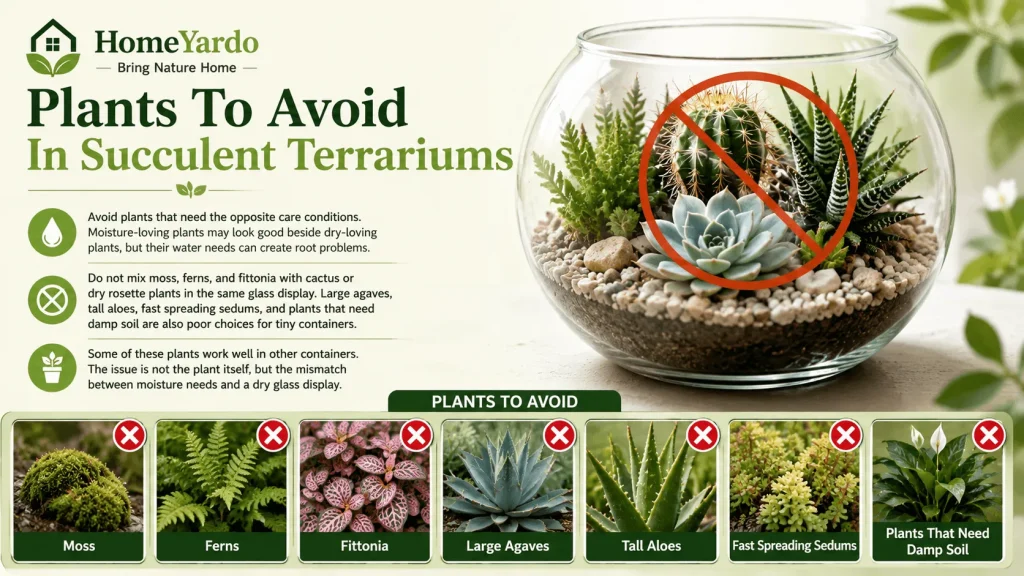
Avoid plants that need the opposite care conditions. Moisture-loving plants may look good beside dry-loving plants, but their water needs can create root problems.
Do not mix moss, ferns, and fittonia with cactus or dry rosette plants in the same glass display. Large agaves, tall aloes, fast spreading sedums, and plants that need damp soil are also poor choices for tiny containers.
Some of these plants work well in other containers. The issue is not the plant itself, but the mismatch between moisture needs and a dry glass display.
Succulents Vs Moss In Terrarium
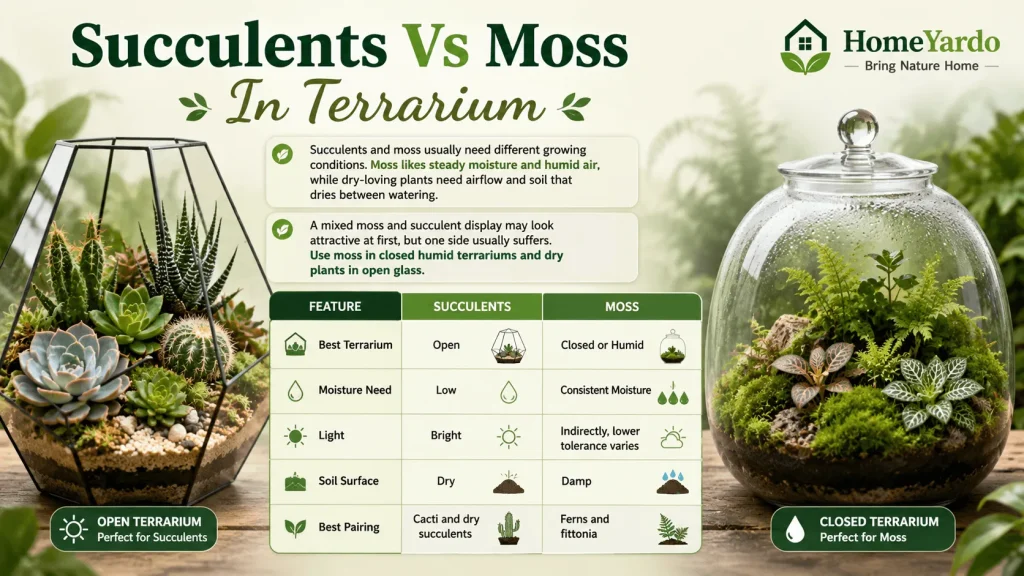
Succulents and moss usually need different growing conditions. Moss likes steady moisture and humid air, while dry-loving plants need airflow and soil that dries between watering.
A mixed moss and succulent display may look attractive at first, but one side usually suffers. Use moss in closed humid terrariums and dry plants in open glass.
| Feature | Succulents | Moss |
|---|---|---|
| Best terrarium | Open | Closed or humid |
| Moisture need | Low | Consistent moisture |
| Light | Bright | Indirectly, lower tolerance varies |
| Soil surface | Dry | Damp |
| Best pairing | Cacti and dry succulents | Ferns and fittonia |
Best Succulents For Open Vs Closed Terrarium Setups
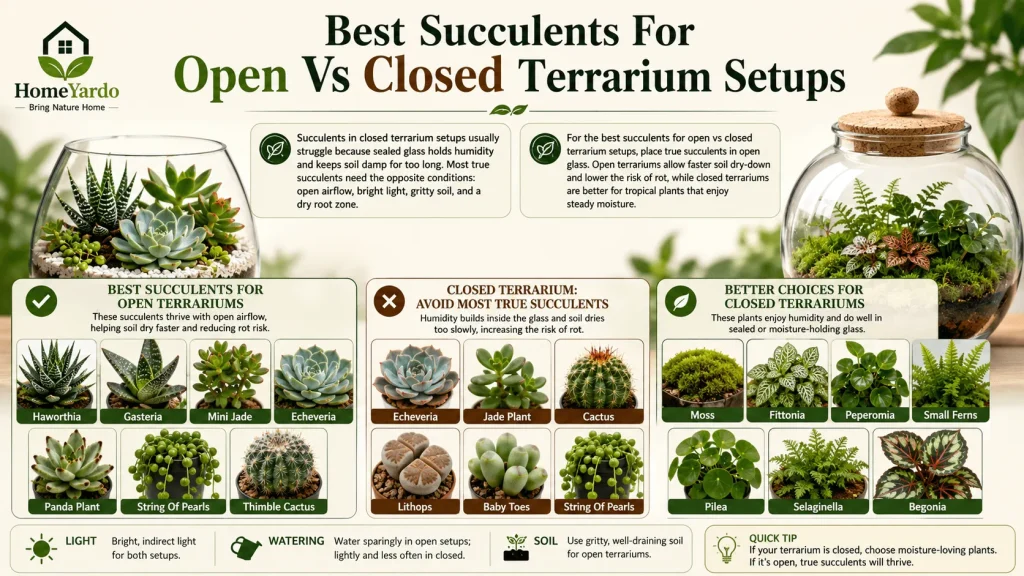
Succulents in closed terrarium setups usually struggle because sealed glass holds humidity and keeps soil damp for too long. Most true succulents need the opposite conditions: open airflow, bright light, gritty soil, and a dry root zone.
For the best succulents for open vs closed terrarium setups, place true succulents in open glass. Open terrariums allow faster soil dry-down and lower the risk of rot, while closed terrariums are better for tropical plants that enjoy steady moisture.
Best choice by setup:
Open terrarium succulents: Haworthia, Gasteria, Mini Jade, Echeveria, Panda Plant, String of Pearls, and Thimble Cactus work best because open airflow helps the soil dry and lowers rot risk.
Closed terrarium: Avoid most true succulents because humidity builds inside the glass, and soil dries too slowly. Echeveria, Jade, cactus, Lithops, Baby Toes, and String Of Pearls are especially risky in sealed glass.
Better closed setup: Moss, Fittonia, Peperomia, small ferns, Pilea, Selaginella, and Begonia handle humid glass better than desert-style succulents. These plants are better choices when the goal is a sealed or moisture-holding glass display.
What You Need Before Building
A clean supply list makes the build easier and prevents overcomplicated layering. The best setup uses fewer materials, thin layers, and tools that help control plant placement and water.
| Item | Purpose |
|---|---|
| Open a glass container | Airflow |
| Gritty cactus mix | Faster drying |
| Gravel or pumice | Thin lower layer |
| Optional charcoal | Odor control |
| Small spoon | Planting |
| Tweezers | Placing small plants |
| Soft brush | Cleaning leaves |
| Squeeze bottle | Controlled watering |
| Topdressing | Clean surface |
Rooted Plants Vs Cuttings
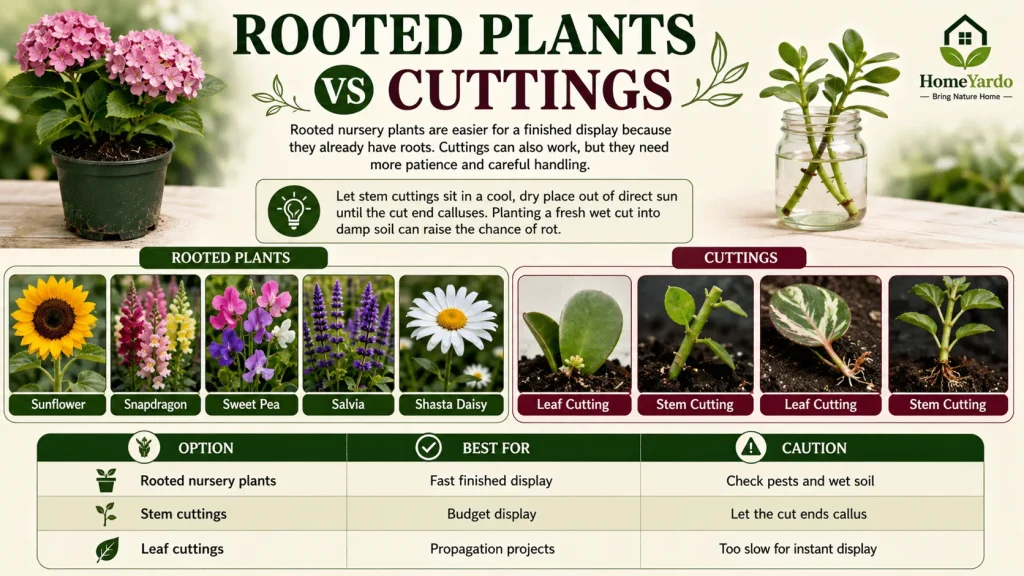
Rooted nursery plants are easier for a finished display because they already have roots. Cuttings can also work, but they need more patience and careful handling.
Let stem cuttings sit in a cool, dry place out of direct sun until the cut end calluses. Planting a fresh wet cut into damp soil can raise the chance of rot.
| Option | Best For | Caution |
|---|---|---|
| Rooted nursery plants | Fast finished display | Check pests and wet soil |
| Stem cuttings | Budget display | Let the cut ends callus |
| Leaf cuttings | Propagation projects | Too slow for instant display |
How To Make A Succulent Terrarium Step By Step
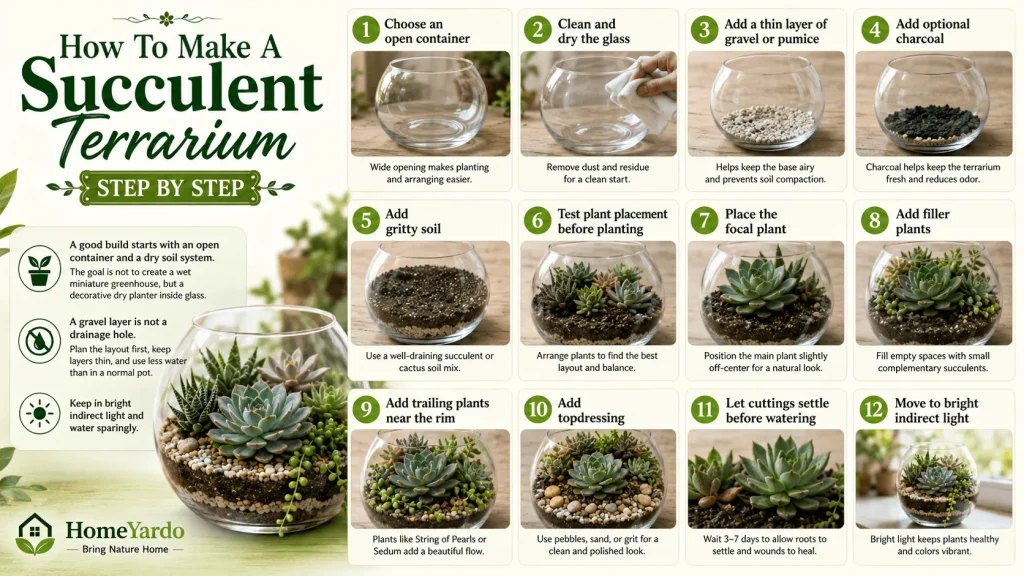
A good build starts with an open container and a dry soil system. The goal is not to create a wet miniature greenhouse, but a decorative dry planter inside glass.
A gravel layer is not a drainage hole. Plan the layout first, keep layers thin, and use less water than in a normal pot.
- Choose an open container
- Clean and dry the glass
- Add a thin layer of gravel or pumice
- Add optional charcoal
- Add gritty soil
- Test plant placement before planting
- Place the focal plant
- Add filler plants
- Add trailing plants near the rim
- Add topdressing
- Let cuttings settle before watering
- Move to bright indirect light
Succulent Terrarium Layers
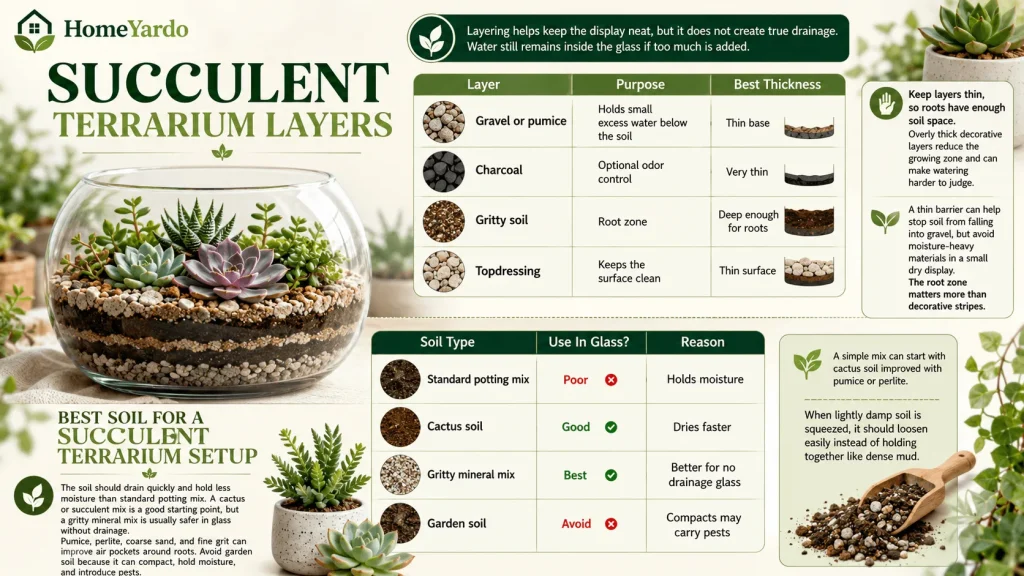
Layering helps keep the display neat, but it does not create true drainage. Water still remains inside the glass if too much is added.
Keep layers thin, so roots have enough soil space. Overly thick decorative layers reduce the growing zone and can make watering harder to judge.
| Layer | Purpose | Best Thickness |
|---|---|---|
| Gravel or pumice | Holds small excess water below the soil | Thin base |
| Charcoal | Optional odor control | Very thin |
| Gritty soil | Root zone | Deep enough for roots |
| Topdressing | Keeps the surface clean | Thin surface |
A thin barrier can help stop soil from falling into gravel, but avoid moisture-heavy materials in a small dry display. The root zone matters more than decorative stripes.
Best Soil For A Succulent Terrarium Setup
The soil should drain quickly and hold less moisture than standard potting mix. A cactus or succulent mix is a good starting point, but a gritty mineral mix is usually safer in glass without drainage.
Pumice, perlite, coarse sand, and fine grit can improve air pockets around roots. Avoid garden soil because it can compact, hold moisture, and introduce pests.
| Soil Type | Use In Glass? | Reason |
|---|---|---|
| Standard potting mix | Poor | Holds moisture |
| Cactus soil | Good | Dries faster |
| Gritty mineral mix | Best | Better for no drainage glass |
| Garden soil | Avoid | Compacts may carry pests |
A simple mix can start with cactus soil improved with pumice or perlite. When lightly damp soil is squeezed, it should loosen easily instead of holding together like dense mud.
Do Succulent Terrariums Need Drainage?
Drainage holes are best for these plants, but most decorative glass containers do not have them. That means watering volume matters more than in a normal pot.
A gravel base can catch a small amount of excess water, but it does not remove water from the container. If water pools at the bottom, roots can still suffer as moisture moves back into the soil.
Use a narrow spout, syringe, or squeeze bottle for better control. Stop watering before the bottom layer looks wet.
Do Succulent Terrariums Need Charcoal?
Charcoal is optional. A very thin layer may help reduce odor in a non-draining glass container, but it does not replace airflow, gritty soil, or careful watering.
Skip thick charcoal layers in shallow bowls because they take up root space. In a wide, open, dry setup, good soil and controlled watering matter more.
Charcoal should not be treated as a mold cure or drainage fix. It is only a small support layer when the container design allows it.
How To Water Succulents In A Terrarium?
Water only when the soil is fully dry. Use less water than a normal pot because extra water cannot drain out of the glass.
Apply water at the soil level with a squeeze bottle, small watering can, spoon, or syringe. Avoid soaking leaves, especially fuzzy plants, and stop before water collects in the bottom layer.
| Condition | Watering Adjustment |
|---|---|
| Low-light room | Water less |
| Wide open bowl | May dry faster |
| Closed or narrow glass | Avoid succulents |
| Winter | Water less |
| Grow light setup | Check dryness more often |
| Wrinkled leaves | Check soil and roots |
Misting rooted plants too often can keep leaves and soil damp. For established displays, controlled soil level watering is safer than frequent misting.
How Much Sunlight Do Terrarium Succulents Need?
Most dry-loving plants need bright light to stay compact. Bright indirect light is usually safer than hot direct sun through glass.
Low light can cause stretching, leaning, faded color, and weak growth. If the container sits far from a window, a grow light may be needed.
Direct sun through glass can heat leaves quickly, especially in a closed or deep bowl. Rotate the display every 1 to 2 weeks so growth stays even.
Mini, Small, Large, And Hanging Succulent Terrarium Ideas
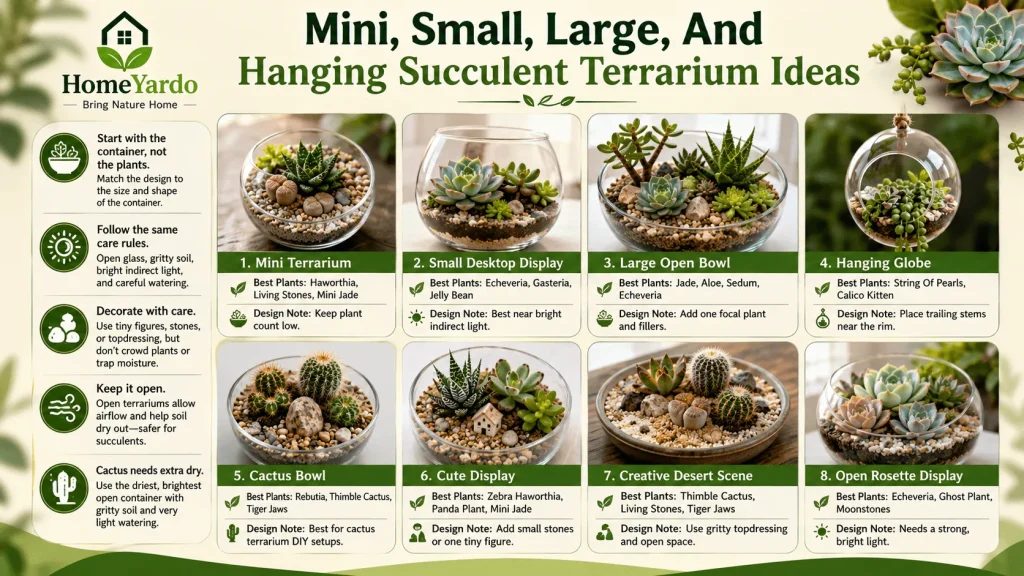
DIY succulent terrarium ideas work best when the design starts with the container, not the plants. Small bowls need fewer plants, hanging globes need trailing stems, and wide open dishes can hold a focal plant with smaller fillers around it. For styling based on room balance and plant placement, feng shui plants can also help guide where a small glass display fits best indoors.
Creative terrarium ideas should still follow the same care rules: open glass, gritty soil, bright indirect light, and careful watering. Cute terrarium ideas often use tiny figures, stones, or colored topdressing, but decorations should not crowd the plants or trap moisture against the leaves.
Open terrarium ideas are safer for succulents than closed jar designs because airflow helps the soil dry. A cactus terrarium DIY setup should use the driest, brightest open container style with gritty soil and very light watering.
| Idea | Best Plants | Container | Design Note |
|---|---|---|---|
| Mini terrarium | Haworthia, Living Stones, Mini Jade | Small open bowl | Keep plant count low |
| Small desktop display | Echeveria, Gasteria, Jelly Bean | Wide-mouth glass | Best near bright indirect light |
| Large open bowl | Jade, Aloe, Sedum, Echeveria | Large dish | Add one focal plant and fillers |
| Hanging globe | String Of Pearls, Calico Kitten | Open hanging globe | Place trailing stems near the rim |
| Cactus bowl | Rebutia, Thimble Cactus, Tiger Jaws | Dry open bowl | Best for cactus terrarium DIY setups |
| Cute display | Zebra Haworthia, Panda Plant, Mini Jade | Shallow open bowl | Add small stones or one tiny figure |
| Creative desert scene | Thimble Cactus, Living Stones, Tiger Jaws | Wide dry dish | Use gritty topdressing and open space |
| Open rosette display | Echeveria, Ghost Plant, Moonstones | Open a glass bowl | Needs a strong, bright light |
Real Vs Artificial Succulents For Terrariums
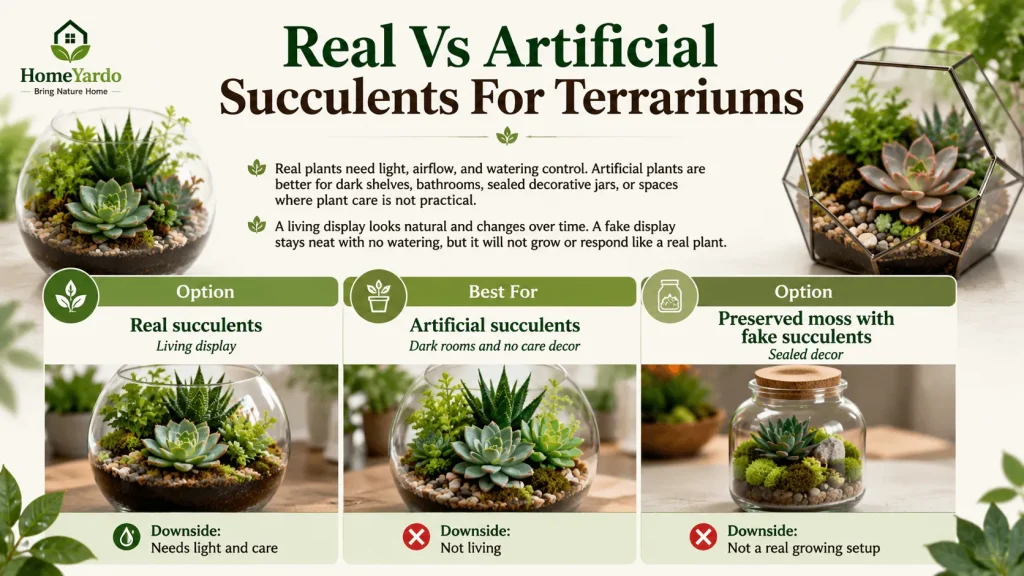
Real plants need light, airflow, and watering control. Artificial plants are better for dark shelves, bathrooms, sealed decorative jars, or spaces where plant care is not practical.
A living display looks natural and changes over time. A fake display stays neat with no watering, but it will not grow or respond like a real plant.
| Option | Best For | Downside |
|---|---|---|
| Real succulents | Living display | Needs light and care |
| Artificial succulents | Dark rooms and no care decor | Not living |
| Preserved moss with fake succulents | Sealed decor | Not a real growing setup |
Common Mistakes With Terrarium Succulents
Most failures come from moisture, light, or crowding problems. The safest approach is to treat the glass display like a dry planter with limited drainage.
Check the container after watering. If the glass fogs often, soil stays damp for days, or leaves turn soft, the setup needs less water, more airflow, or a brighter position.
| Mistake | Result | Fix |
|---|---|---|
| Using closed glass | Humidity builds | Use open glass |
| Overwatering | Root rot | Wait until dry |
| Regular potting soil | Soil stays wet | Use a gritty mix |
| Crowding plants | Poor airflow | Leave space |
| Mixing care types | Some plants fail | Group similar plants |
| Direct hot sun | Scorched leaves | Use bright indirect light |
| Too many layers | Less root space | Keep layers thin |
| Dead leaves left inside | Mold risk | Remove debris |
Other common mistakes include misting rooted plants too often, using a narrow jar for airflow-hungry plants, and leaving wet nursery soil packed around the roots.
Why Are My Terrarium Succulents Dying?
A display of struggling glass typically displays obvious warning signs. Black stems, soft leaves, foggy conditions, and mold are indicators of excessive moisture or insufficient airflow. Growth that is pale and stretched generally indicates low light.
The appearance of wrinkled leaves could indicate water shortage, they could be caused by damaged roots that are unable to absorb water.
| Symptom | Likely Cause | Fix |
|---|---|---|
| Mushy leaves | Overwatering | Stop watering and check the roots |
| Black stem base | Rot | Remove the affected plant |
| Stretching | Low light | Move brighter |
| Brown crispy tips | Sunburn or drought | Adjust the light and watering |
| Mold | Damp soil or debris | Remove dead leaves and dry soil |
| Foggy glass | Excess moisture | Increase airflow |
| Wrinkled leaves | Thirst or root damage | Check soil and roots |
| Leaves falling | Handling or stress | Reduce touching |
| White cottony clusters | Mealybugs | Isolate and clean the plant |
| Tiny flies near the soil | Fungus gnats | Let the soil dry longer |
| Bad smell | Root rot | Remove damaged roots or the plant |
Long-Term Succulent Terrarium Care And Maintenance
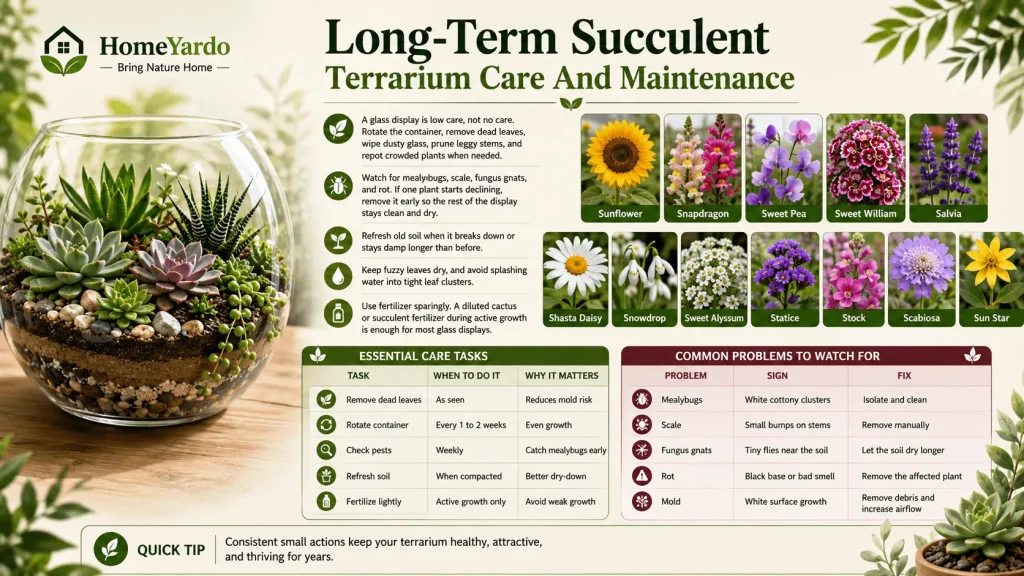
Glass displays require little maintenance, but not without it. Rotate the display, take out dead leaves, wash off dusty glass, trim the stems that are leggy, and then plant new plants if needed. Check for mealybugs and the fungus, scale and the rot.
If a plant is showing signs of decline eliminate it as early as possible to ensure your display is kept clean and dry. Freshen old soil whenever it starts to break down or is more damp than it was before. Make sure that the leaves remain dry and keep from splashing water onto tight leaf clusters.
| Task | When To Do It | Why |
|---|---|---|
| Remove dead leaves | As seen | Reduces mold risk |
| Rotate container | Every 1 to 2 weeks | Even growth |
| Check pests | Weekly | Catch mealybugs early |
| Refresh soil | When compacted | Better dry-down |
| Fertilize lightly | Active growth only | Avoid weak growth |
Use fertilizer sparingly. A reduced cactus or succulent fertilizer in the midst of active growth is sufficient for the majority of glass displays.
| Problem | Sign | Fix |
|---|---|---|
| Mealybugs | White cottony clusters | Isolate and clean |
| Scale | Small bumps on stems | Remove manually |
| Fungus gnats | Tiny flies near the soil | Let the soil dry longer |
| Rot | Black base or bad smell | Remove the affected plant |
| Mold | White surface growth | Remove debris and increase airflow |
Pet And Child Safety Notes
Certain plants may irritate pets if they are chewed. Spiny cacti and sharp agaves do not work well around children. Put the display in a spot that can’t be damaged by a fall.
Stones that are loose, glass pieces, and ornamental gravel could also pose an choking hazard. Be sure to check the safety of your plants before putting any item within the reach of dogs, cats or even toddlers.
Do not place sharp or sharply shaped cacti at a child’s eye height. Use sturdy containers with an extended base when the display is to be placed on a table, a shelf or on a desk.
Best Buying Tips Before You Plant
Begin with small, healthy plants that are healthy and small. The firmness of leaves, the dry soil and growth that is compact are better indicators than stretched stems, mushy bases as well as soil that smells foul.
Avoid plants that have obvious pests, black stems or leaves that drop quickly before taking them off. Select plants that have similar requirements and keep the new plants apart for a few days prior to planting.
Look for mealybugs that are cottony around the leaf joint, the roots and crowns that are tight. Avoid plants that are stretched due to low light since they may not recover their compact size.
Quick Plant Pairing Recipes
Simple pairings are much easier to maintain than mixed displays. Pick one design, and make sure that the plants are small enough to allow space for airflow and roots.
The recipes are grouped based on similar needs in care and also by visual balance.
| Style | Plant Pairing | Best Container |
|---|---|---|
| Beginner bowl | Zebra Haworthia, Mini Jade, Jelly Bean | Shallow open bowl |
| Pastel rosette | Echeveria, Moonstones, Ghost Plant | Bright open dish |
| Trailing globe | String Of Pearls, Calico Kitten, Mini Jade | Hanging open globe |
| Desert look | Thimble Cactus, Tiger Jaws, Living Stones | Wide dry bowl |
| Fuzzy texture | Panda Plant, Bear Paw, Gasteria | Medium open bowl |
| Desk display | Haworthia, Gasteria, Mini Elephant Bush | Wide-mouth glass |
Don’t mix plants of different moisture groups in a glass bowl. The pastel rosette and the cactus require more light than a desk that is far from a window could provide.
Conclusion
Glass displays that are healthy depend on the correct combination of the plant, the container, and the soil as well as light and water. Glass that is open is the best choice since it allows dry plants the airflow they require.
The plants that are compact and slow growing can be kept tidy. Cacti can thrive in dry, open bowls however soft succulents are more suitable for novices. Glass that is closed can be used for ferns, moss, fittonia, and other humid plants.
First, choose the container. Then select the plants that will fit the size, light level the flow of air, and watering requirements.
FAQ’s
Yes, they are good for open glass bowls, wide-mouth jars, and dry hanging globes. They need gritty soil, bright light, airflow, and light watering. Closed humid jars are usually a poor match because the soil dries too slowly.
Low-maintenance choices for open dry displays include Haworthia, Gasteria, Mini Jade, Elephant Bush, Panda Plant, and Zebra Haworthia. These plants stay fairly compact and do not need frequent watering. For closed humid terrariums, better low-care options include moss, Fittonia, Peperomia, and small ferns.
Haworthia, Gasteria, Jade Plant, Elephant Bush, Panda Plant, and some small Aloe types usually handle indoor conditions better than many colorful rosette plants. They still need bright indirect light and soil that dries between watering. Echeveria can survive indoors, too, but it often needs stronger light to stay compact and colorful.
Start with a thin gravel or pumice layer, then add a very thin optional charcoal layer if the glass has no drainage. Add gritty succulent soil deep enough for the roots, then finish with a light topdressing. Keep the layers thin because too many decorative layers reduce root space and do not replace a drainage hole.
Choose an open glass container, add thin layers, then place the focal plant first. Add smaller filler plants next, then place trailing plants near the rim if the container allows it. Press soil gently around the roots, add topdressing, and wait before watering if using fresh cuttings.
A closed terrarium is not a good choice for most true succulents. Closed glass traps humidity and keeps soil damp, which can lead to mold, soft leaves, and root rot. Use an open terrarium for succulents, and save closed glass for moss, ferns, Fittonia, Peperomia, or other humidity-loving plants.
Most true succulents should not live in a closed glass container. Closed glass traps humidity around the leaves and soil. That moisture can lead to mold, weak growth, soft leaves, and root rot.
Good choices include Haworthia, Gasteria, Mini Jade, Echeveria, Panda Plant, Burro’s Tail, String of Pearls, and small Rebutia cactus. The best plants stay compact and tolerate dry soil. Slow-growing types are easier to manage in shallow glass.
Haworthia, Gasteria, Mini Jade, Living Stones, Baby Toes, Tiger Jaws, and small cacti stay compact. They are good choices for small open bowls. Even small plants need bright light, dry soil, and careful watering.
Water only when the soil is fully dry from top to bottom. Use a small amount because glass containers often lack drainage. If water pools in the bottom layer, reduce the amount next time.
A gritty cactus or succulent mix is best. Standard potting soil can hold too much moisture in glass. Adding pumice, perlite, coarse sand, or mineral grit helps the soil dry faster.
References