Guide To Best Plants For Terrarium For Beginners, Low Light & Humid Setups
Terrarium plants are compact plants that are ideal for growing within glass containers, tiny pots, or even small displays. Depending on the size of the container and the light levels, airflow and humidity levels, as well as the plant’s maturity, the ideal choice will differ.
Closed terrariums work well with tropical leaves, mosses, ferns, as well as other plants which thrive in humid conditions. Cacti, succulents, and air plants are thriving in open-air terrariums that require greater oxygenation in dry conditions. A good terrarium plant should be compact, slow-growing and tolerant of pruning and suited to the humidity level of the container. In many cases, the mature size of a plant determines if it can be placed in the smallest container or not, though it might appear tiny in the pot when it is initially placed within the garden.
This guide will provide you with instructions for 30 plants, containers that match the combination of plants for beginners, plant care symbols, problems with plants and pet-friendly plants to choose from.
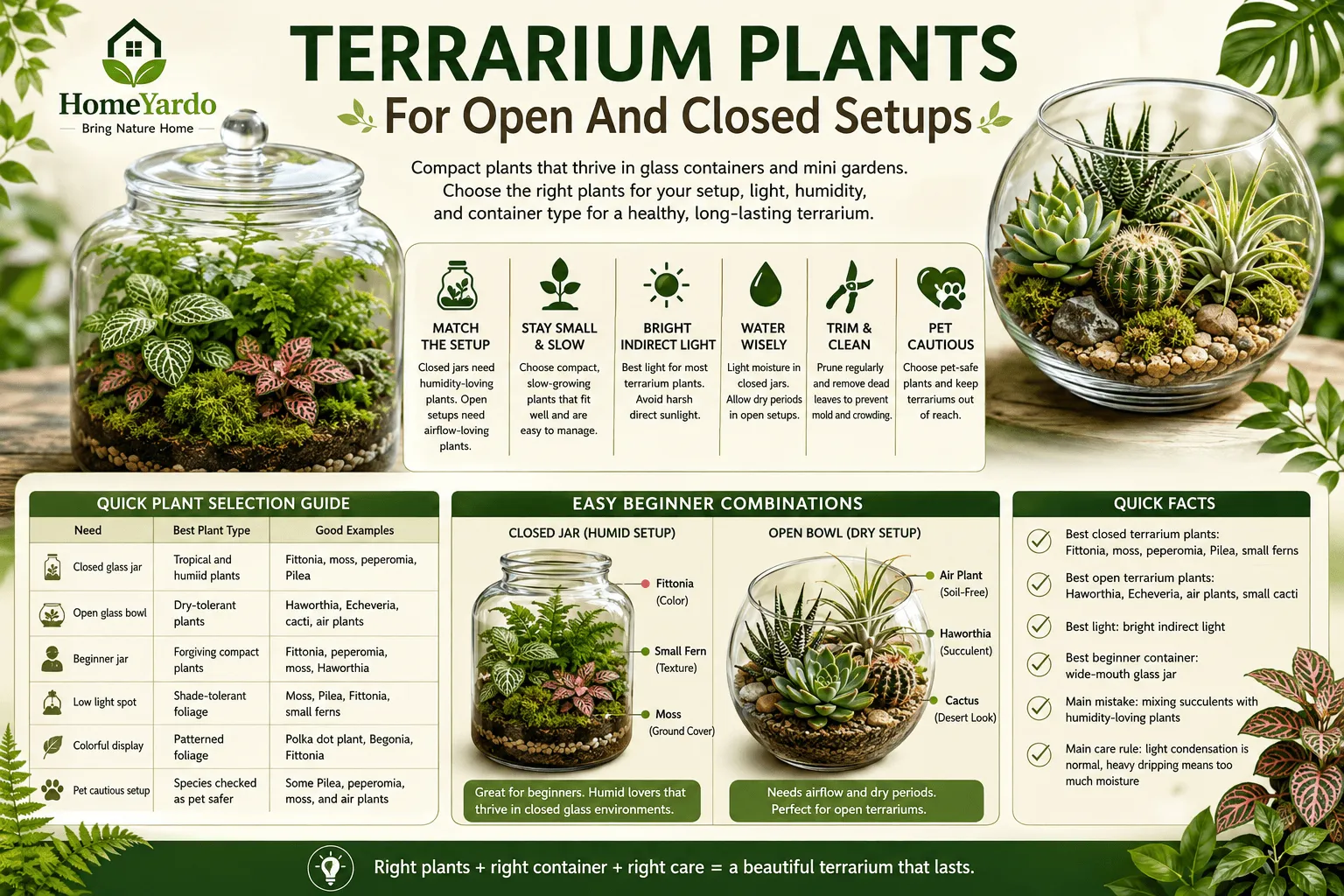
Quick Plant Selection Guide
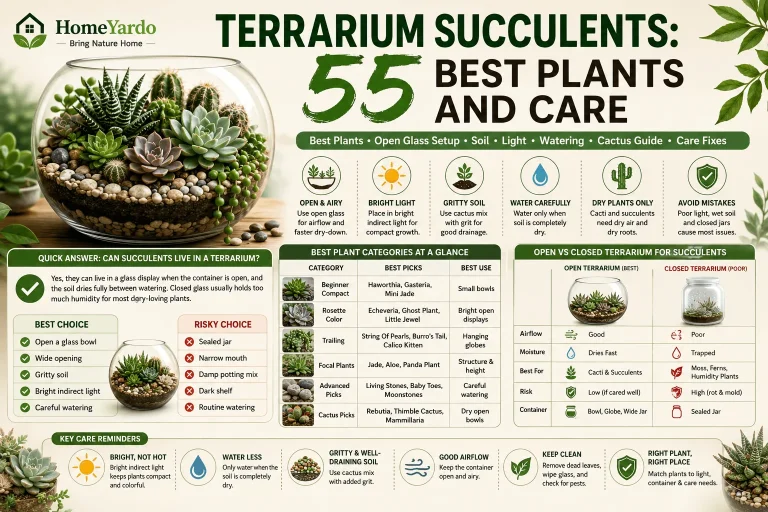
The most effective method of selecting plants for a terrarium is to first examine the container. A closed container will hold the moisture for longer, which is good for smaller succulents. In general, air plants and succulents are best in an open glass container because it dries out faster and allows for better air circulation to the plants.
If The Glass Jar Is Closed, Use The Following:
Select warm, moist-loving and humidity-hungry plants. Typical plants that work well in this system are fittonia, moss, peperomia, or small Pilea.
If You Are Using An Open Glass Bowl:
Plant species that don’t require continuous moist soil. Other options that can be used are Haworthia, Echeveria, small cacti and air plants that can thrive in drier environments.
If It Is A First Terrarium:
Begin with plants that are small and resistant to minor care mistakes. Plants that are easy for novices include peperomia, fittonia, moss, and Haworthia.
If Your Light Corner Or Square Is Small, For A Lower Light Spot:
Choose plants that are able to thrive in moderate indoor lighting without getting weak or stretched. Sun-loving succulents may not work as well as moss, pilea, or small ferns.
For More Colour:
Instead of flowers, choose plants that have patterned leaves. You can create red, pink, silver, or green tones inside the glass with a begonia, polka dots and fittonia.
If You Have Pets At Home:
Examine all plants prior to setting up the terrarium in a cat or dog’s reach. Some mosses, air plants, peperomia, and Pilea species can be included in pet-sensitive arrangements, but you should take care to use species that are safe for pets.
For plants for terrarium for beginners, start with a simple closed jar using Fittonia, moss, and one small fern, or an open display with Haworthia, air plants, and a small cactus. These are some of the easiest plants because they are simple to place, easy to monitor, and less demanding than specialist plants. The easy terrariums are usually compact, slow-growing, and matched to the right container from the start.
Quick Facts:
- Closed plant terrariums: Fittonia, moss, Peperomia, Pilea, as well as tiny ferns are excellent choices.
- Haworthia Echeveria Air plants, Haworthia and cacti that are small are best in an open terrarium.
- Favourable light, moderate indirect light to bright indirect light
- The glass jar with a wide mouth is the ideal container for the novice.
- The most common mistake is mixing succulents and plants that require water.
- Normal is a little condensation within the main care. Heavy drip means excessive moisture.
It’s simpler to keep in a sealed jar than one with many plants. Additionally, it’s likely to have Fittonia as well as moss and tiny ferns. Open setups can be used for plants that don’t require humidity, that is, sealed like Haworthia air plants, Haworthia tiny Cacti.
What Are Terrariums?

Terrariums are tiny or slow-growing plants that grow in glass pots. They can be grown in sealed jars, while others are grown in open bowls or glass displays. Terrariums are similar to an indoor miniature garden.
The airflow, moisture, as well as light intensity and the root space also change within the glass. Therefore, when choosing indoor plants for a terrarium, it is important to choose plants based on their requirements for care, not their appearance. Closed Terrariums hold moisture within the glass. The water evaporates, melts, and condenses and is absorbed back into the soil, creating a moist climate. Small tropical plants like small ferns, mosses, fittonia, Pilea, as well as others, can thrive in such a climate. Terrariums that are open do not retain water like closed terrariums.
They dry faster and also allow more air circulation, which is why they are ideal plants for succulents and cacti, as well as air plants. The decision should not be made just based on the size of a plant at the moment the purchasing. It must also be compact, that is, growing slowly, can tolerate some light and an adult size that does not exceed the dimensions of the pot.
There are many different plants to be purchased at the grocery shop, which will be ideal plants to be placed in glass jars. If plants are placed in containers, they must be small, can withstand the amount of water, and thrive in a small space. Plants that are suitable for a terrarium are contingent on the terrarium’s arrangement. Peperomia, Fittonia, moss, Pilea, small ferns, Haworthia, air plants and cacti can all be placed in the terrarium provided they are paired appropriately.
Terrariums serve a decorative role indoors, while larger privacy plants are better suited for outdoor screening and garden boundaries.
Types Of Terrarium Plants

Here are a few useful areas of territory. Each group can add something unique to the container. This could include providing colour, covering soil or a trail that runs over the stone, adding height or filling up an open dry display. Containers that are semi-closed or closed are the best for incorporating exotic foliage plant species.
Fittonia, peperomia, Pilea, Begonia, polka dots and jewel orchids offer colour, texture of the leaves and patterns. They also provide softness. The humid conditions are ideal for ferns that are compact. The Button Fluffy Ruffles, as well as smaller maidenhair ferns, are a great way to add an attractive and non-dominant feature to a glass garden.
The effect of a forest floor is produced by mosses as well as clubmosses. The mosses, cushion moss and Selaginella are excellent choices for terrariums that are closed because they are tolerant of constant humidity and moisture. Cacti or succulents are best kept in terrariums with open sides. Haworthia, Echeveria, Gasteria, Lithops jade plant and smaller cacti require dryness and air during the interval between waterings.
Open Displays are typically made from air plants and do not require soil. Although they can be positioned on wood, stones, shells, or gravel, they’ll require moisturizing the soil regularly. Some carnivorous species like Venus flytraps and Drosera need specific maintenance. They are not the easiest plants for beginners. They require adequate light, clean water and the right water levels.
For more setup ideas and care basics, see air plants for terrariums to understand how to place and maintain them in open glass displays.
Best Plants For Closed Terrarium Vs Open

Closed and open terrariums require different plants. A closed terrarium is a glass terrarium that is kept moist, and an open terrarium resembles a decorative planter that is kept indoors. Closed terrariums should be able to be kept in indirect light and moist air.
Sealed containers work best for fittonia, moss, Selaginella, baby tears, peperomia, Pilea, and small ferns. Open terrariums require some air to circulate, as well as drier soil. Haworthia, Echeveria, Gasteria, jade plant, Lithops, and air plants will work better in clear bowls or geometric glass containers, while small cacti will do well in geometric glass containers.
Semi-open terrariums fit in between the two. They can be used for peperomia, string of turtles, button fern, and other plants that prefer some humidity but do not prefer a completely enclosed area. There is only one simple rule: closed glass requires moist air plants, and open glass requires dry air plants that can be watered between waterings.
Common Terrarium Plants

Fittonia, peperomia, Pilea, moss, polka dot plant, baby tears, Haworthia, Echeveria, air plants, and small cacti are common choices for terrariums. They are popular, and are readily available, and work for many standard glass arrangements. One of the most popular closed terrariums is the Fittonia, which is compact, colourful, and a humid plant.
Peperomia is also beneficial due to its diversity and the fact that some are small-leaved and moderately growing. A soft green surface is created using moss, baby tears, and Selaginella plants. Closed glass gardens are ideal for them, where the moisture is consistent.
Common plants for open terrariums include Haworthia, Echeveria, air plants, and cacti. Do not put them in a wet jar; moisture will harm them. What is common is not necessarily suitable for all containers. Plants that thrive in an open bowl can not be placed in a closed jar, and one that requires humidity may dry rapidly in an open display.
30 Best Terrarium Plants List

It’s easier to compare the best terrariums when they’re categorized by their plant selections, their purposes, and their containers. Some add colour, some will form a mossy surface, some will run over rocks, and some are best suited in open, dry displays.
Closed terrariums usually suit moisture-loving plants. Open terrariums are better for succulents, air plants, and desert-style displays.
1. Fittonia Fittonia
It is one of the easiest plants to incorporate into a closed terrarium due to its delicate, veined leaves, which bring bold colour without taking over your container too rapidly.
2. Peperomia caperata
This compact peperomia features rippled leaves and an organized growth habit, making it perfect when texture rather than height is required in a terrarium setting.
3. Pilea Glauca
With tiny blue-green leaves that soften the look of glass containers, Pilea glauca is ideal for small settings where delicate foliage looks better than large leaf masses.
4.Pilea Involucrata
Pilea leaves feature texture and fuller shapes, making this Pilea plant suitable for adding depth in a terrarium environment.
5. Aluminum Plant
The aluminum plant adds silver markings, which show well through glass surfaces; to keep its height manageable, it should be pruned regularly or before becoming too tall.
6. Polka Dot Plant
Polka Dot Flowers – these unique flower varieties boast striking foliage design while remaining relatively short-lived plants for your aquarium environment.
Polka dot plant can add vibrant hues of pink, white, red or speckled foliage into any terrarium setting, growing quickly enough that trimming in small jars might be required to manage its rapid expansion.
7. Baby tears
Baby tears create an attractive, soft green carpet effect in humid terrarium environments when placed around stones or wood or at the base of taller plants. They look best around stones or wood as it forms its base and supports taller ones as it forms its carpet form.
8. Creeping fig
Creeping fig gives any terrarium an organic look with its trailing branches that cascade down across hardscape and soften any empty spaces.
9. Selaginella
Selaginella gives off an airy feeling without looking flat; perfect for closed jars with steady moisture levels and gentle light sources.
10 Cushion moss
It also creates an authentic, natural effect when grown indoors in its container home.
Cushion moss can cover bare soil to achieve the look of forest floors and should remain moist but not wet, giving a forest floor effect.
11. Mood Moss
This variety has small, round clumps which create dimension to surfaces in natural woodland-style terrariums.
12 Fluffy Ruffles Fern
Soft feathery foliage adds soft feathery textures to humid settings. Best used where there is enough room for its leaves to open out freely.
13. Maidenhair Fern
This delicate plant features fine, delicate leaves. While beautiful under a glass cover, maidenhair fern requires constant humidity so as to remain healthy and flourish well in its environment. Ultimately, it does not need to dry out completely before looking its best in closed environments such as closed glass shelves.
14. Asparagus Fern
Asparagus Fern is ideal for adding height and airy texture. For optimal growth, larger closed terrariums offer sufficient room to grow.
15. Parlour Palm
A small parlour palm creates the effect of miniature trees when grown indoors in larger containers rather than tiny containers.
16. Begonia
Small Begonia varieties provide bold leaf patterns and colours. They make excellent focal plants in humid glass displays.
17. Cryptanthus
The cryptanthus boasts low rosette-shaped leaves with vivid leaf colours for easy visibility near the front of any terrarium or display case. Eventually,
18 Jewel orchid
Its varieties provide stunning variations. Jewel orchids are grown for their leaves rather than flowers, thanks to the dark foliage with fine markings that make it suitable for growing in shaded, humid terrarium environments.
19. Drosera Growers
Drosera Growers looking for carnivorous plants will appreciate Drosera as it requires proper moisture, light levels and soil mix – ideal for more careful setups.
20. String of Turtles
String of turtles adds trailing detail to any terrarium, performing best when placed in an environment with dry soil conditions or that maintains optimal humidity levels. With no dead leaves to disturb its tidy shape, it works in semi-open glass setups where humidity remains reasonable.
21. Button Fern
Strawberry begonia adds texture with its large leaves and small runners, and can fit either closed or semi-open terrarium environments, depending on airflow and watering requirements.
23. Venus Flytrap
Need for a proper setup to access and manage properly. Not suitable as a closed container plant.
24. Air Plant
This air plant variety makes a beautiful soil-free display in open glass bowls, mounted pieces or airy containers with no standing water around its base.
25. Haworthia
Haworthia is one of the easiest succulents for open terrariums. It stays compact while handling dry soil better than tropical varieties.
26. Echeveria
Echeveria makes for attractive displays when kept outdoors, but should never be kept damp or enclosed within containers.
27. Gasteria
Gasteria is an easy-care succulent with firm leaves. This variety excels when planted in open bowls where the soil can dry between watering sessions, creating an authentic miniature tree look within an open terrarium environment. Bright light exposure and consistent watering help it remain compact for the best results. Totusi
28. Jade Plant
A small jade plant can create a mini tree look in an open terrarium. It needs bright light and careful watering to stay compact.
29. Lithops
Lithops, small desert plants resembling stone-like shapes, should only be displayed in very dry environments with limited amounts of moisture available – best used alone and should never be mixed with moisture-loving plants such as succulents or moisture loving species such as succulents or watermelons.
30. Small Cacti
Small cacti prefer desert-style terrariums with ample light, sandy soil and open airflow; they should never be placed inside an enclosure that seals in humidity; instead, use simple containers for this plant species. Closed jars work better for humid-loving species like Fittonia, moss, peperomia, Pilea Ferns, Begonia, jewel orchid or any others which love humidity-rich conditions.
Facts:
- Fittonia is an excellent choice for closed terrariums for beginners. It prefers light, indirect light, humidity, and light moisture. It can be used in a glass garden for contrast, with its coloured veins.
- Peperomia caperata is a compact plant with textured leaves. Good in closed or semi-open systems, where soil is not maintained in a soggy condition.
- String of turtles has small leaves with patterns and trailing growth. It is best suited to semi-open or open growing conditions and should not be grown if soil conditions are constantly wet, as this can cause root damage.
- The fine foliage and non-thorny trailing habit make Pilea glauca a useful plant for micro terrariums. Before it grows out of control, it will need some light pruning.
- Pilea involucrata is also a plant that provides textured foliage and can be pruned to keep it in bounds. Likes humidity and indirect light. Trailing species like this are also popular as indoor hanging plant choices, especially when grown outside glass in brighter airflow conditions.
- The aluminum plant imparts silver pattened appearance. As long as it is cut short before becoming too tall, it can be used in closed terrariums.
- Polka dot plant provides pink, white, or red mottled leaves. Trimming is required as it grows quicker than some terrariums.
- Baby tears provides a soft carpet-like cover. It prefers moist conditions but may multiply rapidly in a closed container.
- Creeping fig can grow by training as a climber or creeping within a larger terrarium. It has to be pruned early so that it will not grow over the glass and the smaller plants.
- Selaginella can be used to create a moss-like effect and requires moderate humidity. Not to be allowed to become completely dry.
- The cushion moss forms a natural forest floor. Best grown in a closed terrarium under moist conditions and in indirect light.
- The surface layer is shaped by small clusters of mood moss. This should be kept moist, but not wet.
- Fluffy Ruffles fern provides a soft and fern-like texture without becoming too large, too soon. It prefers humid air and indirect light.
- Maidenhair fern is delicate and elegant, but it will not tolerate dryness in the terrarium. Works well within a more stable and closed environment.
- Many delicate ferns are not as resistant or compact as the button fern. It will grow in semi-open glass in a moist, consistent environment.
- Asparagus fern provides height and loft. Trimming is required as it can become too large for small jars.
- In larger closed terrariums, the Parlour palm will lend a mini tree effect. Apply it in areas where there is sufficient vertical clearance.
- Begonia adds patterned foliage and colour. Prefers humidity but requires sufficient air circulation to avoid leaf issues.
- Begonia strawberry has textured leaves and runners. It is suitable for larger glass containers, as runners will spread in the container.
- Cryptanthus provides a splash of colour in rosette form. It prefers bright indirect light and moderate moisture.
- Jewel orchid is more cultivated for its foliage than its flowers. It is ideal for low to medium indirect light and humid environments.
- Drosera is carnivorous. Requires specialist care, water, and a light and moist environment.
- Venus flytrap is NOT a closed jar plant. It should get more light, a more specialized water, and an open design to provide better care.
- Air plants don’t require soil and can be arranged on stones, wood, or shells in open terrariums. They require moisture (soak or mist) according to species care requirements.
- Haworthia is a great first succulent for outdoor terrariums. It remains compact and requires less water.
- Echeverria produces a neat rosette form. Requires plenty of light, air, and dryness.
- Gasteria is a low, slow-growing plant. It is appropriate for open bowls of gritty soil.
- An open terrarium can be used to form a small tree form with the Jade plant. Should be pruned and dried between waterings.
- Lithops form a mini-stone desert. They require lots of light, good drainage, and very attentive watering.
- Small cacti are appropriate for open deserts. They should never be closed in a closed, damp container.
Tropical Terrarium Plants

Tropical terrariums work best in closed or semi-open containers because they often prefer warmth, humidity, and bright indirect light. The best choices are compact tropical plants, not large houseplants that quickly outgrow glass.
Fittonia, peperomia, Pilea, Begonia, polka dot plant, jewel orchid, Cryptanthus, and parlour palm are useful tropical choices when the container has enough room. Fittonia and peperomia are easier for beginners, while Begonia and jewel orchid need closer moisture control.
Not every tropical houseplant belongs in a terrarium. Large pothos, large philodendron, and vigorous vines can quickly crowd the glass, cover smaller plants, and require frequent trimming.
The safest approach is to choose small leaf tropical plants that grow slowly and stay in proportion with the container. Tropical plants should also have enough space between leaves and glass to reduce wet leaf damage.
High Humidity Terrariums

- High-humidity terrariums enjoy moist air, but they still need balanced soil. Humid air does not mean the roots should sit in wet, heavy soil.
- Moss, Selaginella, Fittonia, baby tears, small ferns, and Pilea are strong choices for closed jars because they tolerate steady humidity. These plants help create the soft, green, woodland look often associated with closed terrariums.
- Peperomia and Begonia can also work in humid terrariums, but they need more care with watering. Their roots should not stay soaked, and dead leaves should be removed quickly to prevent mould.
- The best humid terrarium setup feels lightly moist, not swampy. There should be enough condensation to show moisture is present, but not constant dripping down the glass.
- Moss also works as a visual bridge between stones, bark, and foliage plants. It can cover exposed soil, soften the base of a jar, and make the display look more natural.
Mini Fittonia, Pilea glauca, Selaginella, baby tears, small ferns, and compact peperomia are great plants for use in your terrarium that need good humidity. Cushion moss or Moss moss is typically the ideal moss for a closed terrarium because.
Low Light Vs High Light Terrarium Plants

Terrariums in low-light conditions require natural indirect lighting or a grow light. Low light does not have to mean that the shelf is dark or the room is completely dark.
For low to medium indirect light, choose moss, Fittonia, Pilea, Peperomia, jewel orchid, or small ferns. They are able to tolerate less intense lighting than many succulents and cacti.
Bright indirect light is typically the best choice for begonia, polka dot plant, Cryptanthus, and baby tears. This helps to maintain their colour and growth compactly. Haworthia, Echeveria, Gasteria, air plants, and small cacti require brighter conditions in uncovered containers. Rather, they should be kept from the harsh direct sun as glass can heat up rapidly and harm the leaves.
Plants that grow taller, fade, or turn toward light may require a sunnier location. When leaves are scorching or drying on the rim of the glass, it could be too warm.
For anyone asking what plants don’t need much light for terrarium setups, the safer answer is shade-tolerant foliage rather than no-light plants. The best low-light plants for closed terrarium displays include moss, Fittonia, Pilea, Peperomia, jewel orchid, and small ferns. They still need gentle indirect light or a grow light to stay healthy.
Succulents Vs Tropical Plants In Terrariums

Succulents and tropicals generally do not do well together and require different care, so they should be planted in separate terrariums. Succulents like dry soil more than wet, and they appreciate air flow and open containers. Tropical plants like more moisture and humidity. A focused guide on succulents for terrariums explains which species handle open setups best and how to avoid moisture-related problems.
Open terrariums are suitable for Haworthia, Echeveria, Gasteria, jade plant, Lithops, and small cacti. They will spoil if stored in a damp jar. Closed terrariums work best with plants such as fittonia, moss, peperomia, Pilea, baby tears, and small ferns. They are fond of the dampness of the air, which would kill many other succulents.
The common mistake among beginners is planting cactus, moss, and tropical foliage together in one container for a single plant. Appealing at first glance, but the plants are demanding conditions that are opposite to what they have. Adding water will not benefit the succulent if it is in decline in a closed container. It’s typically best to move it to an open pot filled with rough soil and increased airflow.
A common question is, can I use cactus in a terrarium? Yes, but only in an open terrarium with dry soil, strong airflow, and careful watering. Cacti should not be sealed in a closed, humid jar because trapped moisture can lead to rot.
Best Plants For Jar Terrarium Beginners

The plants in a jar terrarium should be easy to care for and adapt well to the environment of the container.
The largest jars are easiest to fit with a terrarium because they are easy to plant, prune, and clean. Narrow bottles are a pretty option, but are more difficult to handle. If you are using a small closed jar, use moss, mini Fittonia, or Pilea glauca. Maintain low populations of plants.
Typically, only 1-3 small plants are required. Fittonia, peperomia, a small fern, and moss can make for a good beginner setup in a medium closed jar. These plants have the same requirements for humidity and are more convenient to care for together.
One mini Fittonia, one small fern or peperomia, and a bit of cushion moss around the base in a simple, beginner closed jar. Keep in bright indirect light, water thoroughly, but lightly, after planting; vent only if condensation is heavy throughout the day.
An open beginner jar requires one Haworthia, one air plant on wood or stone, and a dry, decorative surface. Do not cover and allow for dry periods between watering. A novice jar should not be tightly packed. Plants should be spaced to allow for easier trimming and a lower risk of mould.
Non-Toxic Terrarium Plants For Pets

The safety of plants depends on species, plant part, and the amount chewed by pets. Even lower-risk plants should be kept out of the reach of a terrarium.
Peperomia species, some Pilea species, some air plants, some mosses, and Fittonia are frequently selected in pet-casual houses. Even with the correct species, it is advisable to observe the species prior to purchase.
A few plants, such as Jade plant, Begonia, asparagus fern, Pothos, croton, and some cacti, should be handled with care around pets. Some will cause irritation if chewed; cacti can cause injuries in the spine.
A closed glass container can minimize casual contact, but lids can become disturbed, and glass can break. The use of plants, their placement, and verification of plant species are ways to keep pets safe.
Best Small Terrarium Plants That Stay Small
- The small or Miniature terrarium plant should stay in scale with the container. Many young plants look tiny at purchase but quickly become too tall, wide, or fast-growing.
- The best slow-growing plants for small terrariums are plants with tiny leaves, compact roots, and a growth habit that can be trimmed without ruining the display. Pilea glauca, mini Fittonia, cushion moss, mood moss, Selaginella, and mini peperomia are stronger choices than fast vines or large tropical houseplants.
- Pilea glauca, mini Fittonia, string of turtles, mood moss, cushion moss, Selaginella, baby tears, and mini peperomia are good options for small terrariums.
- Tiny terrarium plant still need room to grow. Mini terrarium plant should be spaced carefully instead of being packed tightly into a small jar. Miniature terrariums look better for longer when their leaf size, growth speed, and trimming needs match the container.
- Pilea glauca gives a fine texture without taking up much space. Mini Fittonia adds color while staying easier to trim. Mood moss and cushion moss create a natural surface layer.
- Baby tears and Selaginella can spread beautifully, but they need trimming before they cover too much soil. String of turtles gives trailing detail, but it should not be kept in constantly wet soil.
- The best small terrarium design uses fewer plants with better spacing. Overplanting looks full at first, but becomes crowded later.
For more specialist builds, compact plants such as Marcgravia, Humata heterophylla, watermelon Dischidia, or Mini Asian Water Fern can add unusual texture, but they are better for experienced terrarium keepers than for first jars.
Best Terrariums Combinations

Ideally, plants in a terrarium should have similar watering, air circulation, humidity, and lighting requirements. Plant compatibility should be the first step, followed by appearance.
Fittonia, Pilea, moss, and a small fern can be incorporated in a closed container in a tropical forest style. All plants like high humidity and indirect light. For placement ideas that focus on balance and indoor harmony, some growers also explore feng shui plants when designing decorative terrarium displays.
Cushion moss, Moss moss, and Selaginella are suitable for a moss garden. This produces a soft green appearance without a lot of height and relatively consistent water requirements.
Fittonia, polka dot plant, and Begonia can be used in a larger closed container in a colour display. This combination requires trimming as moss may grow quicker than the colourful foliage plants.
Haworthia, Lithops, and a small cactus can be planted in a large container in a desert bowl. You will need gritty soil, ample light, and careful watering. Tillandsia, driftwood, rocks, and shells can be utilized in an air plant display. It should remain open to allow air plants to dry off after being misted or soaked.
How To Choose Plants For Terrarium?

The first consideration of a terrarium plant is the container, and the second is the plant’s growth habits and eventual maintenance requirements. In a healthy setup, the plants are of similar requirements. Make sure to inspect the mature size before purchase.
Even though it appears small in a nursery pot, a 12- to 18-inch-tall plant may not be suitable for a small pot. Match moisture needs. Baby tears, moss, and fittonia can be kept in a humid, closed environment. Cacti, Echeveria, and Haworthia call for a looser open arrangement.
Before adding plants to a mix, check the light requirements. Bright-light succulents and low-light ferns should not be planted together in the same glass container. When purchasing, check for healthy green leaves, firm stems, and any signs of pests.
Do not use plants that have soft, squishy stems, sticky materials, webbing, or yellow lower leaves. If available, select slow-growing plants. They require less pruning and maintain their shape longer. If you’re just getting started, two or three plants work better than a large mixture of plants.
Best Containers For Terrarium Plant

The container has as much influence upon the selection of plants as the plants have upon the container. Different types of lids, opening sizes, depths, and airflow determine what grows best.
Moss, mini Fittonia, and Pilea glauca are best in small, closed containers. Too much filling is not advisable because small jars fill up fast.
Large lidded jars are easier to balance due to extra room for air and roots. They are ideal for fittonia, peperomia, moss, and small ferns.
Wide-mouth jars are easier to plant into and to trim, and are better for beginners. Bottle terrariums are nice to look at, but they are tricky and require long tools and attention.
Haworthia, Echeveria, air plants, and small cacti will work best in open glass bowls or geometric terrariums. These allow air to circulate and aid in quickening the drying process of the soil.
Clear glass is better than opaque lids or tinted containers because plants need light. Keep any glass container away from harsh direct sunlight to avoid heat buildup. Avoid metal screw lids if rust is likely in humid conditions.
Plants To Avoid In Terrariums

- Not every plant can live in a terrarium. Some plants fail because the terrarium type does not match their needs. A healthy plant in a normal pot may still be unsuitable inside a glass.
- Avoid cacti and most succulents in closed terrariums. They need dry air, airflow, and dry periods between watering. A sealed jar can make them rot.
- Avoid large pothos, large ferns, and fast vines in small terrariums. They can outgrow the container, crowd other plants, and need constant trimming.
- Avoid flowering plants that need frequent deadheading in sealed terrariums. Opening the container often can disturb the moisture balance.
- In open terrariums, avoid moss, baby tears, maidenhair fern, Selaginella, and thin-leaf tropical plants unless the container stays humid enough. These plants often dry too quickly in the open air.
- The goal is not to avoid these plants completely. The goal is to place them in the right growing conditions.
How To Plant A Terrarium

Typically, a terrarium will include a glass or plastic vessel, a layer of drainage (usually rocks), activated charcoal, a barrier layer (may be rocks or glass), a potting mix, compatible plants, and a layer of surface material (moss, rocks, bark, wood, etc.).
Use a clean container made of glass. Place a thin layer of pebbles, gravel, or LECA beneath the soil to waterproof and retain extra water.
Add a small amount of activated charcoal. This can help to maintain the freshness of the setup, particularly in enclosed containers.
Cover the drainage layer with moss or mesh to prevent soil from falling through. Next, fill with an appropriate terrarium soil.
For closed tropical terrariums, use a mix that is moisture-holding. For open succulent displays, use a gritty and fast-draining mix. Plant the largest plant, then plant the smaller ones around. Do not plant crowns too close to the ground, and do not pot under moss plants.
Chopsticks, narrow planting tools, or tweezers for narrow jars. If possible, do not have leaves touching the glass. Top with moss, bark, rock, or decorative gravel, water lightly, and watch the glass before watering again. Others search for plants that can grow in an undraining terrarium, but even with glass containers, there is still a need for moisture control. Drainage layer should not be used in place of good watering practices, but it does help to keep excess water away from the root zone. Light watering of closed jars is ideal for moss, Fittonia, Pilea, Peperomia, and small ferns.
Terrarium Plant Care

Terrarium plant care depends on whether the container is closed or open. Closed setups need a moisture balance. Open setups need watering based on plant type and soil dryness.
- Closed terrariums should show light condensation at times, not heavy dripping all day. If the glass is constantly foggy, open the lid briefly and check for excess water.
- No condensation for a long period can mean the setup is too dry. Mist lightly or add a small amount of water, then wait and watch the glass before adding more.
- To understand how to make a self-sustaining terrarium, focus on balance rather than neglect. A closed jar needs compatible plants, bright indirect light, light moisture, clean leaves, and enough space for growth. It may recycle moisture, but it still needs checking for mold, crowding, and rotting leaves.
- Open terrariums need more frequent checking because they dry faster. Succulents should dry between watering. Air plants need care based on species, often through soaking or misting outside the container.
- Bright indirect light is safest for most terrarium plant. Direct sun can overheat glass, scorch leaves, and dry the setup unevenly.
- Prune plants before they touch the glass or crowd each other. Remove yellow leaves, dead stems, and fallen plant material quickly to reduce mold risk.
- Fertilizer should be used carefully. Too much feeding can cause fast growth, which makes the terrarium crowded and harder to maintain.
- The plants that usually survive longest in terrarium setups are compact, slow-growing, and matched to the container. Moss, Fittonia, peperomia, Pilea, Selaginella, and small ferns often last well in closed jars, while Haworthia, Gasteria, air plants, and small cacti last better in open displays.
A closed terrarium should not be watered on a fixed weekly schedule. The glass gives better clues than the calendar. Light condensation at certain times shows the system has moisture. Heavy dripping all day means the setup is too wet. No condensation for a long time can mean it needs a small amount of water.
Common Problems With Terrarium Plant
Most terrarium problems come from poor plant matching, too much water, low light, or overcrowding. Correcting the growing condition is usually better than replacing plants again and again.
| Problem | Likely Cause | Fix |
|---|---|---|
| Mold | Too much moisture or dead leaves | Remove debris and vent |
| Yellow leaves | Overwatering or low light | Adjust water and light |
| Rot | Wrong plant or too much water | Remove the affected plant |
| Leggy growth | Not enough light | Move to brighter indirect light |
| No condensation | Too dry | Mist lightly |
| Heavy condensation | Too wet or too warm | Vent briefly |
| Plants touch glass | Overcrowding | Trim or remove the plant |
| Succulent dying | Closed humid setup | Move to an open container |
- Mould often starts on dead leaves or soggy soil. Remove decaying material as soon as it appears.
- Yellow leaves can mean too much water, not enough light, or stress after planting. Check soil moisture and light before adding more water.
- Rot should be handled early. Remove affected leaves or plants before the problem spreads through the container.
- Leggy growth means the plant is reaching for light. Move the terrarium to a brighter indirect position or add a grow light.
- A dying succulent in a closed jar usually needs a different container, not more water. Move it to an open setup with gritty soil and better airflow.
Conclusion
Terrariums are set up according to the type of container used, before the appearance of plants. Compact tropical plants, ferns, mosses, and other plants that like humidity are best for a closed terrarium. Air plants, succulents and cacti that enjoy air movement and drier soil should be used in an open terrarium. In the beginning, it is better to have a simple closed jar with Fittonia, moss, and a little fern than a well-crowded mixed planting.
For a dry effect, use an open bowl that can accommodate Haworthia, air plants or small cacti. Pick the container first and then the plants that require similar light, moisture, air movement and growth. This one decision will help avoid most of the problems, such as mould, rot, overcrowding and weak growth, in your terrarium.
FAQ’s
A Good terrarium plant is compact, slow-growing, and matched to the container. Fittonia, peperomia, moss, Pilea, small ferns, Haworthia, and air plants are common choices. Closed jars need plants that enjoy humidity, while open bowls need plants that prefer airflow. A plant should also stay small enough to fit the container long-term.
The best closed terrarium plants are humidity-loving plants such as Fittonia, moss, Selaginella, peperomia, baby tears, Pilea, and small ferns. These plants handle moist air better than succulents or cacti. They still need bright indirect light, light watering, and trimming before they touch the glass.
Open terrariums suit dry-tolerant plants with better airflow. Haworthia, Echeveria, Gasteria, jade plant, Lithops, air plants, and small cacti are good options. These plants should not sit in wet soil. Use a gritty mix, allow dry periods, and keep the container open so moisture does not stay trapped.
Common terrariums include Fittonia, peperomia, moss, Pilea, polka dot plant, baby tears, air plants, Haworthia, and Echeveria. These plants are popular because they are easy to find and work in common glass setups. The main rule is to place each plant in the correct terrarium type.
Small tropical plants are good for closed terrariums when they like humidity and indirect light. Fittonia, peperomia, Pilea, Begonia, and jewel orchid can work well. Large tropical houseplants are not ideal for small glass containers. They may grow too fast, crowd the space, and need frequent pruning.
Moss, Selaginella, Fittonia, baby tears, small ferns, and many compact tropical plants like humid terrarium conditions. High humidity does not mean wet soil. The best setup has moist air, lightly damp growing media, and no standing water around the roots.
Most succulents should not grow in closed terrariums. They need airflow, dry periods, and soil that does not stay damp. A closed jar traps humidity around the leaves and roots, which can lead to rot. Succulents are better in open bowls or geometric glass containers.
Fittonia, moss, peperomia, Pilea glauca, and small ferns are good for closed beginner jars. They share similar humidity needs and stay manageable with trimming. For open jars, Haworthia and air plants are better choices. They need more airflow and should not be treated like a tropical closed terrarium plant.
Terrariums need light, but most prefer bright indirect light instead of direct sun. Strong sun can overheat glass and burn leaves. Low-light plants still need some brightness. If the spot is too dim, plants may stretch, fade, or grow weak.
Mold usually means there is too much moisture, dead plant material, or not enough airflow. It often starts on fallen leaves, old moss, or wet soil. Remove dead material, reduce watering, and open the lid briefly if the container is too wet. Better light and cleaner plant spacing can also help.
It is usually not a good idea. Succulents prefer drier air and open containers, while tropical plants prefer humidity and steadier moisture. If both are planted together, one group usually struggles. Keep succulents in open displays and tropical plants in closed or semi-open terrariums.
To make a terrarium, start with a clean glass container, then add a drainage layer, a small amount of activated charcoal, a barrier layer, suitable soil, and matched plants. Closed terrariums work best with moss, Fittonia, peperomia, Pilea, and small ferns. Use gritty, fast-draining soil for open succulent displays. After planting, water lightly, place the terrarium in bright indirect light, and watch the glass for condensation before adding more water.
Terrariums should be watered based on the container, not a fixed schedule. Closed terrariums need very little water once balanced because moisture recirculates inside the glass. Open terrariums dry faster and need checking more often, especially if they contain succulents or air plants. Light condensation in a closed jar is normal, but heavy dripping means too much moisture.
Terrariums can live for months or years when the setup stays balanced. Their lifespan depends on plant choice, container size, light, moisture, airflow, pruning, and whether the plants outgrow the glass. Slow-growing plants usually last longer in small terrariums. Moss, Fittonia, peperomia, Pilea, Selaginella, and small ferns often last well in closed jars, while Haworthia, air plants, and small cacti last better in open displays.
No, not every plant can live in a terrarium. A good plant must match the container’s moisture, light, airflow, and space. Cacti and succulents usually need open terrariums, while mosses, ferns, and compact tropical plants usually fit closed jars better.
A closed terrarium should not be opened often when the moisture is balanced. Open it briefly if condensation is heavy all day, mold appears, or leaves are rotting. Light condensation at certain times is normal and does not always mean the lid should be removed.
References