Shrubs For Full Sun: Flowering, Evergreen, And Low Maintenance Picks
Bright garden areas can be enhanced with shrubs for full sun that provide year round form, privacy, color, and structure. It’s not a case of “if the sun shines, it’s built for the sun. It’s not if the sun doesn’t shine; it’s not built for the sun. The performance of a shrub will vary with its mature size, soil drainage, summer heat, winter hardiness, water requirements, and placement.
A full sun shrub requires at least 6 hours of direct, unshaded sun a day. A few shrubs will thrive in bright locations but do not perform well next to hot pavement, walls, gravel or dry slopes. Others can be trained to tolerate heat after becoming established.
This guide is designed to compare flowering, evergreen, small, tall, front yard, heat tolerant and drought tolerant shrubs to see if they will fit into the space before planting.
Quick Answer: Best Shrubs For Full Sun
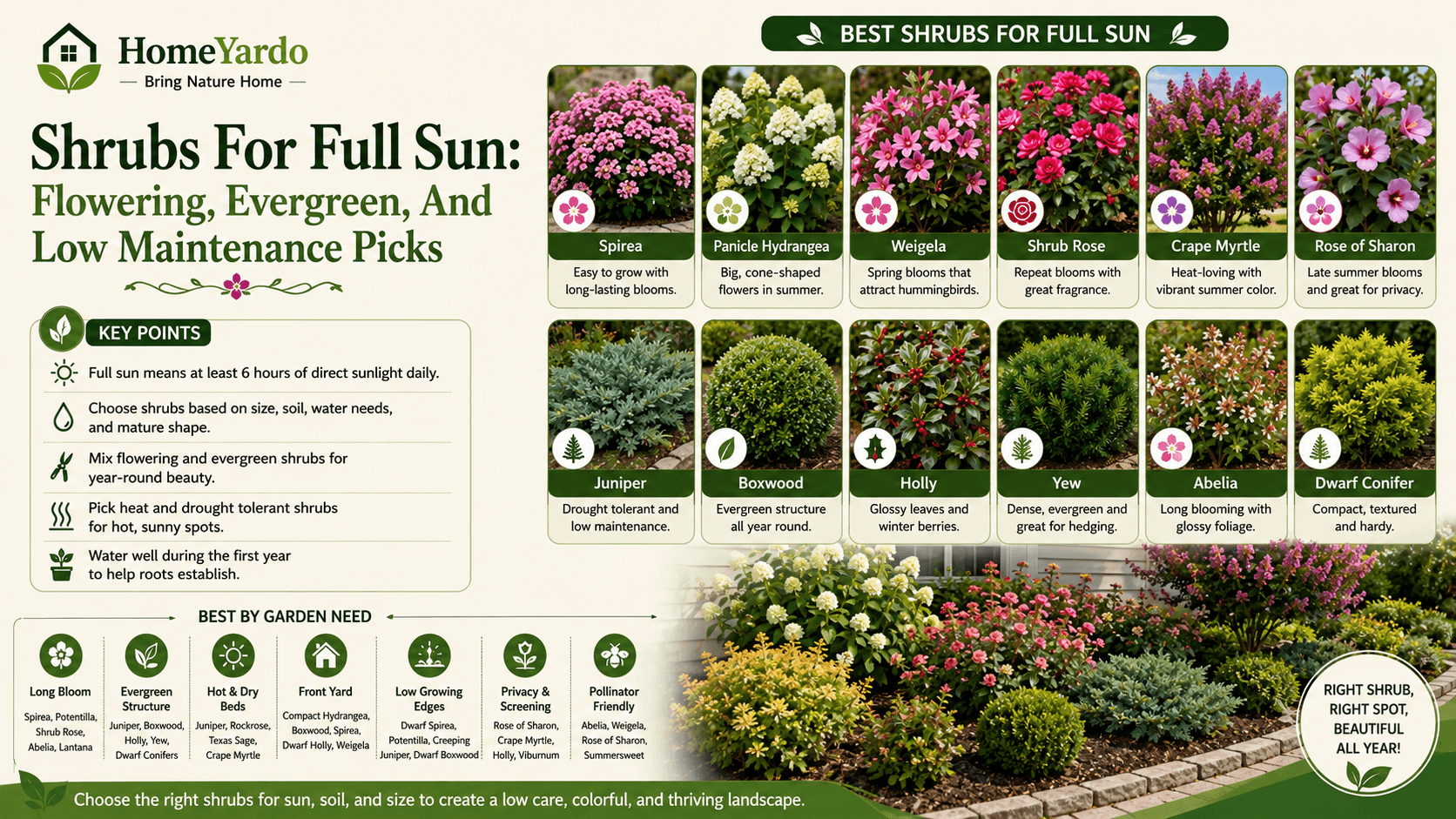
Spiraea, potentilla, panicle hydrangea, weigela, shrub rose, crape myrtle, rose of Sharon, abelia, juniper, boxwood, holly, yew and dwarf conifers are the best full sun shrubs.
Spirea, weigela, panicle hydrangea, shrub roses, potentilla, crape myrtle and rose of Sharon are the best flowering shrubs for full sun. Juniper, boxwood, holly, yew, inkberry holly and dwarf conifers are good choices for evergreen color.
In hot, sunny beds, consider crape myrtle, Texas sage, rockrose, juniper, rose of Sharon and chaste tree. Small-sized hydrangea, boxwood, spirea, dwarf holly, compact weigela, abelia and dwarf conifers are good options for front yards.
What Full Sun Means For Shrubs?

A full sun shrub receives direct sunlight for at least 6 hours during the daylight hours. The term ‘useful’ is overused, but it does not describe the entire situation. Shrubs can also be combined with full sun plants that tolerate the same light, heat, and watering pattern.
The same shrub in cool morning sun may well have a different response than the same shrub next to a south facing wall in a hot climate. A planting site may become much drier, hotter, and harder due to afternoon sun, dry wind, pavement, brick, and gravel.
The sun also varies from area to area. Species that thrive in an open northern garden might require more watering in a hotter, drier southern inland or city garden. Before planting, verify the sun exposure and heat level of the site.
How To Choose The Right Full Sun-Shrub

The flower colour is usually a secondary consideration when selecting a shrub, the first being the planting area. A shrub will grow in an appropriate climate, soil, and water supply and can meet the mature size requirements for the yard.
Good full sun planting also combines various roles. Seasonal color is provided by flowering shrubs. In winter, the garden is kept together by evergreen shrubs. Smaller shrubs can be used in small spaces; taller shrubs provide privacy, shade edges and background structure.
Check Mature Size Before Planting
Nursery pot size does not necessarily reflect mature size. A small plant at the garden center can grow a little too big, and fill up a window, a walkway or come into contact with siding.
The low shrubs are typically 1 to 3 feet in height, best suited under windows, along pathways and adjacent to patios. Medium shrubs (3-6 feet tall) are suitable for borders, foundation planting and mixed beds. For corners, screens, back borders and privacy planting, taller shrubs (over 6 feet) work better.
Space will depend on full grown width. Tightly planting shrubs for immediate fullness usually results in inadequate air circulation, overcrowding, additional pruning and later disease issues.
Match The Shrub To Soil And Water
Some sun loving shrubs like a well drained soil. Examples of plants that thrive in drier areas include juniper, potentilla, rockrose, Texas sage, and a few shrub roses.
Other shrubs require more consistent moisture. Panicle hydrangea, some hollies and a few broadleaf evergreens might suffer under warm summer conditions if planted in a hot, dry soil with little or no regular watering.
Plant shrubs in zones based on water requirements. Do not place a dry site shrub in a small bed with a moisture loving shrub that is over-watered.
Think About Year Round Structure
Flower is just one component of a shrub’s value. The colour, shape, berries, bark and winter form of a sunny garden are also important.
After flowering shrubs have ceased blooming, the garden looks complete with evergreen shrubs like boxwood, juniper, holly, yew, inkberry holly and dwarf conifers. Seasonal color and softness are provided by deciduous shrubs like spirea, hydrangea, weigela and rose of Sharon.
A well-balanced sunny bed will typically feature at least one evergreen plant to anchor the bed, a flowering plant to fill in, a lower level plant near the front, and sufficient space for the plants to grow to a mature size.
Best Shrubs For Full Sun By Garden Need

Various sunny sites require various types of shrubs. Plants on the heated edge of the driveway require more toughness than those on the watered edge of the front bed. The key components of a foundation planting are size and control, and the key components of a privacy planting are height and density.
| Garden Need | Best Choices | Why They Work |
|---|---|---|
| Long bloom | Spirea, potentilla, shrub rose, abelia, lantana | Repeat flowers or long seasonal color |
| Evergreen structure | Juniper, boxwood, holly, yew, dwarf conifers | Year round shape and foliage |
| Hot dry beds | Juniper, rockrose, Texas sage, potentilla, crape myrtle | Better heat or dry site tolerance once established |
| Front yard | Compact hydrangea, boxwood, spirea, dwarf holly, weigela | Manageable size and curb appeal |
| Low growing edges | Dwarf spirea, potentilla, dwarf boxwood, creeping juniper | Fits paths, windows, and borders |
| Privacy | Rose of Sharon, crape myrtle, upright juniper, holly, viburnum | Height, density, or seasonal screening |
| Pollinators | Abelia, weigela, rose of Sharon, sterile butterfly bush cultivars, summersweet | Nectar, bloom clusters, and wildlife value |
Use this table as a quick starting point, then check zone, soil, height, and local growing conditions before planting.
Full Sun Flowering Bushes

The full sun flowers are great in gardens that are bright and vibrant, in which color, form and interest for the season are required. They can help soften your front yard of home or fill in the borders with sunshine or add flowers to patios or open beds to give them a finished appearance. For more bloom options beyond sunny sites, compare flowering bushes by size, season, color, and landscape use before choosing a shrub.
The flowering bush must be selected because of more than the color of its blooms. Size, habit of growth as well as soil moisture, pruning requirements and exposure to heat all take into consideration. A spirea that is compact may be suitable for an edge for a walkway, whereas an older rose of Sharon could be more suitable at in the middle of a sun-drenched border.
Certain flowering bushes bloom during an extremely short but intense time. Other flowers last for several weeks when the weather is sunny, warm and well hydrated in dry times. Mixing the bloom times helps the garden not look empty after a particular shrub has finished flowering.
The best options for sunny flowers include:
- Spirea to fill small beds borders, as well as simple summer or spring flowers
- Weigela for its arching growth, tubular blooms and hummingbird activity
- Panicle hydrangeas are great for large summer flowers in soil is uniformly wet
- Shrub rose for color repetition in sunny open beds that have good airflow
- Potentilla to promote the compact growth and longer bloom time in colder climates
- Abelia for its glossy foliage, tiny blooms, and a soft border
- Crape myrtle in warm areas with long summers and intense sunshine
- Rose of Sharon to be used for late summer flowers and a more imposing background structure
For front gardens with small spaces, use lower flowering plants that are neat and do not require regular pruning. For large, sunny borders, blend tall and medium-sized shrubs to ensure that the plant has depth. In areas around driveways, walls and patios, select more robust flowering plants that can take on more heat reflection once established.
The new flowering plants require constant water throughout their first growing season. Even plants that are able to handle dry weather later might struggle if their roots have not yet firmly rooted into the soil around them.
A well-balanced sunny bed typically will look better if flowering bushes are planted alongside evergreens. The flowers provide seasonal color, and evergreens maintain the shape of the bed after the flowers disappear.
Flowering Shrubs For Full Sun

Sunny beds are the most color-rich in the spring with flowering shrubs. Some flowers profusely for a brief period, while others may have been flowering for many weeks or months.
Not only are the best full sun flowering shrubs attractive when in flower, but they are also attractive to look at when they’re not in bloom. They’re also space-efficient, adaptable to local heat and provide post-flowering foliage, form or pollinator value.
Spirea
Spirea is the easiest flowering shrub for full sun. A large number of varieties remain compact, flower profusely and are suitable for front yards, borders, walkway edges and mixed beds.
Certain spireas are spring bloomers, others are summer-bloomers. There’s also a lot of brightly colored new foliage, such as gold, bronze, red and soft green. Light pruning following bloom may help to maintain a neat plant.
Spirea is a good choice for low maintenance gardens as it is naturally rounded and is generally not a “heavy shaper.
Weigela
Weigela is appreciated for its spring flowers, arching branches and its hummingbird attractiveness. A variety of pink, red or white tubular flowers is readily available that will stand out in sunny mixed borders.
Some newer cultivars come back with a re-flowering in light bloom after the first spring flowering. When the plant is not producing flowers, dark leaf and variegated varieties provide foliage color.
Use weigela in locations that can accommodate its natural spread. It is better to shape light than it is to hard prune at the wrong time.
Panicle Hydrangea
Panicle hydrangea is one of the more suitable selections for sunny locations. Unlike most largeleaf hydrangeas, it will tolerate more direct sunlight when soils are consistently moist.
In summer it forms large cone shaped clusters of flowers. As the season progresses from white or lime green to pink, rose and tan, many cultivars age.
Compact types are suitable for front yards or foundation beds. Larger ones are suitable for focus plants or plants at the rear of the border. Regular watering is vital in warm environments to stop flowers from becoming stressed and wilting.
Shrub Rose
Shrub roses perform well in full sun if long bloomer and traditional flowers are desired. The landscape roses and disease resistant cultivars are generally easier to grow than the older high maintenance rose varieties.
Roses bloom more and have sturdier stems in full sun. An adequate air flow also minimizes leaf diseases.
Plant shrub roses around borders, in cottage gardens, front beds, and sunny entry areas. Keep sufficient space around plant for pruning, air flow and maintenance.
Potentilla
Potentilla is a vigorous flower producing shrub that’s well suited to the sun, particularly in cooler climates. It remains relatively small and has simple flowers that bloom for a long time.
Yellow varieties are widely available, but whites, pinks, orange and soft blends are also available. It is a small plant that can be used in low beds, edges and front yard plantings.
Potentilla will be a useful selection for a long-blooming, low maintenance shrub that will not need significant pruning.
Rose Of Sharon
A tall flowering shrub, Rose of Sharon flowers late into the summer after most other spring flowering shrubs. The flowers are like hibiscus, ranging from white to pink, purple, blue toned, and bicolored.
Excellent for background, privacy screen or as an informal screen anchor in a sunny area. It is also very upright, which is another advantage for it in narrow-spaces.
Some species may volunteer in some areas. If seed is an issue, choose cultivars that are known to be seedless or low in seeds.
Crape Myrtle
Crape myrtle is a good option where hot, sunny conditions prevail and climates are appropriate. It provides summer blooms, smooth bark and a naturally cascading form.
May be trained as a large shrub or small tree depending on variety and training. The color of blooms ranges from white, pink, red, lavender and purple.
Avoid harsh topping. Crape myrtle is best when allowed to grow naturally with only dead, crossing or awkward branches removed.
Abelia
In sunny beds, Abelia offers long blooming, glossy foliage and is an excellent source of pollinators. In mild climates, many types remain semi evergreen or evergreen.
Small tubular flowers, sometimes attracting bees and butterflies. Other cultivars may also have bronze, gold, pink or variegated leaves.
Abelia thrives in proximity to foundations, in borders, around patios, and as a low- to medium-blooming shrub for a more relaxed aesthetic.
Evergreen Shrubs For Full Sun

Use evergreen shrubs to provide structure to sunny gardens when flowering shrubs are barren or not blooming. They serve as a way to outline beds, create entryways, tone down foundations and provide winter interest.
Select evergreen shrubs for mature size, winter hardiness, soil tolerance, and tolerance to pruning. There are evergreens that can tolerate and thrive in full sun in cooler climates, but require more water in hot climates, or relief from the heat in the afternoon.
Juniper
Juniper is a very dependable evergreen shrub that thrives in full sun on dry slopes and for low maintenance landscapes. It has spreading, mounding, upright and columnar varieties.
Low growing junipers are good for sunny banks, walkways and rock gardens. Upright shapes can give the screen a lift or help shield it from view.
Juniper does not tolerate wet soil. Rich, soggy planting beds are not as good as good drainage and open air circulation.
Boxwood
Boxwood is frequently planted at formal boundaries, in foundation plantings, low hedges and container plantings. Provides a clean evergreen form, which is complementary to flowering shrubs.
Boxwoods can be grown in full sun or partial shade, with some varieties potentially becoming stressed in hot climates. Space and ventilation minimise disease threats.
Select small cultivars for small beds; only allow for larger cultivars in areas where they will not exceed the mature size of their width.
Holly
Many varieties of hollies retain their foliage, shape and fruit throughout the winter. It can be used in hedging, screening, foundation planting or as a wildlife planting.
Some hollies need both male and female plants for berries. Others are self fruitful or cultivated primarily for their foliage.
Size varies widely. Dwarf hollies can be used in low beds, and tall hollies can be used as effective privacy shrubs.
Yew
Yew is a dense evergreen shrub for hedging, foundation planting and in structured plantings. Good tolerance to pruning and varies in light requirements depending on the climate.
Yew requires well-drained soil in full sun and the soil should not become waterlogged. Should not be used in hot dry areas without consulting local suitability.
Yew is poisonous if ingested and should be used with care near pets, livestock and children.
Dwarf Conifers
Dwarf conifers provide year round interest, texture and form to sunny beds. These can range from dwarf spruce, falsecypress, mugo pine, compact juniper and other slow-growing conifers.
They are well suited to use in the front yard, rock gardens, mixed borders and foundation beds. Pruning is usually light or not necessary when the correct size is determined.
Be careful to see the mature size. Over time, a “dwarf” can still grow several feet tall and wide.
Inkberry Holly
Inkberry holly is a rounded evergreen shrub that can be used as a boxwood substitute in many landscapes. Small leaf, easy to handle and good year round structure.
It can be used in foundation beds, low hedges, mixed borders, and front yard plantings. There are some that get darker berries, particularly from the correct pollination partner if it is in close proximity.
Inkberry will not grow as a dry slope shrub, but will often grow better on a more even moisture than juniper plants.
Small Shrubs For Full Sun

Small shrubs can be used to provide year round shape or seasonal flowers in areas with limited space. They can be placed in front yards, in small areas around patios, steps, paths, and under windows.
It’s best to select cultivars from the outset that are compact in growth habit. It is a labor intensive process to prune a large shrub constantly to keep it small, and it is sometimes difficult to keep the shrub’s shape intact.
Small Flowering Shrubs
Compact spirea, compact potentilla, compact shrub rose, compact weigela, compact panicle hydrangea, and compact abelia are good small flowering shrubs for full sun.
These plants can be used for colour without being too intrusive in small areas. They are particularly effective in beds in the front yard, low borders, and in combination with perennials or ornamental grasses.
Be sure to look at the height and spread of a compact flowering shrub. Even a short plant can spread out enough to interfere with a walk.
Small Evergreen Shrubs
Evergreen shrubs grow well in full sun when small: Dwarf boxwood, Dwarf holly, Dwarf yew, Dwarf conifer, Creeping juniper, Mounding juniper.
Often these shrubs are helpful in giving structure to a blooming bed once the flowers have died. They also assist in cleaning up front yards during the wintertime.
Care needs to be taken to space small evergreens. Clumping planting may cause moisture to become trapped, decrease air circulation, and make pruning difficult.
Where Small Shrubs Work Best
Small shrubs are best suited in areas where full size shrubs may cause issues. Place them beneath windows, beside walks, around patios, near steps, near mailboxes and next to the front row of mixed beds.
They also facilitate the interaction between taller shrubs and those with low flowers or groundcovers. Short shrubs help to create a more natural look from taller shrubs to lawn or walkway in a layered sunny bed.
One or two small shrub types make for a cleaner appearance than a plethora of shapes within a small area.
Low Maintenance Full Sun Shrubs

Low maintenance flowering shrubs full sun are those plants that suit the location and will require minimal attention for proper form. They require correct planting, watering for establishment, mulch and occasional pruning.
Shrub roses that are disease resistant, spirea, potentilla, juniper, ninebark, abelia, rose of Sharon, dwarf conifers, and good low care shrubs are all examples of good low care selections.
What Makes A Shrub Low Maintenance
The easier it is to maintain a shrub, the more likely it will be to reach its mature size. A plant that grows large naturally makes pruning a frequent task.
Also consider disease resistance. Plants that are well ventilated, naturally shaped, and suited to their climate typically require less action.
Low care shrubs generally require little shaping or pruning, do not require as much winter protection as other shrubs, and do not require as much water once established.
Low Care Does Mean No Care
All easy shrubs require some care in the first year. In hot or windy locations, new roots require regular watering.
Mulch keeps the soil from drying out and covers the roots to shield them from temperature extremes. There may still be some light pruning required to remove dead, damaged and crossing stems.
A quick seasonal pest, leaf spot, broken branch and mulch buildup inspection can stop small problems from becoming big issues.
Heat Tolerant And Drought Tolerant Shrubs For Full Sun

There is a relationship between drought tolerance and heat tolerance, but it is not a direct one. Drought tolerant shrubs tolerate dry conditions once they have established roots. Heat tolerant shrubs require little stress from extreme heat and lots of sun.
Shrubs will not be drought tolerant when planted. All plants require watering periodically during the first few weeks after they are planted, even hardy plants.
Best Shrubs For Hot Sunny Beds
Shrubs that will grow well in hot, sunny areas are crape myrtle, Texas sage, rockrose, juniper, rose of Sharon, chaste tree, lantana (in warm regions only) and oleander (in regions where it is safe and appropriate).
These plants may do better in warm, sunny planting locations than the moisture-loving shrubs. They will work in open beds, wide borders and hot front yards.
Oleander requires special attention because it is poisonous when eaten. It must not be planted in areas where pets, livestock or children can reach leaves, flowers or stems.
Best Shrubs For Dry Soil
Dry soil is better tolerated by junipers, potentilla, rockrose, Texas sage, some shrub roses and California lilac in suitable climates than it is by many of the showy flowering shrubs.
Deep watering is still required for dry soil shrubs. They tend to be better when deep watering is done once in a while and not sprinkled often.
Do not plant dry site shrubs in low areas where water accumulates. There are many hardy sun plants that will not put up as well in a soggy soil as they will in a dry soil.
Best Shrubs Near Driveways, Walls, And Patios
Heat can be elevated around shrubs by driveways, walls, patios, stone mulch and gravel beds. These areas will make the soil dry more quickly and may burn tender leaves or plants.
Hardy shrubs, such as juniper, Texas sage, rockrose and potentilla, may be more suitable for these more arid locations than soft leaf shrubs.Some varieties of crape myrtle also make good choices in these more challenging sites.
Allow for space between shrub and hard surfaces. Stress is minimized in reflected heat areas with airflow, mulch and deep watering.
First Year Watering For Heat Tolerant Shrubs
Water deeply after planting new heat tolerant shrubs. Rootball should be kept uniformly moist during root expansion into the surrounding soil.
In hot weather, probe the soil to determine water levels, not surface water levels. Sunny beds may appear dry surface area, but contain moisture below the surface.
Slowly decrease watering as the shrub becomes established. Deep irrigation occurs less frequently, resulting in a stronger root system as compared to shallow daily irrigation.
Front Yard Shrubs For Full Sun

Shrubs in front yards must be tidy, fit the house, and be easy to maintain. They should delineate windows, entrances, paths and corners without overcrowding the home.
Typically, an evergreen structure is paired with a flowering color in a strong front yard planting. This helps to make the area more appealing in more than one season.
Best Shrubs For Front Of House
Good shrubs for the front of a sunny house include compact panicle hydrangea, boxwood, dwarf holly, spirea, compact weigela, potentilla, dwarf conifer, and abelia.
These choices can provide flowers, foliage, structure, and curb appeal without overpowering the home. Compact cultivars are especially useful beneath windows and along walkways.
Choose plants based on mature height. A shrub that blocks a window or grows into the entry path will create more pruning work later.
Foundation Planting Tips
Compact panicle hydrangea, boxwood, dwarf holly, spirea, compact weigela, potentilla, dwarf conifer and abelia are good front-of-the-house shrubs for a sunny house.
These selections can add flowers, foliage, structure and curb appeal, but not overpower the home. For under windows and walkways, you can use compact varieties.
Select plants for mature size. A shrub on a window or that grows into the doorway will require additional pruning time later.
Simple Front Yard Formula
A practical sunny front yard formula starts with one evergreen anchor, one flowering shrub, one low edging shrub, and one seasonal accent plant.
The evergreen anchor keeps the bed shaped in winter. The flowering shrub brings seasonal color. The low edging shrub softens the front of the bed.
Mulch, spacing, and repetition make the design look cleaner. The goal is not to fill every inch on planting day, but to let the shrubs grow into the space.
Tall Shrubs Full Sun For Privacy And Structure

Tall shrubs can screen neighbors, frame a yard, hide utility areas, or create a background for smaller plants. They are useful where fences feel too hard or where a softer living screen is preferred. For stronger screening, combine tall shrubs with privacy plants that match the same sun exposure and mature spacing needs.
The right tall shrub depends on height, width, density, evergreen habit, flower value, and local climate.
Tall Flowering Shrubs
Tall flowering shrubs for full sun include rose of Sharon, crape myrtle, chaste tree, large panicle hydrangea, viburnum, and butterfly bush, where suitable.
Rose of Sharon gives a late summer bloom. Crape myrtle handles heat in warm regions. Chaste tree adds tall, airy flower spikes. Large hydrangeas create bold summer flowers.
Butterfly bush can be invasive in some regions, so sterile cultivars or local alternatives are better where spreading is a concern.
Tall Evergreen Shrubs
Tall evergreen shrubs for sunny structure include upright juniper, holly, yew, arborvitae in suitable conditions, and taller boxwood cultivars.
These plants are useful for screening and winter privacy. They can also frame entries, hide service areas, and create a clean backdrop for flowering shrubs.
Check mature width before planting near property lines. A tall shrub that grows too wide can cause neighbor, sidewalk, or driveway problems later.
Spacing For Screens
Shrub screens need patience. Planting too close for instant coverage often causes crowding, poor airflow, weak growth, and uneven pruning.
Use mature width as the spacing guide. For a softer screen, shrubs can be staggered in two rows if space allows.
Leave enough room for pruning access behind or between plants. A screen that cannot be reached is harder to maintain and easier to let overgrow.
Flowering Evergreen Shrubs For Full Sun
Flowering evergreen shrubs are appealing because they offer blooms and foliage structure. They can be very useful, but many are climate specific.
Some flowering evergreens are hardy only in mild areas. Others may need afternoon relief, steady moisture, or protection from harsh winter wind.
Best Mild Climate Options
Good mild climate options include abelia, Indian hawthorn, escallonia, oleander, gardenia, and camellia where the cultivar and climate fit.
Abelia is one of the easier choices because it handles sun well in many regions and offers long bloom. Indian hawthorn and escallonia can work in mild coastal or warm climates.
Oleander is highly toxic if eaten, so it needs careful placement. Gardenia and camellia may need more moisture or filtered light in hotter regions.
Best Cooler Climate Options
Cooler climate options are more limited, especially for shrubs that are both evergreen and showy in flower. Inkberry holly, dwarf holly, and some broadleaf evergreens can still provide structure.
Certain rhododendrons or azaleas may tolerate sun in cooler climates, but many prefer part shade or protection from harsh afternoon exposure.
Local growing conditions matter here. A plant label, local nursery advice, or regional extension guidance is useful before choosing flowering evergreens for full sun.
Safety And Regional Cautions
Some shrubs are toxic, invasive, or poorly suited to certain climates. Yew, oleander, and some other ornamentals need careful placement around pets, livestock, and children.
Butterfly bush can spread in some regions. Choose sterile cultivars or native flowering shrubs where local rules or ecological concerns apply.
Climate also changes evergreen behavior. A shrub sold as evergreen in a mild region may lose leaves or suffer winter injury in colder zones.
Native And Wildlife Friendly Shrubs For Full Sun

Native and wildlife-friendly plants can make a garden appear calmer and more natural. They are often able to support local birds, insects and pollinators as well as giving flowers, fruit autumn color or winter shape in the garden. A nearby wild flower garden can support the same wildlife friendly goal by adding meadow style blooms around native shrubs.
The most suitable choice is based on the area. The plant that is thriving in one region might not be suited to different climates, even though both regions have sunshine. Type of soil, temperatures and the temperature of summer, winter cold and drainage all need to be considered prior to making a decision to plant.
Native plants can bring multiple seasons of fascination. Some bloom in spring, others bear fruit for bird feeders, while others have vibrant leaves or stems later in the season. They are great for gardens that require more than a few blooms.
Wildlife friendly and native-friendly alternatives could include:
- Ninebark to create sunny borders and spring flowers. It also has colored foliage and peeling bark
- Chokeberry flowers and berries. It also provides intense fall color in moist to average soil
- New Jersey tea for dry sunny beds and is friendly to pollinators. white flowers
- Sweetspire for sunny and moist areas with fragrant flowers, as well as the rich autumn color
- Serviceberry for larger areas with Spring flowers and edible berries and seasonal structure
- Beautyberry for warm climates, where purple berries may provide late-season interest
- Buttonbush is to be used in sunny, wet areas where most common shrubs would struggle
Utilize native plants in areas that coincide with the natural planting location. Dry soil plants should not be planted in moist low zones, and water-loving plants should not be placed on hot slopes or against dry walls with no regular water.
An easy strategy is to blend one native plant that flowers as well as one that has berries, and another plant with winter or fall-time attraction. This will give the sunny bed more value throughout the year, and also help the garden to support wildlife without looking messy.
Before planting, consult the local extension resources or the nursery’s list of names to confirm the nativeness of a plant to the area in which it is. Native plants are best when the plant is appropriate to the area, not just an extensive national list.
Best Sun Loving Shrubs By Bloom Season

Bloom timing helps a sunny garden stay attractive for more of the year. If all shrubs bloom in spring, the bed may look flat by midsummer.
A better planting plan combines spring bloom, summer flowers, late-season color, fall foliage, berries, and evergreen structure.
| Season | Shrub Examples | Best Use |
|---|---|---|
| Spring | Forsythia, weigela, spirea, lilac, flowering quince | Early color |
| Early Summer | Roses, hydrangea, potentilla, abelia | Main bloom season |
| Mid To Late Summer | Crape myrtle, rose of Sharon, butterfly bush, lantana | Hot weather color |
| Fall | Reblooming roses, hydrangea color, smokebush foliage, abelia | Late interest |
| Winter | Holly, juniper, boxwood, yew, dwarf conifers | Structure and evergreen color |
Use the table as a planning tool. Pick at least one plant for structure and one or two shrubs for different bloom windows.
Best Full Sun Shrubs By Landscape Use

The optimum shrub comes with the duty it should perform. Each of the four treatments, border, hedge, slope and container, requires different demands on the plant.
Select shrubs for their function before restricting by sun, heat, mature size and maintenance.
Sunny Borders
The taller and more textured shrubs create a wonderful contrast against the sunny borders. Arrange taller shrubs at the rear, medium shrubs in the middle and low shrubs at the front. Around the front of a sunny shrub border, full sun perennial plants can add repeat color without blocking the main shrub structure.
Utilize foliage contrast as well as flowers. Even if blooms are sparse, a dark leaf weigela, blue green juniper, golden spirea and glossy abelia will provide interest.
Allow space between shrubs and perennials. Full sun borders quickly close in after the second or third season.
Hedges And Screens
Need dense growth, predictable size and spacing for hedges and screens so that the plants can fill in without choking.
Evergreen screens provide privacy all year long. Evergreen trees provide year round color and privacy, but deciduous flowering trees offer privacy during the growing season.
To create a more flexible hedge, plant staggered or combine shrubs that have similar growth habits and size. Co-locate fast growing with slow compact shrubs on different lines of the hedge.
Dry Slopes
Shrubs that thrive in sun and dry conditions as well as soil movement and drainage, are required for dry slopes. Other plants, such as juniper, rockrose, potentilla, and others, are more drought resistant than thirsty shrubs.
Mulch can help decrease erosion but needs to be carefully placed to not wash away. Saplings should be spaced to promote root spread and soil retention.
Do not plant shrubs in high water areas on steep dry slopes without irrigation. A plant that is always wilted will not develop good roots.
Containers In Full Sun
If the pot is sufficiently large, porous and watered regularly, compact shrubs can be grown in containers. Pots will dry quicker than beds on the ground in the sun.
Dwarf boxwood, dwarf conifers, compact shrub roses, compact hydrangeas, abelia and small hollies are good choices.
Cold climates also require protection for container shrubs in winter. Roots in pots are more susceptible to freezing than root in garden soil.
Common Mistakes When Planting Shrubs In Full Sun

Too many shrub issues start with the “wrong” tree in the “wrong” location. Poor soil, crowding, reflected heat and bad spacing cannot be corrected by full sun.
Several planting choices can avoid years of pruning, watering stress and poor growth.
Choosing Only By Flower Color
The color of the flowers is only temporary. The shrub may produce flowers for a few weeks, but continues to grow and be enjoyed throughout the year.
Before making your selection, consider foliage, mature size, bark, berries, fall color, winter structure and how the plant will blend with adjacent shrubs.
Flowers are not the only thing a good sunny bed can have. It retains structure at the end of bloom season.
Ignoring Mature Size
One of the most frequently made shrub planning errors is the mature size. Small plants in the nursery can get lop-sided, tall and difficult to manage.
If a shrub is planted in a walkway, it may require frequent trimming. A shrub in front of a window could obstruct the light. A shrub in the vicinity of an air conditioner can impede airflow.
Select varieties that have smaller growth habits when space is limited. Better to set the right size seedling than to cut the wrong size seedling forever.
Planting Too Close To Walls Or Pavement
Heat is trapped and retained in walls and pavement. Plants that are too close may dry out more quickly, burn or grow unevenly.
The installation of hard surfaces may also restrict root growth and create difficult access for pruning operations. Provide space for ventilation and upkeep.
Mulch around the base of the plants; do not pile against stems. Mulch should help to reduce soil temperature, not ensure that moisture stays against the crown.
Mixing Dry And Moisture Loving Shrubs
Do not combine dry site shrubs with moisture loving shrubs in the same small bed, unless it can accommodate both.
Some hollies and hydrangeas might require more consistent water. Juniper, rockrose and Texas sage like to be in better soil and drier conditions once established.
Caring for groups of shrubs grouped by water requirements is easier and healthier.
Forgetting Establishment Watering
A shrub that is drought tolerant will NOT be drought tolerant on the day of planting. New roots should be given the time to grow into the soil around them.
The first growing season is the most critical. Deep irrigation allows roots to spread out and downwards.
Although some shrubs can survive without establishment watering, a lack of water may cause leaf scorch, poor growth, branch dieback or plant death.
Ignoring Invasive Or Toxic Risks
Some shrubs may spread aggressively in some areas. However, sterile cultivars or local alternatives could prove better for some plants, such as the butterfly bush.
Some ornamental shrubs are poisonous if consumed. Oleander and yew require special care when used around pets, children and grazing animals.
Use of local plant lists may assist in determining safety, suitability, and area restrictions of shrubs.
Simple Care Guide For Full-Sun Shrubs

Shrubs that are in full sun typically require consistent attention and very light maintenance every season. Many require minimal maintenance once they are established.
Primary care activities include watering, mulching, right time pruning, only feeding when necessary, and watching for pests and disease.
Watering
Water thoroughly when you plant to encourage the root ball to settle in with soil. Shallow watering only dampens the top and isn’t very beneficial to the roots.
Water frequently in dry periods during the first growing season. Water requirements may be greater at sunny sites, in sandy soil, in windy conditions, in containers and/or in the presence of reflected heat.
Older shrubs typically require less frequent watering but if droughted, may need deep waterings.
Mulching
Mulch 2 to 3 inches around shrubs to help slow water evaporation from the soil and to absorb heat around the roots.
Mulch will not touch the trunk or main stem. Mulch piles that are stacked up next to the base will retain moisture and can cause rot or pest issues.
Over time, as mulch breaks down, it also helps to enhance the soil’s texture.
Pruning
Prune shrubs based on how and when they bloom. Heavy late winter pruning may remove flowers that form on older wood on the shrubs that bloom in the spring.
Late winter or early spring pruning is tolerated by many of the summer blooming shrubs. Dead, damaged, crossing or diseased stems can often be pulled out at the time of discovery.
Don’t ball all the shrubs. The natural form tends to be more attractive and requires less upkeep.
Feeding
Heavy feeding is not necessary for most shrubs when they are planted in an appropriate soil. Excessive amounts of nitrogen can give rise to a leafy habit with fewer flowers.
Compost can help create a better soil structure and contribute to even growth. When plants are weak and the reason is not known, a soil test can help.
Apply fertilizers sparingly, according to directions on the label. Higher application rates don’t necessarily equal more flowers.
Pest And Disease Checks
Look for leaf spots, powdery mildew, scale, aphids, mites and branch dieback in shrubs during the growing season.
Plenty of space and air circulation eliminates many disease problems. Fallen infected leaves should be cleaned up.
Where possible, select disease resistant cultivars, particularly roses, boxwood and other shrubs that have common disease problems.
Full-Sun Shrub Comparison Chart

This chart provides a quick reference of shrubs that do well in full sun and what they are used for. Apply it following the checking of your zone, soil, sunlight and space.
| Shrub | Type | Size | Best Feature | Best Use | Care Level |
|---|---|---|---|---|---|
| Spirea | Deciduous flowering | Small to medium | Easy flowers and foliage | Front yard, border | Low |
| Potentilla | Deciduous flowering | Small | Long bloom and cold tolerance | Low beds, sunny edges | Low |
| Panicle Hydrangea | Deciduous flowering | Small to large | Big summer blooms | Foundation, focal point | Medium |
| Weigela | Deciduous flowering | Small to medium | Spring flowers | Mixed border | Low to medium |
| Shrub Rose | Deciduous flowering | Small to large | Long bloom | Border, cottage garden | Medium |
| Crape Myrtle | Flowering shrub or small tree | Medium to tall | Summer flowers | Hot climates | Low to medium |
| Juniper | Evergreen | Low to tall | Drought tolerance | Slopes, structure | Low |
| Boxwood | Evergreen | Small to medium | Formal shape | Foundation, hedge | Medium |
| Holly | Evergreen | Medium to tall | Berries and structure | Hedge, screen | Low to medium |
| Yew | Evergreen | Small to tall | Dense evergreen form | Hedge, foundation | Medium |
| Abelia | Semi evergreen or evergreen | Small to medium | Long bloom | Pollinator border | Low |
| Rose Of Sharon | Deciduous flowering | Medium to tall | Late summer bloom | Privacy, back border | Low |
The best shrub is the one that fits the site without constant correction. Size, heat, water, and mature width matter as much as flower color.
Conclusion
The most suitable shrubs for full sun are those that are suitable for the site, soil, climate and mature space. Flowering shrubs provide seasonal color and evergreens provide structure when the flowers are over. Select smaller varieties for smaller front yards, more hardy varieties for hot, dry locations, and allow each plant ample room to expand to its mature size.
The combination of proper match and proper first year watering can keep the color balance in a sunny garden and make it easier to maintain.
FAQ’s
The best choices include spirea, potentilla, panicle hydrangea, shrub rose, crape myrtle, juniper, boxwood, holly, abelia, and rose of Sharon. The right option depends on zone, soil, size, and whether the space needs flowers, evergreen color, or privacy.
Spirea, weigela, panicle hydrangea, shrub roses, potentilla, crape myrtle, rose of Sharon, and abelia are strong flowering options. Choose by bloom season, mature size, and local heat level.
Juniper, boxwood, holly, yew, inkberry holly, and dwarf conifers can grow in sunny spaces when matched to the right climate and soil. Some evergreens may need more moisture or afternoon protection in very hot regions.
Dwarf spirea, potentilla, compact weigela, dwarf boxwood, dwarf holly, compact abelia, and creeping juniper work well in smaller sunny areas. They fit near windows, paths, patios, and front borders.
Spirea, potentilla, juniper, ninebark, abelia, rose of Sharon, and dwarf conifers are good low care choices. They still need proper planting, mulch, and regular watering during establishment.
Crape myrtle, Texas sage, rockrose, juniper, rose of Sharon, chaste tree, and lantana in warm zones can handle hot sunny sites. First year watering is still needed while roots establish.
Compact panicle hydrangea, boxwood, spirea, dwarf holly, dwarf conifer, compact weigela, and abelia work well in sunny front yards. Keep shrubs below windows and leave room for mature width.
Yes, but choices depend heavily on the climate. Abelia, Indian hawthorn, escallonia, oleander, gardenia, camellia, and some hollies may work in suitable regions, but check zone, toxicity, and local heat tolerance.
New shrubs need regular deep watering during the first growing season. Established shrubs usually need less water, but containers, sandy soil, reflected heat, and drought can increase watering needs.
Yes, compact shrubs can grow in containers if the pot is large, drains well, and receives consistent water. Dwarf boxwood, compact roses, dwarf conifers, abelia, and small hydrangeas can work in sunny pots.
Full sun means a shrub can grow with 6 or more hours of direct sunlight. Heat-tolerant means it can also handle high temperatures, reflected heat, and hot summer conditions without constant stress.
Avoid shrubs that prefer shade, moist woodland soil, or cool conditions unless the cultivar is known to handle sun. Also, avoid invasive or toxic shrubs in unsuitable locations.
References