64 Beautiful Variety Of Flowers That Start With A You Didn’t Know About
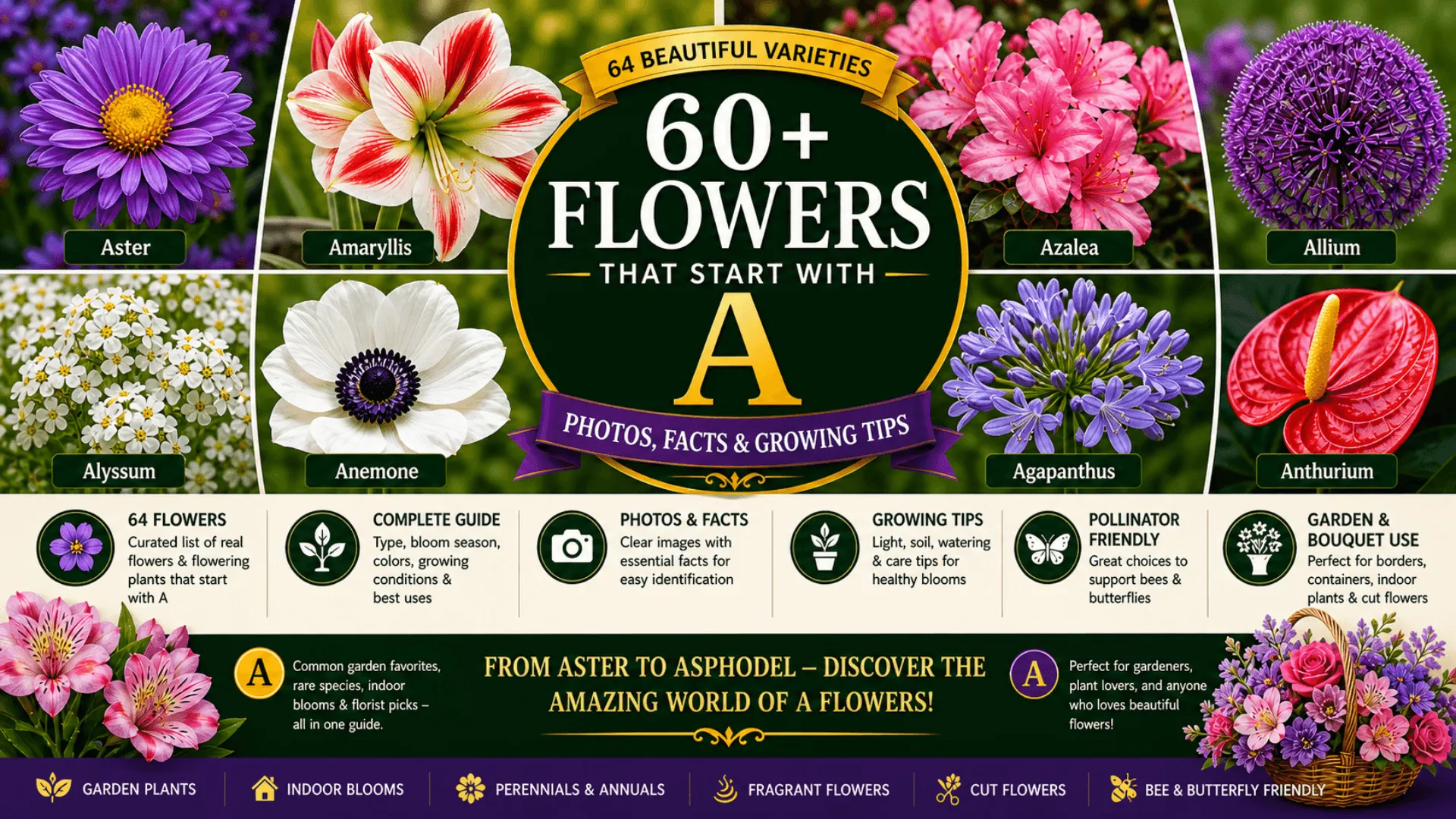
Flowers starting with A include bloomers in the garden, florist, and indoor flowering plants, and little-known species with real ornamental value. A few are grown as a one-season crop, and others are returned as perennials, bulbs, or flowering shrubs.
This is a guide to 64 real flowers and flowering plants beginning with A, Aster, Amaryllis, and Azalea. The list remains near flower value as opposed to filling space with wide name plant names that just happen to start with the same letter.
Each flower has been arranged according to name, type, degree of bloom, color, growing conditions, and optimal use. That makes the list easier to scan, whether the objective is a garden border, an indoor bloom, a bouquet stem, a pollinator plant, a fragrant flower, or a simple alphabetical reference.
Quick Answer: What Are Flowers That Start With A?
Flowers starting with A include Aerobic: Aster, Amaryllis, Anemone, Azalea, Alyssum, Allium, Alstroemeria, African Daisy, Angelonia, Anthurium, Agapanthus, and Aconite. These use A as common names, and others use botanical names, again beginning with A.
Quick List of A Flowers
The complete 64-name master list is sorted alphabetically so that it can be easily scanned. The common-name entries are followed by botanical-name-first entries, which are common on nursery tags, on the labels on plants, and in references to gardens.
Common-Name Entries
- Acacia
- Aconite
- Adonis
- African Daisy
- African Iris
- African Lily
- African Marigold
- African Violet
- Ageratum
- Agapanthus
- Allium
- Alpine Aster
- Alyssum
- Amaranthus
- Amaryllis
- Amazon Lily
- Ammobium
- Anemone
- Angel’s Trumpet
- Angelica
- Angelonia
- Anise Hyssop
- Anthurium
- Apple Blossom
- Arabis
- Arabian Jasmine
- Arnica
- Arum Lily
- Asiatic Lily
- Asphodel
- Aster
- Asteriscus
- Astilbe
- Astrantia
- Aubrieta
- Auricula
- Australian Waxflower
- Azalea
- Aztec Marigold
Botanical-Name-First Entries
- Abutilon
- Achillea
- Acanthus
- Acidanthera
- Acmella
- Adenium
- Aeschynanthus
- Agastache
- Alcea
- Alpinia
- Alyogyne
- Anchusa
- Andromeda
- Anigozanthos
- Antirrhinum
- Aquilegia
- Arctotis
- Argyranthemum
- Arisaema
- Armeria
- Arundina
- Asarina
- Asclepias
- Asystasia
- Aurinia
A Named Flowers: Comparison
A larger comparison table makes the strongest A flowers easier to sort by bloom time, color, growing conditions, and practical use. It also helps separate indoor flowers, border plants, florist stems, and pollinator-friendly choices.
| Flower Name | Botanical Name | Type | Main Colors | Bloom Season | USDA Zones | Light Needs | Best Use | Native Range / Origin | Fragrant / Pollinator / Toxic |
|---|---|---|---|---|---|---|---|---|---|
| Aster | Aster spp. | Perennial | Purple, pink, white, blue | Late summer to fall | 3 to 8 | Full sun | Pollinator beds | Europe, Asia, North America | Pollinator |
| Amaryllis | Hippeastrum spp. | Bulb | Red, white, pink, striped | Winter to spring | 8 to 11, indoors elsewhere | Bright light | Indoor bloom display | South America | |
| Anemone | Anemone spp. | Perennial | White, pink, red, purple | Spring or fall | 4 to 8 | Sun to part shade | Cottage gardens | Europe, Asia, North America | |
| Azalea | Rhododendron spp. | Shrub | Pink, red, white, purple | Spring | 5 to 9 | Part shade | Flowering shrub borders | Asia, North America | Toxic |
| Alyssum | Lobularia maritima | Annual | White, purple, pink | Spring to fall | 5 to 9 as a tender perennial | Full sun | Edges and containers | Mediterranean | Fragrant |
| Allium | Allium spp. | Bulb | Purple, white, pink | Late spring to early summer | 4 to 8 | Full sun | Structural garden accents | Northern Hemisphere | Pollinator |
| Alstroemeria | Alstroemeria spp. | Perennial | Pink, orange, yellow, red | Late spring to summer | 7 to 10 | Sun to part shade | Cut flowers | South America | |
| African Daisy | Osteospermum spp. | Tender perennial | Purple, white, yellow, orange | Spring to fall | 9 to 11 | Full sun | Bright bedding color | South Africa | Pollinator |
| Angelonia | Angelonia angustifolia | Tender perennial | Purple, pink, white | Summer to fall | 9 to 11 | Full sun | Heat-tolerant containers | Mexico, Caribbean | Pollinator |
| Anthurium | Anthurium andraeanum | Tropical perennial | Red, pink, white | Year-round indoors | 11 to 12, indoors elsewhere | Bright indirect light | Houseplant bloom | Central and South America | Toxic |
| Agapanthus | Agapanthus spp. | Perennial | Blue, purple, white | Summer | 8 to 11 | Full sun | Borders and containers | South Africa | Pollinator |
| Aconite | Aconitum spp. | Perennial | Blue, purple | Summer to fall | 3 to 7 | Part shade | Woodland style planting | Europe, Asia | Toxic |
| Ageratum | Ageratum houstonianum | Annual | Blue, purple, pink, white | Summer to fall | 2 to 11 | Full sun | Bedding and edging | Central America | Pollinator |
| Astilbe | Astilbe spp. | Perennial | Pink, red, white | Early to mid-summer | 4 to 9 | Part shade | Moist shade gardens | Asia, North America | |
| Aubrieta | Aubrieta spp. | Perennial | Purple, pink, blue | Spring | 4 to 8 | Full sun | Rock gardens | Southern Europe | Pollinator |
| Anise Hyssop | Agastache foeniculum | Perennial | Lavender, purple | Summer to fall | 4 to 8 | Full sun | Pollinator planting | North America | Fragrant, Pollinator |
| Amazon Lily | Eucharis amazonica | Bulb | White | Late winter to spring | 10 to 11, indoors elsewhere | Bright indirect light | Fragrant indoor bloom | South America | Fragrant |
| Australian Waxflower | Chamelaucium uncinatum | Shrub | Pink, white, purple | Winter to spring | 9 to 11 | Full sun | Long-lasting cut stems | Australia | |
| African Violet | Saintpaulia group | Houseplant | Purple, pink, white, blue | Intermittent year-round | Indoors | Bright indirect light | Compact indoor bloom | East Africa | |
| Aquilegia | Aquilegia spp. | Perennial | Blue, purple, red, yellow, pink | Spring to early summer | 3 to 8 | Sun to part shade | Cottage and woodland gardens | Northern Hemisphere | Pollinator |
| Arnica | Arnica spp. | Perennial | Yellow, orange-yellow | Late spring to summer | 4 to 9 | Full sun to part shade | Meadow-style planting | Europe, North America | |
| Arabis | Arabis spp. | Perennial | White, pink, purple | Spring | 4 to 8 | Full sun | Edging and rock gardens | Europe, Asia | Pollinator |
| Armeria | Armeria maritima | Perennial | Pink, white | Spring to early summer | 3 to 8 | Full sun | Coastal and rock gardens | Europe | |
| Astrantia | Astrantia spp. | Perennial | Pink, white, burgundy | Early summer to fall | 4 to 7 | Part shade | Cottage borders and bouquets | Europe | Pollinator |
| Acidanthera | Gladiolus murielae | Bulb | White with purple center | Late summer | 7 to 10 | Full sun | Fragrant late-season accent | East Africa | Fragrant |
| Abutilon | Abutilon spp. | Shrub / tender perennial | Red, orange, yellow, pink | Spring to fall | 8 to 11 | Sun to part shade | Containers and warm gardens | South America | |
| Achillea | Achillea spp. | Perennial | Yellow, pink, red, white | Summer | 3 to 9 | Full sun | Dry borders and pollinator gardens | Europe, Asia, North America | Pollinator |
| Arctotis | Arctotis spp. | Tender perennial | Orange, yellow, pink, cream | Spring to fall | 8 to 10 | Full sun | Hot, sunny beds | South Africa | Pollinator |
Plants vs Flowers That Start With A
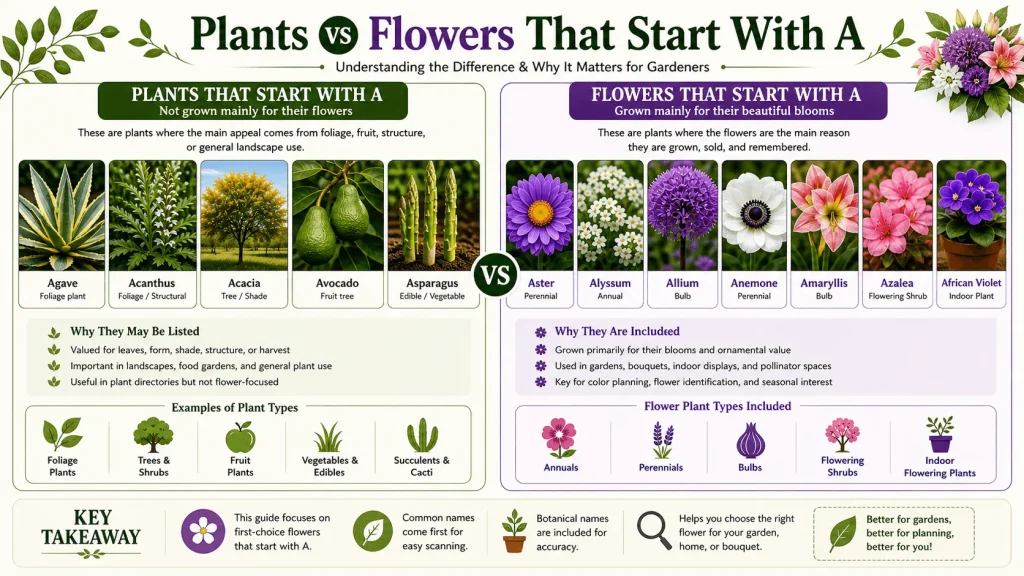
Plants and flowers t with A are often mixed together in alphabetical lists, but they are not always the same type of entry. A plant may begin with A and still be known mainly for foliage, fruit, structure, or general landscape use. A flower-focused list should give priority to names where the bloom is the main reason the plant is grown, sold, or remembered.
This guide includes annuals, perennials, bulbs, flowering shrubs, and indoor flowering plants when the flower is central to the plant’s identity. Aster, Alyssum, Allium, Anemone, Amaryllis, Azalea, and African Violet fit naturally because their blooms are the main attraction. A flowering shrub such as Azalea also belongs because its seasonal flower display is the reason most gardeners choose it.
Some broader plant lists may include foliage-heavy or landscape-first plants that happen to start with A. Those names can be useful in a plant directory, but they do not always match the intent of a flower list. This article stays closer to first-choice flowers, so the list remains useful for gardens, bouquets, indoor blooms, color planning, pollinator planting, and simple flower identification.
Common names appear first because they are easier to scan. Botanical names are also included where they help with plant labels, nursery tags, or accurate identification. This keeps the article practical for quick reading while still giving enough detail for gardeners who want to match a flower with its growing conditions.
Common Flowers That Start With A
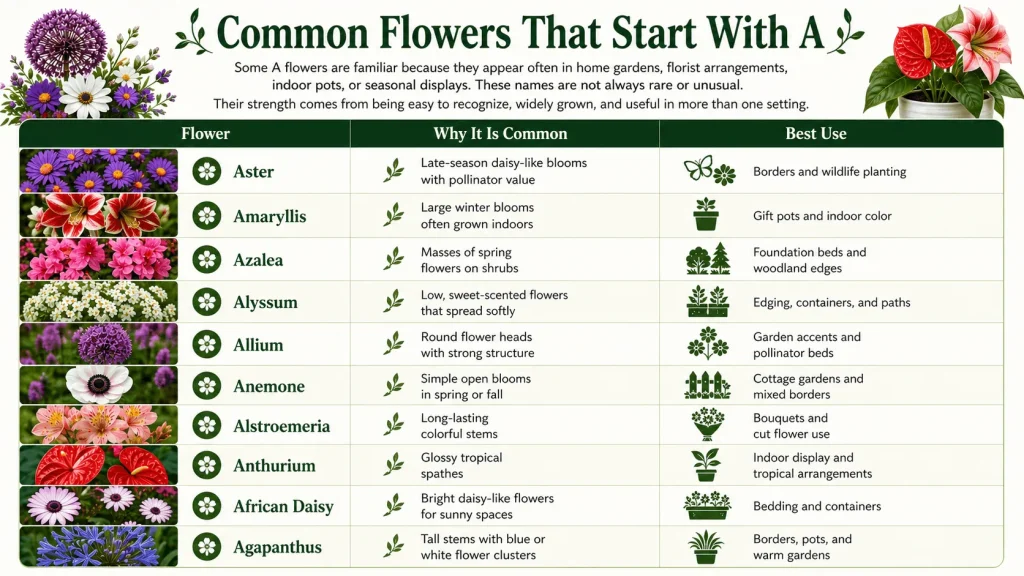
Some A flowers are familiar because they appear often in home gardens, florist arrangements, indoor pots, or seasonal displays. These names are not always rare or unusual. Their strength comes from being easy to recognize, widely grown, and useful in more than one setting.
| Flower | Why It Is Common | Large winter blooms are often grown indoors |
|---|---|---|
| Aster | Late-season daisy-like blooms with pollinator value | Borders and wildlife planting |
| Amaryllis | Large winter blooms often grown indoors | Gift pots and indoor color |
| Azalea | Masses of spring flowers on shrubs | Foundation beds and woodland edges |
| Alyssum | Low, sweet-scented flowers that spread softly | Edging, containers, and paths |
| Allium | Round flower heads with strong structure | Garden accents and pollinator beds |
| Anemone | Simple open blooms in spring or fall | Cottage gardens and mixed borders |
| Alstroemeria | Long-lasting colorful stems | Bouquets and cut flower use |
| Anthurium | Glossy tropical spathes | Indoor display and tropical arrangements |
| African Daisy | Bright daisy-like flowers for sunny spaces | Bedding and containers |
| Agapanthus | Tall stems with blue or white flower clusters | Borders, pots, and warm gardens |
For outdoor planting, Aster, Azalea, Alyssum, Allium, Astilbe, Aubrieta, and African Daisy are among the most useful choices. For floristry, Alstroemeria, Anthurium, Agapanthus, Amaranthus, Allium, and Australian Waxflower stand out because of stem strength, shape, texture, or vase life. For indoor bloom, Amaryllis, African Violet, Anthurium, and Amazon Lily are the strongest names in this group.
Most Recognized In Gardens
Aster, Azalea, Alyssum, Allium, Astilbe, Aubrieta, and African Daisy are among the most familiar outdoor choices. They cover borders, rock gardens, shrub displays, seasonal bedding, and pollinator planting, which gives them broad visibility across different growing styles.
Most Recognized Indoors
Amaryllis, African Violet, Anthurium, and Amazon Lily are some of the best-known indoor flowering plants linked with A. They are memorable because the blooms are showy, easy to display in pots, and often tied to gift or seasonal use.
Florist And Bouquet Favorites
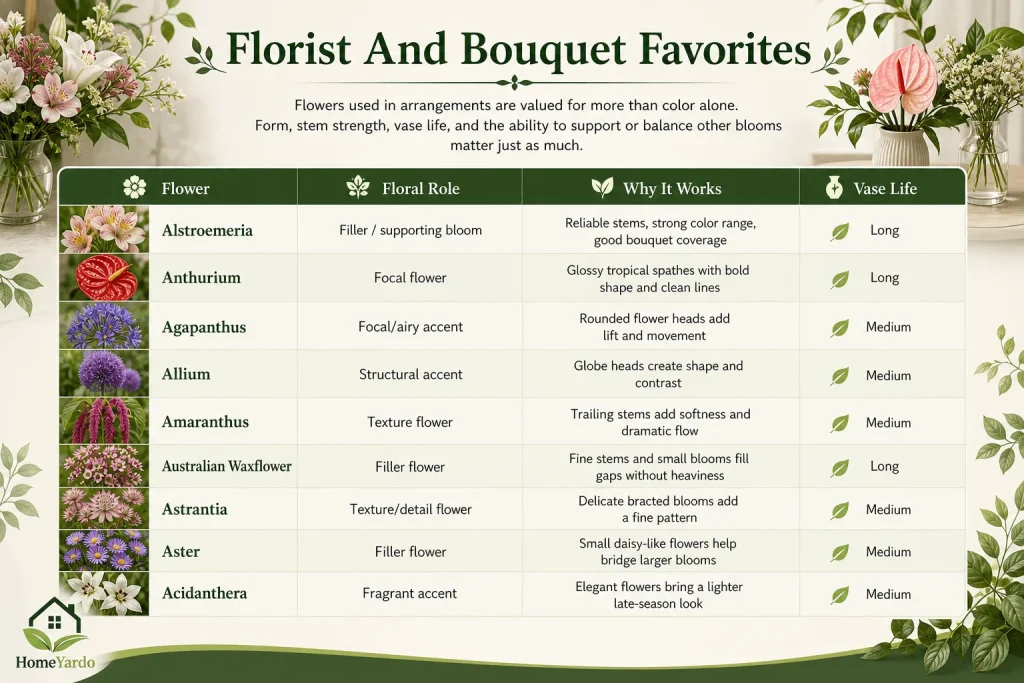
Flowers used in arrangements are valued for more than color alone. Form, stem strength, vase life, and the ability to support or balance other blooms matter just as much.
| Flower | Floral Role | Why It Works | Vase Life |
|---|---|---|---|
| Alstroemeria | Filler / supporting bloom | Reliable stems, strong color range, good bouquet coverage | Long |
| Anthurium | Focal flower | Glossy tropical spathes with bold shape and clean lines | Long |
| Agapanthus | Focal/airy accent | Rounded flower heads add lift and movement | Medium |
| Allium | Structural accent | Globe heads create shape and contrast | Medium |
| Amaranthus | Texture flower | Trailing stems add softness and dramatic flow | Medium |
| Australian Waxflower | Filler flower | Fine stems and small blooms fill gaps without heaviness | Long |
| Astrantia | Texture/detail flower | Delicate bracted blooms add a fine pattern | Medium |
| Aster | Filler flower | Small daisy-like flowers help bridge larger blooms | Medium |
| Acidanthera | Fragrant accent | Elegant flowers bring a lighter late-season look | Medium |
For bouquet work, Alstroemeria and Anthurium are among the strongest all-around choices because they hold well and stay visually clear. Australian Waxflower, Aster, and Astrantia are better when an arrangement needs lighter detail instead of one dominant bloom. Allium and Agapanthus add structure, while Amaranthus brings movement through trailing stems.
The best bouquet choice depends on the role of the flower. A focal stem needs shape and presence. A filler flower needs coverage and balance. A texture flower adds movement, softness, or fine detail around larger blooms.
Waxflower, Aster, and Astrantia are especially useful when a design needs lighter detail rather than one dominant bloom.
For more bouquet-friendly blooms across the alphabet, take a look at flowers that start with L. Waxflower, Aster, and Astrantia are especially useful when a design needs lighter detail rather than one dominant bloom.
Garden Favorites For Beds And Borders
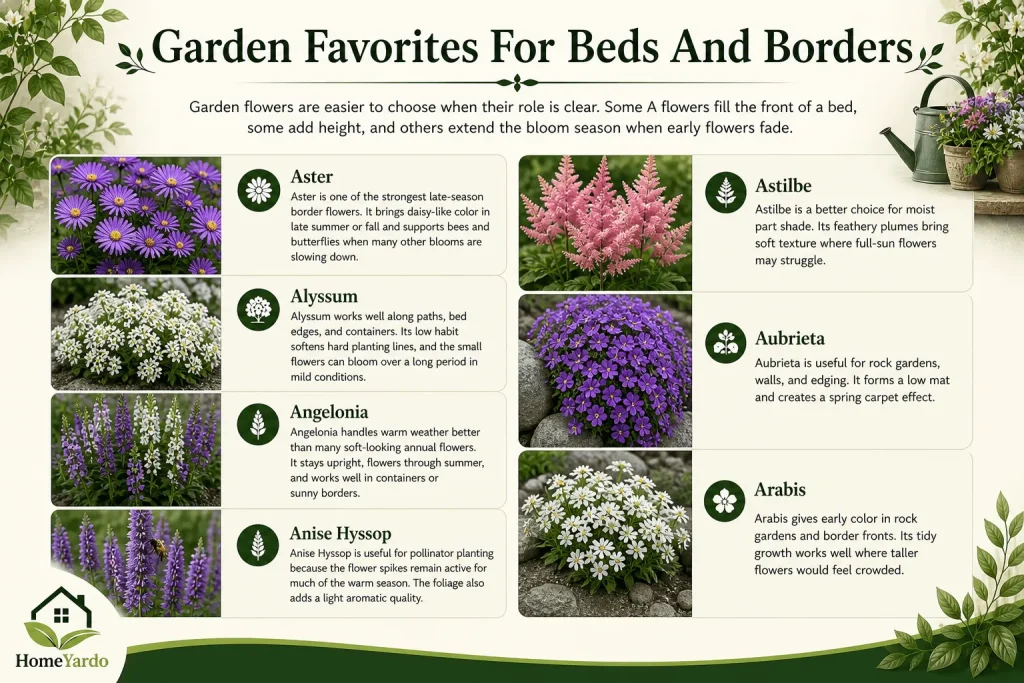
Garden flowers are easier to choose when their role is clear. Some A flowers fill the front of a bed, some add height, and others extend the bloom season when early flowers fade.
- Aster is one of the strongest late-season border flowers. It brings daisy-like color in late summer or fall and supports bees and butterflies when many other blooms are slowing down.
- Alyssum works well along paths, bed edges, and containers. Its low habit softens hard planting lines, and the small flowers can bloom over a long period in mild conditions.
- Angelonia handles warm weather better than many soft-looking annual flowers. It stays upright, flowers through summer, and works well in containers or sunny borders.
- Anise Hyssop is useful for pollinator planting because the flower spikes remain active for much of the warm season. The foliage also adds a light aromatic quality.
- Astilbe is a better choice for moist part shade. Its feathery plumes bring soft texture where full-sun flowers may struggle.
- Aubrieta is useful for rock gardens, walls, and edging. It forms a low mat and creates a spring carpet effect.
- Arabis gives early color in rock gardens and border fronts. Its tidy growth works well where taller flowers would feel crowded.
Botanical Flower Names That Start With A
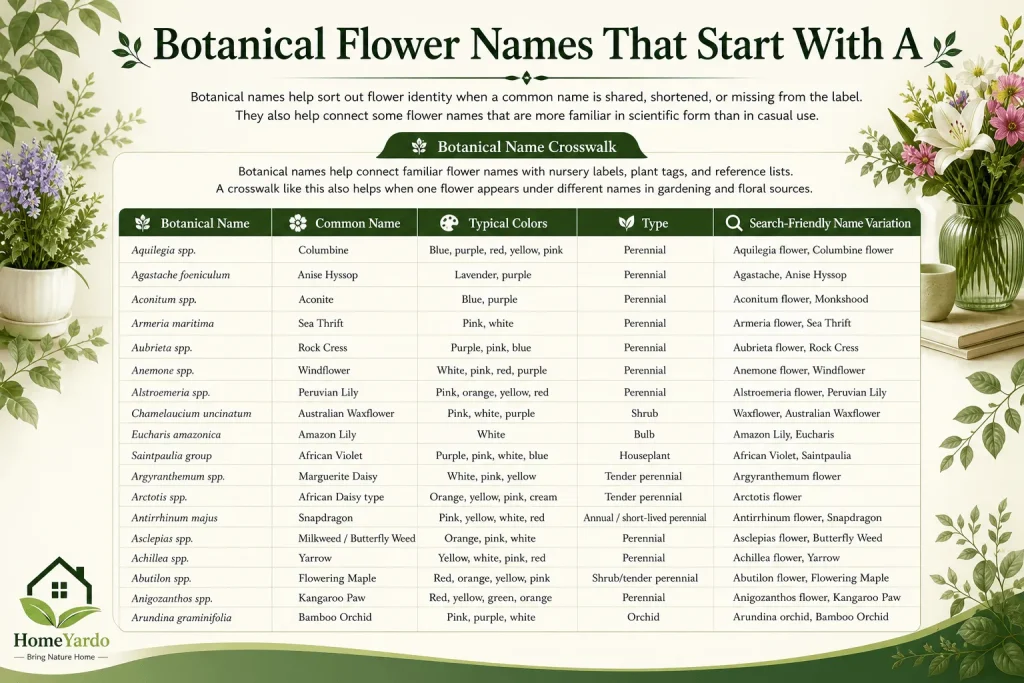
Botanical names help sort out flower identity when a common name is shared, shortened, or missing from the label. They also help connect some flower names that are more familiar in scientific form than in casual use.
Botanical Name Crosswalk
Botanical names help connect familiar flower names with nursery labels, plant tags, and reference lists. A crosswalk like this also helps when one flower appears under different names in gardening and floral sources.
| Botanical Name | Common Name | Typical Colors | Type | Search-Friendly Name Variation |
|---|---|---|---|---|
| Aquilegia spp. | Columbine | Blue, purple, red, yellow, pink | Perennial | Aquilegia flower, Columbine flower |
| Agastache foeniculum | Anise Hyssop | Lavender, purple | Perennial | Agastache, Anise Hyssop |
| Aconitum spp. | Aconite | Blue, purple | Perennial | Aconitum flower, Monkshood |
| Armeria maritima | Sea Thrift | Pink, white | Perennial | Armeria flower, Sea Thrift |
| Aubrieta spp. | Rock Cress | Purple, pink, blue | Perennial | Aubrieta flower, Rock Cress |
| Anemone spp. | Windflower | White, pink, red, purple | Perennial | Anemone flower, Windflower |
| Alstroemeria spp. | Peruvian Lily | Pink, orange, yellow, red | Perennial | Alstroemeria flower, Peruvian Lily |
| Chamelaucium uncinatum | Australian Waxflower | Pink, white, purple | Shrub | Waxflower, Australian Waxflower |
| Eucharis amazonica | Amazon Lily | White | Bulb | Amazon Lily, Eucharis |
| Saintpaulia group | African Violet | Purple, pink, white, blue | Houseplant | African Violet, Saintpaulia |
| Argyranthemum spp. | Marguerite Daisy | White, pink, yellow | Tender perennial | Argyranthemum flower |
| Arctotis spp. | African Daisy type | Orange, yellow, pink, cream | Tender perennial | Arctotis flower |
| Antirrhinum majus | Snapdragon | Pink, yellow, white, red | Annual / short-lived perennial | Antirrhinum flower, Snapdragon |
| Asclepias spp. | Milkweed / Butterfly Weed | Orange, pink, white | Perennial | Asclepias flower, Butterfly Weed |
| Achillea spp. | Yarrow | Yellow, white, pink, red | Perennial | Achillea flower, Yarrow |
| Abutilon spp. | Flowering Maple | Red, orange, yellow, pink | Shrub/tender perennial | Abutilon flower, Flowering Maple |
| Anigozanthos spp. | Kangaroo Paw | Red, yellow, green, orange | Perennial | Anigozanthos flower, Kangaroo Paw |
| Arundina graminifolia | Bamboo Orchid | Pink, purple, white | Orchid | Arundina orchid, Bamboo Orchid |
More Flower Names Worth Knowing
Some A flowers deserve a place in the full list even when they are not as instantly recognized as Aster, Amaryllis, or Azalea. These names add botanical range without drifting away from flower-focused intent.
| Flower | Why It Belongs |
|---|---|
| Acacia | Bright clustered blooms on shrubs or small trees |
| Acanthus | Tall architectural flower spikes |
| Achillea | Long-season garden color and pollinator value |
| Acidanthera | Fragrant white flowers with a dark center |
| Adonis | Bright early-season color |
| African Lily | Strong blue or white flower clusters |
| Agastache | Aromatic flower spikes for pollinators |
| Alcea | Tall cottage-garden flowers, often known as hollyhocks |
| Arnica | Yellow meadow-style flowers |
| Asclepias | Nectar-rich blooms linked with butterfly planting |
| Asphodel | Historic, upright, architectural bloom form |
| Asteriscus | Daisy-like flowers for warm sunny planting |
| Astrantia | Fine-bracted flowers for borders and bouquets |
Types of Flowers That Start With A
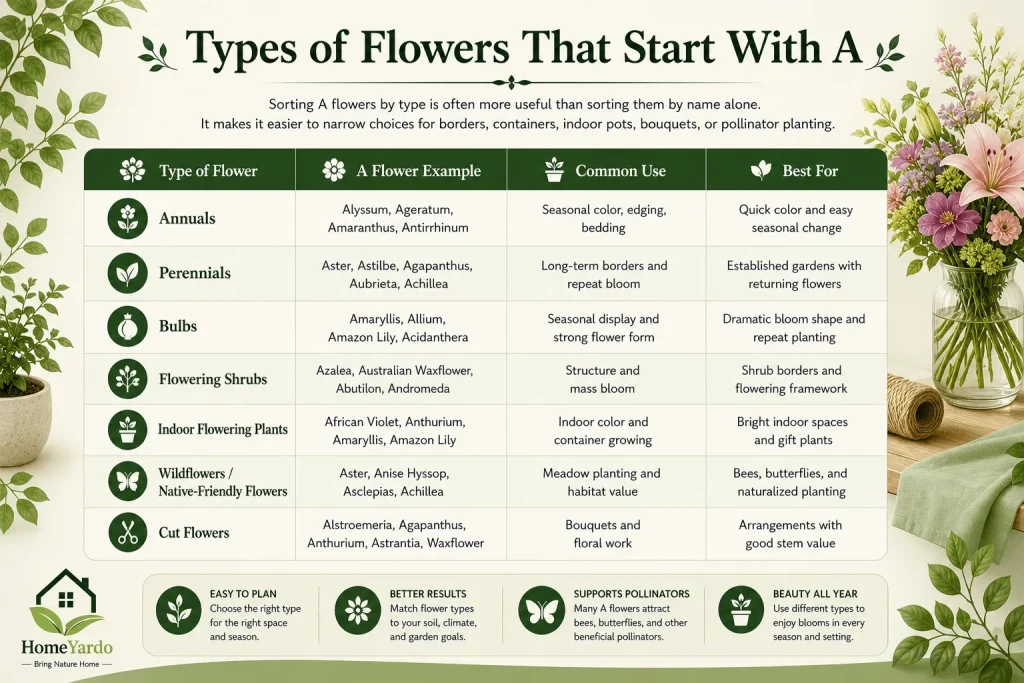
Sorting A flowers by type is often more useful than sorting them by name alone. It makes it easier to narrow choices for borders, containers, indoor pots, bouquets, or pollinator planting.
| Type of Flower | A Flower Example | Common Use | Best For |
|---|---|---|---|
| Annuals | Alyssum, Ageratum, Amaranthus, Antirrhinum | Seasonal color, edging, bedding | Quick color and easy seasonal change |
| Perennials | Aster, Astilbe, Agapanthus, Aubrieta, Achillea | Long-term borders and repeat bloom | Established gardens with returning flowers |
| Bulbs | Amaryllis, Allium, Amazon Lily, Acidanthera | Seasonal display and strong flower form | Dramatic bloom shape and repeat planting |
| Flowering Shrubs | Azalea, Australian Waxflower, Abutilon, Andromeda | Structure and mass bloom | Shrub borders and flowering framework |
| Indoor Flowering Plants | African Violet, Anthurium, Amaryllis, Amazon Lily | Indoor color and container growing | Bright indoor spaces and gift plants |
| Wildflowers / Native-Friendly Flowers | Aster, Anise Hyssop, Asclepias, Achillea | Meadow planting and habitat value | Bees, butterflies, and naturalized planting |
| Cut Flowers | Alstroemeria, Agapanthus, Anthurium, Astrantia, Waxflower | Bouquets and floral work | Arrangements with good stem value |
Flower Meanings And Significance
Some flowers are also known for symbolic meanings in gardens, bouquets, and traditional flower language. Meaning should not be the only reason to choose a plant, but it adds useful context when a flower is grown for gifts, arrangements, memorial planting, or personal symbolism.
Aster is often linked with patience, love, wisdom, and star-like beauty, which makes it useful in late-season gardens and symbolic bouquets. Amaryllis is commonly associated with strength, pride, beauty, and confidence, especially in winter gift pots and bold indoor displays. Alyssum carries a softer meaning tied to sweetness and worth beyond beauty, which fits its use in edging, small bouquets, and gentle planting schemes.
Acacia is often connected with affection, friendship, and remembrance, while Alstroemeria is strongly linked with friendship, devotion, and support. Anemone can suggest anticipation, protection, and delicate beauty, making it suitable for cottage gardens and spring arrangements. Azalea is often tied to care, softness, and fragile beauty, especially in spring shrub borders and gift plants.
Agapanthus is commonly associated with love and elegance, while Anthurium is often linked with hospitality and lasting warmth. Aconite carries a more cautious meaning because of its strong toxicity, so it is better viewed as a specialty garden flower where safety and placement are carefully considered.
Flower meanings can vary by culture, region, and source. For practical gardening, growing conditions still matter more than symbolism. A meaningful flower is most useful when it also fits the available light, soil, climate, and maintenance level.
Purple Flowers That Start With A
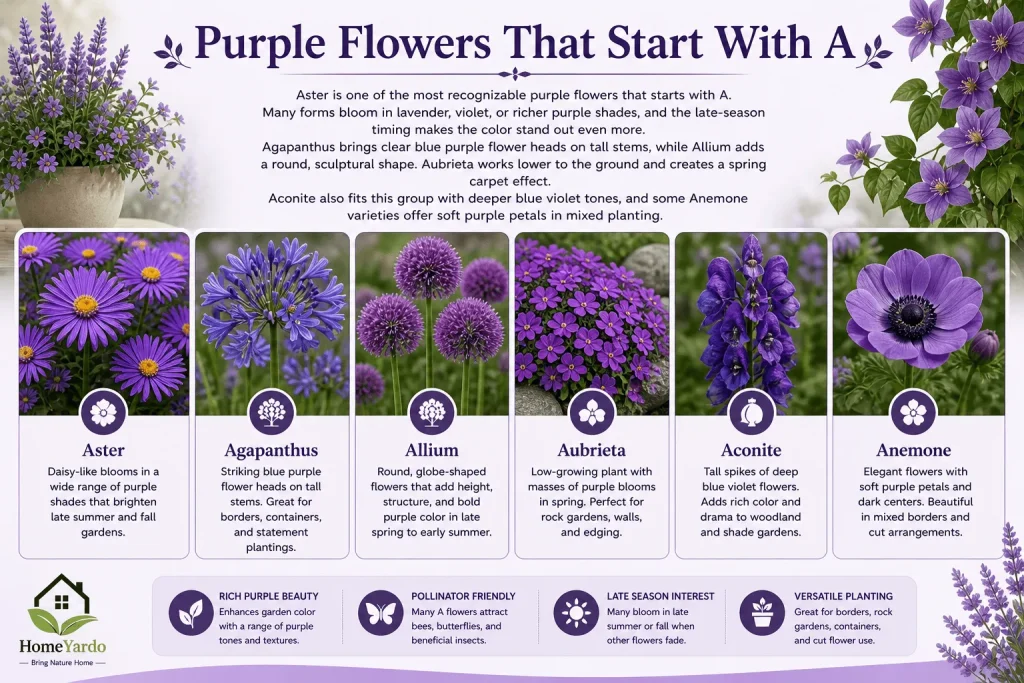
Aster is one of the most recognizable purple flowers that starts with A. Many forms bloom in lavender, violet, or richer purple shades, and the late-season timing makes the color stand out even more.
Agapanthus brings clear blue purple flower heads on tall stems, while Allium adds a round, sculptural shape. Aubrieta works lower to the ground and creates a spring carpet effect.
Aconite also fits this group with deeper blue violet tones, and some Anemone varieties offer soft purple petals in mixed planting.
For more purple, blue, and cool-toned garden options across the alphabet, compare this group with flowers that start with V.
Red Flowers With A
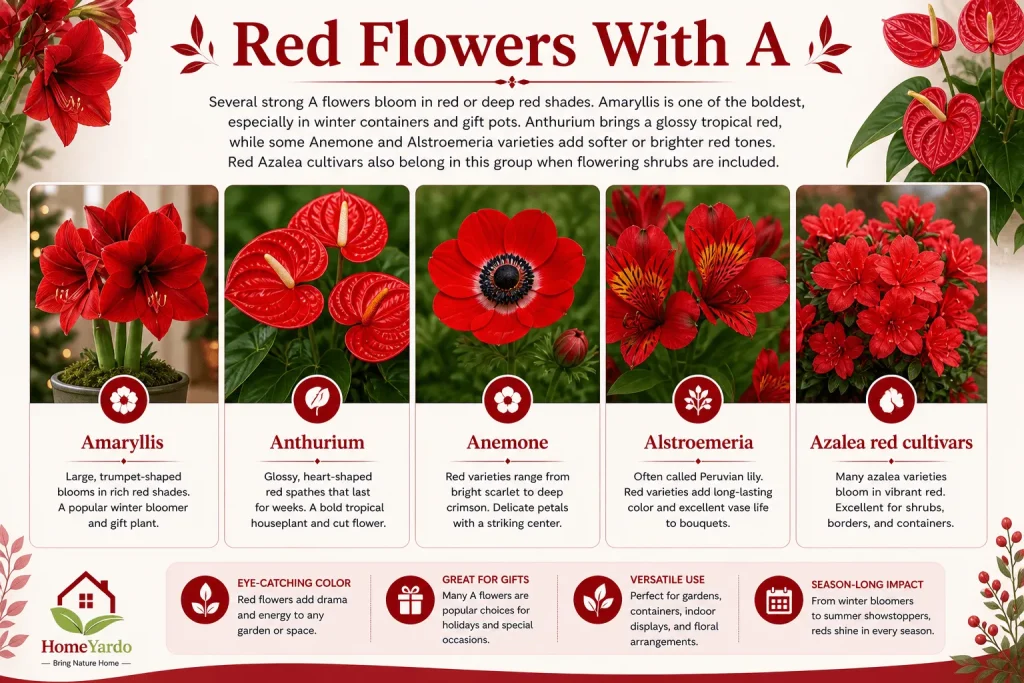
Several strong A flowers bloom in red or deep red shades. Amaryllis is one of the boldest, especially in winter containers and gift pots. Anthurium brings a glossy tropical red, while some Anemone and Alstroemeria varieties add softer or brighter red tones. Red Azalea cultivars also belong in this group when flowering shrubs are included.
- Amaryllis
- Anthurium
- Anemone
- Alstroemeria
- Azalea red cultivar
For more warm-colored blooms beyond Amaryllis, Anthurium, and red Azalea cultivars, explore flowers that start with R.
White Flowers With A
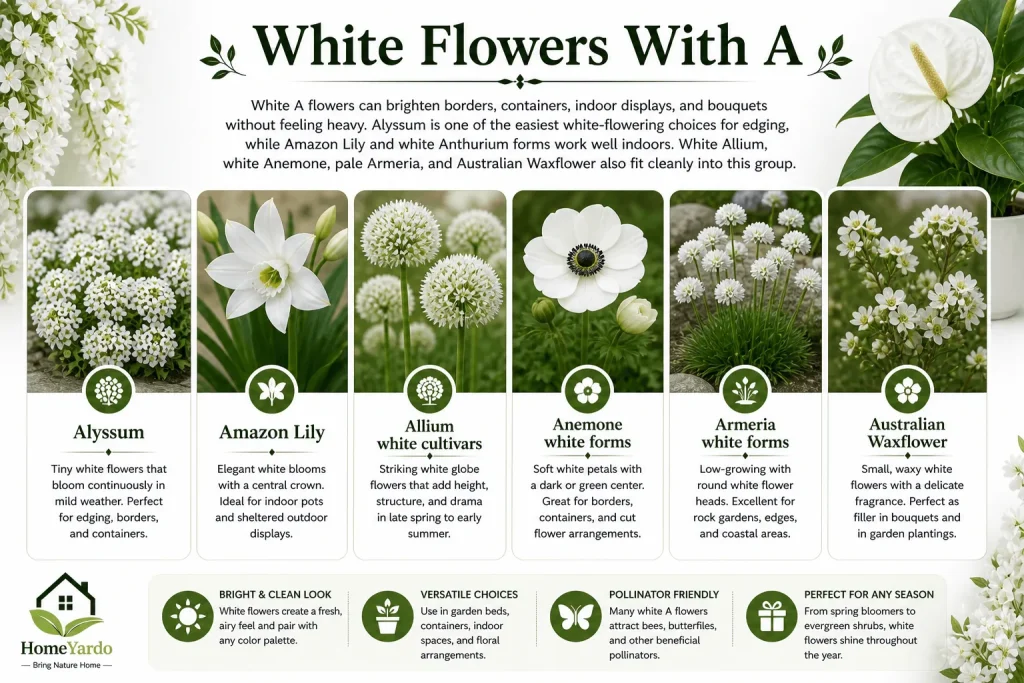
White A flowers can brighten borders, containers, indoor displays, and bouquets without feeling heavy. Alyssum is one of the easiest white-flowering choices for edging, while Amazon Lily and white Anthurium forms work well indoors. White Allium, white Anemone, pale Armeria, and Australian Waxflower also fit cleanly into this group.
- Alyssum
- Amazon Lily
- Allium white cultivars
- Anemone white forms
- Armeria white forms
- Australian Waxflower
For more white and soft-colored flower names, see flowers that start with W.
Perennial Flowers That Start With A
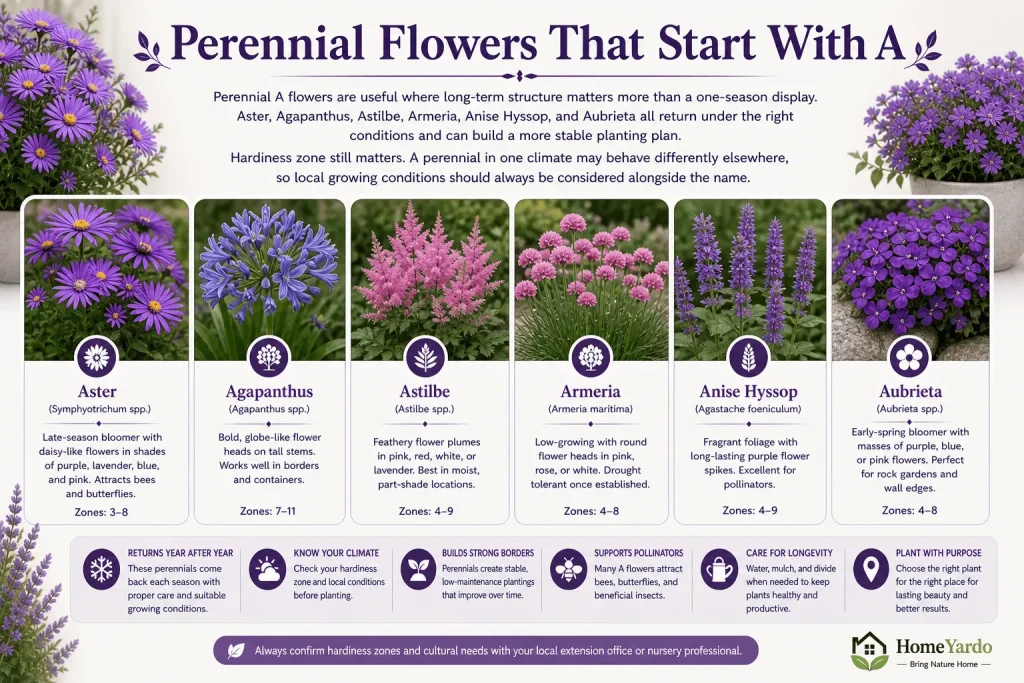
Perennial A flowers are useful where long-term structure matters more than a one-season display. Aster, Agapanthus, Astilbe, Armeria, Anise Hyssop, and Aubrieta all return under the right conditions and can build a more stable planting plan.
Hardiness zone still matters. A perennial in one climate may behave differently elsewhere, so local growing conditions should always be considered alongside the name.
Annual Flowers That Start With A
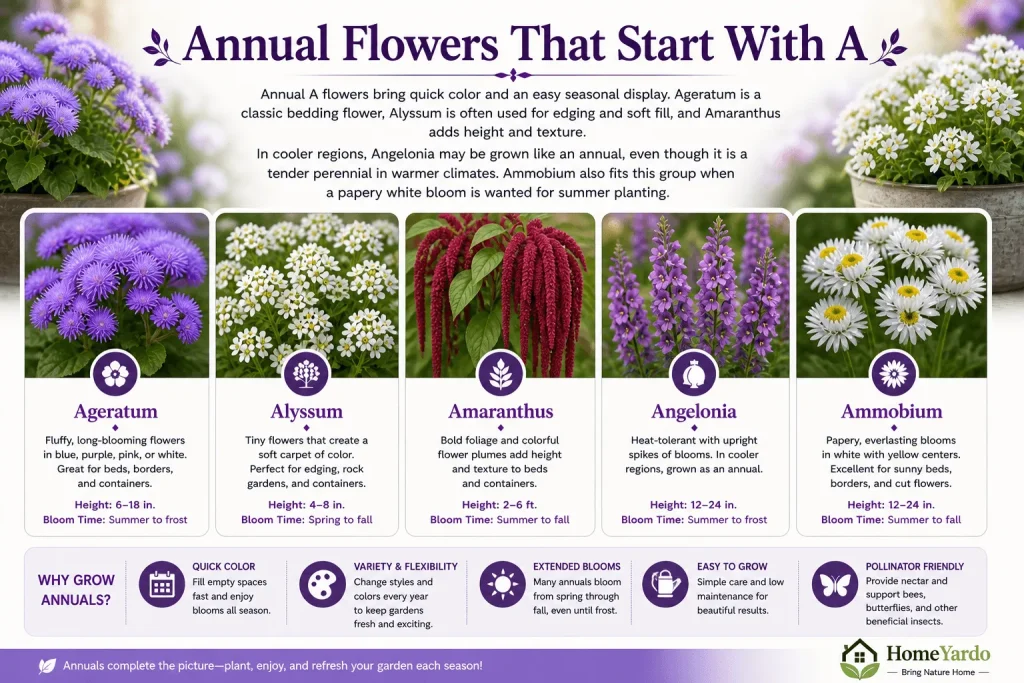
Annual A flowers bring quick color and an easy seasonal display. Ageratum is a classic bedding flower, Alyssum is often used for edging and soft fill, and Amaranthus adds height and texture.
In cooler regions, Angelonia may be grown like an annual, even though it is a tender perennial in warmer climates. Ammobium also fits this group when a papery white bloom is wanted for summer planting.
Indoor Flowers That Start With A
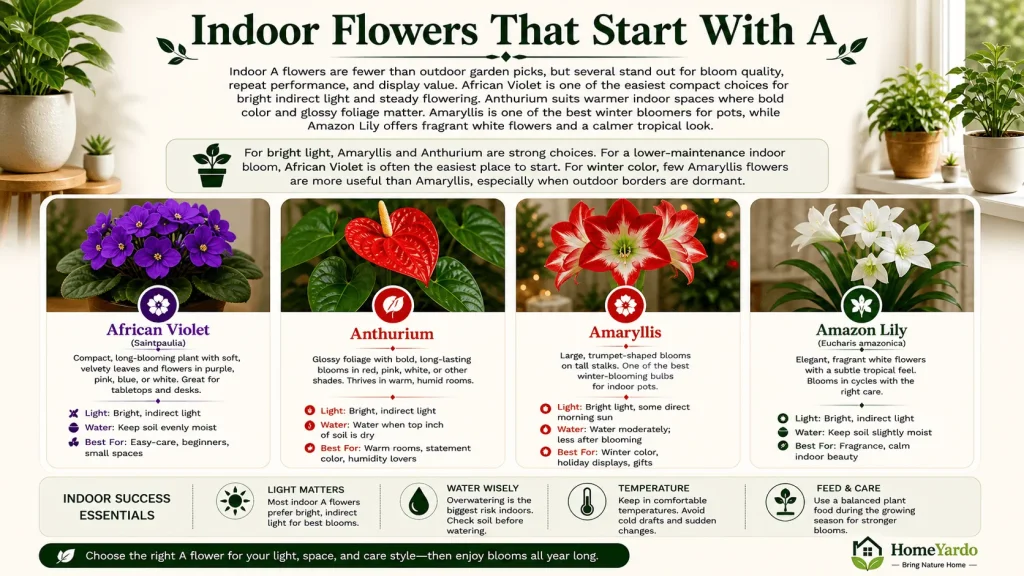
Indoor A flowers are fewer than outdoor garden picks, but several stand out for bloom quality, repeat performance, and display value. African Violet is one of the easiest compact choices for bright indirect light and steady flowering. Anthurium suits warmer indoor spaces where bold color and glossy foliage matter. Amaryllis is one of the best winter bloomers for pots, while Amazon Lily offers fragrant white flowers and a calmer tropical look.
For bright light, Amaryllis and Anthurium are strong choices. For a lower-maintenance indoor bloom, African Violet is often the easiest place to start. For winter color, few Amaryllis flowers are more useful than Amaryllis, especially when outdoor borders are dormant.
Fragrant Flowers That Start With A
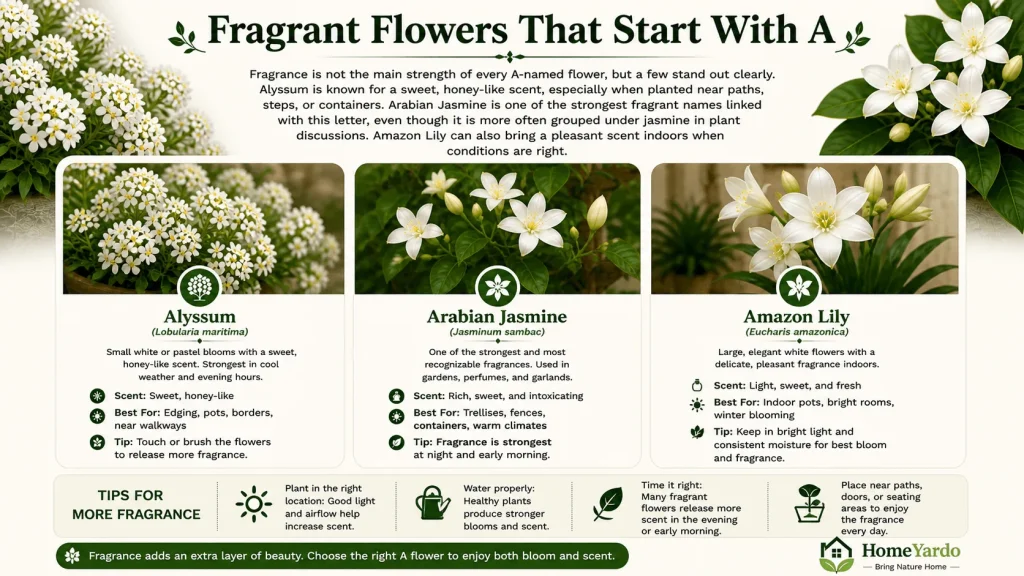
Fragrance is not the main strength of every A-named flower, but a few stand out clearly. Alyssum is known for a sweet, honey-like scent, especially when planted near paths, steps, or containers. For more sweet-scented choices beyond this group, browse flowers that start with F next.
Arabian Jasmine is one of the strongest fragrant names linked with this letter, even though it is more often grouped under jasmine in plant discussions. Amazon Lily can also bring a pleasant scent indoors when conditions are right.
Good A Flowers For Beginners
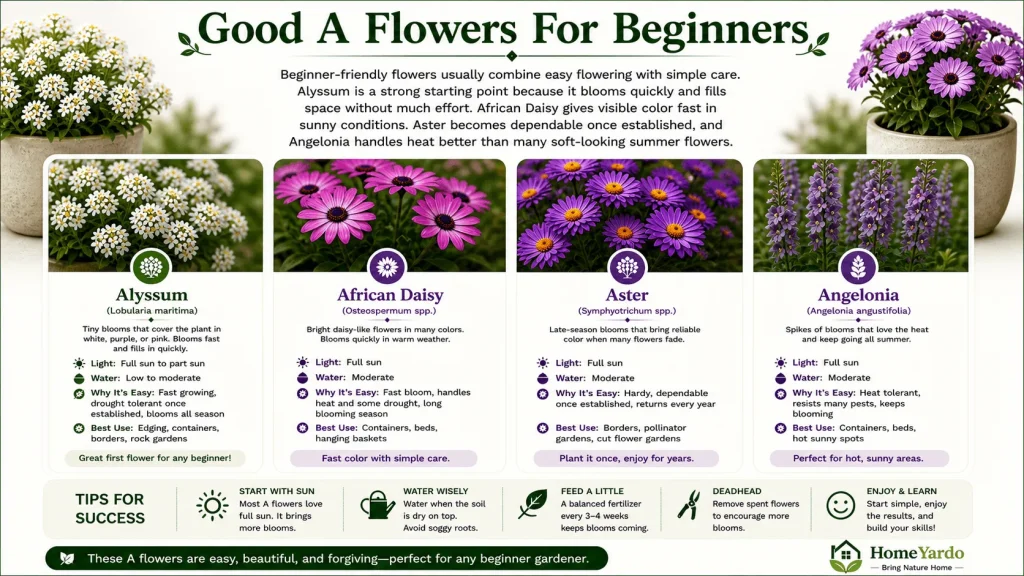
Beginner-friendly flowers usually combine easy flowering with simple care. Alyssum is a strong starting point because it blooms quickly and fills space without much effort.
African Daisy gives visible color fast in sunny conditions. Aster becomes dependable once established, and Angelonia handles heat better than many soft-looking summer flowers.
A Flowers That Attract Pollinators
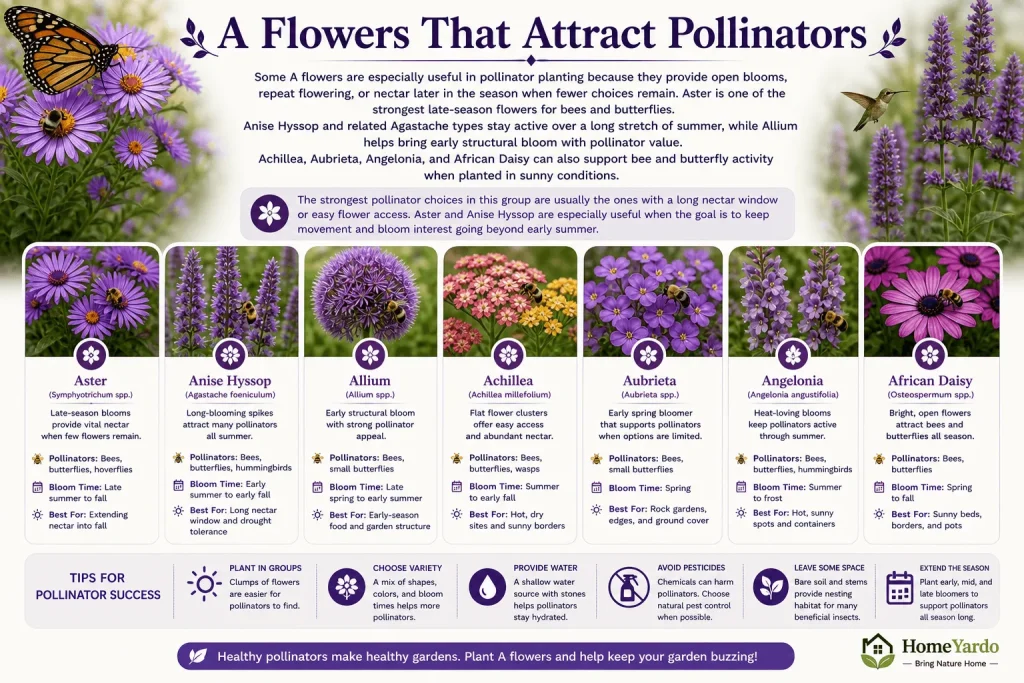
Some A flowers are especially useful in pollinator planting because they provide open blooms, repeat flowering, or nectar later in the season when fewer choices remain. Aster is one of the strongest late-season flowers for bees and butterflies. For more bee-friendly and butterfly-friendly blooms, continue with flowers that start with S.
Anise Hyssop and related Agastache types stay active over a long stretch of summer, while Allium helps bring early structural bloom with pollinator value. Achillea, Aubrieta, Angelonia, and African Daisy can also support bee and butterfly activity when planted in sunny conditions.
The strongest pollinator choices in this group are usually the ones with a long nectar window or easy flower access. Another useful list for pollinator planning is flowers that start with E. Aster and Anise Hyssop are especially useful when the goal is to keep movement and bloom interest going beyond early summer.
Rare Flowers That Start With A
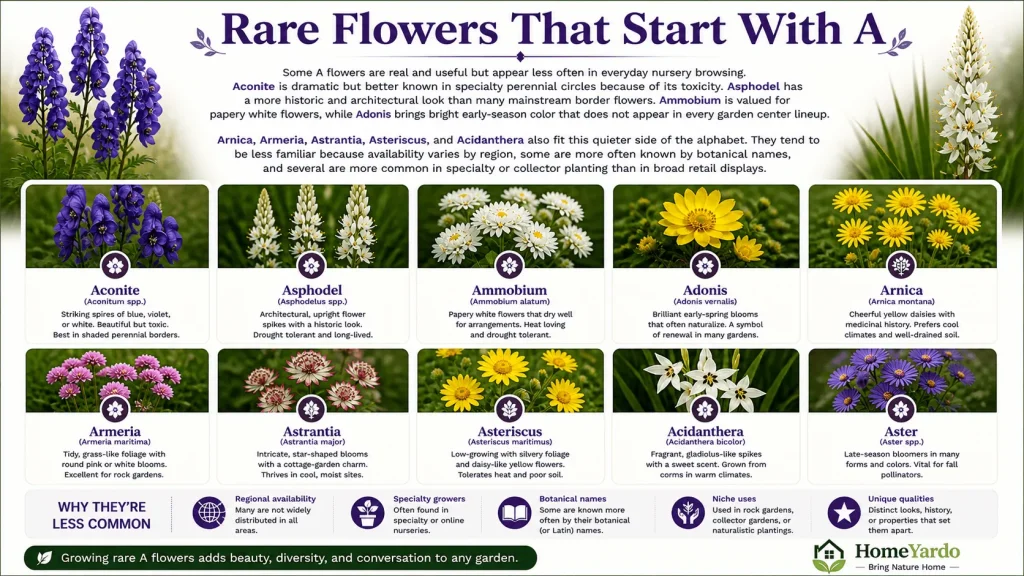
Some A flowers are real and useful but appear less often in everyday nursery browsing. Aconite is dramatic but better known in specialty perennial circles because of its toxicity. Asphodel has a more historic and architectural look than many mainstream border flowers. Ammobium is valued for papery white flowers, while Adonis brings bright early-season color that does not appear in every garden center lineup.
Arnica, Armeria, Astrantia, Asteriscus, and Acidanthera also fit this quieter side of the alphabet. They tend to be less familiar because availability varies by region, some are more often known by botanical names, and several are more common in specialty or collector planting than in broad retail displays.
How To Choose The Right Flower With A
The best A flower depends on where it will grow and what the planting needs to do. Start by deciding whether the flower is meant for indoors or outdoors. Then narrow the choice by light, life cycle, and practical use.
For indoor bloom, African Violet, Anthurium, Amaryllis, and Amazon Lily are some of the clearest options. For sunny outdoor planting, Allium, Angelonia, African Daisy, and Agapanthus are stronger fits. For part shade, Astilbe, Azalea, and some Anemones are easier to place. For one-season color, look at Alyssum, Ageratum, or Amaranthus. For long-term structure, Aster, Achillea, and Aubrieta are more dependable. For fragrance, Alyssum, Arabian Jasmine, and Amazon Lily stand out. For bouquets, Alstroemeria, Anthurium, Astrantia, and Waxflower are often the better picks.
A Few Flowers With A: Need Extra Caution
Most flowers here are included for their ornamental value, but a few deserve more careful placement or handling. Aconite is the clearest example because it is highly toxic and should not be treated like a casual beginner flower. Azalea also belongs on the caution side, where pets are likely to chew leaves or blooms. Anthurium sap may irritate the mouth or skin in some cases, and Angel’s Trumpet is another flowering plant that should be approached carefully because of its toxicity.
That does not remove their beauty or horticultural value. It simply means plant choice should take children, pets, handling habits, and planting location into account.
Decision Flow
A fast decision table helps narrow the list without working through all 64 names one by one.
| Need | Better Flower Choices |
|---|---|
| Indoor flowering plant | African Violet, Anthurium, Amaryllis, Amazon Lily |
| One-season color | Alyssum, Ageratum, Amaranthus, Antirrhinum |
| Long-term perennial structure | Aster, Astilbe, Agapanthus, Achillea, Aubrieta |
| Full sun planting | Allium, Angelonia, Agapanthus, African Daisy, Acidanthera |
| Part shade planting | Astilbe, Azalea, some Anemones, and Andromeda |
| Pollinator support | Aster, Anise Hyssop, Allium, Achillea, Asclepias |
| Cut flower use | Alstroemeria, Australian Waxflower, Agapanthus, Anthurium, Astrantia |
| Low edging or soft spread | Alyssum, Aubrieta, Arabis, Armeria |
| Fragrance | Alyssum, Arabian Jasmine, Amazon Lily, Acidanthera |
| Purple flowers | Aster, Agapanthus, Allium, Aubrieta, Ageratum |
| Beginner-friendly picks | Alyssum, African Daisy, Aster, Angelonia, Ageratum |
| Indoor winter color | Amaryllis, Anthurium, African Violet |
Conclusion
Flowers starting with A range from familiar names such as Aster, Azalea, Alyssum, and Amaryllis to less expected picks such as Aconite, Asphodel, Arnica, and Armeria. Some are better for borders, some for bouquets, some for indoor bloom, and some for pollinator planting.
The most useful way to sort them is by color, light, season, and purpose rather than by name alone. A flower list becomes more practical when it helps narrow real choices, not just expand the alphabet.
FAQ’s
Aster is one of the most popular flowers that starts with A because it is widely grown, easy to recognize, and useful in many garden styles. It is especially valued for late-season color when many other flowers begin to fade. Azalea is another strong answer when flowering shrubs are included.
There is no fixed number because flower lists vary by scope. Some include only common flower names, while others also count botanical names, flowering shrubs, bulbs, and indoor flowering plants. This guide keeps the count at 64 curated flowers and flowering plants that clearly fit the flower-focused intent.
Alstroemeria is one of the clearest flowers that starts with A and is linked with friendship. It is also associated with devotion, support, and a lasting connection. Because it has good vase life and many colors, it is often used in bouquets made for friends or meaningful gifts.
Amaryllis is one of the best-known flowers and blooms in winter, especially indoors. It is often grown in pots for large red, white, pink, or striped flowers during the colder months. African Violet and Anthurium may also bloom indoors when light and warmth are suitable.
Ageratum is a common blue flower that starts with A and is often used in bedding displays. Agapanthus can also produce blue to blue-purple flower clusters on tall stems. Some Aster and Anemone varieties may appear blue or blue-violet depending on the cultivar.
Aster is one of the most familiar purple flowers that starts with A. wide varieties that bloom in lavender, violet, or deeper purple tones, especially in late summer and fall. Agapanthus, Allium, Aubrieta, Ageratum, and some Anemones also fit this color group.
Several flowers with A are perennials, including Aster, Agapanthus, Astilbe, Armeria, Aubrieta, Achillea, and Anise Hyssop. These flowers can return year after year when grown in the right climate and conditions. Hardiness zone, soil, moisture, and winter protection still affect how reliably they come back.
Yes, several A flowers grow well indoors when the light and temperature are suitable. African Violet, Anthurium, Amaryllis, and Amazon Lily are some of the strongest indoor choices. These plants are valued for compact growth, showy blooms, or winter color in pots.
Alyssum, Ageratum, African Daisy, Angelonia, and Aster are good beginner-friendly A flowers. They are easier to use because they provide visible color without highly technical care. The best choice still depends on sunlight, local climate, container size, and how much maintenance the planting space allows.
Rare or less familiar flowers with A include Aconite, Asphodel, Ammobium, Adonis, Arnica, Armeria, Asteriscus, and Acidanthera. Some are harder to find because they are specialty garden plants or are better known by botanical names. Others are less common in everyday garden centers but still have real ornamental value.
Arabian Jasmine is one of the strongest fragrant flowers linked with the letter A. Alyssum is also valued for its sweet, honey-like scent, especially near paths, containers, and garden edges. Amazon Lily and Acidanthera can also add fragrance when grown in suitable conditions.
Amaryllis is one of the clearest red flowers, especially in indoor winter displays. Anthurium is another strong red option with glossy tropical spathes. Some Anemone, Alstroemeria, and Azalea cultivars also produce red or deep red blooms.
Yes, many flowers with an A can bloom in white. Alyssum, Amazon Lily, white Allium cultivars, white Anemone forms, Armeria, and Australian Waxflower are good examples. Some are better for garden edges, while others work well indoors or in bouquets.
Yes, several A flowers attract bees, butterflies, and other pollinators. Aster, Anise Hyssop, Allium, Achillea, Asclepias, Aubrieta, and Angelonia are especially useful choices. Aster is valuable late in the season because it provides nectar when fewer flowers are blooming.
Aconite is one of the most toxic flowers that starts with A and should be handled with serious care. Azalea, Angel’s Trumpet, Anthurium, and Arum Lily also need caution, especially around pets and children. Plant safety should always be checked before adding these flowers to accessible gardens or indoor spaces.
References