80 Beautiful Variety Of Flowers That Start With E You Didn’t Know About
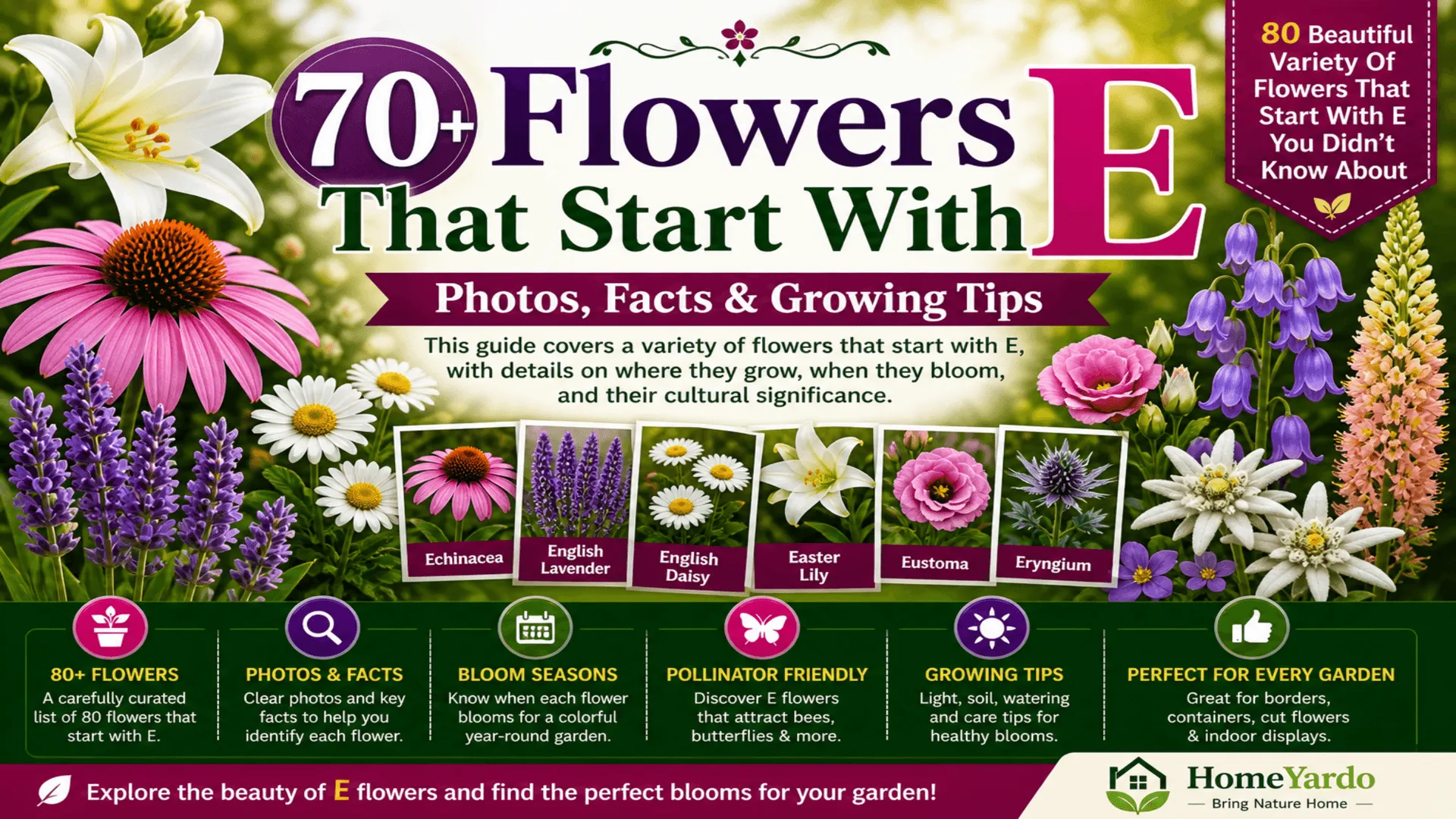
Some flower names that start with E are easy to recognize right away, such as Easter lily, Echinacea, English daisy, and evening primrose. Others feel more unexpected, including Exacum, Eremurus, Eryngium, and Eyebright. Together, they cover cottage garden flowers, cut flower favorites, indoor bloomers, woodland picks, and pollinator-friendly choices.
This guide opens with a quick answer, then moves into best picks, a carefully filtered 80-name master list, a fast comparison table, and garden-use help that makes choosing easier. It stays focused on flowers and flowering plants grown mainly for their blooms, so foliage-first plants are not included unless the flower is a real reason the plant is grown.
Quick Answer: What Are Some Flowers That Start With E?
Flower names that start with E include Easter lily, Edelweiss, English daisy, Echinacea, evening primrose, English lavender, Eustoma, and Elderflower. For another broad letter guide with a mix of common and lesser-known blooms, flowers that start with B is a useful next list to browse. These are among the most recognizable names, with others ranging from alpine flowers to indoor bloomers and wildflower-style picks.
Best Picks At A Glance
| Best For | Flower | Why It Fits |
|---|---|---|
| Best known overall | Echinacea | Easy to recognize, widely grown, and useful in sunny borders. |
| Best for fragrance | English lavender | The scent is clean, herbal, and easy to place near paths or seating. |
| Best for pollinators | Echinacea | Bees and butterflies visit it regularly through the summer. |
| Best for shade | English bluebell | It suits softer light and looks natural in woodland-style planting. |
| Best for containers | Exacum | Its compact shape and violet flowers work well in pots. |
| Best for cut flowers | Eustoma | The blooms hold well in arrangements and look refined. |
| Best beginner flower | English daisy | It is familiar, compact, and simple to use in small beds or edging. |
| Best rare pick | Edelweiss | It stands out for its alpine look and soft, starry flower heads. |
| Best indoor flower | Easter cactus | It adapts well to indoor growing with bright indirect light. |
| Best long-season flower | Erigeron | It can flower for a long stretch and softens paths, edges, and walls. |
Complete List of 80 Flowers That Start With E
- Earleaf False Foxglove (Agalinis auriculata), upright wildflower with tubular late-season blooms
- Easter Cactus (Schlumbergera gaertneri), a spring-flowering succulent for bright indoor spaces
- Easter Lily (Lilium longiflorum), a fragrant white bulb flower for spring display
- Eastern Blazing Star (Liatris scariosa), a tall native flower with purple bottlebrush spikes
- Eastern Bluestar (Amsonia tabernaemontana), a soft blue perennial for sunny borders
- Eastern Joe Pye Weed (Eutrochium purpureum), a tall pollinator plant with dusty pink clusters
- Eastern Red Columbine (Aquilegia canadensis), nodding red and yellow spring woodland flower
- Eastern Redbud (Cercis canadensis), a flowering tree with rosy spring blossoms
- Eastern Shooting Star (Primula meadia), a reflexed spring flower for meadows and light shade
- Eastern Waterleaf (Hydrophyllum virginianum), a shade-loving native with pale, clustered flowers
- Edgeworthia (Edgeworthia chrysantha), a fragrant flowering shrub with nodding yellow blooms
- Edelweiss (Leontopodium alpinum), an alpine perennial with woolly white star-shaped flowers
- Egyptian Lotus (Nymphaea lotus), an aquatic flower with elegant, floating white blooms
- Egyptian Starcluster (Pentas lanceolata), a warm-climate cluster flower loved by butterflies
- Elderflower (Sambucus nigra), creamy flower clusters on a flowering shrub
- Elegant Zinnia (Zinnia elegans), bright bedding and cut flower annual
- Elephant Head Lousewort (Pedicularis groenlandica), an unusual pink wildflower with shaped blooms
- Emilia (Emilia coccinea), airy annual with orange-red tassel flowers
- Encelia (Encelia farinosa), a desert flowering shrub with yellow daisy heads
- Enkianthus (Enkianthus campanulatus), a bell-flowered shrub for acidic gardens
- English Bluebell (Hyacinthoides non scripta), woodland bulb flower with drooping blue bells
- English Daisy (Bellis perennis), a low spring bloomer for edging and small beds
- English Iris (Iris latifolia), an upright early summer iris with rich color
- English Lavender (Lavandula angustifolia), a fragrant perennial with purple flower spikes
- English Marigold (Calendula officinalis), cheerful cool-season bloomer with warm tones
- English Rose (Rosa spp.), classic fragrant bloom for borders and cutting
- Epimedium (Epimedium grandiflorum), a delicate shade perennial with airy spring flowers
- Epidendrum (Epidendrum spp.), an orchid group with long-lasting clustered blooms
- Epiphyllum (Epiphyllum oxypetalum and hybrids), a flowering cactus with dramatic, large blooms
- Eranthemum (Pseuderanthemum laxiflorum), a tropical shrub with purple tubular flowers
- Erica (Erica carnea), a heather-like flower for acidic soil and cool seasons
- Erigeron (Erigeron karvinskianus), daisy-like perennial for walls and edges
- Erinus (Erinus alpinus), compact alpine flower for rock gardens
- Eriogonum (Eriogonum fasciculatum and relatives), drought-tolerant flower clusters for dry sites
- Eriophyllum (Eriophyllum lanatum), golden daisy flower for sunny, dry ground
- Erodium (Erodium reichardii), a low mounding flower with neat pink blooms
- Escallonia (Escallonia rubra), a flowering shrub with tubular pink or red blooms
- Eschscholzia (Eschscholzia californica), a silky cup-shaped flower for bright sunny areas
- Ensata Iris (Iris ensata), an elegant iris for moist soil and summer color
- Ethiopian Calla Lily (Zantedeschia aethiopica), bold white spathe flower for damp ground
- Ethiopian Daisy (Osteospermum ecklonis), a daisy-like flower for long warm-season color
- Eucomis (Eucomis bicolor and relatives), pineapple-like flower head for containers and beds
- Eucryphia (Eucryphia lucida and relatives), a flowering shrub or small tree with white blooms
- Eulophia (Eulophia graminea and relatives), a terrestrial orchid with upright flower stems
- Eupatorium (Eupatorium perfoliatum), a native perennial with flat white flower clusters
- Euphorbia (Euphorbia characias), an architectural perennial with green-yellow floral bracts
- Eustoma (Eustoma grandiflorum), an elegant cut flower with layered petals
- Eutrochium (Eutrochium purpureum), a tall border flower for moisture and pollinators
- Euryops (Euryops pectinatus), shrubby yellow daisy bloomer for mild climates
- Evolvulus (Evolvulus glomeratus), a low blue flowering plant for heat and sun
- Exacum (Exacum affine), a compact violet flowering plant for pots and indoors
- Exochorda (Exochorda x macrantha), a spring-flowering shrub with pearl-like buds
- Eyebright (Euphrasia officinalis), a tiny meadow flower with marked petals
- Eccremocarpus (Eccremocarpus scaber), a climbing plant with tubular orange blooms
- Echeveria (Echeveria spp.), a rosette succulent with delicate flower stalks
- Echinacea (Echinacea purpurea), a strong perennial for borders and pollinator beds
- Echinops (Echinops ritro), globe-shaped blue flower for texture and drying
- Echium (Echium vulgare and relatives), striking spiked flower loved by bees
- Eomecon (Eomecon chionantha), a woodland flower with small white poppy-like blooms
- Eranthis (Eranthis hyemalis), a very early yellow flower for late winter interest
- Eremophila (Eremophila nivea and relatives), a flowering shrub with soft silvery foliage
- Eremurus (Eremurus robustus), tall foxtail flower spike for vertical impact
- Eryngium (Eryngium planum), steel blue architectural flower for dry borders
- Erysimum (Erysimum cheiri), wallflower type with scented spring clusters
- Erythrina (Erythrina crista-galli and relatives), coral-flowered tree or shrub
- Erythronium (Erythronium dens canis), spring bulb with reflexed petals
- Evening Primrose (Oenothera biennis), a yellow flower that often opens later in the day
- Evening Rain Lily (Zephyranthes drummondii and relatives), rain-triggered bloom for warm climates
- Evening Stock (Matthiola longipetala), a fragrant evening flower for cool seasons
- Evergreen Azalea (Rhododendron evergreen hybrids), a spring-flowering shrub with dense color
- Evergreen Candytuft (Iberis sempervirens), neat white spring flower for edging
- Evergreen Clematis (Clematis armandii), a flowering vine with scented white blooms
- Evergreen Magnolia (Magnolia grandiflora), large, creamy blooms on a glossy tree
- Everlasting Daisy (Xerochrysum bracteatum), papery flower used fresh or dried
- Everlasting Pea (Lathyrus latifolius), climbing perennial with soft sweet-pea style flowers
- European Columbine (Aquilegia vulgaris), nodding spurred flower for cottage gardens
- European Globe Flower (Trollius europaeus), a rounded yellow flower for cooler gardens
- European Pasqueflower (Pulsatilla vulgaris), a silky spring flower with seedhead interest
- Emu Bush (Eremophila maculata and relatives), a dry-climate shrub with tubular blooms
- Engelmann’s Daisy (Engelmannia peristenia), a bright daisy flower for sunny native-style planting
How This List Was Curated
This guide focuses on true flowers and flowering plants that are widely known for their blooms. That keeps the list cleaner and more useful than broad alphabet lists that mix in foliage plants, shrub entries, and plant catalog names without much filtering.
A few E names sit between a flower list and a general plant list. Those are included only when the bloom is a meaningful part of why the plant is grown. This helps keep the list practical while still making room for well-known flowering plants such as Elderflower, Exacum, and Exochorda. For a nearby alphabet comparison with many familiar garden names, flowers that start with A can help connect this E list with the previous letter group.
Quick Comparison
This table keeps the most recognizable and most useful names in one place for faster comparison.
| Common Name | Scientific Name | Type | Main Color | Bloom Season | Best Use |
|---|---|---|---|---|---|
| Easter Lily | Lilium longiflorum | Bulb flower | White | Spring to early summer | Fragrance, containers |
| Echinacea | Echinacea purpurea | Perennial | Pink purple | Summer to fall | Pollinators, borders |
| Edelweiss | Leontopodium alpinum | Alpine perennial | White | Summer | Rock gardens |
| English Daisy | Bellis perennis | Short-lived perennial | White, pink, red | Spring | Edging, small beds |
| Evening Primrose | Oenothera biennis | Biennial or short-lived perennial | Yellow | Summer to fall | Naturalized planting |
| English Lavender | Lavandula angustifolia | Perennial | Purple | Summer | Fragrance, dry borders |
| Eustoma | Eustoma grandiflorum | Tender perennial or annual | Pink, purple, white | Summer | Cut flowers |
| English Bluebell | Hyacinthoides non scripta | Bulb flower | Blue violet | Spring | Woodland planting |
| Eremurus | Eremurus robustus | Perennial | Pink, white, yellow | Late spring to early summer | Vertical interest |
| Eryngium | Eryngium planum | Perennial | Steel blue | Summer | Dry gardens, bouquets |
| Eschscholzia | Eschscholzia californica | Annual | Orange, yellow | Spring to summer | Easy seasonal color |
| Eucomis | Eucomis bicolor | Bulb flower | Green, cream, purple-tinted | Summer | Containers, accent planting |
| Exacum | Exacum affine | Flowering plant | Violet purple | Spring to summer | Indoor color |
| Everlasting Daisy | Xerochrysum bracteatum | Annual | Pink, yellow, orange, white | Summer to fall | Fresh and dried flowers |
Featured Flower Profiles
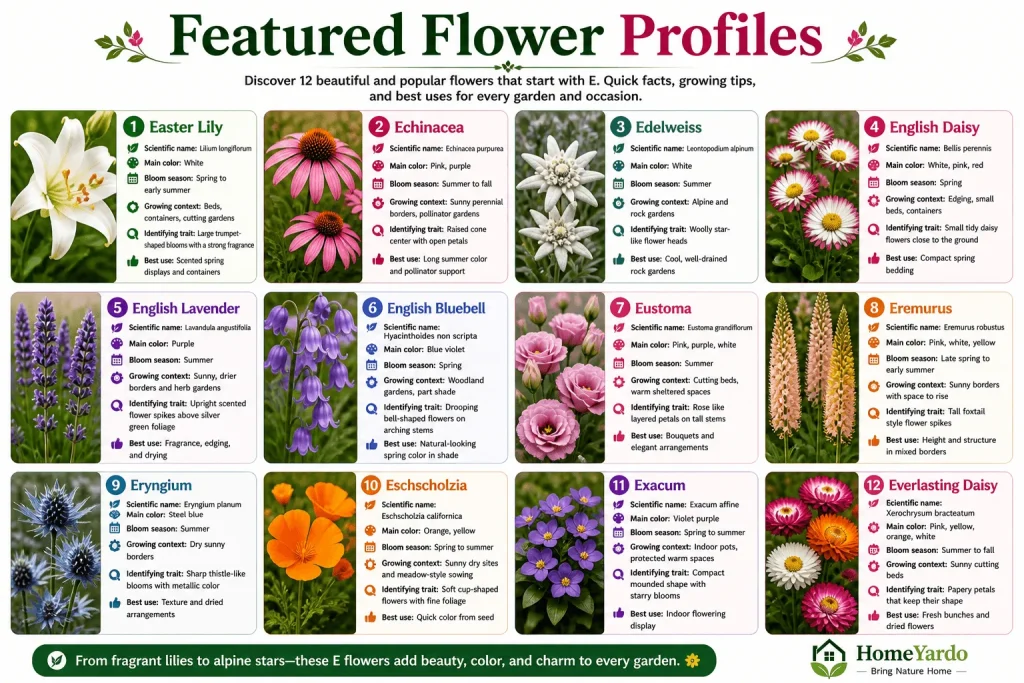
Easter Lily
- Scientific name: Lilium longiflorum
- Main color: White
- Bloom season: Spring to early summer
- Growing context: Beds, containers, cutting gardens
- Identifying trait: Large trumpet-shaped blooms with a strong fragrance
- Best use: Scented spring displays and containers
Echinacea
- Scientific name: Echinacea purpurea
- Main color: Pink, purple
- Bloom season: Summer to fall
- Growing context: Sunny perennial borders, pollinator gardens
- Identifying trait: Raised cone center with open petals
- Best use: Long summer color and pollinator support
Edelweiss
- Scientific name: Leontopodium alpinum
- Main color: White
- Bloom season: Summer
- Growing context: Alpine and rock gardens
- Identifying trait: Woolly star-like flower heads
- Best use: Cool, well-drained rock gardens
English Daisy
- Scientific name: Bellis perennis
- Main color: White, pink, red
- Bloom season: Spring
- Growing context: Edging, small beds, containers
- Identifying trait: Small tidy daisy flowers close to the ground
- Best use: Compact spring bedding
English Lavender
- Scientific name: Lavandula angustifolia
- Main color: Purple
- Bloom season: Summer
- Growing context: Sunny, drier borders and herb gardens
- Identifying trait: Upright scented flower spikes above silver green foliage
- Best use: Fragrance, edging, and drying
English Bluebell
- Scientific name: Hyacinthoides non scripta
- Main color: Blue violet
- Bloom season: Spring
- Growing context: Woodland gardens, part shade
- Identifying trait: Drooping bell-shaped flowers on arching stems
- Best use: Natural-looking spring color in shade
Eustoma
- Scientific name: Eustoma grandiflorum
- Main color: Pink, purple, white
- Bloom season: Summer
- Growing context: Cutting beds, warm sheltered spaces
- Identifying trait: Rose-like layered petals on tall stems
- Best use: Bouquets and elegant arrangements
Eremurus
- Scientific name: Eremurus robustus
- Main color: Pink, white, yellow
- Bloom season: Late spring to early summer
- Growing context: Sunny borders with space to rise
- Identifying trait: Tall foxtail-style flower spikes
- Best use: Height and structure in mixed borders
Eryngium
- Scientific name: Eryngium planum
- Main color: Steel blue
- Bloom season: Summer
- Growing context: Dry sunny borders
- Identifying trait: Sharp thistle-like blooms with metallic color
- Best use: Texture and dried arrangements
Eschscholzia
- Scientific name: Eschscholzia californica
- Main color: Orange, yellow
- Bloom season: Spring to summer
- Growing context: Sunny dry sites and meadow-style sowing
- Identifying trait: Soft cup-shaped flowers with fine foliage
- Best use: Quick color from seed
Exacum
- Scientific name: Exacum affine
- Main color: Violet purple
- Bloom season: Spring to summer
- Growing context: Indoor pots, protected warm spaces
- Identifying trait: Compact mounded shape with starry blooms
- Best use: Indoor flowering display
Everlasting Daisy
- Scientific name: Xerochrysum bracteatum
- Main color: Pink, yellow, orange, white
- Bloom season: Summer to fall
- Growing context: Sunny cutting beds
- Identifying trait: Papery petals that keep their shape
- Best use: Fresh bunches and dried flowers
Flower Meanings And Symbolism
Some E flowers are chosen for more than color, season, or shape. A few also carry common meanings in gardens, bouquets, and floral arrangements.
Easter Lily is often linked with purity, renewal, and spring. It suits formal arrangements, spring containers, and calm white flower displays.
Edelweiss is often associated with courage, devotion, and alpine beauty. Its woolly white flower heads give it a very different character from softer garden flowers.
Echinacea is commonly connected with strength and resilience because of its sturdy form and long garden presence. It also has strong associations with natural style planting and pollinator gardens.
English Daisy is often linked with innocence, simplicity, and early spring charm. Its low tidy blooms make it useful in edging, small beds, and cottage-style planting.
English Lavender is associated with calm, fragrance, and devotion. It is most useful where scent matters, such as herb gardens, dry borders, and paths.
Eustoma often carries a refined, grateful, or elegant feeling in bouquets. Its layered petals make it one of the strongest E flowers for formal arrangements.
Everlasting Daisy is valued for lasting color because its papery blooms keep their shape after drying. It fits cutting gardens, dried bunches, and craft use.
These meanings can vary by region and tradition, so they should be treated as general associations rather than fixed rules.
Common Flowers That Start With E
Common flowers named with E are the names most likely to feel familiar in gardens, bouquets, and seasonal displays. For another letter guide filled with recognizable garden staples, flowers that start with H are a natural companion article.
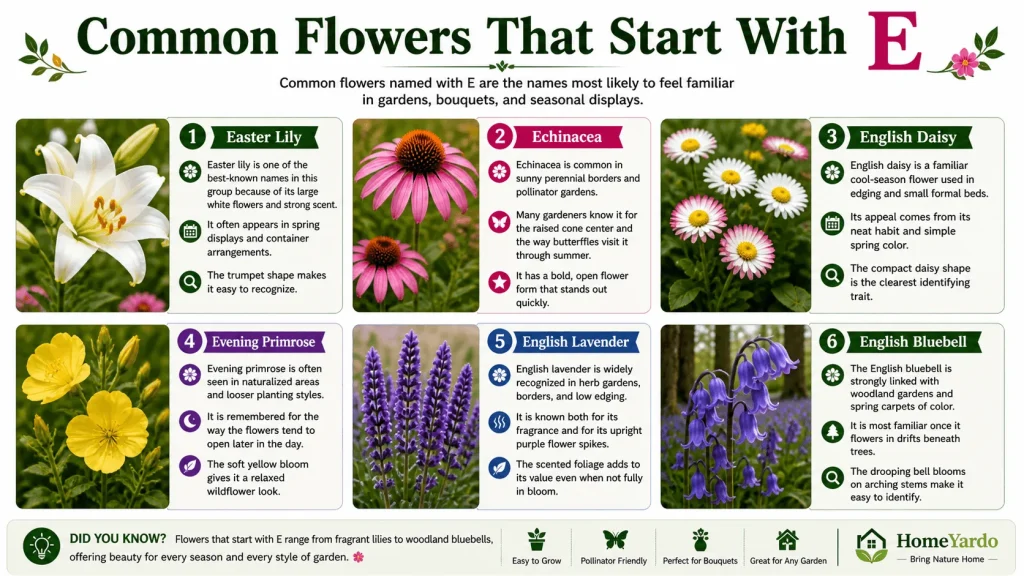
Easter Lily
- Easter lily is one of the best-known names in this group because of its large white flowers and strong scent.
- It often appears in spring displays and container arrangements.
- The trumpet shape makes it easy to recognize.
Echinacea
- Echinacea is common in sunny perennial borders and pollinator gardens.
- Many gardeners know it for the raised cone center and the way butterflies visit it through summer.
- It has a bold, open flower form that stands out quickly.
English Daisy
- English daisy is a familiar cool-season flower used in edging and small formal beds.
- Its appeal comes from its neat habit and simple spring color.
- The compact daisy shape is the clearest identifying trait.
Evening Primrose
- Evening primrose is often seen in naturalized areas and looser planting styles.
- It is remembered for the way the flowers tend to open later in the day.
- The soft yellow bloom gives it a relaxed wildflower look.
English Lavender
- English lavender is widely recognized in herb gardens, borders, and low edging.
- It is known both for its fragrance and for its upright purple flower spikes.
- The scented foliage adds to its value even when not fully in bloom.
English Bluebell
- The English bluebell is strongly linked with woodland gardens and spring carpets of color.
- It is most familiar once it flowers in drifts beneath trees.
- The drooping bell blooms on arching stems make it easy to identify.
Common Names And Scientific Names
Flower lists often use common names because they are easier to recognize and remember. Scientific names still matter because they reduce confusion across regions, lookalike plants, and nursery naming differences.
Using both together makes the guide easier to trust and easier to compare.
| Common Name | Scientific Name |
|---|---|
| Easter Lily | Lilium longiflorum |
| Echinacea | Echinacea purpurea |
| Edelweiss | Leontopodium alpinum |
| English Daisy | Bellis perennis |
| English Lavender | Lavandula angustifolia |
| English Bluebell | Hyacinthoides non scripta |
| Evening Primrose | Oenothera biennis |
| Eustoma | Eustoma grandiflorum |
| Exacum | Exacum affine |
| Eremurus | Eremurus robustus |
| Eryngium | Eryngium planum |
| Everlasting Daisy | Xerochrysum bracteatum |
Quick Identification Guide
Some E flowers are easier to remember by shape than by name. A white trumpet-shaped flower with a strong scent is usually an Easter Lily. A purple daisy-like bloom with a raised cone center is likely Echinacea.
A woolly white star-shaped alpine flower points toward Edelweiss. A small, low daisy in white, pink, or red is likely an English Daisy. Upright purple scented spikes usually suggest English Lavender.
Drooping blue bells in spring shade point toward the English Bluebell. A tall foxtail-style spike may be Eremurus, while a steel blue spiky flower head is usually Eryngium.
A compact pot plant with violet starry blooms may be Exacum. A papery flower that keeps its shape after cutting or drying is likely an Everlasting Daisy.
Expanded List Of Flowers Starting With E
The table below keeps the broader guide useful without forcing all 80 names into one oversized grid. It focuses on the most valuable entries for comparison.
| Woolly star-like flower heads | Scientific Name | Flower Type | Main Color | Bloom Season | Native Region or Growing Context | Identifying Note | Best Garden or Floral Use |
|---|---|---|---|---|---|---|---|
| Easter Cactus | Schlumbergera gaertneri | Flowering succulent | Pink, red, white | Spring | Indoor pots, frost-free spaces | Star-shaped blooms on flat stems | Indoor flowering display |
| Easter Lily | Lilium longiflorum | Bulb flower | White | Spring to early summer | Beds, containers | Large trumpet blooms | Fragrance, spring display |
| Eastern Bluestar | Amsonia tabernaemontana | Perennial | Pale blue | Late spring | Sunny borders | Starry blue flowers | Soft perennial structure |
| Eastern Red Columbine | Aquilegia canadensis | Perennial | Red, yellow | Spring | Woodland edge, part shade | Nodding spurred flowers | Native style planting |
| Edelweiss | Leontopodium alpinum | Alpine perennial | White | Summer | Rock gardens | Woolly star like flower heads | Alpine planting |
| Egyptian Lotus | Nymphaea lotus | Aquatic flower | White | Summer | Ponds, water gardens | Floating lily-like blooms | Water features |
| Egyptian Starcluster | Pentas lanceolata | Tender perennial | Pink, red, white | Summer to fall | Warm beds, pots | Tight starry clusters | Heat-loving color |
| Elderflower | Sambucus nigra | Flowering shrub | Cream white | Late spring to summer | Shrub borders, wildlife planting | Flat scented clusters | Wildlife gardens, cutting |
| Emilia | Emilia coccinea | Annual | Orange red | Summer to fall | Sunny beds | Tassel-like flowers on thin stems | Airy seasonal color |
| Echinacea | Echinacea purpurea | Perennial | Pink purple | Summer to fall | Sunny perennial beds | Raised cone center | Pollinators, seedheads |
| Elegant Zinnia | Zinnia elegans | Annual | Many colors | Summer to fall | Sunny cutting beds | Bright layered flowers | Cut flowers |
| English Bluebell | Hyacinthoides non scripta | Bulb flower | Blue violet | Spring | Woodland, part shade | Drooping bell flowers | Spring carpets |
| English Daisy | Bellis perennis | Short lived perennial | White, pink, red | Spring | Edging, containers | Small neat daisy form | Cool season bedding |
| English Lavender | Lavandula angustifolia | Perennial | Purple | Summer | Sunny dry borders | Scented flower spikes | Fragrance, edging |
| Epimedium | Epimedium grandiflorum | Shade perennial | Pink, white, yellow | Spring | Woodland planting | Airy spider-like flowers | Dry shade planting |
| Epiphyllum | Epiphyllum oxypetalum | Flowering cactus | White, pink, red | Summer | Pots, protected spaces | Large dramatic blooms | Specimen plant |
| Erica | Erica carnea | Low shrub | Pink, purple, white | Winter to spring | Acidic soil gardens | Tiny bell flowers | Evergreen low color |
| Erigeron | Erigeron karvinskianus | Perennial | White to pink | Spring to fall | Walls, edges, paths | Small daisy masses | Soft filler planting |
| Eryngium | Eryngium planum | Perennial | Steel blue | Summer | Dry sunny beds | Spiky metallic flower heads | Texture, dried use |
| Erysimum | Erysimum cheiri | Short lived perennial | Yellow, orange, purple | Spring | Cottage beds | Dense scented clusters | Border color |
| Erythronium | Erythronium dens canis | Bulb flower | Pink, purple, white | Spring | Shade gardens | Reflexed petals, mottled leaves | Woodland display |
| Escallonia | Escallonia rubra | Flowering shrub | Pink, red, white | Summer | Mild climate shrub borders | Small tubular flowers | Flowering hedge |
| Eschscholzia | Eschscholzia californica | Annual | Orange, yellow | Spring to summer | Sunny dry sites | Silky cup-shaped blooms | Easy color from seed |
| Eucomis | Eucomis bicolor | Bulb flower | Green, cream, purple-tinted | Summer | Beds, containers | Pineapple-like flower head | Unusual accent |
| Eupatorium | Eupatorium perfoliatum | Perennial | White | Summer | Moist borders, native planting | Flat flower clusters | Pollinator support |
| Euphorbia | Euphorbia characias | Flowering perennial | Green yellow | Spring | Dry borders | Lime toned bracts | Contrast planting |
| Evening Primrose | Oenothera biennis | Biennial or short-lived perennial | Yellow | Summer to fall | Naturalized areas | Flowers open later in the day | Wildflower look |
| Evening Stock | Matthiola longipetala | Annual | Lilac, purple, white | Spring to summer | Cool-season beds | Stronger evening fragrance | Scent near paths |
| Everlasting Daisy | Xerochrysum bracteatum | Annual | Pink, yellow, orange, white | Summer to fall | Sunny cutting beds | Papery petals | Fresh and dried bouquets |
| Everlasting Pea | Lathyrus latifolius | Perennial climber | Pink, rose, white | Summer | Trellises, fences | Sweet pea style flowers | Vertical color |
| Exacum | Exacum affine | Flowering plant | Violet purple | Spring to summer | Indoor pots, warm climates | Small starry flowers | Indoor bloom |
| Exochorda | Exochorda x macrantha | Flowering shrub | White | Spring | Shrub borders | Pearl-like buds | Spring focal point |
| Eustoma | Eustoma grandiflorum | Tender perennial or annual | Pink, purple, white | Summer | Cutting beds, warm climates | Rose like petals | Elegant cut flowers |
| Eyebright | Euphrasia officinalis | Wildflower | White with yellow and purple markings | Summer | Meadow-style planting | Tiny marked flowers | Naturalistic planting |
Rare Flowers That Start With E
Some E flowers are less familiar but still worth knowing for their form, color, or growing habit.

- Exacum is a compact flowering plant with rich violet blooms. It looks refined in pots and bright indoor spaces.
- Eyebright is a small wildflower with marked petals that give it a delicate, meadow-like look.
- Eremurus is tall and dramatic, yet not commonly seen in ordinary home planting. Its flower spikes stand out from a distance.
- Epiphyllum produces large, striking blooms on cactus-like stems. It is memorable but less common than standard border flowers.
- Egyptian Starcluster brings star-shaped clusters and handles warmth well. It suits bright long-season planting.
- Everlasting Pea adds graceful climbing flowers and a lighter look than many heavier summer vines.
- Edelweiss is also worth noting for its alpine background and soft felted flower heads, which give it a very different look from ordinary garden blooms.
Best E Flowers By Color
Color is one of the easiest ways to narrow the list. Some E flowers have one clear signature color, while others come in several shades depending on species or cultivar.
For white flowers, Easter Lily, Edelweiss, Exochorda, Eyebright, and Evergreen Candytuft are useful choices. Easter Lily gives large scented blooms, while Edelweiss has a smaller alpine look.
For purple flowers, English Lavender, Echinacea, Exacum, Eustoma, and Erica are strong options. Lavender is best for scent, while Eustoma works better for bouquets.
For blue or blue violet flowers, English Bluebell, Eryngium, Evolvulus, and Eastern Bluestar stand out. English Bluebell suits spring shade, while Eryngium brings a sharper metallic look to dry sunny borders.
For yellow flowers, Evening Primrose, Eriophyllum, European Globe Flower, and Eranthis are good choices. These work well when bright seasonal color is the main goal.
For pink flowers, English Daisy, Eustoma, Escallonia, and Everlasting Pea are useful. These suit cottage beds, containers, shrub borders, or cut flower use, depending on the plant.
For orange flowers, Emilia, Eschscholzia, Erythrina, and Evening Rain Lily can add a warmer color. These are better for sunny spaces and relaxed seasonal planting. For another color-focused guide with many pink, purple, and soft-toned garden names, flowers that start with P is a helpful related list.

Purple Flowers That Start With E
Purple flowers named with the E range from soft lavender tones to deeper violet and steel blue shades.
- Echinacea often leans pink or purple and gives an open, bold form.
- English Lavender brings a cooler purple tone and a clean upright shape.
- Erica can bloom in mauve, pinkish purple, or pale purple, depending on the variety.
- Eryngium adds a sharper blue-purple effect with a more architectural look.
- Exacum offers rich violet flowers that work well indoors or in warm, protected spaces.
- Eustoma can carry lilac and deeper purple tones that feel refined in arrangements.
Perennial Flowers That Start With E

Perennial flowers named with E are useful for planting that returns over time with the right care.
- Echinacea is one of the strongest sunny border choices. It brings color and supports pollinators.
- English Lavender keeps its value beyond bloom time because of its scent and shape.
- Eryngium handles drier conditions well and adds texture through summer. Its sharper structure and steel-blue tone make it one of the most architectural flowers in the group.
- Erysimum is often short-lived, but it can still give repeat value and a long flowering period in mild conditions.
- Erythronium suits woodland planting and soft spring displays.
- Erica fits acidic gardens and gives low-growing flower color.
Annual Flowers That Start With E

Annual flowers named with E are useful when fast seasonal color matters more than long-term structure.
- Eschscholzia is one of the easiest bright annual-style flowers in this group. It gives silky blooms in sunny places.
- Emilia adds airy orange-red flowers on thin stems and brings movement to mixed planting.
- Eustoma may be grown as an annual in many climates, even though it can be longer lived in warmer conditions.
- Everlasting Daisy. Its papery petals hold their form well, which is why it is also valued for drying.
These flowers work well where simple color and a strong one-season display are the main goals.
Indoor Flowers That Start With E

A few E flowers adapt well to indoor growing, though most are better outdoors.
- Easter Cactus is one of the strongest indoor bloomers in this letter group. It flowers well with bright indirect light.
- Exacum is another good choice for indoor color. Its compact shape and violet flowers suit small spaces.
- Epiphyllum can also be grown in protected indoor or sheltered conditions, especially where winters are cold.
Most other E flowers prefer outdoor conditions with stronger light and better seasonal rhythm.
Fragrant E Named Flowers

Some E flowers stand out more for scent than for sheer size or color.
- English Lavender has a clean, herbal fragrance that is instantly recognizable and useful in borders and dried bunches.
- Easter Lily has a richer scent that can fill a room or a still corner of the garden.
- Evening Stock becomes more fragrant later in the day and suits paths or sitting spaces.
- Eglantine, when included in broader flower collections, is appreciated for its rose family fragrance and old-fashioned character.
For pure scent, English lavender and Easter lily are usually the strongest starting points. For more scent-led names such as lavender, lily, and lilac, flowers that start with L give another useful fragrance-focused list.
Which E Flowers Are Good For Beginners?
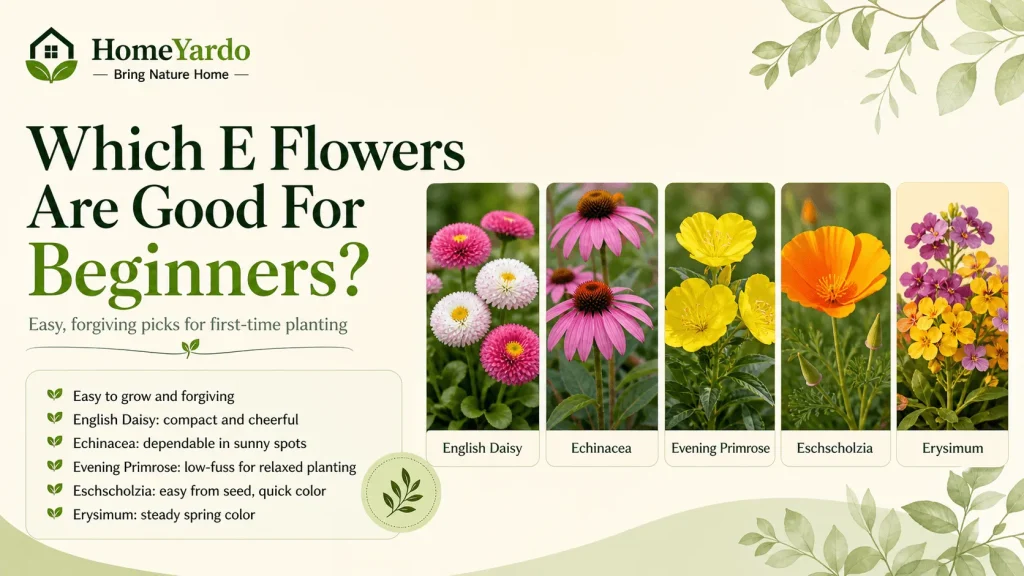
Some flowers starting with E are easier to grow and more forgiving than others.
- English Daisy is compact, cheerful, and simple in cool-season planting.
- Echinacea is a dependable perennial for sunny ground and does not need a complicated routine once established.
- Evening Primrose fits relaxed planting and naturalized spots without much fuss.
- Eschscholzia is easy from seed and gives bright color quickly.
- Erysimum brings long value in mixed borders and suits gardeners who want steady spring color.
These are practical picks for a first planting with the letter E.
Plants Vs Flowers That Start With E

Plants that start with E are not always the same as flowers with E. Some names belong in a broad plant list, while others fit better in a flower-focused guide where the bloom is the main reason the plant is grown.
A true flower entry belongs here because the flower itself is central to its value. A flowering plant may also fit when the blooms are an important part of why it is grown. In contrast, a foliage-heavy plant such as Elephant Ear may flower, but it is usually known more for leaf shape than for floral display.
Types Of Flowers That Start With E

Flowers with E fall into several useful growing groups. Sorting them by type makes the list easier to understand because Easter Lily, Echinacea, Exacum, and Egyptian Lotus do not grow in the same way.
Bulb flowers in this group include Easter Lily, English Bluebell, Erythronium, and Eucomis. These are useful for seasonal displays, spring color, and containers.
Perennial flowers that start with E include Echinacea, English Lavender, Eryngium, Erigeron, and Eremurus. These help build longer-lasting borders because they can return with the right care.
Annual flowers that start with E include Eschscholzia, Emilia, Elegant Zinnia, and Everlasting Daisy. These are practical when quick seasonal color matters more than long-term structure.
Flowering shrubs include Escallonia, Exochorda, Enkianthus, Edgeworthia, and Elderflower. These bring bloom as well as shape, which makes them useful in larger planting plans.
Flowering cacti or succulents include Easter Cactus, Epiphyllum, and Echeveria. These are better suited to indoor pots, sheltered spaces, or protected growing conditions.
Aquatic flowers include Egyptian Lotus. This flower belongs in ponds and water gardens rather than ordinary beds.
These types help separate border flowers from flowering shrubs, indoor bloomers, and water plants. A reader looking for a sunny border flower may choose Echinacea or English Lavender, while someone looking for a container plant may prefer Exacum, Easter Cactus, or Eucomis.
Best E Flowers By Growing Condition
The best flower depends on the space, not just the name. Light, soil, moisture, and container use can change which E flower is the most practical choice.
For full sun, Echinacea, English Lavender, Eryngium, and Eschscholzia are strong choices. They handle bright, open planting better than shade-loving flowers.
For part shade, English Bluebell, Epimedium, Erythronium, and Eastern Red Columbine are better fits. These suit woodland edges, softer light, and natural spring planting. For more shade-friendly and soft garden options across another letter group, flowers that start with S can be a useful next guide.
For dry soil, English Lavender, Eryngium, Eschscholzia, and Eriogonum are more suitable. These are better for leaner sunny spaces than moisture-loving plants.
For moist soil, Eupatorium, Eutrochium, Eastern Bluestar, and Egyptian Lotus are better options. Egyptian Lotus belongs in water gardens, while Eupatorium and Eutrochium suit damp borders or meadow-style spaces.
For containers, Exacum, Easter Cactus, English Daisy, and Eucomis are practical choices. They are easier to place in smaller spaces and can be moved or protected when needed.
For cut flowers, Eustoma, Echinacea, Eremurus, and Everlasting Daisy are useful. Eustoma gives a refined bouquet look, Eremurus adds height, and Everlasting Daisy keeps its form well for fresh or dried use.
For pollinator planting, Echinacea, Egyptian Starcluster, Eupatorium, Evening Primrose, and Eryngium are good options. These work best when matched with the right light and soil conditions.
For indoor growing, Easter Cactus, Exacum, and Epiphyllum are the strongest choices. Most other E flowers need stronger outdoor light and seasonal airflow.
How To Choose The Right E Flower By Garden Use
Choosing by use is often easier than choosing by name alone. Start with the purpose of the planting. For pollinator value, Echinacea, Eupatorium, and Evening Primrose are strong choices. For cut flowers, Eustoma, Elegant Zinnia, Eremurus, and Everlasting Daisy are more useful. For cottage-style planting, English Daisy, Erysimum, Erigeron, and Evening Stock bring a softer look.
Light and moisture also matter. English Lavender, Eryngium, Eschscholzia, and Euphorbia suit drier sunny spaces, while English Bluebell, Erythronium, and Eastern Red Columbine fit better where the light is softer. For containers, Easter Cactus, Exacum, English Daisy, and Eucomis are easier to adapt.
It also helps to think about the life span and maintenance. Annuals such as Emilia and Everlasting Daisy give quick color in one season, while perennials such as Echinacea and English Lavender build a longer-term planting. Fragrance can shape the choice too, with Easter Lily and English Lavender standing out more strongly than flowers grown mainly for form or texture.
Conclusion
Flowers starting with E cover a wide range of garden and floral uses. Familiar choices such as Easter Lily, Echinacea, English Daisy, English Lavender, and Evening Primrose are easy starting points, while Eremurus, Exacum, Eyebright, Eryngium, and Edelweiss bring more unusual forms.
The best choice depends on color, scent, life span, and growing conditions. For sunny borders, Echinacea and English Lavender are strong choices. For containers, Exacum and Easter Cactus work well. For cut flowers, Eustoma and Everlasting Daisy are more useful.
A careful E flower list should do more than collect names. It should help compare flowers by use, appearance, season, and growing habit so the right plant is easier to choose. Readers moving through flower names alphabetically can also continue with flowers that start with F.
FAQ’s
Easter lily is one of the most widely recognized E flowers, especially in spring. Echinacea is also very well known because it often appears in sunny perennial plantings and pollinator gardens.
Several do. Echinacea, English Lavender, Erica, Eryngium, Exacum, and some Eustoma varieties all bring purple or violet tones, though the shade can vary.
Echinacea, English Lavender, Eryngium, Erysimum, Erica, and Erythronium are strong perennial examples. A few others may be treated differently depending on climate and growing conditions.
Edelweiss is the best-known Alpine flower with E. It is recognized for its woolly white flower heads and strong connection with Rocky Mountain settings. It suits cool, well-drained rock gardens better than rich, wet, or very warm flower beds. Its unusual shape also makes it one of the most distinctive E flowers in this list.
Eastern Red Columbine is a red and yellow flower with E. Its nodding blooms have red outer parts and yellow centers, which makes it easy to recognize in spring. Some Eustoma, Erythrina, Epidendrum, Egyptian Starcluster, and Escallonia varieties can also produce red or reddish flowers depending on the species or cultivar.
English Daisy, Echinacea, Erigeron, Everlasting Daisy, Ethiopian Daisy, and Engelmann’s Daisy all have daisy-like forms. They differ in size, season, and garden use. English Daisy is better for low edging, Echinacea is stronger for pollinator beds, and Everlasting Daisy is useful for fresh or dried arrangements.
Echinacea, Egyptian Starcluster, Eupatorium, Eutrochium, Evening Primrose, and Eryngium are good pollinator-friendly E flowers. They can attract bees, butterflies, or other visiting insects, depending on the growing region. For a sunny garden, Echinacea and Eryngium are practical choices. For a softer, naturalized space, Evening Primrose and Eupatorium can fit better.
English Lavender and Easter Lily are two of the strongest fragrant choices. Lavender smells fresh and herbal, while Easter Lily has a richer and fuller perfume.
A flower-focused guide centers on blooms that matter most visually. A broader plant list can include shrubs, foliage plants, and botanical entries that flower but are not mainly grown for that reason.
No. Some names are flowering shrubs, cactus types, or plants better known for foliage or growth habit. That is why a careful flower list is more useful than a broad inventory.
The number changes depending on how strictly the names are filtered. A careful list will be shorter than a broad plant inventory, but it will also be more accurate and more useful.
Common flowers that start with the letter E include Easter Lily, Echinacea, English Daisy, Evening Primrose, English Lavender, and English Bluebell. These are among the most familiar names in gardens, bouquets, and spring or summer planting.
English Daisy, Echinacea, Evening Primrose, Eschscholzia, and Erysimum are good beginner-friendly choices. They offer color, simple growing habits, and a lower-maintenance starting point than some of the more unusual E flowers.
References
- Types of Flowers That Start With E – Petal Republic
- Flowers That Start With E – Trillium Montessori
- Flowers That Start With E – Flora Fauna Fun
- Flowers That Start With E – BioExplorer
- Echinacea purpurea – RHS
- Echinacea – RHS Plant Guide
- Echinacea purpurea – Missouri Botanical Garden Plant Finder
- Bellis perennis – NC State Extension Plant Toolbox
- Lavandula angustifolia – RHS
- How to Grow Lavender – RHS