100 Beautiful Varieties Of Flowers That Start With B You Didn’t Know About
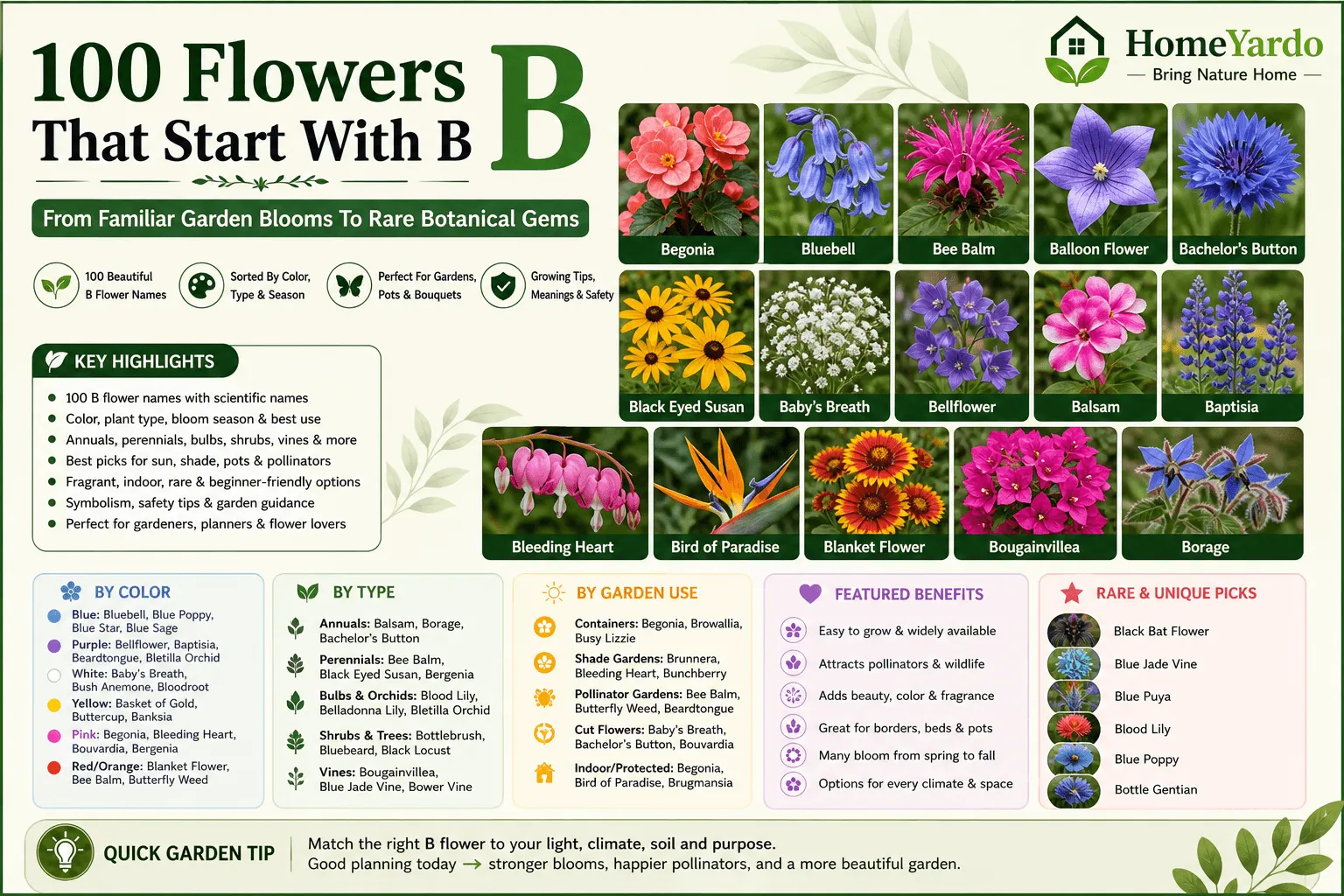
Flowers that start with B include familiar garden blooms, soft woodland flowers, bright pollinator plants, tropical showpieces, and unusual collector picks. Begonia, Bluebell, Bee Balm, Balloon Flower, Bachelor’s Button, Black Eyed Susan, and Baby’s Breath are some of the easiest names to recognize.
The full list is much wider than those common choices. It includes annuals, perennials, bulbs, orchids, vines, shrubs, ground covers, and flowering plants grown for their bloom display. Some are simple beginner flowers. Others need warm climates, protected growing space, sharp drainage, or careful handling.
This guide keeps the list practical. Each name is numbered, paired with a scientific name where useful, and sorted by color, plant type, bloom season, and garden use. It also separates common picks, rare flowers, indoor choices, fragrant options, and safer selection notes so the list stays useful instead of becoming a plain name dump.
For a complete alphabetical flower guide, compare this list with flowers that start with A before moving into the B flower group.
Quick Answer: What Are Flowers That Start With B?
Common B flower names include Begonia, Bluebell, Bee Balm, Balloon Flower, Bachelor’s Button, Black Eyed Susan, Baby’s Breath, Bellflower, Balsam, Baptisia, Bleeding Heart, and Bougainvillea.
The complete guide below includes 100 numbered B flower names with scientific names, color notes, plant type, bloom season, and best garden use. Some are true flowers, while others are flowering shrubs, vines, bulbs, orchids, or ornamental plants commonly grown for their blooms.
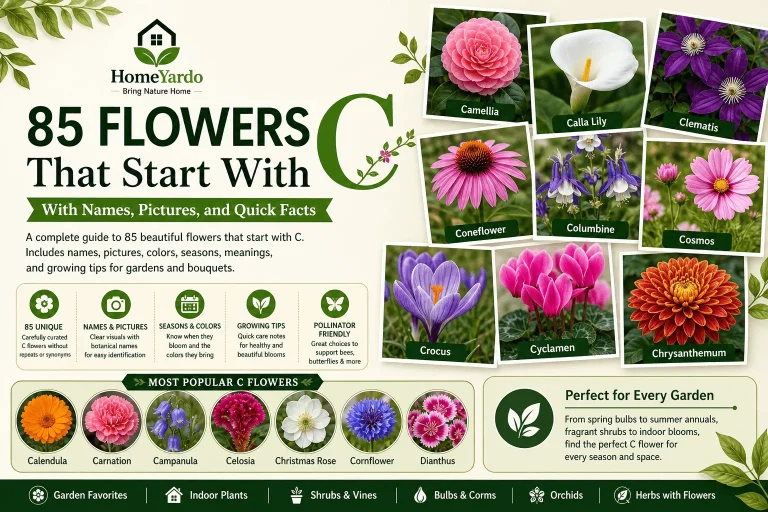
After reviewing these B flower names, the next natural guide is flowers that start with C, which continues the alphabet with common garden and bouquet flowers.
Best B Flowers
- For easy garden color, Begonia, Balsam, Bachelor’s Button, Balloon Flower, Black Eyed Susan, and Blanket Flower are among the most practical choices. They are widely available, easy to recognize, and useful in ordinary beds, containers, and borders.
- For shade, Bluebell, Brunnera, Bleeding Heart, Bloodroot, Bellwort, and Bugbane fit better than sun-loving plants. For pollinators, Bee Balm, Borage, Baptisia, Butterfly Weed, Beardtongue, and Black Eyed Susan are stronger choices.
- Rare and unusual options include Black Bat Flower, Blue Jade Vine, Blue Puya, Blood Lily, Blue Poppy, and Bottle Gentian. These are more about specialty interests than simple beginner planting.
- For containers, Begonia, Browallia, Balsam, Busy Lizzie, and Bracteantha are practical. For fragrance, Brugmansia, Bouvardia, Banana Shrub, Bush Anemone, and Black Locust stand out, although some need caution because of toxicity or size.
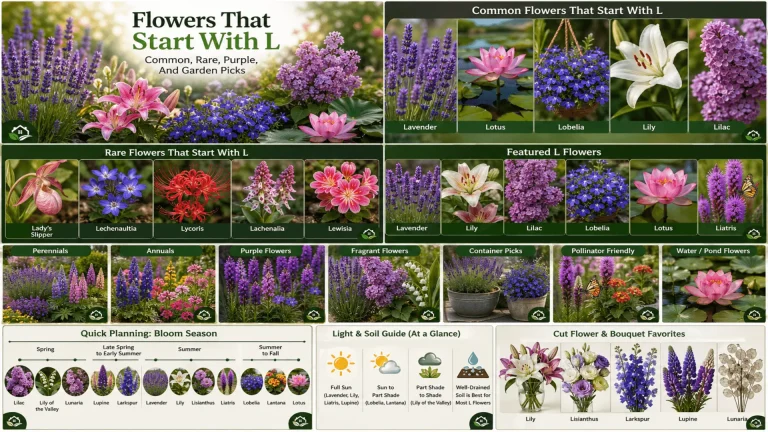
For another list with familiar garden names, flowers that start with L include well-known blooms such as lavender, lily, lilac, lotus, and lobelia.
How This 100 Flower List Was Curated
The list of flowers that starting with B includes true flowers and widely recognized flowering plants that naturally fit the B flower name intent. Some entries are bedding flowers, while others are bulbs, orchids, shrubs, vines, trees, or ground covers with notable blooms.
Common names can vary by country, region, nursery, and garden style. Scientific names help reduce confusion, especially when two plants share a similar common name or when a common name is used loosely.
Exact duplicates and weak cultivar only names were avoided where possible. The goal is a useful list of 100 distinct B flower names, not repeated versions of the same plant.
100 B Flower Names With Scientific Names
The table gives a fast way to compare B flower names by number, scientific name, color, plant type, bloom season, and best use. Climate and bloom time can shift by region, but the table gives a clear starting point.
| No. | Flower Name | Scientific Name | Main Color | Plant Type | Bloom Season | Best Use |
|---|---|---|---|---|---|---|
| 1 | Baby Blue Eyes | Nemophila menziesii | Blue, white | Annual | Spring to early summer | Soft spring color |
| 2 | Baby’s Breath | Gypsophila paniculata | White, pink | Perennial | Summer | Cut flowers and airy texture |
| 3 | Bachelor’s Button | Centaurea cyanus | Blue, pink, white | Annual | Late spring to summer | Cottage gardens |
| 4 | Balloon Flower | Platycodon grandiflorus | Blue, pink, white | Perennial | Summer | Borders and mixed beds |
| 5 | Balsam | Impatiens balsamina | Pink, red, purple, white | Annual | Summer to frost | Seasonal color |
| 6 | Baneberry | Actaea spp. | White | Perennial | Spring to summer | Woodland interest |
| 7 | Banksia | Banksia spp. | Yellow, orange, red | Shrub or small tree | Varies by species | Bold structure |
| 8 | Basket Flower | Plectocephalus americanus | Pink, lavender | Annual | Summer | Meadow-style planting |
| 9 | Basket of Gold | Aurinia saxatilis | Yellow | Perennial | Spring | Rock gardens and edging |
| 10 | Bear’s Breeches | Acanthus mollis | Purple, white, pink | Perennial | Late spring to summer | Architectural planting |
| 11 | Bearded Iris | Iris germanica | Many colors | Rhizome perennial | Spring to early summer | Borders and cut flowers |
| 12 | Beardtongue | Penstemon spp. | Red, pink, purple, blue, white | Perennial | Late spring to summer | Pollinator gardens |
| 13 | Bee Balm | Monarda spp. | Red, pink, purple, white | Perennial | Summer | Wildlife borders |
| 14 | Begonia | Begonia spp. | Pink, red, orange, yellow, white | Tender perennial | Spring to fall | Containers and shade |
| 15 | Bell Heather | Erica cinerea | Purple, pink, white | Shrub | Summer | Heath gardens |
| 16 | Belladonna Lily | Amaryllis belladonna | Pink, white | Bulb | Late summer to fall | Warm climate borders |
| 17 | Bellflower | Campanula spp. | Blue, purple, pink, white | Perennial | Late spring to summer | Borders and rock gardens |
| 18 | Bellis Daisy | Bellis perennis | White, pink, red | Perennial or biennial | Spring | Lawn edges and pots |
| 19 | Bellwort | Uvularia grandiflora | Yellow | Perennial | Spring | Woodland shade |
| 20 | Bergenia | Bergenia cordifolia | Pink, magenta, white | Perennial | Spring | Edging and shade |
| 21 | Betony | Stachys officinalis | Purple, pink | Perennial | Summer | Herb gardens and borders |
| 22 | Bird of Paradise | Strelitzia reginae | Orange, blue | Tender perennial | Warm season | Tropical focal point |
| 23 | Bird’s Foot Trefoil | Lotus corniculatus | Yellow | Perennial | Late spring to summer | Ground cover and wildlife areas |
| 24 | Bishop’s Flower | Ammi majus | White | Annual | Summer | Cut flowers |
| 25 | Bittercress | Cardamine spp. | White, pink | Annual or perennial | Spring | Naturalized damp areas |
| 26 | Bitter Melon Flower | Momordica charantia | Yellow | Vine | Summer | Edible garden interest |
| 27 | Bitterroot | Lewisia rediviva | Pink, white | Perennial | Spring | Rock gardens |
| 28 | Black Bat Flower | Tacca chantrieri | Deep maroon, black | Tropical perennial | Warm season | Collector growing |
| 29 | Black Cohosh | Actaea racemosa | White | Perennial | Summer | Woodland gardens |
| 30 | Black Hollyhock | Alcea rosea | Dark purple, near black | Biennial or perennial | Summer | Cottage gardens |
| 31 | Black Locust | Robinia pseudoacacia | White | Flowering tree | Spring | Fragrant tree blooms |
| 32 | Black Eyed Susan | Rudbeckia hirta | Yellow, dark center | Short-lived perennial | Summer to fall | Sunny borders |
| 33 | Blanket Flower | Gaillardia spp. | Red, orange, yellow | Perennial | Summer to fall | Hot sunny beds |
| 34 | Blazing Star | Liatris spp. | Purple, pink, white | Perennial | Summer | Pollinator beds |
| 35 | Bleeding Heart | Lamprocapnos spectabilis | Pink, white | Perennial | Spring | Shade gardens |
| 36 | Bletilla Orchid | Bletilla striata | Pink, purple, white | Orchid perennial | Spring | Ground orchid interest |
| 37 | Blood Lily | Scadoxus multiflorus | Red | Bulb | Warm season | Dramatic focal point |
| 38 | Bloodroot | Sanguinaria canadensis | White | Perennial | Early spring | Woodland gardens |
| 39 | Blue Anemone | Anemone blanda | Blue, purple, white | Tuberous perennial | Spring | Naturalized spring color |
| 40 | Blue Cardinal Flower | Lobelia siphilitica | Blue | Perennial | Summer to fall | Moist borders |
| 41 | Blue Clematis | Clematis spp. | Blue, purple | Vine | Spring to summer | Trellises |
| 42 | Blue Columbine | Aquilegia coerulea | Blue, white | Perennial | Spring to early summer | Mountain style gardens |
| 43 | Blue Daisy | Felicia amelloides | Blue, yellow center | Tender perennial | Warm season | Containers |
| 44 | Blue Flax | Linum perenne | Blue | Perennial | Late spring to summer | Light border texture |
| 45 | Blue Ginger | Dichorisandra thyrsiflora | Blue, violet | Tropical perennial | Warm season | Protected tropical display |
| 46 | Blue Hibiscus | Alyogyne huegelii | Blue, purple | Shrub | Warm season | Dry climate color |
| 47 | Blue Jade Vine | Strongylodon macrobotrys | Turquoise blue | Tropical vine | Warm season | Rare greenhouse display |
| 48 | Blue Lace Flower | Trachymene coerulea | Blue, lavender | Annual | Summer | Cut flowers |
| 49 | Blue Lobelia | Lobelia erinus | Blue, white | Annual | Spring to fall | Edging and baskets |
| 50 | Blue Passion Flower | Passiflora caerulea | Blue, white, purple | Vine | Summer | Trellises and fences |
| 51 | Blue Poppy | Meconopsis spp. | Blue | Perennial | Late spring to summer | Cool climate gardens |
| 52 | Blue Porterweed | Stachytarpheta jamaicensis | Blue, purple | Tender perennial | Warm season | Butterfly gardens |
| 53 | Blue Puya | Puya alpestris | Metallic blue | Bromeliad | Warm season | Dry climate rarity |
| 54 | Blue Sage | Salvia azurea | Blue | Perennial | Late summer to fall | Pollinator borders |
| 55 | Blue Sea Holly | Eryngium planum | Blue, silver blue | Perennial | Summer | Dry borders and cutting |
| 56 | Blue Star | Amsonia spp. | Pale blue | Perennial | Spring | Meadow-style planting |
| 57 | Blue Trumpet Vine | Thunbergia grandiflora | Blue, lavender | Vine | Warm season | Arbors and trellises |
| 58 | Bluebell | Hyacinthoides spp. | Blue, violet, white | Bulb | Spring | Woodland drifts |
| 59 | Bluebell Creeper | Billardiera heterophylla | Blue, purple | Vine | Spring to summer | Mild climate climbing |
| 60 | Bluebonnet | Lupinus texensis | Blue, white | Annual | Spring | Wildflower planting |
| 61 | Blue Eyed Grass | Sisyrinchium spp. | Blue, purple | Perennial | Spring to early summer | Meadow planting |
| 62 | Bluebeard | Caryopteris x clandonensis | Blue, purple | Shrub | Late summer to fall | Pollinator shrubs |
| 63 | Blueblossom | Ceanothus thyrsiflorus | Blue | Shrub | Spring | Native style planting |
| 64 | Bog Rosemary | Andromeda polifolia | Pink, white | Shrub | Spring | Acidic bog gardens |
| 65 | Borage | Borago officinalis | Blue, pink, white | Annual | Late spring to fall | Edible flowers and pollinators |
| 66 | Boronia | Boronia spp. | Pink, brown, yellow | Shrub | Spring | Fragrant mild climate planting |
| 67 | Bottle Gentian | Gentiana andrewsii | Blue, purple | Perennial | Late summer to fall | Moist native gardens |
| 68 | Bottlebrush | Callistemon spp. | Red, pink, yellow, white | Shrub or small tree | Spring to summer | Warm climate structure |
| 69 | Bottlebrush Buckeye | Aesculus parviflora | White | Shrub | Summer | Large shade gardens |
| 70 | Bougainvillea | Bougainvillea spp. | Purple, pink, red, orange, white | Vine or shrub | Warm season | Walls and trellises |
| 71 | Bouvardia | Bouvardia spp. | White, pink, red | Shrub | Warm season | Cut flowers and scent |
| 72 | Bowman’s Root | Gillenia trifoliata | White, pale pink | Perennial | Late spring to summer | Light woodland borders |
| 73 | Bracteantha | Xerochrysum bracteatum | Yellow, pink, orange, white | Annual or tender perennial | Summer to fall | Dry flowers and containers |
| 74 | Brazilian Jasmine | Mandevilla sanderi | Pink, red, white | Vine | Warm season | Patio containers |
| 75 | Brazilian Plume Flower | Justicia carnea | Pink | Shrub | Warm season | Tropical shade |
| 76 | Brazilian Red Cloak | Megaskepasma erythrochlamys | Red, pink | Shrub | Warm season | Tropical focal point |
| 77 | Bridal Wreath Spirea | Spiraea prunifolia | White | Shrub | Spring | Flowering hedges |
| 78 | Bristly Locust | Robinia hispida | Pink | Shrub | Spring to summer | Informal shrub borders |
| 79 | Broadleaf Arrowhead | Sagittaria latifolia | White | Aquatic perennial | Summer | Pond edges |
| 80 | Brooklime | Veronica beccabunga | Blue | Perennial | Spring to summer | Damp ground and pond edges |
| 81 | Browallia | Browallia speciosa | Blue, violet, white | Annual or tender perennial | Warm season | Pots and sheltered spots |
| 82 | Brugmansia | Brugmansia spp. | White, cream, peach, pink, yellow | Shrub | Warm season | Fragrant tropical display |
| 83 | Brunnera | Brunnera macrophylla | Blue, white | Perennial | Spring | Shade borders |
| 84 | Buckbean | Menyanthes trifoliata | White, pink | Aquatic perennial | Spring to summer | Bog gardens |
| 85 | Buckeye Flower | Aesculus spp. | White, yellow, red, pink | Tree or shrub | Spring | Large landscape bloom |
| 86 | Bugbane | Actaea simplex | White, pink | Perennial | Late summer to fall | Shade gardens |
| 87 | Bugleweed | Ajuga reptans | Blue, purple, pink, white | Ground cover perennial | Spring to early summer | Ground cover |
| 88 | Bulbine | Bulbine frutescens | Yellow, orange | Succulent perennial | Warm season | Dry sunny borders |
| 89 | Bunchberry | Cornus canadensis | White | Ground cover perennial | Spring to early summer | Woodland ground cover |
| 90 | Bush Anemone | Carpenteria californica | White | Shrub | Late spring to early summer | Fragrant shrub planting |
| 91 | Bush Clover | Lespedeza spp. | Pink, purple, white | Shrub or perennial | Late summer to fall | Late-season borders |
| 92 | Bush Morning Glory | Ipomoea carnea | Pink, lavender | Shrub | Warm season | Tropical hedges |
| 93 | Busy Lizzie | Impatiens walleriana | Pink, red, orange, white | Tender perennial | Spring to fall | Shade containers |
| 94 | Butterfly Bush | Buddleja davidii | Purple, pink, white | Shrub | Summer to fall | Pollinator gardens |
| 95 | Butterfly Pea | Clitoria ternatea | Blue, purple, white | Vine | Warm season | Edible flowers and trellises |
| 96 | Butterfly Weed | Asclepias tuberosa | Orange, yellow | Perennial | Summer | Monarch and pollinator planting |
| 97 | Buttonbush | Cephalanthus occidentalis | White | Shrub | Summer | Wet soil and wildlife planting |
| 98 | Butterbur | Petasites hybridus | Pink, white | Perennial | Early spring | Damp shade |
| 99 | Buttercup | Ranunculus spp. | Yellow, white | Annual or perennial | Spring to summer | Meadow color |
| 100 | Bower Vine | Pandorea jasminoides | Pink, white | Vine | Warm season | Trellises and screens |
Most Popular B Flowers

The most popular B flowers are widely grown because they are easy to identify, simple to find, useful in gardens, or common in floral work. These names are the strongest starting point before moving into rarer or more climate-specific plants.
- Begonia is one of the most flexible choices. It works in containers, shaded beds, porch pots, and bright indoor spots. Many types of flowers for a long season, and also offer attractive foliage.
- Bluebell is closely tied to spring woodland planting. Its nodding blue flowers create a soft, natural look under trees and along shaded paths.
- Bee Balm is valued for bold summer color and pollinator activity. Its red, pink, purple, or white flowers attract bees, butterflies, and hummingbirds.
- Balloon Flower is known for rounded buds that open into star-shaped blooms. It fits perennial borders and mixed beds where a clean flower shape is useful.
- Bachelor’s Button is a simple annual grown from seed. The classic blue form is popular in cottage gardens and informal cutting beds.
- Black Eyed Susan gives a strong yellow color from summer into fall. It handles sunny borders well and pairs naturally with grasses and other prairie-style plants.
- Baby’s Breath is famous for fine, airy white flowers. It is common in bouquets and can soften sunny garden borders.
- Bellflower includes many Campanula types, from low edging plants to taller border flowers. Blue and purple forms are the best known.
- Balsam gives fast seasonal color in warm weather. It suits simple annual beds, mixed containers, and informal planting.
- Baptisia is a long-lived perennial with pea-like flowers and attractive seed pods. It is useful in prairie-style gardens and sunny mixed borders.
- Bleeding Heart has arching stems with heart-shaped flowers. It performs best in cool shade and brings early-season interest before many summer plants begin.
- Bird of Paradise creates a bold tropical look with orange and blue flowers. It needs warmth and space, so it is often grown as a protected ornamental in cooler regions.
- Blanket Flower is useful in hot, sunny beds. Its red, orange, and yellow flowers give long color and handle dry conditions better than many soft bedding plants.
- Bougainvillea is grown for vivid bracts around small flowers. It suits warm climates, walls, trellises, and large patio containers.
- Borage has blue star-shaped flowers that attract pollinators. The flowers are also used as edible decoration when grown safely and correctly.
- Brunnera is a shade perennial with small blue spring flowers. wide varieties also have attractive silver-marked leaves.
- Butterfly Bush is grown for long flower clusters that attract pollinators. It works best where it is allowed and managed responsibly, since it can spread in some areas.
- Beardtongue gives tubular flowers in several colors. It is a strong choice for pollinator beds and sunny perennial borders.
- Bergenia is a tough perennial with bold leaves and spring flowers. It works well as edging and tolerates partial shade.
- Bletilla Orchid is a ground orchid with pink, purple, or white flowers. It is easier than many tropical orchids when grown in a suitable, protected spot.
Plants Vs Flowers That Begin With B

Not every B flower name belongs to the same plant category. Begonia, Balsam, and Bachelor’s Button are commonly treated as flowers in a traditional garden sense. Bougainvillea, Bottlebrush, Butterfly Bush, Banksia, and Black Locust are flowering plants grown for showy blooms, even though they are shrubs, vines, or trees.
This difference matters because a useful list should be honest about plant type. A compact annual for a pot is not used the same way as a flowering shrub for a hedge or a vine for a wall.
For a balanced guide, both groups can be included as long as they are labeled clearly. The scientific name and plant type help keep the list accurate.
B Flowers By Color

Color is one of the fastest ways to choose from a long list. Many B flowers fall into blue, purple, white, yellow, pink, red, orange, and dark groups, although exact shade can vary by species and cultivar.
Blue Blooms

Bluebell, Baby Blue Eyes, Blue Flax, Blue Jade Vine, Blue Poppy, Blue Sage, Blue Eyed Grass, Bluebonnet, Blue Lace Flower, and Brunnera are useful blue B flowers.
Bluebell and Bluebonnet give stronger outdoor color in season. Brunnera and Baby Blue Eyes give a softer look. Blue Jade Vine and Blue Poppy are more specialized and need the right climate or protected conditions.
Purple Blooms

Bellflower, Baptisia, Browallia, Bugleweed, Beardtongue, Bougainvillea, Balloon Flower, and Bletilla Orchid can fit purple planting schemes.
Purple B flowers work well in cottage gardens, pollinator beds, shaded borders, and tropical displays. Balloon Flower and Bellflower suit cooler perennial borders, while Bougainvillea gives a much bolder warm climate look.
White Blooms

Baby’s Breath, Bloodroot, Bush Anemone, Bishop’s Flower, Bellis Daisy, Bridal Wreath Spirea, Black Locust, and Bunchberry are useful white choices.
White flowers can brighten shade, soften mixed borders, and support bouquet-style planting. Baby’s Breath and Bishop’s Flower are especially useful in cut flower work, while Bloodroot and Bunchberry fit woodland-style gardens.
For more soft white, pink, and cottage style ideas, flowers that start with H can be useful alongside Baby’s Breath, Bloodroot, and Bellis Daisy.
Yellow Blooms

Basket of Gold, Bird’s Foot Trefoil, Buttercup, Banksia, Bottlebrush, Buckeye Flower, and Butterbur bring yellow tones to the B flower group.
Yellow flowers work well in spring edging, sunny borders, meadow-style planting, and pollinator areas. Basket of Gold is compact and bright, while Banksia and Bottlebrush create a stronger structural impact in warm climates.
Pink Blooms

Begonia, Bergenia, Bleeding Heart, Balsam, Bouvardia, Bracteantha, Busy Lizzie, Boronia, Belladonna Lily, and Brazilian Jasmine offer pink options.
Pink B flowers range from soft spring shade plants to tropical vines and container flowers. Bleeding Heart feels delicate and woodland-based, while Begonia and Busy Lizzie are more practical for pots and shaded displays.
Red And Orange Blooms

Blanket Flower, Blood Lily, Bee Balm, Bottlebrush, Bird of Paradise, Butterfly Weed, Brazilian Red Cloak, Bougainvillea, and some Begonia types provide red or orange color.
These flowers are useful when a garden needs warmth, contrast, or pollinator value. Butterfly Weed is especially valuable for wildlife planting, while Bird of Paradise and Brazilian Red Cloak create a stronger tropical impact.
Black Or Dark Blooms

Black Bat Flower, Black Hollyhock, deep maroon Begonia varieties, and dark forms of Bletilla or Bellflower can add darker tones.
True black is rare in flowers. Most dark blooms are deep purple, maroon, burgundy, or near black. Black Bat Flower is the most dramatic choice, but it needs warm, humid conditions and careful growing.
Types Of B Flowers

B flowers include short-lived annuals, returning perennials, bulbs, orchids, tropical plants, shrubs, vines, and ground covers. Choosing by plant type helps avoid placing the wrong plant in the wrong space.
Annual Flowers That Start With B

Balsam, Bachelor’s Button, Baby Blue Eyes, Borage, Browallia, Blue Lace Flower, and some Blue Lobelia types are useful annual choices.
Annual B flowers are good when quick seasonal color is needed. They work well in seed rows, containers, cutting beds, temporary gaps, and informal garden spaces.
Perennials That Start With B

Bee Balm, Balloon Flower, Baptisia, Bergenia, Bellflower, Brunnera, Bear’s Breeches, Black Eyed Susan, Blanket Flower, Beardtongue, and Blue Star are perennial options.
Perennials are better when long-term structure matters. They usually need more patience at planting time, but they can return for several years when matched with the right light, soil, and climate.
Bulbs, Orchids, And Tropical Choices

Bletilla Orchid, Blood Lily, Belladonna Lily, Bird of Paradise, Black Bat Flower, Blue Ginger, Blue Puya, and Brugmansia add more unusual forms.
These plants are not always beginner choices. Some need warmth, protection from frost, higher humidity, or careful watering. They are best chosen after checking the climate and space.
Flowering Shrubs, Vines, And Trees

Bougainvillea, Bottlebrush, Banksia, Butterfly Bush, Black Locust, Buttonbush, Bluebeard, Blueblossom, Brazilian Jasmine, and Bower Vine are flowering woody or climbing plants.
These choices are useful for structure, screening, wildlife planting, hedges, walls, fences, and larger landscapes. They need more space than small annuals or border perennials.
Rare Flowers That Begin With B

Some B flowers feel rare because they are difficult to find. Others are uncommon because they need a narrow climate, a protected setting, acidic soil, boggy ground, or advanced care.
- Black Bat Flower is one of the most unusual B flowers because of its dark wing-like blooms and long whisker-like filaments. It needs warm, humid conditions and is best for experienced growers.
- Blue Jade Vine is rare in ordinary gardens because it needs tropical or greenhouse-style warmth. Its hanging turquoise flower chains make it one of the most striking names in the list.
- Blue Puya has metallic blue flowers and a dry climate personality. It is uncommon because it suits specialized conditions and is not a typical bedding plant.
- Blood Lily creates round red flower heads that stand out strongly. It suits warm conditions and is usually grown as a dramatic bulb rather than a casual border plant.
- Bellwort is a quieter rarity for woodland shade. Its yellow hanging flowers are graceful, but it is less common in everyday garden center displays.
- Bog Rosemary needs cool, acidic, wet soil. That makes it less practical for ordinary beds but valuable for bog gardens and specialty planting.
- Bush Anemone is a fragrant California native shrub with white flowers. It suits mild dry climates better than humid or cold regions.
- Bloodroot is a short-lived spring woodland flower. Its white blooms are beautiful, but the plant needs careful placement and should not be handled casually.
- Blue Poppy is famous but difficult in many climates. It prefers cool, moist conditions and does poorly in hot, dry areas.
- Bottle Gentian has closed blue flowers and needs moist soil. It is more common in native plant settings than in general bedding displays.
Best B Flowers By Garden Use

A flower can be attractive and still be the wrong fit for the site. Light, water, space, climate, and purpose matter more than the first letter of the name.
Best For Container, Small Space Picks, And Hanging Displays
Begonia, Browallia, Balsam, Busy Lizzie, Blue Lobelia, and Bracteantha are practical for pots and hanging displays.
Begonia is the strongest all-around choice because it handles containers well and tolerates partial shade better than many flowering plants. Browallia and Busy Lizzie suit bright sheltered spots, while Bracteantha works better in sunnier containers.
Best For Borders And Cottage Gardens
Bellflower, Balloon Flower, Bee Balm, Bachelor’s Button, Black Eyed Susan, Blanket Flower, Beardtongue, and Bleeding Heart work well in borders.
These flowers bring different shapes and seasons. Bachelor’s Button gives easy annual color, Balloon Flower gives tidy perennial blooms, and Bee Balm adds a looser pollinator-friendly look.
Best For Shade Gardens
Bluebell, Brunnera, Bleeding Heart, Bloodroot, Baneberry, Bugbane, Bellwort, and Bunchberry are better choices for shade or partial shade.
Shade flowers often bloom earlier and may go quiet in hot weather. They work best under trees, near woodland edges, or in cool garden pockets where sun-loving flowers struggle. For more shade-friendly and woodland-style options, flowers that start with M can be compared with Bluebell, Brunnera, Bleeding Heart, and Bloodroot.
Pollinator Friendly And Meadow Picks
Bee Balm, Borage, Baptisia, Butterfly Weed, Beardtongue, Black Eyed Susan, Buttonbush, Blue Sage, and Blazing Star are strong pollinator choices.
Pollinator planting works better when several bloom seasons are covered. Spring, summer, and fall flowers keep nectar and pollen available for a longer period. For more pollinator-friendly flower ideas, flowers that start with P can pair well with Bee Balm, Borage, Butterfly Weed, and Beardtongue.
Cut Flower And Bouquet Favorites
Baby’s Breath, Bachelor’s Button, Balloon Flower, Black Eyed Susan, Bouvardia, Bracteantha, Belladonna Lily, and Blue Lace Flower all have bouquet value in different ways. Baby’s Breath is useful for light filler and airy texture, while Bachelor’s Button adds simple blue color that mixes easily with other stems.
Bracteantha is one of the best choices when dried material also matters. Balloon Flower and Blue Lace Flower bring a cleaner shape and softer detail, while Bouvardia and Belladonna Lily are more specialized options for growers working with the right season or climate.
Indoor Or Protected Space Picks
Begonia, Browallia, Bird of Paradise, Black Bat Flower, Blue Ginger, Brugmansia, and some tropical orchids are indoor or protected growing candidates.
Begonia is the most practical, indoor-friendly option for many homes. Bird of Paradise and Brugmansia need much more space and light. Black Bat Flower and Blue Ginger need warmth and humidity.
Water And Pond Flower Picks
The B group has better options for pond edges, wet borders, and bog-style planting than for deep-water flower displays. Blue Flag Iris is one of the strongest choices because it handles wet soil well and brings clear flower color along the water’s edge. Bogbean fits softer pond margins and bog gardens, where it adds a more natural look.
If your list includes Blue Water Lily or other water-lily-type entries under B, those are the clearest picks for true open-water bloom, while the others are better treated as moisture-loving flowers around the pond rather than in it.
Flower Meanings And Symbolism
Many B flowers have symbolic meanings in floral language, cultural use, or bouquet traditions. These meanings can vary, so they are best treated as common associations rather than fixed rules.
Baby’s Breath is often linked with innocence, softness, and lasting affection. Bachelor’s Button is commonly associated with hope, devotion, and patience. Bluebell is often connected with gratitude and humility.
Bleeding Heart is linked with love and compassion because of its flower shape. Bird of Paradise often suggests freedom and joy. Borage has a long association with courage.
Begonia can be associated with caution or individuality. Black Eyed Susan often carries a cheerful meaning tied to encouragement. Balloon Flower is often linked with friendship and patience.
Safety Notes Before Growing B Flowers
Some B flowers need caution around pets, children, grazing animals, or edible garden areas. Attractive flowers are not always safe to touch, taste, or place in high-traffic spaces.
Brugmansia is highly toxic and should be handled carefully. Baneberry berries are toxic. Bloodroot sap can irritate skin. Bleeding Heart may irritate if eaten. Buttercup can irritate the mouth and skin.
Unfamiliar ornamental plants should be checked before planting near pets or children. Gloves are sensible when handling plants known for irritating sap, berries, or toxic parts.
How To Choose The Right B Flower
The best choice depends on light, climate, space, water, and purpose. A small flower for a shaded pot is very different from a vine for a wall or a shrub for wildlife planting.
For full sun, consider Bee Balm, Black Eyed Susan, Baptisia, Borage, Blanket Flower, Blue Sage, and Butterfly Weed. For shade, consider Bluebell, Brunnera, Bleeding Heart, Bloodroot, Bugbane, Bellwort, and Bunchberry.
For quick color, choose Balsam, Bachelor’s Button, Baby Blue Eyes, Blue Lobelia, or Browallia. For a longer-term structure, choose Bellflower, Bergenia, Baptisia, Beardtongue, Blue Star, or Black Eyed Susan.
For rare interest, look at Black Bat Flower, Blue Jade Vine, Blue Puya, Blue Poppy, Bottle Gentian, or Blood Lily. For containers, choose Begonia, Browallia, Busy Lizzie, Bracteantha, or Balsam.
For pollinators, Bee Balm, Borage, Butterfly Weed, Beardtongue, Buttonbush, and Blazing Star are stronger choices. For fragrance, Brugmansia, Bouvardia, Banana Shrub, Bush Anemone, and Black Locust are worth considering, with safety and space checked first.
Conclusion
B flowers cover a wide range, from easy garden staples to unusual collector plants. Begonia, Bluebell, Bee Balm, Black Eyed Susan, Bachelor’s Button, and Baby’s Breath are familiar choices, while Black Bat Flower, Blue Jade Vine, Blue Puya, and Blue Poppy bring a more specialized look.
The best choice depends on growing conditions, not just the name. Match the flower to sun, shade, climate, space, water, safety, and purpose before planting.
FAQ’s
Flowers that start with B include Begonia, Bluebell, Bee Balm, Balloon Flower, Bachelor’s Button, Black Eyed Susan, Baby’s Breath, Bellflower, Balsam, Baptisia, and Bleeding Heart. The broader list also includes flowering plants such as Bougainvillea, Bottlebrush, Banksia, Butterfly Bush, Bluebeard, and Buttonbush. Some are traditional garden flowers, while others are shrubs, vines, bulbs, orchids, or trees grown for their blooms.
There is no single fixed number because plant lists use different rules. A narrow list may include only common bedding flowers, while a broader gardening guide may include shrubs, vines, bulbs, orchids, and flowering trees.
Begonia is one of the most popular flowers that starts with B because it is widely grown in containers, shade beds, porch pots, and indoor displays. Bluebell, Bee Balm, Black Eyed Susan, Baby’s Breath, and Bachelor’s Button are also very familiar. The most popular answer can change by region, climate, and whether the focus is gardening or floristry.
Brugmansia is one of the strongest fragrant flowers starting with B, especially in warm evening air. Its large trumpet-shaped flowers can release a strong scent. Bouvardia, Banana Shrub, Bush Anemone, and Black Locust can also add fragrance. Brugmansia must be handled with caution because it is highly toxic.
Perennial B flowers include Bee Balm, Balloon Flower, Baptisia, Bellflower, Bergenia, Brunnera, Bear’s Breeches, Black Eyed Susan, Blanket Flower, Blue Star, and Beardtongue. These plants can return for more than one growing season when planted in suitable conditions. Light, soil, winter cold, summer heat, and drainage all affect how well they perform.
Yes. Begonia is the most practical indoor flower beginning with B for many homes, especially in bright filtered light. Browallia may also work in protected bright spots. Bird of Paradise, Black Bat Flower, Blue Ginger, and Brugmansia can be grown in protected settings, but they need more space, warmth, humidity, or caution than ordinary houseplants.
Good beginner B flowers include Begonia, Balsam, Bachelor’s Button, Balloon Flower, Black Eyed Susan, Blanket Flower, Borage, and Bellflower. These choices are easier to find and less demanding than many rare collector plants. The best beginner option still depends on sun exposure, climate, soil, and whether the plant is going into a bed or a pot.
Rare flowers that start with B include Black Bat Flower, Blue Jade Vine, Blue Puya, Blue Poppy, Bottle Gentian, Blood Lily, Bellwort, Bog Rosemary, and Bush Anemone. Some are rare because they need tropical warmth. Others need cool shade, boggy soil, acidic conditions, or specialty nursery sources. Rare does not always mean impossible, but it often means more specific care.
Purple flowers that start with B include Bellflower, Baptisia, Browallia, Bugleweed, Beardtongue, Bougainvillea, Balloon Flower, and Bletilla Orchid. Some are true purple, while others lean blue violet, lavender, or magenta. Cultivar choice matters because many of these plants come in several colors.
B flowers usually refer to common flower names or plants grown mainly for their blooms. Flowering plants beginning with B can include shrubs, vines, trees, bulbs, ground covers, and tropical ornamentals. Begonia and Bachelor’s Button fit the classic flower list intent. Bougainvillea, Bottlebrush, Banksia, and Black Locust are flowering plants that appear in broader bloom-focused lists.
Yellow flowers starting with B include Basket of Gold, Bird’s Foot Trefoil, Buttercup, Banksia, Buckeye Flower, Butterbur, and some Bottlebrush forms. Basket of Gold is useful for spring edging and rock gardens. Buttercup is common in meadow-style settings, while Banksia and Bottlebrush are better suited to warm-climate ornamental planting.
Pink B flowers include Begonia, Bergenia, Bleeding Heart, Balsam, Bouvardia, Bracteantha, Busy Lizzie, Boronia, Belladonna Lily, and Brazilian Jasmine. Pink choices range from soft shade flowers to warm climate vines and container plants. Begonia and Busy Lizzie are practical for pots, while Bleeding Heart is better for cooler shaded beds.
Bluebell, Brunnera, Bleeding Heart, Bloodroot, Baneberry, Bellwort, Bugbane, and Bunchberry can grow in shade or partial shade. Shade flowers often prefer cooler soil and protection from harsh afternoon sun. Many bloom in spring before trees fully leaf out, while others add foliage value after flowers fade.
Bee Balm, Borage, Baptisia, Butterfly Weed, Beardtongue, Black Eyed Susan, Buttonbush, Blue Sage, and Blazing Star are strong pollinator choices. A better pollinator planting uses several flowers with different bloom times. This gives bees, butterflies, hummingbirds, and other insects more consistent food through the growing season.
Begonia, Browallia, Balsam, Busy Lizzie, Blue Lobelia, Bracteantha, and compact Bellflower types can work well in pots. Container success depends on drainage, light, watering, and plant size. Large shrubs, vines, and trees need bigger containers or outdoor planting space.
Yes. Some B flowers and flowering plants can be toxic or irritating. Brugmansia is highly toxic, Baneberry berries are toxic, Bloodroot sap can irritate skin, and Bleeding Heart may cause irritation if eaten. Buttercup can also irritate the skin and the mucous membranes of the mouth. Plant safety should be checked before adding unfamiliar flowers near pets, children, edible beds, or grazing animals.
References
- Plant Delights
https://www.plantdelights.com/collections/plants-that-start-with-b - Trillium Montessori
https://www.trilliummontessori.org/flowers-that-start-with-b/ - Names In English
https://namesinenglish.com/flowers/flowers-starting-with-b/ - Growing Family
https://growingfamily.co.uk/plants-a-to-z/flowers-that-start-with-b/ - Bloom How To
https://bloomhowto.com/flowers-that-start-with-b/ - Eternity Flower
https://www.eternityflower.com/blogs/news/flowers-that-start-with-b - Frosting And Glue
https://frostingandglue.com/flowers-that-start-with-b/ - Petal Republic
https://www.petalrepublic.com/flowers-that-start-with-b/ - My Garden Flowers
https://mygardenflowers.com/flower-names/b/ - Burncoose
https://www.burncoose.co.uk/site/list.cfm?letter=b&type=cn - Meredith Plays
https://www.meredithplays.com/beautiful-flowers-starting-with-b/