40 Beautiful Varieties of Flowers That Start With R You Didn’t Know About
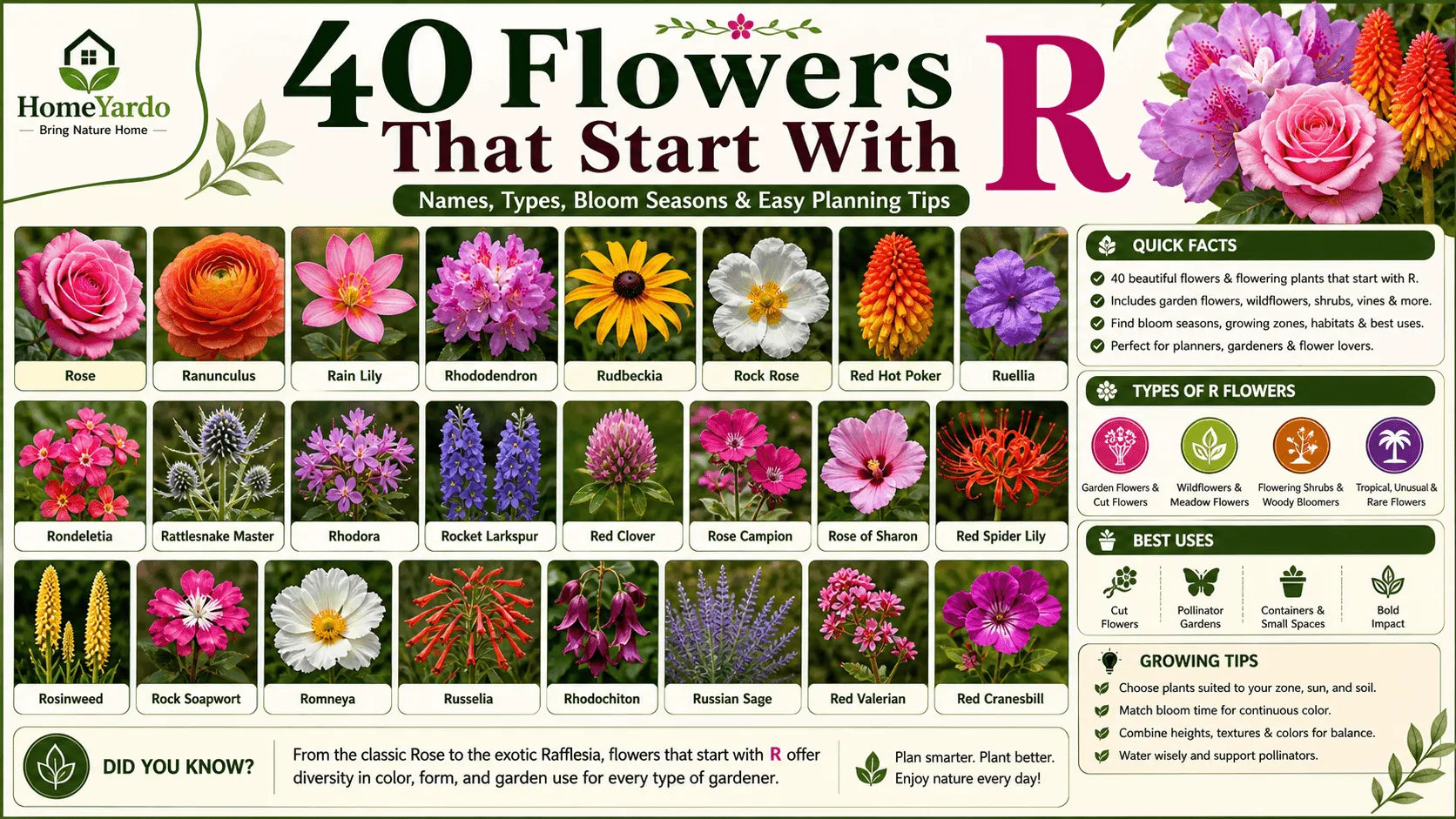
Flowers starting with R include some of the most familiar blooms in gardening, along with a surprising number of lesser-known meadow flowers, shrubs, vines, and bold landscape plants. Rose and ranunculus may come to mind first, yet the list quickly opens up to rain lily, red hot poker, rhododendron, ruellia, ragged robin, and many more.
This guide brings together common flowers, unusual picks, flowering shrubs, and related plants that are often included in alphabetical flower lists. Each entry is grouped clearly by type to make comparison easier. Along the way, it also helps with bloom timing, climate fit, habitat, color filtering, and practical garden use.
Quick Answer: What Are Flowers That Start With R?
R named flowers include Rose, Ranunculus, Rain Lily, Rhododendron, Rudbeckia, Rock Rose, Red Hot Poker, and Ruellia. The group also includes meadow flowers, flowering shrubs, and a few broader blooming plants that are often grouped into R flower lists.
List of Flower Names That Start With R at a Glance
The table below gives a broad overview of 40 flowers and flowering plants whose common names begin with R. It brings together scientific names, plant type, color, and origin in one place, so the list feels more useful than a simple alphabetical roll call.
| Flower name | Scientific name | Plant type | Main color | Native region/origin |
|---|---|---|---|---|
| Rose | Rosa spp. | Flowering shrub | Red, pink, white, yellow | Asia, Europe, North America |
| Ranunculus | Ranunculus asiaticus | Flowering perennial | Red, pink, orange, yellow, white | Mediterranean, Southwest Asia |
| Rain Lily | Zephyranthes spp. | Bulbous perennial | Pink, white, yellow | Americas |
| Rhododendron | Rhododendron spp. | Flowering shrub | Pink, purple, red, white | Asia, Europe, North America |
| Rudbeckia | Rudbeckia spp. | Flowering perennial | Yellow, orange, bronze | North America |
| Rock Rose | Cistus spp. | Flowering shrub | Pink, white, purple | Mediterranean |
| Red Hot Poker | Kniphofia spp. | Flowering perennial | Red, orange, yellow | Africa |
| Ruellia | Ruellia simplex | Flowering perennial | Purple, pink, white | Central and South America |
| Rondeletia | Rondeletia odorata | Flowering shrub | Red, orange | Caribbean |
| Rattlesnake Master | Eryngium yuccifolium | Wildflower perennial | White, pale green | North America |
| Rhodora | Rhododendron canadense | Flowering shrub | Pink, lavender | North America |
| Rocket Larkspur | Consolida ajacis | Annual flower | Purple, blue, pink, white | Mediterranean |
| Red Clover | Trifolium pratense | Meadow flower | Pink, red, purple | Europe, Western Asia |
| Rose Campion | Silene coronaria | Short-lived perennial | Magenta, white | Europe, Western Asia |
| Rose of Sharon | Hibiscus syriacus | Flowering shrub | Pink, white, purple, blue | East Asia |
| Rosinweed | Silphium integrifolium | Prairie perennial | Yellow | North America |
| Rafflesia | Rafflesia arnoldii | Parasitic flowering plant | Red, maroon | Southeast Asia |
| Red Spider Lily | Lycoris radiata | Bulbous perennial | Red | East Asia |
| Red Valerian | Centranthus ruber | Flowering perennial | Red, pink, white | Mediterranean |
| Restharrow | Ononis spinosa | Flowering subshrub | Pink | Europe, Western Asia |
| Rice Flower | Ozothamnus diosmifolius | Flowering shrub | White, pink | Australia |
| Rock Soapwort | Saponaria ocymoides | Groundcover perennial | Pink | Europe |
| Rockfoil | Saxifraga spp. | Alpine perennial | White, pink, yellow | Europe, Asia, North America |
| Rocktrumpet | Mandevilla spp. | Flowering vine | Pink, red, white | Tropical Americas |
| Rose Mallow | Hibiscus moscheutos | Flowering perennial | Pink, white, red | North America |
| Rosebay Willowherb | Chamerion angustifolium | Wildflower perennial | Pink purple | Northern Hemisphere |
| Rue | Ruta graveolens | Herb with flowers | Yellow | Mediterranean |
| Russelia | Russelia equisetiformis | Flowering shrub | Red, coral | Mexico, Central America |
| Rangoon Creeper | Combretum indicum | Flowering vine | Red, pink, white | South and Southeast Asia |
| Ratibida | Ratibida columnifera | Wildflower perennial | Yellow, maroon | North America |
| Romneya | Romneya coulteri | Flowering perennial | White | California, Mexico |
| Romulea | Romulea spp. | Corm perennial | Purple, pink, yellow | Africa, Mediterranean |
| Redbud | Cercis spp. | Flowering tree | Pink, purple | North America, Europe, Asia |
| Russian Sage | Salvia yangii | Flowering perennial | Lavender blue | Central Asia |
| Reseda | Reseda odorata | Flowering plant | Greenish white, yellow | Mediterranean, North Africa |
| Rhodochiton | Rhodochiton atrosanguineus | Flowering vine | Purple, maroon | Mexico |
| Ragged Robin | Silene flos-cuculi | Wildflower perennial | Pink | Europe, parts of Asia |
| Rue Anemone | Thalictrum thalictroides | Woodland perennial | White, pink | Eastern North America |
| Red Cranesbill | Geranium sanguineum | Flowering perennial | Magenta, pink | Europe, Western Asia |
| Regal Geranium | Pelargonium grandiflorum | Tender perennial | Purple, pink, red, white | Southern Africa |
Bloom Season, Growing Zones, And Habitat At A Glance
Bloom timing and climate fit often matter more than the alphabet itself. A compact planning table gives a better sense of which flowers suit borders, meadows, containers, woodland edges, or dry sunny beds.
| Flower name | Main bloom window | USDA zone or climate note | Best habitat or garden setting |
|---|---|---|---|
| Rose | Late spring to fall | Zones 4 to 10, varies by type | Borders, cutting gardens, mixed beds |
| Ranunculus | Spring | Mild winters, often seasonal elsewhere | Cutting gardens, containers, cool-season beds |
| Rain Lily | Summer to early fall after rain | Zones 7 to 10 | Containers, borders, bulb pockets |
| Rhododendron | Spring | Zones 4 to 9, varies by species | Woodland edge, shrub borders |
| Rudbeckia | Summer to fall | Zones 3 to 9 | Pollinator beds, prairie-style borders |
| Rock Rose | Late spring to summer | Zones 8 to 10, dry climates | Gravel beds, sunny, dry slopes |
| Red Hot Poker | Summer to fall | Zones 5 to 9 | Bold borders, focal planting |
| Ruellia | Summer to fall | Zones 8 to 10, warm climates | Borders, moist beds, containers |
| Rocket Larkspur | Spring to early summer | Often grown as an annual in cool seasons | Cutting gardens, cottage beds |
| Rose of Sharon | Summer to early fall | Zones 5 to 9 | Hedges, screens, shrub borders |
| Red Spider Lily | Late summer to early fall | Zones 6 to 10 | Bulb borders, naturalized drifts |
| Red Valerian | Late spring to summer | Zones 5 to 9 | Walls, dry banks, cottage gardens |
| Rock Soapwort | Spring to early summer | Zones 3 to 8 | Rock gardens, edging |
| Rose Mallow | Mid to late summer | Zones 4 to 9 | Moist borders, rain gardens |
| Russelia | Warm season, often long flowering | Frost-free or warm climates | Containers, walls, cascading displays |
| Rattlesnake Master | Summer | Zones 3 to 8 | Native meadows, pollinator gardens |
| Romneya | Late spring to summer | Zones 8 to 10, dry warm regions | Mediterranean-style beds |
| Russian Sage | Summer to fall | Zones 4 to 9 | Dry borders, hot sunny beds |
| Rhodora | Mid to late spring | Zones 3 to 7 | Moist acidic woodland margins |
| Red Clover | Late spring to summer | Zones 3 to 9 | Meadow plantings, bee-friendly spaces |
| Rice Flower | Winter to spring or spring | Mild climates | Shrub borders, floral gardens |
| Rockfoil | Spring to summer | Zones 4 to 8, depending on species | Rock gardens, alpine troughs |
| Ratibida | Summer to fall | Zones 4 to 9 | Prairie beds, native borders |
| Rhodochiton | Summer to fall | Warm climates or seasonal annual use | Trellises, patio containers |
| Ragged Robin | Late spring to summer | Zones 4 to 8 | Damp meadows, cottage gardens |
| Red Cranesbill | Late spring to summer | Zones 4 to 8 | Borders, edging, sunny banks |
What Counts As An R Flower In This Guide
The list uses common names first, with shrubs, trees, vines, and broader flowering plants labeled clearly where relevant. That keeps the guide easier to trust and easier to use.
Rose, ranunculus, and rudbeckia fit naturally into standard flower lists. Rhododendron and Rose of Sharon are flowering shrubs. Redbud is a flowering tree. Rocktrumpet and rhodochiton are vines. A few names, such as Russian Sage or rue, often appear because their blooms are familiar even when the plant itself is discussed in a broader gardening context.
Types of Flowers That Starting With R
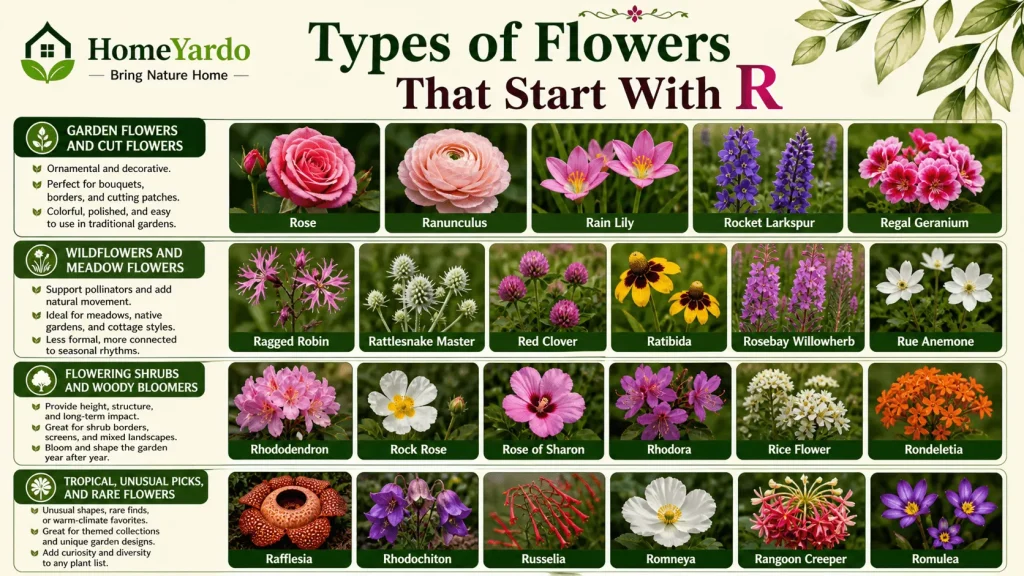
R flowers do not all belong to the same garden style. Some are grown for bouquets, some suit meadow planting, some carry the structure of shrubs, and some stand out mainly for novelty or dramatic form.
Garden Flowers And Cut Flowers
Rose, ranunculus, rain lily, rocket larkspur, and regal geranium belong in the more ornamental side of the list. These names are tied to bouquets, decorative beds, and planted displays where color and form matter first.
Most of them work best in borders, containers, or cutting patches where their flowers can be appreciated up close. They tend to feel polished, colorful, and easy to place in traditional garden designs.
Wildflowers And Meadow Flowers
Ragged Robin, rattlesnake master, red clover, ratibida, rosebay willowherb, and rue anemone lean toward a looser look. Their value often comes from pollinator support, movement, or naturalized planting.
These choices fit well in meadow edges, native gardens, and soft cottage-style layouts. They usually feel less formal than florist blooms and more connected to seasonal landscape rhythm.
Flowering Shrubs And Woody Bloomers
Rhododendron, rock rose, Rose of Sharon, rhodora, rice flower, and rondeletia bring height, structure, and longer-term garden presence. Their flowers matter, but so does the way they shape a planting over time.
These plants suit shrub borders, foundation beds, screens, and mixed landscapes. They help carry the frame of a garden while still adding bloom interest.
Tropical, Unusual Picks, And Rare Flowers That Beginning With R
Rafflesia, rhodochiton, Russelia, Romneya, Rangoon creeper, and Romulea bring a more unusual angle. Some are rare in ordinary home gardens, some prefer warm climates, and some stand out for shape or growth habit more than familiarity.
These names add variety and help the list feel more complete. They are especially useful for themed plant collections, unusual borders, or alphabet projects that go beyond the obvious.
Most Popular Flower Names Starting With R
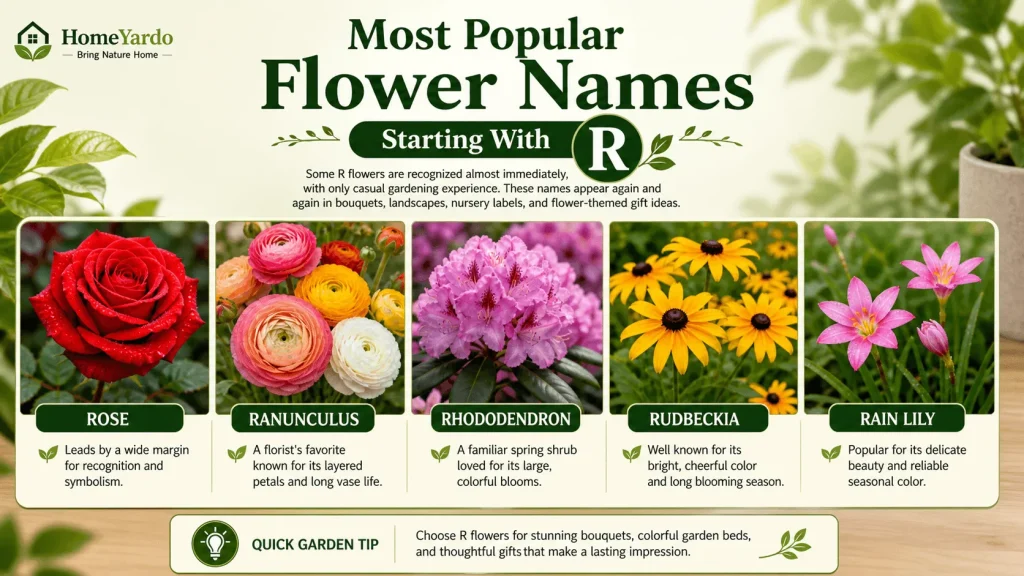
Some R flowers are recognized almost immediately, even by people with only casual gardening experience. These names appear again and again in bouquets, landscapes, nursery labels, and flower-themed gift ideas.
Rose leads by a wide margin for recognition and symbolism. Ranunculus is a florist’s favorite. Rhododendron remains a familiar spring shrub, while rudbeckia and rain lily are both well known for reliable seasonal color.
Full List Of Flowers That Starting With R
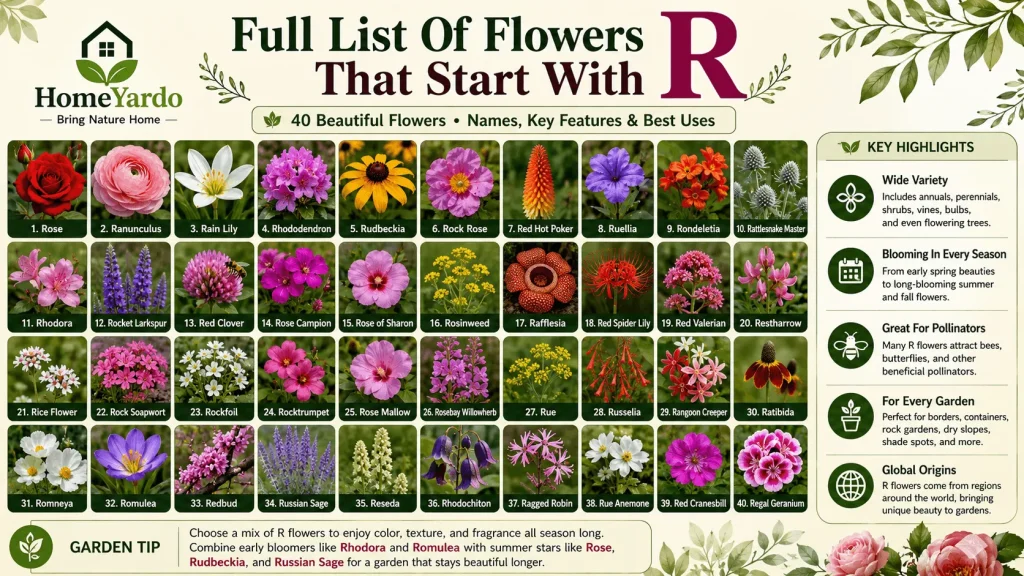
The full list below covers 40 names and gives each one a short, practical profile. The goal is not to turn every entry into a care manual, but to show what makes each flower worth knowing.
1. Rose
Rose is the most familiar flower in the R group, known for layered petals, fragrance, and a huge range of colors and forms. It works in cutting gardens, mixed borders, formal beds, and cottage-style planting.
Bloom: Late spring to fall | Best for: Bouquets and borders | Origin: Asia, Europe, North America
2. Ranunculus
Ranunculus produces densely layered blooms with a soft, almost paper-like finish. It is one of the strongest picks for spring arrangements and elegant seasonal color.
Bloom: Spring | Best for: Cut flowers and containers | Origin: Mediterranean, Southwest Asia
3. Rain Lily
Rain lily is a small bulb flower that often appears after rainfall or humid summer weather. Its delicate shape makes it especially appealing in containers, bulb pockets, and low borders.
Bloom: Summer to early fall | Best for: Containers and edging | Origin: Americas
4. Rhododendron
Rhododendron brings large clusters of flowers in spring and gives strong shrub presence at the same time. It suits woodland-edge gardens, acidic beds, and larger foundation plantings.
Bloom: Spring | Best for: Shrub borders | Origin: Asia, Europe, North America
5. Rudbeckia
Rudbeckia is known for bright daisy-like blooms in yellow, bronze, and orange tones. It performs well in pollinator gardens and gives dependable late-season color.
Bloom: Summer to fall | Best for: Pollinator beds | Origin: North America
6. Rock Rose
Rock rose is a sun-loving shrub with papery flowers and a natural fit for dry, bright spaces. It works best where heat, gravel, and lean soil are part of the setting.
Bloom: Late spring to summer | Best for: Dry borders and slopes | Origin: Mediterranean
7. Red Hot Poker
Red hot poker stands out for tall, torch-like spikes in orange, red, and yellow shades. It gives bold vertical impact and works well as a focal perennial.
Bloom: Summer to fall | Best for: Back borders | Origin: Africa
8. Ruellia
Ruellia carries trumpet-shaped flowers, most often in purple tones, and can bloom generously in warm conditions. It suits containers, moist beds, and warm-climate borders.
Bloom: Summer to fall | Best for: Warm gardens and pots | Origin: Central and South America
9. Rondeletia
Rondeletia is a flowering shrub with clustered blooms in warm red-orange tones. It adds color and a soft tropical feel where winters stay mild.
Bloom: Warm season | Best for: Mild-climate shrub borders | Origin: Caribbean
10. Rattlesnake Master
Rattlesnake master looks unusual from the start, with upright leaves and rounded flower heads that feel almost architectural. It belongs in native gardens, pollinator beds, and meadow-style planting.
Bloom: Summer | Best for: Native plantings | Origin: North America
11. Rhodora
Rhodora is a smaller flowering shrub with pink to lavender blooms that arrive early. It gives a soft woodland feel and fits cooler, moist, acidic settings.
Bloom: Mid to late spring | Best for: Woodland edges | Origin: North America
12. Rocket Larkspur
Rocket larkspur grows tall spires in purple, blue, pink, or white and adds height without heaviness. It is often grown for cutting gardens and cottage-style planting.
Bloom: Spring to early summer | Best for: Cutting patches | Origin: Mediterranean
13. Red Clover
Red clover forms rounded flower heads in pink-red shades and is closely tied to meadow planting and bee activity. It works well in relaxed landscapes and mixed flowering grass systems.
Bloom: Late spring to summer | Best for: Meadow planting | Origin: Europe, Western Asia
14. Rose Campion
Rose campion pairs silver foliage with vivid magenta blooms, which gives it striking contrast in sunny beds. It handles dry conditions well and blends naturally into cottage-style borders.
Bloom: Late spring to summer | Best for: Sunny mixed borders | Origin: Europe, Western Asia
15. Rose of Sharon
Rose of Sharon is a shrub with hibiscus-like flowers that arrive when many earlier shrubs are already finished. It works well in screens, hedge lines, and mixed shrub beds.
Bloom: Summer to early fall | Best for: Hedges and screening | Origin: East Asia
16. Rosinweed
Rosinweed is a prairie perennial with yellow blooms and upright growth. It feels most at home in native-style planting where strong stems and open space suit its habit.
Bloom: Summer | Best for: Prairie borders | Origin: North America
17. Rafflesia
Rafflesia is one of the most famous unusual flowers in the world because of its massive bloom size. It is not a practical home-garden choice, but it is one of the most memorable R flower names.
Bloom: Irregular, species dependent | Best for: Botanical interest | Origin: Southeast Asia
18. Red Spider Lily
Red spider lily has narrow, arching petal segments that create a dramatic starburst look. It blooms late and works beautifully in drifts, path edges, or bulb borders.
Bloom: Late summer to early fall | Best for: Seasonal drama | Origin: East Asia
19. Red Valerian
Red valerian produces airy clusters of small flowers over a fairly long season. It suits cottage gardens, dry banks, old walls, and informal planting schemes.
Bloom: Late spring to summer | Best for: Dry sites and cottage gardens | Origin: Mediterranean
20. Restharrow
Restharrow is a flowering subshrub with pink pea-like blooms and a somewhat wiry habit. It fits dry, open ground better than formal ornamental beds.
Bloom: Summer | Best for: Wild ground and dry banks | Origin: Europe, Western Asia
21. Rice Flower
Rice flower produces many small, clustered blooms that create a fine, airy texture. It is appreciated in mild climates and is often valued in floral work as well.
Bloom: Winter to spring or spring | Best for: Mild-climate gardens | Origin: Australia
22. Rock Soapwort
Rock soapwort is a spreading perennial with bright pink flowers that soften stone edges and sunny slopes. It is especially useful in rock gardens and low edging.
Bloom: Spring to early summer | Best for: Rock gardens | Origin: Europe
23. Rockfoil
Rockfoil includes a wide group of compact flowering plants in the Saxifraga line. Many suit alpine settings, troughs, and cool rock gardens where close viewing is possible.
Bloom: Spring to summer | Best for: Alpine planting | Origin: Europe, Asia, North America
24. Rocktrumpet
Rocktrumpet, often associated with mandevilla types, is a vine with bold trumpet blooms. It thrives where it can climb, spill, or frame a patio space in warm conditions.
Bloom: Warm season | Best for: Trellises and containers | Origin: Tropical Americas
25. Rose Mallow
Rose mallow is a large-flowered perennial hibiscus that loves warmth and moisture. It is especially effective in rain gardens and rich summer borders.
Bloom: Mid to late summer | Best for: Moist beds | Origin: North America
26. Rosebay Willowherb
Rosebay willowherb carries upright spikes of pink-purple flowers and has a natural, open habit. It belongs in wilder plantings more than formal borders.
Bloom: Summer | Best for: Naturalized spaces | Origin: Northern Hemisphere
27. Rue
Rue is better known as an herb, yet it carries small yellow flowers that still earn it a place in an R flower guide. It brings old-garden character and blue-green foliage to hot, dry beds.
Bloom: Summer | Best for: Herb gardens and dry beds | Origin: Mediterranean
28. Russelia
Russelia forms a fountain of fine stems with small tubular flowers, usually in coral-red tones. In warm climates, it shines in pots, on walls, and in cascading displays.
Bloom: Warm season, often extended | Best for: Hanging edges and containers | Origin: Mexico, Central America
29. Rangoon Creeper
Rangoon creeper is a tropical vine known for fragrant blooms that shift color as they mature. It creates a lush, climbing look on arches, fences, and warm garden walls.
Bloom: Warm season | Best for: Arbors and trellises | Origin: South and Southeast Asia
30. Ratibida
Ratibida, often linked with the common name Mexican hat, has a strong cone and drooping petals that give it a lively prairie look. It performs well in sunny native beds and pollinator plantings.
Bloom: Summer to fall | Best for: Prairie and pollinator gardens | Origin: North America
31. Romneya
Romneya, also called matilija poppy, produces very large white blooms with a striking central cluster. It gives a dramatic, almost wild character in dry warm regions.
Bloom: Late spring to summer | Best for: Dry bold plantings | Origin: California, Mexico
32. Romulea
Romulea is a corm-forming plant with crocus-like flowers in soft or bright shades. It is small enough for close-up use in pots, gravel gardens, and rock planting.
Bloom: Late winter to spring or spring | Best for: Pots and rock gardens | Origin: Africa, Mediterranean
33. Redbud
Redbud is a flowering tree whose blooms appear along bare branches in spring. It belongs here as a woody flowering plant rather than a standard bedding flower.
Bloom: Spring | Best for: Small flowering trees | Origin: North America, Europe, Asia
34. Russian Sage
Russian Sage offers airy lavender-blue flower spikes and aromatic foliage over a long summer period. It is a strong choice for hot sunny borders and dry planting schemes.
Bloom: Summer to fall | Best for: Hot dry borders | Origin: Central Asia
35. Reseda
Reseda, often linked with mignonette, is valued more for scent and charm than for large showy petals. It suits old-fashioned planting styles and mixed floral spaces.
Bloom: Spring to summer | Best for: Fragrance gardens | Origin: Mediterranean, North Africa
36. Rhodochiton
Rhodochiton is a vine with trailing purple-maroon blooms that hang with a delicate, lantern-like look. It is especially appealing where its stems can climb or spill freely.
Bloom: Summer to fall | Best for: Trellises and patio pots | Origin: Mexico
37. Ragged Robin
Ragged Robin has finely cut pink petals that give it a loose, airy appearance. It suits damp meadows, cottage-style planting, and softer naturalized edges.
Bloom: Late spring to summer | Best for: Damp meadow gardens | Origin: Europe, parts of Asia
38. Rue Anemone
Rue anemone is a small woodland flower with delicate white or pale pink blooms. It fits shady spring plantings where subtle beauty matters more than showy mass.
Bloom: Spring | Best for: Woodland gardens | Origin: Eastern North America
39. Red Cranesbill
Red cranesbill is a hardy geranium with bright magenta-pink flowers and a neat mounding form. It works well in edging, sunny banks, and mixed perennial planting.
Bloom: Late spring to summer | Best for: Borders and edging | Origin: Europe, Western Asia
40. Regal Geranium
Regal geranium is grown for large, showy flowers in vivid shades and a more refined patio look. It performs best in containers, sheltered spots, and mild climates.
Bloom: Spring to summer | Best for: Patio containers | Origin: Southern Africa
Common Flowers That Begin With R
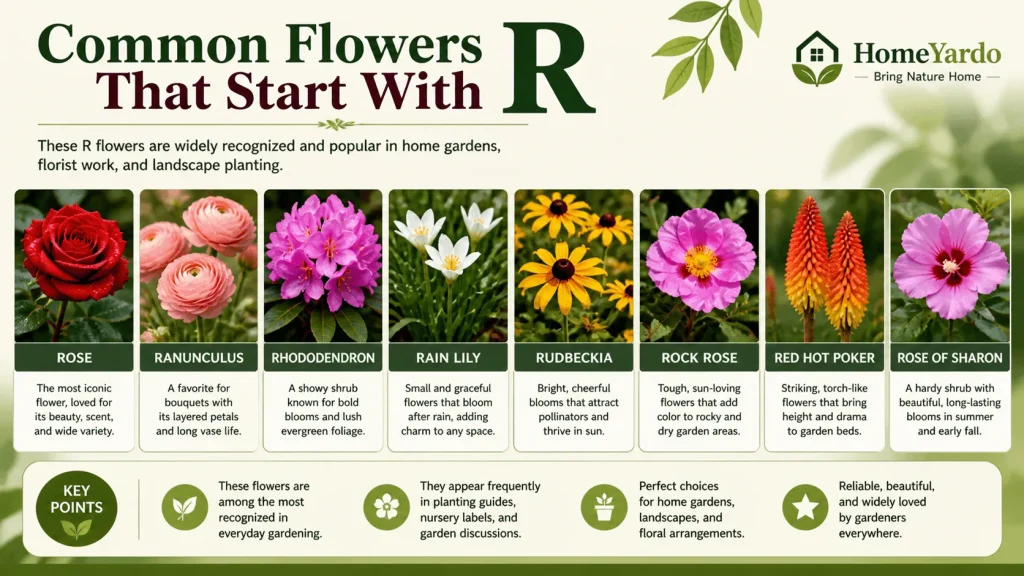
Some names in the R group appear far more often in home gardens, florist work, and familiar landscape planting. These are the flowers most likely to feel instantly recognizable even without a deep gardening background.
Rose sits at the top, followed by ranunculus for bouquet use and rhododendron for shrub borders. Rain lily, rudbeckia, rock rose, red hot poker, and Rose of Sharon also belong in the more familiar side of the list because they appear regularly in planting guides, nursery labels, and everyday garden discussions. For more familiar garden staples, continue with flowers that start with L.
Purple Flowers That Start With R
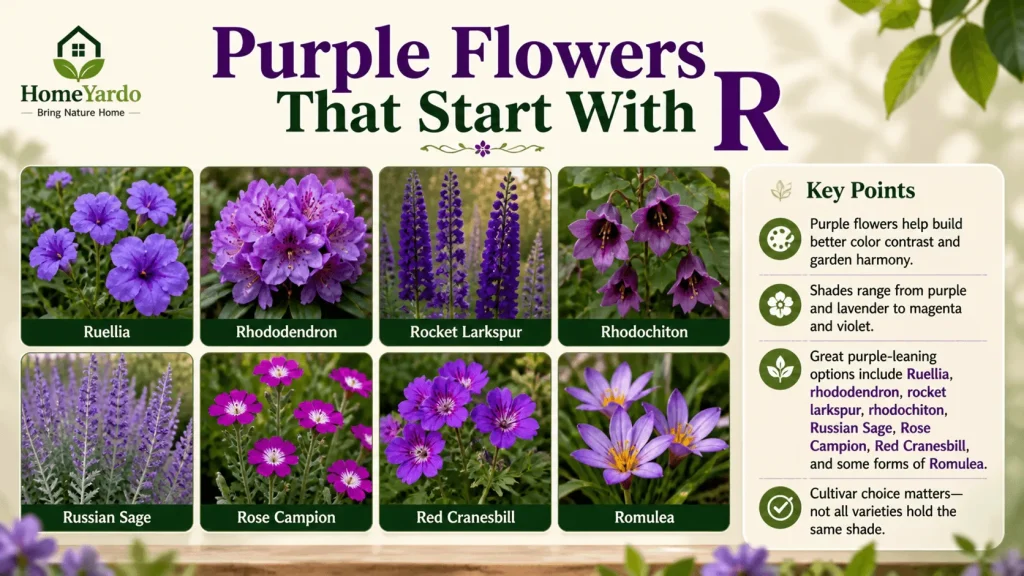
Purple flowers bring a useful color filter because garden plans are often built around tone and contrast as much as bloom shape. Some flowers in this group range from true purple to lavender, magenta, or violet tones, depending on the variety.
Good purple-leaning options include Ruellia, rhododendron, rocket larkspur, rhodochiton, Russian Sage, Rose Campion, Red Cranesbill, and some forms of Romulea. For tighter color matching, cultivar choice matters, since not every plant in the group holds a single shade across all varieties. For another color-rich alphabetical list, explore flowers that start with P next.
Perennials That Start With R
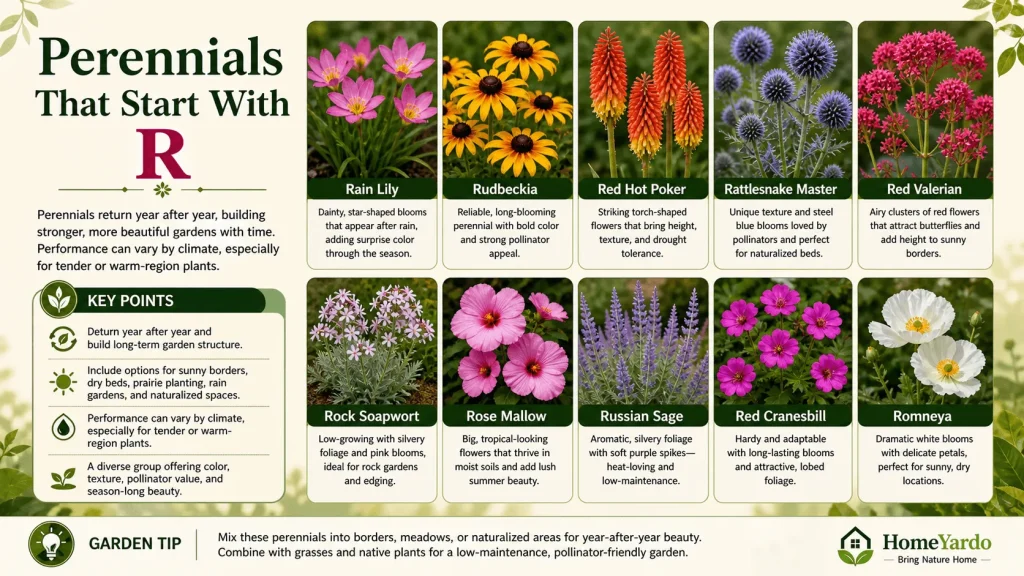
Perennials are often the most practical part of an alphabetical flower list because they return over more than one season and help shape longer-term garden structure. Perennial behavior can shift by climate, especially for tender or warm-region plants.
Strong perennial choices include Rain Lily, Rudbeckia, Red Hot Poker, Rattlesnake Master, Red Valerian, Rock Soapwort, Rose Mallow, Russian Sage, Red Cranesbill, and Romneya. Together, they cover sunny borders, dry beds, prairie planting, rain gardens, and naturalized spaces.
Annual Flowers That Start With R
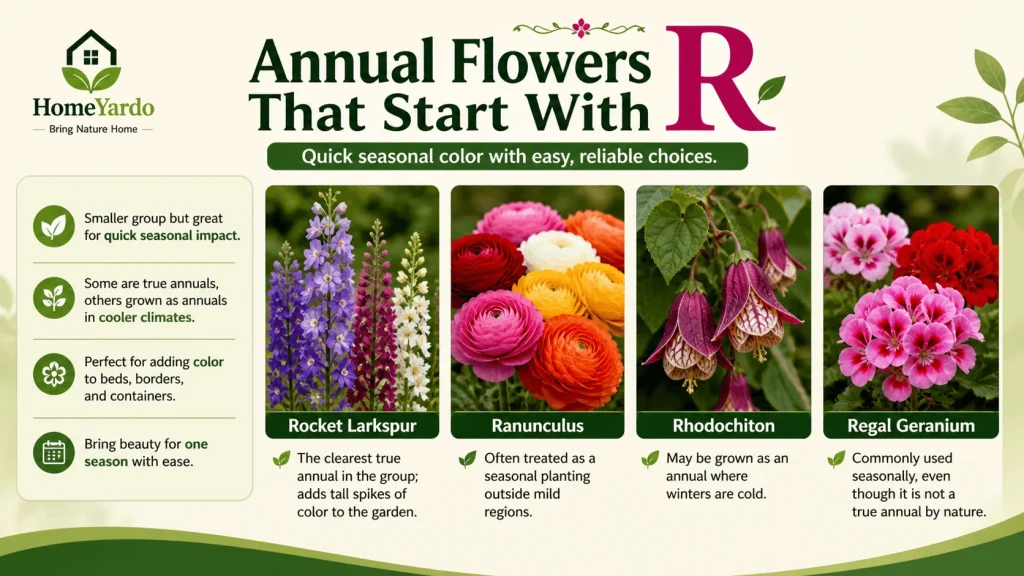
The annual side of the R group is smaller, but it still offers some useful options for quick seasonal color. A few plants here are true annuals, while others are often grown as annuals in cooler climates.
Rocket larkspur is the clearest true annual in the group. Ranunculus is often treated as a seasonal planting outside mild regions. Rhodochiton may be grown as an annual where winters are cold, and regal geranium is commonly used seasonally, even though it is not a true annual by nature. f quick seasonal color is the main goal, flowers that start with M are another useful list to check.
Meaning And Symbolism Of Flowers With R
Symbolism adds another layer to flower names, especially in gifts, event themes, and color-based arrangements. Even so, meanings shift by culture, tradition, and flower color, so they are best treated as broad associations rather than fixed rules.
Rose carries the strongest symbolic weight in the group and is often tied to love, admiration, friendship, remembrance, or devotion, depending on color. Ranunculus is often linked with charm and attraction. Red clover is sometimes associated with luck or abundance. Rhododendron has been linked with beauty, reserve, and caution in different traditions.
How To Choose The Right R Flower
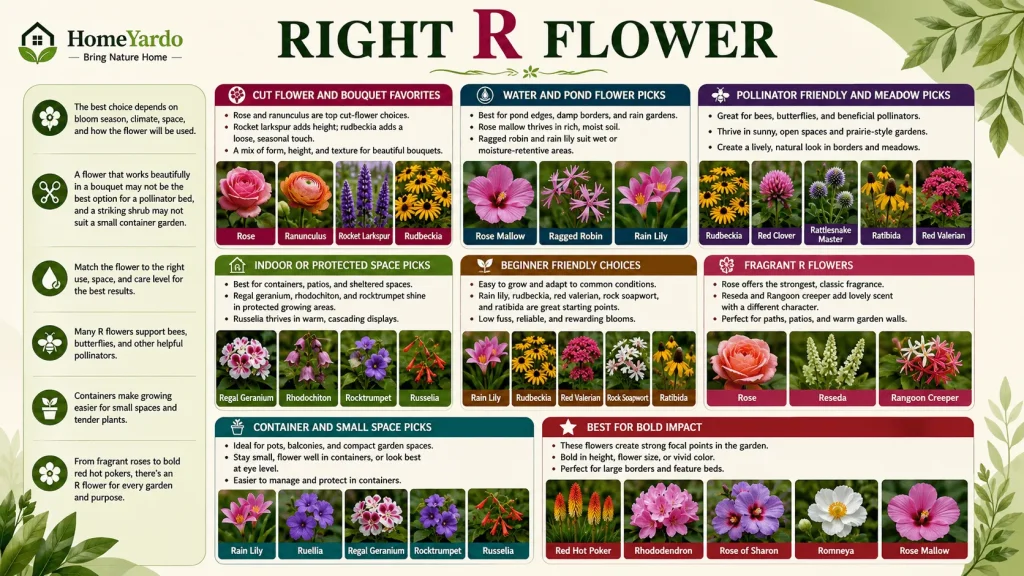
The best choice depends on bloom season, climate, space, and how the flower will be used. A flower that works beautifully in a bouquet may not be the best option for a pollinator bed, and a striking shrub may not suit a small container garden.
Cut Flower And Bouquet Favorites
Rose and ranunculus are the strongest cut-flower choices because both offer form, color range, and arrangement appeal. Rocket larkspur adds height, while rudbeckia brings a looser seasonal look to mixed stems.
A cutting patch built around rose, ranunculus, and rocket larkspur gives variety without looking forced. That combination covers rounded blooms, upright spires, and a softer field-style finish.
Water And Pond Flower Picks
True water flowers are limited in the R group, so the best choices lean more toward pond edges, damp borders, and rain-garden planting than open-water display. Rose mallow is the clearest fit because it handles moisture well and gives large summer flowers where the soil stays rich and damp. Ragged robin also suits softer wet-ground planting, while rain lily can work near watered edges or moisture-retentive pockets without being treated as a true aquatic flower.
Pollinator Friendly And Meadow Picks
Rudbeckia, red clover, rattlesnake master, ratibida, and red valerian all work well where bee and butterfly activity matters. Their flower shapes and seasonal rhythm fit open sunny planting better than formal clipped beds.
Together, they create a bed that feels lively rather than stiff. They also suit prairie-style layouts, native gardens, and mixed pollinator borders with a more natural look.
Indoor Or Protected Space Picks
Most R flowers are better outdoors, but a few suit containers, sheltered patios, or protected growing more than open-ground planting. Regal geranium is one of the strongest choices for this role because it performs well in patio containers and mild, sheltered spots. Rhodochiton and rocktrumpet also fit protected spaces well, where their stems can climb or spill freely, while Russelia works best in warm containers or cascading displays.
Beginner Friendly Choices
Rain lily, rudbeckia, red valerian, rock soapwort, and ratibida are some of the easiest starting points in the R group. They are simpler to place than rarer tropical vines, unusual shrubs, or specialty bloomers, and they match ordinary garden conditions more easily.
For a beginner-friendly mix, rain lily works well in pots or small borders, rudbeckia gives dependable color, and red valerian or rock soapwort can handle sunnier, drier spaces without feeling fussy.
Fragrant R Flowers
Rose is the strongest fragrance flower in the R group because it combines scent with wide garden use and strong recognition. Reseda is another good choice when fragrance matters more than flower size, while Rangoon creeper adds a warmer-scented vine effect in suitable climates. Some roses are far more fragrant than others, so variety still matters.
A scented planting built around rose, reseda, and Rangoon creeper gives variety without feeling repetitive. That combination covers classic shrub fragrance, softer old-style perfume, and climbing scent for paths, patios, and warm walls.
Container And Small Space Picks
Rain lily, Ruellia, regal geranium, rocktrumpet, and Russelia are practical choices for pots and compact planting zones. They either stay small, flower well in containers, or show best when placed closer to eye level.
Containers also make climate-sensitive plants easier to manage. That is especially helpful for tender species or vines that need seasonal protection and a more controlled setting.
Best For Bold Impact
Red hot poker, rhododendron, Rose of Sharon, Romneya, and rose mallow all create a stronger visual statement than smaller edging flowers. Some do it through height, some through flower size, and some through vivid bloom color.
These are the names to consider when a planting needs a focal point rather than background support. They suit larger borders, feature beds, and areas where shape and scale matter as much as color.
Plants Vs Flowers That Start With R
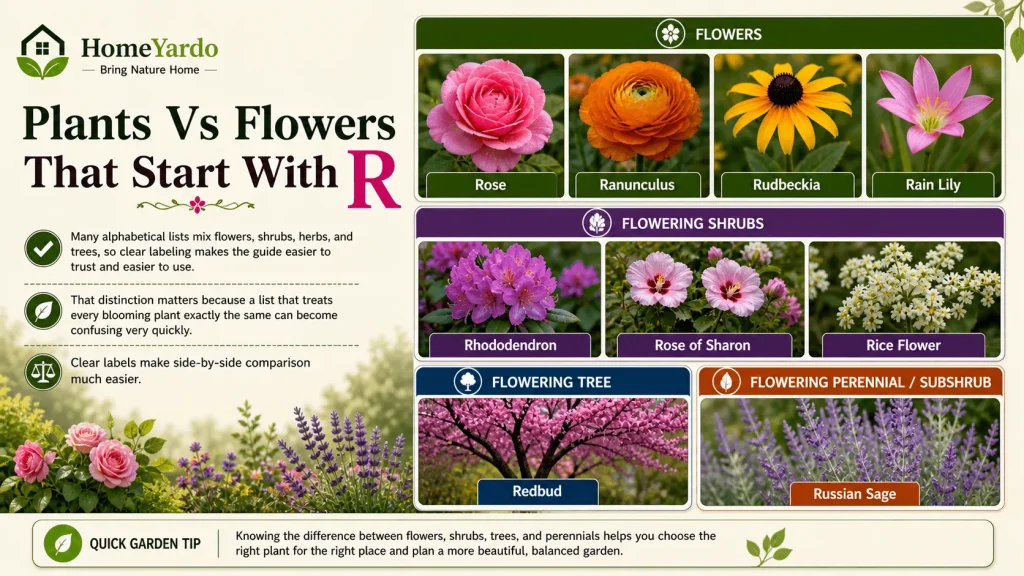
Many alphabetical lists mix flowers, shrubs, herbs, and trees, so clear labeling makes the guide easier to trust and easier to use. That distinction matters because a list that treats every blooming plant exactly the same can become confusing very quickly.
Rose, ranunculus, rudbeckia, and rain lily fit comfortably into a classic flower list. Rhododendron, Rose of Sharon, and rice flower are flowering shrubs. Redbud is a flowering tree. Russian Sage behaves like a flowering border plant, yet it is often discussed in a broader perennial or subshrub context. Clear labels make side-by-side comparison much easier.
Conclusion
Flower names that start with R cover much more than roses alone. The group includes cut flowers, meadow plants, shrubs, vines, bulbs, herbs, and bold landscape bloomers, which gives it far more range than many single-letter flower lists.
A classic border may lean toward rose, ranunculus, or rudbeckia. A warm, dry bed may suit rock rose or Russian Sage. A pollinator-focused planting may call for rattlesnake master, ratibida, or red clover. The right choice depends less on the letter and more on color, bloom timing, climate fit, and the role a flower needs to play.
FAQ’s
Common R flower names include Rose, Ranunculus, Rain Lily, Rhododendron, Rudbeckia, and Rock Rose. These names appear often in gardens, florist work, and everyday plant lists. They are also among the easiest R flowers to recognize without specialist knowledge.
Rose is the most popular flower that starts with R. It stands out for symbolism, fragrance, color range, and strong use in bouquets, garden borders, and events. No other R flower carries the same level of cultural recognition.
Yes, several flowers in the R group bloom in purple or purple-leaning shades. Ruellia, rocket larkspur, rhodochiton, Russian Sage, and some rhododendron varieties are good examples. Color depth can still vary by cultivar and growing conditions.
Yes, many R flowers are perennials. Rudbeckia, Rain Lily, Red Hot Poker, Red Valerian, Rose Mallow, and Russian Sage are all useful perennial examples. They cover a wide range of planting styles, from dry borders to rain gardens.
Yes, although the list is smaller than the perennial group. Rocket larkspur is a strong annual example, while ranunculus or rhodochiton may be grown seasonally in places with colder winters. Some tender plants are treated as annuals outside mild climates.
Rhododendron is a flowering shrub. It still shows up in many flower lists because its blooms are showy, familiar, and strongly tied to ornamental planting. In a practical gardening sense, most people recognize it first through its flowers.
Rose of Sharon is a flowering shrub rather than a standard border flower. It earns a place in alphabetical flower lists because the blooms are large, colorful, and widely recognized. It is especially valued for flowering later in the season.
Rafflesia is the best-known answer. It is famous for producing one of the largest individual flowers in the world. Even though it is not a common garden plant, it remains one of the most striking names in the R group.
Rose and ranunculus are the strongest bouquet choices, with rocket larkspur adding height and rudbeckia adding a looser field-garden look. Together, they can create arrangements that feel balanced rather than overly formal. Color choice shapes the mood even more.
Rudbeckia, red clover, rattlesnake master, ratibida, and red valerian are all good pollinator choices. They work well in sunny borders, meadow beds, and native-style plantings. Their flowers support movement and seasonal activity in a garden setting.
Yes, several unusual names appear in the R group. Rafflesia, Romneya, Rhodochiton, and Romulea are all less familiar than roses or rudbeckia. They help broaden the list and add botanical variety beyond the most common garden choices.
Alphabet lists often group all blooming plants together under one letter. That means shrubs, vines, herbs, and even flowering trees may appear beside standard flowers. Clear labeling helps separate what is a true border flower from a broader blooming plant.
References