42 Beautiful Variety Of Flowers That Start With I You Didn’t Know About
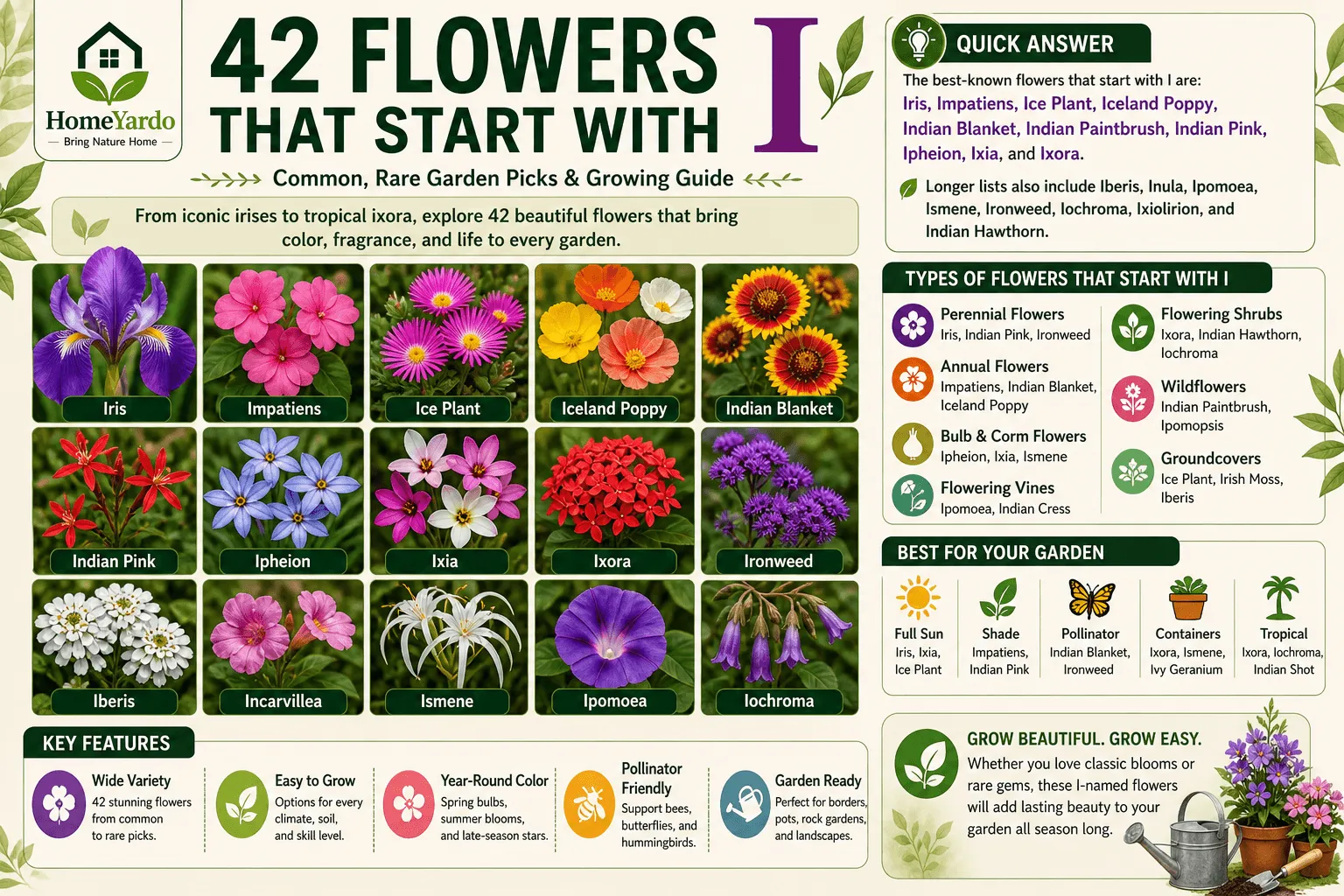
Flowers starting with I include some of the most familiar garden blooms and several botanical names that appear in larger plant lists. Iris is the strongest name in the group, but the list also includes impatiens, ice plant, Iceland poppy, Indian blanket, Indian pink, ipheion, ixia, ixora, ironweed, and many less common flowering plants.
A useful guide should not only collect names. It should also explain which plants suit shade, full sun, containers, pollinator beds, dry soil, borders, and warm climates.
Some entries below are true flower names. Others are flowering shrubs, vines, bulbs, wildflowers, or broader ornamental plants that are often included in alphabetical flower lists. Each one is labeled clearly, so the list stays easy to use. Each one is labeled clearly, so the list stays easy to use. For nearby alphabetical flower guides, see flowers that start with H for more garden names from the previous letter.
Quick Answer: What Are Flowers That Start With I?
The best-known flower names starting with I are iris, impatiens, ice plant, Iceland poppy, Indian blanket, Indian paintbrush, Indian pink, ipheion, ixia, and ixora.
Longer lists may also include Iberis, Inula, Ipomoea, Ismene, Ironweed, Iochroma, Ixiolirion, and Indian Hawthorn. Iris is usually the strongest single answer because it is widely grown, easy to recognize, and available in many colors. The next letter guide, flowers that start with J, can help compare shorter alphabetical flower lists.
I Named Flowers: At A Glance Table
The table below gives a quick view of useful plants I named, including common garden plants, bulbs, vines, flowering shrubs, and warm climate choices.
| Flower Name | Botanical Name | Type | Main Colors | Bloom Season | Light Need | Annual or short-lived perennial |
|---|---|---|---|---|---|---|
| Iris | Iris spp. | Perennial | Purple, blue, white, yellow | Spring to early summer | Full sun to part sun | Borders, cut flowers |
| Impatiens | Impatiens spp. | Annual or tender perennial | Pink, red, white, orange | Spring to frost | Part shade to shade | Shade beds, containers |
| Ice Plant | Delosperma spp. | Succulent perennial | Pink, purple, yellow | Late spring to summer | Full sun | Dry beds, rock gardens |
| Iceland Poppy | Papaver nudicaule | Annual or short lived perennial | Orange, yellow, pink, white | Spring to early summer | Full sun | Cool season color |
| Indian Blanket | Gaillardia pulchella | Annual or short-lived perennial | Red, yellow, orange | Summer to fall | Full sun | Pollinator beds |
| Indian Pink | Spigelia marilandica | Perennial | Red, yellow | Late spring to summer | Part shade | Woodland edges |
| Ironweed | Vernonia spp. | Perennial | Purple, violet | Late summer to fall | Full sun | Pollinator planting |
| Ipheion | Ipheion uniflorum | Bulbous perennial | Blue, white | Spring | Sun to part shade | Edging, naturalizing |
| Ixia | Ixia spp. | A flowering plant | Pink, purple, white, yellow | Spring to summer | Full sun | Pots, sunny borders |
| Ixora | Ixora coccinea | Flowering shrub | Red, pink, orange, yellow | Warm season or year-round in the tropics | Full sun to bright light | Tropical gardens |
| Iberis | Iberis sempervirens | Perennial | White, pink | Spring | Full sun | Edging, rock gardens |
| Incarvillea | Incarvillea delavayi | Perennial | Pink, rose | Late spring to summer | Sun to part shade | Cottage borders |
| Ismene | Ismene spp. | Bulbous plant | White | Summer | Bright light | Fragrant containers |
| Ipomoea | Ipomoea spp. | Flowering vine | Blue, purple, pink, white | Summer to fall | Full sun | Trellises, arches |
| Iochroma | Iochroma spp. | Flowering shrub | Purple, blue, red | Warm season | Bright sun to part sun | Patio containers |
Before The Full List: How This Guide Counts I Flowers
Different flower lists count the letter I in different ways. A short list may include only familiar common names such as iris, impatiens, and ice plant. A broader list may include botanical names, flowering shrubs, vines, bulbs, native wildflowers, tropical plants, and ornamentals.
That is why one list may show 10 flowers while another may show far more. The list below keeps the count focused at 42 names and labels broader flowering plants clearly, instead of adding every possible cultivar or color form.
Full List Of Flowers That Start With I
The list below combines common flower names, botanical entries, flowering shrubs, vines, bulbs, wildflowers, and broader ornamental plants that are often included in flower collections.
- Iris
- Impatiens
- Ice Plant
- Iceland Poppy
- Indian Blanket
- Indian Paintbrush
- Indian Pink
- Indian Cress
- Indian Shot
- Indian Mallow
- Indian Senna
- Indian Pipe
- Indian Hawthorn
- Indian Rhododendron
- Indian Tobacco
- Indian Lily
- Irish Moss
- Italian Aster
- Italian Bugloss
- Italian Jasmine
- Ivy Geranium
- Immortelle
- Ironweed
- Inkberry Holly
- Iberis
- Illicium
- Incarvillea
- Indigofera
- Inula
- Ipheion
- Ipomoea
- Ipomopsis
- Iresine
- Itea
- Ilex
- Ixia
- Ixora
- Ismene
- Isotoma
- Iochroma
- Ixiolirion
- Inga
Some broader pages may also include names such as Inca Lily, Impala Lily, Inside Out Flower, Ivy-Leafed Toadflax, Italian Arum, and Indonesian Wax Ginger. Those can be useful in wider plant lists, but the 42 names above keep the guide focused and easier to sort.
Complete I Named Flower Table With Botanical Names
A full table makes the list easier to scan by plant type, color, bloom period, light needs, and garden use. Bloom time and hardiness can change by species, cultivar, and local climate.
| Flower Name | Botanical Name | Type | Main Colors | Bloom Season | Light | Best Garden Use | Notes |
|---|---|---|---|---|---|---|---|
| Iris | Iris spp. | Perennial | Purple, blue, white, yellow | Spring to early summer | Full sun to part sun | Borders, cut flowers | Good drainage helps many types |
| Impatiens | Impatiens spp. | Annual or tender perennial | Pink, red, white, orange | Spring to frost | Part shade to shade | Shade beds, pots | Strong bedding flower for low light |
| Ice Plant | Delosperma spp. | Succulent perennial | Pink, purple, yellow | Late spring to summer | Full sun | Rock gardens, dry beds | Needs sharp drainage |
| Iceland Poppy | Papaver nudicaule | Annual or short-lived perennial | Orange, yellow, white, pink | Spring to early summer | Full sun | Cool season displays | Best in cooler conditions |
| Indian Blanket | Gaillardia pulchella | Annual or short lived perennial | Red, orange, yellow | Summer to fall | Full sun | Pollinator beds | Handles heat well once settled |
| Indian Paintbrush | Castilleja spp. | Wildflower | Red, orange, yellow | Spring to summer | Full sun | Naturalized planting | Known for colorful bracts |
| Indian Pink | Spigelia marilandica | Perennial | Red, yellow | Late spring to summer | Part shade | Woodland borders | Good hummingbird plant |
| Indian Cress | Tropaeolum majus | Annual vine or trailing plant | Orange, yellow, red | Summer to fall | Sun to part sun | Containers, edible gardens | Often known as nasturtium |
| Indian Shot | Canna indica | Tender perennial | Red, orange, yellow | Summer to fall | Full sun | Tropical beds | Bold leaves and bright flowers |
| Indian Mallow | Abutilon indicum | Shrub | Yellow | Warm season | Sun to part sun | Warm climate planting | Better for mild climates |
| Indian Senna | Senna auriculata | Flowering shrub | Yellow | Warm season | Full sun | Dry warm gardens | Shrubby habit |
| Indian Pipe | Monotropa uniflora | Woodland wildflower | White | Summer | Shade | Woodland interest | Not a standard garden plant |
| Indian Hawthorn | Rhaphiolepis indica | Flowering shrub | White, pink | Spring | Full sun to part sun | Foundation planting | Evergreen in mild climates |
| Indian Rhododendron | Rhododendron arboreum | Flowering shrub or tree | Red, pink | Spring | Part shade | Woodland gardens | Needs suitable acidic soil |
| Indian Tobacco | Lobelia inflata | Annual or biennial | Pale blue, violet, white | Summer | Sun to part shade | Wildflower interest | Not grown as a common bedding plant |
| Indian Lily | Lilium polyphyllum | Bulbous plant | White, pale tones | Summer | Part sun | Specialty bulb planting | Less common in ordinary gardens |
| Irish Moss | Sagina subulata | Groundcover perennial | White | Spring to summer | Sun to part shade | Path edges, rock gardens | Tiny star-like flowers |
| Italian Aster | Aster amellus | Perennial | Purple, lavender, blue | Late summer to fall | Full sun | Borders, late color | Useful late-season daisy flower |
| Italian Bugloss | Anchusa azurea | Perennial | Blue | Late spring to summer | Full sun | Cottage gardens | Tall blue flower spikes |
| Italian Jasmine | Jasminum humile | Shrub | Yellow | Spring to summer | Full sun to part sun | Warm borders | Semi-evergreen in mild areas |
| Ivy Geranium | Pelargonium peltatum | Tender perennial | Pink, red, white, lavender | Spring to fall | Sun to part sun | Hanging baskets | Good trailing container plant |
| Immortelle | Helichrysum italicum | Perennial subshrub | Yellow | Summer | Full sun | Dry gardens, herb beds | Aromatic foliage |
| Ironweed | Vernonia spp. | Perennial | Purple | Late summer to fall | Full sun | Pollinator gardens | Tall native style flower |
| Inkberry Holly | Ilex glabra | Flowering shrub | White | Spring | Sun to part shade | Hedges, wildlife gardens | Flowers are small but useful |
| Iberis | Iberis sempervirens | Perennial | White, pink | Spring | Full sun | Edging, rock gardens | Also called candytuft |
| Illicium | Illicium spp. | Flowering shrub | White, yellow, red, maroon | Spring | Part shade | Woodland shrub borders | Choose species carefully |
| Incarvillea | Incarvillea delavayi | Perennial | Pink, rose | Late spring to summer | Sun to part shade | Cottage borders | Trumpet shaped blooms |
| Indigofera | Indigofera spp. | Shrub or perennial | Pink, purple | Summer | Full sun | Shrub borders | Some species have pea like flowers |
| Inula | Inula spp. | Perennial | Yellow | Summer | Full sun | Natural borders | Daisy like flowers |
| Ipheion | Ipheion uniflorum | Bulbous perennial | Blue, white | Spring | Sun to part shade | Edging, lawns, pots | Also called spring starflower |
| Ipomoea | Ipomoea spp. | Flowering vine | Blue, purple, pink, white | Summer to fall | Full sun | Trellises, fences | Includes morning glory types |
| Ipomopsis | Ipomopsis spp. | Biennial or perennial | Red, pink, orange | Summer | Full sun | Wildflower beds | Good for natural style planting |
| Iresine | Iresine herbstii | Foliage plant | Small pale flowers | Warm season | Bright light | Containers, foliage displays | Grown more for leaves than flowers |
| Itea | Itea virginica | Flowering shrub | White | Late spring to summer | Sun to part shade | Native style borders | Fragrant flower racemes |
| Ilex | Ilex spp. | Flowering shrub or tree | White, greenish white | Spring | Sun to part shade | Hedges, wildlife planting | Flowers are small |
| Ixia | Ixia spp. | A flowering plant | Pink, purple, white, yellow | Spring to summer | Full sun | Pots, sunny beds | Star-shaped blooms |
| Ixora | Ixora coccinea | Flowering shrub | Red, pink, orange, yellow | Warm season | Bright sun | Tropical color | Best in warm climates |
| Ismene | Ismene spp. | Bulbous plant | White | Summer | Bright light | Containers | Fragrant spider-like flowers |
| Isotoma | Isotoma axillaris | Tender perennial | Blue, lavender, white | Summer | Sun to part sun | Pots, edging | Fine-textured flowers |
| Iochroma | Iochroma spp. | Flowering shrub | Purple, blue, red | Warm season | Sun to part sun | Large containers | Tubular flowers |
| Ixiolirion | Ixiolirion tataricum | Bulbous plant | Blue, violet | Spring to summer | Full sun | Specialty bulb beds | Less common garden bulb |
| Inga | Inga spp. | Flowering tree | White | Warm season | Full sun | Tropical landscapes | Fluffy flower clusters |
Types Of Flowers That Start With I

It includes several plant types, not just classic bedding flowers. Some are annuals, some are perennials, and others grow as bulbs, corms, vines, shrubs, wildflowers, or groundcovers.
| Borders, pollinator beds, long-term planting | I Flower Examples | Best Use |
|---|---|---|
| Perennial flowers | Iris, Indian Pink, Ironweed, Iberis | Borders, pollinator beds, long term planting |
| Annual flowers | Impatiens, Indian Blanket, Iceland Poppy | Seasonal color, pots, bedding displays |
| Bulb and corm flowers | Ipheion, Ixia, Ismene, Ixiolirion | Spring color, containers, specialty beds |
| Flowering shrubs | Ixora, Iochroma, Indian Hawthorn, Itea | Warm gardens, hedges, patio containers |
| Flowering vines | Ipomoea, Indian Cress | Trellises, arches, hanging baskets |
| Wildflowers | Indian Paintbrush, Indian Pipe, Ipomopsis | Natural planting and pollinator areas |
| Groundcovers | Ice Plant, Irish Moss, Iberis | Edging, rock gardens, dry slopes |
For more perennial, annual, and garden-friendly names, explore flowers that start with P.
Plants Vs Flowers That Start With I

Not every name in an I list belongs to the same category. Iris, Impatiens, Ice Plant, Iceland Poppy, Indian Blanket, Indian Pink, Ixia, and Ixora are flower-centered names that fit the topic naturally.
Broader entries such as Ilex, Illicium, Itea, Indian Hawthorn, Inkberry Holly, and Inga are flowering plants, shrubs, or trees. They bloom, but many gardeners think of them as landscape plants rather than classic flowers.
| True Flower Names | Broader Flowering Plants |
|---|---|
| Iris | Ilex |
| Impatiens | Illicium |
| Iceland Poppy | Itea |
| Indian Blanket | Indian Hawthorn |
| Indian Pink | Inkberry Holly |
| Ixia | Inga |
| Ipheion | Indian Rhododendron |
| Ismene | Italian Jasmine |
A clear split helps avoid confusion. A garden flower list can stay practical while still including useful, broader flowering plants for people building larger plant lists. For another list that includes shrubs, vines, and classic garden flowers, visit flowers that start with S.
Common Flowers That Start With I

The names below are the strongest starting point because they are easier to recognize, easier to place in a garden, and more likely to appear in nurseries, seed catalogs, or planting guides.
Iris
Iris is one of the most recognizable I flowers. It comes in many forms, including bearded iris, Siberian iris, Japanese iris, and Dutch iris. Many types prefer full sun, though moisture and drainage needs vary by group.
Impatiens
Impatiens is a dependable flower for shade and part shade. It works well in containers, bedding displays, and porch planters where many sun-loving flowers struggle.
Ice Plant
Ice plant is a low-growing succulent-style flower for hot, sunny, dry sites. It suits rock gardens, gravel beds, edges, and slopes where drainage is strong.
Iceland Poppy
Iceland poppy brings soft, papery blooms in orange, yellow, white, pink, and peach tones. It performs best in cooler seasons and gives borders a lighter, airy look.
Indian Blanket
Indian blanket has warm red, orange, and yellow daisy-like flowers. It is a strong choice for pollinator-friendly planting, sunny borders, and meadow-style beds.
Indian Paintbrush
Indian paintbrush is known for vividly colored bracts that look like flame-shaped blooms. It has a wildflower character and suits naturalized planting more than formal bedding.
Indian Pink
Indian pink has red tubular flowers with yellow centers. It is a strong part-shade perennial and can attract hummingbirds when placed in woodland edges or rich border soil.
Ipheion
Ipheion, often called spring starflower, produces small star-shaped flowers in blue, white, or pale tones. It works well near paths, under open shrubs, or in spring containers.
Ixia
Ixia produces star-shaped flowers on upright stems. It suits sunny borders and pots where the flowers can be seen clearly and protected from heavy, wet soil.
Ixora
Ixora is a flowering shrub with dense clusters of red, orange, pink, or yellow blooms. It is best for warm climates, tropical gardens, patios, and bright containers.
Ironweed
Ironweed brings tall purple flowers late in the season. It suits pollinator gardens, native style beds, and meadow plantings where height and late color are welcome. Many familiar garden names also appear in flowers that start with C.
Botanical And Less Common I Flower Names

After the familiar names, the letter I includes several botanical or less common flower names that are useful in fuller plant lists. These names may appear in plant catalogs, botanical gardens, native plant guides, or specialty bulb collections.
- Iberis is often known as candytuft. It forms low mounds of white spring flowers and suits edging, rock gardens, and sunny borders.
- Incarvillea has trumpet-shaped pink flowers and a soft cottage garden look. It is less common than Iris or Impatiens, but still useful in mixed borders.
- Inula produces yellow daisy-like flowers. It fits looser, natural style planting rather than tight formal beds.
- Ismene is a bulbous plant with white, spider-like flowers. It is often grown in pots where drainage and warmth are easier to manage.
- Ipomoea includes morning glory-type vines. It adds vertical color to trellises, fences, arches, and screens.
- Indigofera includes shrubs and perennials with pea-like flowers. Many types bring pink or purple flower clusters and a softer shrub border look.
- Iochroma has hanging tubular flowers, often in purple or blue. It is best for warm, sheltered gardens or large containers.
- Isotoma has fine-textured blue, lavender, or white flowers. It works well in pots, edges, and small planting pockets.
- Ixiolirion is a less common bulb with blue violet flowers. It gives a specialty plant feel to sunny bulb beds.
- Ipomopsis adds a wildflower note with slender stems and bright flowers. It works best where a natural, pollinator-friendly look is preferred.
Rare Flowers That Start With I

Some flowers that start with I stand out because of their shape, growth habit, limited availability, or special site needs. These plants are better treated as specialty choices rather than everyday bedding flowers.
- Iochroma
Iochroma has hanging tubular flowers with a bold tropical look. It works best on warm patios, in sheltered borders, or in frost-free garden areas where it has protection from cold winds. - Ismene
Ismene is known for fragrant white flowers with a spider-like shape. It is a good choice for containers, especially when the soil drains well, and the plant can be moved or protected in cooler weather. - Ixiolirion
Ixiolirion is a less common bulb with blue-violet flowers. It fits well in specialty bulb beds, rock gardens, or sunny spaces where smaller seasonal flowers can be noticed. - Incarvillea
Incarvillea has trumpet-shaped blooms and a soft cottage garden style. It works well in mixed borders, especially where the soil drains freely, and the plant is not crowded. - Indian Pipe
Indian Pipe is unusual because of its pale, almost ghost-like appearance. It is a woodland plant and is better appreciated in natural settings rather than treated as a normal garden flower. - Ipomopsis
Ipomopsis has a wildflower habit and strong pollinator value. It suits natural-style planting, meadow edges, and informal garden spaces with good sunlight.
Rare does not always mean hard to grow. In many cases, it simply means the plant needs careful sourcing, the right climate, or a more specific place in the garden.
Purple Flowers That Start With I

Purple is one of the strongest color themes in the I flower group. Iris leads naturally, but several other choices can bring violet, lavender, blue, purple, or deep purple tones.
| Flower | Purple Shade | Type | Best Use | Note |
|---|---|---|---|---|
| Iris | Violet, lavender, blue, purple, deep purple | Perennial | Borders, cut flowers | Color depends on the variety |
| Ironweed | Deep violet purple | Perennial | Pollinator gardens | Strong late-season color |
| Indigofera | Pink, purple to violet tones | Shrub or perennial | Shrub borders | Flower color varies by species |
| Iochroma | Purple, blue purple | Flowering shrub | Warm patios | Best in mild climates |
| Ipheion | Pale blue purple | Bulbous perennial | Edging, spring pots | Small star-shaped flowers |
| Ixia | Purple, magenta, lavender | A flowering plant | Sunny pots and beds | Needs drainage |
| Italian Aster | Lavender, blue, purple | Perennial | Late borders | Useful when summer flowers fade |
Purple shades can shift by cultivar, soil, light, and flower age. Choose named varieties when exact color matters.
Perennial And Annual Flowers That Start With I

Flower lifespan helps decide where each plant fits in a garden. Some I flowers return year after year when the climate and soil suit them. Others are better used for seasonal color in beds, containers, borders, or hanging baskets.
Perennials That Start With I
- Iris is one of the best-known perennial flowers that start with I. It is grown in borders and cut flower gardens, but the right type should be matched to the site. Some irises prefer moist soil, while others need better drainage.
- Iberis, also called candytuft, is often used along edges, paths, and rock gardens. In mild climates, it may stay evergreen and give the garden a neat, low-growing shape.
- Indian Pink is a part-shade perennial with red and yellow tubular flowers. It grows best in rich soil and works well in woodland borders or natural garden areas.
- Incarvillea brings soft cottage garden color and works well in mixed borders. It needs well-drained soil because wet ground can damage the roots.
- Inula is useful in natural borders and looser planting areas. Its yellow flowers can add a wildflower look to sunny garden spaces.
- Ironweed is a tall perennial often grown in pollinator beds. It needs enough space because many types grow upright and can become large in the right conditions.
- Italian Aster gives late-season color when many summer flowers are fading. It performs best in sunny areas and can help extend the garden’s bloom period.
- Ipheion is a small bulbous perennial used for spring edging. Its star-shaped flowers are useful near paths, borders, and low planting areas.
- Isotoma can be used in pots, borders, and edging. In colder regions, it may be treated as tender rather than fully hardy.
Tender And Annual Flowers That Start With I
- Impatiens are popular for shade bedding and containers. They are often grown as annuals because they provide steady color through the warm season.
- Iceland Poppy is usually grown for cool-season color. In many regions, it performs best during mild weather rather than intense summer heat.
- Indian Blanket is a bright, sun-loving flower used in pollinator beds and informal gardens. Depending on the climate, it may grow as an annual or a short-lived perennial.
- Ivy Geranium is often planted in hanging baskets, window boxes, and containers. It is tender in mild climates, so cold weather usually limits how long it survives outdoors.
- Ixora brings strong tropical color to warm regions. It grows as a shrub in frost-free climates, while cooler areas usually keep it as a container plant.
A flower sold as an annual in one region may return as a perennial in a warmer place. Local winter temperature, soil drainage, and frost exposure decide how long it can stay in the ground.
Indoor And Container-Friendly Choices

Most of the flowers I named are better described as container-friendly rather than true low-light houseplants. Bright windows, patios, sunrooms, balconies, and seasonal pots are usually more realistic than dim indoor corners.
| Plant | Best Container Use | Light Need | Note |
|---|---|---|---|
| Impatiens | Shade pots and porch planters | Bright shade to part shade | Good for low sun areas |
| Ivy Geranium | Hanging baskets | Sun to part sun | Trails well over pot edges |
| Ismene | Decorative pots | Bright light | Needs drainage and warmth |
| Ixora | Patio containers | Bright sun | Best in warm climates |
| Iochroma | Large containers | Sun to part sun | Needs shelter from the cold |
| Ixia | Sunny pots | Full sun | Avoid heavy wet soil |
| Ipheion | Spring containers | Sun to part shade | Compact early bloom |
For pots, drainage matters as much as the plant choice. A healthy container plant needs the right light, the right potting mix, and enough room for roots.
Beginner-Friendly And Low-Maintenance Picks

A beginner-friendly flower should match the site without constant correction. The easiest choice depends on light, moisture, and space.
| Garden Situation | Best I Flower | Why It Works |
|---|---|---|
| Shade or part shade | Impatiens | Gives easy color where the sun is limited |
| Dry sunny ground | Ice Plant | Handles heat and lean soil with drainage |
| Pollinator bed | Indian Blanket | Bright color and simple care in full sun |
| Border structure | Iris | Gives strong shape and dependable bloom |
| Edging or rock garden | Iberis | Low growth and tidy spring flowers |
| Native style planting | Ironweed | Strong late color and pollinator value |
| Spring edging | Ipheion | Compact bulbs with gentle early color |
Low maintenance does mean no care. Even easy flowers perform better when the light, soil, drainage, and climate match their needs.
Best I Flowers By Garden Need

Choosing by garden need is often more helpful than choosing by name alone. The table below sorts I flowers by practical use.
| Garden Need | Best I Flowers | Why They Fit | Avoid If |
|---|---|---|---|
| Shade color | Impatiens, Indian Pink | They handle lower light better than many flowers | The site is hot, dry, and exposed |
| Full sun beds | Iris, Indian Blanket, Ixia | They need stronger light for better bloom | Soil stays soggy |
| Dry ground | Ice Plant, Iberis, Indian Blanket | They suit leaner, sunnier sites | Drainage is poor |
| Pollinator planting | Indian Blanket, Indian Pink, Ironweed, Ipomopsis | They offer nectar, color, and seasonal range | A very formal low bed is needed |
| Containers | Impatiens, Ivy Geranium, Ismene, Ixora | They can be managed in pots with the right light | The container has no drainage |
| Borders | Iris, Italian Aster, Incarvillea, Indian Pink | They add shape, color, and seasonal interest | Space is very limited |
| Cut flowers | Iris, Iceland Poppy, Immortelle | They bring color and form indoors | Long vase life is the only goal |
| Vertical growing | Ipomoea | It climbs, supports, and covers fences | The vine may self-seed too freely |
| Warm climate color | Ixora, Iochroma, Indian Shot | They give a tropical-style bloom | Winters are cold without protection |
A flower can look good in a photo and still fail in the wrong site. Start with the place, then choose the plant.
Pollinator Friendly And Meadow Picks
Indian Blanket, Ironweed, Indian Pink, and Ipomopsis are the strongest I flowers for pollinator-friendly planting. Indian Blanket works well in open sunny beds, while Ironweed helps carry color and insect activity later into the season. Indian Pink adds value in richer part-shade planting, and Ipomopsis suits a looser meadow or natural-style layout where a more relaxed look fits the space.
Cut Flower And Bouquet Favorites
Iris is the strongest cut-flower choice because it brings clean form, a broad color range, and a more classic arrangement look. Iceland Poppy adds softer seasonal color, while Immortelle is useful when a lighter texture or dried-flower value matters. A cutting mix built around iris, Iceland poppy, and immortelle gives variety without feeling forced, covering strong form, papery bloom texture, and a lighter finishing effect.
Water And Pond Flower Picks
True water flowers are limited in the I group, so this section works best when it stays focused on pond edges and moisture-retentive planting rather than deep-water bloom. Iris is the clearest fit when moisture-friendly types are chosen for damp margins, and Impatiens can also soften shaded edges in protected, moist garden pockets. Most other I flowers are better matched to borders, pots, or dry-sun planting than to open-water conditions.
Fragrant I Flowers
Ismene is the strongest fragrance flower in the I group because its white blooms can carry a sweet scent in warm, sheltered conditions. Some Iris varieties can also be fragrant, but scent is not consistent across all types, so named selections matter more here than the flower name alone. This is a smaller fragrance category than some other letters, so it works better when kept focused and selective.
How To Choose The Right Garden Flower?
The right I flower depends on the growing space more than the name. Light, soil, moisture, drainage, climate, and maintenance level should guide the choice.
Use this simple checklist before planting:
| Question | What It Helps Decide | Good I Flower Examples |
|---|---|---|
| Does the spot get sun or shade? | Light fit | Iris for sun, Impatiens for shade |
| Is the soil dry or moist? | Water needs | Ice Plant for dry sites, Indian Pink for richer soil |
| Does the soil drain well? | Root health | Ixia and Ismene need good drainage |
| Is the plant for a pot or a border? | Plant habit | Ivy Geranium for hanging baskets, Iris for borders |
| Is pollinator value needed? | Wildlife use | Indian Blanket, Ironweed, Ipomopsis |
| Is the climate warm or cold? | Survival | Ixora suits warm climates, Ipheion suits spring edging |
| Is easy care important? | Maintenance | Iberis, Ice Plant, Indian Blanket |
For a shaded container, Impatiens is often the simplest pick. For dry sun, Ice Plant is a better match. For a sunny border with structure, Iris is more useful. For part shade and pollinator value, Indian Pink is a strong choice.
Seasonal Bloom Guide

Bloom time helps keep a garden active for longer. The letter I offers spring bulbs, cool season flowers, summer color, and late season pollinator blooms.
| Season | I Flowers To Consider | Best Use | Note |
|---|---|---|---|
| Spring | Ipheion, Iberis, Iris, Iceland Poppy, Ixia | Edging, borders, pots | Bloom timing shifts by region |
| Summer | Impatiens, Indian Blanket, Indian Pink, Indian Shot, Ismene | Containers, sunny beds, part shade borders | Many give steady warm-season color |
| Late Season | Ironweed, Italian Aster, Inula, some Iris types | Pollinator beds, late borders | Useful after early flowers fade |
| Warm Climate Color | Ixora, Iochroma, Indian Mallow, Indian Senna | Tropical beds, patios | Best where cold protection is not needed |
Layering bloom times can make a bed feel planned instead of crowded. A mix of spring, summer, and late-season flowers gives better continuity.
Landscaping And Pairing Ideas

Simple planting formulas make it easier to use flowers. Match light, height, moisture, and bloom season before thinking about color alone.
| Planting Idea | Flower Mix | Site | Why It Works |
|---|---|---|---|
| Sunny border | Iris, Italian Aster, Indian Blanket | Full sun | Iris gives structure, Indian Blanket adds heat color, and Italian Aster extends bloom later |
| Rock garden | Ice Plant, Iberis, Ixia | Full sun, sharp drainage | Low growth and bright flowers suit dry edges |
| Shade container | Impatiens with Indian Pink nearby | Bright shade | Impatiens fills pots while Indian Pink adds taller interest |
| Pollinator patch | Indian Blanket, Ironweed, Ipomopsis | Full sun | Varied flower shapes support more insect activity |
| Tropical patio | Ixora, Iochroma, Ivy Geranium | Warm bright patio | Shrubs and trailing flowers add layers in containers |
Good pairings usually share growing needs. A dry sun plant and a moisture-loving shade plant may look attractive together in theory, but they will not enjoy the same soil.
Creating A Color Palette With I Blooms
Color planning helps the list become more useful for gardens, containers, and bouquets. The easiest approach is to group flowers by mood and site.
| Color Palette | I Flowers To Use | Best Setting |
|---|---|---|
| Purple and blue | Iris, Ironweed, Iochroma, Ipheion, Italian Aster | Borders, pollinator beds |
| Warm sunset | Indian Blanket, Iceland Poppy, Ixora, Ixia, Indian Shot | Sunny beds, tropical pots |
| White and soft | Iberis, Ismene, white Impatiens, Irish Moss | Edging, moon garden style pots |
| Pollinator meadow | Indian Blanket, Indian Pink, Ironweed, Ipomopsis | Natural style planting |
| Bright container mix | Impatiens, Ivy Geranium, Ixora, Ixia | Patio pots and baskets |
Cultivar choice changes the final palette. Always check the plant label or seed packet when a specific shade matters.
Flower Meanings And Symbolism
Flower meanings can add interest to bouquets, themed gardens, and gift planting. They should be treated as cultural notes rather than fixed rules.
| Flower | Common Meaning | Best Use |
|---|---|---|
| Iris | Hope, wisdom, courage | Gift planting, borders, cut flowers |
| Impatiens | Patience, affection | Shade pots, cheerful displays |
| Indian Blanket | Warmth, endurance | Pollinator beds, sunny gardens |
| Ismene | Elegance, purity | Fragrant containers |
| Italian Aster | Affection, softness | Late-season borders |
| Ipomoea | Short-lived beauty, affection | Trellises, morning bloom displays |
Symbolism is best used as a light layer. Plant health, site fit, and bloom performance should still guide garden choices.
Safety And Planting Caution
Some flowering plants need extra care before planting. A few can spread too easily, irritate skin, cause concern around pets or children, or perform poorly outside their preferred climate.
Check local extension guidance before planting aggressive vines, unfamiliar shrubs, or plants known to escape cultivation in some regions. Ipomoea, Ilex, Illicium, Italian Arum, and some tropical ornamentals need careful selection depending on location.
Also, avoid relying on common names alone. One common name can refer to more than one plant, and one plant can have several common names. Botanical names reduce confusion.
Conclusion
Flowers beginning with I are more varied than they first appear. Iris remains the strongest and most familiar answer, but the group also includes shade flowers, dry garden plants, spring bulbs, tropical shrubs, wildflowers, vines, and rare botanical picks.
The best choice depends on the planting site. Start with light, soil, drainage, climate, and garden use, then choose the I flower that fits those conditions naturally.
FAQ’s
Iris is usually the most popular flower that starts with the letter I. It is widely recognized, commonly grown, and available in many colors and forms. Impatiens is also very common, especially for shade beds and containers. For a quick single answer, Iris is usually the safest choice.
The number depends on how the list is counted. A strict common flower list will be shorter, while a broader plant list can include shrubs, vines, wildflowers, bulbs, and botanical names. This guide includes 42 flower names. It also labels broader flowering plants, so the list stays useful instead of becoming a confusing name dump.
Yes. Common flowers with I include Iris, Impatiens, Ice Plant, Iceland Poppy, Indian Blanket, Indian Pink, Ironweed, Ipheion, Ixia, and Ixora. These names are more recognizable than many deeper botanical entries. They also have clear garden uses, such as shade containers, sunny beds, pollinator planting, borders, and tropical color.
Rare or less common I flowers include Iochroma, Ixiolirion, Ismene, Ipomopsis, Incarvillea, and Indian Pipe. Some are rare because they are harder to find in ordinary garden centers. Others stand out because of unusual flower shape, wildflower habit, tropical growth needs, or specialty bulb status.
Perennial I flowers include Iris, Iberis, Indian Pink, Incarvillea, Inula, Ironweed, Ipheion, Italian Aster, and Isotoma in suitable climates. Hardiness can vary by species and cultivar. A plant that returns reliably in one region may need protection or seasonal treatment in another.
Yes. Impatiens is one of the clearest annual style choices, especially in colder regions. Iceland Poppy, Indian Blanket, and Ivy Geranium may also be grown seasonally, depending on the climate. Some plants behave as tender perennials in warm areas but are treated as annuals where winters are cold.
There are some container-friendly choices, but most I flowers are not ideal for dim indoor rooms. They usually need bright windows, patios, sunrooms, or seasonal outdoor containers. Impatiens, Ivy Geranium, Ismene, Ixora, Iochroma, and Ixia can work in pots when light, drainage, and warmth are suitable.
Good beginner friendly I flowers include Impatiens, Ice Plant, Indian Blanket, Iris, Iberis, and Ironweed. Impatiens is useful for shade, Ice Plant fits dry sunny spots, Indian Blanket suits pollinator beds, and Iris gives strong border structure. The easiest plant is the one matched to the right site.
Iris is the strongest answer for a purple flower that starts with I. Many Iris varieties bloom in violet, lavender, blue, purple, or deep purple shades. Other purple-leaning options include Ironweed, Indigofera, Iochroma, Ipheion, Ixia, and Italian Aster. Exact color depends on the species or cultivar.
Ismene is one of the stronger fragrant choices among the flowers. Its white blooms often have a sweet scent, especially in warm, sheltered conditions. Some Iris varieties can also be fragrant, but scent is not equal across all types. Choose named fragrant cultivars when aroma matters.
Flowering plants that start with I include Iris, Impatiens, Ixora, Illicium, Itea, Indian Hawthorn, Ipomoea, Ilex, Inga, and Inkberry Holly. Some are classic flowers, while others are shrubs, vines, trees, or broader ornamentals. They still bloom, but they may not fit a strict flower-only list.
A flower list focuses on bloom-centered names such as Iris, Impatiens, Iceland Poppy, and Indian Blanket. A plant list can include anything that flowers, including shrubs, vines, trees, and botanical genera. That is why Ilex, Itea, Illicium, and Indian Hawthorn may appear in broader lists.
Yes. Indian Blanket, Indian Pink, Ironweed, Ipomopsis, Iochroma, and Italian Aster can support pollinator-friendly planting. Flower shape, nectar access, bloom timing, and local climate all affect pollinator value. A mix of early, summer, and late season flowers works better than one short bloom window.
Impatiens is the easiest shade choice among the flowers. It performs well in bright shade and part shade, especially in containers and bedding areas. Indian Pink is another good part shade option, especially in richer soil and woodland-style borders. Some plants tolerate light shade but bloom better with brighter conditions.
Good pot choices include Impatiens, Ivy Geranium, Ismene, Ixora, Iochroma, Ixia, and Ipheion. Impatiens suits shaded pots, Ivy Geranium trails from baskets, Ismene likes controlled drainage, and Ixora works well in warm, bright containers. Pot success depends on drainage, light, and watering.
References