50 Beautiful Variety Of Flowers That Start With U You Didn’t Know About
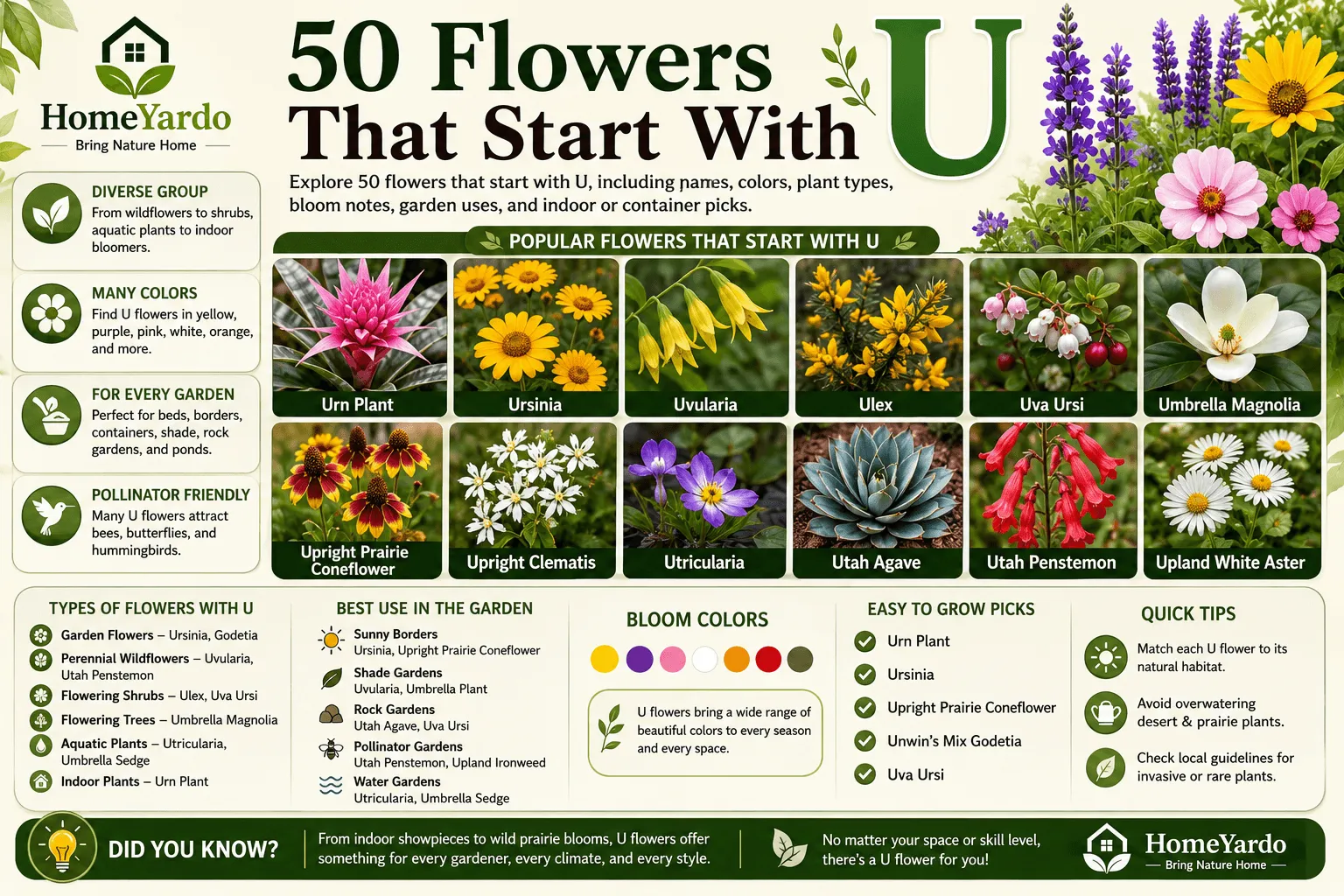
Flower names starting with U are not as common as flower names beginning with many other letters, but the group is surprisingly varied. It includes bright annuals, woodland wildflowers, flowering shrubs, indoor bloomers, aquatic plants, rare bulbs, desert plants, ornamental grasses, and flowering trees.
Some entries are classic garden flowers, while others are flowering plants included for botanical completeness because they produce recognizable blooms or flower structures. Each plant is labeled by type, so it is clear whether it belongs in a flower bed, container, water garden, woodland area, dry rock garden, or specialist collection.
The full list includes 50 flower starts with U without repeating the same flower under nearly identical names. Each entry includes a scientific name where useful, bloom color, plant type, and simple growing or identification notes. For a wider alphabet list, compare these U names with flowers that start with A, which include many familiar garden flowers.
Quick Answer: What Are Flowers That Start With U?
Flower names starting with U include Urn Plant, Ursinia, Uvularia, Ulex, Uva Ursi, Umbrella Magnolia, Upright Prairie Coneflower, Upright Clematis, Utricularia, Utah Agave, Utah Penstemon, and Upland White Aster.
The full list below includes 50 U flower names with simple labels for plant type, color, and best use.
Quick examples:
- Urn Plant
- Ursinia
- Uvularia
- Ulex
- Uva Ursi
- Umbrella Magnolia
- Upright Prairie Coneflower
- Upright Clematis
- Utricularia
- Utah Agave
- Utah Penstemon
- Upland White Aster
Flowers That Begin With The Letter U At A Glance
The table below gives a quick look at some of the most useful U flowers, including plant type, color, best use, and typical bloom timing.
| Flower Name | Scientific Name | Type | Main Color | Best Use | Bloom Season |
|---|---|---|---|---|---|
| Urn Plant | Aechmea fasciata | Indoor bromeliad | Pink, purple | Houseplant display | Seasonal indoors |
| Ursinia | Ursinia anthemoides | Annual | Yellow, orange | Sunny beds | Spring to summer |
| Uvularia | Uvularia spp. | Perennial wildflower | Yellow | Shade gardens | Spring |
| Ulex | Ulex spp. | Flowering shrub | Yellow | Tough sunny sites | Late winter to spring |
| Uva Ursi | Arctostaphylos uva-ursi | Groundcover shrub | White, pink | Dry groundcover | Spring |
| Umbrella Magnolia | Magnolia tripetala | Flowering tree | White | Large landscapes | Spring to early summer |
| Umbrella Plant | Darmera peltata | Moisture-loving perennial | Pink, white | Damp shade | Spring |
| Upright Prairie Coneflower | Ratibida columnifera | Perennial wildflower | Yellow, red, brown | Pollinator beds | Summer |
| Upright Clematis | Clematis recta | Herbaceous perennial | White | Borders | Summer |
| Utricularia | Utricularia spp. | Aquatic flower | Yellow, purple, white | Water gardens | Varies by species |
| Utah Penstemon | Penstemon utahensis | Perennial wildflower | Red, pink | Dry gardens | Spring to early summer |
| Upland Ironweed | Vernonia glauca | Perennial wildflower | Purple | Pollinator gardens | Late summer |
Bloom Season And Native Range Summary
Bloom timing changes by climate, but general season and habitat notes help separate spring woodland flowers from summer prairie flowers, indoor bloomers, aquatic plants, and dryland species.
| Flower | Typical Bloom Season | Native Range Or Common Habitat |
|---|---|---|
| Urn Plant | Seasonal indoors after maturity | Brazil and tropical bromeliad habitats |
| Ursinia | Spring to summer | Southern Africa |
| Uvularia Grandiflora | Spring | Eastern North American woodlands |
| Ulex Europaeus | Late winter to spring, sometimes longer | Western Europe |
| Uva Ursi | Spring | Northern dry slopes and rocky areas |
| Umbrella Magnolia | Spring to early summer | Eastern United States woodlands |
| Umbrella Plant | Spring | Moist woodland and streamside gardens |
| Upright Prairie Coneflower | Summer | North American prairies |
| Upright Clematis | Summer | Europe and western Asia |
| Utah Agave | Seasonal after maturity | Southwestern dry regions |
| Utah Penstemon | Spring to early summer | Western United States |
| Utricularia Vulgaris | Summer | Ponds, wetlands, slow water |
| Upland Ironweed | Late summer | Eastern and central North America |
| Upland Larkspur | Spring to summer | Meadows and open slopes |
| Unwin’s Mix Godetia | Spring to early summer | Garden cultivar group |
Complete List Of 50 Flowers That Begin With The Letter U
The detailed list of flowers that start with U below explains each flower in simple terms. It keeps the entries short enough to scan while still giving useful identification, color, type, and growing context.
1. Urn Plant
Urn Plant, botanically known as Aechmea fasciata, is one of the best-known indoor flower start with U. It is a bromeliad with a vase-shaped center, arching silver green leaves, and a long-lasting pink flower bract that may carry small purple blooms.
It grows best in bright filtered light and works well as a houseplant or container plant. Water can sit lightly in the central cup, but harsh direct sun should be avoided because it can scorch the foliage.
2. Ursinia
Ursinia is a cheerful annual flower known for daisy-like blooms in yellow, orange, and golden tones. Ursinia anthemoides is one of the most common species found in flower lists and garden references.
It prefers full sun and well-drained soil. The fine foliage gives the plant a soft texture, while the bright flowers suit borders, rock gardens, and outdoor containers with strong light.
3. Uvularia
Uvularia is a woodland perennial with soft yellow, drooping, bell-shaped flowers. It grows naturally in shaded woodland settings and is valued for its gentle spring appearance.
The plant suits shade gardens, native plant areas, and naturalized beds with moist, rich soil. Uvularia adds quiet color under trees or along shaded paths where bold annuals may not fit well.
4. Uvularia Grandiflora
Uvularia grandiflora, commonly called large-flowered bellwort, is one of the showier Uvularia species. It has arching stems, soft green leaves, and larger yellow flowers that hang downward in spring.
This perennial grows best in moist woodland soil with partial to full shade. It pairs well with ferns, woodland phlox, wild ginger, and other low-growing shade plants.
5. Uvularia Perfoliata
Uvularia perfoliata is known as perfoliate bellwort. Its pale yellow flowers hang gently from slender stems, while its leaves appear as if the stem passes through them.
That leaf feature makes the plant useful for identification. It prefers woodland conditions with dappled shade and steady moisture, adding soft spring color without needing a formal flower bed look.
6. Uvularia Sessilifolia
Uvularia sessilifolia, often called sessile leaf bellwort, is a smaller woodland wildflower with pale yellow flowers and delicate growth. It is less showy than large-flowered bellwort, but still useful in native shade plantings.
It grows best in cool, moist, shaded areas. The plant suits natural woodland beds where subtle spring flowers look more fitting than bright bedding plants.
7. Ulex
Ulex is a genus of flowering shrubs best known for spiny stems and bright yellow pea-shaped flowers. These plants are often called gorse.
Ulex can handle tough sunny sites and poor soil, but it must be chosen carefully. Some species spread aggressively in certain climates, so local planting guidance should be checked before adding it to a garden.
8. Ulex Europaeus
Ulex europaeus, commonly called common gorse, is an evergreen flowering shrub with sharp spines and many yellow flowers. It is often seen in rough landscapes, coastal areas, and open sunny sites.
The flowers may be fragrant, and the shrub can support pollinators where it grows responsibly. It can also become invasive in some regions, so it should not be planted without checking local guidance.
9. Ulex Gallii
Ulex gallii, known as western gorse, is another yellow flowering shrub in the Ulex group. It has spiny stems and pea-like flowers, usually associated with heathland or open acidic ground.
It is not a typical flower bed plant. Its value in a U flower list is botanical clarity, especially for comparing different gorse species.
10. Uva Ursi
Uva Ursi, botanically known as Arctostaphylos uva-ursi, is a low-growing flowering shrub often used as a groundcover. It produces small white to pink urn-shaped flowers followed by red berries.
It grows best in dry, well-drained, acidic soil. Uva Ursi works well on dry slopes, sandy soil, rocky ground, and natural landscapes where a tough low plant is needed.
11. Umbrella Magnolia
Umbrella Magnolia, or Magnolia tripetala, is a flowering tree with large tropical-looking leaves and creamy white flowers. It needs more room than small shrubs or bedding flowers.
This tree works best in large gardens, woodland edges, and natural landscapes. Its flowers are noticeable, but the oversized leaves also create much of its ornamental value.
12. Umbrella Plant
Umbrella Plant, in this list, refers to Darmera peltata, a moisture-loving perennial with rounded umbrella-like leaves and pink to white spring flower clusters.
It is different from the common indoor Schefflera often sold under the same name. Darmera peltata grows best near pond edges, streams, damp shade, or consistently moist garden soil.
13. Umbrella Sedge
Umbrella Sedge, or Cyperus alternifolius, is a flowering sedge with umbrella-shaped foliage and small greenish-brown flower clusters. It is included because it is a flowering plant, although it is not a classic showy flower.
It grows well in wet soil, water containers, and pond edges. Its form is more architectural than floral, making it useful for texture in water garden designs.
14. Upright Prairie Coneflower
Upright Prairie Coneflower, botanically known as Ratibida columnifera, is a hardy prairie wildflower with drooping petals and a tall central cone. Flower colors may include yellow, red, brown, and mixed tones.
It grows well in full sun and handles dry soil once established. Bees and butterflies may visit the flowers, making it a strong choice for pollinator beds and low-water gardens.
15. Upright Clematis
Upright Clematis, or Clematis recta, is a herbaceous perennial that grows upright rather than climbing like many clematis vines. It produces clusters of small white flowers.
It fits cottage gardens, mixed borders, and perennial beds. Light support can help keep the stems neat, especially when it is used as a soft border plant.
16. Upright Yellow Flax
Upright Yellow Flax, often linked with Linum strictum, is a slender annual or short-lived wildflower with small yellow blooms. It prefers sunny areas and well-drained soil.
This flower has a lighter, more natural look than many bedding plants. It works best in dry wildflower plantings, open meadows, and informal sunny spaces.
17. Unicorn Plant
Unicorn Plant, or Proboscidea louisianica, is an unusual annual with trumpet-shaped flowers in pale pink, white, or purple marked tones. It is also known for its curved seed pods.
It is grown more for curiosity than formal garden design. In warm sunny sites, it can add interest to unusual plant collections and educational gardens.
18. Utah Agave
Utah Agave, botanically known as Agave utahensis, is a succulent flowering plant from dry regions. Mature plants can send up tall flower stalks with yellow to greenish yellow blooms.
It needs strong drainage, sun, and dry conditions. Utah Agave suits rock gardens, desert landscapes, and containers where moisture and cold can be controlled.
19. Utah Penstemon
Utah Penstemon, or Penstemon utahensis, is a perennial wildflower with tubular red, pink, or coral flowers. Its color and shape make it attractive to hummingbirds.
It grows best in full sun and sharply drained soil. This plant is a strong choice for dry gardens, rock gardens, and pollinator beds in suitable climates.
20. Utah Serviceberry
Utah Serviceberry, known botanically as Amelanchier utahensis, is a flowering shrub with white spring flowers and berries that can support wildlife.
It is more of a landscape shrub than a bedding flower. It suits native gardens, dry slopes, and natural landscapes where spring bloom and habitat value both matter.
21. Utah Sweetvetch
Utah Sweetvetch, or Hedysarum boreale, is a perennial wildflower with pink to purple pea-shaped flowers. It grows in dry areas and fits native plantings.
Its flowers appear in upright clusters, giving it a soft but noticeable look. It is useful for dryland gardens, restoration planting, and wildflower style beds where the climate suits.
22. Uinta Basin Hookless Cactus
Uinta Basin Hookless Cactus, or Sclerocactus wetlandicus, is a rare flowering cactus known for pink to purple blooms. It is tied to a specific regional habitat and has conservation importance.
This plant should not be collected from the wild. It is best included for botanical knowledge and awareness, not as a casual garden choice.
23. Uinta Cactus
Uinta Cactus refers broadly to flowering cactus types connected with the Uinta region or Sclerocactus group. Bloom colors can include pink, purple, or yellow, depending on the species.
It belongs in desert plant learning rather than ordinary flower bed planning. Like many regional cacti, it should be treated with care and respect for habitat protection.
24. Utricularia
Utricularia, commonly called bladderwort, is a genus of carnivorous plants that can produce delicate flowers in yellow, purple, white, or pale tones. Many grow in water, bogs, or wet soil.
The plant is known for tiny bladder traps used to capture small organisms. Its flowers are often more visible than the plant body, especially in aquatic settings.
25. Utricularia Vulgaris
Utricularia vulgaris, or greater bladderwort, is an aquatic carnivorous plant with yellow flowers. It grows in ponds, slow water, and wet habitats.
The flowers rise above the water, while the plant’s fine growth stays beneath or near the surface. It is best suited to pond or aquatic plant interest rather than dry garden beds.
26. Utricularia Sandersonii
Utricularia sandersonii is a small carnivorous plant often grown by collectors. It produces small white to pale purple flowers and can grow in moist terrarium-style conditions.
It is not a beginner flower for standard pots. It needs careful moisture control and a suitable growing medium, making it better for specialist indoor plant collections.
27. Utricularia Graminifolia
Utricularia graminifolia is an aquatic carnivorous plant often known for its grass-like foliage in aquarium settings. It can produce pale purple flowers under the right conditions.
Although it is often grown for its carpet-like growth, it still belongs in a flower list because it can bloom. It needs wet or aquatic conditions and careful setup.
28. Utricularia Dichotoma
Utricularia dichotoma, sometimes called fairy aprons, is a wetland carnivorous plant with purple to violet flowers. It grows in moist or boggy environments.
Its blooms are delicate and attractive, making it one of the better U choices for purple flower interest. It is best suited to specialist bog gardens or plant collections.
29. Urceolina
Urceolina is a lesser-known genus of bulbous flowering plants. Depending on the species, flowers may appear in red, orange, yellow, or warm tones.
These plants are more common in rare bulb collections than in ordinary garden centers. They are useful for expanding a U flower list beyond the same familiar names.
30. Urceolina Amazonica
Urceolina amazonica is a bulbous flowering plant associated with warm growing conditions. It may produce elegant white flowers and is sometimes discussed near Amazon lily relatives.
It is not usually a simple outdoor garden choice in cool regions. It is better suited to warm climates, greenhouse care, or protected growing.
31. Urginea Maritima
Urginea maritima, commonly called sea squill, is a bulbous perennial with tall flower spikes. Its flowers are usually white to pale pink.
It suits Mediterranean-style climates and dry conditions. The bulb contains toxic compounds, so it should be handled and planted with care, especially around children and pets.
32. Urginea Indica
Urginea indica is another bulbous flowering plant with pale flowers, often white or pinkish. It grows in warm dry regions and is less familiar in everyday gardens.
It belongs in the botanical and bulb category. For general garden use, it is less common than Urn Plant, Ursinia, or Uvularia.
33. Urena Lobata
Urena lobata, often called Caesarweed, is a flowering plant with pink hibiscus like blooms. It may grow as a shrub or herbaceous plant in warm climates.
Although the flowers can be attractive, the plant may behave like a weed in some regions. It is best included as a botanical U flower rather than a standard garden recommendation.
34. Urena
Urena is a flowering plant genus with pink to mauve blooms. It belongs to the mallow family and includes plants found in tropical and warm regions.
The genus entry is useful for learning flower names that start with U. Garden use depends heavily on species and local growing behavior.
35. Uraria
Uraria is a flowering legume genus with pink or purple pea family flowers. Some species have upright flower clusters that make them noticeable in wild or tropical settings.
It is not a common ornamental in many home gardens. Its value here is botanical, especially for less common U flower names.
36. Uraria Crinita
Uraria crinita is a flowering legume with tall purple to lavender flower clusters. It is more likely to appear in botanical references than in regular garden bedding displays.
Its upright flower form makes it distinct from the broader Uraria entry. It adds variety to a 50 flower U list without relying only on familiar garden names.
37. Upland White Aster
Upland White Aster is a perennial wildflower with white daisy-like blooms. It is often associated with dry sites and native plantings.
Its classification can be treated differently in modern botany, but the common name remains useful for flower name lists. It can support pollinators and fits natural garden designs.
38. Upland Ironweed
Upland Ironweed is a purple-flowering perennial wildflower linked with Vernonia species. It produces clusters of strong purple blooms, often later in the growing season.
This makes it useful for pollinator gardens when many early flowers have faded. It adds height, color, and wildlife value in suitable native or meadow-style plantings.
39. Upland Larkspur
Upland Larkspur is a wildflower with blue to purple flower spikes. It belongs to the Delphinium group or related larkspur types.
The flowers can be beautiful in meadow-style plantings, but larkspurs can be toxic if eaten. It should be placed with care and avoided in grazing areas or pet-heavy spaces.
40. Upland Cotton
Upland Cotton, or Gossypium hirsutum, is a flowering crop plant rather than a standard ornamental flower. Its blooms can appear cream, yellow, or pink before cotton bolls form.
It is included because it is a flowering plant that starts with U. For home gardens, it is more educational than decorative.
41. Ulmus
Ulmus is the genus for elm trees. Elms produce small flowers, usually greenish and not showy, before the leaves fully develop or early in the season.
Ulmus is not a classic flower bed plant. It is included for botanical completeness because trees are flowering plants, even when their flowers are subtle.
42. Ulmus Americana
Ulmus americana, known as American elm, is a flowering tree with small greenish flowers. The flowers are not the main ornamental feature, but they are part of the tree’s life cycle.
This entry is useful for tree flower identification. It should not be presented as a showy garden flower like Ursinia or Urn Plant.
43. Uvaria
Uvaria is a tropical flowering plant genus that may grow as shrubs or vines. Flower colors can include yellow, red, orange, or warm mixed tones, depending on species.
These plants are uncommon in regular garden settings. They fit rare, tropical, and botanical flower lists better than ordinary outdoor borders.
44. Uvaria Grandiflora
Uvaria grandiflora is a tropical flowering shrub known for larger blooms. Flower colors may include red, orange, or yellow tones.
It needs warm conditions and is not widely grown in standard temperate gardens. It works best as a rare tropical entry in a U flower list.
45. Uvaria Rufa
Uvaria rufa is another tropical flowering plant with warm colored blooms, often red to orange. It is not a common nursery flower in many regions.
Its main value is botanical interest. It helps build a fuller flower name list while showing that many U flowers are uncommon or region-specific.
46. Uncarina
Uncarina is a genus of flowering succulent shrubs known for trumpet-shaped flowers and unusual seed pods. Flower colors may include yellow, pink, or purple, depending on the species.
It suits dry climate collections, warm greenhouses, or specialist succulent growers. It is not a common bedding plant, but it adds a strong variety to the U flower group.
47. Uncarina Roeosiiana
Uncarina roeoesliana is a succulent flowering shrub with yellow blooms. It needs warmth, bright light, and sharp drainage.
This plant is uncommon in regular garden centers. It is better suited to collectors who enjoy unusual dry-climate flowering plants.
48. Uruguayan Firecracker Plant
Uruguayan Firecracker Plant, botanically known as Dicliptera suberecta, is a warm-weather perennial with orange tubular flowers and soft gray-green foliage.
It can attract hummingbirds and works well in sunny, warm gardens where conditions suit it. The orange flowers make it one of the more colorful U flower choices.
49. Uruguayan Pampas Grass
Uruguayan Pampas Grass, or Cortaderia selloana, is an ornamental grass with tall cream to white flower plumes. It is not a classic flower, but its plumes are flowering structures.
It needs space and can spread aggressively in some climates. It should be used only where local guidance allows it and where its size can be managed.
50. Unwin’s Mix Godetia
Unwin’s Mix Godetia is a colorful annual flower linked with Clarkia amoena cultivar groups. It may bloom in pink, red, lavender, white, and blended shades.
It is one of the more practical U flowers for garden use because it works in cottage gardens, seasonal beds, patio containers, and cut flower plantings. It prefers mild conditions and well-drained soil.
Types Of Flowers That Start With U
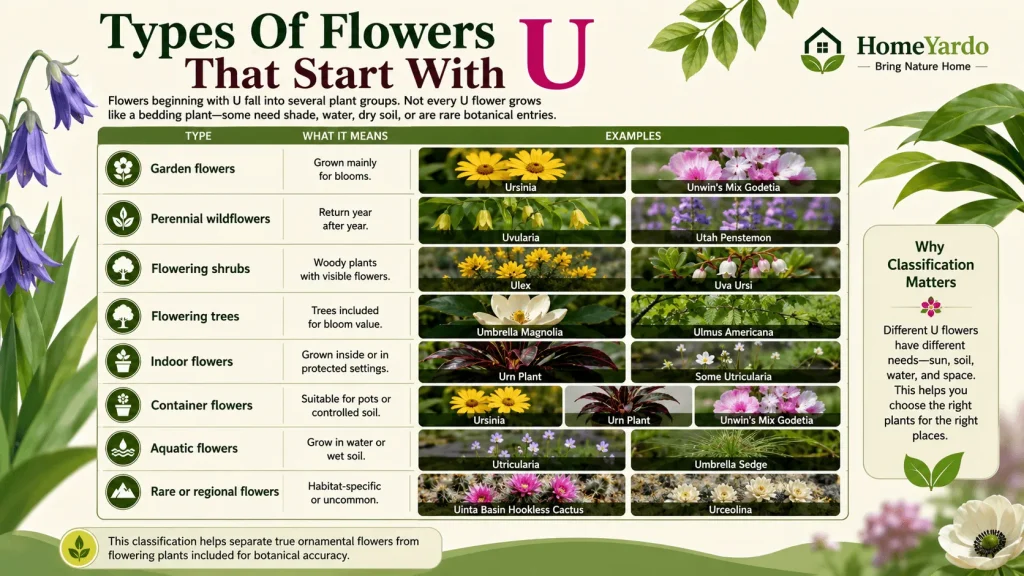
Flowers beginning with U fall into several plant groups. That matters because not every U flower grows like a bedding plant. Some need shade, some need water, some need dry rocky soil, and others are mainly rare or botanical entries.
| Type | What It Means | Examples |
|---|---|---|
| Garden flowers | Grown mainly for blooms | Ursinia, Unwin’s Mix Godetia |
| Perennial wildflowers | Return year after year | Uvularia, Utah Penstemon |
| Flowering shrubs | Woody plants with visible flowers | Ulex, Uva Ursi |
| Flowering trees | Trees included for bloom value | Umbrella Magnolia, Ulmus Americana |
| Indoor flowers | Grown inside or in protected settings | Urn Plant, some Utricularia |
| Container flowers | Suitable for pots or controlled soil | Ursinia, Urn Plant, Unwin’s Mix Godetia |
| Aquatic flowers | Grow in water or wet soil | Utricularia, Umbrella Sedge |
| Rare or regional flowers | Habitat-specific or uncommon | Uinta Basin Hookless Cactus, Urceolina |
This classification helps separate true ornamental flowers from flowering plants included for botanical accuracy.
Indoor And Container Flowers With U
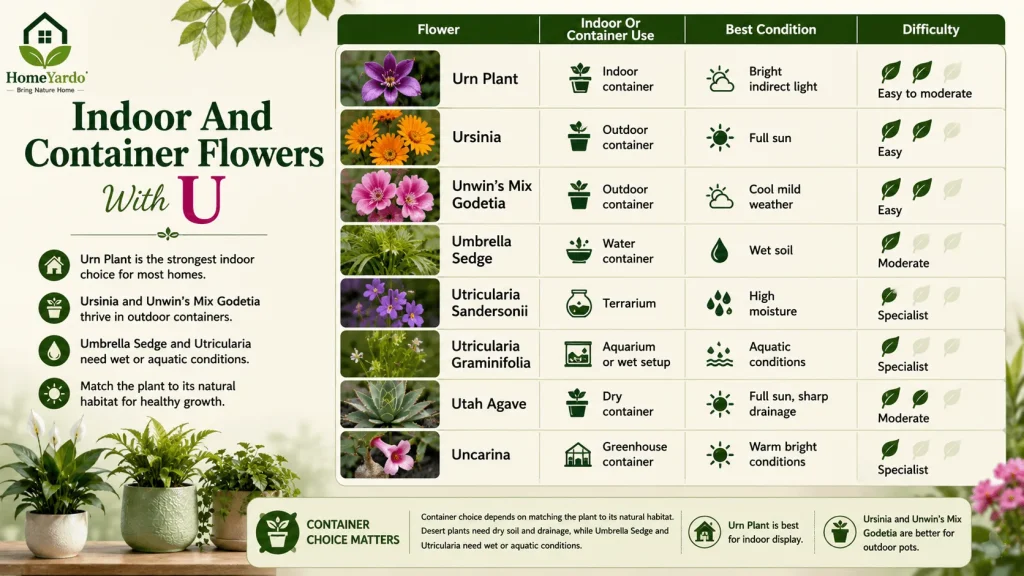
Some U flowers grow well in pots, but only a few are suitable for typical indoor spaces. Urn Plant is the strongest indoor choice for most homes, while aquatic and carnivorous Utricularia species need more controlled setups.
| Flower | Indoor Or Container Use | Best Condition | Difficulty |
|---|---|---|---|
| Urn Plant | Indoor container | Bright indirect light | Easy to moderate |
| Ursinia | Outdoor container | Full sun | Easy |
| Unwin’s Mix Godetia | Outdoor container | Cool mild weather | Easy |
| Umbrella Sedge | Water container | Wet soil | Moderate |
| Utricularia Sandersonii | Terrarium | High moisture | Specialist |
| Utricularia Graminifolia | Aquarium or wet setup | Aquatic conditions | Specialist |
| Utah Agave | Dry container | Full sun, sharp drainage | Moderate |
| Uncarina | Greenhouse container | Warm bright conditions | Specialist |
Container choice depends on matching the plant to its natural habitat. Desert plants need dry soil and drainage, while Umbrella Sedge and Utricularia need wet or aquatic conditions. Urn Plant is best for indoor display, while Ursinia and Unwin’s Mix Godetia are better for outdoor pots.
Best Flowers With U For Garden Use
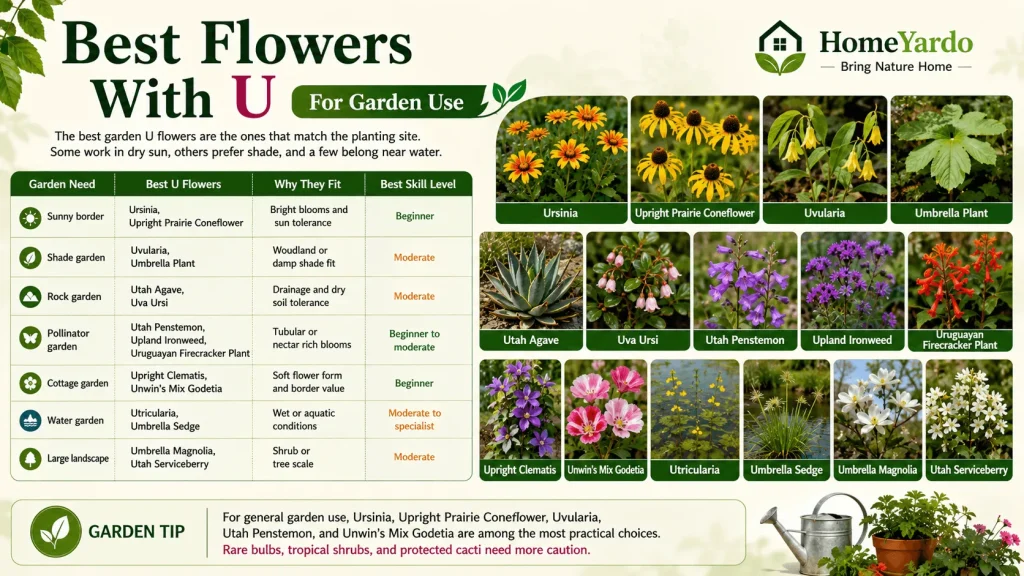
The best garden U flowers are the ones that match the planting site. Some work in dry sun, others prefer shade, and a few belong near water.
| Garden Need | Best U Flowers | Why They Fit | Best Skill Level |
|---|---|---|---|
| Sunny border | Ursinia, Upright Prairie Coneflower | Bright blooms and sun tolerance | Beginner |
| Shade garden | Uvularia, Umbrella Plant | Woodland or damp shade fit | Moderate |
| Rock garden | Utah Agave, Uva Ursi | Drainage and dry soil tolerance | Moderate |
| Pollinator garden | Utah Penstemon, Upland Ironweed, Uruguayan Firecracker Plant | Tubular or nectar rich blooms | Beginner to moderate |
| Cottage garden | Upright Clematis, Unwin’s Mix Godetia | Soft flower form and border value | Beginner |
| Water garden | Utricularia, Umbrella Sedge | Wet or aquatic conditions | Moderate to specialist |
| Large landscape | Umbrella Magnolia, Utah Serviceberry | Shrub or tree scale | Moderate |
For general garden use, Ursinia, Upright Prairie Coneflower, Uvularia, Utah Penstemon, and Unwin’s Mix Godetia are among the most practical choices. Rare bulbs, tropical shrubs, and protected cacti need more caution.
Common Flowers That Start With U
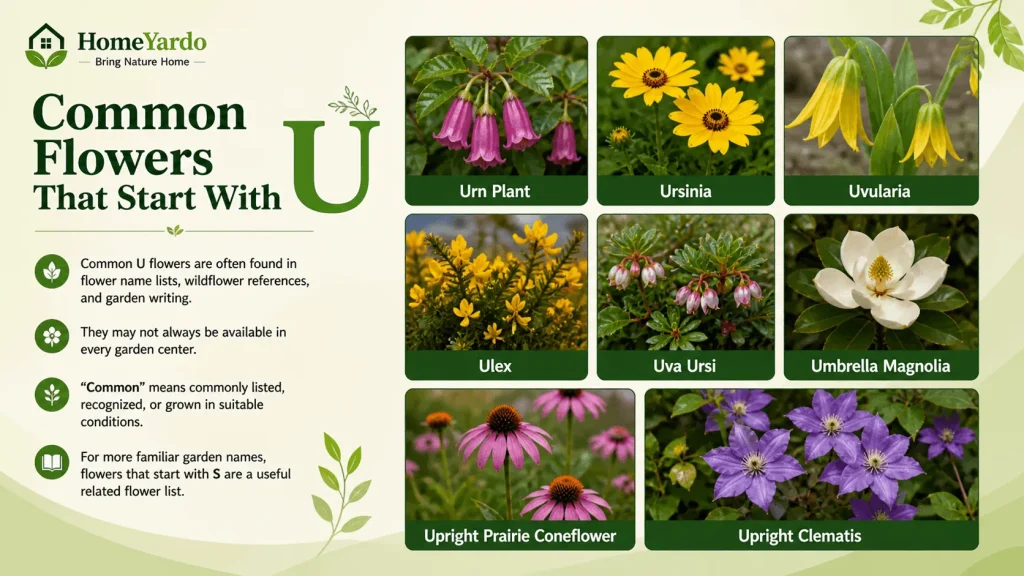
Common U flowers are not always available in every garden center, but they appear often in flower name lists, wildflower references, and garden writing.
Good examples include:
- Urn Plant
- Ursinia
- Uvularia
- Ulex
- Uva Ursi
- Umbrella Magnolia
- Upright Prairie Coneflower
- Upright Clematis
“Common” means commonly listed, recognized, or grown in suitable conditions. For more familiar garden names, flowers that start with S are a useful related flower list.
Rare Flowers That Start With U
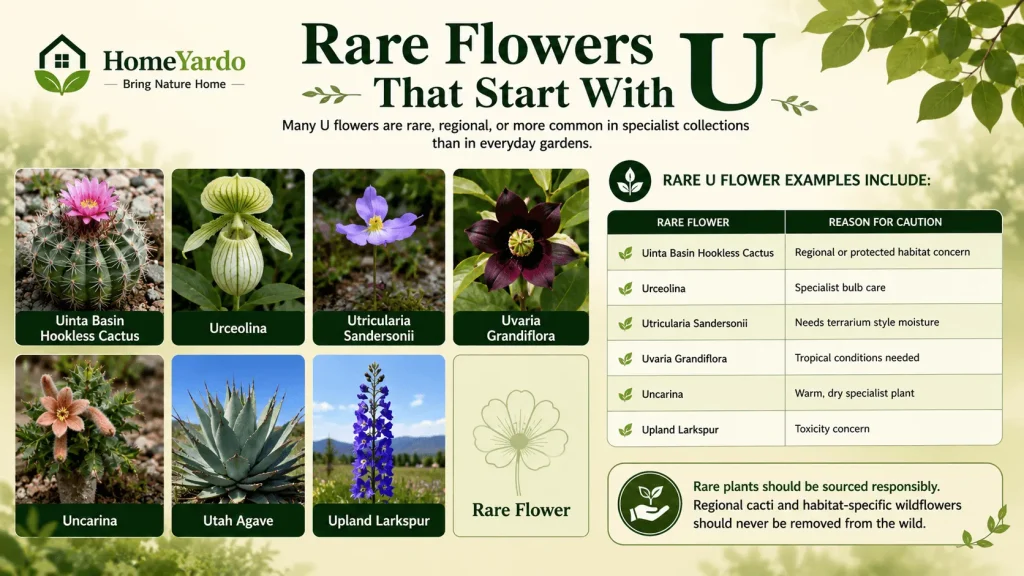
Many U flowers are rare, regional, or more common in specialist collections than in everyday gardens. These plants add depth to the list, but they may not be suitable for casual planting.
Rare U flower examples include:
- Uinta Basin Hookless Cactus
- Urceolina
- Utricularia Sandersonii
- Uvaria Grandiflora
- Uncarina
- Utah Agave
- Upland Larkspur
| Rare Flower | Needs moisture |
|---|---|
| Uinta Basin Hookless Cactus | Regional or protected habitat concern |
| Urceolina | Specialist bulb care |
| Utricularia Sandersonii | Needs terrarium style moisture |
| Uvaria Grandiflora | Tropical conditions needed |
| Uncarina | Warm, dry specialist plant |
| Upland Larkspur | Toxicity concern |
Rare plants should be sourced responsibly. Regional cacti and habitat-specific wildflowers should never be removed from the wild.
Purple Flowers That Start With U
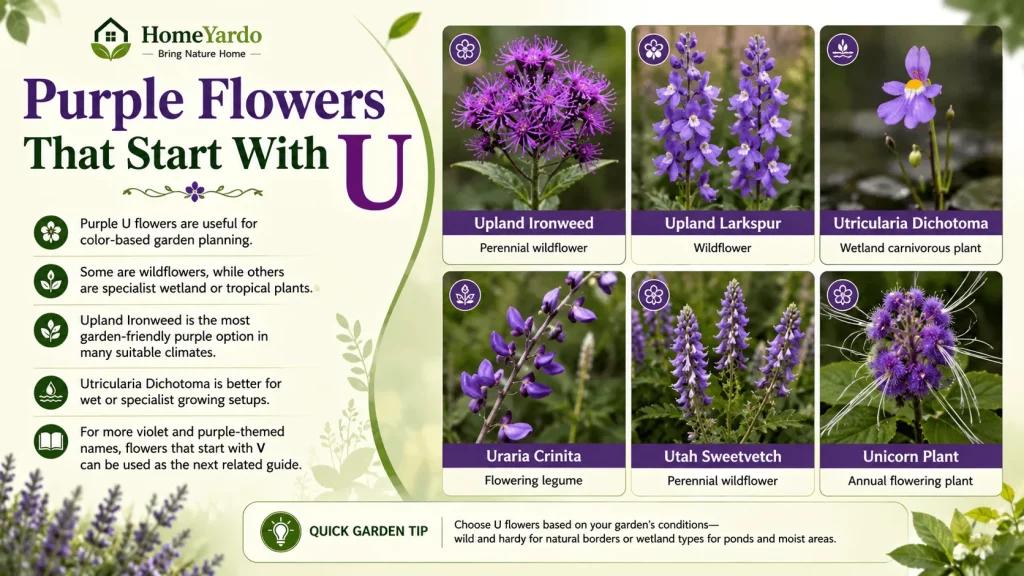
Purple U flowers are useful for color-based garden planning. Some are wildflowers, while others are specialist wetland or tropical plants.
| Purple U Flower | Flower Type |
|---|---|
| Upland Ironweed | Perennial wildflower |
| Upland Larkspur | Wildflower |
| Utricularia Dichotoma | Wetland carnivorous plant |
| Uraria Crinita | Flowering legume |
| Utah Sweetvetch | Perennial wildflower |
| Unicorn Plant | Annual flowering plant |
Upland Ironweed is the most garden-friendly purple option in many suitable climates, while Utricularia Dichotoma is better for wet or specialist growing setups. For more violet and purple-themed names, flowers that start with V can be used as the next related guide.
Yellow Flowers With U
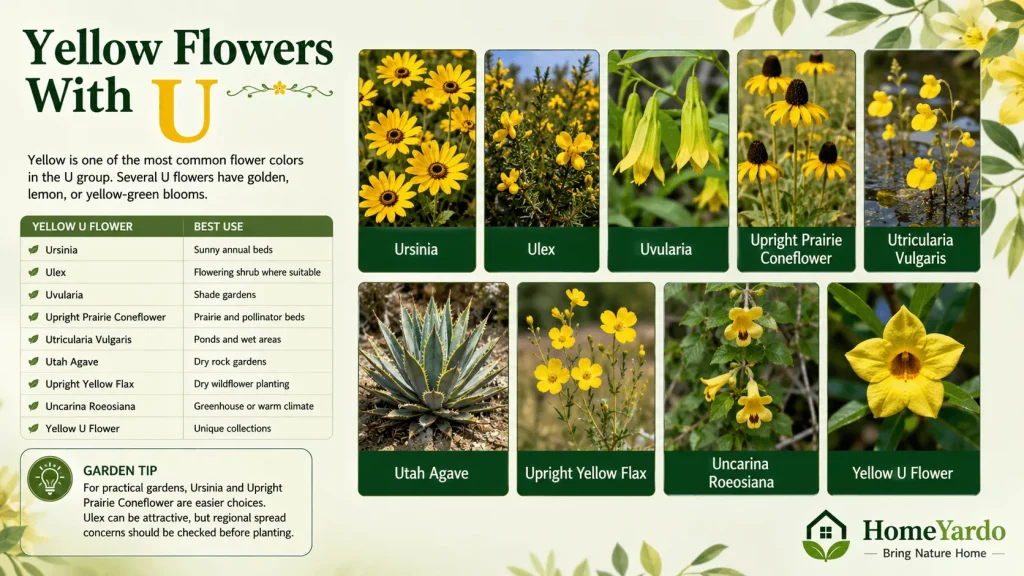
Yellow is one of the most common flower colors in the U group. Several U flowers have golden, lemon, or yellow-green blooms.
Good yellow U flowers include:
- Ursinia
- Ulex
- Uvularia
- Upright Prairie Coneflower
- Utricularia Vulgaris
- Utah Agave
- Upright Yellow Flax
- Uncarina Roeosiiana
| Yellow U Flower | Best Use |
|---|---|
| Ursinia | Sunny annual beds |
| Ulex | Flowering shrub where suitable |
| Uvularia | Shade gardens |
| Upright Prairie Coneflower | Prairie and pollinator beds |
| Utah Agave | Dry rock gardens |
| Upright Yellow Flax | Dry wildflower planting |
For practical gardens, Ursinia and Upright Prairie Coneflower are easier choices. Ulex can be attractive, but regional spread concerns should be checked before planting.
Perennial Flowers That Start With U
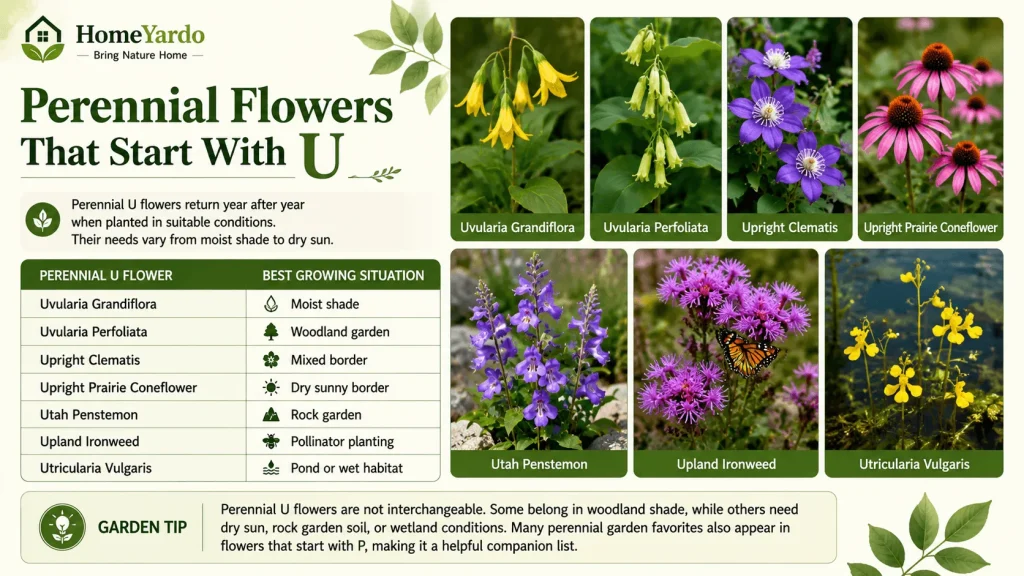
Perennial U flowers return year after year when planted in suitable conditions. Their needs vary from moist shade to dry sun.
| Perennial U Flower | Best Growing Situation |
|---|---|
| Uvularia Grandiflora | Moist shade |
| Uvularia Perfoliata | Woodland garden |
| Upright Clematis | Mixed border |
| Upright Prairie Coneflower | Dry sunny border |
| Utah Penstemon | Rock garden |
| Upland Ironweed | Pollinator planting |
| Utricularia Vulgaris | Pond or wet habitat |
Perennial U flowers are not interchangeable. Some belong in woodland shade, while others need dry sun, rock garden soil, or wetland conditions. Many perennial garden favorites also appear in flowers that start with P, making it a helpful companion list.
Annual Flowers That Start With U
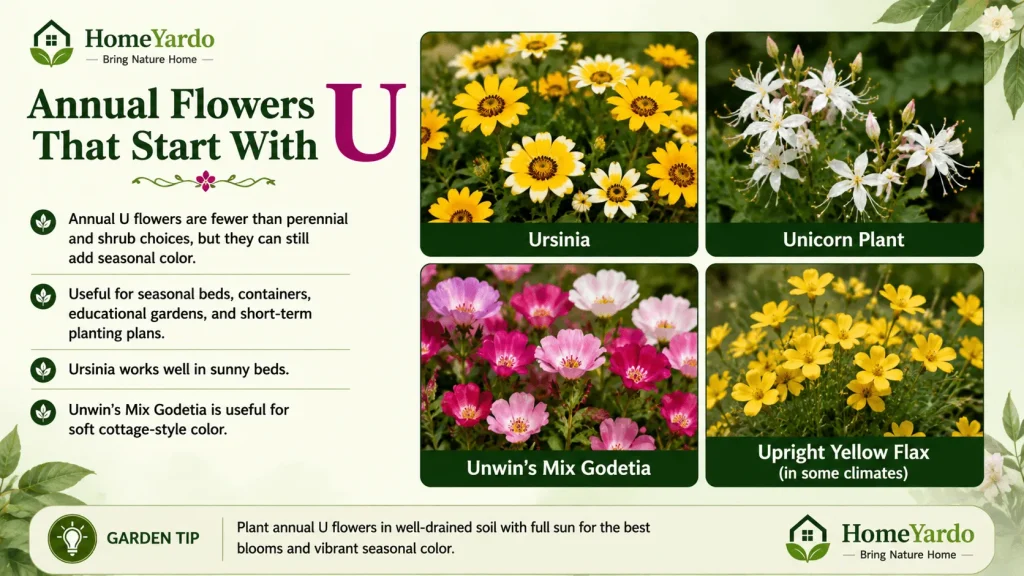
Annual U flowers are fewer than perennial and shrub choices, but they can still add seasonal color.
Examples include:
- Ursinia
- Unicorn Plant
- Unwin’s Mix Godetia
- Upright Yellow Flax in some climates
Annual U flowers are useful for seasonal beds, containers, educational gardens, and short-term planting plans. Ursinia works well in sunny beds, while Unwin’s Mix Godetia is useful for soft cottage-style color.
Beginner Friendly U Flowers
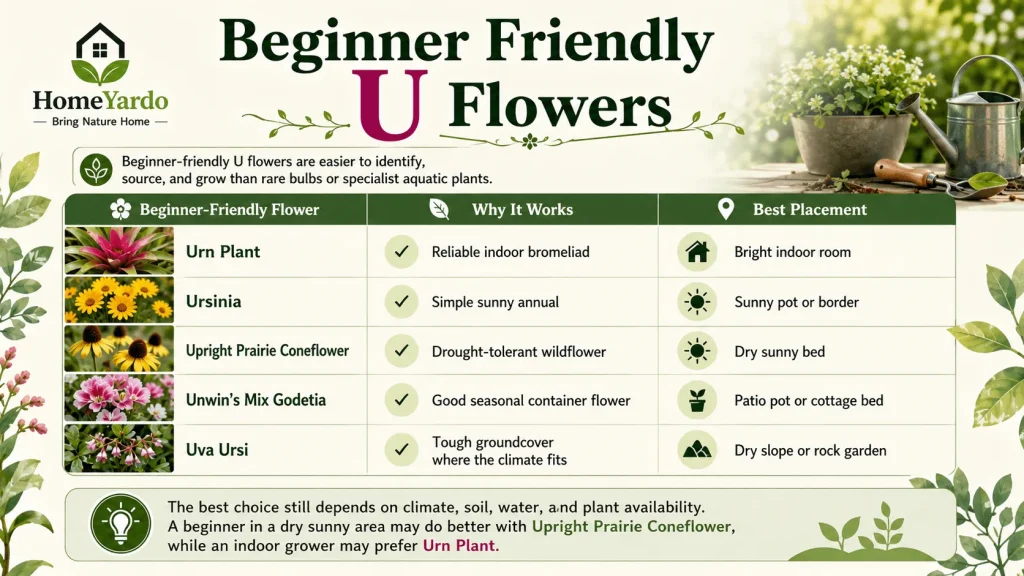
Beginner-friendly U flowers are easier to identify, source, and grow than rare bulbs or specialist aquatic plants.
| Beginner Friendly Flower | Why It Works | Best Placement |
|---|---|---|
| Urn Plant | Reliable indoor bromeliad | Bright indoor room |
| Ursinia | Simple sunny annual | Sunny pot or border |
| Upright Prairie Coneflower | Drought-tolerant wildflower | Dry sunny bed |
| Unwin’s Mix Godetia | Good seasonal container flower | Patio pot or cottage bed |
| Uva Ursi | Tough groundcover where the climate fits | Dry slope or rock garden |
The best choice still depends on climate, soil, water, and plant availability. A beginner in a dry sunny area may do better with Upright Prairie Coneflower, while an indoor grower may prefer Urn Plant.
Plants Vs Flowers That Start With U
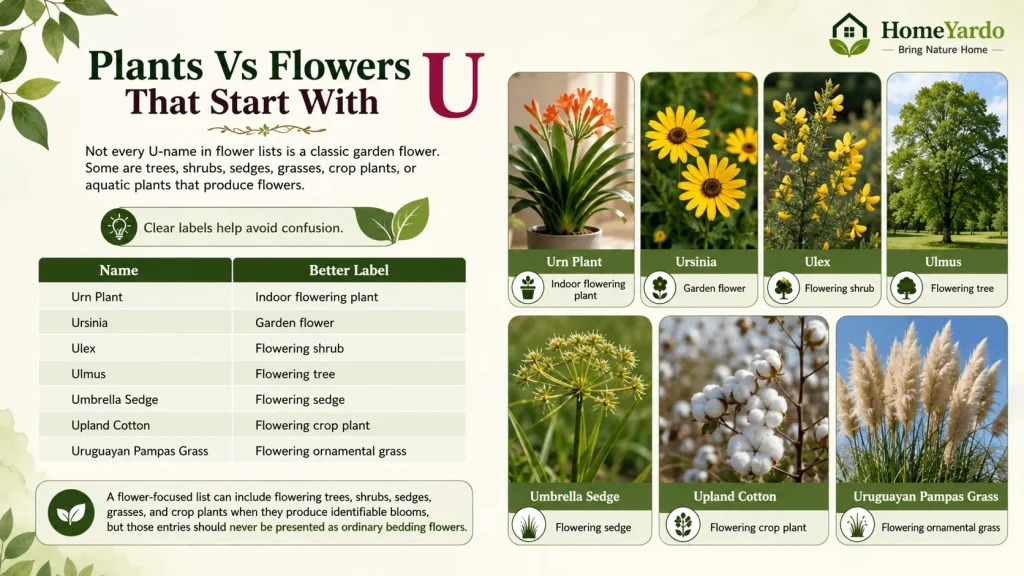
Not every U-name in flower lists is a classic garden flower. Some are trees, shrubs, sedges, grasses, crop plants, or aquatic plants that produce flowers.
Clear labels help avoid confusion.
| Name | Better Label |
|---|---|
| Urn Plant | Indoor flowering plant |
| Ursinia | Garden flower |
| Ulex | Flowering shrub |
| Ulmus | Flowering tree |
| Umbrella Sedge | Flowering sedge |
| Upland Cotton | Flowering crop plant |
| Uruguayan Pampas Grass | Flowering ornamental grass |
A flower-focused list can include flowering trees, shrubs, sedges, grasses, and crop plants when they produce identifiable blooms, but those entries should never be presented as ordinary bedding flowers.
Care Tips For Flowers That Begin With The Letter U
Care depends more on habitat than the first letter of the flower name. A woodland U flower and a desert U flower should not be grown the same way.
| Habitat Type | Care Pattern | Examples | Avoid |
|---|---|---|---|
| Woodland | Moist soil, shade | Uvularia | Hot dry exposure |
| Desert | Sharp drainage, low water | Utah Agave | Heavy wet soil |
| Prairie | Full sun, drought tolerance | Upright Prairie Coneflower | Overwatering |
| Aquatic | Wet soil or water | Utricularia, Umbrella Sedge | Dry potting mix |
| Indoor | Bright filtered light | Urn Plant | Harsh direct sun |
| Tropical | Warmth and humidity | Uvaria, Urceolina | Cold drafts |
Match each flower to its natural setting. Shade plants need cooler, richer soil, while desert and prairie flowers usually need sun and drainage.
Safety, Invasive, And Conservation Notes
Some U flowers need extra caution because they may be toxic, invasive, protected, or unsuitable for casual planting.
| Flower Or Plant | Note | Safer Guidance |
|---|---|---|
| Ulex Europaeus | Can be invasive in some regions | Check local invasive plant lists before planting |
| Urginea Maritima | Toxic bulb caution | Avoid planting where pets or children may dig |
| Upland Larkspur | Toxic if eaten | Avoid grazing areas and pet-heavy gardens |
| Uinta Basin Hookless Cactus | Rare or protected habitat concern | Do not collect from the wild |
| Uruguayan Pampas Grass | Can spread aggressively in some climates | Use only where locally approved |
| Urena Lobata | Can behave like a weed in warm regions | Confirm suitability before planting |
These notes do not mean every plant is unsafe everywhere. They show where extra care, local guidance, or responsible sourcing may be needed.
Best U Flower Names For Learning Lists
Some U flower names are easy to remember, while others are better suited to advanced botanical lists.
Easy U flower names:
- Urn Plant
- Ursinia
- Ulex
- Uva Ursi
- Uvularia
- Umbrella Magnolia
Advanced U flower names:
- Utricularia
- Urceolina
- Urginea
- Uvaria
- Uncarina
- Uraria
Easy names are better for simple flower lists, while advanced names help with botanical vocabulary and scientific plant identification.
Conclusion
Flowers starting with U are uncommon, but they include far more variety than most short lists suggest. Strong examples include Urn Plant for indoor color, Ursinia for sunny beds, Uvularia for shade, Ulex for yellow shrub flowers, Uva Ursi for groundcover use, and Upright Prairie Coneflower for pollinator gardens.
The full 50 flower list includes annuals, perennials, shrubs, trees, aquatic plants, indoor plants, container choices, rare bulbs, and regional wildflowers. Choose U flowers by growing condition first, then by color, plant type, or name.
Since U and Q are both less common starting letters, flowers that start with Q work well as a related alphabet guide.
FAQ’s
Some U named flowers include Urn Plant, Ursinia, Uvularia, Ulex, Uva Ursi, Umbrella Magnolia, Upright Prairie Coneflower, and Utricularia. These names cover more than one plant group, so the list should not be treated as only bedding flowers. Urn Plant works well for indoor display, Ursinia suits sunny outdoor beds, and Uvularia is better for shaded woodland gardens. Utricularia is different again because it belongs to aquatic or bog-style growing conditions.
Urn Plant is one of the most recognizable U flowers because it is widely grown as an indoor bromeliad and has a long-lasting pink flower display. It is easier to recognize than many rare or botanical U flower names. Ursinia is also popular in garden lists because of its bright yellow and orange daisy-like blooms. Uvularia is common in woodland flower references, especially for shaded native style planting.
Yes, the Urn Plant is the best indoor U flower for most homes because it grows well in bright filtered light and has a long-lasting bloom display. Its shape and color make it a practical choice for indoor containers. Some Utricularia species can also grow indoors, but they need terrarium, aquarium, or bog-style conditions. Uncarina may grow in a protected warm space, although it is better suited to collectors than casual indoor plant owners.
Ursinia, Urn Plant, Unwin’s Mix Godetia, Utah Agave, and Umbrella Sedge can grow in containers when their soil and water needs are matched correctly. These plants should not all be placed in the same type of potting mix. Urn Plant suits indoor pots, while Ursinia and Godetia are better for outdoor containers. Utah Agave needs sharp drainage, while Umbrella Sedge needs consistently wet soil or a water container.
Good U flowers for gardens include Ursinia, Upright Prairie Coneflower, Uvularia, Upright Clematis, Utah Penstemon, Uva Ursi, and Unwin’s Mix Godetia. The best option depends on sun, shade, soil, and moisture. For sunny beds, Ursinia and Upright Prairie Coneflower are practical choices. For shade, Uvularia is stronger, while Utah Penstemon works better in dry, well-drained gardens.
Purple U flowers include Upland Ironweed, Upland Larkspur, Utricularia Dichotoma, Uraria Crinita, Utah Sweetvetch, and Unicorn Plant. These flowers vary widely in growing needs. Upland Ironweed is one of the better garden options because it supports pollinators and adds late-season color. Utricularia Dichotoma is more specialized because it prefers wet or bog-style growing conditions.
Yellow U flowers include Ursinia, Ulex, Uvularia, Upright Prairie Coneflower, Utricularia Vulgaris, Utah Agave, Upright Yellow Flax, and Uncarina Roeoesliana. Yellow is one of the more common colors in this flower group. Ursinia is one of the easiest yellow choices for sunny annual beds and containers. Uvularia is better for shade, while Utah Agave and Ulex need more specific growing conditions.
Perennial U flowers include Uvularia, Upright Clematis, Upright Prairie Coneflower, Utah Penstemon, Upland Ironweed, Uva Ursi, and some Utricularia species. They return year after year when planted in suitable conditions. These plants do not all need the same care. Some grow in woodland shade, some prefer dry sunny soil, and others need pond or wetland conditions.
Rare U flowers include Uinta Basin Hookless Cactus, Urceolina, Uvaria Grandiflora, Uncarina, and some Utricularia species. Many of these are not common nursery flowers. Some rare U flowers need specialist care, warm climates, wet setups, or protected habitats. They are best treated as botanical entries unless they can be sourced responsibly from reputable growers.
U plants and U flowers are not always the same. Some U plants are trees, grasses, sedges, shrubs, crop plants, or aquatic plants that produce flowers but are not typical garden flowers. That is why each entry should be labeled clearly. A flower-focused list can include flowering plants, but it should explain whether each one is a garden flower, shrub, tree, sedge, grass, crop plant, aquatic plant, or rare plant.
Ulex is one of the better-known fragrant U flowers, especially common gorse, which can have a sweet scent when in bloom. Fragrance strength can change by species, weather, and growing conditions. Upright Clematis may also have a light fragrance in some gardens. It is usually grown more for its soft white flower clusters, border value, and cottage garden look.
References