20 Beautiful Varieties of Flowers That Start With Q You Didn’t Know About
Flowers that start with Q are not as common as flowers beginning with many other letters, but the group is more useful than it first appears. Some are true wildflowers. Others are flowering vines, shrubs, trees, bromeliads, orchids, cactus plants, annuals, or perennials.
That difference matters because a meadow plant like Queen Anne’s Lace does not need the same care as a tropical vine like Queen’s Wreath or an indoor bromeliad like Queen’s Tears.
This guide covers 20 Q flower names with scientific names, plant types, colors, bloom timing, growing conditions, garden uses, meanings, and helpful facts. It also explains purple Q flowers, rare options, container choices, indoor plants, annual and perennial types, fragrance, and safety notes.
Quick Answer: What Are Flowers That Start With Q?
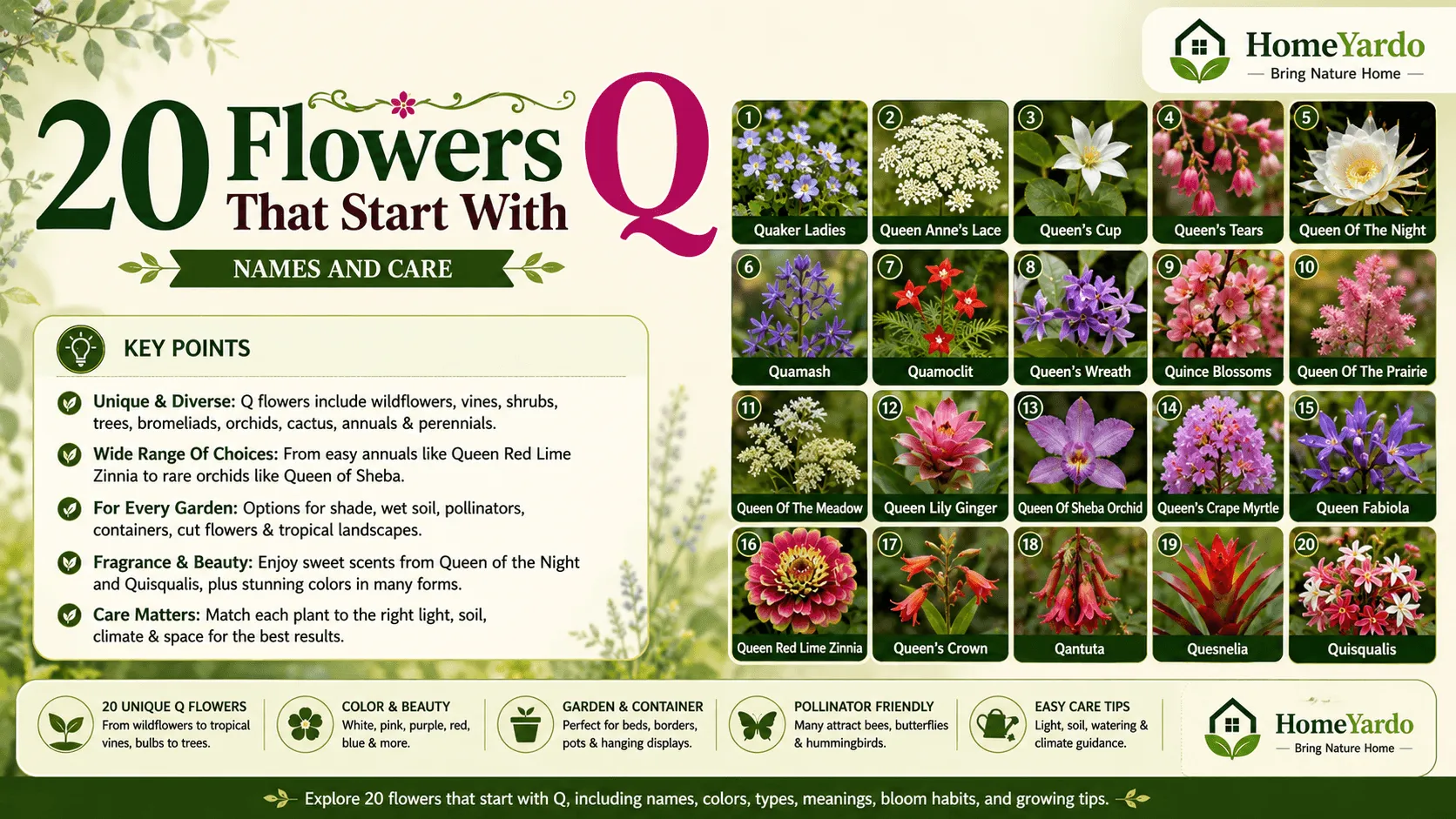
Some flower names that start with Q include Queen Anne’s Lace, Quaker Ladies, Queen’s Cup, Queen’s Tears, Queen of the Night, Quamash, Quamoclit, Quince Blossoms, Queen’s Wreath, and Qantuta.
The full list below includes 20 Q flower names with plant type, color, care notes, garden use, meaning, and bloom details.
Popular Flower Names Starting With Q

Some Q flower names are more familiar because they appear often in gardens, wildflower lists, container plant guides, and alphabet flower lists.
Popular flower names starting with Q include Queen Anne’s Lace, Queen’s Tears, Queen of the Night, Quamash, Quamoclit, Quince Blossoms, Queen’s Wreath, Queen Fabiola, Queen Red Lime Zinnia, and Quaker Ladies.
Queen Anne’s Lace is one of the most recognized Q flowers because of its white lace-like flower clusters. Queen’s Tears is popular for indoor and patio containers. Queen of the Night is known for its large, fragrant flowers that open at night. Quamoclit is valued as a fast-growing climbing flower, while Queen Red Lime Zinnia is a strong choice for easy summer color.
Accuracy Note
Q flower lists can become confusing because some names belong to true flowers, while others belong to flowering shrubs, vines, trees, bromeliads, orchids, cactus plants, or cultivars.
A clear list should label each plant properly. That makes it easier to know whether a flower is useful for borders, shade gardens, containers, indoor growing, cut flowers, tropical landscapes, or meadow planting.
A plant type label also helps separate stronger flower choices from broad plant names that may not fit flower intent well.
20 Q Flower Names
The table below keeps the full list of flowers that start with Q in one place, so the same flowers do not need to be repeated again in separate profiles. Use it to compare name, type, color, bloom timing, growing needs, garden use, and meaning.
| Common Name | Scientific Name | Plant Type | Main Color | Key Properties | Bloom, And Best Growing Conditions | Garden Use | Meaning And Interesting Fact |
|---|---|---|---|---|---|---|---|
| Quaker Ladies | Houstonia caerulea | Low wildflower | Pale blue, white, yellow center | Small spring blooms, low growth, pollinator-friendly | Spring to early summer; full sun to partial shade, moist or sandy soil, cool climates | Rock gardens, native beds, meadow edges | Often linked with simplicity because of its modest, delicate flowers |
| Queen Anne’s Lace | Daucus carota | Biennial wildflower | White, sometimes pale pink | Lace-like umbels, central dark floret, self-seeding habit | Midsummer to fall; full sun, well-drained soil, open meadow conditions | Pollinator gardens, cottage gardens, meadow planting | Symbolizes grace and delicate beauty, but can resemble toxic lookalikes |
| Queen’s Cup | Clintonia uniflora | Woodland perennial | White flower, blue berry later | Shade-loving, glossy leaves, small, star-like bloom | Late spring to early summer; moist woodland soil, cool shade, humus-rich ground | Shade gardens, woodland beds, and naturalized areas | Known for its single white flower and later blueberry |
| Queen’s Tears | Billbergia nutans | Bromeliad | Pink, green, purple, yellow | Arching stems, colorful bracts, indoor friendly | Winter to spring indoors or in mild climates; bright indirect light, sharp drainage, mild humidity | Containers, indoor displays, patios | Called Queen’s Tears because nectar may drip from the flowers |
| Queen Of The Night | Epiphyllum oxypetalum | Night-blooming cactus | White | Large fragrant flowers open at night, with a short bloom window | Late spring to summer; bright filtered light, cactus mix, warm temperatures | Containers, patios, and indoor plant collections | Known for dramatic flowers that open for a short time at night |
| Quamash | Camassia quamash | Bulb perennial | Blue, violet | Spring star-shaped flowers, meadow plant, naturalizing habit | Late spring to early summer; full sun to partial sun, moist spring soil, dry soil during rest | Meadow gardens, borders, naturalized beds | Historically valued by Indigenous communities as a food plant |
| Quamoclit | Ipomoea quamoclit | Annual vine | Red, pink, white | Star shaped flowers, fine feathery leaves, fast climber | Summer to fall; full sun, warm weather, well drained soil, climbing support | Trellises, fences, hummingbird gardens | Also called cypress vine because of its fine foliage |
| Queen’s Wreath | Petrea volubilis | Woody vine | Purple, lavender | Long hanging clusters, sandpaper-like leaves, tropical growth | Spring to summer in warm climates; full sun, warm climate, fertile well-drained soil | Pergolas, arches, tropical landscapes | The purple calyces can remain attractive after the true flowers fade |
| Quince Blossoms | Chaenomeles species | Flowering shrub | Pink, red, orange, white | Early spring flowers, thorny branches, fruit after bloom | Late winter to early spring; full sun to part sun, well-drained loam, hardy shrub conditions | Hedges, borders, cottage gardens | Often linked with spring renewal and love |
| Queen Of The Prairie | Filipendula rubra | Herbaceous perennial | Pink | Tall plumes, moisture loving, pollinator value | Summer; moist soil, sun to partial shade, rain garden conditions | Rain gardens, meadow gardens, pond edges | Its pink plumes create a soft meadow effect in summer |
| Queen Of The Meadow | Filipendula ulmaria | Herbaceous perennial | Creamy white | Fragrant flower clusters, wet soil preference, spreading habit | Summer; moist to wet soil, partial sun, meadow or streamside conditions | Wet meadows, naturalized areas, pond edges | Known for sweetly scented flowers and wetland value |
| Queen Lily Ginger | Curcuma petiolata | Tropical perennial | Pink bracts, yellow flowers | Showy bracts, lush leaves, tropical look | Summer to early fall; partial shade, rich moist soil, warm humid conditions | Containers, tropical beds, shaded patios | The colorful bracts are often more visible than the small true flowers |
| Queen Of Sheba Orchid | Thelymitra variegata | Terrestrial orchid | Purple, pink, yellow, white | Rare orchid, patterned petals, conservation interest | Late winter to spring in native habitat; specialized habitat, conservation sensitive conditions | Educational reference, rare plant collections only where legal | Known as a rare orchid and should not be collected from the wild |
| Queen’s Crape Myrtle | Lagerstroemia speciosa | Flowering tree | Pink, purple | Large summer blooms, ornamental bark, tropical tree form | Summer; full sun, warm climate, well drained soil | Shade tree, street planting, large warm gardens | A flowering tree, not a small bedding flower |
| Queen Fabiola | Triteleia laxa | Bulb perennial | Violet blue | Star-shaped blooms, drought tolerant once established | Late spring to early summer; full sun, well-drained soil, dry summer rest | Borders, cut flowers, bulb displays | Useful for late spring color and small cut arrangements |
| Queen Red Lime Zinnia | Zinnia elegans cultivar | Annual flower | Lime, rose, burgundy | Easy annual, long bloom period, strong cut flower | Summer to fall; full sun, warm soil, regular deadheading | Cut flower beds, borders, pollinator gardens | A cultivar name, not a wild species |
| Queen’s Crown | Dicliptera suberecta | Perennial | Coral, orange-red | Tubular flowers, gray-green foliage, pollinator value | Summer to fall; full sun to part sun, well-drained soil, warm climate | Pollinator beds, containers, dry gardens | Attractive to hummingbirds where the climate allows |
| Qantuta | Cantua buxifolia | Flowering shrub | Red, pink, yellow | Tubular hanging flowers, Andean shrub, cultural value | Spring to summer; sun to light shade, cool mountain style conditions, well-drained soil | Ornamental shrub, cultural gardens, educational planting | National flower of Peru and Bolivia |
| Quesnelia | Quesnelia species | Bromeliad | Red, pink, blue, purple | Tropical rosette, colorful bracts, container-friendly | Varies by species; bright filtered light, airy bromeliad mix, humidity | Tropical containers, greenhouse displays | A bromeliad group with species that vary in flower color and form |
| Quisqualis | Combretum indicum | Climbing vine | White, pink, red | Fragrant flowers, color-changing blooms, vigorous vine | Warm season bloom; full sun, warm frost-free climate, support structure | Fences, pergolas, tropical fragrance gardens | Meadow gardens, borders, and naturalized beds |
Many classic garden blooms appear in flowers that start with s, making it a useful next alphabet guide.
Types Of Flowers That Start With Q

Q flowers are easier to understand when they are grouped by plant type. Some are low wildflowers for natural beds. Some are woody plants for structure. Some climb, bloom indoors, or need frost protection.
This grouping also helps avoid confusion between true flowers, flowering plants, and ornamental plants grown mainly for bracts, fragrance, or unusual bloom habits.
Wildflowers And Meadow Plants
Quaker Ladies, Queen Anne’s Lace, Quamash, Queen of the Prairie, and Queen of the Meadow work well in meadow style, native style, pollinator, or moisture-rich plantings.
Quaker Ladies stay small and delicate. Queen Anne’s Lace gives a soft cottage look, but can spread quickly. Quamash suits naturalized spring beds. Queen of the Prairie and Queen of the Meadow are better for moist soil and larger spaces.
Vines And Climbers
Quamoclit, Queen’s Wreath, and Quisqualis are climbing Q flowers. They need a trellis, fence, arbor, pergola, or other firm support.
Quamoclit is usually grown as a warm-season annual vine. Queen’s Wreath and Quisqualis suit warm climates best. In cooler regions, they need protected container culture or greenhouse care.
Shrubs And Flowering Trees
Quince Blossoms, Qantuta, and Queen’s Crape Myrtle add structure to a garden. These plants need more room than low perennials or bedding annuals.
Quince brings early spring color and can work in hedges. Qantuta is valued for hanging tubular flowers and its cultural meaning. Queen’s Crape Myrtle is a flowering tree for warm regions and larger landscapes.
Bulbs And Perennials That Start With Q
Queen Fabiola, Quamash, Queen’s Cup, Queen’s Tears, Queen Lily Ginger, Queen of the Night, and Quesnelia all fit into bulb or perennial style growing, but they do not need the same care.
Quamash and Queen Fabiola are bulb perennials. Queen’s Cup prefers cool shade. Queen’s Tears and Quesnelia are bromeliads. Queen of the Night is a cactus plant. Queen Lily Ginger gives tropical foliage and showy bracts.
Purple Flowers That Start With Q

Purple Q flowers are useful for color-themed beds, tropical gardens, bulb displays, and flowering trees. Their shades can range from lavender and violet to blue, purple, or pink.
Strong purple choices include:
- Queen’s Wreath for lavender to purple vine flowers on arbors and pergolas.
- Queen Fabiola for violet blue bulb flowers in borders and cut flower beds.
- Quamash for blue violet spring flowers in meadow style planting.
- Queen of Sheba Orchid for rare purple, pink, and yellow markings.
- Quesnelia for tropical red, blue, or purple tones, depending on species.
- Queen’s Crape Myrtle for pink and purple summer flowers on a warm-weather tree.
For more violet and purple bloom ideas, compare this list with flowers that start with v.
Rare Flowers That Start With Q

Rare Q flowers can be unusual for different reasons. Some are hard to find in common nurseries. Some are tied to a narrow region. Some are conservation sensitive. Others are rare because their bloom habit is unusual.
Queen of Sheba Orchid is one of the most special Q flowers because it is habitat-specific and conservation-sensitive. Queen of the Night feels rare because the large white flowers open at night for a short period.
Qantuta is unusual because of its Andean identity and cultural value. Quesnelia is a specialty bromeliad group. Quisqualis is easier in warm climates but less practical for cold gardens unless grown with protection.
These rare choices are best treated with care. Plants connected to wild habitats should be admired through trusted nurseries, botanical gardens, or educational sources rather than wild collection.
Annual Flowers That Start With Q

Annual Q flowers are useful for fast seasonal color, cut flower beds, trellises, and warm summer displays. They complete their main growing and blooming cycle in one season, although some may reseed or behave differently in warm climates.
Queen Red Lime Zinnia and Quamoclit are the main annual choices in this Q flower list. Queen Red Lime Zinnia is a colorful bedding and cut flower with lime, rose, and burgundy tones. It grows best in full sun, warm soil, and well-drained conditions.
Quamoclit, also called cypress vine, is an annual climbing flower with star-shaped blooms and fine, feathery foliage. It works well on trellises, fences, and hummingbird-friendly garden supports.
For a wider mix of annual and perennial garden flowers, visit flowers that start with m.
Container Flowers With Q

Container growing is useful for Q flowers that need controlled soil, patio display, or winter protection. It also helps with plants that are too tender for cold garden beds.
Good Q flowers for containers include:
- Queen’s Tears for indoor or patio bromeliad displays.
- Queen of the Night for a container cactus with large, night flowers.
- Queen Lily Ginger for a warm, shaded patio pot.
- Quesnelia for greenhouse or bright indoor container growing.
- Queen Red Lime Zinnia for summer pots and cut flower color.
- Queen Fabiola for well-drained bulb containers.
- Quamoclit for a deep pot with a small trellis.
Container plants need drainage holes, a suitable potting mix, and the right light level. Tropical plants should be kept away from cold windows and moved indoors before frost. Sun-loving annuals need strong light, while bromeliads and night-blooming cactus plants prefer bright filtered light. Container gardeners may also enjoy flowers that start with o for more unusual flower names.
Indoor Flowers With Q

A few Q flowers can grow indoors or spend part of the year indoors. These are mostly tropical plants, bromeliads, and cactus types that adapt well to pots.
Queen’s Tears is one of the best indoor Q flower choices because it stays manageable and produces colorful, arching blooms. Queen of the Night can also work indoors when grown in a bright spot with careful watering.
Quesnelia may grow well in bright filtered light with humidity and an airy potting mix. Queen Lily Ginger can be overwintered in containers, but it needs warmth, moisture, and filtered light.
Most meadow flowers and large vines are not ideal indoor plants. Indoor success is stronger with plants that naturally handle container life and controlled watering.
Best Q Flowers For Home Gardens

The best Q flower depends on the purpose of the planting. A shaded bed, wet meadow, tropical arbor, container display, and cut flower patch all need different choices.
| Garden Need | Best Q Flower Choices |
|---|---|
| Beginner flower | Queen Red Lime Zinnia, Queen Fabiola, Quamash |
| Pollinator garden | Queen Anne’s Lace, Quamoclit, Queen’s Crown, Queen of the Prairie |
| Shade garden | Queen’s Cup, Queen’s Tears, Queen Lily Ginger |
| Wet soil | Queen of the Prairie, Queen of the Meadow, Quamash |
| Tropical garden | Queen’s Wreath, Quisqualis, Quesnelia, Queen Lily Ginger |
| Cut flowers | Queen Red Lime Zinnia, Queen Fabiola, Queen Anne’s Lace |
| Fragrant flowers | Queen of the Night, Quisqualis, Quince Blossoms |
For easy annual color, Queen Red Lime Zinnia is one of the simplest options. For shaded areas, Queen’s Cup and Queen’s Tears are better fits. For warm climates, Queen’s Wreath and Quisqualis bring a stronger tropical look.
Which Q Flowers Smell The Best?
Fragrance varies by plant health, weather, time of day, and variety. Some Q flowers have only a soft scent, while others are known for a stronger perfume.
| Flower | Fragrance Strength | Scent Type | Best Time To Notice Scent |
|---|---|---|---|
| Queen of the Night | Strong | Sweet, night fragrant | Night |
| Quisqualis | Strong | Sweet, tropical, warm | Evening and warm weather |
| Queen Lily Ginger | Moderate to strong | Spicy, floral, tropical | Warm humid conditions |
| Quince Blossoms | Light to moderate | Fresh, spring-like, soft | Spring daytime |
| Queen Anne’s Lace | Light | Green, herbal, mild | Warm sunny days |
Fragrance is strongest when plants are healthy, well-watered, and placed in the right light. Night fragrant flowers, such as Queen of the Night, are better near patios or windows where the scent can be noticed after sunset.
Tropical Vs Temperate Q Flowers
Q flowers come from different climates, so planting success depends on matching each plant to the right conditions. Tropical choices need warmth and frost protection. Temperate choices are better for cool gardens, seasonal beds, or meadow-style planting.
Tropical Q flowers include Queen’s Wreath, Quisqualis, Quesnelia, and Queen Lily Ginger. These plants need heat, humidity, and protection from cold. In cooler regions, container culture is usually safer.
Temperate Q flowers include Quamash, Queen’s Cup, Quaker Ladies, Queen of the Prairie, and Queen of the Meadow. These plants often need seasonal moisture, winter rest, or cool woodland conditions.
Warm-season annuals include Quamoclit and Queen Red Lime Zinnia. Indoor-friendly choices include Queen’s Tears, Queen of the Night, and Quesnelia.
A plant that grows all year in a warm climate may need a container in a colder region. This is especially true for bromeliads, tropical vines, ginger relatives, and night-blooming cactus plants.
Meaning And Symbolism Of Flowers Starting With Q
Flower meanings can vary by culture, region, and tradition. For Q flowers, symbolism is often tied to appearance, rarity, fragrance, season, or history.
Queen Anne’s Lace is often linked with grace, sanctuary, and delicate beauty. Queen of the Night can suggest rare beauty, mystery, and fleeting moments because the bloom opens for such a short time.
Qantuta carries heritage, pride, and celebration because of its cultural value in Peru and Bolivia. Queen’s Tears can suggest resilience, friendship, and tenderness. Quince Blossoms are often connected with spring renewal, love, and fertility.
Queen’s Wreath can suggest endurance and lasting beauty because the colorful calyces remain attractive after flowering. Queen’s Cup feels simple and woodland-based. Queen Red Lime Zinnia can suggest creativity, warmth, and long-lasting affection.
Meanings should be treated as symbolic notes, not botanical facts. The real value of a flower also depends on how it grows, where it is planted, and how it is used.
How Many Flowers Start With The Letter Q?
There is no fixed number because the Q flower lists count names in different ways. Some include only common flower names. Others include botanical names, cultivars, flowering shrubs, vines, trees, orchids, bromeliads, cactus plants, grasses, and ornamental plants.
That is why a useful Q flower list should explain what each plant is, not just name it. Some entries are true wildflowers. Some are cultivars. Some are flowering trees or shrubs. Some are grown for bracts, fragrance, seed heads, or fruit blossoms instead of classic petals.
A better count is not always the largest count. The strongest list should explain whether each plant is useful for gardens, containers, indoor growing, cut flowers, pollinators, shade, wet soil, tropical planting, or educational use.
Scientific names also reduce confusion because common names can overlap by region. They make it easier to check plant type, bloom habit, growing needs, and safety notes before planting.
Edible Plants Vs Flowers That Start With Q

Not every Q entry belongs in the same category. Some are true ornamental flowers, while others are edible plants, flowering shrubs, vines, trees, bulbs, bromeliads, orchids, or cactus plants. Clear labeling helps prevent confusion when a plant is grown for beauty, food, history, fragrance, fruit, or landscape structure.
Quamash is one example that can create confusion because it has historical food use, but it is also grown as a spring-flowering bulb. Queen Anne’s Lace can also be confusing because it is related to carrots, yet it has dangerous toxic lookalikes and should not be treated as an edible plant without expert identification.
Quince Blossoms come from a fruiting shrub, but the blossoms are usually discussed as ornamental flowers in garden lists. In this article, Q flowers are treated mainly by their bloom value, garden use, plant type, and care needs rather than food use.
Safety And Regional Notes
Some Q flowers need extra care before planting, handling, or identifying. Queen Anne’s Lace can resemble toxic plants in the carrot family, so it should not be used for food, medicine, or wildflower picking unless identification is confirmed by a qualified local source.
Queen Anne’s Lace can also spread aggressively in some areas. In some regions, it may be treated as a weed or restricted plant, so local guidance should be checked before planting it.
Tropical vines may also grow too strongly in warm climates. Rare orchids and native plants should not be removed from wild habitats. Queen of Sheba Orchid is especially sensitive because it is tied to limited native habitats and conservation concerns.
Bulbs, berries, seeds, leaves, or roots from some plants may be unsafe for pets or people. Local extension guidance is useful before planting species known to spread, naturalize, or behave aggressively in a specific region.
Conclusion
Q flower names are less common than many other flower groups, but they include a useful mix of wildflowers, vines, shrubs, trees, bromeliads, cactus plants, orchids, annuals, and perennials.
For easy color, Queen Red Lime Zinnia and Queen Fabiola are strong choices. For fragrance, Queen of the Night and Quisqualis stand out. For shade, Queen’s Cup and Queen’s Tears are better fits. For tropical style, Queen’s Wreath, Quesnelia, and Queen Lily Ginger bring the strongest look. To continue the alphabet series, explore flowers that start with l for more familiar garden options.
FAQ’s
Queen Anne’s Lace is one of the most recognized Q flowers. It is known for white lace-like flower clusters, meadow growth, and pollinator value. It can also spread quickly in some regions, so local planting guidance should be checked before adding it to a garden.
Common Q flower names include Queen Anne’s Lace, Quaker Ladies, Queen’s Cup, Quamash, Quince Blossoms, Queen of the Prairie, and Queen’s Tears. Availability depends on climate, region, and nursery stock.
Perennial Q flowers include Quamash, Queen’s Cup, Queen of the Prairie, Queen of the Meadow, Queen’s Tears, Queen Lily Ginger, Queen Fabiola, and Queen of the Night. Some tropical perennials need indoor winter protection.
Yes. Queen’s Tears, Queen of the Night, Quesnelia, and Queen Lily Ginger can grow indoors or in containers with the right care. Most need bright filtered light, drainage, and protection from cold drafts.
Queen Red Lime Zinnia, Queen Fabiola, Quamash, Queen’s Tears, and Quince Blossoms are good beginner choices. Success depends on matching each plant to the right sunlight, soil, water, and climate.
Rare Q flowers include Queen of Sheba Orchid, Qantuta, Quesnelia, Queen of the Night, and Quisqualis. Some are rare because they are region-specific, conservation sensitive, tropical, or uncommon in local nurseries.
Purple Q flowers include Queen’s Wreath, Queen Fabiola, Quamash, Queen of Sheba Orchid, Quesnelia, and Queen’s Crape Myrtle. Their shades range from lavender and violet to pink, purple, and blue.
No. Some Q entries are true herbaceous flowers, while others are flowering shrubs, vines, trees, bromeliads, orchids, cactus plants, or cultivars. Clear plant type labels help show whether the plant is useful for garden beds, containers, shade, cut flowers, or tropical planting.
Yes. Queen’s Tears, Queen of the Night, Quesnelia, Queen Lily Ginger, Queen Red Lime Zinnia, and Queen Fabiola are good container choices. Quamoclit can also grow in a pot if given a trellis.
References
- Frosting and Glue
- BioExplorer
- A Z Animals
- Trillium Montessori
- BloomHowTo
- FlowersNames
- A To Z Flowers
- LearningVale
Botanical And Gardening References