
Polyaspartic Garage Floor Coating: Cost, Pros, Cons, Epoxy Comparison & Buying Guide
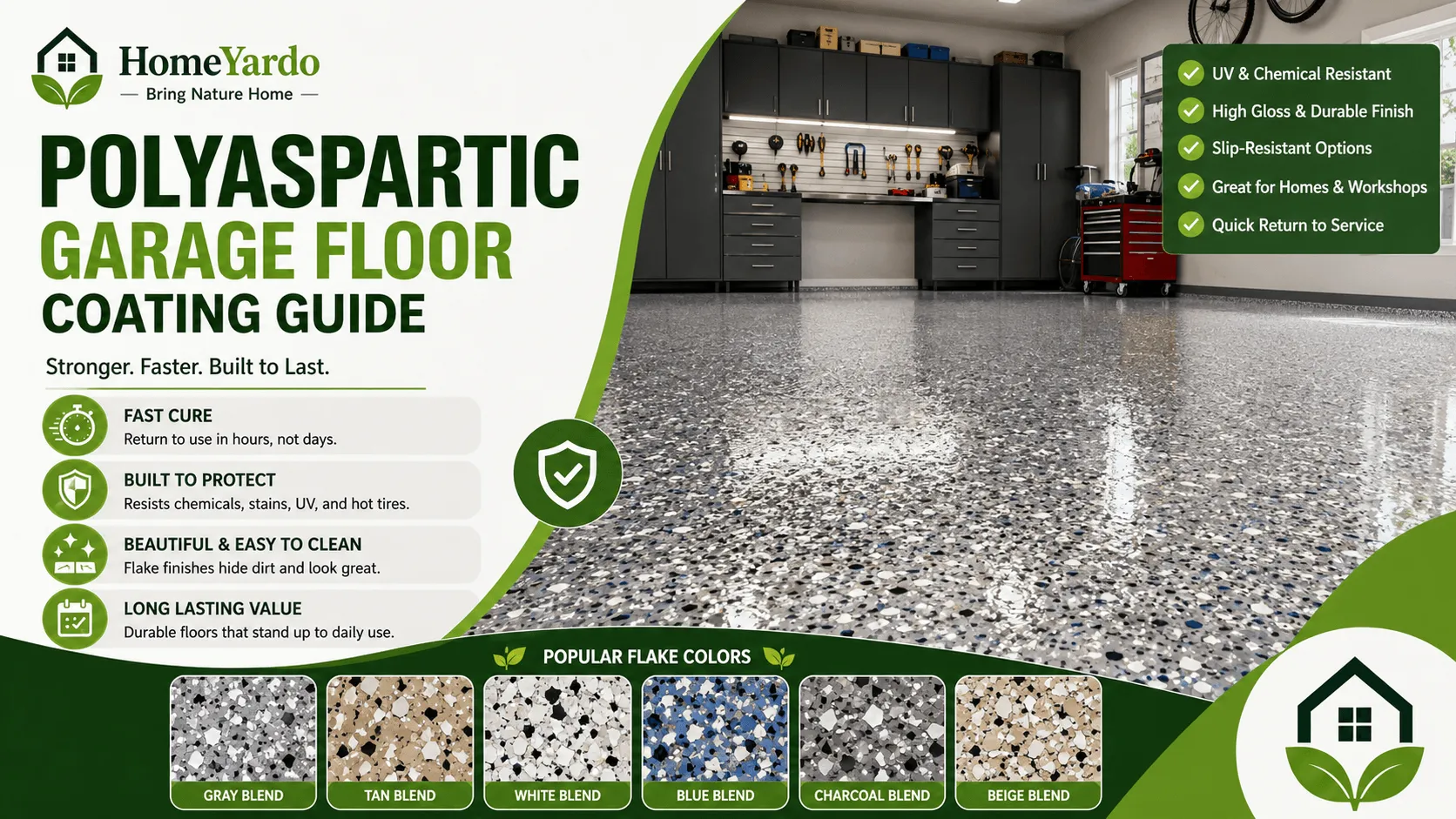
A polyaspartic coating can transform the dull, discolored and vulnerable surface of a concrete garage into a cleaner, brighter and more protective surface. It is recognized for its speedy curing, UV resistance, chemical resistance, decorative flake finishes, and cleanability.
The name of the product is not enough to determine the floor’s lifespan. Good results require the concrete, surface preparation, moisture conditions, coating layers, topcoat, texture, cure window and installer process.
A well installed system will be able to accommodate daily parking, sunlight, road dirt, oil drips, hot tires, road salt, and normal garage traffic. A weak installation may peel, bubble, smell for an extended period of time, or appear slippery when wet.
This guide will help you understand the cost, colors, thickness of the coating, installation conditions, comparison to epoxy, comparison to polyurea, safety, smell, sample checking, recoating, warranty red flags, and questions that you should ask your contractor before you choose a garage floor system.
Quick Answer: Is Polyaspartic Garage Coating Worth It?
Polyaspartic coating is a good value when a quick return to use is desired, UV stability is important, stain resistance is required, and a clean finished appearance is desired. It is a very good choice for garages in direct sunlight and hot tires, oil, road salt, tools and traffic.
It may not be the best option if there are active moisture issues, significant concrete damage, limited warranty coverage, or a low budget. Not all one day garage floors are created equal. Even though the installation is fast, the proper grinding, dust control, moisture testing, repair, and cure schedule are still required.
The most reliable method to judge the floor is to compare the whole system, not just the name of the coating. Find out what basecoat is used, what topcoat is used, how they add traction, when they can come back, and what is not covered by the warranty.
| Key Takeaway | What It Means |
|---|---|
| Best for fast garage use | Many systems allow faster return than epoxy |
| Prep controls success | Grinding, cleaning, and moisture checks matter |
| Texture matters | Smooth glossy floors can feel slick when wet |
| Cost is higher | Compare system details, not only price |
| Warranty needs review | Ask what peeling, moisture, and hot tires exclude |
Polyaspartic is best suited for a garage that is prepared for coating and a careful installation process. Weaker when rushed, concrete is damp, or hides details of prep, products, and cure time.
What Is Polyaspartic Garage Floor Coating?

Polyaspartic coating is a 2-part resin system that is applied on top of existing concrete. It is frequently applied to garage floors, workshops, utility spaces, showrooms, commercial concrete floors and decorative flake systems.
Polyaspartic is a type of polyurea coating. It’s formulated to cure rapidly yet provide the installers with more working time than some pure polyurea systems. The majority of polyaspartic coatings are resin and catalyst that react upon mixing.
Polyaspartic systems have a chemistry called polyaspartic ester. Polyaspartic urethane is also referred to as high performance coating by some contractors or manufacturers.
The installed system is more important to a homeowner than the label. It should describe the product used in each layer, if any, whether it is a basecoat or topcoat and what the final wear layer will consist of.
| Term | Plain Meaning | What To Ask |
|---|---|---|
| Polyaspartic | Fast curing concrete coating | Is it basecoat, topcoat, or full system? |
| Polyurea | Related fast curing coating | Is it used under the flakes? |
| Polyurea polyaspartic | Layered or blended wording | Which product is used in each layer? |
| Polyaspartic epoxy | Often means a hybrid system | Is epoxy the basecoat or only a marketing term? |
| Polyaspartic urethane | Product family wording | Ask for the product data sheet |
Should not use the name of a coating as a substitute for the information provided in the coating specification. Should include the basecoat, topcoat, flake layer, product data, cure schedule and warranty in plain English.
How Does Polyaspartic Garage Flooring Work?

Polyaspartic floor is a multi-layered coating system. It does not involve the same process as just applying a plain concrete paint to the floor.
Concrete is made first. The surface is typically diamond ground or shot blasted to allow the coating to adhere to a clean, open surface. Cracks, pits, spalling, oil contamination, and weak concrete should be dealt with prior to coating.
Once prepared, a basecoat is applied. Decorative flakes are sprinkled in the wet basecoat. After the flakes have cured, the floor is scraped, cleaned and covered with a clear protective topcoat.
Polyaspartic top coat is frequently the last layer of wear. Resists fading, tire marks, stains, abrasion and regular cleaning of the colour system. There are some systems that feature a polyurea basecoat and a polyaspartic topcoat. Others combine epoxy with polyaspartic, using epoxy as the base and polyaspartic as the protective coat.
The thickness of the coating should not be guessed; it should be taken from the product specification. A large number of polyaspartic coatings are applied in the thin film range, typically in the range of 5-20 mils depending on the system design. Finish may vary depending on primer, basecoat, flakes, number of topcoats, and product.
Is the thickness mentioned per coat or is a total system build? Inquire if there is a specific time period for recoating the topcoat. If the system is not designed to be coated thicker, it is not necessarily better.
A helpful spec sheet check should have the following: Product name, Coat thickness, Recoat window, Cure schedule, VOC or odor notes, Slip resistance option, and Compatible basecoat. This information will make it easier to compare floors between contractors.
Pros And Cons Of Polyaspartic

While there are definite advantages to polyaspartic coating, there are also some drawbacks. Performance, cost, ease of installation, smell, surface texture and warranty should all be part of a fair decision.
| Pros | Cons |
|---|---|
| Fast return to use | Higher upfront cost |
| Better UV stability than many epoxies | Short working time during installation |
| Strong stain resistance | Not very forgiving for DIY work |
| Resists many garage chemicals | Odor can be noticeable during application |
| Decorative flakes and color blends | Smooth glossy finishes may feel slick when wet |
| Easier cleaning than bare concrete | Moisture issues can cause failure |
| Good option for sun exposed garages | Poor prep can lead to peeling or bubbles |
The majority of the disadvantages are related to the installation. A good slab that is clean, dry enough, and properly cured and textured will react differently from a rushed floor over dusty or damp concrete.
Low VOC does not necessarily mean odor free. Even during application and early cure, a garage may require ventilation. A few polyaspartic systems can be a poor fit for severe commercial solvent exposure; a different chemical resistant topcoat may be more appropriate.
Polyaspartic Floor Coating Cost

Costs are not just based on the square footage. If one of two garages of the same size has clean, smooth surfaces and the other has some cracks, spalling, oil stains, old coating or moisture, the price will be different.
Price examples on the web can help set expectations, but should not be considered universal pricing. The cost varies depending on the local labor, concrete condition, coating system, warranty, and project timing.
If there is a price breakdown, it should be clear what is being included. It should include a total price and a color selection. The price should factor in grinding, repairs, moisture checks, basecoat, flakes, topcoat, texture, cure schedule, and warranty exclusions.
| Estimate Item | Why It Matters |
|---|---|
| Square footage | Prevents vague pricing |
| Grinding method | Shows prep quality |
| Repair scope | Clarifies cracks, pits, and spalling |
| Moisture testing | Reduces failure risk |
| Basecoat type | Shows system structure |
| Flake coverage | Affects material and appearance |
| Topcoat type | Controls wear layer quality |
| Traction additive | Affects wet grip |
| Cure schedule | Prevents early vehicle damage |
| Warranty exclusions | Clarifies real protection |
Lowest price doesn’t always mean the best value, as it could be missing surface preparation, moisture testing, crack repair, or traction planning. The best price comparison is the total system.
Epoxy Vs Polyaspartic Cost
Epoxy is typically less expensive than polyaspartic. It can have a longer working time and may be more forgiving when installing. Polyaspartic is more expensive due to its quick curing time, less forgiving nature and typically professional installation.
A hybrid epoxy plus polyaspartic system can be used in between a budget epoxy floor and a full polyaspartic system. In that case, epoxy resin for concrete floors can be applied as a base coat, and polyaspartic as a clear protective top coat.
Layer system, prep method, downtime, coating performance and warranty support should be compared to cost. If the epoxy floor is being used for low levels of sunlight and light use, then a cheaper epoxy floor may be appropriate. Consider a polyaspartic system if quick return to use is important, UV stability is a concern and long term finish quality is a concern.
If budget and longer cure time are acceptable, a step-by-step guide on how to epoxy a garage floor can help compare the DIY route with a faster polyaspartic system.
Polyaspartic Vs Epoxy Garage Floor Coating
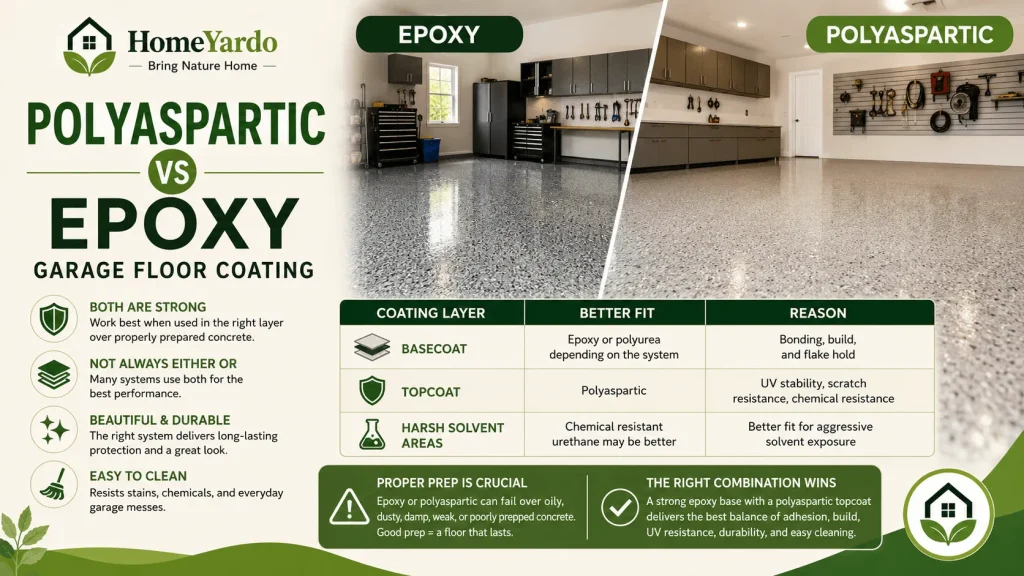
It isn’t always easy to pick the winner in the polyaspartic garage floor coating vs epoxy garage floor coating debate. Both materials can work well when used in the right layer and installed over properly prepared concrete.
Epoxy resin for concrete floors may be helpful as a basecoat. It can be used to create thickness and adhere to ground concrete. Polyaspartic is sometimes used as the last coat because it dries quickly, is more resistant to UV yellowing and is good for many of the common cleaning and staining needs of garages.
It’s not always a question of epoxy or polyaspartic. Many good coating systems employ both materials. The bonding and flake hold may be achieved by epoxy or polyurea, and the final wear surface is achieved by polyaspartic. For a wider look at resin-based coating systems, the epoxy resin flooring guide explains how epoxy works across garage and interior concrete surfaces.
| Coating Layer | Better Fit | Reason |
|---|---|---|
| Basecoat | Epoxy or polyurea depending on the system | Bonding, build, and flake hold |
| Topcoat | Polyaspartic | UV stability, scratch resistance, chemical resistance |
| Harsh solvent areas | Chemical resistant urethane may be better | Better fit for aggressive solvent exposure |
Epoxy is not to be taken lightly. When prepared properly, it can be a valuable base layer when the slab is done well. Don’t consider polyaspartic as a fail-safe for poor concrete. Both systems can be affected when the floor is oily, dusty, damp, weak or not well grounded.
The correct material with the correct layer is a strong epoxy and polyaspartic floor. That can provide a balance of adhesion, build, UV resistance, appearance and cleanability.
Polyaspartic Vs Polyurea Garage Floor Coatings

The terms polyaspartic and polyurea coatings can be confusing due to the similarities between the two. Polyaspartic is an alternative to polyurea. The change enables fast cure and provides greater control for the installation.
Pure polyurea can cure extremely rapidly, often so fast that it is difficult to work with over a wide area, such as a garage floor. Polyaspartic provides additional working time for flake broadcast, topcoat leveling and finish control.
Aliphatic systems are typically selected for applications where UV stability is crucial while aromatic coatings are more susceptible to discoloration in sunlight. The obvious question for a homeowner is: which layer adheres to the concrete, which layer contains the flakes and which layer is the end product to wear?
When the estimate reads “polyurea polyaspartic,” inquire about which layer is polyurea and which is polyaspartic. Question: What product contains the flakes, what product forms the topcoat and what is the cure time for each coat?
The project should be clearly described in the written project details. Any term that is ambiguous, such as “poly system” or “polyaspartic epoxy,” should be clarified before signing.
Types Of Garage Floor Coatings

Polyaspartic is one of the types of garage floors, but there are others. It will depend on the budget, the condition of the slabs, the amount of downtime, the design and the use of the garage.
Epoxy tends to be used in budget controlled projects or basecoat systems. Polyurea is frequently applied in quick professional systems. For some homes, polyurethane can be applied as a topcoat instead of an entire garage floor system. Concrete sealer provides minimal protection and little decorative effect. Garage tiles and mats are not cured and don’t bond to the slab like a coating system.
Coatings are applied to pre-formed concrete to form a surface bond. Tiles and mats are placed on top and can be removed. Sealers are easier to apply to the concrete, but they typically do not offer the same flake finish and wear layer as a coating system.
The term polymer garage floor coating is a general term. Poly floor coating can be polyurea, polyurethane, polyaspartic or a system that incorporates multiple materials.
Best Polyaspartic Floor Coating System For A Garage

The most effective polyaspartic coating system will be determined by the slab and how the garage will be used. The repair work, texture, thickness of coating and topcoat performance may be different for a clean newer slab, an older cracked slab, a workshop, an EV garage and a wet climate garage.
A parking garage that is used daily must be hot tire resistant, easy to clean, and have excellent traction. In a workshop, greater scratch resistance and a thicker wear surface may be required. Tire mark resistance, rolling load support, and ease of clean up around the charging area are all potential requirements for an EV garage. A wet climate garage requires improved texture and road salt cleanup.
Polyaspartic concrete coatings are suitable for garages, workshops, and utility rooms, as well as certain commercial concrete applications, such as showrooms. The ideal system for most homes is one that will complement the slab condition, moisture content, traffic and texture requirements.
With a fast cure system and full flake broadcast, a clean, newer slab might be suitable. Older cracked slab requires more attention to repair the bonding of the depth and basecoat. High sun garages require a clear topcoat that will resist the damaging effects of the sun’s UV rays. A garage that is exposed to the harsh solvents may require a different chemical resistant topcoat.
A system typically consists of a polyurea basecoat and a polyaspartic topcoat, an epoxy basecoat and a polyaspartic topcoat, or a polyaspartic system. Check the sample board, product data sheet, coating layers and cure schedule before selecting.
How To Install Polyaspartic Floor Coating?

The installation of polyaspartic coating should begin with the concrete itself, and not the bucket of coating. The slab should be clean, dry, mechanically prepared and repaired prior to coating.
The first step in a professional job is to clean the garage. The installer inspects cracks, pits, oil stains, old coatings, moisture exposure, and weak concrete. The floor is then diamond ground or shot blasted to provide a better surface profile.
Grinding is followed by the repair of cracks and spalled areas. Appropriate vacuum equipment is used to remove dust. A basecoat is applied, followed by the broadcast of flakes into the wet basecoat, then the loose flakes are scraped after cure, and a clear polyaspartic topcoat is applied.
Some one-day systems have a rapid timeline. It may take several hours to prepare the surface. When the slab is in good condition, basecoat, flakes and topcoat can be applied on the same day. Light foot traffic can be accommodated in some systems within hours, vehicle traffic several hours to days depending on product and conditions.
Grinding, repair, dust removal, flake control, topcoat timing, ventilation, and clear cure instructions should still be provided during the installation of a one day garage floor coating. Quick doesn’t mean hurried. If the garage door is difficult to lift, noisy, or uneven, handle garage door spring replacement before floor coating work begins so the space is safer to clear and prepare.
Polyaspartic Cure Time And Return To Use

The cure time of polyaspartic may vary due to product formula, slab temperature, air temperature, humidity, moisture, coating thickness, and ventilation.
Light foot traffic may be possible on some floors the same day. Others may require waiting until the next day. In some systems, traffic can be permitted after 24 hours, and in others, after 48 to 72 hours. In some systems, traffic is permitted after 24 hours, and in others, after 48 to 72 hours.
There is no single cure time. A floor can be dry to the touch and not ready for storage items. It may be safe for light foot traffic, but not hot tyres. Can be vehicle ready before full chemical resistance is achieved.
Cold temperatures will slow the cure; a typical range for best results is 50°F to 85°F. Working time may be reduced in hot conditions and the likelihood of roller marks or an uneven finish may increase. Cure and adhesion may be affected by high humidity.
Follow the written care schedule provided by the installer or manufacturer. Walk on time, storage ready time, vehicle ready time, and full chemical resistance are various milestones.
Surface Preparation And Moisture Testing

Surface preparation is one of the best predictors of coating performance. An over-dusted, oily, weak, damp or poorly profiled concrete surface is not a suitable base for a premium polyaspartic concrete coating.
Garage coatings are typically prepared mechanically. Diamond grinding or shot blasting is done to open the surface to allow a better bond of the coating. Prior to the application of the coating system, attention must be given to edges, corners, cracks, spalling, and old coatings.
Avoid over-covering new concrete. A minimum cure period of 28 days is typical before coating new concrete, but product use instructions and site conditions will also influence this.
Moisture testing is significant because it can lead to bubbles, cloudiness, peeling or adhesion failure due to moisture from the slab. If moisture is high, then the installer should be able to inform the client if the floor requires additional drying time, mitigation, densifier or a different coating plan.
An acid etching is not always as strong as mechanical grinding for a garage coating. Before starting work, it is important to discuss with the customer any of the following: old coating removal, concrete hardness checks, dust collection, crack repair, and oil removal.
The surface preparation work should be included in the project scope. If a contractor only discusses color and speed and not grinding, repairs, dust control, and moisture risk, he or she is missing information. Before coating near the garage opening, check the garage door weather stripping because poor sealing can allow water, dust, and drafts to reach the coated floor edge.
Common Polyaspartic Garage Floor Problems

Typical floor issues are caused by inadequate preparation, timing of installation, moisture, poor concrete strength, incorrect texture and inadequate warranty provisions.
If peeling occurs, it is usually a sign of poor grinding, dust, oil, moisture or weak concrete. Bubbles can be caused by moisture, humidity, trapped air, or fast coating time. Roller marks may occur if the product cures too quickly or if the installer fails to maintain the working window. When layers are applied outside of the recoat window, intercoat failure can occur.
There are also texture issues. If the large flakes are not flat before the topcoat, they can give a harsher texture. Smaller chips might feel smoother, but they will look different. If the floor is too smooth, it can be slippery when wet. A rough floor can harbor more dirt and can be uncomfortable to walk on.
Dust collection when grinding is also important. Loose dust can form a mess and, if not removed before coating, may have an impact on the quality of the coating.
Warranty confusion is another issue. A “lifetime warranty” is not of any use if it does not cover moisture failure, hot tire damage, peeling, and/or response to repair. When selecting the installer, the warranty should be checked beforehand.
One day is okay, but we shouldn’t push the crew to work on the timing of crack repair, basecoat, flake broadcast, scraping, vacuuming, and topcoat. The installation should be done within the product’s recoat window, not the appointment window.
Is Polyaspartic Slippery When Wet?

If the finish is too smooth, Polyaspartic can be slippery when wet. Water, snow, tire shine, oil, or road salt can decrease the grip on a shiny garage floor.
Texture helps. Skid resistance may be enhanced by the use of decorative flakes, quartz and traction additives. Another option is to add texture to the floor, which can make it slightly less easy to mop, depending on the use of the garage.
A thick bottom is better than a smooth, solid bottom. Quartz texture can provide increased traction, but it can be a bit rougher on the feet. In wet garages, added traction material can help with safety, but can also collect more dirt.
Inquire with the installer what kind of traction additive is being used, where it is going to be applied and how the floor will feel when wet. It helps to have a physical sample. Test the sample with wet shoes, if possible before approving the finish.
Is Polyaspartic Toxic Or Non Toxic?
The polyaspartic coating should be considered on two levels: installed and cured. During installation, coating products can have odor and chemical exposure concerns. Ventilation, PPE, safety data sheets, product data sheets and restricted garage access are important.
After proper curing, the floor is used as a finished product, following product and installer instructions. Low VOC does not necessarily indicate odor free and odor free does not indicate no precautions taken when applying.
Please remove children and pets from the garage before installation. Clear away open food, pet supplies, fabric storage and cardboard storage that can absorb odors. Inquire about the VOC level, odor level, ventilation, and safe return to use timing.
A conscientious contractor will be able to give you the product safety data sheet and product data sheet. These documents assist with verifying safety guidance, cure time, odor information and compatible use.
Non toxic garage flooring claims should be taken with a grain of salt. It is best to ask questions about the specific product, ventilation plan, safety measures and written care schedule.
How Long Does Polyaspartic Smell Last?

The polyaspartic odor tends to be most pronounced when applied and during early cure. The duration of the smell will vary with the product formulation, garage air movement, temperature, humidity, coating thickness and ventilation.
Low odor does not necessarily mean odor free. The cleaning may be quick with good air flow for some installations but for sensitive people, they might want to give it a longer airing time before they use the garage normally.
Extra planning is required for attached garages. If odor is an issue, close the door between the garage and living area. Take away any food, pet supplies, fabrics, cardboard storage, or items that can absorb odor.
Inquire about any products used that have low odors and how long the garage should be vented after application. Do not make hour guarantees without any product data or installer instructions to support it.
Polyaspartic Floor Coating Colors And Finish Options

Polyaspartic colors affect how the garage looks and how much dirt, dust, tire marks, road salt, and small debris show between cleanings. Color choice should be practical, not only decorative.
Common finishes include solid colors, full flake blends, partial flakes, quartz blends, glossy clear coats, and lower gloss finishes when available. Gray flake blends often hide dust well. Tan blends can warm up the space but may show dark tire marks more. Black and white blends look bold but may show dust on darker chips.
Flake size affects both texture and appearance. Smaller flakes can feel smoother. Larger flakes can create a bolder look but may feel rougher if not sealed well. Full flake broadcast can hide minor concrete imperfections better than a solid color finish.
Gloss level also matters. Higher gloss can make the garage look bright and clean, but it may show marks more easily. More texture can improve traction but may hold more dirt.
Color samples should be checked in the actual garage before final approval. Lighting, wall color, cabinets, vehicle color, and daylight can change how a flake blend looks. Polyaspartic coating pictures help with ideas, but physical sample boards are better for checking texture, gloss, flake size, and color depth.
Polyaspartic Garage Floor Coating Kit

Polyaspartic garage coating kits can come with resin, hardener, flakes, rollers, and instructions. Many kits do not come with the necessary equipment for surface preparation, while some will contain cleaners or etching products.
A kit does not equal a complete installation system. Typically, the most challenging tasks include batch timing, topcoat application, dust control, ventilation, crack repair, moisture checking, and grinding.
A full DIY solution might require patch material, mixing buckets, spike shoes, squeegees, edge tools, dust collection, correct rollers, respirator protection and a working time plan. There may also be moisture test tools required prior to coating.
The DIY polyaspartic coating can be used on small, clean slabs by skilled users. It is more dangerous on large garages, cracked concrete, wet slabs, hot days or on oil contaminated floors.
The key issue is not whether or not the kit can be used to coat concrete. The issue is really: Can the floor be prepared and coated during the product’s working time?
Can I Apply Polyaspartic Coating Myself?

Yes, it can be done by an experienced DIY’er, but it is more difficult than applying a standard concrete paint or slower curing epoxy. Less time to correct errors with a fast cure.
The primary problem is not only rolling the coating, but the more difficult part is the slab preparation, crack repair, moisture control, consistent batch mixing, even flake broadcasting and applying the topcoat before it sets.
If the timing is not right, working in small sections can result in lap lines. Working time may be reduced in hot weather. The uneven batch mixing may cause uneven color, cure, or texture of the floor.
If there is moisture variation throughout the garage, it is not sufficient to test a small area. Moisture problems can occur in different parts of a slab.
For DIY, a small clean open slab might be more realistic. If you have a large garage, a damaged slab, old coating, heavy oil staining, or if you are unsure of the moisture level, it’s best to hire a professional installer.
Polyaspartic Garage Floor Coating Installers

Price and color samples should not be the only criteria for judging polyaspartic coating installers. A good installer will be able to clearly communicate surface preparation, moisture risk, layers of coating, cure time, traction, product data, safety data and warranty exclusions.
Request product names, system layers and prep information in writing. It should indicate the type of floor (epoxy, polyurea, polyaspartic or hybrid).
A good installer should let the customer know if the floor will be diamond ground, will be tested for moisture, how cracks and spalling will be fixed, what basecoat will be used, what topcoat will be used, and when vehicles will be able to return.
Request photographs of other garages, not showroom ones. Inquire if old coatings are removed, who is responsible for failure repair, if moisture failure is not covered, and if hot tire pickup is covered.
Red flags from a warranty should not be ignored. If you don’t see the exclusions, beware of a “lifetime warranty”. If the installer doesn’t name the products, doesn’t test moisture, doesn’t provide a written vehicle return time, or can’t explain the repair process, be careful.
The following information should be included in a clear estimate: product data sheet, safety data sheet, preparation method, repair scope, coating thickness, basecoat, polyaspartic topcoat, texture, cure schedule, and warranty exclusions.
How Long Does Polyaspartic Coating Last?

With proper concrete preparation and good maintenance, polyaspartic coating can endure for many years. The lifespan is influenced by the condition of the slabs, moisture control, coating system, traffic, cleaning procedures, exposure to sunlight and warranty support.
A light use garage that is used daily for parking is going to be different than a garage used for working with rolling tool chests, floor jacks, metal work, and chemical spills. A garage that is exposed to road salt, tire shine, oil, or heavy grit may also require more cleaning attention.
Polyaspartic floor coating reviews can be helpful, but they should be taken with a grain of salt. A helpful review covers how old the floor is, the method of floor preparation, basecoat and topcoat, garage usage, climate, moisture exposure, and whether the installer adhered to the warranty.
A brief review of “looks great” is not as useful as a review that describes how the floor did after hot tires, winter salt, rolling equipment, and normal cleaning.
Do not confuse a hastily completed do-it-yourself project on a weak concrete foundation with a well-prepared professional system. The floor should be considered based on the conditions of the floor, and not just the star rating.
Maintenance For Polyaspartic Flooring

Flooring is easier to clean than bare concrete, but it still needs basic care. Dirt, grit, road salt, tire shine, and sharp metal can wear on the surface over time.
Sweep or dust mop the floor often. Clean oil, chemicals, tire dressing, and road salt instead of letting them sit. Use a mild cleaner approved by the installer or product maker. Avoid harsh solvents unless the product sheet says they are safe.
Seasonal care helps in wet or snowy climates. Rinse road salt during winter, clean oil spots quickly, place pads under heavy equipment, and check high traffic areas once or twice a year.
Tool cabinets, jacks, bikes, shelves, and heavy storage can scratch or pressure mark the floor if dragged. Use pads, wheels, or careful lifting when moving heavy items.
Good concrete floor coating maintenance does not need to be complicated. The main goal is to keep abrasive dirt and chemical residue from sitting on the surface.
Best Uses For Polyaspartic Concrete Coatings

Polyaspartic concrete coatings are most common in garages, but they can also be used in workshops, storage rooms, utility spaces, showrooms, and some commercial concrete floors.
They fit spaces where fast return to use, decorative finish, UV stability, stain resistance, and cleanability matter. A residential garage benefits from easier cleaning and a brighter finish. A workshop benefits from a stronger wear surface and better dust control. A showroom benefits from a glossy, finished look.
An EV garage can also benefit from a clean, bright, easy-to-maintain surface around the charging area. Tire mark resistance, rolling load support, and routine cleaning matter in that setting.
Many polyaspartic systems can be suitable for outdoor use, but the product and substrate must match the location. UV stability, slip resistance, drainage, moisture vapor, and temperature exposure should be confirmed before outdoor installation.
Garage use should stay at the center of the decision. Outdoor and commercial uses can show product range, but the best residential choice still depends on slab condition, moisture, traffic, and texture needs. For outdoor living projects, the porch vs patio guide can help decide which surface makes more sense before choosing any coating or finish.
When Polyaspartic May Not Be The Best Choice

Polyaspartic is a strong garage flooring option, but it is not the best answer for every floor. Some garages need concrete repair, moisture control, a cheaper coating, removable flooring, or a softer surface instead.
Severe moisture in the slab should be addressed before coating. Badly damaged concrete may need repair or resurfacing. A rental garage may be better suited to removable tiles or mats. A very tight budget may point toward epoxy, sealer, or another simpler option.
A garage used for heavy welding, harsh solvents, or major metal fabrication may need added protection or a different topcoat. Major slab movement can crack through the coating. Active water vapor can cause adhesion problems.
Polyaspartic may also be less practical if the garage cannot be cleared, if strong odor sensitivity is a concern, or if a softer standing surface is needed.
The best choice depends on the slab, use, budget, and expectations. Polyaspartic performs well when the garage is ready for it and the system is matched to real conditions.
Contractor Checklist Before You Buy

A coating estimate should make the process clear. If the estimate only says “polyaspartic garage” with a price and color, ask for more detail before signing.
Start with preparation questions. Ask whether the floor will be diamond ground, whether moisture will be tested, how cracks are repaired, whether old coatings are removed, and what dust collection system is used.
Then ask product questions. Ask for product names, basecoat type, topcoat type, coating thickness, traction additive, recoat window, and whether the thickness is per coat or total system build.
Warranty questions matter just as much. Ask what voids the warranty, whether peeling is covered, whether hot tire damage is covered, whether moisture failure is excluded, and who handles repair if a problem appears. For indoor flooring plans, red oak wood flooring is a better comparison point because hardwood and garage coatings solve different home surface needs.
| Prep Questions | Product Questions | Warranty Questions |
|---|---|---|
| Grinding method | Product names | What voids warranty |
| Moisture testing | Basecoat type | Peeling coverage |
| Crack repair | Topcoat type | Hot tire coverage |
| Old coating removal | Coating thickness | Moisture exclusions |
| Dust collection | Traction additive | Repair process |
Also inquire if polyaspartic can be applied to existing epoxy, and if old epoxy needs to be removed prior to the application of polyaspartic.
The scope of the project should include prep method, repairs, products, number of layers of coating, texture, cure schedule, warranty and exclusions.
Conclusion
Polyaspartic coating may be a significant improvement for a garage that requires a quick turnaround, UV resistance, chemical resistance, ease of cleaning and a final decorative surface.
The coating isn’t a substitute for poor concrete. The performance of the floor depends on surface preparation, moisture testing, crack repair, system layers, coating thickness, texture, cure time and installer skill.
Compare the entire system, not just the name of the coating, before selecting a contractor. Request product data sheet, safety data sheet, basecoat information, topcoat information, traction plan, cure schedule, and warranty exceptions. The most appropriate floor is the one that is suited to the slab condition, garage usage and long-term outlook.
FAQ’s
Polyaspartic is often better for UV stability, cure speed, and topcoat performance. It can be a strong choice when the garage needs fast return to use and better resistance to sunlight. Epoxy can still work well as a basecoat when the concrete is prepared correctly. The better choice depends on budget, downtime, sunlight exposure, slab condition, and the full coating system.
The cost depends on garage size, concrete damage, crack repair, moisture testing, coating layers, flake coverage, topcoat quality, and warranty terms. A larger or damaged slab usually costs more than a clean, open floor. A good estimate should explain exactly what preparation is included and what coating system is being installed. Price alone is not enough because a cheaper option may skip repairs, moisture testing, or proper surface grinding.
The main disadvantages are higher cost, short working time, installation odor, DIY difficulty, and possible slickness without added texture. These issues are often manageable when the system is chosen and installed correctly. Poor prep can also lead to peeling, bubbling, rough texture, or early coating failure. A clear estimate should explain surface prep, moisture testing, texture, cure time, and warranty exclusions.
Many polyaspartic floor coatings are installed in a 5 to 20 mil range, depending on product type and system design. The total thickness may change when the floor includes primer, basecoat, flakes, and one or more topcoats. Thickness should come from the product data sheet and written project details. A broad claim about a thick coating is less useful than a clear system specification.
Many polyaspartic systems can be applied in one day when the concrete is clean, dry enough, and not badly damaged. Fast cure makes same-day installation possible in the right conditions. Moisture, cracks, oil stains, old coating removal, humidity, and temperature can extend the project. A one-day floor should still include proper grinding, repair, dust removal, topcoat timing, and written cure instructions.
Some systems allow vehicle traffic after about 24 hours, while others recommend 48 to 72 hours before parking. The correct timing depends on the coating product, slab temperature, humidity, ventilation, and system thickness. Walk-on time and vehicle-ready time are not the same. Hot tires, heavy cabinets, and floor jacks should wait until the installer’s written cure schedule allows them.
Polyaspartic coating can peel if the floor is poorly prepared, oily, dusty, damp, or weak. Cracks in the concrete may also show through if they are not repaired before coating. The coating itself is not a fix for bad concrete. Good grinding, moisture testing, crack repair, and correct layer timing help reduce peeling, bubbling, and early failure.
Polyaspartic can feel slippery when wet if the finish is smooth and glossy. Rain, snow, oil, tire shine, or road salt can reduce grip on a smooth coated floor. Flakes, quartz, and traction additives can improve wet traction. The best finish balances grip with cleanability, so texture should be discussed before installation.
Polyaspartic can be recoated when the existing surface is sound, clean, and properly prepared. The surface may need sanding or profiling so the new layer can bond correctly. A contractor should confirm the recoat window, product compatibility, and intercoat adhesion requirements. Recoating over a contaminated or failing surface can trap the same problem under a new layer.
Polyaspartic can be applied over epoxy when the epoxy is sound, bonded, clean, and properly prepared. The old surface may need sanding, grinding, or other preparation before a new topcoat is applied. Failed, peeling, oily, or contaminated epoxy should not simply be coated over. Old coatings may need removal if they are weak or separating from the concrete.
A common best result installation range is about 50°F to 85°F. Cold conditions can slow cure, while hot conditions can shorten working time and increase the risk of roller marks. Humidity, slab temperature, airflow, and coating thickness also affect cure and finish quality. The installer should confirm conditions before applying the coating.
Many polyaspartic systems can be used outdoors, but the product must be matched to the surface and exposure. UV stability, traction, drainage, moisture, and temperature changes should all be checked first. Outdoor concrete can behave differently from a garage slab. Product data sheets and installer guidance should confirm whether the system is suitable for that location.
A cured polyaspartic surface can resist water on top of the floor, but moisture vapor coming through the slab is a separate issue. Surface water resistance does not automatically solve moisture pressure from below. Moisture testing and mitigation may be needed before coating concrete with vapor concerns. Skipping this step can lead to bubbling, cloudiness, peeling, or adhesion problems.
References
- https://www.swisstrax.com/polyaspartic-garage-flooring.html
- https://garageforce.com/2023/08/09/what-is-polyaspartic-floor-coating/
- https://garagekings.com/everything-you-need-to-know-about-installing-polyaspartic-garage-flooring/
- https://www.garageliving.com/blog/polyaspartic-vs-polyurea-floor-coatings
- https://www.strongholdfloors.com/blog/polyaspartic-vs-epoxy-which-is-better-and-why
- https://allsourcesupplyinc.com/polyaspartic-garage-floor-coatings-how-fast-is-the-installation-process/
- https://floortechconcretecoatings.com/polyaspartic-garage-floor-coating-the-pros-and-cons-according-to-real-homeowners/
- https://industrial.sherwin-williams.com/na/us/en/resin-flooring/resources/systems-chemistry/polyaspartic-floor-coatings.html
- https://sawmillcreek.org/threads/polyaspartic-garage-floor-coating.298023/


