Best Hummingbird Flowers for Pots, Shade, Sun, and Native Gardens
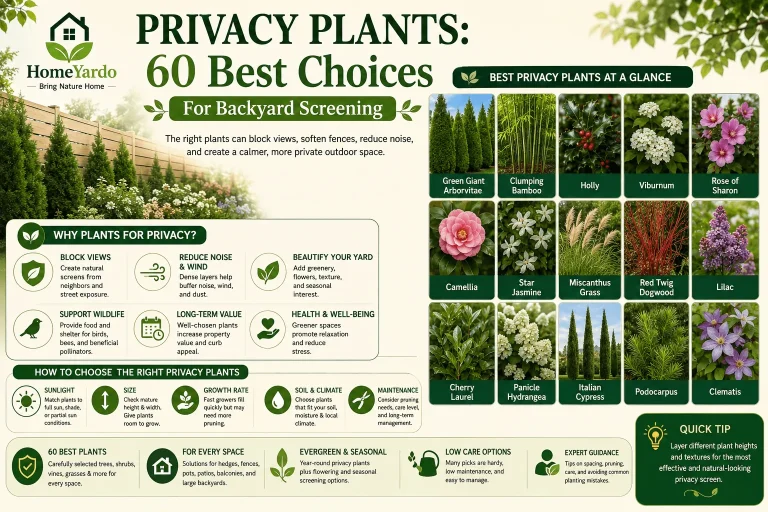
Flowers that offer nectar, color and accessibility are ideal for hummingbirds. Hummingbirds like the red tubular flowers and pink, purple, yellow, blue, and white flowers with nectar.
If you are creating a hummingbird garden from a birds-eye view, do not use a single flower species for the summer. It should offer multiple blooms in the spring, summer and fall and should feature a mixture of annuals, perennials, natives, vines, shrubs, containers, shade selections and full sun plants.
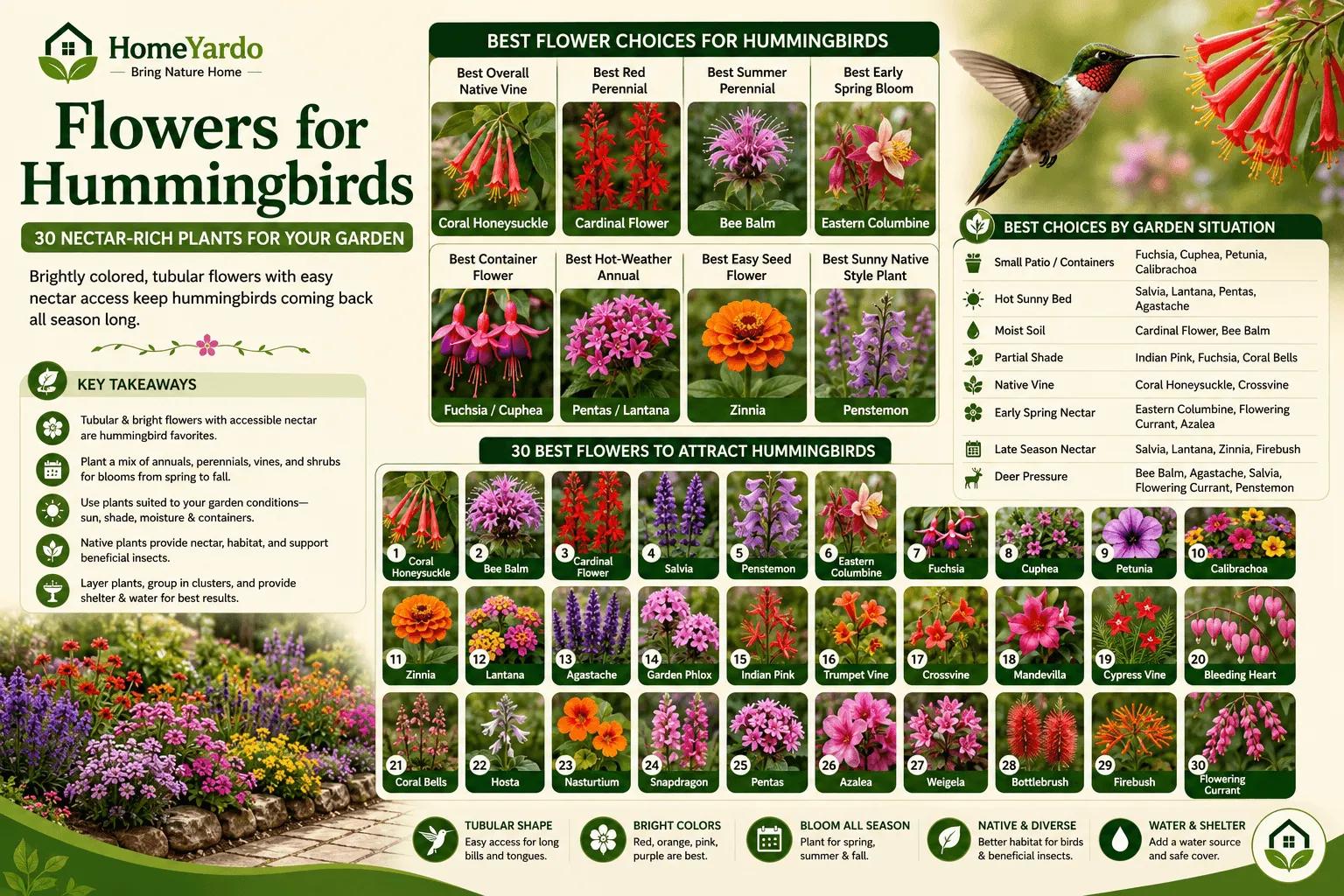
Here is a guide on only the 30 unique flowers for hummingbirds. The plant will NOT be duplicated if the plant has another common name. Crop performance may be influenced by USDA zone, local climate, soil, water and local invasive plant guidance.
Quick Answer: Best Flowers That Attract Hummingbirds
The best flowers that attract hummingbirds tend to be brightly colored, tubular, and have a long bloom period. Hummingbirds love coral honeysuckle, bee balm, cardinal flower, salvia, fuchsia, cuphea, petunia and eastern columbine, as the plant nectar is easily accessible.
Fuchsia, cuphea, petunia, and calibrachoa are good selections for containers and small spaces. In sun-drenched summer gardens, lantana, pentas, zinnia and salvia can offer months of color and nectar.
| Garden Need | Best Flower Choice |
|---|---|
| Best overall native vine | Coral Honeysuckle |
| Best red perennial | Cardinal Flower |
| Best summer perennial | Bee Balm |
| Best early spring bloom | Eastern Columbine |
| Best container flower | Fuchsia or Cuphea |
| Best hot-weather annual | Pentas or Lantana |
| Best easy seed flower | Zinnia |
| Best sunny native style plant | Penstemon |
Coral honeysuckle works well where there is a fence, arbor or trellis. Bee balms and cardinal flower are better plants for perennial beds, while fuchsia, cuphea, petunia and calibrachoa will be more successful in pots, baskets and porch planters.
Best Choices By Garden Situation
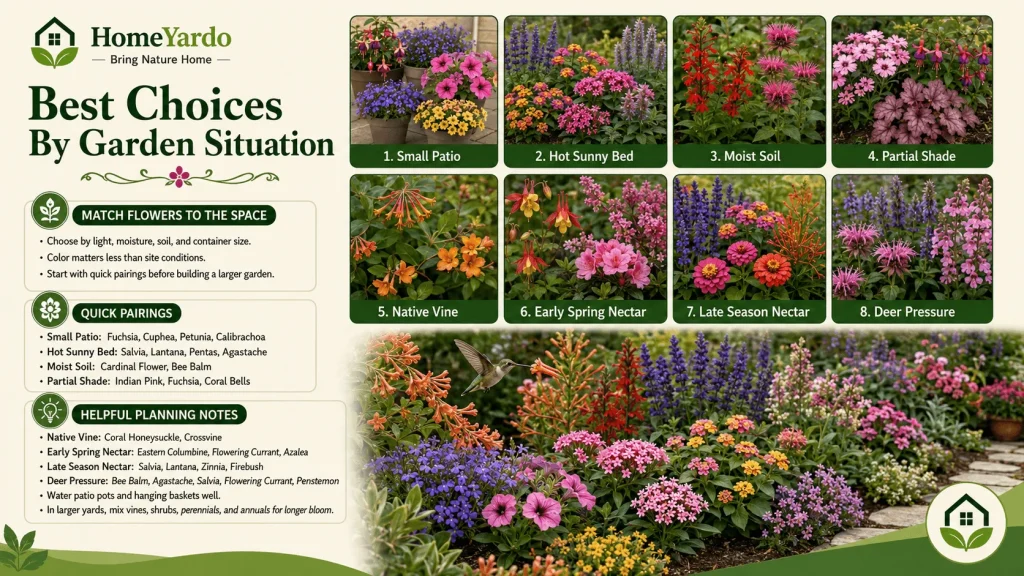
It’s much easier to design a hummingbird garden when the flowers are paired with the actual garden area. Flower color is not as important as light, moisture, soil and size of container.
For a quick pairing, use these before selecting from the long list of 30 flowers.
- Small Patio: Fuchsia, Cuphea, Petunia, Calibrachoa
- Hot Sunny Bed: Salvia, Lantana, Pentas, Agastache
- Moist Soil: Cardinal Flower, Bee Balm
- Partial Shade: Indian Pink, Fuchsia, Coral Bells
- Native Vine: Coral Honeysuckle, Crossvine
- Early Spring Nectar: Eastern Columbine, Flowering Currant, Azalea
- Late Season Nectar: Salvia, Lantana, Zinnia, Firebush
- Deer Pressure: Bee Balm, Agastache, Salvia, Flowering Currant, Penstemon
Aromatic plants or plants that have a tougher texture are less prone to being browsed by deer than soft annuals. Hummingbirds can still make a home on a small patio if a few pots and hanging baskets are well watered. If the yard is larger, vines, shrubs, perennials and annuals can be planted together to provide more continuous bloom.
What Kind Of Flowers Do Hummingbirds Like?
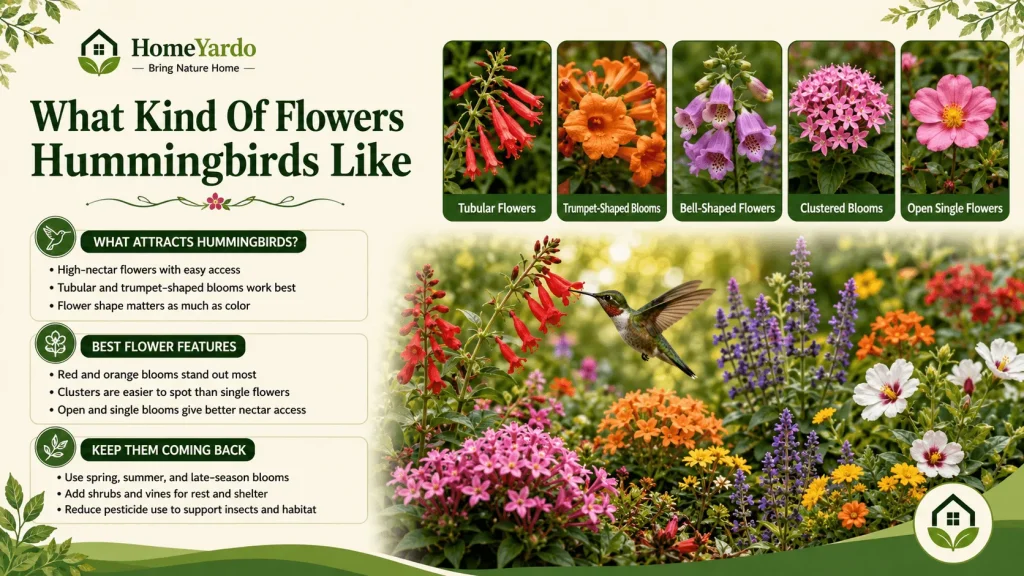
Hummer-birds tend to fly toward easily-accessible, easily-visualized, high-nectar content flowers. Tubular flowers are useful, particularly because they are shaped to fit the long bill and long tongue of the hummingbird.
Flower colour is part of the important criteria, but so too is flower shape, and the availability of the nectar. Nectar rich flowers will do best in a garden when in clusters rather than singletons.
Hummingbirds will also feed on small insects, so an area with flowers, shrubs, and reduced pesticide use will attract more than just nectar. They can find resting and shelter points near them between feeding visits within dense foliage, vines and shrubs.
Flower Shape Matters
Hummingbirds often use tubular-shaped flowers that have nectar in their tubular tubes that they can access while hovering. This feeding mode is aided by trumpet-shaped flowers, bell-shaped flowers and narrow flower tubes.
Clustered flowers may also be helpful since they enable hummingbirds to visit several flowers in one visit. If nectar is available, flat flowers can still spur activity but should not be the sole type of flowers in the garden.
Excessively doubled flowers may not be as useful, because additional petals may close the nectar source. More feeding access with single or open flowers.
Color Helps Hummingbirds Find Blooms
Red flowers that hummingbirds like and this is why they are popular. Also, orange hummingbirds are excellent visual signals, particularly in combination with a tubular shape.
The pink, blue, yellow, white and purple hummingbird flowers can continue to draw visitors even if they aren’t in bloom. Plant selection should be based on color but this should not be the only consideration.
Flowers planted in clusters are easier to see. Three to five nectar-rich plants are slightly more effective than a flower scattered out there.
Nectar Timing Keeps Them Returning
Long-blooming hummingbirds turn a garden into a continually active garden. Early spring flowers are an important food source for the return of hummingbirds and summer flowers are an important food source for regular feeders.
Late blooming flowers can be beneficial during migration, particularly when other nectar sources are declining. Other plants that can be grown in a warm climate garden include winter-blooming shrubs or tender perennials, if appropriate.
Bloom’s succession is an important tool for a strong plan. This implies that one set of flowers begins as another group slows down.
Types Of Flowers Hummingbirds Like
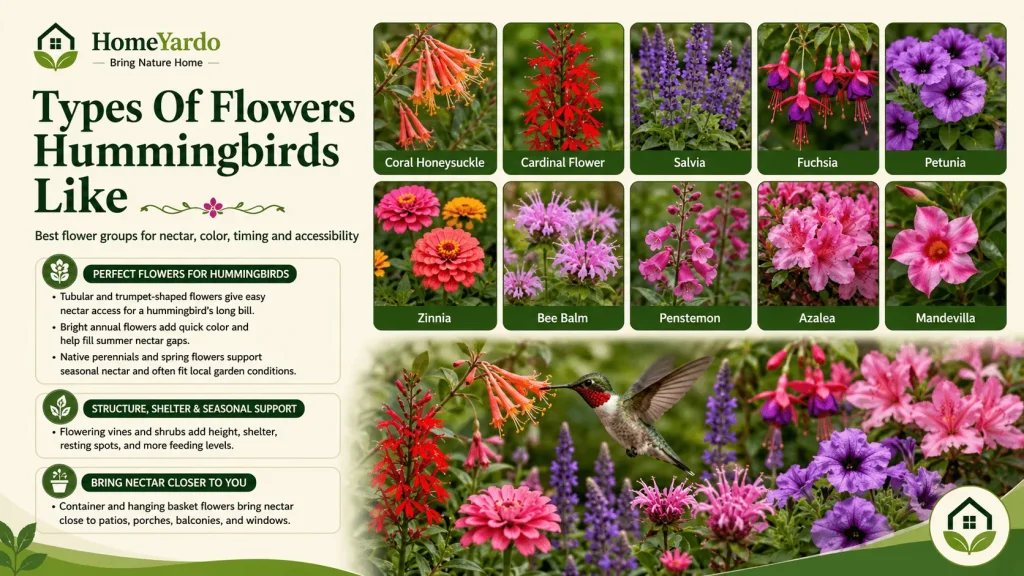
Hummingbirds favor a variety of flower types, but the best combinations are flowers that provide nectar, color, timing and accessibility. This rapid table is intended to distinguish the strongest from the weaker flower groups.
| Flower Type | Best Examples | Why Hummingbirds Visit |
|---|---|---|
| Tubular and trumpet-shaped flowers | Coral honeysuckle, cardinal flower, salvia, cuphea, fuchsia, trumpet vine | The narrow bloom shape gives easy nectar access for a hummingbird’s long bill. |
| Bright annual flowers | Petunia, zinnia, pentas, calibrachoa, nasturtium, snapdragon | These add fast color and help fill summer nectar gaps in beds and containers. |
| Native perennials and spring flowers | Eastern columbine, bee balm, penstemon, Indian pink, coral bells | These support seasonal nectar and often fit local garden conditions better. |
| Flowering vines and shrubs | Coral honeysuckle, crossvine, azalea, weigela, bottlebrush, firebush | These add height, shelter, resting spots, and more feeding levels. |
| Container and hanging basket flowers | Fuchsia, cuphea, petunia, calibrachoa, lantana, mandevilla | These bring nectar close to patios, porches, balconies, and windows. |
30 Best Flowers To Attract Hummingbirds
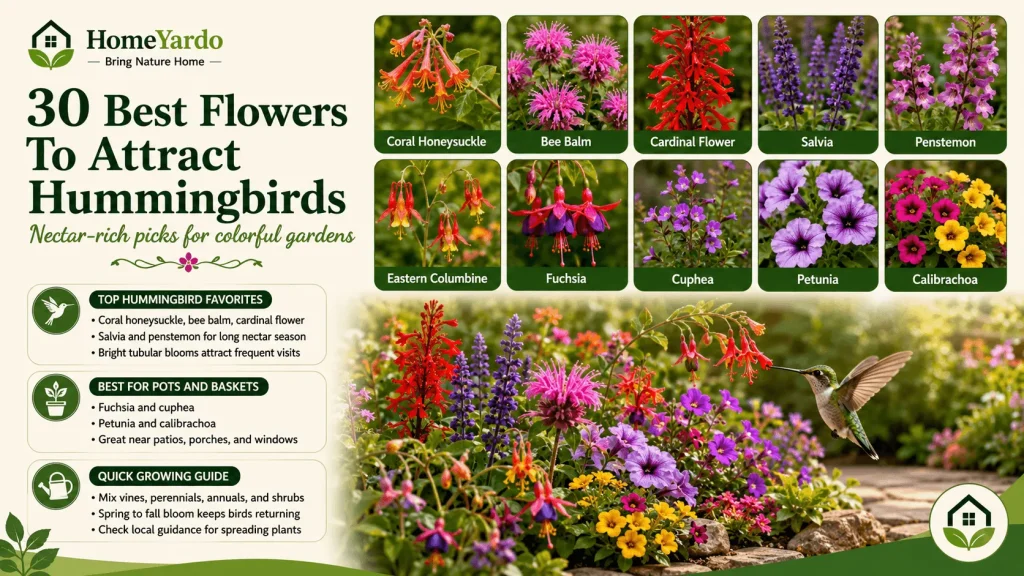
The table below provides a quick scan guide to 30 unique hummingbird flowers. A few plants grow in both warm and cold environments as annuals. If you’re planting vines or spreading shrubs, consult local growing advice as some plants that are hummingbird friendly may be invasive in some areas.
| # | Flower | Plant Type | Best For | Bloom Season |
|---|---|---|---|---|
| 1 | Coral Honeysuckle | Native vine | Trellis, fence, native garden | Spring to summer |
| 2 | Bee Balm | Perennial | Summer nectar, pollinator beds | Summer |
| 3 | Cardinal Flower | Perennial | Moist soil, red blooms | Summer to fall |
| 4 | Salvia | Annual or perennial | Long blooming sunny borders | Summer to fall |
| 5 | Penstemon | Perennial | Sunny native style beds | Late spring to summer |
| 6 | Eastern Columbine | Perennial | Early spring nectar | Spring |
| 7 | Fuchsia | Tender perennial | Hanging baskets, shade pots | Summer to fall |
| 8 | Cuphea | Annual or tender perennial | Heat, pots, patio planters | Summer to fall |
| 9 | Petunia | Annual | Containers and baskets | Spring to fall |
| 10 | Calibrachoa | Annual | Hanging baskets | Spring to fall |
| 11 | Zinnia | Annual | Easy seed-grown flowers | Summer to fall |
| 12 | Lantana | Annual or perennial | Hot sunny gardens | Summer to fall |
| 13 | Agastache | Perennial | Dry sunny beds | Summer to fall |
| 14 | Garden Phlox | Perennial | Summer border color | Summer |
| 15 | Indian Pink | Native perennial | Partial shade | Late spring |
| 16 | Trumpet Vine | Vine | Large trellis or fence | Summer |
| 17 | Crossvine | Native vine | Less aggressive vine option | Spring to summer |
| 18 | Mandevilla | Tropical vine | Patio containers | Summer to fall |
| 19 | Cypress Vine | Annual vine | Light trellis, fast cover | Summer to fall |
| 20 | Bleeding Heart | Perennial | Spring shade garden | Spring |
| 21 | Coral Bells | Perennial | Partial shade and foliage beds | Late spring to summer |
| 22 | Hosta | Perennial | Shade flowers | Summer |
| 23 | Nasturtium | Annual | Containers, edible gardens | Summer to fall |
| 24 | Snapdragon | Annual or short-lived perennial | Cool-season color | Spring to fall |
| 25 | Pentas | Annual or tender perennial | Heat-tolerant clusters | Summer to fall |
| 26 | Azalea | Shrub | Spring structure | Spring |
| 27 | Weigela | Shrub | Flowering borders | Spring to early summer |
| 28 | Bottlebrush | Shrub | Warm climate gardens | Spring to summer |
| 29 | Firebush | Shrub | Southern warm climates | Summer to fall |
| 30 | Flowering Currant | Shrub | Early spring nectar | Spring |
Many hummingbird garden flowers rely on coral honeysuckle, cardinal flower, bee balm, salvia and penstemon. Fuchsia, cuphea, petunia and calibrachoa provide flexible color for pots and hanging baskets near patios, porches and windows.
Gardeners comparing coral honeysuckle, cardinal flower, cuphea, and columbine may also find the flowers that start with C guide useful.
How This List Was Selected
These 30 flowers were selected for nectar access, bloom timing, flower shape, color visibility, home garden usefulness, and value in a layered hummingbird habitat. Duplicate common names were not counted as separate flowers.
The list includes annuals, perennials, native plants, vines, shrubs, shade flowers, full sun flowers, container plants, and late-season nectar choices. This balance helps create a garden that supports hummingbirds across more than one bloom window.
Plant Details For The 30 Hummingbird Flowers
This information should serve as a guide and should be modified based on local climate, cultivar and growing conditions. The cultivar name may have been used to describe a different size, bloom color, hardiness, or growth habit than that which is realized during the growing season; plant tags should be verified prior to purchase.
1. Coral Honeysuckle
Botanical Name: Lonicera sempervirens
Zones: 4 to 9
Sun Exposure: Full sun to partial shade
Soil Needs: Well-drained soil with moderate moisture
Plant Size: 8 to 20 feet as a climbing vine
Bloom Timing: Spring to summer
Care Note: Give it a trellis, fence, or arbor. Avoid confusing it with invasive honeysuckle species.
Coral honeysuckle is one of the best native plants that attract hummingbirds because its tubular flowers are easy for them to use. It also adds vertical cover without needing a large ground footprint.
2. Bee Balm
Botanical Name: Monarda didyma
Zones: 4 to 9
Sun Exposure: Full sun to partial shade
Soil Needs: Moist, rich, well-drained soil
Plant Size: 2 to 4 feet tall
Bloom Timing: Summer
Care Note: Space plants well for airflow because bee balm can develop mildew in crowded beds.
Bee balm for hummingbirds works best in a sunny perennial border with steady moisture. Its clustered flowers create a strong summer nectar stop.
3. Cardinal Flower
Botanical Name: Lobelia cardinalis
Zones: 3 to 9
Sun Exposure: Full sun to partial shade
Soil Needs: Moist to wet soil
Plant Size: 2 to 4 feet tall
Bloom Timing: Summer to fall
Care Note: Use it near rain gardens, pond edges, damp borders, or soil that does not dry quickly.
Cardinal for hummingbirds is a top red perennial where moisture is available. Its upright flower spikes are easy to see and rich in nectar.
4. Salvia
Botanical Name: Salvia spp.
Zones: Varies by species, often 4 to 10
Sun Exposure: Full sun
Soil Needs: Well-drained soil
Plant Size: 1 to 4 feet tall
Bloom Timing: Summer to fall
Care Note: Select perennial or annual varieties for the climate. By removing spent flowers, trim will help flower production.
Salvia is a great long bloomer and hummingbird favorite for sunny beds. There are many varieties that have tubular flowers of red, purple, blue, pink or white.
5. Penstemon
Botanical Name: Penstemon spp.
Zones: Often 3 to 9, depending on species
Sun Exposure: Full sun
Soil Needs: Well-drained soil, often tolerant of dry conditions
Plant Size: 1 to 3 feet tall
Bloom Timing: Late spring to summer
Care Note: Avoid heavy wet soil. Many penstemons perform best with good drainage and less fertilizer.
Penstemon for hummingbirds is useful in sunny native style beds. Its tubular flowers fit hummingbirds well and can support dry garden designs.
6. Eastern Columbine
Botanical Name: Aquilegia canadensis
Zones: 3 to 8
Sun Exposure: Partial shade to full sun in cooler climates
Soil Needs: Well-drained soil with moderate moisture
Plant Size: 1 to 3 feet tall
Bloom Timing: Spring
Care Note: Allow some seed heads to remain if natural reseeding is desired.
Eastern columbine for hummingbirds is valuable because it blooms early, before many summer flowers open. Its nodding red and yellow flowers offer spring nectar.
7. Fuchsia
Botanical Name: Fuchsia spp.
Zones: Often grown as an annual, hardy types vary by region
Sun Exposure: Partial shade or filtered light
Soil Needs: Moist, well-drained potting mix
Plant Size: 1 to 3 feet tall or trailing
Bloom Timing: Summer to fall
Care Note: Protect from harsh afternoon heat and keep containers evenly watered.
Fuchsia is one of the best hanging basket hummingbirds. Its dangling tubular blooms work well near porches, shaded patios, and balcony spaces.
8. Cuphea
Botanical Name: Cuphea spp.
Zones: Often 9 to 11 as perennial, annual elsewhere
Sun Exposure: Full sun to partial shade
Soil Needs: Well-drained soil with regular moisture
Plant Size: 1 to 3 feet tall
Bloom Timing: Summer to fall
Care Note: Keep watered during hot weather, especially in pots.
Cuphea for hummingbirds is a strong container plant because many types produce small tubular flowers over a long season. It is especially useful on sunny patios.
9. Petunia
Botanical Name: Petunia spp.
Zones: Grown as an annual in most climates
Sun Exposure: Full sun
Soil Needs: Well-drained, fertile soil or potting mix
Plant Size: 6 to 18 inches tall, spreading or trailing
Bloom Timing: Spring to fall
Care Note: Feed and water regularly in containers for steady bloom.
Petunias for hummingbirds work best when single, trumpet-shaped flowers are used. They fit beds, window boxes, hanging baskets, and sunny porch planters.
10. Calibrachoa
Botanical Name: Calibrachoa spp.
Zones: Often grown as an annual, perennial in warm zones
Sun Exposure: Full sun to partial sun
Soil Needs: Well-drained potting mix
Plant Size: 6 to 12 inches tall, trailing up to 24 inches
Bloom Timing: Spring to fall
Care Note: Avoid soggy soil. Containers need drainage holes.
Calibrachoa is useful in hanging baskets and mixed containers. Its small trumpet-shaped flowers bloom heavily and pair well with petunia and fuchsia.
11. Zinnia
Botanical Name: Zinnia elegans
Zones: Grown as an annual
Sun Exposure: Full sun
Soil Needs: Well-drained soil
Plant Size: 1 to 4 feet tall, depending on variety
Bloom Timing: Summer to fall
Care Note: Water at the soil level when possible to reduce leaf disease.
Zinnias attract hummingbirds in sunny summer gardens and also support butterflies. They are easy to grow from seed and bring bright late-season color.
12. Lantana
Botanical Name: Lantana camara and hybrids
Zones: 8 to 11 as perennial, annual elsewhere
Sun Exposure: Full sun
Soil Needs: Well-drained soil
Plant Size: 1 to 6 feet tall, depending on type
Bloom Timing: Summer to fall
Care Note: Check local invasive guidance before planting in warm regions.
Lantana is a strong hot-weather for hummingbirds, especially where summer heat slows other plants. Its flower clusters also attract butterflies.
13. Agastache
Botanical Name: Agastache spp.
Zones: Often 5 to 10, depending on species
Sun Exposure: Full sun
Soil Needs: Well-drained soil, often drought-tolerant once established
Plant Size: 2 to 4 feet tall
Bloom Timing: Summer to fall
Care Note: Avoid wet winter soil and heavy fertilizing.
Agastache is also known as hummingbird mint. It offers upright flower spikes, aromatic foliage, and long blooming value in dry sunny beds.
14. Garden Phlox
Botanical Name: Phlox paniculata
Zones: 4 to 8
Sun Exposure: Full sun to partial shade
Soil Needs: Moist, fertile, well-drained soil
Plant Size: 2 to 4 feet tall
Bloom Timing: Summer
Care Note: Provide airflow to help reduce powdery mildew.
Garden phlox adds summer border color and nectar value. It works best when paired with tubular flowers such as salvia, bee balm, or cardinal flower.
15. Indian Pink
Botanical Name: Spigelia marilandica
Zones: 5 to 9
Sun Exposure: Partial shade
Soil Needs: Moist, well-drained, rich soil
Plant Size: 1 to 2 feet tall
Bloom Timing: Late spring to early summer
Care Note: Keep soil evenly moist, especially during establishment.
Indian pink is a strong partial shade native for hummingbirds. Its red tubular flowers with yellow centers are easy to spot in woodland-style beds.
16. Trumpet Vine
Botanical Name: Campsis radicans
Zones: 4 to 9
Sun Exposure: Full sun to partial shade
Soil Needs: Well-drained soil, tolerant once established
Plant Size: 25 to 40 feet as a climbing vine
Bloom Timing: Summer
Care Note: Plant only where strong support and regular pruning are possible.
Trumpet vine attracts hummingbirds with large orange-red trumpet-shaped flowers. It can spread aggressively, so it is not ideal for small beds or low-maintenance gardens.
17. Crossvine
Botanical Name: Bignonia capreolata
Zones: 6 to 9
Sun Exposure: Full sun to partial shade
Soil Needs: Well-drained soil with moderate moisture
Plant Size: 30 to 50 feet as a climbing vine
Bloom Timing: Spring to summer
Care Note: Give it a sturdy fence, arbor, or trellis.
Crossvine is a native vine with tubular flowers that hummingbirds visit. It can be a better-controlled choice than trumpet vine in some gardens.
18. Mandevilla
Botanical Name: Mandevilla spp.
Zones: 10 to 11 as perennial, annual, or patio plant elsewhere
Sun Exposure: Full sun to partial sun
Soil Needs: Well-drained potting mix
Plant Size: 3 to 10 feet as a climbing or trailing plant
Bloom Timing: Summer to fall
Care Note: Use a trellis in containers and protect from cold.
Mandevilla is a good patio vine with bright trumpet-shaped flowers. It works well in warm-weather planters near seating areas and sunny porches.
19. Cypress Vine
Botanical Name: Ipomoea quamoclit
Zones: Grown as an annual in many climates
Sun Exposure: Full sun
Soil Needs: Well-drained soil
Plant Size: 6 to 15 feet as a climbing vine
Bloom Timing: Summer to fall
Care Note: Check local guidance because it can self-seed in warm regions.
Cypress vine has small star-shaped tubular flowers that hummingbirds can use. It is useful for a light trellis, but it should be managed before it spreads.
20. Bleeding Heart
Botanical Name: Lamprocapnos spectabilis
Zones: 3 to 9
Sun Exposure: Partial shade to shade
Soil Needs: Moist, rich, well-drained soil
Plant Size: 2 to 3 feet tall
Bloom Timing: Spring
Care Note: Foliage may fade after bloom in warm weather, so pair with later plants.
Bleeding heart is useful for spring shade gardens. Its arching stems and hanging flowers add early-season interest before many summer nectar plants start.
21. Coral Bells
Botanical Name: Heuchera spp.
Zones: 4 to 9
Sun Exposure: Shade to sun, depending on climate.
Soil Needs: Well-drained soil with moderate moisture
Plant Size: 8 to 18 inches tall, flower stems taller
Bloom Timing: Late spring to summer
Care Note: Avoid heavy wet soil around the crown.
Coral bells produce small bell-shaped flowers on slender stems. They fit partial shade beds and can support hummingbirds while adding foliage color.
22. Hosta
Botanical Name: Hosta spp.
Zones: 3 to 9
Sun Exposure: Partial shade to shade
Soil Needs: Moist, rich, well-drained soil
Plant Size: 6 inches to 4 feet wide, depending on variety
Bloom Timing: Summer
Care Note: Protect from slugs and keep soil evenly moist.
Hosta is often grown for foliage, but its summer flower stalks can attract hummingbirds. It works best in shaded beds with steady moisture.
23. Nasturtium
Botanical Name: Tropaeolum majus
Zones: Growing as an annual in many climates
Sun Exposure: Full sun to partial shade
Soil Needs: Well-drained soil, not overly rich
Plant Size: 1 to 10 feet, depending on bush or trailing type
Bloom Timing: Summer to fall
Care Note: Too much fertilizer can increase leaf growth and reduce flowers.
Nasturtium works in containers, raised beds, and edible gardens. The warm colored flowers can provide nectar and color in the vicinity of patios or vegetable gardens.
24. Snapdragon
Botanical Name: Antirrhinum majus
Zones: Often grown as an annual, short-lived perennial in mild climates
Sun Exposure: Full sun to partial sun
Soil Needs: Well-drained soil with moderate moisture
Plant Size: 6 inches to 3 feet tall
Bloom Timing: Spring to fall, strongest in cool weather
Care Note: Cut back after bloom flushes to encourage new growth.
Snapdragon brings cool-season color and upright flower spikes. It is useful in spring and fall when some heat-loving flowers are not at their best.
25. Pentas
Botanical Name: Pentas lanceolata
Zones: 10 to 11 as perennial, annual elsewhere
Sun Exposure: Full sun to partial sun
Soil Needs: Well-drained soil with regular moisture
Plant Size: 1 to 3 feet tall
Bloom Timing: Summer to fall
Care Note: Water during dry heat to keep flower clusters active.
Pentas is a strong, heat-tolerant annual for hummingbirds and butterflies. Its star-shaped flower clusters work well in beds and containers.
26. Azalea
Botanical Name: Rhododendron spp.
Zones: Often 5 to 9, depending on type
Sun Exposure: Partial shade or filtered light
Soil Needs: Acidic, well-drained, moist soil
Plant Size: 2 to 8 feet tall, depending on variety
Bloom Timing: Spring
Care Note: Avoid planting in alkaline soil or harsh afternoon sun.
Azalea adds early spring shrub structure and bright blooms. It works well in woodland edges, foundation beds, and partial shade gardens.
27. Weigela
Botanical Name: Weigela florida
Zones: 4 to 8
Sun Exposure: Full sun to partial shade
Soil Needs: Well-drained soil with moderate moisture
Plant Size: 3 to 6 feet tall and wide
Bloom Timing: Spring to early summer
Care Note: Prune after flowering if shaping is needed.
Weigela offers tubular flowers on a shrub form, making it useful for borders and layered hummingbird gardens. Some varieties may rebloom lightly later.
28. Bottlebrush
Botanical Name: Callistemon spp. or Melaleuca spp.
Zones: Often 8 to 11, depending on species
Sun Exposure: Full sun
Soil Needs: Well-drained soil
Plant Size: 3 to 15 feet tall, depending on type
Bloom Timing: Spring to summer, sometimes longer in warm climates
Care Note: Protect from hard freezes and choose a size suited to the space.
Bottlebrush is best for warm climate gardens. Its red brush-like flowers provide strong color and nectar appeal near sunny borders or patios.
29. Firebush
Botanical Name: Hamelia patens
Zones: 9 to 11 as perennial, annual in colder areas
Sun Exposure: Full sun to partial shade
Soil Needs: Well-drained soil with moderate moisture
Plant Size: 3 to 10 feet tall, depending on climate
Bloom Timing: Summer to fall
Care Note: Give it warmth and space, especially in frost-free regions.
Firebush is a strong, warm-climate nectar shrub with tubular orange-red flowers. It can support hummingbirds late in the season where temperatures stay mild.
30. Flowering Currant
Botanical Name: Ribes sanguineum
Zones: 6 to 8
Sun Exposure: Full sun to partial shade
Soil Needs: Well-drained soil with moderate moisture
Plant Size: 5 to 10 feet tall
Bloom Timing: Spring
Care Note: Best suited to cooler western garden conditions and shrub borders.
Flowering currant is useful for early spring nectar. Its hanging flower clusters can help bridge the gap before summer perennials begin.
Native Flowers For Hummingbirds
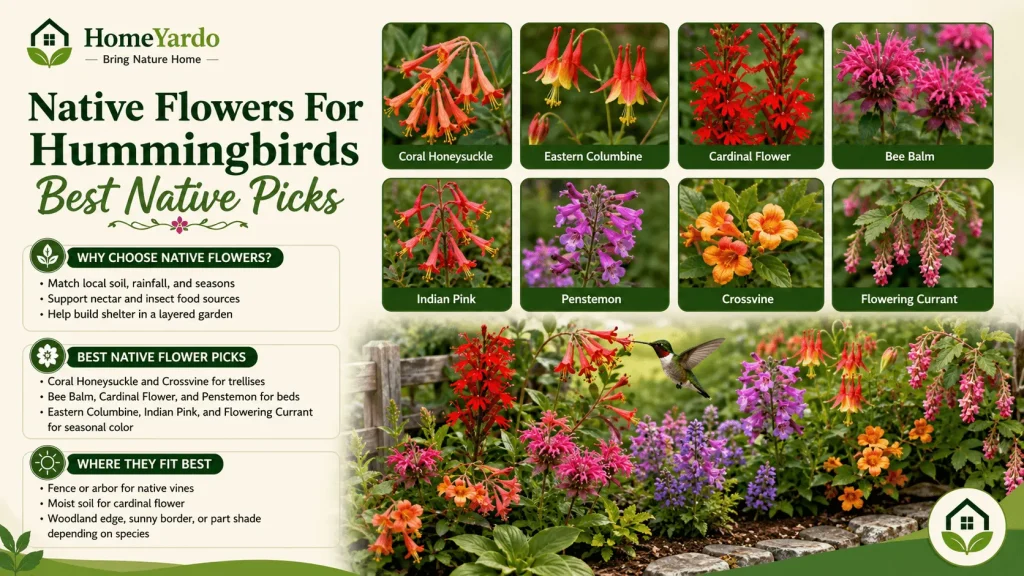
Native plants can satisfy hummingbirds’ needs and can meet the local soil, rainfall and seasonal requirements. They can also provide habitat for insects that hummingbirds feed upon.
Native doesn’t necessarily mean hassle-free. The best sun, water, space and climate match is still required for each plant. Plantings that are suitable in one area may not be suitable or native in another.
| Native Flower | Best Garden Spot | Why It Helps |
|---|---|---|
| Coral Honeysuckle | Fence or trellis | Tubular blooms and shelter |
| Eastern Columbine | Woodland edge | Early nectar |
| Cardinal Flower | Moist soil | Red tubular flower spikes |
| Bee Balm | Sunny border | Summer nectar clusters |
| Indian Pink | Partial shade | Scarlet tubular flowers |
| Penstemon | Dry sunny bed | Bell-shaped nectar flowers |
| Crossvine | Fence or arbor | Native vine structure |
| Flowering Currant | Shrub border | Early spring blooms |
Coral honeysuckle is a good vine to use for hummingbirds as it provides tubular flowers and vertical coverage. Eastern columbine is a good early spring food source, and cardinal flower offers abundant red color later in the season.
Native plants that attract hummingbirds are best in a multi-layered garden. Not just one native plant can provide a steady nectar source, but a vine, a shrub, and a few perennial plants and container flowers that will come and go throughout the year.
The value of native plants varies from region to region. Coral honeysuckle, cardinal flower, bee balm, eastern columbine, and penstemon are good choices in many appropriate locations, but the best native plant list varies by state, rainfall, soil and hummingbird species. Native plant societies and local extension offices can confirm the correct plant species prior to planting.
Annuals That Attract Hummingbirds
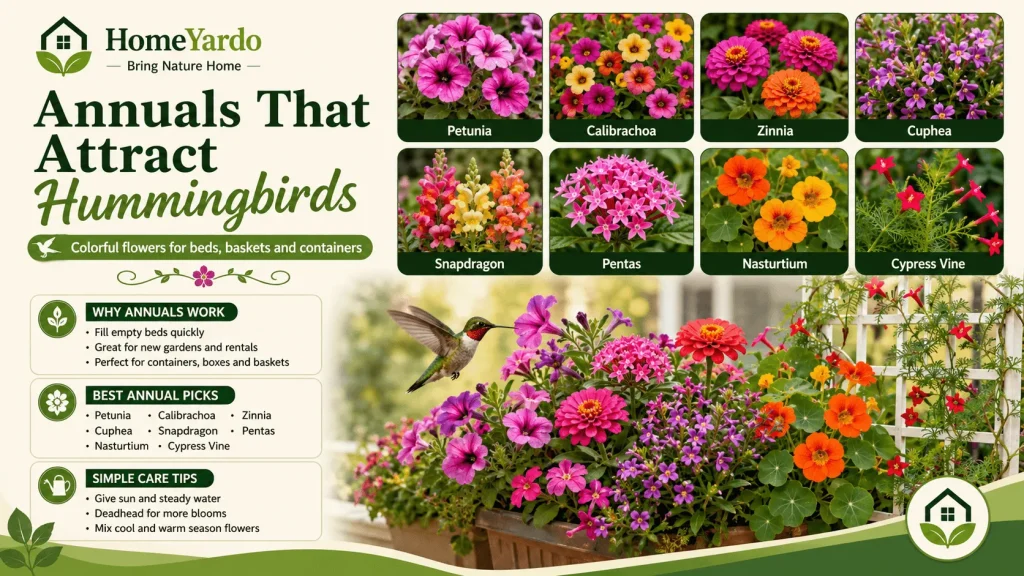
Annual flowers can be beneficial because they provide colour and garden beds fill quickly and easily, particularly when garden beds are empty. They are suitable for new gardens, rented gardens, containers, window boxes and hanging baskets.
Perennial flower beds are also useful for hummingbirds if the flowering period is non-continuous, such as occurs with annual flowers in between periods. Many Annual flowers for hummingbirds will continue to bloom with regular watering, occasional deadheading and adequate sun.
Annuals are particularly beneficial around slower growing perennials and shrubs. They can be placed in young perennial beds when the beds are filling in.
Recommended Annuals
Seasonal color comes in the form of petunia, calibrachoa, zinnia, cuphea, snapdragon, pentas, nasturtium and cypress vine. Some prosper in cool climates and some in warm.
| Annual Flower | Best Use | Care Note |
|---|---|---|
| Petunia | Baskets and beds | Needs sun and regular feeding |
| Calibrachoa | Hanging baskets | Needs good drainage |
| Zinnia | Seed-grown summer color | Avoid overhead watering |
| Cuphea | Hot patios | Keep evenly watered |
| Pentas | Heat zones | Strong summer color |
| Snapdragon | Cool-season beds | May be slow in intense heat |
Hummingbird friendly petunias make a great addition to baskets and containers in the sun, particularly single flower varieties with open trumpets. Zinnias are easy-to-grow, seed flowers that offer summer color, and can be butterfly-friendly as well.
For more alphabet-based garden ideas, the guide to flowers that start with S can help compare salvia, snapdragon, and other colorful blooms.
Perennial Flowers For Hummingbirds
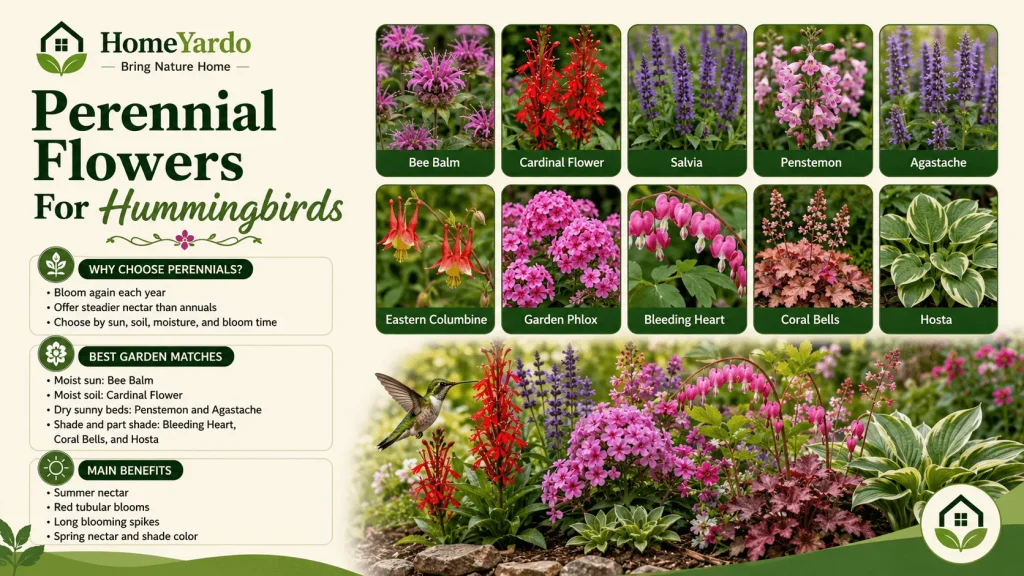
When planted in the right zone and growing conditions, perennial flowers will bloom each year. They have a more persistent nectar source than annuals.
Perennials that attract hummingbirds should be selected based on sun, soil, moisture and flowering time. Plants grow differently in a dry sunny bed as opposed to a moist border or shaded woodland edge.
It is as important as flower color. Cardinal flower and bee balm grow better in wetter conditions; penstemon and agastache thrive in well-drained conditions in sunny areas.
Recommended Perennials
Bee balm, Cardinal Flower, Salvia, Penstemon, Eastern Columbine, Agastache, Garden Phlox, Indian Pink, bleeding heart, coral bells and Hosta all serve various purposes in the garden.
| Perennial | Best Condition | Main Benefit |
|---|---|---|
| Bee Balm | Moist sun to part sun | Summer nectar |
| Cardinal Flower | Moist soil | Red tubular flowers |
| Penstemon | Dry sunny beds | Native style nectar |
| Agastache | Hot dry sites | Long blooming spikes |
| Bleeding Heart | Shade | Spring nectar |
| Coral Bells | Part shade | Small bell flowers |
Among the best of the summer perennials for hummingbirds is bee balm, particularly in sunny or partially shaded beds with moderate moisture. Cardinal flower prefers wet soil and provides an abundance of red flowers.
Penstemon and agastache are better grown in sunnier, more well-drained areas. Many summer annuals can be difficult to grow in shade and partial shade areas and can be filled in with coral bells, bleeding heart, Indian pink and hosta.
If petunia, penstemon, pentas, and phlox are part of the planting plan, the flowers that start with P guide offers more related options.
Flowering Vines And Shrubs That Bring Hummingbirds Into The Garden
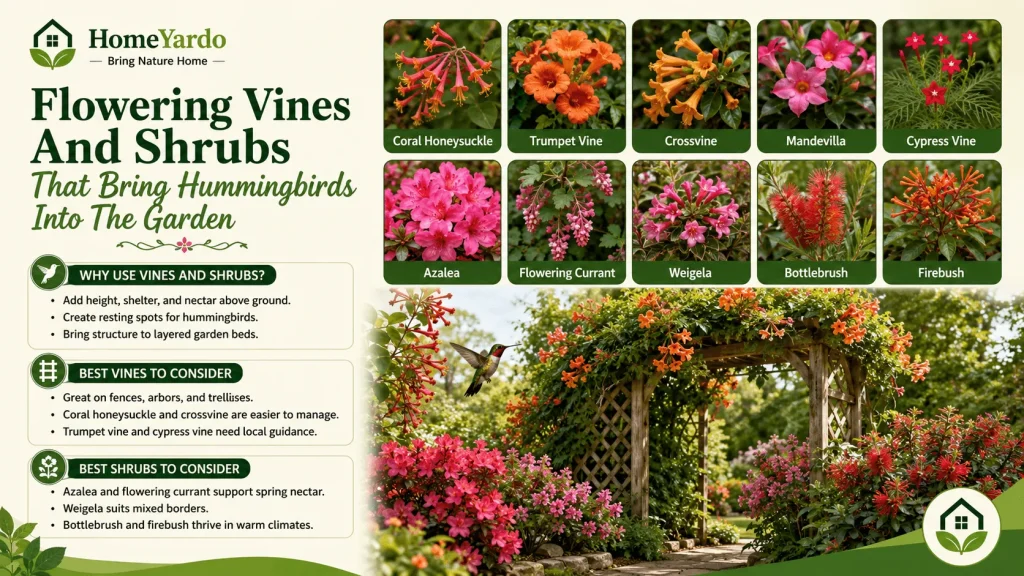
Flowering vines and shrubs provide structure, height and shelter. They can provide nectar that is above ground level and provide more feeding station resting spots for hummingbirds.
Vines do well on a fence, arbor, or trellis. Shrubs are suitable to add interest to the borders, corners and layered garden beds where they can be planted behind lower growing flowers.
Extra care is required for fast growing plants. Trumpet vine can be a problem, cypress seedling, and lantana can be a problem in some warm climates. The final planting decision should be based on local guidance.
Flowering Vines To Consider
Coral honeysuckle is one of the best hummingbird vines due to its tubular flowers and the fact that it is a more controlled hummingbird vine in many areas. Requires support, but can be used in fences, arbors and trellises.
The trumpet vine is large with trumpet-shaped flowers that hummingbirds love and it can become invasive. It should only be planted in areas that have good structure and space for control of growth.
Crossvine features tubular flowers and a good vertical form. It can be a less aggressive native vine in many appropriate areas than the trumpet vine.
Mandevilla can be grown in patio containers during warm weather. Requires trellis or support and should be moved or replaced on a seasonal basis in cooler climates.
Cypress vine is light in weight and a fast-growing plant, although it may seed itself. Please review local invasive plant control information prior to planting in natural areas.
Flowering Shrubs To Consider
Hummingbirds can use azalea and flowering currant as a source of nectar during the spring when they return. Azalea likes an acid soil with filtered light and flowering currant can be best grown in appropriate cooler areas.
Weigela is useful for ousting winter snowdrifts in spring and summer and is suitable for use in mixed borders. It provides shrub form but doesn’t dominate the garden if properly sized.
Bottlebrush and firebush are more at home in warm climates. They are excellent for use around patios, fences, or sunny garden areas because of their colorful blooms and shrub form. For more flower name ideas beyond fuchsia, firebush, and flowering currant, see the full list of flowers that start with F.
Flowers For Pots, Patios, And Hanging Baskets
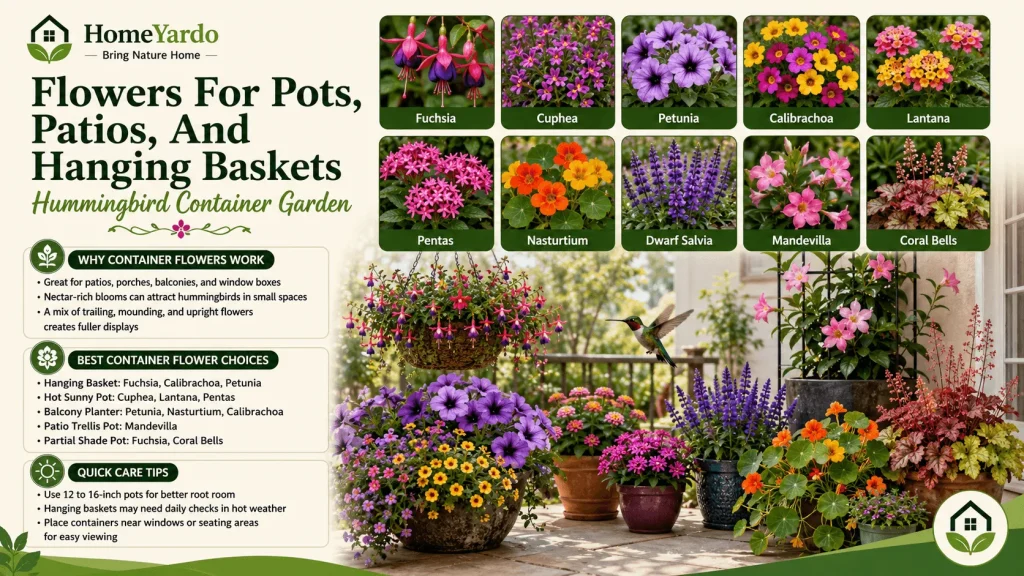
Container flowers can attract hummingbirds even without a large yard. Pots, hanging baskets, porch planters, balcony boxes, and window boxes can all hold nectar-rich flowers.
Containers dry faster than garden beds, so watering matters. A mix of trailing, mounding, and upright flowers gives a fuller look and creates more feeding points.
For mixed annual displays, 12 to 16-inch pots usually give roots more room than tiny containers. Hanging baskets may need daily checks in hot weather.
Hummingbird Container Garden
Fuchsia, cuphea, petunia, calibrachoa, lantana, pentas, nasturtium, dwarf salvia, and mandevilla are strong container plants that attract hummingbirds.
| Container Style | Plant Combination |
|---|---|
| Hanging basket | Fuchsia, Calibrachoa, Petunia |
| Hot sunny pot | Cuphea, Lantana, Pentas |
| Balcony rail planter | Petunia, Nasturtium, Calibrachoa |
| Patio trellis pot | Mandevilla or Cypress Vine |
| Partial shade pot | Fuchsia and Coral Bells |
Hummingbird Flowers For Hanging Baskets
Fuchsia is one of the best hanging basket hummingbirds in partial shade. Cuphea, lantana, and pentas are better for hot, sunny pots.
Mandevilla can climb a small patio trellis. Petunia and calibrachoa work well near windows, porch steps, and seating areas where hummingbird visits can be seen easily.
Flowers For Shade, Partial Shade, And Full Sun
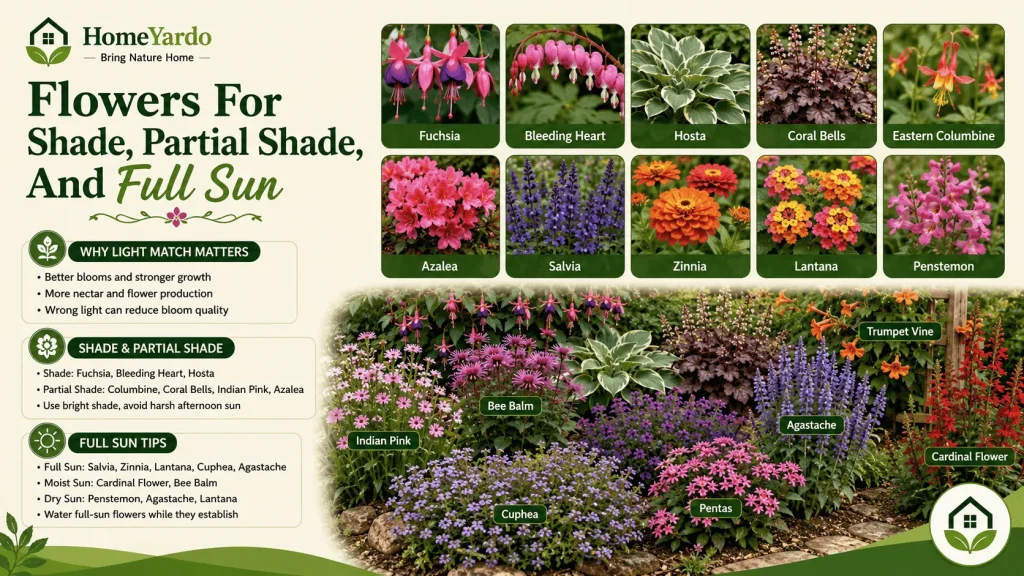
The right flower in the wrong light can bloom poorly. Matching each plant to its preferred light level improves flower production and nectar value.
Full sun flowers usually produce the most blooms in open, bright areas. Shade and partial shade flowers work better near trees, porches, fences, and woodland-style borders.
Partial shade often means morning sun with afternoon shade, or bright filtered light. Dense shade may reduce bloom strength, even on plants that tolerate lower light.
Shade And Partial Shade Choices
Fuchsia, bleeding heart, hosta, coral bells, Indian pink, eastern columbine, and azalea can support shade or partial shade planting.
Fuchsia performs well in hanging baskets with morning light or filtered shade. Bleeding heart and eastern columbine help in spring, while coral bells and hosta add small blooms with foliage value.
Indian pink is useful in partial shade where warm climate or regional conditions support it. Azalea adds spring shrub structure and bright seasonal flowers.
Dense shade may reduce flower production. For more blooms, use the brightest shade available without exposing shade plants to harsh afternoon heat.
Full Sun Choices
Salvia, bee balm, penstemon, zinnia, lantana, cuphea, pentas, agastache, and trumpet vine are better suited to sunny spaces.
| Light Condition | Flower Choices |
|---|---|
| Full sun | Salvia, Zinnia, Lantana, Cuphea, Agastache |
| Partial shade | Columbine, Coral Bells, Indian Pink, Azalea |
| Shade | Fuchsia, Bleeding Heart, Hosta |
| Moist sun | Cardinal Flower, Bee Balm |
| Dry sun | Penstemon, Agastache, Lantana |
Full sun flowers for hummingbirds often need regular watering while they establish. Drought tolerant plants that attract hummingbirds, such as agastache, penstemon, and lantana, are better for hot, open spaces once settled.
Seasonal Nectar Calendar For Hummingbirds
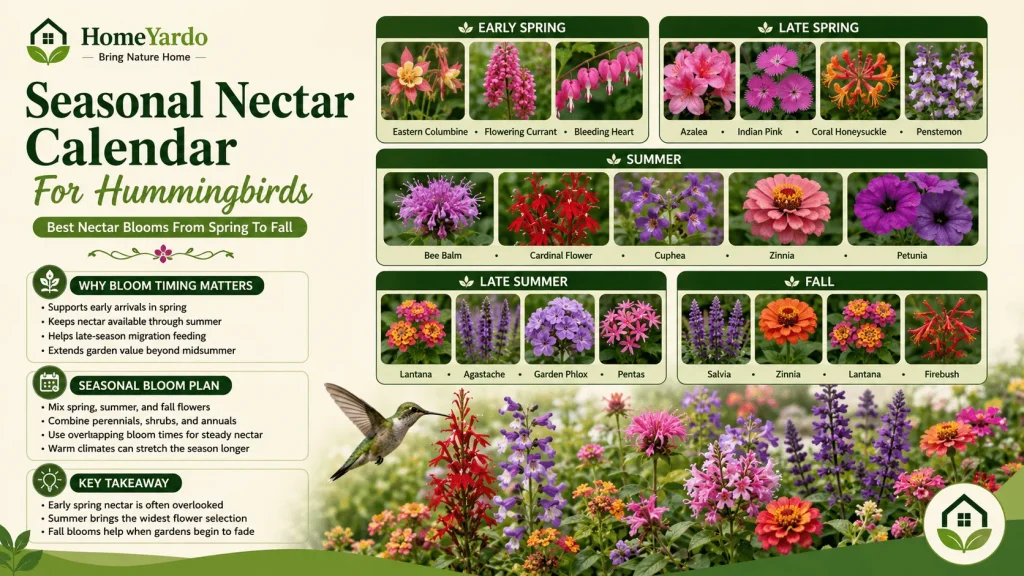
Bloom timing can make a hummingbird garden much stronger. A garden that blooms only in midsummer may miss early arrivals and late migration feeding.
A better plan includes spring flowers, summer flowers, and late-blooming flowers. Warm climate gardens can stretch the season longer with shrubs and tender perennials.
| Season | Nectar Plants To Use |
|---|---|
| Early spring | Eastern Columbine, Flowering Currant, Bleeding Heart |
| Late spring | Azalea, Indian Pink, Coral Honeysuckle, Penstemon |
| Summer | Bee Balm, Cardinal Flower, Cuphea, Zinnia, Petunia |
| Late summer | Lantana, Agastache, Garden Phlox, Pentas |
| Fall | Salvia, Zinnia, Lantana, Firebush |
Early spring nectar is easy to overlook because many popular hummingbird flowers peak in summer. Eastern columbine, flowering currant, bleeding heart, and azalea can help before summer annuals are ready.
Summer flowers for hummingbirds include bee balm, cardinal flower, cuphea, zinnia, petunia, and salvia. Fall flowers for hummingbirds include lantana, agastache, zinnia, salvia, and firebush in warm areas.
Fall nectar can support migration when many gardens start to fade. Keeping a few late-blooming flowers active helps extend the garden’s value beyond summer. For gardeners comparing agastache, azalea, and other early alphabet choices, the flowers that start with A guide can support more planting ideas.
5 Quick Hummingbird Garden Ideas
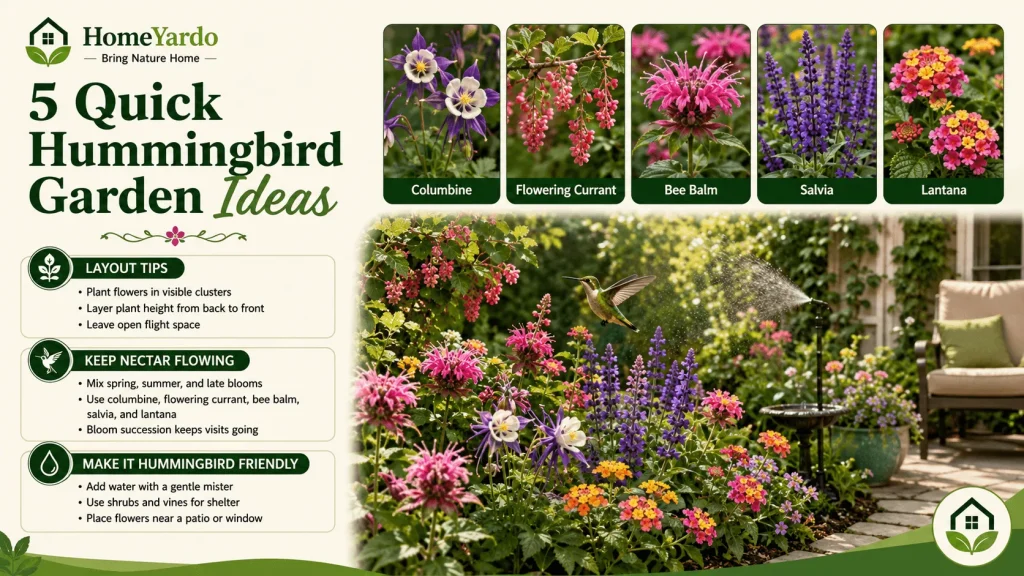
A hummingbird-friendly garden plan works best when flowers are arranged with feeding, movement, shelter, and visibility in mind. Plant choice matters, but layout also affects how often hummingbirds stop and stay.
Use these five design tips to turn a flower list into a working garden plan.
- Plant in visible clusters
Use groups of three to five plants instead of one scattered flower. Red, orange, pink, and purple clusters are easier for hummingbirds to notice from a distance. - Layer plant height
Place flowering vines on fences or trellises, shrubs toward the back, perennials in the middle, and container flowers near patios or paths. This creates height, shelter, and feeding variety. - Keep nectar blooming across seasons
Pair spring flowers like columbine and flowering currant with summer bee balm and late-season salvia or lantana. Bloom succession helps keep nectar available longer. - Leave open flight space
Hummingbirds need room to hover, turn, and move between flowers. Avoid packing tall plants so tightly that feeding spaces become blocked. - Add water, shelter, and safe viewing spots
A gentle mister, nearby shrubs, and a visible flower grouping near a window or seating area can make the garden more useful and more enjoyable.
Simple 5 Plant Starter Plans
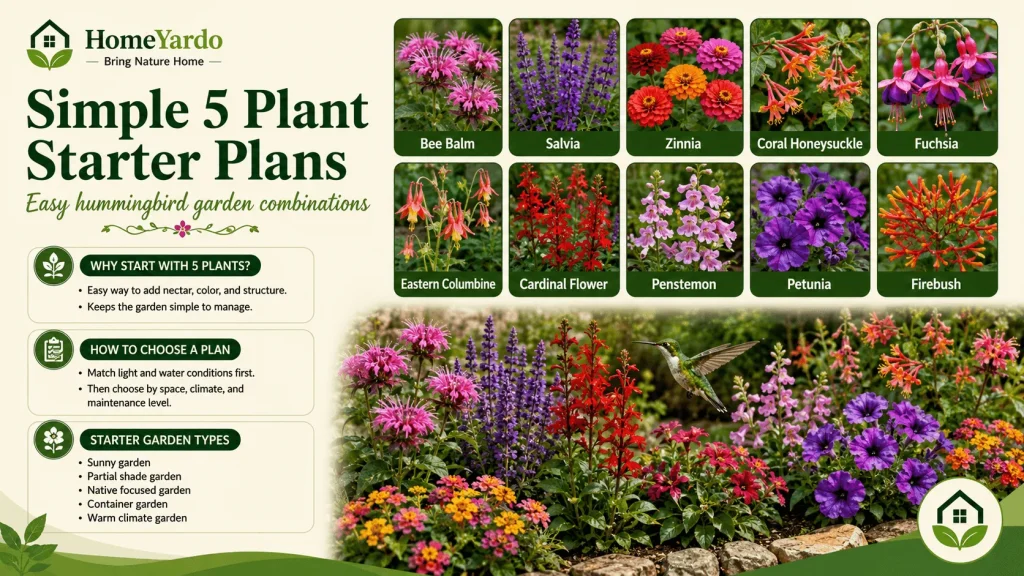
A hummingbird garden does not need all 30 plants at once. Starting with five well-matched plants can create nectar, color, and structure without making the garden hard to manage.
A starter plan should match the garden’s light and water conditions before color is considered. Choose the plan that best fits the space, climate, and maintenance level.
| Garden Type | 5 Plant Combination |
|---|---|
| Sunny garden | Bee Balm, Salvia, Zinnia, Lantana, Coral Honeysuckle |
| Partial shade garden | Eastern Columbine, Fuchsia, Indian Pink, Coral Bells, Azalea |
| Native focused garden | Coral Honeysuckle, Cardinal Flower, Bee Balm, Penstemon, Eastern Columbine |
| Container garden | Fuchsia, Cuphea, Petunia, Calibrachoa, Pentas |
| Warm climate garden | Firebush, Bottlebrush, Lantana, Mandevilla, Pentas |
A starter plan should include at least one early bloom, one strong summer bloomer, and one late-season flower, where possible. That mix gives better nectar continuity than choosing five plants that bloom at the same time. Lantana is one of many colorful garden choices, and the flowers that start with L guide can help compare more L flower names.
Feeders Vs Flowers For Hummingbirds
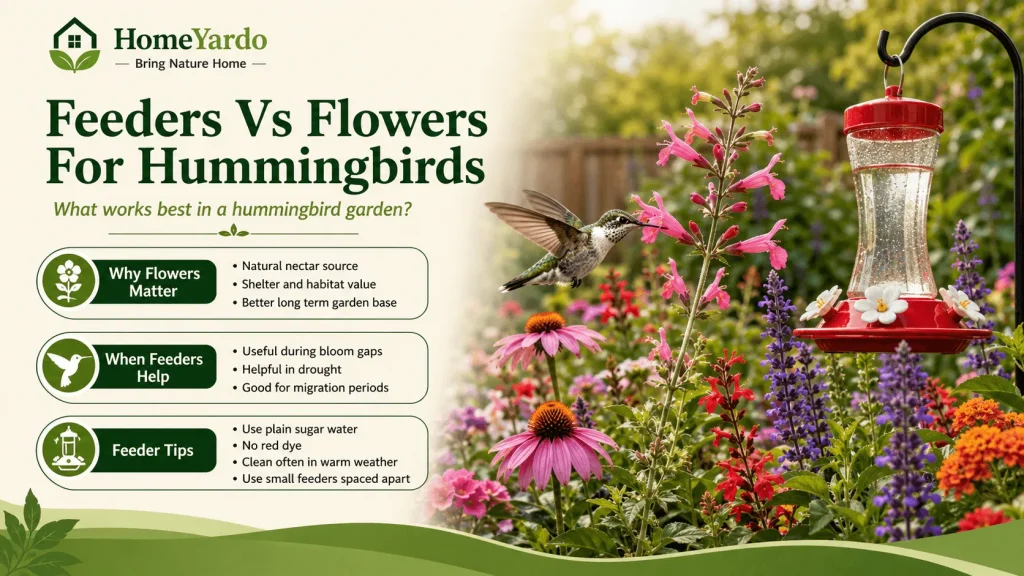
Flowers offer natural nectar, colour, shelter and habitat value. Feeders are welcome additions when flowers are not in bloom, but they should not take the place of a garden that has flowers rich in nectar.
If a feeder, then plain sugar water is sufficient. No red dye is necessary – and should not be used. Clean feeders frequently, particularly during warm weather.
If the feeders are small and spaced out, it will decrease the guarding behaviour. Hummingbirds are territorial and sometimes one large feeder will not feed as many as anticipated.
Flowers make a great long term base as they also provide support for insects, shade, cover and garden structure. Feeders are best installed during bloom gaps, drought or migration.
Common Hummingbird Garden Mistakes
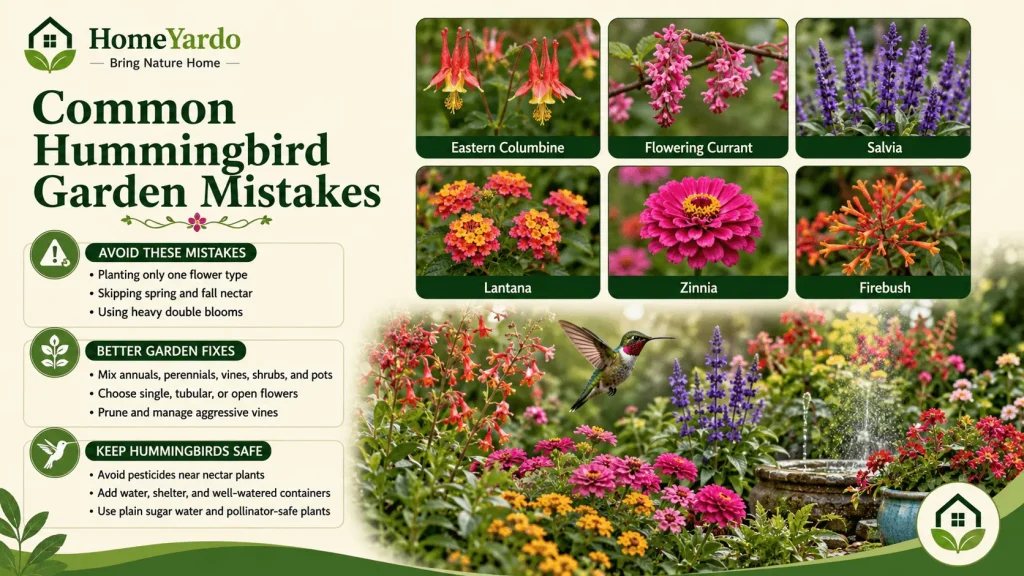
Many hummingbird gardens fail because they offer too little nectar, too short a bloom window, or flowers that are hard to access. Most problems are easy to fix with better plant selection and layout.
- Mistake: Planting only one flower type
Fix it by using annuals, perennials, vines, shrubs, and containers together. A single short blooming plant cannot support steady visits through spring, summer, and fall. - Mistake: Skipping spring and fall nectar
Fix it by adding early blooms such as eastern columbine or flowering currant and late blooms such as salvia, lantana, zinnia, or firebush. - Mistake: Using only heavy double flowers
Fix it by choosing single, tubular, trumpet-shaped, or open flower forms. Extra petals can block nectar access. - Mistake: Using pesticides near nectar plants
Fix it by keeping the garden safer for small insects and pollinators. Hummingbirds use nectar, but they also feed on tiny insects. - Mistake: Planting aggressive vines without control
Fix it by giving vines strong support, pruning when needed, and checking local invasive plant guidance before planting. - Mistake: Forgetting water and shelter
Fix it by adding a gentle mister, nearby shrubs, or flowering vines. Hummingbirds need more than flowers to stay active in a garden. - Mistake: Letting pots dry out
Fix it by checking hanging baskets and small containers often during the heat. Dry containers stop blooming quickly. - Mistake: Using red dye in feeder water
Fix it by using plain sugar water if feeders are used. Red dye is not needed. - Mistake: Buying pesticide-treated flowers without checking.
Fix it by choosing plants from nurseries that can confirm their pollinator safety practices. Avoid using systemic insecticides on nectar plants because hummingbirds visit flowers and also feed on small insects.
Quick Comparison: Salvia Vs Bee Balm Vs Cardinal Flower
Salvia, bee balm, and cardinal flower are three of the best plants for hummingbirds, but they suit different garden conditions. The right choice depends on light, soil, moisture, and bloom goals.
| Plant | Best Condition | Strength | Watch Out For |
|---|---|---|---|
| Salvia | Full sun, well-drained soil | Long bloom season | Some types are annuals |
| Bee Balm | Moist sun or part sun | Strong summer nectar | Needs airflow |
| Cardinal Flower | Moist soil | Strong red tubular blooms | Not ideal for dry beds |
Salvia is a reliable value when compared to other plants, such as Bee Balm and Cardinal Flower.
Three of the most hummingbird friendly plants are considered to be suitable for different conditions in the garden: salvia, bee balm, and cardinal flower. The right one will depend on the light, soil and moisture levels and what the bloomer wants. In sunny and well-drained beds, opt for salvia for longer-lasting color. Bee balm grows very well in summer nectar with a balance of airflow and moisture.
Cardinal flower is a great choice for wet soil and a red flower. Should not be in a dry, hot bed unless watering is adequate to maintain a uniform moisture.
Do Hummingbirds Like These Common Flowers?
There are some common garden flowers that receive mixed comments, as they are good nectar providers, while others are only occasional visitors. This handy guide can be used to help determine whether flowers will be used for main hummingbird plants or as support flowers.
| Question | Quick Verdict | Best Use Or Caution |
|---|---|---|
| Do hummingbirds like zinnias? | Yes, supporting choice | Good summer color, stronger when paired with salvia or bee balm. |
| Do hummingbirds like petunias? | Yes, strong choice | Best in pots, baskets, window boxes, and sunny beds. |
| Do hummingbirds like hibiscus flowers? | Yes, in warm climates | Useful for large bright blooms, especially hardy hibiscus or tropical hibiscus. |
| Do hummingbirds like columbine? | Yes, excellent choice | One of the best early spring nectar flowers. |
| Do hummingbirds like marigolds? | Occasional visits | Not a top nectar flower, better as a support plant. |
| Do hummingbirds like foxglove? | Yes, but use caution | Tubular flowers help, but the plant is toxic if eaten. |
| Do hummingbirds like hydrangeas? | Not a top choice | Better for garden structure than hummingbird nectar. |
| Do hummingbirds like sunflowers? | Occasional visits | Better for bees, butterflies, and seed eating birds. |
| Do hummingbirds like roses? | Not a top choice | Add salvia, bee balm, or fuchsia nearby for nectar value. |
| Do hummingbirds like lilies? | Sometimes | Some may attract visits, but true lilies are dangerous for cats. |
| Do hummingbirds like verbena? | Yes, supporting choice | Good sunny filler flower with pollinator value. |
| Do hummingbirds like azaleas? | Yes, spring choice | Useful spring shrub for partial shade and acidic soil. |
| Do hummingbirds like hollyhocks? | Yes, supporting choice | Adds tall visible blooms in sunny cottage gardens. |
| Do hummingbirds like tulips? | Not a top choice | Spring color, but weaker than columbine or flowering currant. |
| Do hummingbirds like orchids? | Not reliable outdoors | Common indoor orchids are not useful for garden feeding. |
| Do hummingbirds like mint? | Regular mint is weak | Hummingbird mint, also called agastache, is the better choice. |
Conclusion
Hummingbird gardens feature a balance of nectar-producing blooms, color, tubular flowers and consistent blooming periods. Hummingbirds have a reason to come back more often when you have a garden that blooms throughout spring, summer and fall.
Plant 5 to 7 plants from the 30-flower list and correlate them with the sun, soil, space and growing zone available. Start with one vine or shrub, two perennials and two container flowers in a small garden.
FAQ’s
Coral honeysuckle is one of the strongest choices because it has red tubular blooms, easy nectar access, and vine growth that can also provide shelter. Bee balm, cardinal flower, salvia, and eastern columbine are also excellent choices. The best flower can vary by region, climate, and bloom season. A mix of several nectar-rich flowers is better than depending on one plant.
Hummingbirds are strongly drawn to red and orange flowers, especially when the blooms are tubular and rich in nectar. They also visit pink, purple, yellow, blue, and white flowers when nectar is easy to reach. Color helps them find flowers, but flower shape and nectar access matter too. Planting color in groups can make blooms easier to spot.
Bee balm, salvia, cuphea, zinnia, petunia, pentas, lantana, agastache, and garden phlox can support summer nectar. A mix of annuals and perennials gives a longer bloom window. Deadheading some flowers can help extend bloom time. Choose several plants with overlapping bloom periods instead of relying on one summer flower.
Fuchsia, cuphea, petunia, calibrachoa, lantana, pentas, dwarf salvia, nasturtium, and mandevilla are useful container choices. Pots work well on patios, balconies, porches, and near windows. Container soil dries faster than garden soil, so steady watering helps keep blooms active. Use a mix of trailing and upright plants for more flower coverage.
Fuchsia, bleeding heart, hosta, coral bells, Indian pink, eastern columbine, and azalea can work in shade or partial shade. Dense shade may reduce bloom strength, so filtered light is often better. Spring shade plants can help early in the season. Containers with fuchsia can add extra nectar near shaded porches.
Native flowers are often a strong choice because they fit local wildlife, insects, and climate patterns. Coral honeysuckle, cardinal flower, eastern columbine, bee balm, penstemon, Indian pink, and flowering currant are useful examples where suited. Native plants still need correct placement. Sun, soil, moisture, and region should guide the final choice.
Trumpet vine attracts hummingbirds with large orange-red tubular flowers and strong summer nectar appeal. It can spread aggressively in many gardens, so it needs careful placement and strong support. Check local guidance before planting it near fences, walls, or small beds. Coral honeysuckle or crossvine may be better choices where control is a concern.
Hummingbirds do not need feeders when a garden has steady nectar flowers across the season. Feeders can help during bloom gaps, drought, or migration periods. If used, feeders should be cleaned often and filled without red dye. Flowers remain the better long-term base because they add nectar, shelter, insects, and garden structure.
Avoid invasive plants in your region, pesticide-treated flowers, and heavily doubled blooms that block nectar access. Avoid planting only one short-blooming flower because it leaves nectar gaps. Aggressive vines should be used only where they can be managed. Safer choices include region-suited native plants, clean feeders if used, and flowers with open nectar access.
Clusters work better than single scattered plants. Start with groups of three to five plants in two or three garden spots, then add more as space allows. Include at least one spring flower, one strong summer bloomer, and one late-season nectar plant. A small patio can still work with pots, baskets, and one compact vine.
Red and orange flowers attract hummingbirds strongly because these colors are easy for them to notice. Pink, purple, yellow, blue, and white flowers can also work when they offer nectar. Color helps bring hummingbirds closer, but flower shape and nectar access matter too. Tubular flowers with steady nectar are usually better than color alone.
Plant nectar-rich flowers that bloom from spring through fall. Use tubular flowers, bright color clusters, native plants, vines, shrubs, and container flowers to create more feeding spots. Add shelter, open flight space, and a gentle water source where possible. Avoid pesticides near nectar plants because hummingbirds also eat small insects.
Start with one flowering vine or shrub, two nectar-rich perennials, and two annual or container flowers. Choose plants for the backyard’s sun, shade, soil, and moisture instead of choosing by color only. Add early spring flowers, summer bloomers, and late season flowers to keep nectar available longer. Place flowers in visible clusters near shelter and open flying space.
Hummingbirds like flowers with easy nectar access, especially tubular or trumpet-shaped blooms. Coral honeysuckle, cardinal flower, bee balm, salvia, fuchsia, cuphea, penstemon, petunia, and eastern columbine are strong choices. The best flower depends on season, region, and growing conditions. A mixed planting works better than relying on one flower.
Hummingbird-friendly flowers are nectar-rich, easy to access, and useful in the garden across more than one season. Good examples include coral honeysuckle, bee balm, cardinal flower, salvia, fuchsia, cuphea, petunia, penstemon, lantana, and eastern columbine. Native flowers are especially useful when they match the local region. The best garden combines flowers for sun, shade, pots, vines, and seasonal bloom timing.
Eastern columbine is one of the best early spring choices because it blooms before many summer flowers are ready. Flowering currant, azalea, and bleeding heart can also help in suitable climates. Early nectar matters because returning hummingbirds may arrive before annual containers are fully grown. Choose plants that match the local climate and soil.
References