55 Beautiful Variety Of Flowers That Start With X You Didn’t Know About
Flowers that start with X are rare, which is why so many alphabet flower lists feel either too short or too stretched. A better approach is to separate familiar bloom names from broader flowering plant entries, then label everything clearly.
This guide brings together 55 unique X flower entries without repetition. It includes common ornamental picks, botanical flower names, orchids, wetland bloomers, and flowering plants that are often grouped into X flower lists. It also includes quick filters, flower types, color sorting, symbolism, and simple garden-use ideas. Rare flower naming patterns are easier to understand when compared with flowers that start with q, another letter group with very limited everyday bloom names.
Quick Answer: What Are The Best Known Flower Names That Start With X?
The best-known flowers that begin with the letter X include Xeranthemum, Xerochrysum, Xanthisma, Xylobium, Xyris, Yellowhorn, and Xerophyllum. Since X is such an uncommon starting letter in plant names, a full 55-name list works best when it combines true flower names with clearly labeled entries for flowering plants.
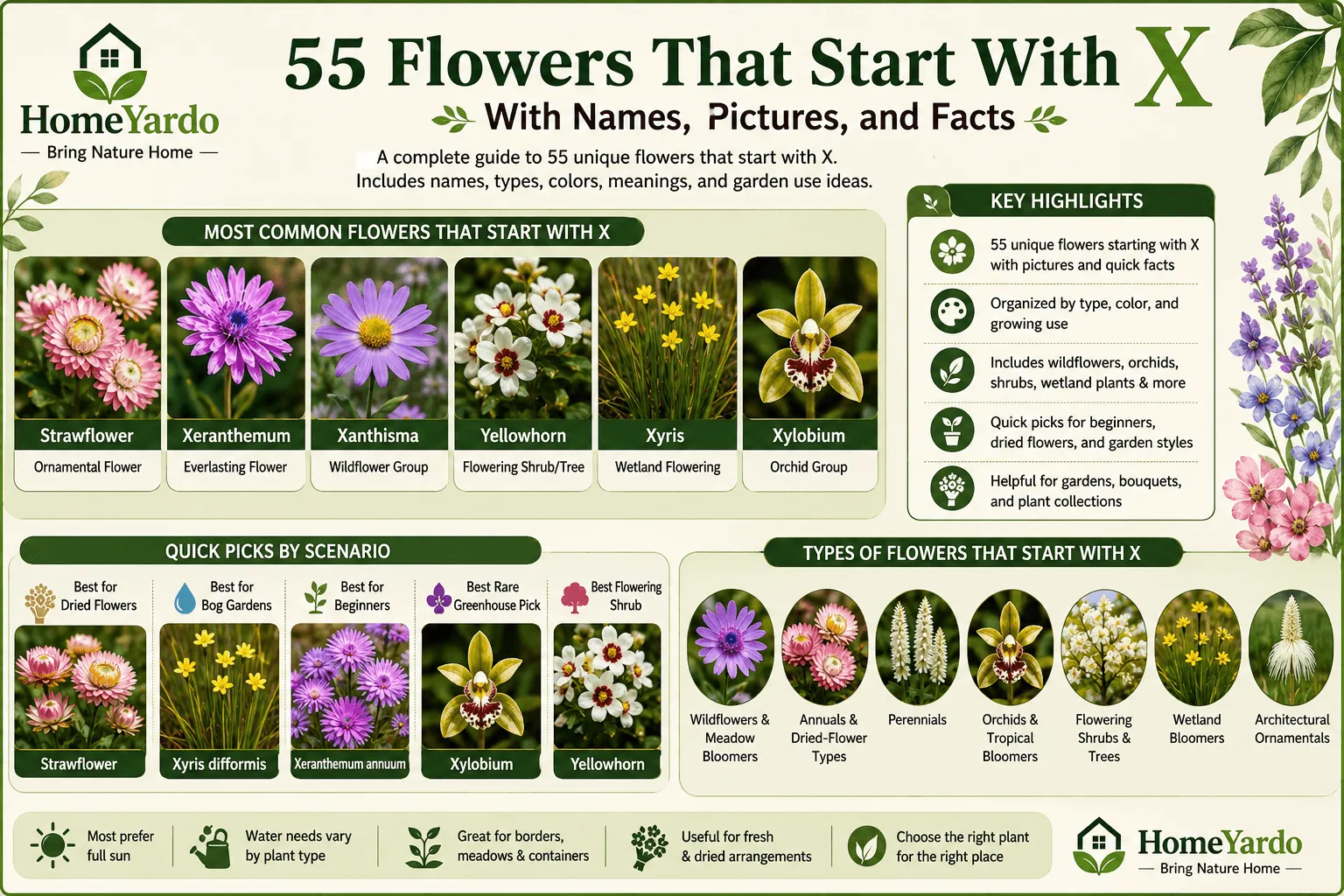
Most Common Flowers That Begin With X
A short common-name block makes the topic easier to scan before the longer botanical list begins.
| Name | Type | Best Known For | Why It Stands Out |
|---|---|---|---|
| Strawflower | Common ornamental flower | Dried arrangements and easy color | The most familiar X-adjacent garden flower is the marigold because it is colorful, simple to grow, and useful fresh or dried. |
| Xeranthemum | Everlasting flower group | Papery blooms and dry gardens | One of the strongest true X flower names in alphabet lists, with a classic everlasting look. |
| Xanthisma | Wildflower group | Native planting and meadow style | A good fit for naturalistic borders, with a soft daisy-like appearance. |
| Yellowhorn | Flowering shrub or small tree | Showy spring bloom | A memorable woody bloomer with white flowers and striking colored centers. |
| Xyris | Wetland flowering group | Bog and marsh planting | Useful for wet ground, with tidy yellow flowers and grassy foliage. |
| Xylobium | Orchid group | Rare tropical growing | Best suited to greenhouse or collector culture rather than open garden beds. |
If unusual flower names are the main interest, flowers that start with u are another useful list to explore because it sits in the same uncommon-letter category.
Quick Picks By Scenario
A few names stand out faster than the full list, especially when the goal is not just collecting names but choosing the most useful options.
| Scenario | Best Pick | Why It Works |
|---|---|---|
| Best for dried flowers | Strawflower | The blooms hold shape and color especially well after cutting. |
| Best for bog gardens | Xyris difformis | It suits moist ground and adds neat yellow flowers where many border plants fail. |
| Best for beginners | Xeranthemum annuum | It likes sun, handles leaner soil, and gives a classic papery bloom look. |
| Best rare greenhouse pick | Xylobium | It brings a strong tropical orchid feel and collector appeal. |
| Best flowering shrub | Yellowhorn | It offers showy spring flowers on a woody plant with real landscape presence. |
Flowers That Starting With The Letter X: At A Glance
The strongest X flower names do not all belong to the same plant type or climate. A quick comparison helps sort the standouts before the full list begins.
| Name | Scientific Name | Type | Main Color | Region | Annual or Perennial | Bloom Season | Sun Needs | Soil Preference | Water Need | Best Use |
|---|---|---|---|---|---|---|---|---|---|---|
| Xanthisma | Xanthisma | Wildflower genus | Purple, lavender | North America | Usually perennial by species | Spring to summer | Full sun | Light, open soil | Low to moderate | Native gardens |
| Yellowhorn | Xanthoceras sorbifolium | Flowering shrub or small tree | White with red and yellow centers | China and Korea | Perennial woody plant | Spring | Full sun | Well-drained fertile soil | Moderate | Specimen planting |
| Xerochrysum | Xerochrysum | Paper daisy genus | Yellow, white, pink, orange | Australia | Annual to perennial by species | Spring to fall | Full sun | Well-drained soil | Low to moderate | Borders and dried flowers |
| Strawflower | Xerochrysum bracteatum | Flowering plant | Yellow, orange, red, pink, white | Australia | Often grown as annual | Summer to fall | Full sun | Light, well-drained soil | Moderate | Beds and bouquets |
| Xeranthemum | Xeranthemum | Everlasting flower genus | Purple, lilac, white | Mediterranean to western Asia | Mostly annual | Summer | Full sun | Lean, dry soil | Low | Dried flowers |
| Annual Xeranthemum | Xeranthemum annuum | Flowering annual | Purple, pink, white | Europe to western Asia | Annual | Summer | Full sun | Dry to moderately poor soil | Low | Dry garden color |
| Xerophyllum | Xerophyllum | Lily-like flowering genus | Creamy white | North America | Perennial | Late spring to summer | Sun to part sun | Well-drained sandy or open woodland soil | Moderate | Woodland and native settings |
| Eastern Turkeybeard | Xerophyllum asphodeloides | Flowering perennial | White | Eastern North America | Perennial | Late spring | Full sun to part shade | Sandy or open meadow soil | Moderate | Meadow-style planting |
| Xylobium | Xylobium | Orchid genus | Cream, yellow, green, bronze tones | Tropical America | Perennial orchid | Varies by species | Bright filtered light | Orchid medium with airflow | Moderate to high humidity | Collector plantings |
| Xyris | Xyris | Yellow eyed grass genus | Yellow, sometimes pale tones | Tropical and temperate regions | Annual to perennial by species | Summer | Full sun | Moist to wet soil | High | Wet sites and bog gardens |
| Yellow Eyed Grass | Xyris difformis | Wetland flower | Yellow | North America | Perennial | Summer | Full sun | Constantly moist ground | High | Rain garden use |
| Bear Grass | Xerophyllum tenax | Flowering perennial | White | Western North America | Perennial | Summer | Full sun | Well-drained mountain or open woodland soil | Low to moderate after establishment | Naturalistic planting |
How We Chose And Verified These X Flower Names
A long X flower list needs clear rules. Without them, the page quickly turns into a mixture of repeated genus names, unrelated organisms, and entries that are only weakly connected to flowering plants.
For this list, accepted flower names were included first. Widely used genus-level entries were kept when they are regularly treated as flower names in gardening or botanical contexts. Species-level entries were included only when they added a distinct identity of their own, such as different habitat value, practical garden use, or a recognizable floral distinction.
Entries that are not flowers were left out. That means no fungi, insects, marine animals, bacteria, or duplicate name padding. The result is a fuller X list that still feels clean and believable.
| Included | Excluded |
|---|---|
| Flower names in common or botanical use | Fungi and mushroom entries |
| Flowering genera commonly treated as flower names | Insects, marine life, and bacteria |
| Species with distinct floral or garden value | Repeated genus and species counted without labels |
| Flowering shrubs, orchids, and wetland bloomers with clear labeling | Weak-fit plant names were included only to inflate the count |
Types Of Flowers That Begin With X
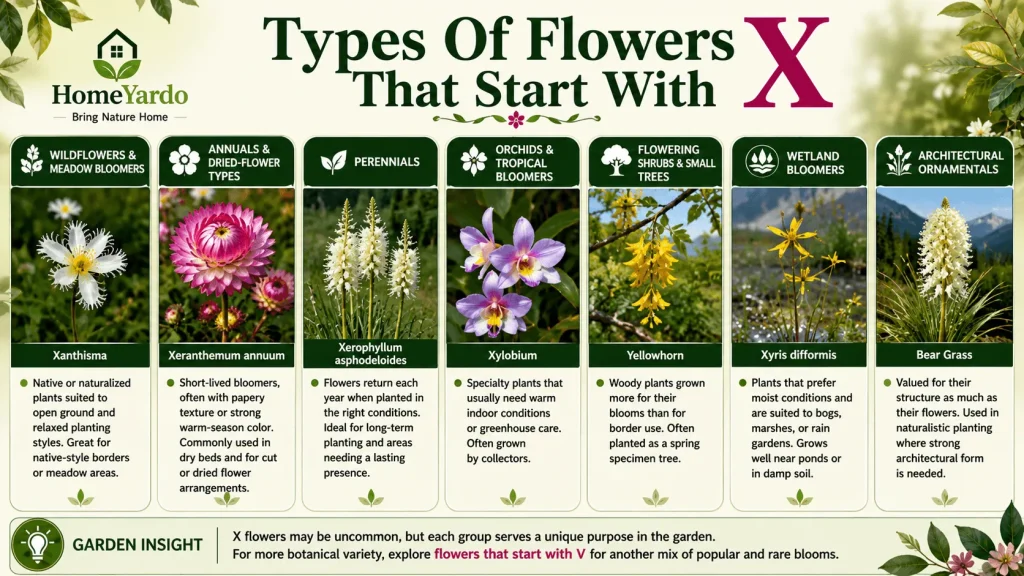
Flower names that begin with X can look scattered at first, but most fall into a few clear groups. Breaking them into types makes it easier to understand how they are used and where they fit in a garden.
- Wildflowers and meadow bloomers
These are native or naturalized plants suited to open ground and relaxed planting styles. Xanthisma is a good example and works well in native-style borders or meadow areas. - Annuals and dried-flower types
These are short-lived bloomers, often with papery texture or strong warm-season color. Xeranthemum annuum is commonly used in dry beds and for cut or dried flower arrangements. - Perennials
These flowers return each year when planted in the right conditions. Xerophyllum asphodeloides fits long-term planting and is often used where a lasting presence is needed. - Orchids and tropical bloomers:
These are specialty plants that usually need warm indoor conditions or greenhouse care. Xylobium is one example, often grown by collectors. - Flowering shrubs and small trees
These are woody plants grown more for their blooms than for border use. Yellowhorn is a known example, often planted as a spring specimen tree. - Wetland bloomers
These plants prefer moist conditions and are suited to bogs, marshes, or rain gardens. Xyris difformis grows well near ponds or in consistently damp soil. - Architectural ornamentals
These plants are valued for their structure as much as their flowers. Bear Grass is often used in naturalistic planting where strong form is needed.
Another good way to compare uncommon floral groups is to look at flowers that start with v, which also blends familiar blooms with less common botanical names.
Plants Vs Flowers That Starting With X
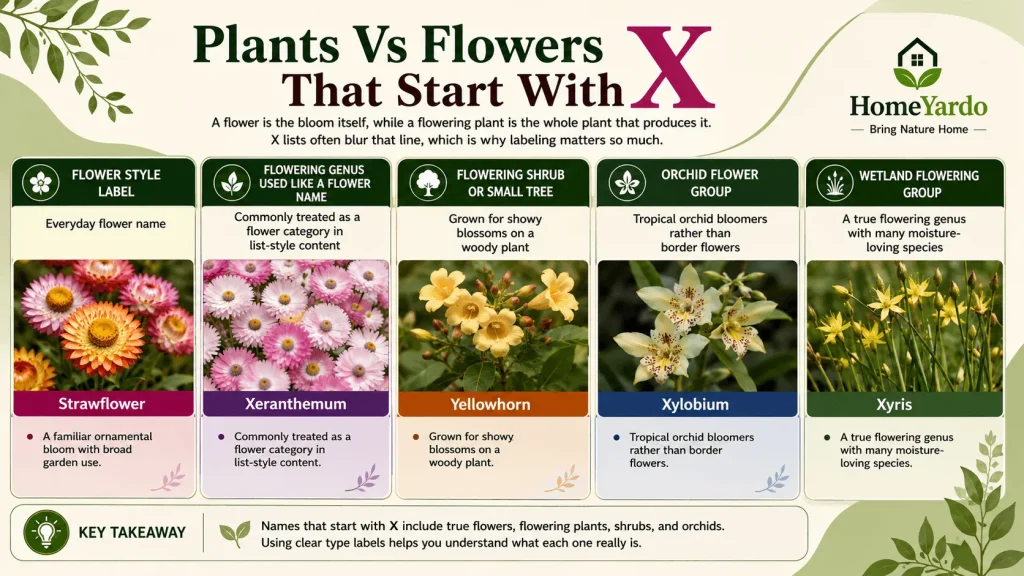
A flower is the bloom itself, while a flowering plant is the whole plant that produces it. X lists often blur that line, which is why labeling matters so much.
Some names in this article are everyday flower names. Others are botanical groups that are still commonly included in X flower lists because the blooms are the main point of interest. That does not make them poor fits, but it does mean they should be labeled clearly.
| Flower Style Label | Best Example | Why It Fits |
|---|---|---|
| Everyday flower name | Strawflower | A familiar ornamental bloom with broad garden use |
| Flowering genus used like a flower name | Xeranthemum | Commonly treated as a flower category in list-style content |
| Flowering shrub or small tree | Yellowhorn | Grown for showy blossoms on a woody plant |
| Orchid flower group | Xylobium | Tropical orchid bloomers rather than border flowers |
| Wetland flowering group | Xyris | A true flowering genus with many moisture-loving species |
That is why the full list below uses type labels instead of treating every X name as the same kind of flower.
The Full List Of 55 Flowers That Begining With X
The list below keeps related names together so the topic stays easy to scan. The strongest and most familiar entries come first, followed by groups that broaden the topic without repeating the same idea.
Group 1: Core X Flower Names
These are the anchor names that carry most of the real-world value for this topic. They are the entries most likely to feel useful in gardening, floral naming, or alphabet-based flower lists.
| # | Name | Scientific Name | Type | Alternate Name | Bloom Time | Best Growing Condition | Best Fit |
|---|---|---|---|---|---|---|---|
| 1 | Xanthisma | Xanthisma | Wildflower genus | Sleepy Daisy group in some contexts | Spring to summer | Open sunny ground | Native borders |
| 2 | Yellowhorn | Xanthoceras sorbifolium | Flowering shrub or small tree | Chinese flowering chestnut relative | Spring | Full sun with good drainage | Specimen planting |
| 3 | Xerochrysum | Xerochrysum | Paper daisy genus | Everlasting daisy group | Spring to fall | Full sun | Dried flowers and borders |
| 4 | Strawflower | Xerochrysum bracteatum | Flowering plant | Everlasting flower | Summer to fall | Warm sunny beds | Bouquets and cutting |
| 5 | Xeranthemum | Xeranthemum | Everlasting flower genus | Paper-like everlasting group | Summer | Dry sunny sites | Dried arrangements |
| 6 | Annual Xeranthemum | Xeranthemum annuum | Annual flower | Common xeranthemum | Summer | Lean, sunny soil | Dry garden color |
| 7 | Xerophyllum | Xerophyllum | Flowering genus | Turkeybeard group | Late spring to summer | Sun to part sun | Native and woodland edges |
| 8 | Eastern Turkeybeard | Xerophyllum asphodeloides | Perennial flower | Eastern turkeybeard | Late spring | Open meadows and sandy sites | Meadow planting |
| 9 | Xylobium | Xylobium | Orchid genus | Tropical xylobium orchid group | Varies by species | Warm, humid, filtered light | Collectors and greenhouses |
| 10 | Xyris | Xyris | Yellow-eyed grass genus | Yellow-eyed grass group | Summer | Wet, sunny sites | Bog gardens |
Group 2: Wildflowers And Meadow Bloomers
This group leans toward habitat value, native garden use, and species that look best in a looser planting style.
| # | Name | Scientific Name | Type | Bloom Time | Best Growing Condition | Best Fit |
|---|---|---|---|---|---|---|
| 11 | Sandy Xanthisma | Xanthisma arenarium | Wildflower | Spring to summer | Dry sunny ground | Native dry beds |
| 12 | Tufted Xanthisma | Xanthisma blephariphyllum | Wildflower | Spring | Open sun | Compact meadow planting |
| 13 | Colorado Xanthisma | Xanthisma coloradoense | Wildflower | Spring to early summer | Rocky sunny sites | Regional native gardens |
| 14 | Slender Xanthisma | Xanthisma gracile | Wildflower | Spring | Light, open soil | Fine-textured meadow planting |
| 15 | Gumweed Xanthisma | Xanthisma grindelioides | Wildflower | Summer | Dry exposed ground | Tough native mixes |
| 16 | Barehead Xanthisma | Xanthisma gymnocephalum | Wildflower | Spring | Sunny native sites | Botanical collections |
| 17 | Two Edged Yellow Eyed Grass | Xyris anceps | Wet meadow flower | Summer | Warm wet soil | Rain gardens |
| 18 | Short Leaf Yellow Eyed Grass | Xyris brevifolia | Wet meadow flower | Summer | Moist subtropical ground | Wet borders |
| 19 | Carolina Yellow Eyed Grass | Xyris caroliniana | Marsh flower | Summer | Sunny marsh or bog | Native wetland planting |
| 20 | Bog Yellow Eyed Grass | Xyris difformis | Wetland flower | Summer | Constant moisture | Bog gardens and pondsides |
Group 3: Orchids And Tropical Bloomers
The X orchid cluster gives the letter more range and a more exotic feel. These names are less useful for ordinary borders, but they are still part of the wider floral picture.
| # | Name | Scientific Name | Type | Bloom Time | Best Growing Condition | Best Fit |
|---|---|---|---|---|---|---|
| 21 | Xylobium Bractescens | Xylobium bractescens | Orchid | Varies | Warm humidity and filtered light | Orchid collections |
| 22 | Xylobium Coelia | Xylobium coelia | Orchid | Varies | Humid greenhouse conditions | Tropical collections |
| 23 | Xylobium Colleyi | Xylobium colleyi | Orchid | Varies | Warm protected growing areas | Specialty growers |
| 24 | Xylobium Corrugatum | Xylobium corrugatum | Orchid | Varies | Bright indirect light | Orchid houses |
| 25 | Xylobium Elatum | Xylobium elatum | Orchid | Varies | Warm humid conditions | Tropical displays |
| 26 | Xylobium Elongatum | Xylobium elongatum | Orchid | Varies | Filtered light and airflow | Botanical collections |
| 27 | Xylobium Foveatum | Xylobium foveatum | Orchid | Varies | Stable warmth and humidity | Indoor specialty growing |
| 28 | Xylobium Leontoglossum | Xylobium leontoglossum | Orchid | Varies | Tropical greenhouse culture | Orchid enthusiasts |
| 29 | Xylobium Miliaceum | Xylobium miliaceum | Orchid | Varies | Warm, humid indoor conditions | Collector shelves |
| 30 | Xylobium Pallidiflorum | Xylobium pallidiflorum | Orchid | Varies | Bright filtered light | Pale-flowered orchid displays |
Group 4: Flowering Shrubs, Trees, And Ornamentals
Some X names are best treated as ornamental flowering plants rather than classic cut flowers. They still belong here because the flowers are the reason they are grown.
| # | Name | Scientific Name | Type | Bloom Time | Best Growing Condition | Best Fit |
|---|---|---|---|---|---|---|
| 31 | Xerochrysum Bicolor | Xerochrysum bicolor | Ornamental flower | Summer | Full sun and good drainage | Dry borders |
| 32 | Xerochrysum Hispidum | Xerochrysum hispidum | Ornamental flower | Summer | Sunny open ground | Native-style planting |
| 33 | Xerochrysum Macranthum | Xerochrysum macranthum | Ornamental flower | Summer | Open sun | Showier perennial beds |
| 34 | Xerochrysum Neoanglicum | Xerochrysum neoanglicum | Ornamental flower | Summer | Full sun | Perennial daisy borders |
| 35 | Xerochrysum Papillosum | Xerochrysum papillosum | Ornamental flower | Summer | Well-drained sunny sites | Regional botanical interest |
| 36 | Xerochrysum Palustre | Xerochrysum palustre | Ornamental flower | Summer | Moist open sites | Habitat-focused planting |
| 37 | Xerochrysum Subundulatum | Xerochrysum subundulatum | Ornamental flower | Summer | Sunny upland conditions | Mountain-style beds |
| 38 | Xerochrysum Viscosum | Xerochrysum viscosum | Ornamental flower | Summer | Open sun and drainage | Drought-friendly borders |
Group 5: Dry Climate and Xeric Bloomers
This group works especially well for sunny spaces, dry garden plans, and dried-flower use.
| # | Name | Scientific Name | Type | Bloom Time | Best Growing Condition | Best Fit |
|---|---|---|---|---|---|---|
| 39 | Cylindrical Xeranthemum | Xeranthemum cylindraceum | Annual flower | Summer | Dry, sunny soil | Xeric beds |
| 40 | Closed Xeranthemum | Xeranthemum inapertum | Annual flower | Summer | Full sun and lean soil | Warm dry gardens |
| 41 | Bear Grass | Xerophyllum tenax | Flowering perennial | Summer | Sunny slopes and open woods | Naturalistic planting |
| 42 | Flatstem Yellow Eyed Grass | Xyris complanata | Wet to seasonally dry flower | Summer | Warm climates with moisture | Flexible habitat planting |
| 43 | Jupicai Yellow Eyed Grass | Xyris jupicai | Annual or biennial flower | Summer | Moist sunny ground | Tropical wet beds |
| 44 | Drummond’s Yellow Eyed Grass | Xyris drummondii | Wetland flower | Summer | Marshy open ground | Habitat gardens |
| 45 | Twisted Yellow Eyed Grass | Xyris torta | Perennial flower | Summer | Moist sandy soil | Native bog planting |
Group 6: Extended X Entries To Reach 55
These final names are extended botanical entries with clear flowering relevance. They are less familiar with casual gardening, but they still help round out the topic without resorting to filler.
| # | Name | Scientific Name | Type | Bloom Time | Best Growing Condition | Best Fit |
|---|---|---|---|---|---|---|
| 46 | Cape Yellow Eyed Grass | Xyris capensis | Flowering grass-like plant | Summer | Moist warm ground | Specialist wet beds |
| 47 | Fallax Yellow Eyed Grass | Xyris fallax | Wetland flower | Summer | Tropical marsh conditions | Botanical collections |
| 48 | Hymenachne Yellow Eyed Grass | Xyris hymenachne | Wetland flower | Summer | Moist tropical sites | Wet habitat planting |
| 49 | Huilla Yellow Eyed Grass | Xyris huillensis | Perennial flower | Summer | Warm open sites | Regional botanical interest |
| 50 | Indian Yellow Eyed Grass | Xyris indica | Annual flower | Summer | Tropical wet ground | Asian and Australian plantings |
| 51 | Lax Yellow Eyed Grass | Xyris laxifolia | Perennial flower | Summer | Moist tropical sites | Rain garden collections |
| 52 | Dark Yellow Eyed Grass | Xyris nigrescens | Perennial flower | Summer | Moist montane conditions | Specialty tropical displays |
| 53 | Operculate Yellow Eyed Grass | Xyris operculata | Wetland flower | Summer | Sunny wet ground | Australian habitat gardens |
| 54 | Mountain Yellow Eyed Grass | Xyris montana | Perennial flower | Summer | Cool boggy sites | North American bog gardens |
| 55 | Witsenioides Yellow Eyed Grass | Xyris witsenioides | Perennial flower | Summer | Moist South American conditions | Rare botanical collections |
Best Flower Names Starting With X By Color
Color filters make the list more useful because many X names are unfamiliar at first glance. Breaking the topic down by color quickly shows which names feel most practical in a planting plan.
Purple Flowers That Start With X
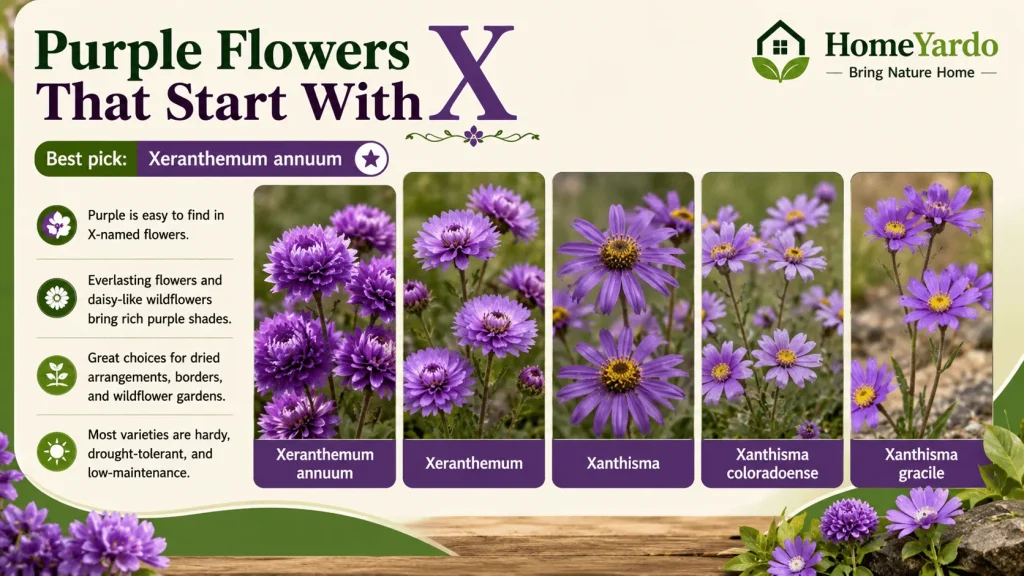
Best pick: Xeranthemum annuum.
Xeranthemum annuum, Xeranthemum, Xanthisma, Xanthisma coloradoense, and Xanthisma gracile are among the strongest purple-leaning options in this letter group. Purple is one of the easiest shades to find here because everlasting flowers and daisy-like wildflowers both contribute to it.
White X Flowers Names
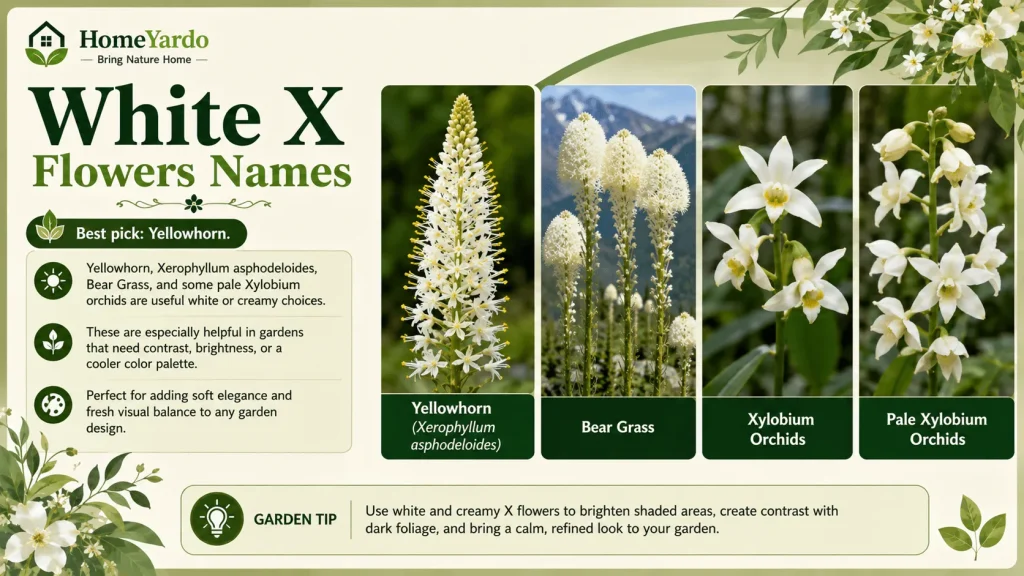
Best pick: Yellowhorn.
Yellowhorn, Xerophyllum asphodeloides, Bear Grass, and some pale Xylobium orchids are useful white or creamy choices. These are especially helpful in gardens that need contrast, brightness, or a cooler color palette.
Yellow X Flowers Names
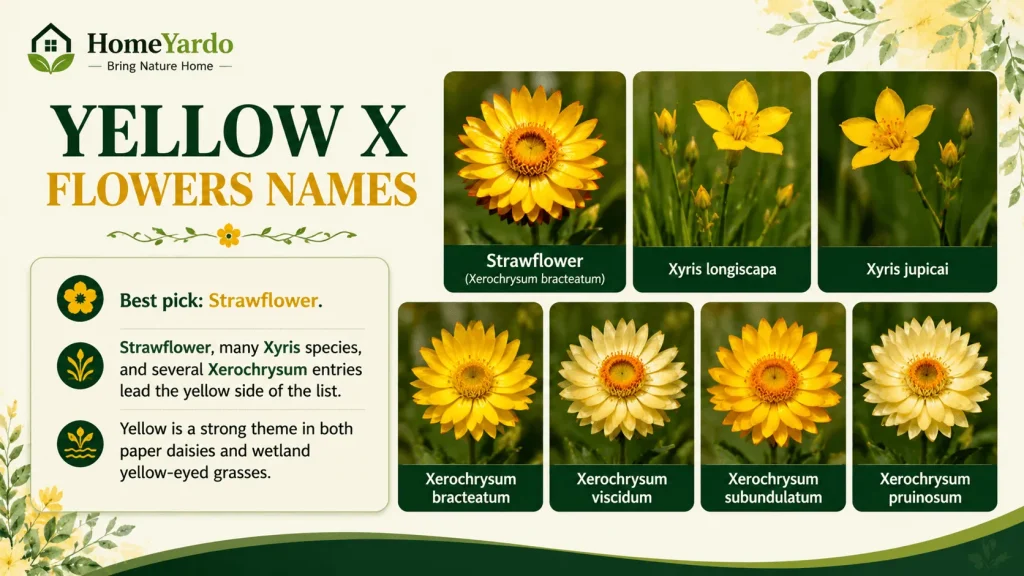
Best pick: Strawflower.
Strawflower, many Xyris species, and several Xerochrysum entries lead the yellow side of the list. Yellow is a strong theme in both paper daisies and wetland yellow-eyed grasses.
Pink X Flowers Names
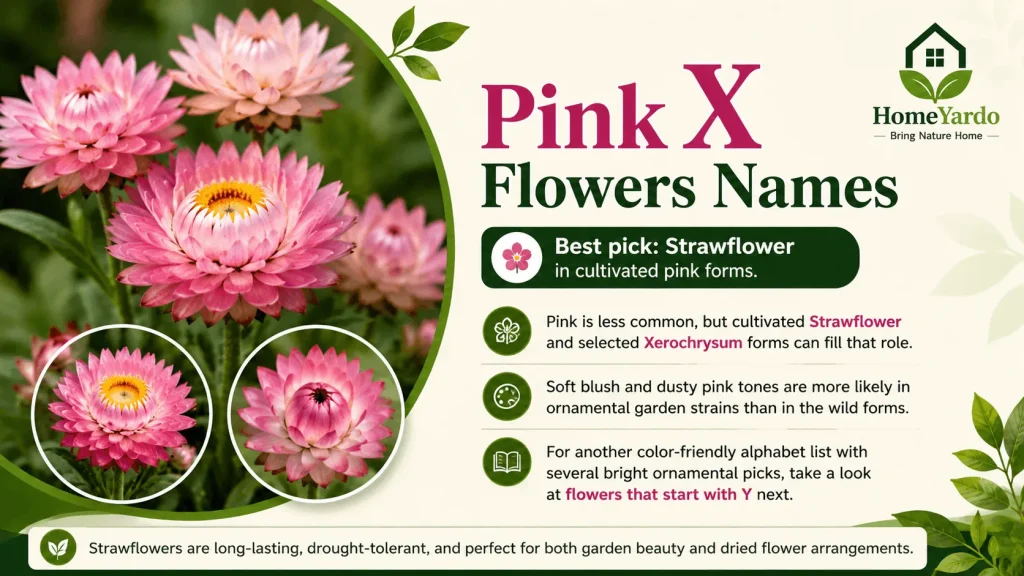
Best pick: Strawflower in cultivated pink forms.
Pink is less common, but cultivated Strawflower and selected Xerochrysum forms can fill that role. Soft blush and dusty pink tones are more likely in ornamental garden strains than in the wild forms. For another color-friendly alphabet list with several bright ornamental picks, take a look at flowers that start with y next.
Best X Flowers by Growing Style and Use
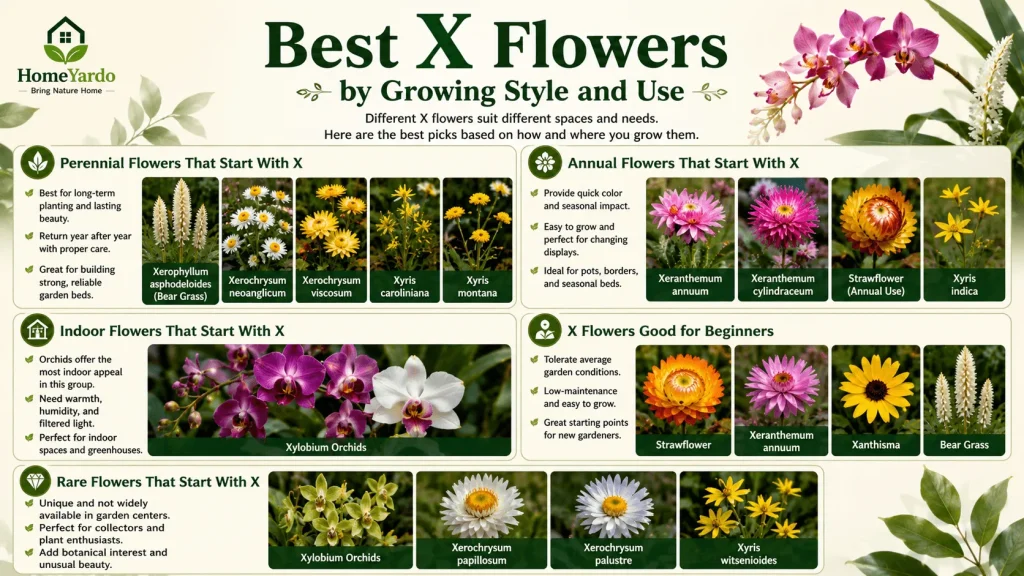
Not every X flower belongs in the same kind of planting. Some work best for dry borders, some suit wet ground, and some make more sense indoors than outdoors.
Perennial Flowers That Start With X
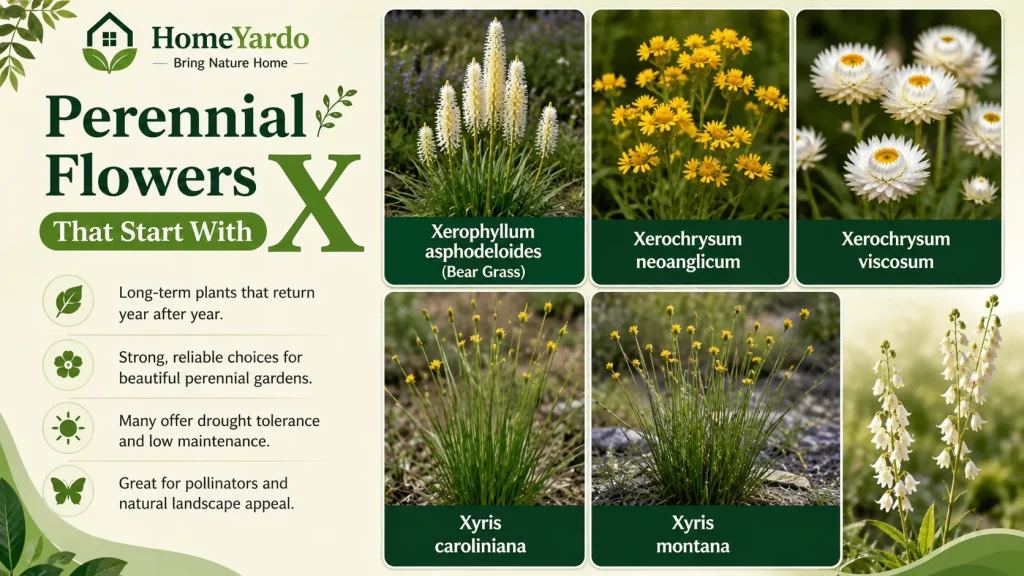
Perennials matter most when the goal is long-term planting rather than one-season color. The most useful perennial picks include Xerophyllum asphodeloides, Bear Grass, Xerochrysum neoanglicum, Xerochrysum viscosum, Xyris caroliniana, and Xyris montana.
Annual Flowers That Start With X
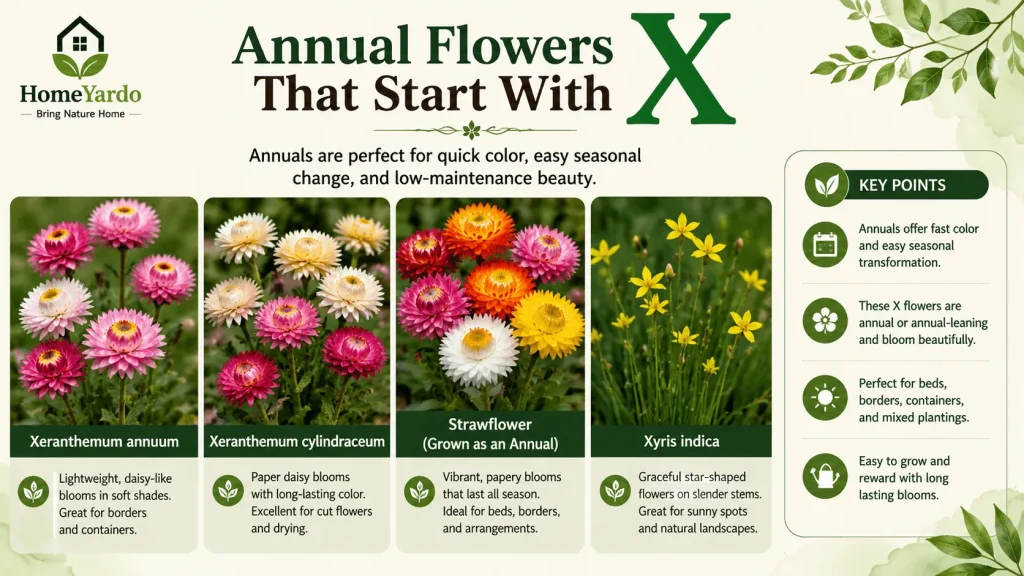
Annuals are useful where quick color and easy seasonal change are the main priorities. Xeranthemum annuum, Xeranthemum cylindraceum, Strawflower when grown as an annual, and Xyris indica are solid annual-leaning options.
Indoor Flowers Start With X
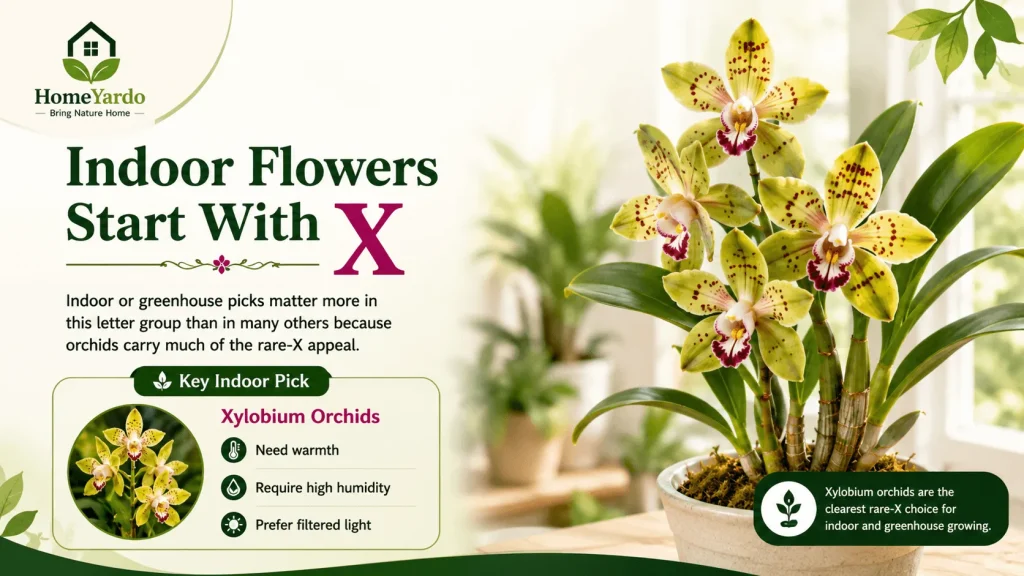
Indoor or greenhouse picks matter more in this letter group than in many others because orchids carry much of the rare-X appeal. The clearest indoor or greenhouse choices are the Xylobium orchids, which need warmth, humidity, and filtered light.
X Flowers Good for Beginners
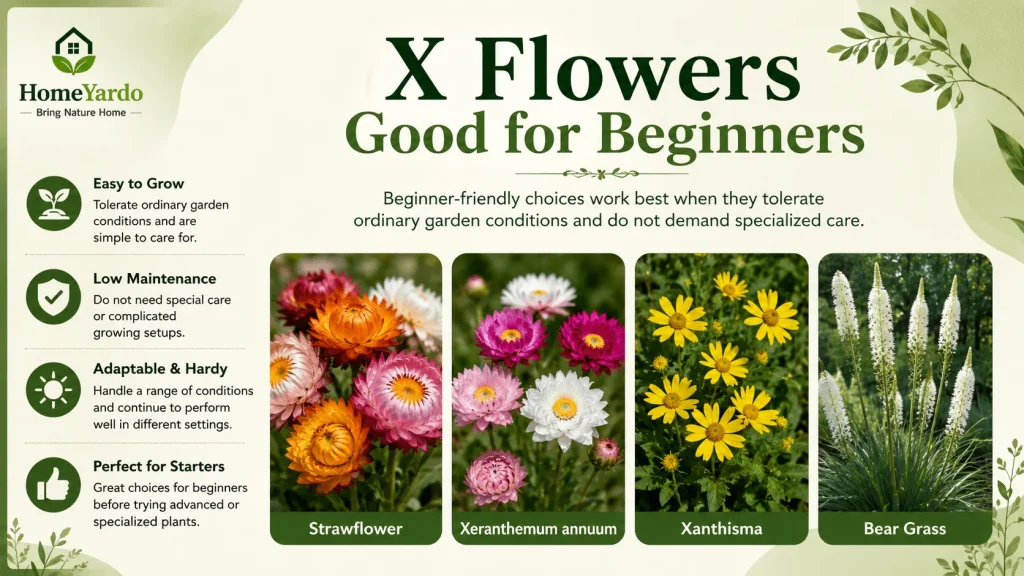
Beginner-friendly choices work best when they tolerate ordinary garden conditions and do not demand specialized care. Strawflower, Xeranthemum annuum, Xanthisma, and Bear Grass are easier starting points than orchids or specialized wetland species.
Rare Flowers That Start With X
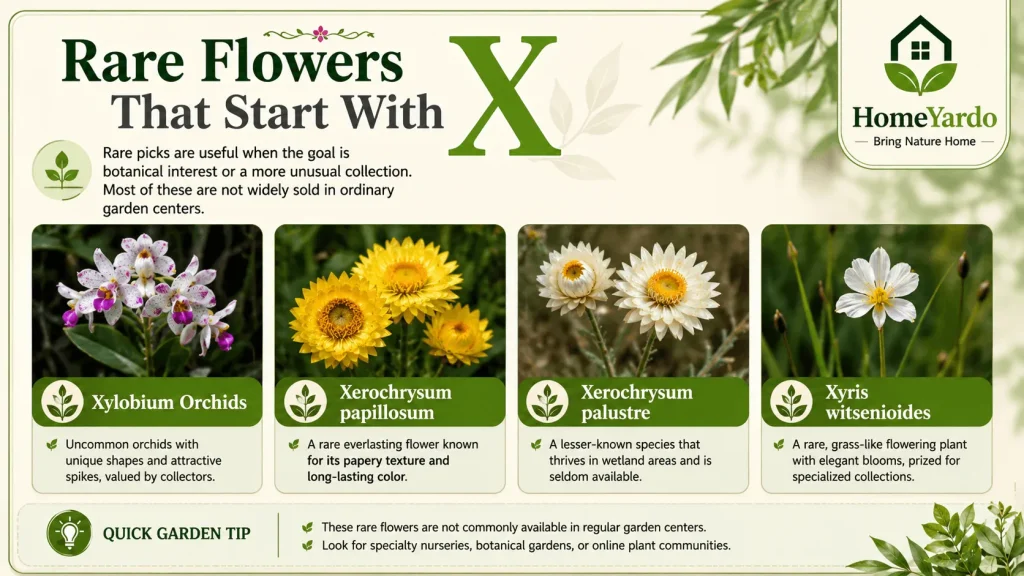
Rare picks are useful when the goal is botanical interest or a more unusual collection. Most Xylobium orchids, Xerochrysum papillosum, Xerochrysum palustre, and Xyris witsenioides are rare because they are not widely sold in ordinary garden centers.
Symbolism and Meaning Of Key X Flowers
Symbolism is not the strongest layer in X flower content, but a few names still carry useful associations when interpreted through their appearance or traditional floral character.
| Flower | Common Symbolic Reading | Why It Fits |
|---|---|---|
| Strawflower | Endurance and lasting memory | The blooms dry well and keep their shape, which gives them a natural link with permanence. |
| Xeranthemum | Calm resilience | Its papery everlasting form suits dry conditions and carries a quiet, enduring feel. |
| Yellowhorn | Renewal and spring energy | It flowers boldly in spring and brings a fresh-start quality to the landscape. |
| Xylobium | Rarity and refinement | As a tropical orchid group, it feels uncommon, elegant, and carefully curated. |
| Xanthisma | Simplicity and natural beauty | Its daisy-like form fits meadow and native garden symbolism better than formal bouquet symbolism. |
What Is the Most Popular Flower That Starts With X?
Strawflower, also known as Xerochrysum bracteatum, is the strongest choice for the most popular flower that starts with X. It is colorful, familiar, easy to grow, and useful both fresh and dried.
Xeranthemum annuum comes next because it has a long history as an everlasting flower. Yellowhorn is also memorable, though it is more often treated as a flowering shrub than a standard flower-bed pick.
Where X Flowers Grow Best
Most X flowers fit into four broad growing patterns. Matching the plant to the right setting makes the whole letter group much more useful.
Dry and sunny sites suit Xeranthemum, Xerochrysum, and Bear Grass. These plants are strongest where drainage is good, sun is steady, and rich, moisture-retentive soil is not the main condition.
Temperate meadow and native planting fit Xanthisma, Eastern Turkeybeard, and several North American Xyris species. These names work especially well in looser planting designs where a more natural look is welcome.
Wet ground and boggy areas suit many Xyris species. That makes yellow-eyed grasses especially valuable in a letter group that might otherwise lean too heavily toward dry-garden bloomers.
Tropical humidity is where Xylobium orchids make the most sense. They are much better suited to greenhouse or specialty indoor growing than ordinary open beds.
How to Use X Flowers in a Garden or Bouquet
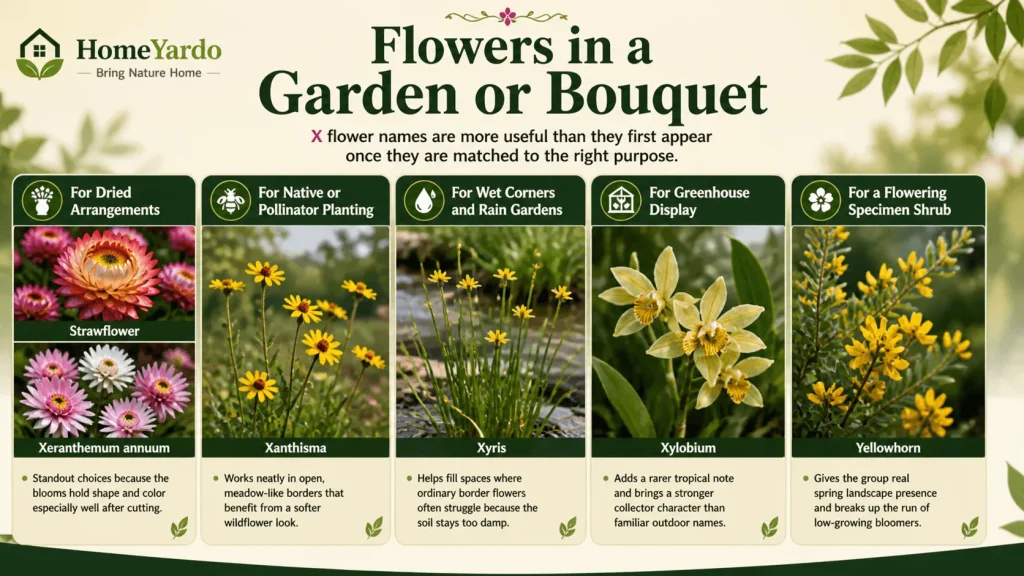
X flower names are more useful than they first appear once they are matched to the right purpose.
For dried arrangements, Strawflower and Xeranthemum annuum are the standout choices because the blooms hold shape and color especially well after cutting.
For native or pollinator planting, Xanthisma works neatly in open, meadow-like borders that benefit from a softer wildflower look.
For wet corners and rain gardens, Xyris helps fill spaces where ordinary border flowers often struggle because the soil stays too damp.
For greenhouse display, Xylobium adds a rarer tropical note and brings a stronger collector character than the more familiar outdoor names in the list.
For a flowering specimen shrub, Yellowhorn gives the group real spring landscape presence and breaks up the run of low-growing or habitat-specific bloomers. For nearby alphabet flower ideas, compare this list with flowers that start with W.
Common Mistakes In X Flower Lists
The most common mistake is forcing the count with entries that are not really flowers. That weakens trust quickly and makes the list feel less useful.
Another common issue is counting a genus and one of its species without any label that explains the difference. A better approach is to keep both only when the genus is widely used in naming lists and the species has a distinct floral or garden identity of its own.
Habitat is another place where many X lists go wrong. Xyris species are not dry border daisies, and Xylobium orchids are not warm-season annual bed plants. Matching each name to the right setting gives the whole article much more value.
| Good Fit | Weak Fit | Wrong Fit |
|---|---|---|
| Clearly labeled flower or flowering plant | Poorly explained shrub or genus entry | Fungi, insects, bacteria, or marine life |
| Species with distinct floral or garden value | Duplicate-style padding | Non-flower items were added only to raise the count |
| Moisture, orchid, or shrub entries with clear type labels | Unlabeled overlap between genus and species | Repeated entries counted twice |
This is why the full list uses type labels instead of treating every X name as the same kind of flower.
Conclusion
Flower names starting with X are rare, but they do not need to feel like filler once the list is organized properly. The strongest names come from everlastings, yellow-eyed grasses, wildflowers, orchids, and a small number of flowering woody plants.
For the best garden value, start with Strawflower, Xeranthemum annuum, Xanthisma, Xyris difformis, and Yellowhorn. For a rarer botanical feel, move toward Xylobium and the less familiar Xyris and Xerochrysum species.
FAQ’s
Flower names starting with X include names such as Xeranthemum, Xerochrysum, Xanthisma, Xylobium, Xyris, and Xerophyllum. Some are familiar ornamental blooms, while others are botanical or specialty plant names used more often in reference lists. That is why a good X flower guide needs clear labels instead of treating every entry as the same kind of garden flower.
Only a small number are widely recognized as common X flower names in everyday gardening. A larger list usually has to include clearly labeled species, genus-level flower names, and flowering plant entries to reach a higher count without repetition. The key is keeping those names organized so the list stays believable and useful.
The most common names in practical gardening are Strawflower, Xeranthemum, Xanthisma, Yellowhorn, Xyris, and Xylobium. Some are common in home gardens, while others appear more often in alphabet flower lists or botanical collections. Together, they form the core group that gives the X category most of its usable identity.
Good perennial examples include Xerophyllum asphodeloides, Bear Grass, Xerochrysum neoanglicum, Xyris caroliniana, and Xyris montana. These are better choices when the goal is repeat bloom over time rather than one-season color. Since some genera contain both annual and perennial species, the exact plant name still matters.
Yes, but the indoor group is much smaller than the outdoor group. The best indoor or greenhouse options are Xylobium orchids, which suit warm, humid conditions with bright filtered light. Dry-garden flowers such as Xeranthemum are much less natural fits for ordinary indoor growing.
Strawflower, Xeranthemum annuum, and some Xanthisma entries are easier places to start because they do not demand the same level of specialized care as orchids or wetland species. They also fit more easily into ordinary sunny planting conditions. That makes them a better match for simple home garden use.
Many X flower names feel rare because the letter itself is unusual in plant naming. The rarest-feeling entries usually come from Xylobium, less common Xerochrysum species, and more obscure Xyris species. Some are rare in cultivation, while others are simply unfamiliar outside specialist plant circles.
Yes, and purple is actually one of the easier colors to find in this letter group. Xeranthemum annuum and several Xanthisma entries are among the strongest purple-leaning choices. Their tones range from soft lavender to deeper purple shades, depending on species or cultivated form.
Yes. Strawflower and Xeranthemum annuum are the best-known dried-flower picks in this list because their blooms keep their shape and color especially well after cutting. That makes them useful for wreaths, dried bouquets, and long-lasting decorative displays.
Fragrance is not the strongest feature in this letter group. Most X flowers are chosen for visual texture, rarity, habitat value, or unusual botanical names rather than a bold scent. For that reason, X flower lists are usually more appealing for structure and curiosity than for perfume-focused planting.
Yes, although the symbolic side of X flowers is gentler than it is for more familiar bouquet flowers. Strawflower is often linked with endurance, Xeranthemum with quiet resilience, and Yellowhorn with spring renewal. These meanings come mostly from appearance, seasonal habit, and lasting floral character rather than long formal traditions.
A flower is the bloom itself, while a flowering plant is the whole plant that produces that bloom. Many X lists mix genus names, species names, flowers, orchids, shrubs, and flowering grasses, which can make the topic confusing if nothing is labeled. Clear type notes help show which names are everyday flowers and which belong to broader flowering plant groups.
References