
AC Repair in Clearwater: A Homeowner’s HVAC Maintenance Guide
Clearwater’s long cooling season, high humidity, coastal air, and frequent AC use can place substantial demand on residential HVAC equipment. When cooling becomes weak, airflow drops, the system starts cycling unusually, or electrical problems appear, waiting for a complete breakdown can turn a manageable problem into an urgent repair.
For homeowners looking into AC repair in Clearwater, the first step is identifying whether the problem involves routine maintenance, airflow, drainage, electrical components, refrigerant-related equipment, or an aging system that may be approaching replacement.
This guide explains common AC problems in Clearwater homes, warning signs that deserve professional attention, what to check when choosing an HVAC contractor, how electrical issues affect cooling equipment, and when repairing an older system may no longer make financial sense.
Key Takeaways
- Weak airflow, poor cooling, unusual cycling, water around the equipment, strange noises, burning odors, and repeated breaker trips can indicate an HVAC problem.
- Clearwater’s heat, humidity, heavy cooling demand, and coastal conditions can increase the need for regular equipment inspection and maintenance.
- Homeowners can safely handle simple tasks such as checking filters, thermostat settings, vents, and accessible outdoor-unit clearance.
- Refrigerant, internal electrical, compressor, motor, and control-system repairs should be handled by appropriately qualified professionals.
- Verify Florida contractor licensing, insurance, written estimates, warranty terms, and permit responsibilities before approving major HVAC work.
- Repeated failures, declining comfort, rising operating costs, and major repairs on an older system can justify comparing repair with replacement.
When Does Your AC Need Repair in Clearwater?
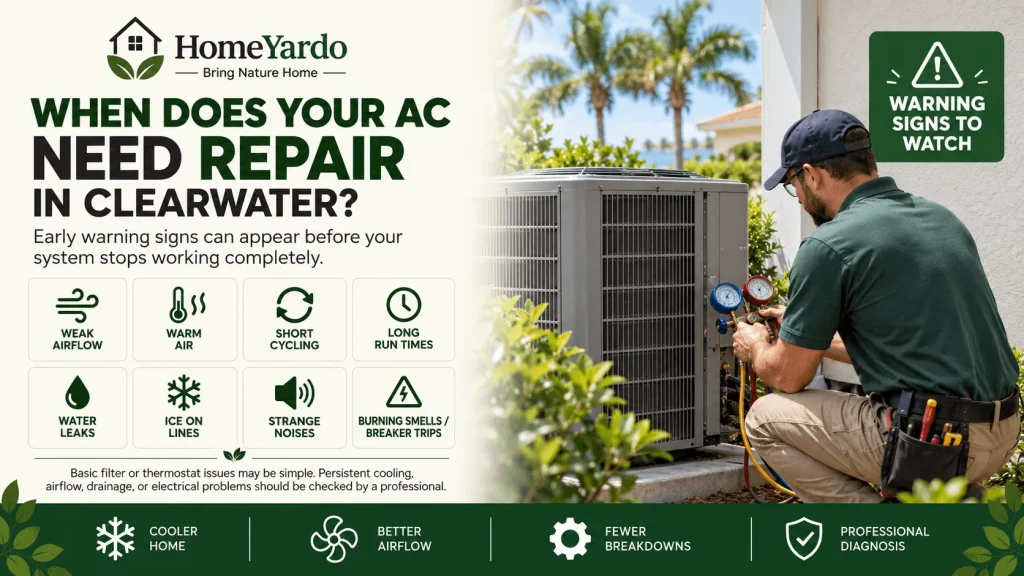
An air conditioner does not have to stop completely before it needs attention. Changes in the way the system cools, sounds, cycles, or handles humidity can provide earlier warning. These HVAC warning signs are worth checking before a minor issue develops into a larger repair.
Warning Signs That Need Professional Diagnosis
Consider arranging an HVAC inspection when you notice:
- warm or noticeably less-cool air from supply vents;
- airflow that has become much weaker;
- unusually long operating cycles;
- frequent starting and stopping;
- ice on accessible refrigerant lines or equipment;
- water around the air handler or condensate system;
- persistent buzzing, grinding, rattling, or other new noises;
- unexplained difficulty controlling indoor humidity;
- burning or electrical odors;
- repeated breaker trips; or
- cooling performance that continues to decline after basic filter and thermostat checks.
A dirty filter, incorrect thermostat setting, or blocked register may have a simple solution. Persistent problems can involve airflow, drainage, electrical controls, mechanical components, or the refrigeration system and should be diagnosed rather than guessed at.
Common AC Problems in Coastal Florida
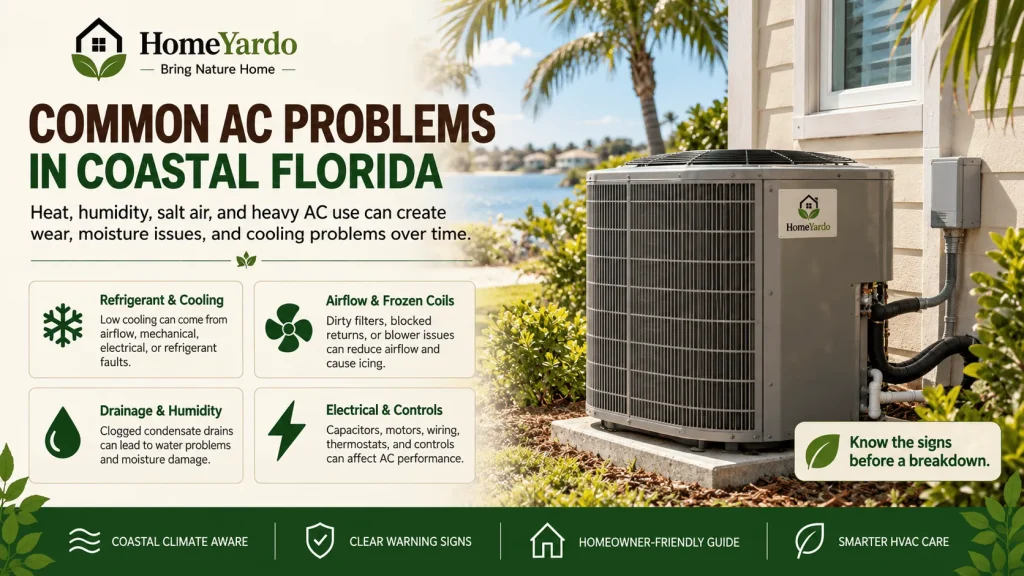
Air-conditioning equipment around Clearwater operates under conditions that can be demanding. Long periods of cooling, high moisture levels, outdoor debris, and coastal exposure can all affect equipment condition over time.
Common problems include:
Refrigerant and Cooling Problems
Low cooling capacity does not automatically mean an air conditioner simply needs more refrigerant. A system may have airflow, mechanical, electrical, or refrigerant-related faults.
If a refrigerant problem is suspected, the cause should be diagnosed by a properly qualified technician rather than repeatedly adding refrigerant without identifying why system performance changed.
Airflow and Frozen-Coil Problems
Dirty filters, blocked returns, blower problems, duct restrictions, and other airflow issues can reduce cooling capacity.
Restricted airflow may also contribute to coil icing. If ice repeatedly returns after the system has been checked, professional diagnosis is appropriate.
Drainage and Humidity Problems
Air conditioners remove moisture while cooling. Condensate drains and related components therefore deserve attention in Florida’s humid climate.
A blocked or poorly draining condensate line can cause water around equipment, trigger safety switches, or contribute to moisture-related damage.
Electrical and Control Problems
Capacitors, contactors, motors, wiring, thermostats, controls, and electrical connections all affect HVAC operation.
Electrical faults can cause intermittent operation, failed starts, unusual noises, or complete shutdown. Burning odors, visible electrical damage, smoke, or repeated breaker trips should not be treated as routine DIY repair projects.
Selecting an HVAC Service Provider

Price is only one part of choosing someone to work on an HVAC system.
Before approving major AC repair in Clearwater, check:
- appropriate Florida contractor licensing;
- current insurance;
- experience with comparable residential systems;
- a written description of the proposed work;
- pricing and payment terms;
- parts and labor warranty information;
- permit responsibilities where applicable;
- emergency-service policies; and
- how additional work will be approved if another problem is discovered.
Verify Florida Licensing and Insurance
Florida regulates air-conditioning contractors. Homeowners can use the Florida Department of Business and Professional Regulation to check available license information rather than relying only on a company website or advertisement.
Confirm that the contractor information shown on the estimate matches the business or individual being hired.
Insurance also matters. Ask the contractor what coverage applies to the work and do not assume licensing automatically answers every insurance question.
Ask About Estimates, Warranties and Emergency Service
A useful HVAC estimate should identify the problem being addressed and explain the recommended work clearly enough for the homeowner to understand what is being purchased.
For larger repairs, ask:
- Which component has failed?
- How was the problem diagnosed?
- Are there other reasonable repair options?
- Is the repair covered by an existing equipment or parts warranty?
- What warranty applies to the new repair?
- Does the quoted amount include labor, materials, and applicable permit costs?
Detailed answers are more useful than choosing a company based only on an online star rating.
The Electrical Component of HVAC Maintenance
An air-conditioning system depends on electrical components to start motors, operate the compressor, communicate with the thermostat, run controls, and protect the equipment.
Possible electrical problems include:
- capacitor failure;
- worn contactors;
- loose or damaged connections;
- thermostat or low-voltage control problems;
- motor electrical faults;
- breaker trips associated with overloads or faults; and
- corrosion or heat damage at connections.
For electrical and HVAC work handled by one contractor, Aire Serv, Mister Sparky, and Three Guys Master Tradesmen are worth considering if you’d rather not coordinate multiple trades.
Internal electrical work should not be treated like changing a filter. HVAC cabinets can contain energized components and capacitors capable of storing electrical energy.
Homeowners who notice smoke, a strong burning odor, damaged wiring, or repeated electrical protection trips should stop repeatedly restarting the equipment and arrange appropriate professional assessment.
Preventative Maintenance vs. Reactive Repairs
Routine maintenance cannot guarantee that an air conditioner will never fail. Components still age and unexpected faults can occur. Learn more about how to prevent AC breakdowns by keeping filters clean, watching for warning signs, and addressing developing problems early.
Its value is that routine inspection gives developing problems a chance to be identified before heavy cooling demand exposes them.
Professional maintenance may include:
- thermostat checks;
- filter and airflow inspection;
- accessible coil inspection;
- condensate-drain inspection;
- electrical-connection checks;
- motor and control checks;
- outdoor-equipment inspection;
- operating-cycle review; and
- refrigeration-system evaluation where appropriate.
The exact service should be based on the equipment type, manufacturer guidance, condition, and service history.
What Homeowners Can Safely Check Between Visits
Useful homeowner checks include:
- Confirm the thermostat is in the correct mode and setting.
- Inspect the air filter and replace it according to the equipment or filter manufacturer’s guidance.
- Make sure supply and return registers are not blocked.
- Keep leaves and loose debris away from the outdoor equipment where it can be done safely.
- Watch for water around indoor HVAC equipment.
- Note new sounds, odors, cycling changes, or cooling problems.
These observations can also help a technician diagnose a problem more efficiently.
Opening electrical panels, handling refrigerant, bypassing safety devices, or dismantling internal HVAC components goes beyond normal homeowner maintenance.
Installation Considerations for New Systems

When an aging AC system is replaced, equipment selection is only part of the project. Installation quality, sizing, airflow, drainage, duct condition, and electrical capacity all affect how the new system performs.
Why HVAC Sizing Matters
A larger air conditioner is not automatically better.
A system that is too small may struggle during heavy cooling demand. An oversized system may operate in shorter cycles and may not control indoor moisture as effectively as a correctly selected system.
Professional system selection should consider the home rather than relying solely on the size of the previous equipment.
Ductwork, Electrical Capacity and Drainage
A replacement project may also require evaluation of:
- existing supply and return ductwork;
- air leakage or damaged ducts;
- available electrical circuits and disconnects;
- refrigerant-line requirements;
- thermostat compatibility; and
- condensate drainage.
Correcting deficiencies while the new equipment is installed can be more practical than discovering them after commissioning.
Permits and Final Inspection
Permit requirements depend on the work being completed and the applicable local rules.
Ask the contractor who will obtain required permits, arrange inspections, and address any corrections identified during inspection. Avoid treating a proposal to bypass a required permit as a cost-saving benefit.
Regional Service Differences: Clearwater vs. St. Petersburg
Clearwater and St. Petersburg are both in Pinellas County and experience many of the same cooling challenges, including high seasonal temperatures, humidity, storms, and coastal exposure.
The larger practical difference for homeowners is often contractor coverage rather than a fundamentally different approach to AC maintenance.
When comparing companies, check whether the contractor regularly services your specific area, what after-hours coverage is available, and whether travel or dispatch policies differ by location.
Local familiarity can be useful, but licensing, diagnostic quality, written terms, communication, and workmanship remain more important than the size of a contractor’s service territory.
Emergency Service and After-Hours Repairs
An AC failure during hot weather can make indoor conditions uncomfortable quickly, particularly for households with people who are more sensitive to heat.
Before relying on a company for emergency service, ask:
- Is a technician actually available after normal business hours?
- How are after-hours diagnostic or dispatch charges calculated?
- What response area does the company cover?
- Are commonly needed parts carried on service vehicles?
- What happens when the required part is not immediately available?
- Will the homeowner receive an estimate before repair work begins?
When an AC Problem May Be an Electrical Safety Issue
Some situations deserve more caution than an ordinary loss of cooling.
Do not keep resetting a breaker or restarting equipment when there is:
- smoke;
- a strong burning or electrical smell;
- visible melted or damaged wiring;
- sparking;
- obvious overheating; or
- repeated breaker tripping.
The immediate priority in these situations is safe assessment of the electrical fault, not simply restoring cold air.
Should You Repair or Replace Your AC?
There is no single age or repair price that automatically determines whether an air conditioner should be replaced.
A better decision considers several factors together.
Signs Repair May Still Make Sense
Repair may remain reasonable when:
- the system has otherwise been reliable;
- the problem is isolated and repairable;
- overall cooling performance remains satisfactory;
- major components are in acceptable condition; and
- repair cost is reasonable compared with replacement.
Signs Replacement Deserves Consideration
It may be worth requesting a replacement estimate when:
- major failures are becoming more frequent;
- expensive components require repeated attention;
- comfort has declined despite repairs;
- the system struggles to manage temperature or humidity;
- energy use has increased without another clear explanation;
- replacement parts are becoming difficult or costly to source; or
- the expected repair expense is large relative to the value and condition of the existing system.
Comparing both options gives homeowners more useful information than relying on a fixed “repair after X years, replace after Y years” rule.
What R-22 Means for Older Systems
Some older air-conditioning systems use HCFC-22, commonly called R-22.
New production and import of HCFC-22 for servicing existing equipment ended in the United States in 2020. Existing systems can still be serviced using available reclaimed or previously produced refrigerant, but availability and cost can affect the economics of maintaining older equipment.
An R-22 system does not automatically require immediate replacement. Its refrigerant type should instead be considered together with equipment condition, repair history, performance, and the cost of the proposed repair.
Maintaining Reliable AC Performance in Clearwater
Reliable cooling in Clearwater depends on more than waiting for the air conditioner to stop working.
Check filters and accessible equipment regularly, pay attention when normal cooling behavior changes, schedule professional maintenance according to the system’s needs, and address persistent airflow, drainage, electrical, or mechanical symptoms rather than repeatedly resetting the equipment.
When repair becomes necessary, verify contractor qualifications and understand what is being repaired before authorizing the work. For an older system with repeated failures, compare the cost and expected benefit of another repair with a properly designed replacement.
That approach makes AC maintenance less about reacting to the next breakdown and more about managing the system throughout its service life.
FAQ’s
Annual professional pre-season maintenance is a reasonable baseline for residential cooling equipment. Homes with heavy equipment use or system-specific requirements may need a different schedule, so manufacturer guidance and the unit’s condition should also be considered.
Weak airflow, poor cooling, unusual noises, short cycling, long run times, water around equipment, unexpected humidity problems, burning odors, and repeated electrical trips are common signs that deserve attention.
Possible causes include restricted airflow, thermostat problems, dirty equipment, electrical faults, mechanical problems, or refrigerant-system issues. Checking the thermostat and accessible filter is reasonable, but persistent loss of cooling usually requires diagnosis.
Outdoor HVAC equipment can be exposed to moisture, airborne contaminants, vegetation, debris, and coastal conditions. Equipment condition should be monitored during routine maintenance rather than assuming every corrosion problem has the same cause.
Changing a filter or checking a thermostat is different from working on internal electrical components. Capacitors, wiring, motors, controls, disconnects, and other energized components should be handled by appropriately qualified professionals.
Consider the equipment’s overall condition, reliability, repair history, comfort performance, efficiency, refrigerant type, expected repair cost, and replacement cost together. Age by itself does not determine the answer.
Florida regulates air-conditioning contracting. Before major work, homeowners can check the contractor or business through the Florida Department of Business and Professional Regulation and confirm that the license information matches the provider being hired.
After-hours pricing varies by contractor. Ask about dispatch fees, diagnostic charges, labor rates, parts pricing, and authorization procedures before approving emergency work whenever circumstances allow.