Redbud Weeping Trees: How To Grow, Prune, And Choose The Best Variety
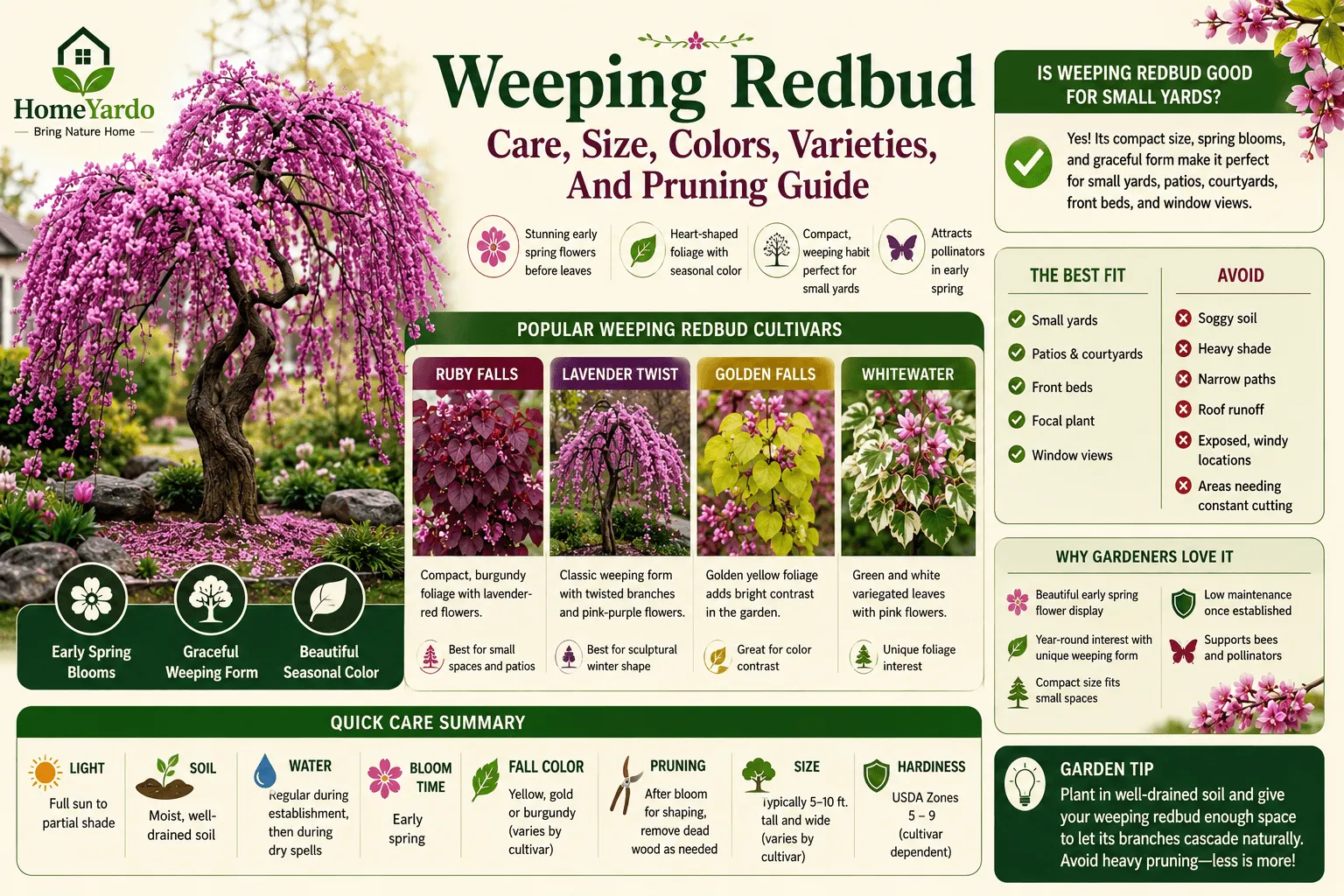
Weeping redbuds are an ornamental small version of Eastern redbuds that are grown for their falling branches as well as early spring flowers and heart-shaped leaves and the seasonal colors. It’s a good choice for smaller gardens where a typical flowering tree can be too large.
The most effective results are achieved by selecting the best cultivar, planting in well-drained soil, allowing ample light to the tree while it is established, ensuring that the tree gets enough water and trimming gently to preserve the natural form of weeping.
Since size, color and form vary with cultivar, the tag on the plant is as important as the general guidelines for care. Ruby Falls, Lavender Twist, Golden Falls, and Whitewater are all different in your garden.
This guide covers the size of the plant, colors, types, planting, pruning, staking, common problems buying suggestions, seasonal maintenance, and the most important questions to ask about cultivating a healthy redbud.
Quick Answer: Is A Weeping Redbud A Good Tree For Small Yards?
Yes, a redbud that is weeping is a great tree for small gardens if it has well-drained soil with enough light and space enough to let the canopy hang naturally. Its compact form as well as its spring blossom and its sculptural branching makes it ideal for patios or courtyards, as well as entrance gardens, front yards and mixed bed.
It’s not the best choice for soil that is spongy large shade, narrow pathways and roof runoff areas or for exposed corners. Young trees might also require some light trimming or staking in order to create a neat form.
Ruby Falls is often chosen because of its dark foliage and compact growth. Lavender Twist is commonly chosen because of its traditional weeping design, twisted branching and a sturdy winter structure.
The best fitting:
- Small yards
- Patios
- Courtyards
- Front beds
- Focal plant
- Views of the garden from the windows
Avoid:
- Soggy soil
- Heavy shade
- Sturdy walkways
- Roof runoff
- Exposed areas of windy and chilly corners
- Locations where branches will require continuous cutting
What Is A Weeping Redbud Tree?
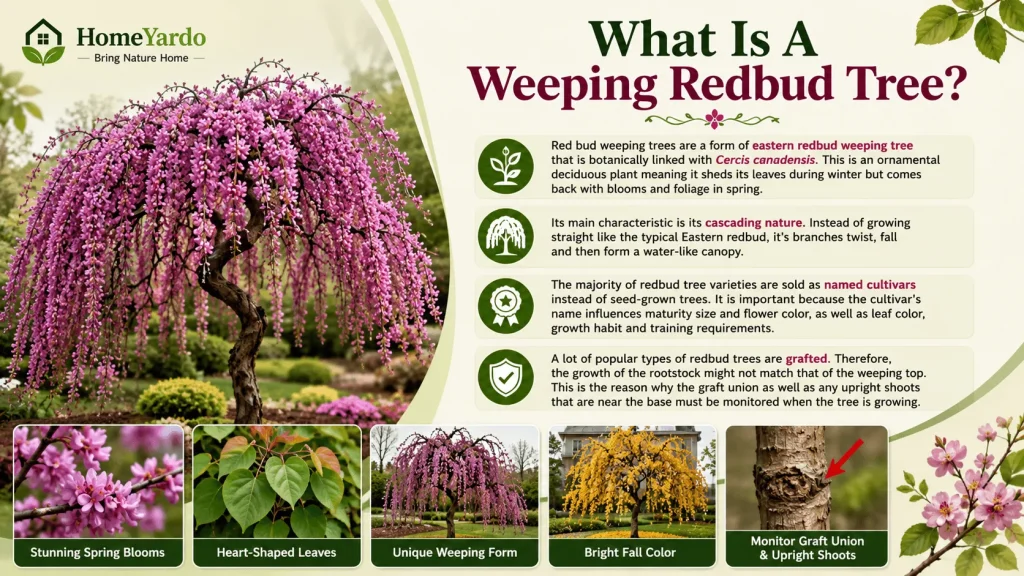
Red bud weeping trees are a form of eastern redbud weeping tree that is botanically linked with Cercis canadensis. This is an ornamental deciduous plant, meaning it sheds its leaves during winter but comes back with blooms and foliage in spring.
Its main characteristic is its cascading nature. Instead of growing straight like the typical Eastern redbud, it’s branches twist, fall and then form a water-like canopy.
The majority of redbud tree varieties are sold as named cultivars instead of seed-grown trees. It is important because the cultivar’s name influences maturity size and flower color, as well as leaf color, growth habit and training requirements.
A lot of popular types of redbud trees are grafted. Therefore, the growth of the rootstock might not match that of the weeping top. This is the reason why the graft union as well as any upright shoots that are near the base must be monitored when the tree is growing.
Types Of Redbud Trees
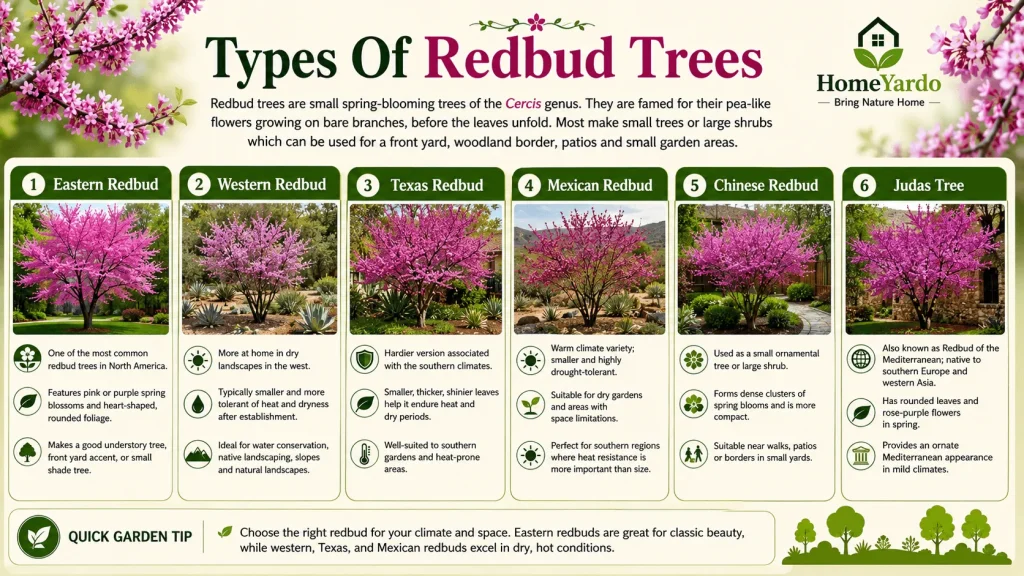
Redbud trees are small spring-blooming trees of the Cercis genus. They are famed for their pea-like flowers growing on bare branches, before the leaves unfold. Most make small trees or large shrubs which can be used for a front yard, woodland border, patios and small garden areas.
Eastern Redbud
Eastern redbud is one of the most common redbud trees in North America. Typically features pink or purple spring blossoms and heart-shaped, rounded foliage.
It makes a good understory tree, front yard accent, or small shade tree. Mature trees frequently exhibit a wide spreading, graceful form, with blossoms on the branches in early spring.
Western Redbud
California redbud, or western redbud, is more at home in dry landscapes in the west. It typically becomes smaller compared with Eastern redbud and is more tolerant of heat and dryness after establishment.
Ideal for water conservation, native landscaping, slopes and natural landscapes.
Texas Redbud
Texas redbud is a hardier version associated with the southern climates. Often, smaller, thicker, shinier leaves than Eastern redbud can help it endure heat and dry periods.
It is well-suited to southern gardens where an ordinary Eastern redbud could be susceptible to heat stress.
Mexican Redbud
Another warm climate variety is Mexican redbud. Smaller, and generally more drought-tolerant than many of the common redbuds.
It is suitable for dry gardens, space limitations, and southern regions where resistance to heat is more important than size of the tree.
Chinese Redbud
Chinese redbud is frequently used as a small ornamental tree or large shrub. Can form dense clusters of spring blooms and tends to be more compact than many Eastern redbuds.
It is suitable where a smaller tree with flowers is required, near walks, patios or borders in a small yard.
Judas Tree
J Judas tree, also known as Redbud of the Mediterranean, is a species that grows in southern Europe and western Asia. Has rounded leaves and rose-purple flowers in spring.
In mild climates, it is often planted as an ornamental tree and may provide an ornate Mediterranean appearance to a garden.
Popular Redbud Cultivars
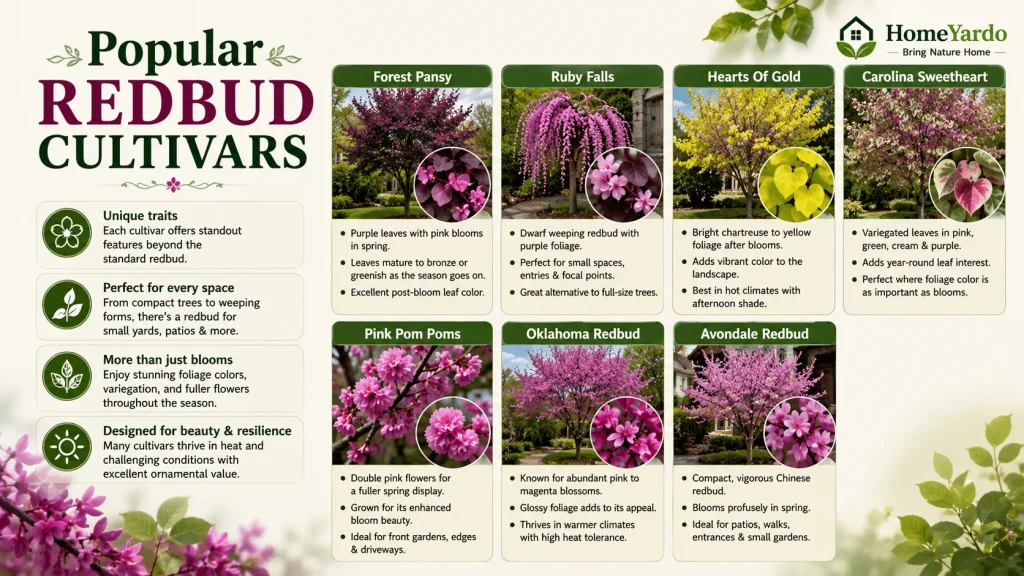
Redbud cultivars are grown for standout traits beyond the standard spring bloom. Some offer rich leaf color, some stay compact, and others add a weeping shape or fuller flowers. These selected varieties help match a redbud tree to small yards, entry areas, borders, patios, and ornamental garden designs without relying on size alone.
Forest Pansy
Forest Pansy is characterized by purple leaves and pink blooms in spring. Leaves will frequently begin purple and turn bronze or greenish in color as the season progresses.
One of the best plants for gardeners looking to have color after blooming.
Ruby Falls
Ruby Falls is a dwarf weeping redbud with purple foliage. Small and cascading, it is suitable for gardens with limited space, entry gardens and focal points.
It’s a nice alternative to a full size redbud.
Hearts Of Gold
Hearts Of Gold is being cultivated for its showy chartreuse to yellow foliage. The leaves add color following the spring blooms.
It is best suited in very hot climates where it can be shaded from the midday sun by bright foliage.
Carolina Sweetheart
Carolina Sweetheart’s leaves are variegated pink, green, cream and purple. It provides additional leaf interest when compared to a regular redbud.
This cultivar is good for gardens where color of the leaves has as much value as the spring flowers.
Pink Pom Poms
Pink Pom Poms features double pink flowers, which are fuller than the typical redbud flower. It is grown primarily for its more attractive spring display.
An excellent addition to front gardens, lawn edges and around a driveway.
Oklahoma Redbud
Oklahoma redbud is a popular selection of Texas redbud. It’s famous for the abundance of pink to magenta blossoms and glossy foliage.
It is often planted in warmer climates due to its tolerance for heat vs many of the typical Eastern redbuds.
Avondale Redbud
Avondale’s a compact, vigorous Chinese redbud that blooms profusely in the spring. It remains smaller than most redbud trees and is useful for smaller gardens. Suitable for a specimen plant on patios, walks or at the entrance.
Compact And Weeping Redbuds
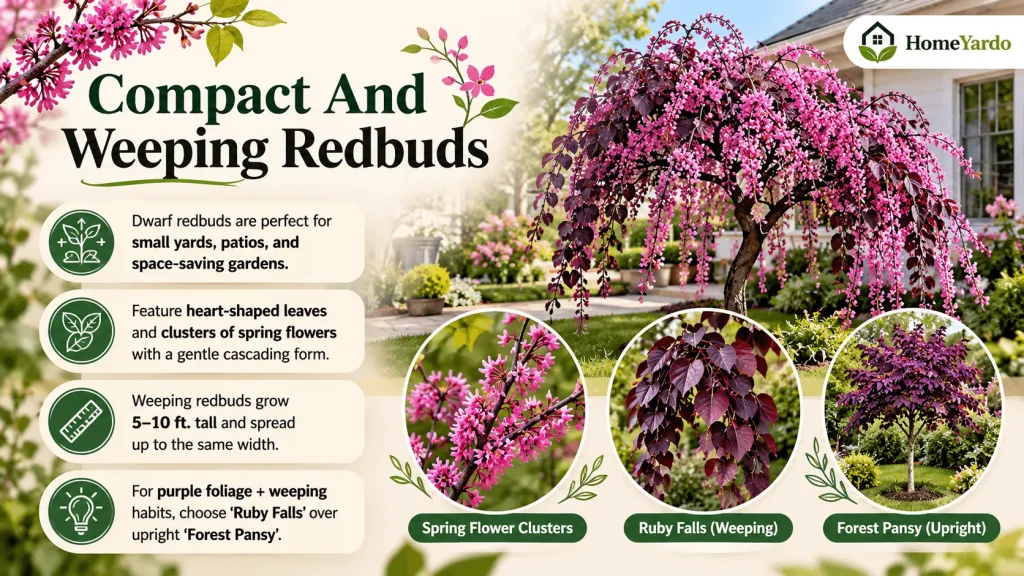
Redbud varieties that grow to a dwarf redbud tree size are suitable for small yards, entry gardens, patios and tight planting areas where a large redbud plant might become too large. The leaves of these are the larger redbuds whose leaves have heart shapes and little clusters of flowers in the spring, but the branches drop in a gentler cascade.
How big does a weeping redbud get often asked by gardeners; it will depend on cultivar and training of the tree. They grow to 5 to 10 feet in height and can expand as wide as the height.
Weeping forest pansy redbud can be confusing as Forest Pansy is typically an upright redbud with purple leaves. If you’re looking for a purple leaf weeping redbud then Ruby Falls is the better option, as it has dark burgundy-purple leaves and a compact weeping growth habit.
Redbud Fall Color And Winter Look

Redbud tree in fall color of redbud trees is typically less intense than that of maple or sweetgum. Redbuds are primarily grown for their spring blossoms, a bonus in the fall.
Yellow, gold or yellow-green colors are often seen in the Redbud tree leaves in fall. Some dark leaf varieties may turn a bronze or burgundy color, but redbuds don’t make the best purple fall trees.
Cercis canadensis fall will produce a warm but moderate fall interest. An Autumn eastern redbud planted next to evergreens, stone, fencing or other darker shrubs may produce a better fall color.
Eastern redbud winter is interesting because of its branching form, flower buds and sometimes its seed pods. A redbud tree in winter is, however, leafless, as redbuds are deciduous, but weeping cultivars can be gracefully leafless, due to their cascading form.
A purple red bud tree, it is typically a redbud cultivar that is burgundy, wine, or deep purple. These types are selected because of their foliage color, rather than spring blooms, particularly for small ornamental gardens.
As the season progresses, a redbud tree with red leaves will have new growth that erupts in red, maroon or burgundy. Cultivars developed for this colorful appearance are often referred to as red leaf redbud.
A redbud sometimes is referred to as the pink bud tree, due to the pink, rose or lavender-pink flower buds showing on bare branches prior to leaf emergence. This early bloom is the soft spring color before the tree comes into leaf.
Best Redbud Type By Garden Needs

The Eastern redbud is typically the easiest tree to plant in a more naturalistic garden from the East.
- Western redbud is more suitable for dry western landscapes.
- In hot, southern areas, Texas redbud, Mexican redbud or Oklahoma redbud are more suitable.
- Forest Pansy or Ruby Falls are the top choices for purple foliage.
- If you’re looking for a weeping shape, Ruby Falls is undoubtedly the most popular option.
- Hearts of Gold should be the primary choice for yellow foliage.
- In smaller areas, Chinese redbud, Avondale, Ruby Falls or Pink Pom Poms can be suitable.
In larger beds, flowering bushes can be placed behind or beside a compact redbud to create layered spring and summer interest.
Weeping Redbud Vs Standard Eastern Redbud

A common weeping eastern redbud is usually upright, with a broad canopy. It is able to grow much bigger than other weeping varieties and is commonly utilized as a small blooming landscape tree.
Redbuds are selected to serve a different function. It’s smaller and forms a cascading form and serves as an accent tree instead of being a shade tree.
Redbuds that are grown in seed cannot reliably yield the weeping type. Gardeners who wish to have the habit of cascading must purchase a cultivar that is properly labeled for weeping from a reliable nursery.
Standard Eastern redbud may reach the size of a tiny landscaping tree, and the majority of weeping cultivars are utilized to create ornamental trees that are compact enough for smaller spaces.
Quick Care Summary
| Care Factor | Best Guideline |
|---|---|
| Plant type | Deciduous ornamental tree |
| Botanical group | Cercis canadensis cultivars |
| USDA zones | Usually 5 to 9 for many popular cultivars, tag dependent |
| Light | Full sun to partial shade |
| Soil | Moist but well drained |
| Water | Regular during establishment, then during dry spells |
| Bloom time | Early spring |
| Main colors | Pink, purple pink, lavender red, burgundy foliage, yellow fall color |
| Pruning | After bloom for shaping, remove dead wood as needed |
| Best use | Small yard specimen, patio view, courtyard, focal tree |
| Main concerns | Poor drainage, drought stress, canker, borers, rootstock suckers |
A healthy tree begins with the proper place. Proper drainage, a proper depth of planting, and consistent early watering are more important than feeding heavily or frequent pruning.
Make sure to read the cultivar label prior to purchasing, as mature size as well as the color of the foliage the color of flowers, and zone performance may differ.
Weeping Redbud Size, Redbud Height, And Growth Rate

The size of redbuds in weeping varies based on the cultivar, graft size, as well as training for nursery workers, staking, pruning, climate, size of the container and the soil. This is why a nursery might list a smaller mature size while another offers an extensive range.
Ruby Falls is often described as a compact redbud. Ruby falls height usually falls between 5 to 8 feet, depending on the source you are using and the nursery’s training. Some sources place it as 5 to 6 feet tall, whereas others put it as 6-8 feet tall and the same length.
Lavender Twists redbuds can differ due to the fact that their final form depends in large part on training at the beginning and the weeping redbud height at which the leader was positioned. If it was left at a low level and untrained the shape may remain form-fitting. If a leader in the early stages is taught upwards and upwards, it could create a taller trunk prior to the branches fall.
Redbud trees don’t grow quickly, they grow slowly. Once established, young trees can grow larger, it’s no fast growing shade tree. This is mainly for shape, flowers, leaves and the seasonal structure. The Redbud may not grow to the size for which it was trained to grow when young.
For a bigger tree, the leader will most often have to be staked prior to the appropriate time, before the tree becomes stiff.
Why size estimates differ:
- Cultivar genetics
- Graft height
- Nursery stakes the height
- Pruning style
- Climate and soil
- Container vs in-ground growth
- Age at the time of purchase
How Wide Does A Weeping Redbud Spread?
The spread is determined by the cultivar and the pruning style. Even a compact tree can seem wide if the branches are swept closer to the ground.
Make sure you leave enough space to allow your canopy to drop naturally. Trees that are in close proximity to a pathway or driveway, a wall or even a porch could require repeated cutting, which may reduce the natural form of the tree.
Give extra space for side clearance around the walkways since drooping branches may make a tree appear bigger than the size of the trunk suggests. For the most pleasing shape you should give the canopy a wide space surrounding it.
Best Weeping Redbud Varieties
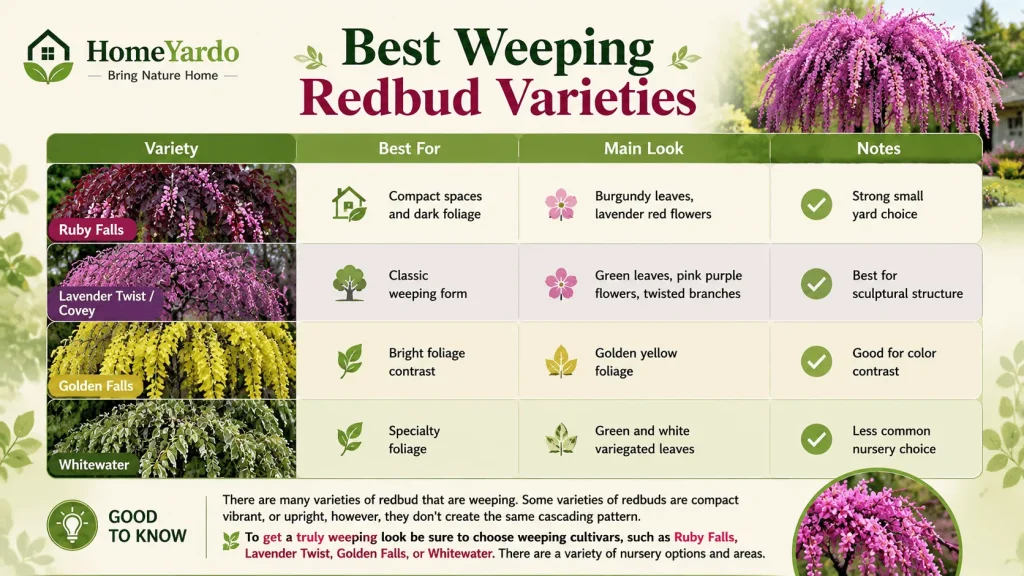
| Variety | Best For | Main Look | Notes |
|---|---|---|---|
| Ruby Falls | Compact spaces and dark foliage | Burgundy leaves, lavender red flowers | Strong small yard choice |
| Lavender Twist / Covey | Classic weeping form | Green leaves, pink purple flowers, twisted branches | Best for sculptural structure |
| Golden Falls | Bright foliage contrast | Golden yellow foliage | Good for color contrast |
| Whitewater | Specialty foliage | Green and white variegated leaves | Less common nursery choice |
There are many varieties of redbuds that are weeping. Some varieties of redbuds are compact vibrant, or upright; however, they don’t create the same cascading pattern.
To get a truly weeping look be sure to choose weeping cultivars, such as Ruby Falls, Lavender Twist, Golden Falls, or Whitewater. There are a variety of nursery options and areas.
Ruby Falls Redbud

Ruby Falls redbuds are among the most sought-after compact weeping redbuds. The botanical form is Cercis canadensis “Ruby Falls”.
It is famous for its cascading shape with burgundy foliage, lavender pink to red shades of the spring flower, along with a bright yellow fall color. Its dark leaves are suitable for smaller gardens that require contrast against green plants, pale stone walls or other lighter perennials. Light colored grasses, silver foliage, and purple perennials can soften the base of Ruby Falls without taking attention away from its dark leaves.
Ruby Falls is often listed as a zone 5-9. However, the local conditions and the nursery tag’s guidance must be reviewed prior to making a decision to plant. Ruby Falls is most likely to thrive in full sun to part sun, with moist but well-drained soil.
It is frequently utilized in small yards front gardens, patio views and mixed borders when one smaller focal tree is needed. The size of the tree can differ based on location; it is typically regarded as one of the best Redbuds to use in smaller areas.
Lavender Twist Redbud

Lavender Twist redbud is called Covey. It is admired by its pendulous appearance and twisted branches, as well as its constrained trunk and pink spring flowers.
Its heart-shaped, green leaves turn yellow in the fall and the branching pattern is attractive even after the leaves have fallen. It is a good choice for gardens where winter shape is more important than spring flowering redbud.
Lavender Twist is able to remain slim and sculptural if it is left in its natural form. If a larger trunk is desired, the young growth could require some staking and a careful approach to training.
It’s a great choice for specimen plants and cottage gardens. It is also visible from lawn edges, as well as places where the branching design is visible from a path, patio or a window.
Lavender Twist Vs Ruby Falls Redbud

| Feature | Ruby Falls | Lavender Twist |
|---|---|---|
| Best reason to choose | Dark foliage and compact form | Classic weeping structure |
| Flower color | Lavender red to red toned | Pink purple |
| Leaf color | Burgundy to green tones | Green, yellow in the fall |
| Size habit | Usually more compact | More variable |
| Training need | Light shaping, depending on nursery form | Often staked if a taller trunk is wanted |
| Best use | Small beds, patios, front yards | Specimen planting, cottage gardens, visible focal point |
Select Ruby Falls. If your aim is darker foliage, compact growth and a stronger contrast of color even in a tiny garden.
Pick Lavender Twist if the aim is to create a classic redbud shape with twisting branching, green leaves and a winter-themed sculptural outline.
Both work well in smaller landscapes if there is enough space, drainage and early attention.
Weeping Redbud Colors: Flowers, Leaves, And Fall Color

Redbuds with weeping can display pink purple, lavender, red, red-toned flowers, burgundy leaves, the golden yellow of foliage and yellow autumn color or leaves with variegated colors based on the cultivar.
The term “redbud” can confuse gardeners because the flowers are typically not really red. Some are more lavender, pink, reddish or pink. The color of leaves can change during the course of the season.
Flowers can appear as pink or purple, red or reddish-purple. The spring foliage can be green or burgundy based on the cultivar. The summer foliage can be green, burgundy or gold, or variegated. Autumn foliage is typically yellow. The winter season’s interest is in the shape of the branches, not leaves.
Ruby Falls is the best combination of the purple leaf, burgundy leaves and ruby purple leaf, and red-toned flowers. Lavender Twist is a better match for pink, purple flowers, green foliage, yellow color and winter structure.
Why Are Some Redbud Trees Purple?
Certain redbuds appear purple due to cultivars specifically selected for darker foliage. Ruby Falls is an excellent instance, sporting burgundy-to purple leaves, which create a darker as opposed to green leaf redbuds.
Dark leaf cultivars have darker burgundy or purple hues due to the fact that the leaves contain greater amounts of visible dark pigment, particularly on the new growth. The color could fade as the leaves grow.
Shade, sunlight, heat, water stress, sunlight and the season may affect how vibrant the foliage appears. The heavy shade can decrease the depth of dark foliage in certain plants.
Are Redbud Flowers Red, Pink Or Purple?
Redbud flowers are usually pink, lavender, red or even pink instead of pure red. The exact color is determined by the cultivar, the light, bloom age, and the way in which it is described in the nurseries.
Ruby Falls may be described as a the terms lavender red, red with red, or even reddish purple flower terminology. Lavender Twist is often described as a pink color.
Photos can make flowers appear more vibrant or darker red than they do from the outside. Live photos of blooms or in-person views will give you the best color perception prior to purchasing.
Where To Plant A Weeping Redbud?

Plant a Redbud in a place where it is visible and also where the canopy can hang naturally. The best locations are small lawns, front yards, entrance gardens, courtyards, patios, gardens with mixed borders and cottage-style gardens.
Full sun generally encourages greater flowering; partial shade is also possible. For warmer areas, the morning sunlight along with afternoon shade, can shield the tree from stress caused by heat. If the surrounding bed gets strong afternoon light, choose full sun plants that can handle open exposure without crowding the redbud’s canopy.
The soil should be moist, but well-drained. Beware of soggy soils, compacted or muddy soils rooftop runoff zones, corners that are narrow and other areas in which lawn equipment could harm the tree.
Cultivated for its ornamental value, the Redbud can be used as a specimen tree, small space tree, patio tree, walking tree or even as a focal point in the foundation, if it is planted at the proper spacing. The canopy should be provided adequate space or it will need to be adjusted continuously.
Is It Ok To Plant A Weeping Redbud In A Residential Zone?
If sufficient space is available to allow for a spread of airflow, mature spread pruning access and roof clearance, a Redbud can be planted near a home. Beware of planting too close to the foundations, walls and walkways. Also, do not plant it in proximity to narrow or rooflines or downspouts or foundations.
The weeping canopy must be left to hang freely and not be continually mowed. Plan for the full width of the desired cultivar so it can be properly accommodated. Avoid setting up the tree so that branches are forced against windows, siding, gutters or the side of the roof.
Are Weeping Redbud Roots Invasive?
Redbuds with weeping are not typically considered to be invasive or aggressive. However, they could be a bit shallow and spread.
The most significant issue is generally low root stress and competition but not an aggressive root invasion. Roots that are small can compete with small adjacent plants. They may also be stressed due to cutting, dry soil compacted ground or the heat.
A wide ring of mulch that is wide can protect the root zone it holds moisture and minimize damage to mowers. Make sure that the mulch is away from the tree so that the bark remains dry and healthy.
Sunlight, Soil, Water, And Mulch Needs

A redbud that is weeping grows best in full sun or partial shade. A higher percentage of sunlight is usually associated with more blooms, and the light shade can be beneficial in hot summer afternoons. Around the outer edge of the planting bed, full sun perennial plants can add repeat color while keeping the redbud as the main focal tree.
The soil should remain equally moist throughout the process of establishment, but it should not be left wet. Draining soil after rainfall is more secure than soil that remains damp around the roots.
Mulch can be beneficial when used correctly. Apply a large ring around the root zone however, ensure that it is pulled away to the tree. Mulch that is piled on top of bark could create a trap for moisture, which can cause bark issues.
Fertilizers should be light and only applied when required. In many gardens at home good soil, regular irrigation, and mulch can be more beneficial than heavy fertilizer. If your garden is struggling to grow testing the soil or seeking advice from a local nursery is better than making a guess.
How Much Water Does A Weeping Redbud Need?
Weeping redbud watering needs to be regular during the initial growing season as roots sink into the soil. A deep watering method is more effective than a quick surface spray.
After planting, after establishment, you should water when it is dry, in intense temperatures, or for a long period of no rain. Inspect the moisture two to three inches below the surface of the soil before repeating the watering.
A greater volume of water than the trunk region because roots extend outward. The leaves that brown can be a result of dry soil, moist soil low drainage, stress on the root or heat, so the best response will depend on the soil conditions close to where the roots are located.
Best Soil For A Weeping Redbud
The best soil is one that is moist but loose enough to allow roots to develop and well-drained following rain. The ideal soil is loam; clay works if water does not sit in the roots.
Poor soil could remain damp for long periods of time, make a sour smell, become compacted or even hold water in the soil after rain. Compacted soil may restrict root growth and cause stress in hot weather.
Avoid areas with water and deep planting. Root flares that are buried can result in a gradual decline even if the top of the tree appears healthy initially. Keep the flare in view and keep mulch clear of the bark.
How To Plant A Redbud Tree?
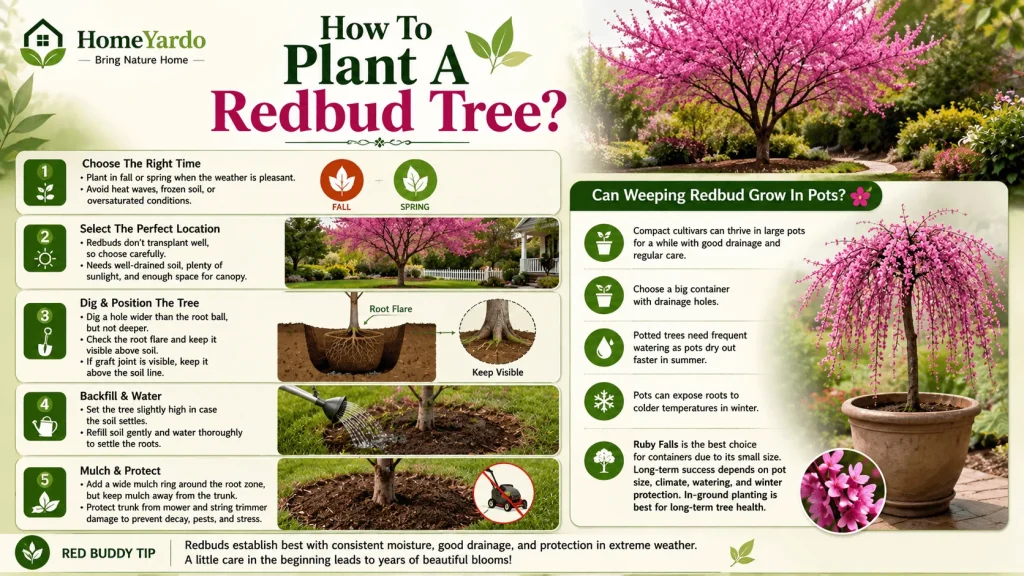
Plant in fall or spring when the weather is pleasant. Avoid planting in the midst of heat waves, frozen soil, or during periods in which the soil is oversaturated.
Pick the location you want to hang it in carefully, since established redbuds don’t react well to movement. Make sure you have drainage that is adequate with enough light, as well as enough space to allow the canopy to be hung.
Dig the hole for planting bigger than the root ball, but not deeper. Verify the root flare prior to setting the tree. The tree should be placed so that it is visible on the soil’s surface. If the graft joint is visible, make sure to keep it over the line in the soil.
Place the tree slightly up instead of too deep in case the soil is likely to settle. Refill the soil gently, and then water after filling in order to help settle in the ground around the roots.
Install a large mulch ring on the root zone, but keep the mulch off the trunk. Make sure the trunk is protected from string trimmer and mower injury since wounds on the trunk could attract decay, pests and stress.
Can Weeping Redbud Grow In Pots?
Compact cultivars can thrive in large pots for a while, especially in pots with excellent drainage and receives regular attention.
Choose a big container that has drainage holes. Container trees require frequent check-ups for watering since pots dry more quickly in summer, and can expose roots to colder temperatures in winter.
Ruby Falls is the most sensible choice for a container because of its small size. However, long-term success is contingent on the size of the pot the climate, the watering schedule, and winter security. In-ground planting is generally more beneficial for the long-term health of trees.
Pruning And Staking A Weeping Redbud

Pruning can help protect the shape clearance, airflow and the structure of the branch. Staking is a way to control height when leaders are young and flexible.
Redbuds can stay at the same height it was taught to reach in the nursery. If a higher-growing trunk is required, the leader of the future requires the stakes to be lowered before the branches can be allowed to fall.
Use softer ties and stay clear of tight loops that wrap around the bark. The ties should be checked and adjusted so that they do not cut the stem when the stem grows.
A simple staking method is ideal:
- Determine the desired trunk height when the tree is young.
- Select a young leader who is flexible and young.
- Secure it to a stake that is sturdy stake with the soft tape for trees.
- Make sure the tie is loose enough to prevent damage to the bark.
- The new leader should be trained to grow upwards until the desired height is attained.
- Tie or un-tie your ties in accordance with the development of the trunk.
- Take the stake off after the leader has a chance to hold it by itself.
If desired shape plant with a light pruning cut after bloom. Remove dead or damaged crossed branches, diseased branches or ruby branches first. Then make small cuts only in areas where it is needed.
A secure pruning order is:
- Remove dead wood.
- Take away damaged or diseased wood.
- Removing branches that are crossing or rubbing.
- Cut off branches that are growing upwards.
- Lightly shape the flower after it has bloomed.
- Beware of removing all the canopy during one season.
How To Prune A Weeping Redbud Tree?
Begin by removing dead, damaged, or diseased trees. Take branches that cross, rub, or grow outwards, or encroach on the middle of the tree.
Cleanly cut that return to a healthy tree or bud collar. Avoid flush cuts, and avoid making long stubs.
To shape, trim the tree after flowering to ensure that the spring show isn’t removed early. Maintain the natural cascading pattern and try to avoid cutting branches into a rigid or too formal form.
Why Is My Redbud Growing Upright?
The growth of uprights can occur due to a variety of reasons. The young upright growth above the graft might be a leader that is being instructed to allow the tree greater height.
Upright shoots coming from below the graft union are typically suckers of the rootstock. They will not maintain the same form of weeping and should be removed as soon as you notice them.
If the weeping top falls back, rootstock growth could take over. If the entire tree is growing in a straight line, examine your plant’s tag as well as the graft region. The tree might not be a true weeping cultivar or it could have lost its original weeping top.
Bloom Time And Winter Interest

Bloom time is usually springtime, either just before or after the first leaves appear. The display of flowers usually lasts several weeks, based on the weather, the health of the tree and the cultivar. Since redbud flowers appear early, summer flowers can help carry color through the warmer months after the tree has finished blooming.
Ruby Falls is valued for the dark burgundy foliage, the purple-red flowers, and the yellow autumn color. Lavender Twist is prized for its pink-purple flowers, heart-shaped leaves, yellow autumn color and twisted winter branches.
The best way to enjoy a Redbud is in a location in a place where the changes of the seasons can be appreciated by a window, path, or patio.
Why A Weeping Redbud Is Not Blooming?
A Redbud might not flower well If it’s young, positioned in a shaded area or stressed by drought, being in soil that is wet or harmed by winter storms.
Pruning in the wrong way could also cause a reduction in flowers. Redbuds develop flower buds prior to flowering; excessive pruning prior to spring could take away a portion of the bloom.
A quick checklist can help narrow the issue:
- Too young
- Too little sun
- Pruned prior to flowering.
- Winter bud damage
- Stress from drought
- Poor drainage
- Transplant shock
Some years are less robust due to the weather. If the tree is healthy with branches and leaves, its blooms can improve with age with better light and regular maintenance.
Common Redbud Tree Problems, Diseases, And Pests
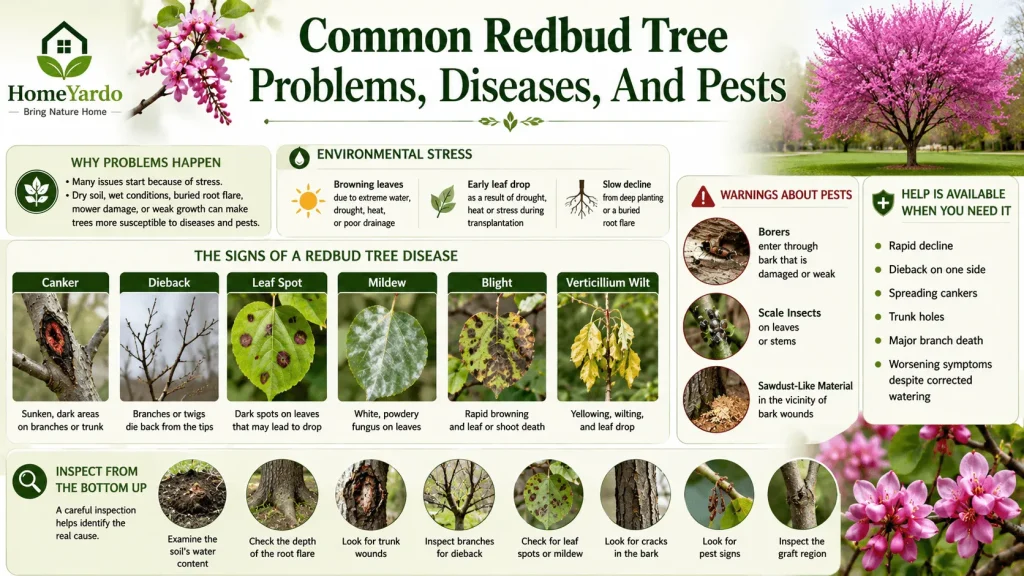
Common issues include the browning of leaves, early leaf drop dieback, canker spot, mildew, blight, verticillium wilt, borers the scale of drought, inadequate drainage, and elevated plant and trunk wounds.
Many problems start because of stress. Dry soil, wet or a root flare that is buried, mower damage, or weak growth can make trees more susceptible to diseases and pests.
Environmental stress:
- Browning leaves due to extreme water or drought or heat, or poor drainage
- Early leaf drop as a result of drought, heat or stress during transplantation
- Slow decline from deep plant or a flare of buried roots
The signs of a red bud tree disease:
- Canker
- Dieback
- Leaf spot
- Mildew
- Blight
- Verticillium will wilt
Warnings about pests:
- Borers enter through bark that is damaged or weak
- Scale insects on leaves or stems
- Sawdust-like material in the vicinity of bark wounds
Help is available when you need it:
- Rapid decline
- Dieback on one side
- Spreading cankers
- Trunk holes
- Major branch death
- Worsening symptoms despite corrected watering
Take a look at the tree from bottom up. Examine the soil’s water content, the depth of root flare the trunk’s wounds, branches denudation, leaf spots, cracks in the bark, pest signs and the graft region.
Why Is My Weeping Redbud Dying?

A dying redbud could be suffering from poor drainage, drought, deep plant stress from transplants Dieback, canker, verticillium wilt or borers, damage to the trunk or graft-related issues.
Start with a straightforward checklist:
- Soil moisture
- Root flare depth
- The wounds on the trunk
- Branch dieback
- Sawdust or pest holes
- Graft union
- Recent weather stresses
In the event that your root zone is constantly damp or extremely dry it could indicate that the tree is under stress. In the event that the roots flare has been buried and the tree is deteriorating slowly over time.
Check for wounds on the trunk. Dead branch tips, cracks, peeling bark made by sawdust, suckers under the graft or one-sided branch dieback. The rapid decline needs to be examined by a tree expert in the area.
Pros And Cons Of Redbud Trees

A redbud that weeps has numerous advantages, but it’s not the best tree for every location.
Pros:
- A small flowering tree that can be used in small landscapes.
- Early spring blooms are strong.
- Weeping form provides year-round structure.
- Ruby Falls offers dark burgundy foliage.
- Lavender Twist offers sculptural branching.
- Flowers can help pollinators.
- A strong early season pollinator is worth it.
Cons:
- It requires a well-drained soil.
- Young trees may require stakes or pruning.
- The branches can sweep down without creating.
- A trunk injury, wet soil or a disease could cause decline.
- The names of cultivars and the estimates of mature size can be confusing buyers.
- Not as long-lived as larger shade trees.
- Certain cultivars require extra care when shopping because their mature size and height can differ from the nursery.
Select it based on aesthetics and shape, and not to shade. It’s best if it is placed in a way that complements the tree, rather than pushing it into an unsuitable location.
Is Weeping Redbud Messy?
The redbud that is weeping sheds leaves in autumn due to its deciduous nature. Certain redbuds can also produce seed pods.
The branches that are low can reach the ground when the tree isn’t well-shaped. This could cause leaves to fall or make cleaning difficult near the tree’s base.
In most yards, cleaning is part of the normal maintenance for the season. The most common is leaves and seed pod cleaning, not massive fruit messes.
How Long Do Weeping Redbud Trees Live?
Weeping redbud lifespan lasts for several years in the landscapes of their homes. However, the length of their lives is dependent on the condition of the land and care.
A good drainage system, the correct planting depth, regular early watering, protection of the trunk and gentle pruning can help maintain better health over time.
Dry soil, drought stress, mower injury and borers. Low planting depth and frequent trunk damage could reduce the lifespan of the tree.
Wildlife, Deer Resistance, And Pet Safety

The redbud flower can attract pollinators like bees and butterflies during the first days of spring. In gardens, there are active butterflies and hummingbirds that could also come to the flower gardens. To increase garden activity around the tree, add flowers for hummingbirds nearby so the area offers nectar beyond the redbud’s short spring bloom.
Seed pods can help birds in certain settings. The tree could add wildlife value without having to be a huge shade tree.
Ruby Falls and other redbuds can be described as deer-tolerant however deer-tolerant does not necessarily mean deer-proof. The risk of browsing is based on the deer population in the area, the season, and the availability of food.
For cats and dogs, use shrewd plants and follow the proper safety guidelines. Find a reputable poison control provider or consult a veterinary professional for advice. Do not allow pets to chew on leaves or flowers, bark or seeds.
Buying Checklist For A Healthy Weeping Redbud
A healthy tree begins with the nursery. Be sure to inspect the plant before purchasing, and ensure it is a suitable cultivar for the space.
Check for:
- An obvious cultivar name is on the label.
- True weeping forms like Ruby Falls, Lavender Twist, Golden Falls, or Whitewater.
- A healthy graft union.
- There are no suckers from the rootstocks beneath the graft.
- No cracks or bark injuries.
- There are no dead tips or low top growth.
- Do not tightly circle roots when the root ball is assessed.
- A height trained to fit the design of the garden.
- Local ability to adapt to soil and climate.
- A tag on a plant that lists the zone’s height, width, zone and the cultivar’s name.
Find out from the nursery if it was the case that the tree has been grafted or the height it was trained to be. The stake’s height currently could affect the final shape therefore it is important to find out if the tree already has the desired form for the garden.
Avoid trees with large root circling, broken trunks, severe bark wounds, extensive dieback or a large number of sprouts that are coming from beneath the graft.
Can You Grow A Weeping Redbud From Seed Or Cuttings?

Redbuds named after them usually are not true from seeds. Seedlings can grow upright or exhibit different traits that its parent.
A variety of known redbud cultivars are cultivated by nurseries in order to keep their shape. Some are grafted to maintain their weeping tips. That’s why acquiring an appropriately labeled cultivar is the most secure choice when the habit of cascading is a concern.
Cuttings may not be reliable for many gardeners at home. If you want a genuine Ruby Falls, Lavender Twist, Golden Falls, or Whitewater form the nursery-grown form is typically the most reliable option.
Best Time To Buy And Plant
The months of spring and autumn are generally the best seasons to purchase and plant trees because the temperatures are milder and trees have time to settle before the storm comes in.
Shopping in bloom can help verify the color of flowers. In the leaf, buying in bloom helps check the leaf color, health and overall health.
Fall planting is a good option in mild conditions if the soil is able to work and is not overly saturated with water. Avoid planting during heatwaves, freezing soil, dry periods where the hole is filled with water.
Redbud Tree Care: Seasonal Care

The season’s care is not heavy; however, timing is important in terms of watering, pruning or removing sucker.
Spring care is focused on blossom, new growth and early shaping. Be aware of the blooms and water the freshly planted trees cut light after blooms, if needed and then remove the rootstock suckers.
The focus of summer care is stress reduction. Monitor the soil’s moisture levels in dry periods, look for signs of leaf scorch, borers, mildew, and scale and ensure that mulch is removed from the tree.
The fall care routine helps prepare your tree to be ready for winter. Clean the fallen leaves, if there was disease. Check the depth of the mulch, plant new trees in cool weather and make sure to water them before winter, if the ground is dry.
Winter maintenance is mainly about watching. Check branch structure, make plans for pruning, shield young trees from injury and cut yourself if spring flowers are the main concern.
Common Mistakes To Avoid
The majority of Redbud issues can be prevented. Most common mistakes are the planting or watering, trimming or staking and misinterpreting the transplanted form.
Avoid:
- Too deep in the plant.
- Choosing wet soil.
- The graft union is being buried.
- Mulching the tree against the tree.
- Letting rootstock suckers grow.
- Too tightly staked.
- It is not a good idea to remove the stake too early.
- Inattention to adjust or remove the tie.
- Pruning in the middle of blooms and removing flowers.
- The removal of too much canopy at one time.
- The trunk is damaged by a trimming or mower.
- Do not pay attention to the current height when purchasing.
- We expect all cultivars to be an equivalent size.
- It is not recommended to plant too near walkways or walls.
- We can assume “redbud” always will refer to real red flowers or leaves.
The easier way is to do the following steps. Choose the right cultivar and correctly plant it and protect the tree, water depending on soil texture, remove suckers early and prune carefully.
Conclusion
A Redbud is an attractive and compact ornamental tree if placed in the right spot. It has early spring flowers and graceful branching, as well as seasonal colors, and is smaller than most flowering trees.
The best results can be achieved by using properly drained soil, a proper plant depth, fulfilling redbud sunlight requirements, regular early watering and cautious pruning. Ruby Falls will be a great option for smaller spaces as well as leaves that are burgundy, while Lavender Twist is more suitable for classic weeping structures and the pink-purple flower.
To get the best results for the best result, match the cultivar to the site first, then match the care with the location.
FAQ’s
Most Redbuds stay smaller than standard Eastern redbuds, but height varies by cultivar and training. Ruby Falls is usually more compact, while Lavender Twist can vary more. Staking, pruning, nursery form, and growing conditions all affect the final height.
A Redbud is usually a moderate grower rather than a fast shade tree. Growth is better when the tree has well drained soil, enough sunlight, regular water during establishment, and protection from trunk injury. Poor drainage or drought can slow it down.
Grow redbud in well-drained soil with full sun to part shade. Water regularly during the first year, mulch around the root zone, and prune only to remove dead, crossing, or awkward branches. Train the leader while young if a taller weeping shape is wanted.
The best place to plant a redbud tree is a spot with well-drained soil, morning sun or full sun, and enough room for the mature spread. In hot climates, light afternoon shade can help reduce stress. Avoid soggy soil, tight corners, and areas where the branches will crowd buildings or walkways.
Plant it in full sun to partial shade with well drained soil. It works best where the weeping canopy has space to hang naturally, such as a front yard, small lawn, courtyard, patio view, or mixed garden bed. Avoid wet corners and narrow paths.
Full sun often gives better flowering and stronger foliage color, but partial shade can also work. In hotter climates, morning sun with afternoon shade may help reduce leaf scorch and summer stress. Heavy shade can reduce bloom.
Ruby Falls is a strong choice for compact spaces, burgundy foliage, and darker color interest. Lavender Twist is better for a classic weeping form, twisted branches, and pink purple spring flowers. The best choice depends on space, color preference, and garden style.
Redbuds can show pink, purple, lavender, burgundy, green, yellow, gold, and variegated color depending on cultivar and season. Ruby Falls is known for burgundy foliage. Lavender Twist is known for pink and purple flowers and green leaves.
Many redbud flowers are not true red. They are often pink, lavender, purple pink, or red toned depending on cultivar and lighting. That is why one nursery may describe a flower as red while another calls a similar bloom lavender red or pink purple.
Yes. Redbud can tolerate light shade or part shade, especially in hot areas where afternoon sun may stress young trees. Full sun usually gives stronger flowering, but bright part shade can still support healthy growth if the soil drains well.
Ruby Falls is better for dark foliage and a compact purple-leaf weeping look. Lavender Twist is better for a green-leaf weeping form with twisted, sculptural branches and soft pink to lavender spring flowers. Both stay smaller than standard redbuds, but they create different garden effects.
Some redbud trees look purple because certain cultivars have leaves with burgundy, wine, or purple pigments, especially when the foliage first opens. The flowers can also appear pink-purple or lavender in spring, which adds to the purple look. Not every redbud is purple, since many standard types have green leaves after bloom.
Redbud roots are not usually considered aggressively invasive, but they can be shallow and spreading. Give the tree enough room and use mulch over the root zone. Avoid planting it where roots will be squeezed by hardscape or tight beds.
Redbud usually blooms in early spring before or as leaves emerge. Bloom length depends on cultivar, weather, and tree health. In favorable conditions, the flower display may last a few weeks.
Start by removing dead, damaged, diseased, crossing, and rubbing branches. For shaping, prune after flowering so the spring bloom is not removed too early. Keep cuts light and preserve the natural cascading form.
Many popular Redbuds grow in USDA zones 5 to 9, but cultivar and site conditions matter. Cold wind, summer heat, drainage, and winter exposure can affect success. Always check the cultivar tag before planting.
For pet safety, check a trusted poison control source or ask a veterinarian. Even when an ornamental plant is not considered highly toxic, pets should not be encouraged to chew leaves, flowers, bark, or seed pods. Remove fallen plant parts if pets chew garden debris.
Named Redbuds usually do not come true from seed. A seedling may grow upright or show different traits from the parent tree. For a reliable cascading form, buy a properly labeled nursery cultivar.
The smallest redbud tree is usually a compact or weeping cultivar rather than a standard eastern redbud. Lavender Twist and Ruby Falls are common choices for small spaces because they stay shorter and work well as ornamental focal points.
Yes. Redbuds are deciduous, so they drop their leaves in cold seasons. Their winter appeal comes from the cascading branch shape, visible buds, and sometimes seed pods.
Lavender Twist redbud may be less preferred by deer, but it should not be treated as deer-proof. Young trees are still vulnerable in areas with heavy deer pressure, so trunk and branch protection may be needed.
References