55 Beautiful Varieties Of Flowers That Start With J You Didn’t Know About
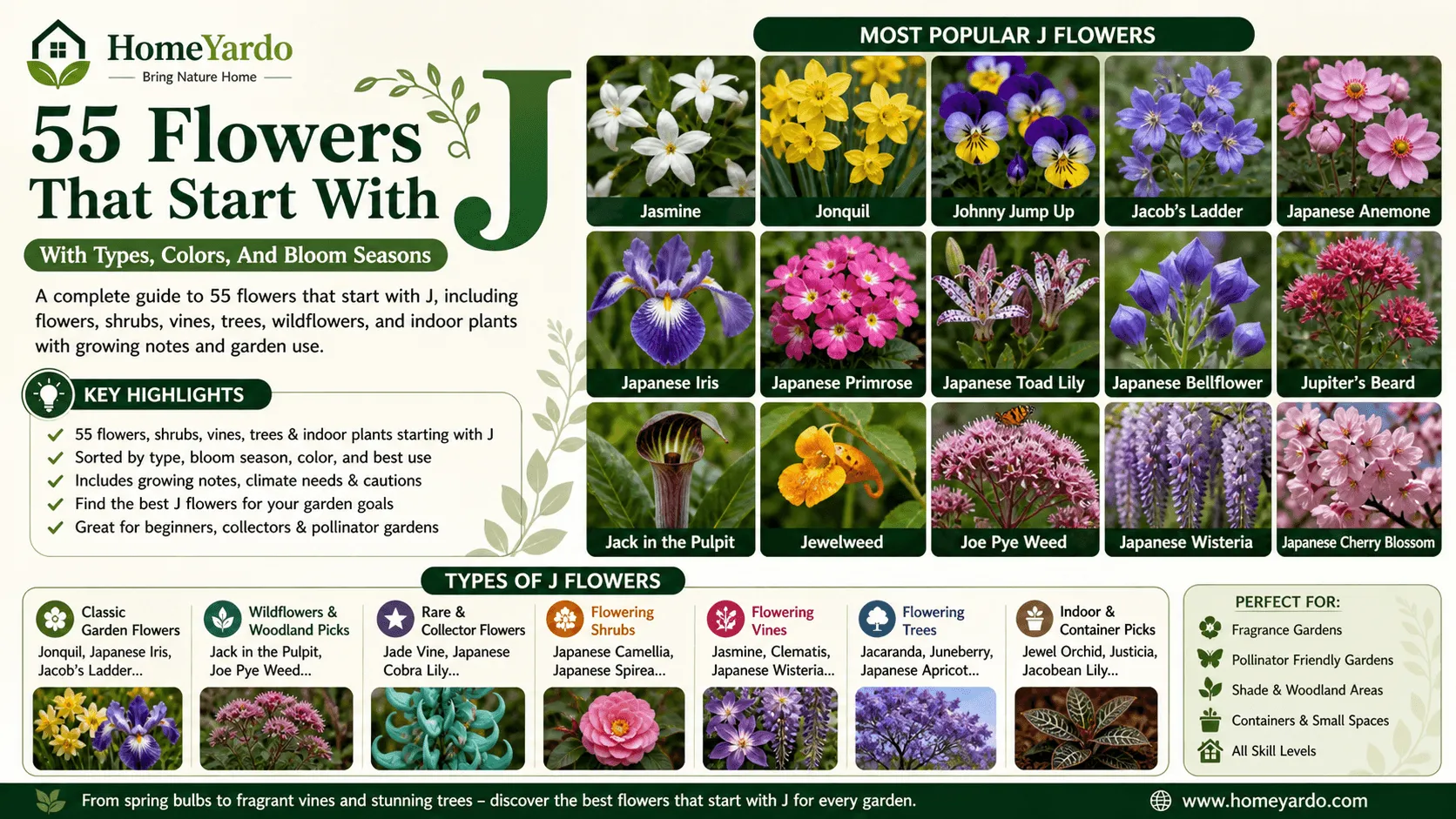
Flowers that start with J include familiar names such as Jasmine, Jonquil, Johnny Jump Up, Jacob’s Ladder, Japanese Anemone, Japanese Iris, and Japanese Primrose.
Some J flower lists become confusing because they mix true flowers with shrubs, vines, trees, wildflowers, and indoor plants without explaining the difference. This guide keeps those groups clear so each name is easier to compare.
The list includes classic flowers, rare plants, flowering shrubs, climbing vines, ornamental trees, and indoor-friendly picks. Each plant is sorted by type, bloom season, color, use, and basic growing needs.
Quick Answer: What Are Flowers That Start With J?
Flowers starting with J include Jasmine, Jonquil, Johnny Jump Up, Jacob’s Ladder, Japanese Anemone, Japanese Iris, Japanese Primrose, Jack in the Pulpit, Jewelweed, Joe Pye Weed, Japanese Bellflower, Jupiter’s Beard, Jade Vine, Jewel Orchid, Jacaranda, and Japanese Cherry Blossom.
A narrow flower list usually includes only classic garden flowers. A broader horticultural list may also include flowering shrubs, vines, trees, and indoor plants when their blossoms are the main reason they are grown.
55 J Flowers At A Glance
A master table makes the list of flowers that start with J easier to compare at a glance. Type labels matter here because some of the best-known J names are shrubs, vines, or trees rather than classic flower-bed plants.
| Common Name | Scientific Name | Type | Main Flower Color | Bloom Season | Fragrant | Best Use | Climate Note | Origin / Range | Light | Moisture | Caution |
|---|---|---|---|---|---|---|---|---|---|---|---|
| Jasmine | Jasminum officinale | Vine | White | Summer | Yes | Trellis, fragrance garden | Warm temperate | Asia | Sun to part shade | Moderate | None |
| Jonquil | Narcissus jonquilla | Flower | Yellow | Spring | Yes | Borders, bulbs | Cool to mild | Mediterranean region | Sun to part shade | Moderate | Mild toxicity if ingested |
| Johnny Jump Up | Viola tricolor | Flower | Purple, yellow | Spring to early summer | Light | Beds, containers | Cool temperate | Europe | Sun to part shade | Even moisture | None |
| Jacob’s Ladder | Polemonium caeruleum | Flower | Blue violet | Late spring | Light | Shade borders | Cool temperate | Europe, Asia | Part shade | Moderate | None |
| Japanese Anemone | Anemone hupehensis | Flower | Pink, white | Late summer to fall | No | Borders, cottage gardens | Temperate | China | Part shade | Moderate | Mild toxicity if ingested |
| Japanese Iris | Iris ensata | Flower | Purple, blue, white | Early summer | Light | Moist beds, pond edges | Temperate | Japan | Sun to part shade | Moist | Mild toxicity if ingested |
| Japanese Primrose | Primula japonica | Flower | Pink, red, white | Spring | Light | Damp shade | Cool temperate | Japan | Part shade | Moist | None |
| Japanese Toad Lily | Tricyrtis hirta | Flower | Purple speckled | Late summer to fall | No | Shade gardens | Temperate | Japan | Part shade to shade | Even moisture | None |
| Jack in the Pulpit | Arisaema triphyllum | Wildflower | Green, purple | Spring | No | Woodland gardens | Cool temperate | North America | Shade | Moist | Toxic if ingested |
| Jewelweed | Impatiens capensis | Wildflower | Orange | Summer to fall | No | Rain gardens, native beds | Moist sites | North America | Part shade | Moist | None |
| Joe Pye Weed | Eutrochium purpureum | Wildflower | Pink mauve | Late summer | Light | Pollinator gardens | Temperate | North America | Sun to part shade | Moist | None |
| Japanese Bellflower | Platycodon grandiflorus | Flower | Blue violet | Summer | No | Borders, cut flowers | Temperate | East Asia | Sun to part shade | Moderate | None |
| Jupiter’s Beard | Centranthus ruber | Flower | Red, pink, white | Late spring to summer | Light | Dry borders, walls | Mild to warm | Mediterranean region | Sun | Low to moderate | Can self-seed |
| Jacobean Lily | Sprekelia formosissima | Flower | Red | Late spring to summer | Light | Containers, bold accent | Warm climates | Mexico, Guatemala | Sun | Moderate | None |
| Jade Vine | Strongylodon macrobotrys | Vine | Turquoise green | Spring | No | Conservatories, tropical trellis | Tropical | Philippines | Bright light | High moisture | Not frost hardy |
| Jatropha | Jatropha integerrima | Shrub | Red | Warm season | No | Tropical hedges, containers | Frost free | Caribbean | Sun | Moderate | Toxic sap/seeds |
| Jungle Flame | Ixora coccinea | Shrub | Red, orange, yellow | Warm season | Light | Tropical beds, hedges | Tropical | South Asia | Sun | Moderate | None |
| Jewel Orchid | Ludisia discolor | Indoor tropical | White | Winter | Light | Houseplant collections | Warm indoor | Southeast Asia | Bright indirect light | Even moisture | None |
| Jasione | Jasione montana | Flower | Blue | Summer | No | Rock gardens | Cool to mild | Europe | Sun | Low to moderate | None |
| Jovellana | Jovellana violacea | Flower | White, lilac | Summer | No | Sheltered borders | Mild climates | Chile | Part shade | Even moisture | None |
| Jessamine | Gelsemium sempervirens | Vine | Yellow | Spring | Yes | Trellis, fence cover | Mild winter areas | Southeastern US | Sun to part shade | Moderate | Toxic if ingested |
| Jackman Clematis | Clematis × jackmanii | Vine | Purple | Summer | No | Trellis, arches | Temperate | Garden hybrid | Sun with cool roots | Moderate | Mild toxicity |
| Japanese Kerria | Kerria japonica | Shrub | Yellow | Spring | No | Shrub borders, shade | Temperate | China, Japan | Part shade | Moderate | None |
| Japanese Camellia | Camellia japonica | Shrub | Pink, red, white | Winter to spring | Light | Woodland borders | Mild climates | Japan, Korea | Part shade | Even moisture | None |
| Japanese Hydrangea Vine | Schizophragma hydrangeoides | Vine | White | Summer | No | Walls, shade trellis | Temperate | East Asia | Part shade | Moderate | None |
| Japanese Morning Glory | Ipomoea nil | Vine | Blue, purple, pink | Summer | No | Fences, annual screens | Warm season | Asia | Sun | Moderate | Seeds may be toxic |
| Justicia | Justicia brandegeeana | Shrub | White through reddish bracts | Warm season | No | Containers, tropical beds | Warm climates | Mexico | Bright light | Moderate | None |
| Jacaranda | Jacaranda mimosifolia | Tree | Lavender blue | Spring to early summer | No | Flowering tree | Warm climates | South America | Sun | Moderate | None |
| Japanese Cherry Blossom | Prunus serrulata | Tree | Pink, white | Spring | Light | Ornamental tree | Temperate | Japan | Sun | Moderate | None |
| Japanese Snowbell | Styrax japonicus | Tree | White | Late spring | Light | Small flowering tree | Temperate | Japan, Korea, China | Sun to part shade | Moderate | None |
| Juneberry | Amelanchier canadensis | Tree | White | Spring | Light | Native landscape | Cool temperate | North America | Sun to part shade | Moderate | None |
| Jerusalem Thorn | Parkinsonia aculeata | Tree | Yellow | Warm season | No | Dry landscapes | Warm, dry areas | Americas | Sun | Low | Thorny |
| Jamesia | Jamesia americana | Shrub | White | Late spring | Light | Dry shrub border | Cool dry climates | North America | Sun to part shade | Low to moderate | None |
| Jamaican Forget Me Not | Browallia americana | Flower | White to pale blue | Warm season | No | Warm borders | Tropical to subtropical | Caribbean, Americas | Sun to part shade | Moderate | None |
| Jump Up and Kiss Me | Persicaria orientalis | Flower | Pink | Summer to fall | No | Tall annual borders | Warm season | Asia | Sun | Moderate | Can self-seed |
| Jimsonweed | Datura stramonium | Flower | White, purple | Summer to fall | Scented at times | Dramatic night garden look | Warm season | Americas | Sun | Moderate | Highly toxic |
| Japanese Cobra Lily | Arisaema sikokianum | Flower | Dark purple, white | Spring | No | Shade collections | Temperate | Japan | Shade to part shade | Moist | Toxic if ingested |
| Japanese Wisteria | Wisteria floribunda | Vine | Purple, white, pink | Spring | Yes | Pergolas, arches | Temperate | Japan | Sun | Moderate | Toxic seeds/pods |
| Japanese Honeysuckle | Lonicera japonica | Vine | White, yellow | Spring to summer | Yes | Fragrant cover | Mild climates | East Asia | Sun to part shade | Moderate | Invasive in some regions |
| Japanese Tree Lilac | Syringa reticulata | Tree | Creamy white | Early summer | Yes | Street tree, specimen | Temperate | Japan | Sun | Moderate | None |
| Japanese Quince | Chaenomeles japonica | Shrub | Red, orange, pink | Early spring | No | Shrub borders | Temperate | Japan | Sun to part shade | Moderate | Thorny |
| Japanese Pieris | Pieris japonica | Shrub | White, pink | Early spring | Light | Acid soil borders | Mild to cool | Japan, China, Taiwan | Part shade | Even moisture | Toxic if ingested |
| Japanese Spirea | Spiraea japonica | Shrub | Pink | Summer | Light | Low borders, mass planting | Temperate | Japan, China | Sun | Moderate | None |
| Japanese Bush Clover | Lespedeza thunbergii | Shrub | Pink purple | Late summer to fall | No | Arching shrub beds | Temperate | East Asia | Sun | Moderate | None |
| Japanese Knotweed | Fallopia japonica | Flowering plant | White | Late summer | No | Not advised in gardens | Aggressive grower | East Asia | Sun to part shade | Moderate | Invasive |
| Japanese Meadow Rue | Thalictrum rochebrunianum | Flower | Lavender | Mid to late summer | No | Moist borders | Temperate | Japan | Part shade | Even moisture | None |
| Julienne | Hesperis matronalis | Flower | Purple, white | Spring to early summer | Light | Cottage gardens | Temperate | Europe, Asia | Sun to part shade | Moderate | Can naturalize |
| Juno Iris | Iris bucharica | Flower | Yellow, white | Spring | Light | Rock gardens, bulbs | Cool dry climates | Central Asia | Sun | Low to moderate | Mild toxicity |
| Jersey Lily | Amaryllis belladonna | Flower | Pink | Late summer | Yes | Dry borders, bulbs | Mild climates | South Africa | Sun | Low to moderate | Toxic if ingested |
| Jerusalem Sage | Phlomis fruticosa | Shrub | Yellow | Summer | Light | Dry Mediterranean beds | Warm, dry areas | Mediterranean region | Sun | Low | None |
| Japanese Spider Lily | Lycoris radiata | Flower | Red | Late summer to fall | Light | Bulb beds | Mild to warm | East Asia | Sun to part shade | Moderate | Toxic if ingested |
| Japanese Gentian | Gentiana scabra | Flower | Blue violet | Late summer to fall | No | Cool borders, containers | Cool temperate | Japan | Sun to part shade | Even moisture | None |
| Japanese Aster | Kalimeris pinnatifida | Flower | Pale lavender | Summer to fall | No | Naturalistic planting | Temperate | East Asia | Sun to part shade | Moderate | None |
| Japanese Stewartia | Stewartia pseudocamellia | Tree | White | Early summer | Light | Specimen tree | Temperate | Japan, Korea | Sun to part shade | Moderate | None |
| Japanese Apricot | Prunus mume | Tree | White, pink | Late winter to spring | Yes | Early blossom tree | Mild to cool | China | Sun | Moderate | Pits toxic if crushed |
| Jaborosa | Jaborosa integrifolia | Flower | Greenish white | Summer | Light | Botanical collections | Mild to warm | South America | Sun to part shade | Moderate | Uncommon in trade |
Types Of Flowers That Start With J
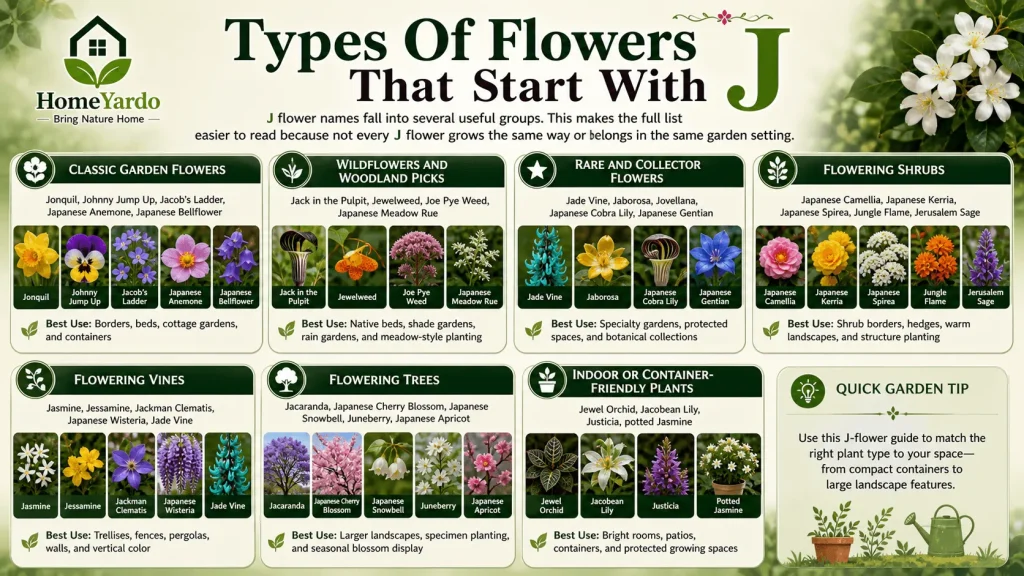
J flower names fall into several useful groups. This makes the full list easier to read because not every J flower grows the same way or belongs in the same garden setting.
| Type | Examples | Best Use |
|---|---|---|
| Classic garden flowers | Jonquil, Johnny Jump Up, Jacob’s Ladder, Japanese Anemone, Japanese Bellflower | Borders, beds, cottage gardens, and containers |
| Wildflowers and woodland picks | Jack in the Pulpit, Jewelweed, Joe Pye Weed, Japanese Meadow Rue | Native beds, shade gardens, rain gardens, and meadow-style planting |
| Rare and collector flowers | Jade Vine, Jaborosa, Jovellana, Japanese Cobra Lily, Japanese Gentian | Specialty gardens, protected spaces, and botanical collections |
| Flowering shrubs | Japanese Camellia, Japanese Kerria, Japanese Spirea, Jungle Flame, Jerusalem Sage | Shrub borders, hedges, warm landscapes, and structure planting |
| Flowering vines | Jasmine, Jessamine, Jackman Clematis, Japanese Wisteria, Jade Vine | Trellises, fences, pergolas, walls, and vertical color |
| Flowering trees | Jacaranda, Japanese Cherry Blossom, Japanese Snowbell, Juneberry, Japanese Apricot | Larger landscapes, specimen planting, and seasonal blossom display |
| Indoor or container-friendly plants | Jewel Orchid, Jacobean Lily, Justicia, potted Jasmine | Bright rooms, patios, containers, and protected growing spaces |
For another alphabet list with a broad mix of garden flowers, shrubs, and climbing plants, see flowers that start with C.
Plants Vs Flowers That Starting With J
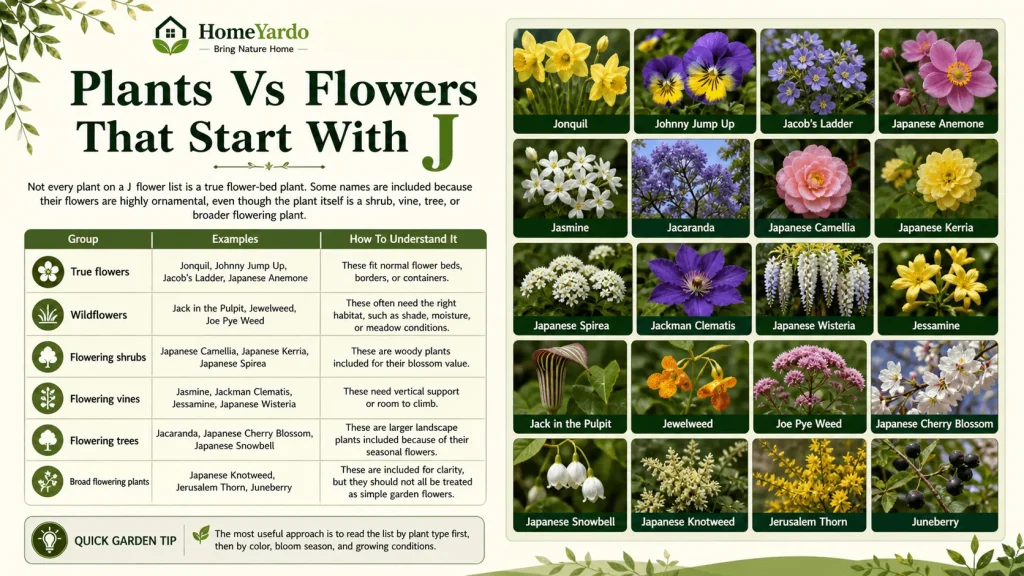
Not every plant on a J flower list is a true flower-bed plant. Some names are included because their flowers are highly ornamental, even though the plant itself is a shrub, vine, tree, or broader flowering plant.
This difference matters because a Jonquil, Jasmine, Jacaranda, and Japanese Camellia do not serve the same role in a garden. Jonquil works as a spring bulb. Jasmine often needs support or warm conditions. Jacaranda is a flowering tree. Japanese Camellia is a shrub grown for glossy foliage and cool-season blooms.
| Group | Examples | How To Understand It |
|---|---|---|
| True flowers | Jonquil, Johnny Jump Up, Jacob’s Ladder, Japanese Anemone | These fit normal flower beds, borders, or containers. |
| Wildflowers | Jack in the Pulpit, Jewelweed, Joe Pye Weed | These often need the right habitat, such as shade, moisture, or meadow conditions. |
| Flowering shrubs | Japanese Camellia, Japanese Kerria, Japanese Spirea | These are woody plants included for their blossom value. |
| Flowering vines | Jasmine, Jackman Clematis, Jessamine, Japanese Wisteria | These need vertical support or room to climb. |
| Flowering trees | Jacaranda, Japanese Cherry Blossom, Japanese Snowbell | These are larger landscape plants included because of their seasonal flowers. |
| Broad flowering plants | Japanese Knotweed, Jerusalem Thorn, Juneberry | These are included for clarity, but they should not all be treated as simple garden flowers. |
The most useful approach is to read the list by plant type first, then by color, bloom season, and growing conditions.
How This List Was Built
A useful J flower list needs more than a long count. It also needs clean sorting, clear plant labels, and honest caution notes.
This list was built using four rules:
| Rule | Why It Matters |
|---|---|
| Duplicate names were removed | Similar names and repeated entries were not counted twice. |
| Plant types were labeled | Each entry is marked as a flower, shrub, vine, tree, wildflower, indoor tropical, or broader flowering plant. |
| Broad inclusions were explained | Some names are included for blossom value, not because they are classic bedding flowers. |
| Caution-worthy plants were marked | Toxic, invasive, thorny, aggressive, or frost-sensitive plants are not presented as easy choices. |
55 Flowers Names Starting With J
The grouped list below turns the alphabet roundup into something more practical. Each plant is placed where it makes the most sense in real gardening use.
Classic Garden Flowers And Familiar Favorites
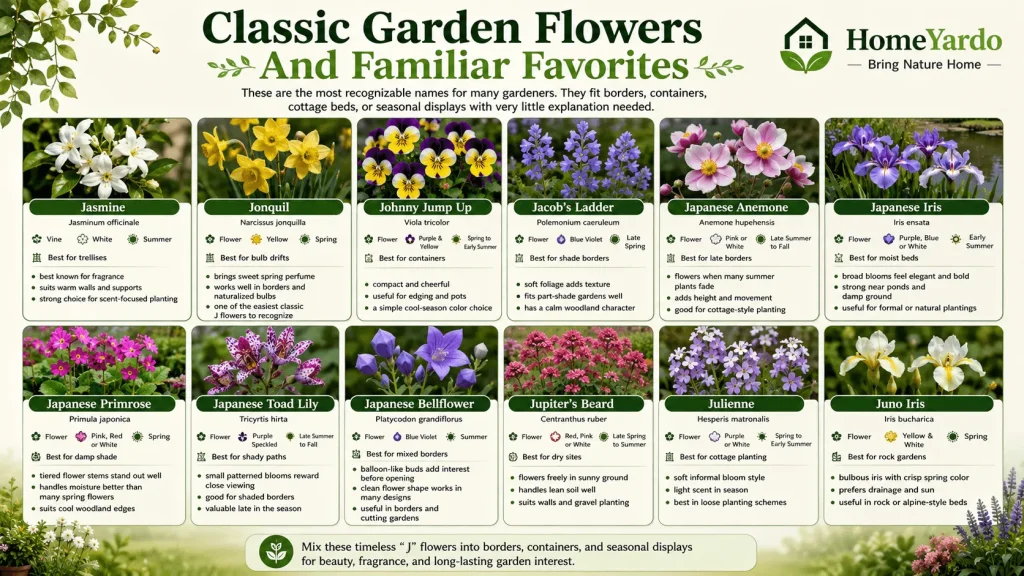
These are the most recognizable names for many gardeners. They fit borders, containers, cottage beds, or seasonal displays with very little explanation needed.
- Jasmine
Jasminum officinale • Vine • White • Summer • Best for trellises- best known for fragrance
- suits warm walls and supports
- strong choice for scent-focused planting
- Jonquil
Narcissus jonquilla • Flower • Yellow • Spring • Best for bulb drifts- brings sweet spring perfume
- works well in borders and naturalized bulbs
- One of the easiest classic J flowers to recognize
- Johnny Jump Up
Viola tricolor • Flower • Purple and yellow • Spring to early summer • Best for containers- compact and cheerful
- useful for edging and pots
- a simple cool-season color choice
- Jacob’s Ladder
Polemonium caeruleum • Flower • Blue violet • Late spring • Best for shade borders- Soft foliage adds texture
- fits part-shade gardens well
- has a calm woodland character
- Japanese Anemone
Anemone hupehensis • Flower • Pink or white • Late summer to fall • Best for late borders- flowers when many summer plants fade
- adds height and movement
- good for cottage-style planting
- Japanese Iris
Iris ensata • Flower • Purple, blue, or white • Early summer • Best for moist beds- broad blooms feel elegant and bold
- strong near ponds and damp ground
- useful for formal or natural plantings
- Japanese Primrose
Primula japonica • Flower • Pink, red, or white • Spring • Best for damp shade- Tiered flower stems stand out well
- handles moisture better than many spring flowers
- suits cool woodland edges
- Japanese Toad Lily
Tricyrtis hirta • Flower • Purple speckled • Late summer to fall • Best for shady paths- small patterned blooms reward close viewing
- Good for shaded borders
- valuable late in the season
- Japanese Bellflower
Platycodon grandiflorus • Flower • Blue violet • Summer • Best for mixed borders- balloon-like buds add interest before opening
- clean flower shape works in many designs
- useful in borders and cutting gardens
- Jupiter’s Beard
Centranthus ruber • Flower • Red, pink, or white • Late spring to summer • Best for dry sites- flowers freely in sunny ground
- handles lean soil well
- suit walls and gravel planting
- Julienne
Hesperis matronalis • Flower • Purple or white • Spring to early summer • Best for cottage planting- soft informal bloom style
- light scent in season
- best in loose planting schemes
- Juno Iris
Iris bucharica • Flower • Yellow and white • Spring • Best for rock gardens- bulbous iris with crisp spring color
- prefers drainage and sun
- useful in rock or alpine-style beds
Wildflowers, Native Blooms, And Woodland Picks
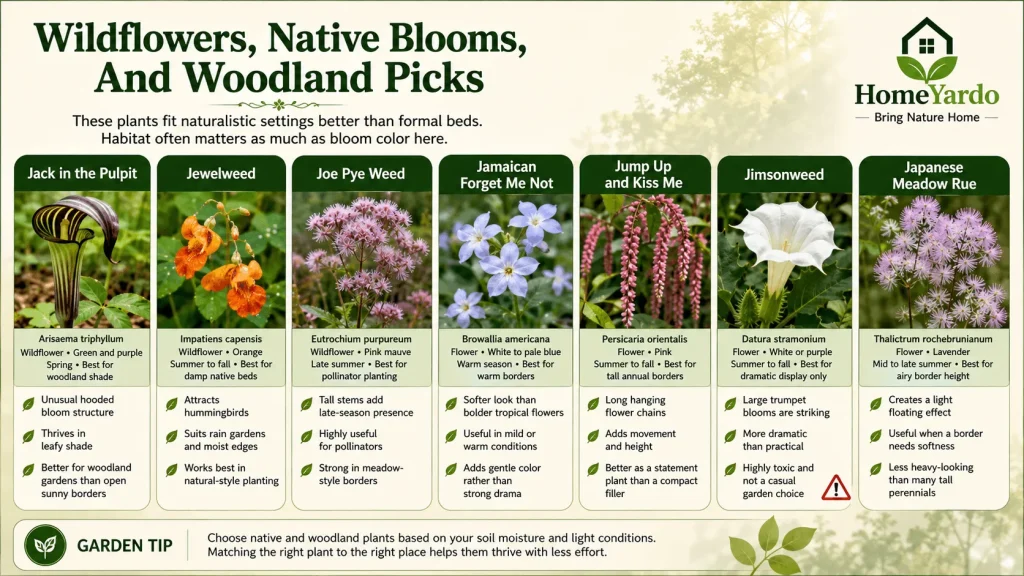
These plants fit naturalistic settings better than formal beds. Habitat often matters as much as bloom color here.
- Jack in the Pulpit
Arisaema triphyllum • Wildflower • Green and purple • Spring • Best for woodland shade- unusual hooded bloom structure
- thrives in leafy shade
- Better for woodland gardens than open sunny borders
- Jewelweed
Impatiens capensis • Wildflower • Orange • Summer to fall • Best for damp native beds- attracts hummingbirds
- suits rain gardens and moist edges
- works best in natural-style planting
- Joe Pye Weed
Eutrochium purpureum • Wildflower • Pink mauve • Late summer • Best for pollinator planting- tall stems add late-season presence
- highly useful for pollinators
- strong in meadow-style borders
- Jamaican Forget Me Not
Browallia americana • Flower • White to pale blue • Warm season • Best for warm borders- softer look than bolder tropical flowers
- useful in mild or warm conditions
- adds gentle color rather than strong drama
- Jump Up and Kiss Me
Persicaria orientalis • Flower • Pink • Summer to fall • Best for tall annual borders- long hanging flower chains
- adds movement and height
- Better as a statement plant than a compact filler
- Jimsonweed
Datura stramonium • Flower • White or purple • Summer to fall • Best for dramatic display only- Large trumpet blooms are striking
- more dramatic than practical
- highly toxic and not a casual garden choice
- Japanese Meadow Rue
Thalictrum rochebrunianum • Flower • Lavender • Mid to late summer • Best for airy border height- creates a light floating effect
- useful when a border needs softness
- less heavy-looking than many tall perennials
Rare, Tropical, And Hard-To-Find J Flowers
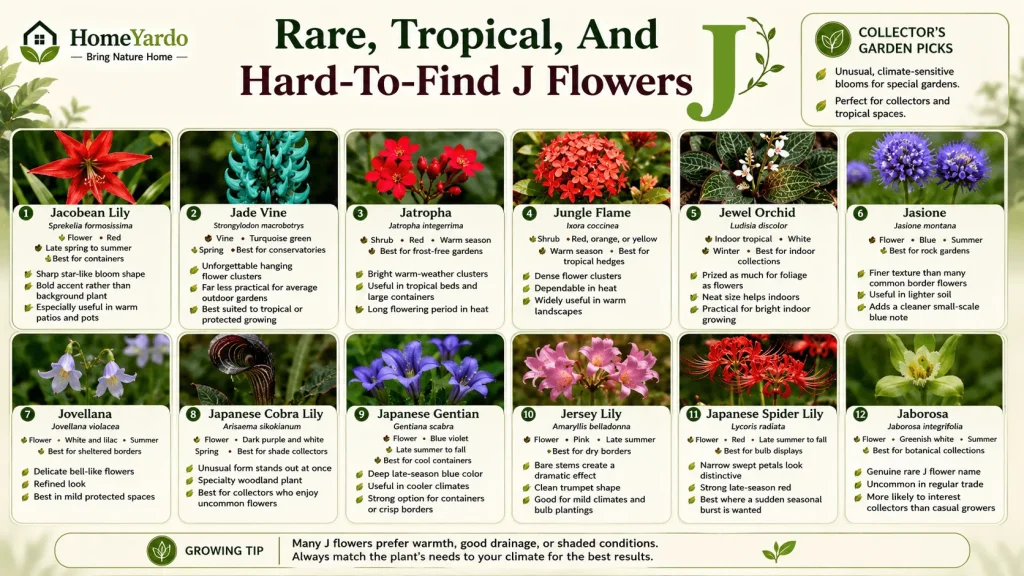
Some J flowers are unusual because they are climate-sensitive, collector-driven, or simply not common in regular retail plant ranges.
- Jacobean Lily
Sprekelia formosissima • Flower • Red • Late spring to summer • Best for containers- sharp star-like bloom shape
- bold accent rather than background plant
- especially useful in warm patios and pots
- Jade Vine
Strongylodon macrobotrys • Vine • Turquoise green • Spring • Best for conservatories- unforgettable hanging flower clusters
- far less practical for average outdoor gardens
- best suited to tropical or protected growing
- Jatropha
Jatropha integerrima • Shrub • Red • Warm season • Best for frost-free gardens- bright warm-weather clusters
- useful in tropical beds and large containers
- long flowering period in heat
- Jungle Flame
Ixora coccinea • Shrub • Red, orange, or yellow • Warm season • Best for tropical hedges- dense flower clusters
- dependable in heat
- widely useful in warm landscapes
- Jewel Orchid
Ludisia discolor • Indoor tropical • White • Winter • Best for indoor collections- prized as much for foliage as flowers
- Neat size helps indoors
- practical for bright indoor growing
- Jasione
Jasione montana • Flower • Blue • Summer • Best for rock gardens- finer texture than many common border flowers
- useful in lighter soil
- adds a cleaner small-scale blue note
- Jovellana
Jovellana violacea • Flower • White and lilac • Summer • Best for sheltered borders- delicate bell-like flowers
- refined look
- best in mild protected spaces
- Japanese Cobra Lily
Arisaema sikokianum • Flower • Dark purple and white • Spring • Best for shade collectors- Unusual form stands out at once
- specialty woodland plant
- best for collectors who enjoy uncommon flowers
- Japanese Gentian
Gentiana scabra • Flower • Blue violet • Late summer to fall • Best for cool containers- deep late-season blue color
- useful in cooler climates
- strong option for containers or crisp borders
- Jersey Lily
Amaryllis belladonna • Flower • Pink • Late summer • Best for dry borders- bare stems create a dramatic effect
- clean trumpet shape
- good for mild climates and bulb plantings
- Japanese Spider Lily
Lycoris radiata • Flower • Red • Late summer to fall • Best for bulb displays- Narrow-swept petals look distinctive
- strong late-season red
- best where a sudden seasonal burst is wanted
- Jaborosa
Jaborosa integrifolia • Flower • Greenish white • Summer • Best for botanical collections- genuine rare J flower name
- uncommon in regular trade
- more likely to interest collectors than casual growers
Flowering Shrubs With J Names
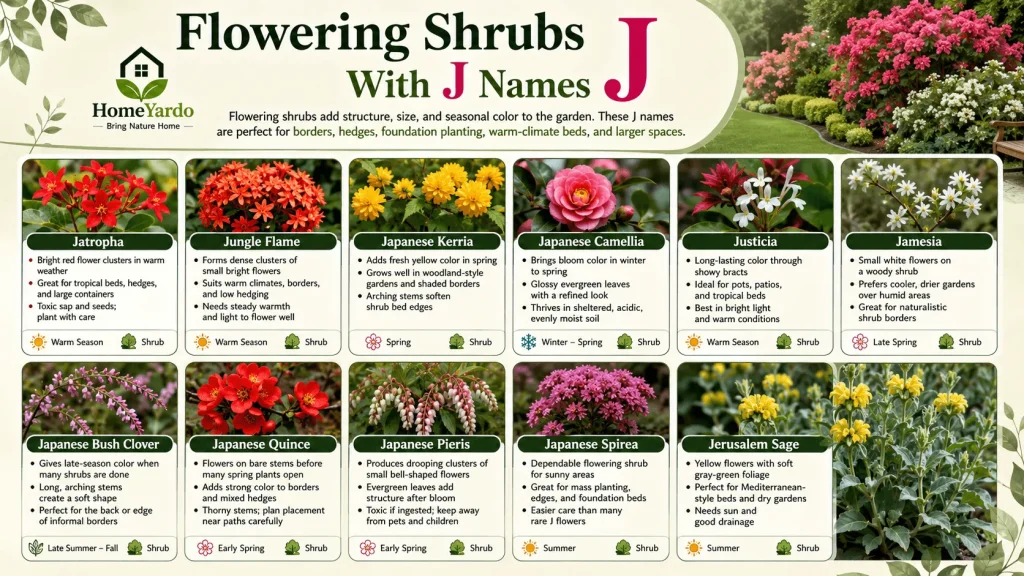
Flowering shrubs add structure, size, and seasonal color to the garden. Unlike small bedding flowers, these J names are better for borders, hedges, foundation planting, warm-climate beds, and larger spaces.
● Jatropha
Jatropha integerrima • Shrub • Red • Warm season • Best for frost-free gardens
○ produces bright red flower clusters in warm weather
○ works well in tropical beds, hedges, and large containers
○ has toxic sap and seeds, so it should be planted with care
● Jungle Flame
Ixora coccinea • Shrub • Red, orange, or yellow • Warm season • Best for tropical hedges
○ forms dense clusters of small bright flowers
○ suits warm climates, borders, and low hedging
○ needs steady warmth and light to flower well
● Japanese Kerria
Kerria japonica • Shrub • Yellow • Spring • Best for part-shade borders
○ adds fresh yellow color in spring
○ grows well in woodland-style gardens and shaded borders
○ has arching stems that soften the edge of shrub beds
● Japanese Camellia
Camellia japonica • Shrub • Pink, red, or white • Winter to spring • Best for mild gardens
○ brings bloom color when many plants are still quiet
○ has glossy evergreen leaves with a refined look
○ works well in sheltered, acidic, evenly moist soil
● Justicia
Justicia brandegeeana • Shrub • White flowers with reddish bracts • Warm season • Best for pots and warm borders
○ gives long-lasting color through its showy bracts
○ fits containers, patios, and tropical-style beds
○ performs best in bright light and warm conditions
● Jamesia
Jamesia americana • Shrub • White • Late spring • Best for dry shrub borders
○ produces small white flowers on a woody shrub form
○ suits cooler, drier garden settings better than humid tropical beds
○ works well in naturalistic shrub borders with enough space
● Japanese Bush Clover
Lespedeza thunbergii • Shrub • Pink purple • Late summer to fall • Best for arching shrub beds
○ gives late-season color when many shrubs have finished blooming
○ has long, arching stems that create a soft shape
○ works well near the back or edge of informal borders
● Japanese Quince
Chaenomeles japonica • Shrub • Red, orange, or pink • Early spring • Best for early-season color
○ flowers on bare stems before many spring plants open
○ adds strong color to shrub borders and mixed hedges
○ has thorny stems, so placement matters near paths and seating areas
● Japanese Pieris
Pieris japonica • Shrub • White or pink • Early spring • Best for acid soil beds
○ produces drooping clusters of small bell-shaped flowers
○ has evergreen leaves that add structure after bloom
○ is toxic if ingested, so it needs care around pets and children
● Japanese Spirea
Spiraea japonica • Shrub • Pink • Summer • Best for low borders and mass planting
○ is a dependable flowering shrub for sunny areas
○ works well in repeated planting, edges, and foundation beds
○ offers easier care than many rare J flowers
● Jerusalem Sage
Phlomis fruticosa • Shrub • Yellow • Summer • Best for dry sunny gardens
○ has yellow flowers with soft gray-green foliage
○ suits Mediterranean-style beds and dry landscapes
○ needs sun and good drainage to perform well
Flowering Vines With J Names
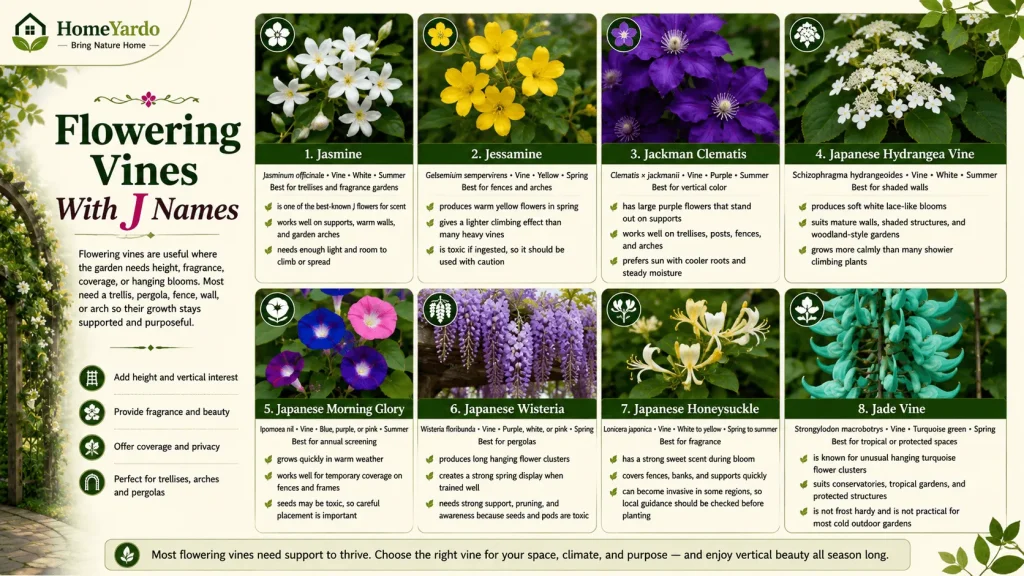
Flowering vines are useful where the garden needs height, fragrance, coverage, or hanging blooms. Most need a trellis, pergola, fence, wall, or arch so their growth stays supported and purposeful.
● Jasmine
Jasminum officinale • Vine • White • Summer • Best for trellises and fragrance gardens
○ is one of the best-known J flowers for scent
○ works well on supports, warm walls, and garden arches
○ needs enough light and room to climb or spread
● Jessamine
Gelsemium sempervirens • Vine • Yellow • Spring • Best for fences and arches
○ produces warm yellow flowers in spring
○ gives a lighter climbing effect than many heavy vines
○ is toxic if ingested, so it should be used with caution
● Jackman Clematis
Clematis × jackmanii • Vine • Purple • Summer • Best for vertical color
○ has large purple flowers that stand out on supports
○ works well on trellises, posts, fences, and arches
○ prefers sun with cooler roots and steady moisture
● Japanese Hydrangea Vine
Schizophragma hydrangeoides • Vine • White • Summer • Best for shaded walls
○ produces soft white lace-like blooms
○ suits mature walls, shaded structures, and woodland-style gardens
○ grows more calmly than many showier climbing plants
● Japanese Morning Glory
Ipomoea nil • Vine • Blue, purple, or pink • Summer • Best for annual screening
○ grows quickly in warm weather
○ works well for temporary coverage on fences and frames
○ Seeds may be toxic, so careful placement is important
● Japanese Wisteria
Wisteria floribunda • Vine • Purple, white, or pink • Spring • Best for pergolas
○ produces long hanging flower clusters
○ creates a strong spring display when trained well
○ needs strong support, pruning, and awareness because seeds and pods are toxic
● Japanese Honeysuckle
Lonicera japonica • Vine • White to yellow • Spring to summer • Best for fragrance
○ has a strong sweet scent during bloom
○ covers fences, banks, and supports quickly
○ can become invasive in some regions, so local guidance should be checked before planting
● Jade Vine
Strongylodon macrobotrys • Vine • Turquoise green • Spring • Best for tropical or protected spaces
○ is known for unusual hanging turquoise flower clusters
○ suits conservatories, tropical gardens, and protected structures
○ is not frost hardy and is not practical for most cold outdoor gardens
Flowering Trees And Landscape Plants Commonly Included In J Lists
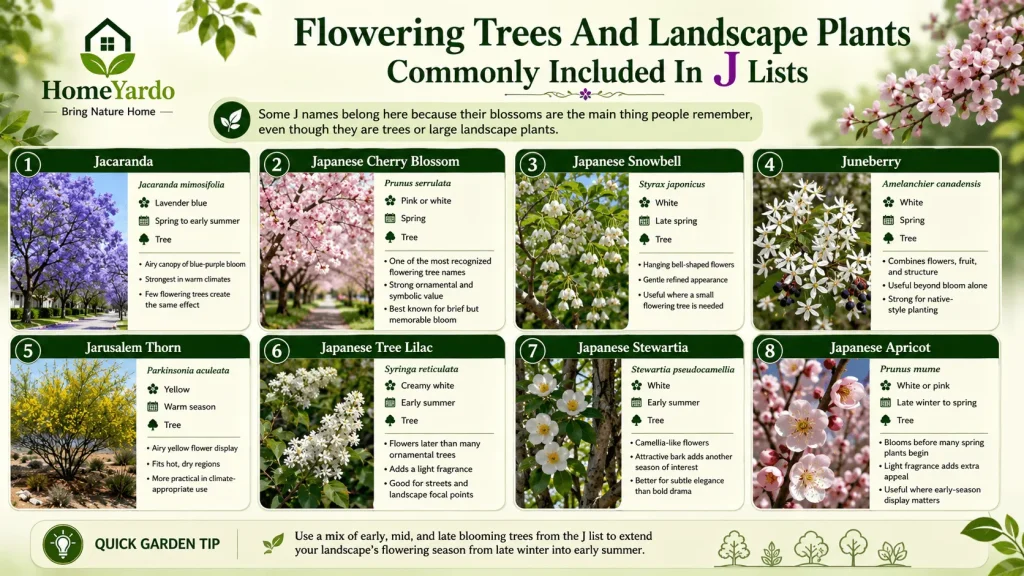
Some J names belong here because their blossoms are the main thing people remember, even though they are trees or large landscape plants.
- Jacaranda
Jacaranda mimosifolia • Tree • Lavender blue • Spring to early summer • Best as a flowering specimen- airy canopy of blue-purple bloom
- strongest in warm climates
- Few flowering trees create the same effect
- Japanese Cherry Blossom
Prunus serrulata • Tree • Pink or white • Spring • Best for seasonal display- One of the most recognized flowering tree names
- strong ornamental and symbolic value
- best known for brief but memorable bloom
- Japanese Snowbell
Styrax japonicus • Tree • White • Late spring • Best for small gardens- hanging bell-shaped flowers
- gentle refined appearance
- useful where a small flowering tree is needed
- Juneberry
Amelanchier canadensis • Tree • White • Spring • Best for native landscapes- combines flowers, fruit, and structure
- useful beyond bloom alone
- strong for native-style planting
- Jerusalem Thorn
Parkinsonia aculeata • Tree • Yellow • Warm season • Best for dry landscapes- airy yellow flower display
- fits hot, dry regions
- more practical in climate-appropriate use
- Japanese Tree Lilac
Syringa reticulata • Tree • Creamy white • Early summer • Best for specimen planting- Flowers later than many ornamental trees
- adds a light fragrance
- good for streets and landscape focal points
- Japanese Stewartia
Stewartia pseudocamellia • Tree • White • Early summer • Best for quiet focal points- camellia-like flowers
- Attractive bark adds another season of interest
- better for subtle elegance than bold drama
- Japanese Apricot
Prunus mume • Tree • White or pink • Late winter to spring • Best for early blossom interest- blooms before many spring plants begin
- light fragrance adds extra appeal
- useful where early-season display matters
Common Flowers That Begin With J
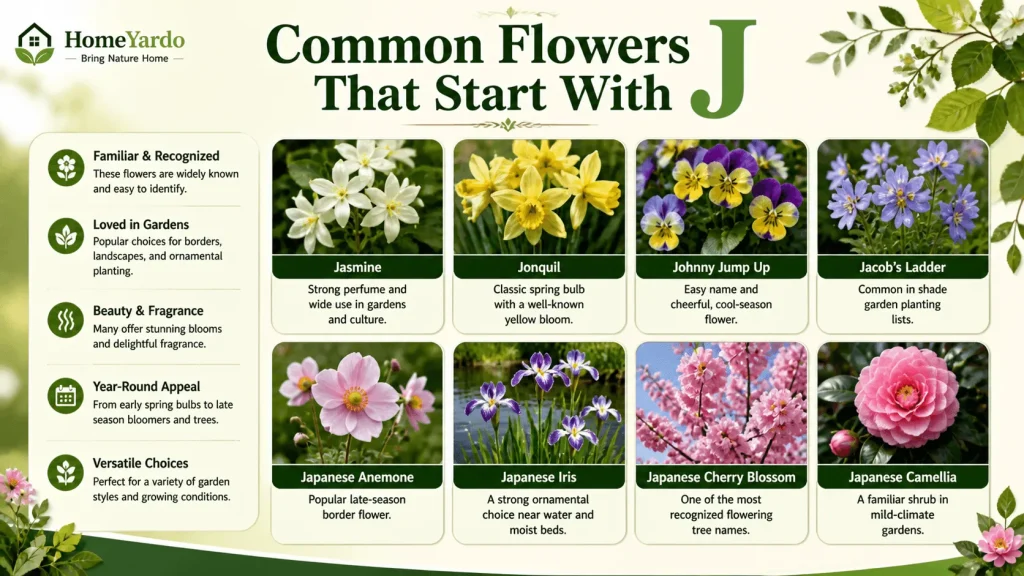
Some names feel familiar right away because they appear often in gardens, plant guides, and ornamental landscapes. These are the easiest starting points.
| Common Name | Why It Feels Familiar |
|---|---|
| Jasmine | Strong perfume and wide use in gardens and culture |
| Jonquil | Classic spring bulb with a well-known yellow bloom |
| Johnny Jump Up | Easy name and cheerful, cool-season flower |
| Jacob’s Ladder | Common in shade garden planting lists |
| Japanese Anemone | Popular late-season border flower |
| Japanese Iris | A strong ornamental choice near water and moist beds |
| Japanese Cherry Blossom | One of the most recognized flowering tree names |
| Japanese Camellia | A familiar shrub in mild-climate gardens |
For more familiar garden picks in the same alphabet cluster, flowers that start with H are also worth comparing.
Rare Flowers That Starting With J
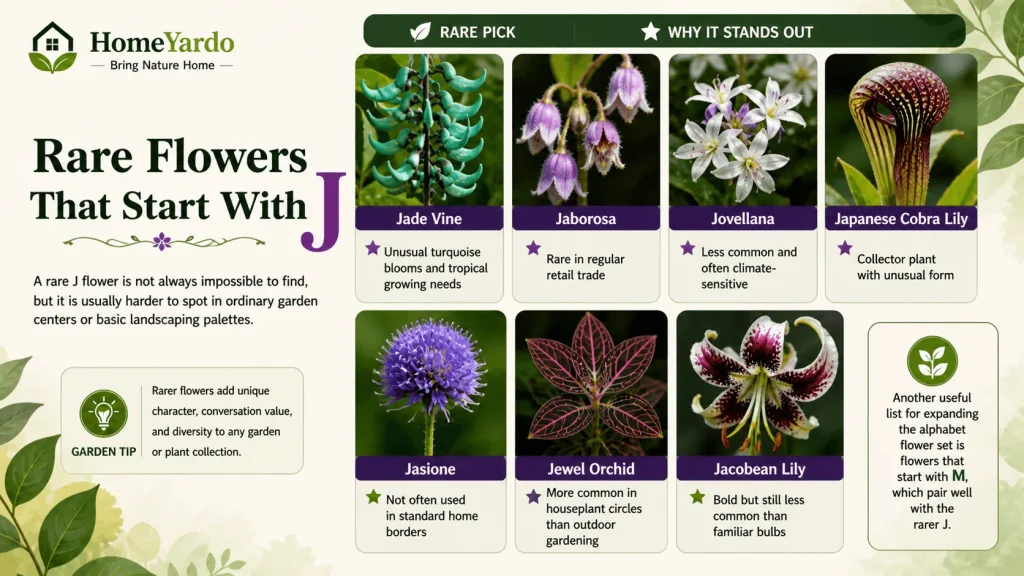
A rare J flower is not always impossible to find, but it is usually harder to spot in ordinary garden centers or basic landscaping palettes.
| Rare Pick | Why It Stands Out |
|---|---|
| Jade Vine | Unusual turquoise blooms and tropical growing needs |
| Jaborosa | Rare in regular retail trade |
| Jovellana | Less common and often climate-sensitive |
| Japanese Cobra Lily | Collector plant with unusual form |
| Jasione | Not often used in standard home borders |
| Jewel Orchid | More common in houseplant circles than outdoor gardening |
| Jacobean Lily | Bold but still less common than familiar bulbs |
Another useful list for expanding the alphabet flower set is flowers that start with M, which pair well with the rarer J.
Purple Flowers That Start With J
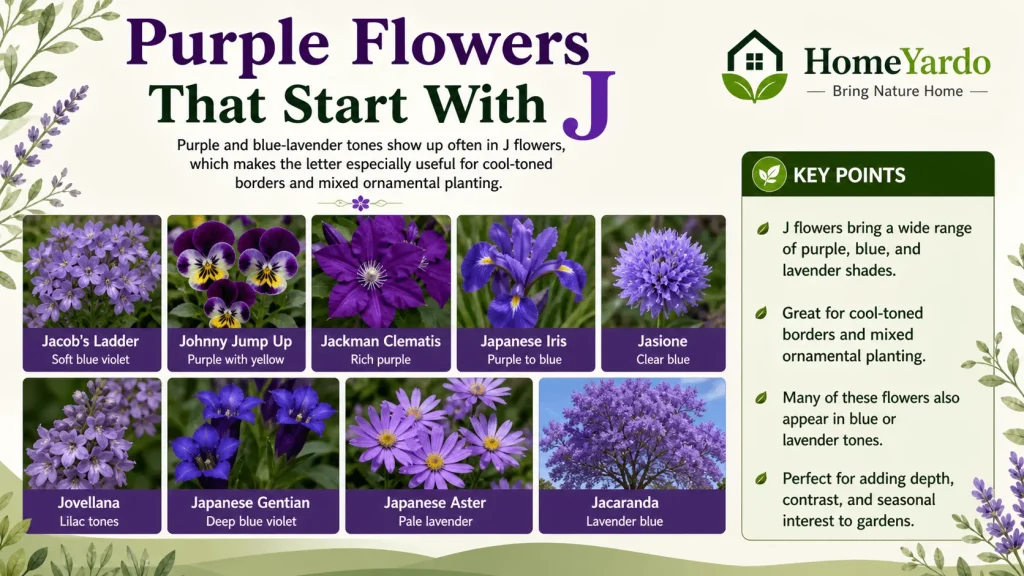
Purple and blue-lavender tones show up often in J flowers, which makes the letter especially useful for cool-toned borders and mixed ornamental planting.
| Purple Choice | Main Shade |
|---|---|
| Jacob’s Ladder | Soft blue violet |
| Johnny Jump Up | Purple with yellow |
| Jackman Clematis | Rich purple |
| Japanese Iris | Purple to blue |
| Jasione | Clear blue |
| Jovellana | Lilac tones |
| Japanese Gentian | Deep blue violet |
| Japanese Aster | Pale lavender |
| Jacaranda | Lavender blue |
Some of these flowers also appear in blue or lavender tones, depending on species or cultivar.
Perennials That Start With J
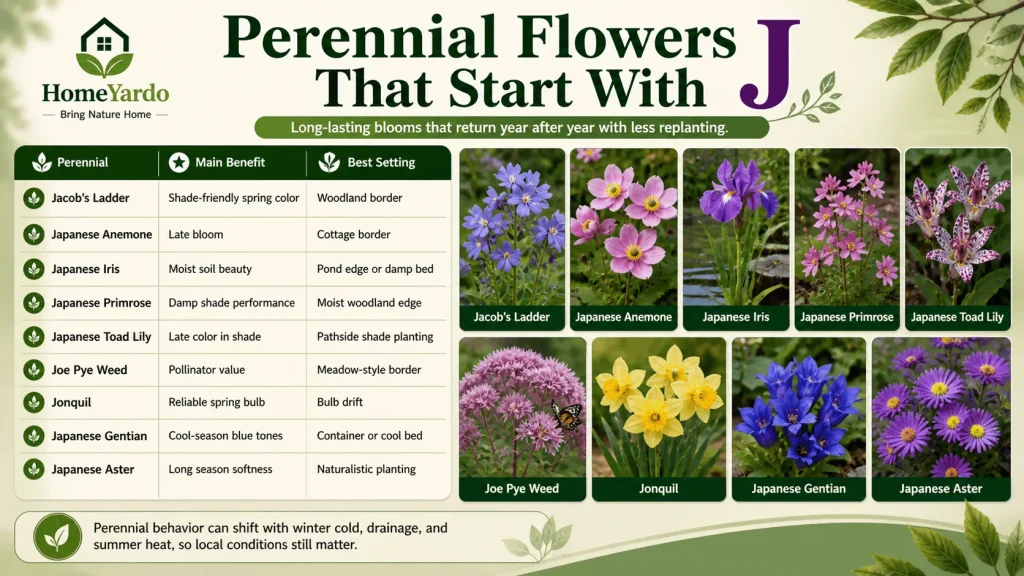
Perennials are often the most practical J flowers for long-term planting because they return with less seasonal rework once established.
| Perennial | Main Benefit | Best Setting |
|---|---|---|
| Jacob’s Ladder | Shade-friendly spring color | Woodland border |
| Japanese Anemone | Late bloom | Cottage border |
| Japanese Iris | Moist soil beauty | Pond edge or damp bed |
| Japanese Primrose | Damp shade performance | Moist woodland edge |
| Japanese Toad Lily | Late color in shade | Pathside shade planting |
| Joe Pye Weed | Pollinator value | Meadow-style border |
| Jonquil | Reliable spring bulb | Bulb drift |
| Japanese Gentian | Cool-season blue tones | Container or cool bed |
| Japanese Aster | Long season softness | Naturalistic planting |
Perennial behavior can shift with winter cold, drainage, and summer heat, so local conditions still matter. For more long-term garden options with strong borders and perennial appeal, compare this list with flowers that start with P.
Annual Flowers That Start With J
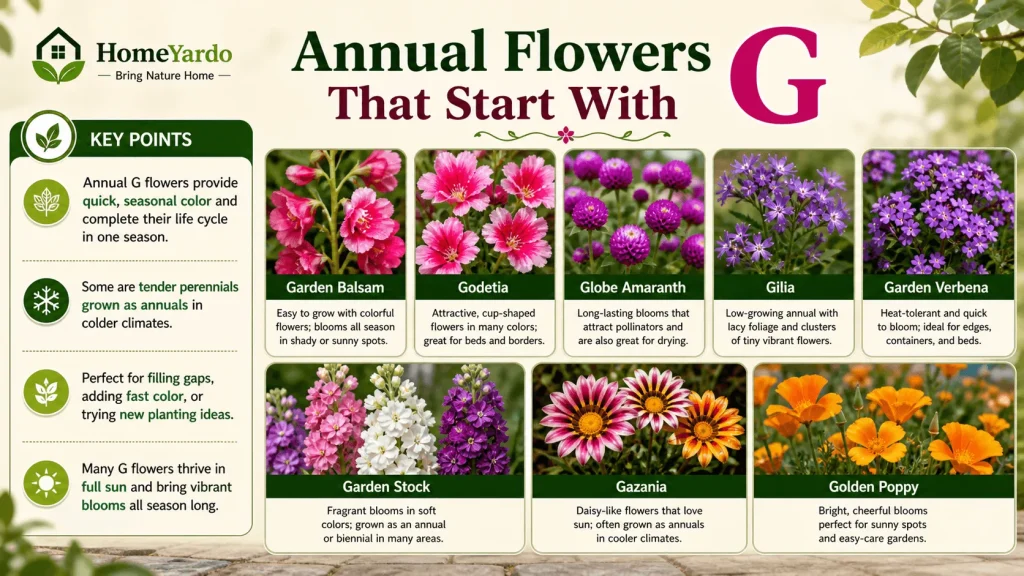
The annual group is smaller, but it still adds useful color. Some plants listed here are true annuals, while others are often grown that way in cooler climates.
| Annual or Often Grown as Annual | Best Use |
|---|---|
| Johnny Jump Up | Cool-season containers and edging |
| Jump Up and Kiss Me | Height in annual borders |
| Japanese Morning Glory | Fast summer screening |
| Jamaican Forget Me Not | Warm-season flower color |
| Jungle Flame | Seasonal container color in cooler areas |
Indoor Flowers That Start With J
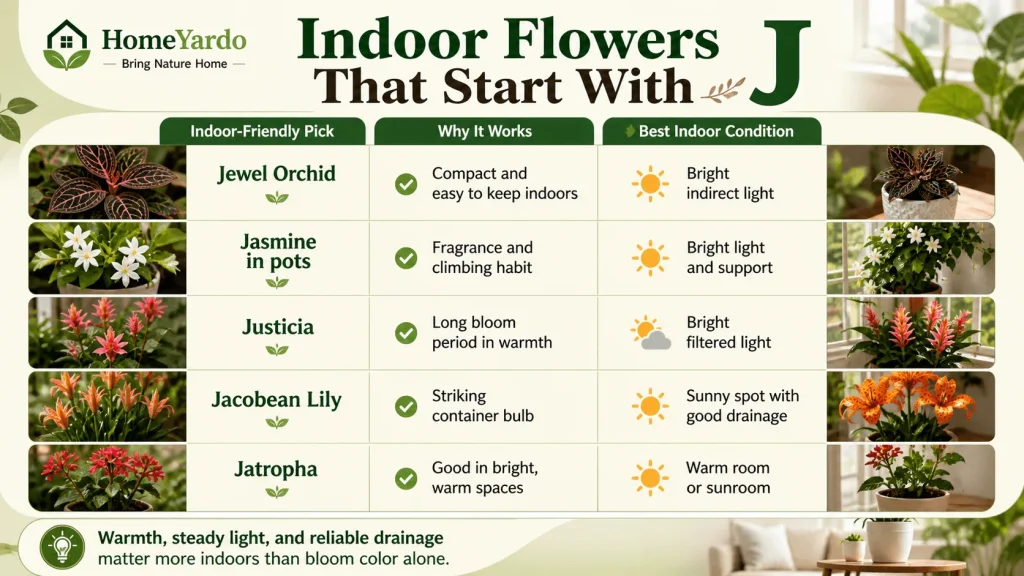
A few J flower names adapt well to pots, bright indoor spaces, or protected patios. These are the best options when outdoor planting is limited.
| Indoor-Friendly Pick | Why It Works | Best Indoor Condition |
|---|---|---|
| Jewel Orchid | Compact and easy to keep indoors | Bright indirect light |
| Jasmine in pots | Fragrance and climbing habit | Bright light and support |
| Justicia | Long bloom period in warmth | Bright filtered light |
| Jacobean Lily | Striking container bulb | Sunny spot with good drainage |
| Jatropha | Good in bright, warm spaces | Warm room or sunroom |
Warmth, steady light, and reliable drainage matter more indoors than bloom color alone.
Beginner Friendly Choices
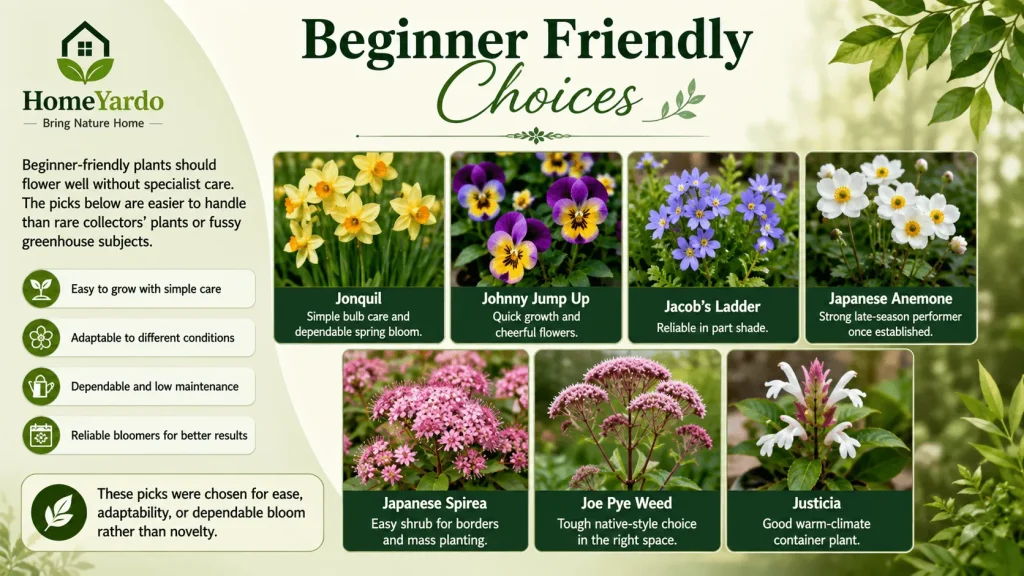
Beginner-friendly plants should flower well without specialist care. The picks below are easier to handle than rare collectors’ plants or fussy greenhouse subjects.
| Beginner Pick | Why It Is Easier |
|---|---|
| Jonquil | Simple bulb care and dependable spring bloom |
| Johnny Jump Up | Quick growth and cheerful flowers |
| Jacob’s Ladder | Reliable in part shade |
| Japanese Anemone | Strong late-season performer once established |
| Japanese Spirea | Easy shrub for borders and mass planting |
| Joe Pye Weed | Tough native-style choice in the right space |
| Justicia | Good warm-climate container plant |
These picks were chosen for ease, adaptability, or dependable bloom rather than novelty.
Best J Flowers By Garden Goal
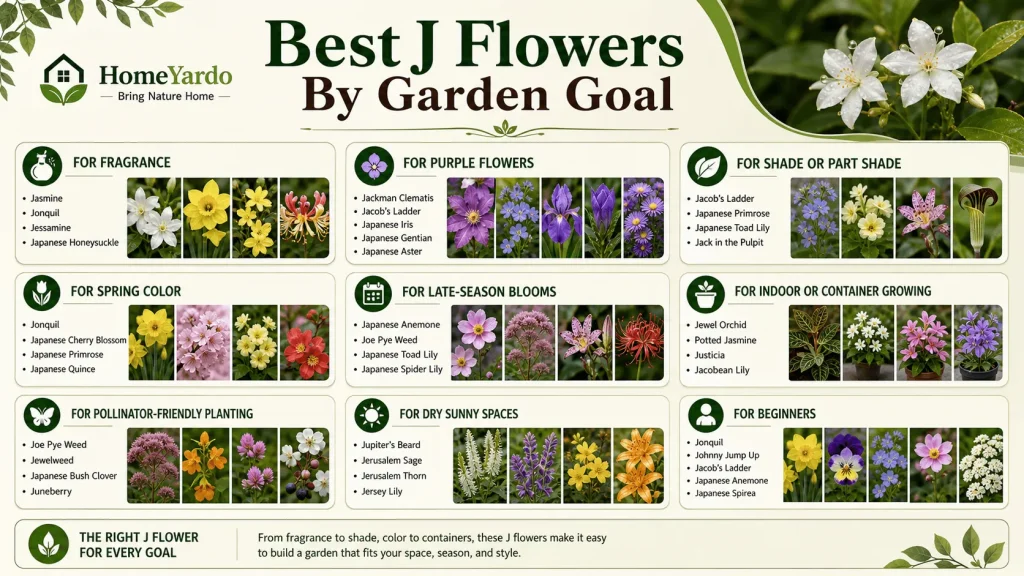
A long alphabet list becomes easier to use when the plants are grouped by purpose. These J flowers can be sorted by fragrance, shade, color, season, container use, pollinator value, and ease of care.
For shade or part shade, Jacob’s Ladder, Japanese Primrose, Japanese Toad Lily, and Jack in the Pulpit are better options than sun-loving J flowers. These plants fit woodland-style beds and cooler garden corners.
For spring color, choose Jonquil, Japanese Cherry Blossom, Japanese Primrose, and Japanese Quince. These bring early seasonal interest before many summer flowers begin.
For late-season flowers, Japanese Anemone, Joe Pye Weed, Japanese Toad Lily, and Japanese Spider Lily are useful because they bloom when many earlier plants have faded.
Indoor or Protected Space Picks
Jewel Orchid, potted Jasmine, Justicia, and Jacobean Lily are the strongest J flowers for indoor or protected growing. They are better suited to bright rooms, sheltered patios, or controlled spaces than larger shrubs and open-ground plants. This group works best when the goal is a manageable size, contained growth, and bloom or foliage value in a more protected setting.
Container And Small Space Picks
Potted Jasmine, Justicia, Jacobean Lily, and Johnny Jump Up are practical choices for containers and smaller spaces. They fit patios, balcony pots, and compact garden areas more easily than broad shrubs or taller meadow plants. For small-space planting, the strongest picks are usually the ones that stay neat, flower well in pots, and do not need a wide open bed to look effective.
Pollinator Friendly And Meadow Picks
Joe Pye Weed, Jewelweed, Japanese Bush Clover, and Juneberry are the clearest J flowers for pollinator-friendly and meadow-style planting. These choices are more useful in wildlife-focused spaces than in formal bedding schemes, especially where a looser natural look is welcome. Joe Pye Weed is especially strong for late-season pollinator activity, while Jewelweed and Japanese Bush Clover add value in softer habitat-style planting.
Cut Flower And Bouquet Favorites
Jonquil, Japanese Iris, Japanese Anemone, and Jacobean Lily are the strongest J flowers for bouquet use. Jonquil brings fresh spring color and scent, while Japanese Iris adds a cleaner, more elegant line. Japanese Anemone works well for a softer late-season look, and Jacobean Lily adds brighter focal color where a bolder stem is needed. Jasmine is better used for fragrance than for fuller bouquet structure.
Water And Pond Flower Picks
Japanese Iris is the strongest J flower for water-adjacent planting because it suits damp soil and pond-edge conditions better than most other J flowers. Japanese Primrose can also work well in moisture-retentive ground near water, especially where the planting needs softer seasonal color. These flowers fit best at the pond margin or in wet borders rather than as deep-water aquatic plants.
Fragrant J Flowers
Jasmine is the strongest fragrance flower in the J group and is still the clearest choice when scent is the main goal. Jonquil is another strong option, especially for spring planting, where soft fragrance matters as much as early color. Jessamine also fits well in scented garden plans, while Japanese Honeysuckle can add perfume in the right setting, though its growth should be managed carefully where it spreads aggressively. For another fragrance-heavy alphabet list with familiar garden names such as lavender, lilac, and lily, see flowers that start with L.
J Flowers That Need Extra Caution
Some J flowers are attractive but need extra care before planting. A plant may be toxic, invasive, thorny, aggressive, or sensitive to cold.
Jimsonweed is highly toxic and should not be treated as a casual garden flower. It may appear in broad J flower lists because of its large trumpet-shaped blooms, but its toxicity makes it a caution plant.
Japanese Knotweed is invasive and best avoided in gardens. It can spread aggressively and is included for accuracy rather than as a planting recommendation.
Japanese Honeysuckle can become invasive in some regions. It has fragrant flowers and fast coverage, but local guidance should be checked before planting.
Jack in the Pulpit is toxic if ingested. It is better suited to woodland-style planting where it will not be disturbed by children, pets, or grazing animals.
Jessamine has attractive yellow flowers, but it is toxic if ingested. It should be used carefully around pets and children.
Japanese Wisteria produces dramatic hanging flower clusters, but its seeds and pods are toxic. It also needs strong support and regular pruning.
Japanese Pieris is an ornamental shrub with white or pink spring flowers, but it is toxic if ingested. It should be planted with awareness in family gardens.
Jatropha has toxic sap and seeds. It is better for frost-free ornamental spaces, where it can be handled and placed with care.
Jerusalem Thorn is thorny and better suited to dry landscapes than small family gardens, narrow paths, or play areas.
Jade Vine is not frost-hardy. It is best for tropical gardens, conservatories, or protected growing spaces rather than cold outdoor beds.
What Is The Most Popular Flower That Starts With J?
Jasmine is the strongest answer for overall popularity. Fragrance, name recognition, and ornamental use all push it ahead of the rest.
Jonquil is a close spring favorite, while Japanese Anemone is especially popular in ornamental garden design.
| Category | Best Pick |
|---|---|
| Most popular overall | Jasmine |
| Best fragrance | Jasmine |
| Best spring bulb | Jonquil |
| Best late-season border flower | Japanese Anemone |
| Best flowering tree | Japanese Cherry Blossom |
| Best container tropical | Justicia |
Scent can still vary by species, cultivar, and growing conditions.
Flower Meanings And Symbolism
A few J flowers carry meanings that make them useful in gift language, seasonal themes, and symbolic planting.
| Flower | Common Meaning |
|---|---|
| Jasmine | Love, purity, grace |
| Jonquil | Renewal, affection, spring |
| Japanese Cherry Blossom | Brief beauty, change, and passing seasons |
| Jacob’s Ladder | Hope, ascent, reflection |
| Jersey Lily | Beauty and resilience |
The symbolic angle works best when it stays brief and grounded.
Bloom Season, Growing Zones, And Habitat At A Glance
Bloom timing helps narrow the list quickly, but climate and site conditions matter just as much when choosing a flower that will actually perform well.
| Flower | Bloom Window | Climate / Zone Pattern | Light Need | Moisture or Habitat |
|---|---|---|---|---|
| Jonquil | Spring | Cool to mild, bulb-friendly climates | Sun to part shade | Moderate, well-drained |
| Japanese Primrose | Spring | Cool temperate | Part shade | Damp ground |
| Jacob’s Ladder | Late spring | Cool temperate | Part shade | Even moisture |
| Japanese Iris | Early summer | Temperate | Sun to part shade | Moist beds |
| Jackman Clematis | Summer | Temperate | Sun with cool roots | Moderate |
| Jungle Flame | Warm season | Tropical to subtropical | Sun | Moderate |
| Joe Pye Weed | Late summer | Temperate | Sun to part shade | Moist meadows |
| Japanese Toad Lily | Late summer to fall | Temperate | Shade to part shade | Even moisture |
| Japanese Anemone | Late summer to fall | Temperate | Part shade | Moderate |
| Japanese Cherry Blossom | Spring | Temperate | Sun | Moderate |
| Japanese Tree Lilac | Early summer | Temperate | Sun | Moderate |
| Japanese Apricot | Late winter to spring | Mild to cool | Sun | Moderate |
How To Use This List In A Garden Plan
A long alphabet list becomes more useful when it is tied to real garden goals. Grouping by function is often the easiest place to start.
- For fragrance: Jasmine, Jonquil, Jessamine, Japanese Honeysuckle
- For shade: Jacob’s Ladder, Japanese Primrose, Japanese Toad Lily, Jack in the Pulpit
- For purple tones: Jackman Clematis, Jacob’s Ladder, Japanese Iris, Japanese Gentian
- For pollinators: Joe Pye Weed, Jewelweed, Japanese Bush Clover, Juneberry
- For dry ground: Jupiter’s Beard, Jerusalem Sage, Jerusalem Thorn
- For containers: Johnny Jump Up, Jacobean Lily, Jewel Orchid, Justicia
A few simple planting ideas:
- spring mix: Jonquil, Jacob’s Ladder, Japanese Primrose
- late-season border: Joe Pye Weed, Japanese Anemone, Japanese Toad Lily
- fragrant warm-climate corner: Jasmine, Jessamine, Japanese Honeysuckle with care
Conclusion
Flowers with J include far more than a short list of familiar names. Jasmine, Jonquil, Johnny Jump Up, Jacob’s Ladder, Japanese Anemone, and Japanese Iris are some of the easiest names to recognize, but the full list also includes wildflowers, flowering shrubs, vines, indoor plants, and ornamental trees.
The most useful way to read the list is by type, bloom season, color, fragrance, and garden use. That makes it easier to separate a true border flower from a flowering tree, a collector plant, or a vine that needs support.
For most gardens, the best starting choices are Jonquil, Johnny Jump Up, Jacob’s Ladder, Japanese Anemone, Japanese Iris, Japanese Bellflower, and Jasmine. Rare or caution-worthy plants such as Jade Vine, Jimsonweed, Japanese Knotweed, and Japanese Honeysuckle need more care before planting.
FAQ’s
The number depends on how strictly the word flower is used. A narrower list stays shorter, while a broader horticultural list can reach 55 once flowering shrubs and trees are labeled clearly.
Jacob’s Ladder, Japanese Anemone, Japanese Iris, Japanese Primrose, Japanese Toad Lily, Joe Pye Weed, and Jonquil are strong perennial examples. Local climate still affects long-term performance.
Yes. Jewel Orchid, potted Jasmine, and Justicia are practical, indoor-friendly choices. A few tropical plants can also work indoors with bright light and warmth.
Jade Vine, Jaborosa, Jovellana, Japanese Cobra Lily, and Jewel Orchid are among the less common names. Their rarity usually comes from climate needs, limited trade, or specialist appeal.
Jacob’s Ladder is one of the clearest purple examples. Jackman Clematis, Japanese Iris, Japanese Gentian, and Japanese Aster also fit well.
No. Some are flowering shrubs, vines, trees, or broader flowering plants. Clear type labels help separate classic flowers from other blossom-bearing plants.
Yes, though the annual group is smaller. Johnny Jump Up, Jump Up and Kiss Me, and Japanese Morning Glory are examples often grown for seasonal color.
References