65 Beautiful Varieties Of Flowers That Start With G You Didn’t Know About
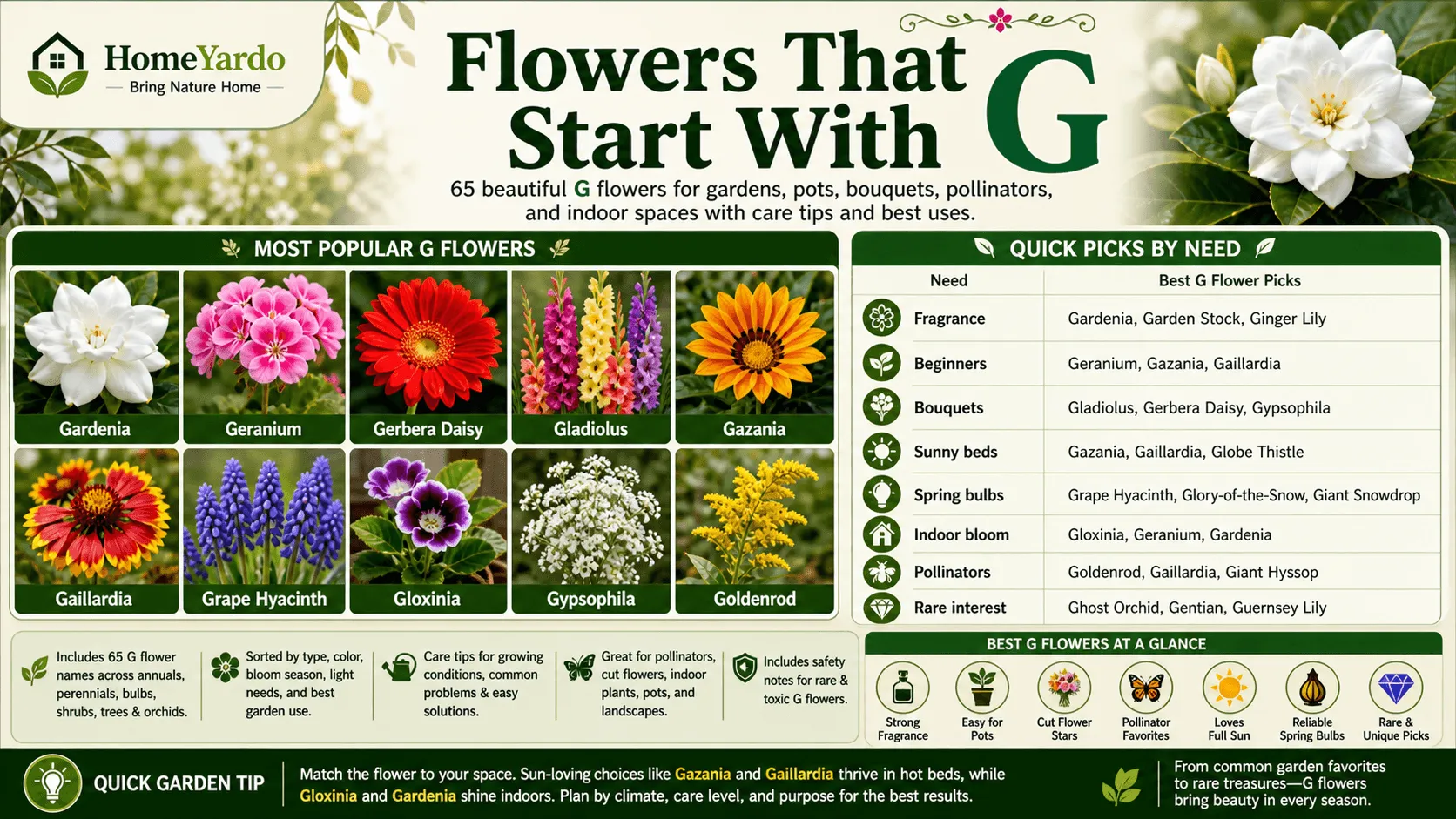
Flowers that start with G include garden favorites, spring bulbs, fragrant shrubs, indoor bloomers, bouquet flowers, pollinator plants, and a few rare collector picks. Some are easy bedding plants, while others need a specific climate, soil, or care.
This guide includes 65 G flower names in a practical format. Each flower is sorted by plant type, color, bloom season, light needs, and best garden use, so the list is easier to compare.
Gardenia, Geranium, Gerbera Daisy, Gladiolus, Gazania, Gaillardia, Grape Hyacinth, Gloxinia, Gypsophila, and Goldenrod are among the most familiar choices. Less common names such as Ghost Orchid, Galax, Grass Pink Orchid, Green Rose, and Guernsey Lily add more variety for specialty gardens and flower reference lists.
Quick Picks By Need
The fastest way to choose a G flower is to match it with the purpose of the planting. Some flowers are best for fragrance, while others work better for pots, bouquets, pollinators, spring color, or rare plant interest.
| Need | Best G Flower Picks |
|---|---|
| Fragrance | Gardenia, Garden Stock, Ginger Lily |
| Beginners | Geranium, Gazania, Gaillardia |
| Bouquets | Gladiolus, Gerbera Daisy, Gypsophila |
| Sunny beds | Gazania, Gaillardia, Globe Thistle |
| Spring bulbs | Grape Hyacinth, Glory-of-the-Snow, Giant Snowdrop |
| Indoor bloom | Gloxinia, Geranium, Gardenia |
| Pollinators | Goldenrod, Gaillardia, Giant Hyssop |
| Rare interest | Ghost Orchid, Gentian, Guernsey Lily |
Quick Answer: What Are Flowers That Start With G?
G flower names include Gardenia, Geranium, Gerbera Daisy, Gladiolus, Gazania, Gaillardia, Gloxinia, Gentian, Geum, Grape Hyacinth, Globe Amaranth, Goldenrod, Gypsophila, Garden Stock, and Gloriosa Lily.
Some are grown for scent. Some are chosen for bold color. Others are useful for bulbs, containers, cut flowers, cottage gardens, pollinator beds, or indoor bloom.
Fragrant choices include Gardenia, Garden Stock, and Ginger Lily. Bouquet choices include Gladiolus, Gerbera Daisy, and Gypsophila. Easy garden choices include Geranium, Gazania, and Gaillardia. Spring bulb choices include Grape Hyacinth, Glory-of-the-Snow, and Giant Snowdrop. Rare picks include Ghost Orchid, Gentian, and Guernsey Lily. For more fragrance and garden-color ideas, compare Gardenia and Garden Stock with flowers that start with L.
Quick Count: Flower Names Starting With G
Here is the full name-only list for quick scanning. Detailed notes appear in the table and later garden-use sections.
- Gaillardia
- Galax
- Garden Angelica
- Garden Balsam
- Garden Phlox
- Garden Rock Cress
- Garden Stock
- Garden Verbena
- Gardenia
- Garland Flower
- Gas Plant
- Gaura
- Gayfeather
- Gazania
- Genista
- Gentian
- Geranium
- Gerbera Daisy
- German Iris
- Geum
- Ghost Orchid
- Giant Allium
- Giant Coreopsis
- Giant Fleeceflower
- Giant Hyssop
- Giant Lily
- Giant Snowdrop
- Gilia
- Gilliflower
- Ginger Lily
- Gladiolus
- Globe Amaranth
- Globeflower
- Globe Thistle
- Glory-of-the-Snow
- Gloriosa Lily
- Gloxinia
- Goat’s Beard
- Goat’s Rue
- Godetia
- Golden Alexanders
- Golden Chamomile
- Golden Chain Tree
- Golden Columbine
- Golden Dewdrop
- Golden Marguerite
- Golden Poppy
- Golden Shower Tree
- Golden Trumpet
- Goldenrod
- Goldenstar
- Gooseneck Loosestrife
- Gorse
- Grape Hyacinth
- Grass Pink Orchid
- Great Blue Lobelia
- Great Masterwort
- Great Periwinkle
- Grecian Windflower
- Greek Valerian
- Green Rose
- Grevillea
- Guernsey Lily
- Gumamela
- Gypsophila
For a wider alphabet flower list, use this list of A to Z Flowers.
How To Use This List
Use the name-only list above for fast flower ideas. Use the main table below to compare plant type, color, bloom season, light, and garden use.
Use the latter parts to choose by fragrance, containers, pollinators, indoor bloom, annuals, perennials, color, and rare flowers.
List Of Flowers That Start With G
The table below keeps the full 65-name list in one place. Botanical names can vary by species, variety, and common regional use, so broad groups are marked with “spp.” where needed.
| Common Name | Botanical Name | Plant Type | Main Color Range | Bloom Season | Light | Best Use |
|---|---|---|---|---|---|---|
| Gaillardia | Gaillardia spp. | Perennial or annual | Red, orange, yellow | Summer to fall | Full sun | Borders, pollinators |
| Galax | Galax urceolata | Evergreen perennial | White | Spring to summer | Part shade | Woodland gardens |
| Garden Angelica | Angelica archangelica | Biennial or short-lived perennial | Greenish white | Summer | Sun to part shade | Herb gardens, height |
| Garden Balsam | Impatiens balsamina | Annual | Pink, red, white, purple | Summer | Sun to part shade | Beds, cottage gardens |
| Garden Phlox | Phlox paniculata | Perennial | Pink, white, purple, red | Summer | Full sun to part shade | Borders, fragrance |
| Garden Rock Cress | Arabis caucasica | Perennial | White, pink | Spring | Full sun | Rock gardens, edging |
| Garden Stock | Matthiola incana | Annual or biennial | White, pink, purple, red | Spring to early summer | Full sun to part shade | Fragrance, cut flowers |
| Garden Verbena | Verbena x hybrida | Tender perennial or annual | Purple, pink, red, white | Spring to fall | Full sun | Containers, edging |
| Gardenia | Gardenia jasminoides | Flowering shrub | White, cream | Late spring to summer | Part sun | Fragrance, containers |
| Garland Flower | Daphne cneorum | Evergreen shrub | Pink | Spring | Sun to part shade | Fragrant low shrub |
| Gas Plant | Dictamnus albus | Perennial | Pink, white | Late spring to early summer | Sun to part shade | Borders, specimen plant |
| Gaura | Oenothera lindheimeri | Perennial | White, pink | Late spring to fall | Full sun | Airy borders |
| Gayfeather | Liatris spicata | Perennial | Purple, white | Summer | Full sun | Pollinators, vertical form |
| Gazania | Gazania rigens | Tender perennial or annual | Yellow, orange, red, pink | Spring to fall | Full sun | Dry beds, pots |
| Genista | Genista spp. | Flowering shrub | Yellow | Spring | Full sun | Slopes, dry borders |
| Gentian | Gentiana spp. | Perennial | Blue, purple, white | Summer to fall | Sun to part shade | Rock gardens, cool color |
| Geranium | Pelargonium spp. and Geranium spp. | Bedding plant or perennial | Red, pink, white, purple | Spring to fall | Sun to part shade | Pots, beds, window boxes |
| Gerbera Daisy | Gerbera jamesonii | Tender perennial | Red, orange, yellow, pink, white | Spring to fall | Full sun | Bouquets, patio color |
| German Iris | Iris germanica | Rhizomatous perennial | Purple, white, yellow, pink | Spring to early summer | Full sun | Borders, cut flowers |
| Geum | Geum spp. | Perennial | Orange, red, yellow, pink | Spring to summer | Sun to part shade | Borders, cottage gardens |
| Ghost Orchid | Dendrophylax lindenii | Orchid | White | Warm season | Filtered light | Specialty orchid growing |
| Giant Allium | Allium giganteum | Bulb | Purple | Late spring to summer | Full sun | Structure, pollinators |
| Giant Coreopsis | Leptosyne gigantea | Shrubby perennial | Yellow | Spring to summer | Full sun | Dry gardens, focal plant |
| Giant Fleeceflower | Persicaria polymorpha | Perennial | White | Summer | Full sun to part shade | Large borders |
| Giant Hyssop | Agastache spp. | Perennial | Purple, pink, orange | Summer to fall | Full sun | Pollinators, herbaceous borders |
| Giant Lily | Cardiocrinum giganteum | Bulbous perennial | White, maroon flushed | Summer | Part shade | Dramatic focal plant |
| Giant Snowdrop | Galanthus elwesii | Bulb | White | Late winter to early spring | Sun to part shade | Early bulbs, woodland edges |
| Gilia | Gilia spp. | Annual or short lived perennial | Blue, lavender, pink | Spring to summer | Full sun | Wildflower planting |
| Gilliflower | Dianthus caryophyllus group | Perennial or annual | Pink, red, white, purple | Spring to summer | Full sun | Cottage gardens, fragrance |
| Ginger Lily | Hedychium spp. | Rhizomatous perennial | White, yellow, orange, pink | Summer to fall | Sun to part shade | Tropical effect, fragrance |
| Gladiolus | Gladiolus spp. | Corm plant | Many colors | Summer | Full sun | Cut flowers, vertical accents |
| Globe Amaranth | Gomphrena globosa | Annual | Purple, pink, magenta, white | Summer to frost | Full sun | Beds, dried flowers |
| Globeflower | Trollius spp. | Perennial | Yellow, orange | Late spring to early summer | Sun to part shade | Moist borders |
| Globe Thistle | Echinops spp. | Perennial | Blue, steel blue | Summer | Full sun | Structure, pollinators |
| Glory-of-the-Snow | Chionodoxa forbesii | Bulb | Blue, pink, white | Early spring | Full sun to part shade | Early bulbs, edging |
| Gloriosa Lily | Gloriosa superba | Tuberous climber | Red, yellow, orange | Summer | Sun to part shade | Exotic focal plant |
| Gloxinia | Sinningia speciosa | Indoor flowering plant | Purple, red, pink, white | Spring to summer | Bright indirect light | Houseplant bloom |
| Goat’s Beard | Aruncus dioicus | Perennial | Creamy white | Late spring to summer | Part shade | Woodland borders |
| Goat’s Rue | Galega officinalis | Perennial | Pink, lavender, white | Summer | Full sun | Naturalistic planting |
| Godetia | Clarkia amoena | Annual | Pink, red, white, salmon | Late spring to summer | Full sun | Beds, cut flowers |
| Golden Alexanders | Zizia aurea | Perennial | Yellow | Spring to early summer | Sun to part shade | Native style planting |
| Golden Chamomile | Cota tinctoria | Perennial | Yellow | Summer | Full sun | Dry borders |
| Golden Chain Tree | Laburnum anagyroides | Flowering tree | Yellow | Late spring | Full sun | Ornamental focal tree |
| Golden Columbine | Aquilegia chrysantha | Perennial | Yellow | Spring to summer | Sun to part shade | Cottage borders |
| Golden Dewdrop | Duranta erecta | Shrub | Purple, blue, white | Warm season | Full sun | Warm climate hedges |
| Golden Marguerite | Anthemis tinctoria | Perennial | Yellow | Summer | Full sun | Cottage borders |
| Golden Poppy | Eschscholzia californica | Annual or short-lived perennial | Orange, yellow | Spring to summer | Full sun | Meadow-style planting |
| Golden Shower Tree | Cassia fistula | Flowering tree | Yellow | Warm season | Full sun | Tropical flowering tree |
| Golden Trumpet | Allamanda cathartica | Shrub or vine | Yellow | Warm season | Full sun | Tropical color |
| Goldenrod | Solidago spp. | Perennial | Yellow | Late summer to fall | Full sun | Pollinator beds |
| Goldenstar | Chrysogonum virginianum | Perennial | Yellow | Spring to summer | Part shade | Groundcover, woodland edge |
| Gooseneck Loosestrife | Lysimachia clethroides | Perennial | White | Summer | Sun to part shade | Moist borders |
| Gorse | Ulex europaeus | Flowering shrub | Yellow | Winter to spring | Full sun | Coastal or poor soils |
| Grape Hyacinth | Muscari spp. | Bulb | Blue, purple, white | Early spring | Sun to part shade | Spring bulbs, edging |
| Grass Pink Orchid | Calopogon tuberosus | Orchid | Pink | Summer | Full sun | Bog gardens, specialty planting |
| Great Blue Lobelia | Lobelia siphilitica | Perennial | Blue | Summer to fall | Sun to part shade | Moist borders, pollinators |
| Great Masterwort | Astrantia major | Perennial | Pink, white, ruby | Late spring to summer | Part shade | Cottage borders, cutting |
| Great Periwinkle | Vinca major | Perennial vine | Blue, violet | Spring | Sun to shade | Groundcover |
| Grecian Windflower | Anemone blanda | Tuberous perennial | Blue, pink, white | Spring | Sun to part shade | Spring edging |
| Greek Valerian | Polemonium caeruleum | Perennial | Blue, violet, white | Late spring to early summer | Sun to part shade | Woodland borders |
| Green Rose | Rosa chinensis viridiflora | Shrub rose | Green | Spring to fall | Full sun | Novelty rose, collectors |
| Grevillea | Grevillea spp. | Shrub or tree | Red, orange, yellow, pink | Varies | Full sun | Warm climate gardens |
| Guernsey Lily | Nerine bowdenii | Bulb | Pink | Late summer to fall | Full sun | Late color, pots |
| Gumamela | Hibiscus rosa-sinensis | Tropical shrub | Red, pink, yellow, orange, white | Warm season | Full sun | Tropical hedges, containers |
| Gypsophila | Gypsophila paniculata | Perennial | White, pink | Summer | Full sun | Bouquets, airy borders |
Most Recognizable G Flowers
Some G flowers are easier to recognize because they appear often in gardens, containers, bulb displays, bouquets, and nursery benches. Gardenia is known for scent, Geranium for pots, Gerbera Daisy for bright cut flowers, and Gladiolus for tall summer spikes.
Gazania, Gaillardia, Grape Hyacinth, Gloxinia, Gypsophila, Garden Stock, Goldenrod, and Geum are also familiar in their own garden settings. Together, these flowers cover fragrance, spring color, sunny beds, indoor bloom, pollinator planting, and floral design.
| Table Accuracy Notes: Common flower names can vary by region, nursery, and garden tradition. Some names refer to a full genus, while others refer to one species, cultivar group, shrub, tree, bulb, orchid, or climber. A flower-name guide may include more than soft herbaceous plants. Gardenia, Golden Chain Tree, Golden Shower Tree, Grevillea, and Gumamela are flowering woody plants. Gladiolus, Grape Hyacinth, Guernsey Lily, and Giant Snowdrop are bulb or corm-type plants. Ghost Orchid and Grass Pink Orchid are specialty orchids. |
Common Flowers That Starting With G

Common G flowers are usually easy to recognize, easy to find, or widely used in garden beds, pots, bouquets, and seasonal displays. They are not always the easiest plants for every climate, but they are among the most familiar names.
Gardenia is common in fragrance gardens and containers in warm areas. Geranium is a classic container flower for patios and window boxes. Gerbera Daisy is popular in bouquets and decorative pots. Gladiolus is often grown for cutting gardens and tall vertical color.
Gazania, Gaillardia, Grape Hyacinth, Gloxinia, Gypsophila, Garden Stock, Goldenrod, and Geum round out the familiar group. They give options for sunny beds, spring bulbs, indoor flowers, bouquet filler, scented spikes, pollinator beds, and cottage borders. Common garden flowers can also be compared with flowers that start with M.
Plants Vs Flowers That Starting With G

Not every G entry grows in the same way. Some are annual bedding flowers. Some return as perennials. Others grow from bulbs, corms, rhizomes, tubers, shrubs, trees, or orchid roots.
Bedding flowers such as Geranium, Gazania, Garden Balsam, and Garden Verbena are often chosen for fast seasonal color. Perennials such as Gaillardia, Geum, Goldenrod, Globe Thistle, and Great Masterwort are used for a longer garden structure.
Bulb and corm flowers such as Gladiolus, Grape Hyacinth, Giant Snowdrop, Guernsey Lily, and Grecian Windflower bring seasonal rhythm. Flowering shrubs and trees such as Gardenia, Genista, Golden Chain Tree, Golden Shower Tree, Grevillea, and Gumamela add woody structure and bloom.
Orchids and specialty plants such as Ghost Orchid and Grass Pink Orchid belong in the list because they are flowering plants with recognized G names, even though they are not typical bedding plants. For more flowering shrubs, bulbs, and specialty plants by letter, see flowers that start with O.
Types Of Flowers That Start With G

G flowers can be grouped by how they grow and how they are used. This makes a long list easier to handle without repeating every flower in every category.
Annual flowers include Garden Balsam, Godetia, Globe Amaranth, Gilia, and Garden Verbena. Some plants, such as Gazania and Garden Stock, may behave as perennials in mild areas but are often grown as annuals in colder regions.
Perennial flowers include Gaillardia, Gentian, Geum, Globe Thistle, Goldenrod, Great Masterwort, Great Blue Lobelia, Golden Alexanders, Goat’s Beard, and Greek Valerian. Bulb, corm, rhizome, or tuber types include Gladiolus, Grape Hyacinth, Giant Snowdrop, Guernsey Lily, Gloriosa Lily, and Grecian Windflower.
Shrubs and trees include Gardenia, Genista, Golden Chain Tree, Golden Shower Tree, Golden Dewdrop, Grevillea, and Gumamela. Indoor bloomers include Gloxinia, Geranium in bright windows, Gardenia with careful humidity, and Gumamela in warm, bright spaces.
Fragrant flowers include Gardenia, Garden Stock, Ginger Lily, Garland Flower, and some Gilliflower types. Bouquet flowers include Gladiolus, Gerbera Daisy, Gypsophila, Garden Stock, Globe Amaranth, and German Iris.
Best G Flowers At A Glance

For quick planning, a few G flowers stand out for specific needs. Gardenia is the best-known fragrance choice. Geranium is one of the easiest container choices. Gladiolus and Gerbera Daisy are strong bouquet flowers.
For garden performance, Gazania works well in bright sunny beds, while Goldenrod and Gaillardia support pollinators. Grape Hyacinth gives easy spring color, and Gloxinia is a compact indoor bloomer.
Strong picks by use:
- Strong fragrance: Gardenia, Garden Stock, Ginger Lily
- Beginner-friendly pots: Geranium, Gazania, Gloxinia
- Cut flowers: Gladiolus, Gerbera Daisy, Gypsophila
- Purple or blue tones: Gentian, Grape Hyacinth, Globe Thistle
- Pollinator planting: Gaillardia, Goldenrod, Giant Hyssop
- Dry sunny beds: Gazania, Globe Thistle, Golden Marguerite
- Spring bulbs: Grape Hyacinth, Glory-of-the-Snow, Giant Snowdrop
- Rare interest: Ghost Orchid, Gloriosa Lily, Guernsey Lily
Popular Flower Names Starting With G For Gardens And Bouquets

Popular G flowers stay useful because they solve common garden and floral needs. Gardenia brings fragrance near patios, entries, and containers. Geranium gives long-season color in pots, window boxes, and bedding displays.
Gerbera Daisy works well when bright, round blooms are needed for bouquets or patio pots. Gladiolus adds height and clean vertical lines to cutting gardens. Gazania handles hot sunny spaces where many softer flowers struggle.
Gaillardia and Goldenrod are strong for pollinator beds. Grape Hyacinth is useful for early spring edging. Gypsophila softens bouquets and airy borders. Garden Stock adds scent to cool-season planting. Globe Amaranth gives texture and works well in dried arrangements.
Common Vs Rare G Flowers

Common G flowers are usually easier to find in garden centers, seed packets, bouquet displays, or local nurseries. Rare or less common G flowers may need specialty growers, specific climate conditions, or more careful placement.
| Common G Flowers | Rare Or Less Common G Flowers |
|---|---|
| Gardenia | Ghost Orchid |
| Geranium | Gentian |
| Gerbera Daisy | Gloriosa Lily |
| Gladiolus | Guernsey Lily |
| Gazania | Grass Pink Orchid |
| Grape Hyacinth | Green Rose |
| Gaillardia | Great Masterwort |
| Goldenrod | Giant Lily |
Rare Flowers That Beginning With G

Some G flowers are less common in everyday garden centers but are worth knowing for reference, specialty gardens, or unique planting plans. Ghost Orchid is one of the most famous rare G flowers, though it is not a practical plant for most home gardens.
Gentian is valued for its deep blue and violet tones, but many types prefer cooler conditions and careful placement. Gloriosa Lily has flame-like flowers and a climbing habit, but it needs warmth and caution because of toxicity concerns.
Guernsey Lily adds late pink bloom from bulbs. Grass Pink Orchid suits specialized bog-style conditions. Green Rose is a novelty rose grown for its unusual green bloom form. Great Masterwort has a refined cottage garden look. Giant Lily can create a dramatic focal point in cool, moist gardens. Galax and Grevillea add more range for woodland and warm-climate planting. For more flowering shrubs, bulbs, and specialty plants by letter, see flowers that start with O.
Color And Design Highlights

Color helps narrow the long G flower list. Some G flowers are best for cool blue and purple tones, while others bring white fragrance, yellow brightness, or hot red and orange color.
Purple Flowers That Start With G

Purple and blue-purple G flowers include Gentian, Gloxinia, Grape Hyacinth, Globe Thistle, Globe Amaranth, some Geranium varieties, and some Great Masterwort varieties.
Gentian is one of the strongest cool-color choices because many types have rich blue or violet flowers. Grape Hyacinth is a good spring bulb for purple edging and drift planting. Globe Thistle gives a round steel-blue form that works well in sunny perennial borders.
Gloxinia is useful when a purple indoor bloom is the goal. Globe Amaranth and Geranium varieties give warmer purple tones for annual beds, pots, and decorative displays.
White Flowers With G Names

White G flowers include Gardenia, Gypsophila, Gooseneck Loosestrife, Ghost Orchid, Giant Lily, Glory-of-the-Snow, Garden Stock, Goat’s Beard, and some Geranium or Gladiolus varieties.
Gardenia leads the white group because it combines white flowers with a strong fragrance. Gypsophila gives a light, airy look in bouquets and borders. Garden Stock adds upright scented spikes in cool-season planting.
Gooseneck Loosestrife and Goat’s Beard suit moist borders or woodland edges. Ghost Orchid and Giant Lily are specialty white flowers that need more specific conditions.
Yellow And Gold G Flowers

Yellow and gold G flowers include Goldenrod, Golden Poppy, Golden Marguerite, Golden Chamomile, Golden Chain Tree, Golden Shower Tree, Golden Alexanders, Gazania, Goldenstar, Genista, and Gorse.
Goldenrod is strong for late-season pollinator planting. Golden Poppy works well in sunny meadow-style spaces. Golden Marguerite and Golden Chamomile fit dry, sunny borders. Golden Alexanders and Goldenstar can suit more naturalistic or woodland-edge planting.
Golden Chain Tree and Golden Shower Tree are flowering trees, not bedding flowers. They are best treated as structural plants for suitable climates and spaces.
Red, Orange, And Hot Color Picks

Warm-color G flowers include Gaillardia, Gazania, Gerbera Daisy, Gladiolus, Gloriosa Lily, Geum, Gumamela, and many Garden Balsam varieties.
Gaillardia gives red, orange, and yellow tones for sunny borders. Gazania brings bright daisy-like flowers for hot beds and containers. Gerbera Daisy creates a bold bouquet color. Gladiolus adds tall spikes in many warm shades.
Gloriosa Lily has a dramatic red, yellow, and orange form. Geum works well in cottage gardens with orange, red, and yellow flowers. Gumamela, also known as tropical hibiscus, gives warm-climate gardens a bold tropical look.
Perennials That Start With G

Many G flowers return year after year when planted in suitable climates. Perennial behavior still depends on winter temperature, soil drainage, summer heat, and local growing conditions.
Good perennial G flowers include Gaillardia, Gentian, Geum, Globe Thistle, Goldenrod, Great Masterwort, Greek Valerian, Giant Hyssop, Goat’s Beard, Golden Alexanders, Goldenstar, Great Blue Lobelia, Great Periwinkle, and hardy Geranium types.
Sunny perennial borders can use Gaillardia, Goldenrod, Globe Thistle, Giant Hyssop, and Geum. Moist or cooler settings may suit Great Blue Lobelia, Goat’s Beard, Globeflower, Greek Valerian, and Great Masterwort.
Hardy Geranium should be separated from Pelargonium, the bedding plant often called Geranium. Both can appear in garden guides, but they behave differently.
Annual Flowers That Start With G
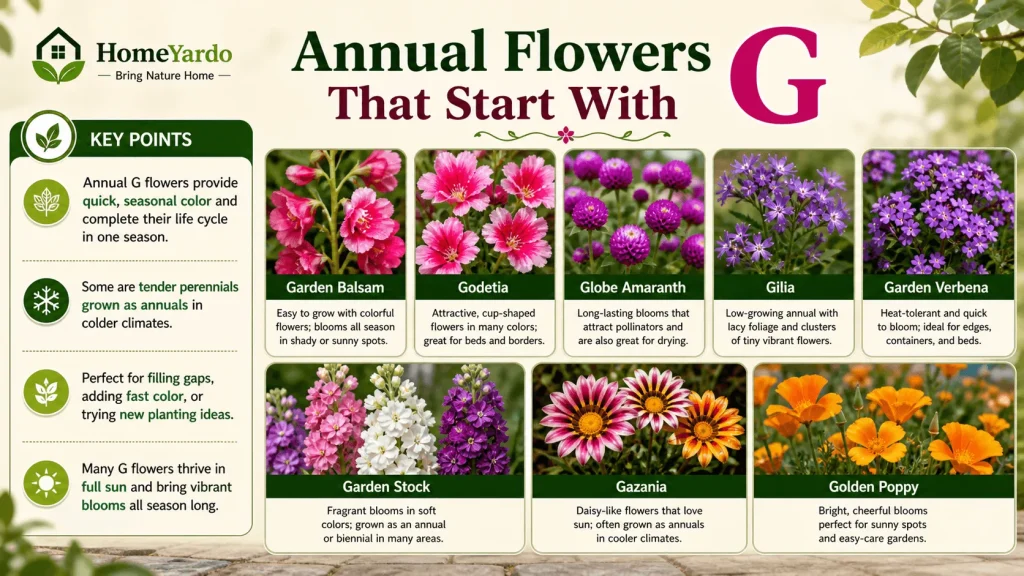
Annual G flowers are useful when quick seasonal color matters more than long-term structure. Some grow, bloom, set seed, and finish in one season. Others are tender perennials grown as annuals where winters are cold.
Garden Balsam, Godetia, Globe Amaranth, Gilia, and Garden Verbena are common annual choices. Garden Stock is often grown as an annual or biennial, depending on the climate. Gazania may behave as a perennial in mild areas but is often treated as an annual in colder gardens.
Golden Poppy can be grown for seasonal color in many sunny garden settings. These flowers work well for filling gaps, adding fast color, or testing a planting style before committing to long-term perennials.
Indoor Bloomers And Bulb Types

Some G flowers are better suited to indoor pots or protected growing. Others are seasonal bulb, corm, rhizome, or tuber plants that need planning around planting time and bloom season.
Bulbs, Corms, And Tuberous Types
Bulb and corm style G flowers include Gladiolus, Grape Hyacinth, Glory-of-the-Snow, Guernsey Lily, Gloriosa Lily, Giant Allium, Giant Snowdrop, and Grecian Windflower.
Grape Hyacinth, Glory-of-the-Snow, Giant Snowdrop, and Grecian Windflower are useful for early seasonal color. Gladiolus gives summer height and strong cutting stems. Guernsey Lily adds late-season pink bloom. Gloriosa Lily brings a tropical climbing form in warm conditions.
These plants are often planned by season. Some are planted in the fall for spring bloom, while others are planted for summer or late-season flowers.
Growing Conditions, Common Problems, And Safety
A good flower choice depends on matching plant needs with the site. Light, drainage, moisture, temperature, and spacing often decide whether a flower performs well.
Light And Soil Basics
Full sun flowers include Gazania, Gaillardia, Gladiolus, Globe Thistle, Golden Marguerite, Golden Poppy, and Goldenrod. These are usually better for open beds, dry borders, and bright container spaces.
Part shade choices include Gardenia, Great Masterwort, Greek Valerian, Goat’s Beard, and some hardy Geranium types. Moisture-friendly flowers include Great Blue Lobelia, Gooseneck Loosestrife, Globeflower, and Goat’s Beard.
Water And Pond Flower Picks
The G group is usually stronger for pond edges, moist borders, and water-adjacent planting than for true floating water flowers. Flowers in this section work best where the soil stays damp and helps soften the line between open water and the rest of the garden.
If your G list includes moisture-tolerant or bog-friendly plants, they fit here as pondside flowers rather than as deep-water aquatics. This heading works best when it stays focused on practical edge planting instead of stretching ordinary border flowers into a pond category.
Common Issues And Easy Fixes
Many flower problems begin with poor light, crowded spacing, wet soil, or planting a flower in the wrong climate. The table below keeps common problems easy to check.
| Plant | Common Issue | Practical Fix |
|---|---|---|
| Gardenia | Yellow leaves | Check drainage, feeding, and soil acidity |
| Gerbera Daisy | Crown rot | Avoid soggy soil and overhead watering |
| Gladiolus | Tall stems falling | Stake stems or plant in groups |
| Gazania | Poor bloom | Move to a stronger sun |
| Gloxinia | Crown damage | Keep water away from the crown |
| Garden Stock | Heat decline | Grow in cooler seasons |
| Gooseneck Loosestrife | Spreading habit | Plant where spread can be managed |
| Goldenrod | Misunderstood allergy concern | Value it for pollinators and place it thoughtfully |
Safety, Toxicity, And Special Cases
Some G flowers and flowering plants need extra caution. Gloriosa Lily is highly toxic if ingested. Golden Chain Tree also raises safety concerns, especially around seeds and plant parts. Golden Shower Tree, Gas Plant, Gorse, Great Periwinkle, and some other less common plants may need local suitability checks before planting.
Gas plants can irritate skin in some situations. Gorse can be invasive in some regions. Great Periwinkle may spread aggressively where conditions suit it.
Homes with pets, children, or grazing animals should check plant safety before planting uncommon bulbs, shrubs, trees, climbers, or specialty flowers.
How To Choose The Right G Flower For Your Space

The best G flower depends on the place where it will grow. A hot patio, shaded border, indoor windowsill, cutting garden, spring bulb bed, and pollinator strip all need different choices.
For beginners, Geranium, Gazania, Gaillardia, Globe Amaranth, Grape Hyacinth, and Golden Poppy are practical starting points. They are easier to place and give clear visual results.
For pollinators, choose Gaillardia, Goldenrod, Giant Hyssop, Globe Thistle, Great Blue Lobelia, Golden Alexanders, and Gayfeather. These work best when grouped in sunny or moisture-matched planting areas.
For dry sunny beds, choose Gazania, Gaillardia, Globe Thistle, Golden Marguerite, Golden Chamomile, and Golden Poppy. For cooler or part-shade spots, look at Great Masterwort, Greek Valerian, Goat’s Beard, Gardenia, and hardy Geranium.
For containers, Geranium, Gazania, Gloxinia, Gardenia, Garden Verbena, and Gumamela are useful choices. For cut flowers, Gladiolus, Gerbera Daisy, Gypsophila, Garden Stock, Globe Amaranth, German Iris, and Gayfeather are stronger options.
Choose By Climate, Care Level, And Purpose
Hot sunny settings suit Gazania, Gaillardia, Golden Poppy, Globe Thistle, Golden Marguerite, and Gladiolus. Warm, humid gardens may support Gardenia, Ginger Lily, Gumamela, Golden Dewdrop, and Golden Shower Tree, where the climate allows.
Cooler gardens often suit Gentian, Greek Valerian, Great Masterwort, Grape Hyacinth, Giant Snowdrop, and Glory-of-the-Snow. Moist borders can use Great Blue Lobelia, Globeflower, Goat’s Beard, and Gooseneck Loosestrife.
For easy care, start with Geranium, Gazania, Gaillardia, Globe Amaranth, Grape Hyacinth, or Golden Poppy. For bouquets, look first at Gladiolus, Gerbera Daisy, Gypsophila, Garden Stock, Globe Amaranth, and German Iris. For fragrance, Gardenia remains the strongest classic choice.
Cut Flower And Bouquet Favorites
Gladiolus, Gerbera Daisy, Gypsophila, Garden Stock, German Iris, Globe Amaranth, and Gayfeather are the strongest G flowers for bouquet use. Gladiolus gives height and a clean vertical line, while Gerbera Daisy adds bold focal color. Gypsophila softens mixed arrangements, and Garden Stock brings fragrance along with fuller stems. German Iris suits more elegant spring work, Globe Amaranth adds texture, and Gayfeather helps with upright movement in garden-style bouquets.
Pollinator Friendly And Meadow Picks
Gaillardia, Goldenrod, Giant Hyssop, Globe Thistle, Golden Alexanders, Great Blue Lobelia, and Gayfeather are the most useful G flowers for pollinator planting. Gaillardia is especially good for sunny borders, while Goldenrod helps carry insect activity later into the season. Giant Hyssop and Globe Thistle add structure as well as nectar value, and Great Blue Lobelia fits better where the soil stays reliably moist. For a looser meadow look, Gayfeather and Golden Alexanders are especially useful.
Container And Small Space Picks
Geranium, Gazania, Gloxinia, Garden Verbena, Gardenia, and Gumamela are the clearest G flowers for containers and smaller spaces. Geranium is one of the easiest all-around choices for patio pots and window boxes, while Gazania works better in hotter, sunnier spots. Gloxinia is stronger indoors or in protected bright light, and Garden Verbena gives longer trailing or spreading color. Gardenia suits decorative containers where fragrance matters, and Gumamela works best in warm climates or protected patio growing.
Indoor Or Protected Space Picks
Gloxinia is the strongest true indoor bloomer in the G group because it stays compact and flowers well in bright indirect light. Geranium can also bloom near a strong window, while Gardenia can work indoors where humidity, watering, and light are managed carefully. Gumamela belongs more in a bright, protected space or greenhouse-style setting than in an ordinary room. Ghost Orchid is part of the G list, but it is a specialty plant and should not be treated as a practical home choice.
Beginner Friendly Choices
Geranium, Gazania, Gaillardia, Globe Amaranth, Grape Hyacinth, and Golden Poppy are the most practical starting points for beginners. Geranium is dependable in pots, Gazania handles strong sun well, and Gaillardia gives long-lasting color without much fuss. Globe Amaranth is useful for easy seasonal bloom, while Grape Hyacinth is one of the simpler spring bulbs in the group. Golden Poppy is also a good choice where the garden has open sun and decent drainage.
Fragrant G Flowers
Gardenia is the clearest fragrance leader among G flowers and is still the strongest choice when scent is the main goal. Garden Stock is another good option for softer seasonal fragrance, especially in cooler planting periods. Ginger Lily brings a richer, warm-climate scent, while Garland Flower can add fragrance on a smaller shrub scale where the setting suits it. In this group, fragrance is best treated as a focused category rather than something spread across too many weaker names.
Detailed Plant Profiles
The full list includes 65 names, but some flowers deserve closer attention because they are common, useful, highly recognizable, or often chosen for gardens and floral design.
Gardenia

Gardenia is a fragrant flowering shrub with glossy green leaves and creamy white blooms. It is often grown near patios, doors, and seating areas where its scent can be enjoyed.
It prefers warm conditions, good drainage, and consistent care. In containers, Gardenia needs steady moisture without soggy soil. It belongs in the G flower list because it is one of the best-known scented flowers beginning with this letter.
Geranium

Geranium is a familiar name used for both Pelargonium bedding plants and hardy Geranium perennials. Pelargoniums are common in pots, window boxes, and seasonal beds, while hardy Geraniums are used more often in perennial borders.
The bedding types bring long-season color in red, pink, white, and purple. They need bright light and careful watering. Geranium belongs in the list because it is one of the most recognized G flower names.
Gerbera Daisy

Gerbera Daisy has large, bright, round flowers in red, orange, yellow, pink, white, and many blended shades. It is popular in bouquets because the flower shape is clean, bold, and easy to notice.
In gardens or containers, it needs bright light and well-drained soil. Wet crowns can cause rot, so careful watering matters. Gerbera Daisy is the clearest daisy-style flower starting with G.
Gladiolus

Gladiolus grows from corms and produces tall flower spikes. It is one of the best G flowers for cutting gardens because the stems add height and structure to arrangements.
The flowers come in many colors, including red, pink, yellow, orange, white, purple, and bicolor forms. Gladiolus grows best in full sun with good drainage. Tall stems may need support in windy gardens.
Gazania

Gazania is a sun-loving flower with bright daisy-like blooms. It often appears in yellow, orange, red, pink, and mixed warm shades.
It is useful for dry beds, hot borders, edging, and containers. Gazania needs strong sun for the best bloom. In cooler climates, it is usually grown as an annual, while in mild regions it may behave as a tender perennial.
Gaillardia

Gaillardia, often called blanket flower, brings warm red, orange, and yellow tones to sunny gardens. It is valued for its long bloom and pollinator use.
It handles heat and open sun better than many softer border flowers. Gaillardia works well in informal borders, meadow-style plantings, and pollinator beds. It is a strong choice for gardeners who want color without overly delicate care.
Gloxinia

Gloxinia is a compact indoor flowering plant with soft, velvety blooms. Common flower colors include purple, red, pink, and white.
It prefers bright indirect light and careful watering. Water sitting around the crown can damage the plant, so watering near the soil is safer. Gloxinia belongs in the G flower list as one of the best indoor bloomers.
Gentian

Gentian is valued for its deep blue, violet, purple, or white flowers. It is one of the strongest choices when cool blue flower color matters.
Many Gentians prefer cooler climates, steady moisture, and well-matched soil conditions. They are not always beginner plants, but they are highly distinctive. Gentian fits well in rock gardens, alpine-style gardens, and specialty perennial beds.
Grape Hyacinth

Grape Hyacinth is a small spring bulb with dense clusters of blue, purple, or white flowers. The flower spikes look like tiny bunches of grapes.
It works well along paths, under deciduous shrubs, in bulb drifts, and near early spring borders. Grape Hyacinth is easy to recognize and often returns well in suitable climates.
Gypsophila

Gypsophila, often called baby’s breath, has airy sprays of small white or pink flowers. It is widely used in bouquets because it softens arrangements and fills space without feeling heavy.
In gardens, Gypsophila prefers full sun and sharp drainage. It can work in airy borders, cutting gardens, and cottage-style planting. The light flower texture makes it different from many bold G flowers.
Garden Stock

Garden Stock produces upright fragrant flower spikes in white, pink, red, purple, and soft pastel shades. It is a favorite for cool-season color and scented arrangements.
It performs best in mild weather and may fade in strong heat. Garden Stock works well in cottage gardens, spring borders, containers, and cut flower planting.
Geum

Geum is a compact perennial with warm flowers in orange, red, yellow, and pink. It fits well in borders and cottage gardens where a cheerful, informal look is wanted.
It usually prefers good drainage with steady moisture. Geum pairs nicely with other spring and early summer perennials. Its flower shape and warm color make it useful near the front or middle of mixed borders.
Goldenrod

Goldenrod is a yellow-flowering perennial known for late-season color and pollinator support. It is often unfairly blamed for seasonal allergies, but its heavier pollen is mainly moved by insects rather than wind.
It grows best in sunny spaces and can be used in naturalistic beds, meadow-style gardens, and pollinator borders. Some species spread more than others, so selection matters.
Globe Amaranth

Globe Amaranth is an annual with round, papery flowers in purple, pink, magenta, red, and white. It handles heat well and keeps its shape after drying.
It is useful in annual beds, containers, cutting gardens, and dried flower arrangements. Globe Amaranth works best in full sun and well-drained soil.
Globe Thistle

Globe Thistle has round blue or steel-blue flower heads on upright stems. It adds structure and texture to sunny perennial borders.
Once established, it can handle drier conditions better than many moisture-loving perennials. Bees and other pollinators often visit the flowers. Its rounded form makes it useful in both garden beds and dried arrangements.
Gloriosa Lily

Gloriosa Lily is a tuberous climber with dramatic red, yellow, and orange flowers. The petals curve backward, giving the flower a flame-like look.
It needs warmth, support, and careful handling. Gloriosa Lily is toxic if ingested, so it is not the right choice for every home or garden. It belongs in the list because of its striking flower form and strong G-name recognition.
Garden Phlox

Garden Phlox is a perennial border flower with clusters of pink, white, purple, lavender, or red blooms. It is often used in cottage gardens and mixed summer borders.
It performs best with good air circulation, steady moisture, and enough sun. Some varieties are selected for better mildew resistance. Garden Phlox adds height, fragrance, and soft color in the warm season.
Gayfeather

Gayfeather, also called Liatris, produces upright flower spikes in purple or white. The blooms attract pollinators and add a vertical line to sunny borders.
It grows best in full sun with well-drained soil. Gayfeather works well in prairie-style planting, cutting gardens, and pollinator beds. Its narrow flower spikes contrast well with daisy-shaped flowers.
Golden Poppy

Golden Poppy, often known as California poppy, produces bright orange or yellow cup-shaped flowers. It is useful for sunny, dry, meadow-style planting.
It grows best in full sun and lean soil. Overly rich or wet conditions can reduce performance. Golden Poppy is a strong seasonal color flower for informal gardens and open spaces.
Gumamela

Gumamela is a common name for tropical hibiscus. It produces large flowers in red, pink, yellow, orange, white, and mixed shades.
It works well in warm climates, tropical hedges, large containers, and bright patios. In cooler regions, it may need indoor or greenhouse protection. Gumamela adds a bold tropical look and strong color impact.
Meaning, Symbolism, And Floral Styling
Some G flowers are chosen for floral design as much as for garden use. Gardenia is often linked with grace, purity, and refined scent. Gladiolus is commonly connected with strength and remembrance because of its tall, upright form.
Gerbera Daisy gives cheerful color in bouquets and celebration arrangements. Gypsophila adds soft filler texture and lightness. Globe Amaranth is useful for dried flowers because it keeps its color and shape well.
Garden Stock adds fragrance and cottage style to spring arrangements. Goldenrod gives late-season warmth and works well in natural-looking floral designs. Flower meanings can vary by culture, region, and floral tradition, so they are best used as gentle styling notes rather than fixed rules.
Companion Pairings For G Flowers
Good pairings depend on matching light, moisture, height, bloom time, and color. Gaillardia pairs well with Salvia, Coneflower, and ornamental grasses in sunny borders. Gazania can pair with Lavender, Portulaca, or other dry-sun plants in containers and edging.
Grape Hyacinth works well with Daffodils, Tulips, and early spring perennials. Goldenrod pairs naturally with Asters for late-season color and pollinator value. Globe Thistle pairs well with Yarrow, Coneflower, and grasses because the round blue flowers contrast with softer shapes.
Geranium can be paired with trailing annuals in containers. Gardenia works best with plants that enjoy similar container care, rather than with dry-sun flowers.
Common Mistakes When Choosing G Flowers
A common mistake is choosing a fragrant flower without checking the climate. Gardenia smells beautiful, but it can be demanding outside warm, suitable conditions.
Another mistake is planting sun-loving flowers in shade. Gazania, Gaillardia, Golden Poppy, Gladiolus, and Globe Thistle need bright light for strong bloom.
Tender perennials are often mistaken for hardy perennials. Gazania, Gerbera Daisy, Gumamela, and Golden Trumpet may need protection in colder areas. Rare flowers such as Ghost Orchid, Grass Pink Orchid, and Gentian should not be chosen without checking their growing needs.
Safety is another point to check. Gloriosa Lily and Golden Chain Tree are not casual planting choices for every home. Spreading plants such as Gooseneck Loosestrife and Great Periwinkle should be placed where their growth can be managed.
Conclusion
Flowers starting with G include 65 names across garden beds, containers, bouquets, spring bulbs, indoor pots, pollinator borders, rare collections, shrubs, and flowering trees.
Gardenia, Geranium, Gerbera Daisy, Gladiolus, Gazania, Gaillardia, Grape Hyacinth, Goldenrod, Gloxinia, and Gypsophila are strong starting points for many uses. Less common choices such as Ghost Orchid, Gentian, Gloriosa Lily, Green Rose, and Guernsey Lily add specialty interest.
The right choice depends on space, climate, color, care level, fragrance, and purpose.
FAQ’s
Gardenia, Geranium, Gerbera Daisy, Gladiolus, and Gazania are among the most popular flowers with G. Each one is known for a different use. Gardenia is popular for its fragrance. Geranium is popular for pots and bedding displays. Gerbera Daisy is popular for bright bouquets. Gladiolus is popular for its tall cutting stems. Gazania is popular for sunny containers and hot beds.
Gardenia is the strongest answer when scent is the main goal. Its white flowers have a rich, sweet fragrance that is stronger than most other G flowers. Garden Stock and Ginger Lily can also add scent to gardens and arrangements. Garland Flower may also be fragrant in suitable settings. For a classic scented G flower, Gardenia remains the clearest pick.
Perennial G flowers include Gaillardia, Gentian, Geum, Globe Thistle, Goldenrod, Great Masterwort, Greek Valerian, Giant Hyssop, Goat’s Beard, Golden Alexanders, Goldenstar, Great Blue Lobelia, and hardy Geranium types. These flowers can return year after year when climate and soil match their needs. Some prefer dry sunny beds, while others need moisture or cooler conditions. Grape Hyacinth and Giant Snowdrop also return well, though they are usually grouped as bulbs.
Yes, some G flowers can work indoors. Gloxinia is one of the best indoor G flowers because it stays compact and produces bold, velvety blooms. Geranium can bloom indoors near a bright window. Gardenia may grow indoors with careful humidity, watering, feeding, and light. Gumamela can also be grown in bright, warm indoor or greenhouse-style conditions where space allows.
Geranium, Gazania, Gaillardia, Globe Amaranth, Grape Hyacinth, and Golden Poppy are good beginner-friendly G flowers. They are easier to place than many rare or specialty plants. Geranium works well in containers. Gazania handles strong sun. Gaillardia gives long-season color in sunny borders. Grape Hyacinth is a simple spring bulb. Globe Amaranth and Golden Poppy are useful for fast seasonal color.
Rare or less common flowers with G include Ghost Orchid, Gentian, Gloriosa Lily, Guernsey Lily, Grass Pink Orchid, Green Rose, Great Masterwort, Giant Lily, Galax, and Grevillea. Some are rare because they need special habitats or climates. Others are simply less common in everyday garden centers. Many of these plants are better suited to specialty growers than basic flower beds.
Gentian, Gloxinia, Grape Hyacinth, Globe Thistle, Globe Amaranth, and some Geranium varieties can have purple or blue-purple flowers. Gentian is one of the best-known deep blue or violet options. Grape Hyacinth gives purple-blue spring bulb color. Gloxinia works well for a purple indoor bloom. Globe Thistle adds a steel-blue, rounded form in sunny borders.
Yes, annual flowers with G include Garden Balsam, Godetia, Globe Amaranth, Gilia, and Garden Verbena. Some plants, such as Gazania and Garden Stock, are often grown as annuals in colder climates. Annual G flowers are useful for fast seasonal color in beds, borders, containers, and cutting gardens. They are good choices when short-term bloom matters more than permanent structure.
Yes, several flowering plants that start with G support bees, butterflies, and other pollinators. Gaillardia, Goldenrod, Giant Hyssop, Gayfeather, Globe Thistle, Great Blue Lobelia, and Golden Alexanders are good examples. These flowers work best when planted in groups and matched to their preferred light and soil. Sunny pollinator beds can use Gaillardia, Goldenrod, Globe Thistle, and Giant Hyssop. Moist borders can use Great Blue Lobelia.
Gladiolus is one of the best G flowers for bouquets because it adds height and vertical shape. Gerbera Daisy is another strong choice because it brings bold focal color. Gypsophila softens arrangements with airy white or pink flowers. Garden Stock adds scent and fullness. Globe Amaranth works well in fresh and dried arrangements. German Iris can add an elegant spring structure.
Gerbera Daisy is the clearest daisy-style flower that starts with G. It has a bright, round flower face and is widely used in bouquets, containers, and decorative displays. Gazania also has a daisy-like form, though it is usually grown as a sunny bedding or container flower. Gaillardia can also look daisy-like because of its open ray petals and warm colors.
Care depends on the plant type. Sun-loving G flowers such as Gazania, Gaillardia, Gladiolus, Golden Poppy, and Globe Thistle need bright open light and good drainage. Moisture-loving or cooler-condition choices such as Great Blue Lobelia, Globeflower, Goat’s Beard, and Gentian need more careful placement. Indoor G flowers such as Gloxinia and Gardenia need controlled watering, enough light, and steady conditions.
Common G flower names include Gardenia, Geranium, Gerbera Daisy, Gladiolus, Gazania, Gaillardia, Grape Hyacinth, Gloxinia, Gypsophila, Garden Stock, Goldenrod, and Geum. These names appear often because they are used in gardens, containers, bouquets, bulb displays, and nursery selections. They cover fragrance, color, spring bloom, cutting stems, indoor bloom, and pollinator planting.
Yellow flowers with G include Goldenrod, Golden Poppy, Golden Marguerite, Golden Chamomile, Golden Alexanders, Goldenstar, Gazania, Golden Chain Tree, Golden Shower Tree, Genista, and Gorse. Some are bedding or border flowers, while others are shrubs or flowering trees. Goldenrod is useful for late-season pollinators. Golden Poppy is useful for sunny meadow-style planting. Golden Chain Tree and Golden Shower Tree need more space and climate planning.
White flowers with G include Gardenia, Gypsophila, Ghost Orchid, Giant Lily, Gooseneck Loosestrife, Glory-of-the-Snow, Garden Stock, Goat’s Beard, and some Gladiolus or Geranium varieties. Gardenia is the strongest white fragrant choice. Gypsophila is a classic bouquet filler. Giant Lily and Ghost Orchid are more specialty white flowers. Gooseneck Loosestrife and Goat’s Beard can suit moist or part-shade garden areas.
Bulb, corm, or tuber type flowers with G include Gladiolus, Grape Hyacinth, Glory-of-the-Snow, Guernsey Lily, Giant Allium, Giant Snowdrop, Grecian Windflower, and Gloriosa Lily. Some bloom early in spring, while others flower in summer or late season. Grape Hyacinth and Giant Snowdrop are good for early color. Gladiolus is grown for summer cutting stems. Guernsey Lily adds late pink flowers.
Gentian is one of the best rare or less common blue flowers starting with G. Its deep blue tones make it stand out from many common garden flowers. Globe Thistle can also give a blue or steel-blue effect in sunny borders. Grape Hyacinth gives blue-purple spring color and is easier to grow than many Gentians. Great Blue Lobelia is another blue option for moist garden areas.
No, not all G flowers are easy to grow. Geranium, Gazania, Gaillardia, Globe Amaranth, Grape Hyacinth, and Golden Poppy are easier choices for many gardens. Ghost Orchid, Gentian, Grass Pink Orchid, Gardenia, and some specialty bulbs or trees need more care. Climate, soil, moisture, and light make a big difference. A flower should be chosen for the growing space, not just the name.
References
- Royal Horticultural Society Plant Finder
https://www.rhs.org.uk/plants/search-form - Missouri Botanical Garden Plant Finder
https://www.missouribotanicalgarden.org/plantfinder/plantfindersearch.aspx - NC State Extension Plant Toolbox
https://plants.ces.ncsu.edu/ - Lady Bird Johnson Wildflower Center Plant Database
https://www.wildflower.org/plants/ - Plants of the World Online
https://powo.science.kew.org/ - University of Florida Gardening Solutions
https://gardeningsolutions.ifas.ufl.edu/ - University of Wisconsin Horticulture
https://hort.extension.wisc.edu/ - Clemson Cooperative Extension Home and Garden Information Center
https://hgic.clemson.edu/