Types of Roses: 20 Rose Varieties, Names, Meanings, and Garden Uses
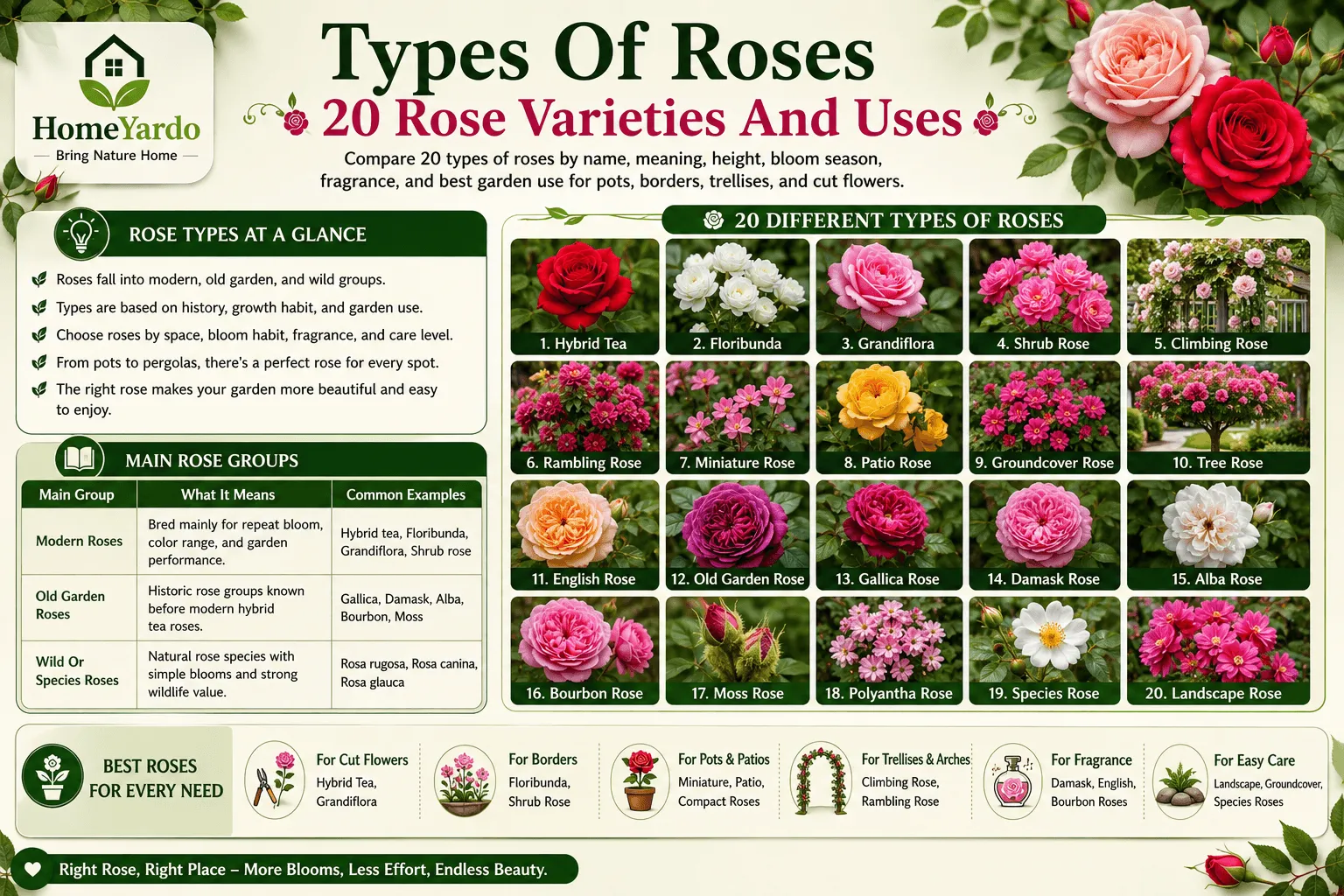
While there are more than 100 rose species and thousands of roses that are cultivated, most selections found in the garden can be sorted into a few groups that are useful. Some names are related to the shape of the flower, some to plant size, some to history, growth habit, or named cultivars.
There are many different kinds of roses, such as hybrid tea roses, floribunda roses, shrub roses, climber roses, rambler roses, miniature roses, patio roses, groundcover roses, and tree roses.
A named rose, such as ‘Peace’ or ‘Iceberg’ is a cultivar, while a term such as floribunda is a rose class. When selecting a rose for the border, container, trellis, arch, cutting bed, fragrance garden, or wildlife garden, knowing these terms is helpful.
Quick Answer: What Are The Main Types Of Roses?
Roses can be categorised as modern roses, old garden roses, or wild roses, and come in a variety of forms including shrub, climbing, rambling, miniature, patio, groundcover, and tree roses. Newer roses are selected for repeat bloom, colour spectrum and garden ability.
Historic value, fragrance and classic bloom form are the characteristics of old garden roses. Wild roses are natural roses, typically with simple flowers and rose hips.
| Main Group | What It Means | Common Examples |
|---|---|---|
| Modern roses | Roses bred mainly for repeat bloom, color range, garden performance, and flower form | Hybrid tea, floribunda, grandiflora, shrub rose |
| Old garden roses | Historic rose groups known before modern hybrid tea roses became dominant | Gallica, damask, alba, bourbon, moss |
| Wild roses | Natural rose species with simple blooms and strong wildlife value | Rosa rugosa, Rosa canina, Rosa glauca |
Some rose names are historical, others are reflective of the shape of the plant, and others are for a specific cultivar.
Classification Of Rose

Rose classification may overlap as roses are classified according to history, shape of their flowers, shape of their plants, and the way they are used in the garden. A rose can be modern, fragrant, shrub and repeat-blooming and sold under a cultivar name at the same time.
Modern roses are generally associated with roses that have been developed since the hybrid tea rose. Old garden roses are historic varieties, frequently associated with scent and traditional rose shapes. Wild roses are naturally occurring species and are frequently simple in flower.
The rose classification can be described as follows:
Rose Classification
→ Modern Roses
→ Old Garden Roses
→ Wild Or Species Roses
→ Growth Habit Types
→ Named Cultivars
A hybrid tea is a variety of rose. ‘Peace’ is a cultivar. Climbing rose refers to the form of plants. These differences are important because the gardener might be selecting based on flower shape, plant size, scent, growth habit or garden application.
Rose Cultivars Vs Rose Varieties

A rose cultivar is a cultivar of rose that has a specific name because of its unique characteristics like color, scent, flower shape, disease resistance or repeat bloom. These include the ‘Peace’ rose, ‘Iceberg,’ ‘New Dawn,’ ‘Queen Elizabeth’ and Knock Out roses. In gardening rose variety is not used so strictly.
It could refer to a rose class, a named cultivar or a broad group or species of rose plants. Most gardeners would use the word ” rose variety” as a generic term, but the word cultivar” is a more specific and defined term, which refers to a named cultivated rose.
| Term | What It Means | Example | Best Use In Article |
|---|---|---|---|
| Rose class | A group with shared traits | Hybrid tea | Used for rose-type headings |
| Rose cultivar | A named cultivated rose | ‘Peace’ | Used for examples |
| Rose variety | Common phrase for a type or named rose | Iceberg rose | Used naturally in body copy |
| Rose plant form | Growth shape | Climbing rose | Used for garden planning |
20 Different Types Of Roses

The 20 rose varieties listed below combine major rose classes, old garden rose groups, wild roses, and practical garden forms. This approach is more useful than mixing broad rose categories with random cultivar names.
Hybrid Tea Roses
Hybrid tea roses are known for large, elegant blooms on long stems. They are one of the most familiar types of cut flowers and formal rose beds.
These roses usually grow upright and produce blooms one at a time or in small groups. Popular examples include ‘Peace,’ ‘Mister Lincoln,’ and ‘Double Delight.’
Typical height is about 3 to 6 feet, depending on cultivar and climate. Most prefer full sun and bloom in repeated flushes from late spring to fall in suitable conditions.
Care level is usually medium to high. Hybrid tea roses reward pruning, feeding, good airflow, and regular disease monitoring.
Floribunda Roses
Floribunda roses produce clusters of flowers instead of one large bloom per stem. They often bloom repeatedly and create strong color in borders, beds, and mixed garden spaces.
Popular examples include ‘Iceberg,’ ‘Julia Child,’ and ‘Cinco de Mayo.’ Compared with hybrid tea roses, floribundas usually give more flower coverage across the plant.
Many floribundas grow about 2 to 5 feet tall. They prefer full sun and usually have a medium care level.
They are useful for gardeners who want steady color without relying only on single-stem blooms.
Grandiflora Roses
Grandiflora roses combine traits of hybrid tea and floribunda roses. They often have large blooms like hybrid teas, but may flower in clusters like floribundas.
Many grandifloras grow tall, often around 3 to 8 feet. ‘Queen Elizabeth,’ ‘Gold Medal,’ and ‘Dick Clark’ are common examples.
They prefer full sun and usually bloom in repeated cycles through the growing season. Care level is medium, with regular pruning and spacing helping the plant stay healthy.
Grandiflora roses work well in back borders, focal points, and cutting gardens.
Shrub Roses
Shrub roses have a bushy growth habit and are often chosen for mixed borders, cottage gardens, hedges, and lower-maintenance planting. Many modern shrub roses are bred for repeat bloom and better disease resistance.
Knock Out, Oso Easy, Carefree Wonder, and many David Austin shrub roses fit into this broad group. Height varies widely, but many grow about 3 to 6 feet.
Shrub roses usually prefer full sun. Care level ranges from low to medium, depending on cultivar and climate.
They are practical garden rose varieties when a full, natural shape is preferred over formal stem blooms.
Climbing Roses
Climbing roses grow long canes that can be trained over arches, fences, trellises, walls, and pergolas. They do not cling like true vines, so their canes need tying and support.
Examples include ‘New Dawn,’ ‘Don Juan,’ and ‘Eden.’ Some climbing roses repeat bloom, while others flower more heavily during one main season.
Many climbing roses reach 6 to 12 feet or more. They prefer full sun and need a medium care level because training and pruning are part of long-term maintenance.
They are best for vertical structure and can soften hard garden edges with flowers and foliage.
Rambling Roses
Rambling roses grow with long, flexible canes that can cover pergolas, trees, large arches, and wide supports. They are often more vigorous than climbing roses.
Many ramblers bloom heavily once in the season, though some repeat-blooming forms exist. Examples include ‘American Pillar’ and ‘Rambling Rector.’
Ramblers may reach 10 to 20 feet or more. They prefer full sun and usually need a medium care level, mainly because their size requires space and pruning after flowering.
Rambling roses are best for larger gardens, informal structures, and broad supports.
Climbing Vs Rambling Roses
Climbing and rambling roses are often confused because both grow long canes. The difference is mainly in vigor, bloom habit, cane flexibility, and the size of support needed.
| Feature | Climbing Roses | Rambling Roses |
|---|---|---|
| Growth | Long trained canes | Often, one strong seasonal flush |
| Bloom habit | Often repeat blooming | Often one strong seasonal flush |
| Best support | Trellis, fence, arch, wall | Pergola, tree, large arch |
| Space needed | Medium to large | Large |
| Pruning style | Train and shape canes | Prune after flowering for once bloomers |
Climbing roses suit controlled vertical spaces. Rambling roses need more room and often look best when allowed to cover larger garden structures.
Miniature Roses
Miniature roses are small rose bushes with compact growth and smaller flowers. They are useful for pots, edging, balconies, small patios, and tight garden spaces.
Many grow about 1 to 3 feet tall. They prefer full sun and often bloom repeatedly through the growing season.
Care level is usually medium. Containers can dry quickly, so steady watering and drainage matter.
Although miniature roses are often sold as indoor gift plants, they usually perform better outdoors with sunlight, airflow, and proper watering.
Patio Roses
Patio roses are compact rose plants that are usually larger than miniature roses but smaller than many shrub roses. They are selected for containers, small borders, and patio displays.
Many patio roses grow about 1.5 to 3 feet tall. They prefer full sun and often bloom repeatedly.
Care level is medium. A deep pot with drainage holes gives roots more room and helps prevent waterlogged soil.
Patio roses are a practical choice for small gardens where standard rose bushes feel too large.
Groundcover Roses
Groundcover roses have a low, spreading growth habit. They are useful for slopes, edging, mass planting, and filling low garden areas with repeated bloom.
Many grow about 1 to 3 feet tall but spread wider than they grow upward. Flower Carpet and Drift roses are common examples.
They prefer full sun and often have a low to medium care level. Many are selected for toughness, repeated bloom, and landscape performance.
Groundcover roses are not the same as miniature roses because their main trait is spreading growth rather than small plant size.
Tree Roses
Tree roses, also called standard roses, are created by grafting a rose onto a tall stem. The result looks like a small flowering tree with a rose head at the top.
Height depends on the graft height and the rose cultivar used at the top. Bloom season, fragrance, and care needs also depend on the grafted rose.
Tree roses prefer full sun and are often used near entrances, patios, formal paths, and containers.
Care level can be medium to high in cold regions because the grafted head may need winter protection.
English Roses
English roses are modern roses bred to combine old rose style with repeat flowering. Many have full, cupped blooms, strong fragrance, and a soft garden look.
David Austin roses made this group especially popular. Examples include ‘Gertrude Jekyll,’ ‘Graham Thomas,’ and ‘Lady of Shalott.’
Many English roses grow about 4 to 6 feet tall, though some become larger. They prefer full sun, with light shade helpful in hot climates.
They are often chosen for fragrance gardens, mixed borders, cottage gardens, and romantic planting designs.
Old Garden Roses
Old garden roses are historic roses known before modern hybrid tea roses became dominant. They often have strong fragrance, full flowers, and classic forms.
Many old garden roses bloom once per season, though some groups or cultivars repeat. Gallica, damask, alba, bourbon, moss, and centifolia roses belong in this broad historic group.
Growth habit varies from compact to tall and arching. Care level is usually medium, with pruning timing depending on bloom habit.
Old garden roses suit heritage gardens, fragrance gardens, cottage gardens, and collectors who value rose history.
Gallica Roses
Gallica roses are among the oldest cultivated roses. They usually grow as compact shrubs with rich pink, red, purple, or striped flowers.
‘Rosa Mundi’ is a well-known example. Many gallica roses bloom once in a strong seasonal display.
They are often compact compared with many other old roses and can suit historic gardens or fragrance-focused borders.
Their value is strongest in old rose character, color depth, and classic garden identity.
Damask Roses
Damask roses are famous for their fragrance. They are strongly linked with perfume, rose oil, and traditional rose gardens.
Their blooms are often pink to white, with soft, full flower forms. ‘Madame Hardy’ is a classic example.
Some damask roses bloom in summer, while autumn damask forms may repeat or bloom later. They prefer full sun and need good airflow.
Damask roses are best for fragrance-focused gardens rather than areas where constant repeat bloom is the main goal.
Alba Roses
Alba roses usually have pale pink to white flowers, blue-green foliage, and strong cold tolerance. They are among the more graceful old garden roses.
Many alba roses tolerate partial shade better than many modern roses, although enough light is still needed for strong bloom.
They often grow as tall shrubs and can work in cooler gardens, heritage borders, and softer planting designs.
Their pale flowers and foliage make them useful where a gentle, classic garden look is preferred.
Bourbon Roses
Bourbon roses are old garden roses known for fragrant, full blooms. Some cultivars repeat bloom, which makes them attractive to gardeners who want old rose beauty with more than one flowering period.
They may grow as shrubs or show a climbing habit, depending on the cultivar. ‘Souvenir de la Malmaison’ is a famous example.
Bourbon roses prefer full sun and often need a medium care level. Good airflow helps protect dense flowers and foliage.
They work well in fragrance gardens, mixed borders, and heritage planting schemes.
Moss Roses
Moss roses are old garden roses with a moss-like texture on buds and stems. This texture is one of the easiest ways to identify them.
They often have fragrant flowers and a strong antique rose look. ‘William Lobb’ is a known example.
Moss roses usually prefer full sun and need moderate care. Their bloom habit is often seasonal rather than nonstop.
They are useful among unique rose varieties because the buds look distinct before the flowers fully open.
Polyantha Roses
Polyantha roses produce many small flowers in clusters. They are usually compact and can work well in edging, small gardens, low hedges, and containers.
‘The Fairy’ is a widely known example. Many polyanthas grow about 2 to 4 feet tall.
They prefer full sun and often have a low to medium care level. Their flowers are smaller than floribundas, but the clusters can be generous.
Polyantha roses are useful when a compact plant with repeated clustered blooms is needed.
Species Roses
Species roses are wild rose flower types found in nature. They usually have simple five-petal flowers, natural growth habits, and good rose hip production.
Examples include Rosa rugosa, Rosa canina, and Rosa glauca. Many species of roses support wildlife by offering pollen, hips, and shelter.
They often suit naturalistic gardens, hedges, wildlife gardens, and informal landscapes. Some are tougher than highly bred garden roses.
Species roses are best for a less formal look and strong ecological value.
Landscape Roses
Landscape roses are bred for easy garden use, repeat bloom, disease resistance, and reliable performance. They are common in public plantings and home gardens.
Knock Out, Drift, and Flower Carpet roses are familiar examples. These roses are often chosen by people who want color without the strict care routine of formal rose beds.
Growth habit may be shrubby, spreading, or compact, depending on the cultivar. Many prefer full sun and have a low to medium care level.
Landscape roses are among the best rose varieties for practical, lower-maintenance planting.
Different Rose Varieties List: Quick Comparison Table
This table gives a fast comparison of 20 rose types by growth habit, height, bloom season, best use, fragrance, care level, and example cultivar.
| Type | Growth Habit | Height | Bloom Season | Best Use | Fragrance | Care Level | Example Cultivar |
|---|---|---|---|---|---|---|---|
| Hybrid tea | Upright bush | 3 to 6 ft | Repeat | Cut flowers, formal beds | Medium to strong | Medium to high | ‘Peace’ |
| Floribunda | Bushy | 2 to 5 ft | Repeat | Borders, mass planting | Light to medium | Medium | ‘Iceberg’ |
| Grandiflora | Tall upright | 3 to 8 ft | Repeat | Back borders, focal points | Medium | Medium | ‘Queen Elizabeth’ |
| Shrub rose | Bushy, rounded | 3 to 6 ft or more | Varies | Mixed beds, hedges | Light to strong | Low to medium | Knock Out |
| Climbing rose | Long trained canes | 6 to 12 ft or more | Once or repeat | Arches, trellises, fences | Varies | Medium | ‘New Dawn’ |
| Rambling rose | Long flexible canes | 10 to 20 ft or more | Often once | Pergolas, large arches, trees | Varies | Medium | ‘Rambling Rector’ |
| Miniature rose | Compact | 1 to 3 ft | Repeat | Pots, edging, balconies | Light to medium | Medium | ‘Cupcake’ |
| Patio rose | Compact bush | 1.5 to 3 ft | Repeat | Containers, patios | Light to medium | Medium | Patio rose cultivars |
| Groundcover rose | Low spreading | 1 to 3 ft | Repeat | Slopes, borders, mass planting | Light | Low to medium | Flower Carpet |
| Tree rose | Grafted standard form | Varies | Varies | Entrances, containers | Varies | Medium to high | Standard rose forms |
| English rose | Shrubby | 4 to 6 ft or more | Repeat in many cultivars | Fragrance gardens, borders | Strong | Medium | ‘Gertrude Jekyll’ |
| Old garden rose | Shrub, often arching | Varies | Often once | Heritage gardens | Strong | Medium | ‘Madame Hardy’ |
| Gallica rose | Compact shrub | 3 to 5 ft | Often once | Historic gardens | Medium to strong | Medium | ‘Rosa Mundi’ |
| Damask rose | Shrub | 3 to 6 ft | Once or seasonal repeat | Perfume, fragrance gardens | Strong | Medium | ‘Madame Hardy’ |
| Alba rose | Tall shrub | 5 to 8 ft | Often once | Cool gardens, light shade | Medium | Medium | Alba cultivars |
| Bourbon rose | Shrub or climbing | 4 to 8 ft | Some repeat | Borders, fragrance gardens | Strong | Medium | ‘Souvenir de la Malmaison’ |
| Moss rose | Shrub | 3 to 6 ft | Often once | Unique rose collections | Medium to strong | Medium | ‘William Lobb’ |
| Polyantha rose | Compact bush | 2 to 4 ft | Repeat | Edging, small gardens | Light | Low to medium | ‘The Fairy’ |
| Species rose | Natural shrub | Varies | Spring to summer | Wildlife gardens | Light to medium | Low to medium | Rosa rugosa |
| Landscape rose | Spreading or shrub | 1 to 5 ft | Repeat | Easy care landscapes | Light to medium | Low to medium | Drift rose |
Rose Bush Types And Rose Plant Types

Rose bush types and rose plant types describe how roses grow in a garden. Plant form often matters more than flower colour when choosing where a rose should grow.
Tall rose bushes include grandiflora roses, some shrub roses, old garden roses, and many species roses. Small rose bushes include miniature roses, patio roses, compact floribundas, and polyantha roses.
Climbing and rambling roses grow long canes that need training. Groundcover roses spread low across the soil, while tree roses add height through a grafted standard form. Hedge roses are useful when a living boundary or repeated shrub form is needed. For stronger screening around borders, compare hedge roses with other privacy plants that can add height, coverage, and structure.
Popular Rose Varieties

Popular varieties are usually easy to recognize, widely sold, or strongly linked with a specific garden use. ‘Peace’ is famous as a hybrid tea rose, while ‘Iceberg’ is widely known as a floribunda.
Knock Out roses are popular landscape roses because they are often chosen for repeat bloom and easier care. ‘New Dawn’ is a popular climbing rose for arches and supports. ‘Queen Elizabeth’ is a classic grandiflora.
| Popular Rose | Type | Why It Is Popular |
|---|---|---|
| ‘Peace’ | Hybrid tea | Large classic flowers |
| ‘Iceberg’ | Floribunda | Reliable clusters and garden color |
| ‘New Dawn’ | Climbing | Soft color and vertical use |
| Knock Out | Landscape | Easy care and repeat bloom |
| ‘Queen Elizabeth’ | Grandiflora | Tall growth and showy flowers |
| ‘The Fairy’ | Polyantha | Compact clusters |
Popularity does not always mean the rose is best for every garden. Climate, disease pressure, mature size, fragrance, and maintenance needs still matter.
Best Rose Varieties For the Garden Need

Different varieties suit different garden goals. A rose chosen for fragrance may not be the best rose for a pot, and a rose chosen for cutting may need more care than a landscape rose.
Use garden needs first, then compare plant size, bloom habit, and care level.
Roses For Beginners: Gardening
Shrub roses, landscape roses, floribundas, and groundcover roses are often good beginner choices. They usually offer strong bloom performance and do not always need the same level of formal pruning as hybrid tea roses.
Good beginner options often have disease resistance, repeat bloom, and a forgiving growth habit. Local climate still matters, so regional nursery advice can help with final selection.
Best Roses For Gardens
Floribundas work well in borders because they produce clusters of flowers. Shrub roses fit mixed beds and cottage-style gardens. Groundcover roses fill low spaces and slopes. For fall color after many roses slow down, a mum plant can add fresh bloom to mixed borders and seasonal garden beds.
Climbing roses add height to arches, walls, fences, and trellises. A balanced rose garden usually works best with a mix of plant shapes instead of one type.
Best Roses For Pots
Miniature roses, patio roses, compact floribundas, and tree roses can grow well in pots. Container roses need enough root space, drainage holes, sunlight, and regular watering.
Large pots are better than small decorative containers because rose roots need room. In hot climates, containers may dry out quickly and need closer care.
Best Roses For Fragrance
Damask roses, English roses, Bourbon roses, and many hybrid tea roses are known for fragrance. Scent can vary strongly between cultivars, even within the same class.
For fragrance-focused planting, choose named cultivars known for scent rather than relying only on color or flower shape.
Best Roses For Cut Flowers
Hybrid tea roses are classic cut flower roses because of their long stems and large blooms. Grandiflora roses can also provide strong stems and showy flowers.
Floribundas may be used for smaller arrangements because they produce bloom clusters. For cutting, choose healthy plants with strong stems and good repeat bloom.
Best Roses For Trellises And Arches
Climbing roses are usually the best choice for trellises, walls, fences, and smaller arches. They can be trained and tied to supports as their canes grow.
Rambling roses suit larger structures because their canes can be longer and more vigorous. They are better for pergolas, trees, and broad garden features.
Easiest Roses To Grow At Home

The easiest roses to grow at home are often landscape roses, shrub roses, groundcover roses, floribundas, and disease-resistant modern roses. These roses are usually selected for garden performance rather than perfect exhibition blooms.
Knock Out, Drift, Flower Carpet, Oso Easy, Carefree Wonder, and Rosa rugosa are common examples to compare when ease of care matters.
Easy-care roses still need sunlight, watering, pruning, and healthy soil. No rose is completely maintenance-free, but some types tolerate ordinary garden conditions better than others.
Landscape roses and modern shrub roses are especially useful for homes where steady color and lower upkeep are more important than formal flower shape.
Which Rose Varieties Are Disease Resistant?
Disease resistance matters because roses can be affected by black spot, powdery mildew, rust, and other leaf problems. Humid climates often create more pressure for fungal disease.
Landscape roses, many modern shrub roses, and some floribundas are bred for better disease resistance. Knock Out, Drift, Flower Carpet, Oso Easy, Carefree Wonder, and Rosa rugosa are often selected for stronger garden performance.
Disease resistance depends on region, humidity, airflow, spacing, and cultivar. A rose that performs well in one climate may need more care in another.
Good airflow, sunlight, proper spacing, and clean fallen leaves all help reduce disease pressure.
What Roses Bloom All Year Round?
Most roses are not hardy for the entire year in all climates. Many roses that bloom more than once will produce blooms from spring through fall and have a period of rest in between. Blooming time can be longer in warm climates, and shorter in cold climates. To keep beds colorful between rose bloom cycles, mix roses with summer flowers that can fill seasonal gaps.
The repeat bloom of floribundas, shrub roses, landscape roses, grandifloras, hybrid teas and some English roses is often good.
The preferred term is longest bloom season instead of guaranteed all year bloom. To achieve long-lasting blooms, select repeat-blooming varieties and regular pruning, feeding, watering and deadheading.
Unique Rose Varieties Worth Knowing

Colour, fragrance, form, history, growth habit, etc. It can be a unique feature for some varieties. Striped roses, purple roses, green toned roses, moss roses and strongly fragrant old roses tend to attract attention. For more unusual bloom shapes and rare garden colors, cool flowers can add extra interest beside unique rose varieties.
It is easy to identify moss roses since their growth is textured around stems and buds. Rugosa roses are distinguished by hard leaves, simple flowers and large hips.
Rosary selection should be done with careful consideration of unique roses. Certain roses are easy and others are more demanding and require particular growing conditions.
Rose Identification: How To Identify Roses
The first step to identifying roses is the study of their growth habit and the appearance of their flowers. Growth habit is generally more reliable than flower colour, as many share the same colour.
If the stem is long with one big bloom, it may be a hybrid tea or if the flowers are numerous in clusters, it may be a floribunda or polyantha.
Long trained canes may indicate a climbing rose and very flexible and vigorous canes may indicate a rambler. Cane length, plant height, bloom shape, flower clusters, fragrance, hips, thorns, foliage and bloom season can limit the type.
Types Of Roses Meanings

Rose meanings tend to be associated with color, event, culture, and not botanical class. The red can be replaced by any other color as long as the type is either a red hybrid tea or a red floribunda.
Red roses are often associated with love, romance and respect. Pink roses may indicate admiration, gratitude and gentleness. White roses are frequently utilised for purity, remembrance and formal events.
Yellow roses symbolise friendship, happiness and warmth. Orange roses symbolise vitality and enthusiasm. Lavender roses may have an element of uniqueness and enchantment. The dark red color of roses can be dramatic and symbolic. In garden beds, lavender and pale pink roses can pair well with purple perennials for a soft, cooler color palette.
Rose meanings are more like guidelines than rules, and are subject to change and different interpretations depending on culture and circumstance.
How Many Types Of Roses Are There?
There are more than 100 species of roses and thousands of varieties and hybrids that are cultivated. Variations in counts are due to the different way species, classes, cultivars, hybrids or categories of nurseries are counted.
People who garden don’t typically select roses based on the number of cultivars. Major classes, growth habits, bloom patterns and uses in the garden are more helpful to understand.
The best groups to use are modern roses, old garden roses, wild roses, shrub roses, climbing roses, rambling roses, miniature roses, groundcover roses, and tree roses.
How To Choose The Right Rose Plant?
The selection of the right rose plant depends upon space, light, climate, level of maintenance and grade of garden use. Not all roses will look equally good in a pot or arch as in a cutting bed.
Prior to purchase, look for mature height, mature spread, local growing zone, bloom season, disease resistance, ease of watering, soil drainage and need for a support structure.
| Need | Good Rose Options |
|---|---|
| Cut flowers | Hybrid tea, grandiflora |
| Steady border color | Floribunda, shrub rose |
| Easy care planting | Landscape rose, groundcover rose |
| Pots and patios | Miniature, patio, compact floribunda |
| Trellis or arch | Climbing rose |
| Large pergola or tree | Rambling rose |
| Strong fragrance | Damask, English, Bourbon, fragrant hybrid tea |
| Wildlife value | Species rose, rugosa rose |
| Formal entrance | Tree rose |
| Historic garden look | Old garden roses |
A good rose should match both the garden style and the care routine available. Local nursery guidance can also help because disease pressure, heat, humidity, and winter cold vary by region.
Rose Care Basics By Type

Most roses will require full sun, well drained soil, regular watering, and adequate air movement around the roses. Diseases of leaves and better flowering can be achieved by good spacing.
There are a few differences in the care requirements for different types. Training and tying is required for climbing and rambling roses. Hybrid teas may require more formative pruning. Lighter pruning might be required for older garden roses, particularly those that bloom but once.
If you are growing miniature and patio roses, they require special container watering. In colder regions, tree roses might require some protection during the winter. Species roses may require less training due to the natural shape being part of the rose’s beauty.
Common Mistakes When Comparing Types
A common mistake is to mistake the class names of roses for cultivar names. The word hybrid tea is a class, and ‘Peace’ is a cultivar. One is to label all tall roses as climbing roses, even those with a natural upright growth habit.
Rambling roses are also sometimes confused with the climbing roses. Ramblers tend to be more vigorous and can only flower quite once; many climbers can be more easily trained on smaller supports.
Other frequently made errors are flower colour selection alone, neglecting to consider full size, expecting all roses to flower throughout the year, buying roses without appreciation of local disease pressure and treating miniature roses as permanent indoor houseplants.
Conclusion
Roses are more easily understood when they are organized by classification, form and shape of the plants, form and shape of their flowers, type of garden use, and meaning. The selection will depend on the garden size, the climate of the area, the fragrance desired, the time the flowers would bloom, the disease resistance and how the garden is to be maintained. Hybrid teas and grandifloras make excellent cutting flowers.
Floribundas, shrub roses, and landscape roses may be more practical for a more consistent garden color. Climbing and rambling roses add height and structure to vertical spaces. The most straightforward method for picking is to match it with space, kind of blooms, care level and climate.
FAQ’s
The most popular varieties include hybrid tea roses, floribundas, shrub roses, climbing roses, English roses, and miniature roses. Well-known cultivar names include ‘Peace,’ ‘Iceberg,’ ‘New Dawn,’ Knock Out, and ‘Queen Elizabeth.’ These roses are commonly chosen for strong bloom form, garden color, fragrance, repeat flowering, or easier landscape performance.
Shrub roses, landscape roses, floribundas, and groundcover roses are often the best types for beginners. They usually have stronger garden performance and can be easier to manage than formal hybrid tea roses. Many beginner-friendly roses also offer repeat bloom, better disease resistance, and a more forgiving growth habit.
Hybrid tea roses usually produce large flowers on long individual stems, which makes them useful for cut flowers. Floribunda roses produce clusters of blooms, giving more color across the plant in garden beds and borders. Hybrid teas are often more formal, while floribundas are usually better for steady landscape color.
Miniature roses, patio roses, compact floribundas, and tree roses can grow well in pots. They still need a container with enough root space, strong drainage, full sun, and regular watering. Large pots are usually better than small decorative containers because rose roots need room to stay healthy.
Damask roses, English roses, Bourbon roses, and many hybrid tea roses are known for their strong fragrance. Scent can vary from one cultivar to another, even within the same rose class. For fragrance gardens, choose named varieties known for scent instead of relying only on flower color or type.
Types can be identified by bloom form, flower clusters, cane length, plant height, fragrance, hips, and growth habit. Long single stems may suggest hybrid tea roses, while clustered blooms may point to floribundas or polyanthas. Long trained canes often suggest climbing roses, while flexible, vigorous canes may suggest rambling roses.
Old garden roses are historic rose groups that were known before modern hybrid tea roses became dominant. They are often valued for fragrance, full blooms, classic flower shape, and garden history. Many old garden roses bloom once per season, though some groups and cultivars can repeat bloom.
Rose meanings are usually tied to color, occasion, and cultural tradition. Red roses often suggest love and respect, while pink roses suggest admiration and gratitude. White roses are often linked with remembrance or purity, yellow with friendship, and lavender with uniqueness.
Patio roses, miniature roses, compact floribundas, and polyantha roses usually fit small gardens well. These types stay more manageable than large shrub, climbing, or rambling roses. Check mature height and spread before planting because some compact roses still need enough outdoor space.
No, types and rose colors are not the same. Type describes the plant group, growth habit, or class, such as hybrid tea, floribunda, shrub, or climbing rose. Rose color describes the flower shade, so a red rose can belong to several different types.
Common rose bush varieties include Knock Out, ‘Iceberg,’ ‘Peace,’ ‘Queen Elizabeth,’ ‘The Fairy,’ and many David Austin shrub roses. Some are grown for cut flowers, while others are chosen for borders, fragrance, or easier care. The best variety depends on climate, mature size, bloom season, and how much maintenance the garden can support.
Climbing roses are used for trellises, arches, fences, walls, pergolas, and other vertical garden supports. They grow long canes that need tying and training because they do not cling like true vines. They are useful for adding height, softening hard structures, and creating flowering entrances or garden focal points.
Different types of rose plants include shrub roses, climbing roses, rambling roses, miniature roses, patio roses, groundcover roses, tree roses, hybrid tea roses, floribundas, and grandifloras. These groups are based on plant shape, growth habit, bloom style, and garden use. For planting, growth habit matters most because it helps decide whether the rose fits a pot, border, trellis, hedge, or large garden structure.
Types of rose trees usually refer to standard roses, which are roses grafted onto a tall stem to create a tree-like form. The flowering top may be a hybrid tea, floribunda, miniature, patio, or shrub rose cultivar. Rose trees are often used in containers, entrances, patios, formal paths, and focal points, but they may need extra support and winter protection in colder areas.
References
- Perkins)
- Bouqs — 15 Types of Roses: Unique Roses for Your Garden (The Bouqs Co.)
- Fast Growing Trees — Types of Roses (Fast Growing Trees)