30 Beautiful Varieties of Flowers That Start With O You Didn’t Know About
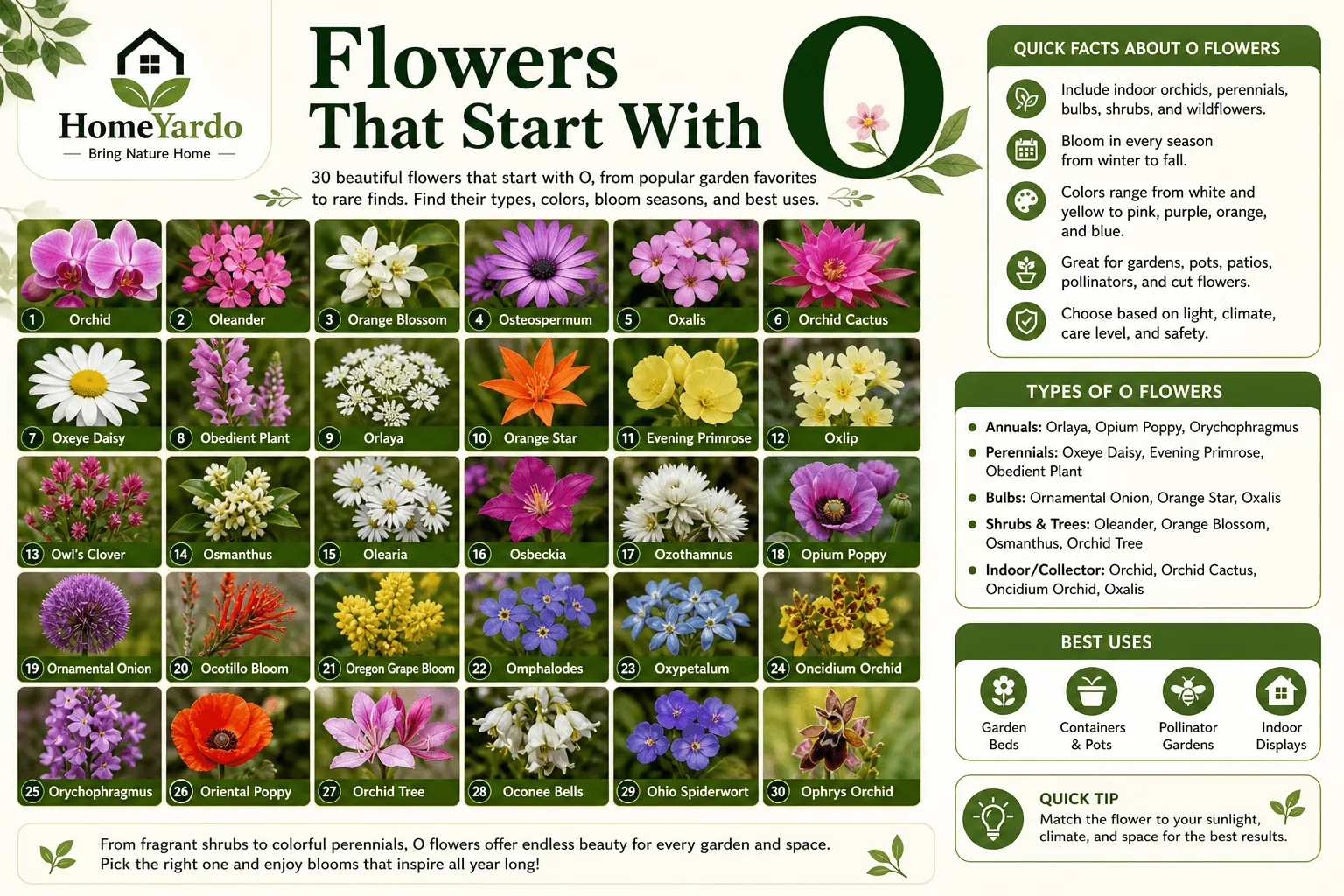
The flowers starting with O include well-known names like orchid and oleander, as well as those that are not listed as extensively as the others, such as Oconee bells and Orychophragmus. Clean O list is best used when there is a separation between the true flowers and flowering shrubs, flowering trees, bulbs, and specialty plants, rather than them being mixed into a single loose catalog. And that makes it less difficult to compare the color of the blooms, their season, how well they are taken care of, or where each plant can be found within a garden, in a container or patio, or in an indoor collection.
Quick Answer: What Are Flowers That Start With O?
Orchid, Oleander, Orange Blossom, Osteospermum, Oxalis, and Orchid Cactus are among the flowers that begin with O. These names encompass various groups of flowering plants, such as classic garden perennials, flowering shrubs, bulbs, indoor blooms, and specialty plants.
Most O lists confuse flowers with larger entries of plants. A more practical solution is to name each one of them by type, then to distinguish them by season of bloom, light, fragrance, beginner value, and use in the garden.
Common flowers that starting with O include Orchid, Osteospermum, Oxeye Daisy, Oleander, Orange Blossom, Orange Star, Oxalis, and Obedient Plant, which are usually the most familiar O flowers across indoor pots, sunny beds, patio containers, and flowering shrubs. For the next letter guide, continue with flowers that start with P.
O Flowers Names: At A Glance
| Common Name | Botanical Name | Flower Type | Main Color | Light | Bloom Season | Beginner Friendly | Best Use |
|---|---|---|---|---|---|---|---|
| Orchid | Orchidaceae spp. | Indoor/tropical | Mixed | Bright indirect | Year-round by type | Often | Pot, gift, indoor display |
| Oleander | Nerium oleander | Woody bloomer | Pink, white, red | Full sun | Summer to fall | No | Warm landscape shrub |
| Orange Blossom | Citrus spp. | Woody bloomer | White | Full sun | Spring | Moderate | Fragrant patio tree |
| Osteospermum | Osteospermum spp. | Annual/tender perennial | Purple, pink, white | Full sun | Spring to fall | Yes | Beds, edges, pots |
| Oxeye Daisy | Leucanthemum vulgare | Perennial / wildflower | White | Full sun | Late spring to summer | Yes | Meadow, cottage border |
| Obedient Plant | Physostegia virginiana | Perennial | Pink, white, purple | Full sun to part shade | Summer | Moderate | Border, pollinator bed |
| Orlaya | Orlaya grandiflora | Annual | White | Full sun | Late spring to summer | Yes | Airy filler, cutting garden |
| Orange Star | Ornithogalum dubium | Bulb | Orange | Full sun to bright light | Late winter to spring | Moderate | Pot, bulb display |
| Oxalis | Oxalis spp. | Bulbous / perennial | Pink, white, yellow | Sun to part shade | Spring to fall | Yes | Pot, edging |
| Orchid Cactus | Epiphyllum spp. | Indoor/tropical | Pink, red, white | Bright indirect | Spring to summer | Moderate | Indoor bloom plant |
| Evening Primrose | Oenothera spp. | Perennial | Yellow, pink | Full sun | Late spring to summer | Yes | Naturalized border |
| Oxlip | Primula elatior | Perennial | Soft yellow | Part shade | Spring | Moderate | Woodland edge |
| Owl’s Clover | Castilleja / Orthocarpus spp. | Wildflower | Pink, magenta | Full sun | Spring | Moderate | Wildflower patch |
| Osmanthus | Osmanthus fragrans | Woody bloomer | Cream white | Sun to part shade | Fall | Moderate | Fragrant hedge, patio |
| Olearia | Olearia spp. | Woody bloomer | White, lavender | Full sun | Spring to summer | Moderate | Shrub border, coast gardens |
| Osbeckia | Osbeckia spp. | Tropical / shrub flower | Purple, pink | Sun to part shade | Warm season | Moderate | Tropical border |
| Ozothamnus | Ozothamnus diosmifolius | Woody bloomer | White, pink | Full sun | Spring | Moderate | Cut flower shrub |
| Opium Poppy | Papaver somniferum | Annual | Pink, purple, white | Full sun | Late spring to summer | Moderate | Cottage bed |
| Ornamental Onion | Allium spp. | Bulb | Purple, white | Full sun | Late spring to early summer | Yes | Structure, pollinator planting |
| Ocotillo Bloom | Fouquieria splendens | Desert woody bloomer | Red orange | Full sun | Spring to summer | No | Dry xeric garden |
| Oregon Grape Bloom | Mahonia aquifolium | Woody bloomer | Yellow | Part shade to sun | Spring | Moderate | Woodland shrub |
| Omphalodes | Omphalodes cappadocica | Perennial | Blue | Part shade | Spring | Yes | Shade carpet |
| Oxypetalum | Tweedia caerulea | Tender perennial | Sky blue | Full sun | Summer | Moderate | Container, cutting bed |
| Oncidium Orchid | Oncidium spp. | Indoor/tropical | Yellow, brown, red | Bright indirect | Variable | Moderate | Indoor collection |
| Orychophragmus | Orychophragmus violaceus | Cool-season annual | Violet | Full sun | Spring | Moderate | Seasonal filler |
| Oriental Poppy | Papaver orientale | Perennial | Orange, red, pink | Full sun | Late spring | Moderate | Bold spring focal point |
| Orchid Tree | Bauhinia spp. | Flowering tree | Pink, white, purple | Full sun | Winter to spring in warm areas | No | Specimen tree |
| Oconee Bells | Shortia galacifolia | Woodland perennial | White | Part shade | Spring | No | Rare woodland garden |
| Ohio Spiderwort | Tradescantia ohiensis | Perennial | Blue, violet | Full sun to part shade | Late spring to summer | Yes | Prairie style planting |
| Ophrys Orchid | Ophrys spp. | Specialty terrestrial orchid | Pink, brown, green | Sun to part shade | Spring | No | Collector grower |
A quick scan shows why O flowers are easier to choose when they are labeled by growth habit. The list includes indoor orchids, short-season annuals, long-lived perennials, bulbs for spring structure, and woody bloomers that behave more like shrubs or trees than border flowers.
Types Of Flowers That Starting With O
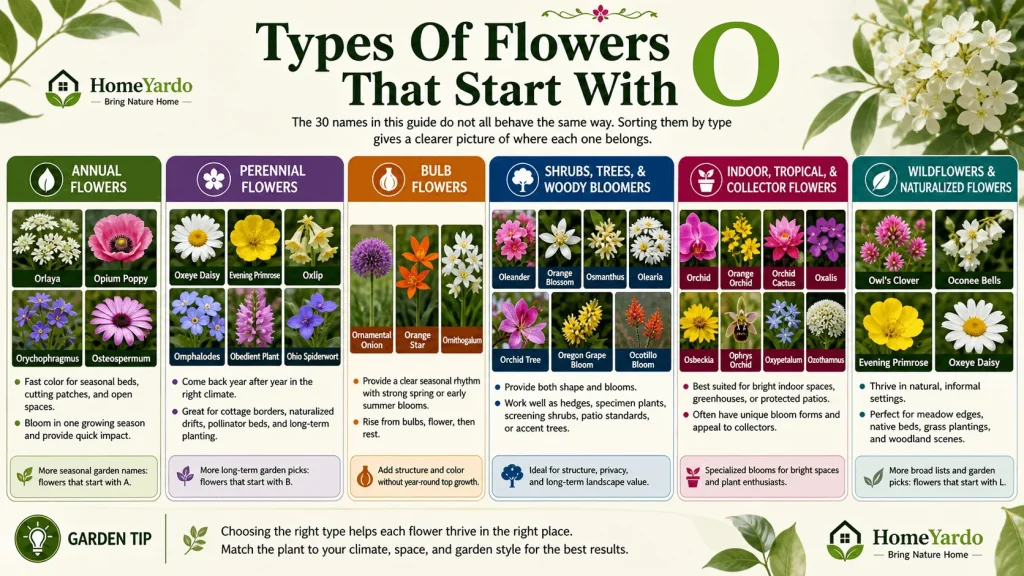
The 30 names in this guide do not all behave the same way. Some are brief seasonal bloomers, some return for years, some rise from bulbs, and some are flowering shrubs or trees. Sorting them by type gives a clearer picture of where each one belongs.
Annual Flowers
Annual O flowers are useful when fast color matters more than long-term structure. They suit seasonal beds, cutting patches, and open spaces that need a soft filler look in one growing season.
Good examples include Orlaya, Opium Poppy, Orychophragmus, and Osteospermum, where it is grown as seasonal plants. For more seasonal garden names, see flowers that start with A.
Perennial Flowers
Perennial O flowers offer a stronger return value. They come back year after year in the right climate and are often the better fit for cottage borders, naturalized drifts, pollinator beds, and long-term mixed planting.
Good examples include Oxeye Daisy, Evening Primrose, Oxlip, Omphalodes, Obedient Plant, and Ohio Spiderwort. For more long-term border and garden picks, explore flowers that start with B.
Bulb Flowers
Bulb-based flowers are useful for a clear seasonal rhythm. They rise, flower, and rest in a pattern that adds strong spring or early summer structure without needing permanent top growth all year.
Good examples include Ornamental Onion and Orange Star, with some growers also grouping selected Ornithogalum forms into this bulb category.
Shrubs, Trees, And Woody Bloomers
Woody O bloomers bring shape as well as flowers. They work as hedges, specimen plants, screening shrubs, patio standards, or warm climate accent trees rather than as classic bedding flowers.
Good examples include Oleander, Orange Blossom, Osmanthus, Olearia, Orchid Tree, Oregon Grape Bloom, and Ocotillo Bloom.
Indoor, Tropical, And Collector Flowers
Some O flowers are more specialized. They may suit bright indoor conditions, protected patios, greenhouses, or collectors who enjoy unusual bloom forms and a slower care routine.
Good examples include Orchid, Oncidium Orchid, Orchid Cactus, Oxalis, Osbeckia, Ophrys Orchid, Oxypetalum, and Ozothamnus.
Wildflowers And Naturalized Flowers
Wild and naturalized O flowers usually look best in looser planting styles. They fit meadow edges, native style beds, informal grass plantings, and spring woodland scenes where a polished formal look is not the goal. Good examples include Owl’s Clover, Oconee Bells, Evening Primrose, and Oxeye Daisy.
For another broad flower list with common, rare, and garden-friendly picks, visit flowers that start with L.
How To Choose The Right Garden Flower?
The right O flower depends less on the letter and more on the conditions around it. A fast filter keeps the choice practical.
| Condition | Best Match |
|---|---|
| Full sun | Osteospermum, Ornamental Onion, Oriental Poppy, Oleander, Orlaya |
| Part shade | Oxlip, Omphalodes, Oconee Bells, Oregon Grape Bloom |
| Containers | Orchid, Oxalis, Orange Star, Orchid Cactus, Oncidium Orchid |
| Strong fragrance | Orange Blossom, Osmanthus, some Orchid types |
| Pollinator value | Obedient Plant, Ornamental Onion, Ohio Spiderwort, Evening Primrose |
| Low maintenance | Oxeye Daisy, Evening Primrose, Olearia in the right site |
| Small spaces | Oxalis, Orange Star, compact Orchid, Orlaya |
| Warm climates | Oleander, Orchid Tree, Orange Blossom, Osbeckia, Ocotillo |
| Cool-season interest | Orychophragmus, Orlaya, Oxlip, Orange Star |
| Safety first | Avoid Oleander and use caution with Opium Poppy around children and pets |
Container suitability, fragrance strength, bloom season, and safety matter just as much as color. A flower that looks perfect in a list can still be the wrong fit if the planting site is too hot, too shaded, too dry, or too exposed.
Complete List Of Flowers That Beginning With O
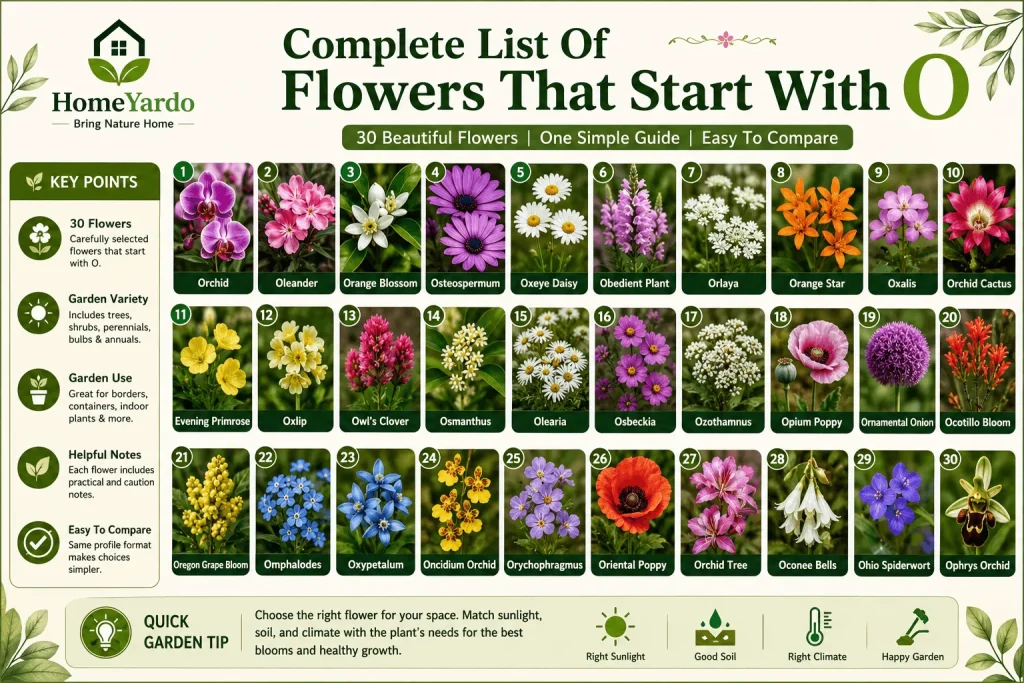
The catalog below keeps the 30 flower count fixed and uses one profile format throughout. That makes it easier to compare similar names without blending plant type, garden use, and rarity into one loose list.
- Orchid
- Botanical Name: Orchidaceae spp.
- Flower Type: Indoor or tropical flower
- Main Colors: White, pink, purple, yellow, and mixed tones
- Bloom Season: Variable throughout the year
- Best Use: Indoor display, gift plant, bright room collection
- Practical Note: Most home orchids prefer bright filtered light and a fast-draining orchid mix rather than standard potting soil.
- Caution Note: Check the exact type before buying because care varies widely between moth orchids, cattleyas, and other groups.
- Oleander
- Botanical Name: Nerium oleander
- Flower Type: Flowering shrub
- Main Color: Pink, white, red, and apricot by cultivar
- Bloom Season: Summer to fall
- Best Use: Warm climate hedge, screen, or specimen shrub
- Practical Note: It performs best where heat, sun, and sharp drainage are reliable.
- Caution Note: All parts are highly toxic, so it is not a casual choice for homes with pets or children.
- Orange Blossom
- Botanical Name: Citrus spp.
- Flower Type: Flowering citrus tree
- Main Color: White
- Bloom Season: Spring, with repeat flushes in warm climates
- Best Use: Fragrant patio tree, edible garden accent
- Practical Note: Grow it where the sun is strong and the airflow is good, especially in pots.
- Caution Note: Use care with sprays and ornamental treatments if blossoms are being used in edible settings.
- Osteospermum
- Botanical Name: Osteospermum spp.
- Flower Type: Annual or tender perennial
- Main Colors: Purple, pink, white, yellow, and bicolor
- Bloom Season: Spring and again in milder weather
- Best Use: Beds, front borders, and mixed containers
- Practical Note: It flowers best when the weather is mild and may pause in strong summer heat.
- Caution Note: Treat it as seasonal in cold climates.
- Oxeye Daisy
- Botanical Name: Leucanthemum vulgare
- Flower Type: Perennial or naturalized wildflower
- Main Color: White with yellow center
- Bloom Season: Late spring to summer
- Best Use: Meadow style planting, cottage borders, simple white drifts
- Practical Note: It gives an easy, natural look in open sunny ground.
- Caution Note: In some regions, it can spread freely, so check whether it is welcome in the planting scheme.
- Obedient Plant
- Botanical Name: Physostegia virginiana
- Flower Type: Perennial
- Main Color: Pink, white, or soft purple
- Bloom Season: Summer to early fall
- Best Use: Pollinator beds and mixed borders
- Practical Note: It adds upright flower spikes and a looser cottage garden feel.
- Caution Note: Give it room because it can spread by underground growth.
- Orlaya
- Botanical Name: Orlaya grandiflora
- Flower Type: Annual
- Main Color: White lace-like bloom heads
- Bloom Season: Late spring to summer
- Best Use: Cutting garden, airy filler, edge softener
- Practical Note: It is useful when a border needs a light cloud effect rather than a solid block of color.
- Caution Note: Sow where it can stay undisturbed for the best display.
- Orange Star
- Botanical Name: Ornithogalum dubium
- Flower Type: Bulb
- Main Color: Orange
- Bloom Season: Late winter to spring
- Best Use: Pots, gift bulbs, bright seasonal containers
- Practical Note: It brings a sharp orange color when many outdoor beds are still quiet.
- Caution Note: Best in bright light and careful watering because soggy bulbs decline quickly.
- Oxalis
- Botanical Name: Oxalis spp.
- Flower Type: Bulbous or perennial flower
- Main Color: Pink, white, yellow, and lavender by type
- Bloom Season: Spring through fall, depending on type
- Best Use: Indoor pot, edging, small accent plant
- Practical Note: It suits containers and smaller spaces because foliage and flowers stay neat.
- Caution Note: Some forms spread steadily, so use with intention in open ground.
- Orchid Cactus
- Botanical Name: Epiphyllum spp.
- Flower Type: Tropical flowering cactus
- Main Colors: Red, pink, white, orange, and mixed shades
- Bloom Season: Spring to summer
- Best Use: Indoor collection or sheltered patio plant
- Practical Note: It prefers bright filtered light and better air movement than desert cacti usually need.
- Caution Note: Avoid heavy, water-holding mixes.
- Evening Primrose
- Botanical Name: Oenothera spp.
- Flower Type: Perennial
- Main Color: Yellow most often, with pink in some species
- Bloom Season: Late spring to summer
- Best Use: Naturalized beds and loose borders
- Practical Note: It fits informal gardens well and can bring evening interest.
- Caution Note: Some types spread, so match the species to the space.
- Oxlip
- Botanical Name: Primula elatior
- Flower Type: Perennial
- Main Color: Soft yellow
- Bloom Season: Spring
- Best Use: Woodland edge or cool border
- Practical Note: It is most at home in evenly moist soil with some shade protection.
- Caution Note: It is not a heat-loving flower and struggles in hot, dry placements.
- Owl’s Clover
- Botanical Name: Castilleja or Orthocarpus spp.
- Flower Type: Wildflower
- Main Color: Pink to magenta
- Bloom Season: Spring
- Best Use: Native style patch or seasonal wildflower mix
- Practical Note: It works best where the planting style is loose and natural rather than formal.
- Caution Note: Performance depends heavily on local climate and sourcing.
- Osmanthus
- Botanical Name: Osmanthus fragrans
- Flower Type: Flowering shrub
- Main Color: Creamy white
- Bloom Season: Fall, sometimes lightly at other times
- Best Use: Fragrant hedge, entry planting, patio shrub
- Practical Note: Its small flowers are easy to miss visually, but the scent can be remarkable.
- Caution Note: Give it a sheltered position in cooler regions.
- Olearia
- Botanical Name: Olearia spp.
- Flower Type: Flowering shrub
- Main Color: White, lavender, or pale daisy shades
- Bloom Season: Spring to summer
- Best Use: Shrub border, coastal style garden
- Practical Note: It adds a daisy shrub look where a tougher woody framework is needed.
- Caution Note: Best performance comes with good drainage and enough light.
- Osbeckia
- Botanical Name: Osbeckia spp.
- Flower Type: Tropical flowering shrub or perennial
- Main Color: Purple, pink, and mauve
- Bloom Season: Warm season
- Best Use: Tropical border or protected patio planting
- Practical Note: Its bold color suits hot-season planting, where a soft cottage look is not the goal.
- Caution Note: It is not dependable in frost.
- Ozothamnus
- Botanical Name: Ozothamnus diosmifolius
- Flower Type: Flowering shrub
- Main Color: White or blush pink
- Bloom Season: Spring
- Best Use: Cut flower production, shrub border
- Practical Note: The tight clusters have a dry textured look that works well in floristry.
- Caution Note: Humidity and drainage can affect performance.
- Opium Poppy
- Botanical Name: Papaver somniferum
- Flower Type: Annual
- Main Colors: Pink, lilac, white, red, and purple
- Bloom Season: Late spring to early summer
- Best Use: Cottage bed, ornamental annual display
- Practical Note: It brings a softer, old garden character and decorative seed pods.
- Caution Note: Grow only where permitted and suitable because laws and safety concerns vary by location.
- Ornamental Onion
- Botanical Name: Allium spp.
- Flower Type: Bulb
- Main Color: Purple, white, pink
- Bloom Season: Late spring to early summer
- Best Use: Structural accent, pollinator planting, bulb layer
- Practical Note: The globe-shaped heads add strong form even after peak bloom.
- Caution Note: Leaves often fade before the flowers finish, so pair it with companion foliage.
- Ocotillo Bloom
- Botanical Name: Fouquieria splendens
- Flower Type: Desert flowering shrub
- Main Color: Red orange
- Bloom Season: Spring to summer after moisture
- Best Use: Xeric and desert gardens
- Practical Note: It is a dramatic, dry climate choice rather than a general garden flower.
- Caution Note: Not suited to wet, cold, or heavy soil conditions.
- Oregon Grape Bloom
- Botanical Name: Mahonia aquifolium
- Flower Type: Flowering shrub
- Main Color: Yellow
- Bloom Season: Spring
- Best Use: Woodland shrub layer, shade-tolerant structure
- Practical Note: Its clustered spring flowers sit well with shaded or partly shaded planting schemes.
- Caution Note: Leaf texture can be prickly, so place it with access in mind.
- Omphalodes
- Botanical Name: Omphalodes cappadocica
- Flower Type: Perennial
- Main Color: Blue
- Bloom Season: Spring
- Best Use: Shade carpet, woodland underplanting
- Practical Note: It is useful where a low, cool-toned spring layer is needed beneath shrubs.
- Caution Note: Best in soil that holds moisture without staying waterlogged.
- Oxypetalum
- Botanical Name: Tweedia caerulea
- Flower Type: Tender perennial or annual
- Main Color: Sky blue
- Bloom Season: Summer
- Best Use: Container, support frame, cutting bed
- Practical Note: The soft blue flowers are unusual and pair well with warm colors.
- Caution Note: It often needs support and warm growing conditions.
- Oncidium Orchid
- Botanical Name: Oncidium spp.
- Flower Type: Indoor orchid
- Main Color: Yellow, brown, red, and mixed patterns
- Bloom Season: Variable by type
- Best Use: Indoor collector plant, bright filtered room
- Practical Note: Its dancing spray of smaller blooms gives a different effect from fuller moth orchids.
- Caution Note: Humidity and light balance matter more than frequent watering.
- Orychophragmus
- Botanical Name: Orychophragmus violaceus
- Flower Type: Cool-season annual
- Main Color: Violet to lavender
- Bloom Season: Spring
- Best Use: Seasonal filler, cool-season patch
- Practical Note: It works best as a brief spring display rather than a long-season backbone plant.
- Caution Note: Use it where a fast spring flush is enough.
- Oriental Poppy
- Botanical Name: Papaver orientale
- Flower Type: Perennial
- Main Colors: Orange, scarlet, salmon, white, and pink
- Bloom Season: Late spring to early summer
- Best Use: Spring focal point in sunny borders
- Practical Note: The blooms are bold and short-lived, but the visual impact is strong.
- Caution Note: The plant often goes quiet after flowering, so neighboring perennials help fill the gap.
- Orchid Tree
- Botanical Name: Bauhinia spp.
- Flower Type: Flowering tree
- Main Color: Pink, white, lavender, or purple
- Bloom Season: Winter to spring in warm climates
- Best Use: Specimen tree, warm climate courtyard
- Practical Note: It is valued more as a flowering small tree than as a classic garden flower.
- Caution Note: Cold tolerance depends on the exact species and local winter conditions.
- Oconee Bells
- Botanical Name: Shortia galacifolia
- Flower Type: Woodland perennial
- Main Color: White with a soft pink blush in bud
- Bloom Season: Spring
- Best Use: Rare woodland collection or shaded native style garden
- Practical Note: It suits calm, humus-rich woodland conditions rather than exposed border planting.
- Caution Note: It is uncommon in trade and best handled as a specialty choice.
- Ohio Spiderwort
- Botanical Name: Tradescantia ohiensis
- Flower Type: Perennial
- Main Color: Blue to violet
- Bloom Season: Late spring to summer
- Best Use: Prairie-style bed, pollinator strip, naturalized planting
- Practical Note: It gives a looser vertical line and works well with grasses.
- Caution Note: Flowers open best in good light, and each bloom is brief, though the display continues.
- Ophrys Orchid
- Botanical Name: Ophrys spp.
- Flower Type: Terrestrial specialty orchid
- Main Color: Pink, brown, green, and patterned tones
- Bloom Season: Spring
- Best Use: Collector growing and niche displays
- Practical Note: Its flowers are admired for their unusual insect-like forms.
- Caution Note: It is a specialist plant and not a simple beginner orchid.
Flower Meanings, Symbolism, And Cultural Uses
Not every O flower carries a widely used symbolic meaning, but a few appear often in floral language, wedding traditions, fragrance culture, and ornamental lore. These meanings work best as cultural notes rather than fixed botanical truths.
| Flower | Common Symbolism Or Cultural Association |
|---|---|
| Orchid | Refinement, beauty, rarity, admiration |
| Orange Blossom | Purity, celebration, bridal symbolism, fragrance |
| Oleander | Beauty paired with caution |
| Oxeye Daisy | Simplicity, freshness, meadow charm |
| Osmanthus | Sweet fragrance, seasonal memory, tea, and scent culture |
| Opium Poppy | Sleep, remembrance, transience, historical symbolism |
Used carefully, symbolism can add a softer descriptive layer to garden writing, floral gifts, and themed plantings without replacing the practical facts that actually guide plant choice.
Plants Vs Flowers That Starting With O
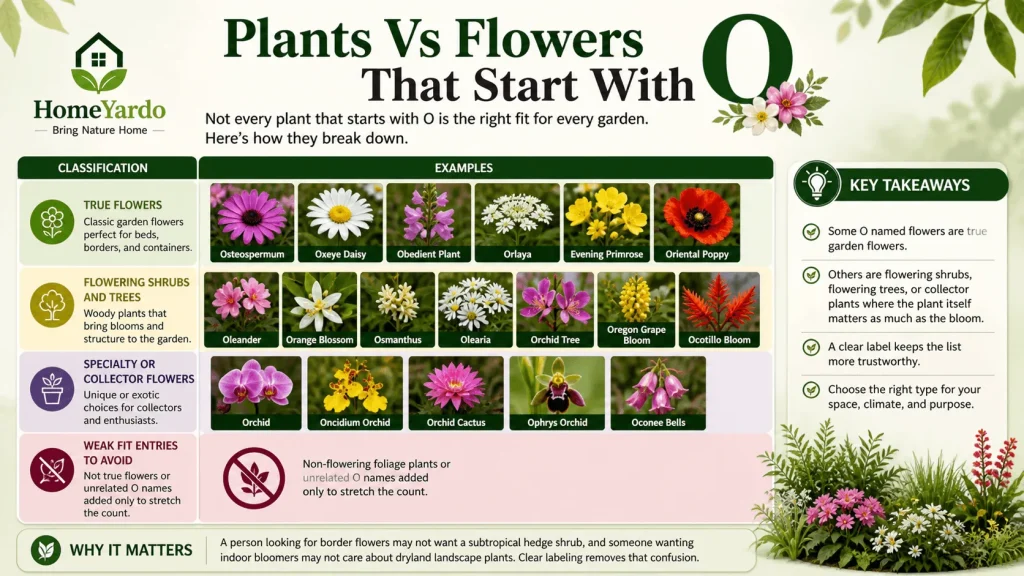
Some O named flowers are true garden flowers. Others are flowering shrubs, flowering trees, or collector plants where the plant itself matters as much as the bloom. A clear label keeps the list more trustworthy.
| Classification | Examples |
|---|---|
| True flowers | Osteospermum, Oxeye Daisy, Obedient Plant, Orlaya, Evening Primrose, Oriental Poppy |
| Flowering shrubs and trees | Oleander, Orange Blossom, Osmanthus, Olearia, Orchid Tree, Oregon Grape Bloom, Ocotillo Bloom |
| Specialty or collector flowers | Orchid, Oncidium Orchid, Orchid Cactus, Ophrys Orchid, Oconee Bells |
| Weak fit entries to avoid | Non-flowering foliage plants or unrelated O names added only to stretch the count |
That distinction matters because a person looking for border flowers may not want a subtropical hedge shrub, and someone wanting indoor bloomers may not care about dryland landscape plants. Clear labeling removes that confusion.
Best O Flowers By Color, Care Level, And Garden Use
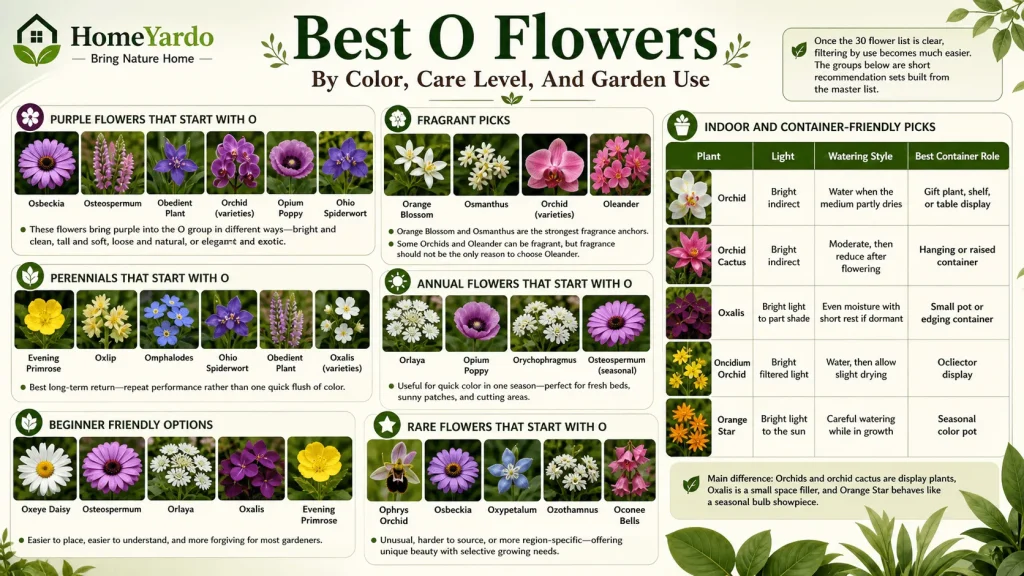
Once the 30 flower list is clear, filtering by use becomes much easier. The groups below are not a second catalog. They are short recommendation sets built from the master list.
Purple Flowers That Start With O
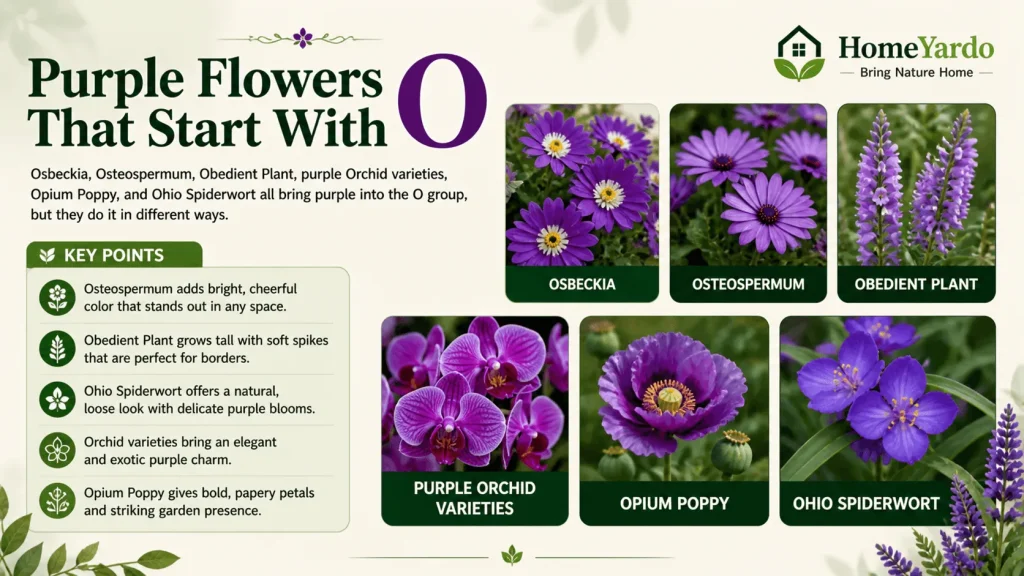
Osbeckia, Osteospermum, Obedient Plant, purple Orchid varieties, Opium Poppy, and Ohio Spiderwort all bring purple into the O group, but they do it in different ways. Osteospermum feels bright and clean, Obedient Plant is taller and softer, Ohio Spiderwort is looser and more natural, and orchid types can lean elegant or exotic.
Fragrant O Flowers
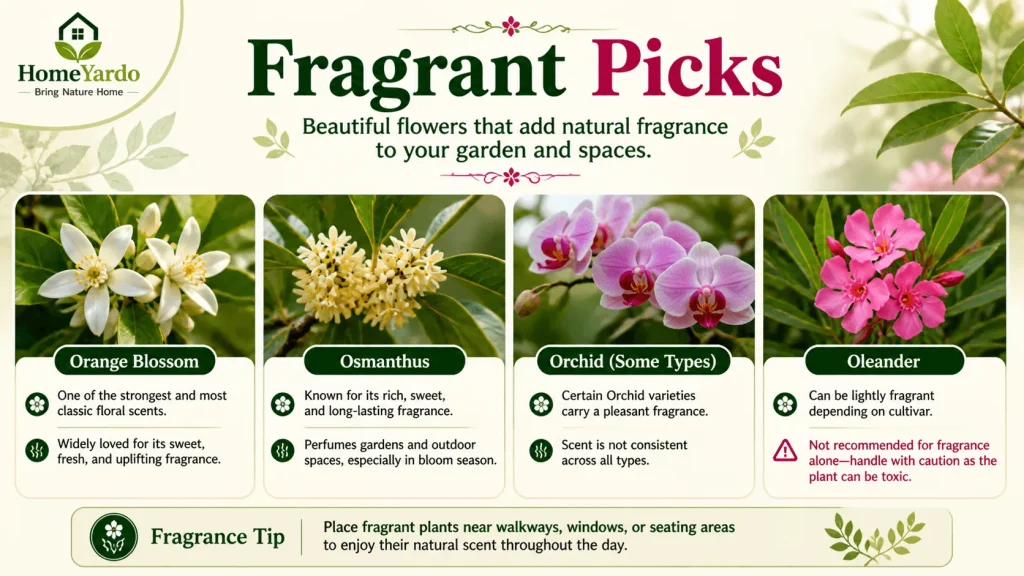
Orange Blossom and Osmanthus are the strongest fragrance anchors in this group. Some Orchid types also carry scent, though it is not consistent across every variety. Oleander can be lightly fragrant depending on cultivar, but fragrance should never be the only reason to choose it because the plant needs more caution than many other O blooms.
Perennials That Start With O
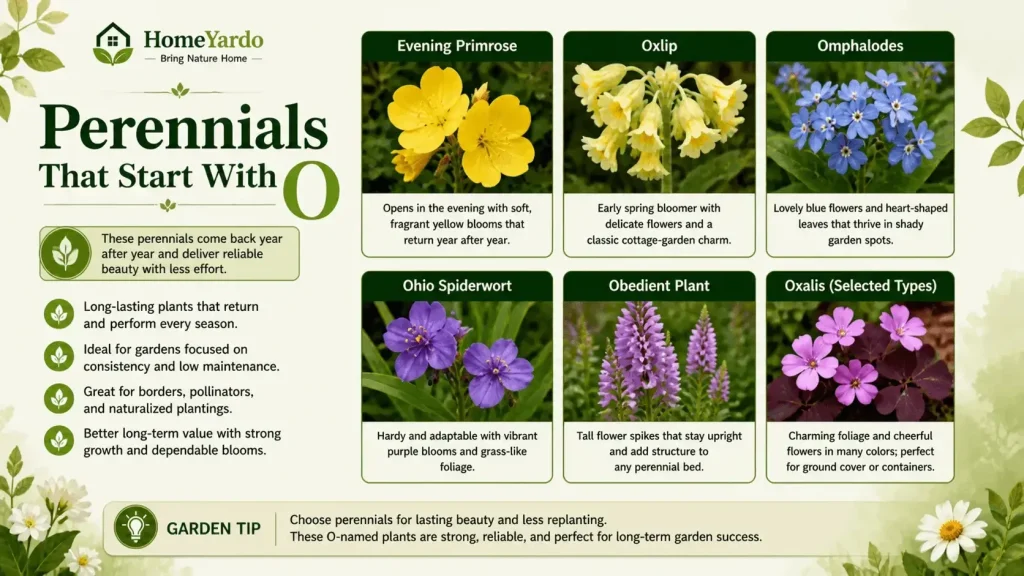
Evening Primrose, Oxlip, Omphalodes, Ohio Spiderwort, Obedient Plant, and selected Oxalis types offer the best long-term return in this guide. These are better picks when the goal is repeat performance rather than one quick flush of color.
Annual Flowers That Start With O
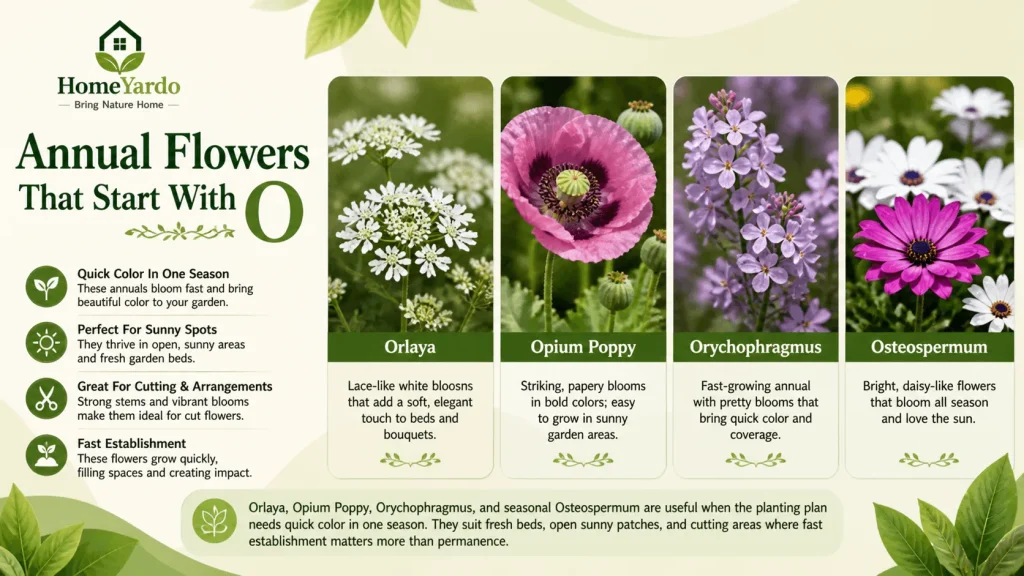
Orlaya, Opium Poppy, Orychophragmus, and seasonal Osteospermum are useful when the planting plan needs quick color in one season. They suit fresh beds, open sunny patches, and cutting areas where fast establishment matters more than permanence.
Indoor And Container-Friendly Picks
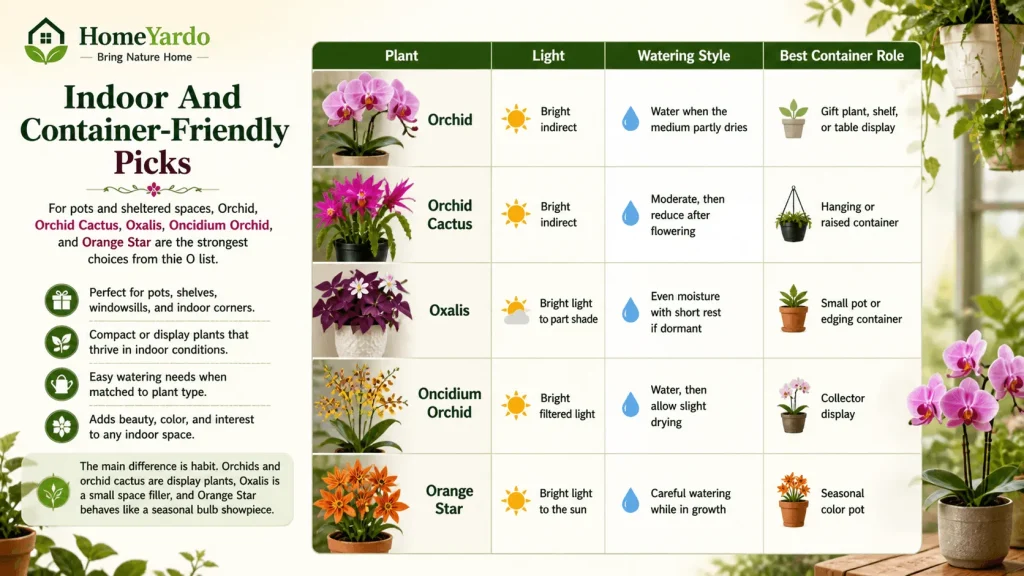
For pots and sheltered spaces, Orchid, Orchid Cactus, Oxalis, Oncidium Orchid, and Orange Star are the strongest choices from the O list.
| Plant | Light | Watering Style | Best Container Role |
|---|---|---|---|
| Orchid | Bright indirect | Water when the medium partly dries | Gift plant, shelf, or table display |
| Orchid Cactus | Bright indirect | Moderate, then reduce after flowering | Hanging or raised container |
| Oxalis | Bright light to part shade | Even moisture with short rest if dormant | Small pot or edging container |
| Oncidium Orchid | Bright filtered light | Water, then allow slight drying | Collector display |
| Orange Star | Bright light to the sun | Careful watering while in growth | Seasonal color pot |
The main difference is habit. Orchids and orchid cactus are display plants, Oxalis is a small space filler, and Orange Star behaves like a seasonal bulb showpiece.
Beginner Friendly Choices
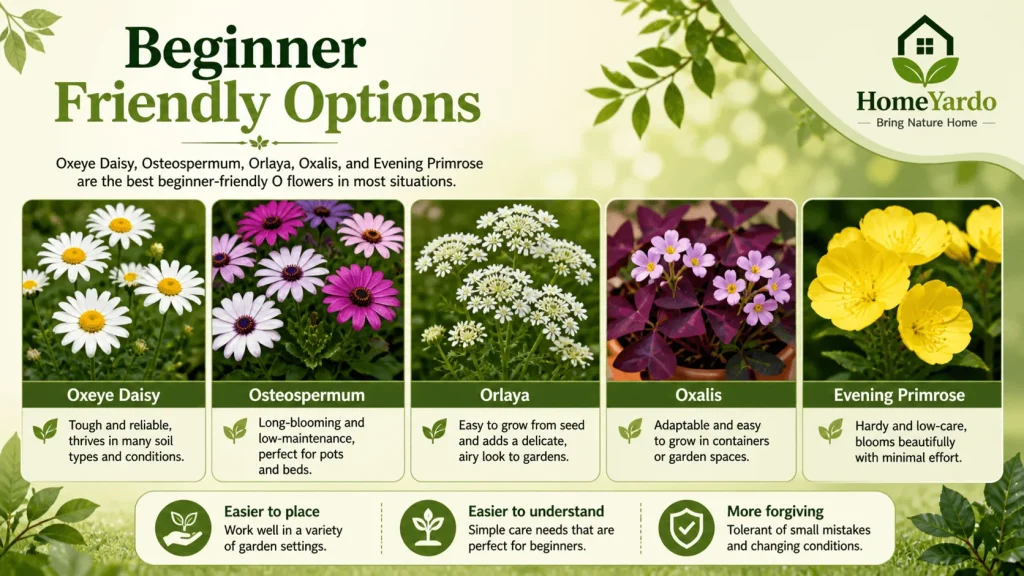
Oxeye Daisy, Osteospermum, Orlaya, Oxalis, and Evening Primrose are the best beginner-friendly O flowers in most situations. They are easier to place, easier to understand, and more forgiving than collector orchids, specialty wildflowers, or climate-specific woody bloomers.
Rare Flowers That Start With O
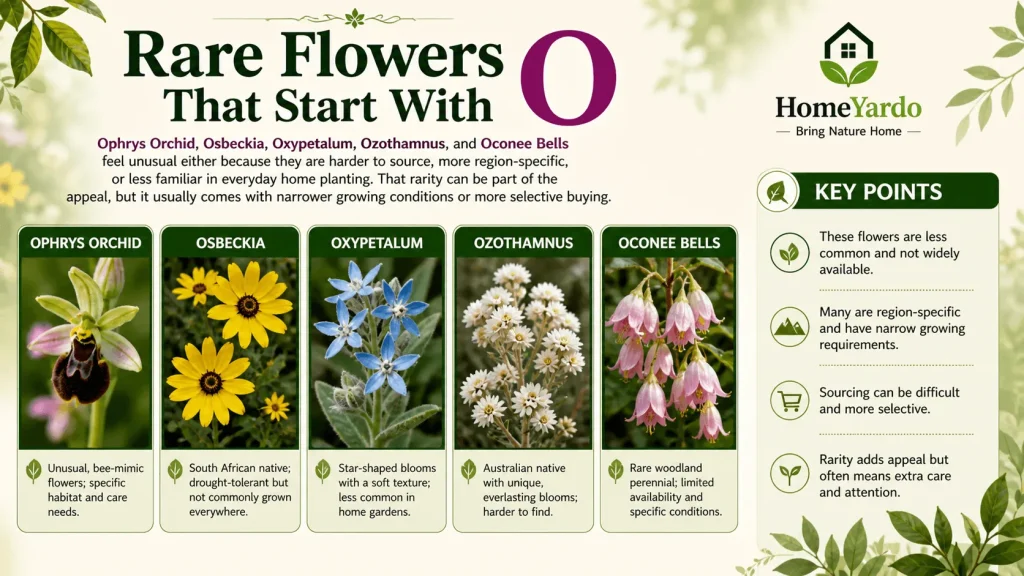
Ophrys Orchid, Osbeckia, Oxypetalum, Ozothamnus, and Oconee Bells feel unusual either because they are harder to source, more region-specific, or less familiar in everyday home planting. That rarity can be part of the appeal, but it usually comes with narrower growing conditions or more selective buying.
Pollinator Friendly And Meadow Picks
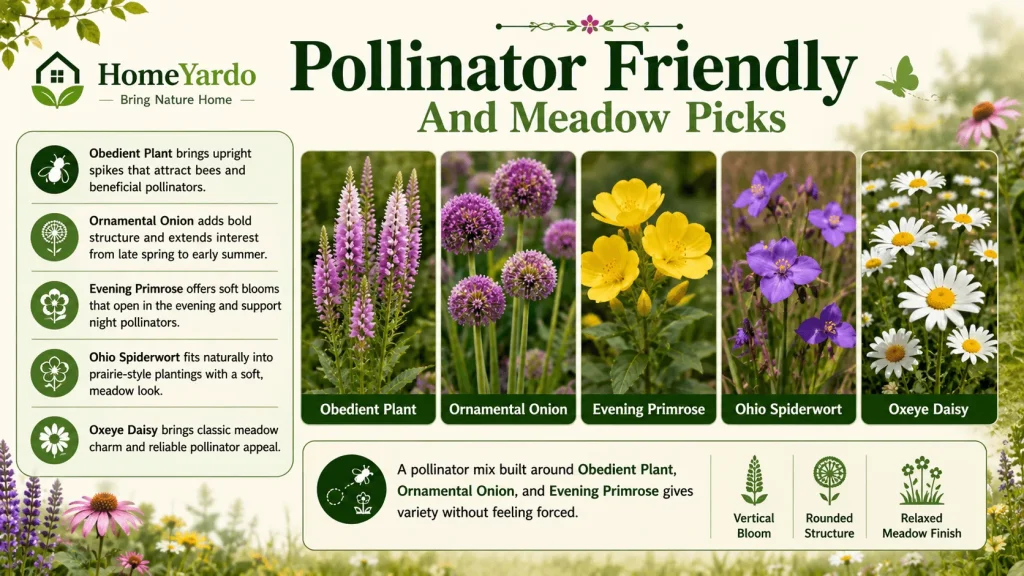
Obedient Plant, Ornamental Onion, Evening Primrose, Ohio Spiderwort, and Oxeye Daisy are the strongest O flowers for pollinator-friendly and meadow-style planting. Obedient Plant gives upright spikes, while Ornamental Onion adds structure and helps bridge late spring into early summer. Evening Primrose and Oxeye Daisy fit looser naturalized beds, and Ohio Spiderwort works well where the planting needs a softer prairie-style look.
A pollinator mix built around Obedient Plant, Ornamental Onion, and Evening Primrose gives variety without feeling forced. That combination covers vertical bloom, rounded structure, and a more relaxed meadow finish.
Cut Flower And Bouquet Favorites
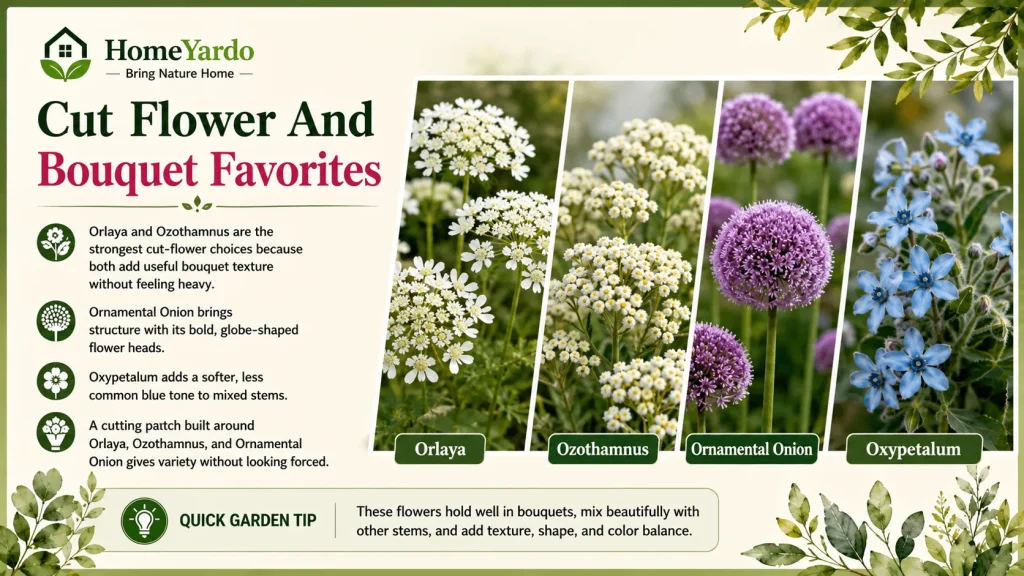
Orlaya and Ozothamnus are the strongest cut-flower choices because both add useful bouquet texture without feeling heavy. Ornamental Onion brings structure, while Oxypetalum adds a softer, less common blue tone to mixed stems.
A cutting patch built around Orlaya, Ozothamnus, and Ornamental Onion gives variety without looking forced. That combination covers airy filler, clustered texture, and stronger upright form for garden-picked arrangements.
Water And Pond Flower Picks
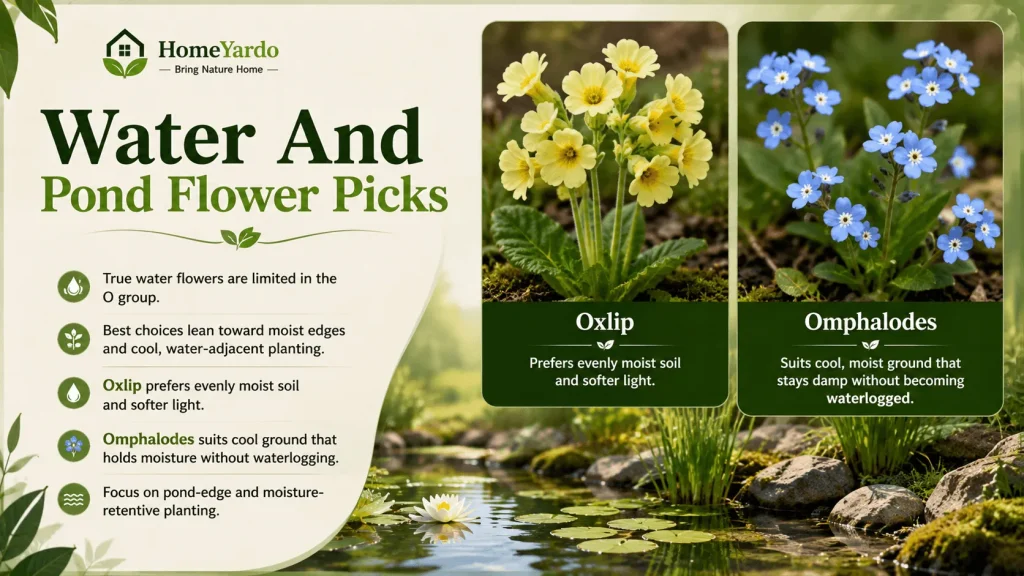
True water flowers are limited in the O group, so the best choices lean more toward moist edges and cool, water-adjacent planting than open-water display. Oxlip is one of the better fits because it prefers evenly moist soil and softer light, while Omphalodes also suits cool ground that holds moisture without becoming waterlogged.
This section works best when it stays focused on pond-edge and moisture-retentive planting rather than forcing dry-border or container flowers into a water-garden role.
Safety, Toxicity, And Accuracy Notes
A short caution layer helps more than dramatic wording. Most O flowers are straightforward ornamental plants, but a few deserve extra care or clearer labeling.
| Flower Or Issue | Issue | What To Know |
|---|---|---|
| Oleander | High toxicity | Do not place where children or pets may chew leaves, stems, or flowers. |
| Opium Poppy | Legal and safety concerns | Rules vary by location, and the plant should not be treated as a casual family garden choice. |
| Orange Blossom | Edible versus ornamental context | Use only food-safe blossoms from untreated plants if blossoms are intended for culinary use. |
| Oxeye Daisy | Spread potential | Beautiful in the right place, but it can naturalize strongly in some regions. |
| Mixed O lists | Label accuracy | Some lists pad the count with non-flowering or weak-fit names. Clear classification fixes that. |
Clear labeling improves trust just as much as caution notes do. A simple statement that a plant is a shrub, bulb, or collector flower is often enough to prevent poor buying decisions.
Garden Design Ideas Using O Flowers
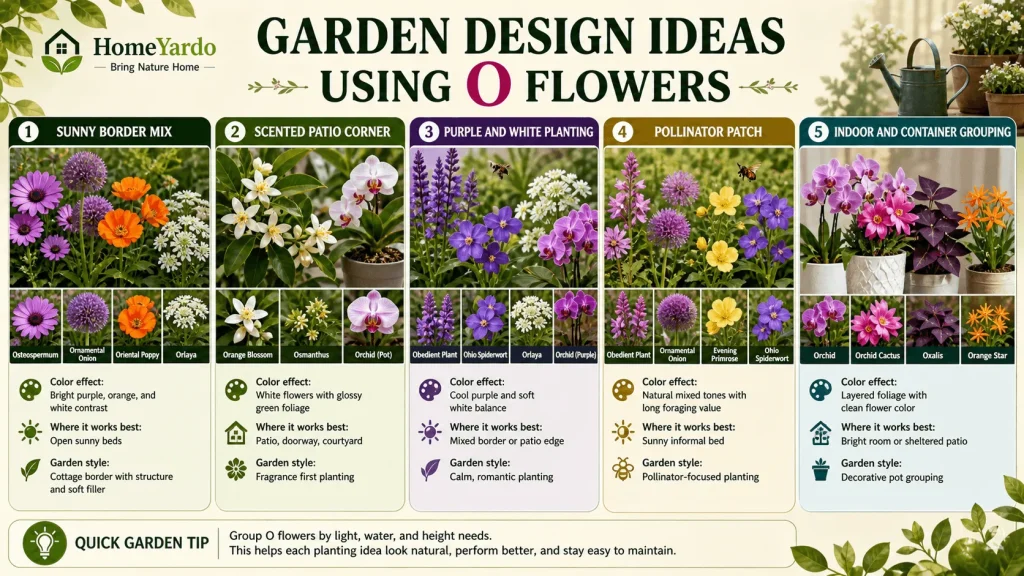
O flowers work best when they are grouped by mood and habit rather than by alphabet alone. These five planting ideas translate the list into something usable.
- Sunny Border Mix
- Flower mix: Osteospermum, Ornamental Onion, Oriental Poppy, Orlaya
- Color effect: Bright purple, orange, and white contrast
- Where it works best: Open sunny beds
- Garden style: Cottage border with structure and soft filler
- Scented Patio Corner
- Flower mix: Orange Blossom, Osmanthus, compact Orchid in a pot
- Color effect: White flowers with glossy green foliage
- Where it works best: Patio, doorway, courtyard
- Garden style: Fragrance first planting
- Purple And White Planting
- Flower mix: Obedient Plant, Ohio Spiderwort, Orlaya, purple Orchid tones in containers
- Color effect: Cool purple and soft white balance
- Where it works best: Mixed border or patio edge
- Garden style: Calm, romantic planting
- Pollinator Patch
- Flower mix: Obedient Plant, Ornamental Onion, Evening Primrose, Ohio Spiderwort
- Color effect: Natural mixed tones with long foraging value
- Where it works best: Sunny informal bed
- Garden style: Pollinator-focused planting
- Indoor And Container Grouping
- Flower mix: Orchid, Orchid Cactus, Oxalis, Orange Star
- Color effect: Layered foliage with clean flower color
- Where it works best: Bright room or sheltered patio
- Garden style: Decorative pot grouping
Expert Notes And How This List Was Built
This list was built by checking botanical relevance, garden usefulness, indoor suitability where needed, and the difference between true flowers and broader flowering plant entries. The 30-name count stays fixed across the quick answer, table, catalog, and filter blocks, so the page remains consistent from top to bottom.
Conclusion
Flowers that start with the letter O cover far more than a short novelty list. The strongest picks range from indoor orchids and patio citrus bloom to long-lived perennials, spring bulbs, woody landscape flowers, and rare collector choices. For quick selection, start with the comparison table, then use the type and filter sections to narrow the list by light, fragrance, care level, and garden use.
FAQ’s
A practical garden list can comfortably hold 30 solid O flower names without padding the count with weak-fit plants. More names do exist, but quality matters more than a stretched total. A fixed 30 flower list is easier to compare and much cleaner to use.
Orchid is usually the most recognized O flower because it is widely sold, widely gifted, and grown both indoors and in specialist collections. In outdoor garden planting, Osteospermum and Oxeye Daisy are also very recognizable choices. The most popular pick depends on whether the setting is indoor, ornamental, or landscape-based.
Orange Blossom and Osmanthus are among the strongest fragrance picks in the O group. Orange Blossom is fresh and citrusy, while Osmanthus is sweeter and more perfume-like. Some orchids are also fragrant, but scent varies a lot by type and cultivar.
Good perennial O flowers include Oxeye Daisy, Obedient Plant, Evening Primrose, Oxlip, Omphalodes, and Ohio Spiderwort. Oriental Poppy is also a perennial, though its main display window is shorter. These are stronger long-term choices than annual fillers or brief seasonal bulbs.
Yes, Orchid, Oncidium Orchid, Orchid Cactus, and Oxalis are all good indoor or indoor leaning choices. Orange Star can also work in containers for a seasonal indoor display if the light is strong. Indoor success depends more on light and watering routine than on the letter itself.
Oxeye Daisy, Osteospermum, Orlaya, Oxalis, and Evening Primrose are among the easiest options for beginners. They are simpler to place and do not require the same level of climate control or niche care as collector orchids and rare woodland plants. Matching the flower to the site still matters.
Ophrys Orchid, Oconee Bells, Osbeckia, Ozothamnus, and Oxypetalum feel rarer than the common O names used in general garden lists. Some are uncommon in everyday retail channels, while others are more climate-specific or collector-oriented. Rare does not always mean hard to grow, but it often means harder to source.
Several O flowers can be purple, including Osteospermum, Obedient Plant, Osbeckia, Ohio Spiderwort, some Orchid forms, and some Opium Poppy selections. The look differs from one plant to another. Some are rich and bold, while others lean soft violet or mauve.
Flowers are individual bloom types or plants mainly chosen for their flowers, while broader plant entries may be shrubs, trees, or foliage plants that only happen to flower. Oleander, Orange Blossom, and Orchid Tree are flowering woody plants rather than simple border flowers. Clear labeling prevents that mix-up.
For many gardens, Oxeye Daisy and Osteospermum are the easiest O flowers to start with. They are easy to understand visually, adapt well to simple designs, and do not need specialist care. The easiest choice still depends on local light, heat, and soil drainage.
Yes, Osmanthus and Orange Blossom are the strongest fragrant shrub or small tree options in this group. Oleander may also carry scent in some cultivars, but fragrance is not equally strong across all forms. When scent is the main priority, Osmanthus and citrus bloom are the safer targets.
References
- Missouri Botanical Garden: Nerium oleander
- Missouri Botanical Garden: Osteospermum (group)
- NC State Extension: Leucanthemum vulgare (Ox-eye Daisy)
- Missouri Botanical Garden: Physostegia virginiana (Obedient Plant)
- NC State Extension: Citrus × sinensis
- RHS: Osmanthus fragrans
- RHS: Allium (Ornamental Onion)
- RHS: Cymbidium Orchids
- NC State Extension: Oenothera biennis (Evening Primrose)
- NC State Extension: Primula elatior (Oxlip)
- NC State Extension: Tradescantia ohiensis (Ohio Spiderwort)
- NC State Extension: Bauhinia × blakeana (Orchid Tree)