28 Beautiful Variety Of Flowers That Start With K You Didn’t Know About
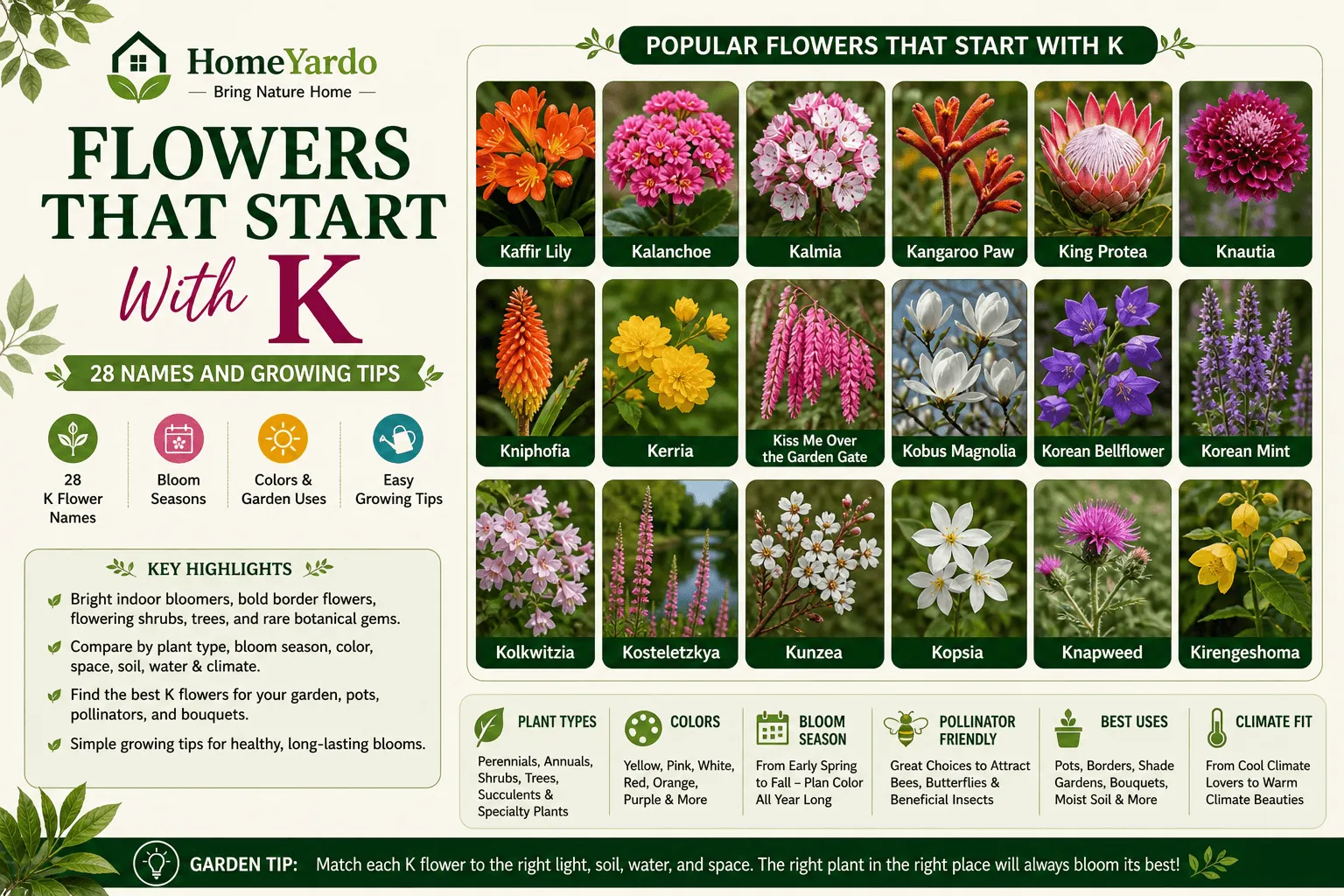
Flowers that start with K include bright indoor bloomers, bold border flowers, flowering shrubs, unusual tropical plants, and a few rare botanical entries. Some are familiar garden choices, such as Kalanchoe, Kalmia, Kangaroo Paw, King Protea, Knautia, Kerria, and Kniphofia. Others are less common but still useful in a complete K flower list.
The best way to compare them is not by name alone. Plant type, bloom season, color, space, soil, water, and climate all matter. A compact Kalanchoe can sit in a sunny indoor pot, while a Kobus Magnolia needs landscape space. Knautia fits a pollinator border, while King Protea works best as a bold focal bloom in warmer, well-drained conditions.
This guide covers 28 K flower names with botanical names, colors, bloom timing, garden use, beginner fit, and simple growing notes.
Quick Answer: What Are K Flower Names?
Common K flower names include Kalanchoe, Kalmia, Kangaroo Paw, King Protea, Knautia, Kniphofia, Kerria, Kaffir Lily, Knapweed, and Kiss Me Over the Garden Gate.
Some are classic garden flowers, while others are flowering shrubs, flowering trees, succulents, or specialty ornamentals grown mainly for their blooms. The clearest way to compare them is by plant type, color, bloom season, and growing conditions.
Alphabetical Quick List
The quickest way to compare the full K group is to start with the complete name list. The list below includes true flowers first, followed by flowering plants often grouped with K flower names.
- Kaffir Lily
- Kalanchoe
- Kalmia
- Kalmiopsis
- Kangaroo Paw
- Kanawao
- Kadupul
- Kelkiewyn
- Kerria
- Kigelia
- King Protea
- King’s Mantle
- Kirengeshoma
- Kiss Me Over the Garden Gate
- Kitaibelia
- Knautia
- Knapweed
- Kniphofia
- Kobus Magnolia
- Kochia
- Koki’o
- Kolkwitzia
- Korean Bellflower
- Korean Mint
- Korolkowia
- Kopsia
- Kosteletzkya
- Kunzea
Some names are classic border flowers, while others are included because they are flowering shrubs, trees, succulents, or regional ornamentals that people often group with flower names. For a nearby alphabet guide with more soft garden names, see flowers that start with L.
K Named Flowers: At A Glance
Some readers want full flower descriptions, while others want a quick comparison first. This table gives a faster view of the best-known K entries and helps sort them by plant type, color, bloom season, best use, beginner friendliness, and general climate fit.
| Common Name | Botanical Name | Plant Type | Main Colors | Bloom Season | Best Use | Beginner Friendly | Climate Fit |
|---|---|---|---|---|---|---|---|
| Kaffir Lily | Clivia miniata | Flowering plant | Orange, red, yellow | Late winter to spring | Indoor pots, shade patios | Yes | Indoors or warm, sheltered spaces |
| Kalanchoe | Kalanchoe blossfeldiana | Flowering succulent | Red, pink, orange, yellow, white | Winter to spring | Indoor pots, containers | Yes | Indoors or warm climates |
| Kalmia | Kalmia latifolia | Flowering shrub | Pink, white | Late spring to early summer | Woodland gardens | Moderate | Cooler to moderate climates |
| Kalmiopsis | Kalmiopsis leachiana | Flowering shrub | Pink | Spring to early summer | Rock gardens, specialty planting | Moderate | Cooler, well-drained sites |
| Kangaroo Paw | Anigozanthos species | Perennial flower | Red, orange, yellow, green | Spring to summer | Accent planting, cut flowers | Moderate | Warm sunny climates |
| Kanawao | Broussaisia arguta | Flowering shrub | White, pink, blue | Seasonal by climate | Regional botanical interest | No | Humid tropical to subtropical areas |
| Kadupul | Epiphyllum oxypetalum | Flowering cactus | White | Night-blooming, warm-season | Specialty containers | Moderate | Warm sheltered spaces |
| Kelkiewyn | Babiana ringens | Bulbous flower | Red | Spring | Specialty bulb gardens | Moderate | Mild, well-drained climates |
| Kerria | Kerria japonica | Flowering shrub | Yellow | Spring | Shrub borders, cottage gardens | Yes | Moderate climates |
| Kigelia | Kigelia africana | Flowering tree | Dark red, maroon | Warm season | Large landscapes | No | Warm climates |
| King Protea | Protea cynaroides | Flowering shrub | Pink, cream, red | Spring to fall by climate | Focal bloom, bouquets | Moderate | Warm dry climates |
| King’s Mantle | Thunbergia erecta | Flowering shrub | Purple, blue violet | Warm season | Tropical borders, hedges | Moderate | Warm climates |
| Kirengeshoma | Kirengeshoma palmata | Perennial flower | Soft yellow | Late summer to fall | Shade gardens | Moderate | Cooler shaded gardens |
| Kiss Me Over The Garden Gate | Persicaria orientalis | Annual flowering plant | Pink | Summer to fall | Cottage gardens | Moderate | Moderate to warm climates |
| Kitaibelia | Kitaibelia vitifolia | Flowering perennial | White | Summer | Specialty borders | Moderate | Moderate climates |
| Knautia | Knautia macedonica | Perennial flower | Crimson, purple red | Summer to fall | Pollinator borders | Yes | Broad garden range |
| Knapweed | Centaurea species | Herbaceous flower | Purple, pink, white | Summer | Meadow style planting | Moderate | Varies by species |
| Kniphofia | Kniphofia uvaria | Perennial flower | Red, orange, yellow | Summer | Sunny borders | Yes | Moderate to warm climates |
| Kobus Magnolia | Magnolia kobus | Flowering tree | White | Early spring | Ornamental landscape tree | Moderate | Cooler to moderate climates |
| Kochia | Bassia scoparia | Ornamental annual | Green, red foliage, small flowers | Summer | Foliage displays | Moderate | Sunny annual beds |
| Koki’o | Hibiscus kokio | Flowering shrub | Red, orange | Seasonal by climate | Hawaiian native interest | No | Warm tropical spaces |
| Kolkwitzia | Kolkwitzia amabilis | Flowering shrub | Pink | Late spring | Shrub borders | Yes | Moderate climates |
| Korean Bellflower | Campanula takesimana | Perennial flower | Pink, lavender, white | Summer | Cottage and border planting | Moderate | Cooler to moderate climates |
| Korean Mint | Agastache rugosa | Herbaceous perennial | Purple, lavender | Summer to fall | Pollinator planting | Yes | Sunny well-drained beds |
| Korolkowia | Korolkowia sewerzowii | Bulbous perennial | Greenish yellow, brown tones | Spring | Collector bulb planting | No | Dry, well-drained sites |
| Kopsia | Kopsia fruticosa | Flowering shrub | Pink, white | Warm season | Tropical ornamental planting | Moderate | Warm climates |
| Kosteletzkya | Kosteletzkya virginica | Flowering perennial | Pink | Summer | Moist soils, rain gardens | Moderate | Moist moderate to warm sites |
| Kunzea | Kunzea species | Flowering shrub | White, pink | Spring to summer | Coastal or native style planting | Moderate | Warm to moderate climates |
Bloom Time And Growing Zones At A Glance
Bloom time can change with climate, cultivar, and indoor growing conditions. The ranges below are general planning notes, not fixed bloom dates for every garden.
| Flower | Typical Bloom Time | General Growing Range | Best Placement |
|---|---|---|---|
| Kaffir Lily | Late winter to spring | Indoors or warm, sheltered spaces | Indoor pots, shade patios |
| Kalanchoe | Winter to spring | Indoors, outdoors in warm climates | Bright indoor pots |
| Kalmia | Late spring to early summer | Cooler to moderate climates | Woodland gardens |
| Kalmiopsis | Spring to early summer | Cooler well-drained sites | Rock gardens |
| Kangaroo Paw | Spring to summer | Warm sunny climates | Accent beds, cut flower gardens |
| Kadupul | Warm-season night blooms | Warm sheltered spaces | Specialty containers |
| Kerria | Spring | Moderate climates | Shrub borders |
| Kigelia | Warm season | Warm climates | Large landscapes |
| King Protea | Spring to fall by climate | Warm dry climates | Focal planting, floral cutting |
| King’s Mantle | Warm season | Tropical to subtropical climates | Hedges and warm borders |
| Kirengeshoma | Late summer to fall | Cooler shaded gardens | Shade borders |
| Kiss Me Over The Garden Gate | Summer to fall | Moderate to warm climates | Cottage gardens |
| Knautia | Summer to fall | Broad garden range | Pollinator borders |
| Knapweed | Summer | Varies by species | Meadows and naturalized spaces |
| Kniphofia | Summer | Moderate to warm climates | Sunny borders |
| Kobus Magnolia | Early spring | Cooler to moderate climates | Landscape specimen |
| Kolkwitzia | Late spring | Moderate climates | Shrub borders |
| Korean Bellflower | Summer | Cooler to moderate climates | Borders and cottage beds |
| Korean Mint | Summer to fall | Sunny moderate gardens | Pollinator planting |
| Kosteletzkya | Summer | Moist moderate to warm sites | Rain gardens and damp borders |
| Kunzea | Spring to summer | Warm to moderate climates | Coastal or native style planting |
Plants Vs Flowers That Start With K
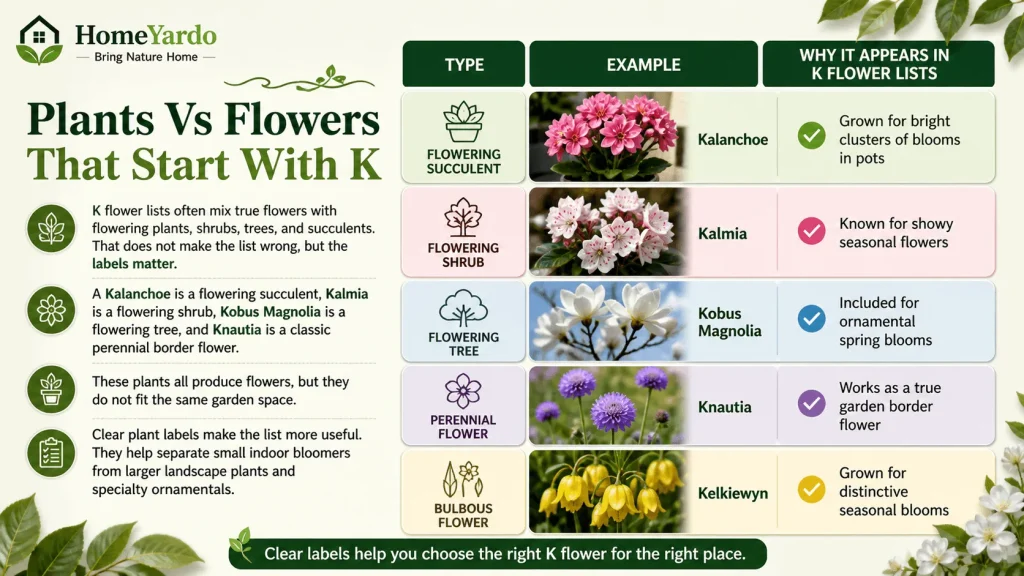
K flower lists often mix true flowers with flowering plants, shrubs, trees, and succulents. That does not make the list wrong, but the labels matter.
A Kalanchoe is a flowering succulent, Kalmia is a flowering shrub, Kobus Magnolia is a flowering tree, and Knautia is a classic perennial border flower. These plants all produce flowers, but they do not fit the same garden space.
| Type | Example | Why It Appears In K Flower Lists |
|---|---|---|
| Flowering succulent | Kalanchoe | Grown for bright clusters of blooms in pots |
| Flowering shrub | Kalmia | Known for showy seasonal flowers |
| Flowering tree | Kobus Magnolia | Included for ornamental spring blooms |
| Perennial flower | Knautia | Works as a true garden border flower |
| Bulbous flower | Kelkiewyn | Grown for distinctive seasonal blooms |
Clear plant labels make the list more useful. They help separate small indoor bloomers from larger landscape plants and specialty ornamentals. For another list that mixes classic blooms with flowering plants, see flowers that start with H.
Types of Flowers That Start With K
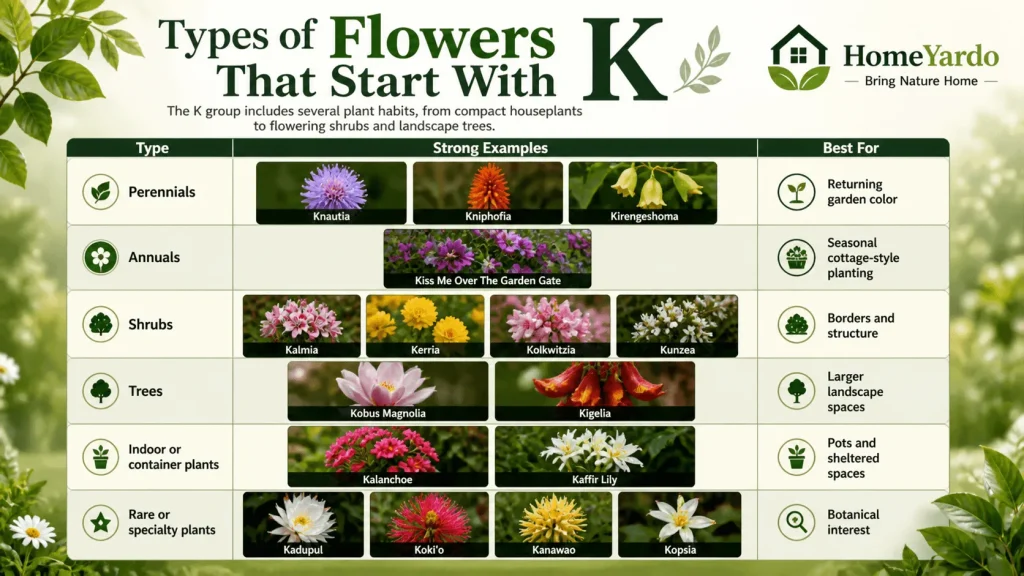
The K group includes several plant habits, from compact houseplants to flowering shrubs and landscape trees. Plant type affects care, spacing, pruning, watering, and where the flower belongs.
| Type | Strong Examples | Best For |
|---|---|---|
| Perennials | Knautia, Kniphofia, Kirengeshoma | Returning garden color |
| Annuals | Kiss Me Over The Garden Gate | Seasonal cottage style planting |
| Shrubs | Kalmia, Kerria, Kolkwitzia, Kunzea | Borders and structure |
| Trees | Kobus Magnolia, Kigelia | Larger landscape spaces |
| Indoor or container plants | Kalanchoe, Kaffir Lily | Pots and sheltered spaces |
| Rare or specialty plants | Kadupul, Koki’o, Kanawao, Kopsia | Botanical interest |
For a broader alphabet list with many common garden choices, see flowers that start with C.
Perennials That Start With K
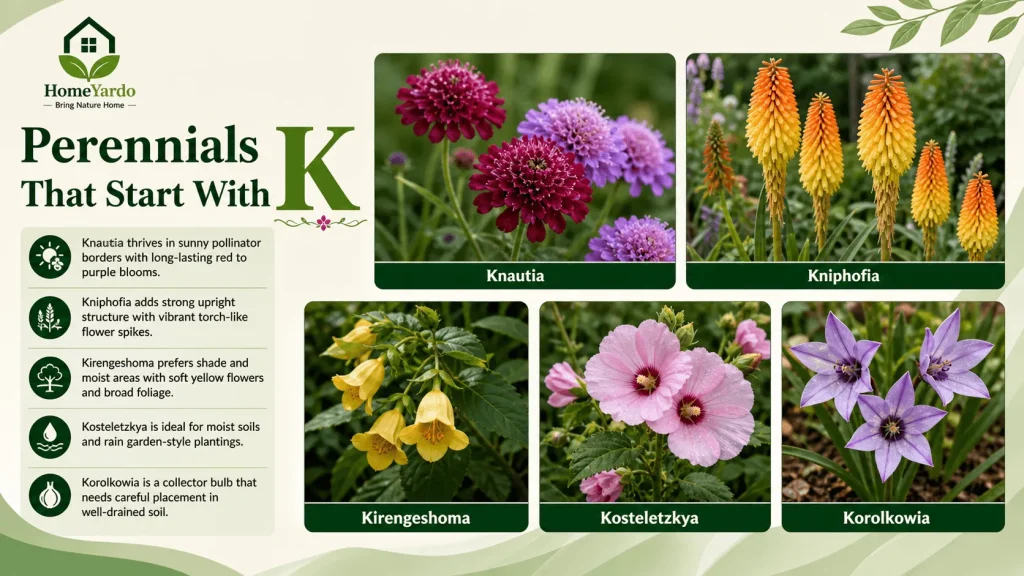
Several K flowers work well as perennial choices when the site matches their needs. Knautia is useful in sunny pollinator borders because it produces small, rich red to purple blooms over a long period.
Kniphofia gives sunny beds a strong upright shape with torch-like flower spikes. Kirengeshoma suits shaded gardens better, especially where softer yellow flowers and broad foliage fit the planting style.
Kosteletzkya is a better match for moist soil and rain garden-style planting. Korolkowia belongs more to collector bulb planting and needs careful placement in well-drained soil. For more perennial and border flower ideas, see flowers that start with M.
Annual Flowers That Start With K
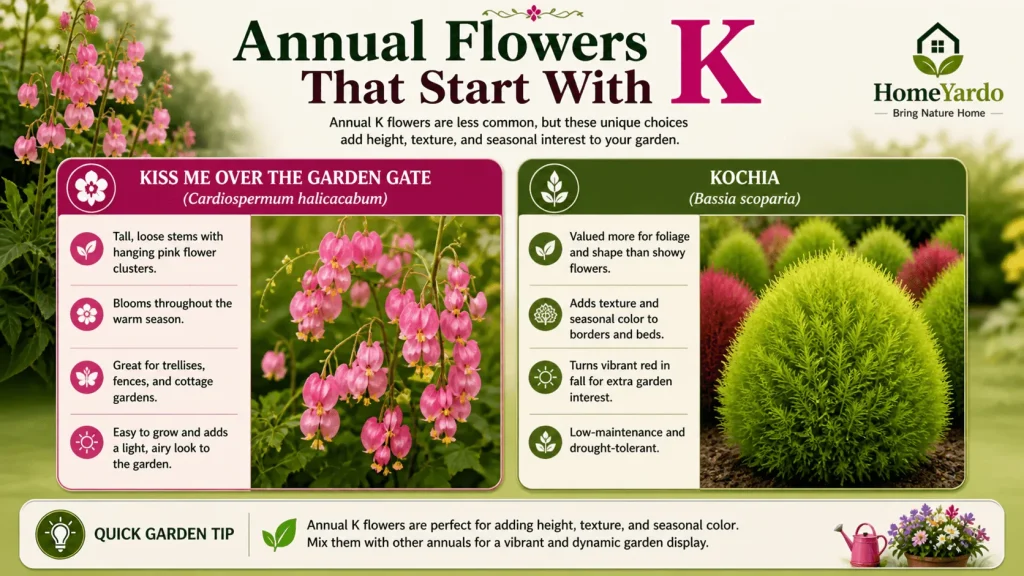
Annual K flowers are less common than perennial and shrub entries. Kiss Me Over The Garden Gate is the clearest choice because it brings tall, loose stems and hanging pink flower clusters through the warm season.
Kochia is sometimes included in K plant lists, but it is valued more for foliage and shape than classic showy flowers. It can still fit ornamental annual beds where texture and seasonal color are the main goals.
Purple Flowers That Start With K
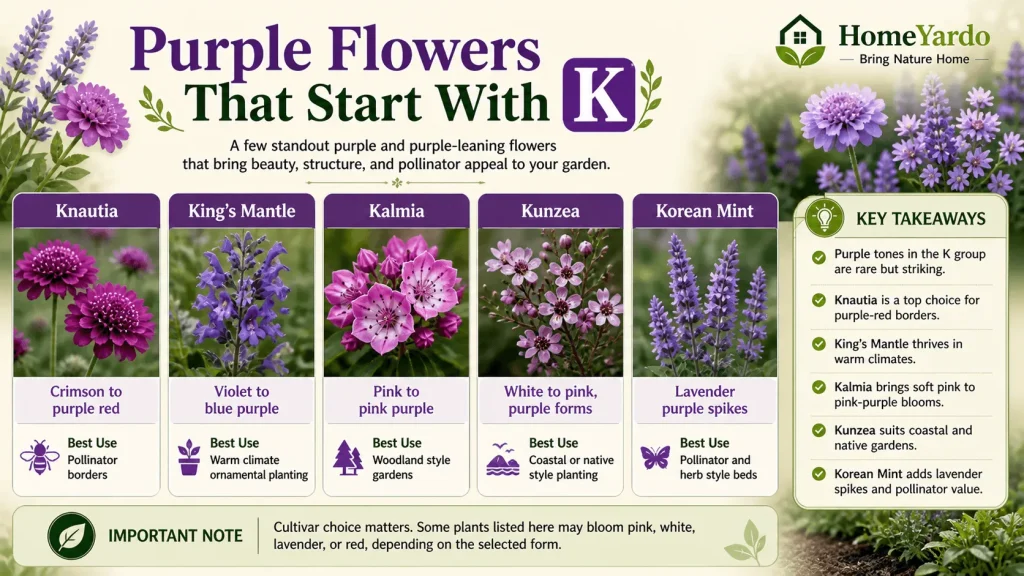
Purple is not the most common color in the K group, but a few flowers give strong purple, violet, or purple-leaning tones. Knautia is one of the best options for a purple-red border flower.
| Flower | Purple or Purple-Leaning Shade | Best Use |
|---|---|---|
| Knautia | Crimson to purple red | Pollinator borders |
| King’s Mantle | Violet to blue purple | Warm climate ornamental planting |
| Kalmia | Pink to pink purple varieties | Woodland style gardens |
| Kunzea | White to pink, purple forms | Coastal or native style planting |
| Korean Mint | Lavender purple spikes | Pollinator and herb style beds |
Cultivar choice matters. Some plants listed here may bloom pink, white, lavender, or red, depending on the selected form. For more purple, pink, and pollinator-friendly blooms, see flowers that start with P.
K Flower Names By Color
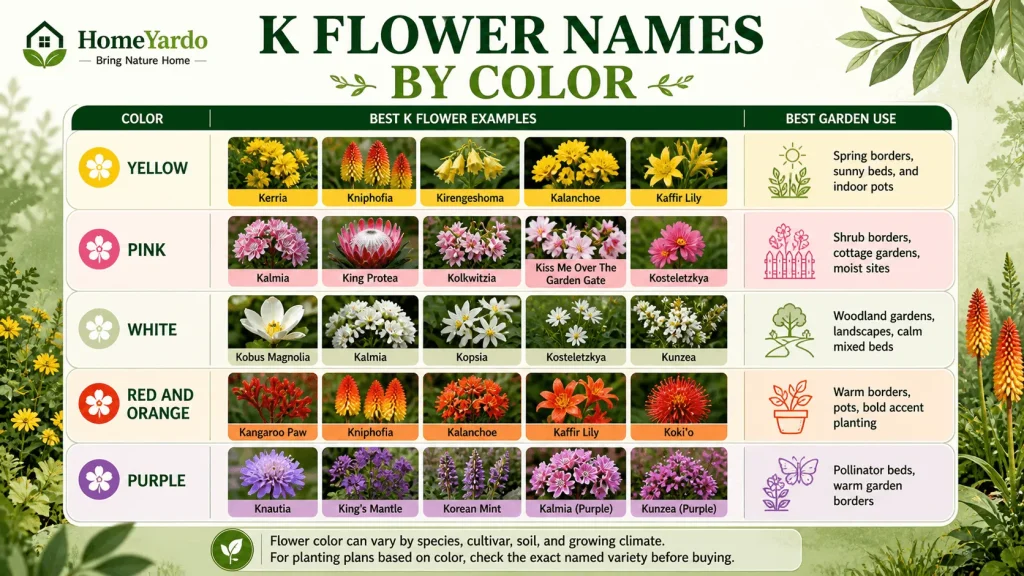
Color is one of the easiest ways to narrow a K flower list. Some K flowers bring soft woodland shades, while others add hot orange, red, or yellow tones.
| Color | Best K Flower Examples | Best Garden Use |
|---|---|---|
| Yellow | Kerria, Kniphofia, Kirengeshoma, Kalanchoe, Kaffir Lily | Spring borders, sunny beds, and indoor pots |
| Pink | Kalmia, King Protea, Kolkwitzia, Kiss Me Over The Garden Gate, Kosteletzkya | Shrub borders, cottage gardens, moist sites |
| White | Kobus Magnolia, Kalmia, Kopsia, Kosteletzkya, Kunzea | Woodland gardens, landscapes, calm mixed beds |
| Red And Orange | Kangaroo Paw, Kniphofia, Kalanchoe, Kaffir Lily, Koki’o | Warm borders, pots, bold accent planting |
| Purple | Knautia, King’s Mantle, Korean Mint, some Kalmia, some Kunzea | Pollinator beds, warm garden borders |
Flower color can vary by species, cultivar, soil, and growing climate. For planting plans based on color, check the exact named variety before buying. For another color-rich flower list with many garden favorites, see flowers that start with S.
Are There Indoor Flowers That Start With K?
Yes. Kalanchoe is the strongest indoor K flower because it stays compact, blooms in bright clusters, and handles container life well. It suits windowsills, tabletops, and bright indoor areas where watering can be controlled.
Kaffir Lily is another useful option for indoor pots or sheltered patios. It has strap-like foliage and clusters of orange, red, or yellow flowers. It prefers steady conditions instead of constantly wet soil.
| Indoor Pick | Why It Works | Basic Care Note |
|---|---|---|
| Kalanchoe | Compact, colorful, pot-friendly | Give bright light and let the soil dry between watering |
| Kaffir Lily | Strong foliage and showy clusters | Use bright indirect light and a well-drained potting mix |
The main indoor mistake is overwatering. Succulent types and fleshy-rooted plants usually struggle when the soil stays wet for too long.
Which K Flowers Are Good For Beginners?
The easiest K flowers depend on the growing space. A beginner with a sunny windowsill needs a different plant than someone filling an outdoor border.
Kalanchoe is the best beginner choice for indoor pots. Kerria is a simple shrub for spring color where climate and space are suitable. Kniphofia and Knautia are good outdoor options for sunny borders.
| Beginner Need | Best Pick | Why |
|---|---|---|
| Indoor pot | Kalanchoe | Compact and forgiving when not overwatered |
| Sunny border | Kniphofia | Bold color and strong garden presence |
| Shrub border | Kerria | Easy spring color and simple care |
| Pollinator border | Knautia | Long bloom value and useful nectar |
| Shade garden | Kirengeshoma | Better fit for softer garden light |
Rare K flowers are usually not the best first choice. Many need specific climates, special soil, or more plant knowledge.
Best K Flowers By Use
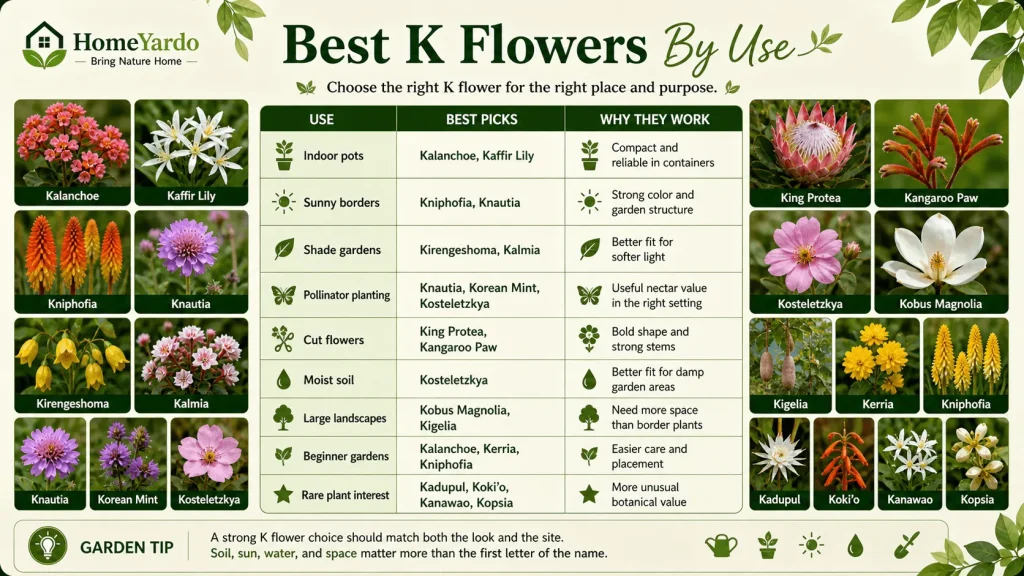
Choosing by use is often easier than choosing by name. A flower that works beautifully in a bouquet may not suit a small container, and a flowering tree may not belong in a compact border.
| Use | Best Picks | Why They Work |
|---|---|---|
| Indoor pots | Kalanchoe, Kaffir Lily | Compact and reliable in containers |
| Sunny borders | Kniphofia, Knautia | Strong color and garden structure |
| Shade gardens | Kirengeshoma, Kalmia | Better fit for softer light |
| Pollinator planting | Knautia, Korean Mint, Kosteletzkya | Useful nectar value in the right setting |
| Cut flowers | King Protea, Kangaroo Paw | Bold shape and strong stems |
| Moist soil | Kosteletzkya | Better fit for damp garden areas |
| Large landscapes | Kobus Magnolia, Kigelia | Need more space than border plants |
| Beginner gardens | Kalanchoe, Kerria, Kniphofia | Easier care and placement |
| Rare plant interest | Kadupul, Koki’o, Kanawao, Kopsia | More unusual botanical value |
A strong K flower choice should match both the look and the site. Soil, sun, water, and space matter more than the first letter of the name.
Fragrant And Pollinator Friendly K Flowers
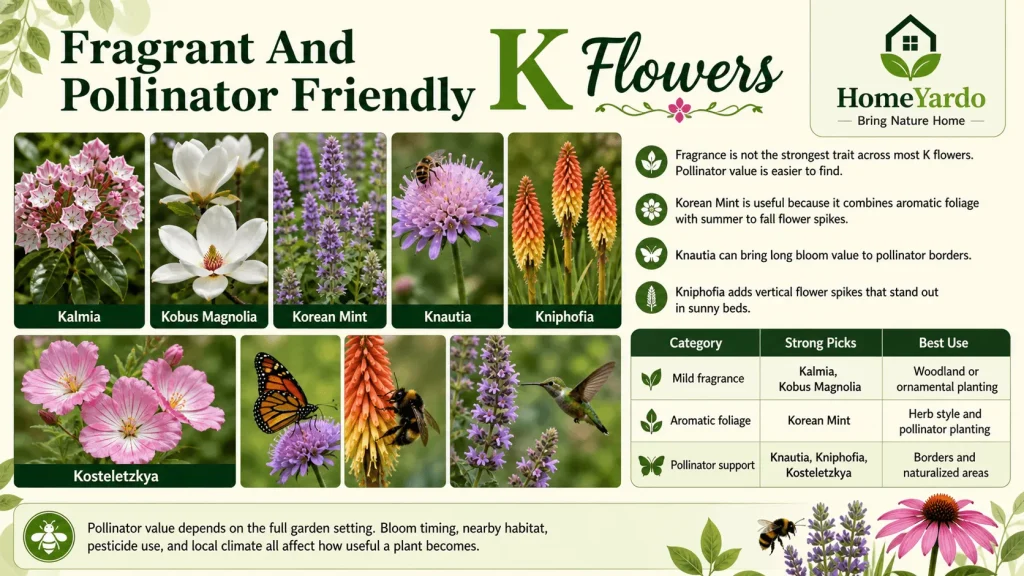
Fragrance is not the strongest trait across most K flowers. Pollinator value is easier to find, especially among Knautia, Kniphofia, Korean Mint, and Kosteletzkya.
Korean Mint is useful because it combines aromatic foliage with summer to fall flower spikes. Knautia can bring long bloom value to pollinator borders. Kniphofia adds vertical flower spikes that stand out in sunny beds.
| Category | Strong Picks | Best Use |
|---|---|---|
| Mild fragrance | Kalmia, Kobus Magnolia | Woodland or ornamental planting |
| Aromatic foliage | Korean Mint | Herb style and pollinator planting |
| Pollinator support | Knautia, Kniphofia, Kosteletzkya | Borders and naturalized areas |
Pollinator value depends on the full garden setting. Bloom timing, nearby habitat, pesticide use, and local climate all affect how useful a plant becomes.
Common Flowers That Start With K
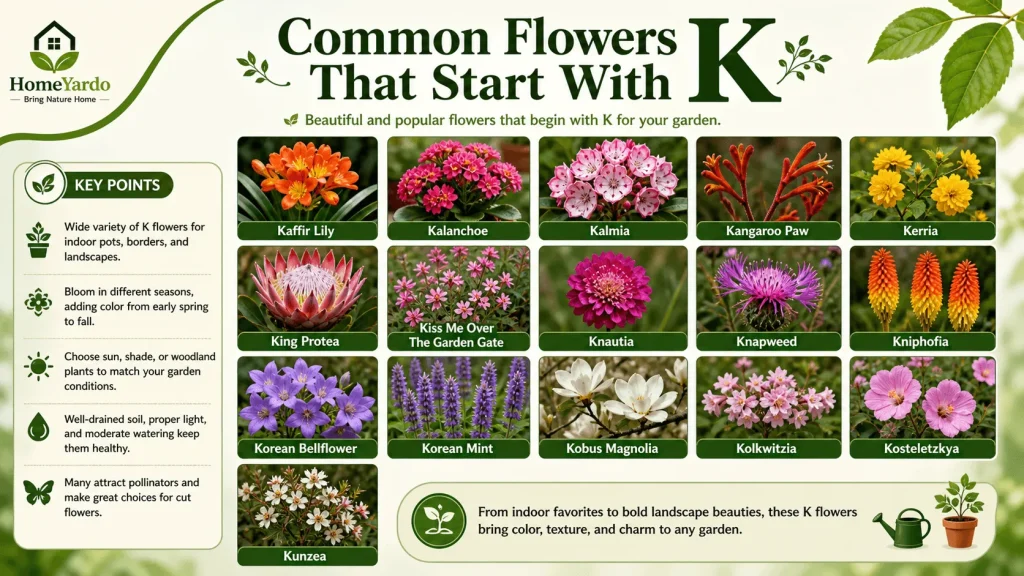
These K flowers are easier to recognize, buy, or place in ordinary garden settings. Some are common in homes and nurseries, while others are familiar because of their strong shape, color, or landscape value.
- Kaffir Lily
- Botanical name: Clivia miniata
- Plant type: Flowering plant
- Main colors: Orange, red, yellow
- Bloom season: Late winter to spring
- Best use: Indoor pots, shaded patios, sheltered containers
- Care note: Use bright indirect light and avoid soggy soil.
- Kalanchoe
- Botanical name: Kalanchoe blossfeldiana
- Plant type: Flowering succulent
- Main colors: Red, pink, orange, yellow, white
- Bloom season: Winter to spring
- Best use: Indoor pots and warm climate containers
- Care note: Give bright light and allow the soil to dry between watering.
- Kalmia
- Botanical name: Kalmia latifolia
- Plant type: Flowering shrub
- Main colors: Pink, white
- Bloom season: Late spring to early summer
- Best use: Woodland gardens and acidic soil plantings
- Care note: It prefers cool, moist, acidic, well-drained soil.
- Kangaroo Paw
- Botanical name: Anigozanthos species
- Plant type: Perennial flower
- Main colors: Red, orange, yellow, green
- Bloom season: Spring to summer
- Best use: Accent planting and cut flowers
- Care note: Full sun and sharp drainage help it perform best.
- Kerria
- Botanical name: Kerria japonica
- Plant type: Flowering shrub
- Main colors: Yellow
- Bloom season: Spring
- Best use: Shrub borders and cottage gardens
- Care note: Light shaping after flowering helps keep the plant tidy.
- King Protea
- Botanical name: Protea cynaroides
- Plant type: Flowering shrub
- Main colors: Pink, cream, red
- Bloom season: Spring to fall by climate
- Best use: Focal planting and bouquets
- Care note: It needs bright exposure, lean soil, and careful watering.
- Kiss Me Over The Garden Gate
- Botanical name: Persicaria orientalis
- Plant type: Annual flowering plant
- Main colors: Pink
- Bloom season: Summer to fall
- Best use: Cottage gardens and informal beds
- Care note: Give it space so the tall, loose stems can show naturally.
- Knautia
- Botanical name: Knautia macedonica
- Plant type: Perennial flower
- Main colors: Crimson, purple red
- Bloom season: Summer to fall
- Best use: Pollinator borders and meadow-style beds
- Care note: Sun and well-drained soil support stronger flowering.
- Knapweed
- Botanical name: Centaurea species
- Plant type: Herbaceous flower
- Main colors: Purple, pink, white
- Bloom season: Summer
- Best use: Meadow-style planting and naturalized borders
- Care note: Choose species carefully because behavior can vary by region.
- Kniphofia
- Botanical name: Kniphofia uvaria
- Plant type: Perennial flower
- Main colors: Red, orange, yellow
- Bloom season: Summer
- Best use: Sunny borders and bold planting schemes
- Care note: Full sun and free-draining soil are important.
- Korean Bellflower
- Botanical name: Campanula takesimana
- Plant type: Perennial flower
- Main colors: Pink, lavender, white
- Bloom season: Summer
- Best use: Cottage gardens and mixed borders
- Care note: It fits cooler to moderate gardens with decent soil moisture.
- Korean Mint
- Botanical name: Agastache rugosa
- Plant type: Herbaceous perennial
- Main colors: Lavender, purple
- Bloom season: Summer to fall
- Best use: Pollinator planting and herb-style borders
- Care note: Sun, drainage, and airflow help the plant stay strong.
- Kobus Magnolia
- Botanical name: Magnolia kobus
- Plant type: Flowering tree
- Main colors: White
- Bloom season: Early spring
- Best use: Ornamental landscape specimen
- Care note: Give it enough space because it becomes a small to medium tree.
- Kolkwitzia
- Botanical name: Kolkwitzia amabilis
- Plant type: Flowering shrub
- Main colors: Pink
- Bloom season: Late spring
- Best use: Shrub borders and informal screens
- Care note: It works best where arching growth has room to spread.
- Kosteletzkya
- Botanical name: Kosteletzkya virginica
- Plant type: Flowering perennial or subshrub
- Main colors: Pink
- Bloom season: Summer
- Best use: Moist soil, rain gardens, damp borders
- Care note: It suits moisture-retentive sites better than dry beds.
- Kunzea
- Botanical name: Kunzea species
- Plant type: Flowering shrub
- Main colors: White, pink
- Bloom season: Spring to summer
- Best use: Coastal, native style, or warm garden planting
- Care note: Select the species according to climate and space.
What Are Rare Flowers That Start With K?
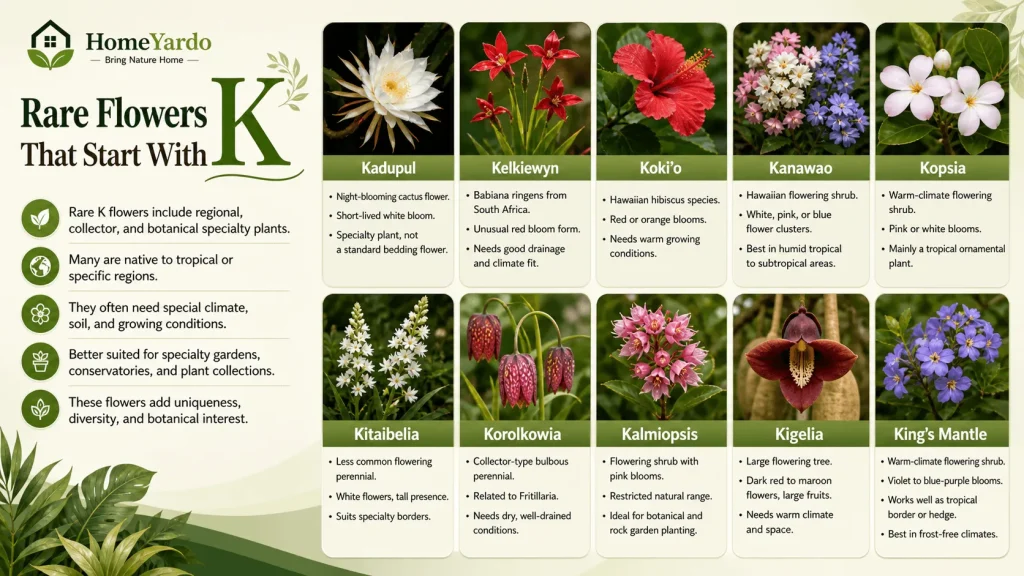
Rare K flowers add depth beyond the familiar garden names. Some are regional plants, some are collector plants, and some are discussed more often in botanical settings than in ordinary home gardens.
- Kadupul
- Kadupul is commonly linked with night-blooming cactus flowers.
- It is valued for its short-lived white bloom and unusual flowering habit.
- It belongs in the rare K group because it is more of a specialty plant than a standard bedding flower.
- Kelkiewyn
- Kelkiewyn is associated with Babiana ringens, a South African bulbous flower.
- It is known for its unusual red bloom form.
- It is better suited to specialty bulb collections than casual flower beds.
- Drainage and climate fit are important.
- Koki’o
- Koki’o refers to the Hawaiian hibiscus species.
- It is often known for red or orange blooms.
- It adds regional interest to a K flower list.
- It is not a typical temperate garden flower and needs warm growing conditions.
- Kanawao
- Kanawao is a Hawaiian flowering shrub.
- Its ornamental flower clusters can include white, pink, or blue tones.
- It is more regionally important than common in general garden centers.
- Humid tropical to subtropical conditions suit it best.
- Kopsia
- Kopsia is a warm-climate flowering shrub.
- It can produce pink or white blooms.
- It fits tropical ornamental planting better than cold climate beds.
- In cooler areas, it is mostly a botanical or conservatory interest.
- Kitaibelia
- Kitaibelia is a less common flowering perennial.
- It produces white flowers and has a tall garden presence.
- It can suit specialty borders where space and climate are appropriate.
- It is not as widely known as Knautia or Kniphofia.
- Korolkowia
- Korolkowia is a collector-type bulbous perennial.
- It is often linked with Fritillaria relatives.
- Its blooms are more subtle than bright bedding flowers.
- It needs dry, well-drained conditions and careful siting.
- Kalmiopsis
- Kalmiopsis is a flowering shrub with pink blooms.
- It has a more restricted natural range than many common shrubs.
- It is valuable in botanical collections and rock garden-style planting.
- It is less common than Kalmia in ordinary landscapes.
- Kigelia
- Kigelia is a large flowering tree.
- It is known for unusual dark red to maroon flowers and large hanging fruits.
- It needs warm climates and landscape space.
- It should not be treated like a normal border flower.
- King’s Mantle
- King’s Mantle is a warm-climate flowering shrub.
- It produces violet to blue-purple blooms.
- It can work as a tropical border or hedge plant.
- It is more practical in frost-free or sheltered climates.
Before Planting K Flowers: Safety, Invasive, And Climate Notes
A flower list should also help prevent poor plant choices. Some K plants need caution because of toxicity, local plant restrictions, climate sensitivity, size, or watering needs.
| Concern | Examples | What To Know |
|---|---|---|
| Toxicity caution | Kalmia | Avoid casual planting where pets or children may chew plant parts |
| Invasive concern | Kudzu if included elsewhere | Do not treat it as a normal garden flower |
| Climate sensitivity | King Protea, Kangaroo Paw | Best in warm, bright, well-drained conditions |
| Space needs | Kobus Magnolia, Kigelia | Better for landscapes than small beds |
| Overwatering risk | Kalanchoe | Succulent types dislike soggy soil |
| Species variation | Knapweed, Kunzea | Choose the exact species with local guidance |
Before planting any unfamiliar flower, check local extension guidance or a trusted plant database. Regional climate and local plant rules can change whether a plant is useful, risky, or impractical.
Growing Snapshot
K flowers do not share one care pattern. Some prefer sunny, dry, well-drained sites. Others need shade, moisture, acidic soil, or indoor protection.
Kalanchoe and Kaffir Lily are mainly practical as pot plants in many climates. Kalmia and Kirengeshoma lean toward softer light. Kniphofia, King Protea, and Kangaroo Paw need brighter sites and strong drainage. Kosteletzkya stands out because it can handle wetter soil than many other K flowers.
Sun, Soil, Water, And Bloom Season Patterns
Matching the plant to the site is the simplest way to avoid failure. A dry sunny border plant and a woodland shrub should not receive the same care.
| Growing Condition | Best K Examples | Notes |
|---|---|---|
| Full sun and drainage | Kangaroo Paw, King Protea, Kniphofia | Avoid waterlogged soil |
| Indoor bright light | Kalanchoe, Kaffir Lily | Best in pots or sheltered spaces |
| Part shade | Kalmia, Kirengeshoma | Better for woodland-style settings |
| Moist soil | Kosteletzkya | Useful for rain garden-style planting |
| Acidic soil | Kalmia | Soil condition matters |
| Larger landscape space | Kobus Magnolia, Kigelia | Not ideal for small beds |
Bloom season also affects placement. Spring bloomers such as Kerria and Kobus Magnolia give early color, while Knautia, Korean Mint, Kosteletzkya, and Kiss Me Over The Garden Gate can support later season interest.
Common Growing Mistakes
Many K flower problems come from treating the whole list as one plant group. These names do not all need the same light, soil, or watering.
Checklist:
- Do not treat every K flower as a full sun border plant.
- Do not overwater succulent types such as Kalanchoe.
- Do not choose rare plants without checking climate fit.
- Do not plant large shrubs or trees in tight beds.
- Do not assume every K flower is a true bedding flower.
- Do not ignore local invasive plant guidance.
- Do not expect every cultivar to bloom in the same color.
- Do not place shade-suited plants in hot, exposed beds.
A flower can be easy in the right site and difficult in the wrong one.
Best Garden Uses
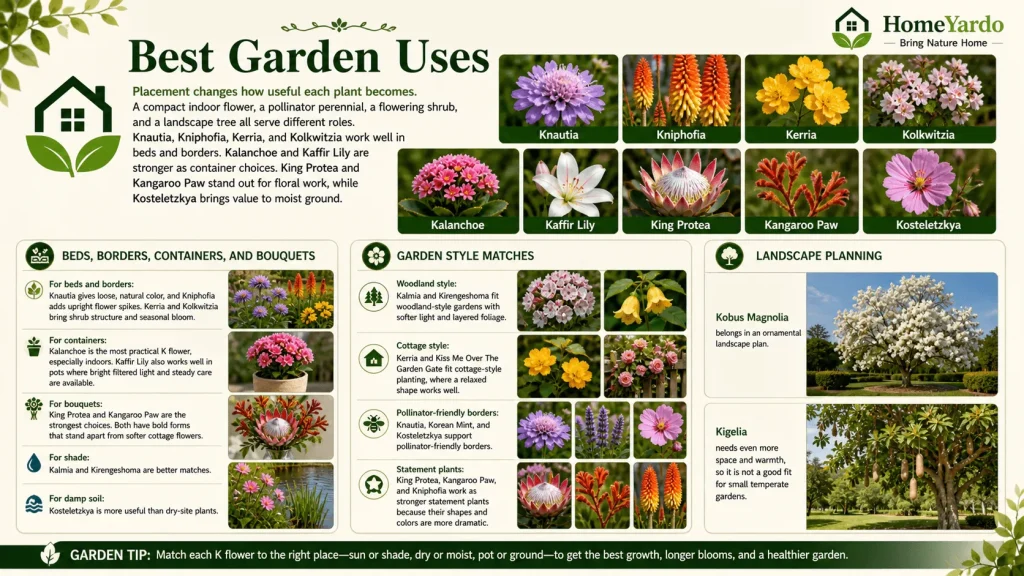
Placement changes how useful each plant becomes. A compact indoor flower, a pollinator perennial, a flowering shrub, and a landscape tree all serve different roles.
Knautia, Kniphofia, Kerria, and Kolkwitzia work well in beds and borders. Kalanchoe and Kaffir Lily are stronger as container choices. King Protea and Kangaroo Paw stand out for floral work, while Kosteletzkya brings value to moist ground.
Beds, Borders, Containers, And Bouquets
For beds and borders, Knautia gives loose, natural color, and Kniphofia adds upright flower spikes. Kerria and Kolkwitzia bring shrub structure and seasonal bloom.
For containers, Kalanchoe is the most practical K flower, especially indoors. Kaffir Lily also works well in pots where bright filtered light and steady care are available.
For bouquets, King Protea and Kangaroo Paw are the strongest choices. Both have bold forms that stand apart from softer cottage flowers. For shade, Kalmia and Kirengeshoma are better matches. For damp soil, Kosteletzkya is more useful than dry-site plants.
Garden Style Matches
Different K flowers suit different garden looks. Kalmia and Kirengeshoma fit woodland-style gardens with softer light and layered foliage. Kerria and Kiss Me Over The Garden Gate fit cottage-style planting, where a relaxed shape works well.
Knautia, Korean Mint, and Kosteletzkya support pollinator-friendly borders. King Protea, Kangaroo Paw, and Kniphofia work as stronger statement plants because their shapes and colors are more dramatic.
Kobus Magnolia belongs in an ornamental landscape plan. Kigelia needs even more space and warmth, so it is not a good fit for small temperate gardens.
Conclusion
Flower names that start with K range from easy indoor plants to rare collector blooms and large landscape ornamentals. The most useful choices depend on plant type, color, bloom season, garden role, and growing conditions.
For simple starting points, Kalanchoe, Kerria, Knautia, and Kniphofia are among the most practical names. For bold flowers, King Protea and Kangaroo Paw stand out. For rare botanical interest, Kadupul, Koki’o, Kanawao, Kopsia, and Kelkiewyn add variety.
The best result comes from matching each flower to the right light, soil, water level, climate, and space.
FAQ’s
K Flower names include Kalanchoe, Kalmia, Kangaroo Paw, King Protea, Knautia, Kniphofia, Kerria, and Kaffir Lily. Longer lists may also include flowering shrubs, trees, and rarer botanical plants.
There is no official fixed total because some lists only include common flowers, while others expand into shrubs, trees, vines, and rarer botanical names. In practical garden content, a useful K list usually falls between a shorter core list and a broader expanded list.
Kalanchoe is one of the most widely recognized because it is common in homes and garden centers. King Protea and Kangaroo Paw are also highly recognizable because their flower shapes are so distinctive.
Yes. Kalanchoe is one of the easiest indoor K flowers because it stays compact, blooms brightly, and handles lighter watering well. Kaffir Lily is another strong option for bright indoor spaces or sheltered patios where conditions stay steady.
Kadupul is one of the clearest examples because of its short-lived night bloom. Kelkiewyn, Koki’o, Kanawao, and Kopsia also belong in the rarer side of the K list because they are much less common in ordinary home gardens.
Yes. Knapweed belongs in a K-flower list and is one of the more practical outdoor choices in this group. It is especially useful for pollinator-friendly planting and natural-looking borders.
Several Flower names start with K bloom in yellow shades. Good examples include Kerria, Kniphofia in yellow-toned varieties, Kirengeshoma with its soft yellow flowers, and some Kalanchoe selections. These flowers give the K list a useful mix of bright garden color and softer yellow tones.
Yes. A few K flower names have strong Hawaiian ties. Koki’o is one of the best-known examples, and Kanawao also adds regional Hawaiian interest to the K group. These plants are less common in everyday home gardening, but they broaden the list with more botanical and regional depth.
Knautia is one of the strongest purple-leaning examples. Some Kalmia varieties, King’s Mantle, and some Kunzea forms can also fit that search depending on the bloom shade.
A flower list usually focuses on bloom-first ornamentals, while a flowering plant list may also include shrubs, trees, vines, and houseplants. A stronger article labels those types clearly so readers know whether a name belongs to a border, a pot, or a larger landscape space.
Yes. Knautia, Kniphofia, Korean Mint, and Kosteletzkya can all support pollinator activity in the right conditions. Their value is strongest where bloom timing, sun, and nearby habitat also support visiting insects and birds.
References