Air Plants In A Terrarium: Types, Terrarium Setup, Watering, and Care Guide
Air plants for terrariums can be an ideal, clean, and soil-free option to make a smaller indoor display of plants. They can be used in glasses, bowls, hanging globes, walls, planters, shells, driftwood display, and even large tabletop pots.
The basic rule is easy. Air plants require light, airflow, water, and drying time. They should not be placed in moss, soil, or stagnant water. The terrarium must display the plant and not entrap the plant in moist air.
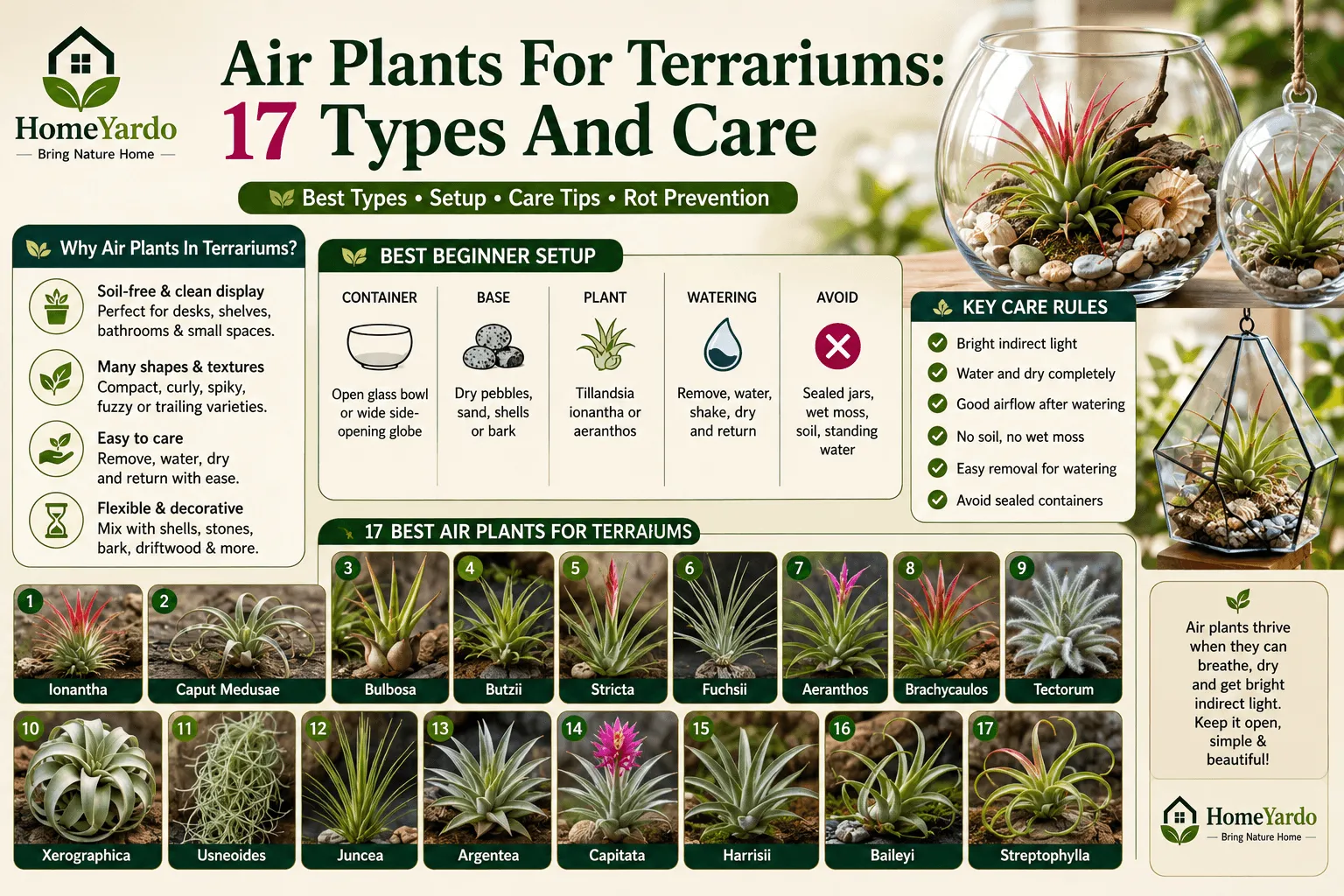
This guide will help you choose the most suitable Tillandsia plant and construct the ideal plant terrarium arrangement to avoid water-related errors, which result in condensation. The guide covers 17 air plant selections, glass globes hanging terrariums, open and closed containers, installation steps, maintenance instructions, as well as common issues and buying advice.
Quick Answer: Can Air Plants Live In Terrariums?
Air plants are able to thrive in terrariums as long as the terrarium is equipped with bright indirect light, airflow, and enough drying time following irrigation.
The open terrariums are much safer than closed containers. Air plants are best placed on pebbles and sand, and dry and shells. They can also be placed on bark or driftwood. The plants should not be placed on the ground or in damp soil or moss.A good air plant’s terrarium needs to allow the plant to breathe dry, and be able to be removed without difficulty to water it.
Best Beginner Setup
- Container: open glass bowl or wide side-opening globe
- Base: pebbles that are dry, shells, sand, or bark
- Plant: Tillandsia Ionantha, or the aeranthos
- The watering method is to remove it, then wash, shake, and dry. Return
- Do not use sealed containers and soil, moss that is wet, or standing water
Benefits Of Air Plants In Terrariums
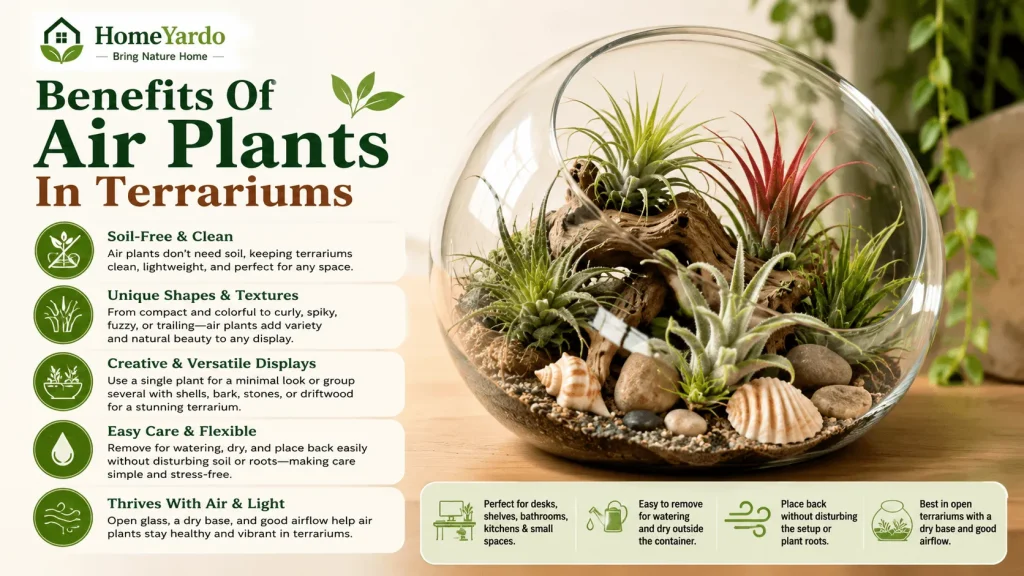
Air plants can be used in Terrariums since they don’t require soil. The display is cleaner than terrariums with soil and can be useful on tables, shelves, bathrooms, kitchens, and small spaces.
There are also a variety of forms and textures. Many are small and bright as well as soft, curly, fluffy, and flowing. An air plant is able to make a beautiful display, and larger pots can be used to house multiple plants, including stone, bark, or driftwood.
One of the biggest benefits is its Flexibility. The air plants are able to be removed for watering, dried inside the pot, and then put back in the same container without disturbing the roots or soil. This arrangement is most effective with the glass open while the base remains dry and the plant is able to breathe.
What Are Air Plants And Why Do They Work In Terrariums?
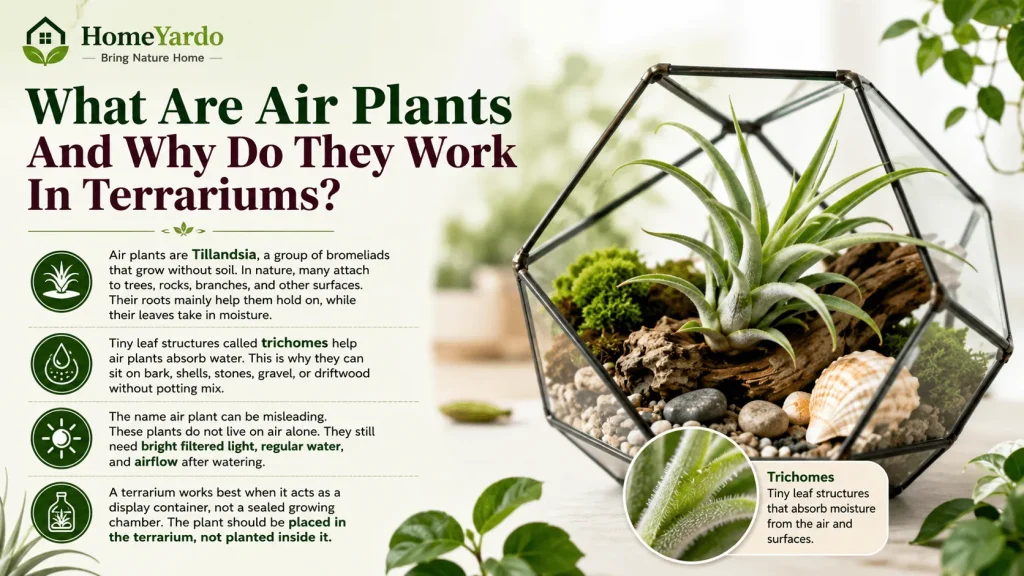
Air plants include Tillandsia (a species) of bromeliads, which do not require soil. They are found in nature and attach to rocks, trees, branches, and even other structures. The roots aid in holding them, and their leaves absorb the moisture.
The tiny leaf structures known as trichomes assist air plants in absorbing water. That’s why they rest on shells, bark, stone, gravel, or driftwood with no potting mix.
The term “air plant” is often confusing. The plants don’t depend on air for their survival. They need bright filters, regular light as well as airflow following watering.
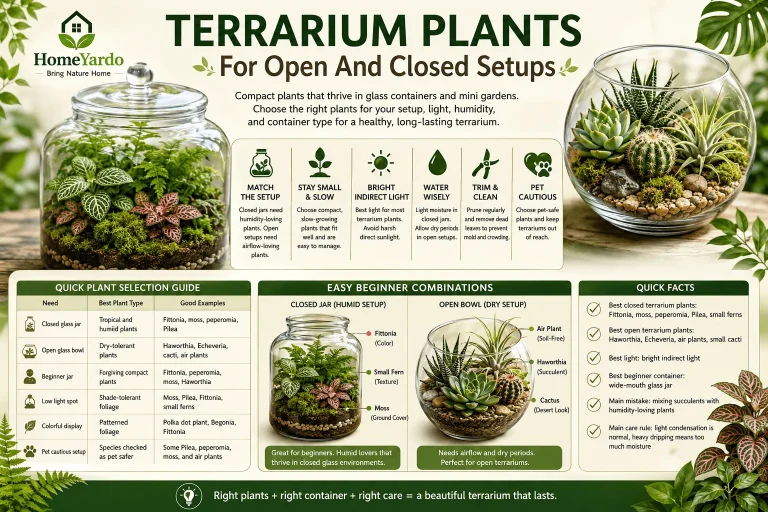
A terrarium is best when it functions as a container for display and not as a closed cultivation chamber. Plants should be put within the terrarium and or placed in it. A more extensive look at jars with lids closed, open bowls, as well as moss, ferns, plants, and succulents, and look at terrarium plants prior to deciding on a glass-based setup.
What Is The Best Air Plant For A Terrarium?

The best terrarium for air plants is small enough to fit the container, easy to remove for watering, and suited to the humidity level in the room. Some Tillandsia handle small glass globes well. Others need larger open bowls so their leaves can spread and dry properly.
Choose by mature size first, display style second, and humidity fit third.
| Air Plant | Best Terrarium Use | Container Fit | Humidity Fit | Beginner Level | Care Note |
|---|---|---|---|---|---|
| Tillandsia ionantha | Small glass globes and beginner displays | Small globes, mini bowls, wall planters | Moderate | Easy | Compact plant that can blush red or pink in brighter light |
| Tillandsia caput medusae | Beach, shell, and driftwood displays | Medium globes and open bowls | Moderate | Easy | Curved leaves give a sea-inspired look |
| Tillandsia bulbosa | Sculptural humid displays | Open glass bowls or wide globes | Higher humidity | Moderate | Bulbous base needs airflow to prevent rot |
| Tillandsia butzii | Humid terrarium displays | Wide globes and open containers | Higher humidity | Moderate | Works better with moisture, but still needs air movement |
| Tillandsia stricta | Tabletop terrariums and mixed displays | Small to medium containers | Moderate | Easy to moderate | Good texture and bloom potential |
| Tillandsia fuchsii | Mini terrariums and delicate designs | Small globes and wall planters | Moderate | Moderate | Fine leaves dry quickly and need careful hydration |
| Tillandsia aeranthos | Simple glass displays | Small to medium open containers | Moderate | Easy | Tough, compact, and useful for beginners |
| Tillandsia brachycaulos | Color-focused displays | Open bowls and medium glass containers | Moderate | Easy to moderate | Can develop strong red tones in bright indirect light |
| Tillandsia tectorum | Dry open displays | Open bowls and airy containers | Lower humidity | Moderate | Fuzzy silver leaves prefer strong drying |
| Tillandsia xerographica | Large open bowl centerpiece | Large open bowls only | Lower to moderate humidity | Moderate | Too large for tight globes or narrow jars |
| Tillandsia usneoides | Hanging accents and vertical displays | Open hanging displays | Moderate to higher humidity | Moderate | Needs airflow and regular moisture |
| Tillandsia juncea | Tall vertical displays | Open tall containers | Moderate | Moderate | Long leaves need space and should not be cramped |
| Tillandsia argentea | Mini texture displays | Small globes and tiny bowls | Moderate | Moderate | Fine leaves need steady care and airflow |
| Tillandsia capitata | Statement plant in open bowls | Medium to large open containers | Moderate | Easy to moderate | Works well as a focal point |
| Tillandsia harrisii | Dry bright displays | Open bowls and airy glass | Lower humidity | Easy to moderate | Silver leaves prefer drying between waterings |
| Tillandsia baileyi | Curved form displays | Medium open containers | Moderate | Moderate | Avoid water sitting near the base |
| Tillandsia streptophylla | Large sculptural displays | Large open bowls | Lower to moderate humidity | Moderate | Leaf curl changes with hydration level |
Best Air Plants For Small Terrariums
Smaller terrariums require plants that are able to traverse the opening with no harm. The most suitable air plants to use in small terrariums are Tillandsia ionantha fuchsii, argentea stricta, aeranthos, and tiny caput medusae.
The plants are great for glass globes, miniature bowls, containers for walls, and smaller desktop terrariums, as they remain easy to manage. It is also possible to remove them for watering, without taking away the entire installation.
Beware of large xerographicas, high capitalta, and large juncea within tiny globes. These may be attractive to look at initially, but the clogged leaves restrict airflow, making the task of watering more difficult.
Best Air Plants For Large Glass Bowls And Open Displays
Large glass bowls give air plants more room to spread, dry, and show their natural shape. They are better for sculptural plants such as xerographica, streptophylla, capitata, brachycaulos, and larger caput medusae.
A wide-open bowl is one of the easiest containers to maintain. The plant can be lifted out for watering, placed back after drying, and arranged without pressing leaves against the glass.
Large containers should still use dry base materials. Pebbles, shells, bark, driftwood, and gravel are better than wet moss or soil.
Tillandsia Ionantha Vs Xerographica For Terrariums

Tillandsia ionantha and Tillandsia xerographica are both good terrarium plants, but they fit very different containers. Ionantha is compact and better suited for small glass globes. Xerographica is larger and works best as a statement plant in a wide open bowl.
| Feature | Tillandsia Ionantha | Tillandsia Xerographica |
|---|---|---|
| Best container | Small glass globe, mini terrarium, wall planter | Large open bowl or wide display |
| Size | Small | Large |
| Beginner fit | Easier | Moderate |
| Watering risk | Can dry fast in dry rooms | Curled leaves can hold water |
| Best look | Compact colorful accent | Sculptural centerpiece |
| Avoid | Crowded mini displays | Narrow globes and sealed jars |
Ionantha is the safer choice for a first air plant glass globe. Xerographica needs more room, better airflow, and careful drying after watering.
Open Vs Closed Terrariums For Air Plants
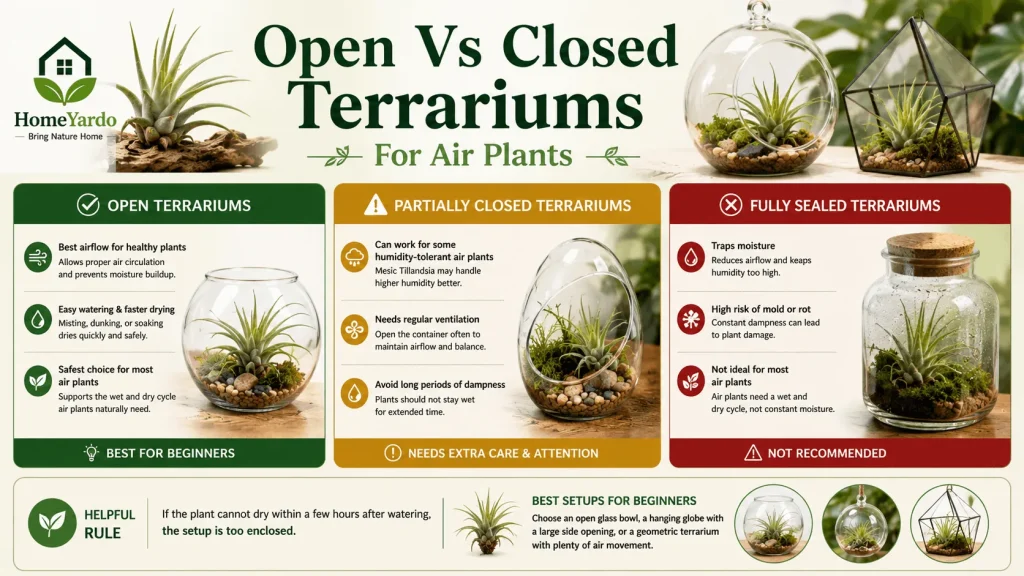
The most secure open terrariums are an alternative for a majority of air plant species. They provide greater airflow, more efficient irrigation, and quicker drying when misting, dunking, or soaking.
Partially enclosed terrariums are a good option with some plants that tolerate humidity. However, they require more attention. The container needs to be opened frequently, and the plants should not be kept damp for prolonged periods of time.
Terrariums with a complete seal aren’t recommended for all air plant species. They can trap moisture, decrease airflow, and increase the chances of developing mold or decay. Air plants require a moist and dry cycling, not perpetual humidity.
The most effective way to do this is if the plant is not able to dry up within a couple of hours after watering it, the plant is not sufficiently closed. Mesic Tillandsia can be more tolerant of humidity than other types that prefer dry air; they do require airflow.
To start, pick an open-faced glass bowl, an elongated globe that has wide side openings, as well as an elongated terrarium that has plenty of air circulation.
Best Air Plant Containers: Glass Globes, Hanging Terrariums, And Open Displays
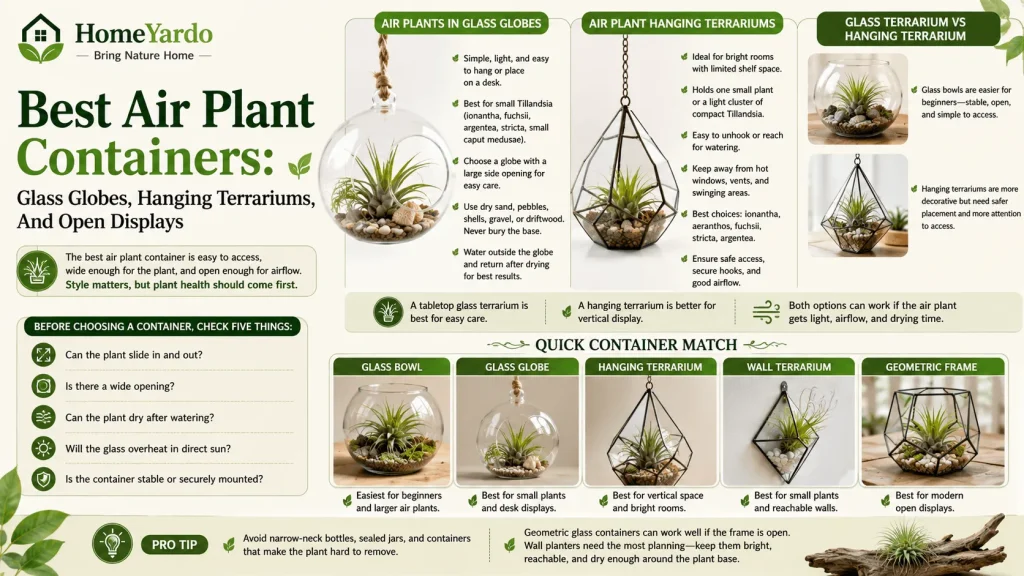
The ideal air plant pot is accessible and wide enough to accommodate the plant and wide enough to allow airflow. Design is crucial, but the plant’s well-being should be first.
When you are choosing a container, be sure to check the following five points:
- Does the plant have the ability to slide in and out?
- Are there wide-openings?
- Does the plant need to dry out following irrigation?
- Can the glass melt in direct sunlight?
- Are the containers stable and well-secured?
The best options are glass bowls and globes of air plants hanging in terrariums, wall plants, dishes, that are shallow and geometric frames. Do not use narrow-necked bottles, sealed containers, or containers that make it difficult to take down
Air Plants In Glass Globes
Glass globes with air plants are very popular due to their basic, light, and easy-to-hang or set on a desk. They’re best used with smaller Tillandsia, such as ionantha Fuchsii, argentea, and stricta, and tiny medusae caput.
Pick a glass air plant that has a wide side opening. It should be able to slide into and out of the glass without damaging. This helps with watering and stops leaves from becoming bent or smashed.
Utilize dry sand, pebbles, gravel, shells, or driftwood within the globe. Avoid burying the air base of the plant in sand. It should be placed lightly on the display materials.
If the glass is misting, be aware of moisture spots as well as stagnant moisture. The air plants that are housed in glass typically do better if they were it is watered outside of the globe, and then washed after drying.
Air Plant Hanging Terrariums
A hanging air plant terrarium can be used in areas with lots of light where space for shelves is small. The terrarium that hangs from the ceiling can accommodate a single plant, or even a small group of Tillandsia. If you are looking for more ideas to grow vertically outside of glass globes, an indoor hanging plant will also be a good fit in spaces with bright lighting, safe positioning, and good air flow.
The most efficient hanging containers that are easy to take off or use to water. If the height of the container is tall, your care may be inconsistent. Be sure to keep globes out of heating vents, hot windows, and areas in which glass can swing or be slammed.
Smaller ionantha, aeranthos stricta, fuchsii, and argentea are more suitable instead of large, bulky plant species. Glass terrariums that hang must always have secure hooks that are secure, as well as enough airflow to dry.
Glass Terrarium Vs Hanging Terrarium For Air Plants
Glass bowls are a great choice to use for novices because they’re sturdy, open, and accessible. Terrariums that are hung look attractive; however, they require greater care and a safer place in order to get accessibility.
Tabletop glass terrariums are most suitable when the objective is simple maintenance. An encased terrarium can be ideal when you require the vertical aspect of the display. The two options are viable when the air plant is provided with sunlight, airflow, and drying times.
Quick Container Match
- Glass bowls are the best for newbies and bigger air planters
- Glass globes work best with smaller plants, as well as desk displays
- Hanging terrariums are ideal for using vertical space and large, bright spaces
- Wall terrariums are ideal for smaller plants, and with reachable walls
- Geometric frame: best for modern open displays
Geometric glass containers can also be useful if the frame has an opening. Wall planters require the best plan because they need to remain clear, accessible, and dry to be able to stand up around the plant’s base
What To Put In An Air Plant Terrarium?

A terrarium for an air plant should utilize dry decorative elements rather than soil. The materials will be designed to enhance the look and help hold the plant’s position; however, they shouldn’t stay in contact with the base.
Dry sand is a good choice, as are pebbles, gravel, glass stones, driftwood, cork, cholla bark, sea Urchin shells, preserved and drained stone, moss, and crystals. Miniature figures are a good option in the event that they don’t hold water in the plants.
Utilize safe layering to build the display. Beginning with a dry base to create a pleasing appearance. You can add a little preserved moss, should you desire. Make use of shells, bark, or stones to elevate the plant over anything that could contain moisture.
Conserved moss can be safer than living moss that is wet when set in proximity to plants. Living moss typically requires more water than Tillandsia, and pressing wet moss against the ground can result in rotting.
To mount, make use of natural cracks in bark, driftwood, or shells when feasible. If glue is required for mounting, apply a tiny amount of glue that is safe for plants in the area of the dead base and not on the living leaves. Do not use Copper wires and standing water, pot soil, and moist layers that are in contact with the base or crown.
DIY Air Plant Terrarium: Build A Terrarium Step By Step
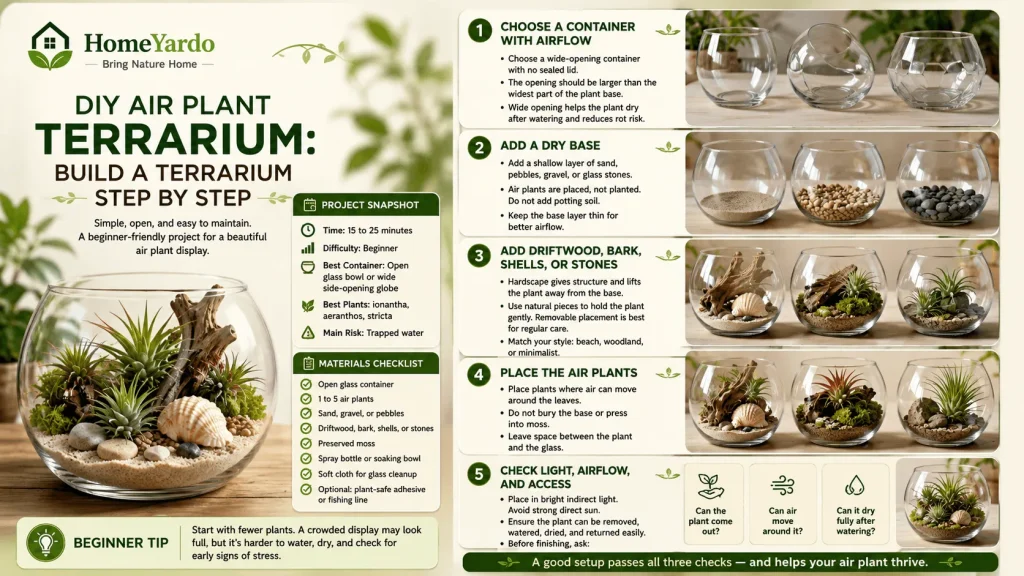
A home-made air plant terrarium is one that is simple, clear, and easy to keep. The terrarium of a beginner air plant DIY is ideal with a few plants, a large glass container, and dry ornamental materials.
The aim is to construct an impressive terrarium that still allows the plant to be exposed to light, airflow, moisture, and drying. An attractive container won’t be beneficial if it can’t be moved to a clean area for cleaning.
Project Snapshot
- Time between 15 and 25 minutes
- The difficulty is for beginners.
- Best container: open glass bowl or wide side-opening globe
- Best plants: ionantha, aeranthos, stricta
- The main risk is water trapped
Materials Checklist
Make a list of the materials you will need to build the enclosure. The setup should be lightweight and simple to alter.
- Crack open a glass
- One to five air plants
- Sand, gravel, or pebbles
- Shells, driftwood, bark, or even stones
- Moss that has been preserved
- The spray bottle, or the water jug
- Soft cloths for glass cleaning
- Alternative plant-safe adhesive, or fishing line
Beginning gardeners need to begin with smaller plant species. An overcrowded garden may appear overflowing, but it’s more difficult to water, dry, and check for signs of stress early.
These steps for terrariums show how to construct a secure and open space where air plants will receive light and airflow, as well as water and drying without being in moist material.
Step 1: Choose A Container With Airflow
Pick a container that has an open, wide-mouthed opening without a closed lid. The plant must have moss and bark. An elegant style could use only one stone and a compact air plant.
Make sure the plant is kept away from any materials that could absorb moisture.
Step 2: Add A Dry Base
Sprinkle a small layer of pebbles, sand, gravel, glass, or stones. The base can be decorative and must remain dry.
The air plants are placed and not established. Avoid adding potting soil since it traps moisture near the base, which can lead to decay.
When you have small globes, try to ensure that the base layer remains in a thin layer. The excess material will overflow the plant and limit the airflow.
Step 3: Add Driftwood, Bark, Shells, Or Stones
Hardscape creates a terrarium structure and lifts plants away from their base. Cork bark, driftwood, shells, cholla wood, and rocks all do the trick.
Utilize natural openings to support the plant with care. It is preferable to remove the placement rather than permanent mounting since the plant requires regular maintenance of watering and drying.
A terrarium with a beach theme can be made using shells, sand, and other materials. For a woodland-themed design, you can make use of preserving the display.
When you call the setup complete, ask three questions before calling the setup finished:
- Is the plant able to be released?
- Is it possible for air to move about?
- Will it completely dry out after irrigation?
An excellent setup can pass each of the three checks.
Step 4: Place The Air Plants
The air plants should be placed in an area in a place where air circulates through the leaves. Don’t bury the base of the plant or press it into the moss.
The plant must be able to move out of the way to water. If it is difficult to remove when you set it up, the pot could be too tight.
Don’t firmly wedge leaves into bark, shells, or shells. The bottom should be visible and dry.
Allow some space between the plant and the glass. This prevents moisture from getting into the leaves.
Step 5: Check Light, Airflow, And Access
Set the terrarium up under bright indirect lighting. Do not let direct sunlight shine through the glass as it could make the container hot and cause burning of the leaves.
Verify that the plant is able to be removed, hydrated or dried and then brought back without being easy to get rid of without having to bend the leaves.
The opening needs to be bigger than the largest portion of the base. This will make drying and watering simpler.
An open space also assists in keeping the plant dry following irrigation. This is among the most effective ways to decrease the chance of rot within glass terrariums.
Make sure you leave enough room for the plant to develop. An overly tight pot may appear appealing at first, but it may restrict airflow and trap moisture.
Air Plant Care Instructions For Terrarium Air Plants

Terrarium air plant care is slightly different from normal air plant care because the glass changes the moisture and heat. Water can stay trapped longer, and sunlight through glass can become too strong.
Healthy care depends on light, watering, humidity, water quality, airflow, temperature, and fertilizer. The safest routine is to water the plant outside the terrarium, dry it fully, then return it to the display.
Quick Care
- Light: bright indirect
- Water: remove and mist, dunk, or soak
- Drying: dry upside down before returning
- Humidity: helpful, but not stagnant
- Airflow: needed after watering
- Fertilizer: light and occasional
Light Needs
Air plants require lighting that is bright and indirect. Bright rooms, an east-facing window, a filtering window, or even a soft grow light will perform well.
Do not expose yourself to direct sunlight through glass. The container may heat up rapidly, and leaves can change color, becoming dry or burnt.
If your room is dark and dark, a grow lamp can assist. Light levels that are low can be an acceptable option for a brief duration; however, it’s not the best choice for long-term development.
Watering Needs
Most air plants should be removed from the terrarium before watering. They can be misted, dunked, or soaked, depending on the plant type and room conditions.
After watering, shake off extra moisture and dry the plant upside down on a towel. Return it to the terrarium only when the base and leaf centers are dry.
A weekly watering rhythm works for many homes, but it should be adjusted. Dry rooms, warm rooms, and bright rooms may need more water. Humid rooms may need less.
Simple Watering Schedule By Room Condition
- Dry bright room: check twice weekly and soak or mist as needed
- Humid bathroom with light: water less often and watch for trapped moisture
- Small glass globe: remove plant for watering and dry fully
- Large open bowl: safer drying and easier care
- Partly closed container: use lighter watering and ventilate often
Air Plant Humidity Needs
Air plants require some humidity; humidity does not mean wetness. Dry, stagnant air in the glass may damage the plant.
Rooms with humidity may decrease the requirement for regular soaking. Rooms that are dry may require greater misting or more irrigation.
Mesic varieties, like butzii and bulbosa, can take on more moisture than silver or fuzzy dry-loving varieties like the tectorum, harrisii, and the xerographica. The plants that can tolerate humidity require airflow.
Bathrooms work best with daylight and ventilation. It is not possible to replace brightness with humidity.
Water Quality For Air Plants
Water that has been filtered, such as rainwater or water with low mineral content, is generally superior to hard tap water. Water that is hard can cause white mineral marks to glass and leaves.
If the tap water you drink is highly chlorinated, allow it to sit prior to use if it is possible.
Do not drink softened water with excessive salt content because it may cause stress on the air plants.
The quality of water won’t fix bad light or insufficient airflow, but it will aid in the growth of healthier leaves over time.
Airflow Needs
Airflow aids in drying the air plants after watering. Also, it reduces the chance of mold, rot, and fungal issues.
Wide globes, open containers, and aerated geometric terrariums allow for more airflow than sealed containers. If a plant is humid for too long will be more likely to die.
It is much more crucial to have airflow in the aftermath of watering as opposed to when the plant is dry. This is crucial in the case of bulbosa or caput medusae, as water could be hidden near the plant’s base.
Temperature Needs
Air plants generally do very well with normal indoor temperatures. Be sure to keep them out of frigid drafts, heating vents, air conditioning vents, and hot glass.
The sudden fluctuations in temperature can be stressful for the plant. The stability of an indoor area with large indirect lighting is much better than windows that get extremely hot in the day, and then cold during the night.
Beware of glass containers that are pressed against windows that are hot in the summer, and against cold windows in winter. If the glass is hot on the skin, it is best to relocate the container.
Fertilizer Needs
Air plants can be fed lightly with diluted air plant or bromeliad fertilizer during periods of active growth. Apply a thin mix, and apply the fertilizer only once or twice.
Avoid feeding small plants in terrariums. Fertilizers should promote the growth of healthy plants, but not substitute for adequate light, water, and airflow.
Don’t use regular fertilizers for your plants unless you are sure it’s suitable for air plants.
Misting Vs Soaking Air Plants In Terrariums
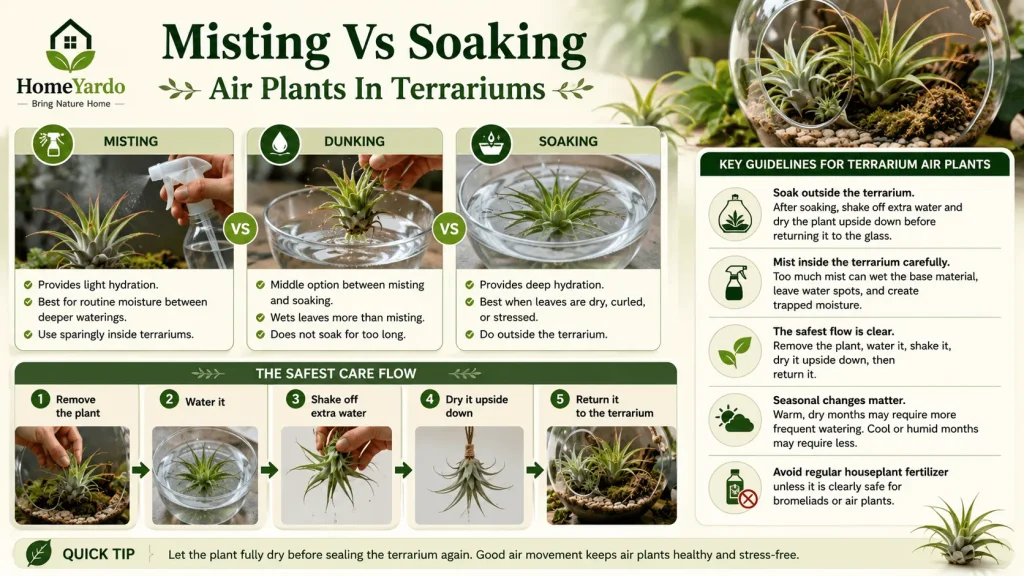
Misting and soaking can both work, but they serve different needs. Misting gives light hydration and is useful between deeper waterings. Soaking gives stronger hydration when leaves are dry, curled, or stressed.
Dunking is a middle option. It wets the leaves more than misting but does not soak the plant for as long.
For terrarium air plants, soaking should usually happen outside the container. After soaking, shake off extra water and dry the plant upside down before returning it to the glass.
Misting inside the terrarium should be used carefully. Too much mist can wet the base material, leave water spots, and create trapped moisture.
The safest flow is clear: remove the plant, water it, shake it, dry it upside down, then return it.
Seasonal changes also matter. Warm, dry months may require more frequent watering. Cool or humid months may require less. The plant should guide the routine through leaf firmness, color, curl, and drying time.
Where To Place An Air Plant Terrarium?
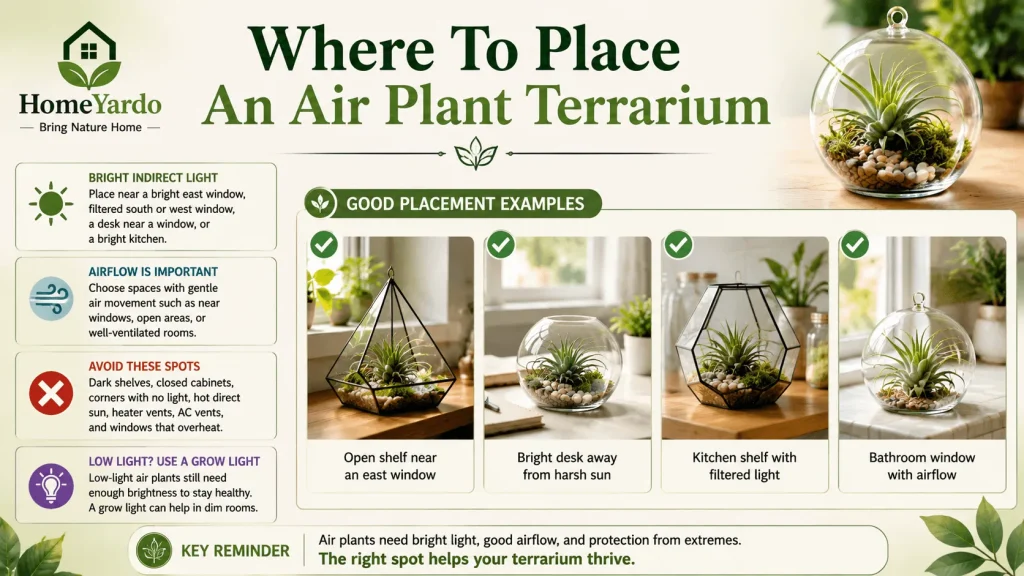
Install your terrarium with an air plant in a place near a window that gets bright indirect sunlight and is surrounded by soft air circulation. An east-facing window that is bright and a well-filtered east or west-facing window, an office near windows, or even the brightness of a kitchen could work effectively.
Bathrooms work best when they are surrounded by natural light as well as air flow. The bathroom that is dark isn’t an ideal long-term location, regardless of whether the humidity is greater.
Beware of dark shelves and corner cabinets that have been closed and are dark. Beware of hot direct sunshine, heater vents, air conditioning vents, and windows in which the glass is overheated.
Air plants with low light levels still require adequate brightness to be fit and healthy. A low light level should be less than optimal light, not darkness. Growing lights may help when the lighting is dim.
A good example of a suitable placement is the open shelves close to an east-facing window, an open desk that is sheltered from the harsh sunlight, and a cabinet that is filtered, or even a bathroom window that has airflow. If you are looking for ideas on placement based upon lighting, balance, and space energy, feng shui plants could provide extra direction to style indoor plants.
Air Plant Terrarium Ideas For Glass, Hanging, Beach, And Wall Displays
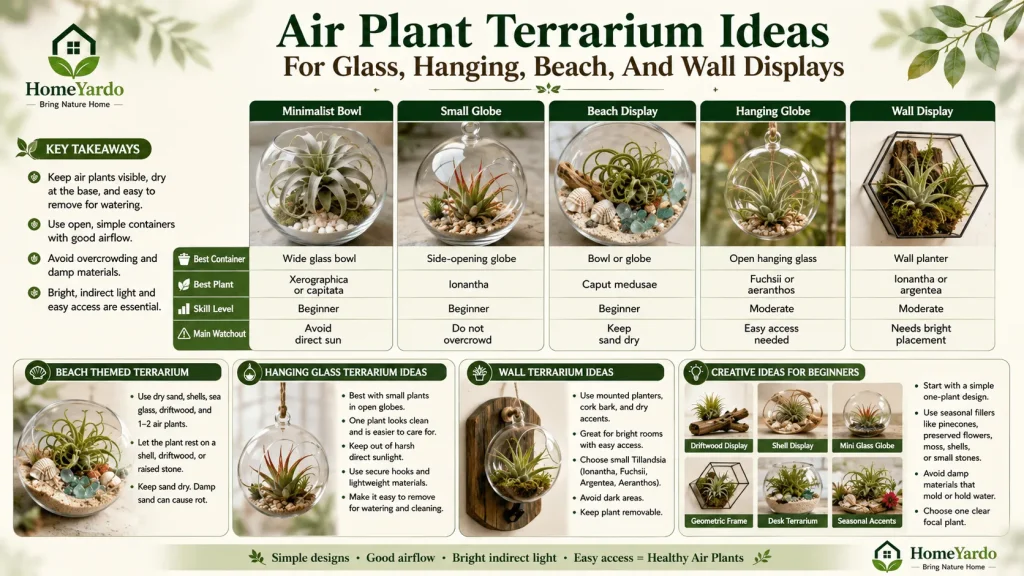
Air plant terrarium ideas should balance appearance with plant health. A good design keeps the air plant visible, dry at the base, and easy to remove for watering.
Creative terrarium ideas can use glass globes, bowls, hanging containers, driftwood, shells, pebbles, bark, and preserved moss. The safest designs are open, simple, and not overcrowded.
| Idea | Best Container | Best Plant | Skill Level | Main Watchout |
|---|---|---|---|---|
| Minimalist bowl | Wide glass bowl | Xerographica or capitata | Beginner | Avoid direct sun |
| Small globe | Side-opening globe | Ionantha | Beginner | Do not overcrowd |
| Beach display | Bowl or globe | Caput medusae | Beginner | Keep sand dry |
| Hanging globe | Open hanging glass | Fuchsii or aeranthos | Moderate | Easy access needed |
| Wall display | Wall planter | Ionantha or argentea | Moderate | Needs bright placement |
Beach Themed Terrarium
A coastal-themed terrarium could use dried sand, shells, driftwood, sea glass, as well as the possibility of two or more air plants. Caput medusae is a good choice due to its curly leaves, which are perfect for seashells and displays that are coastal.
Avoid burying the plant with sand. Place it on a shell, a piece of driftwood, or a raised stone, so that the bottom can dry.
Maintain the sand’s dryness. Sand that is damp near the plant’s base may cause it to turn into decay.
Hanging Glass Terrarium Ideas
Ideas for hanging glass terrariums work most effectively with plants that are small and open globes. One ionantha within a globe looks neat and easier to maintain as opposed to a large hanging display.
Two plants hanging together are possible when the display is large and accessible. The displays that hang in front of windows with bright light must be kept out of the bright light.
Make sure you use secure hooks as well as lighter material. The container must be simple to get out for watering and cleaning.
Wall Terrarium Ideas
Ideas for wall terrariums can include plants that are mounted on glass, cork bark, smaller air plants, and dry accents for decoration. The best displays are in rooms with bright lighting in which the plants are accessible effortlessly.
Small Tillandsia are best used, such as Ionantha, Fuchsii, argentea, or Aeranthos. The larger plants can pull away or be difficult to water.
Do not walk through dark corridors. The wall-mounted display requires ample indirect lighting and airflow. Also, the plant must be able to be removed, even if it appears to be permanent.
Creative Terrarium Ideas For Beginners
Inspiration for terrariums that are beginner-friendly should remain basic. Simple, one-plant bowls are usually the most straightforward design to care for.
Another simple idea is an attractive tabletop display made of driftwood or a display of shells and a glass globe miniature, or the open frame of geometric shapes, or even a tiny desktop Terrarium.
Fillers for the season can alter their appearance without affecting the plants. Utilize dried pinecones and preserved flowers, preserved in color in moss, shells, or tiny stones. Do not use damp natural material that can create mold or absorb water on the base of the plant. If you are looking for more plant ideas to decorate outdoor terrariums, cool flowers are a great way to give shape, color, and seasonal interest to gardens or indoor spaces.
Pick a single focal plant. The use of too many plants can create more difficult care and cover the early indications of stress in plants.
Air Plants In Vivariums And Bioactive Terrariums
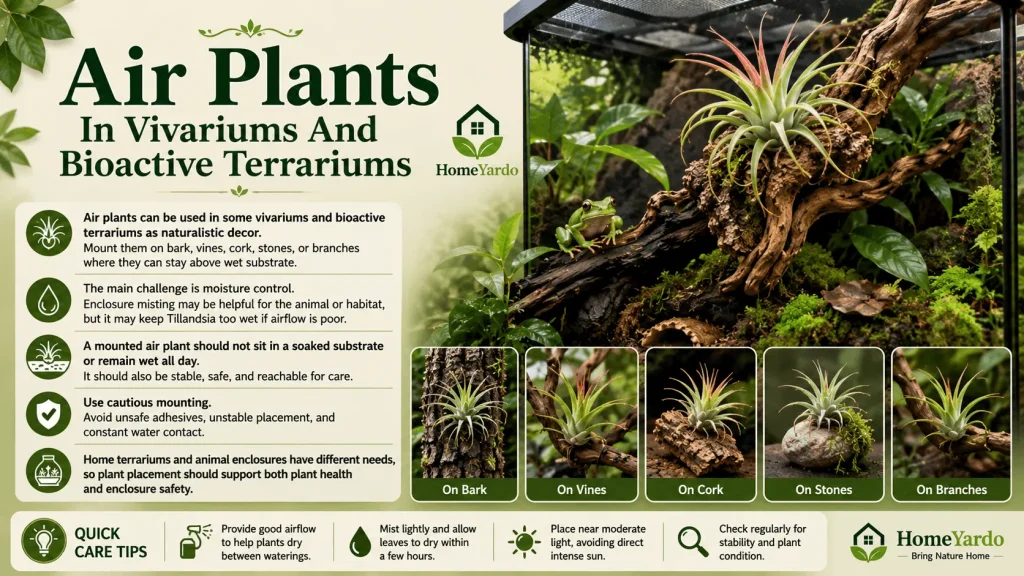
Air plants are utilized in vivariums as well as bioactive terrariums to create a naturalistic décor. They can be positioned on vines, bark, cork, rocks, or on branches that are able to remain above the wet substrates.
The primary issue is controlling moisture. The enclosure misting can be useful for animals or the environment, but it could make Tillandsia excessively wet when airflow is not optimal.
An air plant that is mounted shouldn’t be placed in an undamped substrate or stay submerged throughout the day. It must also be stable in its location, secure, and easily accessible to take care of.
Be careful when installing. Beware of unsafe adhesives, unsteady positioning, and continual contact with water. Terrariums for animals and homes require different requirements, therefore the placement of plants should be based on the security and health of the enclosure.
Air Plants Vs Moss, Succulents, And Artificial Plants In Terrariums

Moss, air plants, succulents, as well as artificial plants, can all be found in terrariums; they aren’t all in need of the same attention. If you mix them up without thinking about it, they could cause moisture issues.
Air plants require cycles of dry and wet. Moss usually prefers more constant humidity. Succulents favor dry roots and bright lighting. Artificial plants require no attention; however, they do not develop or blossom.
Mixed displays are most effective in situations where each plant’s needs for water can be managed in a separate manner. The ideal choice is based on the objective, whether it’s an indoor display of living plants, a simple decoration, or even a mixed Terrarium.
Air Plants Vs Moss Terrarium
Moss generally requires more constant water than air plants. Air plants require moisture and then drying time.
Living moss may create an environment that makes the air surrounding the exhibit more humid. However, wet moss pressing on an air plant could result in rotting. Conserved moss is usually safer for air-plant terrariums since it resembles it without the moisture requirement.
If moss and air plants are used in conjunction, make sure to keep the Tillandsia higher than the moist area.
Real air plants grow, change color, bloom, and produce pups when cared for well. They need light, water, airflow, and drying time.
Artificial air plants need no water, no light, and no maintenance beyond cleaning. They are useful for dark rooms, sealed decorations, or places where live plants would be hard to reach.
For a living display, real air plants are the better choice. For no care decor, artificial plants are simpler.
Air Plants Vs Succulents Terrarium
Air plants and succulents can each be utilized in open, dry exhibits, but they absorb water in different ways. They grow in soil or gritty mixtures and hold water in their leaves or in stems. Air plants absorb moisture via their leaves and don’t require soil. An extra guide for succulents for terrariums will aid in comparing dry exhibits, soil with a gritty texture, drainage, and the selection of plants before mixing the air plants.
The pairing of plants can be successful when the arrangement is kept open, and the plants are kept separately watered. Do not water the whole terrarium so that it maintains the base of the air plant moist.
The succulent or air plant display must be made of dry and soft materials, bright lighting, and separate routines for care.
Real Vs Artificial Air Plants Terrarium
Real air plants grow, change color, bloom, and produce pups when cared for well. They need light, water, airflow, and drying time.
Artificial air plants need no water, no light, and no maintenance beyond cleaning. They are useful for dark rooms, sealed decorations, or places where live plants would be hard to reach.
For a living display, real air plants are the better choice. For no care decor, artificial plants are simpler.
Air Plant Terrarium Kit Vs DIY Setup: Step By Step Terrarium
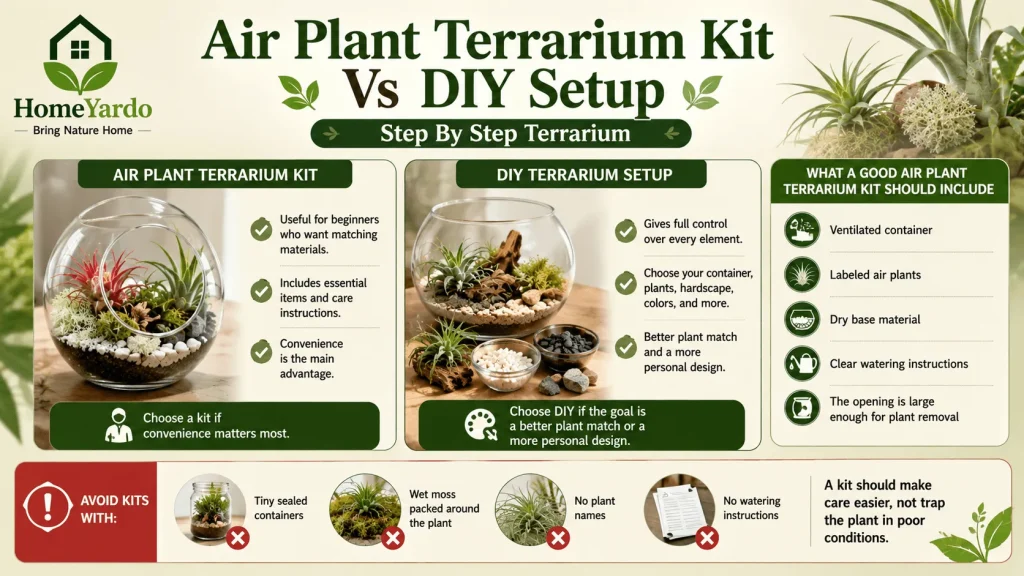
An air plant terrarium kit is useful for beginners who want matching materials. A good kit should include a suitable container, labeled plants, dry base materials, and clear care instructions.
DIY setups give more control. The container size, plant type, hardscape, color theme, and care access can all be chosen separately.
Choose a kit if convenience matters most. Choose DIY if the goal is a better plant match or a more personal design.
What A Good Air Plant Terrarium Kit Should Include
- Ventilated container
- Labeled air plants
- Dry base material
- Clear watering instructions
- The opening is large enough for plant removal
- No wet moss packed against the plant
- No tiny sealed jar for beginner care
Avoid kits with tiny sealed containers, wet moss packed around the plant, no plant names, or no watering instructions. A kit should make care easier, not trap the plant in poor conditions.
Common Mistakes With Air Plant Terrariums

Most air plant terrarium problems come from moisture, poor airflow, or the wrong container. These mistakes are easy to avoid when the setup is planned around plant care.
Common mistakes include:
- Planting air plants in soil instead of placing them on dry materials
- Using sealed containers with no airflow
- Crowding too many plants in one globe
- Returning plants before they are dry
- Pressing plants into wet moss
- Leaving water in the crown or base
- Placing glass in harsh direct sunlight
- Using a container with a narrow opening
- Over-misting inside the glass
- Using copper wire
- Ignoring brown tips, soft bases, or loose center leaves
The safest correction is usually simple. Open the container, reduce trapped moisture, improve light, remove the plant for watering, and let it dry fully before returning it.
Troubleshooting Terrarium Air Plants
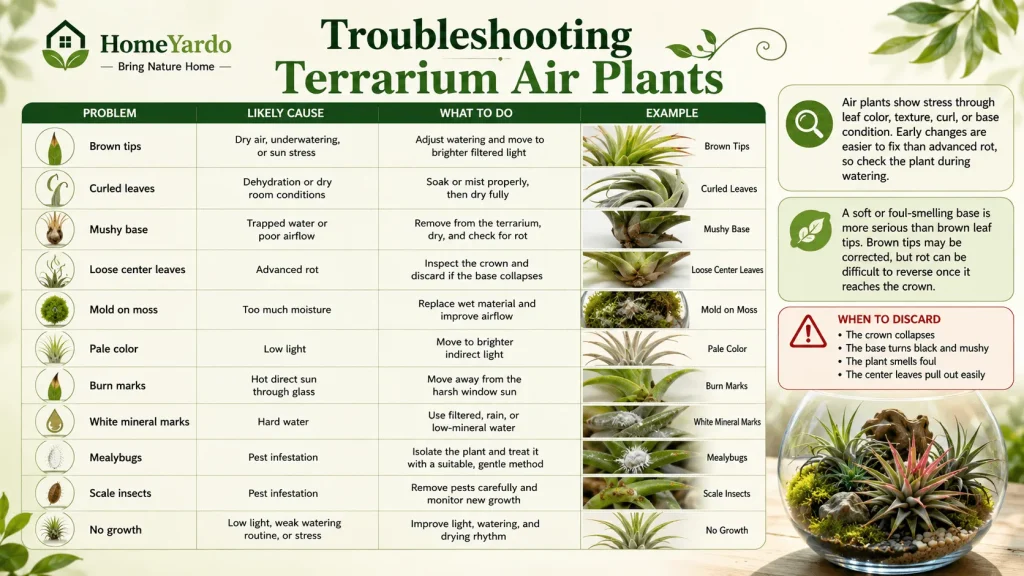
Air plants often show stress through leaf color, texture, curl, or base condition. Early changes are easier to fix than advanced rot, so check the plant during watering.
| Problem | Likely Cause | What To Do |
|---|---|---|
| Brown tips | Dry air, underwatering, or sun stress | Adjust watering and move to brighter filtered light |
| Curled leaves | Dehydration or dry room conditions | Soak or mist properly, then dry fully |
| Mushy base | Trapped water or poor airflow | Remove from the terrarium, dry, and check for rot |
| Loose center leaves | Advanced rot | Inspect the crown and discard if the base collapses |
| Mold on moss | Too much moisture | Replace wet material and improve airflow |
| Pale color | Low light | Move to brighter indirect light |
| Burn marks | Hot direct sun through glass | Move away from the harsh window sun |
| White mineral marks | Hard water | Use filtered, rain, or low-mineral water |
| Mealybugs | Pest infestation | Isolate the plant and treat it with a suitable, gentle method |
| Scale insects | Pest infestation | Remove pests carefully and monitor new growth |
| No growth | Low light, weak watering routine, or stress | Improve light, watering, and drying rhythm |
A soft or foul-smelling base is more serious than brown leaf tips. Brown tips may be corrected, but rot can be difficult to reverse once it reaches the crown.
Discarding may be safer when the crown collapses, the base turns black and mushy, the plant smells foul, or the center leaves pull out easily.
Air Plant Lifespan In Terrariums
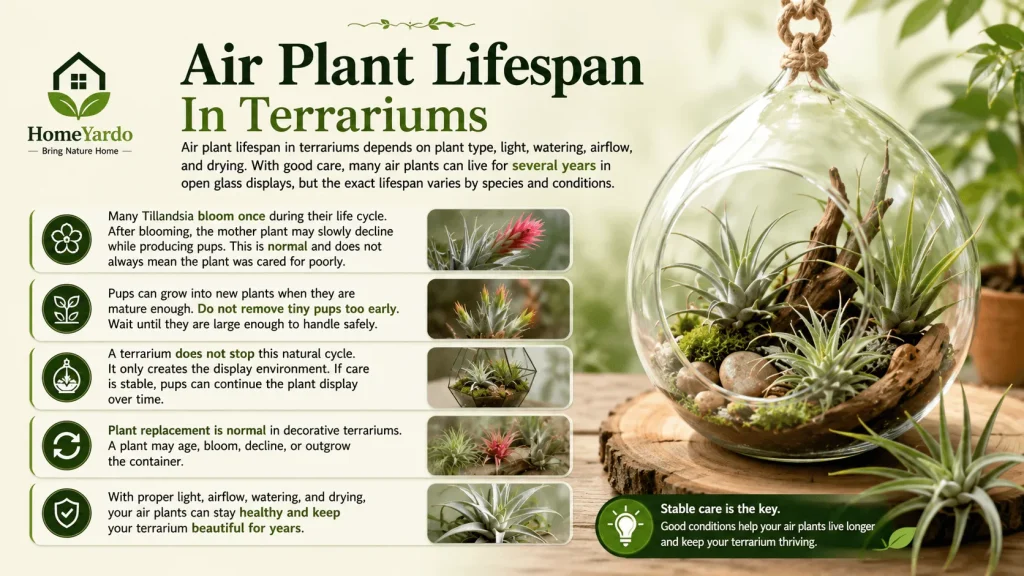
Air plant lifespan in terrariums depends on plant type, light, watering, airflow, and drying. With good care, many air plants can live for several years in open glass displays, but the exact lifespan varies by species and conditions.
Many Tillandsia bloom once during their life cycle. After blooming, the mother plant may slowly decline while producing pups. This is normal and does not always mean the plant was cared for poorly.
Pups can grow into new plants when they are mature enough. Do not remove tiny pups too early. Wait until they are large enough to handle safely.
A terrarium does not stop this natural cycle. It only creates the display environment. If care is stable, pups can continue the plant display over time.
Plant replacement is normal in decorative terrariums. A plant may age, bloom, decline, or outgrow the container.
Buying Tips For Air Plants
Healthy plants are easier to keep in terrariums. Before buying, check the leaves, base, size, and species label.
Choose plants with firm leaves and a solid base. Avoid plants with black crowns, mushy areas, foul smell, loose center leaves, or visible pests.
Pick plants that fit the container opening. A plant that must be squeezed into a glass will be harder to remove, water, and dry.
Labeled species are easier to care for because their size, humidity needs, and drying preference are clearer. Avoid unlabeled mixed packs if the container is small or the humidity level is unknown.
Beginners should start with ionantha, aeranthos, stricta, or caput medusae before trying larger or more sensitive types.
Conclusion
Air plants can grow well in terrariums when the setup supports airflow, bright indirect light, and proper drying. The safest beginner choice is an open glass container with dry materials and compact Tillandsia.
Water the plant outside the terrarium when possible, shake off extra moisture, and return it only after it dries. Start with one or two beginner-friendly plants before building a larger display.
A simple open terrarium is easier to maintain than a crowded sealed glass container.
FAQ’s
Terrariums for air plants are Tillandsia terrariums displayed in glass bowls, globes, hanging containers, or open decorative setups. They do not need soil, but they still need light, water, airflow, and drying time.
Air plants can survive in some partly closed setups, but fully closed terrariums are risky. Trapped moisture and poor airflow can lead to rot, mold, and weak growth.
Most terrarium air plants need watering about once a week, but humidity, light, airflow, and species matter. Remove the plant, water it, shake off extra moisture, and let it dry before returning it.
Air plants need bright indirect light. Direct hot sun through glass can burn leaves or overheat the container, so filtered window light is safer.
No, air plants should not be planted in soil. Soil can hold moisture around the base and raise the risk of rot. Use dry pebbles, sand, bark, shells, or driftwood instead.
Yes, misting can work in humid rooms or between deeper waterings. Soaking gives stronger hydration, but the plant must dry fully before going back into the terrarium.
It starts with choosing an open glass container, then adding a dry base such as pebbles, sand, gravel, or glass stones. Place bark, shells, stones, or driftwood above the base, then set the air plant on top instead of planting it in soil. The plant should be easy to remove for watering and should dry fully before going back into the terrarium.
Brown tips often mean dryness, sun stress, or inconsistent watering. A brown, soft, or mushy base is more serious and may mean rot from trapped moisture.
Air plants are good for beginners when placed in open containers with bright indirect light and a simple watering routine. Sealed glass, wet moss, and poor drying make them harder to keep.
Air plants are living plants, but a small terrarium should not be treated as an air purifier. Their main value is decorative growth, texture, and easy soil-free display.
Air plants survive by absorbing moisture through their leaves and using roots mainly for support. In terrariums, they still need watering, airflow, light, and a dry base.
To build a plant terrarium , choose an open glass container, add a dry base such as pebbles or sand, then place bark, shells, stones, or driftwood for support. Set the air plant on top instead of planting it in soil. The plant should be easy to remove for watering and should dry fully before going back into the terrarium.
Start with a wide opening glass container, then add dry pebbles, sand, gravel, or glass stones. Place driftwood, bark, shells, or stones to lift the plant above the base. Add the air plant last, keeping it removable, open to airflow, and away from wet moss or standing water.
Low-light air plants include Tillandsia ionantha, aeranthos, stricta, and caput medusae because they are more adaptable than many larger or silver-leaved types. Low light does not mean a dark shelf or sealed jar. These plants still need bright indirect light, gentle airflow, and proper drying after watering to stay healthy long term.
Silver or fuzzy air plants such as tectorum, harrisii, and xerographica usually prefer stronger drying and less stagnant humidity. They work best in open displays with good airflow.
References