Purple Perennials: Flowers That Return Every Year for Sun, Shade & Borders
The purple perennials flowers provide fresh color, pollinator appeal and a steady growth rate to borders, garden beds paths, containers and shady corners. Certain flower in spring, while others provide color throughout the summer months, and some can help to extend the garden into autumn.
The most suitable choice is based on the location of the plant. A dry, sunny border requires various plants compared to a damp shade bed. A low-edging plant serves a different function than a back-facing tall flower.
Certain purple flowering perennials bloom consistently for years, whereas others are perennial only in warmer regions. This guide will provide 65 of the most beautiful purple flowers, with information on height, light flowering time, toughness, and optimal use so that the appropriate plant can be suited to the appropriate space.
The height of the plant, the bloom time and winter survival may differ depending on the cultivar and local climate. Hence, the tag on your plant or the local extension guidelines should be reviewed prior to planting.
Quick Answer: Best Purple Flowers Perennials For The Garden
The quick picker helps reduce the number of plants available before evaluating all 65 flowers. These are the best selections for gardeners with common requirements.
| Garden Need | Best Purple Perennial Choices | Why They Work |
|---|---|---|
| Best overall | Lavender, Salvia, Catmint | Easy color, pollinator value, and good availability |
| Best for full sun | Coneflower, Allium, Russian Sage | Handles bright exposure and open beds |
| Best for shade | Astilbe, Hosta, Hellebore | Adds purple tones where the sun is limited |
| Best tall flowers | Delphinium, New England Aster, Joe Pye Weed | Adds height and back border color |
| Best low-growing flowers | Creeping Phlox, Aubrieta, Veronica | Works near paths, edges, and rock gardens |
| Best ground cover | Ajuga, Spotted Dead Nettle, Creeping Phlox | Covers bare soil and softens edges |
| Best long-blooming flowers | Catmint, Hardy Geranium, Salvia | Can bloom for a long period with proper care |
| Best pollinator flowers | Bee Balm, Blazing Star, Wild Bergamot | Attracts bees, butterflies, and hummingbirds |
| Best beginner flowers | Catmint, Salvia, Coneflower | Forgiving in suitable conditions |
| Best drought-tolerant choices | Lavender, Sea Holly, Globe Thistle | Performs well once established in dry soil |
| Best purple foliage pairing | Heuchera, Ajuga, Lamb’s Ear | Adds color after blooms fade |
| Best warm zone choice | Lily Of The Nile, Verbena, African Daisy | Useful where winters stay mild |
At A Glance: 65 Purple Flower Perennials
This table gives a fast comparison of the full flower list. Plant status matters because some choices return every year in cold zones, while others are perennial only in warmer climates.
| No. | Common Name | Botanical Name | Perennial Status | Light | Zone | Height | Bloom Time | Best Garden Use |
|---|---|---|---|---|---|---|---|---|
| 1 | Lavender | Lavandula spp. | True perennial in suitable zones | Full sun | 5 to 9 | 1 to 3 ft | Summer | Dry borders, paths |
| 2 | Salvia | Salvia nemorosa | True perennial | Full sun | 4 to 8 | 1 to 3 ft | Late spring to summer | Pollinator beds |
| 3 | Catmint | Nepeta spp. | True perennial | Full sun | 3 to 8 | 1 to 3 ft | Spring to fall | Edges, low borders |
| 4 | Purple Coneflower | Echinacea purpurea | True perennial | Full sun | 3 to 9 | 2 to 4 ft | Summer to fall | Wildlife gardens |
| 5 | Allium | Allium spp. | Perennial bulb | Full sun | 4 to 9 | 1 to 4 ft | Spring to summer | Accent planting |
| 6 | Russian Sage | Salvia yangii | True perennial | Full sun | 4 to 9 | 3 to 5 ft | Summer to fall | Dry borders |
| 7 | Sea Holly | Eryngium spp. | True perennial | Full sun | 4 to 9 | 2 to 4 ft | Summer | Dry gardens |
| 8 | Stokes’ Aster | Stokesia laevis | True perennial | Full sun to part sun | 5 to 9 | 1 to 2 ft | Summer | Front and middle borders |
| 9 | Scabiosa | Scabiosa spp. | True or short lived perennial | Full sun | 5 to 9 | 1 to 2 ft | Summer to fall | Cut flowers |
| 10 | Penstemon | Penstemon spp. | True perennial | Full sun | 3 to 9 | 1 to 3 ft | Late spring to summer | Pollinator beds |
| 11 | Bee Balm | Monarda spp. | True perennial | Full sun to part sun | 4 to 9 | 2 to 4 ft | Summer | Hummingbird gardens |
| 12 | Anise Hyssop | Agastache foeniculum | True perennial | Full sun | 4 to 9 | 2 to 4 ft | Summer to fall | Pollinator beds |
| 13 | Delphinium | Delphinium spp. | True perennial | Full sun | 3 to 7 | 3 to 6 ft | Summer | Back borders |
| 14 | Lupine | Lupinus spp. | True perennial | Full sun to part sun | 4 to 8 | 2 to 4 ft | Late spring | Cottage gardens |
| 15 | New England Aster | Symphyotrichum novae angliae | True perennial | Full sun | 3 to 8 | 3 to 6 ft | Fall | Late season color |
| 16 | Joe Pye Weed | Eutrochium spp. | True perennial | Full sun to part sun | 4 to 9 | 4 to 7 ft | Summer to fall | Moist borders |
| 17 | Monkshood | Aconitum spp. | True perennial | Part sun to shade | 3 to 7 | 2 to 5 ft | Late summer to fall | Cool shade beds |
| 18 | Garden Phlox | Phlox paniculata | True perennial | Full sun to part sun | 4 to 8 | 2 to 4 ft | Summer | Cottage borders |
| 19 | Ironweed | Vernonia spp. | True perennial | Full sun | 5 to 9 | 3 to 7 ft | Late summer | Native gardens |
| 20 | Bearded Iris | Iris germanica | Rhizomatous perennial | Full sun | 3 to 9 | 2 to 4 ft | Spring | Sunny borders |
| 21 | Hollyhock | Alcea rosea | Short lived perennial | Full sun | 3 to 9 | 5 to 8 ft | Summer | Cottage backdrops |
| 22 | Meadow Rue | Thalictrum spp. | True perennial | Part sun | 4 to 8 | 3 to 6 ft | Summer | Airy borders |
| 23 | Creeping Phlox | Phlox subulata | True perennial | Full sun | 3 to 9 | 4 to 8 in | Spring | Ground cover |
| 24 | Aubrieta | Aubrieta deltoidea | True perennial | Full sun | 4 to 8 | 4 to 6 in | Spring | Rock gardens |
| 25 | Dalmatian Bellflower | Campanula portenschlagiana | True perennial | Full sun to part shade | 4 to 8 | 6 to 12 in | Summer | Walls, edges |
| 26 | Dwarf Iris | Iris reticulata | Perennial bulb | Full sun to part sun | 5 to 9 | 4 to 8 in | Early spring | Early color |
| 27 | Pasque Flower | Pulsatilla vulgaris | True perennial | Full sun | 4 to 8 | 8 to 12 in | Spring | Rock gardens |
| 28 | Self Heal | Prunella vulgaris | True perennial | Full sun to part shade | 4 to 9 | 6 to 12 in | Summer | Naturalized lawns |
| 29 | Veronica | Veronica peduncularis | True perennial | Full sun | 4 to 8 | 6 to 12 in | Spring | Edging |
| 30 | Purple Ice Plant | Delosperma cooperi | True perennial in dry sites | Full sun | 5 to 9 | 3 to 6 in | Summer | Hot dry edges |
| 31 | Ajuga | Ajuga reptans | True perennial | Part shade | 3 to 9 | 4 to 8 in | Spring | Ground cover |
| 32 | Common Violet | Viola sororia | True perennial | Part shade | 3 to 9 | 4 to 8 in | Spring | Woodland edges |
| 33 | Astilbe | Astilbe spp. | True perennial | Part shade | 4 to 9 | 1 to 4 ft | Summer | Moist shade |
| 34 | Hosta | Hosta spp. | True perennial | Shade to part shade | 3 to 9 | 1 to 3 ft | Summer | Foliage beds |
| 35 | Hellebore | Helleborus spp. | True perennial | Part shade | 4 to 9 | 1 to 2 ft | Late winter to spring | Shade borders |
| 36 | Lungwort | Pulmonaria spp. | True perennial | Shade to part shade | 3 to 8 | 8 to 12 in | Spring | Woodland beds |
| 37 | Spotted Dead Nettle | Lamium maculatum | True perennial | Part shade | 3 to 8 | 6 to 12 in | Spring to summer | Shade ground cover |
| 38 | Corydalis | Corydalis flexuosa | True perennial | Part shade | 5 to 8 | 8 to 12 in | Spring to summer | Woodland paths |
| 39 | Columbine | Aquilegia spp. | Short lived perennial | Part shade | 3 to 9 | 1 to 3 ft | Spring | Cottage shade |
| 40 | Toad Lily | Tricyrtis spp. | True perennial | Part shade | 4 to 9 | 1 to 3 ft | Late summer to fall | Shade beds |
| 41 | Jacob’s Ladder | Polemonium caeruleum | True perennial | Part shade | 3 to 8 | 1 to 2 ft | Spring | Woodland borders |
| 42 | Woodland Phlox | Phlox divaricata | True perennial | Part shade | 3 to 8 | 1 to 2 ft | Spring | Native shade beds |
| 43 | Balloon Flower | Platycodon grandiflorus | True perennial | Full sun to part sun | 3 to 8 | 1 to 3 ft | Summer | Middle borders |
| 44 | Hardy Geranium | Geranium spp. | True perennial | Full sun to part shade | 4 to 8 | 1 to 2 ft | Spring to summer | Ground layer |
| 45 | Spiderwort | Tradescantia spp. | True perennial | Full sun to part shade | 4 to 9 | 1 to 3 ft | Spring to summer | Natural beds |
| 46 | Dianthus | Dianthus spp. | True perennial | Full sun | 3 to 9 | 6 to 18 in | Spring to summer | Edging |
| 47 | Anemone | Anemone spp. | True perennial | Full sun to part shade | 4 to 8 | 1 to 4 ft | Late summer to fall | Late color |
| 48 | Hardy Chrysanthemum | Chrysanthemum morifolium | True perennial in suitable zones | Full sun | 5 to 9 | 1 to 3 ft | Fall | Seasonal beds |
| 49 | Hardy Ageratum | Conoclinium coelestinum | True perennial | Full sun to part shade | 5 to 10 | 1 to 3 ft | Late summer to fall | Pollinator beds |
| 50 | Clematis | Clematis spp. | Perennial vine | Full sun to part shade | 4 to 9 | 6 to 15 ft | Spring to fall | Trellises |
| 51 | Crocus | Crocus spp. | Perennial bulb | Full sun to part sun | 3 to 8 | 3 to 6 in | Early spring | Lawns, borders |
| 52 | Hyacinth | Hyacinthus orientalis | Perennial bulb | Full sun to part sun | 4 to 8 | 6 to 12 in | Spring | Fragrant beds |
| 53 | Siberian Iris | Iris sibirica | Rhizomatous perennial | Full sun to part sun | 3 to 9 | 2 to 4 ft | Late spring | Moist borders |
| 54 | Virginia Bluebells | Mertensia virginica | True perennial | Part shade | 3 to 8 | 1 to 2 ft | Spring | Woodland gardens |
| 55 | Baptisia | Baptisia australis | True perennial | Full sun | 3 to 9 | 3 to 4 ft | Late spring | Native borders |
| 56 | Primrose | Primula spp. | True perennial | Part shade | 4 to 8 | 6 to 12 in | Spring | Cool shade |
| 57 | Lily Of The Nile | Agapanthus spp. | Zone-dependent perennial | Full sun | 7 to 11 | 2 to 4 ft | Summer | Warm zone beds |
| 58 | Camassia | Camassia spp. | Perennial bulb | Full sun to part sun | 4 to 8 | 1 to 3 ft | Spring | Moist meadows |
| 59 | Blazing Star | Liatris spicata | True perennial | Full sun | 3 to 9 | 2 to 4 ft | Summer | Pollinator beds |
| 60 | Obedient Plant | Physostegia virginiana | True perennial | Full sun to part sun | 3 to 9 | 2 to 4 ft | Summer | Native beds |
| 61 | Wild Bergamot | Monarda fistulosa | True perennial | Full sun | 3 to 9 | 2 to 4 ft | Summer | Pollinator gardens |
| 62 | Blue Vervain | Verbena hastata | True perennial | Full sun to part sun | 3 to 9 | 3 to 5 ft | Summer | Moist native beds |
| 63 | Purple Prairie Clover | Dalea purpurea | True perennial | Full sun | 3 to 8 | 1 to 3 ft | Summer | Dry native beds |
| 64 | Globe Thistle | Echinops ritro | True perennial | Full sun | 3 to 9 | 2 to 4 ft | Summer | Dry borders |
| 65 | Lamb’s Ear | Stachys byzantina | True perennial | Full sun | 4 to 9 | 1 to 2 ft | Summer | Texture and edging |
Plant Data Verification
Zone, height, and bloom time can vary by cultivar, region, soil, and winter drainage. Use the table for planning, then confirm final details from a local nursery label, regional extension resource, or trusted grower.
Tender plants, short-lived perennials, bulbs, vines, and foliage forward plants are marked carefully so the list stays useful without blurring plant categories.
What Counts As A Purple Perennial?
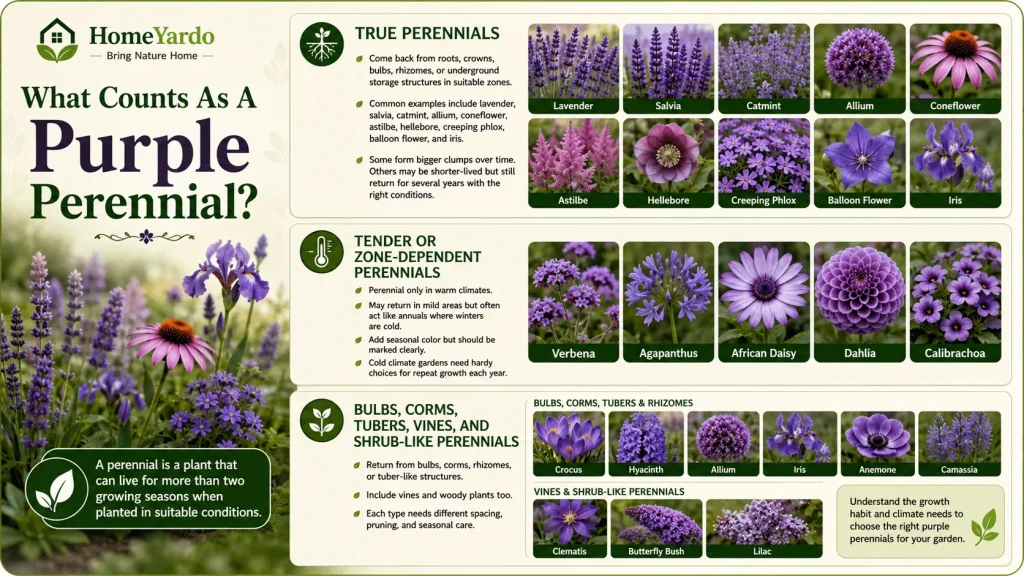
A perennial plant is one that can last longer than a season if it is planted in the right conditions. Perennial purple flowers can develop from root systems, crowns bulbs, rhizomes vines, groundcovers or even warm zones of plants that bloom only in mild climates.
The label on the plant shouldn’t be the only factor to consider. The hardiness zone and winter moisture and summer heat, drainage of the soil and light exposure impact the likelihood that a plant will return well.
True Perennials
True perennials emerge from the roots, crowns bulbs, rhizomes and underground structures for storage within the right areas. Salvia, lavender, catmint and allium, as well as coneflowers, hellebore, astilbe, balloon flower, creeping phlox and iris are all common examples.
Some form bigger clumps over time. Some may live longer, but they will still be around for many years if the soil, lighting, and drainage are in line with their requirements.
Tender Or Zone-Dependent Perennials
Certain purple flowers can be found in perennial bloom only in warmer climates. Verbena, agapanthus African dahlia and calibrachoa can be found in areas with mild temperatures, but they usually appear as annuals when winters are cold.
They can bring color to the garden, but they must be identified clearly. In a cold climate, a garden must have robust plants if the objective is to grow each year.
Bulbs, Corms, Tubers, Vines, And Shrub-Like Perennials
The purple flowers don’t appear in the same way. Crocus and hyacinth, as well as allium and iris, as well as anemone and camassia emerge from corms, bulbs tubers, or rhizomes.
Clematis is a perennial vine, whereas butterflies and lilacs are woody plants, not herbaceous perennials. The garden may contain all of these varieties however, each requires distinct spacing and pruning and seasonal maintenance.
How To Choose Purple Flowers Perennial
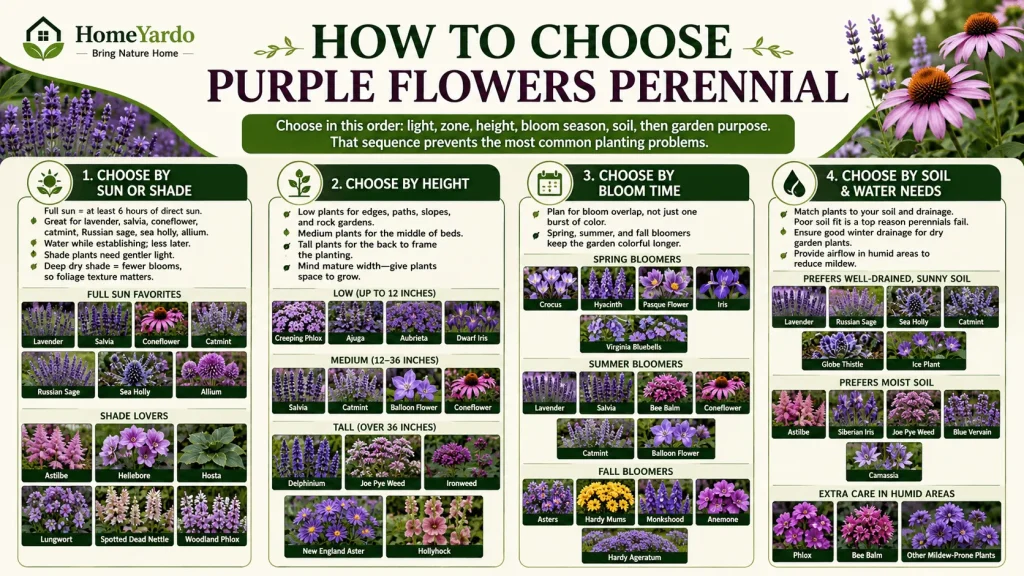
The flower that is right for you should be in line with the surrounding area before the color is considered. A purple flower that likes dry sunlight can be a challenge in humid shade and a shade plant can burn in a border with a large opening.
Select in this order the following order: light, zone height, bloom time soil, and then the garden’s purpose. This sequence will prevent the most frequent problems with planting.
Choose By Sun Or Shade
Full sun plants generally require at least six hours of direct sunlight. Conflowers, salvia, lavender, catmint Russian sage sea holly, as well as allium are suitable for sunny borders.
Flowers of purple, with full sun options are still in need of water when growing. Once roots have settled dry site plants usually require less frequent irrigation.
Shade plants need gentler light. Astilbe Hellebore hosta, lungwort dead nettle with spots, and woodland phlox work best in light shade or part shade. Dry shade offers fewer options for flowers, and the texture of the foliage is more important.
Choose By Height
The height determines where a plant can be found. Low-growing flowers like creeping phlox and ajuga, aubrieta and dwarf iris grow in the vicinity of paths, edges or slopes. They also work in rock gardens.
The medium-sized plants like catmint, salvia, balloon flower and coneflower can be found in the middle of the bed. A tall perennial that has purple flowers like dulphinium Joe Pye weed, ironweed, New England aster, or hollyhock, is best suited to the rear where it can create a frame for the planting.
The width of mature plants is also important. Large plants may grow, spread or shade smaller ones in the event that they are placed too close.
Choose By Bloom Time
A strong, vibrant purple plant will not bloom at all. Spring flowers like pasque, hyacinth and crocus flowers, as well as iris and Virginia bluebells begin the season earlier.
Summer colors can be found in salvia, lavender bee balm catmint, and balloon flowers. The fall color is derived from asters, hardy mums monkshood, anemone and the hardy ageratum.
The objective is to create an overlap. An area with just one bloom window could look lush for a couple of weeks, and then it will lose color.
Choose By Soil And Water Needs
Soil fit is among the most important reasons why a perennial is successful or fails. It is the reason that lavender Russian Sage, Sea catmint, holly globe thistle, as well as Ice plant like well-drained, sunny soils.
Astilbe, Siberian iris, Joe Pye weed, blue vervain and camassia can handle more moisture. The hot and humid garden may require more airflow around phlox, bee balm and other plants susceptible to mildew.
Lavender needs to be drained in winter for, Russian sage, sea holly, as well as other plants that require dry soil. The winter rain can cause damage to roots, even if the plant is strong enough to withstand the climate.
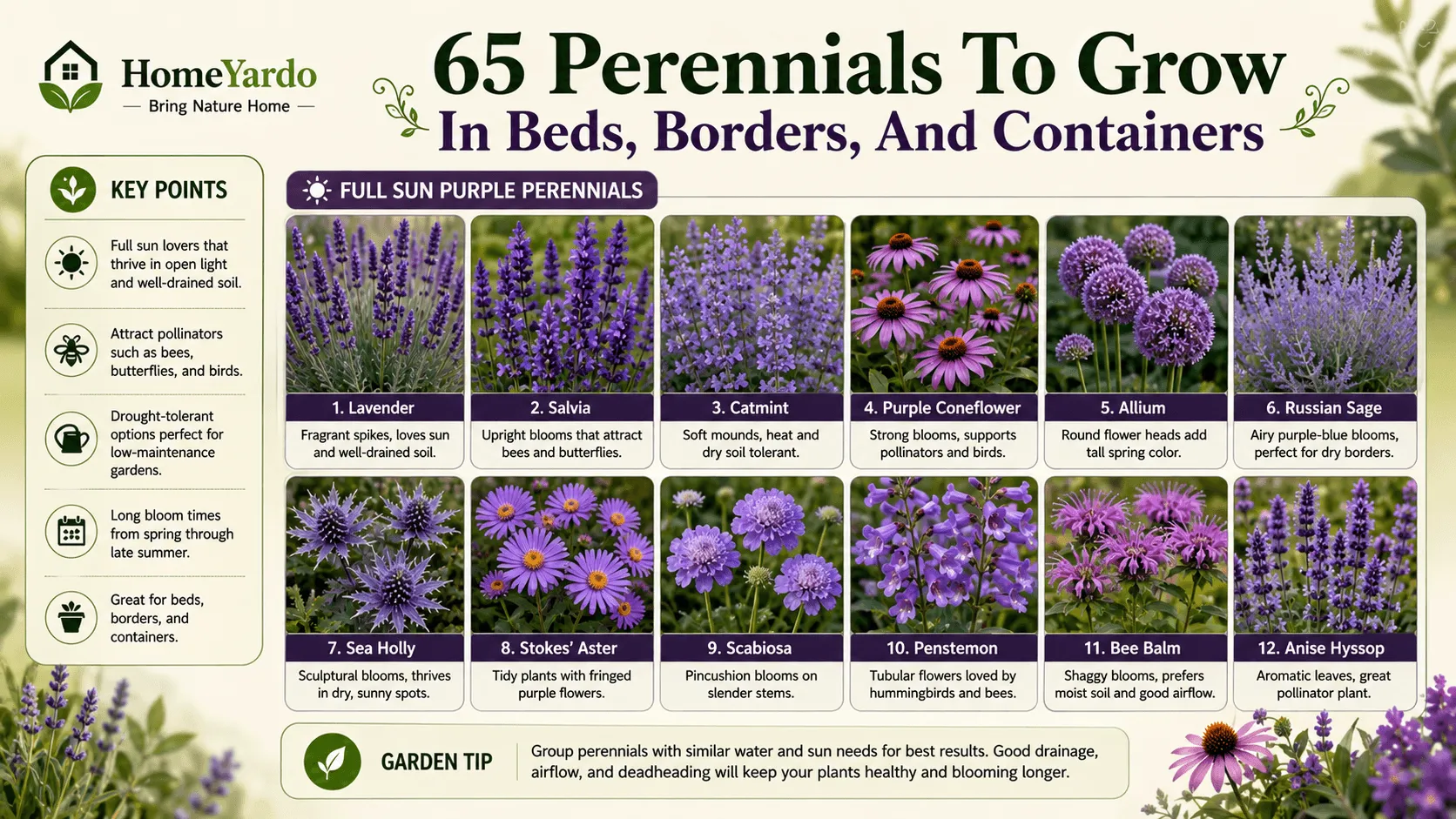
65 Perennials To Grow In Beds, Borders, And Containers
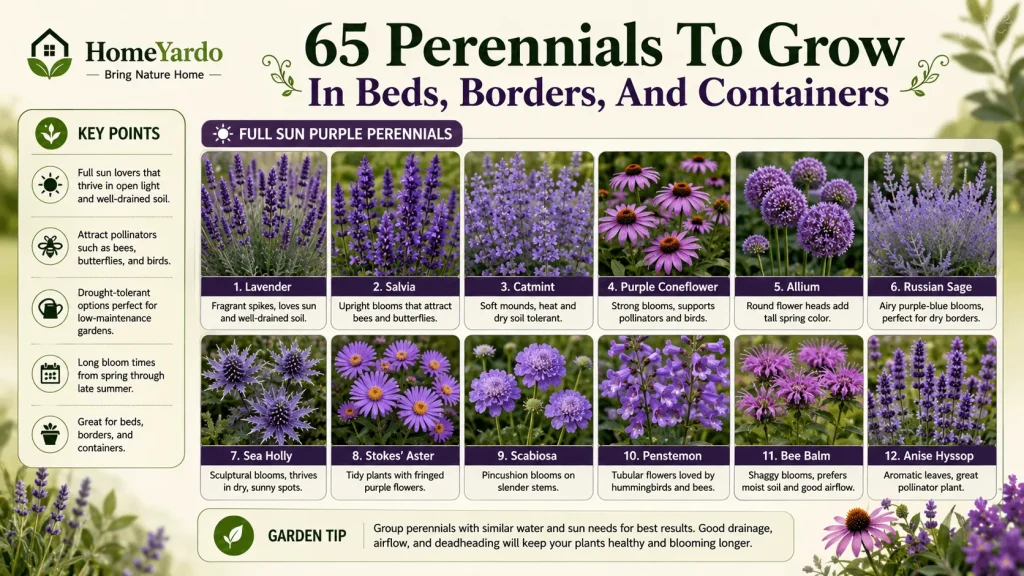
The list below groups the 65 flowers by their best garden role. Each plant brings a different use, from sunny drought-tolerant borders to shaded ground cover and late-season pollinator beds.
Full Sun Purple Perennials
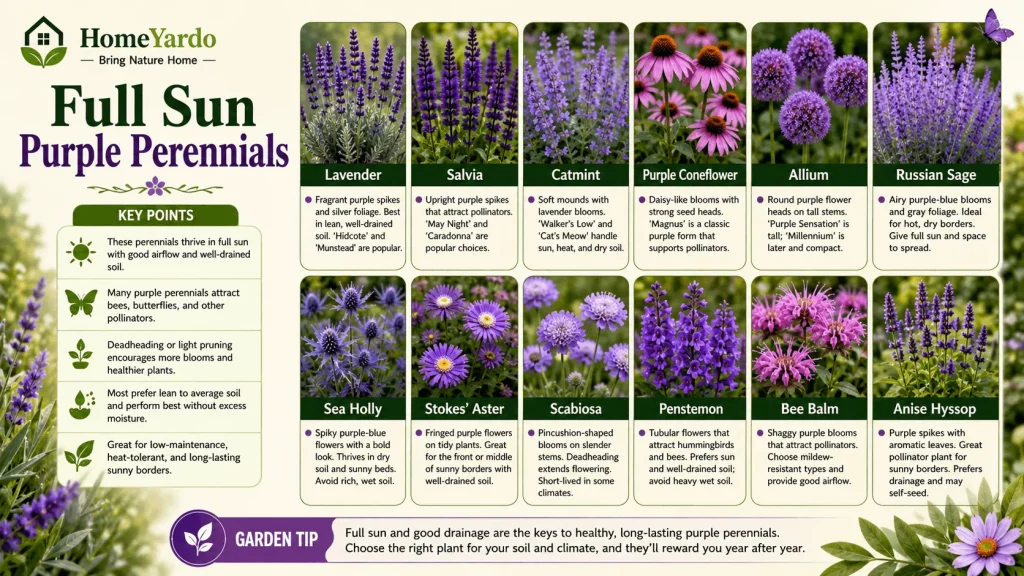
Sunny gardens can support many of the most reliable purple plants. These choices often flower well with open light, good airflow, and soil that does not stay wet for too long.
- Lavender
Lavender gives fragrant purple flower spikes and silver-green foliage. It works best in full sun, lean soil, and well-drained soil. ‘Hidcote’ and ‘Munstead’ are common compact choices, but winter survival depends on drainage and climate. - Salvia
Salvia produces upright purple spikes that draw bees and butterflies. ‘May Night’ and ‘Caradonna’ are popular purple choices. Cut back spent blooms to encourage a fresh flush. - Catmint
Catmint forms soft mounds with lavender purple flowers. ‘Walker’s Low’ and ‘Cat’s Meow’ are common options for borders. It handles sun, heat, and dry soil once established. - Purple Coneflower
Purple coneflower has daisy-like blooms with strong seed heads. ‘Magnus’ is a classic purple form. It supports pollinators in summer and birds later in the season. - Allium
Allium adds round purple flower heads above strappy leaves. ‘Purple Sensation’ gives tall spring color, while ‘Millennium’ has a later compact habit. Plant bulbs or clumps in well-drained soil. - Russian Sage
Russian sage gives airy, purple-blue blooms and gray foliage. It suits hot, dry borders where many softer plants struggle. Give it full sun and room for a loose, open shape. - Sea Holly
Sea holly has spiky purple-blue flowers with a sculptural look. It is a strong choice for dry soil and sunny beds. Rich, wet soil can make stems weaker. - Stokes’ Aster
Stokes’ aster offers fringed purple flowers on tidy plants. It works well near the front or middle of a sunny border. It prefers soil that drains well but does not dry out completely. - Scabiosa
Scabiosa has pincushion-shaped blooms on slender stems. Deadheading can help extend its flowering period. In some climates, it behaves as a short-lived perennial. - Penstemon
Penstemon produces tubular flowers that attract hummingbirds and bees. Many types prefer sun and soil with good drainage. Avoid heavy wet soil in winter. - Bee Balm
Bee balm brings purple, pink, or red-toned flowers with a shaggy form. Choose mildew-resistant varieties and give it airflow. It does best with steady moisture rather than dry soil. - Anise Hyssop
Anise hyssop has purple flower spikes and aromatic leaves. It is a strong pollinator plant for sunny, low-care borders. It prefers drainage and can self-seed lightly.
Tall Perennials Plants For Back Borders
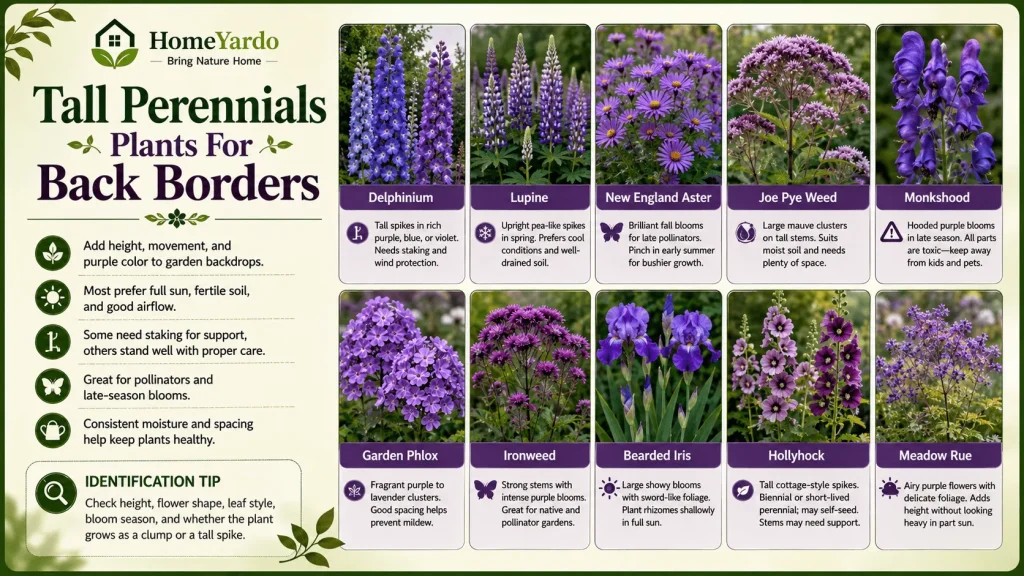
Tall plant with purple flowers give height, movement, and background color. Some need staking, while others stand well with enough spacing, airflow, and sun.
- Delphinium
Delphinium grows tall spikes of rich purple, blue, or violet flowers. It needs fertile soil, moisture, and protection from strong winds. Staking helps keep flower spikes upright. - Lupine
Lupine gives upright pea-like flower spikes in spring and early summer. It prefers cooler conditions and well-drained soil. Hot, humid sites can shorten its life. - New England Aster
New England aster brings purple fall flowers when many summer plants are fading. It is excellent for late pollinators. Pinching in early summer can help create a bushier plant. - Joe Pye Weed
Joe Pye weed has large mauve purple flower clusters on tall stems. It suits moist soil and naturalistic borders. Give it room because mature plants can become wide. - Monkshood
Monkshood gives hooded purple flowers in late season. All parts are toxic, so it should be handled with care and kept away from children and pets. It prefers cool soil and part shade. - Garden Phlox
Garden phlox brings fragrant clusters of purple, lavender, or pinkish flowers. Good spacing helps reduce mildew risk. ‘Blue Paradise’ and ‘Nicky’ are common purple-toned choices. - Ironweed
Ironweed has strong stems and intense purple flower clusters. It fits native plantings and late summer pollinator beds. It can grow tall, so place it where height is useful. - Bearded Iris
Bearded iris has large, showy purple blooms and sword like foliage. Plant rhizomes shallowly in a sunny, open spot. Too much mulch over the rhizome can reduce flowering. - Hollyhock
Purple hollyhock creates tall cottage-style flower spikes. It is often a biennial or short-lived perennial, but it may self-seed in suitable places. Tall stems may need support. - Meadow Rue
Meadow rue has airy purple flowers and delicate foliage. It gives height without looking heavy in part sun borders. It works well with other soft-textured perennials.
If tall purple perennial flower identification is the goal, check height, flower shape, leaf style, bloom season, and whether the plant grows as a clump or tall spike.
Small Purple Perennials For Edging
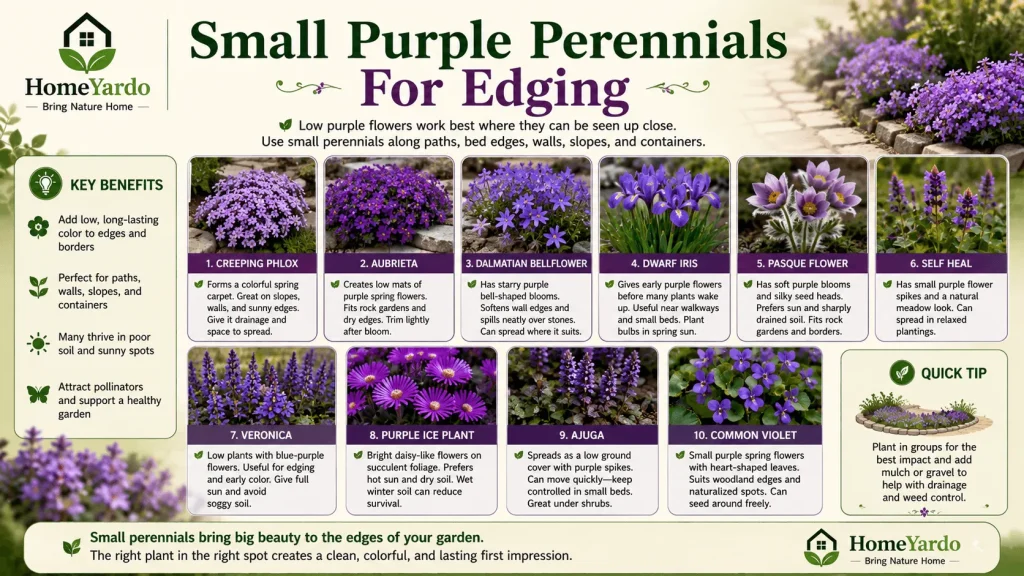
Low purple flowers work best where they can be seen up close. Use small perennials along paths, bed edges, walls, slopes, and containers.
- Creeping Phlox
Creeping phlox forms a colorful spring carpet. It works well on slopes, walls, and sunny border edges. Give it drainage and space to spread over bare soil. - Aubrieta
Aubrieta creates low mats of purple spring flowers. It fits rock gardens and dry edges with good drainage. Trim lightly after bloom to keep growth tidy. - Dalmatian Bellflower
Dalmatian bellflower has starry purple bell-shaped blooms. It softens wall edges and spills neatly over stones. It can spread where conditions suit it. - Dwarf Iris
Dwarf iris gives early purple flowers before many plants wake up. It is useful near walkways and small beds. Plant bulbs where spring sun reaches the soil. - Pasque Flower
Pasque flower has soft purple blooms and silky seed heads. It prefers sun and sharply drained soil. It fits rock gardens and open front borders. - Self Heal
Self-heal has small purple flower spikes and a natural meadow look. It can spread in relaxed plantings. Use it where a naturalized look is welcome. - Veronica
Low Veronica creates blue-purple flowers on tidy plants. It is useful for edging and early color. Give it full sun and avoid soggy soil. - Purple Ice Plant
Purple ice plant has bright daisy-like flowers on succulent foliage. It prefers hot sun and dry soil. Wet winter soil can reduce survival. - Ajuga
Ajuga spreads as a low ground cover with purple flower spikes. It can move quickly, so keep it controlled in small beds. It is useful under shrubs and along shaded edges. - Common Violet
Common violet has small purple spring flowers and heart-shaped leaves. It suits woodland edges and naturalized spots. It can seed around freely in comfortable soil.
Purple Shade Perennials And Woodland Flowers
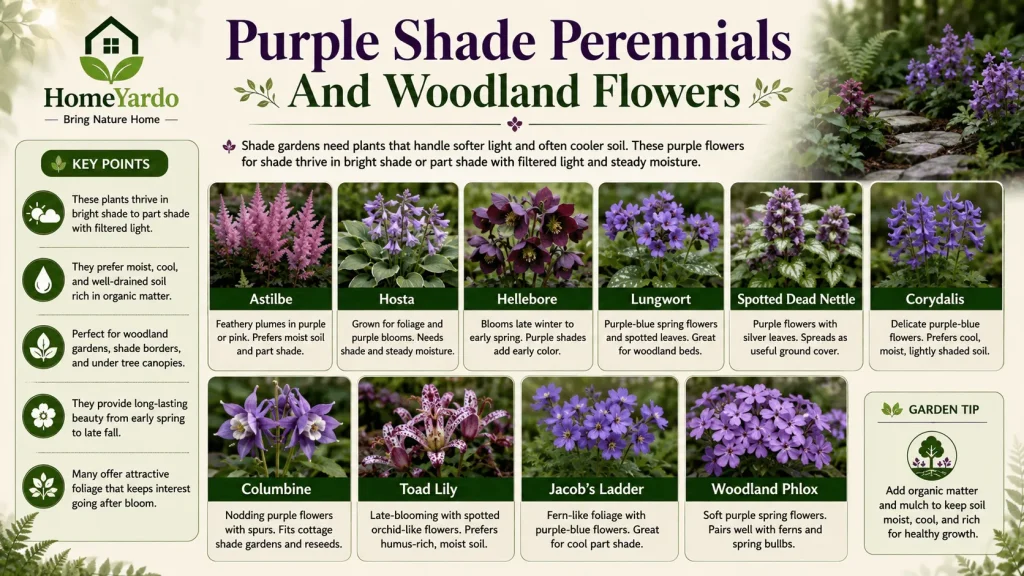
Shade gardens need plants that handle softer light and often cooler soil. These purple flowers for shade work best in bright shade or part shade, where they still receive enough filtered light to bloom.
- Astilbe
Astilbe has feathery purple, pink, or white plumes. It prefers moist soil and part shade. Dry soil can cause browning and weak flowering. - Hosta
Hosta is grown mostly for foliage, but many types produce purple or lavender flowers. It is reliable in shade with steady moisture. Use it for leaf texture as much as bloom color. - Hellebore
Hellebore blooms in late winter or early spring. Purple forms may range from plum and mauve to near black. It gives early color in part shade. - Lungwort
Lungwort has purple-blue spring flowers and spotted leaves. It works well in cool woodland-style beds. Its foliage helps carry interest after bloom. - Spotted Dead Nettle
Spotted dead nettle has purple flowers and silver-marked leaves. It is useful as a shade ground cover. It can spread, so place it where coverage is wanted. - Corydalis
Corydalis gives delicate purple-blue flowers and soft foliage. It prefers cool, moist, lightly shaded soil. Hot, dry weather can make it decline. - Columbine
Columbine has nodding purple flowers with graceful spurs. It fits cottage shade and natural gardens. It is often short-lived but can reseed. - Toad Lily
Toad lily blooms late with spotted orchid-like flowers. It brings interest to shade when many plants are done. It prefers humus-rich soil with steady moisture. - Jacob’s Ladder
Jacob’s ladder has fern-like foliage and purple-blue flowers. It prefers cool part shade. It works well near woodland edges and shaded paths. - Woodland Phlox
Woodland phlox has soft purple flowers in spring. It pairs well with ferns, hellebores, and spring bulbs. It prefers soil that does not dry out hard.
Long Blooming Purple Perennials
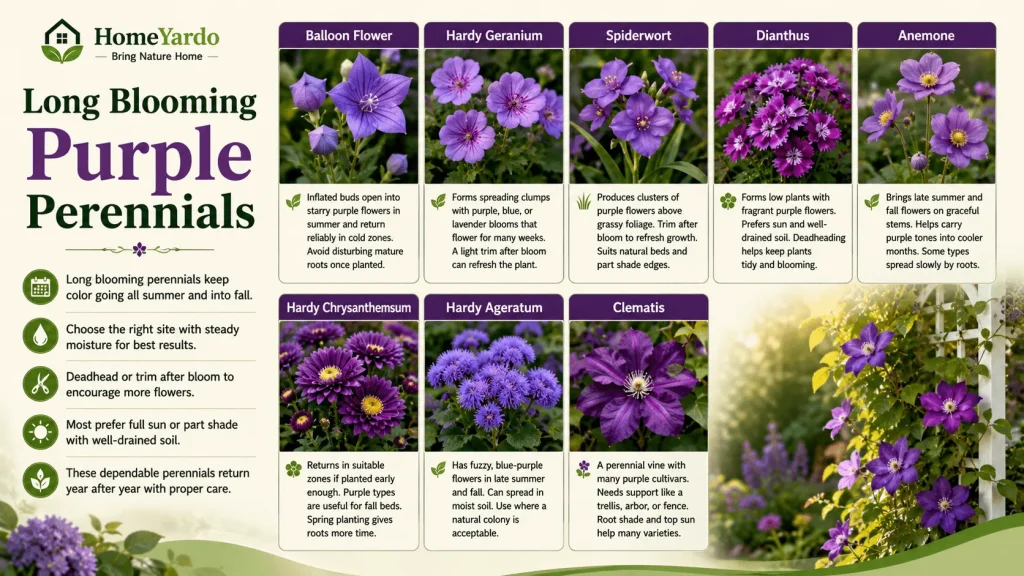
Long-blooming perennials help keep color in the garden for more than a short spring flush. Perennials that bloom all summer usually need the right site, steady moisture, and occasional trimming to keep producing flowers.
- Balloon Flower
Balloon flower has inflated buds that open into starry purple flowers. It blooms in summer and returns reliably in cold zones. Avoid disturbing mature roots once planted. - Hardy Geranium
Hardy geranium forms spreading clumps with purple, blue, or lavender blooms. Some types flower for many weeks. A light trim after bloom can refresh the plant. - Spiderwort
Spiderwort produces clusters of purple flowers above grassy foliage. It can be trimmed after bloom to refresh growth. It suits natural beds and part shade edges. - Dianthus
Purple dianthus forms low plants with fragrant flowers. It prefers sun and well drained soil. Deadheading helps keep plants tidy. - Anemone
Anemone brings late summer and fall flowers on graceful stems. It helps carry purple tones into cooler months. Some types spread slowly by underground roots. - Hardy Chrysanthemum
Hardy mums can return in suitable zones if planted early enough. Purple types are useful for fall beds. Spring planting gives roots more time before winter. - Hardy Ageratum
Hardy ageratum has fuzzy, blue-purple flowers in late summer and fall. It can spread in moist soil. Use it where a natural colony is acceptable. - Clematis
Clematis is a perennial vine with many purple cultivars. It needs support such as a trellis, arbor, or fence. Root shade and top sun help many varieties grow well.
Purple Spring Perennials
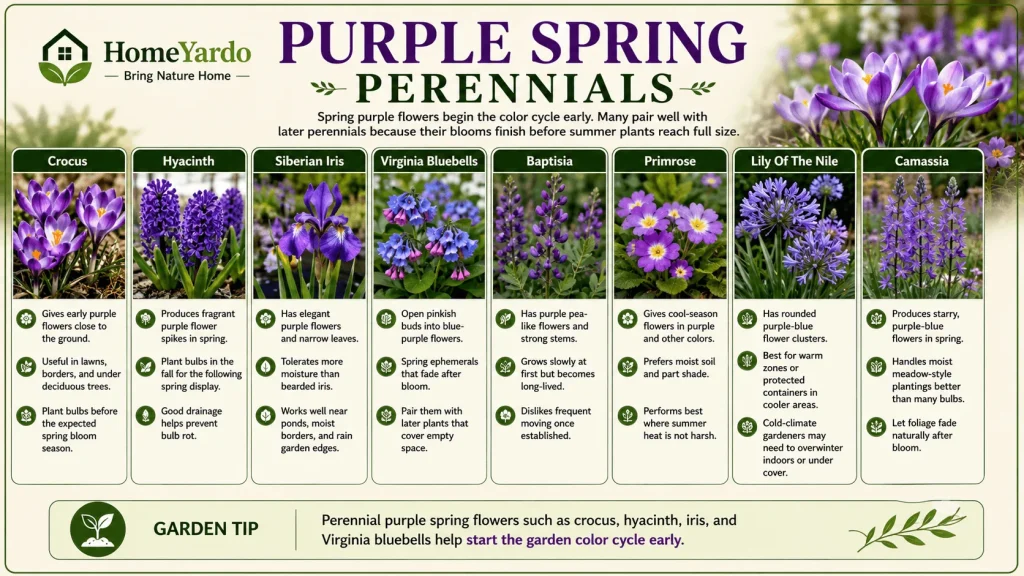
Spring purple flowers begin the color cycle early. Many pair well with later perennials because their blooms finish before summer plants reach full size.
- Crocus
Crocus gives early purple flowers close to the ground. It is useful in lawns, borders, and under deciduous trees. Plant bulbs before the expected spring bloom season. - Hyacinth
Hyacinth produces fragrant purple flower spikes in spring. Plant bulbs in the fall for the following spring display. Good drainage helps prevent bulb rot. - Siberian Iris
Siberian iris has elegant purple flowers and narrow leaves. It tolerates more moisture than bearded iris. It works well near ponds, moist borders, and rain garden edges. - Virginia Bluebells
Virginia bluebells open pinkish buds into blue-purple flowers. They are spring ephemerals that fade after bloom. Pair them with later plants that cover empty space. - Baptisia
Baptisia has purple pea-like flowers and strong stems. It grows slowly at first but becomes long-lived. It dislikes frequent moving once established. - Primrose
Primrose gives cool-season flowers in purple and other colors. It prefers moist soil and part shade. It performs best where summer heat is not harsh. - Lily Of The Nile
Lily of the Nile has rounded purple-blue flower clusters. It is best for warm zones or protected containers in cooler areas. Cold-climate gardeners may need to overwinter it indoors or under cover. - Camassia
Camassia produces starry, purple-blue flowers in spring. It handles moist meadow-style plantings better than many bulbs. Let foliage fade naturally after bloom.
Perennial purple spring flowers such as crocus, hyacinth, iris, and Virginia bluebells help start the garden color cycle early.
Native, Pollinator, And Special Use Perennials
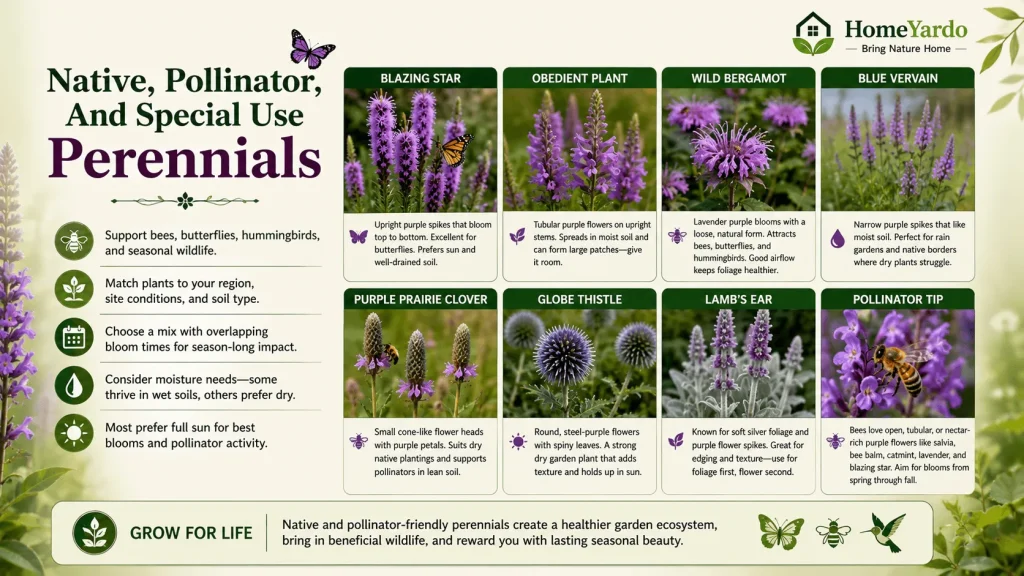
Native and pollinator-friendly plants add more than color. They can support bees, butterflies, hummingbirds, and seasonal wildlife when matched to the site and region.
- Blazing Star
Blazing star has upright purple flower spikes that bloom from top to bottom. It is excellent for butterflies. It prefers sun and soil that does not stay soggy. - Obedient Plant
Obedient plant has tubular purple flowers on upright stems. It spreads in moist soil, so give it room. It can form large patches if not managed. - Wild Bergamot
Wild bergamot has lavender purple flowers with a loose, natural form. It attracts bees, butterflies, and hummingbirds. Good airflow helps keep foliage healthier. - Blue Vervain
Blue vervain has narrow purple flower spikes and likes moist soil. It fits rain gardens and native borders. It is useful where dry soil plants struggle. - Purple Prairie Clover
Purple prairie clover has small cone-like flower heads with purple petals. It suits dry native plantings. It supports pollinators and does well in lean soil. - Globe Thistle
Globe thistle has round, steel purple flowers and spiny leaves. It is a strong, dry garden plant. It gives texture and holds up well in sunny borders. - Lamb’s Ear
Lamb’s ear is known mostly for soft silver foliage, but it also produces purple flower spikes. It works well as edging and texture. Use it for foliage value first and flower color second.
Purple perennial plants that attract bees often have open, tubular, or nectar-rich flowers, such as salvia, bee balm, catmint, lavender, and blazing star. Pollinator-friendly purple perennial plants are strongest when bloom times overlap from spring through fall.
Best Perennials By Growing Conditions
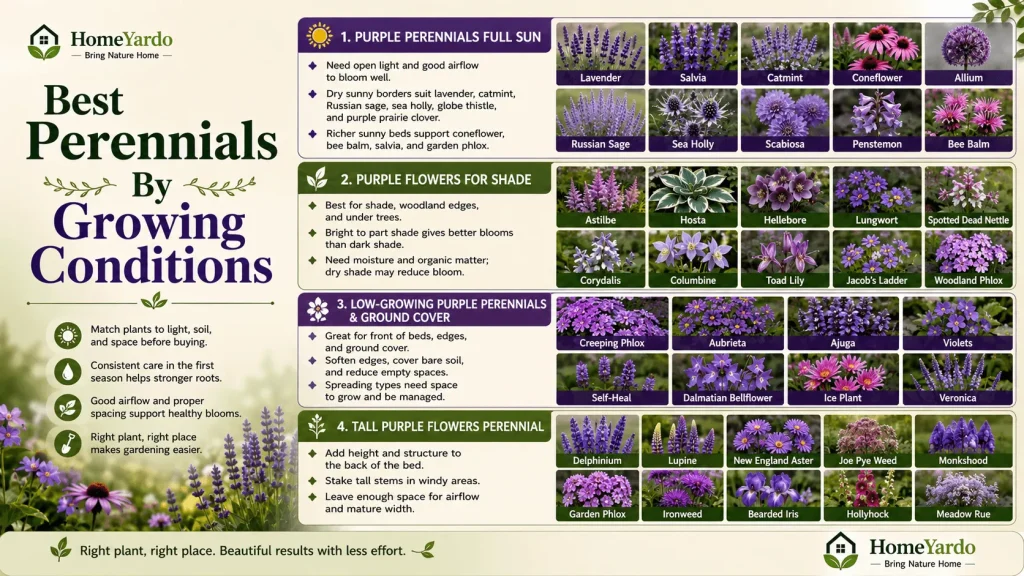
The entire list provides many options, smaller groups help with planting. Make sure that these plants are in harmony with the light, soil and available space before purchasing.
Purple Perennials Full Sun
Full sun perennials require plenty of space and plenty of airflow for them to flourish. Salvia, lavender, catmint coneflower, allium Russian sea holly, sage and penstemon. as well as bee balm, are all good sun-loving options.
The purple perennial plants, which are full sun varieties are still in need of consistent water throughout the initial growing season. Dry, sunny borders work best by using lavender, catmint Russian sea holly, sage globe thistle, and Purple prairie clover. The beds with more sun can be a source of coneflowers, bee balm, salvia as well as garden phlox.
Purple Flower For Shade
Purple shade perennials work best for woodland edges, beds facing north and under tall canopy trees. Astilbe hostsa, hellebore lungwort, spotted deadnettle, columbine, corydalis, toad lily, Jacob’s ladder along with woodland phlox can be all good choices.
Part shade and bright shade are generally more flowering than those in dark shade. Shade plants usually require organic matter and moisture. Dry shade is more difficult to grow, and drought stress can cause a reduction in the bloom of shade plants.
Low-Growing Purple Plants, Perennials, And Ground Cover
Low-growing perennials are great for filling the bed’s front. Creeping Phlox, Aubrieta, violets, ajuga, Dalmatian bellflower, ice plant and Veronica are excellent options for borders as well as ground cover.
A purple perennial groundcover will soften the edges of a plant, cover the bare soil, and decrease empty spaces in between plants. The spreading purple perennial plants like violets, ajuga, self-healers, and obedient plants are best placed in areas in a place where their growth is controlled.
A creeping purple flower like creeping phlox aubrieta, or ajuga may also aid in reducing the slope of rocks, walls and edges of paths.
Tall Purple Flowers Perennial
Tall purple perennials add an additional height to the back of the bed. Delphinium, Lupine, New England aster, Joe Pye monkshood, ironweed, garden phlox bearded iris, hollyhock and meadow rue are all good for adding vertical colour.
The tallest plants should be placed in areas that won’t shade the smaller flowers. The windy garden may require the staking of delphiniums, hollyhocks, or other taller stems. Make sure to leave enough mature width so that airflow is maintained.
Bloom Time Planner For Purple Flowers Perennials
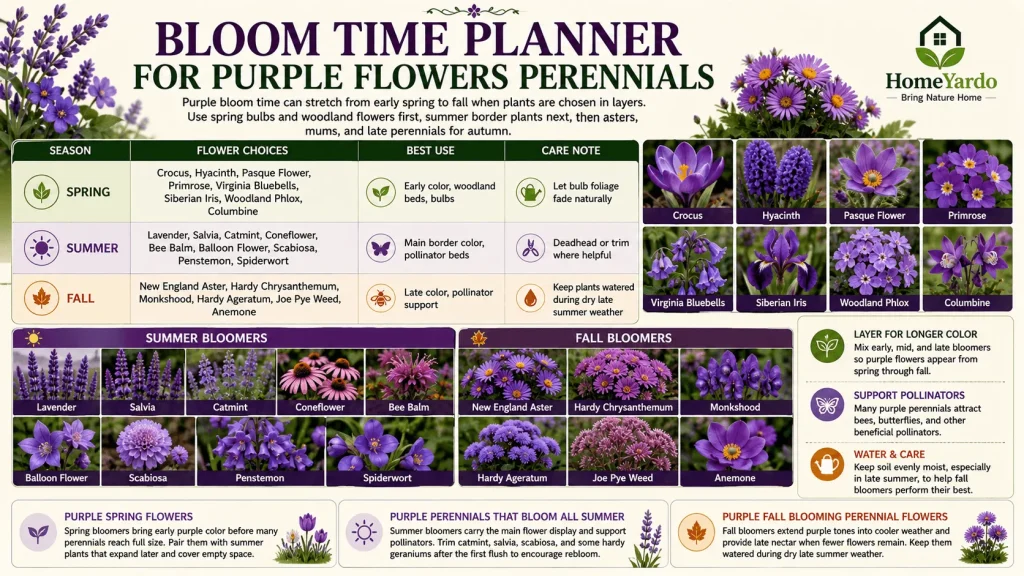
Purple bloom time can stretch from early spring to fall when plants are chosen in layers. Use spring bulbs and woodland flowers first, summer border plants next, then asters, mums, and late perennials for autumn.
| Season | Flower Choices | Best Use | Care Note |
|---|---|---|---|
| Spring | Crocus, Hyacinth, Pasque Flower, Primrose, Virginia Bluebells, Siberian Iris, Woodland Phlox, Columbine | Early color, woodland beds, bulbs | Let bulb foliage fade naturally |
| Summer | Lavender, Salvia, Catmint, Coneflower, Bee Balm, Balloon Flower, Scabiosa, Penstemon, Spiderwort | Main border color, pollinator beds | Deadhead or trim where helpful |
| Fall | New England Aster, Hardy Chrysanthemum, Monkshood, Hardy Ageratum, Joe Pye Weed, Anemone | Late color, pollinator support | Keep plants watered during dry late summer weather |
Perennial Purple Spring Flowers
Spring bloomers bring early purple color before many perennials reach full size. Crocus, hyacinth, pasque flower, primrose, Virginia bluebells, Siberian iris, woodland phlox, and columbine all work well in spring-focused planting.
Many spring flowers fade after blooming. Pair them with summer plants that expand later and cover empty space.
Purple Perennials That Bloom All Summer
The blooms of summer are the centrepiece of the floral display. Salvia, lavender, catmint coneflower, beebalm the balloon, scabiosa spiderwort, and penstemon can make a splash in a sunny or partly sun-filled bed.
Remove salvia, catmint the scabiosa plant, and other tough geraniums following the first flowering to encourage better growth and blooming again. Flowers in summer also aid butterflies and bees during the busiest times in the garden. For more warm-season color ideas beyond purple planting schemes, summer flowers can help compare bright annuals and perennials for sunny garden beds.
Purple Fall Blooming Perennial Flowers
The fall bloomers help keep the garden from fading early. New England aster, hardy monkshood, chrysanthemum ageratum Joe Pye weed, and anemone keep the purple hues going through cooler temperatures.
The fall-blooming purple flowers offer late nectar, when fewer flowers are left. Make sure to water the fall blooms in the dry summer months so that the buds don’t stop. A mum plant is one of the easiest ways to add late-season color near borders, porches, and fall garden displays.
Best Perennials By Zone
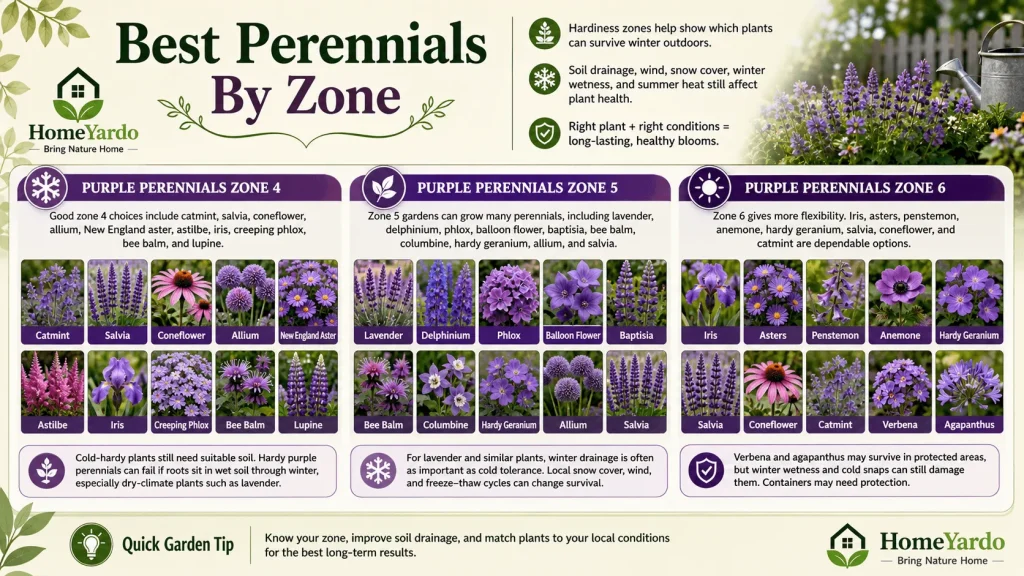
Hardiness zones help show which plants can survive winter outdoors. They are useful, but soil drainage, wind, snow cover, winter wetness, and summer heat still affect plant health.
Purple Perennials Zone 4
Some good zone 4 plants include salvia, catmint and allium. New England aster, astilbe aster, iris, creeping Phlox bee balm, and Lupine.
Plants that are cold-hardy still require adequate soil. Purple perennials that are hardy can die when roots are placed in damp soil during winter, and especially dry-climate plants like lavender.
Purple Perennials Zone 5
Zone 5 gardens can produce various perennials, including lavender delphinium and phlox. the balloon flower columbine, bee balm allium, hardy geranium and salvia.
For plants like lavender and others the winter drainage can be just as important as tolerance to cold. Local snow cover winds, and freeze-thaw cycles could affect the survival of plants.
Purple Perennials Zone 6
Zone 6 offers more flexibility. Asters, Iris anemone, hardy geranium coneflower, salvia and catmint are reliable choices.
Agapanthus and Verbena may thrive in areas that are protected, but winter’s wetness and cold snaps can cause damage to the plants. Containers might require protection if temperatures drop.
Climate Notes For Better Plant Survival
Zones are used to measure winter cold however, they don’t describe every garden issue. The soil’s drainage, humidity as well as summer heat, winds and winter moisture could be just as important.
Gardeners who are in cold weather should focus on drainage and hardy plants. The hot, humid garden should be observing delphinium, lavender and phlox that is susceptible to mildew. Dry, sunny gardens work well with the lavender flower, Russian Sage, Sea globe thistle and catmint. Astilbe’s shade is moist and a good fit for a hosta, as well as lungwort, Siberian Iris and blue vervain.
Low Maintenance Purple Perennials For Beginners
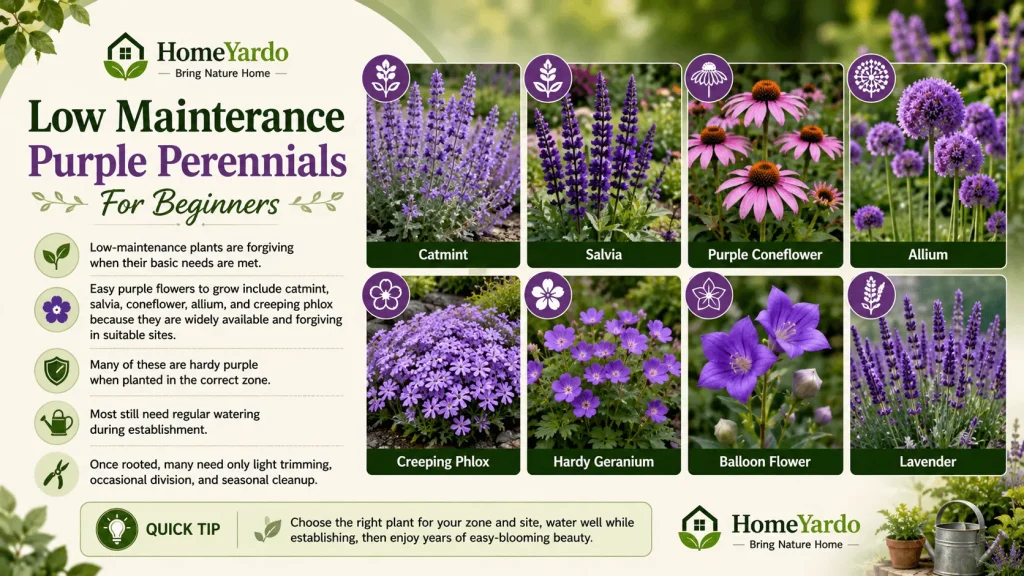
They are easy to care for provided their requirements are satisfied. Salvia, catmint, purple coneflower, allium and creeping phlox, hardy-geranium, balloon flower and lavender in dry, sunny soils are excellent selections.
Easy to grow purple flowers include salvia, catmint, coneflower, allium and creeping phlox since they are readily available and can be tolerated in appropriate places. A lot of them are hardy purple if placed in the right zone.
The majority of them still require irrigation during the initial stages. Once they are established, most require only a light trimming, periodic division, and seasonal clean-up.
Deer-Resistant And Drought Tolerant Purple Perennials
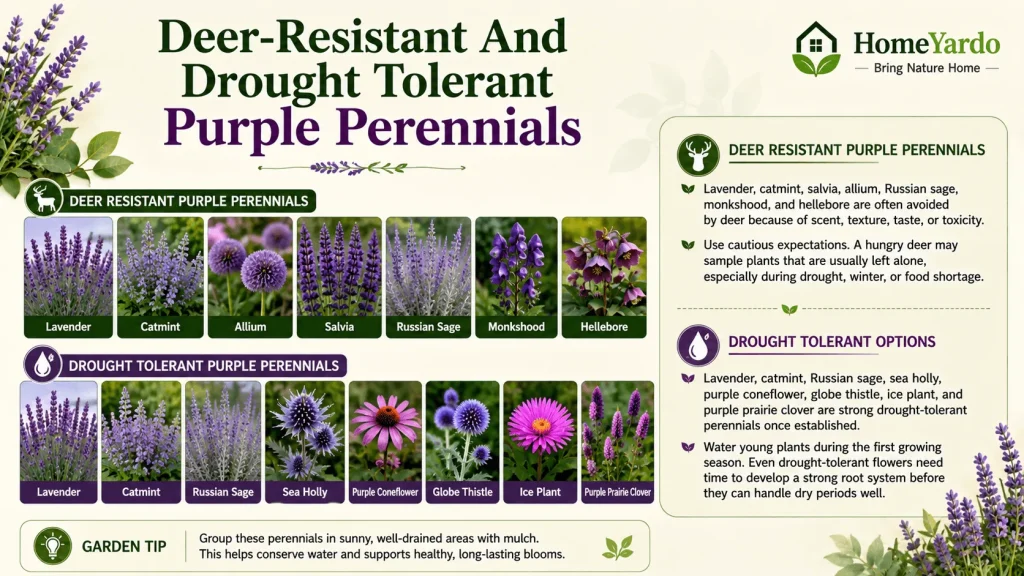
It is not possible to be 100% drought-proof or deer-proof for every garden. The pressure on deer can change with the season and drought tolerance increases when roots are established.
Deer Resistant Purple Perennials
Salvia, catmint, lavender and allium Russian monkshood, sage and hellebore are frequently avoided by deer due to smell or texture, taste or even toxicity.
Be cautious about your expectations. Deer that are hungry may eat plants that are typically kept in a secluded area, particularly in winter, drought, or a food shortage.
Drought Tolerant Options
Lavender, catmint Russian sea holly and purple coneflower. Globe thistle, ice plant as well as purple prairie clover, are all drought-tolerant plants once they are established.
The young plants need water during the beginning of their growing season. Even the most drought-tolerant flowers require time to establish a solid base of roots prior to when they are able to endure dry spells.
Purple Perennial Flower Identification Guide
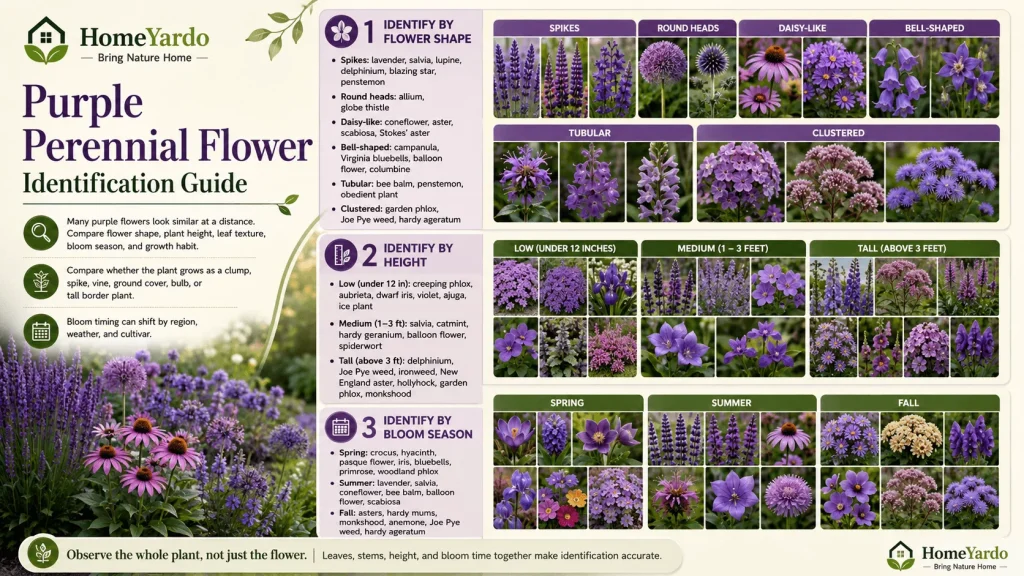
A lot of purple flowers look alike in the distance. The identification of purple perennial flowers is much easier when the flower’s shape, height as well as the texture of the leaves, flower season, and growth habits are contrasted.
To recognize purple flower varieties look at whether the plant grows in an clump, spike vine, groundcover bulb or a tall border plant.
Identify By Flower Shape
Spikes may point to salvia, lavender delphinium or penstemon. The flower heads that are round can suggest globe thistle or allium.
The flowers that resemble a daisy are coneflower aster, scabiosa or Stokes aster. Bell-shaped flowers can include campanulas, Virginia bluebells, balloon flower or columbine.
Tubular flowers can point towards penstemon, bee balm or even an obedient plant. The clustered flower may indicate garden Phlox, Joe Pye weed, or the hardy ageratum.
Identify By Height
Low-purple flowers that are less than 12 inches can include creeping phlox, aubrieta violet, dwarf iris, Ajuga, or an ice plant. Smaller plants ranging between 1 and 3 feet can include catmint, salvia balloon flower, geranium that is hardy and spiderwort.
The identification of tall purple perennial flowers should be focused on tallness as well as the strength of the stem, flower arrangement and the time of bloom. Flowers that are taller than 3 feet can comprise delphinium Joe Pye weed, ironweed, New England aster, the hollyhock, garden phlox and monkshood.
Identify By Bloom Season
Spring purple flowers can be hyacinths, crocus Pasque flower, iris bluebells, primrose as well as woodland phlox. The summer flowers could be salvia, lavender coneflowers, honey balm balloon flower or scabiosa.
Flowers of the fall season can include asters, hardy mums monkshoods, anemones, Joe Pye weed, or the hardy ageratum. The timing of the bloom can vary based on location, weather and cultivar.
Purple Foliage Perennials To Pair With Purple Flowers
Purple foliage gives color after flowers have faded. It can also be contrasted with silver foliage and yellow or white flowers.
Heuchera and Ajuga, purple leaf sedum and dark foliage astilbe and coral bells with purple leaves can be used to support flower beds of purple. The purple shamrock can be used in containers, however it can be brittle in colder climates.
The foliage plants shouldn’t be considered as purple flowers unless they appear on the main list of flower names. Make use of them for design support instead of the primary number of flowers.
Purple Flowers Often Confused With Purple Flowers
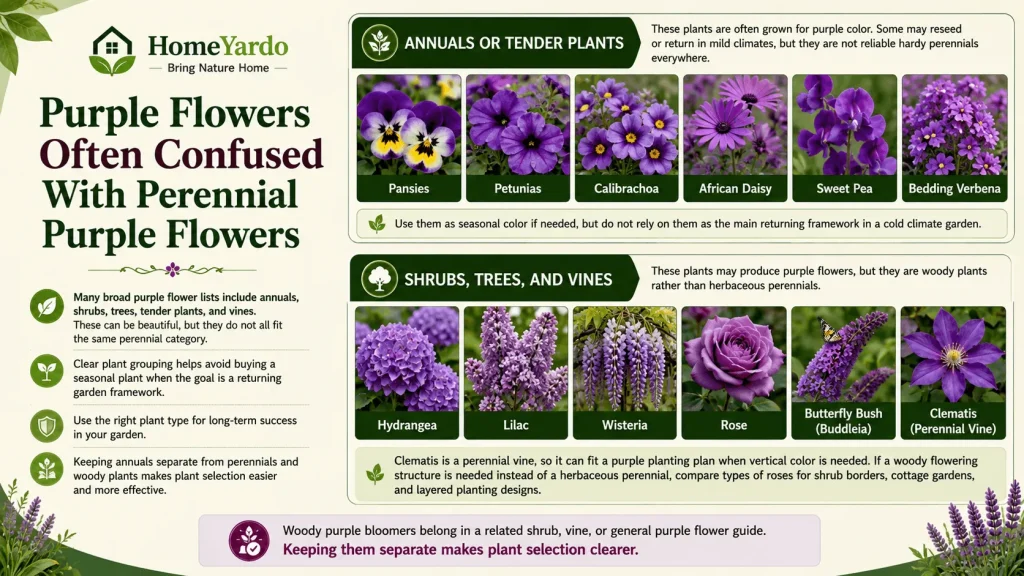
The vast purple lists cover annuals, bushes and tender plants, trees and vines. They can be stunning however they don’t all fall into the same category of perennials.
Clear plant groups can help avoid purchasing a plant that is seasonal in the event of an annual garden framework.
Annuals Or Tender Plants
Pansies, petunias, African daisies, sweet peas, and other varieties of bedding verbena are typically cultivated for their purple hue. Some varieties can reseed and return in warmer climates, they aren’t reliable hardy perennials all over the world.
Use them as a seasonal colour if you want but don’t count on them as the main framework of return in a garden with colder climates.
Shrubs, Trees, And Vines
Hydrangea, lilac and wisteria, butterflies, and roses could produce flowers of purple, however, they are woody plants instead of herbaceous perennials. Clematis is an annual vine, which means it is a good choice for a purple plant plan if vertical color is required. If a woody flowering structure is needed instead of a herbaceous perennial, compare types of roses for shrub borders, cottage gardens, and layered planting designs.
The woody purple flowers belong in the same category as a vine, shrub or general guide to purple flowers. Separating them makes your choice of plants easier.
How To Design A Garden With Purple Perennials
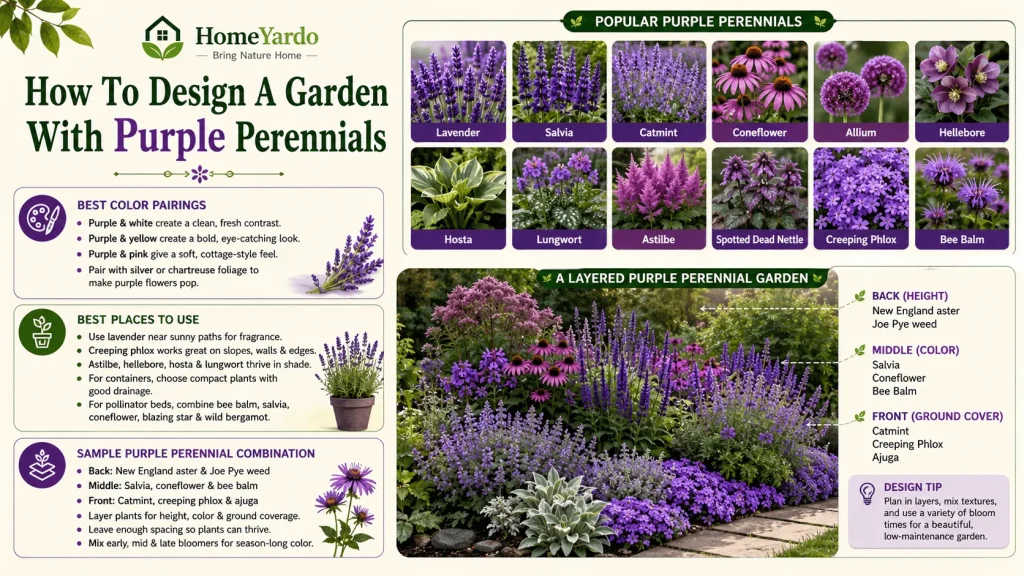
The purple flowers can appear soft and cool, as well as bold or striking depending on the surrounding plants. The most striking designs combine the color as well as texture, height spacing, and flower timing.
A sunny style may include lavender, salvia, catmint coneflower and allium. Shade designs may include the hosta, hellebore Astilbe, and spotted dead nettle.
Best Color Pairings
The combination of white and purple creates an uncluttered contrast. The combination of white daisies and purple salvia or white phlox gives an attractive border.
Yellow and purple make an even stronger contrast. Coneflowers in purple and yellow with a coropsis, or a black-eyed Susan makes a more vibrant summer bed.
Pink and purple give an elegant cottage look. Bee balm, garden phlox and hardy geranium can be used in soft mixed borders.
Purple is also a great match for silver foliage made from lamb’s ear, lavender, and Russian sage. The chartreuse foliage makes purple flowers appear more luscious. For more unusual color and shape ideas, cool flowers can help add standout blooms beside purple perennials in mixed garden beds.
Best Places To Use Purple Flower Perennials
Place lavender in areas near paths where the scent can be appreciated. Use creeping phlox along walls, slopes and bedsides. Utilize hellebore, astilbe, lungwort, and hosta in beds with shade.
To use in containers, pick smaller plants like dwarf iris, dianthus salvia, lavender and low-veronica. Good drainage is essential for containers since roots can’t escape the sloppy soil.
To create pollinator beds, mix with salvia coneflower, blazing star and wild bergamot. Utilize multiple bloom times so that pollinators can have more than one feeding time.
Sample Purple Perennial Combination
A bed of purple that is layered can begin in New England aster, and Joe Pye weed in the back. Include coneflower, salvia, and bee balm towards the middle.
Make use of creeping phlox, catmint and ajuga close to the front. This provides the appearance of height as well as middle color, coverage of the ground and blooms that span multiple seasons.
Make sure to leave enough space between layers so that taller plants do not overpower front-edge flowers. The first bloomers are best put between the plants that will expand later in the summer.
How To Plant Purple Perennials
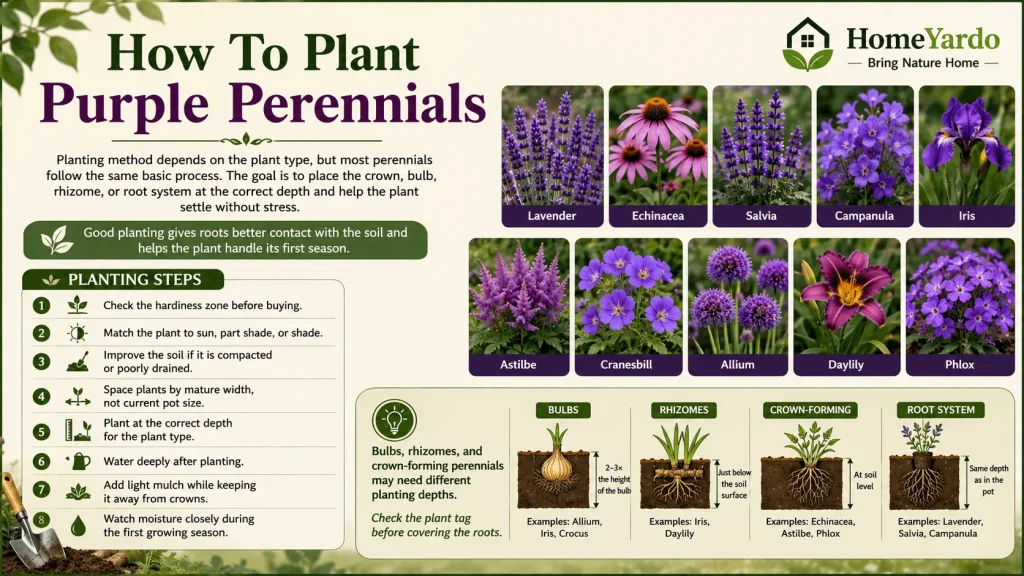
Planting method depends on the plant type, but most perennials follow the same basic process. The goal is to place the crown, bulb, rhizome, or root system at the correct depth and help the plant settle without stress.
Good planting gives roots better contact with the soil and helps the plant handle its first season.
Planting Steps
- Check the hardiness zone before buying.
- Match the plant to sun, part shade, or shade.
- Improve the soil if it is compacted or poorly drained.
- Space plants by mature width, not current pot size.
- Plant at the correct depth for the plant type.
- Water deeply after planting.
- Add light mulch while keeping it away from crowns.
- Watch moisture closely during the first growing season.
Bulbs, rhizomes, and crown-forming perennials may need different planting depths. Check the plant tag before covering the roots.
How To Care For Purple Flowering Perennials
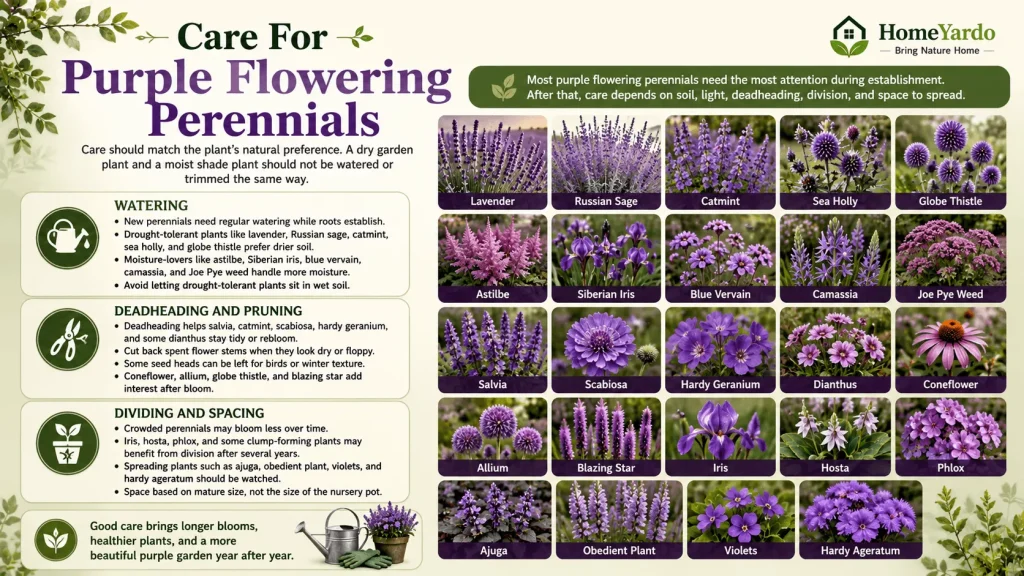
Care should match the plant’s natural preference. A dry garden plant and a moist shade plant should not be watered or trimmed the same way.
Most purple flowering perennials need the most attention during establishment. After that, care depends on whether the plant prefers dry soil, moist shade, deadheading, division, or space to spread.
Watering
New perennials need regular watering while roots establish. After that, plants such as lavender, Russian sage, catmint, sea holly, and globe thistle prefer drier soil.
Astilbe, Siberian iris, blue vervain, camassia, and Joe Pye weed handle more moisture. Avoid letting drought-tolerant plants sit in wet soil because root stress can follow.
Deadheading And Pruning
Deadheading can help salvia, catmint, scabiosa, hardy geranium, and some dianthus stay tidy or rebloom. Cut back spent flower stems when they look dry or floppy.
Some seed heads can be left for birds or winter texture. Coneflower, allium, globe thistle, and blazing star can add interest after bloom.
Dividing And Spacing
Crowded perennials may bloom less over time. Iris, hosta, phlox, and some clump-forming plants may benefit from division after several years.
Spreading plants such as ajuga, obedient plant, violets, and hardy ageratum should be watched so they do not overtake smaller plants. Spacing should be based on mature size, not the size of the nursery pot.
Buying Checklist For Purple Perennial Plants
Color alone buying can cause bad results. The plant must be suited to the climate and location.
Make sure you read these prior to purchasing:
- Botanical name
- Hardiness zone
- Mature height
- Mature spread
- Shade or sun is what you need.
- Bloom time
- Soil preference
- Needs for water
- True perennial or status of tender perennial
- Possible toxicity
- Self-seeding or spreading habit
- The shipping season is the best time to buy on the internet
- The return policy applies to online purchases
- If the plant is offered as a cultivar, bulb, species, root plug, pot, or plant
A healthy plant must be able to stand on firm stems, with clean leaves, moist but not spongy roots and there are no evidence of pest or disease damage.
Common Mistakes To Avoid
Perennial plantation is more successful when it’s selected for the location. The majority of problems stem from incorrect light, the wrong soil and a lack of space, confusion about plant status, or simply not paying attention to its mature dimensions.
Beware of these mistakes:
- If you purchase a purple flower, do not bother making sure it is local to you.
- Affording a large list of flowers in purple without confirming the species of the plant
- Flowering in full sun shade
- Lavender or Russian sage in soil that is wet
- If you are choosing plants that are tall, there isn’t enough space
- Applying abrasive ground cover near delicate perennials
- We are expecting every perennial to flower throughout the entire season long.
- Doing nothing to avoid warnings about toxicity
- Inattention to mature height and spread
- Ignoring cultivar height differences
An alternative is to create a layer garden with spring, summer and autumn bloomers that complement the landscape.
Conclusion
Purple perennial plants are able to fulfill numerous garden roles, ranging from low soil cover to a tall back border colour. The most appropriate choice isn’t always the most beautiful flower. It’s the flower that best suits the area’s lighting, zone, soil height, water needs and bloom time. Pick the right mix of summer, spring, and fall blooms for a vibrant color that returns with greater balance every year.
FAQ’s
Perennials are plants that return for more than one growing season and produce purple, violet, lavender, plum, mauve, or lilac flowers. They may grow from roots, crowns, bulbs, corms, rhizomes, or tubers. They are used in borders, shade gardens, ground cover plantings, pollinator beds, and containers. The best choice depends on zone, light, soil, and mature size.
True perennials return each year in suitable zones. Some purple flowers are tender perennials, which means they return in warm climates but act like annuals in colder gardens. Always check the plant’s hardiness range before buying. A plant can be perennial in one region and seasonal in another.
Most come back every year when planted in the right zone, soil, and light. Poor drainage, winter wetness, or extreme cold can stop some from returning. Dry site plants such as lavender may fail in wet winter soil. Moisture loving plants such as astilbe may decline if the soil dries too much.
Most bloom once during their natural season. Some, such as catmint, salvia, hardy geranium, and scabiosa, can bloom longer after trimming. A better way to keep color going is to plant spring, summer, and fall bloomers together. That gives a longer purple display without expecting one plant to flower all year.
Spring and fall are usually the best planting times for many perennials. Cool weather helps roots settle before heat or winter stress. Bulbs, corms, and tubers may need seasonal planting based on the plant type. Spring-blooming bulbs are often planted before their bloom season.
Catmint, hardy geranium, salvia, verbena, scabiosa, balloon flower, and some anemones can give a longer bloom window. Deadheading may extend flowering. Bloom length depends on cultivar, water, heat, trimming, and soil. No perennial should be expected to flower heavily all year.
Astilbe, hosta, hellebore, lungwort, spotted dead nettle, corydalis, columbine, and toad lily are good shade choices. Bright shade usually gives better blooms than dark shade. Dry shade is harder than moist shade. In dry shade, foliage plants may perform better than heavy-blooming plants.
Catmint, salvia, purple coneflower, allium, creeping phlox, balloon flower, and hardy geranium are strong beginner choices. They are forgiving when planted in the right site. Beginner-friendly does not mean no care. Water during the first season and check the light, zone, and spacing before planting.
Bee balm, coneflower, salvia, catmint, blazing star, wild bergamot, lavender, and Joe Pye weed attract bees, butterflies, and hummingbirds. These are useful pollinator-friendly perennials for mixed beds. Planting several bloom times gives pollinators more support. Spring, summer, and fall flowers work better than one short bloom window.
Purple pairs well with white, yellow, pink, silver, blue, and chartreuse. White gives contrast, yellow adds brightness, and silver softens sunny, dry gardens. Try purple salvia with white daisies, lavender with silver lamb’s ear, or purple coneflower with yellow coreopsis. Keep plant height and bloom time balanced.
References