How to Keep Your Home Generator Ready Before Hurricane Season Hits
3.4 million. That is how many Florida customers lost power in a single month during Hurricane Milton in 2024. If your standby generator was not ready that week, no amount of installation paperwork or original warranty made it useful. A generator that sits idle for eleven months and then gets asked to run continuously for four days is not a plan. It is a gamble.
The good news: keeping a whole-home generator in reliable shape is genuinely not complicated. You just have to do it on a schedule, know which checks actually matter, and understand what to do when something goes wrong at the worst possible moment. This guide covers all three.
Why Florida Homeowners Are Playing a Harder Game Than Most
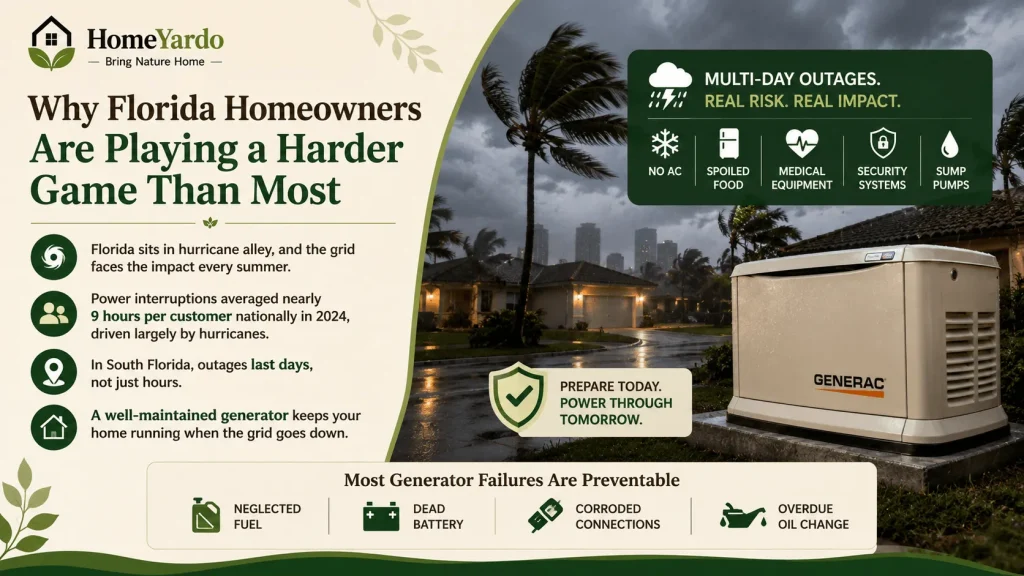
Florida does not get to treat power outages as a minor inconvenience. The state sits squarely in hurricane alley, and the grid reflects that reality every summer. According to the U.S. Energy Information Administration’s 2024 Electric Power Annual report, interruptions attributed to major events averaged nearly nine hours per customer nationally in 2024, the highest figure in a decade, with hurricanes accounting for the bulk of those lost hours.
Nine hours is the national average. In South Florida, a direct hurricane hit means multi-day outages, not single-afternoon ones. Your air conditioning, refrigerator, medical equipment, security system, and sump pump all stop working at once. Regular AC maintenance can also help reduce unexpected cooling-system problems, especially during periods of heavy use. A properly maintained standby generator bridges that gap automatically. One that has been ignored does not. Here is the thing most homeowners miss: the generator itself rarely fails because of age. It fails because of neglected fuel, a dead battery, corroded connections, or an overdue oil change. Every single one of those failure modes is preventable.
The Four Maintenance Checks That Actually Matter
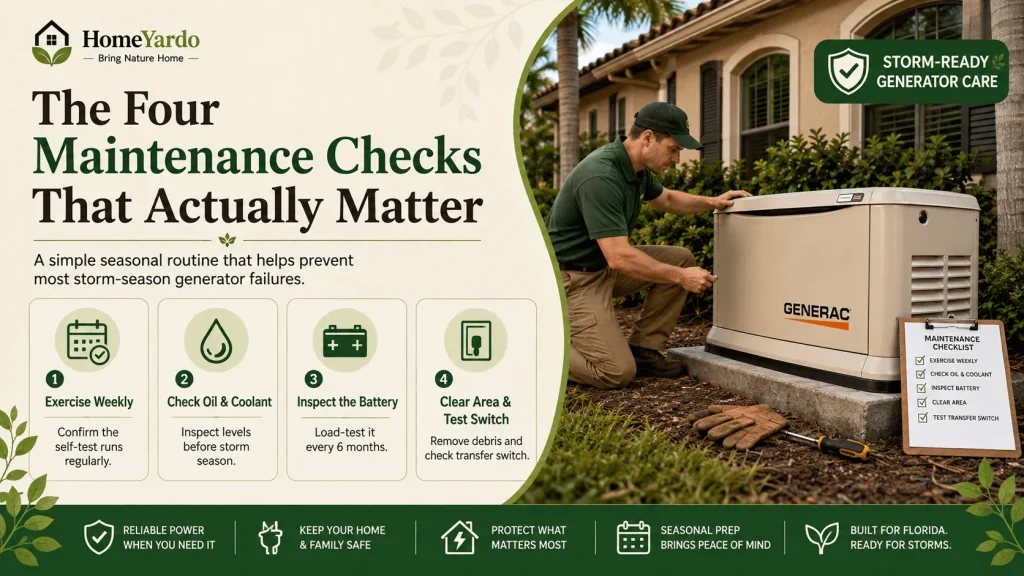
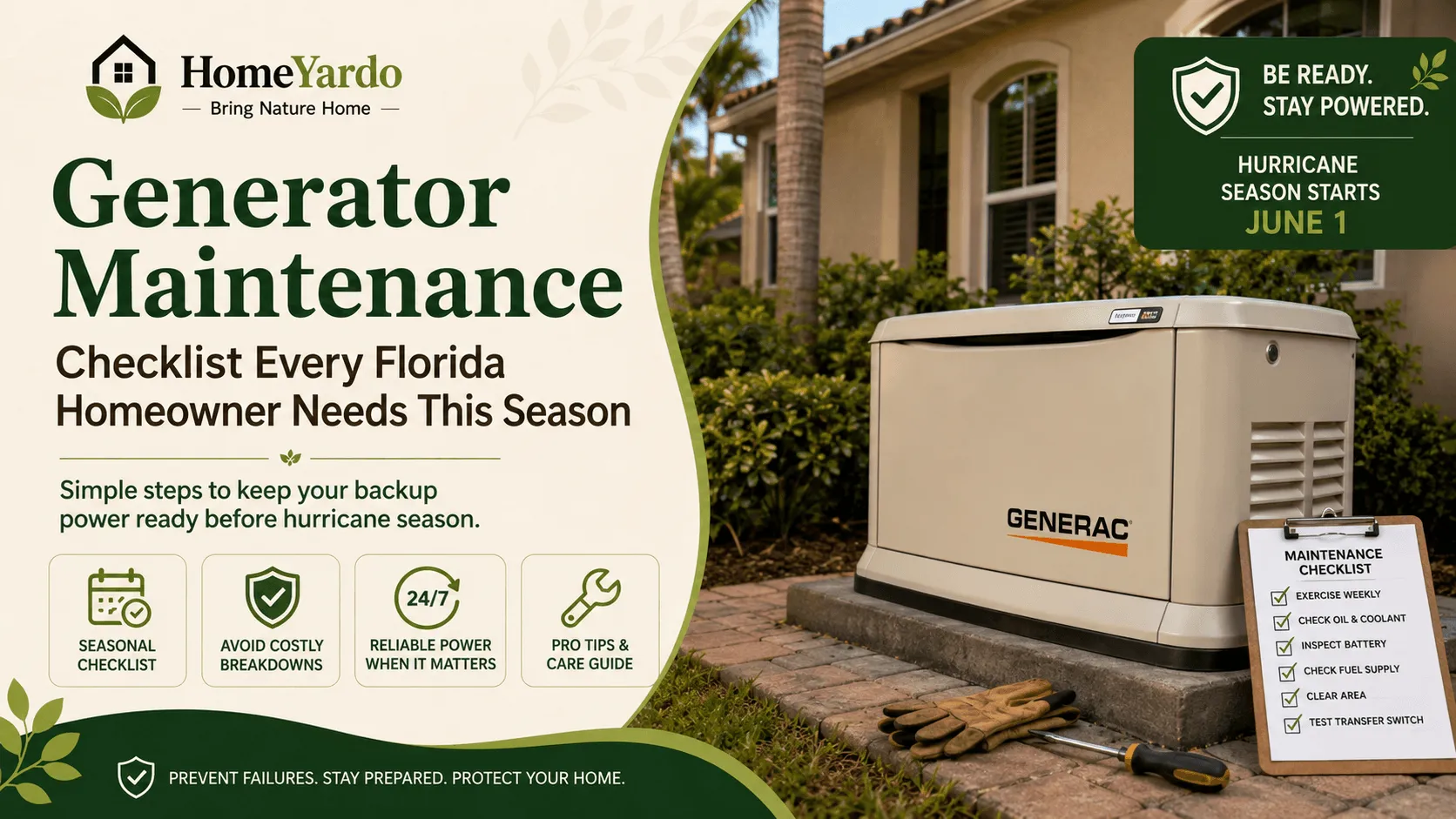
Your generator manufacturer will give you a full service manual. Respect it. But if you want the short list of checks that prevent the vast majority of storm-season failures, these four cover most of the ground.
- Exercise the unit weekly. Modern standby generators run a short self-test automatically, usually once a week for about 20 minutes. Confirm yours is actually doing this. If the unit has not run under load in several months, the engine seals dry out, the fuel degrades, and the battery drains. Weekly exercise prevents all three problems simultaneously.
- Check the oil and coolant before every storm season. Oil degrades over time even when the engine is not running hard. Check the level and condition in May, before the June 1 hurricane season start. If the oil looks dark or gritty, change it. Coolant levels drop slowly and then, right when the generator is working its hardest, an overheated engine shuts down.
- Inspect the battery every six months. The battery is what starts the generator when the power goes out at 2 a.m. during a storm. Load-test it rather than just looking at it. Most generator batteries last three to five years. If yours is older than that, replace it before hurricane season, not after the first failed start.
- Clear the area around the unit and check the transfer switch. Debris, vegetation, and even wasp nests accumulate around outdoor enclosures. The transfer switch, which automatically disconnects your home from the grid and connects it to the generator, should be tested annually by a qualified technician. A switch that sticks or trips incorrectly defeats the whole point of a standby system.
What Happens When the Generator Fails During a Storm
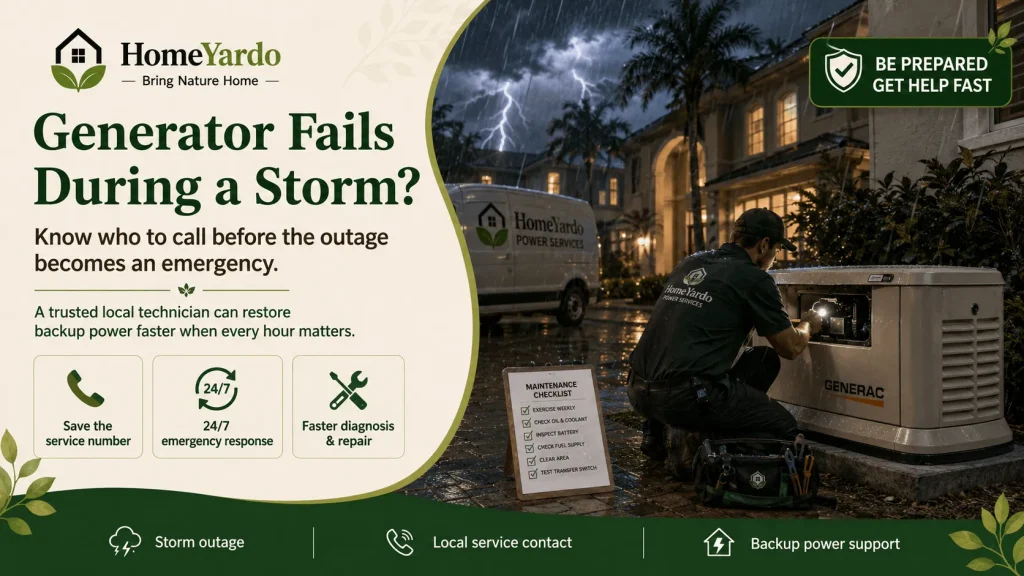
You did the maintenance. You checked the battery. You ran the self-test in April. And then on the second day of a major storm, your generator goes quiet. This happens. A failed fuel solenoid, a tripped circuit, a flooded carburetor on an older unit- any of these can take a generator offline without warning.
This is exactly the scenario where a pre-established relationship with a local service provider pays off. Knowing who to call before an emergency is not an optional luxury. Homeowners in Broward County have used providers like Emergency Generator Services Coral Springs, FL from Personalized Power Systems, which offers 24/7 response specifically because generator failures do not follow business hours. The technician who already knows your unit, your transfer switch configuration, and your fuel setup can diagnose and fix problems in a fraction of the time a stranger would need. Save that number before you need it. Store it in your phone and on a physical card near your electrical panel.
The Seasonal Reset: A Four-Stage Framework
Most generator maintenance advice gets framed as a vague “maintain regularly” instruction. This framework breaks that down into four concrete stages tied to the Florida calendar, so nothing gets skipped and nothing overlaps.
| Stage | When | What to Do | Who Does It |
|---|---|---|---|
| Pre-Season Tune-Up | April or early May | Oil change, air filter, spark plugs, coolant check, battery load test, transfer switch test | Certified technician |
| Storm Watch Check | 72 hours before any named storm | Confirm propane or natural gas supply, clear debris from enclosure, verify self-test log | Homeowner |
| Post-Storm Review | Within one week after a storm run | Oil check after extended operation, enclosure inspection, record runtime hours | Homeowner plus technician if runtime exceeded 48 hours |
| Off-Season Check | December or January | Visual inspection, confirm weekly exercise cycle is active, battery voltage check | Homeowner |
The value of this framework is not that it introduces anything exotic. It is that it prevents the single most common failure mode: the homeowner who assumes “it passed the self-test so it must be fine” and skips the annual professional service for three consecutive years.
A Real Scenario With Real Texture
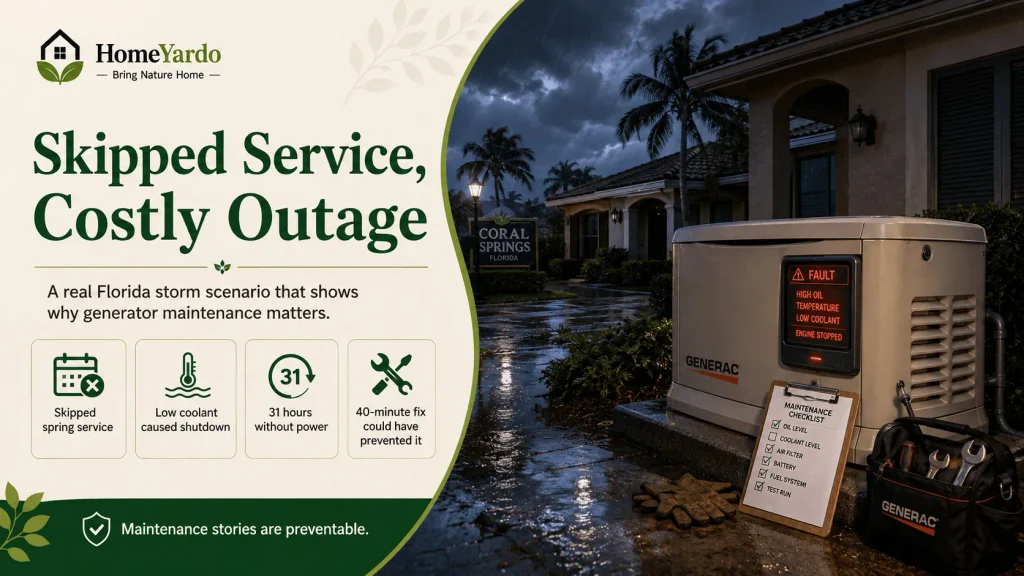
Picture a house in Coral Springs. The generator is a 20 kW natural gas unit installed six years ago. It has run flawlessly through every self-test. The homeowner skipped the professional spring service twice because the unit was working fine. Hurricane season arrives. A Category 2 storm hits Broward County. The power goes out at 7 p.m. The generator starts. By midnight, it has shut itself down on a high oil temperature fault because the coolant was low and nobody had checked it since the previous technician visit.
The house sits without power for 31 hours in August heat. The refrigerator contents are lost. The sump pump does not run. The fix, when a technician finally reaches them the next morning, takes 40 minutes. The coolant was three quarts low. That is a 40-minute fix that a spring service call would have caught for less than the cost of the groceries that spoiled. This is not a horror story. It is a maintenance story. And it is the one Florida homeowners repeat every active hurricane season.
“Among the many devastating impacts in the aftermath of a hurricane are power outages, which can take days or even weeks to restore. Communities grappling with the loss of electricity may encounter obstacles in accessing vital services.” Florida Atlantic University researchers, writing in a DOE-referenced analysis of the EAGLE-I outage dataset covering more than 146 million U.S. customers across a decade of storm events.
The Bottom Line for Florida Homeowners
Your generator is the most important piece of emergency infrastructure your home has. A new roof keeps the rain out. A generator keeps your family comfortable, your food cold, and your medical equipment running when the grid goes dark for days at a time. Treat it accordingly.
Book the annual professional service before hurricane season opens, not during it. Technicians are swamped once storm watches start. The homeowners who already have a service relationship and a tested unit are the ones who sleep through storms instead of sweating through them. Build your Seasonal Reset into your calendar this week, and you will not be scrambling when the next named storm makes landfall.
FAQ’s
Follow the generator manufacturer’s maintenance schedule and service-hour requirements. Florida homeowners should also complete a pre-hurricane-season inspection because storms can require prolonged operation.
Typical maintenance can include checking engine oil, filters, spark plugs, battery condition, enclosure clearance and the fuel system, along with professional inspection of electrical and transfer-switch components. Requirements vary by model.
Schedule professional service before hurricane season rather than waiting for a storm watch, when local service demand may already be higher.
Many standby generators have an automatic exercise schedule, but frequency and duration vary by manufacturer and model. Follow the controller settings and owner’s manual for your unit.
Homeowners can usually perform basic visual checks and certain manufacturer-approved maintenance tasks. Electrical work, transfer-switch testing, fuel-system repairs and complex diagnostics should be handled by appropriately qualified technicians.
Possible causes include battery problems, fuel-supply issues, fault conditions, electrical problems or other mechanical issues. Check the unit’s status or fault code according to its manual and call a technician when the cause is not safely identifiable.
Yes. Extended operation can bring a generator closer to its manufacturer-defined oil-change or service-hour interval. Check the oil and maintenance requirements specified for your particular model.
Yes. A successful exercise cycle confirms some basic operating functions but does not replace scheduled maintenance, battery testing, fluid checks or professional inspection.