How to Fix Yard Drainage Before It Ruins Your Home’s Foundation
Standing water in your yard looks like a minor annoyance. It isn’t. Left alone for one rainy season, it quietly undermines your foundation, kills plant roots, and hands mosquitoes a free breeding ground within feet of your back door. Most homeowners notice the puddles and wait. That wait is where the real cost accumulates.
This guide gives you a clear way to read your yard, name the problem correctly, and choose the fix that actually matches the situation. Some solutions are a Saturday project. Others are a phone call. Knowing which is which saves you a lot of wasted afternoons and a lot of money.
What Standing Water Is Really Doing to Your Property
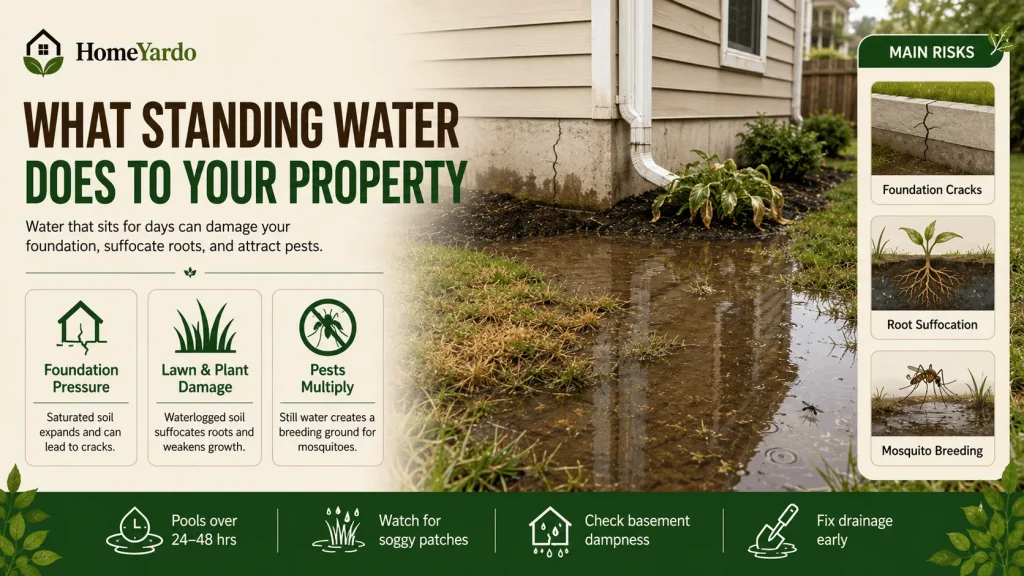
Water that pools in your yard after rain and stays for more than 24 to 48 hours is water that has nowhere to go. That sounds obvious, but the consequence chain it starts is less obvious.
- Foundation pressure. When soil stays saturated close to your house, it expands and pushes against the foundation walls. Over repeated wet-dry cycles, that movement opens cracks. By the time you see a crack in your basement wall, the process has already been going on for months.
- Plant and lawn death. Roots need air as much as they need water. Saturated soil suffocates roots, so even drought-tolerant plants die in chronically wet ground. That soggy patch in your lawn that never greens up in spring is almost always a drainage symptom, not a soil nutrition problem.
- Pest escalation. Mosquitoes need only a bottle-cap’s worth of still water to breed. A low corner of your yard holding water for days is a far bigger problem. Add the fact that standing water attracts other insects that feed on wood, and you’ve got a direct line from your yard to your home’s structural elements.
Poor drainage is rarely just a yard problem. It’s a whole-property problem wearing yard clothes.
Five Warning Signs You Can Spot Right Now
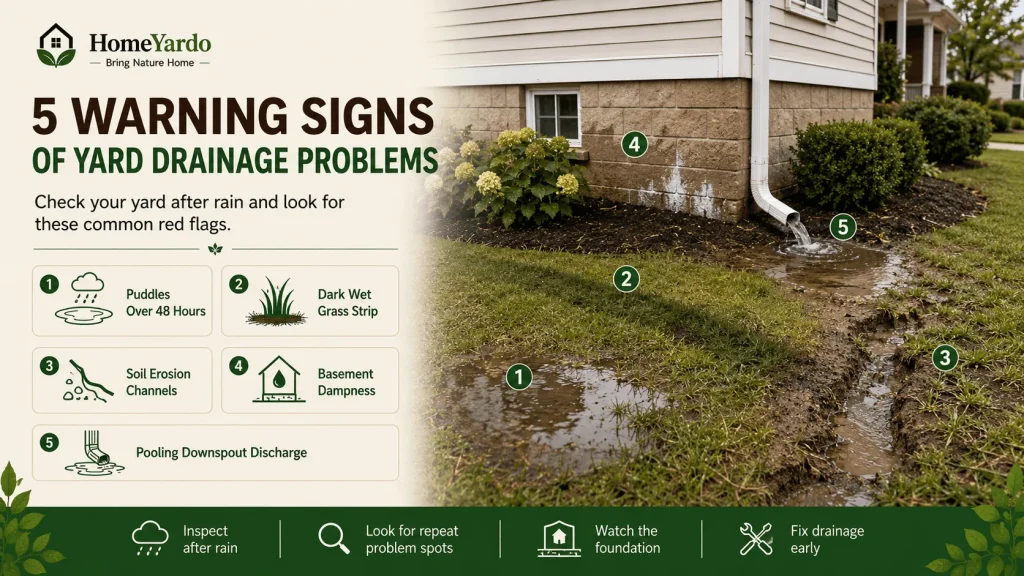
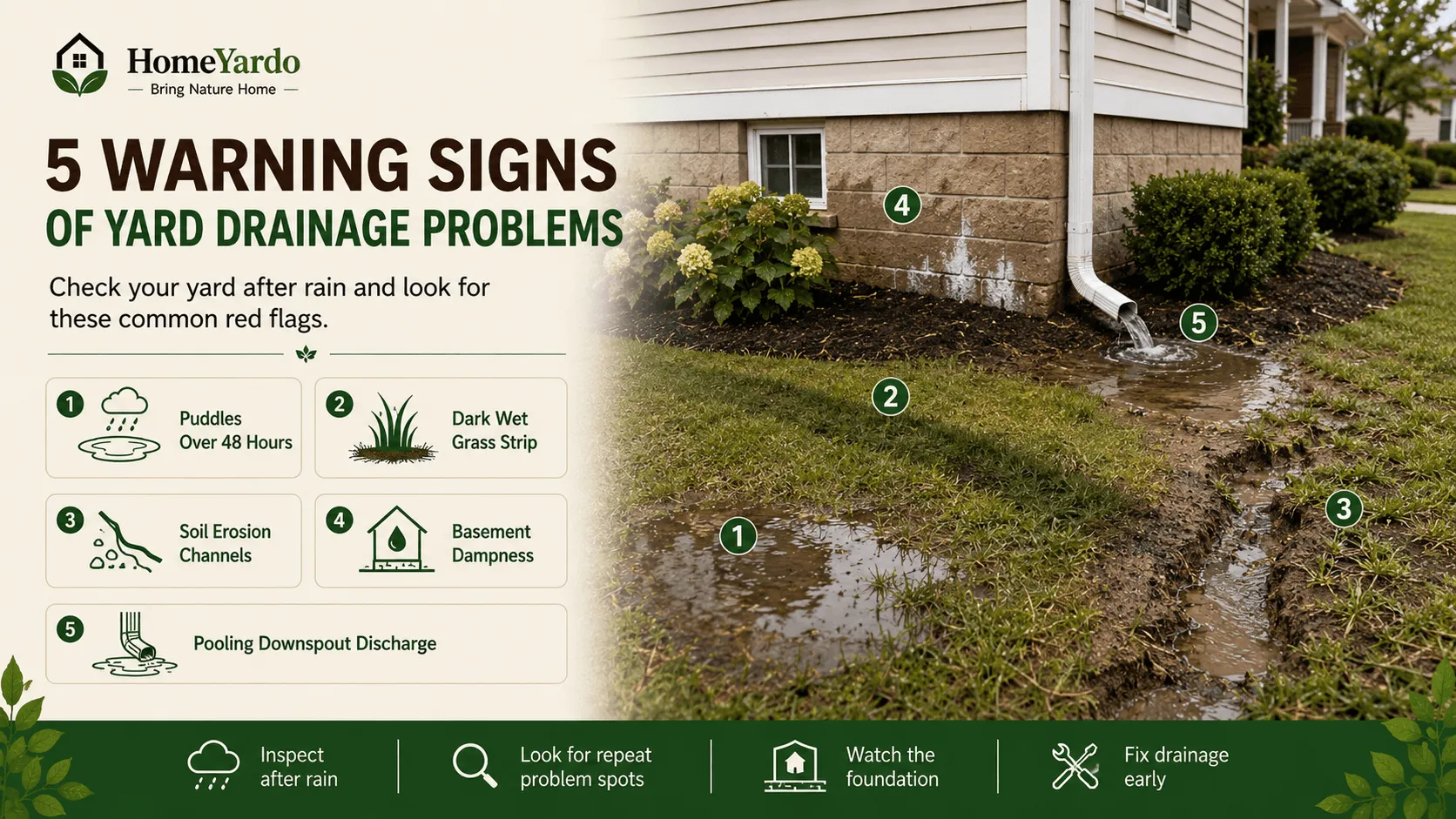
You don’t need a hydrologist to read your property. Walk your yard during or immediately after the next moderate rain and look for these five markers.
- Puddles that last past 48 hours. A healthy yard absorbs or redirects most rain within a day. Persistent puddles mean the soil is either compacted, clay-heavy, or the grade is pointing water at a dead end.
- Grass that’s always darker and lusher in one strip. This usually means a subsurface water line is running just beneath the surface, keeping that soil wetter than the surrounding area. Useful for locating the flow path.
- Soil erosion channels. If rain is carving small ruts or gullies across your yard, the water is moving fast and unchecked. That speed is what strips topsoil and deposits sediment against your foundation.
- Basement dampness or efflorescence after rain. White mineral deposits on basement walls are a textbook sign that water is migrating through the foundation. The source is almost always a yard that grades toward the house.
- Downspout discharge that pools instead of dispersing. A downspout is concentrating a massive volume of roof runoff into a single exit point. If that exit isn’t connected to a drain or extended far enough from the foundation, every storm is a mini flood event at your wall.
Two or more of these in the same yard means the drainage problem is systemic, not isolated. One alone is still worth addressing, but the approach is different.
The Solutions, Matched to the Problem
The biggest mistake homeowners make is buying a solution before diagnosing the cause. A French drain does nothing for compacted soil. Regrading does nothing for a high water table. Match the fix to the finding.
According to the EPA’s WaterSense program, as much as 50 percent of the water used outdoors is lost due to wind, evaporation, and runoff caused by inefficient irrigation methods and systems. That means a poorly positioned sprinkler or a yard without adequate slope is contributing to your saturation problem every single time the system runs, not just when it rains. Fixing drainage often means fixing your irrigation setup at the same time.
| Problem | Best Solution | DIY Difficulty | When to Call a Pro |
|---|---|---|---|
| Yard grades toward the house | Regrading with fill soil | Moderate | When the slope covers more than 300 sq ft |
| Low-lying pooling spots | French drain or dry well | Moderate to Hard | When pooling is within 10 ft of the foundation |
| Compacted, clay-heavy soil | Core aeration plus organic topdress | Easy to Moderate | When aeration alone doesn’t improve drainage in two seasons |
| Downspout discharge pooling | Extend downspout 6 to 10 feet, add splash block | Easy | When you need an underground discharge line |
| Chronic saturation near structure | Channel drain or catch basin installation | Hard | Almost always; depth and slope require precision |
For most yards, the right answer is a combination of two approaches: one that redirects surface water and one that addresses what’s happening below grade. Treating only one layer rarely solves the problem.
Regrading: The Underrated First Move
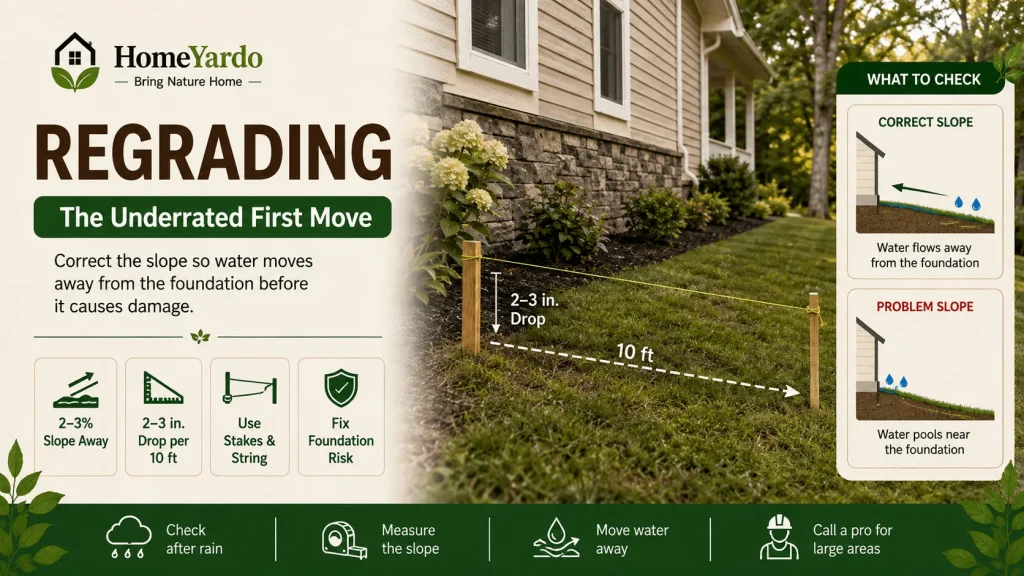
Your yard’s slope is the most fundamental drainage factor, and it’s one most homeowners overlook because it’s invisible to the casual eye. The standard guidance is a fall of at least 2 to 3 percent away from the foundation for the first 10 feet. That’s roughly 2 to 3 inches of drop per 10 feet of horizontal run. Less than that and you’re likely pushing water back toward the house without realizing it.
Testing your grade is simple. Drive two stakes 10 feet apart, stretch a level string between them, and measure the gap from the string to the ground at the far stake. Less than 2 inches is a problem. If you find it slopes toward the house at all, that’s your primary project before you touch anything else.
“Heavy rains, poor drainage, and even nearby construction projects can put you at risk for flood damage.”
FEMA makes this point directly in its homeowner flood risk resources, underscoring that drainage failures are not just a coastal concern. Any property with a 1 percent or higher annual chance of flooding is considered high-risk, and those properties carry at least a one-in-four chance of flooding over the course of a standard 30-year mortgage, according to FEMA’s flood risk data for homeowners. That figure includes properties many owners assume are safe because they aren’t near a river or coast.
When to Stop DIYing and Call a Professional
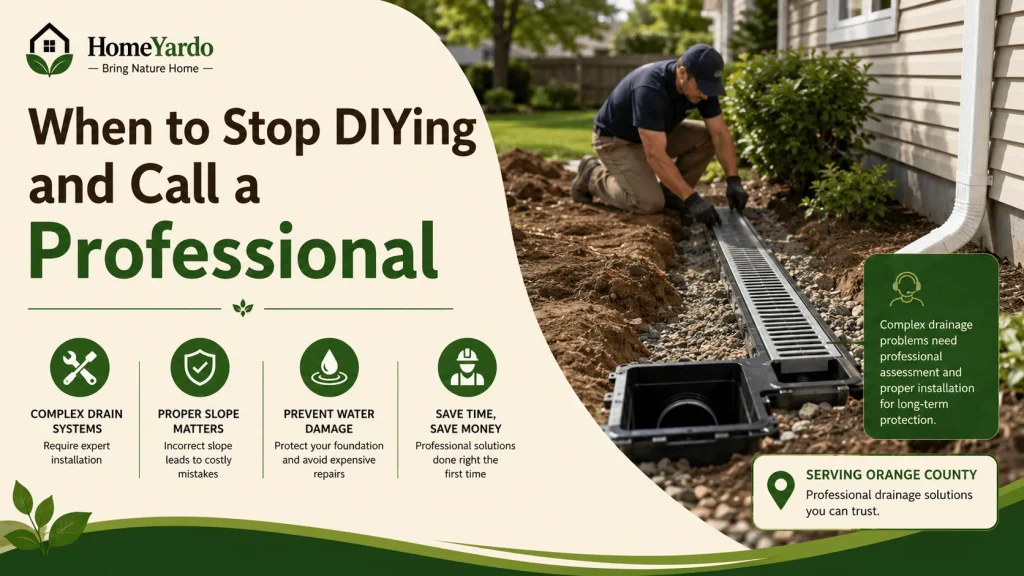
There’s a clear line between work that rewards a motivated homeowner and work that punishes guessing. Extending a downspout, aerating compacted soil, and filling low spots with graded fill are all reasonable weekend projects. What’s not reasonable is attempting to install a channel drain system, a catch basin, or any underground drain line without a solid understanding of your property’s slope, soil profile, and existing utility locations.
The reason is simple: underground drain lines need a consistent, calculated slope to function. Too little slope and water sits in the pipe. Too much and it outpaces the discharge point’s capacity. Either mistake turns your fix into a new problem, and excavating to correct a bad installation costs more than doing it right the first time.
If you’re in the Orange County area and dealing with pooling near the foundation or a yard that simply won’t stop collecting water, a professional assessment is the fastest path to a real answer. Services like Drain Installation Brea are equipped to evaluate subsurface conditions and install systems sized correctly for your specific property, which is something a general contractor or a weekend project rarely gets right on the first attempt.
The EPA’s WaterSense data notes that a household irrigation system that isn’t properly maintained can waste up to 25,000 gallons of water annually. Combine that with a drainage system that’s routing water back toward your structure, and you’ve compounded a manageable problem into an expensive one. Getting professional eyes on a serious drainage issue usually reveals that the fix is simpler and cheaper than the homeowner feared, but only when caught early.
Building a Yard That Sheds Water by Design
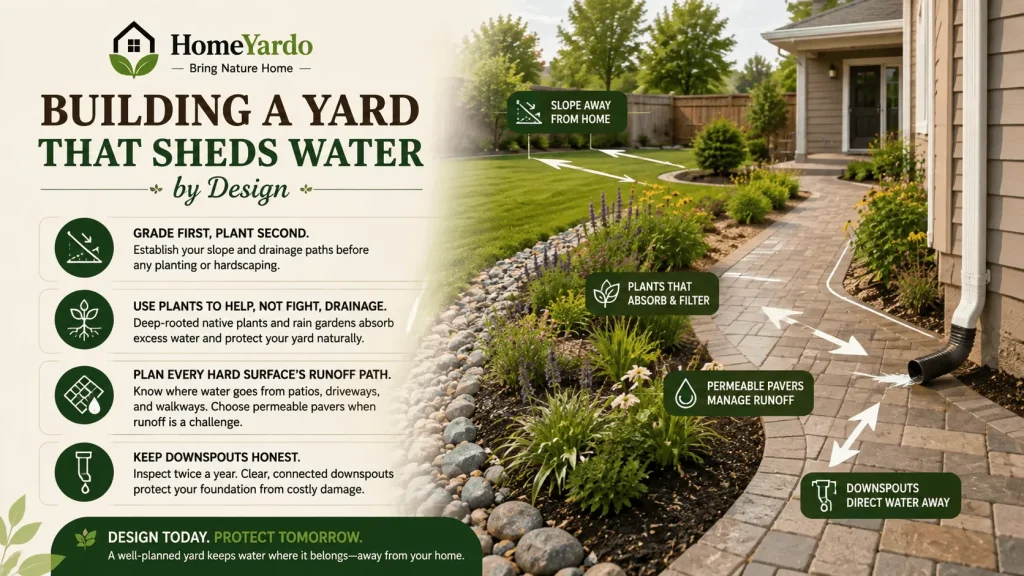
The best drainage solution is one baked into the yard’s original design. If you’re landscaping from scratch or doing a major outdoor renovation, here’s the four-point framework to build in from the start:
- Grade first, plant second. Establish your slope and drainage paths before any planting or hardscaping. It’s nearly impossible to correct grade once beds and patios are in place.
- Use plants to help, not fight, drainage. Deep-rooted native plants along natural drainage paths break up compacted soil and absorb excess water. Rain gardens built in natural low spots are one of the most effective and lowest-cost drainage tools available.
- Plan every hard surface’s runoff path. Patios, driveways, and walkways shed water fast. Know where it goes before you pour or pave. Permeable pavers are worth the premium cost in any yard where runoff is already a challenge.
- Keep downspouts honest. Inspect them twice a year. A clogged or disconnected downspout turns every heavy rain into a foundation-soaking event in under an hour.
Your yard doesn’t need to be an engineering project. It just needs a plan that accounts for where water goes when it falls. Get that right and most drainage problems either never develop or show up small enough to fix with a shovel and an afternoon.
The time to address a drainage problem is before you see the basement crack, not after. Walk your yard in the rain this week. What you find in that 20-minute walk could be the most valuable home inspection you’ve ever done.
FAQ’s
First, find out why the water is building up. Grading that is not enough may need to be regraded or a swale, concentrated roof drainage may need downspout adjustments, compacted soil may need aeration and chronic low-point drainage may need a catch basin, French drain or another drainage system appropriate for the location.
For mild problems, inexpensive starting points may be fixing downspout discharge, cleaning gutters, filling minor low spots, changing irrigation, or aerating compacted soil. It is contingent upon what is causing the water to gather.
Observe the garden in the rain to see where the water originates and where it ends. The pooling might be due to several causes that can be addressed by correcting the gradient, creating a safe runoff path, enhancing soil infiltration or building an adequate collecting or drainage system.
It can be helpful under the correct site conditions, especially where water needs to be captured and diverted below the surface. It is not the right remedy for every problem in standing water; poor grading or concentrated surface runoff may necessitate a different solution.
Aeration and proper soil management procedures may help compacted clay soil, however soil additives alone will not fix water running toward the home or a site without a good drainage outlet.
The 2024 International Residential Code says lots should slope away from foundation walls and typically requires a minimum of 6 inches of fall within the first 10 feet, with exceptions where site constraints exist. Make sure you verify the local requirements.
French drains are a subterranean drainage system , filled with gravel , to capture and redirect water . Catch basins are mostly for collecting surface water at a low point . The source and velocity of the water decide the optimal system.
A professional assessment is appropriate if water is continually collecting against the foundation, entering the basement or crawlspace, causing substantial erosion, requiring large-scale grading, or requiring the installation of subsurface drainage.