70 Beautiful Varieties Of Flowers That Start With P You Didn’t Know About
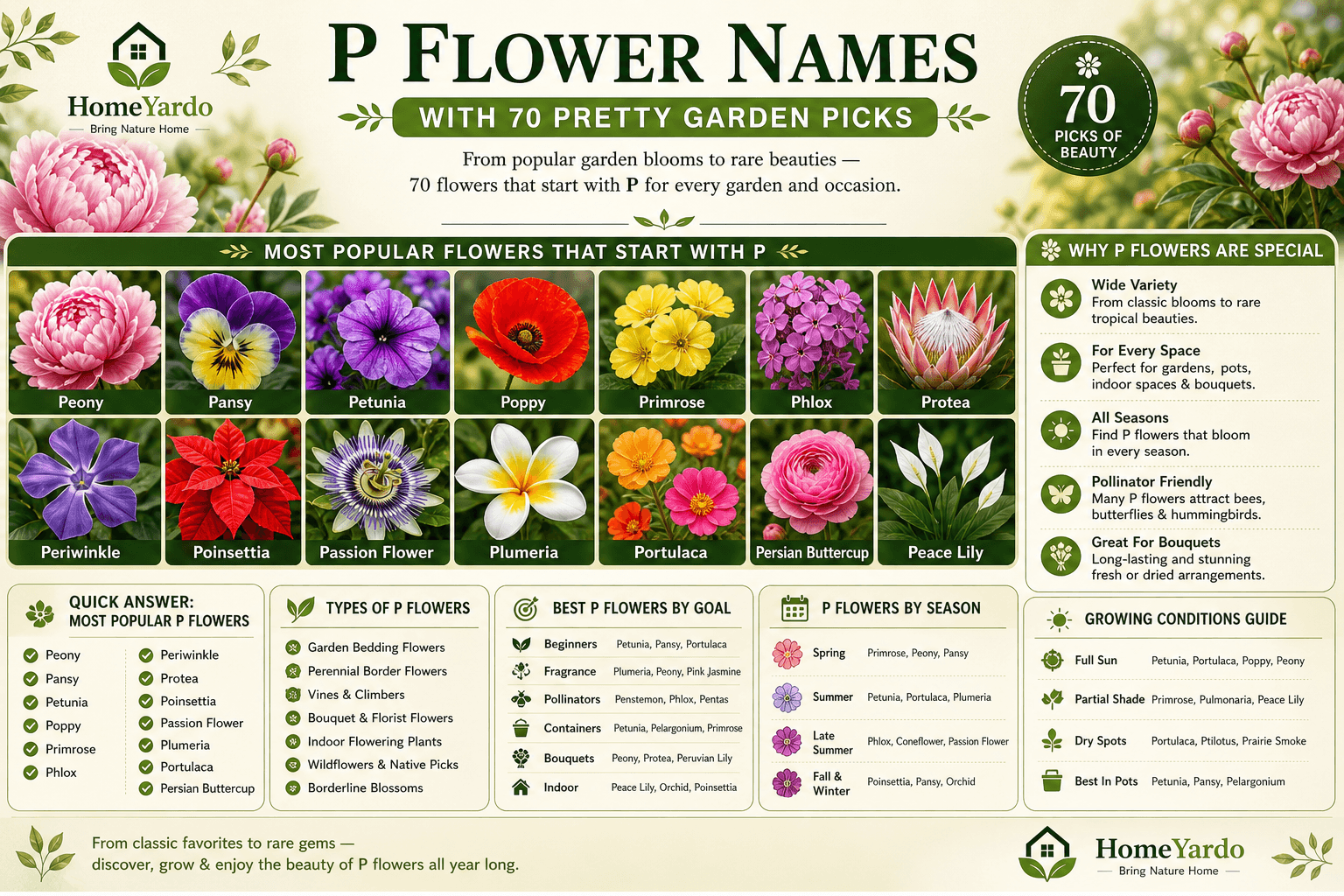
Flowers starting with P include some of the most familiar garden blooms and some unusual flower forms that stand out in borders, pots, bouquets, and indoor displays. Peony, pansy, petunia, poppy, primrose, phlox, and protea are common favorites, while pasque flower, ptilotus, pua kala, pineapple lily, and Pleurothallis orchid add more unusual choices.
This guide includes 70 P flower names without counting the same flower twice under both common and botanical names. Some entries are true flower-first choices, while others are flowering shrubs, indoor bloomers, cactus flowers, or fruit-tree blossoms that often appear in broad flower lists.
The goal is simple: help sort P flower names by popularity, color, season, use, growing condition, bouquet value, indoor appeal, and garden role. For more alphabet-style flower ideas, start with flowers that start with A before moving through the rest of the flower alphabet.
Quick Answer: What Are The Most Popular Flowers That Start With P?
The most popular flowers that beginning with the letter P include peony, pansy, petunia, poppy, primrose, phlox, periwinkle, protea, poinsettia, passion flower, plumeria, portulaca, and Persian buttercup.
These names cover spring bedding flowers, summer container color, cottage garden flowers, indoor bloomers, tropical flowers, and florist stems. For a short list of standout choices, start with:
| Flower | Best Known For |
|---|---|
| Peony | Large layered spring blooms |
| Pansy | Cool-season bedding color |
| Petunia | Long summer color in pots and baskets |
| Poppy | Papery cottage garden flowers |
| Primrose | Early spring color |
| Phlox | Border flowers and pollinator value |
| Protea | Bold statement blooms |
| Poinsettia | Winter indoor display |
| Passion Flower | Exotic vine flowers |
| Plumeria | Tropical fragrance |
70 Flowers That Starting With P
The master list of flowers starts with P below and gives 70 flower names beginning with P. Each entry is counted once, even when it also has a botanical or trade name.
- Painted Daisy
- Painted Tongue
- Pansy
- Pasque Flower
- Passion Flower
- Pavonia
- Peace Lily
- Pearly Everlasting
- Peacock Orchid
- Pelargonium
- Penstemon
- Pentas
- Peony
- Perilla Flower
- Periwinkle
- Persian Buttercup
- Persian Candytuft
- Persian Violet
- Peruvian Lily
- Petunia
- Phacelia
- Pheasant’s Eye
- Phalaenopsis Orchid
- Philadelphus
- Phlomis
- Phlox
- Pigsqueak
- Pimpernel
- Pincushion Flower
- Pine Lily
- Pineapple Lily
- Pink
- Pink Jasmine
- Pink Rain Lily
- Pink Musk Mallow
- Pink Turtlehead
- Pitcher Plant Flower
- Platycodon
- Plectranthus Flower
- Pleione Orchid
- Pleurothallis Orchid
- Plumbago
- Plumeria
- Poinsettia
- Polemonium
- Polyanthus
- Poppy
- Portulaca
- Pot Marigold
- Potentilla
- Prairie Gentian
- Prairie Smoke
- Pride of Madeira
- Primrose
- Protea
- Pulmonaria
- Purple Coneflower
- Purple Loosestrife
- Purple Poppy Mallow
- Ptilotus
- Pua Kala
- Prickly Pear Cactus Flower
- Prickly Poppy
- Paper Daisy
- Parrot Tulip
- Paintbrush Lily
- Pachysandra Flower
- Pomegranate Flower
- Plum Blossom
- Peach Blossom
Master Comparison Table For Flowers Starting With P
The table below focuses on the strongest practical choices from the full 70-name list. These flowers are easier to compare for garden use, indoor display, bouquet value, color, season, fragrance, and growing conditions.
| Flower | Botanical Name | Main Colors | Bloom Season | Type | Fragrance | Indoor Or Outdoor | Best Use | Sun Or Light | Difficulty | Pollinator Value | Bouquet Value |
|---|---|---|---|---|---|---|---|---|---|---|---|
| Painted Daisy | Tanacetum coccineum | Pink, red, white | Late spring to summer | Perennial | Light | Outdoor | Borders, pollinator beds | Full sun | Easy to moderate | Medium | Medium |
| Painted Tongue | Salpiglossis sinuata | Purple, red, yellow, pink, blue | Summer to fall | Annual | Light | Outdoor | Cottage beds, containers | Full sun to part shade | Moderate | Medium | Low |
| Pansy | Viola × wittrockiana | Purple, yellow, white, blue, mixed | Spring and fall | Seasonal bedding plant | Light | Outdoor | Cool-season beds, pots | Sun to part shade | Easy | Medium | Low |
| Pasque Flower | Pulsatilla vulgaris | Purple, white, red | Early spring | Perennial | Light | Outdoor | Rock gardens, early color | Full sun | Moderate | Medium | Low |
| Passion Flower | Passiflora spp. | Purple, blue, white | Summer to fall | Flowering vine | Light to moderate | Outdoor | Trellises, fences, exotic blooms | Full sun | Moderate | High | Low |
| Pavonia | Pavonia spp. | Pink, red | Summer to fall | Tender perennial | Light | Outdoor or bright indoor | Tropical borders, containers | Full sun to bright light | Moderate | Medium | Low |
| Peace Lily | Spathiphyllum spp. | White | Indoor bloom cycles | Flowering houseplant | Light | Indoor | Indoor white bloom display | Bright indirect light | Easy to moderate | Low | Low |
| Pearly Everlasting | Anaphalis margaritacea | White, cream | Summer to fall | Perennial wildflower | Light | Outdoor | Dried flowers, natural gardens | Full sun | Easy | Medium | High |
| Peacock Orchid | Gladiolus murielae | White with purple center | Summer to early fall | Bulb or corm | Strong | Outdoor | Fragrant beds, cut flowers | Full sun | Moderate | Medium | Medium |
| Pelargonium | Pelargonium spp. | Red, pink, white, salmon | Spring to frost | Tender perennial | Light | Outdoor or bright indoor | Pots, window boxes | Full sun to bright light | Easy | Medium | Low |
| Penstemon | Penstemon spp. | Purple, pink, red, white | Late spring to summer | Perennial | Light | Outdoor | Pollinator borders | Full sun | Easy to moderate | High | Medium |
| Pentas | Pentas lanceolata | Pink, red, white, lavender | Summer to frost | Tender perennial | Light | Outdoor | Butterfly gardens, patio pots | Full sun | Easy | High | Low |
| Peony | Paeonia spp. | Pink, white, red, coral | Spring to early summer | Perennial | Moderate to strong | Outdoor | Borders, bouquets | Full sun | Moderate | Medium | High |
| Perilla Flower | Perilla frutescens | White, pink, lavender | Summer to fall | Herbaceous flowering plant | Light | Outdoor | Herb gardens, pollinator interest | Full sun to part shade | Easy | Medium | Low |
| Periwinkle | Vinca spp. | Blue, purple, white, pink | Spring to summer | Groundcover | Light | Outdoor | Edging, groundcover | Sun to shade by type | Easy | Medium | Low |
| Persian Buttercup | Ranunculus asiaticus | Yellow, pink, orange, red, white | Spring | Tender perennial | Light | Outdoor | Cut flowers, spring beds | Full sun | Moderate | Medium | High |
| Persian Candytuft | Aethionema grandiflorum | Pink, lavender | Spring to early summer | Perennial | Light | Outdoor | Rock gardens, edging | Full sun | Easy to moderate | Medium | Low |
| Persian Violet | Exacum affine | Blue, purple, white | Warm season | Tender flowering plant | Light | Indoor or patio | Small pots, indoor display | Bright indirect light | Moderate | Low | Low |
| Peruvian Lily | Alstroemeria spp. | Pink, orange, yellow, white, red | Late spring to summer | Perennial | Light | Outdoor | Long-lasting bouquets, borders | Sun to part shade | Moderate | Medium | High |
| Petunia | Petunia spp. | Purple, pink, white, red, mixed | Spring to frost | Annual | Light | Outdoor | Hanging baskets, beds, containers | Full sun | Easy | Medium | Low |
| Phacelia | Phacelia tanacetifolia | Lavender, blue | Spring to summer | Annual wildflower | Light | Outdoor | Pollinator planting | Full sun | Easy | High | Low |
| Pheasant’s Eye | Adonis annua | Red | Spring to early summer | Annual | Light | Outdoor | Meadow style planting | Full sun | Moderate | Medium | Low |
| Phalaenopsis Orchid | Phalaenopsis spp. | White, pink, purple, yellow | Indoor bloom cycles | Orchid | Light | Indoor | Indoor flower spikes | Bright indirect light | Moderate | Low | Medium |
| Philadelphus | Philadelphus spp. | White | Late spring to early summer | Flowering shrub | Strong | Outdoor | Fragrant hedges, shrub borders | Full sun to part shade | Easy to moderate | Medium | Medium |
| Phlomis | Phlomis spp. | Yellow, pink, purple | Summer | Perennial | Light | Outdoor | Dry borders, texture | Full sun | Easy to moderate | Medium | Low |
| Phlox | Phlox spp. | Purple, pink, white, red | Spring to late summer | Annual or perennial | Moderate | Outdoor | Borders, groundcover, pollinators | Sun to part shade | Easy to moderate | High | Medium |
| Pigsqueak | Bergenia cordifolia | Pink, purple, white | Spring | Perennial | Light | Outdoor | Shade edging, groundcover | Part shade | Easy | Medium | Low |
| Pimpernel | Anagallis arvensis | Orange, red, blue | Spring to summer | Annual wildflower | Light | Outdoor | Meadow style planting | Full sun | Easy | Medium | Low |
| Pincushion Flower | Scabiosa spp. | Purple, blue, pink, white | Summer to fall | Annual or perennial | Light | Outdoor | Borders, bouquets | Full sun | Easy | High | High |
| Pine Lily | Lilium catesbaei | Red, orange | Summer to fall | Lily | Light | Outdoor | Naturalistic gardens | Full sun to part shade | Moderate | Medium | Medium |
| Pineapple Lily | Eucomis spp. | Green, cream, purple, white | Summer | Bulb | Light | Outdoor | Containers, focal points | Full sun | Moderate | Medium | Medium |
| Pink | Dianthus spp. | Pink, red, white, purple | Spring to summer | Annual or perennial | Moderate | Outdoor | Edging, cottage beds | Full sun | Easy | Medium | Medium |
| Pink Jasmine | Jasminum polyanthum | Pink buds, white flowers | Late winter to spring | Flowering vine | Strong | Outdoor or bright indoor | Fragrant trellises, patio pots | Full sun to bright light | Moderate | Medium | Medium |
| Pink Rain Lily | Zephyranthes grandiflora | Pink | Summer to fall | Bulb | Light | Outdoor | Small beds, containers | Full sun to part shade | Easy | Medium | Low |
| Pink Musk Mallow | Malva moschata | Pink, white | Summer | Perennial | Light | Outdoor | Cottage borders, pollinator beds | Full sun | Easy | Medium | Medium |
| Pink Turtlehead | Chelone lyonii | Pink, rose | Late summer to fall | Perennial | Light | Outdoor | Moist borders, shade edges | Part shade to sun | Easy to moderate | High | Low |
| Pitcher Plant Flower | Sarracenia spp. | Red, yellow, green, purple | Spring | Carnivorous plant flower | Light | Outdoor or specialty indoor | Bog gardens, specialty collections | Full sun | Advanced | Medium | Low |
| Platycodon | Platycodon grandiflorus | Blue, purple, white, pink | Summer | Perennial | Light | Outdoor | Borders, cottage gardens | Full sun to part shade | Easy | Medium | Medium |
| Plectranthus Flower | Plectranthus spp. | Purple, blue, white | Summer to fall | Tender flowering plant | Light | Outdoor or bright indoor | Containers, foliage with blooms | Part shade to bright light | Easy to moderate | Medium | Low |
| Pleione Orchid | Pleione spp. | Pink, purple, white, yellow | Spring | Orchid | Light | Indoor or specialty | Pots, cool greenhouse displays | Bright filtered light | Advanced | Low | Medium |
| Pleurothallis Orchid | Pleurothallis spp. | Yellow, purple, red, green | Varies by species | Orchid | Light | Indoor or specialty | Orchid collections | Bright filtered light | Advanced | Low | Low |
| Plumbago | Plumbago auriculata | Blue, white | Warm season | Flowering shrub | Light | Outdoor | Warm-climate borders, containers | Full sun | Easy in warm climates | Medium | Low |
| Plumeria | Plumeria spp. | White, yellow, pink, red | Summer | Flowering shrub or tree | Strong | Outdoor or very bright indoor | Tropical gardens, fragrance | Full sun | Moderate | Medium | Medium |
| Poinsettia | Euphorbia pulcherrima | Red, white, pink, cream | Winter display | Flowering shrub | Light | Indoor or warm outdoor | Seasonal decor | Bright indirect light | Moderate | Low | Medium |
| Polemonium | Polemonium caeruleum | Blue, purple, white | Late spring to early summer | Perennial | Light | Outdoor | Woodland edges, cottage borders | Part shade | Easy to moderate | Medium | Low |
| Polyanthus | Primula × polyantha | Yellow, red, pink, orange, mixed | Late winter to spring | Seasonal perennial | Light | Outdoor | Spring beds, containers | Part shade | Easy | Medium | Low |
| Poppy | Papaver spp. | Red, orange, pink, white, purple | Spring to summer | Annual or perennial | Light | Outdoor | Cottage gardens, meadow planting | Full sun | Easy | Medium | Medium |
| Portulaca | Portulaca grandiflora | Pink, yellow, orange, red, white | Summer to frost | Annual | Light | Outdoor | Hot dry containers, edging | Full sun | Easy | Medium | Low |
| Pot Marigold | Calendula officinalis | Yellow, orange | Cool season to summer | Annual | Light | Outdoor | Beds, cut flowers, edible gardens | Full sun | Easy | Good | Medium |
| Potentilla | Potentilla spp. | Yellow, pink, orange, white | Late spring to summer | Perennial or shrub | Light | Outdoor | Borders, groundcover | Full sun to part shade | Easy | Medium | Low |
| Prairie Gentian | Eustoma grandiflorum | Purple, pink, white | Summer | Annual or tender perennial | Light | Outdoor | Cut flowers, beds | Full sun | Moderate | Medium | High |
| Prairie Smoke | Geum triflorum | Pink to red buds | Spring | Perennial | Light | Outdoor | Naturalistic planting | Full sun | Easy to moderate | Medium | Low |
| Pride Of Madeira | Echium candicans | Blue, purple | Spring to summer | Flowering shrub | Light | Outdoor | Coastal gardens, dry borders | Full sun | Moderate | High | Low |
| Primrose | Primula spp. | Yellow, pink, purple, blue, white | Early spring | Perennial or seasonal plant | Light | Outdoor | Spring beds, shaded borders | Part shade | Easy to moderate | Medium | Low |
| Protea | Protea spp. | Pink, red, cream | Late winter to spring by climate | Flowering shrub | Light | Outdoor | Statement bouquets, focal planting | Full sun | Moderate to hard | Medium | High |
| Pulmonaria | Pulmonaria spp. | Blue, pink, purple | Early spring | Perennial | Light | Outdoor | Shade gardens, early color | Part shade | Easy | Good | Low |
| Purple Coneflower | Echinacea purpurea | Purple, pink, white | Summer to fall | Perennial | Light | Outdoor | Pollinator gardens, borders | Full sun | Easy | High | Medium |
| Purple Loosestrife | Lythrum salicaria | Purple, magenta | Summer | Perennial | Light | Outdoor | Wetland style planting with caution | Full sun | Easy | High | Low |
| Purple Poppy Mallow | Callirhoe involucrata | Purple, magenta | Late spring to summer | Perennial | Light | Outdoor | Dry sunny borders, groundcover | Full sun | Easy | Medium | Low |
| Ptilotus | Ptilotus exaltatus | Pink, silver, purple | Summer | Annual or tender perennial | Light | Outdoor | Dry containers, texture | Full sun | Moderate | Medium | Medium |
| Pua Kala | Argemone glauca | White | Spring to summer | Wildflower | Light | Outdoor | Dry native style planting | Full sun | Moderate | Medium | Low |
| Prickly Pear Cactus Flower | Opuntia spp. | Yellow, orange, pink, red | Spring to summer | Cactus flower | Light | Outdoor | Dry gardens, cactus displays | Full sun | Easy in dry climates | Medium | Low |
| Prickly Poppy | Argemone spp. | White, yellow | Spring to summer | Wildflower | Light | Outdoor | Dry meadows, naturalistic planting | Full sun | Easy to moderate | Medium | Low |
| Paper Daisy | Xerochrysum bracteatum | Yellow, orange, pink, white, red | Summer to fall | Annual | Light | Outdoor | Dried flowers, beds | Full sun | Easy | Medium | High |
| Parrot Tulip | Tulipa cultivars | Red, yellow, pink, purple, mixed | Spring | Bulb | Light | Outdoor | Spring beds, bouquets | Full sun to part shade | Moderate | Low | High |
| Paintbrush Lily | Scadoxus puniceus | Orange, red | Spring to summer | Bulb | Light | Outdoor or warm indoor | Warm-climate pots, focal display | Bright filtered light | Moderate | Medium | Medium |
| Pachysandra Flower | Pachysandra terminalis | White | Spring | Groundcover flower | Light | Outdoor | Shade groundcover | Part shade to shade | Easy | Low | Low |
| Pomegranate Flower | Punica granatum | Orange, red | Spring to summer | Flowering shrub or tree | Light | Outdoor | Ornamental fruiting shrub | Full sun | Moderate | Medium | Low |
| Plum Blossom | Prunus mume or Prunus spp. | White, pink | Late winter to spring | Tree blossom | Light | Outdoor | Ornamental spring trees | Full sun | Moderate | Medium | Medium |
| Peach Blossom | Prunus persica | Pink, pale rose | Spring | Tree blossom | Light | Outdoor | Ornamental fruit trees | Full sun | Moderate | Medium | Meadow-style planting |
Types Of Flowers That Begin With P
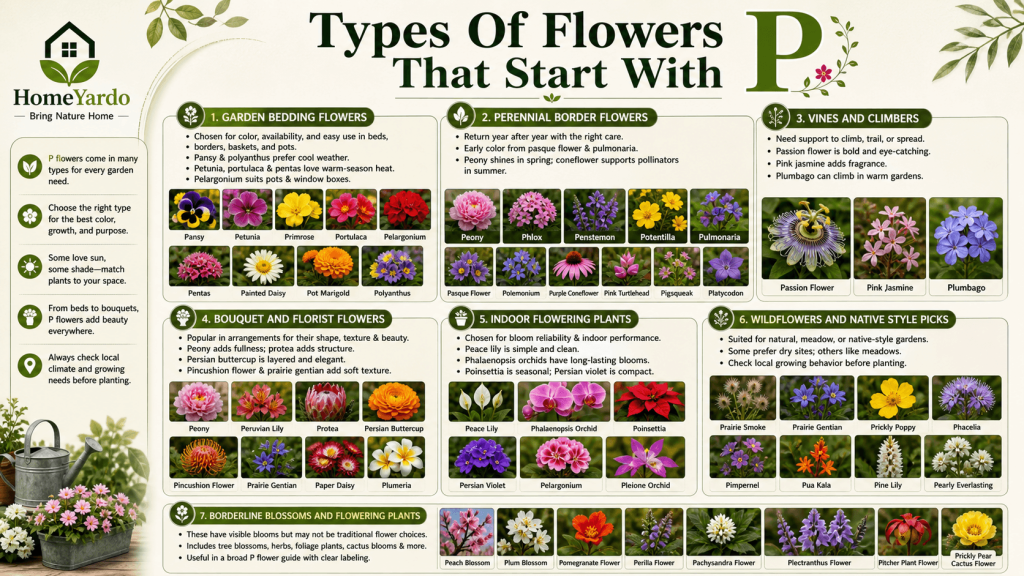
Sorting P flowers by type makes the list easier to use. Some flowers suit bedding displays, some work better in perennial borders, and some belong in indoor pots, bouquets, wildflower gardens, or specialty collections.
Garden Bedding Flowers
Garden bedding flowers are usually chosen for color, availability, and easy placement in beds, baskets, borders, and patio pots. Pansy, petunia, primrose, portulaca, pelargonium, pentas, painted daisy, pot marigold, and polyanthus all fit this role well.
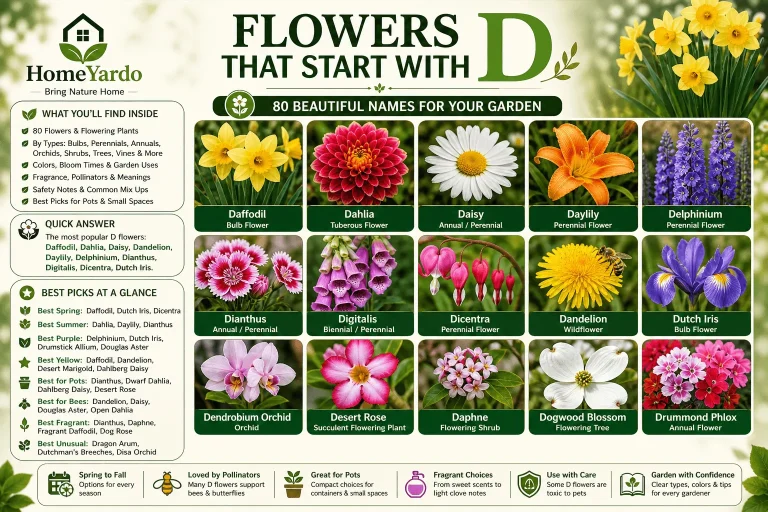
Pansy and polyanthus suit cooler weather. Petunia, portulaca, and pentas give stronger warm-season color. Pelargonium works well in pots and window boxes where neat growth matters. For more bedding and border options like calendula, cosmos, and carnation, compare this list with flowers that start with C.
Perennial Border Flowers
Perennial border flowers return for more than one season when climate and care suit them. Peony, phlox, penstemon, potentilla, pulmonaria, pasque flower, polemonium, purple coneflower, pink turtlehead, pigsqueak, and platycodon are useful border choices.
These flowers do not all bloom at the same time. Pasque flower and pulmonaria bring early color, peony adds spring impact, and purple coneflower carries pollinator value into summer.
Vines And Climbers
Some P flowers need support because they climb, trail, or grow with a vine-like habit. Passion flower is the strongest example because its layered blooms stand out on trellises, fences, and pergolas.
Pink jasmine adds fragrance and a softer vine look. Plumbago can also be trained in warm gardens, although it is more often treated as a loose shrub than a true climber.
Indoor Flowering Plants
Indoor P flowers are best judged by bloom reliability, light needs, and display value. Peace lily, Phalaenopsis orchid, poinsettia, Persian violet, pelargonium, and Pleione orchid are the strongest indoor or indoor-adjacent choices.
Peace lily is simple and clean. Phalaenopsis has long-lasting flower spikes. Poinsettia is seasonal, while Persian violet is compact and decorative.
Wildflowers And Native Style Picks
Wildflower and naturalistic choices often work best where a looser garden style is welcome. Prairie smoke, prairie gentian, prickly poppy, phacelia, pimpernel, pua kala, pine lily, and pearly everlasting fit this group.
Some of these flowers suit dry sites, while others prefer meadow-like or native-style planting. Always check local growing behavior before planting aggressive or regionally restricted species.
Borderline Blossoms And Flowering Plants
A few P entries appear in flower lists because they produce visible blooms, even though they are not standard flower-first garden choices. Peach blossom, plum blossom, pomegranate flower, perilla flower, pachysandra flower, plectranthus flower, pitcher plant flower, and prickly pear cactus flower fit this label.
They can still be useful in a broad P flower guide, but they should be labeled clearly so the list does not confuse flowers with herbs, shrubs, foliage plants, cactus blooms, or fruit-tree blossoms.
Common Flowers That Beginning With P
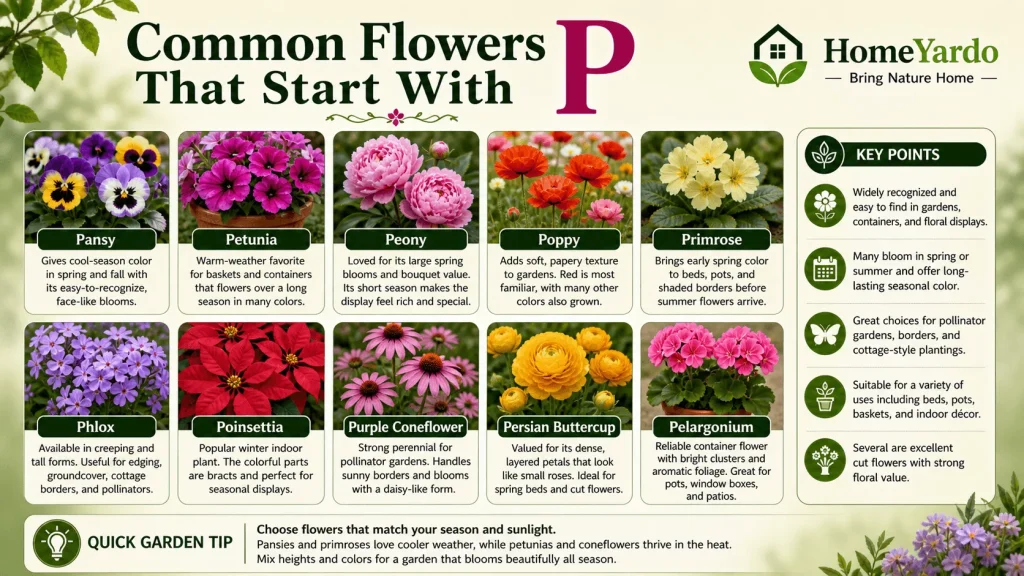
Common P flowers are popular because they are easy to recognize, widely sold, or useful in many garden settings. These are the names most likely to appear in gardens, containers, florist displays, and indoor plant collections. For more familiar garden names such as begonia, bluebell, and bougainvillea, see flowers that start with B.
- Pansy gives cool-season color in spring and fall. Its flat, face-like bloom makes it one of the easiest bedding flowers to identify.
- Petunia is a warm-weather favorite for baskets, containers, and mass planting. It flowers over a long season and comes in many colors.
- Peony is loved for its large spring blooms and bouquet value. Its short flowering window is part of its appeal because the display feels rich and seasonal.
- Poppy adds soft, papery texture to cottage gardens and meadow-style beds. Red poppies are the most familiar, but pink, orange, white, and purple forms are also grown.
- Primrose brings early spring color to beds, pots, and lightly shaded borders. It works well where a softer seasonal color is wanted before summer flowers take over.
- Phlox appears in low creeping forms and taller border forms. It is useful for edging, groundcover, cottage borders, and pollinator planting.
- Poinsettia is best known as a winter indoor display plant. The colored parts are bracts, but the plant is still widely treated as a seasonal flowering favorite.
- Purple coneflower is a strong perennial for pollinator gardens. It handles sunny borders well and gives summer color with a simple daisy-like form.
- Persian buttercup is valued for dense, layered petals that resemble small roses. It is popular in spring beds and cut flower arrangements.
- Pelargonium is a reliable container flower with bright clusters and aromatic foliage in many types. It works well in pots, window boxes, and warm patio spaces.
Popular Flower Names Starting With P
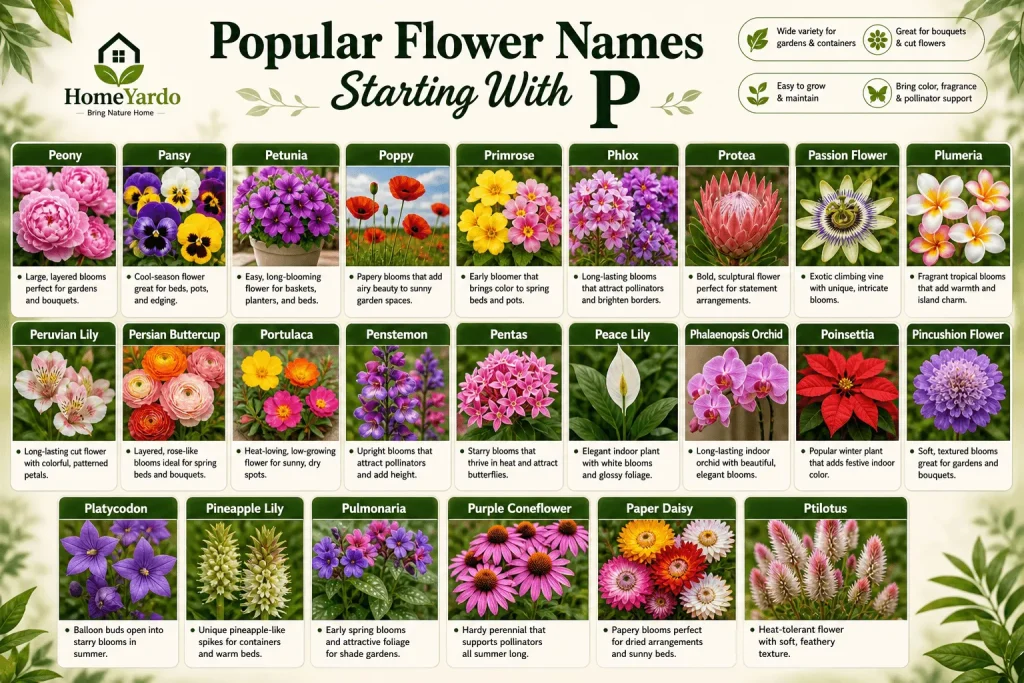
The profiles below cover the strongest P flowers for gardens, bouquets, containers, and indoor use. Each one has a clear role, which makes the full list easier to sort.
Peony
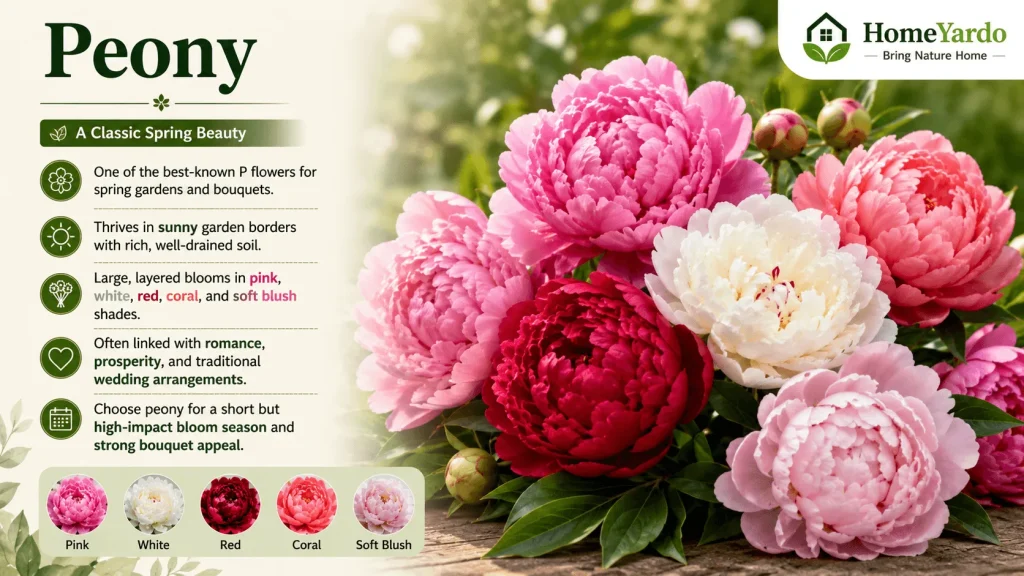
Peony is one of the best-known P flowers for spring gardens and bouquets. It produces large, layered blooms in pink, white, red, coral, and soft blush shades.
It works best in sunny garden borders with rich, well-drained soil. Peony flowers are often linked with romance, prosperity, and traditional wedding arrangements.
Choose peony for a short but high-impact bloom season and strong bouquet appeal.
Pansy
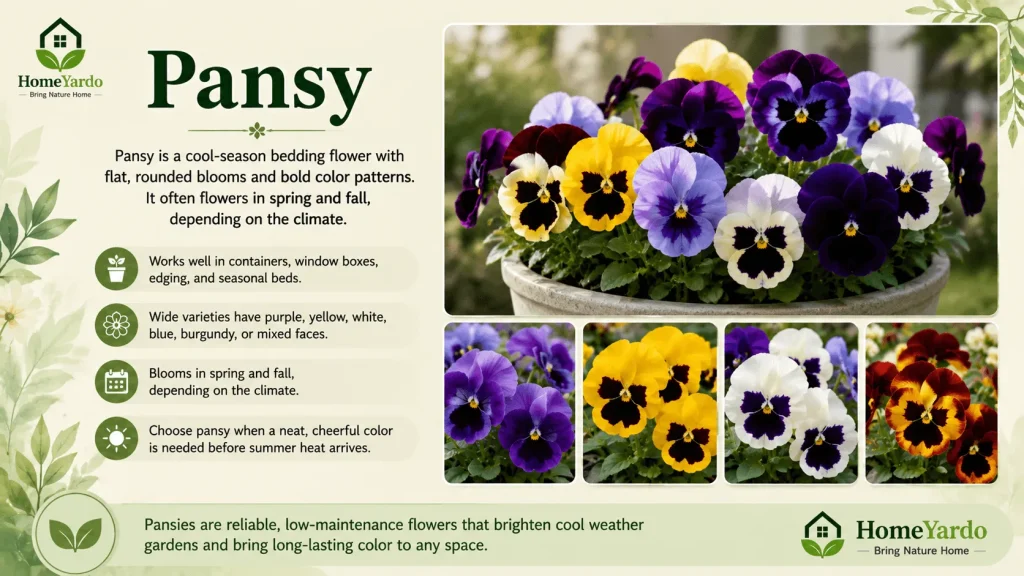
Pansy is a cool-season bedding flower with flat, rounded blooms and bold color patterns. It often flowers in spring and fall, depending on the climate.
It works well in containers, window boxes, edging, and seasonal beds. wide varieties have purple, yellow, white, blue, burgundy, or mixed faces. Choose pansy when a neat, cheerful color is needed before summer heat arrives.
Petunia
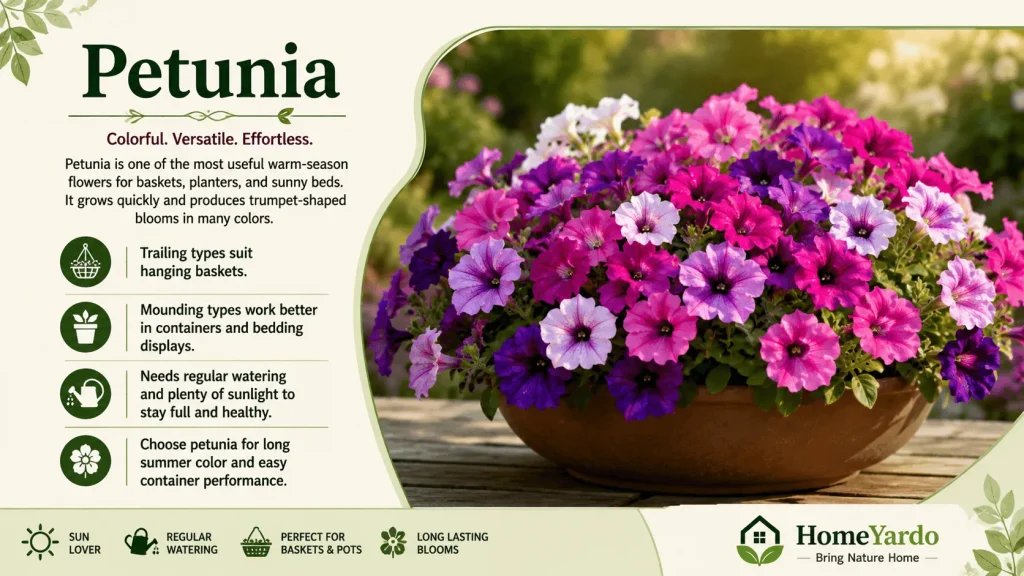
Petunia is one of the most useful warm-season flowers for baskets, planters, and sunny beds. It grows quickly and produces trumpet-shaped blooms in many colors.
Trailing types suit hanging baskets, while mounding types work better in containers and bedding displays. Petunia needs regular watering and sunlight to stay full. Choose petunia for long summer color and easy container performance.
Poppy
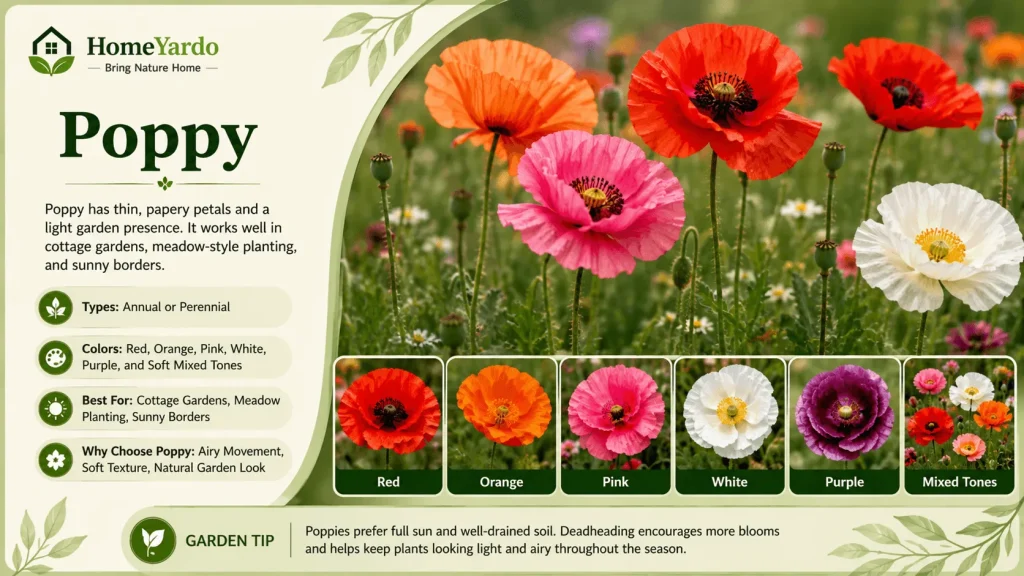
Poppy has thin, papery petals and a light garden presence. It works well in cottage gardens, meadow-style planting, and sunny borders.
Different poppy types may be annual or perennial. Colors include red, orange, pink, white, purple, and soft mixed tones. Choose poppy for airy movement, soft texture, and a natural garden look.
Primrose
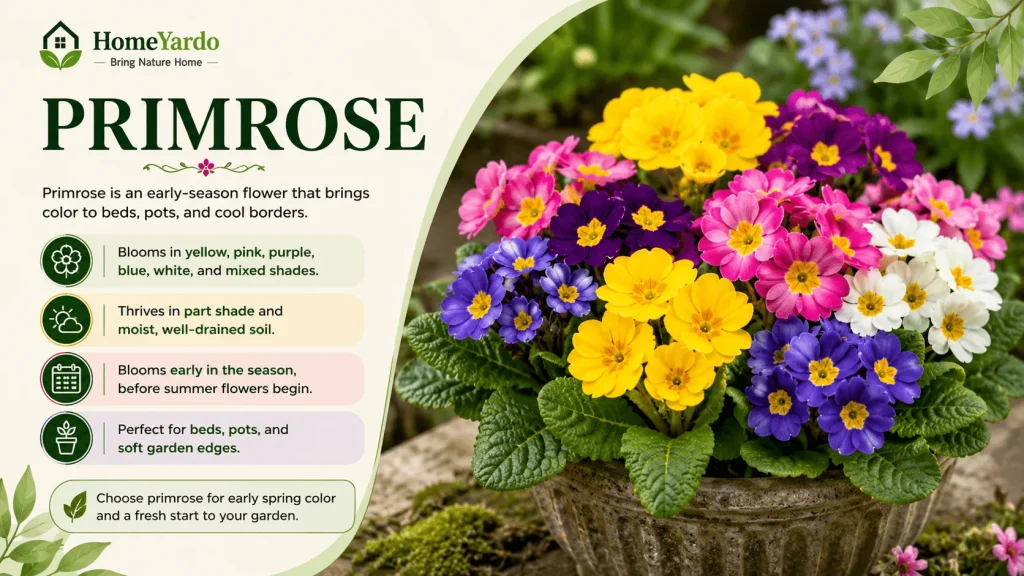
Primrose is an early-season flower that brings color to beds, pots, and cool borders. It often blooms in yellow, pink, purple, blue, white, and mixed shades.
It suits part shade and moist, well-drained soil. In many gardens, primrose is valued because it blooms before stronger summer flowers begin. Choose primrose for early spring color and softer garden edges.
Phlox
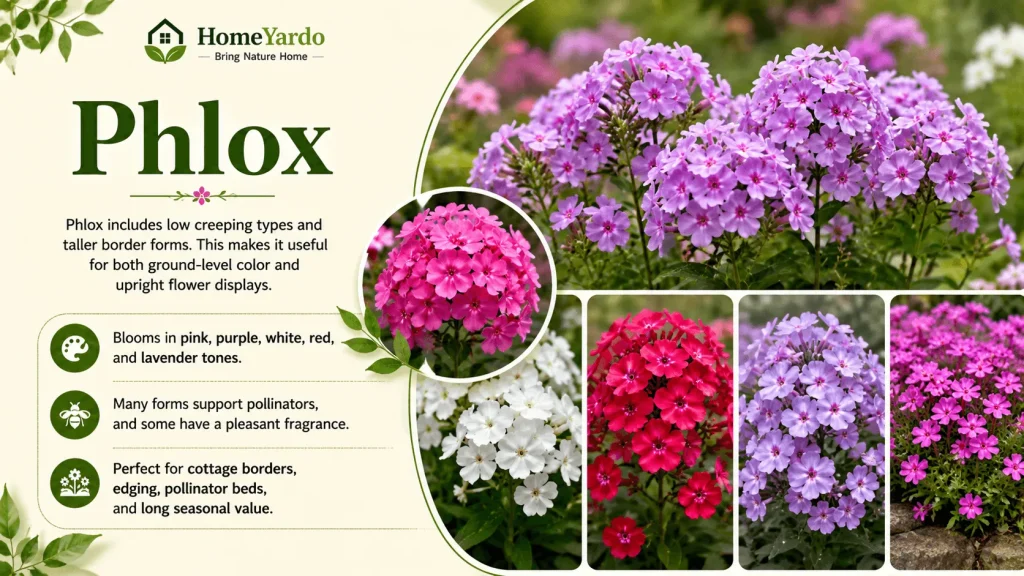
Phlox includes low creeping types and taller border forms. This makes it useful for both ground-level color and upright flower displays.
The blooms appear in pink, purple, white, red, and lavender tones. Many forms support pollinators, and some have a pleasant fragrance. Choose phlox for cottage borders, edging, pollinator beds, and long seasonal value.
Protea
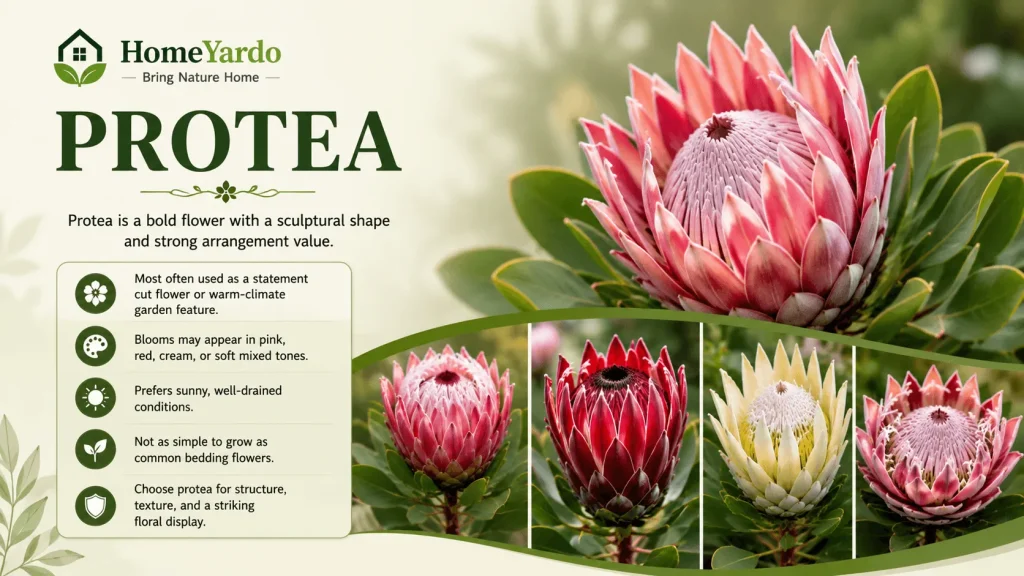
Protea is a bold flower with a sculptural shape and strong arrangement value. It is most often used as a statement cut flower or warm-climate garden feature.
The blooms may appear in pink, red, cream, or soft mixed tones. Protea prefers sunny, well-drained conditions and is not as simple to grow as common bedding flowers. Choose protea for structure, texture, and a striking floral display.
Passion Flower
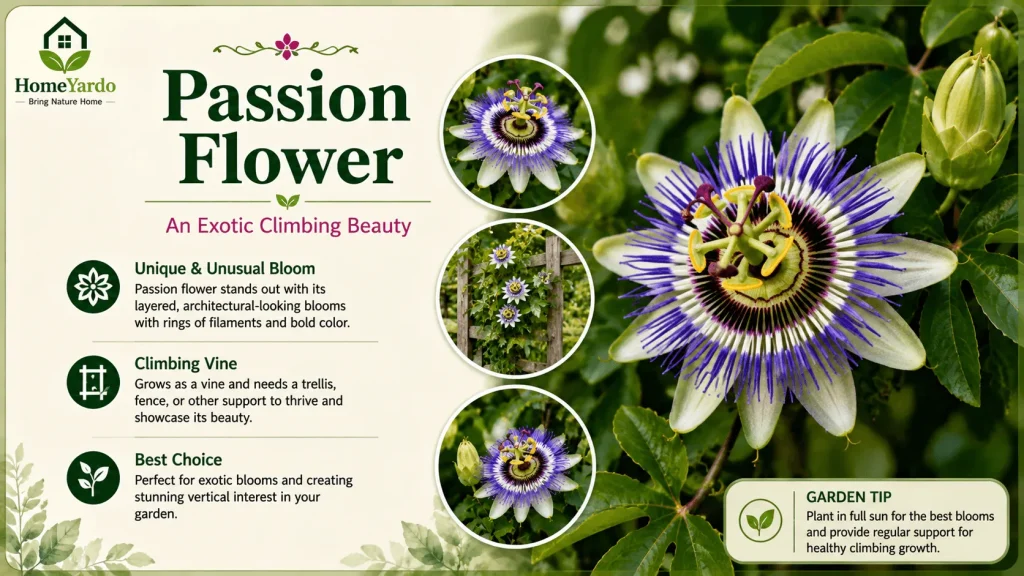
Passion flower is one of the most unusual P flowers because of its layered bloom structure. The flower can look almost architectural, with rings of filaments and bold color contrast.
It grows as a vine and often needs a trellis, fence, or support. In suitable climates, it can create strong vertical interest.
Choose passion flower for exotic blooms and climbing garden coverage.
Plumeria
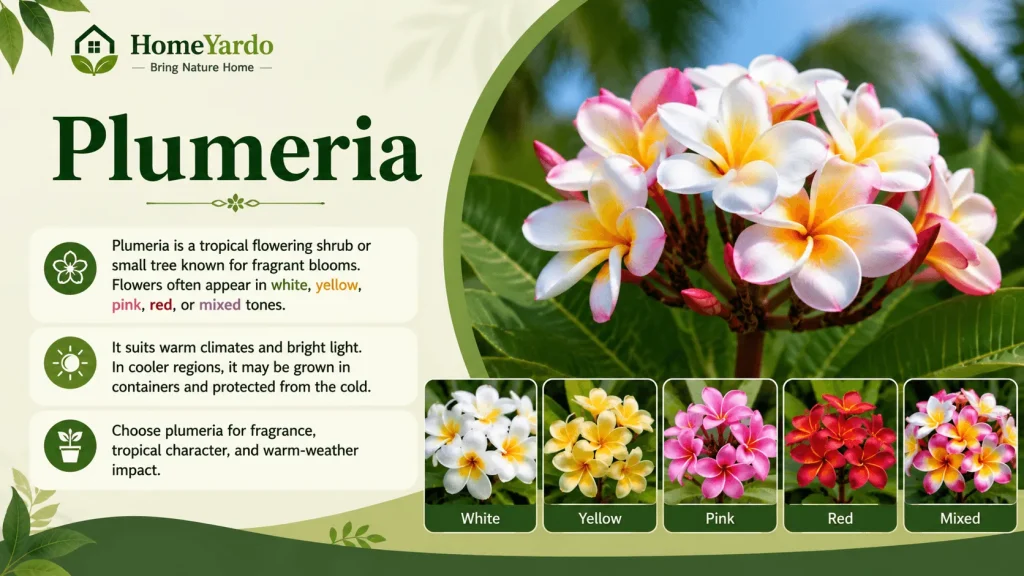
Plumeria is a tropical flowering shrub or small tree known for fragrant blooms. Flowers often appear in white, yellow, pink, red, or mixed tones.
It suits warm climates and bright light. In cooler regions, it may be grown in containers and protected from the cold.
Choose plumeria for fragrance, tropical character, and warm-weather impact.
Peruvian Lily
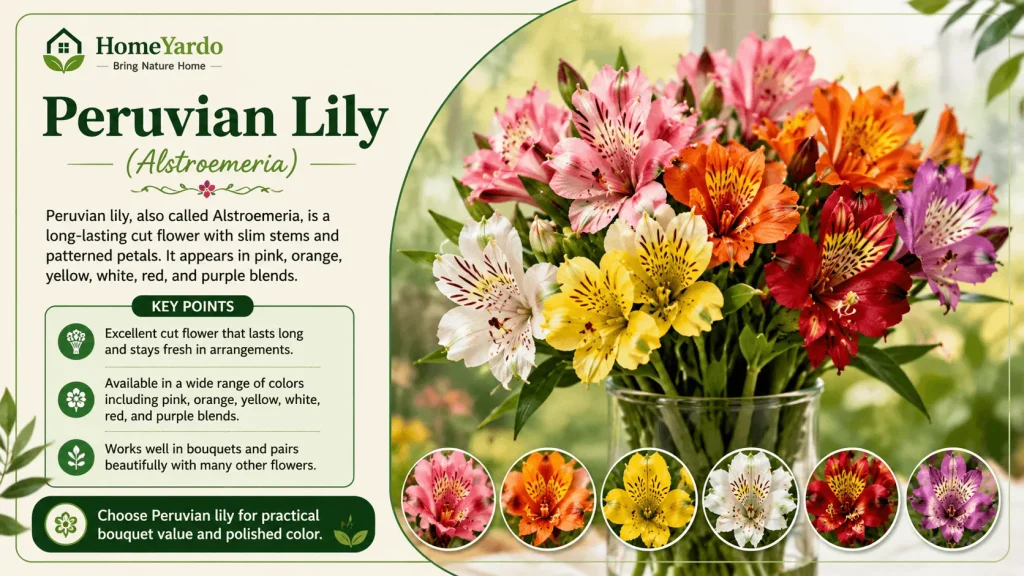
Peruvian lily, also called Alstroemeria, is a long-lasting cut flower with slim stems and patterned petals. It appears in pink, orange, yellow, white, red, and purple blends.
It works well in bouquets because the flowers last well and mix easily with many other stems. Garden use depends on climate and variety.
Choose Peruvian lily for practical bouquet value and polished color.
Persian Buttercup
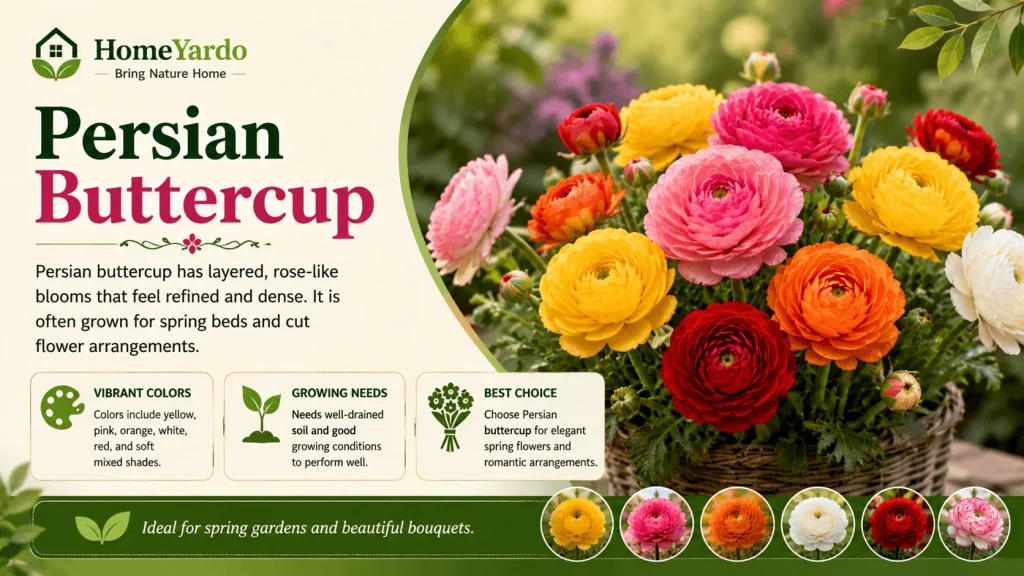
Persian buttercup has layered, rose-like blooms that feel refined and dense. It is often grown for spring beds and cut flower arrangements.
Colors include yellow, pink, orange, white, red, and soft mixed shades. It needs well-drained soil and good growing conditions to perform well.
Choose Persian buttercup for elegant spring flowers and romantic arrangements.
Portulaca
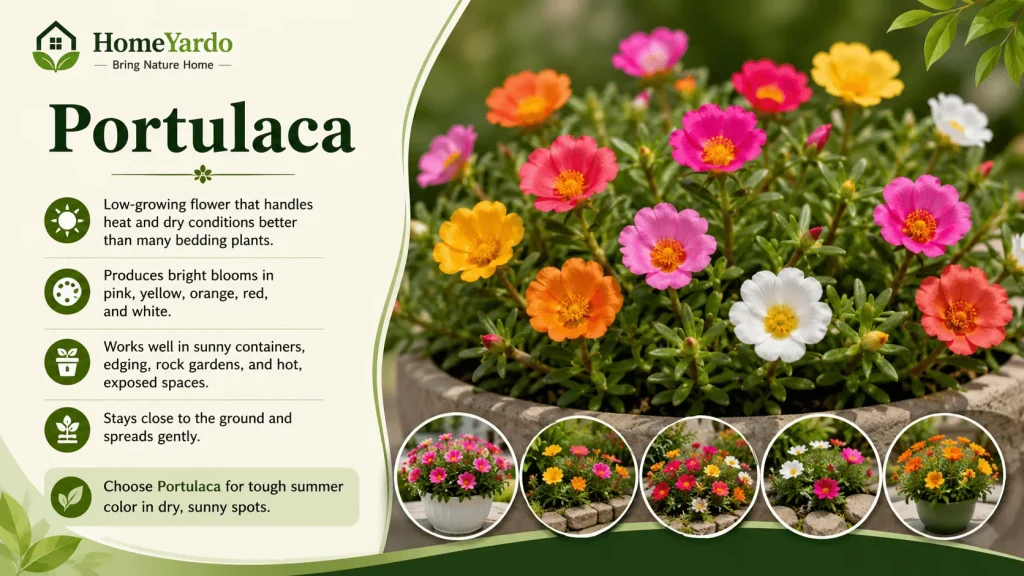
Portulaca is a low-growing flower that handles heat and dry conditions better than many bedding plants. It produces bright blooms in pink, yellow, orange, red, and white.
It works well in sunny containers, edging, rock gardens, and hot, exposed spaces. The plant stays close to the ground and spreads gently.
Choose portulaca for tough summer color in dry, sunny spots.
Penstemon
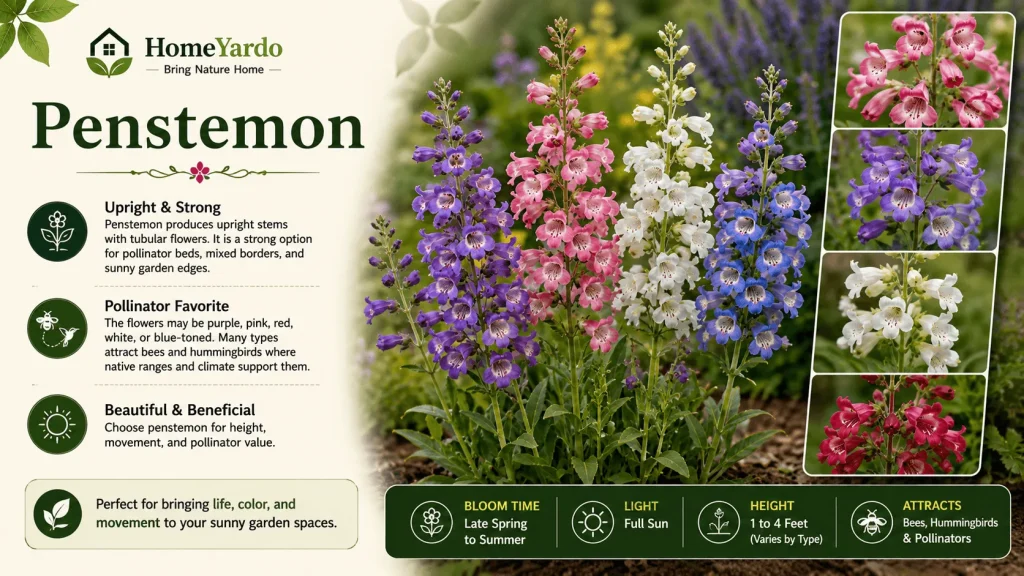
Penstemon produces upright stems with tubular flowers. It is a strong option for pollinator beds, mixed borders, and sunny garden edges.
The flowers may be purple, pink, red, white, or blue-toned. Many types attract bees and hummingbirds where native ranges and climate support them.
Choose penstemon for height, movement, and pollinator value.
Pentas
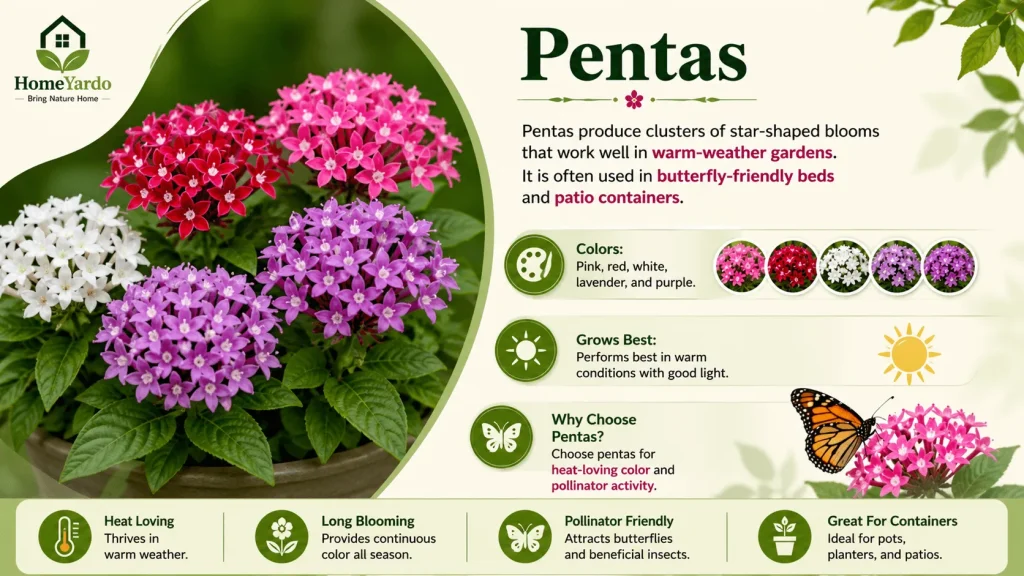
Pentas produce clusters of star-shaped blooms that work well in warm-weather gardens. It is often used in butterfly-friendly beds and patio containers.
Colors include pink, red, white, lavender, and purple. It performs best in warm conditions with good light.
Choose pentas for heat-loving color and pollinator activity.
Peace Lily
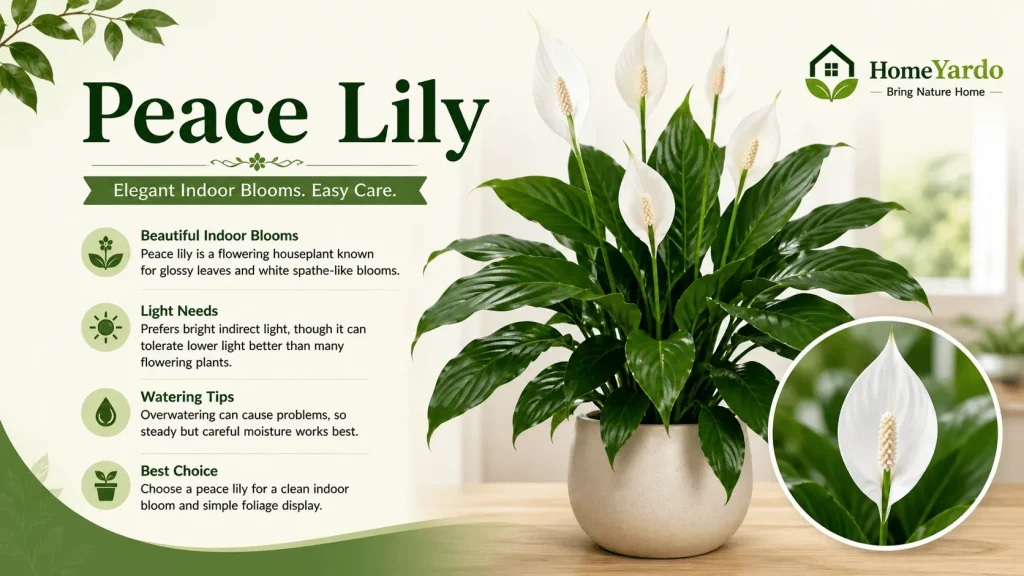
Peace lily is a flowering houseplant known for glossy leaves and white spathe-like blooms. It is not a classic outdoor flower in many climates, but it is one of the clearest indoor P flower choices.
It prefers bright indirect light, though it can tolerate lower light better than many flowering plants. Overwatering can cause problems, so steady but careful moisture works best.
Choose a peace lily for a clean indoor bloom and simple foliage display.
Phalaenopsis Orchid
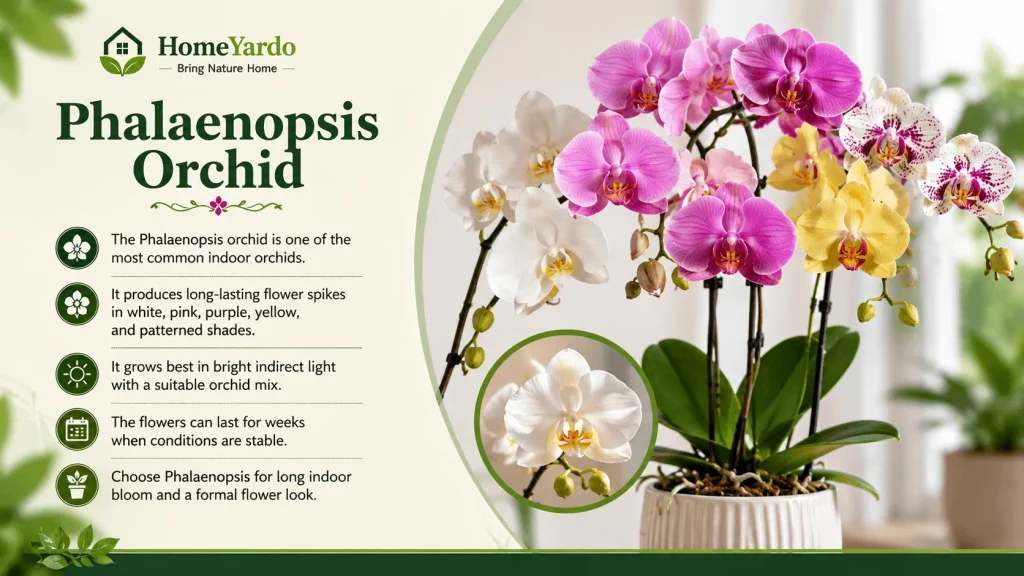
The Phalaenopsis orchid is one of the most common indoor orchids. It produces long-lasting flower spikes in white, pink, purple, yellow, and patterned shades.
It grows best in bright indirect light with a suitable orchid mix. The flowers can last for weeks when conditions are stable.
Choose Phalaenopsis for long indoor bloom and a formal flower look.
Poinsettia
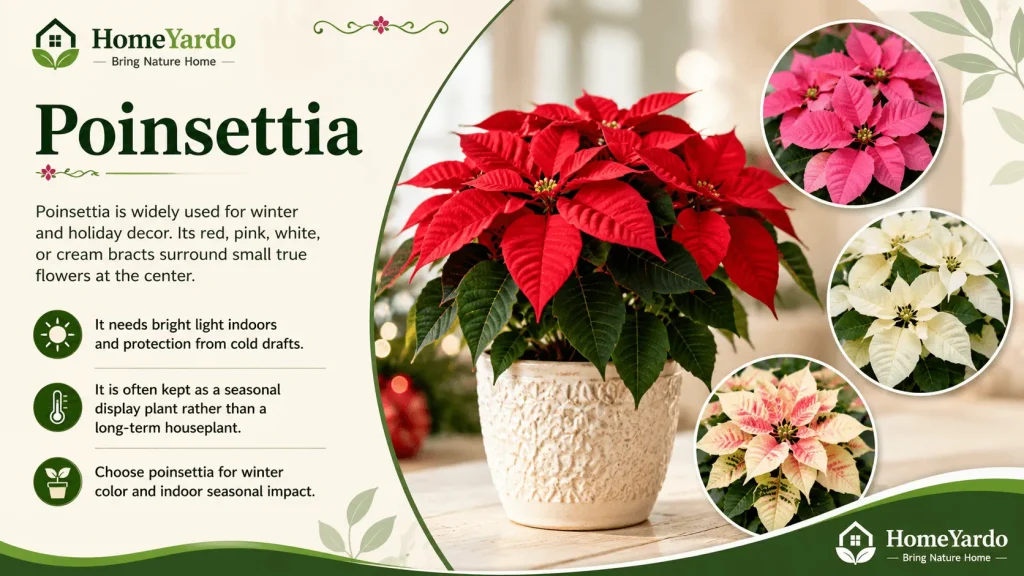
Poinsettia is widely used for winter and holiday decor. Its red, pink, white, or cream bracts surround small true flowers at the center.
It needs bright light indoors and protection from cold drafts. It is often kept as a seasonal display plant rather than a long-term houseplant.
Choose poinsettia for winter color and indoor seasonal impact.
Pincushion Flower
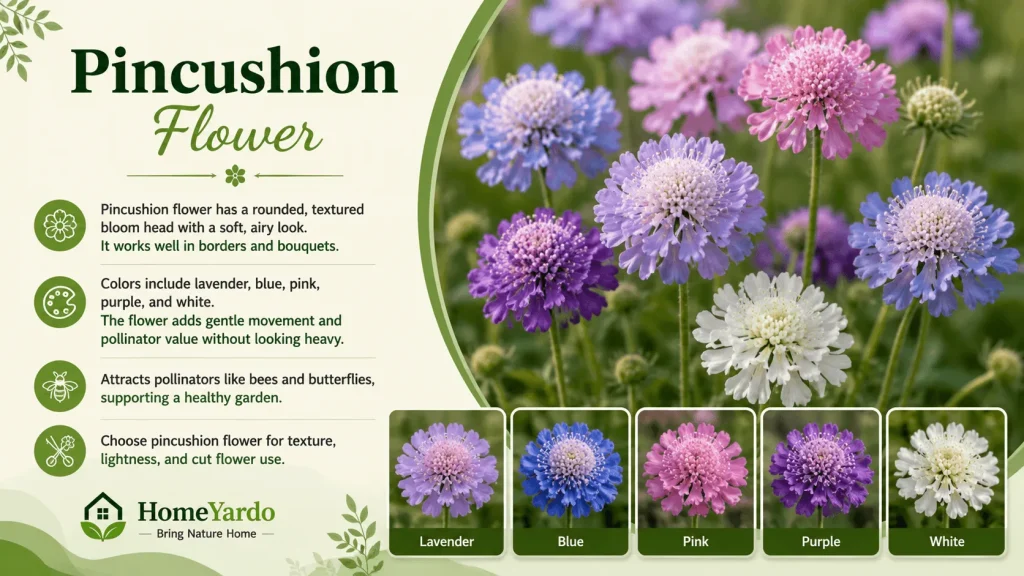
Pincushion flower has a rounded, textured bloom head with a soft, airy look. It works well in borders and bouquets.
Colors include lavender, blue, pink, purple, and white. The flower adds gentle movement and pollinator value without looking heavy.
Choose pincushion flower for texture, lightness, and cut flower use.
Platycodon
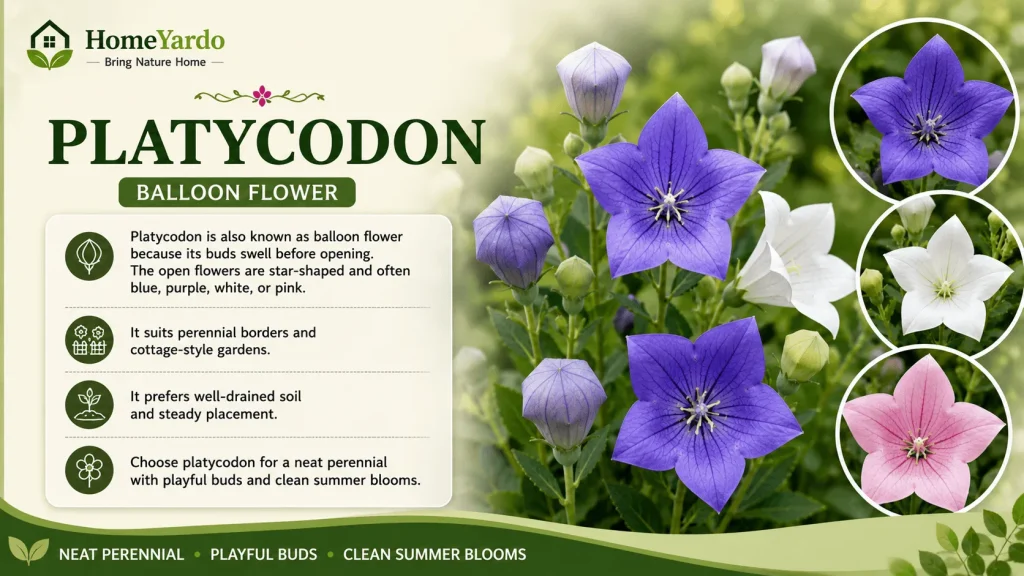
Platycodon is also known as balloon flower because its buds swell before opening. The open flowers are star-shaped and often blue, purple, white, or pink.
It suits perennial borders and cottage-style gardens. It prefers well-drained soil and steady placement.
Choose platycodon for a neat perennial with playful buds and clean summer blooms.
Pineapple Lily
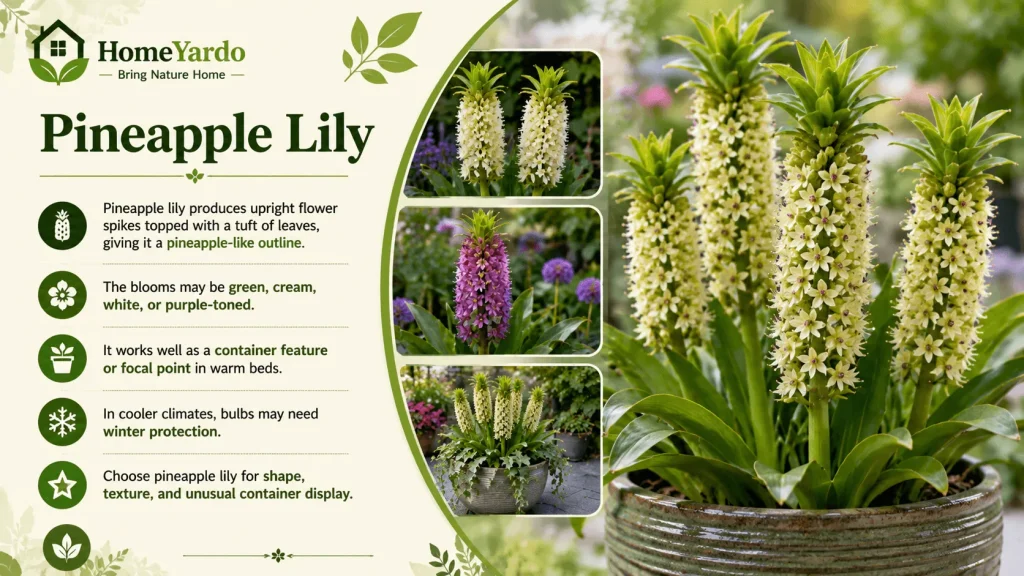
Pineapple lily produces upright flower spikes topped with a tuft of leaves, giving it a pineapple-like outline. The blooms may be green, cream, white, or purple-toned.
It works well as a container feature or focal point in warm beds. In cooler climates, bulbs may need winter protection.
Choose pineapple lily for shape, texture, and unusual container display.
Pulmonaria
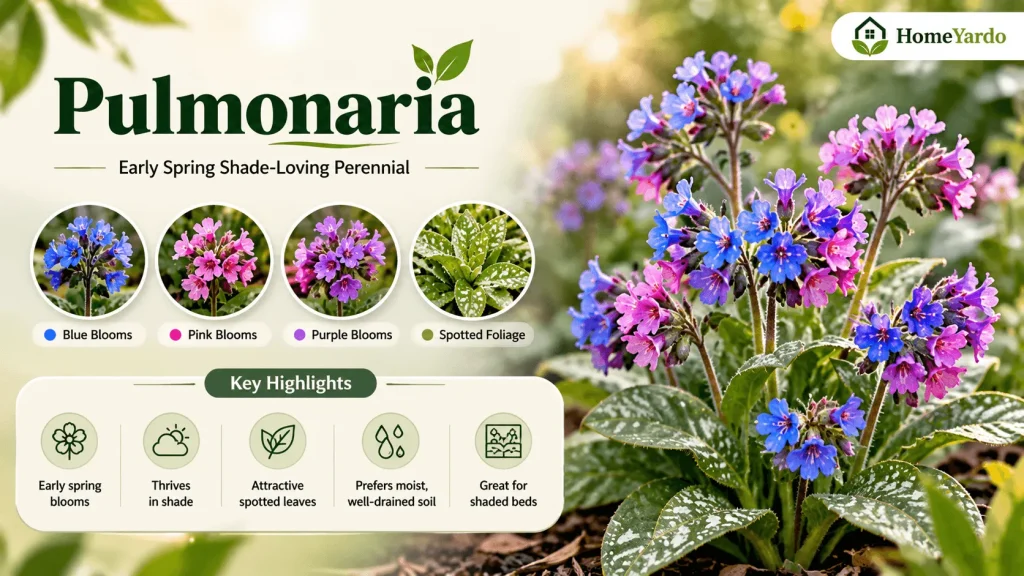
Pulmonaria is an early spring perennial often grown in shade gardens. It produces blue, pink, or purple flowers above spotted or patterned foliage.
It helps bring color to cooler parts of the garden before many summer flowers start. Moist, well-drained soil suits it best.
Choose pulmonaria for shaded beds, early bloom, and foliage interest.
Purple Coneflower
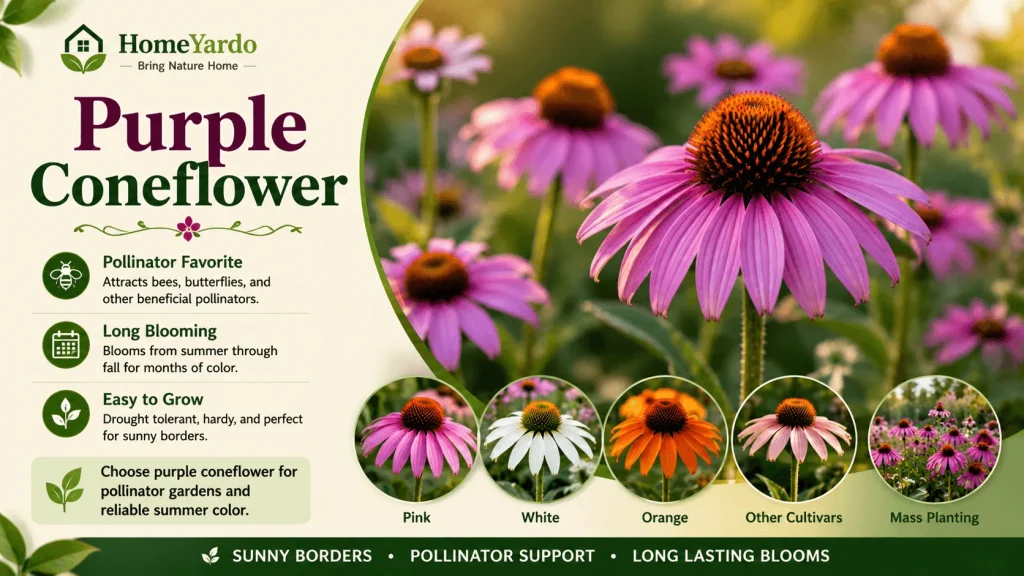
Purple coneflower is a strong, sunny-border perennial with daisy-like blooms. It is valued for pollinator support and a long summer-to-fall presence.
The central cone gives the flower structure, while the petals add simple color. Purple is the classic shade, but pink, white, orange, and other cultivars exist.
Choose purple coneflower for pollinator gardens and reliable summer color.
Paper Daisy
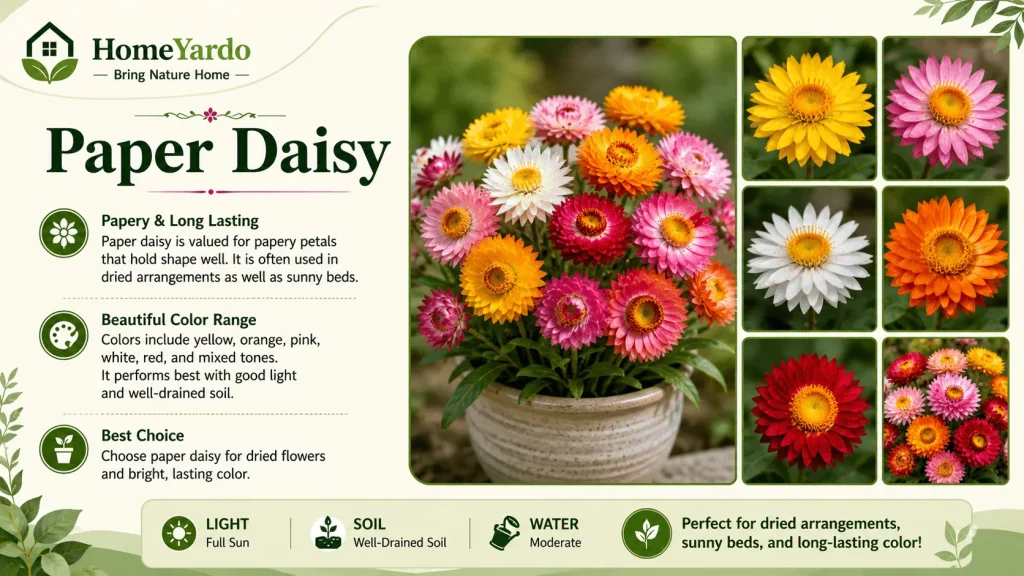
Paper daisy is valued for papery petals that hold shape well. It is often used in dried arrangements as well as sunny beds.
Colors include yellow, orange, pink, white, red, and mixed tones. It performs best with good light and well-drained soil.
Choose paper daisy for dried flowers and bright, lasting color.
Ptilotus
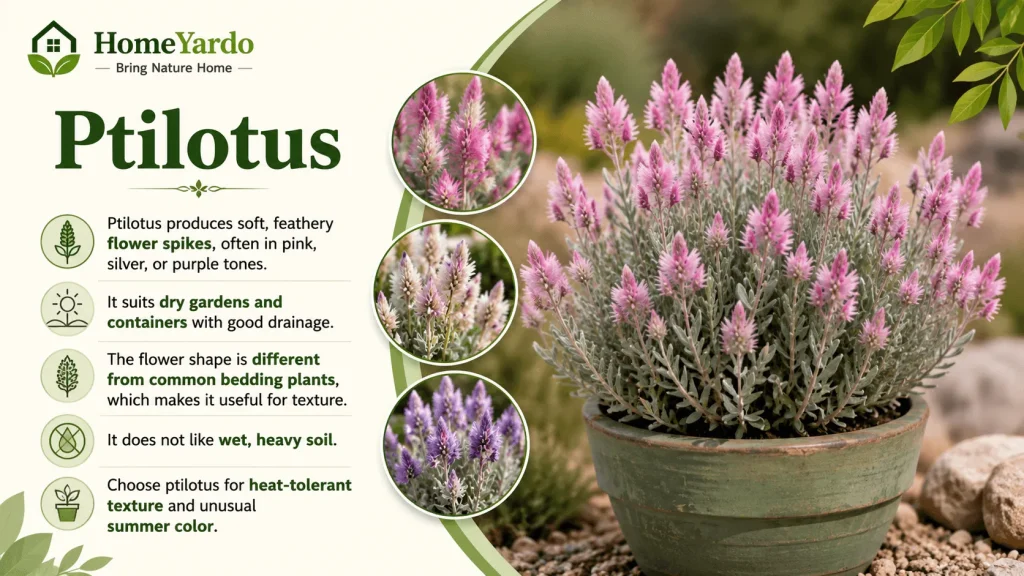
Ptilotus produces soft, feathery flower spikes, often in pink, silver, or purple tones. It suits dry gardens and containers with good drainage.
The flower shape is different from common bedding plants, which makes it useful for texture. It does not like wet, heavy soil.
Choose ptilotus for heat-tolerant texture and unusual summer color.
Bouquet And Florist Favorites
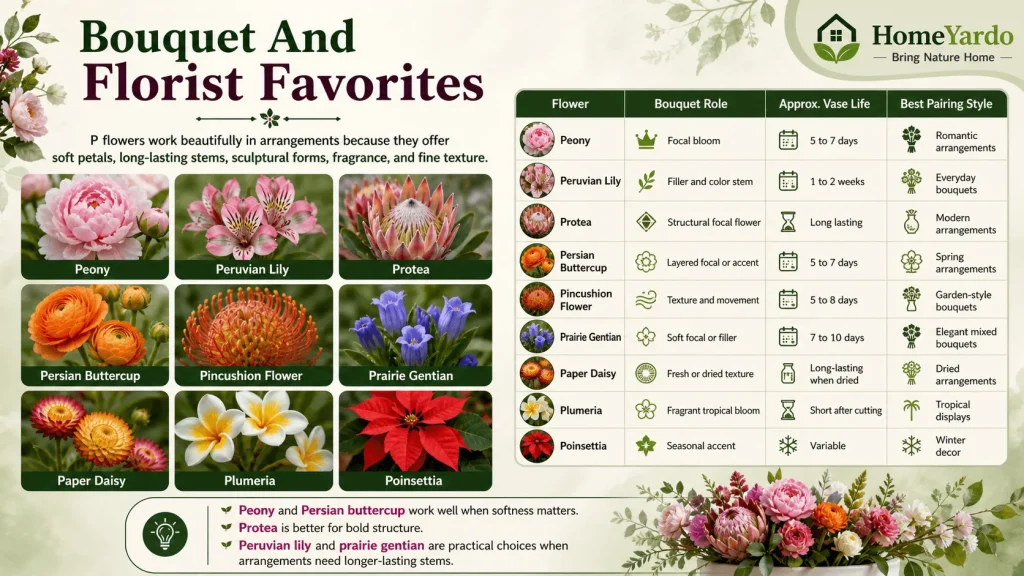
P flowers work beautifully in arrangements because they offer soft petals, long-lasting stems, sculptural forms, fragrance, and fine texture. The strongest bouquet choices are peony, Peruvian lily, protea, Persian buttercup, pincushion flower, prairie gentian, paper daisy, plumeria, and poinsettia for seasonal displays.
| Flower | Bouquet Role | Approx. Vase Life | Best Pairing Style |
|---|---|---|---|
| Peony | Focal bloom | 5 to 7 days | Romantic arrangements |
| Peruvian Lily | Filler and color stem | 1 to 2 weeks | Everyday bouquets |
| Protea | Structural focal flower | Long lasting | Modern arrangements |
| Persian Buttercup | Layered focal or accent | 5 to 7 days | Spring arrangements |
| Pincushion Flower | Texture and movement | 5 to 8 days | Garden-style bouquets |
| Prairie Gentian | Soft focal or filler | 7 to 10 days | Elegant mixed bouquets |
| Paper Daisy | Fresh or dried texture | Long-lasting when dried | Dried arrangements |
| Plumeria | Fragrant tropical bloom | Short after cutting | Tropical displays |
| Poinsettia | Seasonal accent | Variable | Winter decor |
Peony and Persian buttercup work well when softness matters. Protea is better for bold structure. Peruvian lily and prairie gentian are practical choices when arrangements need longer-lasting stems.
Less Common And Distinctive Picks
Some P flowers stand out because of rare shapes, specialty growing needs, or unusual habitats. These names add variety beyond the common bedding and bouquet flowers.
- Ptilotus: Stands out for soft, feathery flower spikes. Best for dry containers and texture.
- Pua Kala: Stands out for a spiny wildflower look. Best for dry native-style planting.
- Pleurothallis Orchid: Stands out as a specialty orchid form. Best for orchid collections.
- Pleione Orchid: Stands out for compact orchid blooms. Best for pots and cool greenhouse displays.
- Pineapple Lily: Stands out for its upright flower spike and tufted top. Best for containers and focal points.
- Paintbrush Lily: Stands out for bold, warm-climate blooms. Best for patio pots and focal displays.
- Peacock Orchid: Stands out for fragrant white flowers with a purple center. Best for summer beds and cut flowers.
- Pride of Madeira: Stands out for tall blue to purple flower spikes. Best for coastal gardens and dry borders.
These picks should stay short because the master table already contains the details. The bullets are enough to give visual variety and reduce repeated table formatting.
Plants Vs Flowers That Starting With P
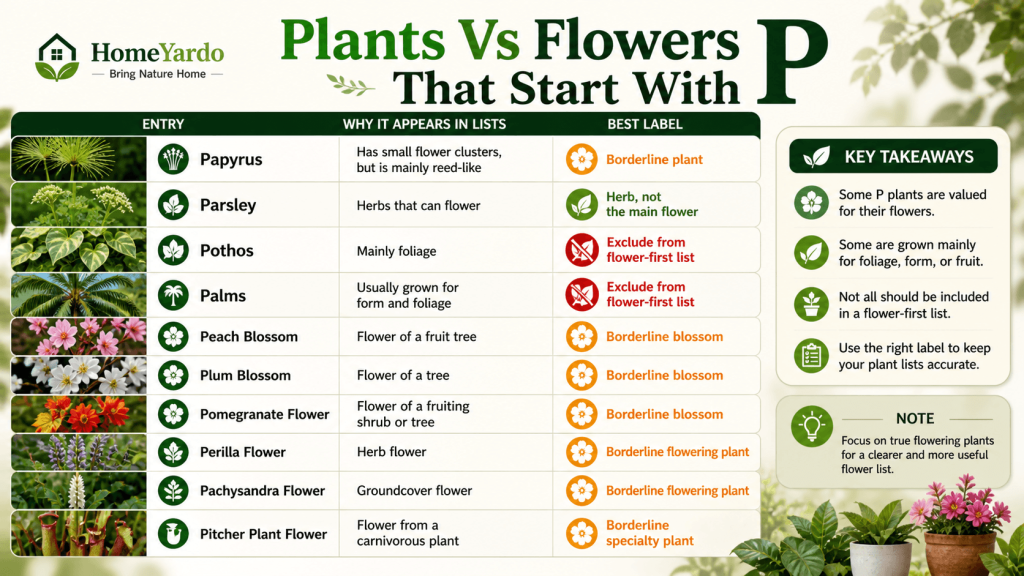
Not every P plant belongs in a flower-first list. Some names are included because they produce flowers, while others are mainly herbs, foliage plants, reeds, palms, or fruiting plants.
| Entry | Why It Appears In Lists | Best Label |
|---|---|---|
| Papyrus | Has small flower clusters, but is mainly reed-like | Borderline plant |
| Parsley | Herbs that can flower | Herb, not the main flower |
| Pothos | Mainly foliage | Exclude from flower-first list |
| Palms | Usually grown for form and foliage | Exclude from flower-first list |
| Peach Blossom | Flower of a fruit tree | Borderline blossom |
| Plum Blossom | Flower of a tree | Borderline blossom |
| Pomegranate Flower | Flower of a fruiting shrub or tree | Borderline blossom |
| Perilla Flower | Herb flower | Borderline flowering plant |
| Pachysandra Flower | Groundcover flower | Borderline flowering plant |
| Pitcher Plant Flower | Flower from carnivorous plant | Flower from a carnivorous plant |
P Flowers By Color
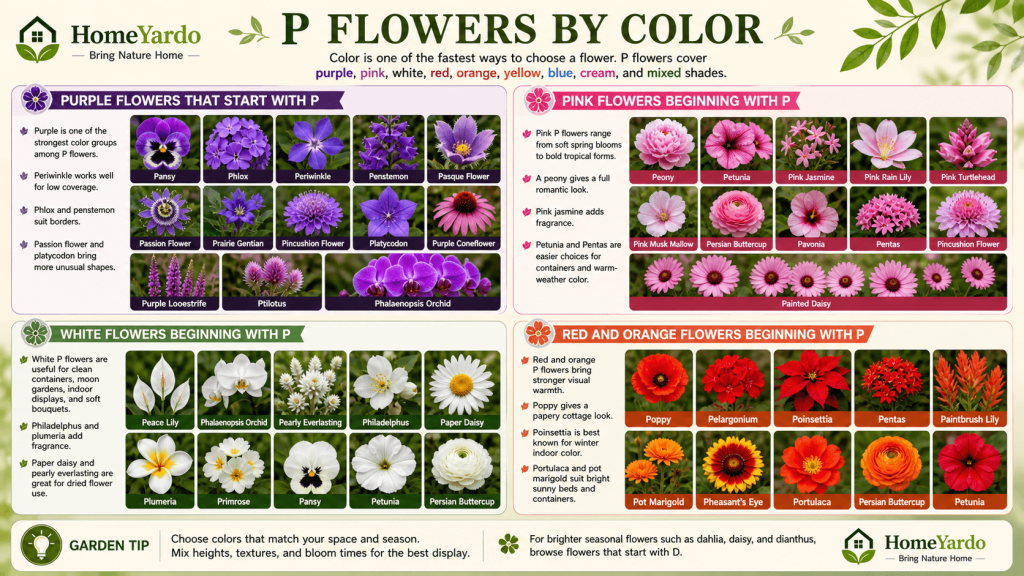
Color is one of the fastest ways to choose a flower. P flowers cover purple, pink, white, red, orange, yellow, blue, cream, and mixed shades.
Purple Flowers That Start With P
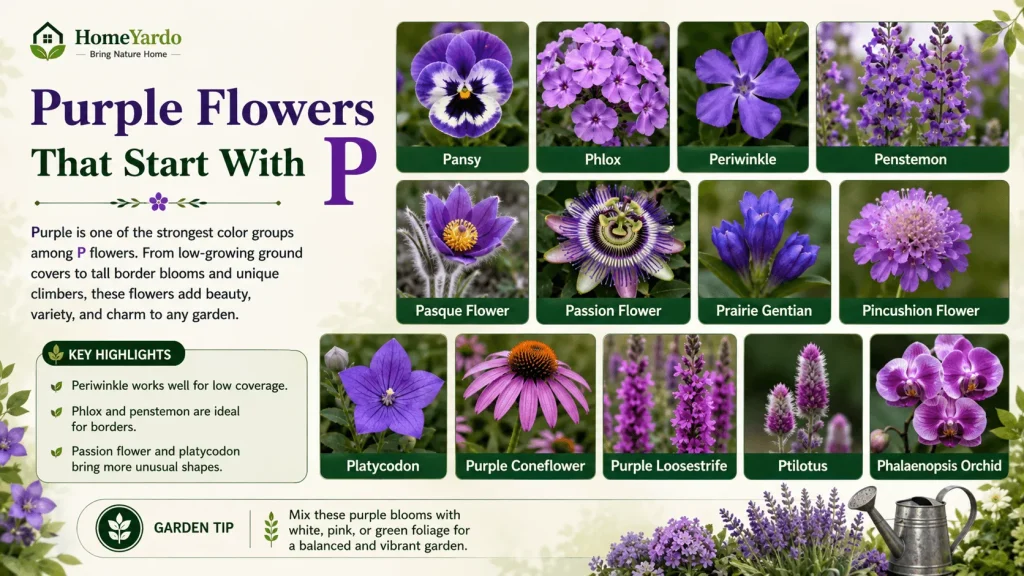
Purple is one of the strongest color groups among P flowers. Pansy, phlox, periwinkle, penstemon, pasque flower, passion flower, prairie gentian, pincushion flower, platycodon, purple coneflower, purple loosestrife, ptilotus, and Phalaenopsis orchid can all fit the purple flower intent.
Periwinkle works well for low coverage. Phlox and penstemon suit borders. Passion flower and platycodon bring more unusual shapes.
Pink Flowers Beginning With P
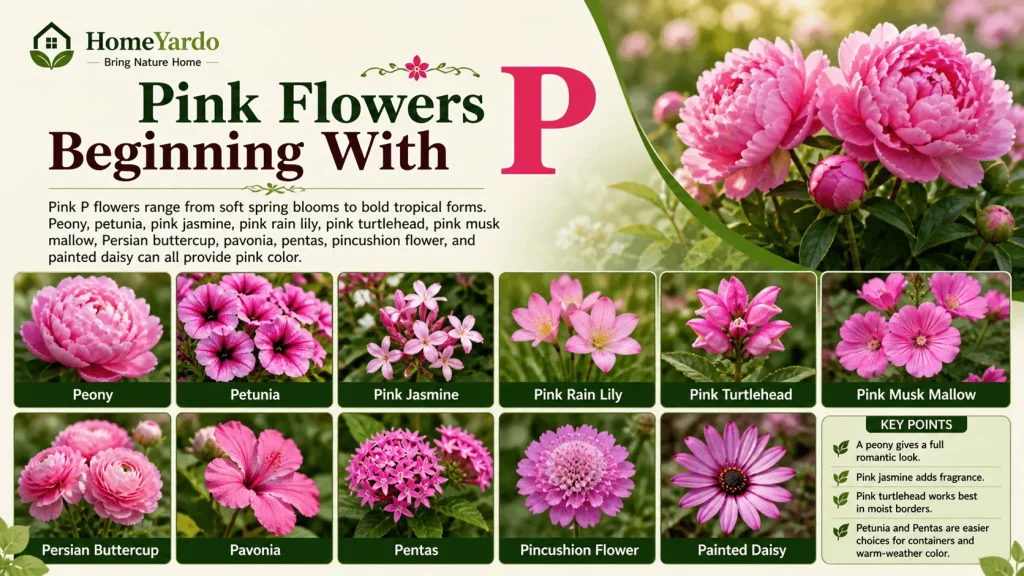
Pink P flowers range from soft spring blooms to bold tropical forms. Peony, petunia, pink jasmine, pink rain lily, pink turtlehead, pink musk mallow, Persian buttercup, pavonia, pentas, pincushion flower, and painted daisy can all provide pink color.
A peony gives a full romantic look. Pink jasmine adds fragrance. Pink turtlehead works best in moist borders. Petunia and Pentas are easier choices for containers and warm-weather color.
White Flowers Beginning With P
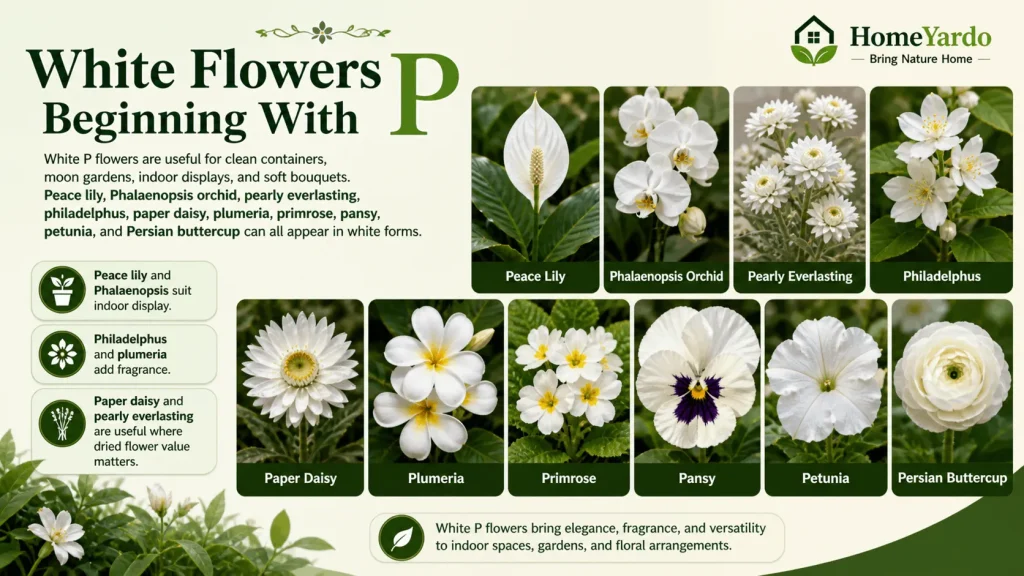
White P flowers are useful for clean containers, moon gardens, indoor displays, and soft bouquets. Peace lily, Phalaenopsis orchid, pearly everlasting, philadelphus, paper daisy, plumeria, primrose, pansy, petunia, and Persian buttercup can all appear in white forms.
Peace lily and Phalaenopsis suit indoor display. Philadelphus and plumeria add fragrance. Paper daisy and pearly everlasting are useful where dried flower value matters.
Red And Orange Flowers Beginning With P
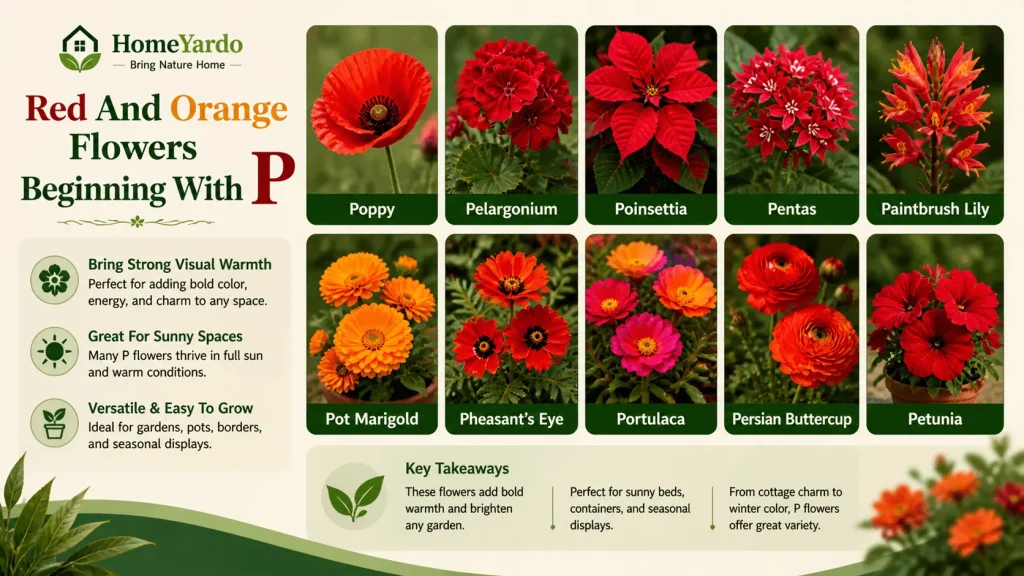
Red and orange P flowers bring stronger visual warmth. Poppy, pelargonium, poinsettia, pentas, paintbrush lily, pot marigold, pheasant’s eye, portulaca, Persian buttercup, and petunia are good examples.
Poppy gives a papery cottage look. Poinsettia is best known for winter indoor color. Portulaca and pot marigold suit bright sunny beds and containers. For brighter seasonal flowers such as dahlia, daisy, and dianthus, browse flowers that start with D.
Perennials That Start With P
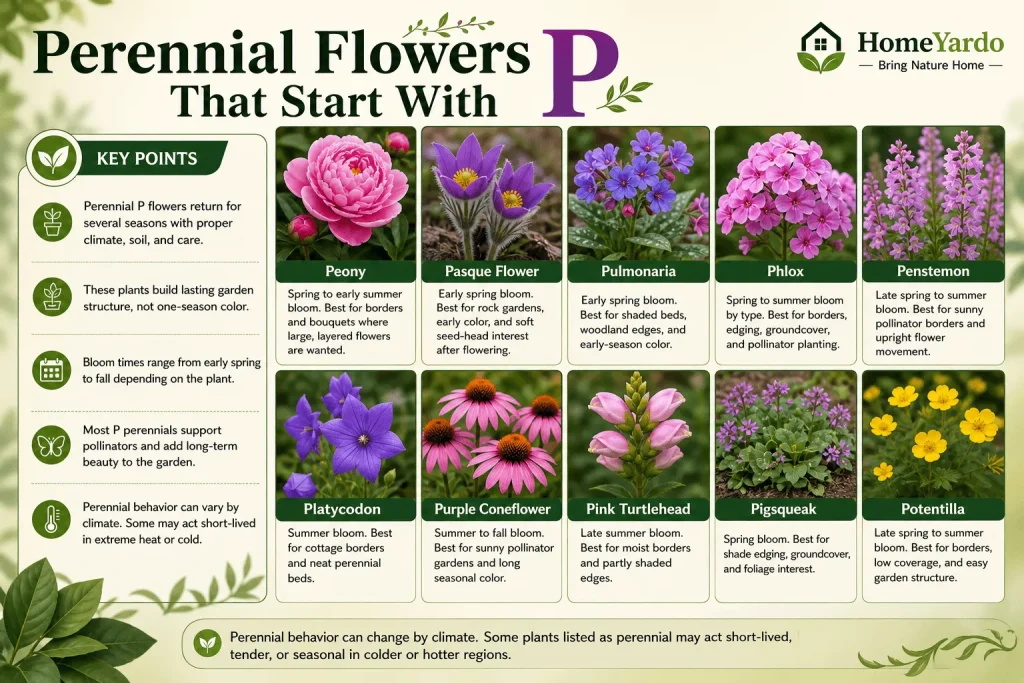
Perennial P flowers can return for several seasons when the climate, soil, and care are suitable. These choices work best when the goal is a longer-lasting garden structure instead of one-season color.
- Peony: Spring to early summer bloom. Best for borders and bouquets where large, layered flowers are wanted.
- Pasque Flower: Early spring bloom. Best for rock gardens, early color, and soft seed-head interest after flowering.
- Pulmonaria: Early spring bloom. Best for shaded beds, woodland edges, and early-season color.
- Phlox: Spring to summer bloom by type. Best for borders, edging, groundcover, and pollinator planting.
- Penstemon: Late spring to summer bloom. Best for sunny pollinator borders and upright flower movement.
- Platycodon: Summer bloom. Best for cottage borders and neat perennial beds.
- Purple Coneflower: Summer to fall bloom. Best for sunny pollinator gardens and long seasonal color.
- Pink Turtlehead: Late summer bloom. Best for moist borders and partly shaded edges.
- Pigsqueak: Spring bloom. Best for shade edging, groundcover, and foliage interest.
- Potentilla: Late spring to summer bloom. Best for borders, low coverage, and easy garden structure.
Perennial behavior can change with the climate. Some plants listed as perennial may act short-lived, tender, or seasonal in colder or hotter regions.
Annual Flowers That Start With P
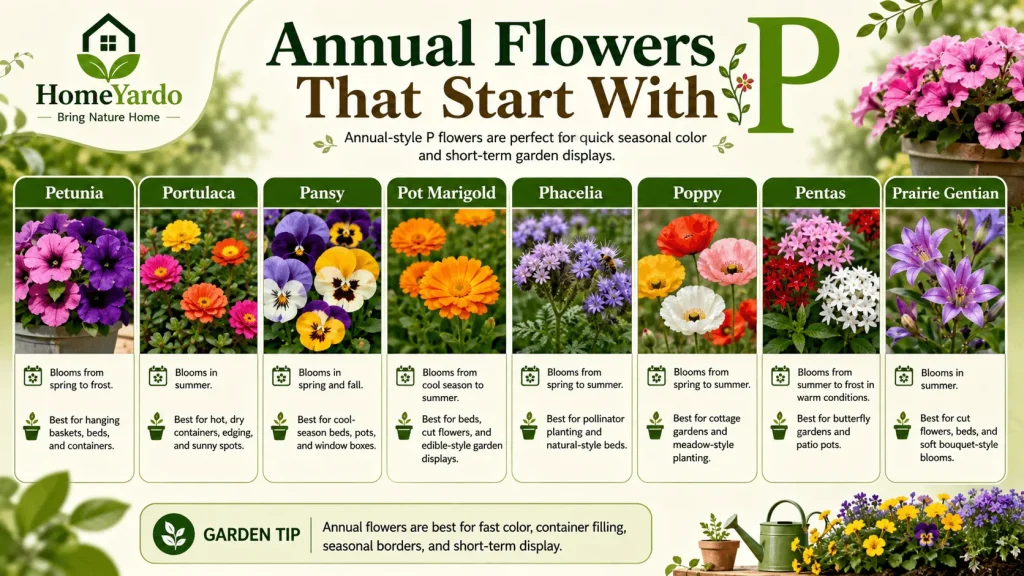
Annual-style P flowers are useful when quick seasonal color is the goal. Some are true annuals, while others are tender perennials or short-lived perennials grown as annuals in many gardens.
- Petunia: Blooms from spring to frost. Best for hanging baskets, beds, and containers.
- Portulaca: Blooms in summer. Best for hot, dry containers, edging, and sunny spots.
- Pansy: Blooms in spring and fall. Best for cool-season beds, pots, and window boxes.
- Pot Marigold: Blooms from cool season to summer. Best for beds, cut flowers, and edible-style garden displays.
- Phacelia: Blooms from spring to summer. Best for pollinator planting and natural-style beds.
- Poppy: Blooms from spring to summer. Best for cottage gardens and meadow-style planting.
- Pentas: Blooms from summer to frost in warm conditions. Best for butterfly gardens and patio pots.
- Prairie Gentian: Blooms in summer. Best for cut flowers, beds, and soft bouquet-style blooms.
Annual flowers are best for fast color, container filling, seasonal borders, and short-term display.
Indoor Or Protected Space Picks
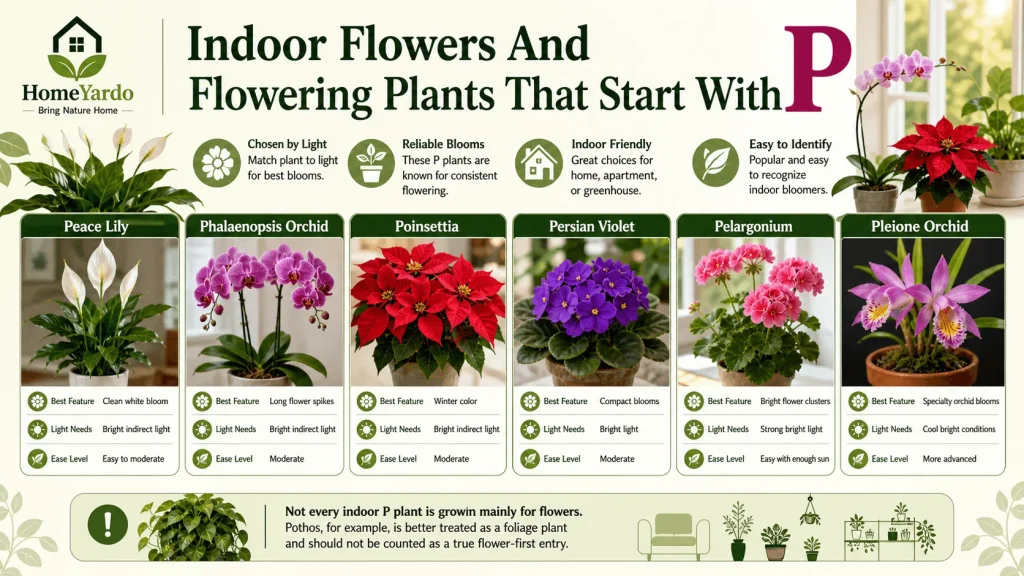
Indoor P flowers should be chosen based on light needs and bloom reliability. Peace lily and Phalaenopsis orchid are the strongest indoor bloomers because they are widely grown and easy to recognize.
Poinsettia is a seasonal indoor favorite. Persian violet works well as a compact flowering pot plant. Pelargonium can flower near bright windows, and the Pleione orchid suits more specialized indoor or greenhouse care.
| Indoor Flower | Best Feature | Light Needs | Ease Level |
|---|---|---|---|
| Peace Lily | Clean white bloom | Bright indirect light | Easy to moderate |
| Phalaenopsis Orchid | Long flower spikes | Bright indirect light | Moderate |
| Poinsettia | Winter color | Bright indirect light | Moderate |
| Persian Violet | Compact blooms | Bright light | Moderate |
| Pelargonium | Bright flower clusters | Strong bright light | Easy with enough sun |
| Pleione Orchid | Specialty orchid blooms | Cool bright conditions | More advanced |
Not every indoor P plant is grown mainly for flowers. Pothos, for example, is better treated as a foliage plant and should not be counted as a true flower-first entry.
P Flowers By Bloom Season
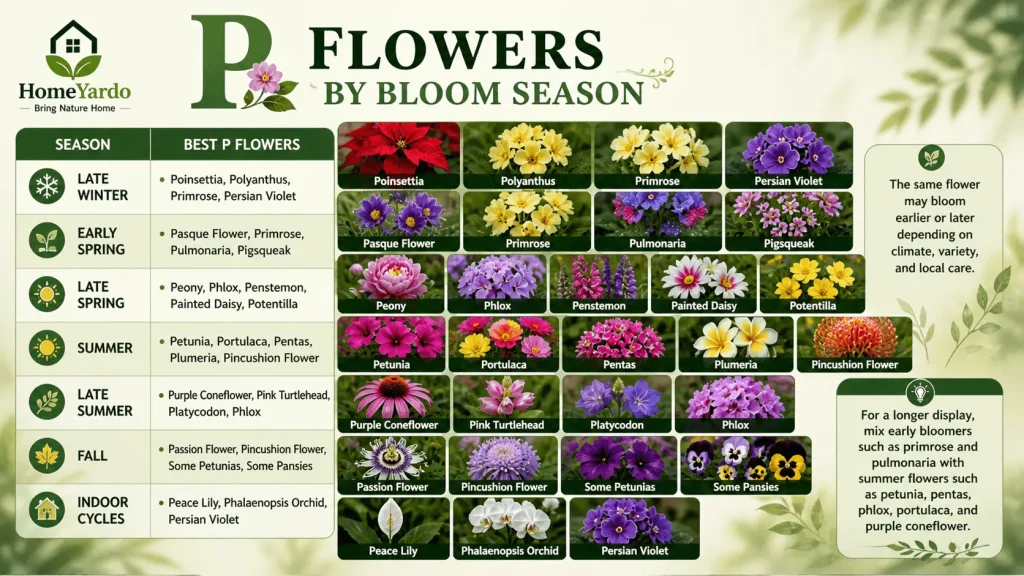
Bloom time helps match flowers to a garden plan. The same flower may bloom earlier or later depending on climate, variety, and local care.
| Season | Best P Flowers |
|---|---|
| Late Winter | Poinsettia, Polyanthus, Primrose, Persian Violet |
| Early Spring | Pasque Flower, Primrose, Pulmonaria, Pigsqueak |
| Late Spring | Peony, Phlox, Penstemon, Painted Daisy, Potentilla |
| Summer | Petunia, Portulaca, Pentas, Plumeria, Pincushion Flower |
| Late Summer | Purple Coneflower, Pink Turtlehead, Platycodon, Phlox |
| Fall | Passion Flower, Pincushion Flower, Some Petunias, Some Pansies |
| Indoor Cycles | Peace Lily, Phalaenopsis Orchid, Persian Violet |
For a longer display, mix early bloomers such as primrose and pulmonaria with summer flowers such as petunia, pentas, phlox, portulaca, and purple coneflower.
P Flowers By Growing Condition
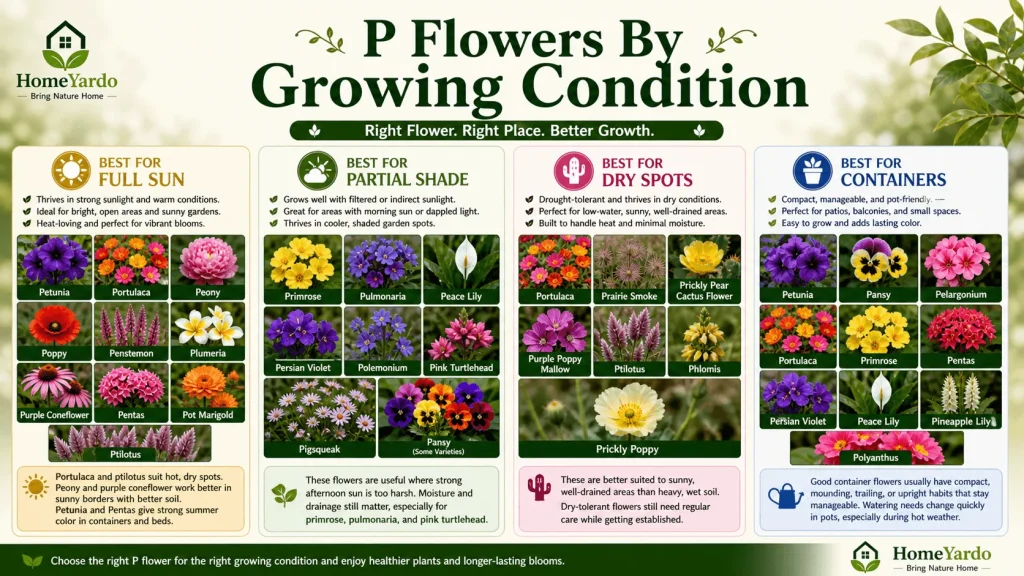
Growing conditions matter more than the flower name alone. A flower that thrives in full sun may struggle in shade, while a moisture-loving plant may fail in dry soil.
Best For Full Sun
Full sun P flowers include petunia, portulaca, peony, poppy, penstemon, plumeria, purple coneflower, pentas, pot marigold, and ptilotus.
Portulaca and ptilotus suit hot, dry spots. Peony and purple coneflower work better in sunny borders with better soil. Petunia and Pentas give strong summer color in containers and beds.
Best For Partial Shade
Partial shade choices include primrose, pulmonaria, peace lily, Persian violet, polemonium, pink turtlehead, pigsqueak, and some pansies.
These flowers are useful where strong afternoon sun is too harsh. Moisture and drainage still matter, especially for primrose, pulmonaria, and pink turtlehead.
Best For Dry Spots
Dry-site P flowers include portulaca, prairie smoke, prickly pear cactus flower, purple poppy mallow, ptilotus, phlomis, and prickly poppy.
These are better suited to sunny, well-drained areas than heavy, wet soil. Dry-tolerant flowers still need regular care while getting established.
Best P Flowers By Use Case
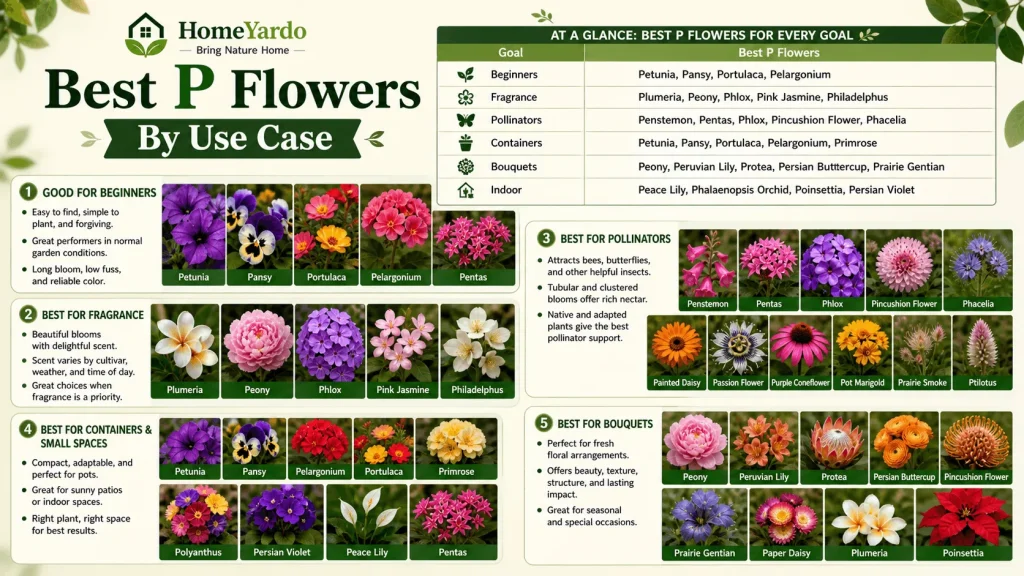
A long alphabet list becomes more useful when each letter has a clear purpose. The table below sorts strong P flowers by common goals.
| Goal | Best P Flowers |
|---|---|
| Beginners | Petunia, Pansy, Portulaca, Pelargonium |
| Fragrance | Plumeria, Peony, Phlox, Pink Jasmine, Philadelphus |
| Pollinators | Penstemon, Pentas, Phlox, Pincushion Flower, Phacelia |
| Containers | Petunia, Pansy, Portulaca, Pelargonium, Primrose |
| Bouquets | Peony, Peruvian Lily, Protea, Persian Buttercup, Prairie Gentian |
| Indoor | Peace Lily, Phalaenopsis Orchid, Poinsettia, Persian Violet |
Beginner Friendly Choices
Beginner-friendly P flowers should be easy to find, simple to place, and forgiving in normal garden conditions. Petunia, pansy, portulaca, pelargonium, periwinkle, and pentas are strong choices.
Petunia gives long summer color in containers. Pansy works well in cool weather. Portulaca handles hot, dry sites. Pelargonium is dependable in pots. Pentas add warm-weather color and pollinator value.
Fragrant P Flowers
Fragrant P flowers include plumeria, peony, phlox, pink jasmine, philadelphus, and peacock orchid. Fragrance can vary by cultivar, weather, time of day, and bloom age.
Plumeria has a tropical scent. Peony may smell rich and floral, though not every variety is fragrant. Pink jasmine and philadelphus are better choices when scent is a main goal. For more scented and garden-friendly options such as freesia, foxglove, and forget-me-not, see flowers that start with F.
Pollinator Friendly And Meadow Picks
Pollinator-friendly P flowers include penstemon, pentas, phlox, pincushion flower, painted daisy, passion flower, phacelia, purple coneflower, pot marigold, prairie smoke, and ptilotus.
Tubular flowers such as penstemon can attract long-tongued pollinators. Clustered blooms such as pentas and phlox offer strong landing and feeding value. Native and regionally adapted choices often give the best support.
Container And Small Space Picks
Container-friendly P flowers need a suitable growth habit. Petunia, pansy, pelargonium, portulaca, primrose, polyanthus, Persian violet, peace lily, and pentas are some of the best options.
Petunia and portulaca suit sunny pots. Pansy, primrose, and polyanthus fit cooler seasonal containers. Peace lily and Persian violet are better for indoor pots.
Cut Flower And Bouquet Favorites
Peony, Peruvian lily, protea, Persian buttercup, pincushion flower, prairie gentian, and paper daisy are the strongest P flowers for bouquets. Peony adds fullness and a soft focal look, while Peruvian lily brings dependable color and good vase life.
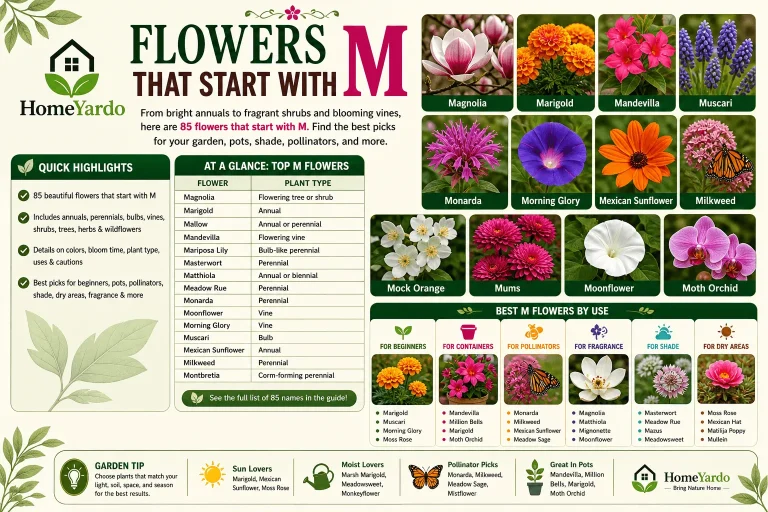
Protea gives a stronger structure, Persian buttercup adds a layered spring finish, and pincushion flower helps lighten mixed arrangements with texture and movement. Prairie gentian suits more polished designs, and paper daisy works well both fresh and dried. For more bouquet-focused names, flowers that start with M include many recognizable flowers used in arrangements and garden beds.
Water And Pond Flower Picks
True pond flowers are limited in the P group, so the best options lean more toward bog gardens, wet edges, and moisture-loving borders than deep-water planting. Pitcher plant flowers are the most specialized choice for wet conditions and suit bog-style settings best. Pink turtlehead works well along moist borders and pond margins where the soil stays reliably damp.
Purple loosestrife also fits wetland-style planting, but it should be used with caution because of its aggressive behavior in some regions. For softer moisture-retentive spots near water, primrose can also add seasonal color without pushing the planting too far into true aquatic territory.
Flower Meanings And Symbolism
Flower meaning changes by culture, occasion, and tradition, so symbolism should be treated as a light guide rather than a fixed rule. Many P flowers still carry familiar associations in gifts, events, memorials, and seasonal decor.
| Flower | Common Meaning | Best Use |
|---|---|---|
| Flower | Common Meaning | Best Use |
| Peony | Romance, prosperity | Weddings, spring bouquets |
| Poppy | Remembrance, rest | Memorial gardens, cottage beds |
| Pansy | Thoughtfulness | Gift pots, cool-season displays |
| Protea | Strength, change | Modern bouquets |
| Primrose | New beginnings | Spring gifts |
| Poinsettia | Celebration, winter warmth | Holiday decor |
| Plumeria | Beauty, tropical welcome | Tropical arrangements |
| Passion Flower | Faith, wonder, complexity | Trellises, symbolic gardens |
| Periwinkle | Lasting affection | Groundcover, soft borders |
| Pink Jasmine | Grace, affection | Fragrant gardens |
Symbolism should support flower choice, not replace practical factors such as light, season, space, and climate.
Side-by-Side Comparisons
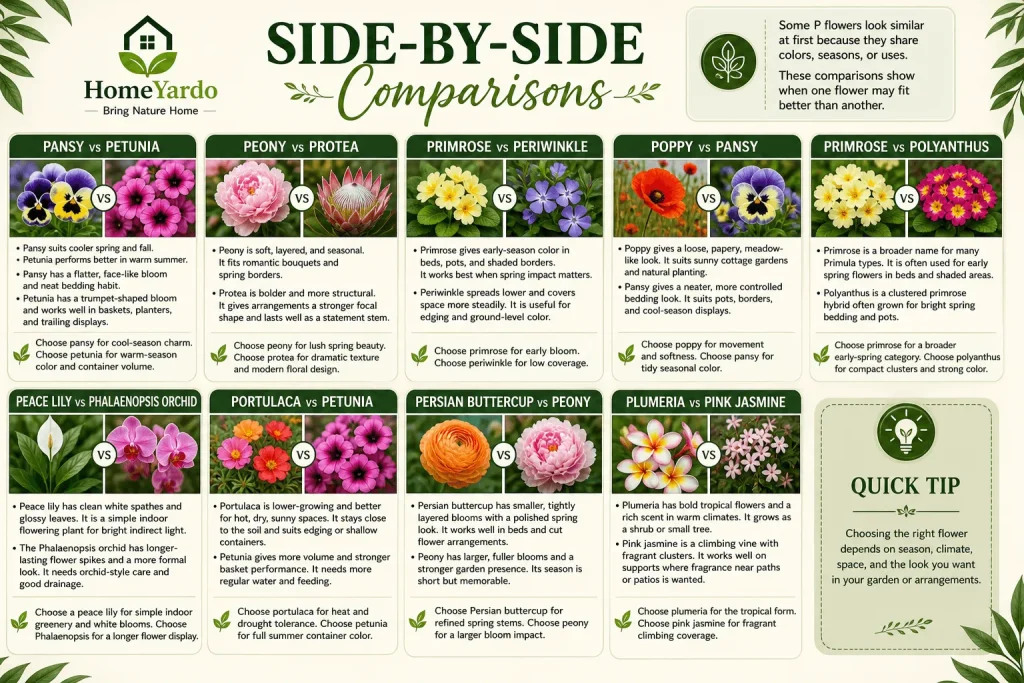
Some P flowers look similar at first because they share colors, seasons, or uses. These comparisons show when one flower may fit better than another.
Pansy Vs Petunia
Pansy suits the cooler spring and fall weather. Petunia performs better in warm summer conditions.
Pansy has a flatter, face-like bloom and a neat bedding habit. Petunia has a trumpet-shaped bloom and works well in baskets, planters, and trailing displays.
Choose pansy for cool-season charm. Choose petunia for warm-season color and container volume.
Peony Vs Protea
Peony is soft, layered, and seasonal. It fits romantic bouquets and spring borders.
Protea is bolder and more structural. It gives arrangements a stronger focal shape and lasts well as a statement stem.
Choose peony for lush spring beauty. Choose protea for dramatic texture and modern floral design.
Primrose Vs Periwinkle
Primrose gives early-season color in beds, pots, and shaded borders. It works best when spring impact matters.
Periwinkle spreads lower and covers space more steadily. It is useful for edging and ground-level color.
Choose primrose for early bloom. Choose periwinkle for low coverage.
Poppy Vs Pansy
Poppy gives a loose, papery, meadow-like look. It suits sunny cottage gardens and natural planting.
Pansy gives a neater, more controlled bedding look. It suits pots, borders, and cool-season displays.
Choose poppy for movement and softness. Choose pansy for tidy seasonal color.
Primrose Vs Polyanthus
Primrose is a broader name for many Primula types. It is often used for early spring flowers in beds and shaded areas.
Polyanthus is a clustered primrose hybrid often grown for bright spring bedding and pots.
Choose primrose for a broader early-spring category. Choose polyanthus for compact clusters and strong seasonal color.
Peace Lily Vs Phalaenopsis Orchid
Peace lily has clean white spathes and glossy leaves. It is a simple indoor flowering plant for bright indirect light.
The Phalaenopsis orchid has longer-lasting flower spikes and a more formal look. It needs orchid-style care and good drainage.
Choose a peace lily for simple indoor greenery and white blooms. Choose Phalaenopsis for a longer flower display.
Portulaca Vs Petunia
Portulaca is lower-growing and better for hot, dry, sunny spaces. It stays close to the soil and suits edging or shallow containers.
Petunia gives more volume and stronger basket performance. It needs more regular water and feeding.
Choose portulaca for heat and drought tolerance. Choose petunia for full summer container color.
Persian Buttercup Vs Peony
Persian buttercup has smaller, tightly layered blooms with a polished spring look. It works well in beds and cut flower arrangements.
Peony has larger, fuller blooms and a stronger garden presence. Its season is short but memorable.
Choose Persian buttercup for refined spring stems. Choose peony for a larger bloom impact.
Plumeria Vs Pink Jasmine
Plumeria has bold tropical flowers and a rich scent in warm climates. It grows as a shrub or small tree.
Pink jasmine is a climbing vine with fragrant clusters. It works well on supports where fragrance near paths or patios is wanted.
Choose plumeria for the tropical form. Choose pink jasmine for fragrant climbing coverage.
Borderline Entries Better Treated Separately
Some P names appear in broad flower lists even though they are not ideal main flower entries. Including them with clear labels is better than mixing them into a flower list without explanation.
Papyrus is better understood as a reed-like plant. Parsley is an herb. Pothos is mainly foliage. Palms are grown for their structure and leaves. Peach blossom, plum blossom, and pomegranate flower are attractive blooms, but they are tied to fruiting trees or shrubs.
| Borderline Entry | Best Treatment |
|---|---|
| Papyrus | Mention as a plant, not a main flower |
| Parsley | Exclude unless discussing herb flowers |
| Pothos | Exclude from flower-first lists |
| Palms | Exclude from flower-first lists |
| Peach Blossom | Label as a tree blossom |
| Plum Blossom | Label as a tree blossom |
| Pomegranate Flower | Label as fruit shrub or tree blossom |
| Perilla Flower | Label as herb flower |
| Plectranthus Flower | Label as a flowering foliage plant |
| Pachysandra Flower | Mentioned as a plant, not a main flower |
Final Thoughts
P flowers range from easy bedding plants to rare orchids, tropical shrubs, wildflowers, indoor bloomers, and bouquet stems. A flower-first list keeps the topic clean, while a labeled 70-name master table gives enough breadth for alphabet browsing.
Choose by light, season, space, climate, and use. Peony, pansy, petunia, poppy, primrose, phlox, and protea are strong starting points, while passion flower, ptilotus, pineapple lily, and Pleurothallis orchid add more unusual choices.
FAQ’s
Plumeria is one of the strongest fragrance choices among P flowers, especially in warm climates. Its scent is rich, tropical, and often used in floral displays. Peony, phlox, pink jasmine, philadelphus, and peacock orchid can also smell very good. Fragrance changes by variety, weather, and bloom stage, so plant choice matters.
Perennial P flowers include peony, penstemon, phlox, potentilla, primrose, pulmonaria, pasque flower, polemonium, platycodon, pink turtlehead, pigsqueak, and purple coneflower. Some flowers act perennial in one climate but seasonal in another. Tender plants such as pelargonium, pentas, and plumeria may survive outdoors only in warmer regions.
Yes. Peace lily, Phalaenopsis orchid, poinsettia, Persian violet, and Pleione orchid are indoor or indoor-adjacent flowering choices that start with P. Peace lily and Phalaenopsis are the clearest indoor bloomers. Poinsettia is usually used as a seasonal indoor plant, while Persian violet works well as a compact flowering pot plant.
Petunia, pansy, portulaca, pelargonium, pentas, pot marigold, and periwinkle are good beginner choices. They are widely available and easy to place in common garden settings. Petunia works well in sunny pots. Pansy suits cool weather. Portulaca handles heat and dry soil better than many bedding flowers.
Rare or less common P flowers include ptilotus, pua kala, Pleurothallis orchid, Pleione orchid, pine lily, paintbrush lily, pineapple lily, and pasque flower. These flowers may be harder to find, more climate-specific, or better suited to collectors. They are useful when a garden or flower list needs unusual shape, texture, or origin.
Pansy is one of the best-known purple flowers that starts with P. Other purple choices include phlox, periwinkle, penstemon, pasque flower, passion flower, prairie gentian, platycodon, and pincushion flower. Purple coneflower is also a strong perennial option. For indoor purple blooms, Phalaenopsis orchid and Persian violet may be suitable choices.
This guide lists 70 flower names starting with P without counting the same plant twice under both common and botanical names. The total can change because some broad lists include herbs, palms, reeds, foliage plants, tree blossoms, and cactus flowers. A flower-first list is usually cleaner than a plant-heavy directory.
A flower-first entry is mainly known for its bloom, such as peony, pansy, petunia, poppy, or phlox. A plant entry may produce flowers but is usually grown for foliage, fruit, structure, or herb value. Pothos, parsley, papyrus, and palms are examples of P plants that should not be treated as standard flower-first entries.
Peony, Peruvian lily, protea, Persian buttercup, pincushion flower, prairie gentian, and paper daisy are some of the best bouquet choices. Peony gives fullness, Peruvian lily adds lasting color, protea gives structure, and pincushion flower adds texture. Paper daisy is especially useful for dried arrangements.
Petunia, portulaca, peony, poppy, penstemon, purple coneflower, pentas, plumeria, pot marigold, and ptilotus are good full-sun choices. Portulaca and ptilotus are better for hot, dry spots. Peony and purple coneflower prefer sunny borders with better soil and regular care during establishment.
Primrose, pulmonaria, peace lily, Persian violet, polemonium, pigsqueak, and pink turtlehead can suit partial shade or bright indirect light, depending on where they are grown. Peace lily and Persian violet are better for indoor filtered light. Pulmonaria and primrose are stronger choices for shaded outdoor beds.
Spring-blooming P flowers include primrose, polyanthus, pasque flower, pulmonaria, peony, pansy, Persian buttercup, pigsqueak, and some phlox types. Early spring choices help fill gaps before summer flowers start. Peony and Persian buttercup give a stronger late spring bouquet value.
Petunia, pansy, pelargonium, portulaca, primrose, polyanthus, pentas, Persian violet, peace lily, and pineapple lily are good pot choices. Petunia works well in sunny baskets. Portulaca suits dry sunny containers. Peace lily and Persian violet are better for indoor pots with bright indirect light.
Poinsettia is commonly treated as a flowering plant that starts with the letter P, especially in winter displays. The colorful parts are bracts, while the small true flowers sit near the center. It still belongs in a broad P flower guide because it is chosen for its floral display value. It should be labeled as a flowering plant rather than a typical bedding flower.
Passion flower is one of the most unusual P flowers because of its layered structure and detailed center. Pineapple lily, ptilotus, protea, and Pleurothallis orchid are also distinctive. The best choice depends on the setting. Passion flower suits vines, protea suits arrangements, and ptilotus suits dry containers.
Penstemon, pentas, phlox, pincushion flower, painted daisy, phacelia, purple coneflower, passion flower, pot marigold, and prairie smoke can attract pollinators. Native or regionally adapted plants are often the strongest choices. Flower shape, bloom timing, and pesticide use also affect pollinator value.
Paper daisy, pearly everlasting, protea, pincushion flower, and some statice-like dried bouquet partners work well in dried arrangements. Paper daisy and pearly everlasting are especially useful because their texture holds after drying. Protea adds stronger structure and shape.
References
- Eternity Flower: Flowers That Start With P
- Royer’s Floral Library: Flowers That Start With P
- Names In English: Flowers That Start With P
- Simply Beyond Herbs: Flowers That Start With P
- Growing Family: Flowers That Start With P
- BioExplorer: Flowers That Start With P
- Flora Fauna Fun: Flowers That Start With P
- WorldAtlas: Flowers That Start With P
- Trees.com: Flowers That Start With P
- BloomHowTo: Flowers That Start With Letter P
- Schisandra And Bergamot: Flowers That Start With P
- Frosting And Glue: Flowers That Start With P