Best Plants For Privacy: Great Ideas for Fast-Growing and Evergreen Screens
Plants for privacy can obscure views from nearby areas or soften fences. They can also help screen patios, cut down on street exposure, and help make the outdoor area feel more peaceful. The best choice is based on the width, height and width, sun, soil, the climate, the speed of growth and the amount of pruning the garden will need to handle.
Some plants are green all year long and provide continuous coverage. Some bloom in the summer or spring, and fall off their leaves during winter. Fast-growing plants can fill in gaps fast, but they do require more trimming. Slower plants generally require more time for filling in however they are more manageable once they are mature.
This guide outlines the top 60 plants to use to be used for backyard screening plants, hedge planting and fence lines and patios. It also covers pots, patios, and gardens as well as mixed borders. The guide also addresses the spacing, growth rate as well as low-maintenance options. budget-friendly plants, ones to be used with caution and the first year of care.
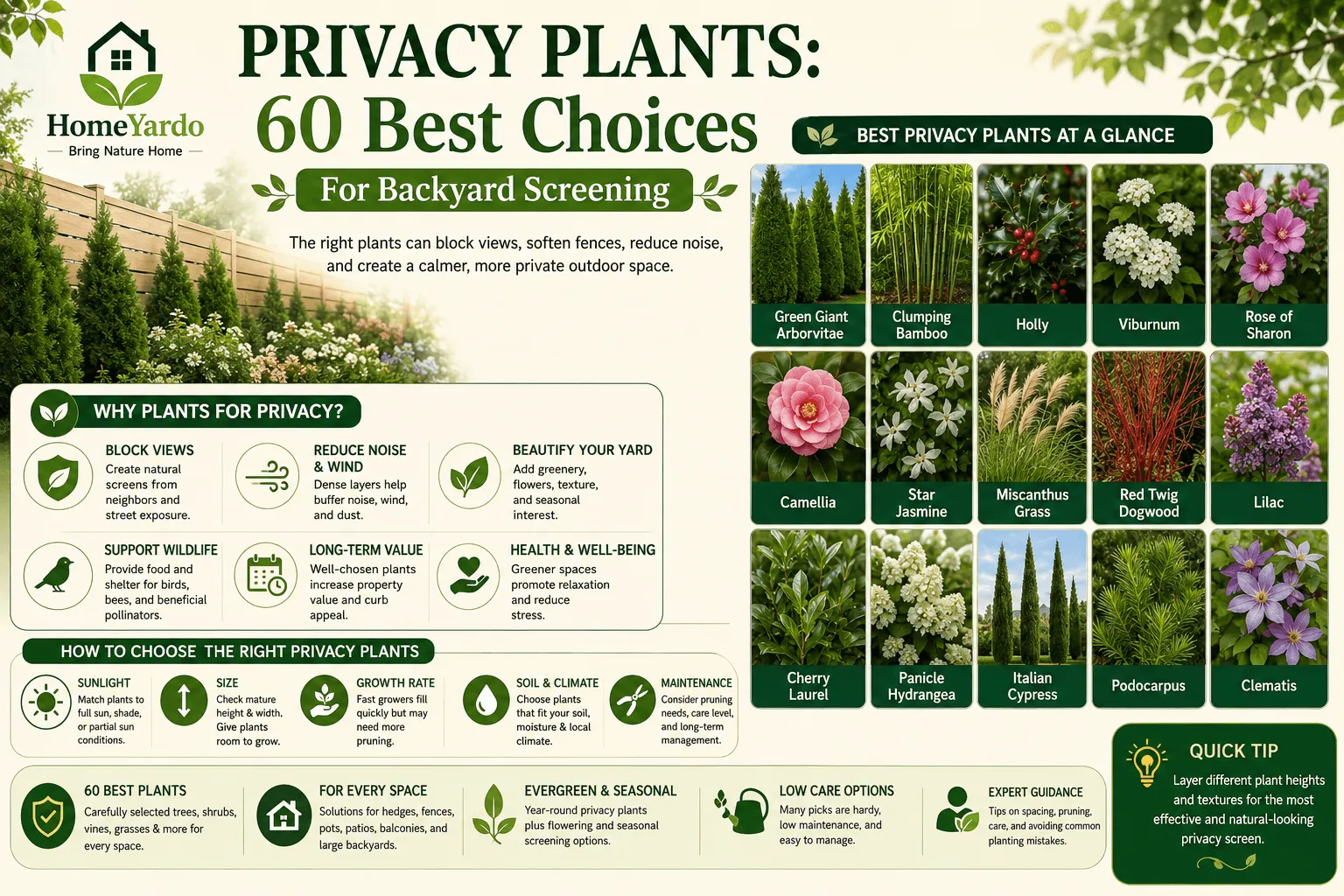
Quick Answer: Best Privacy Plants For Your Yard
The most suitable plant will depend on the privacy objective. A tall evergreen could be suited to the property line, whereas the narrower vine, shrub or container plant might be better suited on a balcony, patio or fence.
| Need | Best Plant Choices | Why It Works |
|---|---|---|
| Best overall screen | Green Giant arborvitae | Tall, evergreen, dense, and reliable in many yards |
| Fast privacy | Leyland cypress, clumping bamboo | Quick coverage where space and climate allow |
| Evergreen shrub | Holly, cherry laurel, wax myrtle | Dense foliage for year-round screening |
| Low-maintenance hedge | Inkberry holly, podocarpus, Eastern red cedar | Manageable growth when planted in the right space |
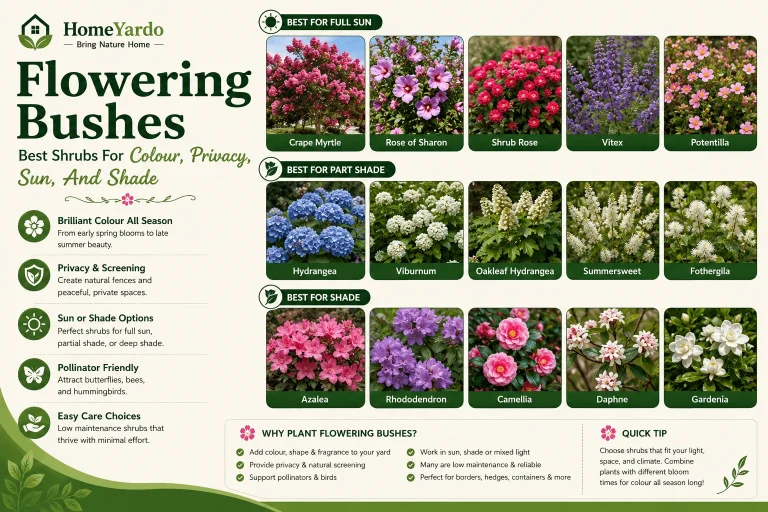
| Flowering screen | Viburnum, camellia, lilac, rose of Sharon | Adds privacy with flowers or seasonal interest |
| Fence line cover | Arborvitae, laurel, star jasmine, clematis | Screens, fences, and narrow borders |
| Potted privacy | Bay laurel, dwarf Alberta spruce, podocarpus | Works for patios, decks, and large containers |
| Narrow yard screen | Italian cypress, Japanese holly, Emerald Green arborvitae | Upright growth saves width |
What Privacy Flowers Or Plants Can Do In A Yard
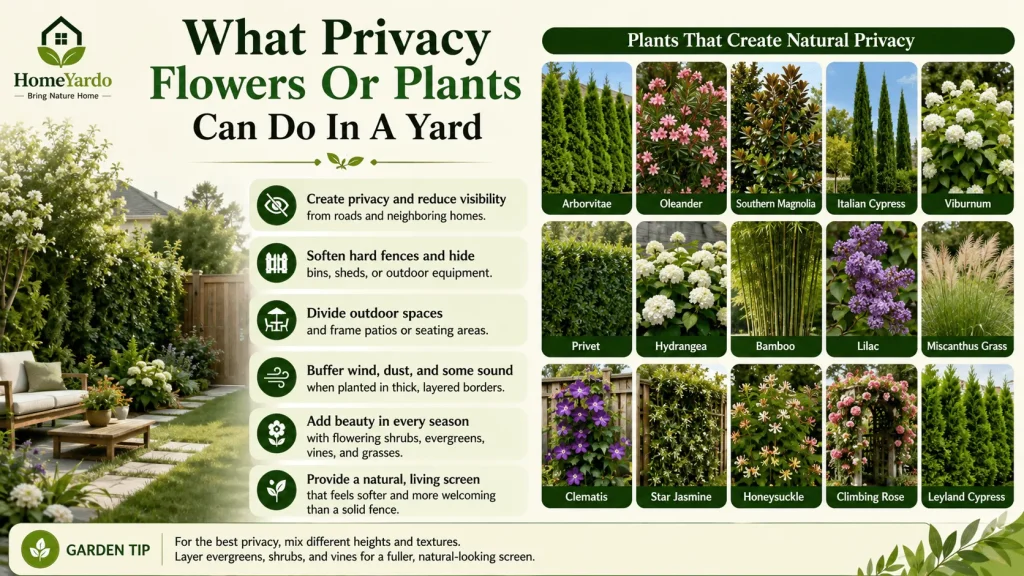
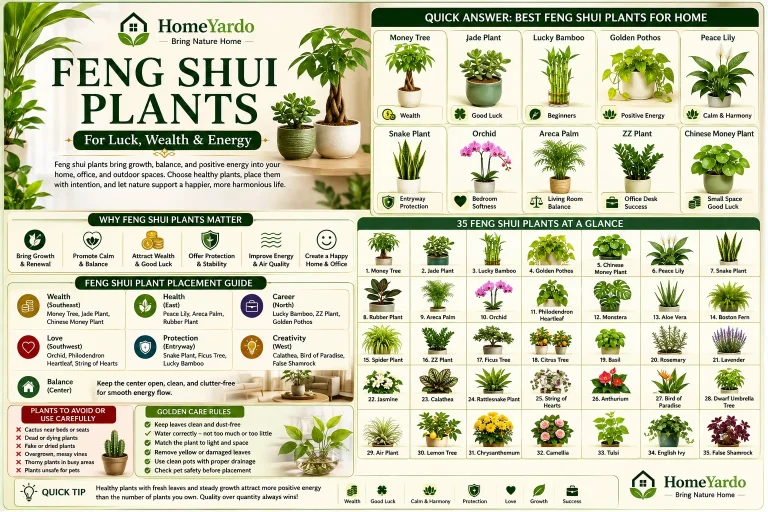
Living screens can do more than limit the view. They can soften the look of a fence, conceal bins or sheds, separate spaces for outdoor use and frame patios and limit direct exposure to a neighboring road or homes. For plant placement ideas based on balance and outdoor energy flow, feng shui plants can help guide how greenery is arranged around entrances, patios, and garden edges.
Dense landscaping can also assist in reducing dust, wind and some noise when it is used in layers. The plants will not be able to make a yard soundproof. However, a border made of evergreens, trees and smaller trees can make a house feel more secure.
Flowers in the shrubs are a great way to add colour. Evergreens add winter cover. Vines are great for narrow areas. Long grasses and perennials can create summer screening areas where hedges aren’t required.
A lot of homeowners opt for plants to block neighboring properties when their fences feel too high, too open or hard in the landscape. The dense evergreens, the layered shrubs and vines on Trellises can soften the view of neighbors while preserving the natural landscape. For informal screens, bushe
How To Choose The Right Plants For Privacy?
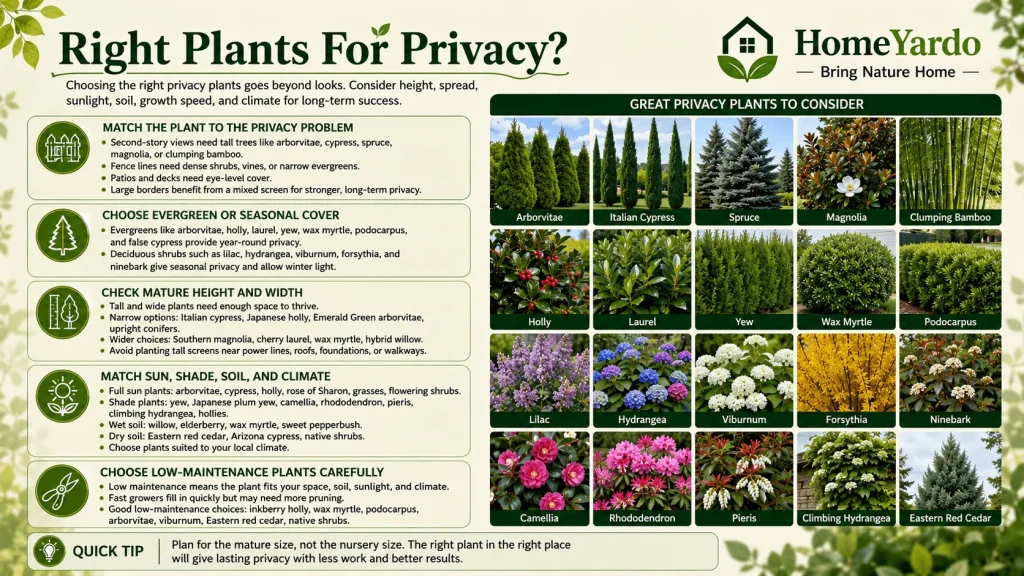
Choosing by appearance alone can create problems later. Mature height, mature width, sunlight, soil moisture, growth speed, pruning needs, and local climate should guide the choice before planting.
Match The Plant To The Privacy Problem
A second-story view requires some elevation. The Arborvitae, Cypress, Spruce magnolia, and bamboo clumps can be used if space permits.
A fence line typically requires thick vines, dense shrubs or even small evergreens. Patios and decks usually require the protection of an eye level instead of a high property line screening.
For large areas, a mixed screen of plants, trees, flowering plants and grasses provides more long-term coverage than just a single plant in a row.
Choose Evergreen Or Seasonal Cover
Evergreens are ideal in winter when it comes to covering. Arborvitae, holly, yew podocarpus, and false cypress maintain their leaves through the whole year.
Deciduous plants like viburnum, lilac, hydrangea ninebark, forsythia and viburnum are still effective in areas where privacy is essential during summer, spring and fall. They also permit more winter sun to the backyard.
Check Mature Height And Width
Height is just one aspect of the privacy plant. A plant that is 20 feet high but is 15 feet wide could not be suitable for a small side yard.
The narrow options include Italian Cypress, Japanese holly, Emerald Green arborvitae, and a few upright conifers. The larger plants like Southern magnolia and cherry laurel wax myrtle, hybrid willows require more space.
Do not plant tall screens next to power lines and foundations, roof edges, roads, and sidewalks. The size of mature plants is more than the younger plants in the nursery.
Match Sun, Shade, Soil, And Climate
Full shade Privacy plants comprise arborvitae the cypress, holly, rose of Sharon ornamental grasses and a variety of flowering plants. These plants typically thrive when they have plenty of light, constant irrigation throughout the establishment period and a sufficient area to grow. It is generally easier to grow dense hedges since plants remain fuller when sunlight reaches all sides.
Shade-loving plants require an alternative approach as many fast evergreens wilt in light conditions. Shade privacy shrubs like Yew, Japanese plum yews, camellias, rhododendron climbing hydrangeas, and some hollies are better in shaded or partially protected areas. If you live in a shaded area, select plants with a high density of foliage and tolerance to site conditions, not rapid growth.
Wet soil can be a good fit for willow and elderberry, wax myrtle and sweet pepperbush. However, dry soil requires more robust options like Eastern red cedar, Arizona Cypress and some native trees. The local climate is important since a plant that does well in a sunny coastal garden might not thrive in cold, inland gardens.
Choose Low-Maintenance Plants Carefully
Low-maintenance privacy plants do mean no care. It is the term used to describe plants that are suited to the area as well as the climate, light and soil, without constant adjustment.
Fast-growing plants fill up quickly, but they require more trimming. Formal hedges require constant trimming. Screens made of natural materials can be trimmed by pruning them with a lighter, more selective approach.
Inkberry Holly, wax myrtle viburnum, podocarpus, arborvitae, Eastern red cedar, and other native plants that are region-friendly are all easy to plant in the correct place.
Native And Region-Friendly Plants Privacy
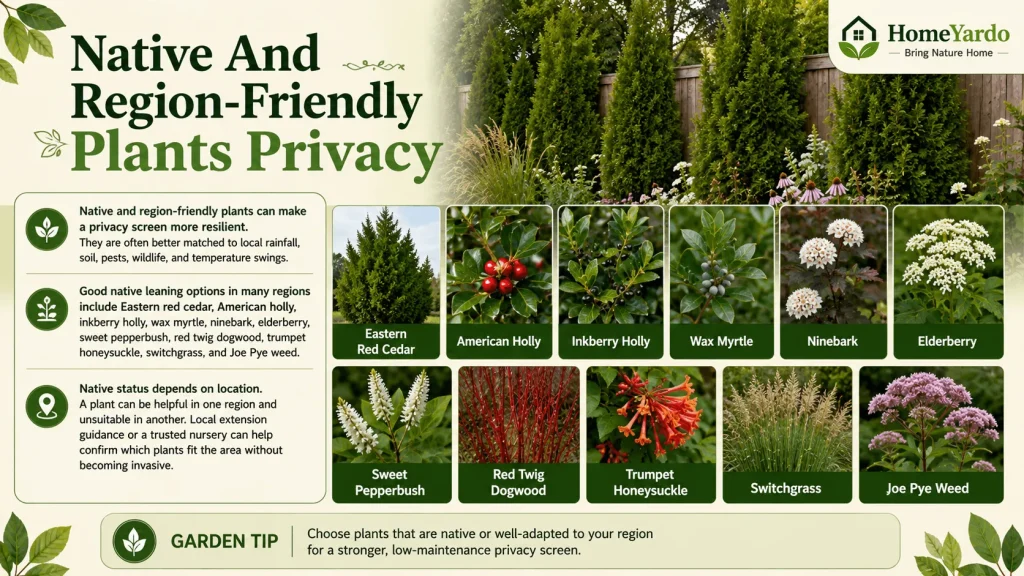
The native plants and the ones that are suited to the region create a privacy screening that is more durable. They tend to be better suited to the local weather soil as well as wildlife, pests and temperature fluctuations.
Some good native-leaning choices in a wide range of areas are Eastern Red Cedar, American Inkberry, holly, wax myrtle ninebark, elderberry and sweet pepperbush red twig dogwood, trumpet honeysuckle and switchgrass as well as Joe Pye weed.
Native status depends on location. The plant may be beneficial in one area but not suitable in another. Local extension guidelines or a trusted nursery may aid in determining which plants are suitable for the region without becoming invasive.
Privacy Planting: At A Glance
The plants listed below are listed by their use. The table offers an overview of the plants before going into detailed descriptions of the plants.
| Plant | Type | Cover | Size | Growth | Best Use | Care |
|---|---|---|---|---|---|---|
| Green Giant arborvitae | Evergreen tree | Year round | 40 to 60 ft | Fast | Tall property line screen | Medium |
| Emerald Green arborvitae | Evergreen tree | Year round | 12 to 15 ft | Moderate | Narrow hedge | Low to medium |
| Leyland cypress | Evergreen tree | Year round | 40 to 70 ft | Fast | Large yard screen | Medium to high |
| Eastern red cedar | Evergreen tree | Year round | 30 to 50 ft | Moderate | Windbreak and rural screen | Low |
| Italian cypress | Evergreen tree | Year round | 35 to 60 ft | Moderate | Narrow vertical privacy | Low to medium |
| Arizona cypress | Evergreen tree | Year round | 30 to 50 ft | Moderate to fast | Dry sunny screen | Low |
| Japanese cedar | Evergreen tree | Year round | 30 to 60 ft | Moderate | Soft evergreen screen | Medium |
| Norway spruce | Evergreen tree | Year round | 40 to 60 ft | Moderate to fast | Large windbreak screen | Low to medium |
| Eastern white pine | Evergreen tree | Year round | 50 to 80 ft | Fast | Large natural screen | Medium |
| Southern magnolia | Evergreen tree | Year round | 40 to 80 ft | Moderate | Broadleaf evergreen privacy | Medium |
| False cypress | Evergreen tree or shrub | Year round | 6 to 30 ft | Moderate | Soft-textured hedge | Medium |
| Clumping bamboo | Grass-like screen | Year-round or semi-evergreen | 8 to 25 ft | Fast | Narrow privacy screen | Medium |
| Cherry laurel | Evergreen shrub | Year round | 10 to 20 ft | Fast | Dense hedge | Medium |
| Portuguese laurel | Evergreen shrub | Year round | 10 to 20 ft | Moderate | Formal or natural hedge | Medium |
| American holly | Evergreen tree or shrub | Year round | 15 to 50 ft | Slow to moderate | Dense winter screen | Low to medium |
| Nellie Stevens holly | Evergreen shrub | Year round | 15 to 25 ft | Moderate to fast | Tall hedge | Medium |
| Inkberry holly | Evergreen shrub | Year round | 5 to 8 ft | Moderate | Low hedge or screen | Low |
| Japanese holly | Evergreen shrub | Year round | 4 to 10 ft | Moderate | Narrow hedge | Low to medium |
| Boxwood | Evergreen shrub | Year round | 2 to 8 ft | Slow | Formal hedge | Medium |
| Hicks yew | Evergreen shrub | Year round | 10 to 15 ft | Slow to moderate | Shade tolerant screen | Medium |
| Japanese plum yew | Evergreen shrub | Year round | 3 to 10 ft | Slow | Shade privacy | Low to medium |
| Wax myrtle | Evergreen shrub | Year round | 10 to 20 ft | Fast | Natural screen | Low |
| Podocarpus | Evergreen shrub or tree | Year round | 10 to 30 ft | Moderate | Warm climate hedge | Medium |
| Pittosporum | Evergreen shrub | Year round | 8 to 15 ft | Moderate | Coastal hedge | Medium |
| Griselinia | Evergreen shrub | Year round | 8 to 20 ft | Fast | Mild climate hedge | Medium |
| Elaeagnus | Evergreen shrub | Year round or semi evergreen | 8 to 15 ft | Fast | Tough informal screen | Medium |
| Privet | Shrub | Semi evergreen or seasonal | 8 to 15 ft | Fast | Formal hedge | High |
| Red tip photinia | Evergreen shrub | Year round | 10 to 15 ft | Fast | Colorful hedge | Medium to high |
| Dappled willow | Deciduous shrub | Seasonal | 6 to 10 ft | Fast | Soft summer screen | Medium |
| Hybrid willow | Deciduous tree | Seasonal | 30 to 60 ft | Fast | Quick large screen | High |
| Elderberry | Deciduous shrub | Seasonal | 6 to 12 ft | Fast | Wildlife friendly screen | Medium |
| Forsythia | Deciduous shrub | Seasonal | 6 to 10 ft | Fast | Spring flowering screen | Medium |
| Rose of Sharon | Deciduous shrub | Seasonal | 8 to 12 ft | Moderate to fast | Summer flowering screen | Medium |
| Panicle hydrangea | Deciduous shrub | Seasonal | 6 to 15 ft | Moderate to fast | Flowering hedge | Medium |
| Viburnum | Shrub | Evergreen or seasonal | 6 to 15 ft | Moderate | Mixed privacy border | Low to medium |
| Lilac | Deciduous shrub | Seasonal | 8 to 15 ft | Moderate | Fragrant screen | Medium |
| Mock orange | Deciduous shrub | Seasonal | 6 to 12 ft | Moderate | Fragrant flowering screen | Medium |
| Camellia | Evergreen shrub | Year round | 6 to 15 ft | Slow to moderate | Shade flowering privacy | Medium |
| Rhododendron | Evergreen shrub | Year round | 4 to 12 ft | Slow to moderate | Acid soil shade screen | Medium |
| Abelia | Semi-evergreen shrub | Semi evergreen | 3 to 8 ft | Moderate | Small flowering screen | Low |
| Beautyberry | Deciduous shrub | Seasonal | 3 to 6 ft | Moderate | Berry interest and soft screen | Low |
| Sweet pepperbush | Deciduous shrub | Seasonal | 3 to 8 ft | Moderate | Wet soil flowering screen | Low |
| Ninebark | Deciduous shrub | Seasonal | 5 to 10 ft | Moderate to fast | Tough mixed border | Low |
| Crape myrtle | Deciduous shrub or tree | Seasonal | 10 to 25 ft | Moderate | Warm climate flowering screen | Medium |
| Red twig dogwood | Deciduous shrub | Seasonal | 6 to 10 ft | Fast | Winter stem interest | Medium |
| Loropetalum | Evergreen shrub | Year round | 5 to 15 ft | Moderate to fast | Colorful evergreen hedge | Medium |
| Climbing hydrangea | Vine | Seasonal | 30 to 50 ft | Slow to moderate | Shade fence or wall | Medium |
| Crossvine | Vine | Evergreen or semi-evergreen | 30 to 50 ft | Fast | Fence or trellis cover | Medium |
| Trumpet honeysuckle | Vine | Semi-evergreen or seasonal | 10 to 20 ft | Moderate | Wildlife-friendly trellis | Medium |
| Clematis | Vine | Seasonal | 6 to 20 ft | Moderate | Trellis flowers | Medium |
| Star jasmine | Vine | Year round | 10 to 20 ft | Moderate | Fragrant fence screen | Medium |
| American wisteria | Vine | Seasonal | 15 to 30 ft | Fast | Strong arbor screen | High |
| Carolina jessamine | Vine | Year round | 10 to 20 ft | Fast | Warm climate fence cover | Medium |
| Switchgrass | Ornamental grass | Seasonal | 3 to 7 ft | Moderate | Soft summer privacy | Low |
| Miscanthus | Ornamental grass | Seasonal | 5 to 10 ft | Fast | Tall seasonal screen | Medium |
| Pampas grass | Ornamental grass | Seasonal | 6 to 12 ft | Fast | Bold summer screen | Medium |
| Canna | Tropical perennial | Seasonal | 3 to 8 ft | Fast | Patio summer screen | Medium |
| Joe Pye weed | Perennial | Seasonal | 4 to 7 ft | Moderate | Pollinator screen | Low |
| Bay laurel | Evergreen shrub | Year round | 6 to 20 ft | Slow to moderate | Container privacy | Medium |
| Dwarf Alberta spruce | Evergreen conifer | Year round | 6 to 12 ft | Slow | Potted or small screen | Low to medium |
60 Best Privacy Plants By Type And Use
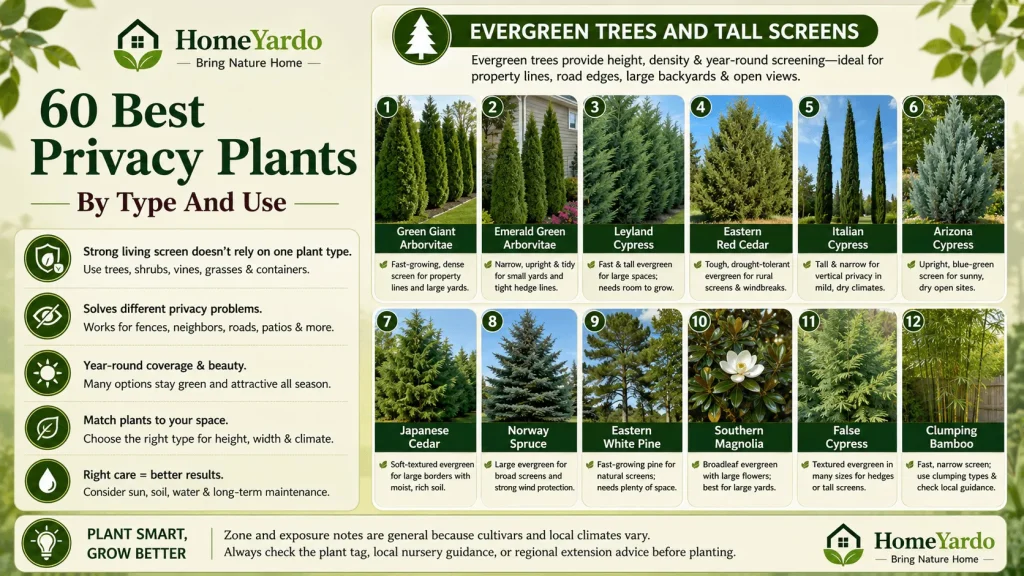
A sturdy living screen doesn’t have to depend on just one plant species. Large evergreens, dense plants, flowering bushes, a variety of grasses, vines, and container plants can solve privacy issues of various kinds.
Notes on exposure and zone are general as cultivation methods and regional climates can differ. Always read the tag on your plant or local nursery guidelines, or regional extension guidelines prior to planting.
Evergreen Trees And Tall Screens
Evergreen trees are among the tallest plants that can be used to provide privacy as they offer tallness, density, and all-year-round screening.
Tall privacy plants like arborvitae, cypress and spruce pine, magnolia, false cypress, and clumping Bamboo prefer to be planted in areas that border property lines, road borders, huge backyards and wide views. They need space to the mature height, spread of roots airflow, the possibility of future pruning access.
- Green Giant arborvitae: An excellent choice for tall property lines that provide privacy. It is suitable for full sun to partial sun, and is typically employed in cool to moderate zones when an evergreen hedge has sufficient space. It expands quickly, is thick, and is a great choice when a large hedge needs the space.
- Emerald Green Arborvitae: A shorter, more compact arborvitae suitable to be used in smaller yards or side yards as well as more slender hedge lines. It likes full sun to a little sun, and thrives when the soil is equally moist, but not sloppy. It develops more slowly in comparison to Green Giant but keeps a clean, upright appearance.
- Leyland Cypress: A quick evergreen that is ideal for large areas. It’s ideal for full sunshine and warm to mild zones. However, it could be too large for small gardens. It requires room for airflow and surveillance in areas that are prone to storms or diseases.
- Eastern Red Cedar A sturdy evergreen suitable for windbreaks, rural screens and open spaces with sun. It thrives in full sun and works with drier ground than smaller hedges. It’s a great choice for areas where a sturdy, low-maintenance screen is required.
- Italian Cypress: A tall, wide plant suitable for privacy in dry or mild climates. It requires full sun, good drainage and protection from the wet winter snow. It’s a great choice for formal designs as well as small areas where the width is restricted.
- Arizona Cypress is a good option for dry, sunny open spaces. The blue-green foliage as well as the upright form make it ideal when irrigation is restricted following the establishment.
- Japanese cedar is soft-textured, evergreen to create larger borders. It is most effective when the soil is moist and it has enough room to grow.
- Norway spruce: A big evergreen suitable for creating large screening and for wind-proofing. It’s not a good choice for small urban spaces due to the mature width can be large.
- Eastern white pine. It is a fast growing pine to make huge natural screens. It has a soft appearance however, it requires space and might not be suitable for small gardens or areas with high pollution.
- Southern magnolia An evergreen broadleaf that has shiny leaves and big flowers. It is suitable for full sun to part shade in mild warm climates. It requires ample space for its roots and canopy. It’s better for big gardens than narrow fence lines.
- False Cypress: An evergreen with a texture that is with a variety of textures and sizes. It is a hedge, shrub or taller screen based on the type of cultivar.
- Clumping Bamboo: It is a fast-growing and small screen that is ideal for areas where conditions and containment are ideal. It typically thrives in the shade to sun, according to the species, and requires constant watering throughout the development. Pick clumping plants that are not running and make sure you check the local guidelines prior to planting.
Evergreen Shrubs For Privacy And Bushes For Dense Privacy
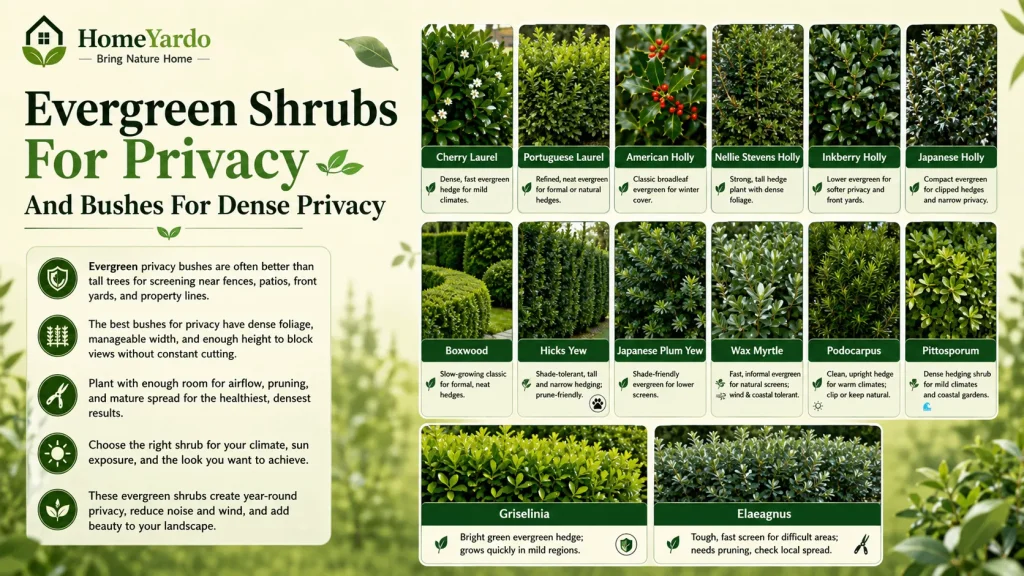
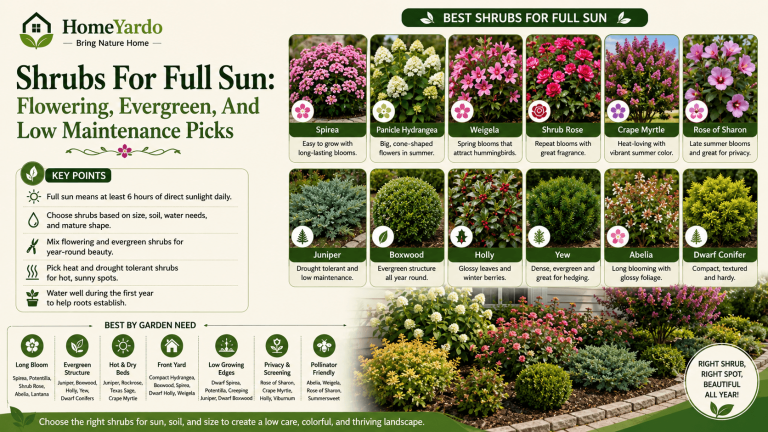
Evergreen privacy bushes are often better than tall trees when screening is needed near fences, patios, front yards, and property lines. The best bushes for privacy usually have dense foliage, a manageable mature width, and enough height to block views without constant cutting. These can work best when planted with enough room for airflow, pruning, and mature spread.
Tall shrubs for privacy, such as cherry laurel, Nellie Stevens holly, wax myrtle, podocarpus, pittosporum, and griselinia, can create a dense screen without the scale of large trees. They need enough room for mature width, airflow, and pruning access.
- Cherry laurel: A dense, fast evergreen hedge for mild climates. It grows well in full sun to part shade and works along fences where there is enough room for mature width. It needs pruning to stay controlled.
- Portuguese laurel: A refined evergreen shrub for formal or natural hedges. It grows more neatly than cherry laurel and suits privacy screens with a cleaner look.
- American holly: A classic broadleaf evergreen for winter cover. It suits full sun to part shade and can become a tall shrub or small tree. It often supports berries when pollination needs are met.
- Nellie Stevens holly: A strong, tall hedge plant with dense evergreen foliage. It works well where a broad, upright screen is needed.
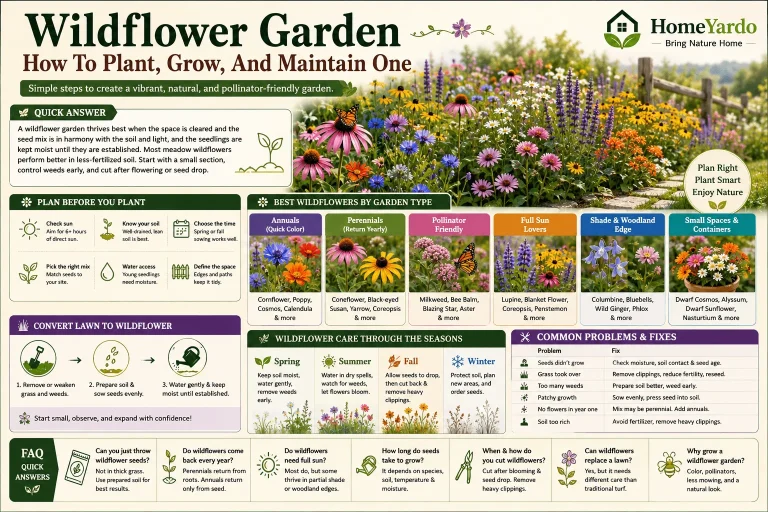
- Inkberry holly: A lower evergreen option for softer privacy and front yard screening. It grows in full sun to part shade and can handle moist soil better than many hedge plants. It fits mixed borders and native leaning landscapes. For more returning color around seasonal screens, purple perennials can help soften borders with flowers that come back year after yea
- Japanese holly: A compact evergreen shrub for clipped hedges and narrow privacy. It gives a boxwood-like look in many designs.
- Boxwood: A slow-growing classic for formal hedges. It works best where neat structure matters more than fast screening.
- Hicks yew: A shade-tolerant evergreen for tall, narrow hedging. It can grow in part shade and handles pruning well, but it should not be planted where pets or children may eat plant parts. It is useful where many sun-loving hedges thin out.
- Japanese plum yew: A shade-friendly evergreen for lower screens and foundation privacy. It works well in part shade to shade and suits protected sites. It grows slowly, so it is better for a steady structure than fast privacy.
- Wax myrtle: A fast, informal evergreen for natural screens in suitable climates. It prefers sun to part shade and handles wind, coastal exposure, and mixed borders well. It is a good choice where a softer hedge look is wanted.
- Podocarpus: A clean, warm climate hedge plant with upright evergreen growth. It suits full sun to part shade and can be clipped or left more natural. It is best for mild regions where winter cold is not severe.
- Pittosporum: A mild climate shrub for dense hedging and coastal gardens. It needs suitable winter temperatures and regular shaping if used formally.
- Griselinia: A bright green evergreen hedge for mild regions. It grows quickly and suits wind-protected coastal or temperate yards.
- Elaeagnus: A tough, fast screen for difficult areas. It needs pruning and should be checked locally because some types can spread.
Fast-Growing Privacy Plants
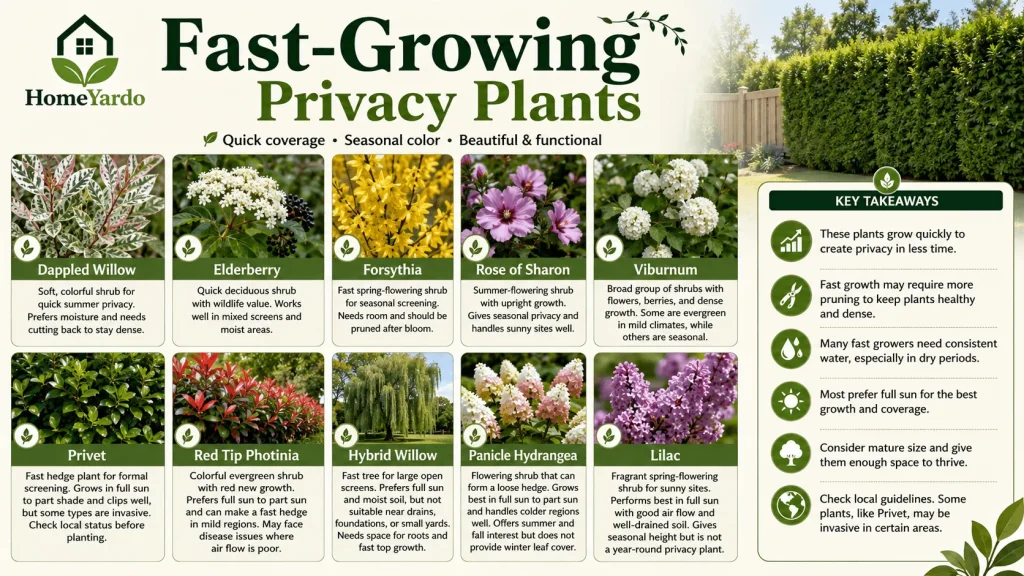
Fast-growing plants help when coverage is needed sooner. Speed can also bring more pruning, wider growth, or higher water demand.
- Dappled willow: A soft, colorful shrub for quick summer privacy. It prefers moisture and needs cutting back to stay dense.
- Elderberry: A quick deciduous shrub with wildlife value. It works well in mixed screens and moist areas.
- Forsythia: A fast spring-flowering shrub for seasonal screening. It needs room and should be pruned after bloom.
- Rose of Sharon: A summer-flowering shrub with upright growth. It gives seasonal privacy and handles sunny sites well.
- Viburnum: A broad group of shrubs with flowers, berries, and dense growth. Some are evergreen in mild climates, while others are seasonal.
- Privet: A fast hedge plant for formal screening. It grows in full sun to part shade and clips well, but some types are invasive. Local status should be checked before planting.
- Red tip photinia: A colorful evergreen shrub with red new growth. It prefers full sun to part sun and can make a fast hedge in mild regions. It may face disease issues where air flow is poor.
- Hybrid willow: A fast tree for large open screens. It prefers full sun and moist soil, but it is not a good fit near drains, foundations, or small yards. It needs space for roots and fast top growth.
- Panicle hydrangea: A flowering shrub that can form a loose hedge. It grows best in full sun to part sun and handles colder regions better than many flowering privacy shrubs. It offers summer and fall interest but does not give winter leaf cover.
- Lilac: A fragrant spring flowering shrub for sunny sites. It performs best in full sun with good air flow and well-drained soil. It gives seasonal height but is not a year-round privacy plant.
Flowering Privacy Shrubs
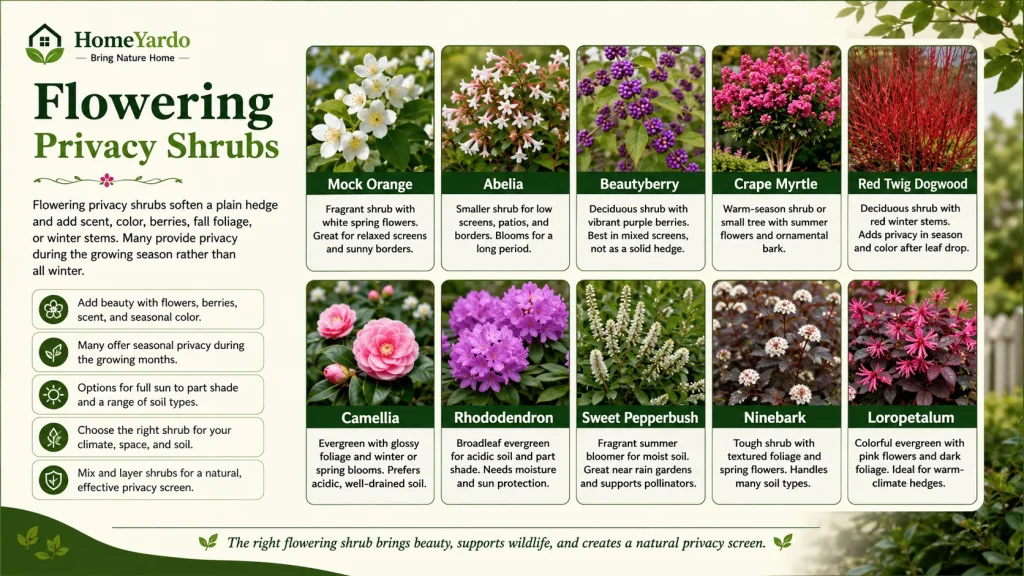
Flowering privacy shrubs soften a plain hedge and add scent, color, berries, fall foliage, or winter stems. Many provide privacy during the growing season rather than all winter. For a flowering shrub option with classic blooms, compare types of roses before adding rose shrubs to a privacy border.
- Mock orange: A fragrant shrub with white spring flowers. It suits relaxed screens and sunny mixed borders.
- Abelia: A smaller flowering shrub for low screens, patios, and mixed borders. It blooms for a long period in suitable climates.
- Beautyberry: A soft deciduous shrub known for purple berries. It is best in mixed screens rather than as a solid hedge.
- Crape myrtle: A warm-weather shrub or small tree with summer flowers. It gives seasonal privacy and ornamental bark. For more warm-season bloom ideas near patios and mixed borders, summer flowers can add color in front of privacy shrubs.
- Red twig dogwood: A deciduous shrub with red winter stems. It adds privacy in the growing season and color after leaf drop.
- Camellia: An evergreen flowering shrub for mild climates and part shade. It gives privacy with glossy foliage and winter or spring blooms. It works best in acidic, well-drained soil with protection from harsh exposure.
- Rhododendron: A broadleaf evergreen for acidic soil and part shade. It needs consistent moisture and protection from harsh afternoon sun in warmer regions. It is a good privacy shrub for woodland-style gardens.
- Sweet pepperbush: A fragrant summer-flowering shrub for moist soil. It grows in full sun to part shade and works well near rain gardens or damp borders. It supports pollinators while adding seasonal privacy.
- Ninebark: A tough shrub with textured foliage and spring flowers. It grows best in full sun to part sun and handles a range of soil conditions. It suits informal screens where low care matters.
- Loropetalum: A colorful evergreen shrub with pink flowers and dark foliage. It suits full sun to part shade in mild to warm regions. It works well as a warm-climate hedge or mixed screen.
For more warm-season bloom ideas near patios and mixed borders, summer flowers can add color in front of privacy shrubs.
Vines And Climbers For Fence Privacy
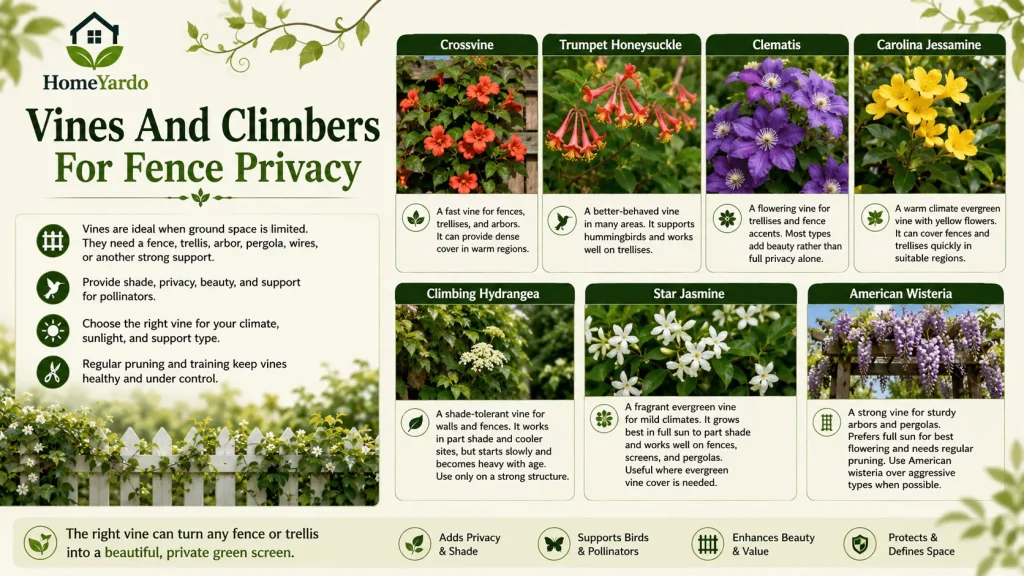
Vines are useful where ground space is limited. They need a fence, trellis, arbor, pergola, wires, or another strong support.
- Crossvine: A fast vine for fences, trellises, and arbors. It can provide dense cover in warm regions.
- Trumpet honeysuckle: A better-behaved vine than aggressive honeysuckle types in many areas. It supports hummingbirds and works well on trellises.
- Clematis: A flowering vine for trellises and fence accents. Most types add beauty rather than full privacy alone.
- Carolina jessamine: A warm climate evergreen vine with yellow flowers. It can cover fences and trellises quickly in suitable regions.
- Climbing hydrangea: A shade-tolerant vine for walls and fences. It works in part shade and cooler sites, but it starts slowly and becomes heavy with age. Use it only on a strong structure.
- Star jasmine: A fragrant evergreen vine for mild climates. It grows best in full sun to part shade and works well on fences, screens, and pergolas. It is useful where evergreen vine cover is needed.
- American wisteria: A strong vine for sturdy arbors and pergolas. It prefers full sun for best flowering and needs regular pruning. Use American wisteria instead of more aggressive wisteria types where possible.
Seasonal Screens, Patio Plants, And Container Choices
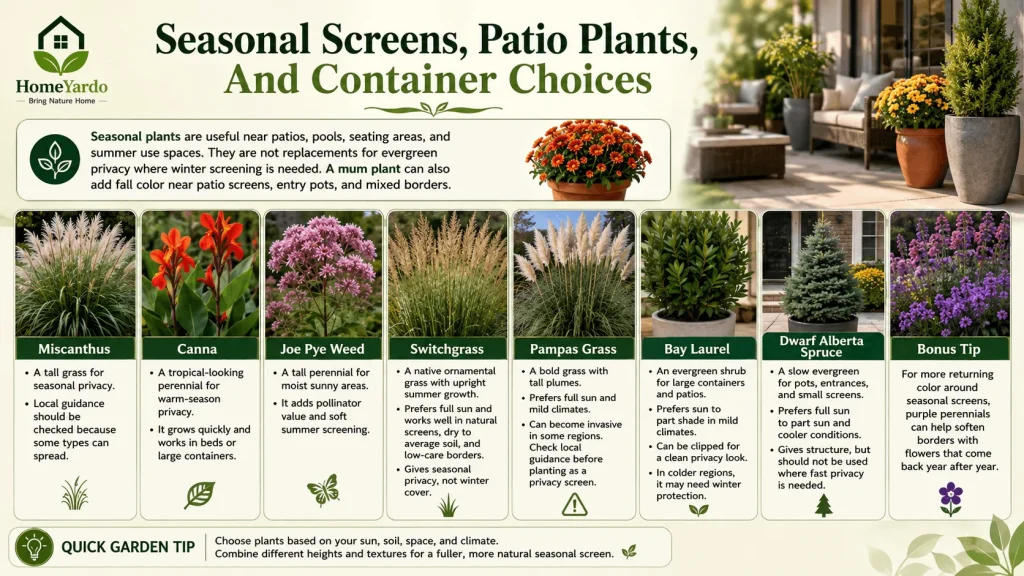
Seasonal plants are useful near patios, pools, seating areas, and summer use spaces. They are not replacements for evergreen privacy where winter screening is needed. A mum plant can also add fall color near patio screens, entry pots, and mixed seasonal borders.
- Miscanthus: A tall grass for seasonal privacy. Local guidance should be checked because some types can spread.
- Canna: A tropical-looking perennial for warm-season privacy. It grows quickly and works in beds or large containers.
- Joe Pye weed: A tall perennial for moist sunny areas. It adds pollinator value and soft summer screening.
- Switchgrass: A native ornamental grass with upright summer growth. It prefers full sun and works well in natural screens, dry to average soil, and low-care mixed borders. It gives seasonal privacy, not winter cover.
- Pampas grass: A bold grass with tall plumes. It prefers full sun and mild climates but can become invasive in some regions. Check local guidance before planting it as a privacy screen.
- Bay laurel: An evergreen shrub for large containers and patios. It prefers sun to part shade in mild climates and can be clipped for a clean privacy look. In colder regions, it may need winter protection.
- Dwarf Alberta spruce: A slow evergreen for pots, entrances, and small screens. It prefers full sun to part sun and cooler conditions. It gives structure, but should not be used where fast privacy is needed.
Best Privacy Planting By Yard Location
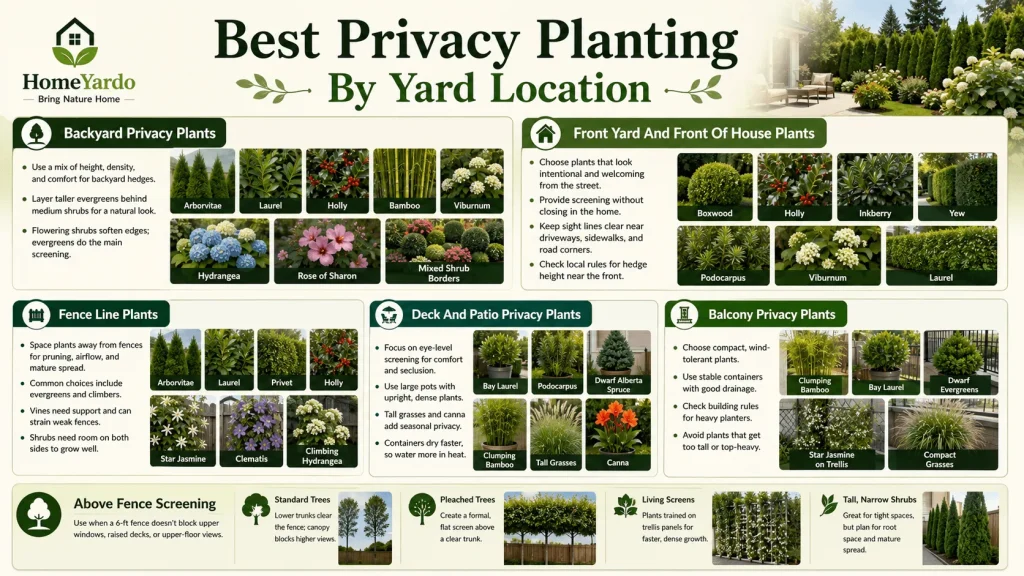
Different parts of a yard need different plant shapes. A backyard may need height, while a balcony may need upright container plants that tolerate wind.
Backyard Privacy Plants
Backyard hedges often need a mix of height, density, and comfort. Arborvitae, laurel, holly, bamboo, viburnum, hydrangea, rose of Sharon, and mixed shrub borders can all work.
For patios and pools, place taller evergreens behind medium shrubs so the planting does not feel like a flat wall. Flowering shrubs can soften the edges, while evergreens handle the main screening job.
Front Yard And Front Of House Plants
Front yard privacy plants should look intentional from the street. Boxwood, holly, inkberry, yew, podocarpus, viburnum, and laurel can provide screening without making the home feel closed off.
Keep sight lines clear near driveways, sidewalks, and road corners. In many areas, local rules limit hedge height near the front of a property.
Fence Line Plants
Privacy fence plants should be spaced far enough from the fence for pruning, air flow, and mature spread. Arborvitae, laurel, privet, holly, star jasmine, clematis, and climbing hydrangea are common choices.
Vines need support and may damage weak fences if they become too heavy. Shrubs need space on both sides so they do not press tightly against wood or vinyl panels.
Deck And Patio Privacy Plants
Patios and decks often need screening at eye level rather than a tall property line hedge. Large pots with bay laurel, podocarpus, dwarf Alberta spruce, clumping bamboo, or upright hollies can work well.
Tall grasses and canna can add seasonal summer privacy. Containers dry faster than garden soil, so watering needs are higher during the heat.
Balcony Privacy Plants
Balcony privacy needs compact plants, stable containers, and wind-tolerant choices. Clumping bamboo, bay laurel, dwarf evergreens, star jasmine on a trellis, and compact grasses can work where weight and light allow.
Check building rules before adding heavy planters. Use containers with drainage and avoid plants that become too tall or top-heavy in the wind.
Above Fence Screening
Above fence screening is useful when a 6-foot fence does not block upper windows, raised decks, or nearby upper-floor views. Standard trees, pleached trees, living screens, bamboo, and tall, narrow shrubs can help.
Standard trees give privacy above fence panels because the lower trunk clears the fence, and the canopy blocks higher views. Pleached trees create a formal flat screen above a clear stem. Living screens use plants trained on trellis panels for faster growth. Tall, narrow shrubs can work where space is limited, but roots and mature spread still need planning.
Privacy Hedge Ideas And Layouts
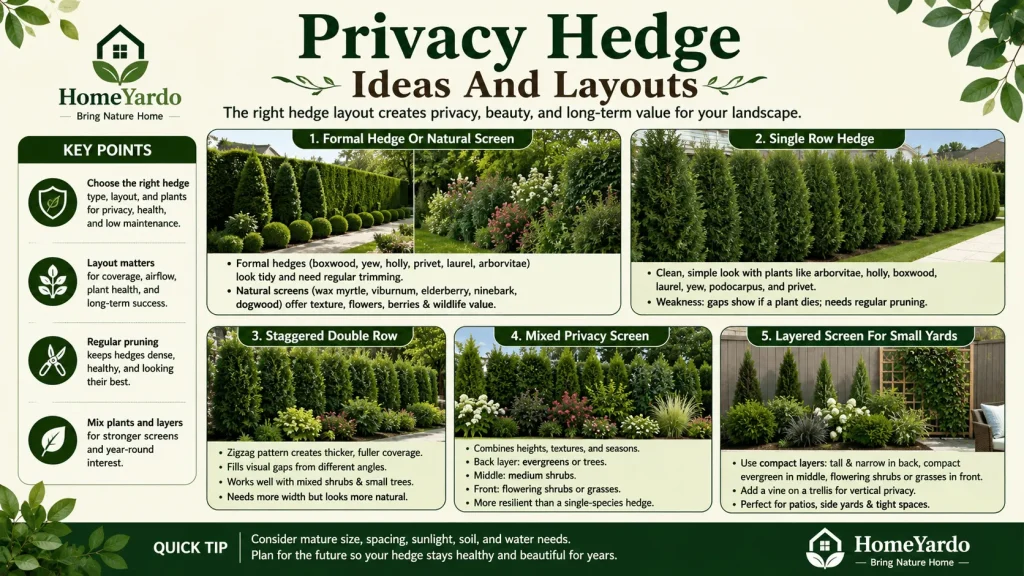
A privacy hedge can be formal, natural, single row, staggered, or layered. The layout affects coverage, airflow, plant health, and long-term maintenance.
Formal Hedge Or Natural Screen
The best hedge for privacy depends on the shape, height, and maintenance level desired. Boxwood, yew, holly, privet, podocarpus, laurel, and arborvitae make some of the best hedges when the goal is a dense, controlled screen. For taller boundaries, tall hedges for privacy work best when the plants have enough room to grow without crowding fences, sidewalks, or driveways.
A natural screen has a softer shape and usually needs less frequent cutting. Wax myrtle, viburnum, elderberry, ninebark, red twig dogwood, and mixed native shrubs can work well when a less formal look is preferred. Formal hedges look tidy, while natural screens give more texture, flowers, berries, and wildlife value
Single Row Hedge
A single row hedge gives a clean, simple look. It works well with arborvitae, holly, boxwood, laurel, yew, podocarpus, and privet.
The weakness is plant loss. If one plant dies, the gap is easy to see. Regular pruning is also needed to keep formal hedges dense and even.
Staggered Double Row
A staggered double row uses a zigzag pattern. It creates thicker coverage than one straight row and fills visual gaps from different angles.
This layout works well with mixed shrubs and small trees. It needs more width, but it can look fuller and more natural than a tight single row.
Mixed Privacy Screen
A mixed screen combines different plant heights, textures, and seasons. Evergreen trees can form the back layer, medium shrubs can fill the middle, and flowering shrubs or grasses can soften the front.
This approach is often more resilient than planting only one species. If one plant struggles, the whole screen is less likely to fail at once.
Layered Screen For Small Yards
Small yards can still use layered planting if the plant sizes are controlled. A narrow upright plant can sit near the back, a compact evergreen can fill the middle, and a flowering shrub or grass can sit in front.
A vine on a trellis can add vertical privacy without taking much ground space. This layout works well near patios and side yards.
How Far Apart Should Privacy Plants Be Planted?
Spacing depends on mature width, hedge style, and how fast a filled-in look is needed. Tight spacing fills faster, but it can increase pruning and reduce air flow.
| Plant Type | Typical Spacing | Best Layout | Notes |
|---|---|---|---|
| Narrow arborvitae | 3 to 5 ft | Single row | Good for tight evergreen hedges |
| Large arborvitae | 6 to 10 ft | Single or staggered row | Needs more room as it matures |
| Laurel hedge | 4 to 8 ft | Single row | Prune to control width |
| Mixed shrubs | 5 to 12 ft | Staggered row | Use the mature spread as the guide |
| Vines | 3 to 8 ft | Fence or trellis | Spacing depends on species and support |
| Grasses | 3 to 6 ft | Clumps or rows | Best for seasonal cover |
| Container screens | One plant per large pot | Pots or troughs | Use stable containers with drainage |
Do not plant directly against fences, walls, foundations, or utilities. Leave enough room to prune, water, mulch, and inspect the plants.
How Fast Do Privacy Plants Grow?
Fast growth usually means 2 to 4 feet per year in suitable conditions. Moderate growth is often 1 to 2 feet per year. Slow growth is usually under 1 foot per year.
Growth depends on plant size at purchase, sunlight, soil, water, climate, root health, and aftercare. A large nursery plant may create privacy sooner than a fast-growing small starter plant.
Fast privacy choices include Leyland cypress, Green Giant arborvitae, clumping bamboo, privet, red tip photinia, hybrid willow, dappled willow, forsythia, elderberry, and rose of Sharon.
Fastest is not always best. Many fast growers need more pruning, more water, or more width.
Cheapest Ways To Create Privacy With Plants
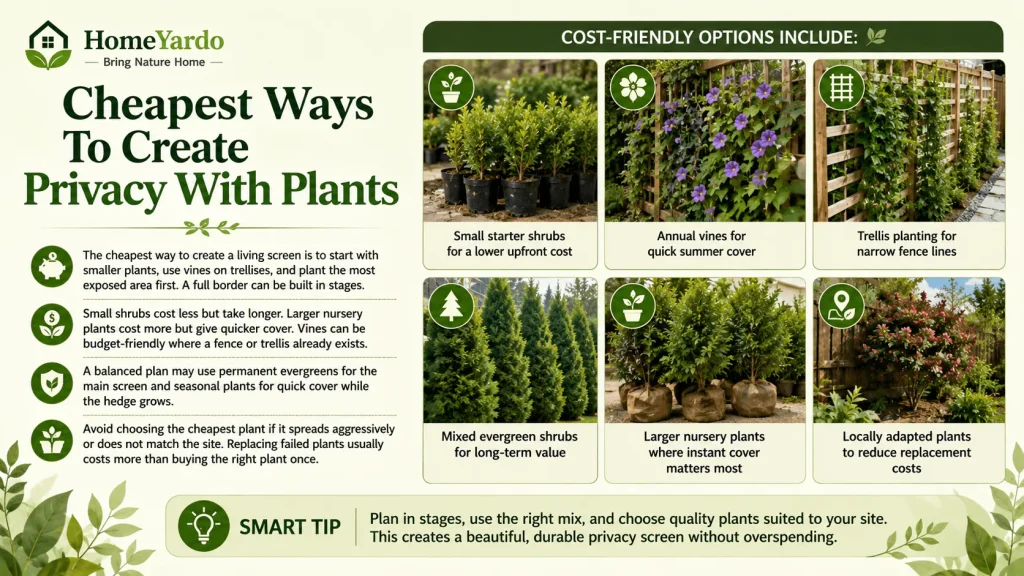
The cheapest way to create a living screen is to start with smaller plants, use vines on trellises, and plant the most exposed area first. A full border can be built in stages instead of all at once.
Small shrubs cost less but take longer. Larger nursery plants cost more but give quicker cover. Vines can be budget-friendly where a fence or trellis already exists.
A balanced plan may use permanent evergreens for the main screen and seasonal plants for quick cover while the hedge grows.
Cost-friendly options include:
- Small starter shrubs for a lower upfront cost
- Annual vines for quick summer cover
- Trellis planting for narrow fence lines
- Mixed evergreen shrubs for long-term value
- Larger nursery plants where instant cover matters most
- Locally adapted plants to reduce replacement costs
Avoid choosing the cheapest plant if it spreads aggressively or does not match the site. Replacing failed plants usually costs more than buying the right plant once.
Plants To Use With Caution
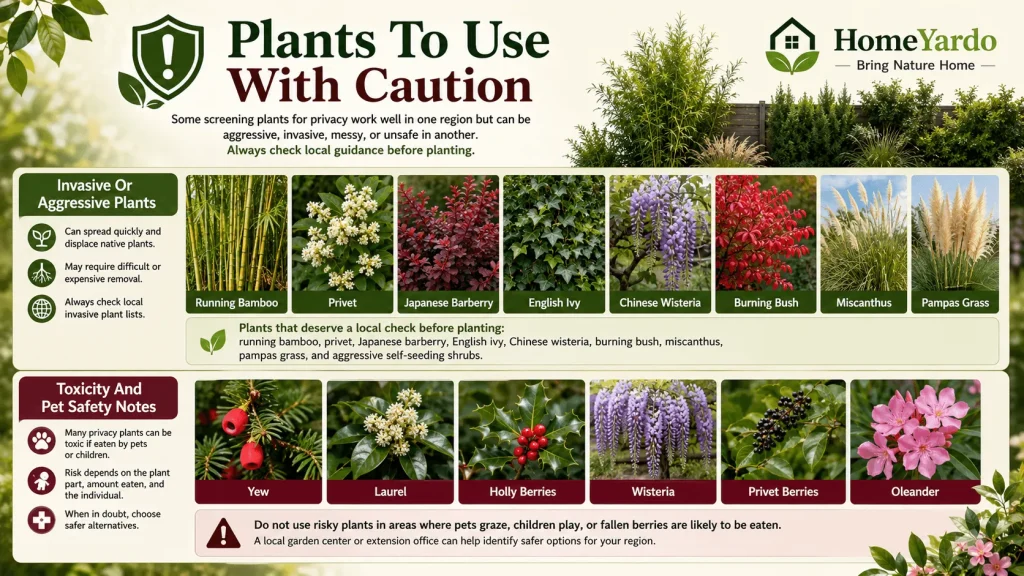
Some screening plants for privacy work well in one region but become aggressive, invasive, messy, or unsafe in another. Local guidance should be checked before planting any spreading privacy plant.
Invasive Or Aggressive Plants
Running bamboo can spread far beyond the planting area if not professionally contained. Clumping bamboo is usually easier to manage, but it still needs the right climate and space.
Some privets, Japanese barberry, English ivy, Chinese wisteria, burning bush, and certain ornamental grasses are invasive in parts of North America. Miscanthus and pampas grass also need local checks because some types can spread in suitable climates.
Plants that deserve a local check before planting include running bamboo, privet, Japanese barberry, English ivy, Chinese wisteria, burning bush, miscanthus, pampas grass, and aggressive self-seeding shrubs.
Toxicity And Pet Safety Notes
Yew, laurel, holly berries, wisteria, privet berries, and oleander can be unsafe if eaten by pets or children. Toxicity risk depends on plant part, amount eaten, and the animal or person exposed.
Do not use risky plants in areas where pets graze, children play, or fallen berries are likely to be eaten. A local garden center or extension office can help identify safer options for the region.
Common Privacy Plant Mistakes
Many planting problems start with choosing only by speed. A fast grower that becomes too wide, too tall, or too invasive can create more work than it solves.
Common mistakes include planting too close to fences, ignoring mature width, using one species in a long row, forgetting winter privacy, and choosing a plant that does not match the sunlight or soil.
Small pots are another problem. Tall shrubs in undersized containers dry out quickly and can tip in the wind. Flowering shrubs can also lose bloom quality if pruned at the wrong time.
A better plan starts with the privacy goal, then matches plant habit, mature size, and care level to the space.
Privacy Plant Care After Planting
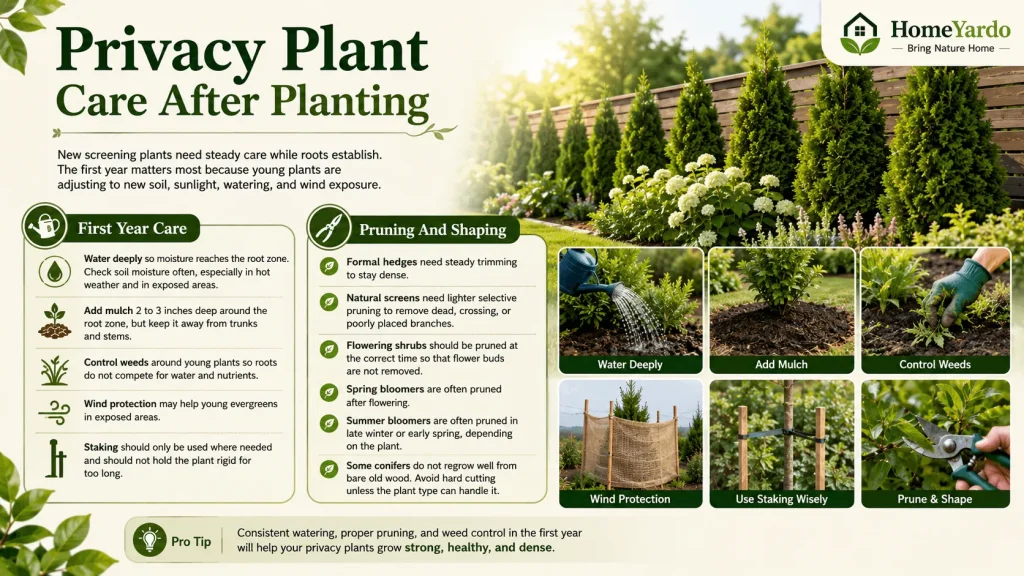
Screening plants that are new requires constant maintenance while the roots grow. The first year is the most important since young plants must adjust to the new soil, light and watering as well as exposure to the wind.
First Year Care
Make sure to water deeply, so that moisture gets to at the base of. Insufficient watering will encourage weak surface roots. In hot weather, be sure to check soil moisture frequently in close proximity to fences and walls, driveways, and storage containers.
Put mulch about 2 to three inches in depth around your root area; however, keep it clear of branches and trunks. Keep weeds out of the young plants to ensure that roots don’t compete for nutrients and water.
Wind protection could assist younger evergreens in areas that are exposed. Staking should be only used when needed, and shouldn’t hold the plant too long.
Pruning And Shaping
Formal hedges require constant trimming to keep them thick. Natural screens require light selective pruning to get rid of dead, crossed, or unnaturally placed branches.
The flowering plants should be cut at the appropriate time, so that the flower buds don’t get taken away. Spring bloomers tend to be removed after blooming. Spring bloomers are typically cut back in winter and early spring based on the species.
Certain conifers don’t grow easily from old, bare wood. Avoid cutting with a knife unless the plant is able to handle it.
Final Takeaway
The most effective living screen begins with privacy. A tall evergreen could be ideal for a fence line, whereas a vine or potted plant, or even a small upright plant could be more suitable for a balcony, patio or fence.
Evergreen trees and plants provide the best year-round coverage. Flowers give color and seasonal appeal. Vines help to save space. The perennials and grasses create summer screening.
Mixed screens typically provide the most long-term results due to their combination of thickness, height, density along with seasonal value and resiliency. Pick plants according to their maturity and climate, as well as sunlight and soil type, spacing and maintenance prior to planting.
FAQ’s
The best shrubs for privacy and evergreen trees are dense, site-matched, and easy to manage at mature size. Holly, cherry laurel, wax myrtle, podocarpus, viburnum, camellia, yew, and arborvitae are strong choices in the right climate. For privacy, work well near fences, patios, and front yards, while taller trees help block higher views. The best choice depends on sunlight, mature width, soil, climate, and pruning needs.
Arborvitae, laurel, holly, privet, star jasmine, and clematis can work along fences. Leave enough space between the plant and fence for pruning, airflow, and mature spread. Vines need strong support because weak fence panels can bend under heavy growth. Shrubs are better where a thicker, year-round screen is needed.
Leyland cypress, Green Giant arborvitae, clumping bamboo, privet, red tip photinia, hybrid willow, elderberry, and forsythia are fast choices. These plants can fill space quickly when sunlight, water, and soil conditions are suitable. Fast growth often means more pruning. Always check mature width before planting.
These can range from small 3-foot shrubs to trees over 60 feet tall. Small hedges work near patios and front yards, while tall evergreens work better for property lines or second-story views. Mature height should be checked before planting near fences, power lines, roof edges, sidewalks, or driveways.
Good evergreen plants include arborvitae, holly, laurel, boxwood, yew, Eastern red cedar, wax myrtle, podocarpus, false cypress, and Southern magnolia. These plants are useful when privacy is needed in winter as well as summer. The best choice depends on local climate, sunlight, soil, mature size, and available width.
Yes, some plants grow well in large pots if the container has drainage and enough root space. Bay laurel, dwarf Alberta spruce, podocarpus, clumping bamboo, and compact hollies can work for patios, decks, and balconies. Potted plants need more regular watering than plants grown in the ground.
Low-maintenance plants include inkberry holly, wax myrtle, arborvitae, podocarpus, viburnum, Eastern red cedar, and region-friendly native shrubs. The easiest plants are usually those that match the site’s sunlight, soil, and mature size. Fast-growing hedges are not always low maintenance because they often need more pruning.
Dense evergreen shrubs, arborvitae, holly, laurel, wax myrtle, layered mixed screens, and tall shrubs can help soften noise while blocking views. Plants do not fully soundproof a yard, but thick planting can reduce the feeling of exposure. A mix of trees, shrubs, and evergreens usually works better than one thin row.
The cheapest way is to start with smaller plants, use vines on trellises, and plant the most exposed area first. Small shrubs cost less upfront but take longer to fill in. Choosing locally adapted plants can save money over time because they are less likely to fail and need replacement.
Privacy hedges add greenery, soften views, support wildlife, and can make a yard feel more natural. Fences give instant structure and privacy, while plants take time to grow and need care. A fence with layered planting often gives the best mix of quick screening and long-term softness.
References