Pink Flower Tree: 45 Beautiful Types For Every Yard
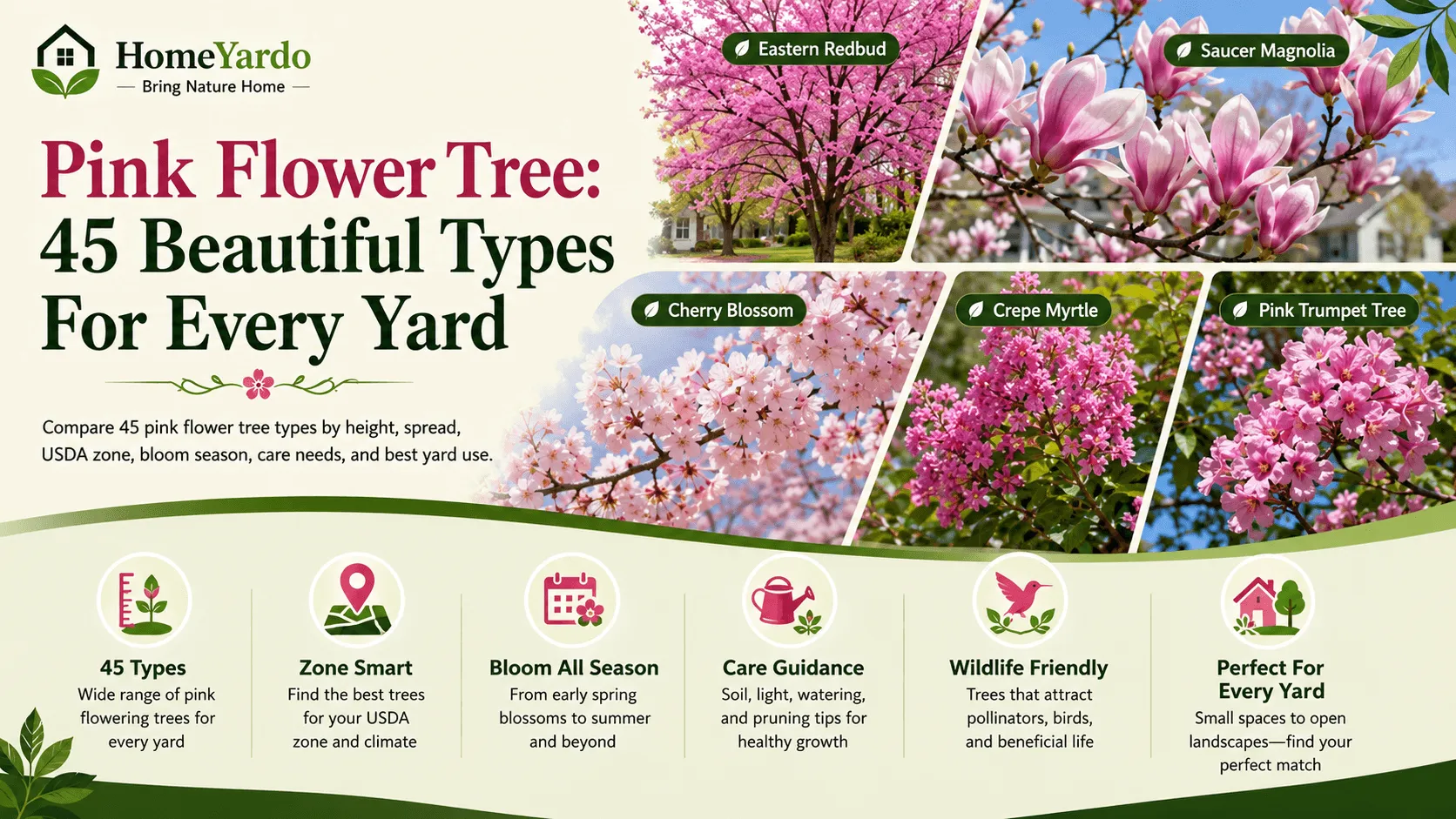
A pink flower tree makes a yard look softer, even before the garden is fully up. Branches can change color in the springtime, while the summer heat can trigger colorful crepe myrtle blooms and warm climate gardens can shine with trumpet-shaped blooms during the colder times.
The term can refer to a variety of plants. Cherry blossom, redbud, magnolia, dogwood, crepe myrtle, peach, pink trumpet tree, and a variety of tree-form plants may all be considered to fit into the concept. Some are real trees. Others are vines or other shrubs that have been trained to form a small tree shape. Some flowering bushes can also be trained into tree forms, although they may require regular pruning to maintain a clear trunk and balanced canopy.
This guide assists in the identification of different types of trees that have pink flowers as well as the best planting options. It begins with simple comparison tables, suggestions for regions and design tips before advancing to the complete 45-tree checklist. Each card is filled with useful information like spread, height, USDA zones, bloom season, light, soil maintenance, and warnings.
What Is A Pink Flower Tree?
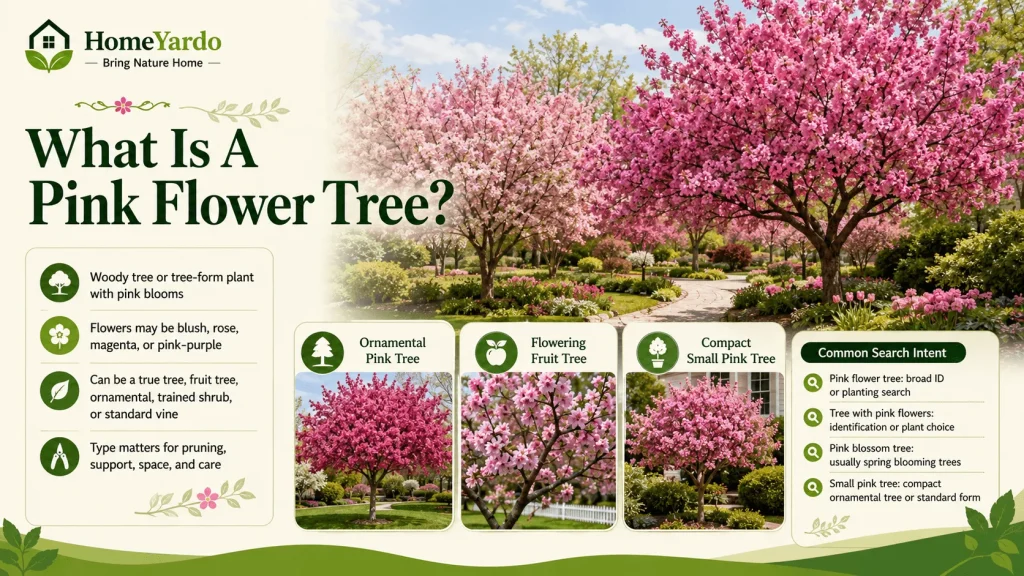
Pink flower trees are shady trees or tree-form plants that are grown to produce pink flowers, pink buds, and pink bloom clusters. There are some that have soft blush blooms and others bloom in magenta, rose or pink-purple shades.
The pink flowers tree name may refer to a genuine tree, a flowering tree, an ornamental one that is trained to one trunk, or one that has been trained into an ordinary shape. This distinction is important as each variety has distinct trimming, support, space and needs for care.
| Phrase | Meaning |
|---|---|
| Pink flower tree | Broad ID or planting search |
| Pink flowering trees | Garden selection search |
| Tree with pink flowers | Identification or plant choice |
| Pink blossom tree | Usually spring blooming trees |
| Small pink blossom tree | Compact ornamental tree or standard form |
| Pink flowering tree identification | Help name a tree by flowers, leaves, season, or fruit |
How Do I Identify A Tree With Pink Flowers?
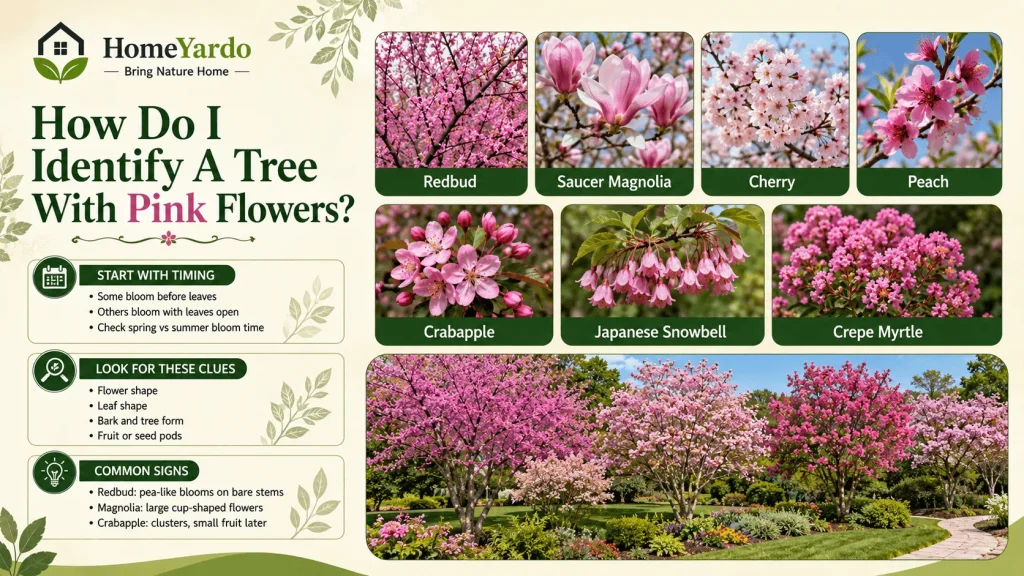
The identification process begins with the timing. Certain pink trees flower before their leaves are revealed and the branches appear as if they’re covered in hue. Other blooms have leaves that are already open, which means that the flowers appear in bracts, clusters of bell-shaped spikes, or summer panicles.
Take a close look at the shape of the flower, the leaf shape as well as bark, whole-tree shape, maturing size, fruits and pods of seeds. Redbuds often have pea-like flowers on bare stems. The magnolia is a large cup with flowers. The crabapple could make small fruits after flowering.
Pink Flowering Trees Identification Checklist
Make sure you take a clear picture of the flower, the leaf or bark and the complete tree’s shape if the name isn’t known. The four clues above usually aid in narrowing the tree more quickly than the color of the flower alone. These trees can be combined with lower-growing summer flowers to carry color from the base of the planting bed into the canopy.
| Clue | What To Look For | Common Examples | Extra Clue |
|---|---|---|---|
| Flowers before leaves | Bare branches covered in pink blooms | Redbud, magnolia, cherry, peach | Often early spring |
| Cup-shaped blooms | Large pink or pink-purple flowers | Saucer magnolia, Jane magnolia | Large petals |
| Pea-like branch blooms | Flowers on stems and older wood | Redbud, Judas tree | Heart-shaped leaves later |
| Pink flower clusters | Many small flowers grouped together | Crabapple, cherry, crepe myrtle | Fruit may follow |
| Bell-shaped blooms | Hanging flowers under branches | Japanese snowbell | Often late spring |
| Pink summer panicles | Long-lasting hot-season flowers | Crepe myrtle | Some have peeling bark |
| Fruit after flowers | Apples, crabapples, peaches, plums | Fruiting trees | More cleanup |
Best Pink Flower Trees At A Glance
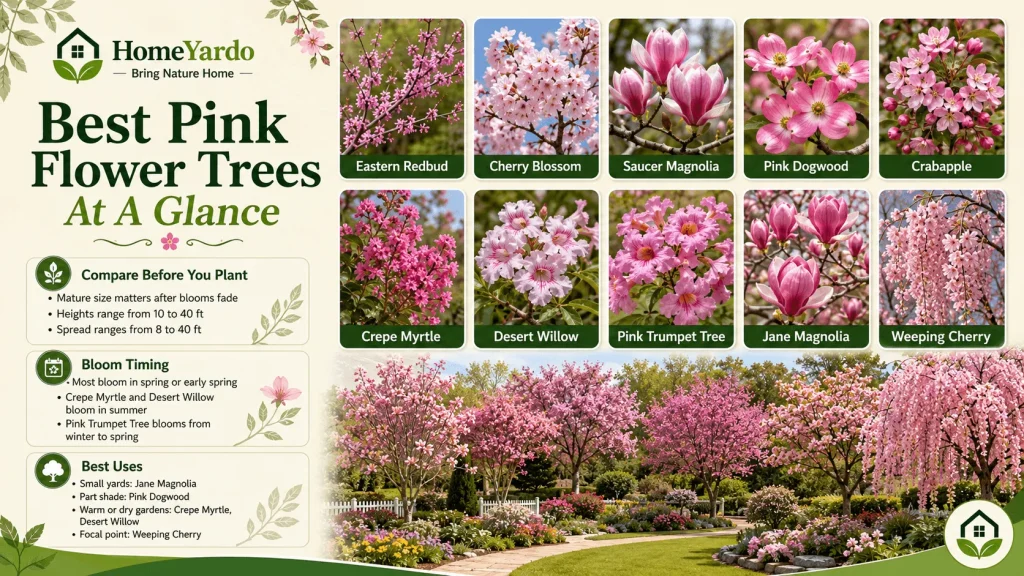
A quick review helps make it easier to choose the color of the flowers on its own. Height and spread are crucial as a tree should be able to accommodate the space after the blooming season has ended.
| Tree | Height | Spread | USDA Zones | Bloom Season | Best For |
|---|---|---|---|---|---|
| Eastern Redbud | 20 to 30 ft | 25 to 35 ft | 4 to 9 | Early spring | Native-style gardens |
| Cherry Blossom | 15 to 30 ft | 15 to 30 ft | 5 to 8 | Spring | Spring display |
| Saucer Magnolia | 20 to 30 ft | 20 to 25 ft | 4 to 9 | Early spring | Large flowers |
| Pink Dogwood | 15 to 30 ft | 15 to 30 ft | 5 to 9 | Spring | Part shade gardens |
| Crabapple | 15 to 25 ft | 12 to 25 ft | 3 to 8 | Spring | Flowers and bird fruit |
| Crepe Myrtle | 10 to 30 ft | 6 to 20 ft | 6 to 10 | Summer | Warm climates |
| Desert Willow | 15 to 30 ft | 10 to 20 ft | 7 to 11 | Summer | Dry gardens |
| Pink Trumpet Tree | 20 to 40 ft | 20 to 40 ft | 10 to 11 | Winter to spring | Tropical gardens |
| Jane Magnolia | 10 to 15 ft | 8 to 12 ft | 4 to 8 | Spring | Small yards |
| Weeping Cherry | 15 to 25 ft | 15 to 25 ft | 5 to 8 | Spring | Focal point planting |
Choose Fast: Best Flowering Pink Tree By Need
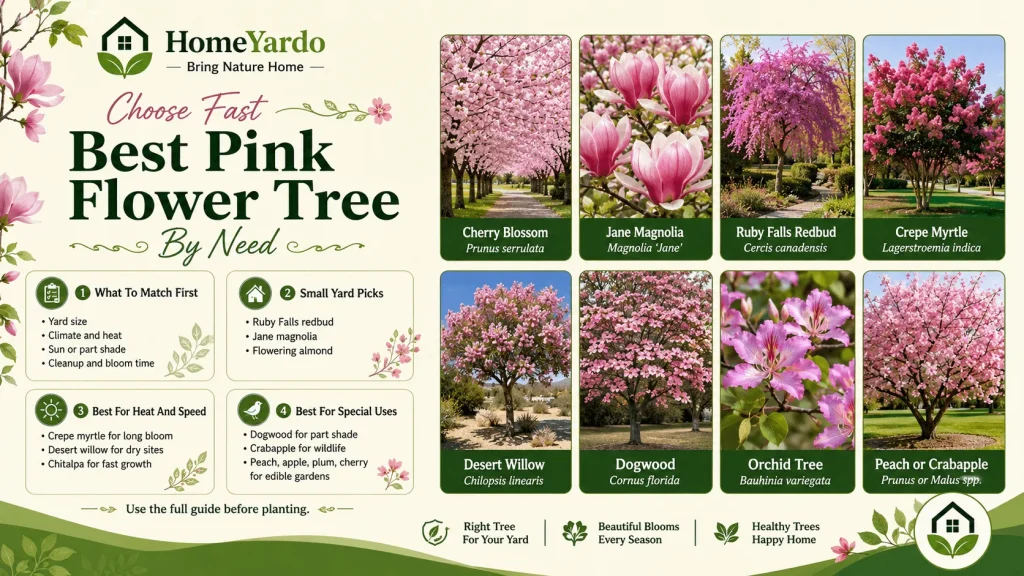
The garden is simpler to design when the tree is selected to solve the issue it is solving. A small front yard or a dry slope, an enticing southern garden and a border with pollinators require various plants.
Make use of this table as a quick starting point. Then, you can check the entire card prior to planting.
| Need | Best Picks |
|---|---|
| Small yard | Ruby Falls redbud, Jane magnolia, flowering almond |
| Spring impact | Cherry blossom, saucer magnolia, eastern redbud |
| Long bloom | Crepe myrtle, pink panicle hydrangea tree form, rose of Sharon |
| Dry climate | Desert willow, chitalpa, western redbud |
| Warm climate | Pink trumpet tree, pink poui, orchid tree |
| Wildlife | Crabapple, dogwood, red buckeye, redbud |
| Low cleanup | Redbud, Jane magnolia, camellia tree form |
| Edible garden | Peach, apple, plum, cherry |
| Part shade | Dogwood, camellia, rhododendron |
| Fast growth | Crepe myrtle, desert willow, chitalpa |
Best Pink Flower Trees By Region
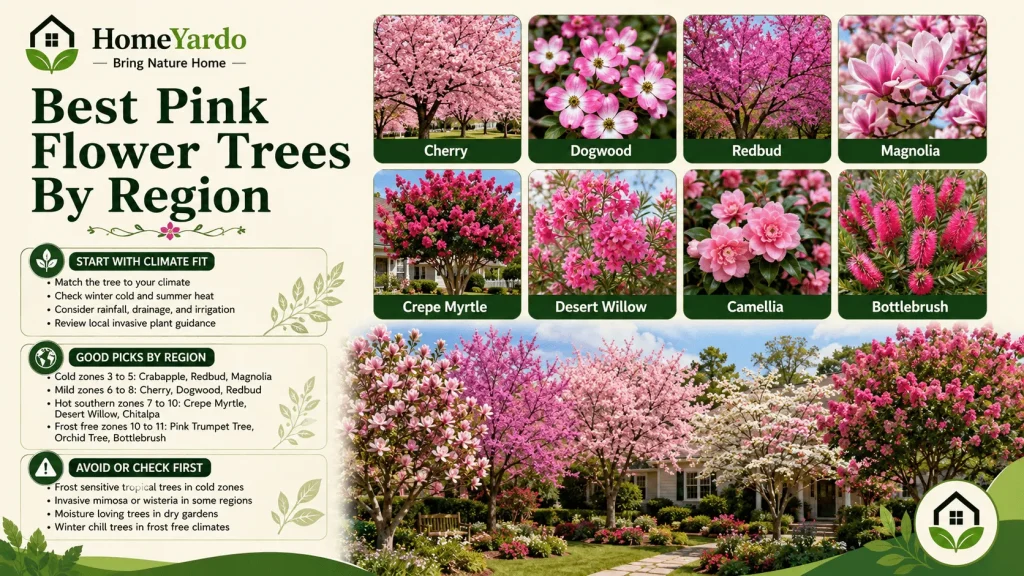
A tree must be able to adapt to the climate before anything else. The colour of flowers cannot compensate for a cold winter excessive humidity poor drainage or a dry area without any irrigation.
Utilize USDA zones to establish a base. Then, check the local temperatures and rainfall, soil and the guidance for invasive plants.
| Region Or Climate | Good Choices | Avoid Or Check First |
|---|---|---|
| Cold zones 3 to 5 | Crabapple, flowering almond, redbud, cold-hardy magnolias | Frost-sensitive tropical trees |
| Mild zones 6 to 8 | Cherry, dogwood, redbud, magnolia, crabapple | Regionally invasive wisteria or mimosa |
| Hot southern zones 7 to 10 | Crepe myrtle, desert willow, chitalpa, camellia | Cold-climate-only lilacs in hot areas |
| Dry western gardens | Western redbud, desert willow, chitalpa | Moisture-loving trees without irrigation |
| Humid southeast gardens | Dogwood, redbud, crepe myrtle, crabapple | Trees prone to disease in poor airflow |
| Frost-free zones 10 to 11 | Pink trumpet tree, pink poui, orchid tree, bottlebrush | Cold-hardy trees that need winter chill |
| Part-shade gardens | Dogwood, camellia, rhododendron, some magnolias | Full-sun fruit trees in deep shade |
Best Pink Flower Tree By Situation
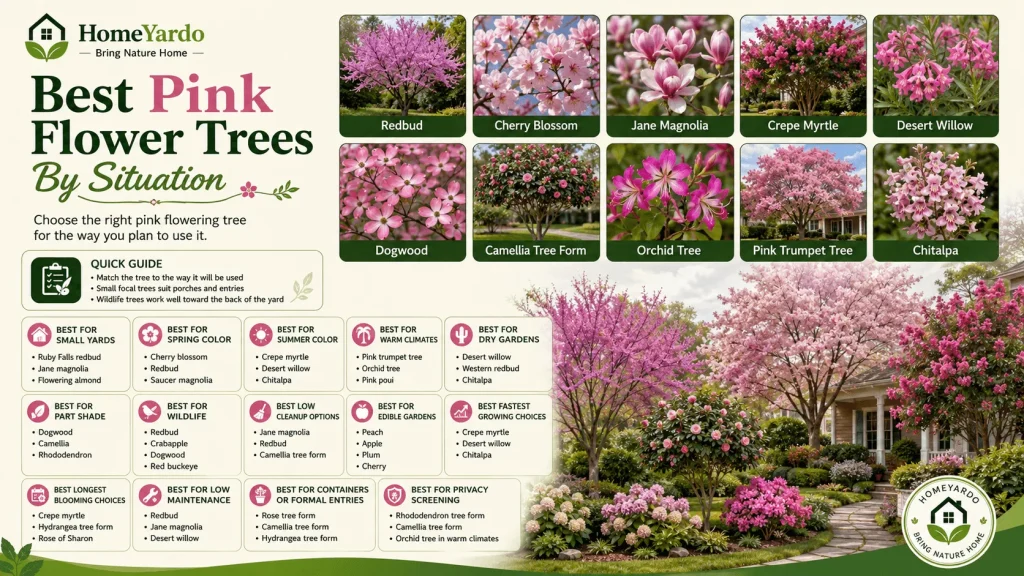
The most appropriate choice is based on the way in which the tree is utilized. A focal tree close to an outdoor space has distinct needs from those of one that is a wildlife tree in the backyard. Where a full-sized tree would overwhelm the available space, compact shrubs for full sun can provide flowers and structure with a more manageable spread.
This table allows you to link each scenario with a sensible set of possibilities.
| Situation | Best Choices |
|---|---|
| Best for small yards | Ruby Falls redbud, Jane magnolia, flowering almond |
| Best for spring color | Cherry blossom, redbud, saucer magnolia |
| Best for summer color | Crepe myrtle, desert willow, chitalpa |
| Best for warm climates | Pink trumpet tree, orchid tree, pink poui |
| Best for dry gardens | Desert willow, western redbud, chitalpa |
| Best for part shade | Dogwood, camellia, rhododendron |
| Best for wildlife | Redbud, crabapple, dogwood, red buckeye |
| Best low cleanup options | Jane magnolia, redbud, camellia tree form |
| Best for edible gardens | Peach, apple, plum, cherry |
| Best fastest growing choices | Crepe myrtle, desert willow, chitalpa |
| Best longest blooming choices | Crepe myrtle, hydrangea tree form, rose of Sharon |
| Best for low maintenance | Redbud, Jane magnolia, desert willow |
| Best for containers or formal entries | Rose tree form, camellia tree form, hydrangea tree form |
| Best for privacy screening | Rhododendron tree form, camellia tree form, and orchid tree in warm climates. If screening is the main goal, compare these trees with other privacy plants that provide denser foliage or more dependable year-round coverage. |
Small Pink Flower Trees For Front Yards
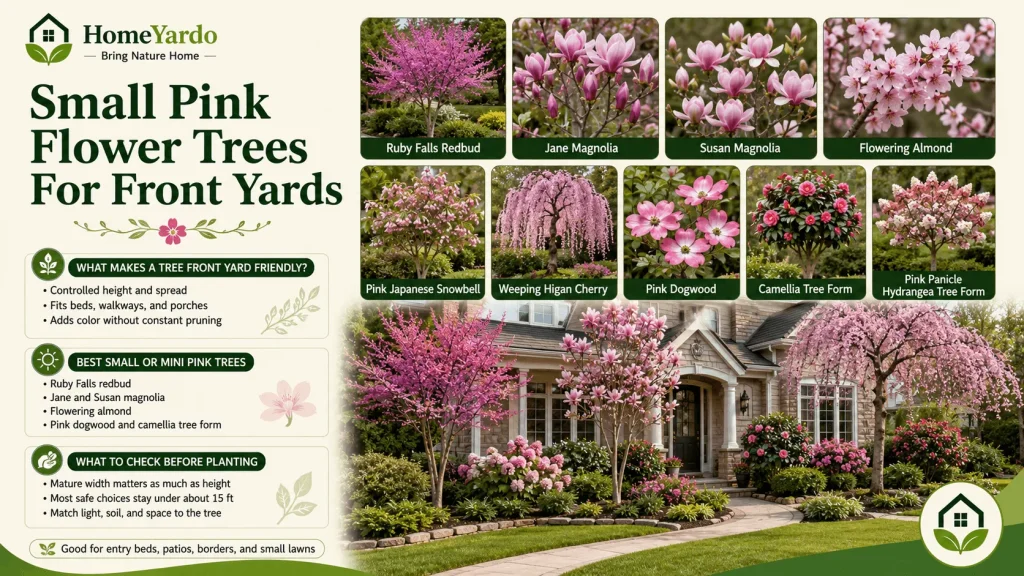
Small front yards require trees that have a controlled height and spread that is manageable. The young tree in the nursery may appear innocent but then get too close to a window, driveway, walkway or roofline. A small, pink tree should be able to frame the home with a gentle arc. It should give the home a more attractive form without requiring constant pruning.
A lot of homeowners employ the term dwarf pink flowering trees for a small ornamental tree; however dwarf trees aren’t always identical to naturally small trees. Some are dwarf cultivars; others are grafted standards and others are grafted standards that have been that have been trained to form a tree. The best options for rose-colored trees that aren’t too tiny are those that have an adult height of less than 15 feet and a spread that fits in the planting bed.
For pink flowering trees for small gardens, concentrate on the mature width as well as the height. Ruby Falls redbud, Jane magnolia, flowering almond the camellia form, and the pink panicle hydrangea form will work best if the location is suitable for sunlight, soil, space, and drainage.
Best Small Or Mini Pink Trees
The best choices for compact varieties work best when the spread of mature trees is inspected prior to planting. Some of these are tiny trees, whereas others are tree-form plants that require some light shaping.
The best small options are:
- Ruby Falls redbud
- Jane magnolia
- Susan magnolia
- Almonds that are blooming
- Pink Japanese snowbell
- Weeping Higan cherry
- Pink dogwood
- Camellia tree forms
- Pink panicle hydrangea trees form
Small Tree Comparison
This table is focused on trees that fit in between entry beds, small lawns, patios, or front border plants when they have enough space.
| Tree | Height | Spread | USDA Zones | Best Placement | Watch For |
|---|---|---|---|---|---|
| Ruby Falls Redbud | 6 to 10 ft | 5 to 8 ft | 5 to 9 | Entry bed or focal point | Weeping branch spread |
| Jane Magnolia | 10 to 15 ft | 8 to 12 ft | 4 to 8 | Front garden | Frost exposure |
| Flowering Almond | 8 to 15 ft | 6 to 12 ft | 3 to 7 | Patio edge | Short bloom season |
| Camellia Tree Form | 6 to 15 ft | 5 to 10 ft | 7 to 10 | Part shade entry | Acidic soil need |
| Pink Hydrangea Tree Form | 6 to 10 ft | 6 to 8 ft | 3 to 8 | Small lawn or border | Needs shaping |
Large Pink Flowering Trees For Open Spaces
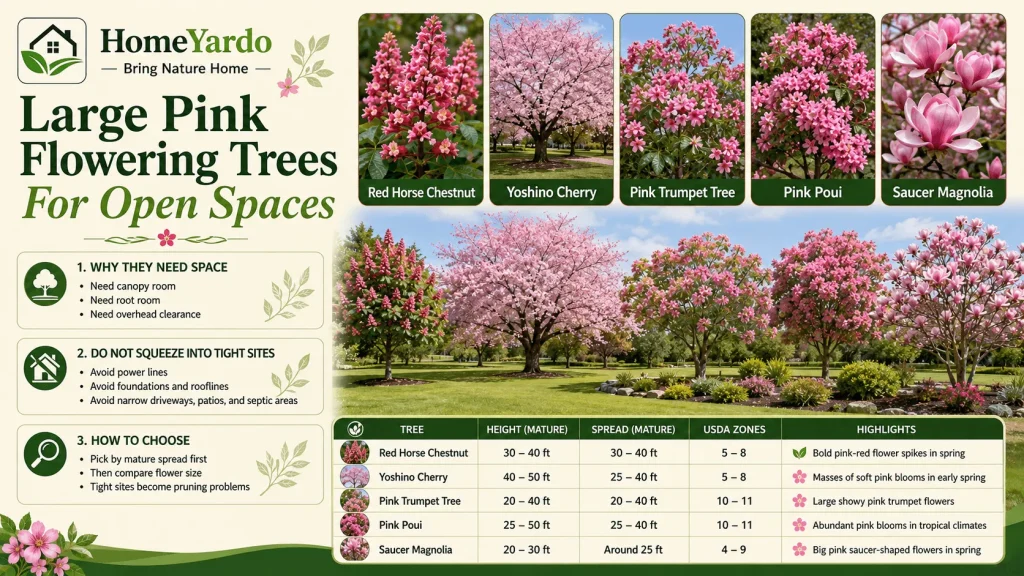
Trees with large pink flowers s require a canopy as well as root space and overhead clearance. They should not be placed beneath power lines or positioned near foundations or driveways with narrow widths patios, septic areas or rooflines.
They can be stunning provided they are placed in the right location. If they are placed in a confined space, they can be a problem with pruning instead of an attractive garden design.
Certain trees that have tree with big pink flowers make an impact through the large blooms of individual flowers, and others appear bold as the entire canopy is filled with pink flowers. Saucer magnolia comes with large cup-shaped flowers. Pink trumpet trees and pink poui are both dazzling trumpet flowers in warmer conditions, and the red horse chestnut is a tall tree with red-pink blooms. If you want to plant in open areas, go first by the mature spread, then the size of the flower.
| Tree | Height | Spread | USDA Zones | Why It Needs Space |
|---|---|---|---|---|
| Red Horse Chestnut | 30 to 40 ft | 30 to 40 ft | 5 to 8 | Larger canopy and toxic nuts |
| Yoshino Cherry | 40 to 50 ft | 25 to 40 ft | 5 to 8 | Wide crown |
| Pink Trumpet Tree | 20 to 40 ft | 20 to 40 ft | 10 to 11 | Warm-climate canopy |
| Pink Poui | 25 to 50 ft | 25 to 40 ft | 10 to 11 | Large tropical growth |
| Saucer Magnolia | 20 to 30 ft | Around 25 ft | 4 to 9 | Wide, low branching |
Best Pink Flower Trees By Bloom Season
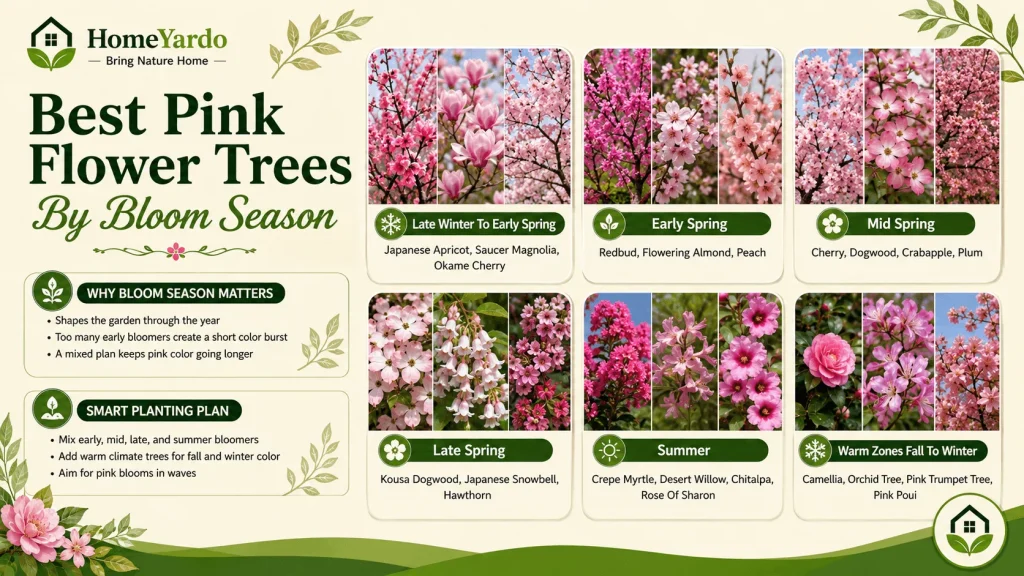
The bloom season determines the way that the garden appears throughout the entire year. Planting only flowers that are pink in early spring could create brief bursts of color. Then, you can leave the garden in peace for several months.
The best strategy is to mix the early, mid and late summer, warm-climate bloomers, so that the pink hues show up in waves.
| Season | Good Choices |
|---|---|
| Late winter to early spring | Japanese apricot, saucer magnolia, Okame cherry |
| Early spring | Redbud, flowering almond, peach |
| Mid spring | Cherry, dogwood, crabapple, plum |
| Late spring | Kousa dogwood, Japanese snowbell, hawthorn |
| Summer | Crepe myrtle, desert willow, chitalpa, rose of Sharon |
| Fall to winter in warm zones | Camellia, orchid tree, pink trumpet tree, pink poui |
45 Pink Flower Tree
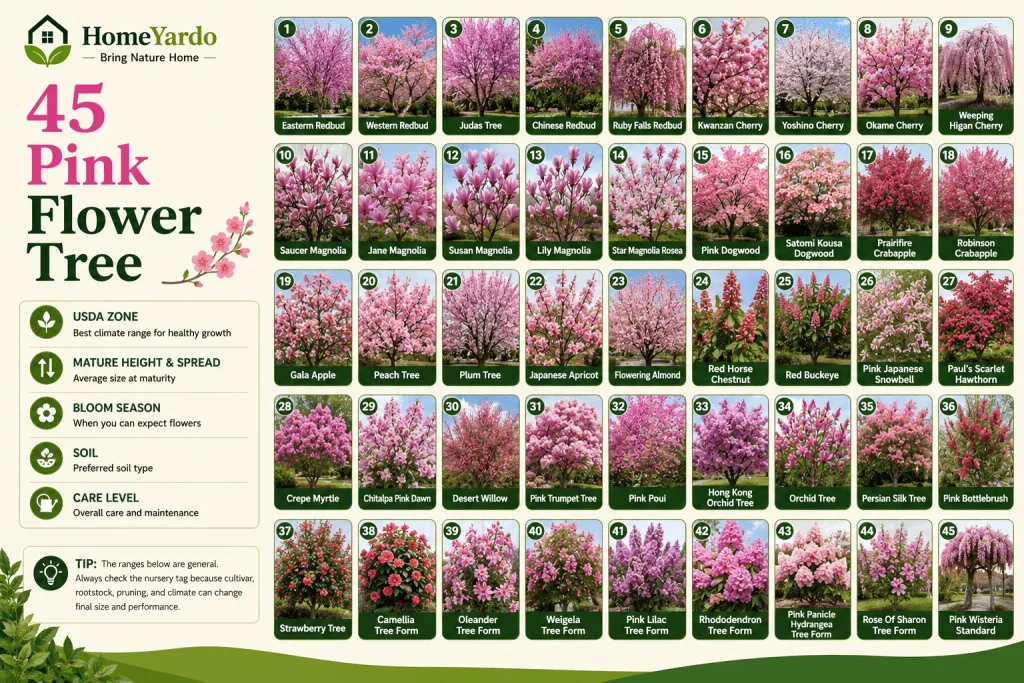
Use these cards to generate a plant library. First USDA zone, then mature height and spread, then bloom season, soil and care level.
The range listed below is approximate. Always refer to the nursery tag as cultivars, rootstock, pruning and climate can all affect final size and performance.
1. Eastern Redbud
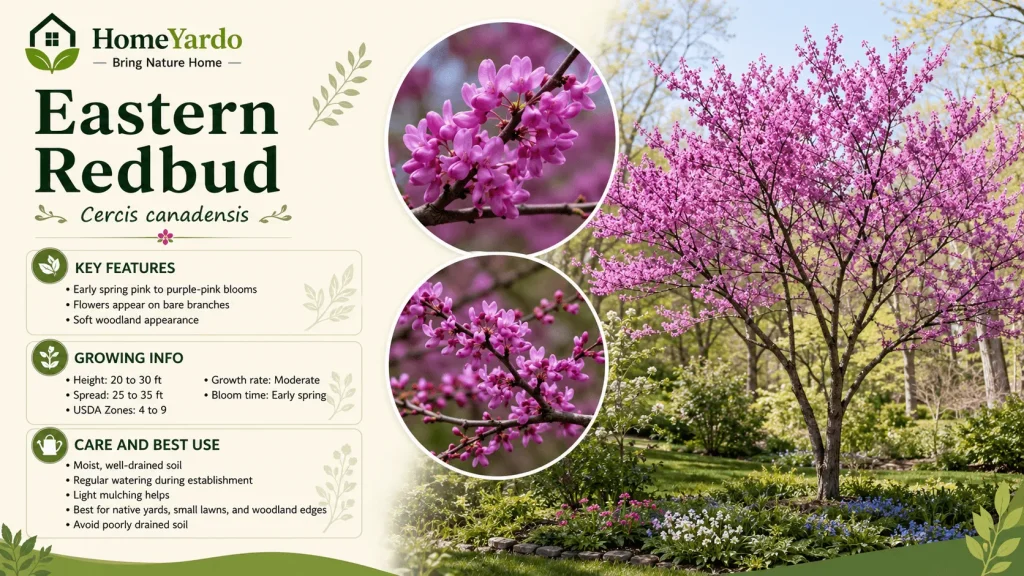
Eastern redbud blooms first in the spring with pink to purple-pink flowers on bare branches. It has a soft woodland appearance due to its late leafing.
- Botanical name: Cercis canadensis.
- Height: 20 to 30 ft
- Spread: 25 to 35 ft
- USDA zones: 4 to 9
- Period of bloom: Early spring
- Water: Regular watering, but not too much.
- Soil: Moist, well-drained soil
- Growth rate: Moderate
- Ideal for use: Native yards, small lawns, woodland edges
- Please note: Water during establishment and light mulching.
- Avoidance: Will not tolerate poorly drained soils.
2. Western Redbud
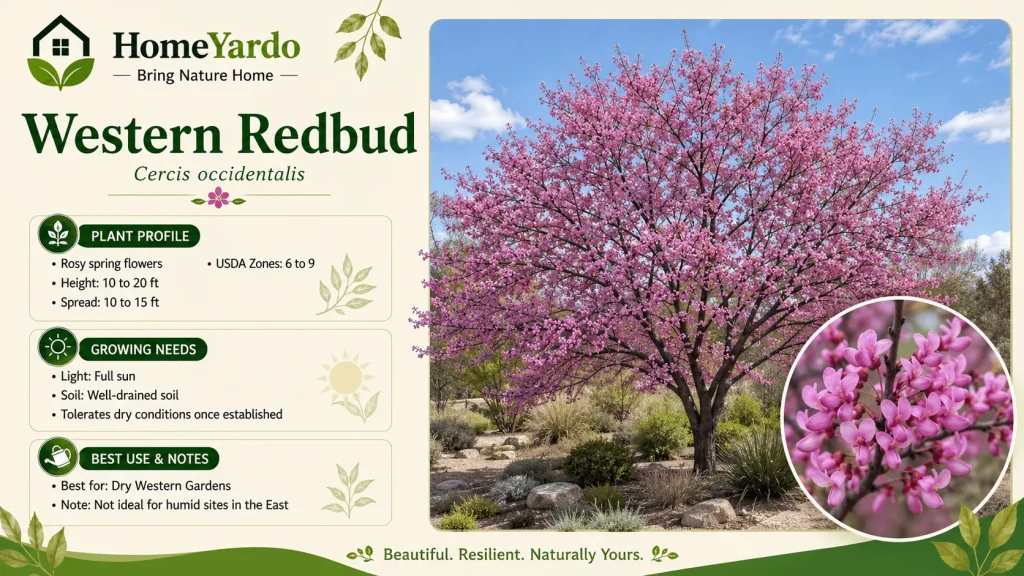
Western redbud is a pleasing plant for western gardens that don’t need as much water. It has rosy spring flowers and a smaller habit than many ornamental trees.
- Botanical name: Cercis occidentalis.
- Height: 10 to 20 ft
- Spread: 10 to 15 ft
- USDA zones: 6 to 9
- Flowers appear in the early spring.
- Light: Full sun
- Soil: Well-drained soil, tolerates dry conditions once established
- Involvement: passive, not encouraging
- Ideal usage: Dry Western Gardens
- Note: Dry the soil a bit after established.
- Note: Not ideal on humid sites in the East.
3. Judas Tree
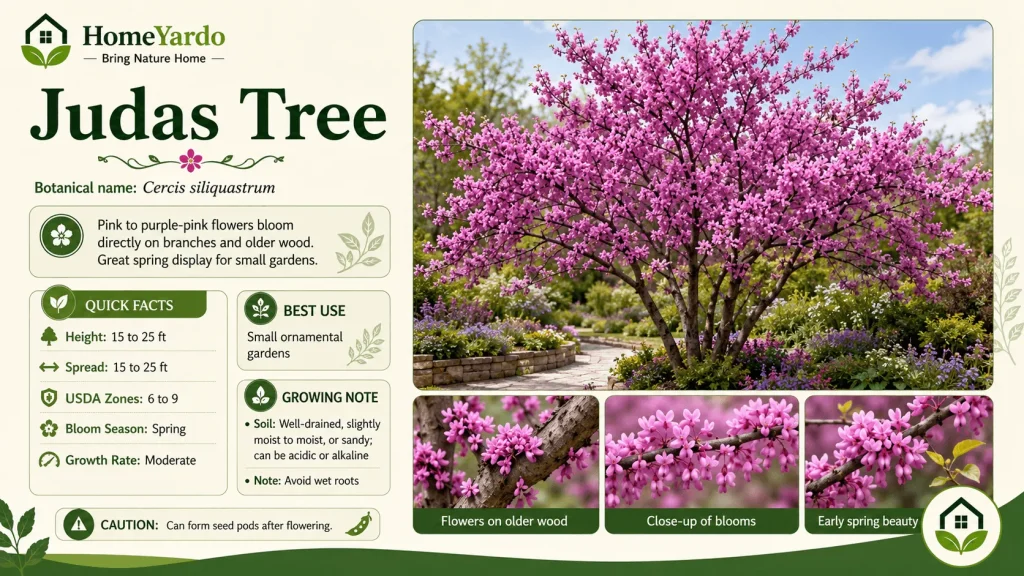
Judas tree has pink to purple-pink flowers that bloom directly on branches and older wood. It provides a spring display for small gardens without the necessity of a large lawn.
- Botanical name: Cercis siliquastrum.
- Height: 15 to 25 ft
- Spread: 15 to 25 ft
- USDA zones: 6 to 9
- Bloom season: Spring
- Soil: Slightly moist to moist, well-drained, or sandy, can be acidic or alkaline
- Soil: Well-drained soil
- Growth rate: Moderate
- Ideal uses: Small ornamental gardens
- Note: Avoid wet roots, and plant in well-drained soil.
- Caution: Can form seed pods after flowering.
4. Chinese Redbud
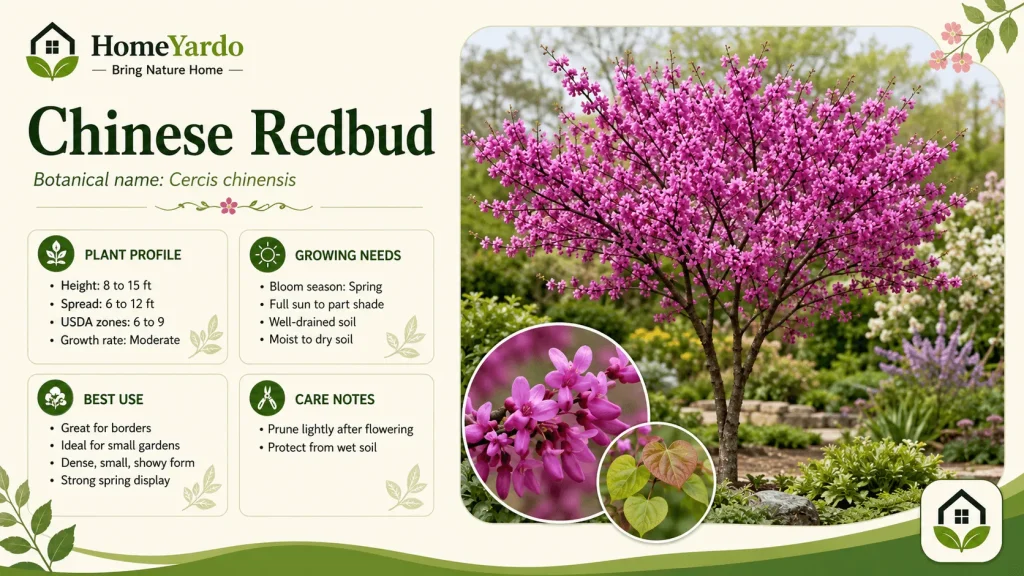
Chinese redbud can be very dense, small and showy. Suitable for areas that require a good spring display, but don’t desire a high canopy.
- Botanical name: Cercis chinensis.
- Height: 8 to 15 ft
- Spread: 6 to 12 ft
- USDA zones: 6 to 9
- Bloom season: Spring
- Moisture: Moist to dry, well drained soil.Heat: Full sun to part shade.
- Soil: Well-drained soil
- Growth rate: Moderate
- Best use: Borders and small gardens
- Note for care: If shaping is required, prune lightly after flowering.
- Precaution: Should be protected from wet soil.
5. Ruby Falls Redbud
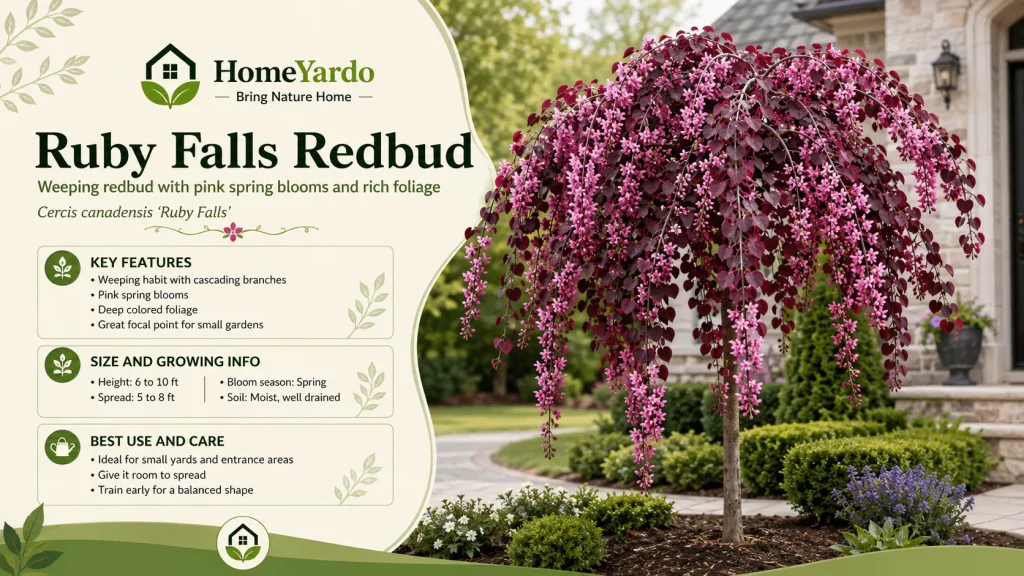
Weeping redbud Ruby Falls provides a weeping habit, pink spring blooms and deep colored foliage. It’s like a life-sized centerpiece of a miniature garden.
- Botanical name: Cercis canadensis ‘Ruby Falls’.
- Height: 6 to 10 ft
- Spread: 5 to 8 ft
- USDA zones: 5 to 9
- Bloom season: Spring
- Soil: Moist, well-drained, rocky or sandy.Hardiness zone: 4 to 8.
- Ripe: Moisture content, well-drained soil
- Foliage area index: 2.2 m²/m²
- Ideal application: Small yard/entrance areas
- Caution: train early to achieve a balanced weeping shape.
- Special note: Grows with cascading branches so it should be planted with room to spread out.
6. Kwanzan Cherry
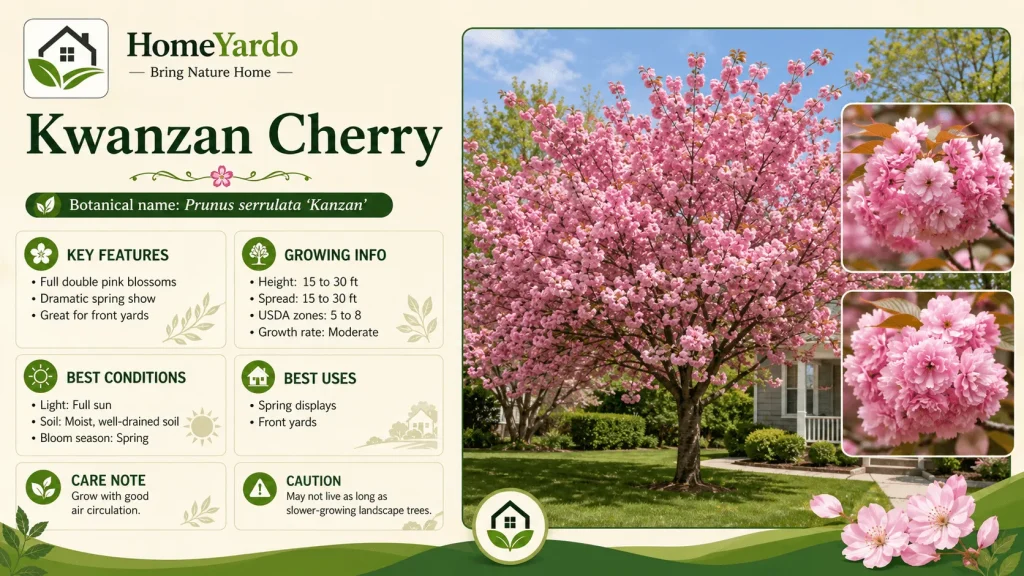
It is known that the Kwanzan cherry has full double pink blossoms. It makes a dramatic spring show and works in front yards, where it is the primary objective.
- Botanical name: Prunus serrulata ‘Kanzan’.
- Height: 15 to 30 ft
- Spread: 15 to 30 ft
- USDA zones: 5 to 8
- Bloom season: Spring
- Light: Full sun
- Soil: Moist, well-drained soil
- Growth rate: Moderate
- Ideal applications: Spring displays and front yards
- Note of care: If the plant is to be grown in good air circulation.
- Caution: May not live as long as other landscape trees that grow more slowly.
7. Yoshino Cherry
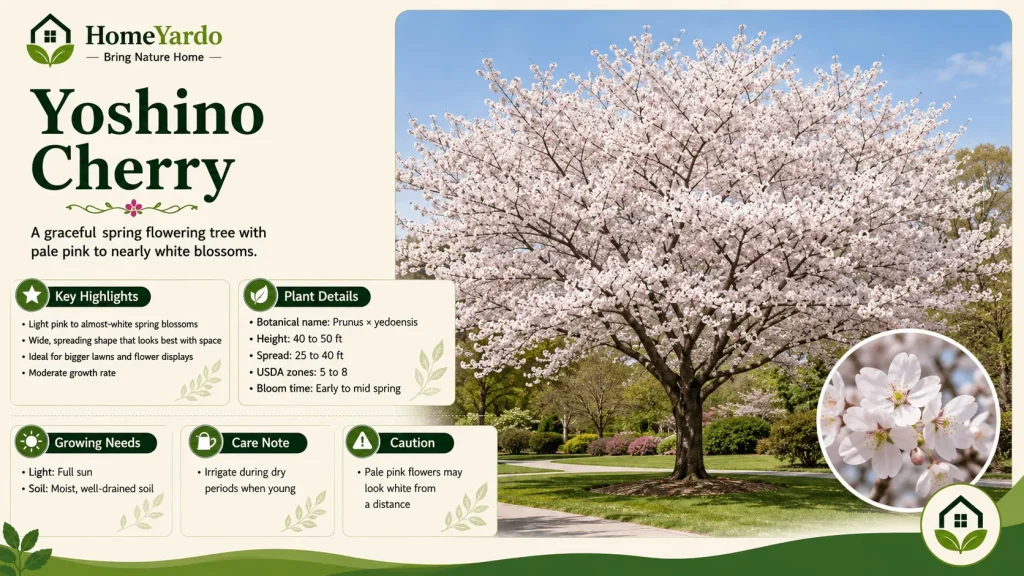
The Yoshino cherry has light pink to almost-white flowers in a showy display of blossoms in the spring. It is its wide shape that is more pleasing when given adequate space.
- Botanical name: Prunus × yedoensis.
- Height: 40 to 50 ft
- Spread: 25 to 40 ft
- USDA zones: 5 to 8
- The time of bloom: Early to mid spring
- Light: Full sun
- Soil: Moist, well-drained soil
- Growth rate: Moderate
- Ideal use: In bigger lawns and flower displays
- Care note: Irrigate during dry periods when young.
- Caution: Pale pink flowers may look white from a distance.
8. Okame Cherry
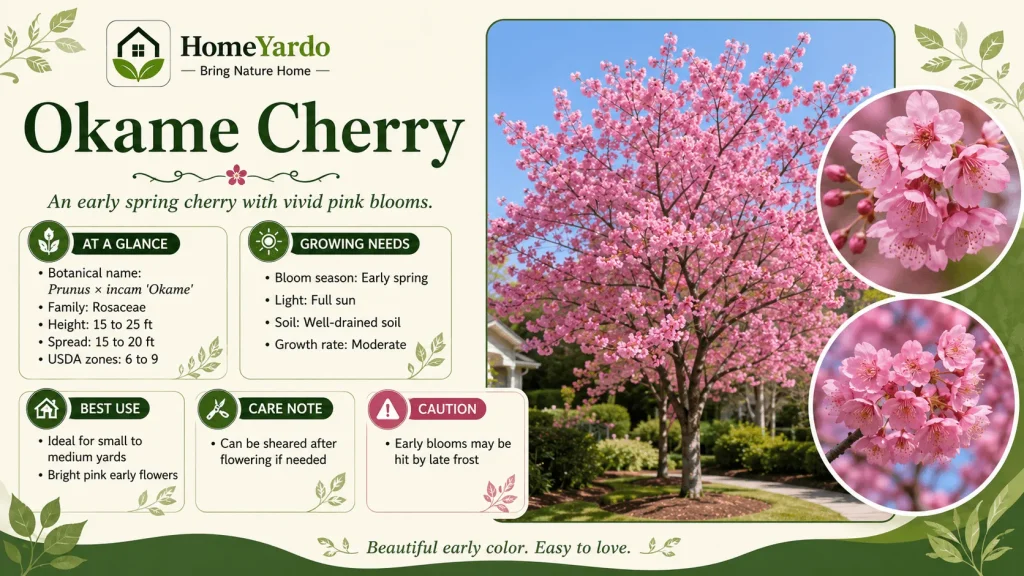
The Okame cherry produces early flowers that are brightly coloured pink. It’s a colorer early in this year’s displays.
- Botanical name: Prunus × incam ‘Okame’.Family: Rosaceae.
- Height: 15 to 25 ft
- Spread: 15 to 20 ft
- USDA zones: 6 to 9
- Bloom season: Early spring
- Light: Full sun
- Soil: Well-drained soil
- Growth rate: Moderate
- Ideal to use in small to medium yard applications.
- Note: This plant can be sheared back after flowering if necessary.
- Caution: Early blooms may be hit by late frost.
9. Weeping Higan Cherry
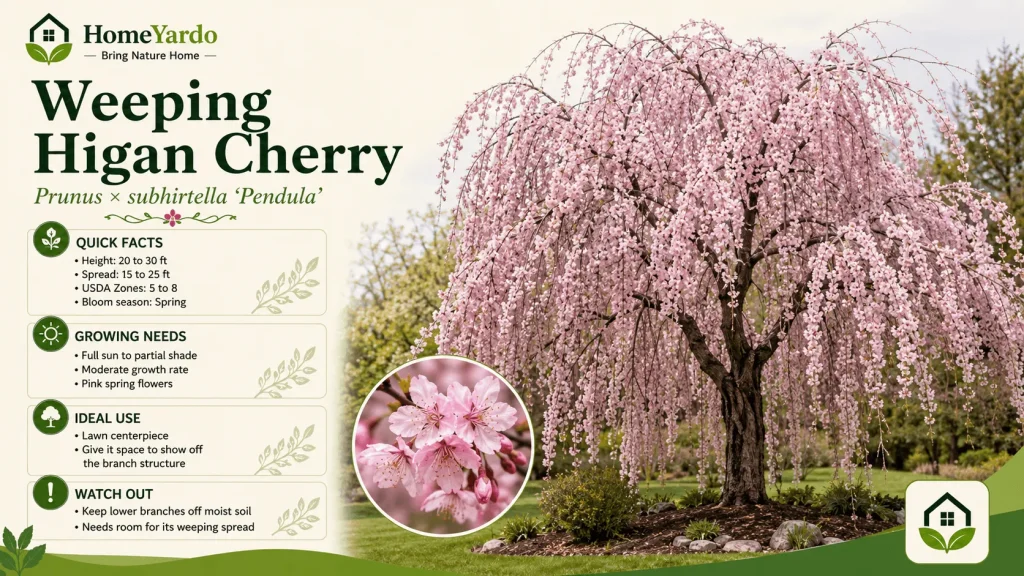
Pink flowers in the spring and a drooping form make the weeping Higan cherry an elegant choice. Provide adequate space to see the branch structure.
- Botanical name: Prunus × subhirtella ‘Pendula’.
- Height: 20 to 30 ft
- Spread: 15 to 25 ft
- USDA zones: 5 to 8
- Bloom season: Spring
- Light: Full sun
- Light: Sunlight (full sun to partial shade)
- Growth rate: Moderate
- Ideal use: As a lawn centerpiece
- Watch out: Do not allow lower branches to trail on moist soil.
- Caution: Needs room for its weeping spread.
10. Saucer Magnolia
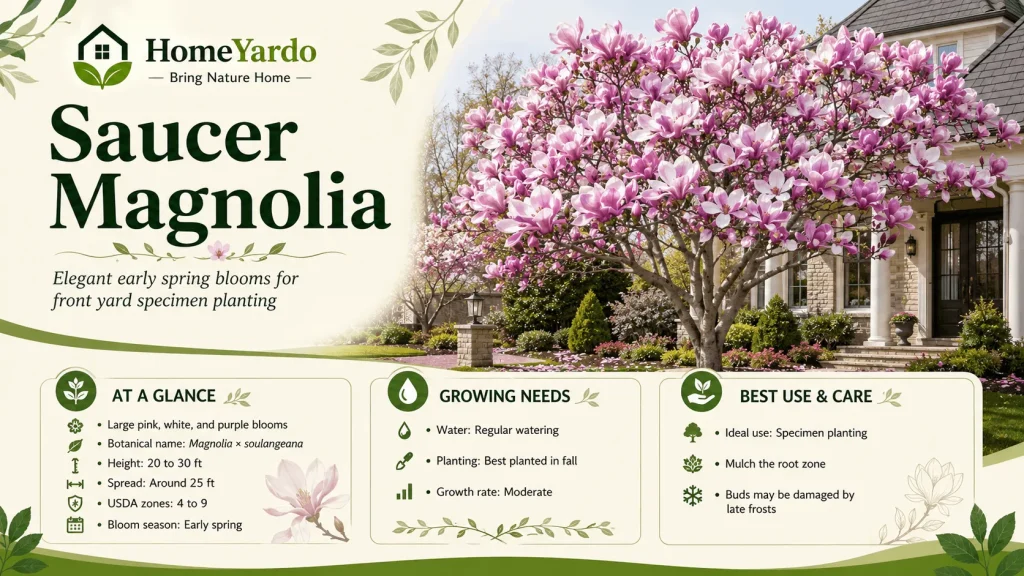
Saucer magnolia produces large flowers of pink, white and purple. Can help create a harmonious and elegant front yard early in spring.
- Botanical name: Magnolia × soulangeana.
- Height: 20 to 30 ft
- Spread: Around 25 ft
- USDA zones: 4 to 9
- The average bloom season is early spring.
- Water: Regular watering is required.Planting: Grasses should be planted in the fall.
- Shelter: Part shade or full shade protection from the sun
- Growth rate: Moderate
- Ideal uses: For larger flowers and specimen plantings
- Avoid damage: Mulch the root zone.
- Note: Buds can be damaged by late frosts.
11. Jane Magnolia
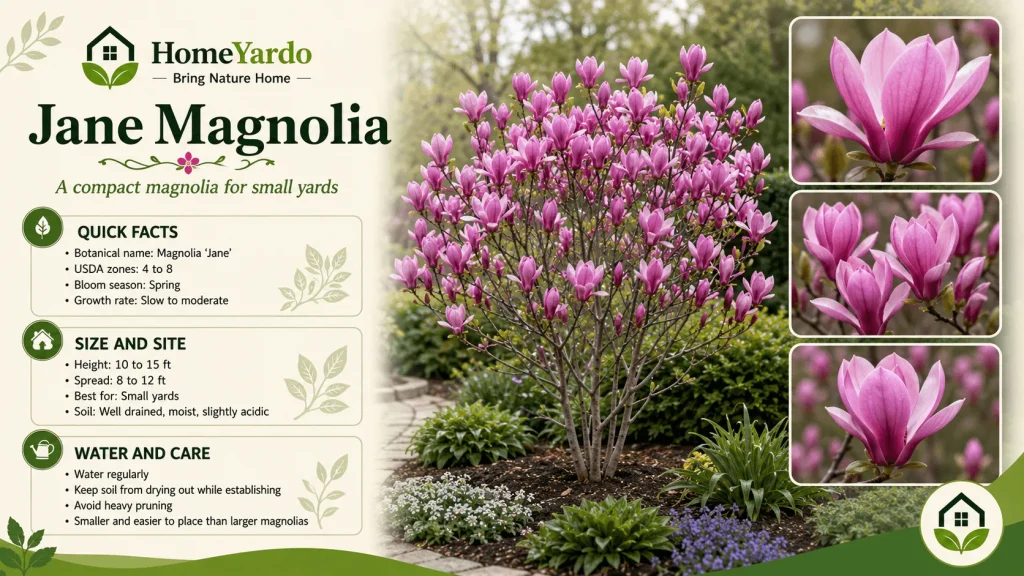
Jane magnolia produces pink-purple flowers on a smaller plant. It does not require as much effort to place as many larger magnolias.
- Botanical name: Magnolia ‘Jane’.
- Height: 10 to 15 ft
- Spread: 8 to 12 ft
- USDA zones: 4 to 8
- Bloom season: Spring
- Water: Regular.Mature Size: 4 to 6 feet.
- Water: Well drained and moist (slightly acidic)
- Spikes in the growth rate are anticipated.
- A slow to moderate growth rate is expected.
- Ideal for: Small yards
- Care: Do not allow soil to dry out while establishing.
- Care: Do not do heavy pruning.
12. Susan Magnolia
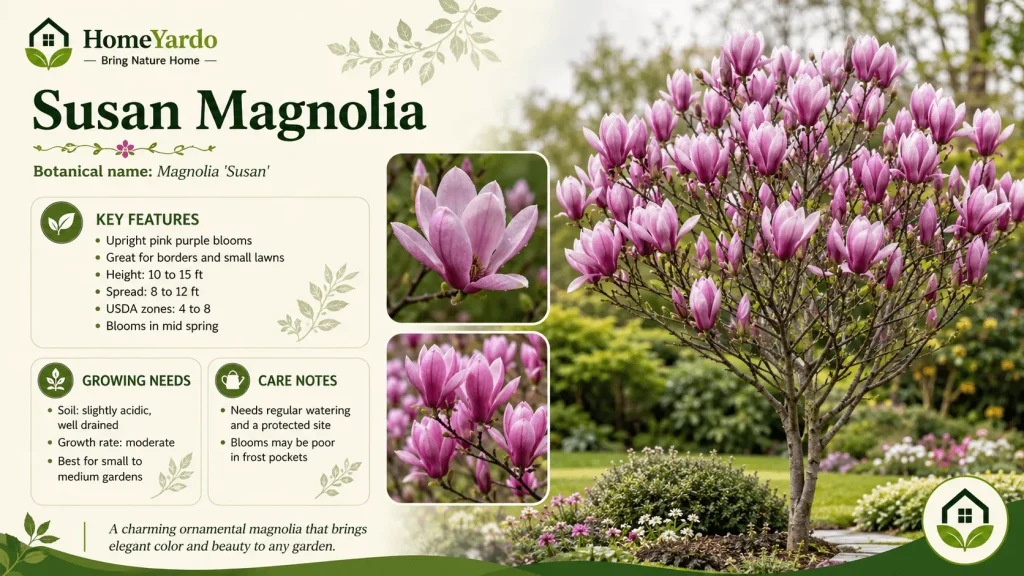
Susan magnolia is a neat, upright pink-purple flower. Good for borders, small lawns and in-ground plantings.
- Botanical name: Magnolia ‘Susan.’
- Height: 10 to 15 ft
- Spread: 8 to 12 ft
- USDA zones: 4 to 8
- Period of bloom: Mid spring
- Soil: Dry to moist, well-drained soil.
- Soil: Slightly acidic, well-drained soil
- Growth rate: Moderate
- Ideal for use in small to medium gardens.
- Please note: Plant in protected soil, regular watering.
- Note: Blooms may be poor in frost pockets.
13. Lily Magnolia
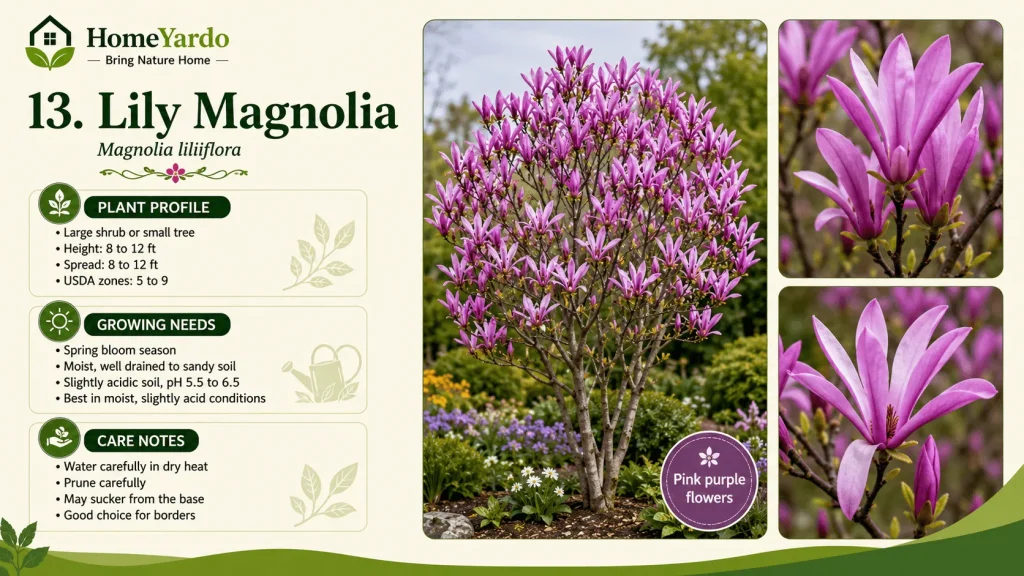
Lily magnolia features narrow, pink/purple flowers. Often grown as a large shrub or a small tree.
- Botanical name: Magnolia liliiflora
- Height: 8 to 12 ft
- Spread: 8 to 12 ft
- USDA zones: 5 to 9
- Bloom season: Spring
- Soil: Moist but well-drained to sandy, with an acidic pH of 5.5–6.5
- Conditions: Moist, well drained, slightly acid soil.
- Bloom: Poor to fair
- Ideal use: Border compacting.
- Water: Carefully during dry heat.
- Prune Carefully: May suck from the base.
14. Star Magnolia Rosea
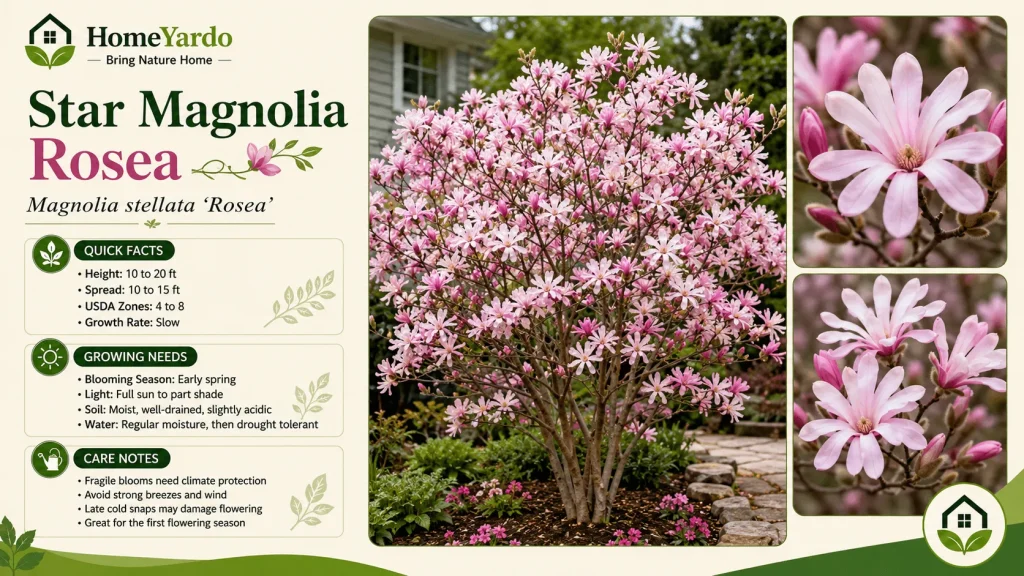
Star magnolia Rosea develops pink buds and blooms into star-shaped flower. It is very fragile and requires climatic protection.
- Botanical name: Magnolia stellata ‘Rosea’
- Height: 10 to 20 ft
- Spread: 10 to 15 ft
- USDA zones: 4 to 8
- Blooming season: Early spring
- Water: Water well to drought tolerant.Shade: Full sun to part shade.
- Soil: Moist, well-drained, slightly acidic soil
- Growth rate: Slow
- Ideal use: First flowering season
- Note: Avoid strong breezes and wind.
- Beware of late cold snaps, as they can be detrimental to flowering.
15. Pink Dogwood
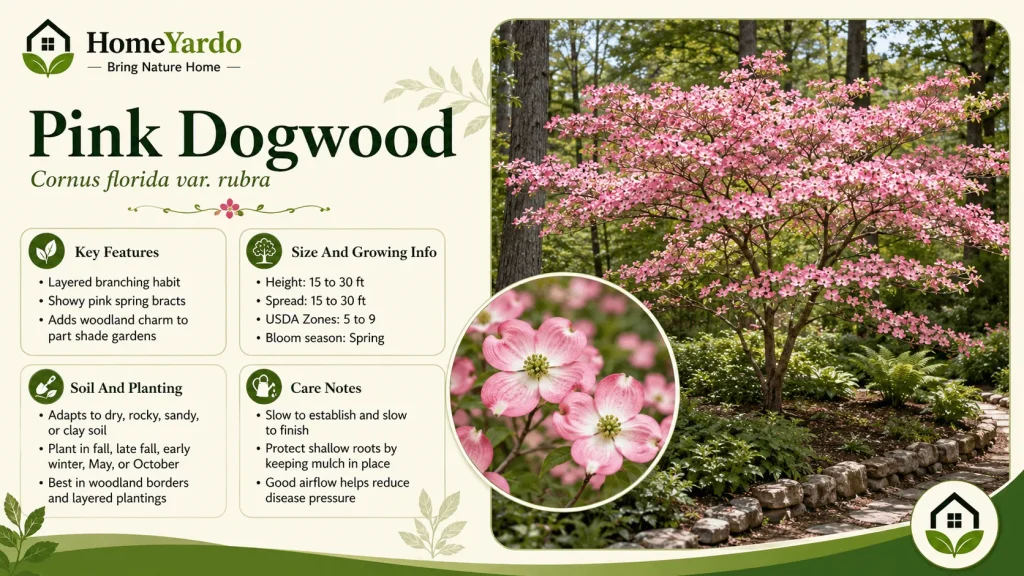
Layered branches and spring bracts are characteristics of pink dogwood. Adds a natural woodland ambiance to part shade gardens.
- Botanical name: Cornus florida var. rubra
- Height: 15 to 30 ft
- Spread: 15 to 30 ft
- USDA zones: 5 to 9
- Bloom season: Spring
- Soil: All soil types including dry, rocky, sandy or clayey
- Planting: In fall, late fall, or early winter; May; October.Suggested use: ground cover.
- Life Cycle: slow to start, slow to finish
- Ideal uses: Woodland borders and multi-layered plantings.
- Precaution: Do not remove mulch from shallow roots.
- Caution: Must be air-flowed to decrease disease pressure.
16. Satomi Kousa Dogwood
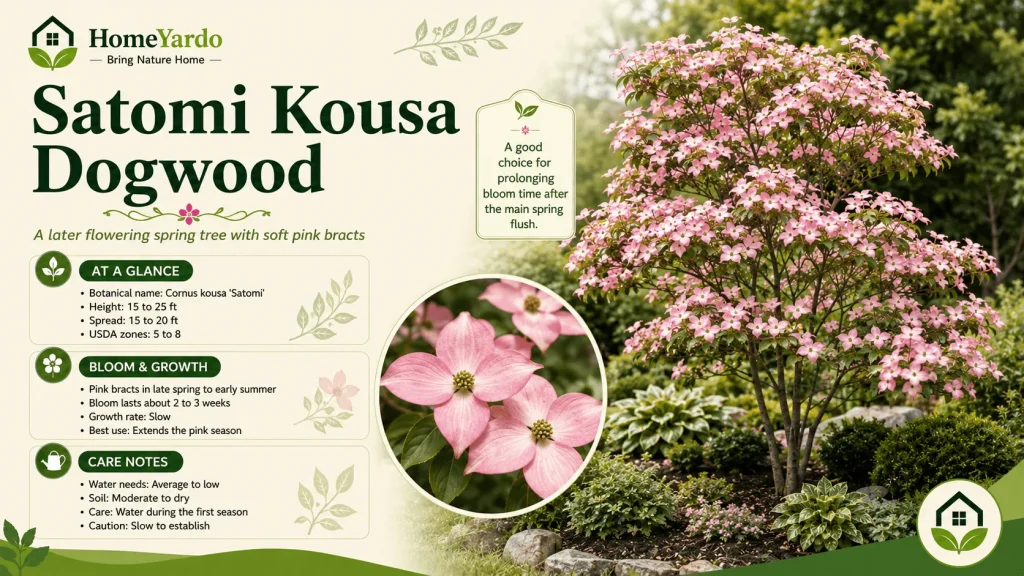
Satomi Kousa dogwood is one of the later flowering spring trees. It has pink bracts that extend the pink season into late spring or early summer.
- Botanical name: Cornus kousa ‘Satomi.’
- Height: 15 to 25 ft
- Spread: 15 to 20 ft
- USDA zones: 5 to 8
- Longevity: 2-3 weeks
- Water: Average to low water needs.Soil: Moderate to dry.
- Light: Sunlight exposure and risk of erosion.Plantation stock: Seedlings.
- Growth rate: Slow
- Best use: To prolong bloom time following spring drop-off in trees
- Care: Water during the first season.
- Caution: Slow to establish
17. Prairifire Crabapple
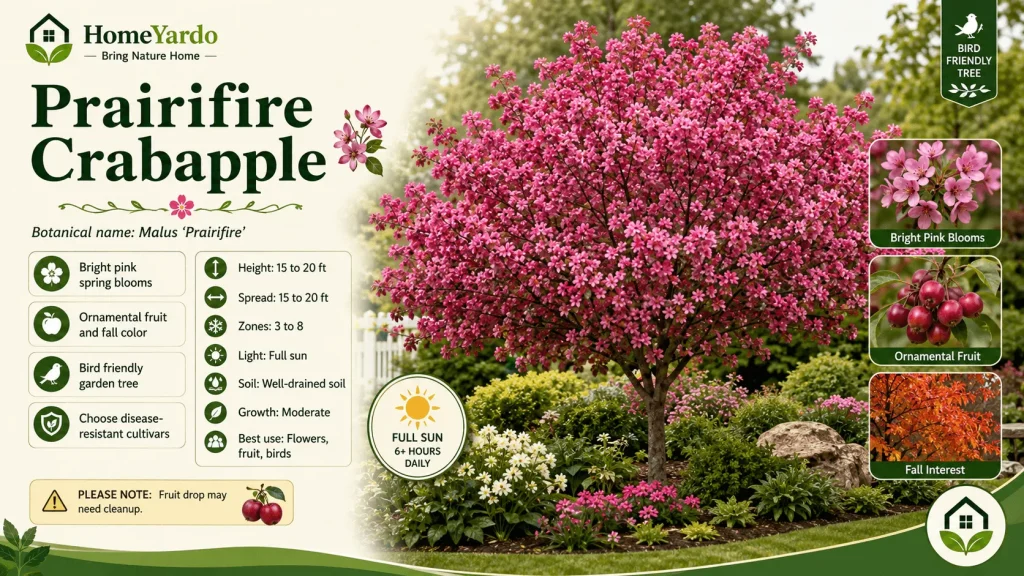
Prairifire crabapple provides fall interest, ornamental fruit and bright pink spring blooms. Works well in gardens that are bird friendly.
- Botanical name: Malus ‘Prairifire’.
- Height: 15 to 20 ft
- Spread: 15 to 20 ft
- USDA zones: 3 to 8
- Bloom season: Spring
- Light: Full sun
- Soil: Well-drained soil
- Growth rate: Moderate
- Outstanding use: Flowers, fruit, birds, fall color
- Note: Select cultivars that are resistant to the disease.
- Fruit may drop; caution – should be cleaned up.
18. Robinson Crabapple
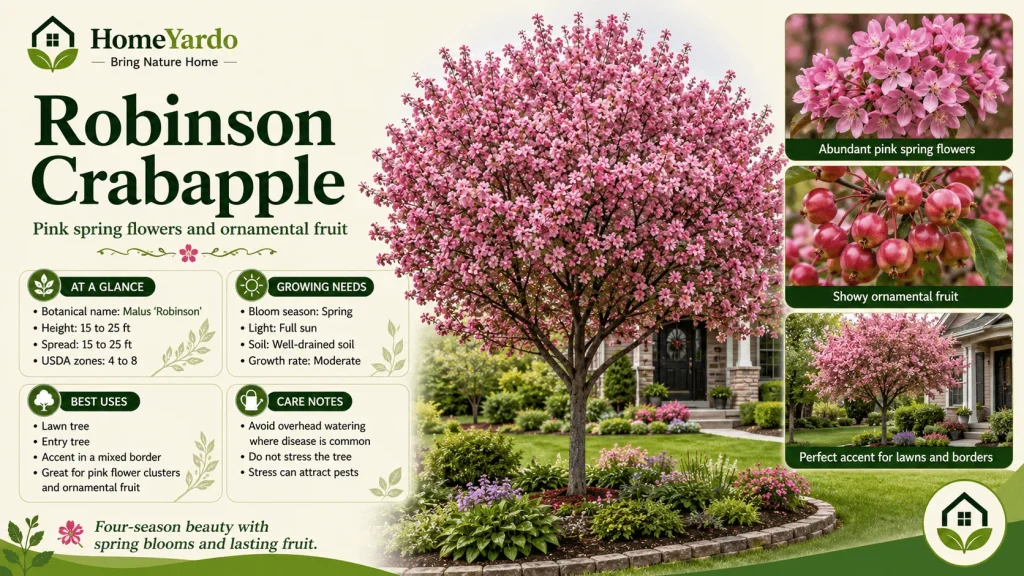
Robinson crabapple has pink spring flowers and ornamental fruit. It can be used as a lawn tree, entry tree or as an accent tree in a mixed border.
- Botanical name: Malus ‘Robinson.’
- Height: 15 to 25 ft
- Spread: 15 to 25 ft
- USDA zones: 4 to 8
- Bloom season: Spring
- Light: Full sun
- Soil: Well-drained soil
- Growth rate: Moderate
- Ideal uses: for pink flower clusters and ornamental fruit
- Care note: Do not use overhead watering in areas with a history of disease.
- Avoid stressing; it can attract pests.
19. Gala Apple
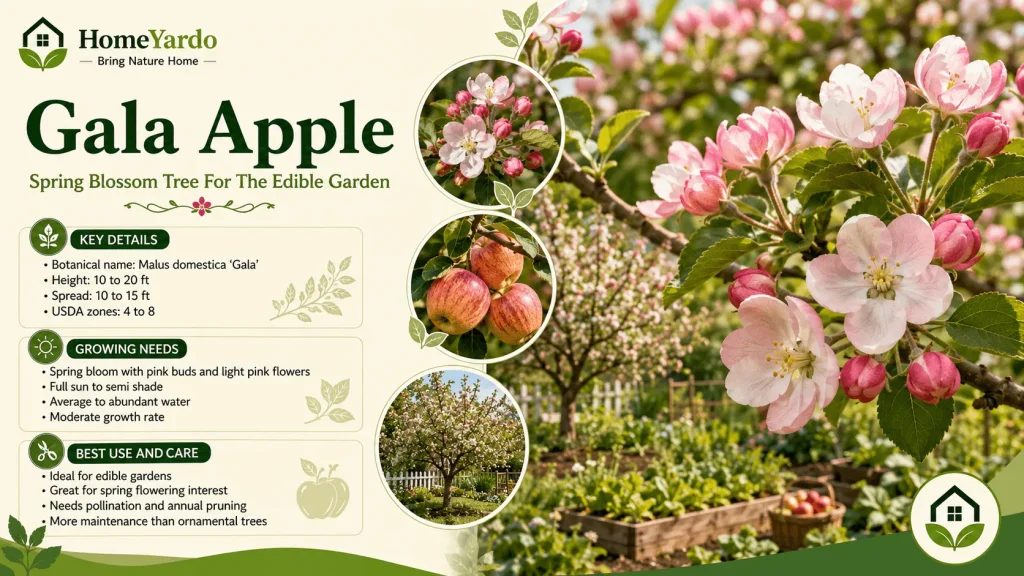
Fruit produced from Gala apple trees has pink buds and opens to light pink blossom; pollination and management are correct. These ought to be in the edible garden, not the low maintenance ornamental garden.
- Botanical name: Malus domestica ‘Gala.’
- Height: 10 to 20 ft
- Spread: 10 to 15 ft
- USDA zones: 4 to 8
- Bloom season: Spring
- Light: Full sun
- Planting site: In sun or semi-shade.Water: average to abundant water.
- Growth rate: Moderate
- Ideal for: Edible garden and spring flowering
- Note for care: Plan for pollination and annual pruning.
- Caution: More maintenance than ornamental trees.
20. Peach Tree
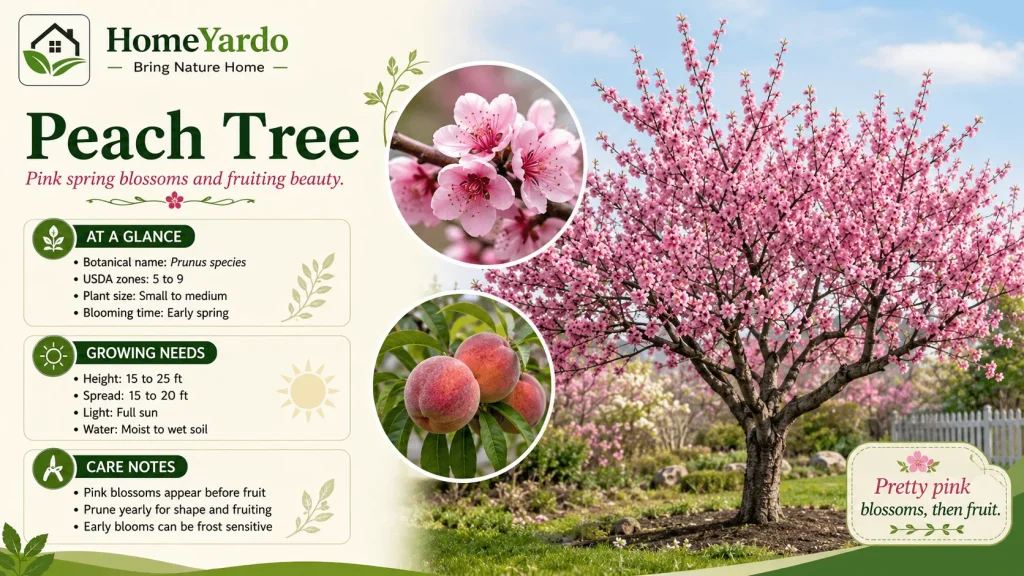
Peach trees produce pink blossoms first, then their fruit. Early flowers are susceptible to cold snaps, but are often pretty.
- Botanical name: Prunus species
- Height: 15 to 25 ft
- Spread: 15 to 20 ft
- USDA zones: 5 to 9
- Blooming time: Early spring.
- Light: Full sun
- Water: Moist to wet soil conditions.
- Plant size: Small to medium
- Ideal harvest time: Pink blossoms and fruit.
- Prune yearly for fruiting shape and care.
- Note: Early blooms can be frost sensitive.
21. Plum Tree
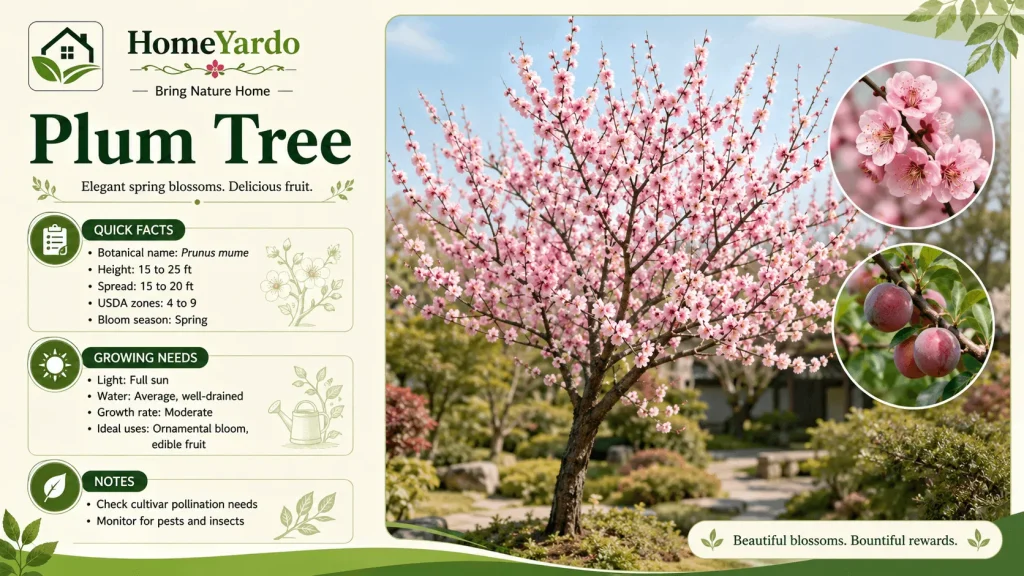
Some plum trees will produce soft pink flowers in the spring before the edible or ornamental fruit. They require some sunshine and frequent checking for insects.
- Botanical name: Prunus mume
- Height: 15 to 25 ft
- Spread: 15 to 20 ft
- USDA zones: 4 to 9
- Bloom season: Spring
- Light: Full sun
- Water: Average to well-drained water.
- Growth rate: Moderate
- Ideal uses: Ornamental bloom or edible fruit.
- Note: Be aware of cultivar pollination requirements.
- Please note: Some varieties require pest monitoring.
22. Japanese Apricot
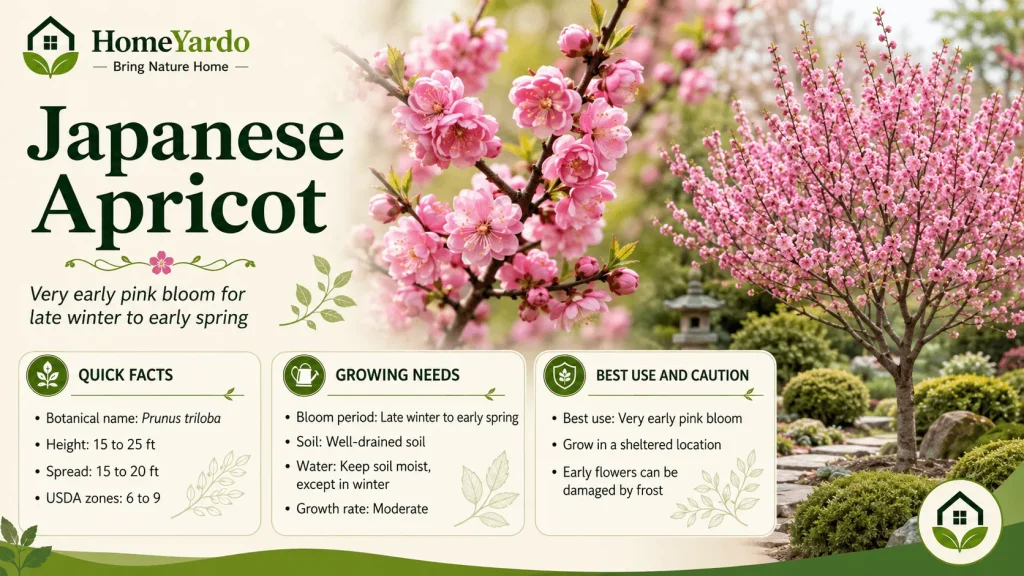
Japanese apricot is a very early bloomer, sometimes before the garden is awake. It is a gentle winter-to-spring transition in suitable areas with its pink flowers.
- Botanical name: Prunus triloba
- Height: 15 to 25 ft
- Spread: 15 to 20 ft
- USDA zones: 6 to 9
- Bloom period: Late winter – early spring
- Water: Water, except in winter.Moisture: Moist to wet.Soil: Moist to wet soil.
- Soil: Well-drained soil
- Growth rate: Moderate
- Best use: Very early pink bloom
- Caution: Grow in a sheltered location.
- BE CAREFUL: Early flowers can be eaten by frost.
23. Flowering Almond
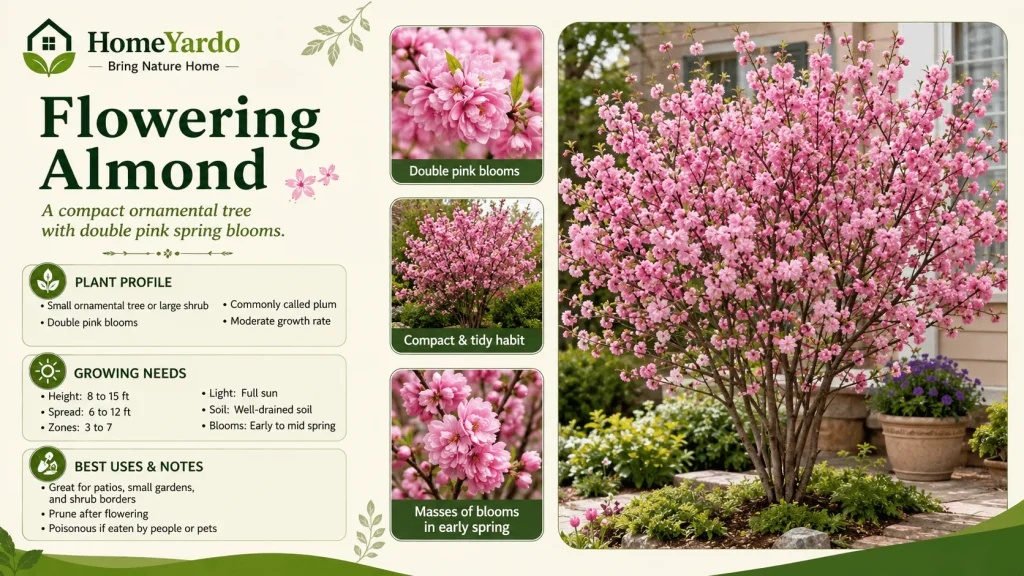
A small ornamental tree or large shrub with flowering almond having double pink blooms. It is suited for the patio, cottage borders and small spaces.
- Commonly called Plum,
- Height: 8 to 15 ft
- Spread: 6 to 12 ft
- USDA zones: 3 to 7
- Flowers: Early to mid spring
- Light: Full sun
- Soil: Well-drained soil
- Growth rate: Moderate
- Best use: Small gardens and shrub borders
- Note: Prune following flowers.
- Note: Poisonous if eaten by man or animals.
24. Red Horse Chestnut
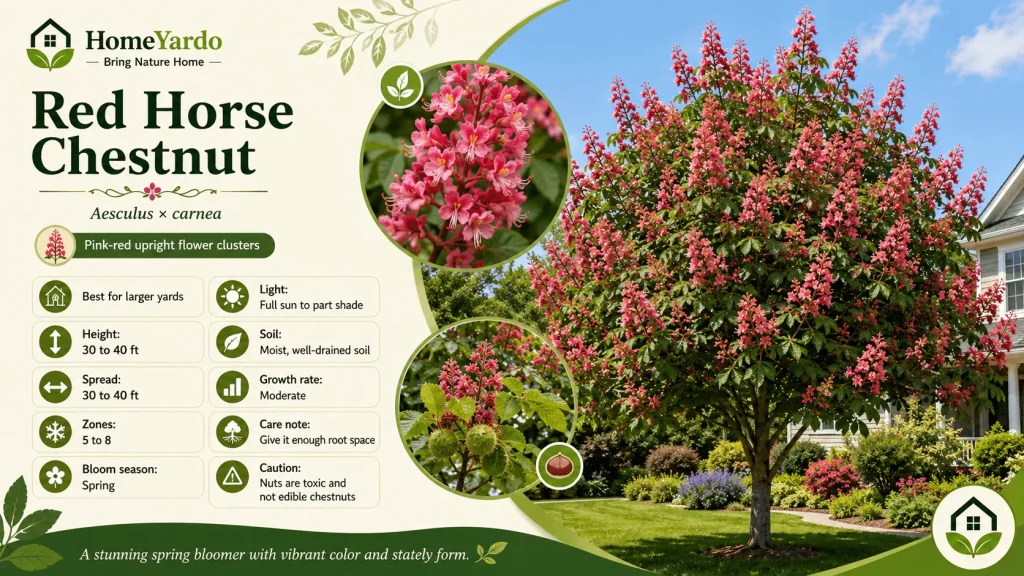
Red horse chestnut produces upright pink-red flower clusters and grows larger than many small ornamentals. It needs open space and careful placement.
- Botanical name: Aesculus × carnea
- Height: 30 to 40 ft
- Spread: 30 to 40 ft
- USDA zones: 5 to 8
- Bloom season: Spring
- Light: Full sun to part shade
- Soil: Moist, well-drained soil
- Growth rate: Moderate
- Best use: Larger yards
- Care note: Give it enough root space.
- Caution: Nuts are toxic and not edible chestnuts.
25. Red Buckeye
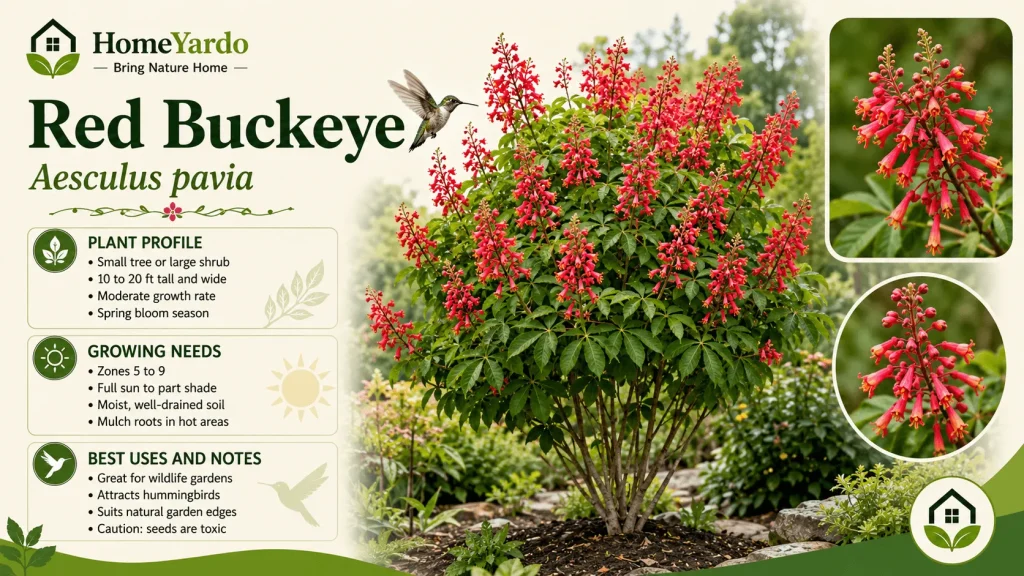
Red buckeye can be grown as a small tree or large shrub. Its pink-red flowers attract hummingbirds and suit natural garden edges.
- Botanical name: Aesculus pavia
- Height: 10 to 20 ft
- Spread: 10 to 20 ft
- USDA zones: 5 to 9
- Bloom season: Spring
- Light: Full sun to part shade
- Soil: Moist, well-drained soil
- Growth rate: Moderate
- Best use: Wildlife and hummingbird gardens
- Care note: Mulch to protect roots in hot areas.
- Caution: Seeds are toxic.
26. Pink Japanese Snowbell
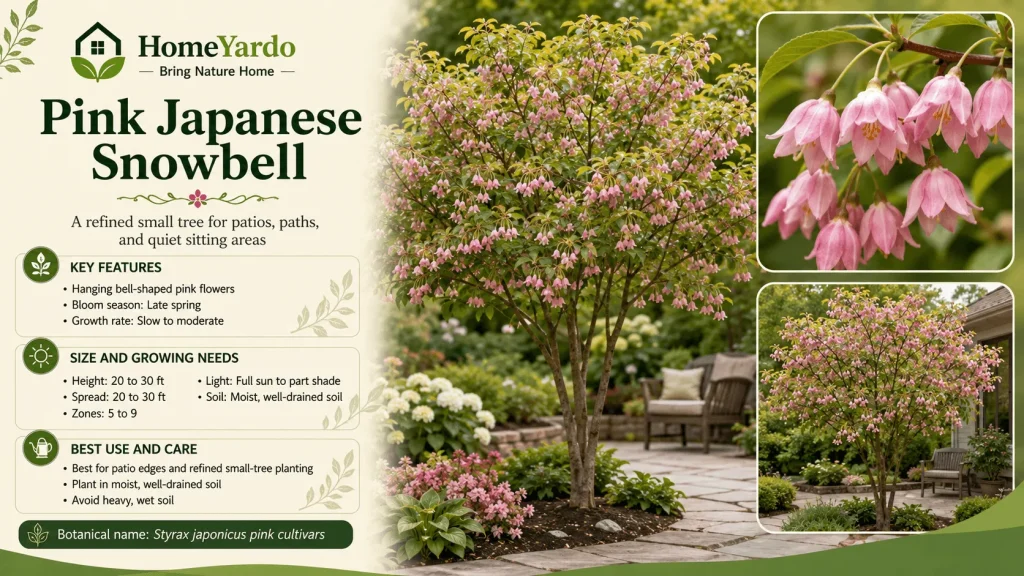
Pink Japanese snowbell has hanging bell-shaped flowers that appear under the branches. It feels refined near patios, paths, and quiet sitting areas.
- Botanical name: Styrax japonicus pink cultivars
- Height: 20 to 30 ft
- Spread: 20 to 30 ft
- USDA zones: 5 to 9
- Bloom season: Late spring
- Light: Full sun to part shade
- Soil: Moist, well-drained soil
- Growth rate: Slow to moderate
- Best use: Patio edges and refined small-tree planting
- Care note: Plant in moist, well-drained soil.
- Caution: Does not like heavy, wet soil.
27. Paul’s Scarlet Hawthorn
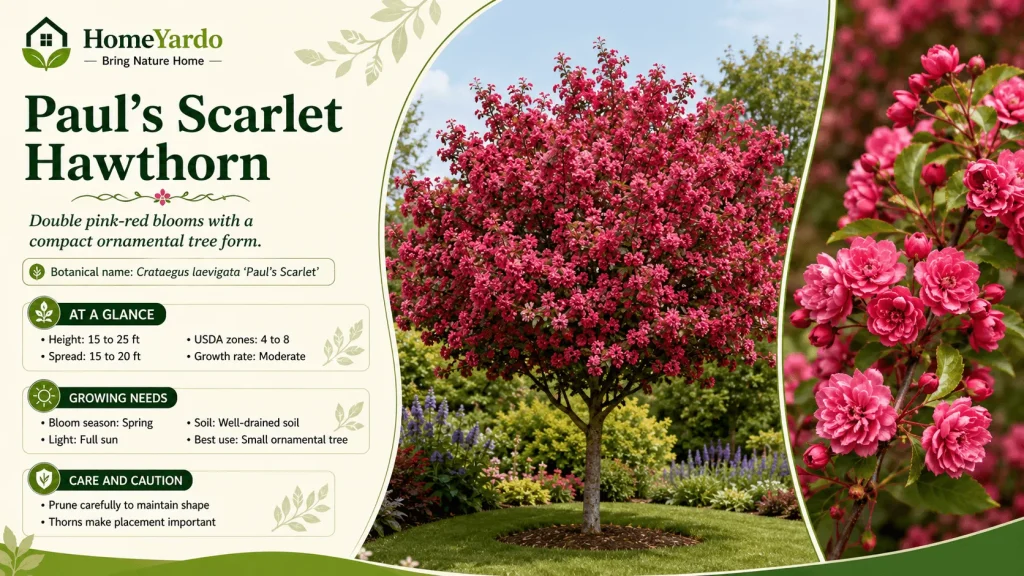
Paul’s Scarlet hawthorn has double pink-red flowers and a compact tree shape. It can be beautiful in spring, but thorns make placement important.
- Botanical name: Crataegus laevigata ‘Paul’s Scarlet’
- Height: 15 to 25 ft
- Spread: 15 to 20 ft
- USDA zones: 4 to 8
- Bloom season: Spring
- Light: Full sun
- Soil: Well-drained soil
- Growth rate: Moderate
- Best use: Small ornamental tree
- Care note: Prune carefully to maintain shape.
- Caution: Thorns make placement important.
28. Crepe Myrtle
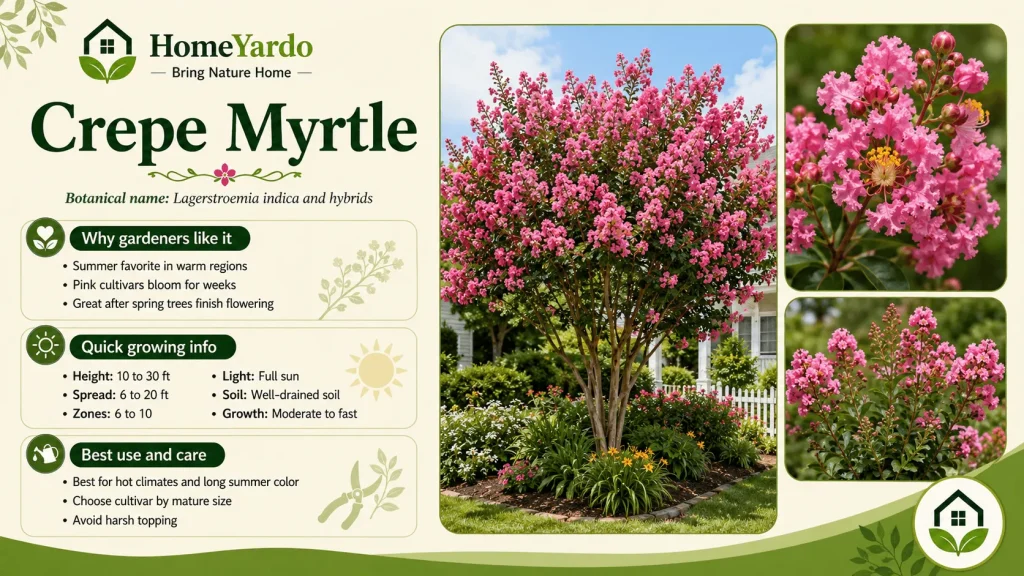
Crepe myrtle is a summer favorite in warm regions. Pink cultivars can bloom for weeks after spring trees have finished.
- Botanical name: Lagerstroemia indica and hybrids
- Height: 10 to 30 ft
- Spread: 6 to 20 ft
- USDA zones: 6 to 10
- Bloom season: Summer
- Light: Full sun
- Soil: Well-drained soil
- Growth rate: Moderate to fast
- Best use: Hot climates and long summer color
- Care note: Choose cultivar by mature size.
- Caution: Avoid harsh topping.
29. Chitalpa Pink Dawn
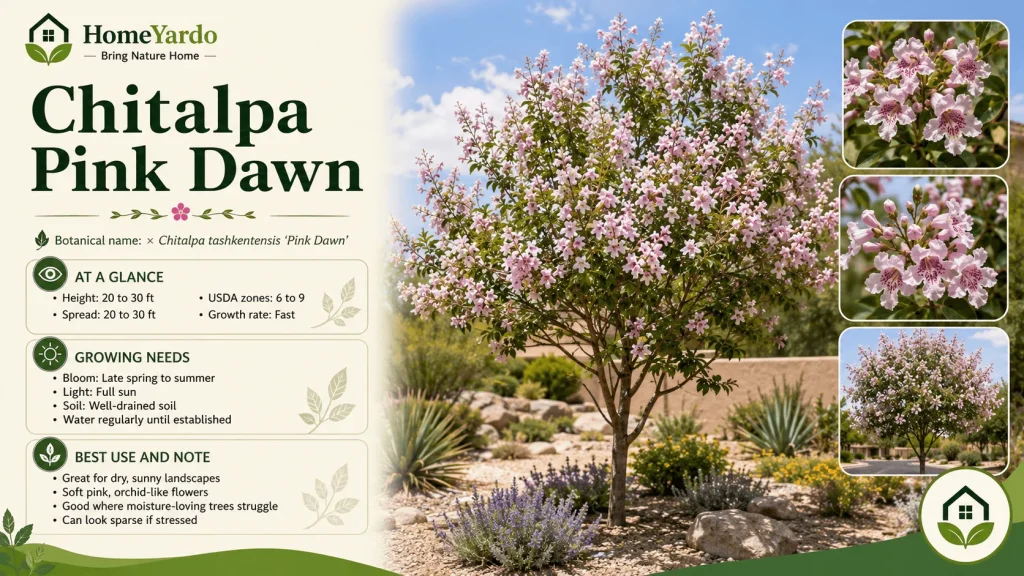
Chitalpa Pink Dawn has soft pink, orchid-like flowers in late spring and summer. It suits sunny, dry gardens where moisture-loving trees struggle.
- Botanical name: × Chitalpa tashkentensis ‘Pink Dawn.’
- Height: 20 to 30 ft
- Spread: 20 to 30 ft
- USDA zones: 6 to 9
- Bloom season: Late spring to summer
- Light: Full sun
- Soil: Well-drained soil
- Growth rate: Fast
- Best use: Dry, sunny landscapes
- Care note: Water regularly until established.
- Caution: Can look sparse if stressed.
30. Desert Willow
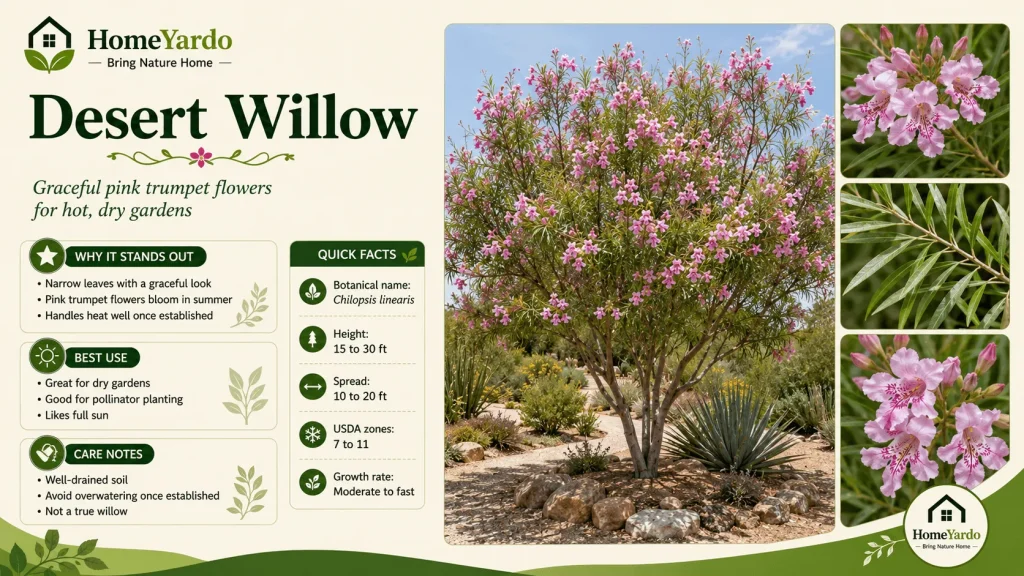
Desert willow is not a true willow, but its narrow leaves and pink trumpet flowers make it graceful in dry gardens. It handles heat well once established.
- Botanical name: Chilopsis linearis
- Height: 15 to 30 ft
- Spread: 10 to 20 ft
- USDA zones: 7 to 11
- Bloom season: Summer
- Light: Full sun
- Soil: Well-drained, dry to moderately moist soil
- Growth rate: Moderate to fast
- Best use: Dry gardens and pollinator planting
- Care note: Avoid overwatering once established.
- Caution: Not a true willow.
31. Pink Trumpet Tree
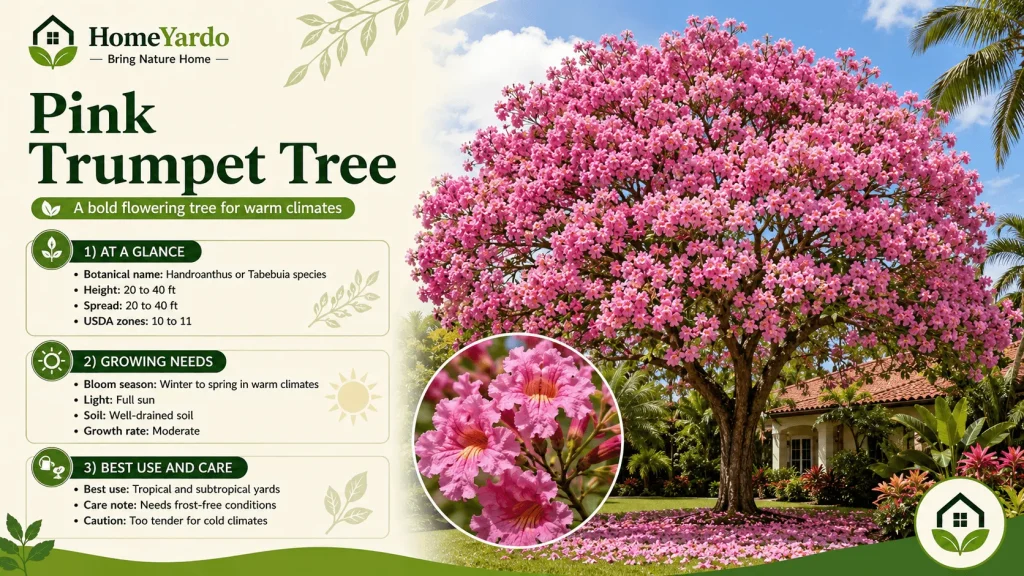
Pink trumpet tree can cover its canopy with large trumpet-shaped blooms in warm climates. It is a bold choice for tropical and subtropical yards.
- Botanical name: Handroanthus or Tabebuia species
- Height: 20 to 40 ft
- Spread: 20 to 40 ft
- USDA zones: 10 to 11
- Bloom season: Winter to spring in warm climates
- Light: Full sun
- Soil: Well-drained soil
- Growth rate: Moderate
- Best use: Tropical and subtropical yards
- Care note: Needs frost-free conditions.
- Caution: Too tender for cold climates.
32. Pink Poui
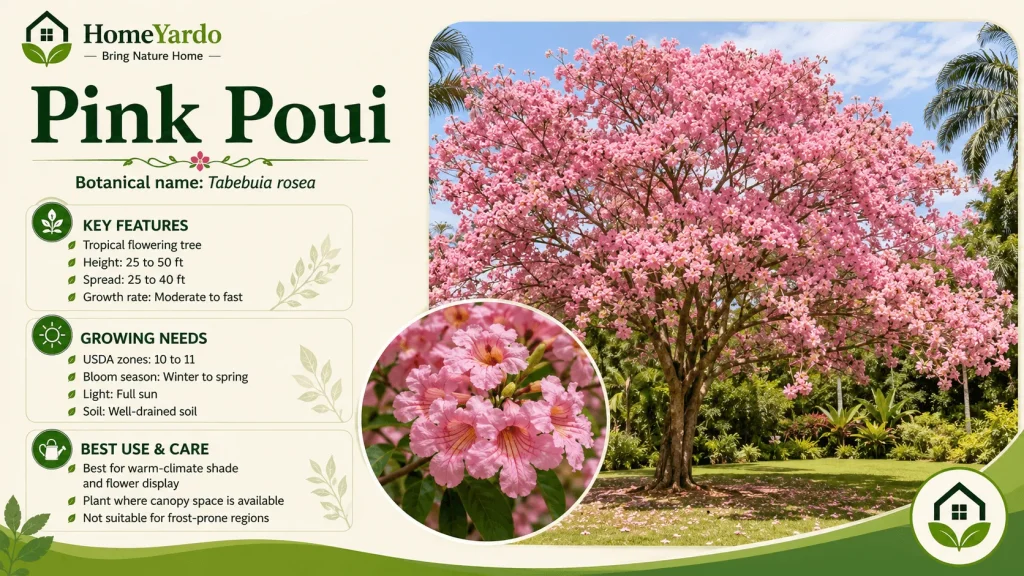
Pink poui is a tropical flowering tree with a dramatic seasonal display. It needs warmth, space, and a frost-free climate.
- Botanical name: Tabebuia rosea
- Height: 25 to 50 ft
- Spread: 25 to 40 ft
- USDA zones: 10 to 11
- Bloom season: Winter to spring
- Light: Full sun
- Soil: Well-drained soil
- Growth rate: Moderate to fast
- Best use: Warm-climate shade and flower display
- Care note: Plant where canopy space is available.
- Caution: Not suitable for frost-prone regions.
33. Hong Kong Orchid Tree
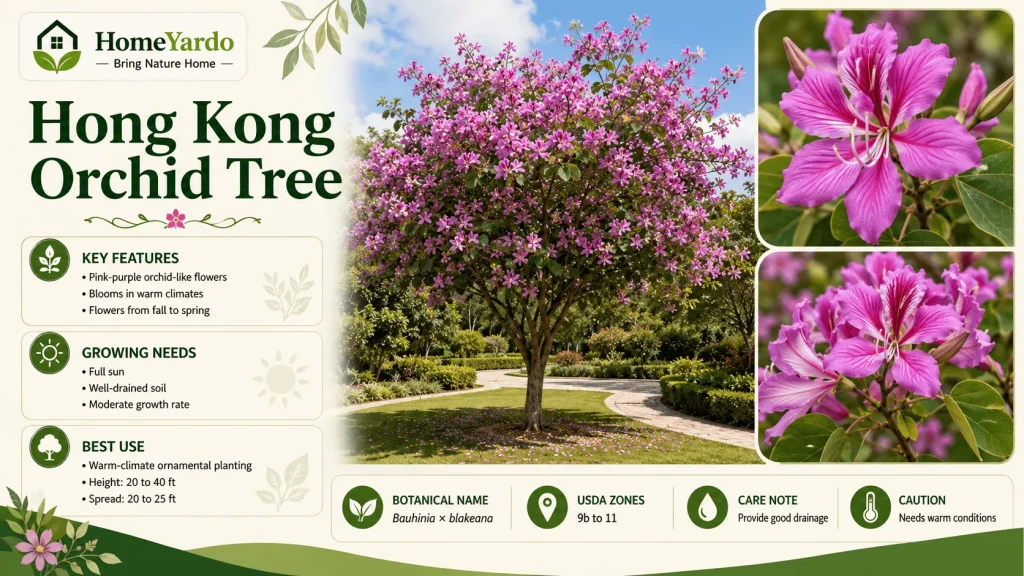
Hong Kong orchid tree produces pink-purple orchid-like flowers in warm climates. It can bloom during cooler months where winters stay mild.
- Botanical name: Bauhinia × blakeana
- Height: 20 to 40 ft
- Spread: 20 to 25 ft
- USDA zones: 9b to 11
- Bloom season: Fall to spring in warm climates
- Light: Full sun
- Soil: Well-drained soil
- Growth rate: Moderate
- Best use: Warm-climate ornamental planting
- Care note: Provide good drainage.
- Caution: Needs warm conditions.
34. Orchid Tree
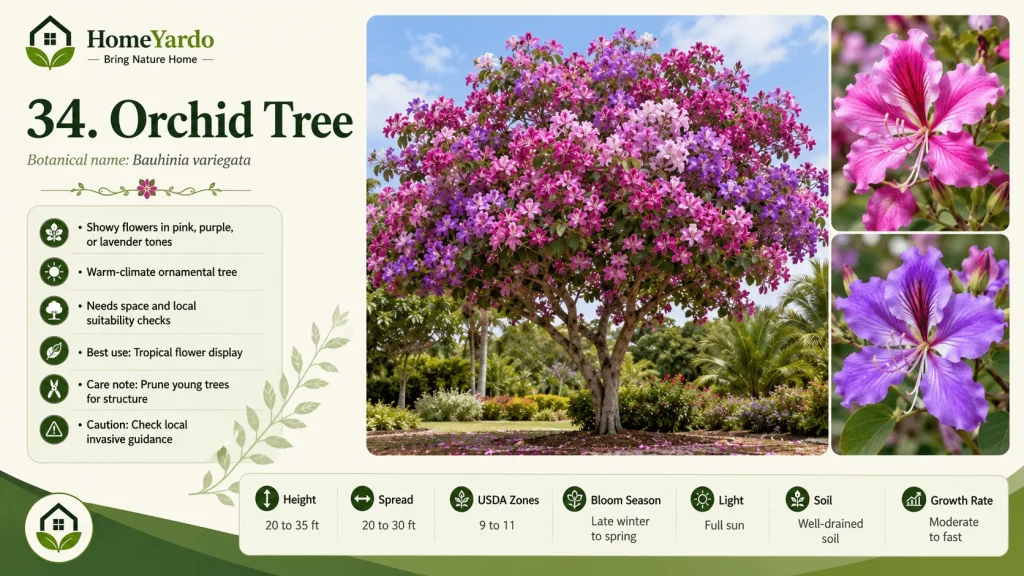
Orchid tree has showy flowers in pink, purple, or lavender tones. It is a warm-climate ornamental that needs space and local suitability checks.
- Botanical name: Bauhinia variegata
- Height: 20 to 35 ft
- Spread: 20 to 30 ft
- USDA zones: 9 to 11
- Bloom season: Late winter to spring
- Light: Full sun
- Soil: Well-drained soil
- Growth rate: Moderate to fast
- Best use: Tropical flower display
- Care note: Prune young trees for structure.
- Caution: Check local invasive guidance.
35. Persian Silk Tree
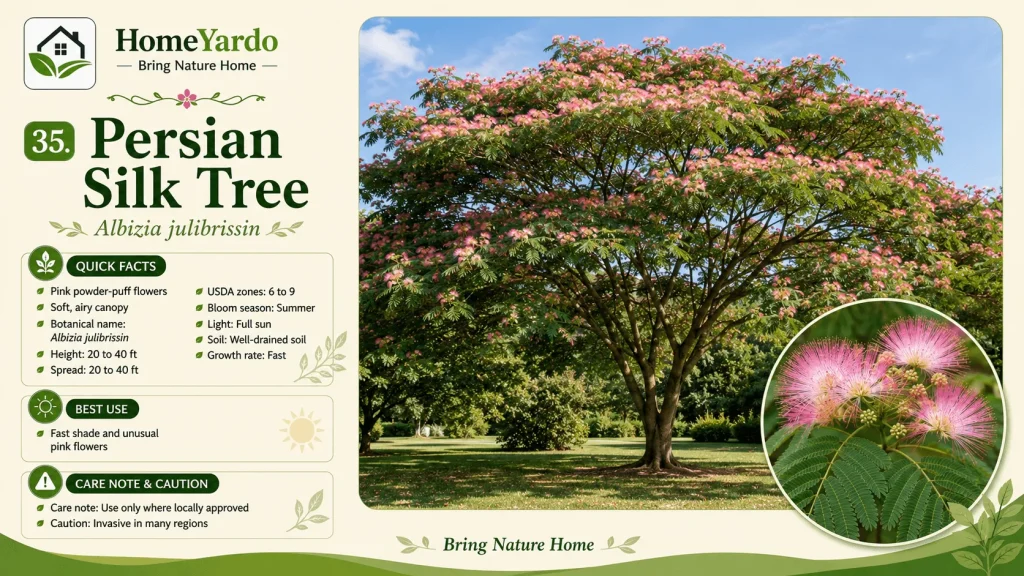
Persian silk tree has pink powder-puff flowers and a soft, airy canopy. It looks romantic in bloom, but its regional risk makes caution necessary.
- Botanical name: Albizia julibrissin
- Height: 20 to 40 ft
- Spread: 20 to 40 ft
- USDA zones: 6 to 9
- Bloom season: Summer
- Light: Full sun
- Soil: Well-drained soil
- Growth rate: Fast
- Best use: Fast shade and unusual pink flowers
- Care note: Use only where locally approved.
- Caution: Invasive in many regions.
36. Pink Bottlebrush
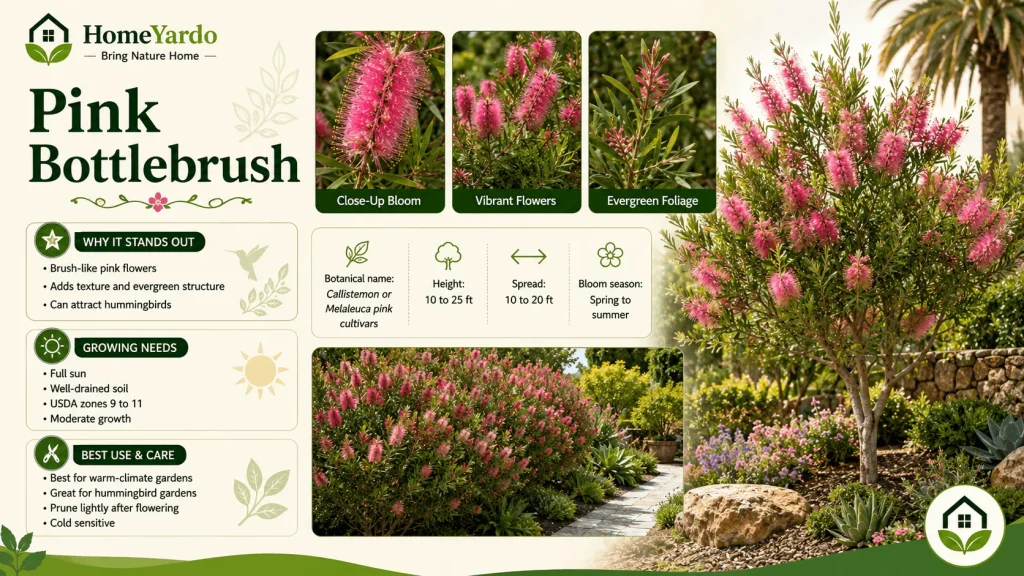
Pink bottlebrush has brush-like flowers that stand out in warm gardens. It can bring hummingbirds, texture, and evergreen structure where hardy.
- Botanical name: Callistemon or Melaleuca pink cultivars
- Height: 10 to 25 ft
- Spread: 10 to 20 ft
- USDA zones: 9 to 11
- Bloom season: Spring to summer
- Light: Full sun
- Soil: Well-drained soil
- Growth rate: Moderate
- Best use: Hummingbird and warm-climate gardens
- Care note: Prune lightly after flowering.
- Caution: Cold sensitive.
37. Strawberry Tree
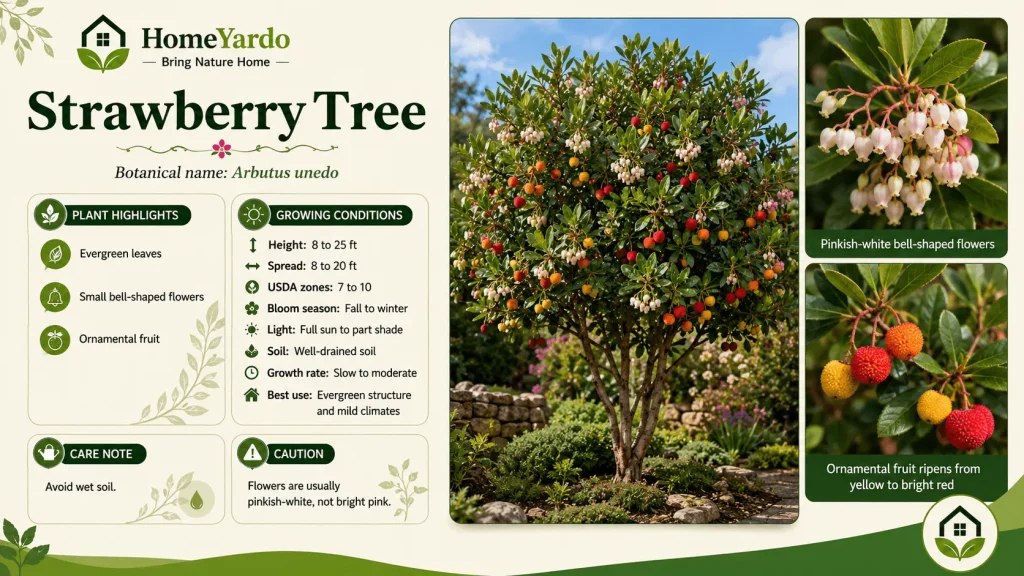
Strawberry tree has evergreen leaves, small bell-shaped flowers, and ornamental fruit. The flowers are usually pinkish-white rather than bright pink.
- Botanical name: Arbutus unedo
- Height: 8 to 25 ft
- Spread: 8 to 20 ft
- USDA zones: 7 to 10
- Bloom season: Fall to winter
- Light: Full sun to part shade
- Soil: Well-drained soil
- Growth rate: Slow to moderate
- Best use: Evergreen structure and mild climates
- Care note: Avoid wet soil.
- Caution: Flowers are usually pinkish-white, not bright pink.
38. Camellia Tree Form
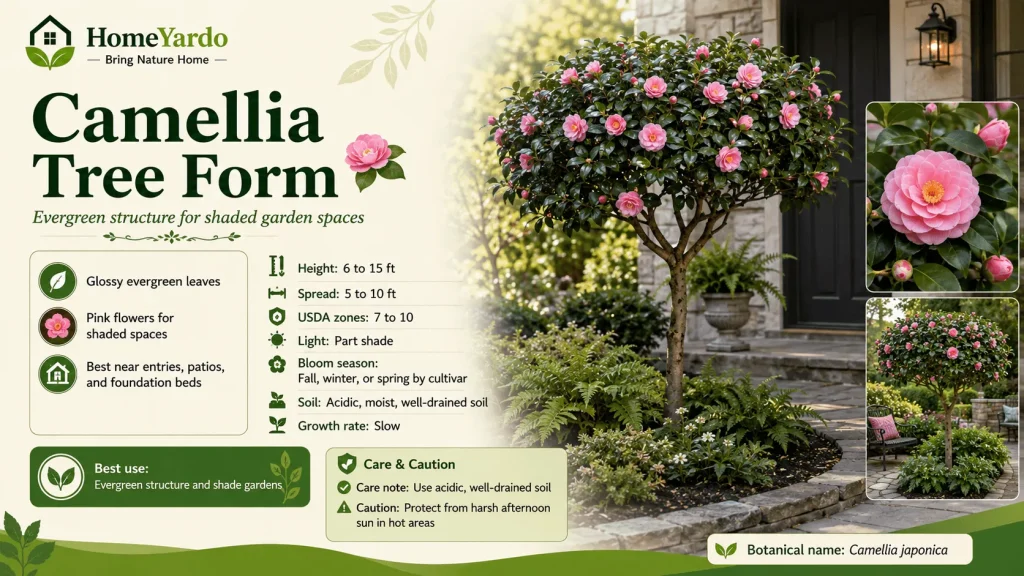
Camellia tree form adds glossy evergreen leaves and pink flowers to shaded garden spaces. It feels polished near entries, patios, and foundation beds.
- Botanical name: Camellia japonica
- Height: 6 to 15 ft
- Spread: 5 to 10 ft
- USDA zones: 7 to 10
- Bloom season: Fall, winter, or spring by cultivar
- Light: Part shade
- Soil: Acidic, moist, well-drained soil
- Growth rate: Slow
- Best use: Evergreen structure and shade gardens
- Care note: Use acidic, well-drained soil.
- Caution: Needs protection from harsh afternoon sun in hot areas.
39. Oleander Tree Form
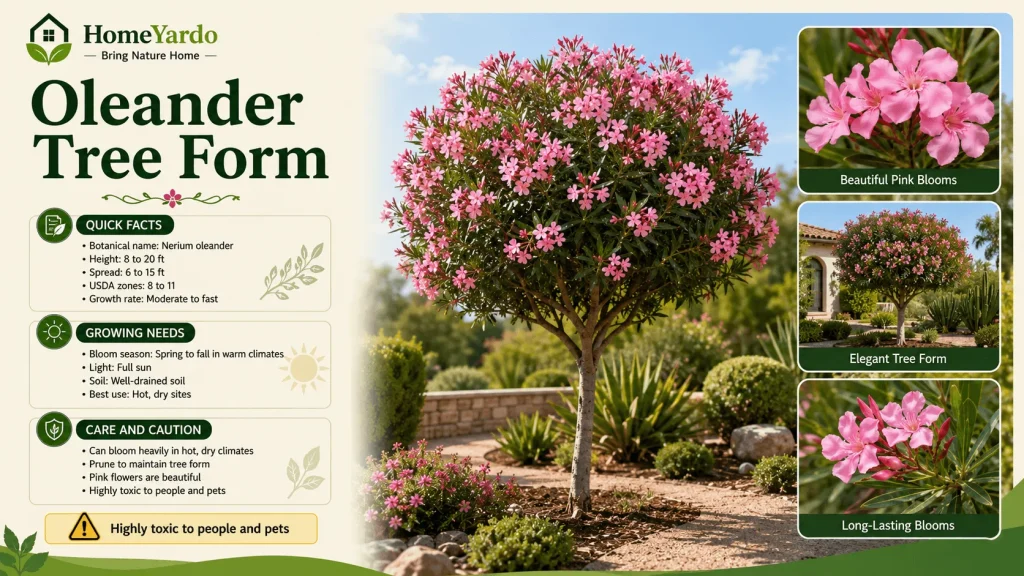
Oleander tree form can bloom heavily in hot, dry climates. Its pink flowers are beautiful, but its toxicity makes it a poor fit for some homes.
- Botanical name: Nerium oleander
- Height: 8 to 20 ft
- Spread: 6 to 15 ft
- USDA zones: 8 to 11
- Bloom season: Spring to fall in warm climates
- Light: Full sun
- Soil: Well-drained soil
- Growth rate: Moderate to fast
- Best use: Hot, dry sites
- Care note: Prune to maintain tree form.
- Caution: Highly toxic to people and pets.
40. Weigela Tree Form
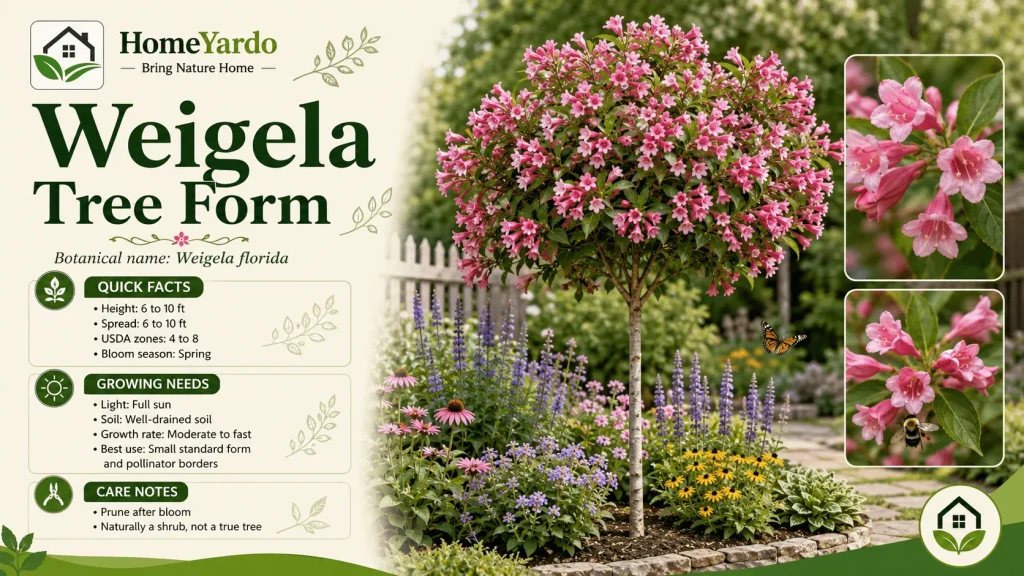
Weigela is naturally a shrub, but it can be trained as a small standard. Pink trumpet flowers make it appealing for pollinator-friendly borders.
- Botanical name: Weigela florida
- Height: 6 to 10 ft
- Spread: 6 to 10 ft
- USDA zones: 4 to 8
- Bloom season: Spring
- Light: Full sun
- Soil: Well-drained soil
- Growth rate: Moderate to fast
- Best use: Small standard form and pollinator borders
- Care note: Prune after bloom.
- Caution: Naturally a shrub, not a true tree.
41. Pink Lilac Tree Form
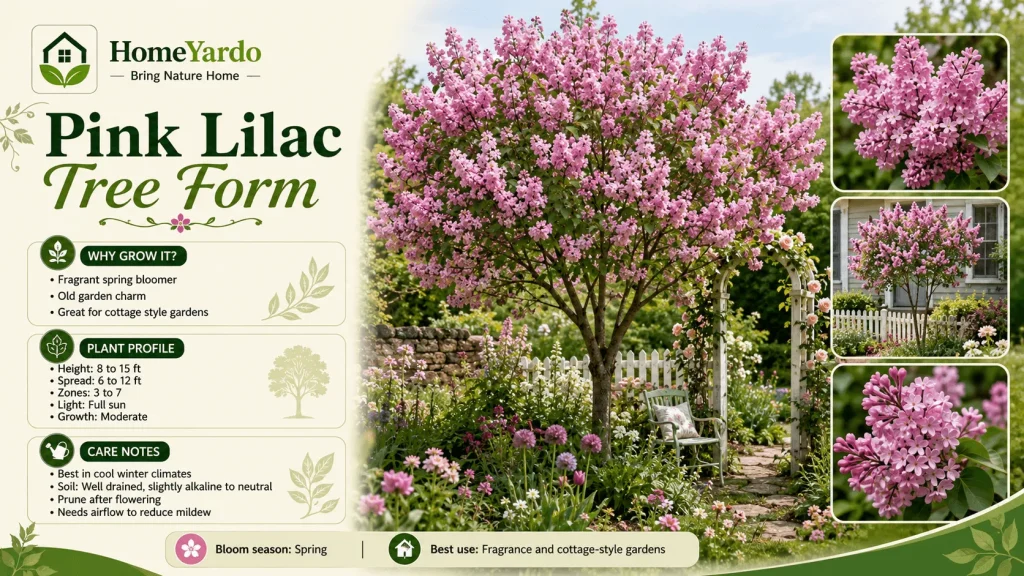
Pink lilac tree form brings fragrance and old-garden charm. It works best where winters are cool enough to support strong spring bloom.
- Botanical name: Syringa vulgaris pink cultivars
- Height: 8 to 15 ft
- Spread: 6 to 12 ft
- USDA zones: 3 to 7
- Bloom season: Spring
- Light: Full sun
- Soil: Well-drained, slightly alkaline to neutral soil
- Growth rate: Moderate
- Best use: Fragrance and cottage-style gardens
- Care note: Prune after flowering.
- Caution: Needs airflow to reduce mildew.
42. Rhododendron Tree Form
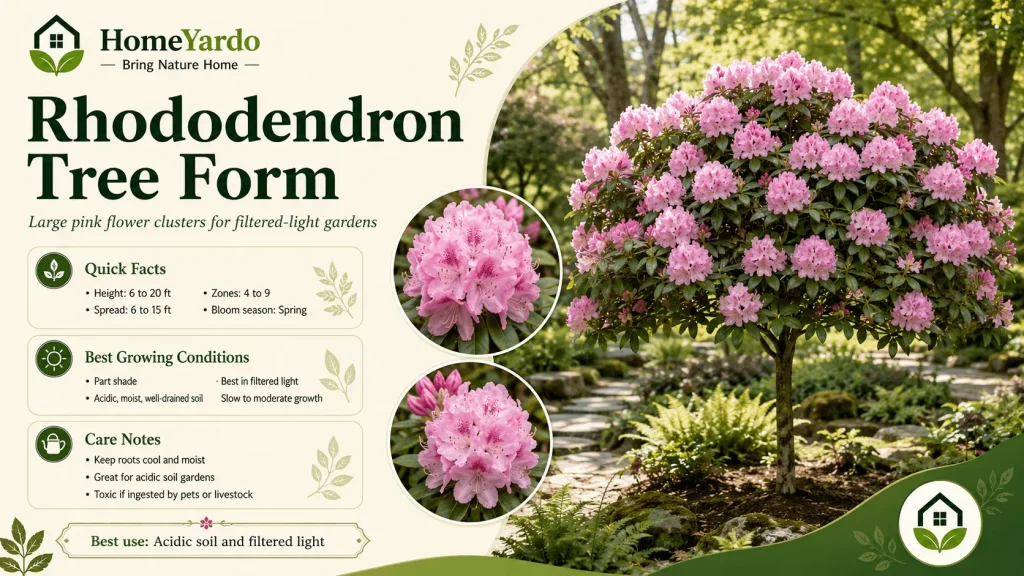
Rhododendron tree form brings large pink flower clusters to filtered-light gardens. It performs best in acidic soil with cool, protected roots.
- Botanical name: Rhododendron species and cultivars
- Height: 6 to 20 ft
- Spread: 6 to 15 ft
- USDA zones: 4 to 9
- Bloom season: Spring
- Light: Part shade
- Soil: Acidic, moist, well-drained soil
- Growth rate: Slow to moderate
- Best use: Acidic soil and filtered light
- Care note: Keep roots cool and moist.
- Caution: Toxic if ingested by pets or livestock.
43. Pink Panicle Hydrangea Tree Form
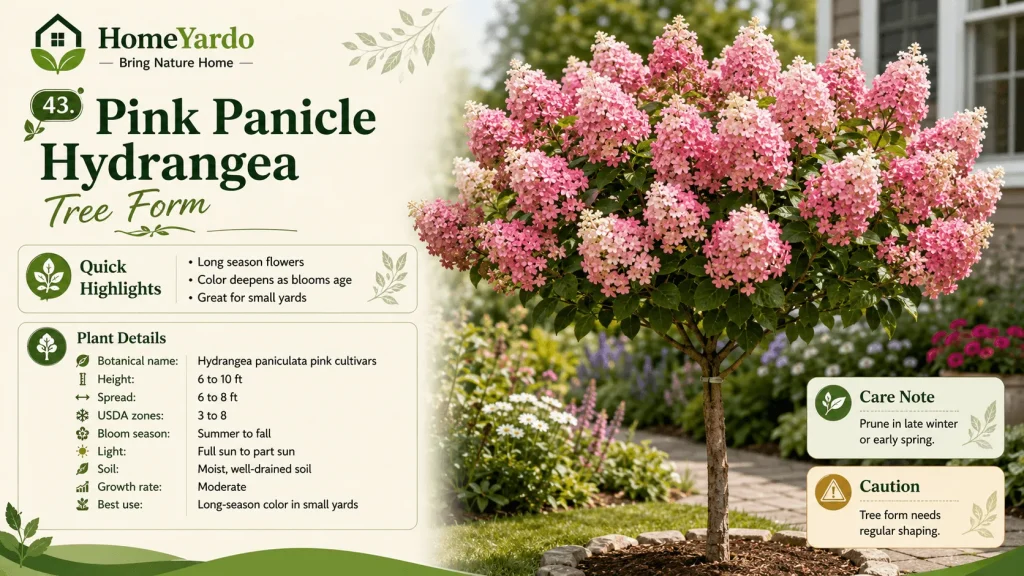
Pink panicle hydrangea tree form gives long-season flowers that often deepen in color as they age. It is not a true tree, but it works well in small yards.
- Botanical name: Hydrangea paniculata pink cultivars
- Height: 6 to 10 ft
- Spread: 6 to 8 ft
- USDA zones: 3 to 8
- Bloom season: Summer to fall
- Light: Full sun to part sun
- Soil: Moist, well-drained soil
- Growth rate: Moderate
- Best use: Long-season color in small yards
- Care note: Prune in late winter or early spring.
- Caution: Tree form needs regular shaping.
44. Rose Of Sharon Tree Form
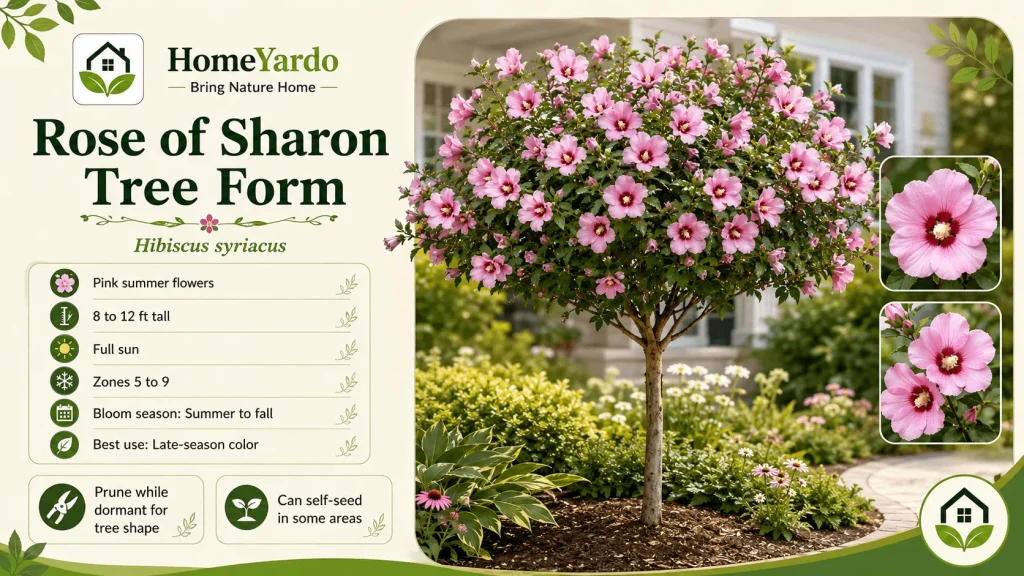
Rose of Sharon tree form gives pink summer flowers after many spring bloomers are done. It is useful for late-season structure and color.
- Botanical name: Hibiscus syriacus
- Height: 8 to 12 ft
- Spread: 6 to 10 ft
- USDA zones: 5 to 9
- Bloom season: Summer to fall
- Light: Full sun
- Soil: Well-drained soil
- Growth rate: Moderate
- Best use: Late-season pink flowers
- Care note: Prune while dormant for tree shape.
- Caution: Can self-seed in some areas.
45. Pink Wisteria Standard
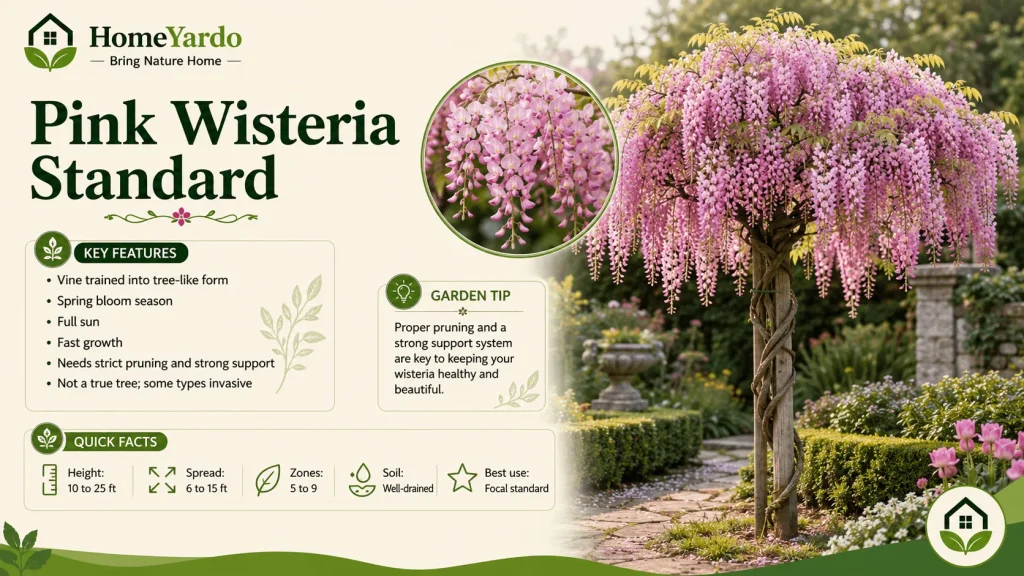
Pink wisteria standard is a vine trained into a tree-like form. It can look magical in bloom, but it needs strict pruning and strong support.
- Botanical name: Wisteria species and pink cultivars
- Height: 10 to 25 ft when trained
- Spread: 6 to 15 ft when trained
- USDA zones: 5 to 9
- Bloom season: Spring
- Light: Full sun
- Soil: Well-drained soil
- Growth rate: Fast
- Best use: Trained standard or strong focal structure
- Care note: Needs strict pruning and strong support.
- Caution: Not a true tree and some types are invasive.
Also Consider These Pink Flowering Options
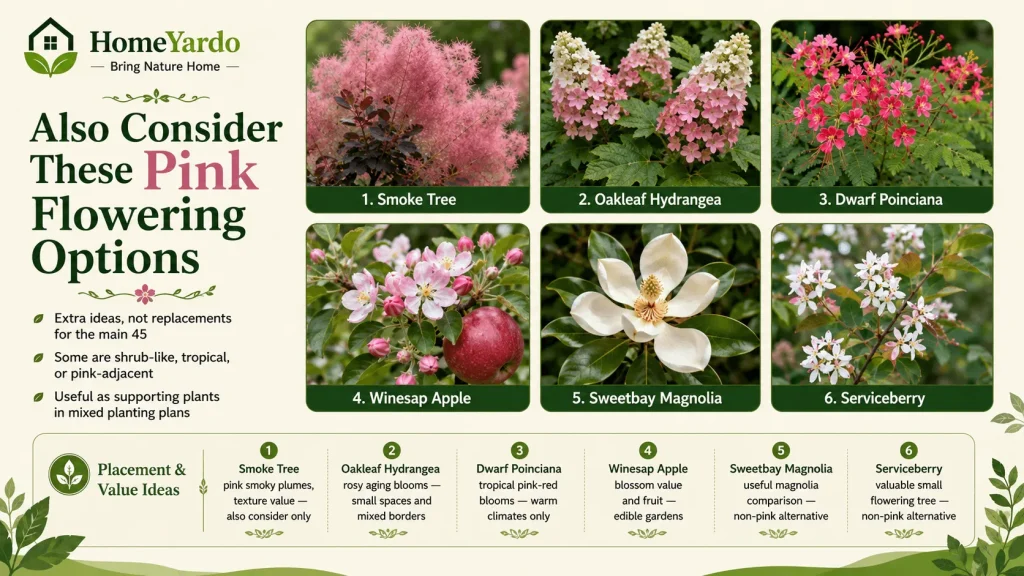
Certain plants are worth knowing about even if they’re not ideal matches for the classic pink-flowered tree. They can be a shrub-like variety or pink-adjacent to tropical or used to support plants.
Consider these ideas as additional suggestions and not as replacements for the 45 main ideas.
| Plant | Why Mention It | Best Placement |
|---|---|---|
| Smoke tree | Pink smoky plumes and texture value | Also consider only |
| Oakleaf hydrangea | Aging blooms can turn pink and rosy | Small spaces and mixed borders |
| Dwarf poinciana | Tropical pink-red blooms | Warm climates only |
| Winesap apple | Fruit tree with blossom value | Edible gardens |
| Sweetbay magnolia | Not mainly pink but a useful magnolia comparison | Non-pink alternative |
| Serviceberry | Often white, but a valuable small flowering tree | Non-pink alternative |
Pink Flowering Spring Trees
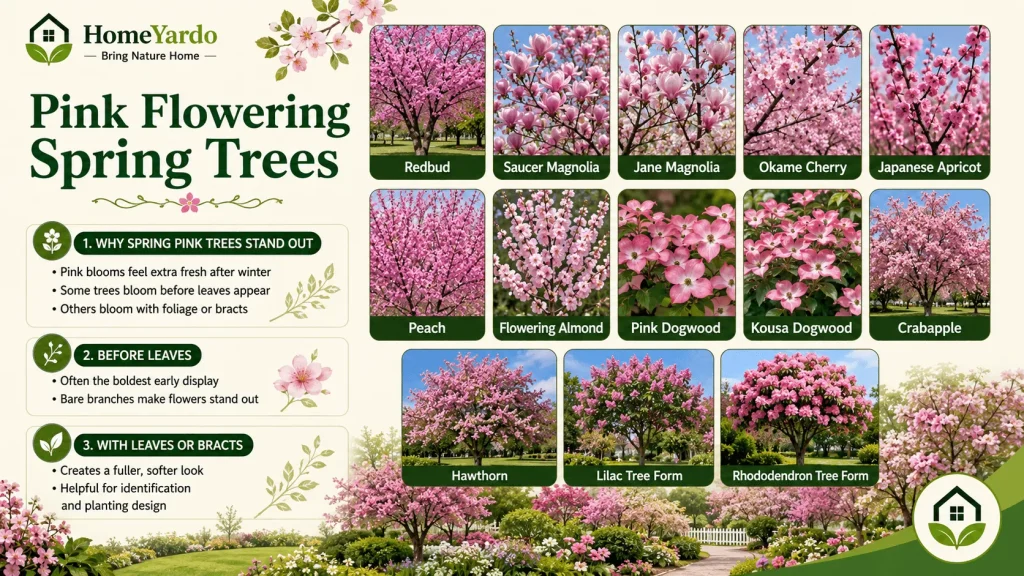
Spring is the most popular season for trees with pink blossoms. The delicate color is stronger because it is a result of the fact that it occurs shortly after winter and usually appears before the garden is filled with leaves.
Certain trees bloom on unadorned branches. Others blossom with bracts, foliage, or both. This is beneficial for the recognition and design of the plant.
Trees With Pink Blossoms Before Leaves
The trees that bloom before the leaves typically create the most dramatic early blooms. The branches appear to be covered with blooms because there is no foliage to hide the colour.
Good examples include:
- Redbud
- Saucer magnolia
- Jane magnolia
- Okame cherry
- Japanese apricot
- Peach
- Almonds that are blooming
Leaves And Trees With Pink Flowers In Spring
Certain trees bloom when leaves begin to open or as the foliage starts to emerge. They often appear fuller and softer in the natural landscape.
Good examples include:
- Pink dogwood
- Kousa dogwood
- Crabapple
- Hawthorn
- The Lilac tree is a form
- The Rhododendron tree is a form
Which Pink Flower Tree Should I Plant In My Yard?
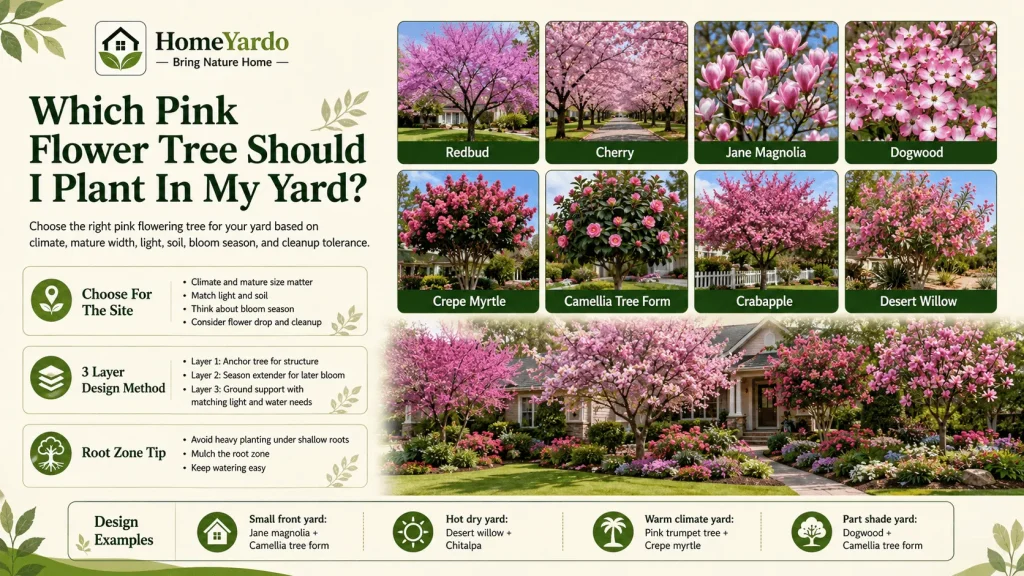
The ideal flowering pink tree is one that is suited to the conditions, size, soil, bloom time, and also the tolerance for cleanup. The tree must look stunning when it is in bloom, and feel when the flowers are gone.
Select the tree as part of a longer-term gardening plan, not just a single spring photograph.
The 3 Layer Pink Tree Design Method
The anchor tree is Layer 1. It is the primary tree that gives the yard structure, including magnolia, redbud, cherry dogwood, and crepe myrtle.
Layer 2. This is the layer that extends the season. This tree blooms at a different time, like Kousa dogwood and desert willow. Camellia and chitalpa. It can also be referred to as the pink panicle hydrangea tree form.
Layer 3 is the support at ground level. Low plants close to the tree need to have the same water and light needs, but not compete too much with roots that are shallow.
Avoid planting heavily directly beneath shallow-rooted trees like magnolia and dogwood. Make sure the root zone is protected with mulch and accessible to water.
Design Examples
The best gardens for pink depend on more than just one flowering moment. These examples mix the color of the canopy, the timing of the seasons as well as a basic sub-planting style.
| Yard Type | Anchor Tree | Season Extender | Best Underplanting Style |
|---|---|---|---|
| Small front yard | Jane magnolia | Camellia tree form | Low evergreen edging |
| Native-style yard | Eastern redbud | Dogwood | Woodland perennials |
| Hot dry yard | Desert willow | Chitalpa | Gravel and drought plants |
| Cottage garden | Crabapple | Pink lilac tree form | Spring bulbs and herbs |
| Warm climate yard | Pink trumpet tree | Crepe myrtle | Low heat-tolerant shrubs |
| Cold climate yard | Crabapple | Flowering almond | Hardy spring bulbs |
| Part shade yard | Dogwood | Camellia tree form | Shade perennials |
| Low cleanup yard | Redbud | Jane magnolia | Mulched ground layer |
Pink Flowering Trees For Wildlife And Pollinators
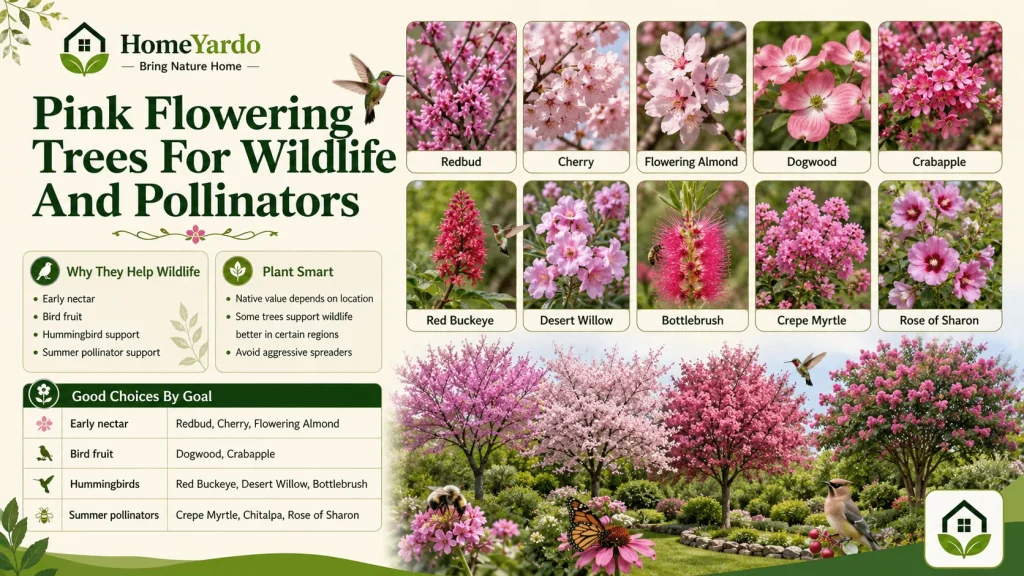
Certain flowering trees that bloom pink bring more than just colour. They may offer early nectar, bird fruits, flowering hummingbird flowers, or summer pollinator assistance.
Native value depends on location. The tree that helps wildlife in one area might not be as suitable in another particularly if it grows quickly.
| Wildlife Goal | Good Choices |
|---|---|
| Early nectar | Redbud, cherry, flowering almond |
| Bird fruit | Dogwood, crabapple |
| Hummingbirds | Red buckeye, desert willow, bottlebrush |
| Summer pollinators | Crepe myrtle, chitalpa, rose of Sharon |
Pink Flowering Fruit Trees
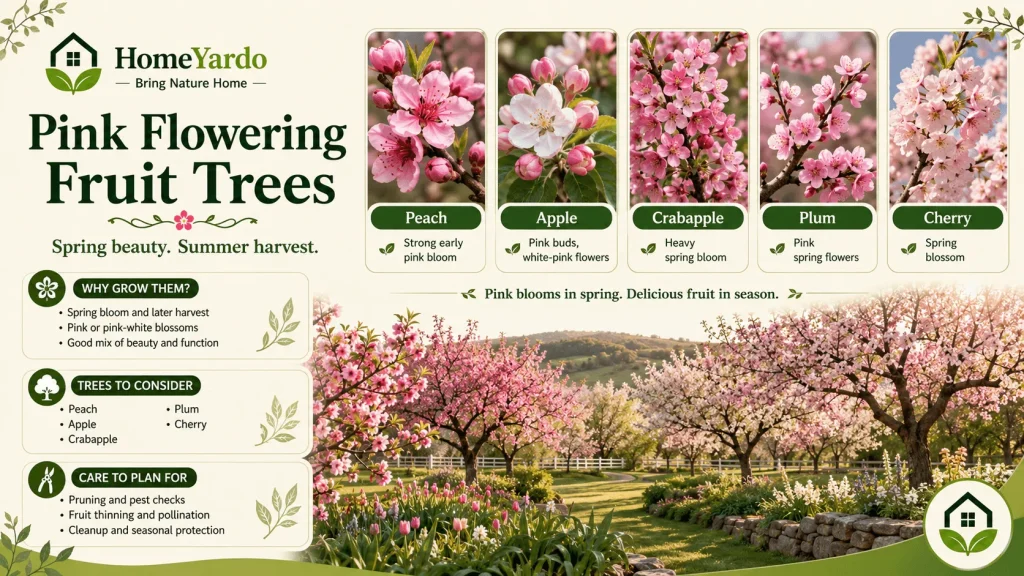
Fruit trees provide two advantages: blossoming in spring and a later harvest. Apple, peach, plum, cherry and crabapple are all able to add blooms that are pink or white.
They also require more attention than a lot of trees that are purely ornamental. Pruning, pest inspections and thinning of the fruit, pollination and cleaning must be part of the overall plan.
| Tree | Flower Value | Fruit Or Cleanup Note |
|---|---|---|
| Peach | Strong early pink bloom | Needs pruning and frost protection |
| Apple | Pink buds and white-pink flowers | Often needs a pollination partner |
| Crabapple | Heavy spring bloom | Fruit may drop or feed birds |
| Plum | Pink spring flowers | Pest monitoring may be needed |
| Cherry | Spring blossom | Fruit types need more care |
True Trees Vs Tree Form Shrubs And Vines
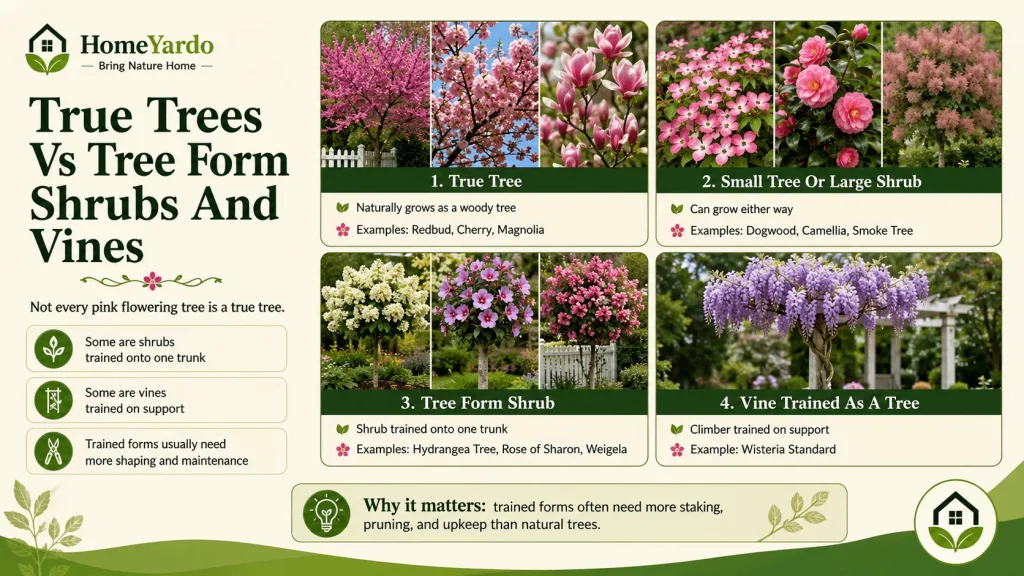
It is not the case that every plant that is referred to as a rose-colored tree can be considered a tree, actually. Certain plants are natural shrubs, but they are tied to one trunk. Some are vines that are anchored on a support so as to resemble trees.
This distinction is important since trained trees often require more shaping and shaping, staking, pruning and care than natural trees.
| Type | Meaning | Examples |
|---|---|---|
| True tree | Naturally grows as a woody tree | Redbud, cherry, magnolia |
| Small tree or large shrub | Can grow either way | Dogwood, camellia, smoke tree |
| Tree form shrub | Shrub trained onto one trunk | Hydrangea tree, rose of Sharon, weigela |
| Vine is trained as a tree | Climber trained on support | Wisteria standard |
Pink Flower Tree Care Guide
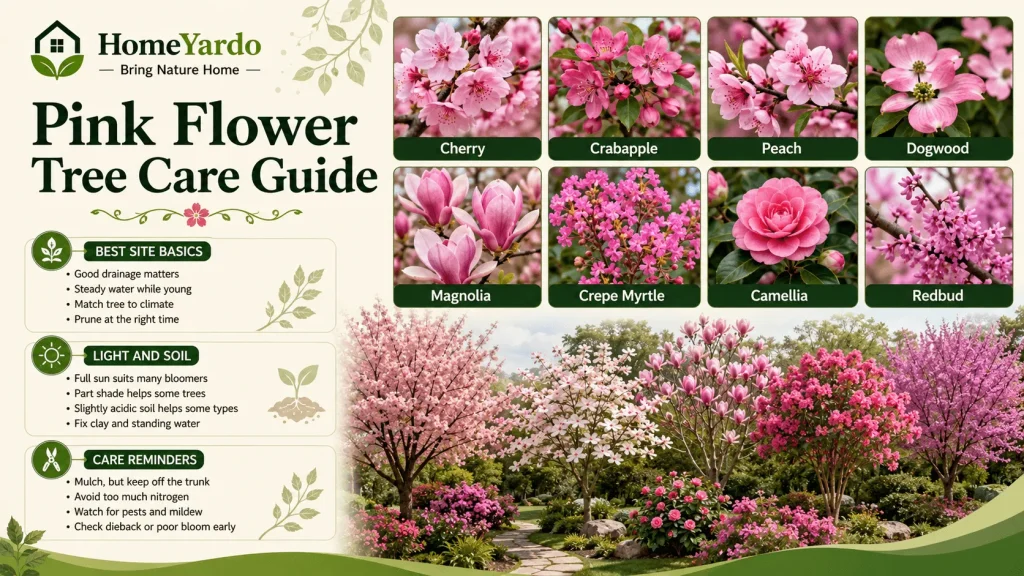
A healthy bloom starts by choosing the correct location. Trees that are planted in poor sunlight or soil might survive, but they could flower poorly or require constant adjustment.
The majority of the flowering pink trees require an adequate drainage system, constant irrigation during the initial stages and pruning when it is appropriate.
| Tree Type | Main Care Need |
|---|---|
| Spring bloomers | Prune after flowering if needed |
| Fruit trees | Annual pruning and pest monitoring |
| Warm-climate trees | Frost protection when young |
| Tree-form shrubs | Regular shaping to keep the standard form |
| Acid-loving trees | Slightly acidic, well-drained soil |
| Dry-climate trees | Do not overwater once established |
Light Needs
A variety of flowers in pink bloom best when they are in full sun, which is usually at least six hours of direct sunlight. Peach, crabapple and cherry crepe myrtle, willow, and even chitalpa typically require strong lighting for the most spectacular flower display.
The camellia, dogwood, rhododendron and magnolias can tolerate shade. In areas of high temperatures, shade in the afternoon can help protect the leaves and flowers from stress.
Soil And Drainage
The soil’s drainage is among the most essential requirements. Roots that are wet can damage numerous flowering trees, particularly crabapple, cherry and magnolia along with Japanese snowbell.
Camellia, magnolia, dogwood and rhododendron all prefer soil that is slightly acidic. Desert canows and redbuds from the west can handle dry soils better after they have been established. Heavy clay or standing water must be addressed prior to planting.
Watering
New trees require gentle, long-lasting watering until roots grow. A shallow daily watering regimen is not as effective because it keeps roots close to the surface.
Drought-tolerant trees require regular watering when they are young. After their establishment trees like desert willow or western redbud endure dry conditions better than trees that prefer moisture.
Mulching
Mulch can help hold water, shield roots and help reduce grass competition. A large mulch ring is particularly beneficial for trees with shallow roots, such as dogwood.
Make sure that the mulch is away from the tree. A mulch pile placed against bark could draw in moisture and cause decay.
Pruning
The pink spring trees are typically cut back after flowering, if a shape is required. Pruning too late could cause the removal of buds that will bloom next year.
Crepe myrtle shouldn’t be topped with a harsh manner. Tree-form plants require light pruning to help keep their trunk free and the canopy in balance. Get rid of dead, crossing or diseased branches whenever needed.
Fertilizer
An examination of the soil is your most secure start point. A high concentration of nitrogen can cause the growth of plants and slow flowering.
Camellia, rhododendron and certain magnolias might require fertilizers specifically designed for plants that are acid-loving. Fruit trees usually require an individualized feeding program that is based on the soil type, age, maturity and the fruiting goals.
Pests And Disease
Common problems include scale, aphids, beetles, borers, mildew, leaf areas, fire blight and canker. Lilac and weigela are susceptible to mildew when there is low airflow conditions, whereas apple and crabapple might require focus on fire blight in certain regions.
If a tree shows signs of dieback, oozing bark, sudden drop of leaves or frequent inability to bloom, the local extension assistance and a certified arborist will give a more precise assessment.
How To Plant A Pink Flowering Tree
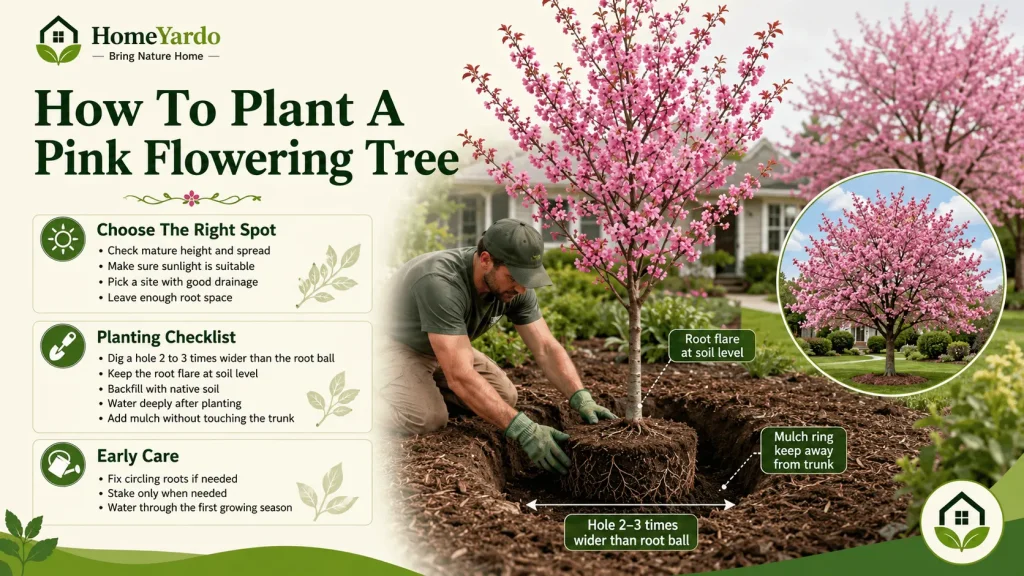
Planting depth can impact the long-term health of trees. A tree that is planted too deeply could struggle for years even though fertilizer and watering appear to be in order.
Begin by assessing the spread and height of mature trees. Select a site that is suited to adequate sun and drainage as well as the space for roots.
Planting Checklist
A well-planned start will help the tree settle down with less stress. Make sure the root flare is visible and do not bury the tree’s trunk.
- Pick a tree that will fit the mature environment.
- Make sure to check the USDA zone and the light exposure.
- Dig a hole that is 2 to 3 times bigger than the diameter of your root ball.
- Remove or correct the circular roots, if they are there.
- Make sure the flare is at the same level as the soil.
- Backfill the soil with native soil.
- After planting, water thoroughly.
- Apply mulch, but don’t touch the trunk.
- Only take a stake when you need to.
- Water throughout the first growing season.
Common Problems With Flowering Pink Trees
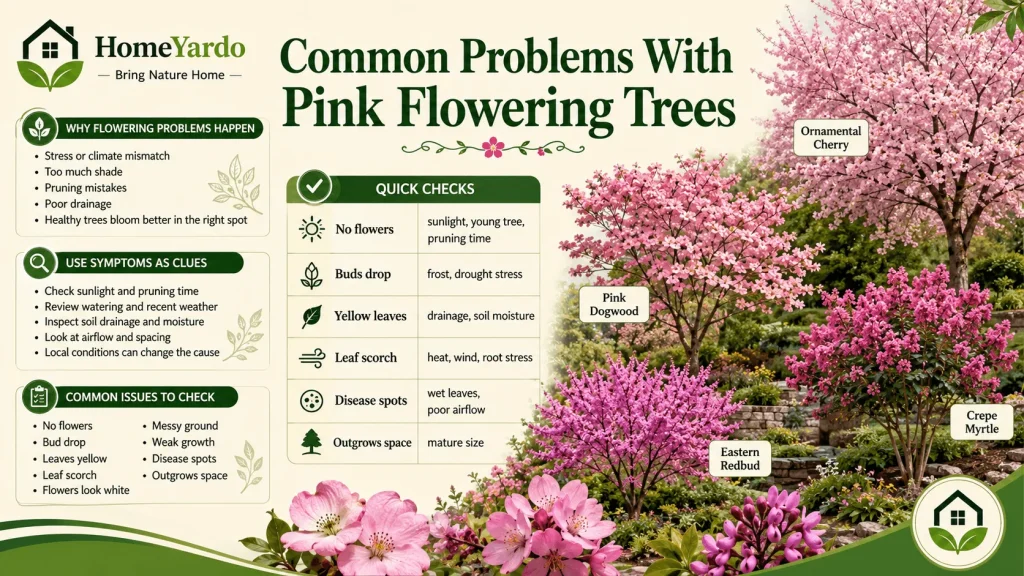
The majority of flowering issues stem from stress, a mismatch in climate and shading, pruning mistakes and poor drainage. A healthy tree planted in the right spot typically blooms more consistently.
Utilize symptoms to help you identify clues, not as definitive answers. The signs of decline must be monitored locally because weather, soil, pests and disease pressure differ by region.
| Problem | Likely Cause | What To Check |
|---|---|---|
| No flowers | Too much shade, young tree, wrong pruning | Sunlight and pruning time |
| Buds drop | Late frost or drought stress | Weather and watering |
| Leaves yellow | Poor drainage or soil issue | Soil moisture |
| Leaf scorch | Heat, drought, wind, or root stress | Watering and exposure |
| Flowers look white | Cultivar, temperature, age, or mutation | Plant tag and bloom history |
| Messy ground | Fruit, seed pods, petals | Tree type |
| Weak growth | Wrong zone or poor soil | USDA zone and drainage |
| Disease spots | Wet leaves or poor airflow | Spacing and irrigation |
| Outgrows space | The wrong mature size was chosen | Height and spread |
Pink Flower Trees To Use With Caution
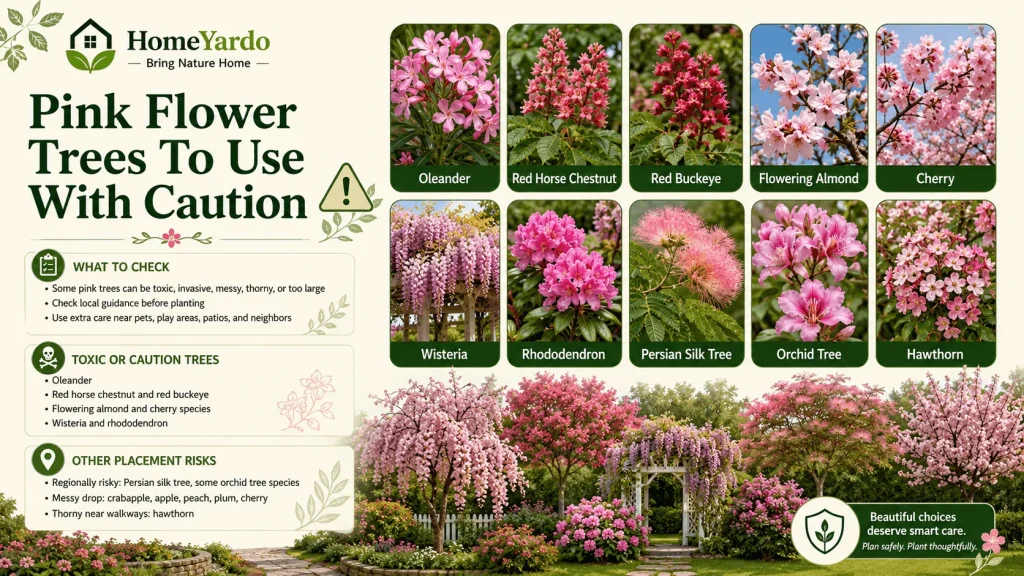
A few flowering pink trees can be gorgeous but aren’t suitable for every area. The plant may be beautiful and yet be poisonous or messy, thorny, and too large for the space.
Make sure you follow local guidelines prior to installing anything that has risks to the region, particularly near play areas, pet zones or patios. It is also important to consider neighbouring properties.
Toxic Pink Flower Trees Or Tree Forms
They require extra attention in areas with pets, children, livestock, and areas of grazing. Beware of placing them in areas where curious animals or small children might chew seeds, leaves or flowers. Also, avoid dropping plant parts.
- Oleander
- Red horse chestnut
- Red Buckeye
- Flowers almond
- Cherry species
- Wisteria
- Rhododendron
Invasive Or Regionally Risky Choices
A tree may be suitable in one location, but be problematic in another. The local invasive plant lists can help in making the final decision.
- Persian silk tree
- Wisteria
- Certain orchid tree species
- Some nonnative ornamentals depend on the region
Messy Choices
Some trees drop fruit, petals, seed pods, or nuts. They are still worth planting, but the place they are planted is important.
Do not place unkept trees alongside the driveways, narrow paths or patios. Avoid placing them near pools, patios and areas with high traffic.
- Crabapple
- Apple
- Peach
- Plum
- Cherry
- Horse chestnut
Thorny Choices
Thorns are a problem around entryways, walkways, playgrounds and patios. Thorny trees can be useful if planted in areas of high traffic.
- Hawthorn
Buying Checklist Before Choosing A Pink Flower Tree
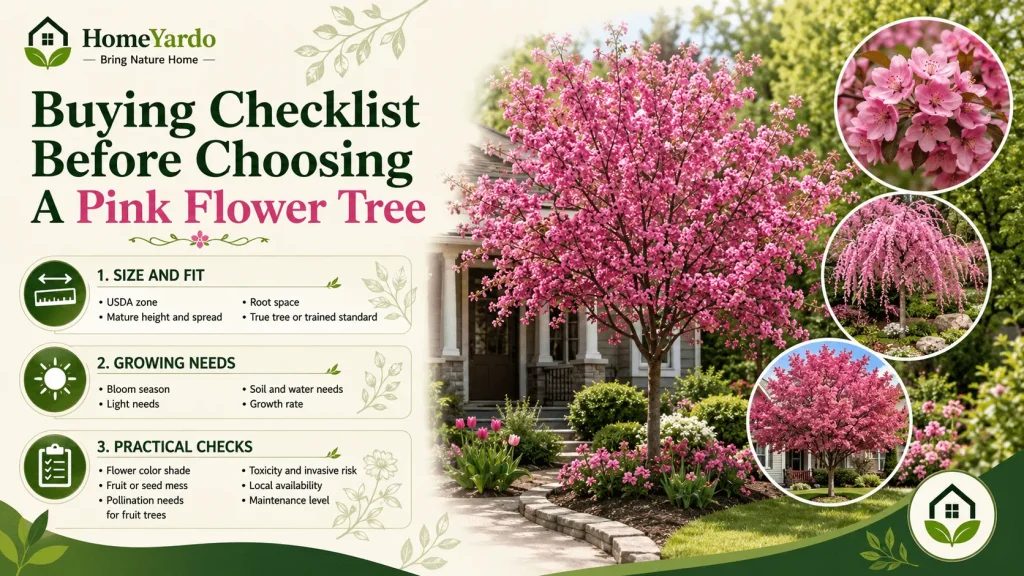
The nursery photos could be appealing, however the tag of the tree will tell the whole story. A healthy tree will be able to look good in the garden right now and be able to continue to grow after 10 or 20 years.
Be sure to read this information before purchasing:
- USDA zone
- Mature height
- Mature spread
- Bloom season
- Flower color shade
- Light is a necessity
- Soil is essential
- Needs for water
- Rate of growth
- Fruits and seeds in a mess
- Pollination is a must for fruit trees.
- Toxicity
- Invasive risk
- True tree vs. standard
- Local availability
- Space for root
- Maintenance level
Final Takeaway
A flowering tree with a pink hue should be selected for a lot more than the flower hue. Size, climate and spread, sunlight, soil, bloom time cleanup, toxicity and maintenance all determine the way that the tree feels right in your backyard.
For many gardens such as cherry blossom, redbud, magnolia and dogwood crepe myrtle and crabapple are excellent beginning points. Smaller gardens might do better by using the Jane magnolia, Ruby Falls redbud, camellia tree form or the pink panicle hydrangea forms.
The best option is to choose a tree that will fit the space elegantly, and is still beautiful when the flowers are gone.
FAQ‘s
Cherry blossom, redbud, magnolia, dogwood, crabapple, peach, plum, and crepe myrtle are common flowering pink trees. In colder zones, redbud, crabapple, cherry, and magnolia are more common. In warmer regions, crepe myrtle, orchid tree, desert willow, and pink trumpet tree may be more likely.
Redbud, cherry blossom, saucer magnolia, pink dogwood, crabapple, peach, plum, and flowering almond bloom with pink flowers in spring. In USDA zones 4 to 8, these are among the most familiar choices. Bloom time can shift by several weeks depending on winter length and spring warmth.
Ruby Falls redbud, Jane magnolia, flowering almond, camellia tree form, and pink panicle hydrangea tree form are strong small-yard choices. Check mature spread before planting near windows, walkways, or driveways. A compact tree should frame the home without crowding the entry.
Crepe myrtle, desert willow, chitalpa, pink trumpet tree, orchid tree, and pink poui can suit warm or hot regions. Desert willow and chitalpa are helpful in dry heat. Pink trumpet tree, pink poui, and orchid tree need warm climates and may not tolerate freezing winters.
Crabapple, flowering almond, eastern redbud, cold-hardy magnolia cultivars, and some cherries can grow in colder regions. USDA zones 3 to 5 need trees that can handle winter lows. Tropical trees such as pink poui and pink trumpet tree are not good choices for freezing winters.
Cherry blossom, eastern redbud, saucer magnolia, pink dogwood, and crabapple are among the most recognized flowering pink trees. The most common choice depends on climate and local planting style. In hot southern yards, crepe myrtle may be more practical than cherry or dogwood.
Redbud, cherry, saucer magnolia, peach, Japanese apricot, and flowering almond can produce pink blossoms before leaves appear. This bare-branch bloom creates a stronger pink effect because leaves do not cover the flowers. In warm climates, some pink trumpet trees can also bloom before the canopy fills.
Crepe myrtle, desert willow, chitalpa, and some cherry trees can grow quickly in suitable climates. Fast growth can help when shade or structure is wanted sooner. Mature size, branch strength, hardiness, and disease resistance should still matter more than speed.
Crepe myrtle is one of the longest-blooming flowering pink trees in warm climates. Rose of Sharon tree form, pink panicle hydrangea tree form, desert willow, and oleander tree form can also bloom for a long period. Spring trees often bloom for less time but create a stronger seasonal moment.
Eastern redbud, Jane magnolia, desert willow, and camellia tree form can be lower maintenance when planted in the right climate and soil. Fruit trees usually need more pruning, pest care, and cleanup. Low maintenance still depends on matching the tree to sun, drainage, and mature space.
Some are safe in normal landscape use, but several need caution. Oleander, wisteria, rhododendron, horse chestnut, red buckeye, cherry species, and flowering almond can be risky if plant parts are eaten. Check plant toxicity before planting near pets, livestock, or play areas.
Redbud has pea-like pink blooms along bare branches and heart-shaped leaves after flowering. Cherry blossom trees have classic Prunus flowers and often create a soft cloud-like spring display. Redbud usually feels more natural and woodland-like, while cherry often feels more ornamental.
Yes, many magnolias are flowering pink trees, including saucer magnolia, Jane magnolia, Susan magnolia, lily magnolia, and pink star magnolia. Their flowers are usually larger than cherry or crabapple blooms. Some magnolias bloom early, so late frost can reduce the flower show.
Fall or early spring is usually best because mild weather helps roots establish. In cold regions, spring planting gives tender trees more time before winter. In warm regions, fall planting can reduce heat stress and give roots more time to settle.
Many flowering pink trees bloom best in full sun, including cherry, crabapple, peach, crepe myrtle, desert willow, and chitalpa. Dogwood, camellia, rhododendron, and some magnolias can handle part shade. In very hot areas, afternoon shade can protect leaves and flowers.
Choose a tree that matches the USDA zone, soil, and sunlight. Water deeply during establishment, mulch around the root zone without touching the trunk, and prune at the right time. Spring bloomers are usually pruned after flowering, while tree-form shrubs need regular shaping.
A soil test is the best starting point because fertilizer needs vary by tree and soil type. Too much nitrogen can encourage leaves instead of flowers. Camellia, rhododendron, and some magnolias may need acid-loving plant fertilizer, while fruit trees need a fruit-tree feeding plan.
Cherry blossom, eastern redbud, saucer magnolia, pink dogwood, crabapple, peach, plum, and crepe myrtle all bloom with pink flowers. In cold and mild regions, redbud, cherry, magnolia, and crabapple are common choices. In warmer climates, crepe myrtle, pink trumpet tree, orchid tree, and pink poui may be better suited.
Flowering pink trees are often called flowering pink trees, pink blossom trees, or ornamental flowering trees. Common names include cherry blossom, redbud, magnolia, dogwood, crabapple, peach, plum, crepe myrtle, and pink trumpet tree. The exact name depends on flower shape, leaf type, bloom season, fruit, and climate.
References
- House Beautiful: https://www.housebeautiful.com/lifestyle/gardening/g71151051/pink-flowering-trees-guide/
- Pretty Purple Door: https://www.prettypurpledoor.com/pink-flowering-trees/
- DIY Gardening: https://diygardening.co.uk/ideas/pink-flowers-trees/
- Planet Natural: https://www.planetnatural.com/pink-trees/
- Mehrabyan Nursery: https://www.mehrabyannursery.com/growing-guide/flowering-trees/pink-flowering-trees/
- Epic Gardening: https://www.epicgardening.com/trees-with-pink-flowers/
- Arbor Day Foundation: https://www.arborday.org/perspectives/10-favorite-flowering-trees-add-your-yard-2022
- The Spruce: https://www.thespruce.com/pink-flowering-trees-for-your-yard-5190641
- Fairview Garden Center: https://fairviewgardencenter.com/blog/pink-trees-bloom-spring/