A Practical Room Comfort Checklist For Changing Seasons
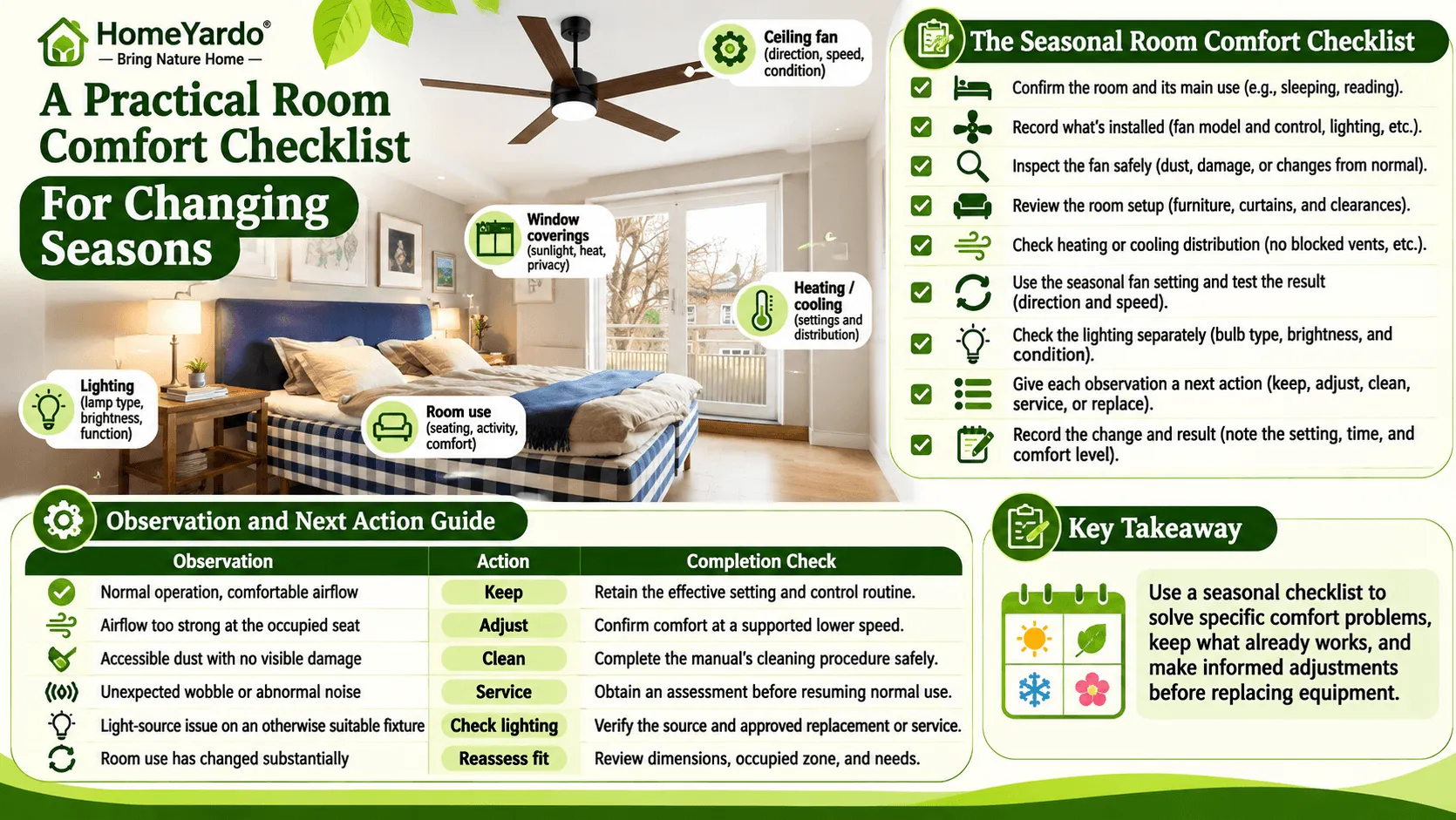
The start of a new season is a good time to check how a room works before replacing anything in it. Window coverings, furniture positions, heating or cooling settings and fan operation can all influence the experience. For the fan portion of the check, AirSurferHome’s summer and winter fan direction guide explains how to review the supported seasonal setting and confirm the airflow. A useful checklist ends with specific actions: keep, adjust, clean, service or replace. Seasonal checks should cover the room, fan settings and lighting separately. Image: AirSurferHome
Make The Checklist About One Room
Choose the room that produces the most consistent complaint. Write down where people sit, what they do there and when discomfort appears. A bedroom used at night has different operating needs from a living room receiving afternoon sun. When planning a larger home improvement project, reviewing how people use the space can also help identify layout and maintenance requirements before changes are made.
Record what is already installed, including the fan’s model, its control method and whether it has a light. Keep the manual or manufacturer guidance available. This avoids importing instructions from another fan that happens to look similar.
Use a short record rather than a vague rating. “Draft feels strong at the reading chair on medium speed” gives you something to test. “The fan is bad” does not distinguish the setting, location or condition responsible.
Inspect Before Changing The Setup
With the fan off and stationary, look from a safe position for visible dust, damaged parts or an obvious change from normal operation. Do not touch moving blades or investigate electrical components.
Unusual wobble, scraping, looseness, a burning smell or another concerning change is not a styling problem. Stop using the equipment where a fault is suspected and arrange appropriate service. A seasonal checklist should not turn into an improvised repair procedure.
For routine cleaning, follow the manufacturer’s method and use safe access. If reaching the fixture is difficult, arrange suitable help. Do not bend blades, soak components or assume that a household cleaning product is suitable for every finish.
Recheck The Room Around The Fan
Furniture arrangements change. A reading chair may have moved beneath a stronger part of the airflow, or a newly placed tall unit may create an obstruction that was not present when the fan was installed.
Look at the full room setup, including open cabinet doors and the position of curtains during use. Keep textiles and objects clear of moving parts and preserve the selected model’s required clearances.
Then check normal heating or cooling distribution. Do not use a fan adjustment to disguise a blocked supply opening or an equipment fault. Record those as separate actions for the appropriate person to resolve.
Choose The Seasonal Setting, Then Test The Result
Use the direction and speed supported by the model. Many residential fans use a downward breeze for warm-weather comfort and a gentle reverse setting for cool-weather circulation, but the manual and the airflow you experience are the practical checks.
Stop the fan before changing a physical direction switch, wait for the blades to stop and follow the specified procedure. After restarting, observe from below without reaching toward the equipment.
Evaluate the setting from the occupied seat. A high speed is not automatically a better one. The goal is comfortable air movement for the activity, not the most noticeable draft available.
Separate Fan Maintenance From Lighting Maintenance
If the fixture includes a light, note its behavior separately. A failed or unsuitable lamp is not evidence that the fan motor needs replacement.
Identify whether the model uses replaceable lamps or an integrated light. For replaceable lamps, confirm the base, allowed rating and any control compatibility before buying replacements. For integrated lighting, follow the documented service process instead of treating the module as a generic bulb.
Check the lighting with the other lamps normally used in the room. A new bulb that appears too harsh may be a lighting-selection issue, while flickering or another abnormal condition may require qualified attention.
Give Each Observation One Next Action
| Observation | Action category | Useful completion check |
|---|---|---|
| Normal operation, comfortable airflow | Keep | Retain the effective setting and control routine |
| Airflow too strong at the occupied seat | Adjust | Confirm comfort at a supported lower speed |
| Accessible dust with no visible damage | Clean | Complete the manual’s cleaning procedure safely |
| Unexpected wobble or abnormal noise | Service | Obtain an assessment before resuming normal use |
| Light-source issue on an otherwise suitable fixture | Check lighting | Verify the exact source and approved replacement or service method |
| Room use has changed substantially | Reassess fit | Review dimensions, occupied zone and performance needs |
Do not leave the action as “check fan” indefinitely. Add who will do it and what information they need: the model number, a description of the condition and when it occurs.
Close The Loop After The Change
Consider an illustrative room where the reading chair was moved closer to the fan and the occupants began reporting an uncomfortable draft. If a supported lower speed resolves the complaint, replacement may not be necessary. Record the new setting and reassess it during normal use.
In a different room, visible wobble may continue regardless of speed. That belongs in the service category, not a sequence of informal adjustments. The checklist helps distinguish the two situations without claiming to diagnose a mechanical fault.
For ordinary warm-weather cooling use, include switching the fan off when the room becomes empty. A fan circulates air rather than refrigerating an unoccupied room. Keep any cool-weather circulation routine tied to a useful, observed result.
Make the comparison repeatable. Note the time of day, occupied seat, curtain position and fan setting before changing one item. Repeat the observation under reasonably similar conditions, rather than comparing an empty room in the morning with a crowded room in afternoon sun. Ask the person who normally uses the room whether the change helped with the original complaint. A quieter reading session and a more comfortable seat are useful observations; an assumed reduction in the electricity bill is not a measured result. Keep a short before-and-after note so the next seasonal review starts with evidence instead of repeating the same experiments.
Replace Only Against A Clear Requirement
Replacement becomes easier to evaluate when the reason is specific: an unsuitable installation arrangement, a service problem that cannot be resolved appropriately, changed room use or a control requirement the existing model cannot meet.
Carry the room measurements and maintenance findings into the shortlist. Compare complete installed dimensions, operating information and service options rather than selecting solely by appearance.
The value of a seasonal checklist is not the number of tasks it creates. It is the number of uncertain complaints it turns into a clear decision, while leaving correctly functioning equipment alone.
Final Takeaway
A seasonal room comfort checklist helps homeowners solve specific comfort problems before replacing equipment unnecessarily.
Start with one room, identify the original complaint, inspect visible conditions safely, and test supported adjustments.
Keep ceiling fan operation, lighting, furniture placement, and heating or cooling concerns separate so each problem receives the right response.
When equipment shows signs of a possible fault, arrange qualified service rather than experimenting with repairs.
A short before-and-after record makes the next seasonal review easier and helps preserve the settings that already work.
Frequently Asked Questions
Include ceiling fan direction and speed, furniture placement, window coverings, heating or cooling settings, visible fan condition, lighting, and the comfort of occupied seating areas. Record each observation and assign a next action.
Review settings when seasons change, when furniture is rearranged, or when occupants report a new comfort problem. Follow manufacturer recommendations for equipment maintenance and cleaning intervals.
Many conventional ceiling fans rotate counterclockwise when viewed from below during summer, producing downward airflow. Always confirm the intended setting in your model’s instructions.
Many conventional models use clockwise rotation at a low speed to support gentle air circulation during winter. Some designs operate differently, so follow the manufacturer’s guidance.
A ceiling fan generally does not lower room air temperature. Its moving air can help people feel cooler by increasing heat loss from the skin.
A strong draft may result from fan speed, seasonal direction, or the position of occupied seating. If the fan operates normally, test a supported lower speed and reassess comfort. Abnormal vibration or noise requires a different response.