
How To Tell If Your Home Needs New Insulation
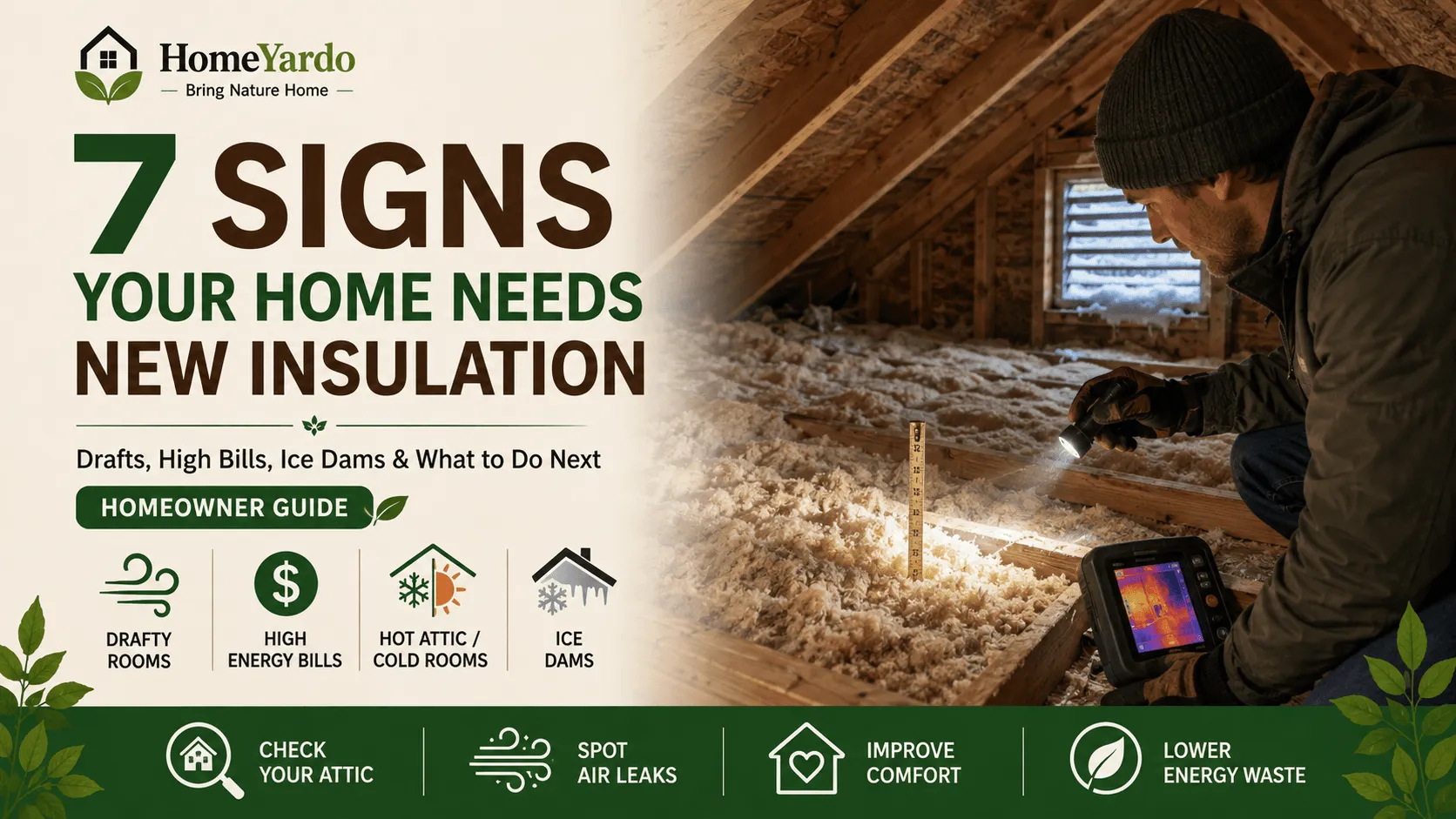
Your heating bill climbed again last month, but nobody touched the thermostat. One bedroom runs ten degrees warmer than the rest of the house. The attic feels like a sauna in July. These aren’t random quirks — they’re your home telling you its insulation is failing. The trick is knowing how to read the signals before another winter of wasted money rolls in.
A lot of homeowners think that insulation is a no-maintenance type of product. Set it up, and forget about it! This is a costly assumption. Insulation loses its insulating properties, settles, gets wet and is disturbed due to pests or renovations. Many houses, even those constructed fairly recently, do not meet the present energy performance requirements. The solution is to take about 30 minutes to observe and make it a point to actually go up to your attic.
The Thermal Drift Ladder: A Simple Diagnostic Framework

Here’s a framework I call the Thermal Drift Ladder. Start at the top of your home and work down. Heat rises, so the attic is where most insulation failures begin. From there, problems cascade into the walls and basement. Each rung of the ladder gives you a more specific answer about where your insulation gaps actually live.
- Rung 1 — The top of the attic. Go up and look at the thickness of the insulation. For most northern climates, 10 to 14 inches of blown-in cellulose or fiberglass is desired. If the tops of your floor joists are visible, it is a problem. Thin insulation is worse than compressed, discolored or visibly wet insulation.
- Rung 2 — Upper-floor rooms. On a hot summer day, go through all the rooms on the second floor of the house in the middle of the afternoon. If the room is clearly warmer than the ground floor, and the air conditioner is on, it’s a clear sign of attic insulation failure. That same room will be cold at the ceiling during winter with the heat turned up, too.
- Rung 3 — Exterior walls. On a cold night, touch an inside wall surface. Insulated walls are near room temperature. If the wall is cold and clammy, it is losing heat to the outside.
- Rung 4 — The rim joist of the basement. This is the piece of wood that is installed between your foundation wall and the floor above. One of the most neglected air leakage areas in any home. Look into corners of basement framing where it connects to the foundation. Look for areas where there is no insulation in place, as these are major heat loss areas.
- Your Energy Bills Are Telling You
- One of the most obvious diagnostic indicators is if there is a significant increase in heating or cooling expenses with no other changes. The EPA’s ENERGY STAR program estimates that homeowners can reduce their heating and cooling bills by an average of 15% by sealing the air leaks in their home and insulating their attics, floors over crawl spaces, and accessible basement rim joists. That’s a significant amount and suggests that homes with poor air sealing and insulation are paying too much for their homes on a regular basis by that amount or more.
Air leakage can also occur around doors and other openings, so drafts do not always mean the insulation itself has failed. In areas such as an attached garage, garage door weatherstripping can help control unwanted airflow around the door edges while insulation handles heat transfer through the building assembly.
Your Energy Bills Are Telling You Something

A spike in heating or cooling costs, when nothing else has changed, is one of the clearest diagnostic signals available. According to the EPA’s ENERGY STAR program, homeowners can save an average of 15% on heating and cooling costs by air sealing their homes and adding insulation in attics, floors over crawl spaces, and accessible basement rim joists. That’s a meaningful number, and it implies that homes without adequate air sealing and insulation are routinely overpaying by that margin or more.
Pull up 12 months of utility bills and compare year over year. If your costs are climbing while your usage habits haven’t changed, and your HVAC equipment isn’t aging out, insulation is the most logical culprit to investigate. If costs are climbing while your habits haven’t changed, inspect the home as a system rather than assuming insulation is responsible. Air leaks, HVAC performance, duct losses, and inefficient windows can produce similar symptoms. If drafts or temperature changes are concentrated around older windows, a window replacement assessment can help determine whether the opening, glazing, frame, or surrounding insulation is contributing to the problem.
“Poorly insulated homes cause high energy bills, uncomfortable temperatures, and needless damage to our climate from wasted energy. This report shows that under-insulated homes are unfortunately not a rare occurrence but rather the norm.”- Steve Nadel, Executive Director, American Council for an Energy-Efficient Economy, commenting on 2024 ICF Consulting research
How Common Is This Problem, Really?
More common than most people expect. Research sponsored by NAIMA and conducted by ICF Consulting found that 89% of U.S. single-family homes are under-insulated, using the 2012 International Energy Conservation Code as the benchmark, based on the National Renewable Energy Laboratory’s 2024 ResStock database of 1 million homes.
That number includes newer construction, not just old farmhouses. Builders often meet minimum code requirements at the time of construction, but codes have tightened considerably over the years, and settling or moisture intrusion degrades performance over time. If your home is more than 15 years old, there’s a strong statistical case for at least inspecting your current insulation levels.
Heating and cooling are also the biggest energy draws in any home. According to the U.S. Energy Information Administration’s 2020 Residential Energy Consumption Survey, space heating alone typically accounts for about 40% of energy use in homes. That’s the single biggest line item in your home’s energy budget, which means insulation improvements carry an outsized return compared to almost any other upgrade.
Warning Signs You Can Check Today
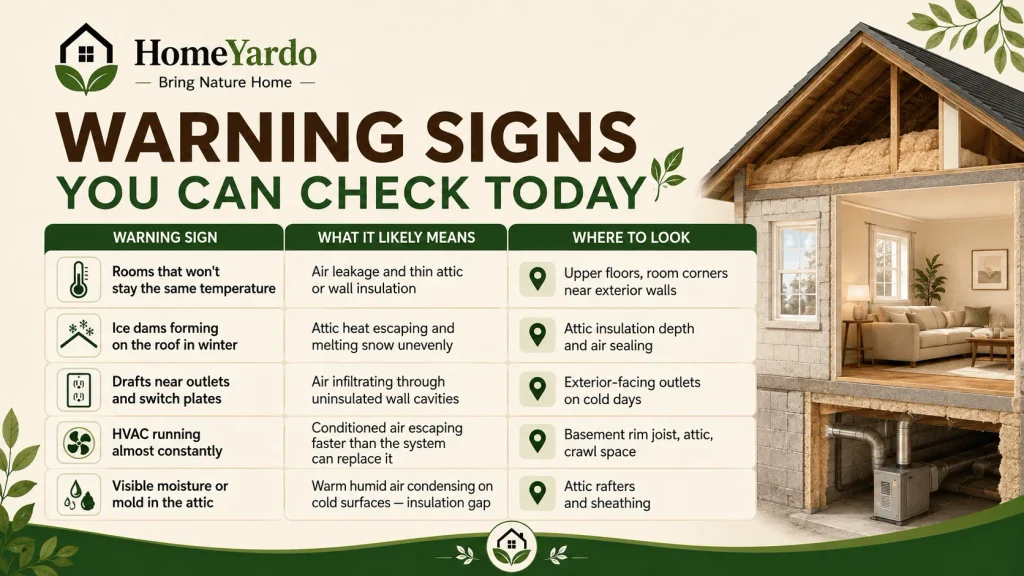
| Warning Sign | What It Likely Means | Where to Look |
|---|---|---|
| Rooms that won’t stay the same temperature | Air leakage and thin attic or wall insulation | Upper floors, room corners near exterior walls |
| Ice dams forming on the roof in winter | Attic heat escaping and melting snow unevenly | Attic insulation depth and air sealing |
| Drafts near outlets and switch plates | Air infiltrating through uninsulated wall cavities | Exterior-facing outlets on cold days |
| HVAC running almost constantly | Conditioned air escaping faster than the system can replace it | Basement rim joist, attic, crawl space |
| Visible moisture or mold in the attic | Warm humid air condensing on cold surfaces — insulation gap | Attic rafters and sheathing |
What To Do Once You’ve Confirmed The Problem
Don’t simply apply insulation over poor insulation. When the current material is damp, mouldy, damaged by pests or older products that have become degraded, removal must be done first and only then can replacement be considered. New blown-in cellulose simply covers up the sodden fiberglass.
Second, air sealing and insulation go hand in hand. Insulation reduces heat transfer and air sealing prevents air from moving. If the attic is not well insulated and there are still open spaces around plumbing, wiring and HVAC ducting, it will fail to perform well. The two upgrades are most effective when done at the same time.
Third, get a professional assessment before committing to materials or R-values. A qualified contractor will use a blower door test to measure actual air leakage and can identify where your specific home loses the most conditioned air. If you’re in the Stratford, CT area, for example, a company specializing in insulation installation Stratford can perform a home energy audit that maps out exactly where the gaps are before any work begins.
If you prefer to check yourself out in a preliminary way, take a stick of incense on a cold and windy day. Close all windows and doors, shut off the HVAC, and circulate the incense around window frames, electrical outlets and the attic hatch. Smoke traveling across the side is an indication of air leakage. It’s not scientific, but it will get you to the right places before you call a pro.
The Bottom Line
When your home is uncomfortable, your bills are uncomfortable, and your attic is cold, it’s money that’s leaving your home every day. The diagnostic steps outlined above are less time-consuming than running to the grocery store, and the information you gather will help you determine if you’re installing a little more insulation or a complete retrofit. In any case, you’ll know. Knowing is what makes a hunch about your heating bill a project with a definite return on investment. Begin at the top of your house this week. Take a flashlight, open the attic door and check out what’s really in the attic. The results may come as a surprise.
FAQ’s
Unusual heating or cooling spikes, inconsistent temperatures in rooms, drafts, extended run times of the HVAC system, ice dams, or poor attic insulation or wet or damaged insulation are common warning signs. An energy assessment can be used to determine the real cause.
There is no one standard replacement schedule for insulation. It is influenced by the material, installation, moisture exposure, pests, compression, disturbance and building assembly. Dry, intact insulation may not require a complete change-out.
In certain cases, extra insulation can be added to an existing insulation system that is dry, clean, and undamaged and can be left in place. Any insulation that is wet, contaminated, damaged by pests or otherwise compromised should be evaluated before additional insulation is placed upon it.
It can contribute. Less insulation will lead to more heat transfer across the building envelope that may result in greater heating and cooling needs. Other factors that can impact bills include air leakage, HVAC efficiency, ducts, weather, energy rates and occupant behavior.
One of the possibilities is missing or inadequate insulation, but duct problems, imbalance of airflow, air leaks, windows, solar exposure, and room location can also cause differences in temperature.