How To Reduce Delays In Property Development Projects

‘By failing to prepare, you are preparing to fail.’ This phrase from Benjamin Franklin perfectly describes one of the major problems in real estate development, which is maintaining schedules in a complicated project.
From developing apartments and constructing commercial buildings to renovating existing properties, all of them can easily be delayed, thus turning a potentially profitable venture into an extremely expensive one.
The problem lies in the fact that property development is a process that includes coordination of various people, assets, and processes. Failure to maintain effective communication or neglecting to consider some details can cause a snowball effect and result in a project delay.
However, there is no need to worry, because many of the possible delays can be avoided with a proper approach to development.
This article will show how it is possible to maintain your property development project schedule, how to avoid any additional delays and how to successfully complete construction of the project on time and within budget.
Improve Material Tracking And Supply Chain Visibility
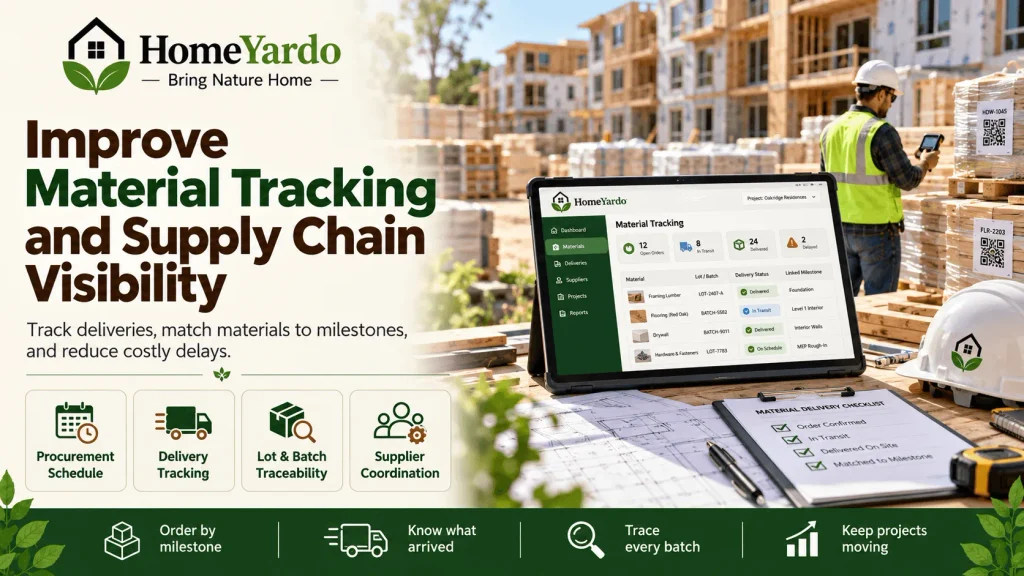
Material supplies play a vital role in every construction project. No matter how thoroughly you have planned the schedule, you won’t be able to complete tasks unless your materials arrive at the correct time.
However, supply chain issues are one of the most common reasons for construction delays. Supplies may not arrive on time; there might be the wrong amounts of material or some of the supplies may not conform to the necessary criteria. Sometimes, materials are available but nobody knows where they are kept or what deliveries they relate to.
And this is exactly why you should start with increasing visibility of your materials.
First of all, you need to develop a procurement schedule that links material orders to particular construction milestones. In other words, you have to plan orders according to the need for the materials rather than order everything at once or wait until supplies become urgent.
You also have to keep track of orders that you have made, materials that have been delivered to your construction site and used during work.
For developers that deal with prefabricated components, building products or manufacturers, lot traceability software provided by MRPeasy may help to do so. It tracks materials and manufactured products through batch/lot numbers and stores information about their origin, quantity, price, expiration date and certificates of conformity.
Traceability is especially useful when materials that have to meet particular criteria or comply with the requirements are ordered.
In case of any issue related to the product batch reported by the supplier, it becomes much easier to find out which products are affected rather than investigate every delivery.
Moreover, this software allows purchasing and production staff to monitor materials better.
However, using the software won’t solve supply chain issues alone. You also have to communicate with your suppliers regularly to make sure that your deliveries come to you on time before some critical stages of construction, and to find alternative suppliers for your essential materials.
Keep Subcontractors Connected And Working From Current Plans

Even if your materials are delivered on time, delays in implementation can occur due to the lack of coordination among the persons in charge of executing work.
Take, for instance, any construction project. Electricians should complete some parts of the installation prior to plastering. Plumbing contractors rely on structural elements being finished. Flooring experts will not be able to do anything without prepared surfaces.
The delay in execution or obsolete drawings in one team will result in delays in multiple other teams.
In order to ensure smooth execution of work and minimize delays, you should establish proper communication and provide convenient access to project information.
Instead of using scattered emails, printed drawings and hours spent on long phone calls, it would be reasonable to use a single place for all subcontractors to get the information they need.
For instance, the project management software for subcontractors called Fieldwire allows construction teams to collaborate and coordinate work from the field. Its platform makes sure that the drawings are synchronized, handles drawing revisions and gives crews the opportunity to access and comment on the drawings via a mobile device, tablet or computer.
It is especially useful that the platform provides such an option as offline access to drawings which makes it possible to use it at the construction site even with a poor Internet connection.
It can be really helpful when it comes to revised drawings provided by architects or engineers. Instead of wondering whether the team got the drawings, you will have an efficient tool to disseminate new information and avoid working according to outdated plans.
Nevertheless, technology will prove itself only if you set up clear expectations.
Each subcontractor should know about his duties, deadlines, dependencies and reporting procedures. Hold regular coordination meetings, encourage teams to report any problems in advance and assign someone to handle the conflict between trades.
Not every meeting requires a long time. Sometimes the discussion of future tasks and possible barriers takes only minutes.
Plan a Realistic Timeline from the Start

One of the major reasons why construction projects often get delayed is excessive optimism in planning. Of course, it is natural for every developer to try to complete construction work as fast as possible since it allows earning money from rent quicker, sell constructions, and save on the financing of construction projects. However, there is a significant difference between having challenging deadlines and setting a reasonable timeline that your team will be able to follow.
Consider developing a plan where you obtain every permit immediately, every material is delivered on time, and each contractor completes all the assigned construction activities without facing any disruptions. It sounds ideal, but construction rarely works that way. Unexpected weather, supply problems, and technical complications can easily disrupt the best-planned construction activities. That’s why your schedule needs to account for how construction actually happens, rather than how you’d like it to happen.
Start by dividing the development into clear phases, including design, approvals, site preparation, foundations, structural work, installations, finishing, and inspections. Then consider how these activities depend on one another.
For example, certain structural tasks can’t begin until the foundations are ready, while interior finishing often has to wait until electrical and plumbing installations have been inspected. Understanding these connections helps you identify the critical path, or the sequence of tasks that determines how quickly the entire project can be completed.
Then, consider the amount of additional time needed to perform certain activities. Take into account how much time you need to wait for the planning permission, for delivery of the required materials, and other sensitive activities. Don’t forget about the holiday period, regular equipment maintenance, and inspection dates.
Monitor Progress and Respond Quickly to Warning Signs

Rather than relying on occasional updates or waiting until the end of the month to review progress, establish a routine for checking completed work against your original schedule. Weekly progress meetings are a good place to start, as they give everyone an opportunity to discuss achievements, upcoming activities, and potential obstacles before they become serious problems.
A useful weekly progress report could include:
- Completed milestones: Verify which tasks have been completed and whether the output satisfies the necessary quality requirements.
- Future work: Go over the assignments for the upcoming week or two so that everyone is aware of what is expected of them.
- Material availability: Verify that the equipment and supplies required will be delivered on time.
- Subcontractor readiness: Verify that the appropriate teams are available and ready to start their assigned tasks.
- Unresolved decisions: Determine any outstanding approvals, design queries, or technical problems that might cause delays.
- Possible delays: Talk about new issues and determine who is in charge of fixing them.
Finding a delay is, of course, only half the work. Before choosing how to react, you must also comprehend what is causing it. For instance, adding more workers to the site won’t help much if they’re still waiting on materials. Similarly, if construction cannot proceed until an inspection is finished, then extending working hours won’t be helpful.
Begin Preparation for Handover before End of Construction Process
Many developers wrongly assume that since construction is coming to an end, their projects are nearing completion. However, that is often not true. Developers are so preoccupied with completing the physical part of a project that they forget about the administrative part. Different kinds of developments require different preparations prior to handover, including inspections and safety certification, connection to utilities, repairs of defects and so on. Failure to prepare for such requirements will result in completion of a building that cannot be legally occupied by anybody. This situation is especially frustrating for a developer whose time and resources have already been invested in fulfilling the construction deadline.
The best course of action in this case would be to start preparing for a development’s handover while it is still under construction. This implies that one should ascertain ahead of time what kinds of certifications and inspections must be obtained, as well as who is in charge of each. While there is still time, collecting warranties and maintenance and operations manuals from contractors is another crucial step. Requesting documents from contractors who have long since left the project is far more challenging.
Additionally, it is important to make sure that the necessary inspections and defect reviews have enough time to allow for corrections. Therefore, this process should be divided into multiple phases and completed concurrently with the remainder of the construction process rather than being delayed until the very end.
FAQs
Realistic timetables, incomplete designs, sluggish approvals, late materials, disputes between subcontractors, labor shortages, inspection delays, scope changes, unforeseen site conditions, and inadequate communication among project participants are common causes.
A realistic program, identification of critical activities, early ordering of long-lead materials, co-ordination of subcontractors, control of design changes, regular monitoring of progress and preparation of approvals and handover requirements in advance can help reduce construction delays.
The series of interdependent tasks that directly establishes the earliest feasible project completion date is known as the critical path. If there is not enough scheduling flexibility or float, a critical activity delay may impact the completion date.
Late materials can prevent dependent work from starting even when labor and equipment are available. Procurement planning should therefore consider lead times, approvals, manufacturing, delivery, storage, and the date each product is actually needed on site.
Give subcontractors access to current drawings, clearly define responsibilities and deadlines, identify dependencies between trades, confirm upcoming work in advance, and resolve conflicts before one team’s delay affects several others.