
How To Tell If Your Toilet Is Leaking (And What Happens If You Ignore It)
Your water bill suddenly increased by $40 and you don’t know why. The shower duration is the same. There was no hose left on. It’s almost always because of the toilet and the bad news is you don’t realise it’s doing it.
The most frequent and least noticed plumbing issue in homes is leaky toilets. The trickle behind the tank can be as quiet as a mouse, or the rush of water every couple of minutes; either one or the other causes damage and does so quickly. Here are the steps on how to identify one, decipher what you’re looking at, and when the repair isn’t a weekend task.
The Three Leak Profiles You’ll Actually Encounter
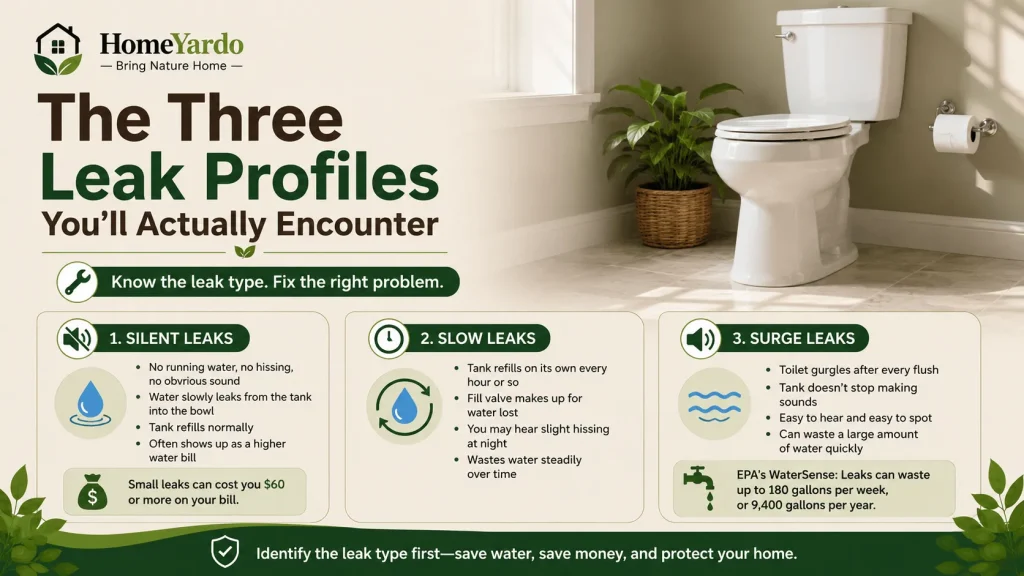
There are many different types of toilet leaks and if you don’t recognize the type, you are likely to end up fixing the wrong problem. It is always good to have this in mind before picking up a wrench.
A silent leak is the worst! Nothing is made of water running out of the tank into the bowl, no hissing, no sound, just the water oozing out of the tank in the bowl. Toilet works well. The tank fills in regularly. However, if the gap is only a hairline, then there’s a constant drop in the flapper seal straight into the bowl, 24 hours a day, seven days a week. These are the leaks you’ll see as an overage on your bill and will be confused by, because it costs you $60.
Slow leaks are a little easier to detect. Even if no one used the toilet you may notice that the tank refills for a short period of time every hour or so. This is the fill valve making up for water lost. A slight hissing sound may be heard in the house at night when it is quiet.
Surge leaks can be easily identified. After each flush, the toilet gurgles, the tank doesn’t stop making sounds and the noise is audible. These can consume water at an astounding speed. The EPA’s WaterSense program estimates that the average household can lose 180 gallons a week, or 9,400 gallons a year, due to leaks in their plumbing. And that leaky toilet can account for a significant portion of that total.
The Food-Coloring Test: Two Minutes, No Tools

This is the quickest diagnostic that can be performed and is free. Here’s how to do it.
- Remove the top of the tank; carefully place it on a towel.
- Add 5-10 drops of food coloring to the tank water. Any colour will do, but blue or green is most suitable against the white porcelain.
- Do not flush. Take a 10-minute walk to get away from anything without touching.
- Return to the water in the bowl. If you notice the colour bleeding in, water is leaking from the tank to the bowl without a flush command. That’s a confirmed leak.
- The darker the color in the bowl, the greater the leak rate.
When the water in the bowl remains clear, the flapper seal is holding. Then proceed to the supply line connection at the bottom of the tank and look to see if there is any water around the toilet base on the floor, indicating a failed wax ring and not an issue with something else within the toilet unit.
What a Leaking Toilet Actually Costs Over Time
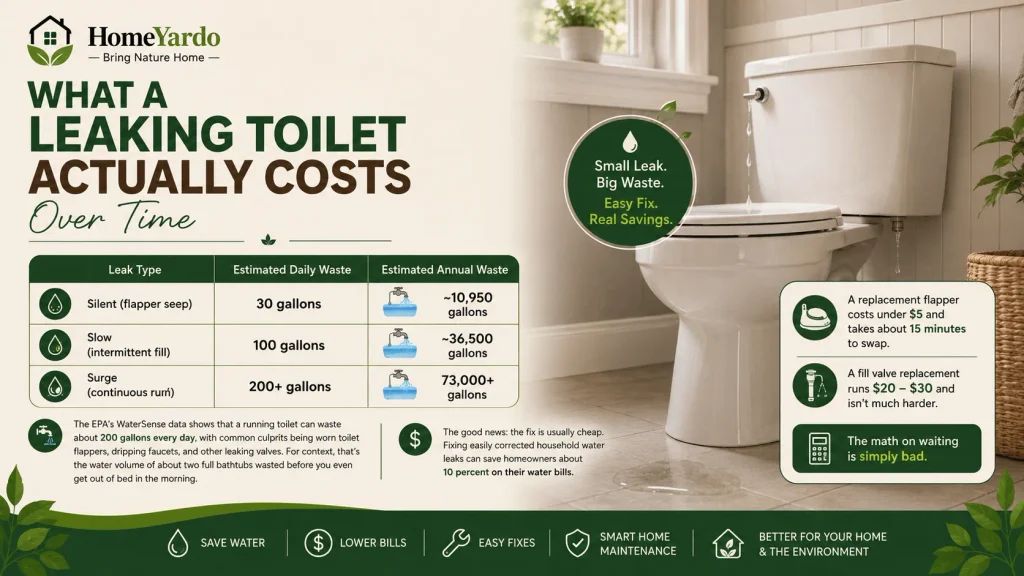
People tend to mentally file toilet leaks under “annoying but minor.” The numbers argue otherwise.
| Leak Type | Estimated Daily Waste | Estimated Annual Waste |
|---|---|---|
| Silent (flapper seep) | 30 gallons | ~10,950 gallons |
| Slow (intermittent fill) | 100 gallons | ~36,500 gallons |
| Surge (continuous run) | 200+ gallons | 73,000+ gallons |
The EPA’s WaterSense data shows that a running toilet can waste about 200 gallons every day, with common culprits being worn toilet flappers, dripping faucets, and other leaking valves. For context, that’s the water volume of about two full bathtubs wasted before you even get out of bed in the morning.
The good news: the fix is usually cheap. Fixing easily corrected household water leaks can save homeowners about 10 percent on their water bills. A replacement flapper costs under five dollars at any hardware store and takes roughly fifteen minutes to swap. A fill valve replacement runs twenty to thirty dollars and isn’t much harder. The math on waiting is simply bad.
The Four Parts Most Likely to Fail
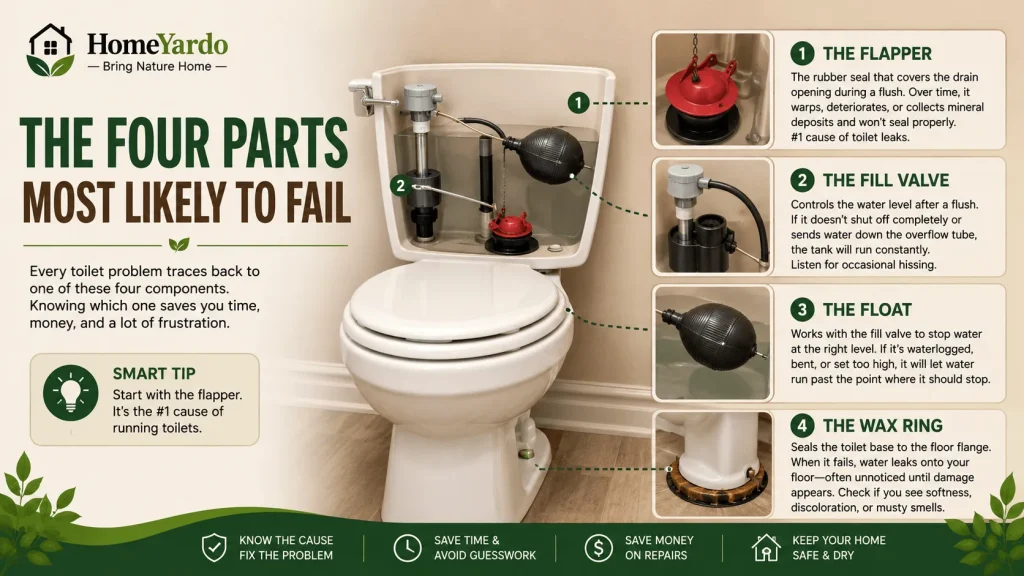
You don’t need to be a plumber to understand what’s happening inside your tank. Every toilet failure traces back to one of four components, and knowing which one saves you a wasted trip to the hardware store.
The rubber seal in the bottom of the tank that falls over the drain after a flush is the flapper. It is the leading cause of toilet leaks–and that’s saying a lot. Rubber deteriorates over time, particularly if exposed to chlorinated water, and even if it is a slight warp or mineral deposits accumulate, it will not seal off properly. If you have a positive food-coloring test, do this first.
After the flush, the water level is controlled by a fill valve. It either overflows the tank (due to not shutting off completely) or it overflows the tank (due to it sending water down the overflow tube). Occasional hissing will be heard when no one is in the bathroom.
The float is used to control the fill valve. Older style ball cock toilets have a rubber float on a metal arm. Riding too high, it will maintain the water flow past the point where it should stop if it is waterlogged or bent.
The wax ring seals the connection between the toilet and the floor flange. When that seal fails, water may appear around the toilet base during or after flushing rather than leaking silently into the bowl. Don’t assume the wax ring is always responsible, though. Supply connections, tank hardware, or condensation can also leave water on the floor. Repeated moisture should be investigated quickly because hidden water damage can spread into the flooring and subfloor before the problem becomes obvious.
When You Should Stop DIY-ing And Call Someone
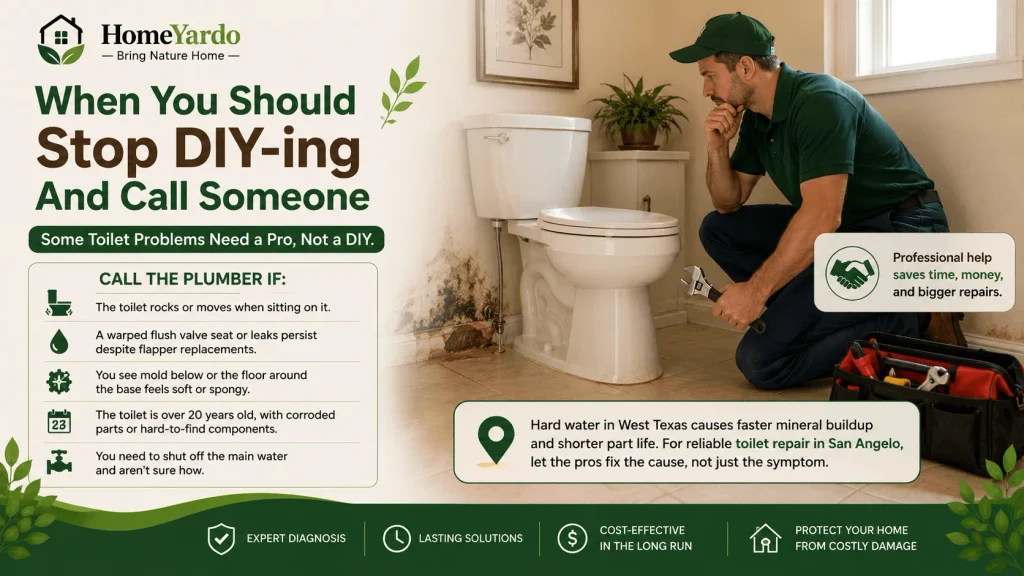
Replacing a flapper? Do it yourself. Changing out a fill valve? Reasonable weekend project. However, there’s a clear cut when a toilet issue turns a plumbing issue and when you cross that line without assistance, things tend to get worse.
Call the plumber if:
- The toilet rocks or moves when sitting on it, typically due to a broken flange or damaged subfloor.
- A warped flush valve seat necessitates resurfacing or replacement, and if the leak persists despite two flapper replacements over six months, it’s likely that the seat is warped.
- You can see mold and mildew in the ceiling below, or you notice the ground around the toilet base is spongy or soft.
- The toilet is over 20 years old, and inside parts are corroded or not available in standard sizes.
- You have to turn off the water main for any job and you don’t know how to do it safely.
Homeowners in West Texas already deal with hard water that accelerates mineral buildup inside toilet tanks and on flappers, shortening component lifespans compared to softer-water regions. If you’re in that part of the state and a recurring toilet problem keeps coming back, getting a professional diagnosis is almost always cheaper than repeat part replacements. A team that handles toilet repair in san angelo will spot a flush valve seat issue or a corroded fill valve in minutes, saving you the frustration of fixing the symptom instead of the cause.
How to Check Your Water Meter for a Hidden Leak

No food coloring on hand? Your water meter gives you a definitive answer. According to the EPA’s WaterSense program, household leaks can account for nearly 10,000 gallons of water wasted every year and could be adding as much as 10 percent to your water bill — which means a meter check is worth two minutes of your time.
Here’s the method:
- Turn off all water sources around the house, including the dishwasher, washing machine and any open faucets.
- Find the water meter near the street or property line, and record the meter reading.
- Wait 1 hour without any water.
- Take the meter reading once again. Water movement has occurred if the number has moved; otherwise, it hasn’t.
Look for a small leak indicator triangle or dial on digital meters. If it is spinning when all activity is eliminated, there is an active leak in the house. Then, isolate by shutting off the toilet supply valve and repeat the test. If the meter has stopped, it’s the toilet’s fault.
One Final Thought
A toilet that runs silently is the home maintenance problem that rewards the people who catch it early and punishes everyone else. The test takes two minutes. The fix is often five dollars. The damage from ignoring it — on your water bill, on the flooring, on the subfloor — can run into thousands. Check yours today, and if the food-coloring test comes back blue, don’t wait another billing cycle to act.
If the toilet is only one of several aging fixtures causing problems, it may also be worth considering the repair as part of a broader bathroom remodeling plan rather than replacing fixtures one at a time.
FAQ’s
Place a few drops of food coloring in the toilet tank, but do not flush. Wait about 10 minutes. The presence of coloured water in the bowl indicates that water is leaking from the tank to the bowl. Flush afterward to prevent staining of the fixture.
When the tank is refilling intermittently, it may be leaking between flushes. If the flapper is worn or there is not a proper seal, water might enter the bowl, causing the fill valve to periodically restore water to the tank.
Yes. A faulty flapper might permit water to trickle into the bowl without making any sound that is noticeable. Toilets should have a dye test periodically every 6 months to check for silent leaks, EPA recommends.