Variegated Monstera Types, Colors, Care, And Buying Guide
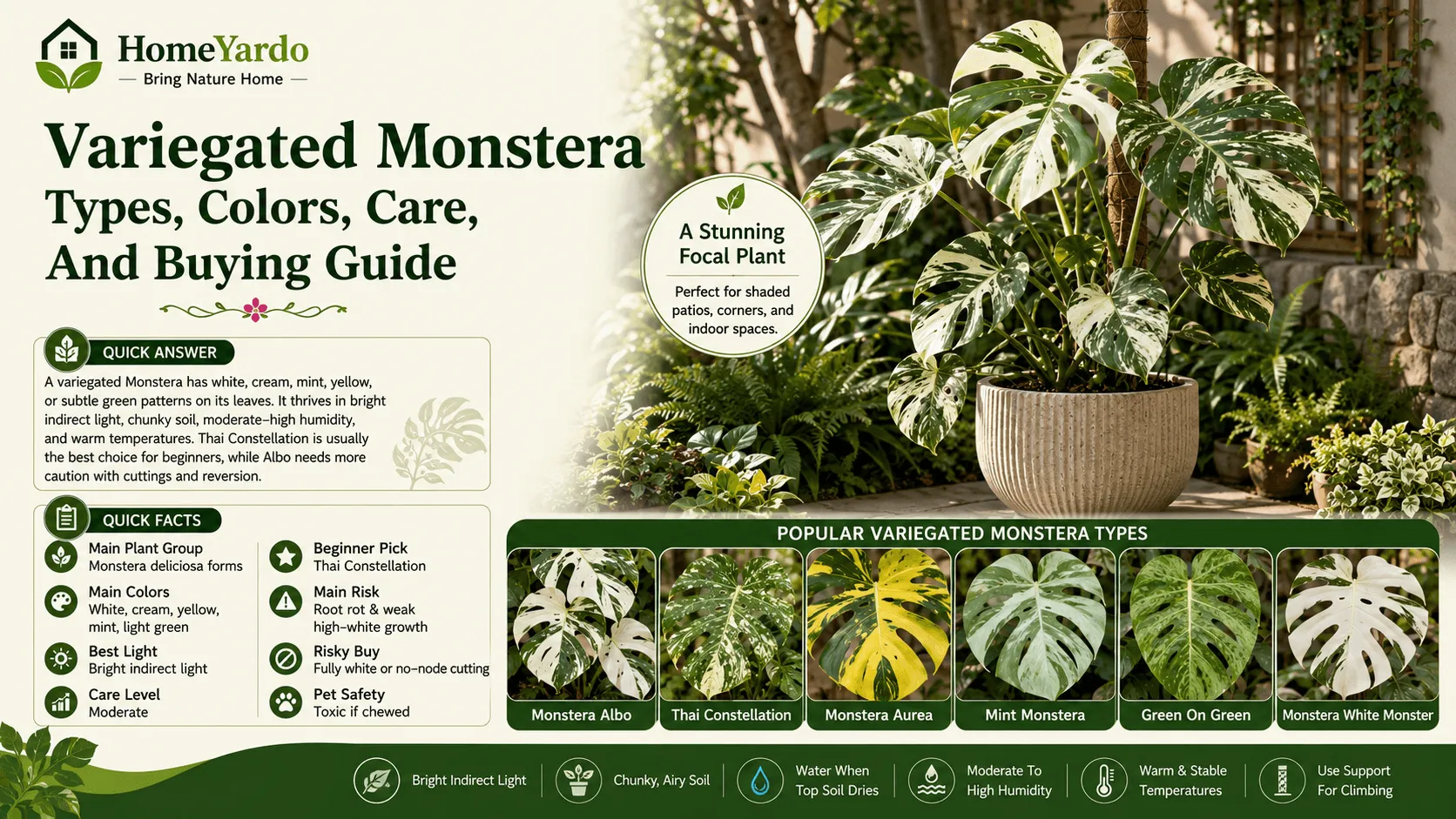
A variegated Monstera can make a quiet corner feel alive. The leaves can open up with a deep green or soft cream, white mint, yellow or even a marbled shade that appears like it was painted by hand. This slow reveal is part of the attraction.
The beauty demands the cultivation of plants with care. Less leafy areas of the plant have less chlorophyll compared to green tissue which is why many different Monstera are slower to grow than plants that are completely green. They require bright indirect sunlight and airy soil. They also require steady warmth and a steady flow of water to keep pace with the plant.
This guide will help you to identify rare and common varieties of Monstera kinds, comparing hues, comprehend their natural habitat, create an outdoor feature that is shaded, maintain your plant inside, stay clear of weak cuttings, identify frequent problems, and purchase with greater assurance.
Quick answer:
A variegated Monstera is a Monstera that has white, cream, mint, yellow, or subtle green designs in its leaves. It thrives best in the bright indirect light, the hefty soil moderate to high humidity and warm indoor temperatures. Thai Constellation is typically the best choice for beginners while Albo monstera needs more caution when it comes to cuttings, reversion and growth that is all-white.
Quick Facts
| Quick Fact | Answer |
|---|---|
| Main plant group | Monstera deliciosa forms and variegated selections |
| Main colors | White, cream, yellow, mint, light green |
| Best light | Bright indirect light |
| Care level | Moderate |
| Beginner pick | Thai Constellation |
| Main risk | Root rot and weak high-white growth |
| Risky buy | Fully white cutting or no-node cutting |
| Pet safety | Toxic if chewed |
This profile is a quick overview of the most secure starting point. This is not a problem because it is extremely rare. It is difficult to identify when the light is weak or the soil is wet, the cutting has no nodes, or when the plant is too white and there is not enough green tissue.
What Is Variegated Monstera?
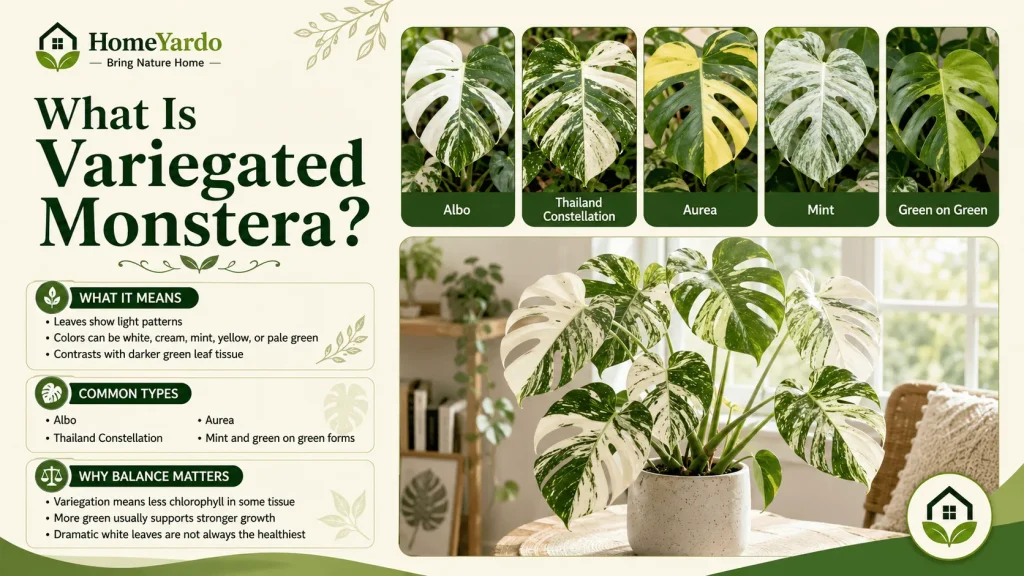
This is a Monstera plant that has light patterns in its leaves. The patterns can appear as white, cream, mint, yellow pale green, or soft green in contrast to dark leaf tissues.
The term “variegated Monstera” is a broad term used in the trade of plants. It is not a description of a single plant. It could be referring to Albo monstera or Thailand Constellation, Monstera Aurea, Mint Monstera, Green on Green forms or even rare collector plants.
Variegation is when tissues of plants have less chlorophyll. Chlorophyll is a component that helps plants make energy by absorbing light. The green parts of the plant are more forceful while the lighter parts produce the gorgeous pattern.
A plant with a balance of green and pale tissue typically will grow better than one that has extremely white leaves. The most appealing plant may not be the healthiest one. When it comes to long-term care balance is more important than the drama.
Monstera Natural Habitat
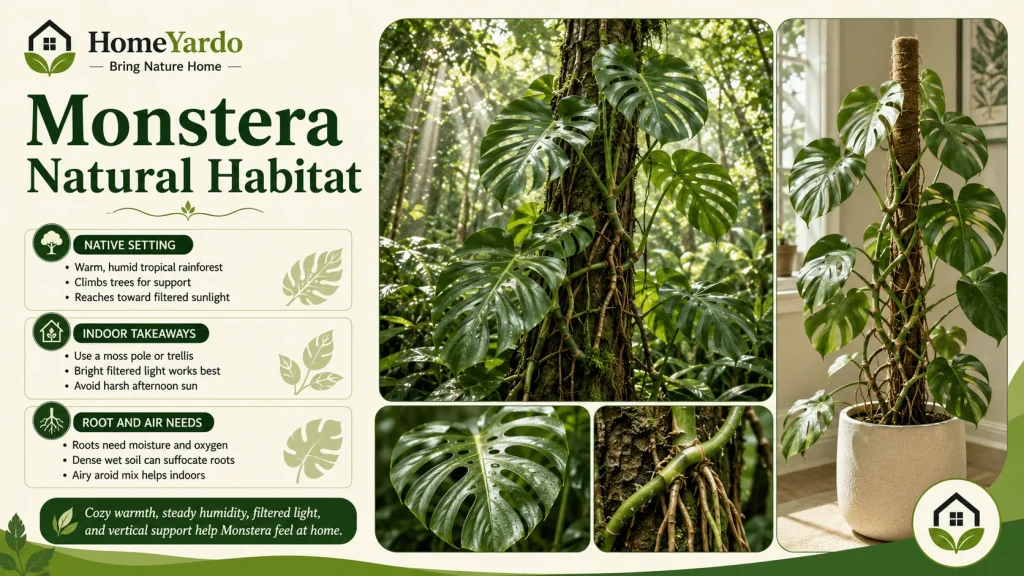
Monstera thrives naturally in tropical climates that are warm and humid the Americas. In rainforest environments, it climbs trees and reaches out towards sunlight that is filtered, and then uses branches to anchor onto rough surfaces.
This is why Monstera is different from other smaller house plants. It is a climber and not a small bush. If it is given a moss stake or stake or even trellis it will rise and produce more robust mature leaves.
The natural light of the area is filtered through the tree canopy. Indoors, this translates into direct light that is bright rather than intense direct sun. The cream and white parts of variegated leaves could be burned quickly when the plant is placed in the sun’s strong afternoon.
The roots also require air. In the natural world, Monstera roots experience moisture and oxygen. Indoors, moist soil could cause them to become suffocated. A thick aroid mix can help to recreate the airy root zone inside pots.
A cozy room, steady humidity, brightly filtered light and support for the vertical help the plant feel more at home. Variegated Monstera shares many growing requirements with other tropical foliage plants, including philodendrons, pothos, and rubber plants. If you are building an indoor collection, our guide to tropical house plants compares 30 popular varieties by lighting, watering, humidity, and maintenance needs.
Real Life Yard Design Example With Variegated Monstera
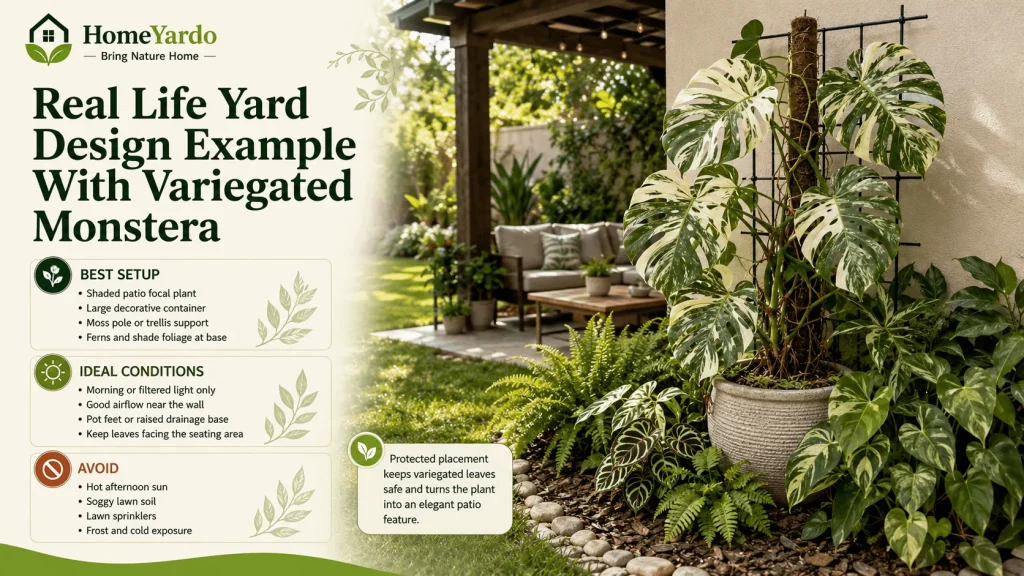
A variety of Monstera should not be treated as a normal lawn plant. It’s best as a feature that is protected close to a shaded patio pergola, courtyard wall, covered walkway or an area for sitting in the garden.
Outdoor use depends on the climate. In warm, frost-free locations this plant can be kept outdoors in a shaded area. In cooler areas, it’s safer to keep it stored in a container that is movable to allow it to move indoors in the winter months before the colder nights begin.
The aim is to create a feeling of protection. The pale leaves are prone to burning in hot sun and its roots don’t appreciate heavy lawn soil or sprays of water every day.
Indoors, the same broad leaves can also become a striking focal point in a bright living room or entryway. Monstera is sometimes associated with growth and expansion in plant-based Feng Shui traditions. Our guide to best Feng Shui plants explores other popular indoor choices and how to position them according to room conditions.
Example: Shaded Patio Border With A Variegated Monstera Focal Point
Imagine a tiny backyard that has an ecru wall, a patio that is covered and a small planter bed that is situated next to the seating space. The lawn gets sun while the wall receives soft morning light as well as afternoon shade.
The corner with the protection is the ideal spot for an edgy Monstera as opposed to the grass’s middle.
| Yard Area | What To Add | Why It Works |
|---|---|---|
| Back wall or patio corner | One rooted Thai Constellation or balanced Albo in a large pot | Creates a strong focal plant without exposing roots to wet lawn soil |
| Behind the plant | Moss pole, cedar plank, or black metal trellis | Supports climbing growth and larger leaves |
| Base layer | Ferns, calathea, philodendron, or low shade foliage | Builds a rainforest style understory without crowding the Monstera |
| Ground finish | Bark mulch or stone mulch around the pot area | Keeps the area clean and separates it from lawn irrigation |
| Lighting | Morning light or filtered light only | Protects white and cream leaf sections from sunburn |
| Seating angle | Place the plant where the leaves face the patio | Turns the variegated pattern into a visible garden feature |
| Drainage zone | Pot feet, gravel base, or raised container position | Keeps the pot from sitting in pooled patio water |
Put it in a large decorative container instead of placing it directly on the ground. The pot should be kept a bit off the walls to ensure air can flow through the plant. Install a vertical support behind it, and then make the base softer by using smaller green leaves.
Avoid direct sunlight on your lawn and soggy ground, as well as regular sprays of sprinklers frost pockets and the hot reflection of walls. This plant looks elegant outside but only if the environment is protected by foliage and the roots.
Yard design:
A variety of Monstera can be used outdoors as a focal point for a shaded patio plant. It can be planted in a large container next to the wall, trellis or even a moss pole. Protect it from hot afternoon sunlight, lawn sprinklers and exposure to cold. Place it in a shaded area with other plants to create a tranquil tropical appearance.
Quick Variegated Monstera Care Summary
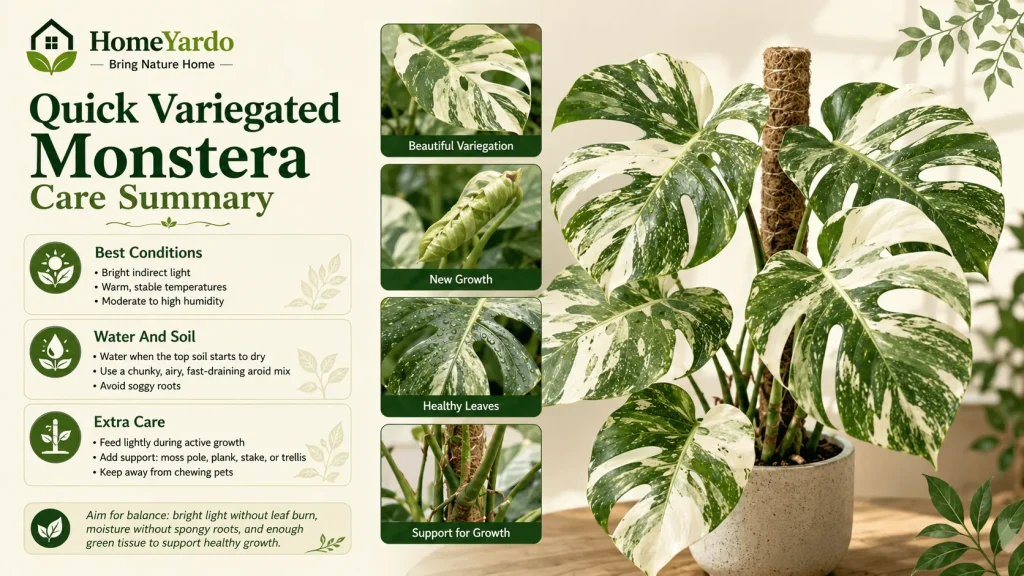
Care is similar to the regular Monstera maintenance; it often requires more light and slower watering. Leaves that are pale don’t provide the same support as green leaves; the weak light and moist soil could cause issues quickly.
| Care Need | Best Approach |
|---|---|
| Light | Bright indirect light |
| Water | Water when the upper soil starts to dry |
| Soil | Chunky, airy, fast draining aroid mix |
| Humidity | Moderate to high indoor humidity |
| Temperature | Warm and stable |
| Fertilizer | Light feeding in active growth |
| Support | Moss pole, plank, stake, or trellis |
| Pet Safety | Keep away from chewing pets |
The primary rule for care is to find a balance between bright light with no burn, moisture without spongy roots, and even a little variation without too much green tissue.
Variegated Monstera Colors
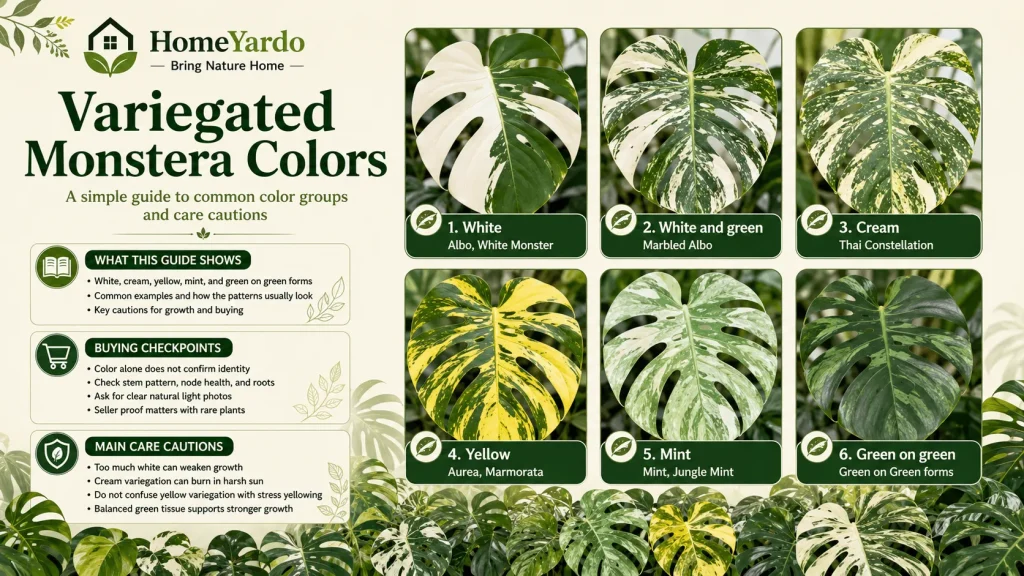
Color is among the most effective ways to appreciate different Monstera plants. Certain varieties have white spots while others have speckles of cream. Some have yellow marbling, while others have light mint or green-on-green designs.
Color alone is not enough to establish the plant’s identity. Sellers can use names in a loose manner particularly with rare and collector plants. The pattern of the stem, leaf as well as root health quality, node health, and seller proof are more important than the name.
| Color Group | Common Examples | What It Usually Looks Like | Main Care Caution |
|---|---|---|---|
| White | Albo, White Monster | White blocks, marbling, half moon leaves | Too much white weakens growth |
| White and green | Marbled Albo, balanced Albo | Mixed white and green pattern | Check the balance across the stem |
| Cream | Thai Constellation | Cream speckles and marbling | Avoid harsh sun |
| Yellow | Aurea, Marmorata | Lime to yellow patches | Do not confuse with stress yellowing |
| Mint | Mint, Jungle Mint | Pale green or cloudy marbling | Verify real plant photos |
| Green on green | Green on Green forms | Light green on dark green | Can be hard to see in photos |
This color map can be helpful prior to going through the complete list. The same plant could alter slightly as new leaves develop and mature.
White Monstera
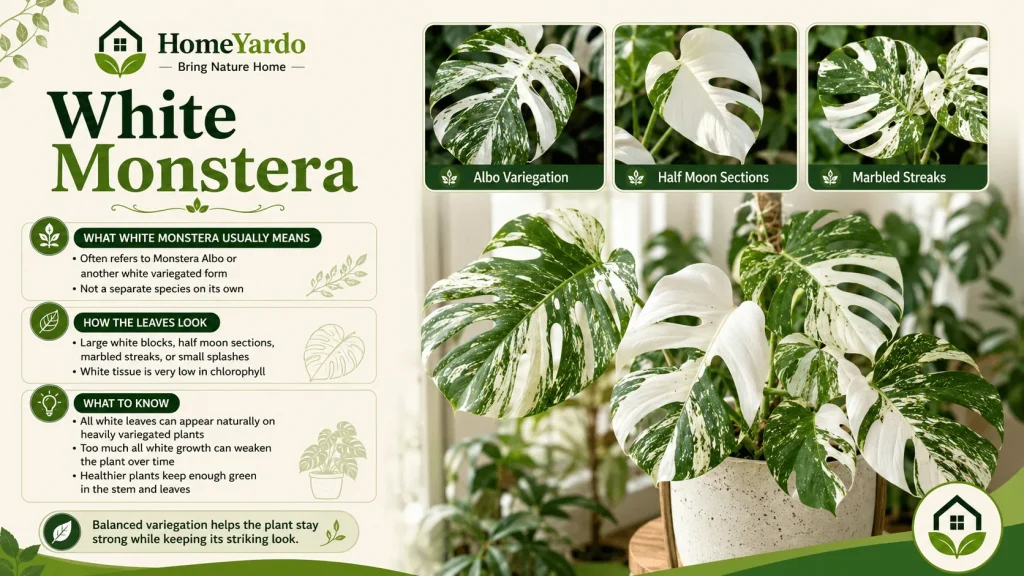
A white Monstera typically refers to Albo monstera or a different white variant. It’s not a separate species in its own.
White Monstera leaves could show large white blocks, half moon sections or marbled streaks. small white splashes. The crisp contrast could look beautiful, but white tissue is very low in chlorophyll.
A completely white leaf may be seen naturally on plants that are heavily variegated. All-white leaves are not necessarily a problem. All-white growth can repeatedly make the plant weaker as the leaves can’t help the plant grow properly.
A healthier white Monstera is a good green plant with enough green in the stem and leaves. The green tissue keeps the plant thriving behind the beauty.
White And Green Monstera
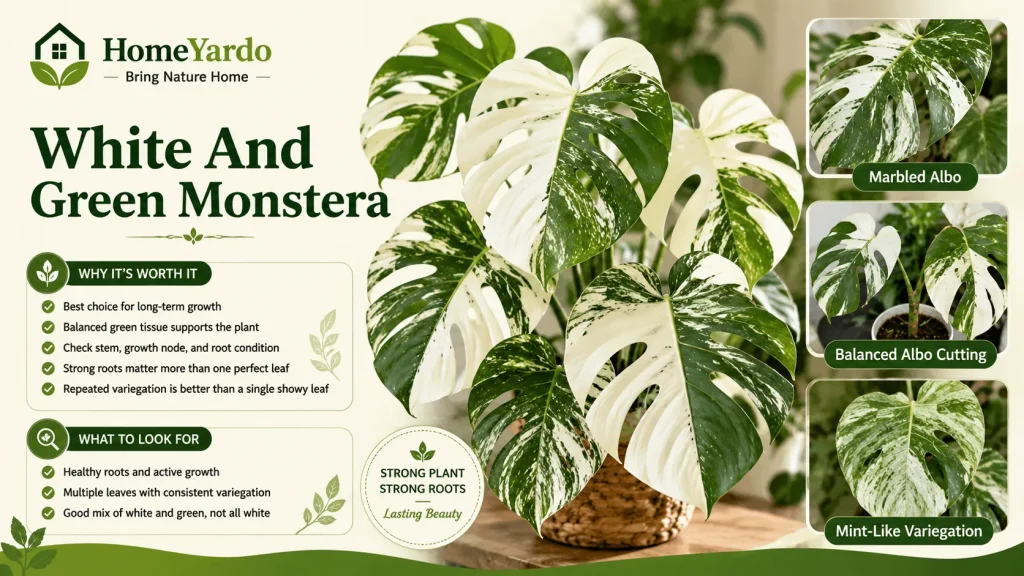
A green and white Monstera is typically the best option to ensure long-term growth. It offers the bright contrast that people are accustomed to, while also retaining enough green tissue to nourish the plant.
This appearance can be seen on marbled Albo plants as well as in balanced Albo cuttings, a few Mint forms as well as several Green on Green plants with lighter patterns. The most robust plants typically have a balanced, repeated pattern of variegation, not one gorgeous leaf.
If you are buying a green and white Monstera, look past the most beautiful leaf. Be sure to check the stem, most recent growth node, root condition, and if the plant is able to sustain sufficient green tissues.
A plant with a perfect leaf but weak roots isn’t an investment. A less striking plant with strong roots can be more satisfying.
Cream Variegated Monstera
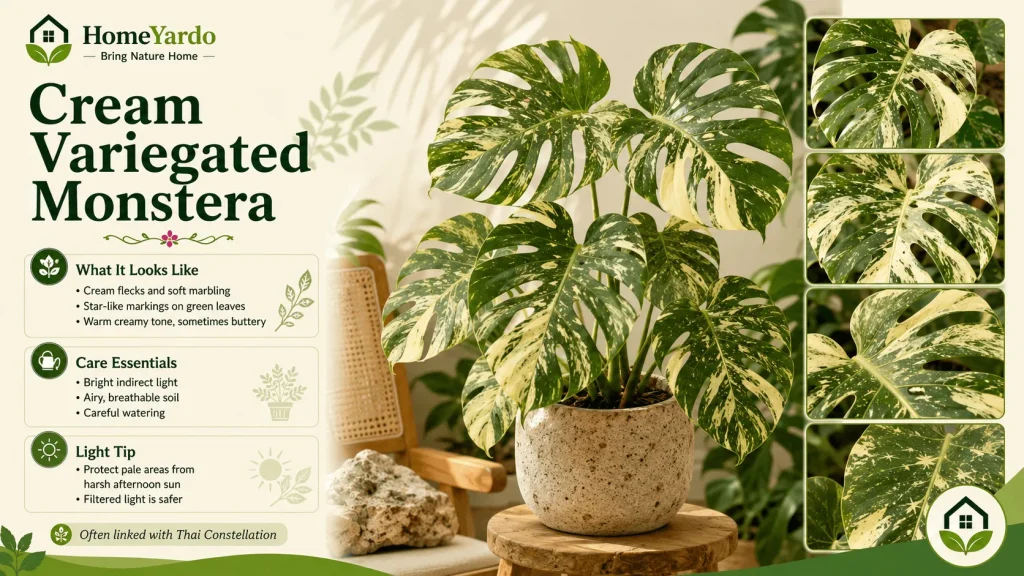
Cream variegation has a strong connection to the Thai Constellation. Its leaves are often covered with cream flecks, light marbling and star-like marks scattered over green tissue.
Cream variegation may appear more warm as pure white. In certain light conditions it could appear light yellow or buttery. This soft hue perfectly blends with stones, wood or terracotta. It also looks great with the shaded tropical plants.
Thai Constellation is popular due to its pattern, which is generally more durable than other Albo plants. However, it still requires ample indirect light, a breathable soil, and careful irrigation.
The skin parts of the cream may burn in intense sunlight, which is why the filtering of light is safer than direct sunlight in the afternoon.
Yellow Variegated Monstera
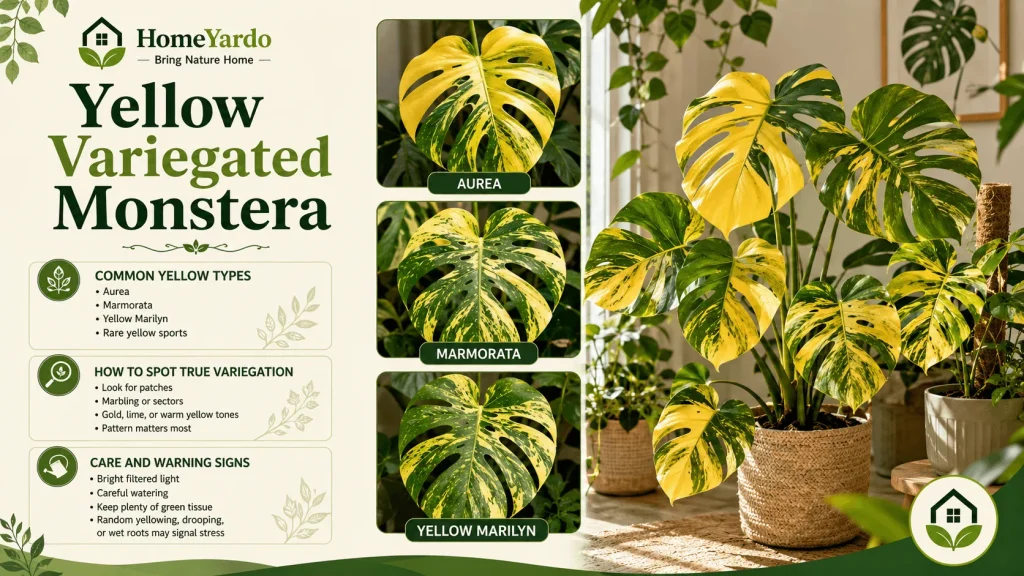
Yellow varieties comprise Aurea, Marmorata, Yellow Marilyn and a few rare yellow sports forms. They can display gold, lime, yellow or warm-toned marks.
The pattern is the most important hint. True yellow variegation typically appears in patches, marbling or in sectors. Stress yellowing can be spread in a random manner and can be accompanied by soft stems, drooping, roots that are wet roots, or problems.
A yellow-colored leaf could be normal. The whole plant that is turning yellow should be checked for care.
The yellow variegated plants can provide an inviting look to bright corners in the indoor without the need for direct sun. They require the same constant attention as other Monstera with bright, filtered sunlight, careful watering and plenty of green tissue.
Mint And Pale Green Variegated Monstera
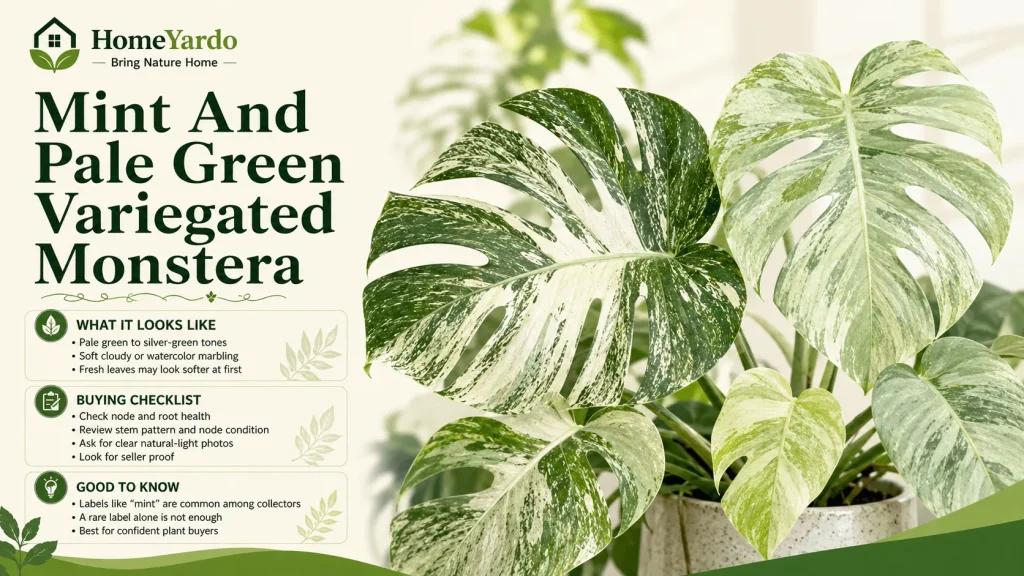
Mint Monstera kinds show pale green, silver-green, white-green, as well as cloudy marbling. The color may be soft particularly when the fresh leaves are still hardening.
Certain mint forms appear almost silvery. Some appear like soft watercolors that have been layered over the leaf. Since the pattern may be soft and natural, photos of natural light are important when you purchase.
Mint labels are frequently used by collectors. A unique label shouldn’t be the only reason you purchase. Quality of node, root health stem pattern, node health, and seller proof are also important.
They can be stunning, although they’re better for those who feel confident in checking the details prior to purchase.
Green On Green Variegation
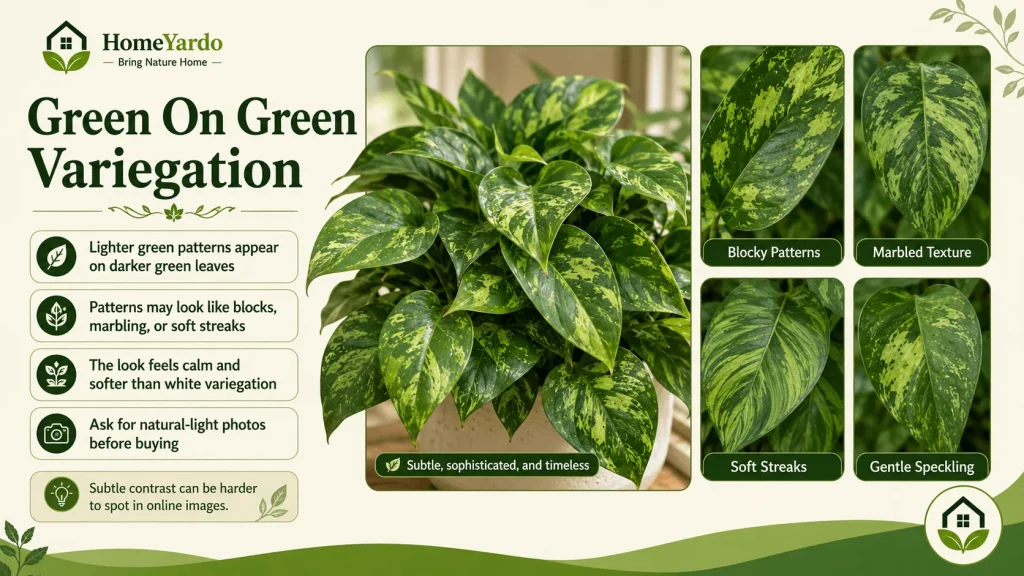
Green-on-green variegation can be seen like light-green, lime green or lighter green lines on darker-colored green tissues. It is sometimes harder to discern than yellow or white variation, particularly in online images.
The pattern could appear in the form of blocks, marbling, or even gentle streaks. Certain leaves show the contrast better as they grow.
The green and green look of the plants is ideal for those who prefer a calmer appearance. They are still a bit odd but they don’t appear as stark as white plants.
Because the contrast isn’t high, ask for clear images in natural lighting before purchasing.
35 Main Types Of Monstera Variegated
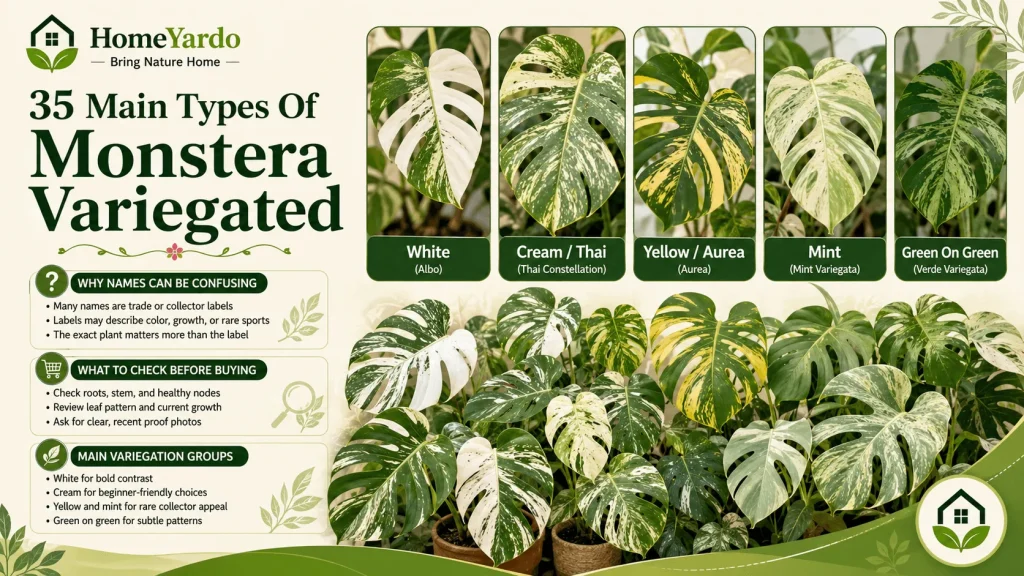
Numerous different Monstera names are employed in the plant trade, collections and listings of tissue culture and descriptions of sellers. Certain names are related to color, others relate to growth and others are related to rare sports.
Monstera names are used as trade names as well as sport names or collector labels, rather than widely recognized botanical names. Make sure you know the exact plant, roots and stem patterns, nodes leaf patterns, and evidence of sale before paying high-end plant prices.
| Type Group | Examples | Main Color | Best For | Buyer Caution |
|---|---|---|---|---|
| White | Albo, White Monster, White Lava | White and green | High contrast leaves | Avoid fully white cuttings |
| Cream | Thai Constellation, Creme Brulee | Cream and green | Beginners and collectors | Check root health |
| Yellow | Aurea, Marmorata, Yellow Marilyn | Yellow and green | Warm color collectors | Do not confuse with stress |
| Mint | Mint, Jungle Mint, Ocean Mint | Mint and pale green | Rare plant collectors | Verify photos carefully |
| Green on green | Green On Green forms | Light and dark green | Subtle variegation lovers | Harder to confirm online |
| True Variegata | True Deliciosa Variegata | Variable | Advanced collectors | Unstable and unpredictable |
The following list provides an overview of the names most commonly employed by the Monstera. Make sure to keep each name in its proper context. A healthy plant that has proof will always be better than a fanciful label that has poor images.
White Variegated Types
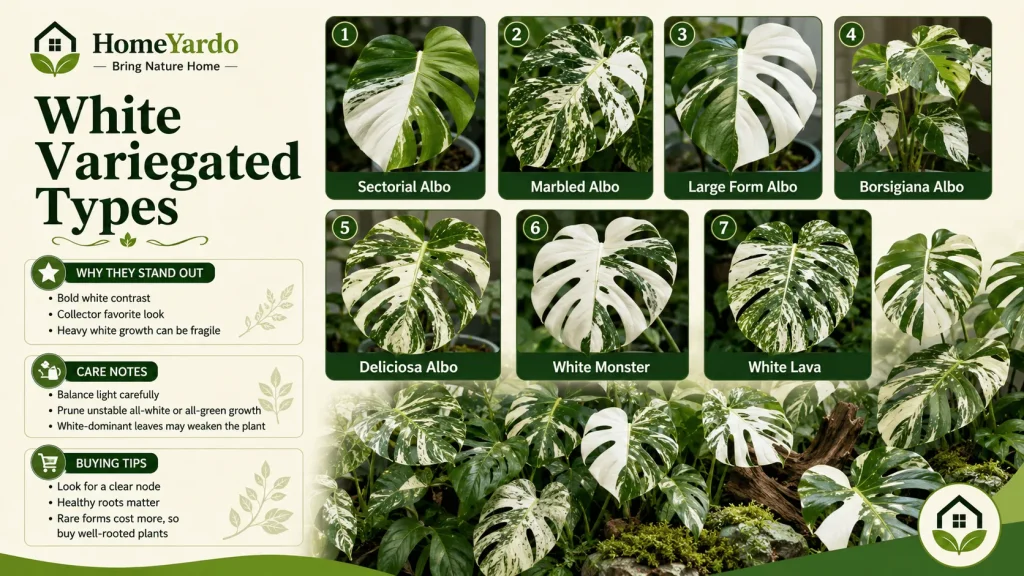
White variegated varieties are usually the most well-known since their color contrast is striking. They can also be fragile when the plant has excessive white growth.
- Monstera Albo Variegata Sectorial
This kind of plant has huge white blocks or half-moon-style leaves. It may appear dramatic however it can also produce green or all-white growth. Therefore, the pruning method and light balance are important. - Monstera Albo Variegata Marbled
Marbled Albo is a combination of light green, white, and dark green throughout the leaves. It’s often more balanced than the heavy sectorial whites and is easier to maintain attractive. - Large Form Monstera Albo
Large Form Albo is a taller size and has shorter internodes than other forms that are smaller. It can be difficult to find and could cost more. - Monstera Borsigiana Albo
This is among the most frequently sold Albo varieties. It is typically propagated via cuttings, which is why a clear node as well as healthy roots are crucial. - Monstera Deliciosa Albo Variegata
This is a common name to describe white Monstera plants. Since the name of the seller can differ and the exact plant can be more valuable than a label on its own. - Monstera White Monster
White Monster is famous for its pale, white-dominant appearance, with green tissue in the form of green tissue. It is important to grow it with care as too much pale tissue that is pale can cause the plant to weaken. - Monstera White Lava
White Lava is a rare name for collectors that is which is associated with white patterned growth. Make it a high-end purchase if the plant is well-rooted solid, healthy, and well documented.
Cream And Thai Constellation Types
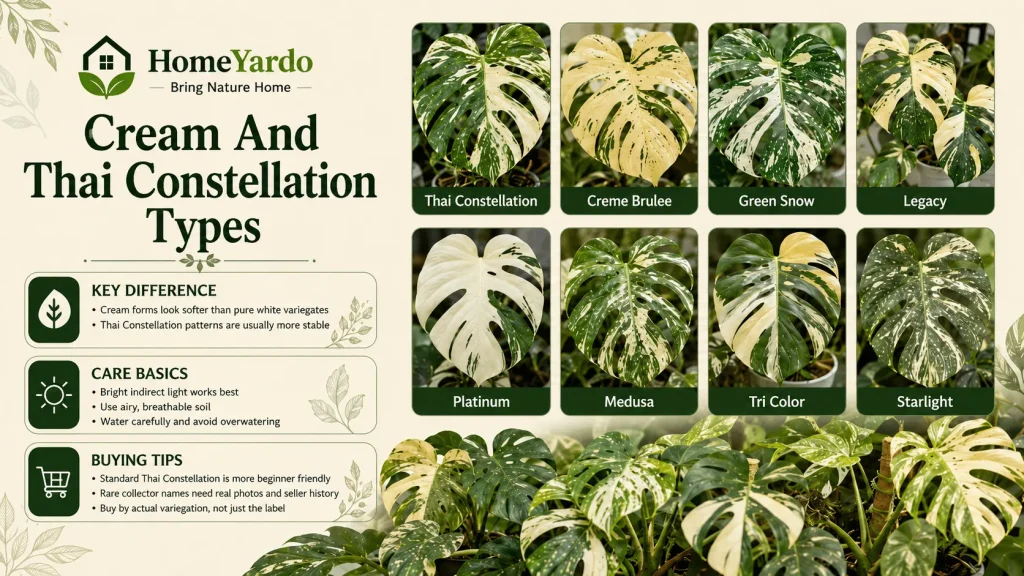
The cream variegated varieties are often more soft as pure white plant varieties. The Thai Constellation forms are very sought-after because their patterns are generally more stable.
- Monstera Thai Constellation
Thai Constellation is a cream-colored berry with flecks of marbling and speckles across green leaves. It is among the most well-known Monstera kinds and is more accessible for novices than Albo. - Thai Constellation Creme Brulee
Creme Brulee is associated with more intense cream variegation. It may appear warm and rich, however it requires an indirect light source, a breathable soil, and a careful application of water. - Thai Constellation Green Snow
Green Snow has pale flecking with soft green and cream effects. It might resemble an extremely variable Thai Constellation which is why photos are crucial when buying. - Thai Constellation Legacy
Legacy is a collectible choice that has a strong appeal due to its variety. It should be confirmed by looking at the history of the seller as well as current photographs and stability of the plant. - Thai Constellation Platinum
Platinum varieties have a light soft, muted appearance with fine flecks. They can be a match for mint-like plants, and natural light photos can help. - Thai Constellation Medusa
Medusa is a sought-after collector name that is paired with unique designs. Because rare names are often misused, it is best to purchase based on the actual location, not just the name. - Thai Constellation Tri Color
Tri Color is often described as a blend of white, cream with yellow and white tones. Think of it as an item for collectors that requires careful examination prior to purchase. - Monstera Starlight
Starlight is a fine star-like variation. It is part of the rare collector group, rather than novice care options.
Yellow And Aurea Types
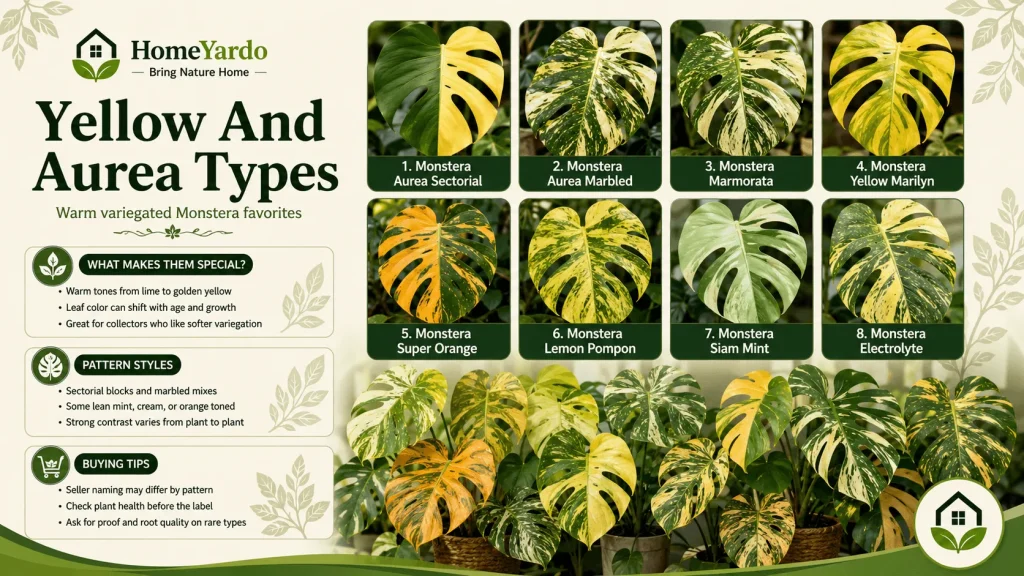
The yellow variegated varieties bring warmth. They could appear like lime, golden or soft yellow, depending on the species and leaf age.
- Monstera Aurea Sectorial
Aurea Sectorial has yellow or lime blocks that are spread across the leaf. Similar to Albo it has the ability to change between stronger colors and more green growth. - Monstera Aurea Marbled
Aurea Marbled is a yellow-colored marble interspersed with green tissue. It’s a great choice for those who prefer warmer colors and softer shades. - Monstera Marmorata
Marmorata is frequently associated to yellow marbling and Aurea-style names. The seller’s wording may differ depending on the leaf pattern before relying on the naming. - Monstera Yellow Marilyn
Yellow Marilyn is a rare yellow variegated plant that has a strong contrast. It is a great choice for collectors who are aware of slow growth and shifts in variegation. - Monstera Super Orange
Super Orange is associated with the orange-to-yellow-toned variegation. It is best to treat it as an uncommon collector plant, not the typical houseplant choice. - Monstera Lemon Pompon
Lemon Pompon can have mint, cream as well as yellow hues. Due to its rarity the quality of the root and seller’s proof of purchase should be the primary criteria for purchasing. - Monstera Siam Mint
Siam Mint can sit between lime, yellow and mint-style variations. It’s great for those who are comparing pale green and yellow types. - Monstera Electrolyte
Electrolyte is associated with lime green patterns. It’s a scarce name, and therefore the health of plants is more important than the label’s excitement.
Mint And Pale Green Types
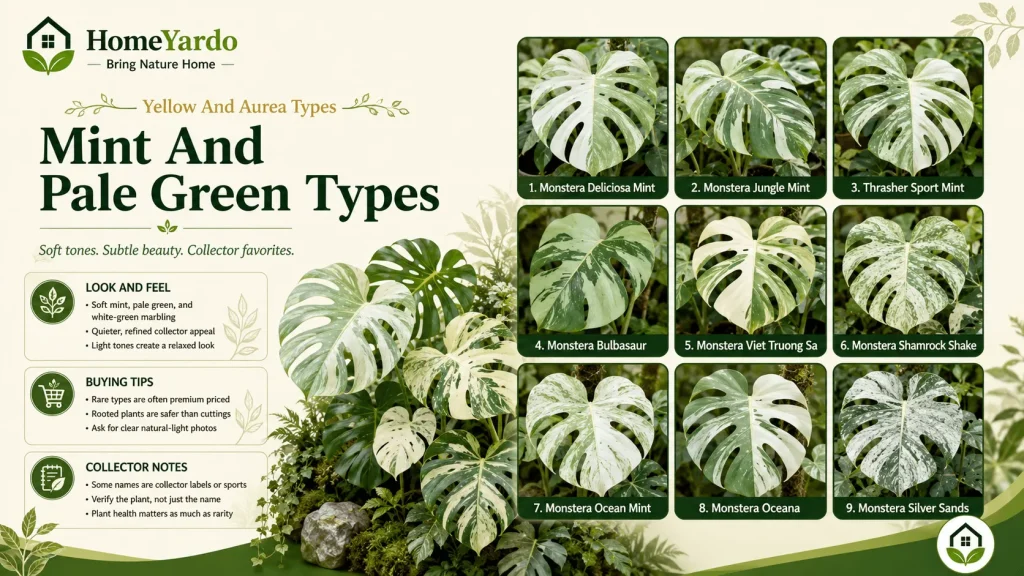
Mint and light green mixed with light green Monstera have a more relaxed look. Their aesthetic is quieter, but collectors love their appearance because they feel unique and sophisticated.
- Monstera Deliciosa Mint
Mint Monstera has pale green or white-green marbling. It’s rare and usually expensive, therefore buying root plants is more secure than cuttings. - Monstera Jungle Mint
Jungle Mint can show mint green, albo-like patches. It is usually regarded as a kind of sport, and must be confirmed with photographs that are clear. - Monstera Thrasher Sport Mint
Thrasher Sport Mint is a mix of mint, pale and green markings. It is a rare category of sports and should be purchased with care. - Monstera Bulbasaur
Bulbasaur is a name that collectors love, which is associated with mint-dominated coloring. The value of the name is heavily dependent on the health of the plant and not just the rarity. - Monstera Viet Truong Sa
Viet Truong Sa is linked to mint and pale green patterns. A clear explanation is helpful since uncommon names are often confusing. - Monstera Shamrock Shake
Shamrock Shake is famous for its minty-lime flavor in a muted shade. It is often a soft color and natural light photos can show the true color. - Monstera Ocean Mint
Ocean Mint is a large form mint-like plant. It is rare and must be treated as a premium purchase. - Monstera Oceana
Oceana is a reference to the ocean’s flowing marks. The name is more often used as a collector’s label, and therefore the plant proof is more valuable than the description on its own. - Monstera Silver Sands
Silver Sands can show light silver, white or soft green flecks. It’s part of the rare pale variation group.
Green On Green And Natural Variegata Types
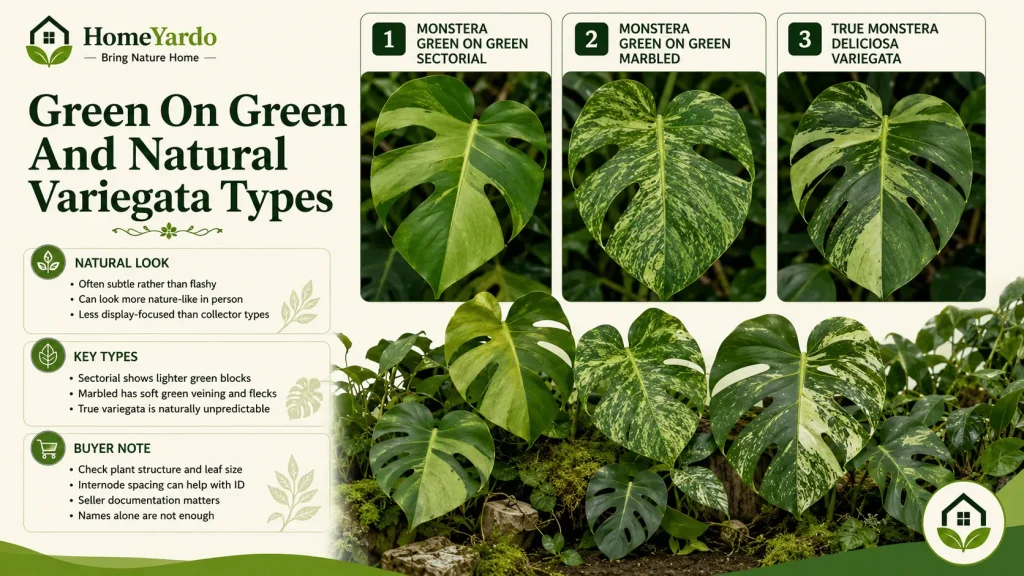
Natural variegata plants may not be striking in pictures however they can be stunning in the real world. They are often more akin to nature than collector-focused display plants.
- Monstera Green On Green Sectorial
This type displays lighter green blocks against dark green leaves. It can be subtle but it can be more apparent as the leaves grow. - Monstera Green On Green Marbled
Green On Green Marbled has more delicate green marbling across the leaf. It is able to blend with the white or green Monstera to create interest since the contrast is subtle. - True Monstera Deliciosa Variegata
True Variegata is a term used to describe natural unpredictable variation. It can display different patterns of color and is more difficult to predict than the named cutting-propagated or tissue-cultured varieties.
Certain sellers make use of some sellers employ the Deliciosa and Borsigiana names in a loose manner. Plant structure, leaf size, internode spacing and documentation for sellers can assist, but labeling the plants alone will not suffice.
Best Variegated Monstera Varities Or Types For Most Homes
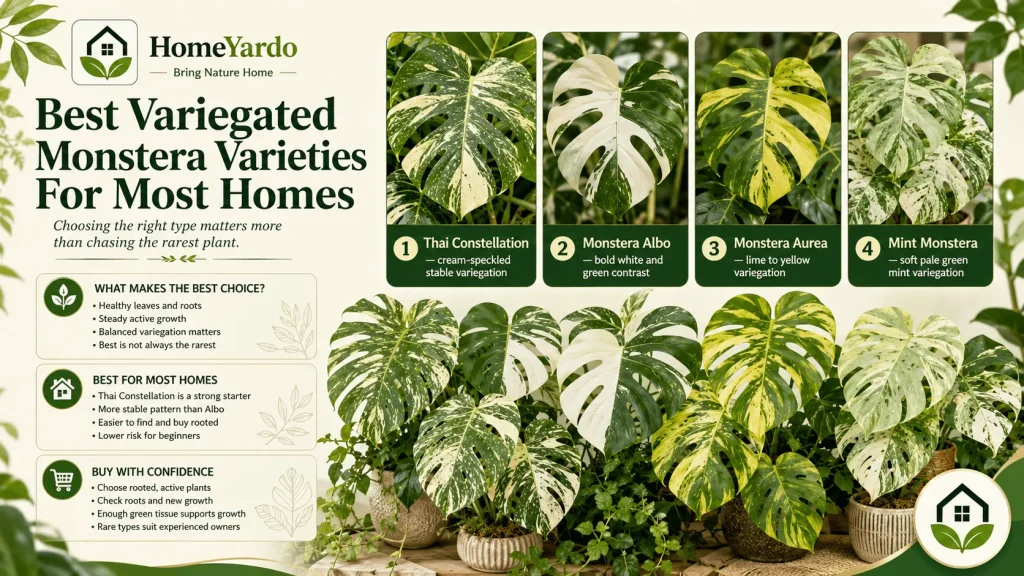
The best variety of Monstera isn’t always the rarest. A sturdy plant with healthy leaves, balanced leaf roots, and steady growth will usually yield more than a weak cutting sporting one striking leaf.
| Best For | Better Choice | Why |
|---|---|---|
| Beginner collectors | Thai Constellation | More stable and easier to find |
| Strong white contrast | Monstera Albo | Clear white and green pattern |
| Yellow variegation | Monstera Aurea | Lime to yellow leaf sections |
| Rare collectors | Mint Monstera | Unusual pale green pattern |
| Safer buying | Rooted Thai Constellation | Easier to verify than risky cuttings |
| Long term growth | Balanced variegation plant | Enough green tissue to support growth |
| Lowest buyer risk | Rooted, actively growing plant | Roots and new growth are easier to check |
Best doesn’t mean the rarest. It’s about matching the house, light budget, and working with confidence.
For the majority of homes for most homes, Thai Constellation is a good starting point. It requires some attention however, its pattern is generally more secure than Albo.
Albo monstera is better for those who appreciate stark white contrast and are able to handle the weak growth of white, reversion and cutting quality. Rare, Aurea, as well as rare varieties are more appropriate for knowledgeable plant owners.
Monstera Albo Vs Thai Constellation
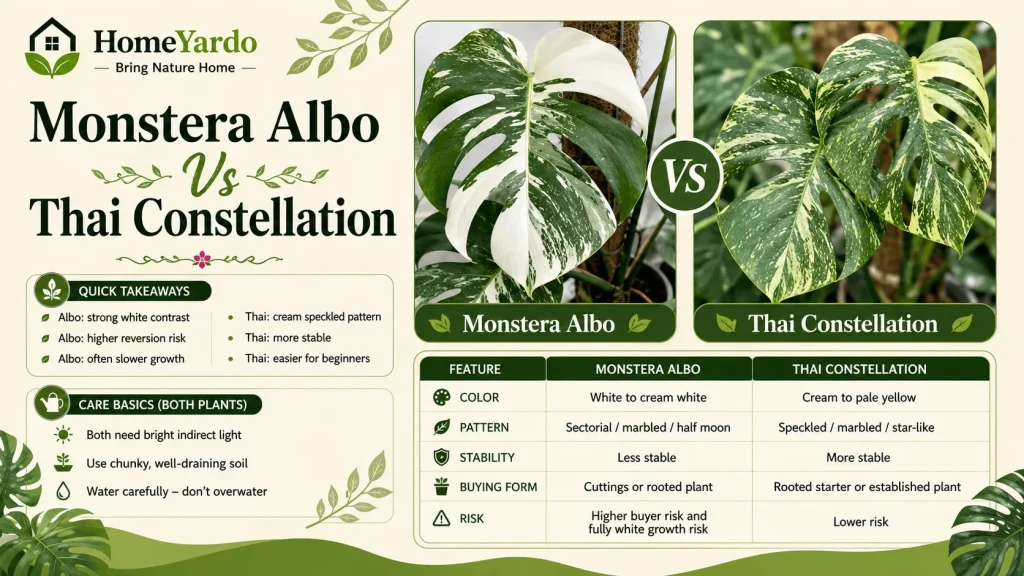
Albo monstera and Thai Constellation are two of the plants that are which are often in comparison. Both are stunning, but they have different behaviors.
| Feature | Monstera Albo | Thai Constellation |
|---|---|---|
| Color | White to cream white | Cream to pale yellow |
| Pattern | Sectorial, marbled, half moon | Speckled, marbled, star like |
| Stability | More likely to revert or over whiten | Usually more stable |
| Growth | Often slower | Slow to moderate |
| Availability | Cuttings and specialty sellers | More widely available |
| Beginner fit | Moderate | Usually easier |
| Buyer risk | Higher with weak cuttings | Lower when rooted |
| Propagation type | Usually cutting propagated | Often tissue cultured or sold rooted |
| Reversion risk | Higher | Lower |
| Fully white growth risk | Higher | Lower |
| Typical buying form | Cutting a node, or a rooted plant | Rooted starter or established plant |
Thai Constellation is generally simpler for beginners as the pattern with the cream speckles is usually more robust. albo monstera has stronger white contrast, but requires more care when it comes to cuttings, reversion and growth that is all white.
Albo offers more contrast. Thai Constellation provides a more delicate cream pattern. Both require bright indirect light as well as a hefty soil and cautious watering.
Why Are Variegated Monstera Plants Expensive?
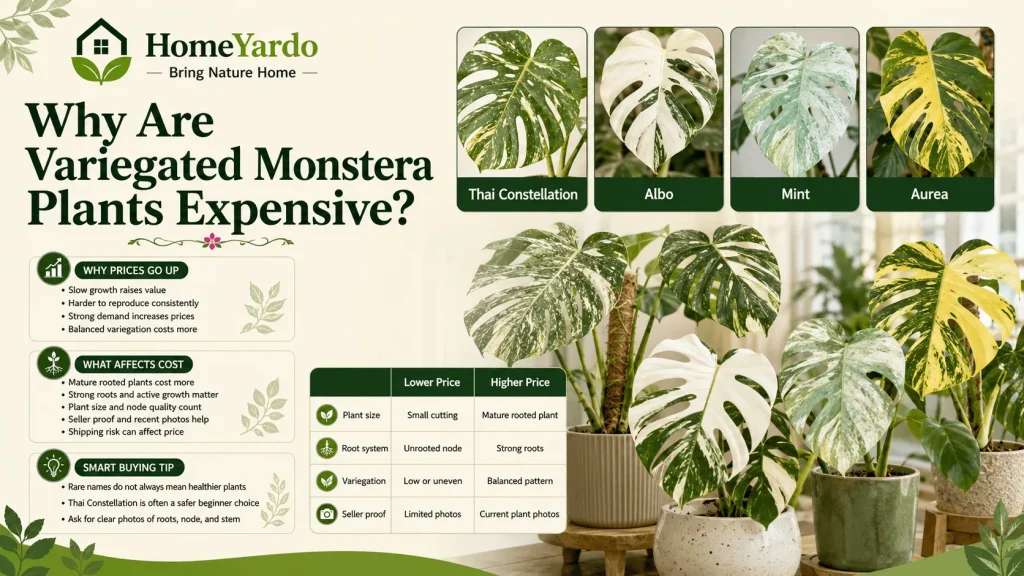
These plants are more expensive because they take a long time to grow, take time to spread and are more difficult to reproduce consistently. The demand for them also drives prices up particularly for plants that have solid and balanced patterns.
A big rooted plant will cost more than a tiny cut because the risk is less. Active growth, roots and multiple leaves provide the plant a greater chance of starting.
Variegation is also a factor in cost. Plants that have uncluttered, balanced colors are usually more expensive than a low-variegation plant. Rare names can increase the cost, but rare does not necessarily suggest that the plant is healthier.
Other factors to consider include risk of shipping the reputation of the seller, plant size, quality of the node as well as the health of the root and if the plant is equipped with recently taken photographs. The most profitable purchase is usually not the one with the biggest impact. It’s the one that is with the highest likelihood of continuing to grow.
How Much Does A Variegated Monstera Cost?
Prices fluctuate based on the region, season and size, as well as seller availability, and rarity. Fixed prices may become out of date quickly, so it is essential to know what factors affect the value.
| Factor | Lower Price | Higher Price |
|---|---|---|
| Plant size | Small cutting | Mature rooted plant |
| Root system | Unrooted node | Strong roots |
| Type | Common Thai | Rare Mint or sport |
| Variegation | Low or uneven | Balanced, attractive pattern |
| Seller proof | Limited photos | Current plant and root photos |
A root-based Thai Constellation is often the most secure choice for beginners. A well-rooted Albo could be suitable for those who are willing to undergo more cautious pruning and managing variegation. Mint, Aurea, and uncommon sport names are in the category of “advanced buying” as they are more difficult to confirm and can be more expensive.
Don’t pay for just an initial name. Make sure you have clear pictures that show the precise plant’s root as well as the stem and node. A reliable seller should be able to show these details.
How To Care For Variegated Monstera Indoors
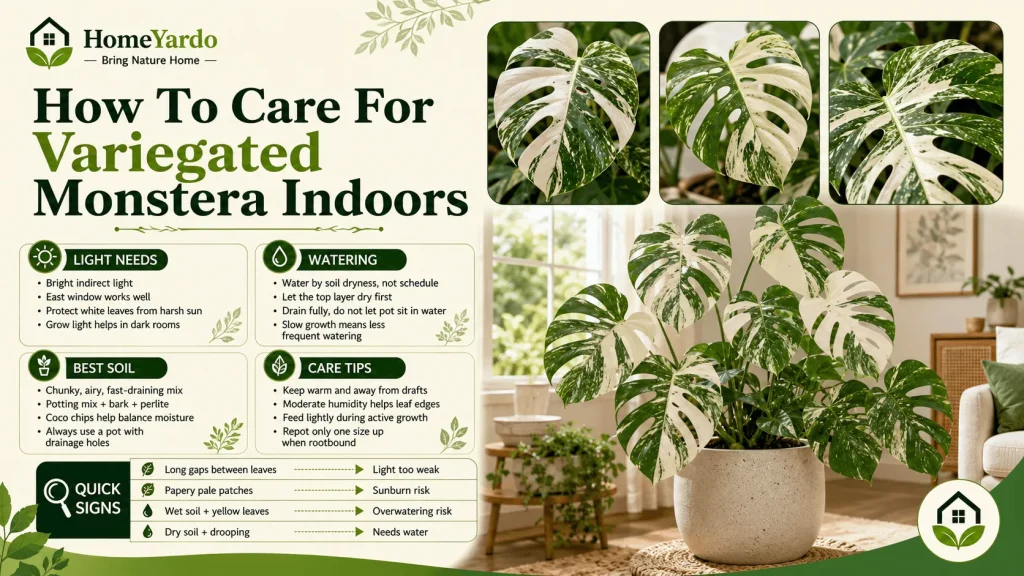
Monstera care for beginners should emulate the nature of the plant to the extent that a home permits. Think of filtered light, open roots, constant warmth, and the support needed to help grow.
The routine for caring for the Monstera plants must also be tolerant of variations. A plant with leaves that are pale leaves could grow more slowly and drink less water and display leaf damage more quickly than a completely green Monstera.
Choosing a houseplant that matches your home’s light, humidity, and available space can prevent many common care problems. Our guide to houseplant statistics and indoor plant trends also explains common buying considerations and why matching plants to indoor conditions matters.
Monstera Light Requirements
This plant requires an indirect, bright light. It requires the help of a grow light to help support its leaf tissue. However, intense direct sunlight could burn areas of white and cream.
A bright, east-facing window typically is a good choice. A west or south-facing window may also be effective when the light is blocked by a sheer curtain or set back from the glass.
The growth of plants in dark rooms is slowed by darkness. New leaves can be smaller, weaker or may be spread further apart. Growing lights can be helpful in the event that natural light isn’t great.
| Light Check | What It May Mean |
|---|---|
| Firm new growth and clean color | Light is likely working well |
| Long gaps between leaves | Light may be too weak |
| Slow recovery after watering | Low light or root stress may be involved |
| Papery pale patches | Sunburn risk |
| Brown white sections | Harsh light, dryness, salt, or stress |
Slowly move the plant when changing the light. The sudden change from direct sunlight to shade can cause damage to pale leaf tissue that is pale.
Monstera Watering Needs
The frequency of watering should be determined by soil moisture and not by a daily routine. It generally grows more slowly than the green Monstera which means that it can use water more slowly.
Make sure to check the soil in the upper part prior to making sure to water it. If the top layer is dry and the pot appears lighter, fill it with water until the excess water has gone out.
Do not allow the pot to remain in the water. Roots that are not oxygenated can cause root decay.
| Sign | Possible Meaning |
|---|---|
| Wet soil and yellow leaves | Overwatering or root stress |
| Dry soil and drooping | Needs water |
| Drooping with wet soil | Root problem risk |
| Brown crispy white patches | Sunburn, salt, or dryness stress |
In the cooler months, or when there is slow growth, the amount of watering should be cut back. The plant may appear fine in the soil but the roots struggle below, so be sure to examine the mix of potting soil prior to taking action.
Best Monstera Soil
The ideal soil for Monstera is airy, clumpy and swiftly draining. The soil that is dense can remain damp for too long and choke roots.
| Ingredient | Purpose |
|---|---|
| Indoor potting mix | Holds light moisture |
| Orchid bark | Adds chunky structure |
| Perlite or pumice | Improves drainage and airflow |
| Coco chips | Adds texture and moisture balance |
| Horticultural charcoal | Helps keep the mix fresher |
The mix should be able to hold some moisture, but it should not remain dry and compact. Roots need oxygen after watering.
A pot that has drainage holes is also necessary. Even a great soil mix can be a problem if there is no place for water to go.
Humidity And Temperature
This plant prefers stable, warm indoor environments. Avoid cold windows, heaters and air conditioner vents.
A moderate to high level of humidity may make leaf edges appear better particularly on lighter shades. However, humidity can’t help with root rot, excessive watering or sunburn. A bright bathroom with good ventilation can provide suitable humidity for some Monstera plants, provided there is enough space and indirect sunlight. For other moisture-loving options, see our guide to best plants for bathroom, which compares tropical plants, ferns, and compact varieties for different lighting conditions.
A humidifier will last longer than sporadic misting. Plants that are grouped together can aid a bit, but it’s not going to replace lighting and watering.
The stability of the weather is more important than trying to achieve perfect numbers. Cold drafts that are sudden and abrupt and hot, dry weather may cause stress to new leaves very quickly.
Fertilizer
Feeding lightly during growth. A well-balanced fertilizer for your houseplant with a light concentration is typically sufficient.
Do not apply fertilizer to a plant with wet soil root rot or severe stress. Fertilizers will not heal damaged roots and can cause salt accumulation.
If the tips of your leaves are turning brown and the plant is fertilized frequently flushing the soil could assist in eliminating salts.
Fertilizers promote growth, however it is not able to cause stable variation. The nature of the pattern is largely dependent on the genetics of the plant and stem tissue.
Repotting
Repot in the event that your plant has become rootbound or dries out too quickly or has been broken down. Only move one pot size larger in most instances.
| When To Repot | What It Means |
|---|---|
| Roots circle tightly inside the pot | The plant may be rootbound |
| Roots push from drainage holes | The pot may be too small |
| Water runs through too quickly | The mix may be too dry or root-filled |
| Soil stays compact and wet | The mix may have broken down |
| The plant dries too fast after watering | Pot or soil may need review |
An oversized pot could retain too much water within the root zone. It can cause the onset of rot, particularly for slower-growing varieties.
Use fresh soil that is chunky and a container with drainage holes. After repotting, be sure to keep it steady and avoid harsh sunlight or excessive feeding.
How To Train Monstera
Monstera is a plant that climbs and training can help it develop the shape it needs and a more natural growth path. In the wild, it makes use of aerial roots to bind trees and then grow upwards towards the filtered light. Indoors, a moss stake wood planks, poles made of coir trellis or sturdy stakes will provide the plant with the same support.
Begin to train when the main stem begins to lean and spread outwards or create tall aerial roots. Put the support in front of the stem that is strongest, and move the stem towards it by using plant ties that are soft, Velcro plant straps, or garden tape. Attach the stem to the main stem only and not the petioles of the leaf since petioles require space to move when leaves open, and then turn towards the light.
In the case of the training it can help the leaves that are patterned to receive more light. This could encourage better growth, but it’s not a way to force the creation of new variegation. The plant that has been trained looks better, is more upright and has a greater chance of producing more mature leaves over the course of time.
| Training Step | What To Do | Why It Helps |
|---|---|---|
| Choose support | Use a moss pole, plank, stake, or trellis | Gives the plant something to climb |
| Place support correctly | Set it behind the main stem | Keeps growth upright and stable |
| Tie gently | Use soft ties around the stem | Prevents pressure marks and stem damage |
| Guide aerial roots | Let roots reach the pole or plank | Helps the plant anchor naturally |
| Adjust light direction | Rotate the pot slightly when needed | Keeps growth balanced |
| Check ties monthly | Loosen ties as stems thicken | Prevents tight spots as the plant grows |
Beware of forcing stems that are older into a specific position. The stiff stems may break when bent too strongly. The plant should be trained gradually, adjusting the tie-ups as it grows and then add a higher support when the top of the plant becomes too heavy.
Monstera Plant Maintenance
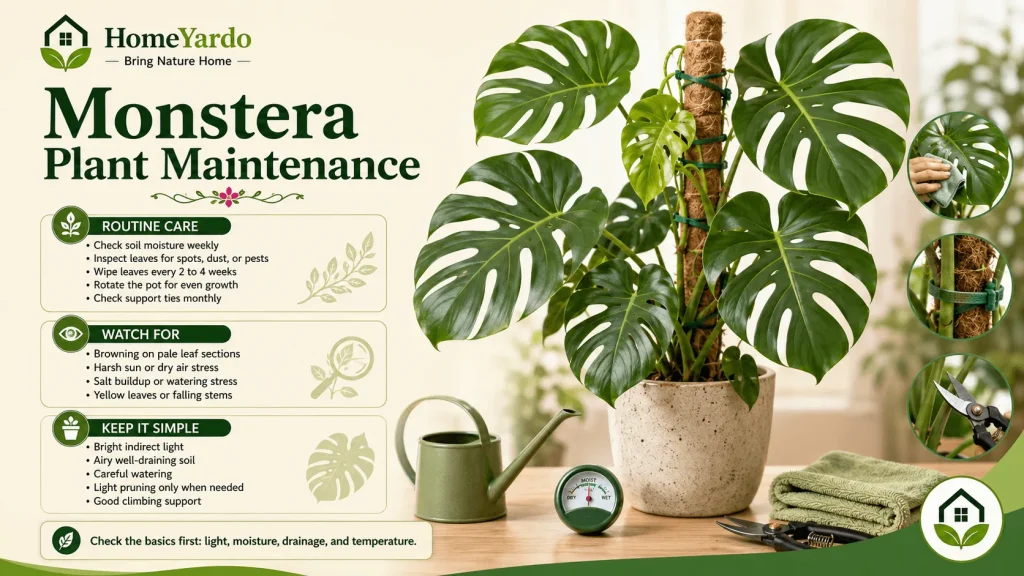
Monstera maintenance of plants is a routine to keep the plant in good condition, well-supported and easy to keep track of. It involves checking soil water content, wiping off dusty leaves, trimming the damaged plant, looking for insects and ensuring that the plant’s support is still in line with the size of the plant.
This plant requires the same maintenance as green Monstera however, the lighter leaf sections can be stressed more quickly. Yellow, white, cream and mint leaves can turn brown due to harsh sunlight dry air, the dry climate, salt accumulation or stress from watering. Regular checks can catch minor issues before they get worse.
| Maintenance Task | How Often | What To Check |
|---|---|---|
| Check soil moisture | Weekly | Water only when the upper soil starts to dry |
| Inspect leaves | Weekly | Look for yellowing, brown spots, pests, or dust |
| Wipe leaves | Every 2 to 4 weeks | Remove dust so leaves receive light better |
| Rotate the pot | Every few weeks | Keep growth balanced toward the light |
| Check support ties | Monthly | Loosen ties if stems are thickening |
| Prune damaged leaves | As needed | Remove dead, yellow, or badly damaged growth |
| Check the pot condition | During watering | Watch for poor drainage or compact soil |
| Review root health | During repotting or decline | Look for rot, crowding, or weak roots |
To maintain the plant, try not to take too much care of it. Monstera is not in need of constant pruning or moving. A steady set-up with indirect airy soil, careful watering, well-maintained leaves and good support for climbing is often enough.
If the plant’s growth slows, leaves turn yellow or the plant starts falling down, look at the basic issues first, including sunlight, soil moisture, drainage as well as temperature. The majority of Monstera issues begin in one of these zones. For plants with variegated foliage, examine whether the damage is only in pale leaf sections or all over the plant.
How Fast Do Monstera Grow?
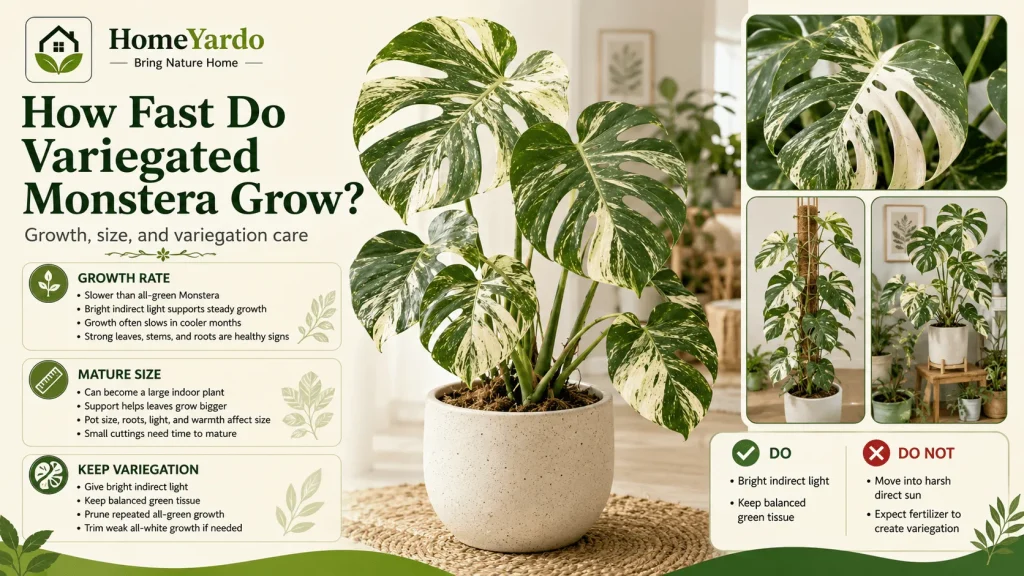
This plant tends to grow more slowly than a completely green Monstera. The less pale the tissue the plant is the lower the energy it will produce.
Monstera growth rate is dependent on the amount of light, the root seasons, the soil, temperature, and kind. A Thai Constellation in indirect, bright light could grow more consistently than a weak Albo cutting with strong white variations.
Indoor growth often slows in cooler months. Plants can stop growing for a few weeks, but not be unhealthy.
Healthy growth resembles robust new leaves, solid stems and roots that gradually fill the pot. Growth that is fast is great but slow growth is more secure.
How Big Does Variegated Monstera Grow?
This plant is able to grow into a massive indoor plant if it gets sufficient light, space and support. The mature plants may develop larger leaves that have natural splitting and holes. As the plant matures, its climbing habit and large leaves can make it an attractive choice for filling empty vertical spaces. If you want to compare Monstera with other statement plants, explore our guide to best tall indoor plants for more options suited to bright rooms and spacious corners.
Size varies based on the size of the plant. A tiny cutting won’t appear as an adult display plant in the first few days. It will take time for the root to climb and gain muscle.
Support can help increase the size of leaves. A plant that is swaying around the shelf could end up smaller and less tidy, whereas the plant that is supported grows higher with more confidence.
Pot size the size of the pot, the health of the root light, temperature, and all impact maturing growth. A plant that is compact with sturdy leaf structure and healthy roots will do better than a plant that is tall and weak which is thriving in light conditions.
How To Keep Variegation In Monstera?
Variegation is controlled by the genetics of plants as well as stem tissues. The right care can help support the pattern however it is not able to turn an ordinary green Monstera into a stable variegated Monstera.
The bright indirect light aids in the growth of the plant. Insufficient light can cause weak leaves and cause variegation to be less appealing on certain plants.
| Do | Do Not |
|---|---|
| Give bright indirect light | Move suddenly into the harsh sun |
| Keep balanced green tissue | Keep only fully white growth |
| Prune repeated all-green reverted growth | Expect fertilizer to create variegation |
| Prune repeated weak all-white growth if needed | Ignore the stem pattern when buying |
If this plant starts to show full-grown green growth, pruning could aid. Cut back to a point where there is still variegation within the stem.
If the plant has a habit of producing completely white leaves, then it might also require trimming. The all-white foliage looks stunning but it’s not able to help the plant on its own.
Why Monstera Leaves Turn White
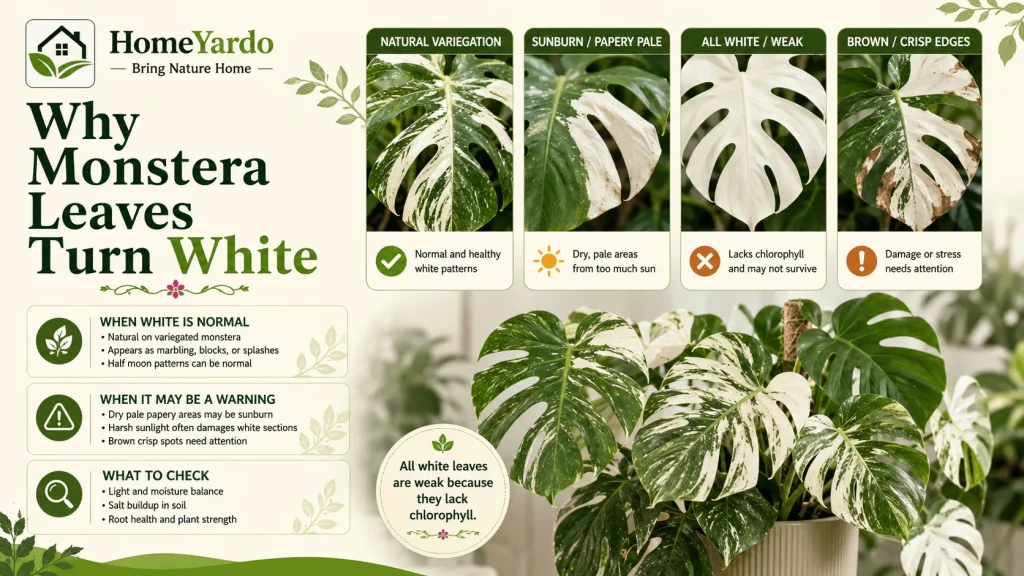
White leaves may be normal or they could be a warning sign. The difference is determined by texture, pattern and health of the plant.
When you look at albo monstera or other white patterns white patches are a part of the pattern that is natural. They can appear as marbling, blocks, half-moon leaflets, or tiny splashes.
The sudden appearance of dry, pale areas that appear papery could be sunburn. This is often the case when a plant receives harsh sunlight, especially on the white or cream parts.
White leaves can appear naturally on plants with a lot of variegation. However, they are weak because they are not able to produce enough chlorophyll. All-white leaves are not necessarily a catastrophe. A series of all-white leaves could cause the plant to weaken.
If white areas become brown, crisp, thin, or papery, you should check for moisture, light as well as salt buildup and the health of your root.
Common Variegated Monstera Problems
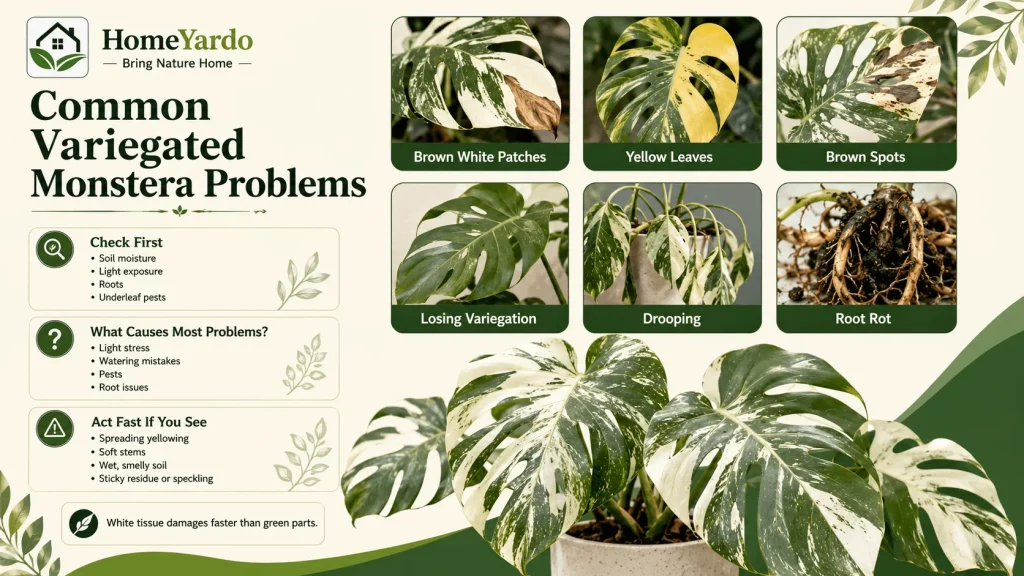
Most issues begin with a light source, water pests, roots, or stress. The leafy tissue of pale leaves may show signs of damage more quickly than green tissues, which means tiny mistakes made in the care of plants can be more striking.
Before applying treatment to the plant, be sure to check the moisture of the soil and light exposure, as well as the root systems for spreading yellowing and insects underneath the leaves. Be aware of whether the damage is visible solely on the tissue that is white or throughout the entire plant.
| Problem | Likely Cause | What To Do |
|---|---|---|
| Brown white patches | Sunburn, low humidity, stress, salt buildup | Move from harsh sun, check water, trim dead edges |
| Monstera leaves turning yellow | Overwatering, root stress, old leaves, low light | Check roots and soil moisture |
| Monstera Brown spots | Sunburn, pests, root stress, fungal spotting | Inspect leaves and roots |
| Losing variegation | Low light or reversion | Improve light and prune carefully |
| Fully white leaves | Too little chlorophyll | Keep only if the plant has enough green growth |
| No growth | Low light, cold, weak roots, poor soil | Improve warmth, roots, light, and soil |
| Drooping | Dry soil, wet roots, shock | Check moisture before acting |
| Root rot | Wet soil or oversized pot | Trim bad roots and repot |
| No fenestrations | Immaturity, weak light, no support | Add support and improve the light |
| Pest speckling or sticky residue | Spider mites, thrips, or scale | Isolate the plant and inspect it closely |
Don’t view every leaf that is yellow as a catastrophe. A lower leaf that is old may get older naturally. The spreading yellowing of the stems, soft stems and soil that is wet soil, or an unpleasant smell coming from the pot requires immediate care.
How To Propagate Variegated Monstera
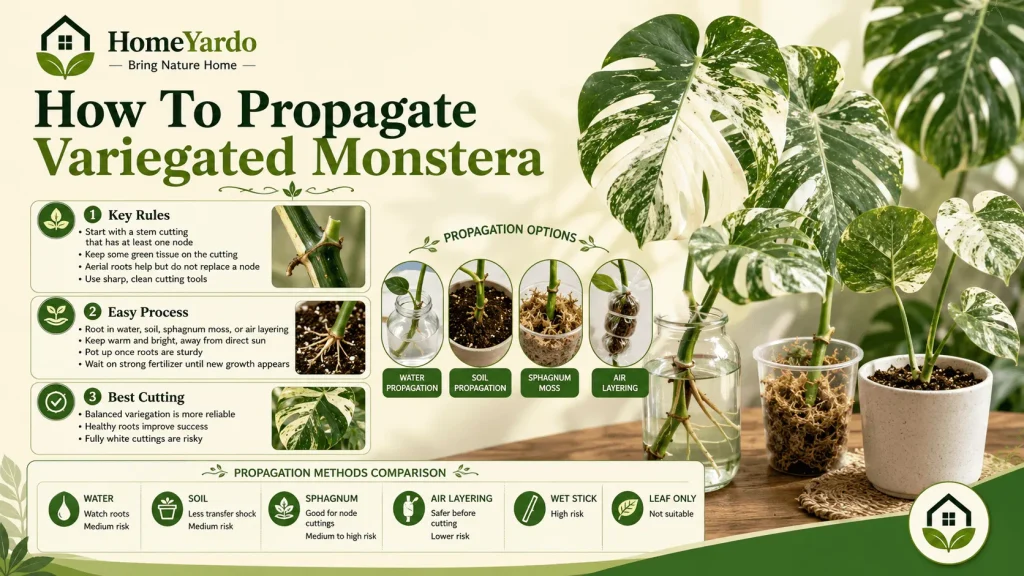
Variegated Monstera growth requires an underlying stem node. A single leaf could remain green for a few days however it won’t transform into a complete green plant without having a stem node.
A node is a part of the stem that can generate new growth. Aerial roots are a good option but they cannot take the place of the node.
Follow this easy process:
- Pick a stem with at the very least one node.
- Make sure there is some green tissue.
- Make sure you use sharp, clean cutting tools.
- Roots in soil, water, sphagnum or even air layers.
- Keep warm and bright away from direct sunlight.
- Pot when roots are sturdy enough.
- Do not apply fertilizers that are heavy until the first signs of new growth appear.
Cuttings that are completely white can be risky due to the fact that they do not have adequate green cells to sustain new growth. A cutting that has healthy roots and balanced variegation is more likely to succeed.
Propagation Methods
Each technique has advantages and risks. Air layering is usually more secure because roots may form prior to the cutting being removed from the plant.
| Method | Best For | Risk Level |
|---|---|---|
| Water propagation | Watching root growth | Medium |
| Soil propagation | Less transfer shock | Medium |
| Sphagnum moss | Wet sticks and node cuttings | Medium to high |
| Air layering | Safer before cutting | Lower |
| Wet stick | Experienced growers | High |
| Leaf only cutting | Not suitable | Fails as a full plant |
After propagation, keep the cutting cool and bright. It should also be steady. Do not apply fertilizers that are strong until the roots have grown and the plant is showing active growth.
What To Check Before Buying A Variegated Monstera
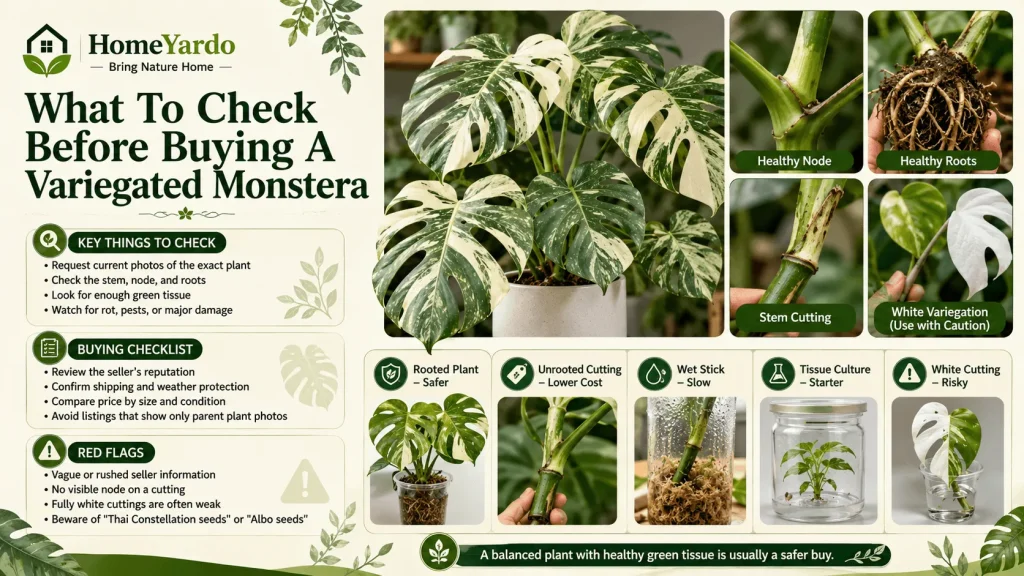
The purchase of this plant is a thrilling experience particularly when the pattern is stunning. But the best purchase is one based on facts and not on emotion.
Request current pictures of the specific plant. Photos of the parent plant can be useful, but they do not reflect the state of the plant that is being sold.
| Buying Option | Best For | Main Risk |
|---|---|---|
| Rooted plant | Safer first purchase | Higher cost |
| Unrooted cutting | Lower entry price | Rot or no new growth |
| Wet stick | Experienced growers | Slow and uncertain |
| Tissue culture | Small starter plant | Acclimation stress |
| Fully white cutting | Display only | Often weak or unsustainable |
For cuttings, look for the node. If the plant is rooted, look at the roots. If you purchase expensive plants, inquire about the cost of shipping and pests, protection from weather, and return guidelines.
Buying Checklist
A reputable seller must be able to demonstrate that the item is clearly. If the information is vague or has been rushed, or too promising for its own good, you should think twice before making a purchase.
- Request photos from the root.
- Get images of the stem and node
- Request current photos of the plant.
- Review the seller’s reviews.
- Make sure you know the weather for your shipping
- Check that the cut has at the very least one node
- Find sufficient green tissue on the stem and leaves
- Beware of listings that show only the parent plant’s photos.
- Be sure to check for rot, pests or serious damage
- Compare prices based on the size, type, and condition of the root
- Beware of “Thai Constellation seeds” or “Albo seeds.”
A well-balanced plant is generally more secure than a cutting that is not rooted and has one striking leaf. Beauty is important, but survival is more important.
If a rare variegated Monstera seems too expensive or demanding for your current experience, consider starting with easier foliage plants. Pothos, heartleaf philodendron, and some common Monstera varieties can offer a similar tropical appearance with more forgiving care requirements. Compare these choices in our indoor tropical plant guide before making a purchase.
Variegated Monstera Seeds And Scam Warning
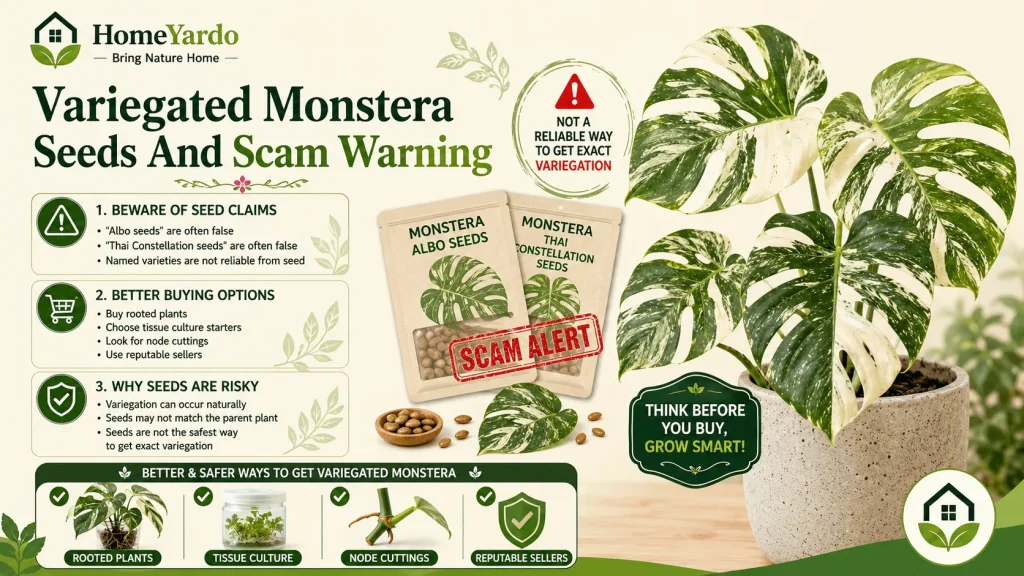
Named needs aren’t trustworthy. Plants like albo monstera or Thai Constellation are typically sold via cuttings, tissue culture or even rooted plants, but not seed packets that are true to type.
Beware of advertisements that offer “Albo seeds” or “Thai Constellation seeds.” These statements are often false.
Named Albo as well as Thai Constellation seeds aren’t an effective method of growing these specific plants. Purchase rooted plant, tissue culture starters or node-cuttings from reputable sellers.
Variegation can be found naturally in plants; seeds will not always produce the same pattern. The purchase of seeds isn’t the most secure way to acquire an exact Monstera that is variegated.
Is Variegated Monstera Rare?
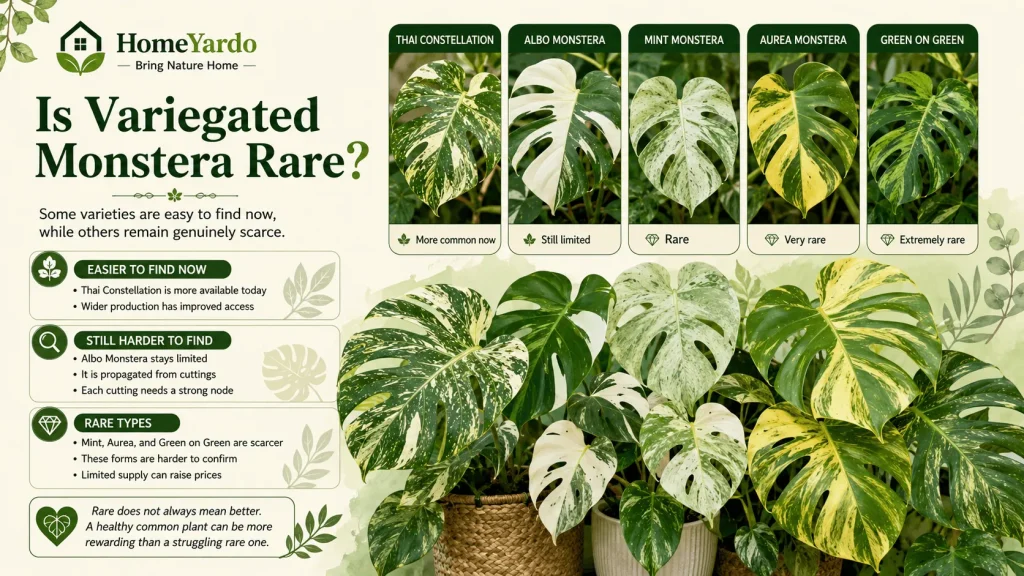
A few varieties of Monstera are scarce, while others are easy to locate today. Thai Constellation is now more accessible in a number of locations because of the wider production.
albo monstera is still more restricted as it is proliferating through cuttings. Every cutting requires a strong node, sufficient to grow green, as well as enough time to establish.
Mint, Aurea, Green on Green and other rare sports names are typically difficult to locate and are more difficult to confirm. The prices may be higher due to the fact that supply is very limited, and demand can be high.
Rare monsters do not necessarily suggest superiority. Common healthy plants can be more enjoyable than a unique plant struggling in poor conditions.
Is Variegated Monstera Toxic To Cats And Dogs?

This plant is not recommended for pets that chew plants. Similar to green Monstera, it has calcium oxalate crystals, which could cause irritation to the tongue, mouth, throat, and stomach.
Make sure the plant is kept away from pets, cats and curious pets. Tall stands, a locked plant room, or a secure shelf could be helpful; the determined pet can still get to leaves.
If your pet chews on the plant and is drooling, making paws at their mouth or vomiting, swelling or distress, consult an animal veterinarian.
The beauty of plants should never be at the expense of pet security.
Conclusion
A Variegated Monstera may appear to be a live piece of art. Each leaf is opened slowly and the design is not identical twice.
The best plant isn’t always the rarest, whitest or most expensive. A healthy plant that has strong roots balanced shade and steady growth is likely to provide more pleasure.
Thai Constellation is typically the safest option for those who are just starting out. Albo monstera, Aurea, Mint and rare sport varieties can be stunning; they require more cautious purchasing and maintenance.
Select a plant that has strong roots, balanced color and needs for care that are in line with the decor of your home. It should be given ample indirect light, a good amount of soil, gentle watering, warmth and help. The effect lasts longer when your plant’s health is good and well-maintained according to the design.
FAQ’s
This usually happens because some plant tissue produces less chlorophyll. This creates white, cream, yellow, mint, or lighter green patterns on the leaves. Good care can support existing variegation, but fertilizer or light cannot turn a normal green Monstera into a stable variegated plant.
The main types include Thai Constellation, Albo monstera, Aurea, Mint Monstera, Green on Green, and true Monstera deliciosa Variegata. Thai Constellation usually has cream speckles, while Albo often has stronger white patches. Rare collector names also exist, but they should be checked carefully because seller labels can vary.
This plant needs bright indirect light to support healthy green tissue and steady growth. Gentle morning light can help, but harsh afternoon sun may burn the white or cream sections. In darker rooms, a grow light can help prevent weak growth, slow recovery, and smaller leaves.
This plant may survive in low light for some time, but it will usually grow slowly and weaken. Because pale leaf areas make less energy, the plant depends heavily on good green tissue and proper light. Bright indirect light is better for stronger leaves, better color, and healthier root activity.
A Monstera may lose variegation because of low light, natural reversion, or unstable stem tissue. Better light can support healthier patterned growth, but it cannot always reverse genetic reversion. If new growth becomes fully green, prune back carefully to a node that still shows variegation.
Brown areas on this plant often come from harsh sun, dry air, watering stress, salt buildup, or root problems. White and cream leaf sections brown more easily because they are more delicate than green tissue. Check light exposure, soil moisture, drainage, humidity, and root condition before trimming damaged edges.
Water this plant when the upper soil starts to dry, not on a fixed weekly schedule. The plant may use water more slowly than a green Monstera because variegated leaves often grow at a slower pace. If the soil is still wet, wait. If the pot feels lighter and the top soil is dry, water deeply and let excess drain.
The best soil for this plant is chunky, airy, and fast draining. A good mix can include indoor potting soil, orchid bark, perlite or pumice, coco chips, and a small amount of charcoal. The soil should hold light moisture but still allow oxygen around the roots after watering.
This plant does not need a moss pole to stay alive, but support helps it grow better. In nature, Monstera climbs trees, so a moss pole, plank, stake, or trellis supports its natural growth habit. A supported plant often develops stronger stems, larger leaves, and a cleaner display shape indoors.
This plant can become a large indoor plant when it has strong light, healthy roots, and climbing support. Small cuttings need time before they develop mature leaves with splits and holes. Leaf size depends on care, support, pot size, root strength, and how well the plant adapts to the home.
Seeds are not reliable. Albo and Thai Constellation are normally sold as rooted plants, tissue culture starts, or node cuttings, not true-to-type seed packets. Avoid listings that promise specific named variegated Monstera seeds because they are often misleading.
Choose a healthy stem cutting with at least one node, because a leaf without a node cannot grow into a full plant. The cutting should also have some green tissue, since fully white cuttings often struggle to make enough energy. Root it in water, sphagnum moss, chunky soil, or through air layering, then keep it warm, bright, and out of harsh direct sun until strong roots form.
One fully white Monstera leaf is not always bad, but repeated fully white growth can weaken the plant. White leaves have very little chlorophyll, so they cannot make enough energy for strong growth. If the plant keeps producing all white leaves, pruning back to a more balanced node may help protect the plant.
A rooted, actively growing Thai Constellation is often the safest first Monstera to buy. It is usually easier to verify than an unrooted Albo cutting, wet stick, or rare collector plant. For any type, choose healthy roots, a visible node, balanced variegation, current photos, and a trusted seller.
This plant can live outside in warm, frost free areas with shade, filtered light, and protection from harsh weather. It should not be placed in open lawn sun, soggy soil, or daily sprinkler spray. In cooler climates, grow it in a movable container so it can come indoors before cold nights.
Yes, this plant can be used as a shaded patio or courtyard focal plant in warm protected settings. It works best in a large container near a wall, trellis, moss pole, or covered seating area. Surround it with lower shade plants like ferns or philodendrons, and keep it away from harsh afternoon sun and wet lawn soil.
Monstera leaves can turn white because of natural variegation, especially in plants like Albo monstera or Thai Constellation. Patterned white areas are normal on variegated plants, but sudden pale, dry, or papery patches can mean sunburn. Fully white leaves may look beautiful, but repeated all-white growth can weaken the plant because it has very little chlorophyll.
Yes, Albo monstera is usually harder to care for than a normal green Monstera. Its white leaf sections make less energy, so the plant often grows more slowly and reacts faster to poor light, overwatering, or weak roots. It also needs more careful pruning because it can produce all-green reverted growth or weak all-white leaves.
You can support existing variegation by giving the plant bright indirect light, healthy roots, and careful pruning. If new growth turns fully green, pruning back to a node with visible variegation may help encourage patterned growth again. However, fertilizer, extra sunlight, or sprays cannot turn a normal green Monstera into a stable variegated plant.
It is popular because it has cream speckles and marbled leaves that look bold but softer than pure white Albo leaves. Its variegation is usually more stable, which makes it easier for many homes than some cutting-grown Albo plants. It is also more available now in many markets, so buyers often see it as a safer first variegated Monstera.
Yes, this plant needs bright indirect sunlight to grow well. It should not sit in harsh afternoon sun because white, cream, or yellow leaf areas can burn more easily than green tissue. A bright window with filtered light, gentle morning sun, or a suitable grow light can help support stronger growth.
Monstera deliciosa is the green species commonly grown as a houseplant, while “Variegata” refers to a variegated form with lighter leaf patterns. A variegated Monstera may show white, cream, yellow, mint, or pale green sections depending on the plant type. The care is similar, but variegated plants usually need brighter indirect light and more careful watering because they often grow more slowly.
Repot Monstera when roots circle the pot, push through drainage holes, or the soil breaks down and stays too wet. Use a pot only one size larger and fill it with a chunky, airy mix that drains well. After repotting, keep the plant in bright indirect light and avoid heavy fertilizer until it settles.
Prune Monstera by removing yellow, damaged, dead, or weak growth with clean sharp snips. For variegated plants, pruning can also help manage fully green reverted stems or repeated all-white leaves. Cut near a node when shaping the plant, and avoid removing too many healthy leaves at once.
A Monstera may look like it is dying because of root rot, low light, underwatering, cold stress, pests, or poor soil drainage. Yellow leaves with wet soil often point toward overwatering or root trouble, while crispy leaves can come from harsh sun or dryness. Check the roots, soil moisture, light exposure, and stem firmness before deciding what to fix.
A Monstera usually has large green, heart-shaped leaves that develop splits and holes as the plant matures. This plant may also show white, cream, yellow, mint, or light green patterns on the leaves. Young plants often look simpler, while mature plants with good support can grow larger leaves with stronger fenestrations.
Monstera grow naturally in warm tropical regions of the Americas, where they climb trees and receive filtered rainforest light. They use aerial roots to attach to trunks and grow upward toward brighter conditions. Indoors, this natural habit explains why they prefer bright indirect light, warmth, airy soil, and climbing support.
Monstera growth speed depends on light, warmth, roots, soil, season, and plant type. A healthy green Monstera may grow faster than a variegated one because variegated leaves have less energy-producing green tissue. Small cuttings can take months to settle before strong new growth appears, while mature supported plants usually grow more confidently.
Encourage existing variegation by giving the plant bright indirect light, keeping roots healthy, and pruning fully green reverted growth when needed. Choose stems that already show variegation, because the pattern comes from plant tissue rather than fertilizer or sprays. Avoid pushing the plant into harsh sun, since pale leaf sections can burn quickly.
How This Guide Was Built
This guide was built by comparing plant care guidance, variegated Monstera type descriptions, buyer safety advice, propagation notes, common problem explanations, and outdoor growing context from plant-care publishers, nursery pages, and houseplant guides.
Care claims were organized into practical steps. Rare plant names were treated carefully because seller labels, collector names, and trade names can vary.
References
- Greenery Unlimited: Variegated Monstera care
https://greeneryunlimited.co/pages/variegated-monstera-care - Pretty in Green: Variegated Monstera types
https://prettyingreen.com/blogs/plant-tea/variegated-monstera-deliciosa-guide - Trex Plants: Thai Constellation and Albo care
https://trexplants.com/blog/variegated-monstera-deliciosa-thai-constellation-albo - Thursd: Variegated Monstera color and type guide
https://thursd.com/articles/all-variegated-monstera-plants-together-albo-aurea-sport-thai-constellation - Quirky Plants: Beginner care guide
https://www.quirkyplants.co.uk/blogs/plant-care-guides/variegated-monstera-care-guide - Ohio Tropics: Care, propagation, pruning, toxicity
https://www.ohiotropics.com/2020/10/05/variegated-monstera-deliciosa/ - The Spruce: Types, buying cautions, seed warning
https://www.thespruce.com/everything-you-need-to-know-about-variegated-monstera-deliciosas-5089401 - Verdant Dwellings: Borsigiana, Thai, true Variegata identification
https://www.verdantdwellings.com.au/blog/variegated-monstera-deliciosa-which-one-is-which - UConn Home And Garden Education Center: Monstera growing notes
https://homegarden.cahnr.uconn.edu/factsheets/monstera-deliciosa/ - Love The Garden: Outdoor Monstera growing notes
https://www.lovethegarden.com/au-en/growing-guide/how-to-grow-monstera