13 Houseplant Statistics That Reveal How Beginner Gardeners Buy Indoor Greenery
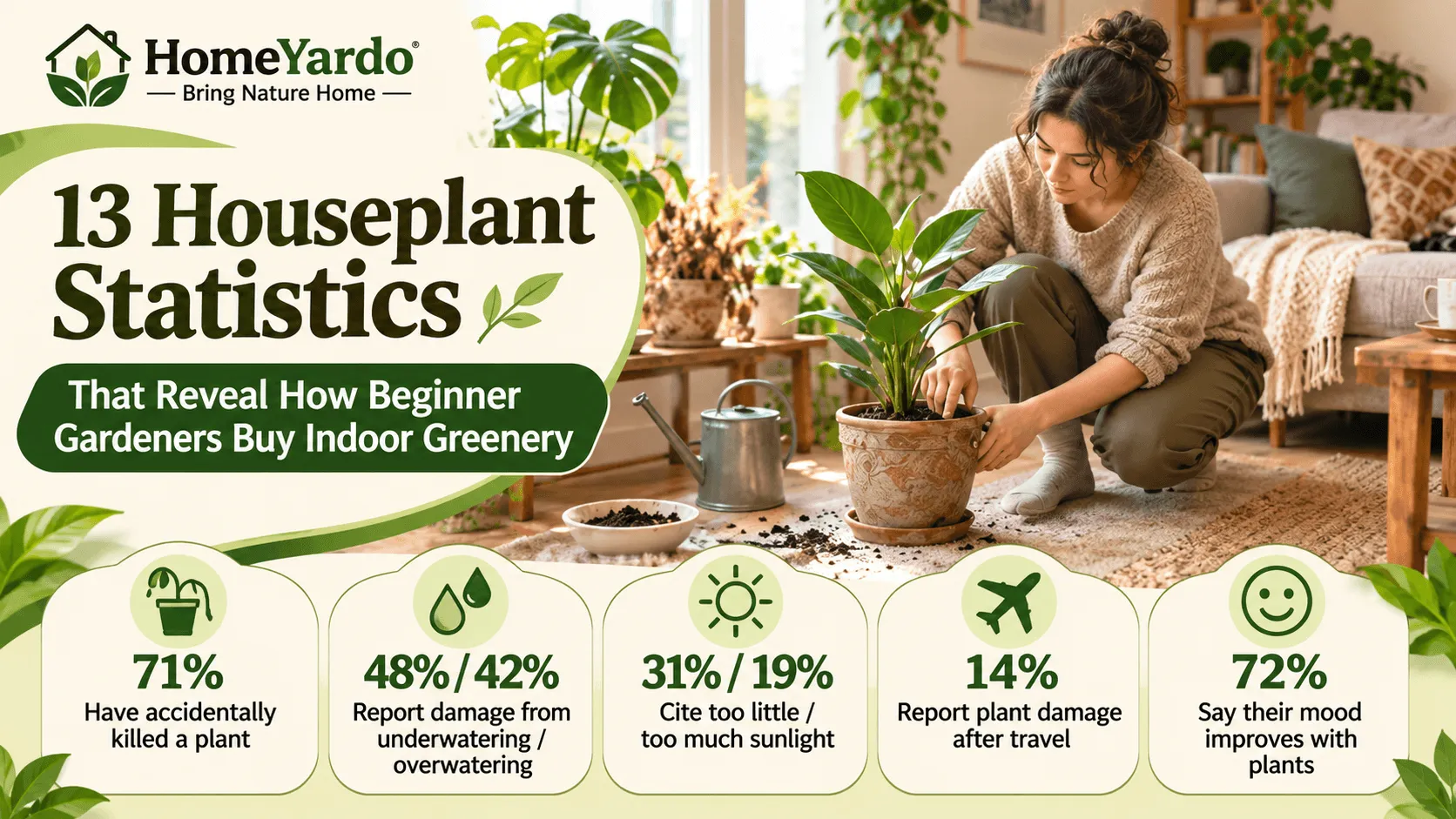
Under flattering store lights, healthy leaves make buying greenery feel easy. Before you reach the checkout, read the care label: admiring a pot won’t tell you whether its plant fits your home. Although respondents weren’t exclusively new gardeners, recent houseplant ownership survey findings offer beginners useful warnings. Before shopping, take a close look at the space beside your sofa or desk. How much light reaches that space, and can you realistically check soil between trips away?
What A Houseplant Ownership Survey Reveals About Plant Losses
Start with reported plant losses.
1. Seventy-One Percent Have Accidentally Killed a Plant
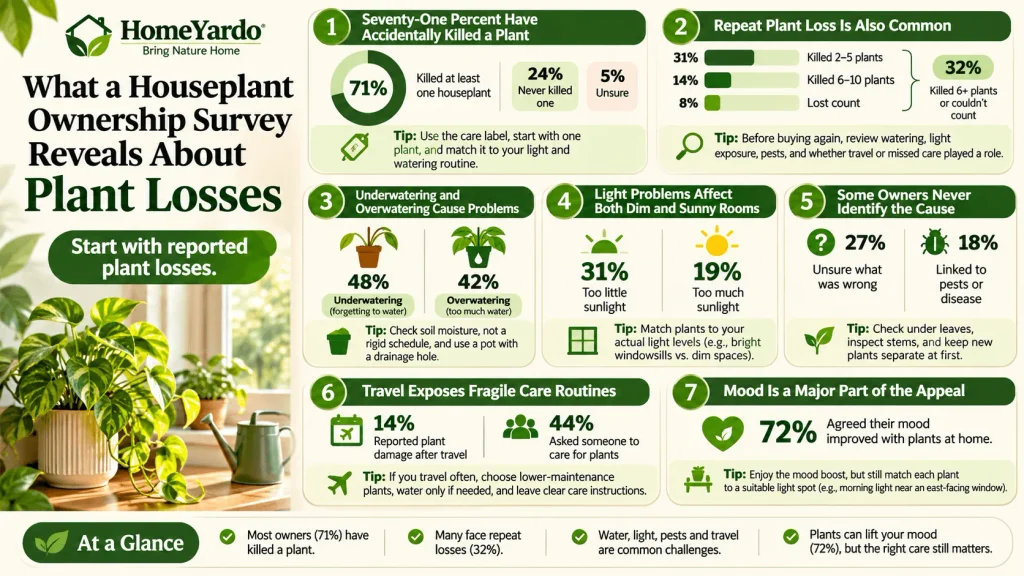
Of the 1,000 U.S. owners in a September 2026 houseplant ownership survey, 71% said they’d accidentally killed at least one houseplant.
Another 24% said they’d never killed one; 5% were unsure. Use the care label to guide what you buy. Choose one plant instead of a decorative group; before shopping, note your room’s light level and decide how often you can realistically check soil moisture.
2. Repeat Plant Loss Is Also Common
In the same September 2026 survey, 31% of respondents had killed two to five houseplants, 14% had killed six to 10, and 8% had lost count. The survey’s combined share of respondents who’d killed at least six plants or could no longer count their losses was 32%.
Without working out what killed the last plant, buying its replacement can leave you with the same result. First, look back at watering and light exposure. Next, before buying again, check whether pests or missed care during travel played a part.
3. Underwatering and Overwatering Cause Opposite Problems
Among respondents in the September 2026 survey, 48% had seriously damaged or killed a plant by forgetting to water; 42% reported damage from overwatering. These were the care mistakes owners reported most often.
Check the potting mix first. With dry soil and limp growth, check for missed watering; if stems feel soft in constantly wet soil, check for excess moisture instead. A diagnosis takes more than leaf color alone. Instead of watering by a rigid calendar, check moisture and choose a container with a drainage hole. Water needs also vary considerably between tropical house plants, so check the requirements of the particular species rather than treating every indoor plant the same way.
4. Light Problems Affect Both Dim and Sunny Rooms
In the September 2026 survey, 31% of respondents reported plant damage associated with insufficient sunlight, while 19% had exposed a plant to too much sunlight.
“Indoor plant” doesn’t mean suitable for anywhere indoors. A south-facing windowsill differs from a dark hallway. Before buying, watch where direct sun falls over several hours, then reserve sun-loving plants for genuinely bright windowsills and choose low-light-tolerant foliage for dimmer rooms
Rooms with higher humidity can present a different set of growing conditions. If you are choosing greenery for one of these spaces, compare low-light bathroom plants based on both available light and humidity rather than assuming every houseplant will thrive there.
5. Some Owners Never Identify the Cause
Plant decline left 27% unsure what was wrong in the September 2026 survey; pests or disease were associated with the damage reported by 18%.
Put fertilizer aside for now. Before adding any, look under leaves and along stems, then check soil moisture and drainage. Keep a new purchase separate briefly if you already have plants, using that time to look beneath its leaves for visible pests.
6. Travel Exposes Fragile Care Routines
In the September 2026 survey, 14% of respondents reported damage after leaving a plant unattended during travel. Separately, 44% reported asking someone to care for plants while they were away.
Frequent travelers should question whether a plant needing frequent intervention fits their routine. Before departure, water only if the plant needs it, and consider drought-tolerant options. Rather than prescribing a fixed cupful of water, leave written instructions that describe soil checks.
7. Mood Is a Major Part of the Appeal
Of those in the September 2026 survey, 72% agreed their mood improved with plants at home. These results don’t prove that plants cause mental-health improvements; owners were describing how they felt.
Suitable light still matters, however much you enjoy looking at your plants. Check whether your favorite empty shelf suits the plant you want. Consider placing foliage that’s suited to morning light near an east-facing window.
Houseplant Ownership Trends in the U.S. Favor Practical Purchases
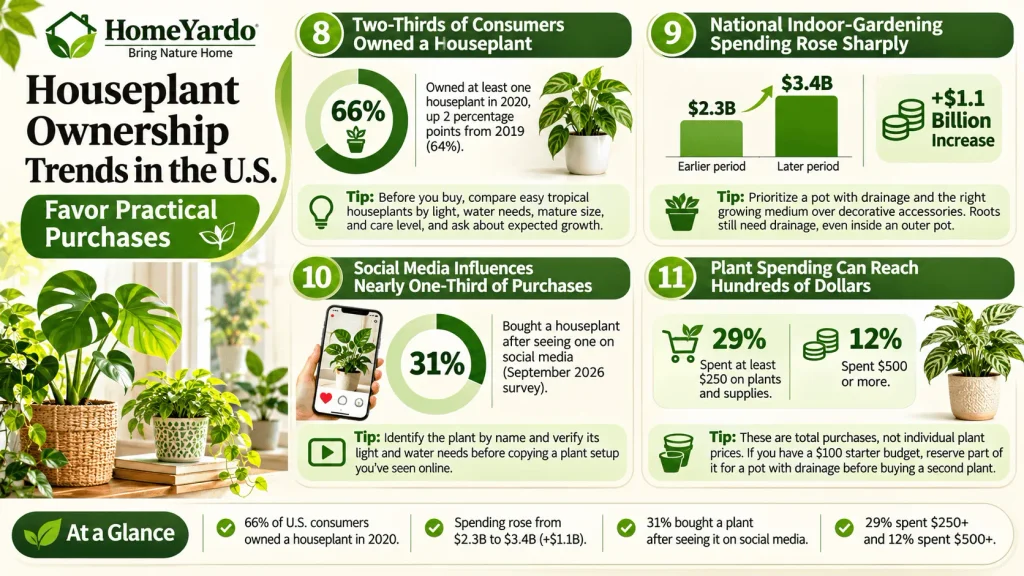
8. Two-Thirds of Consumers Owned a Houseplant
In CivicScience’s 2020 survey, 66% of U.S. consumers owned at least one houseplant, two percentage points above 2019.
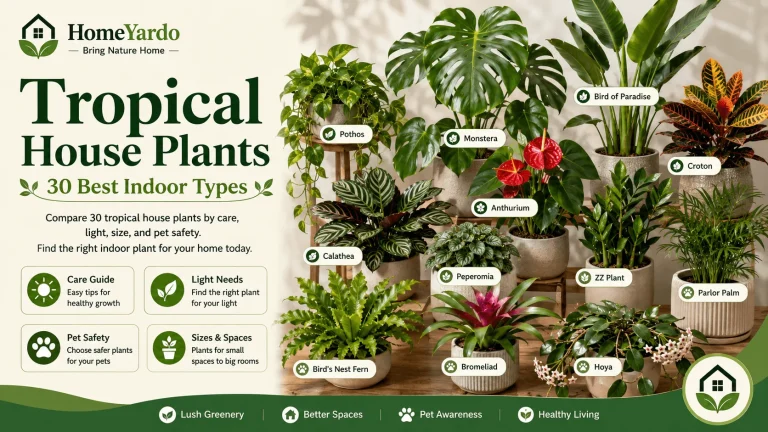
Knowing how to care for a houseplant doesn’t automatically come with owning one. A demanding plant isn’t beginner-friendly just because it keeps appearing online. If this is your first purchase, compare easy tropical house plants for beginners by light, watering needs, mature size, and care level before choosing one mainly for its appearance. Ask the nursery about expected growth if the label gives only the plant’s name.
9. National Indoor-Gardening Spending Rose Sharply
Over the covered period, U.S. spending on indoor houseplant gardening rose from $2.3 billion to $3.4 billion, according to the 2024 National Gardening Survey reporting summarized by Greenhouse Management. The increase comes to $1.1 billion.
Plants and related supplies can both count toward category spending; that isn’t your recommended budget. Prioritize a suitable pot with drainage and the right growing medium over decorative accessories. Even inside an outer pot, roots still need drainage in their own container.
10. Social Media Influences Nearly One-Third of Purchases
In the September 2026 survey, 31% of owners had bought a houseplant after seeing one on social media.
Room orientation and local humidity aren’t always in short videos, nor are mature size and the creator’s care routine. First, identify the plant by name. Verify the plant’s light and water needs before copying that attractive setup you’ve seen.
11. Plant Spending Can Reach Hundreds of Dollars
In the September 2026 survey, 29% had spent at least $250 on plants and plant supplies during the previous year; 12% had spent $500 or more.
These are combined purchases, not individual plant prices. Replacement potting mix and suitable containers need room in your collection budget, too. Reserve part of a $100 starter budget for a pot with drainage rather than immediately buying a second plant.
How Many Houseplants Does the Average Person Own?
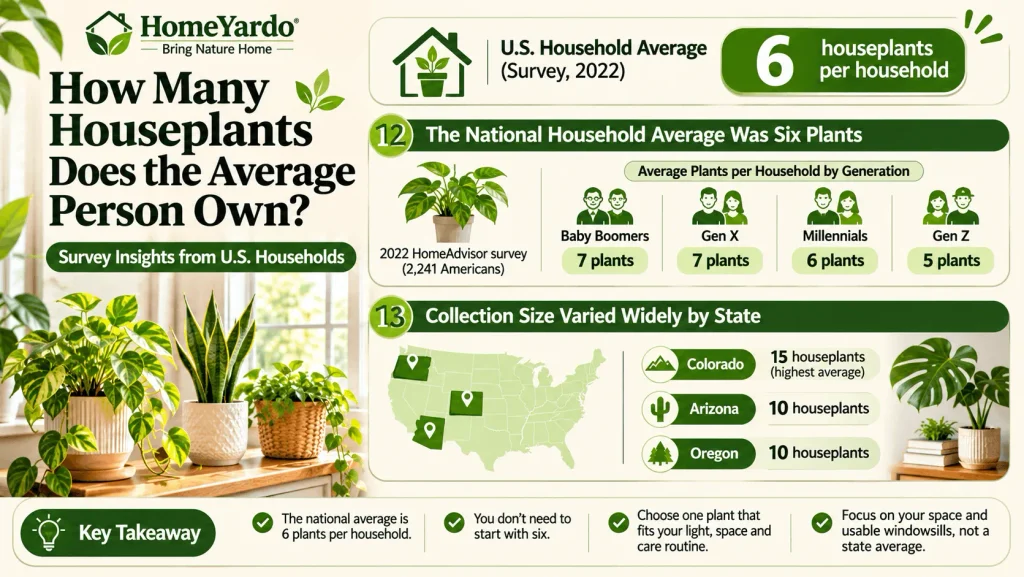
In a 2022 survey, the average U.S. household among respondents owned six houseplants.
12. The National Household Average Was Six Plants
The 2022 survey of 2,241 Americans, reported by HomeAdvisor, found Baby Boomers and Gen X respondents averaged seven plants per household; Millennials averaged six, with Gen Z at five.
The available national average is six plants per surveyed household, not per person. That isn’t where you need to start. Instead of juggling several plants with different light and moisture requirements, begin with one that fits your conditions.
13. Collection Size Varied Widely by State
Colorado households had the highest average at 15 houseplants in the same 2022 survey reported by HomeAdvisor. In Arizona and Oregon, averages were 10.
Don’t assume climate caused those differences without evidence from the survey explaining them. Rather than matching a state average, focus on your available space and indoor conditions. Take a particularly close look at how many usable windowsills you actually have.
Buy For The Room You Actually Have
A plant’s care needs have to fit your room and routine for it to survive. Use this checklist to compare a prospective purchase with the spot you’ve chosen beside a window or on a tabletop. Room conditions matter too; for example, the best plants for bathroom spaces need to be selected according to light, humidity, available space, and other conditions rather than humidity alone.
| Home condition | Check before buying | Beginner-friendly direction | Main caution |
|---|---|---|---|
| Lower indirect light | How far the spot sits from a window | ZZ plant or snake plant | Low-light tolerance does not mean no light |
| Bright indirect light | Whether direct rays hit the leaves | Pothos or heartleaf philodendron | Strong direct sun can scorch foliage |
| Dry indoor air | Distance from heating vents | ZZ plant or snake plant | Cold drafts can still cause stress |
| Frequent travel | How long the soil normally stays moist | A drought-tolerant foliage plant | Do not compensate with excessive watering |
| Limited floor space | The plant’s mature width and height | A compact tabletop variety | Small nursery plants can outgrow shelves |
Choose a plant based on the room conditions you can measure and the care you can repeat, even if the result looks different from your ideal display. Check which direction your window faces before visiting the nursery.
Final Takeaway
Houseplant statistics show that plant ownership is popular, but common problems such as missed watering, excess water, unsuitable light, travel, and uncertain diagnoses can make indoor gardening harder than it looks. The best lesson for a beginner isn’t to own more plants. It’s to choose a plant whose needs match the light, space, and care routine available in the home.
Start with the room, not the plant. Check the available light, drainage, mature size, and watering requirements before buying. A smaller collection that fits your routine is more useful than trying to match somebody else’s shelf—or a national average.
FAQ’s
One of the strongest findings in the data cited here is that 71% of respondents in a September 2026 survey said they had accidentally killed at least one houseplant. The same survey found that forgotten watering, overwatering, and inadequate sunlight were commonly reported problems.
A 2020 CivicScience survey reported that 66% of U.S. consumers owned at least one houseplant. Ownership rates can differ between surveys because sampling methods, populations, and definitions aren’t always the same.
A 2022 survey of 2,241 Americans reported an average of six houseplants per surveyed household. The figure represents households in that survey, not six plants for every individual in the United States.
There isn’t one universal cause for every houseplant. In the September 2026 survey cited here, 48% reported serious plant damage or loss after forgetting to water, while 42% reported problems associated with overwatering.