Tropical House Plants: 30 Best Indoor Types And Care Guide
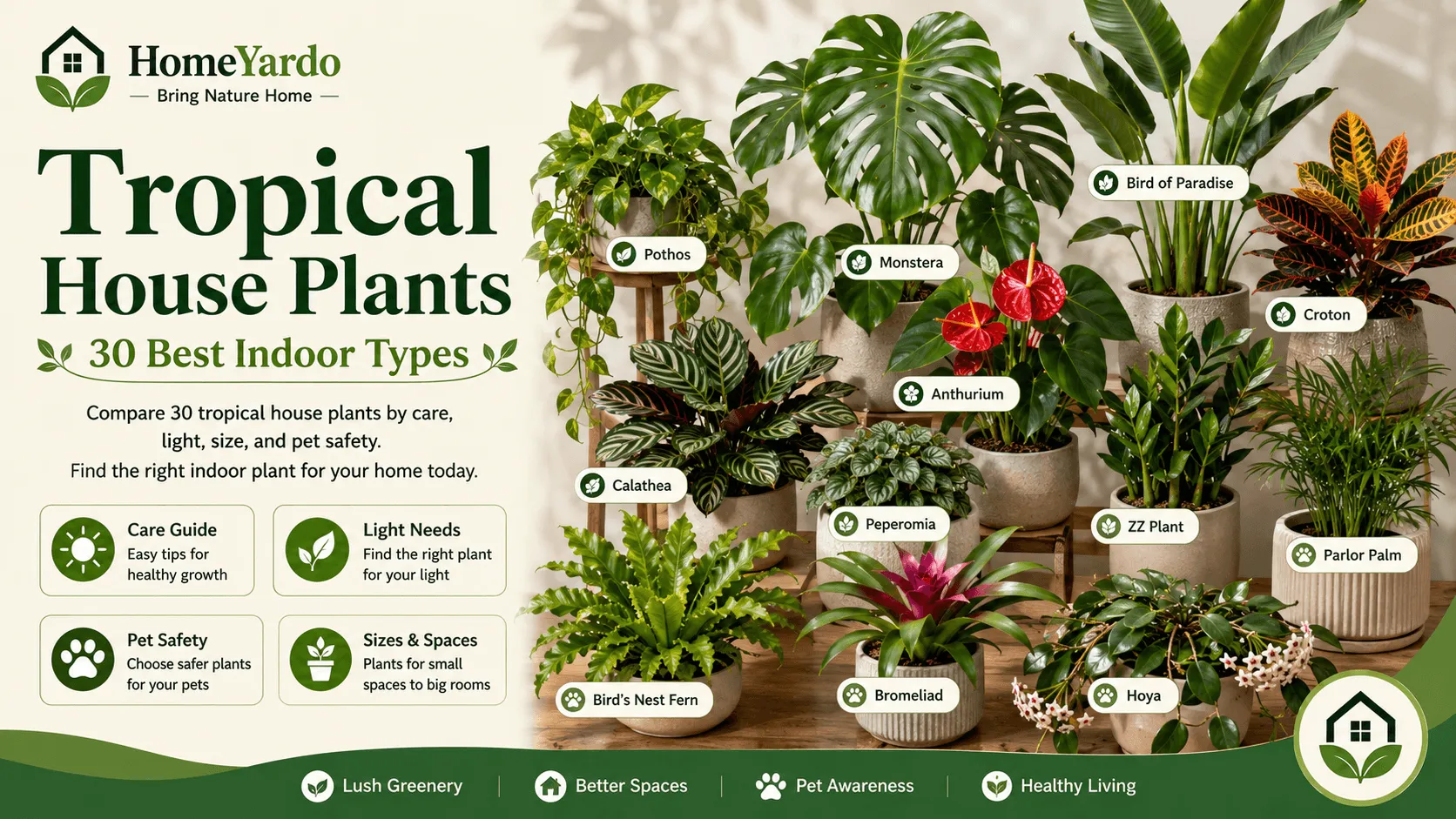
If you choose the right tropical house plants, then the room will look more serene, green and alive. That fresh indoor garden feeling without needing to have a greenhouse in the living room comes from large leaves, soft palms, glossy vines and colorfully colored foliage.
However, all tropical plants are not the same. There are some that are less light tolerant. Others require a well-lighted window and consistent humidity. Some tolerate the lack of water while others get upset when it is not raining after one dry day. Plant people know just how small a drama can be.
This guide provides a comparison of 30 of these house plants when it comes to light, water, soil, humidity, size, pet safety and care level. It also has a Quick Plant Card, Best By Need Tables, Plant Care Information, Common Plant Problems, and Safe Plant Shopping. Needs vary by room, pot size, season and variety of plants and the ideal plant is the one that fits the home first.
Best Tropical House Plants At A Glance
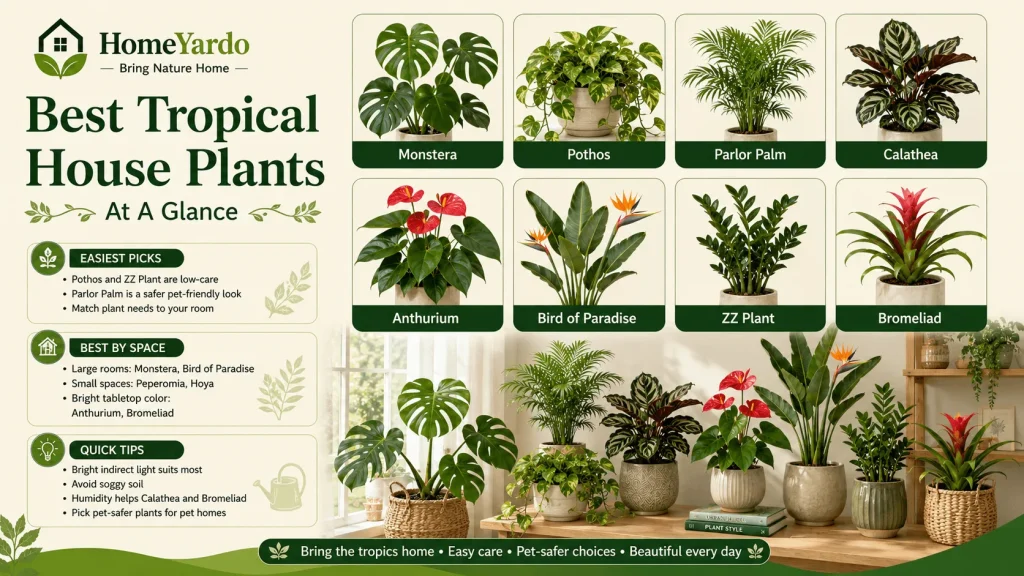
There’s lots less plant regret with a quick comparison. A beautiful plant in the wrong room may not thrive, and a simple plant in the right corner can be happy for years.
Use this table as a quick reference guide. More information about care, size, soil and common mistakes is provided in the full plant profiles later.
| Plant | Best For | Light | Water | Humidity | Pet Safety | Indoor Size | Soil Note | Best Room | Quick Warning |
|---|---|---|---|---|---|---|---|---|---|
| Monstera | Big tropical leaves | Bright indirect | Moderate | Medium-high | Not pet-safe | Large | Chunky aroid mix | Living room | Needs support |
| Pothos | Beginners | Low-bright indirect | Let the topsoil dry | Normal-medium | Not pet-safe | Trailing | Draining potting mix | Office, shelf | Avoid soggy soil |
| Parlor Palm | Pet-safe palm look | Low-medium | Moderate | Medium | Safer choice | Small-medium | Light indoor mix | Bedroom, office | Do not dry hard |
| Calathea | Patterned leaves | Medium indirect | Steady moisture | High | Safer choice | Small-medium | Moist but draining | Bathroom | Crisps in dry air |
| Anthurium | Tropical color | Bright indirect | Lightly moist | High | Not pet-safe | Small-medium | Loose airy mix | Bright tabletop | Low light reduces blooms |
| Bird of Paradise | Statement plant | Bright indirect | Moderate | Medium-high | Not pet-safe | Large | Well-draining mix | Bright corner | Needs space |
| ZZ Plant | Low care | Low-bright indirect | Low | Normal | Not pet-safe | Small-medium | Fast-draining mix | Office | Water rarely |
| Bromeliad | Compact color | Bright indirect | Moderate | Medium-high | Safer choice | Small-medium | Very draining mix | Tabletop | Care varies by type |
Some plants are easier to choose by need than by name. This table works well when the room is already fixed and the plant has to fit around it.
| Need | Best Picks |
|---|---|
| Beginner | Pothos, ZZ Plant, Snake Plant |
| Low light | ZZ Plant, Parlor Palm, Chinese Evergreen |
| Pet-safer | Parlor Palm, Calathea, Peperomia |
| Large room | Bird of Paradise, Monstera, Kentia Palm |
| Small space | Peperomia, Nerve Plant, Hoya |
| Flowers | Anthurium, Orchid, Bromeliad |
| High humidity room | Calathea, Bird’s Nest Fern, Nerve Plant |
What Are Tropical House Plants?
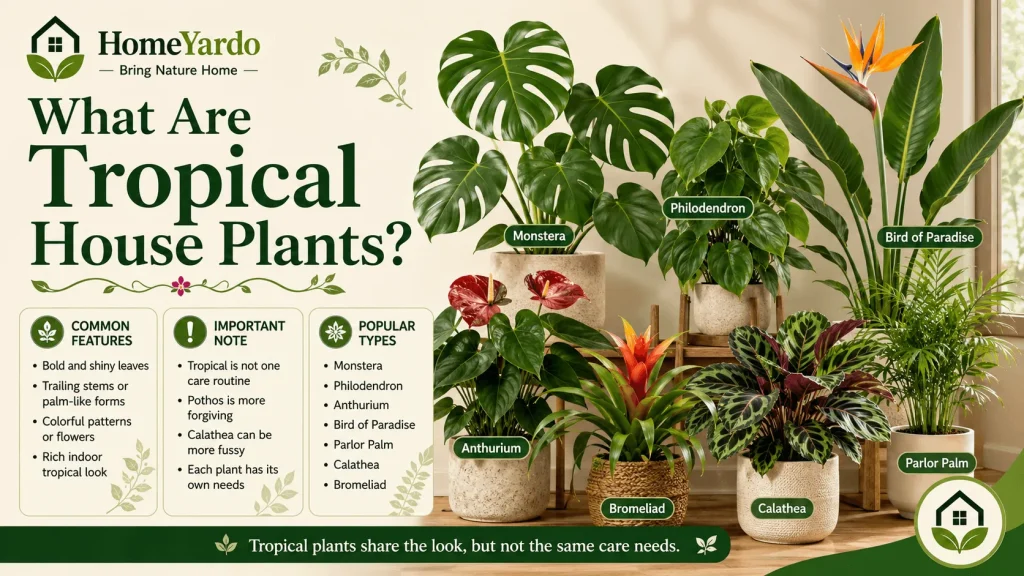
Plants that grow in warm (tropical or subtropical) places or plants that look tropical that will grow well indoors are tropical house plants. Many are utilized for their bold leaves, shiny leaves, trailing stems, palm-like shape, color patterns, or long-lasting flowers.
Tropical is not a single care treatment. A Pothos will do its best to get over a hectic week. During dry conditions, a Calathea might complain. Both can appear tropical in appearance, but in reality have different requirements.
Some typical ones include Monstera, Philodendron, Anthurium, Bird of Paradise, Parlor Palm, Calathea and Bromeliad. They all have a rich indoor feel, but there’s a comfort zone for each.
Types Of Tropical House Plants
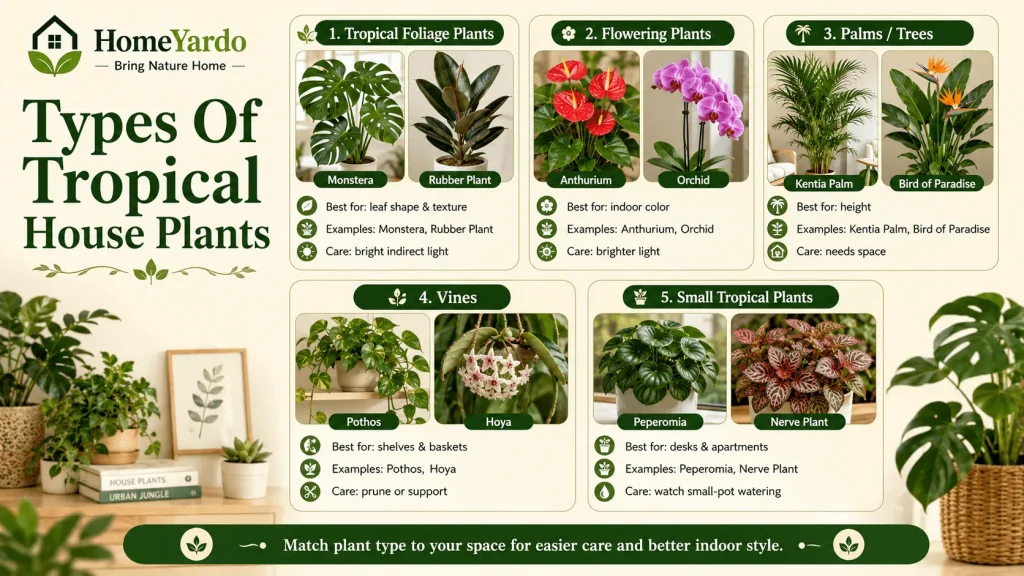
When tropical house plants are categorized by function, choosing the right option becomes easier. Some bring height, while others trail from shelves or add colorful, flowering, or patterned foliage. If vertical growth is the main goal, these tall plants include indoor options that can fill empty corners and add height to larger rooms.
This basic classification allows you to identify the plant with the room that you plan to purchase it for. That little pause could help save some leaf drama later.
| Type | Best For | Examples | Care Note |
|---|---|---|---|
| Tropical Foliage Plants | Leaf shape and texture | Monstera, Rubber Plant | Usually bright indirect light |
| Flowering plants | Indoor color | Anthurium, Orchid | Needs brighter light |
| Palms/Trees | Height | Kentia Palm, Bird of Paradise | Needs space |
| Vines | Shelves and baskets | Pothos, Hoya | Needs pruning/support |
| Small Tropical Plants | Desks and apartments | Peperomia, Nerve Plant | Watch small-pot watering |
What Makes A Plant Tropical?
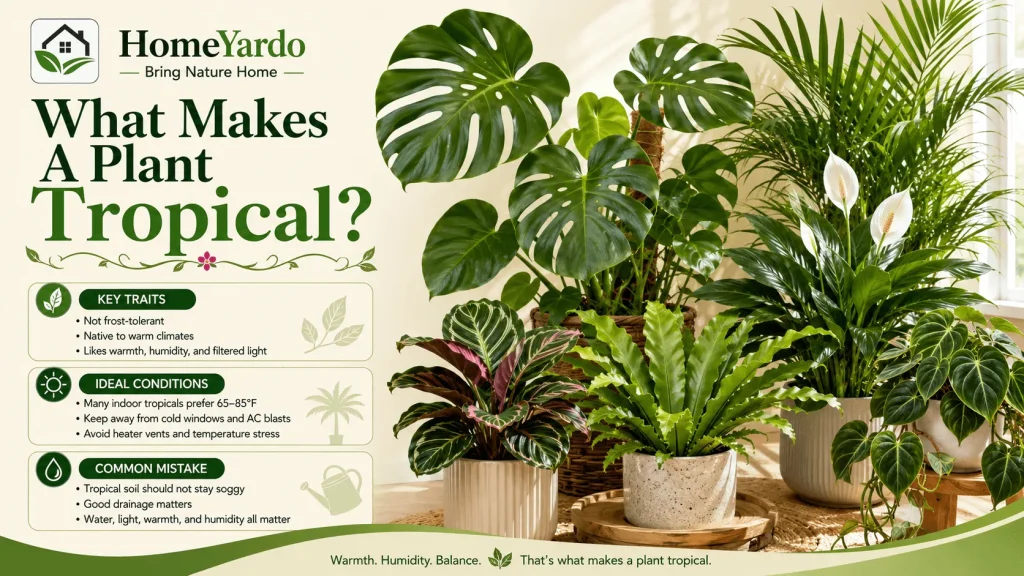
A tropical plant is typically not frost-tolerant and is native to a warm climate. There are many tropical plants that thrive in environments with warm, humid, and filtered light.
The ideal temperature ranges for many indoor tropical plants are approximately 65–85°F, but may be different for different species. The leaves can be stressed before they realize it by cold windows or air conditioning blasts and by heater vents.
A common error is the wrong idea that tropical soil is wet soil. Warmth, drainage, humidity and appropriate light are just as important as watering.
Tropical Plants Vs Desert Plants
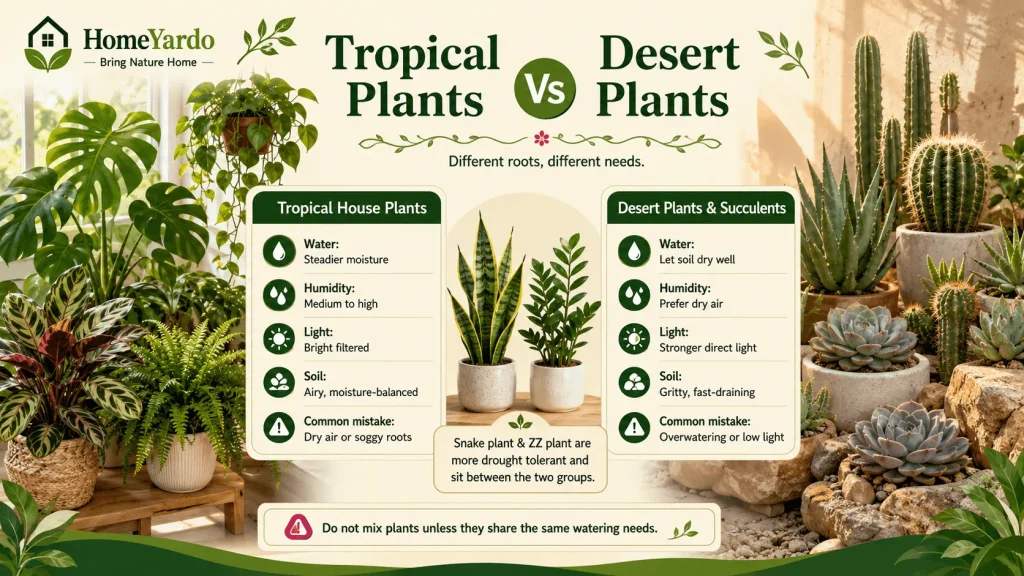
Tropical plants and desert plants frequently are not successful in the home for different reasons. Some plants from tropical regions will not thrive in dry air and others from desert regions may rot from damp soil.
Snake plant and ZZ plant are somewhere in the middle. They are acceptable in tropical arrangement rooms, but are more drought tolerant than many rainforest plants with leaves.
| Feature | Tropical House Plants | Desert Plants And Succulents |
|---|---|---|
| Water | Often need steadier moisture | Prefer soil to dry well |
| Humidity | Many prefer medium-high humidity | Usually prefer dry air |
| Light | Often bright filtered light | Often stronger direct light |
| Soil | Airy and moisture-balanced | Gritty and fast-draining |
| Common mistake | Dry air or soggy roots | Overwatering and low light |
Don’t combine tropical foliage plants with desert succulents unless their watering and soil requirements are compatible. They often have very different preferences for root-zone moisture. If the available space receives strong direct sunlight rather than filtered indoor light, consider plants for full sun instead of forcing a shade-adapted tropical plant into unsuitable conditions.
30 Best Tropical House Plants To Grow Indoors
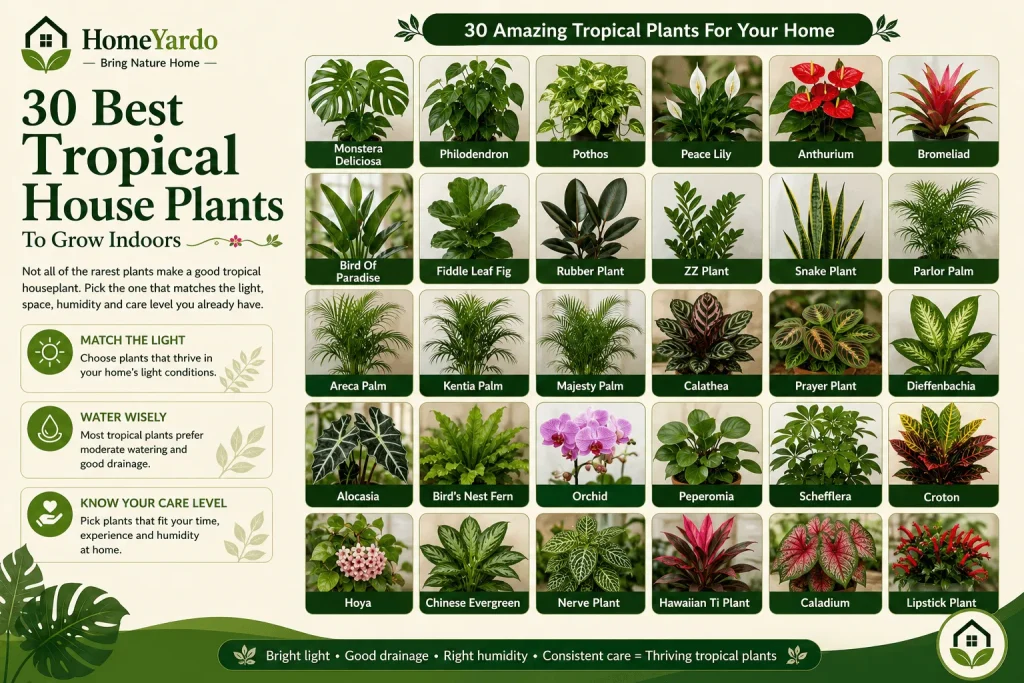
Not all of the rarest plants make a good tropical houseplant. The one that matches the light, space, humidity and care level already in place at home.
There is a list of tropical plants below; each plant has a quick care card. With this information, you can do a more effective comparison of plants before purchasing a plant that becomes an “emotional” project.
Monstera Deliciosa
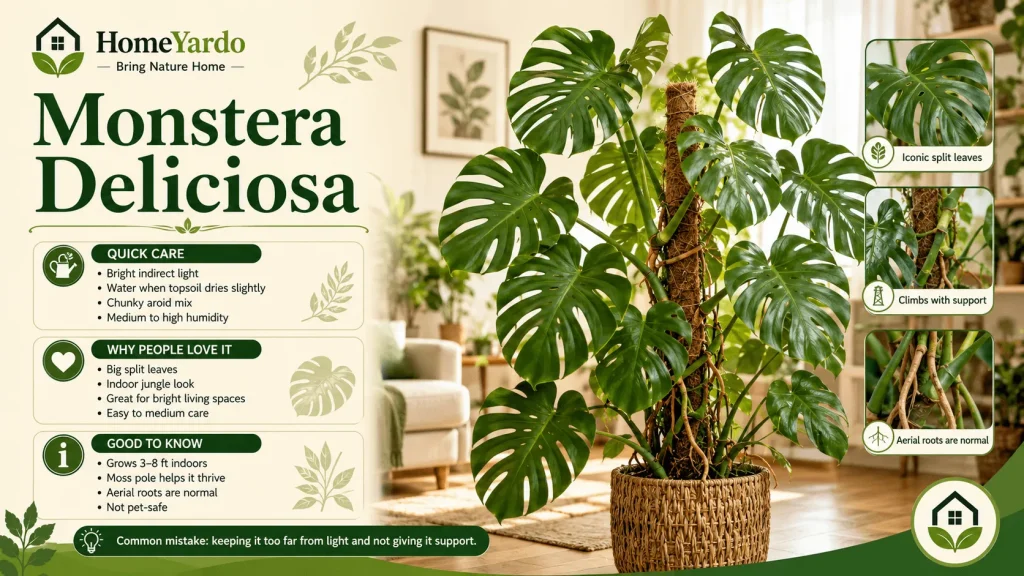
Monstera deliciosa is a single of the most well-known exotic houseplants. The leaves are large and split, giving an instant jungle-like indoor look particularly in a bright living space.
The mature plants are able to spread out and usually do better by using a moss pole or a sturdy support. The roots that grow from the ground are normal and not an indication that it is trying to get out of.
| Quick Care | Details |
|---|---|
| Scientific name | Monstera deliciosa |
| Best for | Big leaves and indoor jungle style |
| Light | Bright indirect light |
| Water | Moderate; let the topsoil dry slightly |
| Soil | Chunky aroid mix |
| Humidity | Medium to high |
| Indoor size | Large, often 3–8 ft indoors |
| Pet safety | Not pet-safe |
| Care level | Easy-medium |
| Care quirk | Aerial roots and climbing growth are normal |
A common mistake is keeping it away from light and not giving it any assistance.
Philodendron
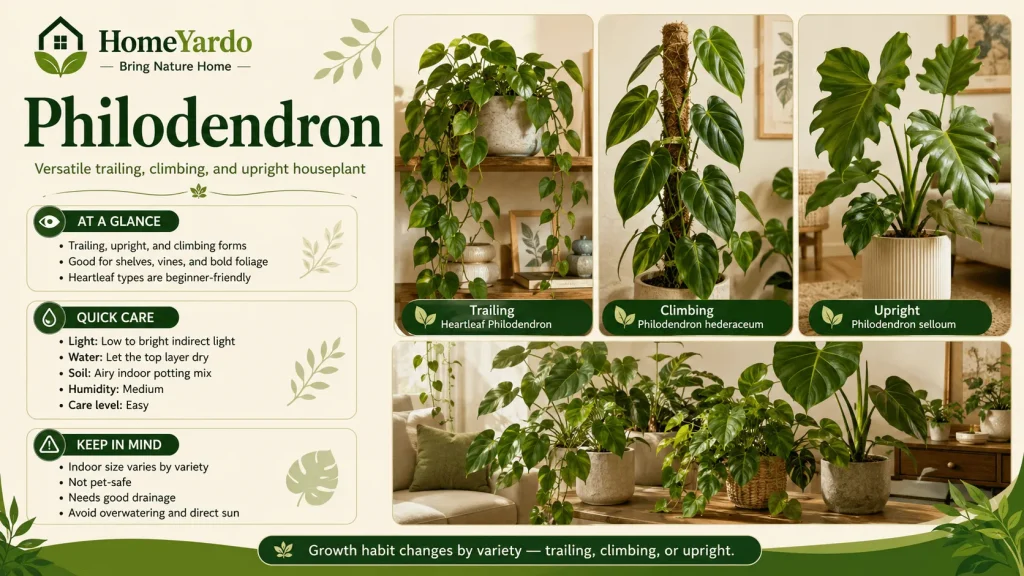
Philodendron is a large plant family with trailing upright, and climbing forms. Heartleaf Philodendron is easy and comfortable for novices, whereas the taller upright forms provide a more exotic look.
Many types can be adapted. However, they do require drainage and a sensible amount of water. Be sure to treat them as a flexible material and not impervious to damage.
| Quick Care | Details |
|---|---|
| Scientific name | Philodendron spp. |
| Best for | Vines, climbing plants, and upright foliage |
| Light | Low to bright indirect light |
| Water | Moderate; let top layer dry |
| Soil | Airy indoor potting mix |
| Humidity | Medium |
| Indoor size | Small trailing types to large upright forms |
| Pet safety | Not pet-safe |
| Care level | Easy |
| Care quirk | Growth habit changes by variety |
Common error: excessively watering leaves or putting them in direct sunlight.
Pothos
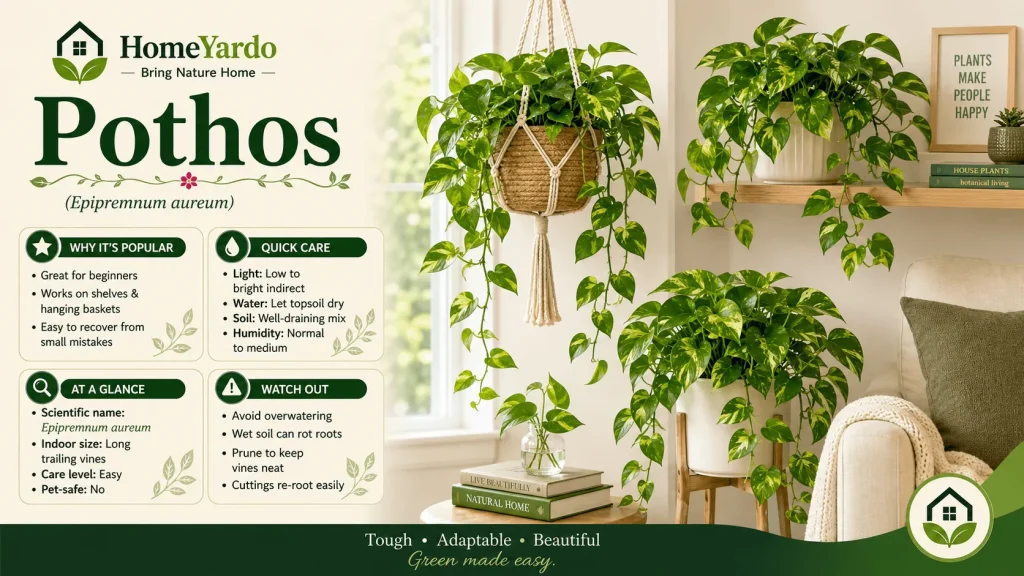
Pothos is a great start-up plant suitable for hanging baskets, shelves and stand-up plants. It is easy to grow and can recover from minor mistakes more easily than many tropical-looking plants.
The vines may grow long, so a little pruning is necessary to keep the plant neat. Cuttings also re-root easily that feel like plants that aren’t. It’s always a win.
| Quick Care | Details |
|---|---|
| Scientific name | Epipremnum aureum |
| Best for | Beginners, shelves, and hanging baskets |
| Light | Low to bright indirect light |
| Water | Let the topsoil dry |
| Soil | Well-draining potting mix |
| Humidity | Normal to medium |
| Indoor size | Long trailing vines |
| Pet safety | Not pet-safe |
| Care level | Easy |
| Care quirk | Roots rot if the soil stays wet |
The most common error is watering too often, because the plant appears effortless.
Peace Lily
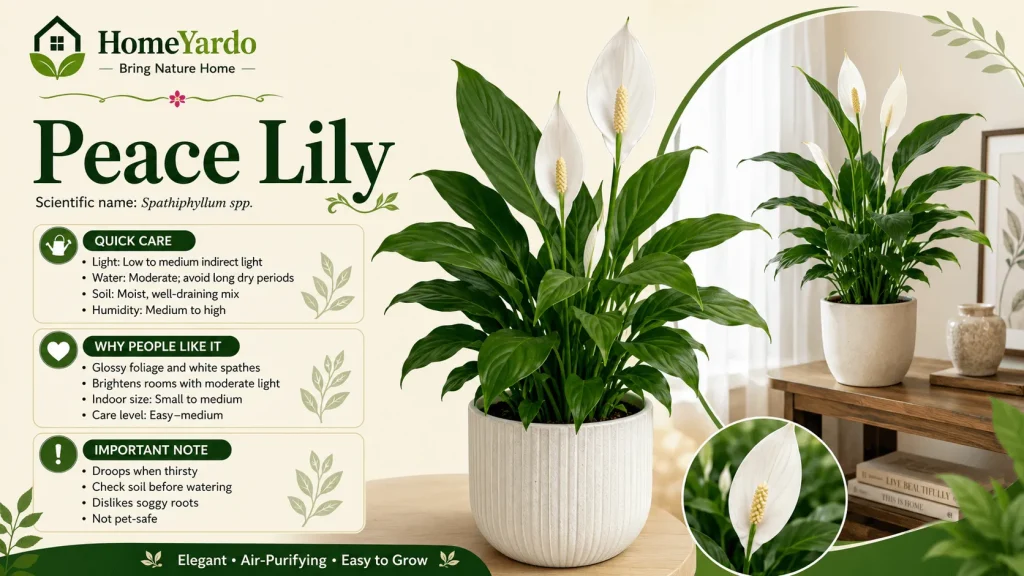
Peace Lily has glossy leaves and white spathes that lighten rooms with moderate lighting. It can take less light, but more indirect light typically encourages greater growth and larger spathes.
The plant can appear to shrink when thirsty. This can be beneficial but allowing it to go down isn’t a great long-term strategy.
| Quick Care | Details |
|---|---|
| Scientific name | Spathiphyllum spp. |
| Best for | Glossy foliage and white spathes |
| Light | Low to medium indirect light |
| Water | Moderate; avoid long dry periods |
| Soil | Moist but well-draining mix |
| Humidity | Medium to high |
| Indoor size | Small to medium |
| Pet safety | Not pet-safe |
| Care level | Easy-medium |
| Care quirk | Droops when thirsty but dislikes soggy roots |
A common mistake is to overwater after each droop, without making sure to check the soil first.
Anthurium
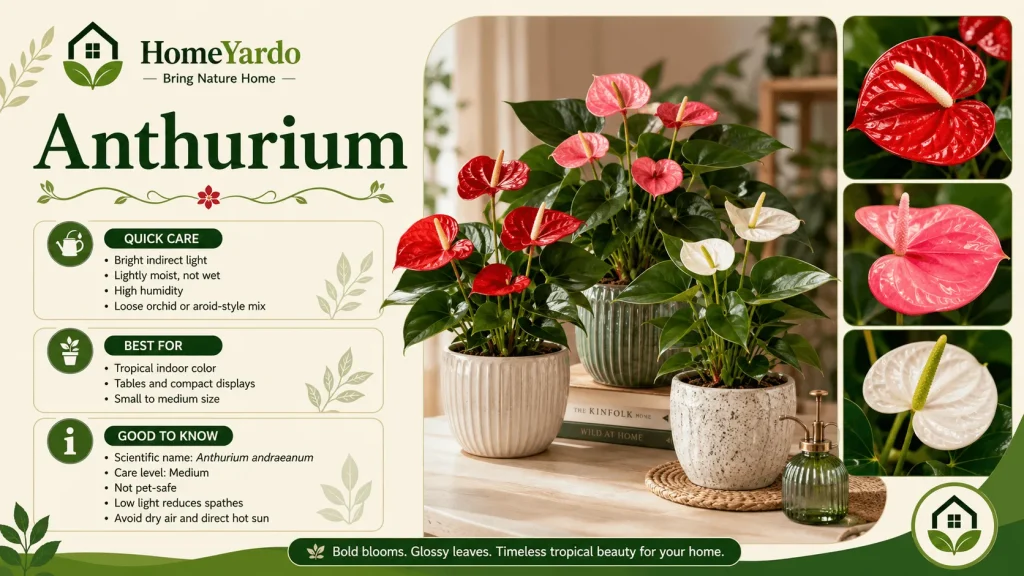
Anthurium reveals tropical hues through vibrant leaves and bright spathes. The most vibrant part of the plant is a spathe centered around the spadix. This isn’t an ordinary flower, but it looks great on tables.
It thrives in bright indirect lighting with constant humidity. A lack of light usually means fewer blooms and less energy.
| Quick Care | Details |
|---|---|
| Scientific name | Anthurium andraeanum and related types |
| Best for | Tropical color and compact display |
| Light | Bright indirect light |
| Water | Lightly moist, not wet |
| Soil | Loose orchid or aroid-style mix |
| Humidity | High |
| Indoor size | Small to medium |
| Pet safety | Not pet-safe |
| Care level | Medium |
| Care quirk | Low light reduces spathes |
A common error is to place it in the dry air or direct hot sun.
Bromeliad
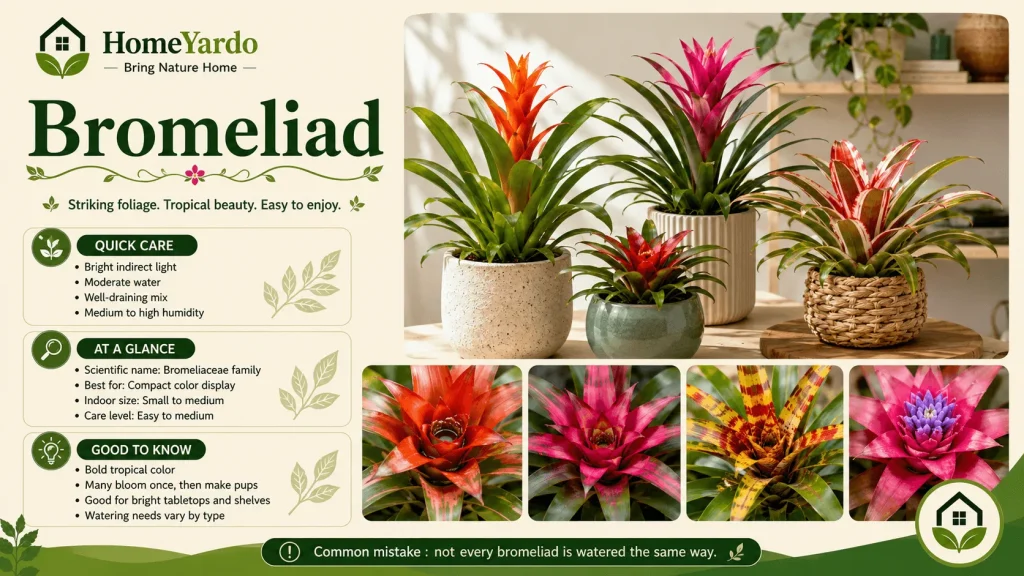
Bromeliads are tropical plants that are compact with bold colors and a sculptural shape. They are great for countertops, tabletops and shelves that are bright.
Bromeliads can bloom in one instance in a central rose after which they give birth to pups. The cycle is often a surprise to those who are new to the species, but it’s normal.
| Quick Care | Details |
|---|---|
| Scientific name | Bromeliaceae family |
| Best for | Compact color and tabletop display |
| Light | Bright indirect light |
| Water | Moderate; varies by type |
| Soil | Very well-draining mix |
| Humidity | Medium to high |
| Indoor size | Small to medium |
| Pet safety | Safer choice for many pet homes |
| Care level | Easy-medium |
| Care quirk | Many bloom once, then produce pups |
A common mistake is treating every bromeliad as though it requires the same method of watering.
Bird Of Paradise
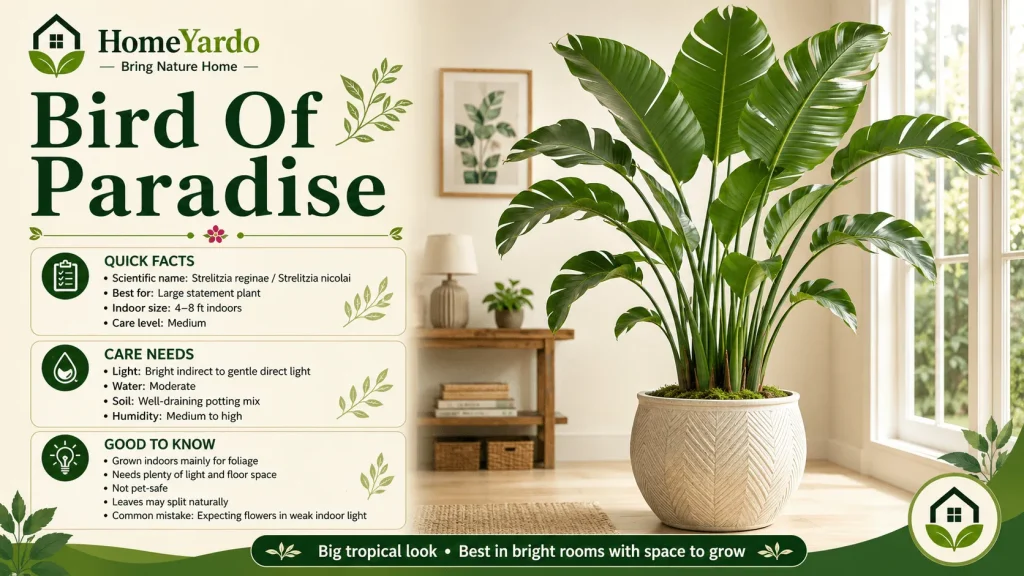
Bird of Paradise is a huge tropical plant with large upright leaves. Indoors, it’s usually used for its foliage, not flowers.
It requires a light-filled space and plenty of flooring space. Leaf splitting is a natural process when leaves get older or shift with the airflow.
| Quick Care | Details |
|---|---|
| Scientific name | Strelitzia reginae or Strelitzia nicolai |
| Best for | Large statement plant |
| Light | Bright indirect to some gentle direct light |
| Water | Moderate |
| Soil | Well-draining potting mix |
| Humidity | Medium to high |
| Indoor size | Large, often 4–8 ft indoors |
| Pet safety | Not pet-safe |
| Care level | Medium |
| Care quirk | Leaves may split naturally |
Common mistake: expecting flowers indoors in weak light.
Fiddle Leaf Fig
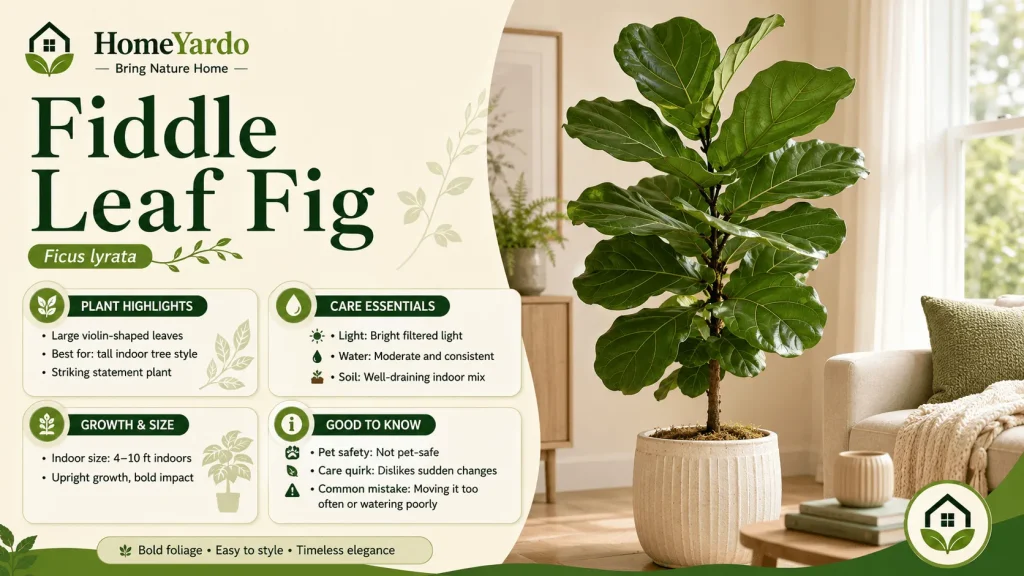
Fiddle Leaf Fig features large violin-shaped leaves and a high indoor tree appearance. It’s gorgeous, but it prefers regularity more than excitement.
A bright, stable spot is crucial. Its movement too often could lead to leaf fall and, and if you’re lucky, it could feel intimate.
| Quick Care | Details |
|---|---|
| Scientific name | Ficus lyrata |
| Best for | Tall indoor tree style |
| Light | Bright filtered light |
| Water | Moderate and consistent |
| Soil | Well-draining indoor mix |
| Humidity | Medium |
| Indoor size | Medium to large; often 4–10 ft indoors |
| Pet safety | Not pet-safe |
| Care level | Medium to higher-care |
| Care quirk | Dislikes sudden changes |
A common error is moving it frequently or not watering properly.
Rubber Plant
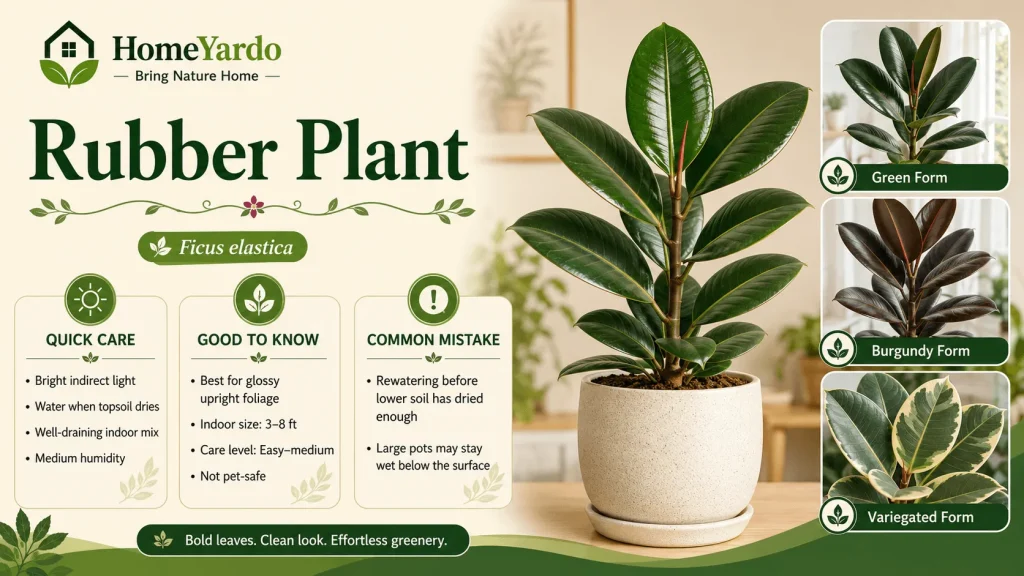
Rubber Plant has thick, shiny leaves with upright growth. Its burgundy, green and variegated forms provide a strong, sturdy outdoor foliage plant.
It’s generally more tolerant in comparison to Fiddle Leaf Fig, which is why it’s a great choice for those looking for an edgy houseplant that doesn’t have the same amount of drama.
| Quick Care | Details |
|---|---|
| Scientific name | Ficus elastica |
| Best for | Glossy upright foliage |
| Light | Bright indirect light |
| Water | Moderate; let the topsoil dry |
| Soil | Well-draining indoor mix |
| Humidity | Medium |
| Indoor size | Medium to large; often 3–8 ft indoors |
| Pet safety | Not pet-safe |
| Care level | Easy-medium |
| Care quirk | Large pots may stay wet below the surface |
Common mistake: watering again before the lower soil has dried enough.
ZZ Plant
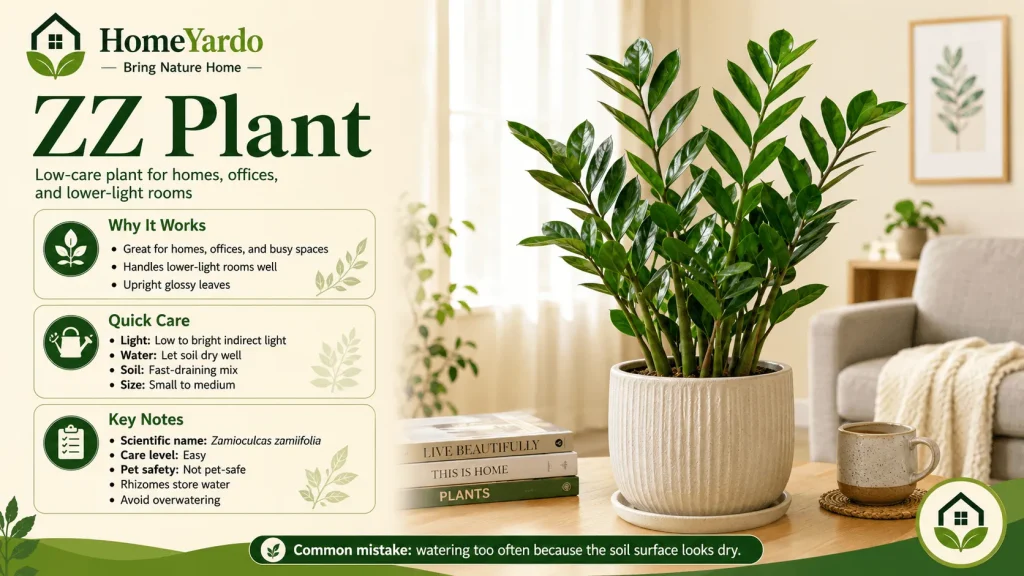
ZZ Plant is a tought has shiny upright leaves. It’s a great option for homes with lots of traffic or offices as well as lower-light rooms.
The rhizomes in the soil store water which means that it doesn’t require frequent irrigation. The storage can be beneficial but it can also mean that it can lead to an issue very quickly.
| Quick Care | Details |
|---|---|
| Scientific name | Zamioculcas zamiifolia |
| Best for | Low care and lower light |
| Light | Low to bright indirect light |
| Water | Low; let soil dry well |
| Soil | Fast-draining potting mix |
| Humidity | Normal |
| Indoor size | Small to medium |
| Pet safety | Not pet-safe |
| Care level | Easy |
| Care quirk | Rhizomes store water |
A common mistake is to water too often, because the soil’s surface appears dry.
Snake Plant
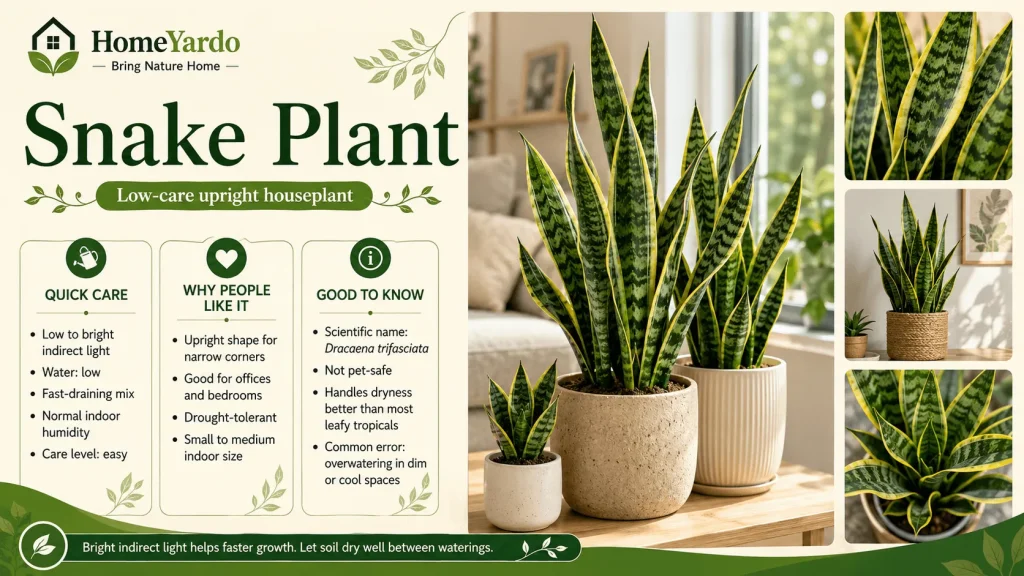
Snake Plant has upright leaves and a neat design that works well in offices, bedrooms and corners that are narrow. It’s drought-tolerant and more compact than other leafy tropical plants.
It is able to handle light levels that are low but bright indirect light encourages more growth. Dry soil is more secure than moist soil for this species.
| Quick Care | Details |
|---|---|
| Scientific name | Dracaena trifasciata |
| Best for | Upright shape and low care |
| Light | Low to bright indirect light |
| Water | Low |
| Soil | Fast-draining mix |
| Humidity | Normal |
| Indoor size | Small to medium |
| Pet safety | Not pet-safe |
| Care level | Easy |
| Care quirk | Handles dryness better than most leafy tropicals |
Common error: excessive watering in a dim or cool space.
Parlor Palm
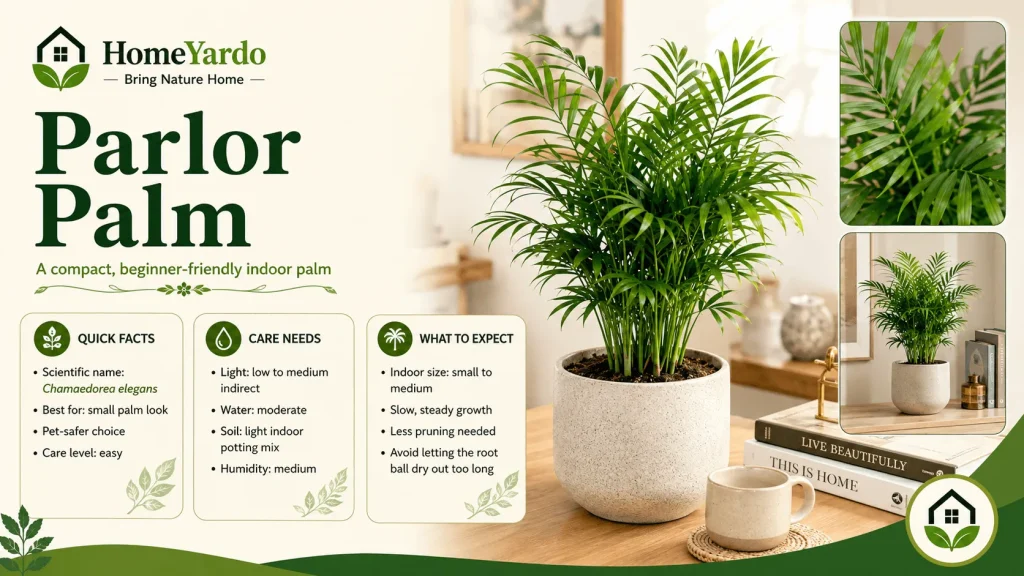
Parlor Palm gives a soft palm appearance without the need for an enormous space. Parlor Palm is among the most popular palms for beginner indoor areas.
It’s slow and steady. It can be boring initially but it also means less pruning and fewer unexpected events.
| Quick Care | Details |
|---|---|
| Scientific name | Chamaedorea elegans |
| Best for | Small palm looks and pet-safer homes |
| Light | Low to medium indirect light |
| Water | Moderate |
| Soil | Light indoor potting mix |
| Humidity | Medium |
| Indoor size | Small to medium |
| Pet safety | Safer choice |
| Care level | Easy |
| Care quirk | Slow, steady growth |
A common error is letting the root ball dry out too long.
Areca Palm
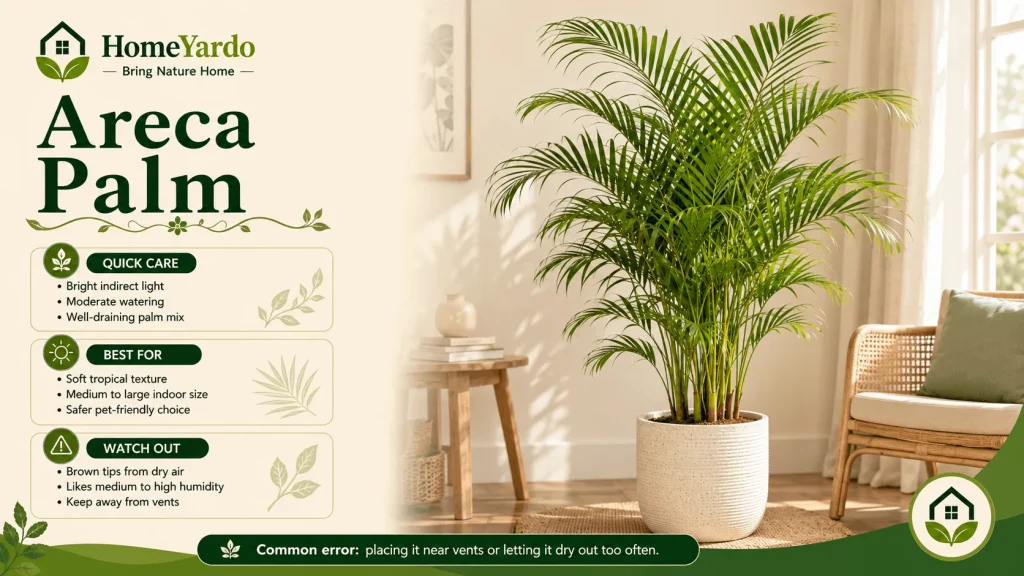
Areca Palm has soft, feathery fronds and a lush tropical feel. It is able to make a space feel fresh and relaxed.
It requires more attention than the Parlor Palm does. Dry air is often visible as brown tips, and humidity and consistent moisture are helpful.
| Quick Care | Details |
|---|---|
| Scientific name | Dypsis lutescens |
| Best for | Soft tropical texture |
| Light | Bright indirect light |
| Water | Moderate |
| Soil | Well-draining palm mix |
| Humidity | Medium to high |
| Indoor size | Medium to large |
| Pet safety | Safer choice |
| Care level | Medium |
| Care quirk | Brown tips often come from dry air |
Common error: placing it close to vents or drying it too frequently.
Kentia Palm
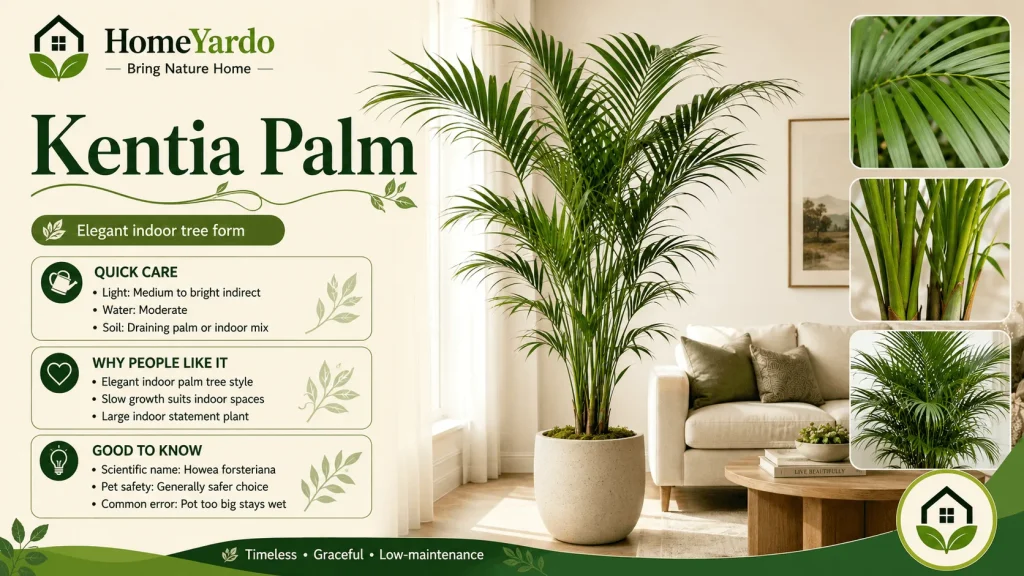
Kentia Palm has an elegant indoor tree form. It develops slowly and is able to handle indoor conditions better than other palms.
It’s more expensive than houseplants, and so the placement of them should be thought out prior to buying. A hefty palm placed in the wrong place isn’t exactly a fun thing to do.
| Quick Care | Details |
|---|---|
| Scientific name | Howea forsteriana |
| Best for | Elegant indoor palm tree style |
| Light | Medium to bright indirect light |
| Water | Moderate |
| Soil | Draining palm or indoor mix |
| Humidity | Medium |
| Indoor size | Large |
| Pet safety | Generally safer choice |
| Care level | Easy-medium |
| Care quirk | Slow growth suits indoor spaces |
Common error: making use of a pot that is too big and remains wet.
Majesty Palm
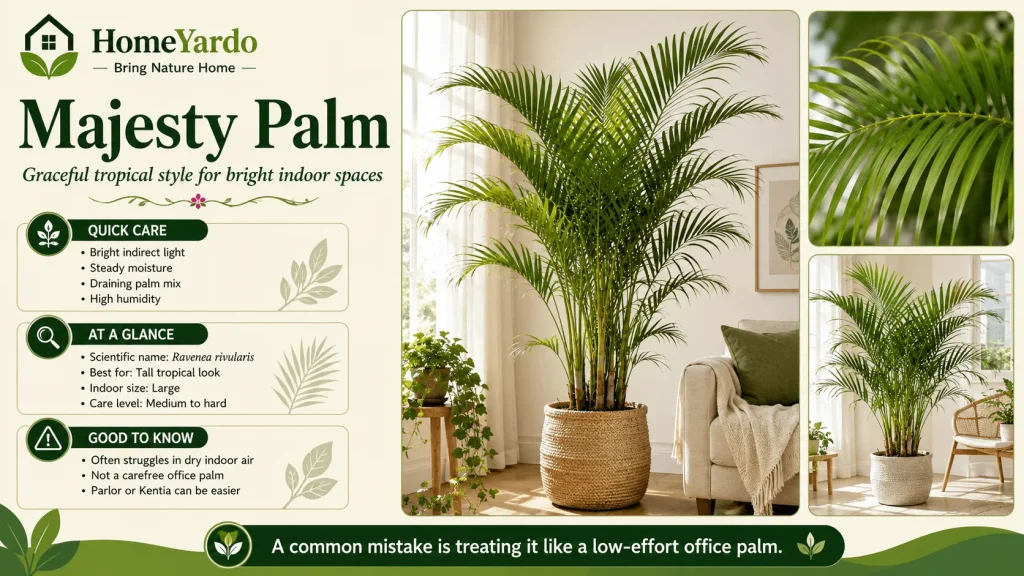
Majesty Palm looks graceful and tropical; it can be more challenging inside than it is outside the store. It typically requires bright lighting constant moisture, and more humidity.
Dry environments could cause it to decrease. For a simple palm that is more streamlined, it is recommended to use the Parlor Palm or Kentia Palm, which is usually the best choice.
| Quick Care | Details |
|---|---|
| Scientific name | Ravenea rivularis |
| Best for | Tall tropical palm looks |
| Light | Bright indirect light |
| Water | Steady moisture |
| Soil | Draining palm mix |
| Humidity | High |
| Indoor size | Large |
| Pet safety | Generally safer choice |
| Care level | Medium to hard |
| Care quirk | Often struggles in dry indoor air |
A common mistake is treating it as a sloppy palm for the office.
Calathea
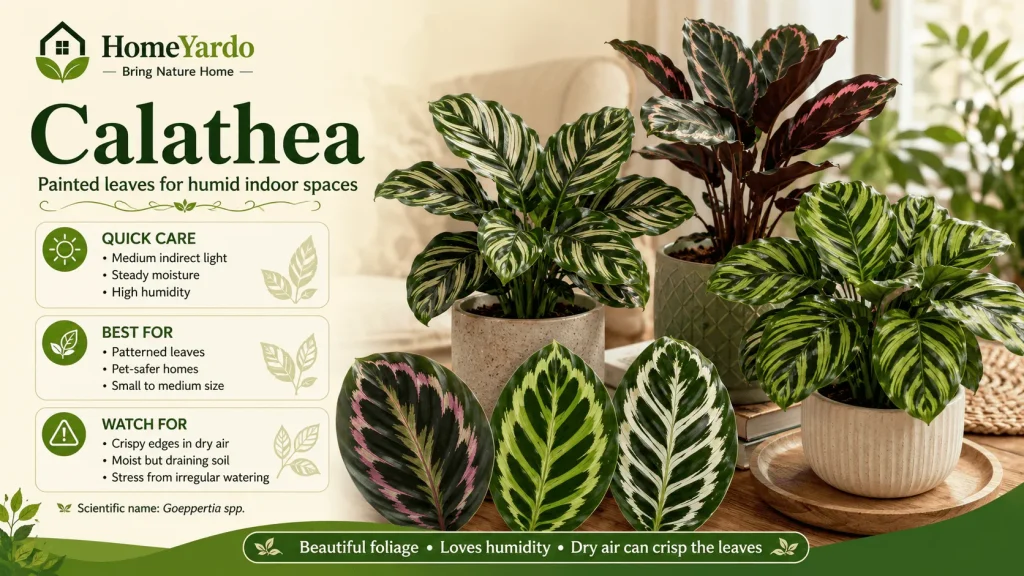
Calathea is known for its beautiful leaves that appear to be painted. It’s amazing in the right environment particularly in areas where humidity is higher.
It’s not the simplest plant to learn about. Sharp edges usually result from dry air, irregular moisture or even water sensitivities.
| Quick Care | Details |
|---|---|
| Scientific name | Goeppertia spp. |
| Best for | Patterned leaves and pet-safer homes |
| Light | Medium indirect light |
| Water | Steady moisture |
| Soil | Moist but draining mix |
| Humidity | High |
| Indoor size | Small to medium |
| Pet safety | Safer choice |
| Care level | Medium/fussy |
| Care quirk | Crisps in dry air or water stress |
A common error is letting the air in the dry air for a long time.
Prayer Plant
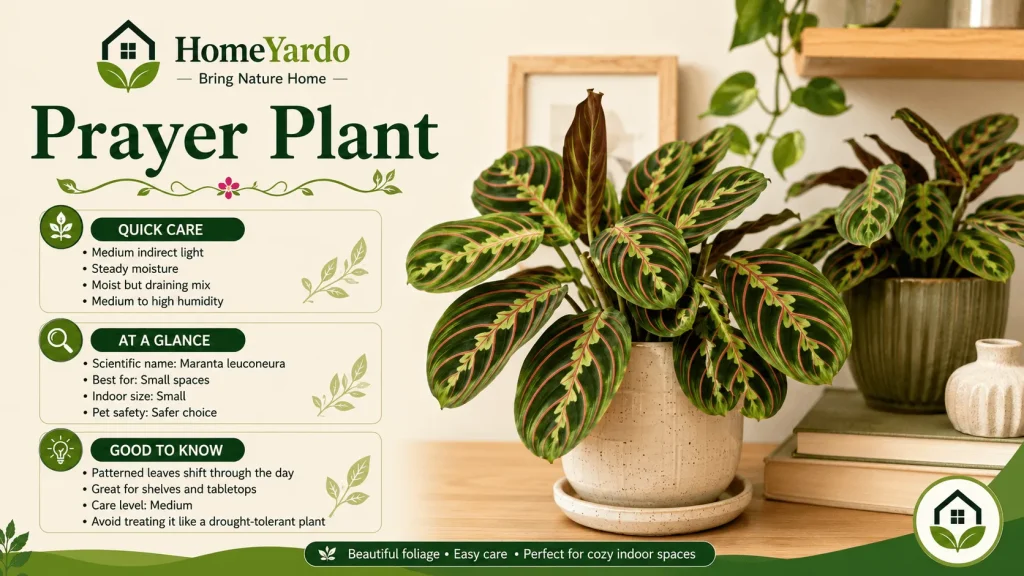
Prayer Plant features patterns on its leaves that change and fold during the day. It is smaller than other exotic houseplants, which makes it a great place to put it on a shelf or tabletop.
It is a fan of constant moisture and medium to high levels of humidity. Dry periods that last for long can cause the leaves to curl and appear tired.
| Quick Care | Details |
|---|---|
| Scientific name | Maranta leuconeura |
| Best for | Small spaces and patterned leaves |
| Light | Medium indirect light |
| Water | Steady moisture |
| Soil | Moist but draining mix |
| Humidity | Medium to high |
| Indoor size | Small |
| Pet safety | Safer choice |
| Care level | Medium |
| Care quirk | Leaves shift position through the day |
Common error: treating it as a drought-tolerant plant.
Dieffenbachia
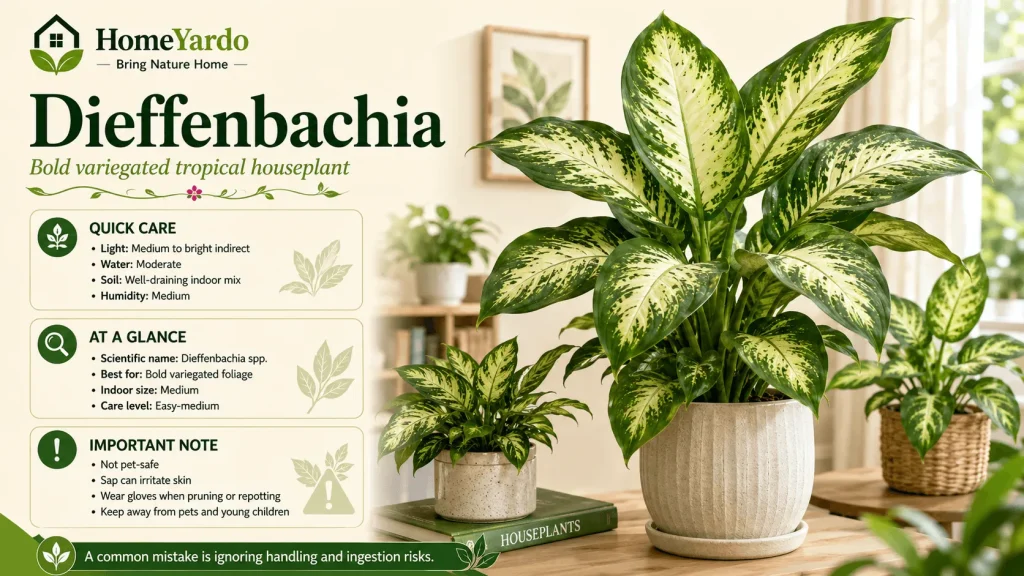
Dieffenbachia is a striking, multi-colored plant with an upright design. It gives a tropical vibe without the need for an enormous indoor tree.
The sap could cause irritation to the skin, and the plant must be kept out of reach of pets and young children. It is recommended to wear gloves when pruning or changing the pot.
| Quick Care | Details |
|---|---|
| Scientific name | Dieffenbachia spp. |
| Best for | Bold variegated foliage |
| Light | Medium to bright indirect light |
| Water | Moderate |
| Soil | Well-draining indoor mix |
| Humidity | Medium |
| Indoor size | Medium |
| Pet safety | Not pet-safe |
| Care level | Easy-medium |
| Care quirk | Sap can irritate skin |
A common error is not to consider the dangers of handling and ingestion.
Alocasia
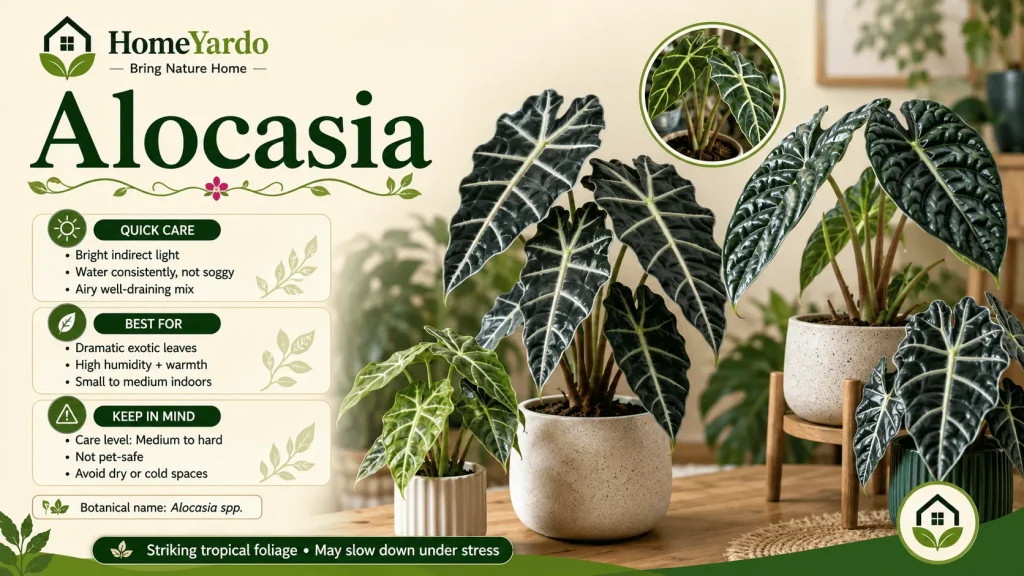
Alocasia is among the most striking wild house plants. The leaves of the plant can resemble shields, arrows or shiny sculptures.
Beauty can be found with a bit of attitude. It loves humidity, warmth and a steady level of attention. In times of stress, certain species might slow down or shed leaves.
| Quick Care | Details |
|---|---|
| Scientific name | Alocasia spp. |
| Best for | Dramatic exotic leaves |
| Light | Bright indirect light |
| Water | Consistent but not soggy |
| Soil | Airy well-draining mix |
| Humidity | High |
| Indoor size | Small to medium, some large |
| Pet safety | Not pet-safe |
| Care level | Medium to hard |
| Care quirk | May slow down under stress |
A common mistake is to place it in a dry or cold space.
Bird’s Nest Fern
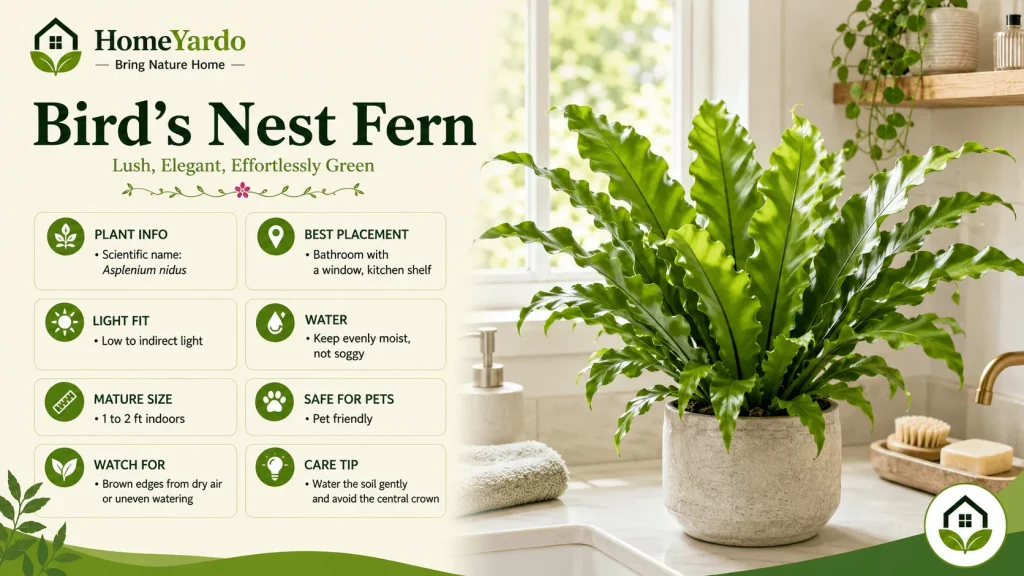
Bird’s Nest Fern has broad wispy fronds with a refreshing tropical appearance. It’s particularly useful in bathrooms with enough lighting.
It is a fan of humidity and constant humidity; the central crown should not be left damp. The small thing is more important than it appears.
| Quick Care | Details |
|---|---|
| Scientific name | Asplenium nidus |
| Best for | Bathrooms and humid rooms |
| Light | Medium indirect light |
| Water | Steady moisture |
| Soil | Moist but draining mix |
| Humidity | High |
| Indoor size | Small to medium |
| Pet safety | Safer choice |
| Care level | Easy-medium |
| Care quirk | Avoid soaking the center crown |
A common error is often pouring the water straight into your crown.
Orchid
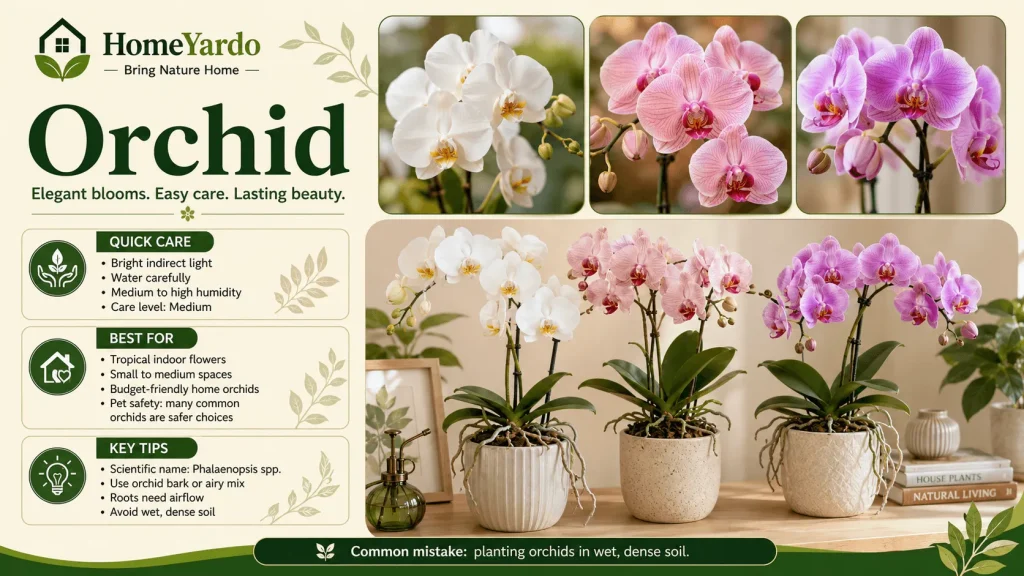
Orchids can bring tropical flowers indoors without taking up too much space. Phalaenopsis orchids are the most suitable for homes with a small budget.
The roots of orchids require airflow; therefore, dense soil can be an issue. A mix of orchid bark performs better than regular pot soil.
| Quick Care | Details |
|---|---|
| Scientific name | Phalaenopsis spp. and related types |
| Best for | Tropical indoor flowers |
| Light | Bright indirect light |
| Water | Careful; roots need air |
| Soil | Orchid bark or airy orchid mix |
| Humidity | Medium to high |
| Indoor size | Small to medium |
| Pet safety | Many common orchids are safer choices |
| Care level | Medium |
| Care quirk | Roots need airflow |
A common mistake is to plant orchids in wet, dense soil.
Peperomia
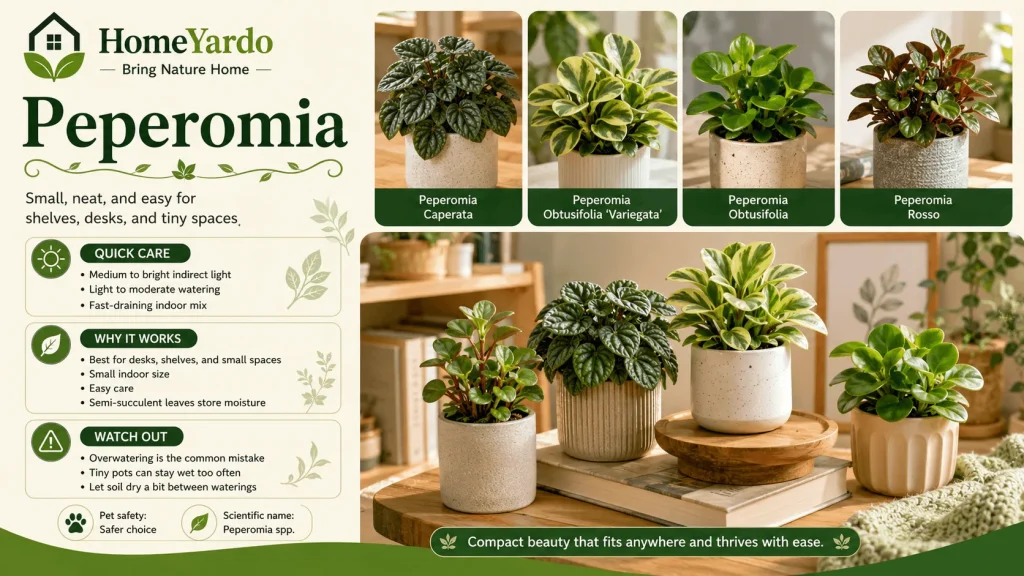
Peperomia is small, neat and simple to set up. It is ideal for shelves, desks, or tiny side tables.
Some varieties have leaves that are slightly thick, which retain some water. This means that overwatering is a greater danger than submerging for a variety of Peperomias.
| Quick Care | Details |
|---|---|
| Scientific name | Peperomia spp. |
| Best for | Desks, shelves, and small spaces |
| Light | Medium to bright indirect light |
| Water | Light to moderate |
| Soil | Fast-draining indoor mix |
| Humidity | Normal to medium |
| Indoor size | Small |
| Pet safety | Safer choice |
| Care level | Easy |
| Care quirk | Semi-succulent leaves store moisture |
A common mistake is to water tiny pots too frequently.
Schefflera
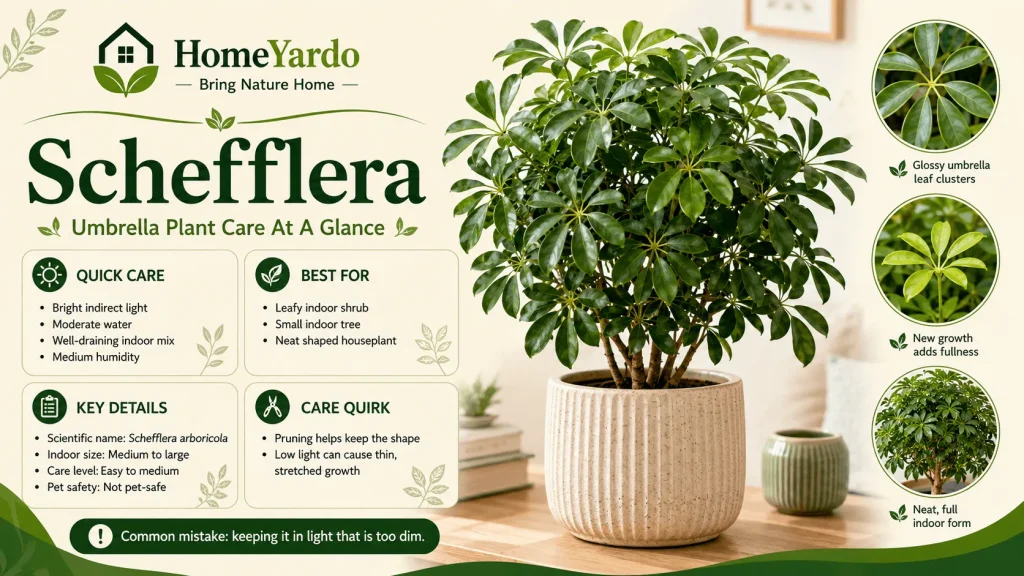
Schefflera, also known as”the umbrella” plant, is a perennial that grows as a slender, leafy plant or a small indoor tree. It is a neat shape and is taken care of to remain small.
The bright indirect light makes the plant fuller. When the light is dim, the branches can stretch, and plants may appear thin.
| Quick Care | Details |
|---|---|
| Scientific name | Schefflera arboricola |
| Best for | Leafy indoor shrub or small tree |
| Light | Bright indirect light |
| Water | Moderate |
| Soil | Well-draining indoor mix |
| Humidity | Medium |
| Indoor size | Medium to large |
| Pet safety | Not pet-safe |
| Care level | Easy-medium |
| Care quirk | Pruning helps keep the shape |
A common error is to keep it in a light too fragile.
Croton
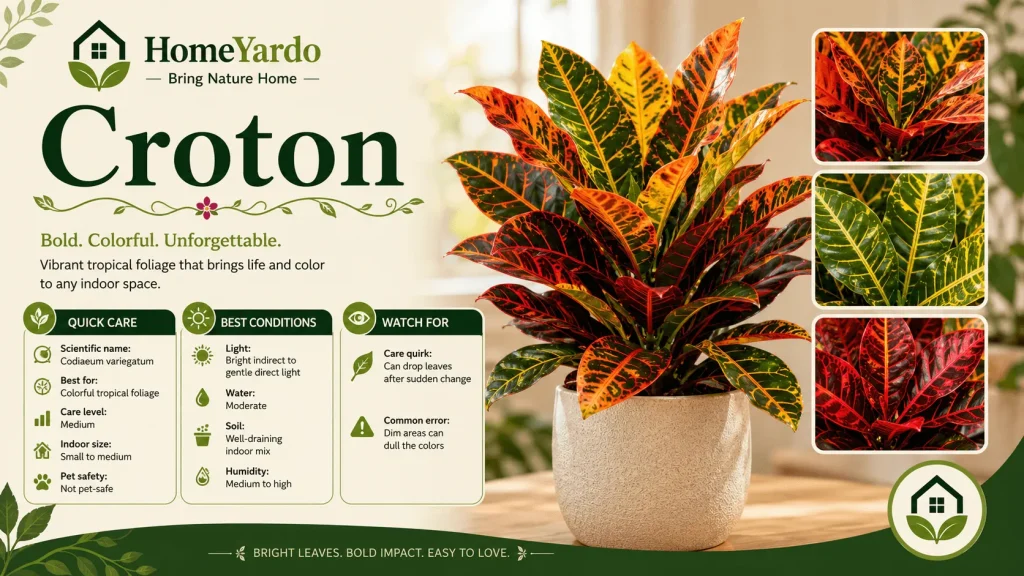
Croton is cultivated to produce vibrant tropical foliage. The leaves can be the colors of orange, green, yellow, red, burgundy as well as mixed hues.
Color is greatly affected by lighting. A dark room can cause the croton to appear less vibrant, no matter if the tree is able to survive.
| Quick Care | Details |
|---|---|
| Scientific name | Codiaeum variegatum |
| Best for | Colorful tropical foliage |
| Light | Bright indirect to some gentle direct light |
| Water | Moderate |
| Soil | Well-draining indoor mix |
| Humidity | Medium to high |
| Indoor size | Small to medium |
| Pet safety | Not pet-safe |
| Care level | Medium |
| Care quirk | Can drop leaves after a sudden change |
Common error: Placing it in a dim area and assuming bright colors.
Hoya
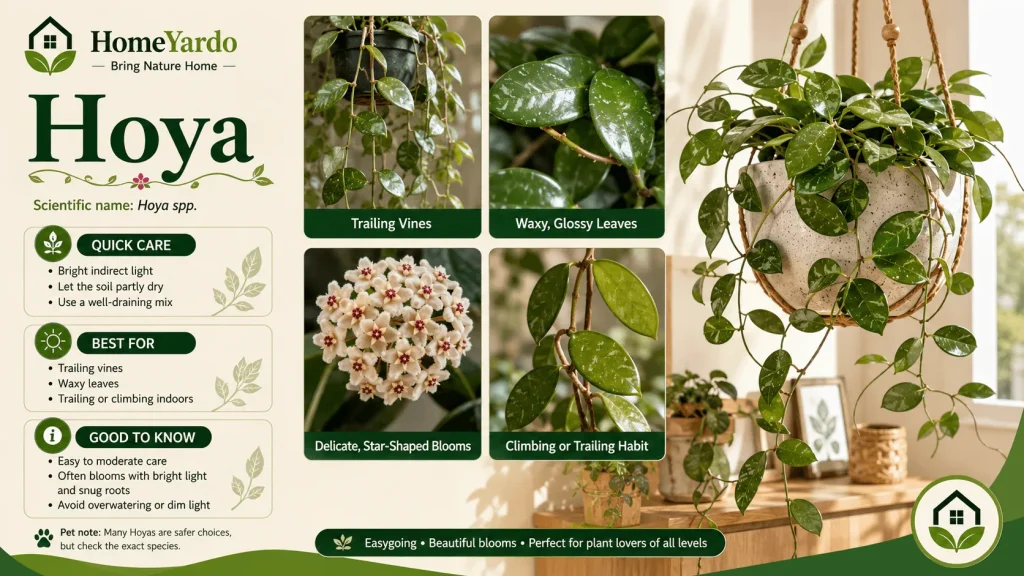
Hoya has waxy leaves as well as growing stems that trail or climb. Different varieties can bloom when they receive enough light and steady care.
It is preferred to dry partially between irrigations. Overpotting can cause it to slow down and excessive water could cause damage to the roots.
| Quick Care | Details |
|---|---|
| Scientific name | Hoya spp. |
| Best for | Trailing vines and waxy leaves |
| Light | Bright indirect light |
| Water | Let the soil partly dry |
| Soil | Well-draining mix |
| Humidity | Normal to medium |
| Indoor size | Trailing or climbing |
| Pet safety | Many Hoyas are safer choices; check species |
| Care level | Easy-medium |
| Care quirk | Often blooms better with bright light and snug roots |
A common mistake is excessively watering or expecting flowers to bloom in dim light.
Chinese Evergreen
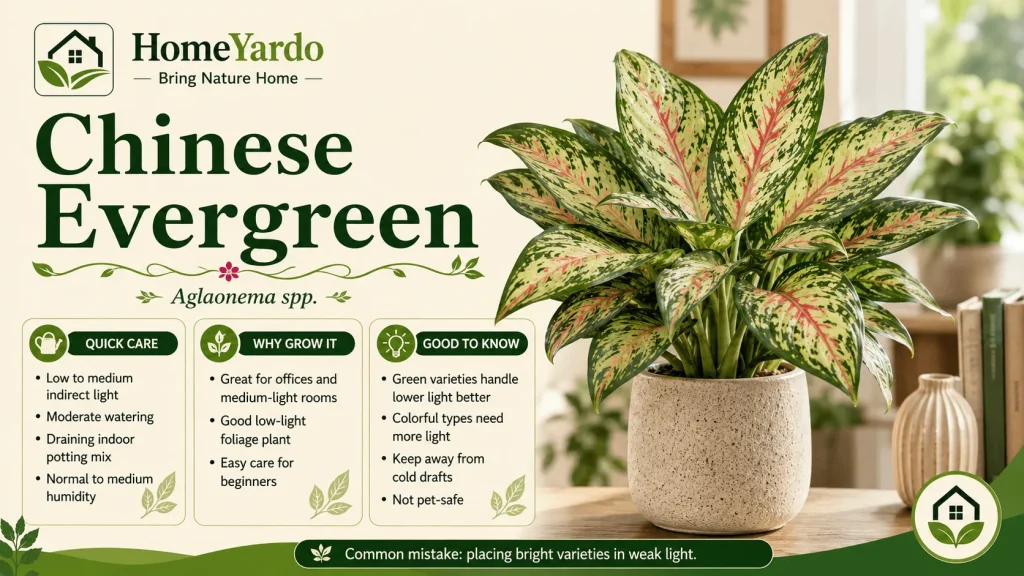
Chinese Evergreen makes a sturdy indoor plant that has attractive foliage and a good tolerance to low light. The green varieties generally handle less light better than the bright varieties.
It’s an excellent choice for offices or rooms that are medium-light. Cold drafts can cause damage to leaves, so keep away from cold windows.
| Quick Care | Details |
|---|---|
| Scientific name | Aglaonema spp. |
| Best for | Low-light foliage and beginners |
| Light | Low to medium indirect light |
| Water | Moderate |
| Soil | Draining indoor potting mix |
| Humidity | Normal to medium |
| Indoor size | Small to medium |
| Pet safety | Not pet-safe |
| Care level | Easy |
| Care quirk | Colorful types need more light |
A common error is to place the brighter varieties in weak light.
Nerve Plant
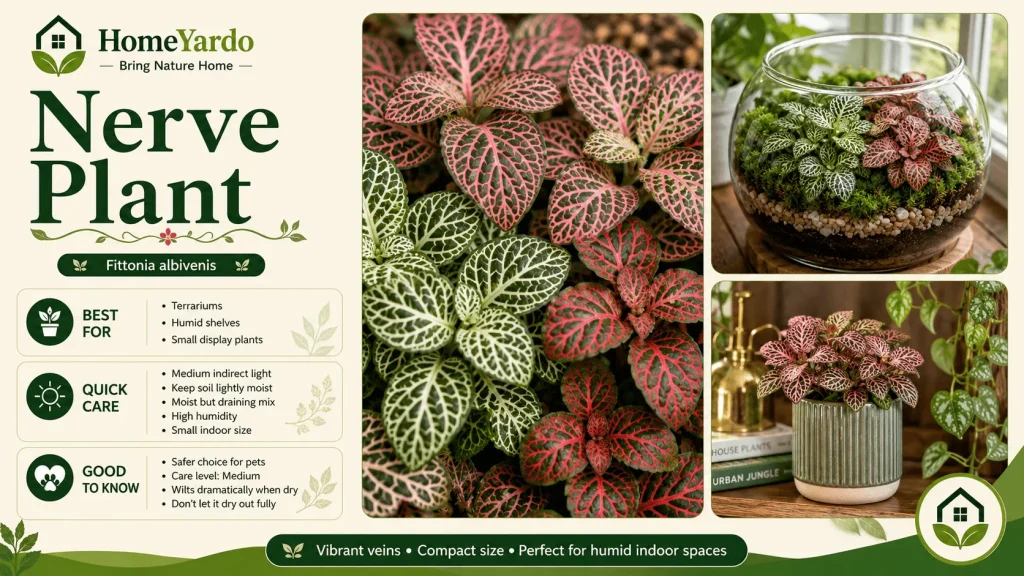
Nerve Plant has small leaves with intricate vein patterns. It’s an excellent option for terrariums, humid shelves, and small display plants.
It will wilt severely if it is too dry. Luckily, it will be able to recover if it is watered before the damage gets too far.
| Quick Care | Details |
|---|---|
| Scientific name | Fittonia albivenis |
| Best for | Small colorful foliage and terrariums |
| Light | Medium indirect light |
| Water | Steady light moisture |
| Soil | Moist but draining mix |
| Humidity | High |
| Indoor size | Small |
| Pet safety | Safer choice |
| Care level | Medium |
| Care quirk | Wilts dramatically when dry |
A common mistake is leaving it to dry completely in excess.
Hawaiian Ti Plant
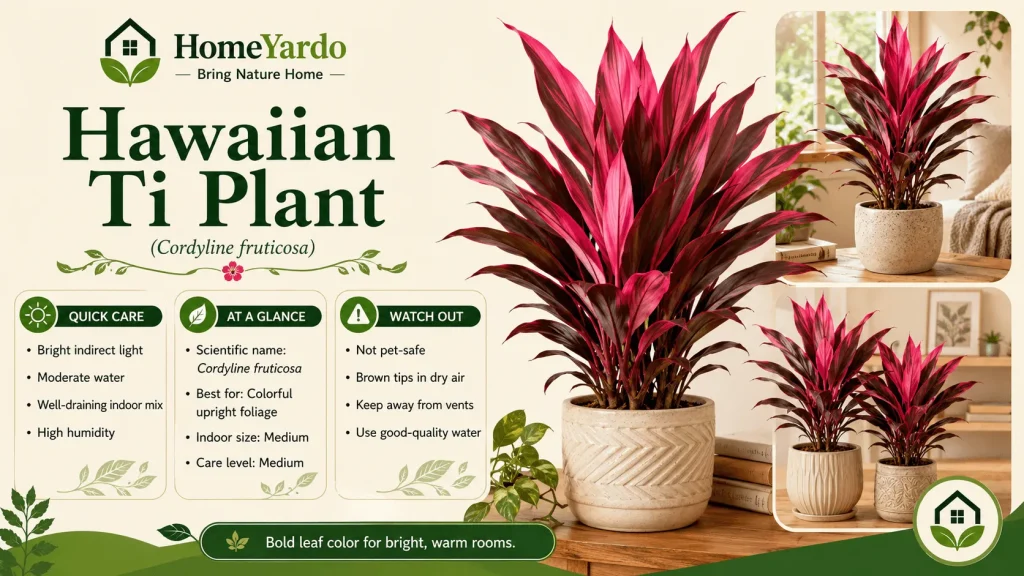
Hawaiian Ti Plant adds upright coloration with pink, red or burgundy leaves. It thrives in bright, warm rooms with constant humidity.
Dry air and low water quality can result in brown tips. It’s gorgeous but it requires the same care as simple green plants.
| Quick Care | Details |
|---|---|
| Scientific name | Cordyline fruticosa |
| Best for | Colorful upright foliage |
| Light | Bright indirect light |
| Water | Moderate |
| Soil | Well-draining indoor mix |
| Humidity | High |
| Indoor size | Medium |
| Pet safety | Not pet-safe |
| Care level | Medium |
| Care quirk | Leaf tips can brown in dry air |
A common error is to place it close to vents or use poor water without testing the response of the plant.
Caladium
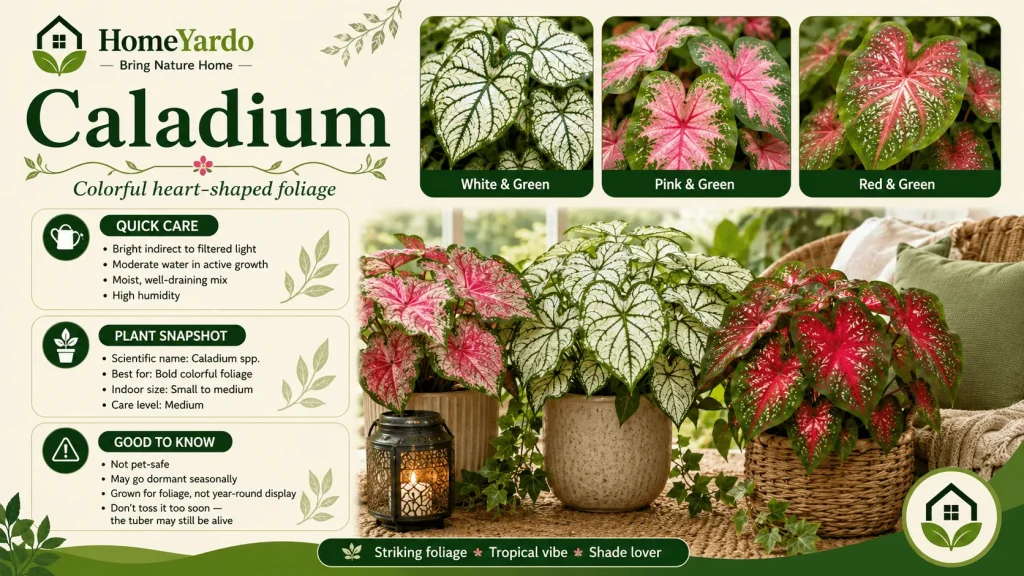
Caladium’s heart-shaped leaves are adorned with striking colors and patterns. It is typically planted for its foliage during the season instead of a year-round display.
It is possible to confuse new plant owners. If the Caladium sits, it might appear to be completed; the tuber might be in existence.
| Quick Care | Details |
|---|---|
| Scientific name | Caladium spp. |
| Best for | Heart-shaped colorful leaves |
| Light | Bright indirect to filtered light |
| Water | Moderate during active growth |
| Soil | Moist but well-draining mix |
| Humidity | High |
| Indoor size | Small to medium |
| Pet safety | Not pet-safe |
| Care level | Medium |
| Care quirk | May go dormant seasonally |
A common mistake is to throw it away before dormancy begins.
Lipstick Plant
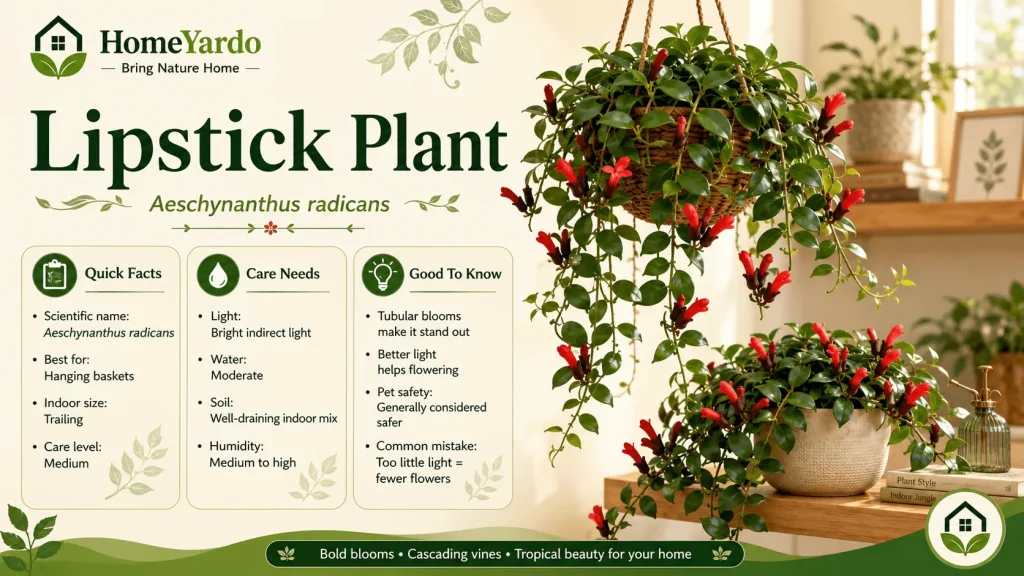
Lipstick Plant is a trailing tropical plant that has tubular flowers. It looks stunning in hanging baskets and shelves that are bright shelves.
It requires bright indirect light to produce better flowers. Foliage can look great in less light, but the flowers may be a bit sluggish.
| Quick Care | Details |
|---|---|
| Scientific name | Aeschynanthus radicans |
| Best for | Hanging baskets and tubular flowers |
| Light | Bright indirect light |
| Water | Moderate |
| Soil | Well-draining indoor mix |
| Humidity | Medium to high |
| Indoor size | Trailing |
| Pet safety | Generally considered a safer choice |
| Care level | Medium |
| Care quirk | Needs bright light for better blooms |
The most common error is to keep the room too dark and ponder where the flowers were.
Honorable Mention: Dragon Fruit Cactus
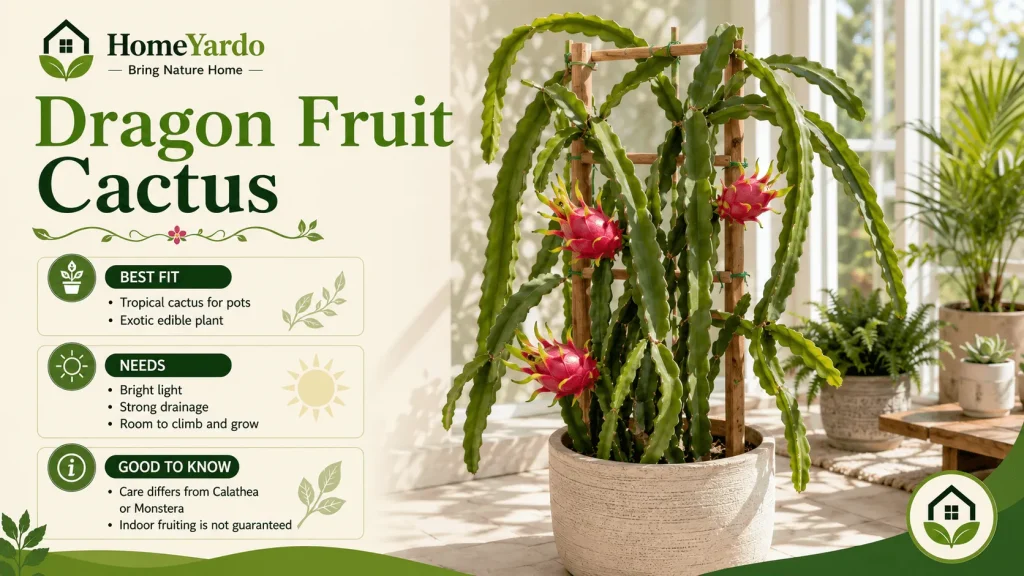
Dragon Fruit Cactus is a tropical cactus that can be grown in pots. It’s not a lush rainforest plant, and its maintenance is different from other plants such as Calathea as well as Monstera.
It requires bright lighting, a strong drainage system and enough space to grow or climb. The fruiting of indoors isn’t guaranteed but it could be an enjoyable option for those looking for an exotic tropical plant that is edible.
Exotic Tropical House Plants That Still Work Indoors
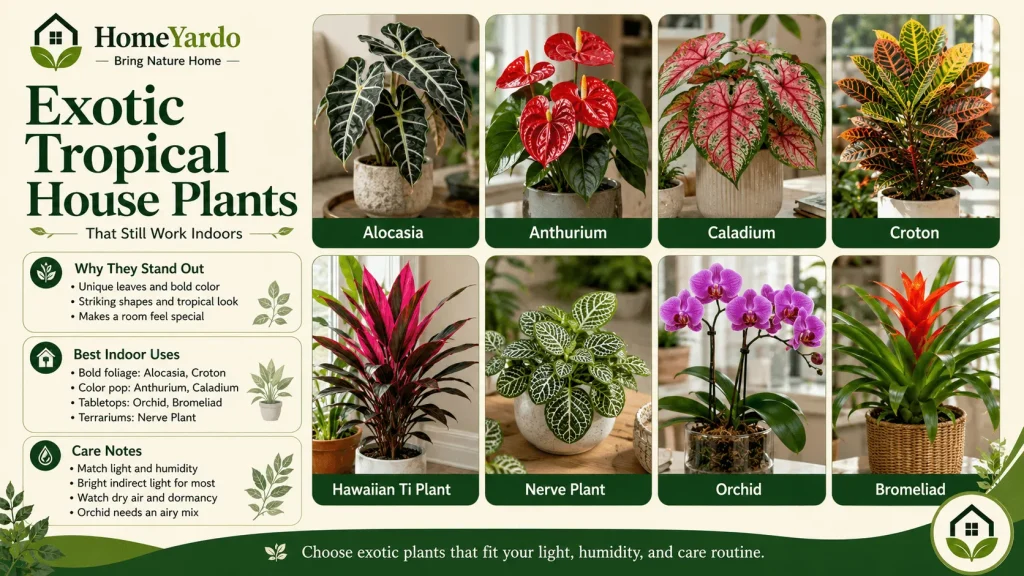
The exotic house plant stands out due to its unique leaves, vibrant colors, striking forms, or even flowers. They can make any room feel a bit more special, without requiring an extensive collection of rare plants.
Exotic does not necessarily suggest impossible. It’s all about choosing plants that are compatible with the lighting and humidity as well as the maintenance schedule.
| Exotic Plant | Why It Stands Out | Best For | Care Warning | Difficulty |
|---|---|---|---|---|
| Alocasia | Dramatic leaf shape | Bold foliage | Needs humidity and warmth | Medium-hard |
| Anthurium | Bright spathes and glossy leaves | Color | Needs indirect light and humidity | Medium |
| Caladium | Colorful heart-shaped leaves | Seasonal foliage | May go dormant | Medium |
| Croton | Strong leaf color | Bright rooms | Needs bright light | Medium |
| Hawaiian Ti Plant | Upright colorful foliage | Warm bright rooms | Dislikes dry air | Medium |
| Nerve Plant | Fine leaf veins | Terrariums | Wilts when too dry | Medium |
| Orchid | Tropical flowers | Bright tabletops | Needs airy mix | Medium |
| Bromeliad | Bold color and form | Compact display | Bloom cycle varies | Easy-medium |
Easy Tropical House Plants For Beginners
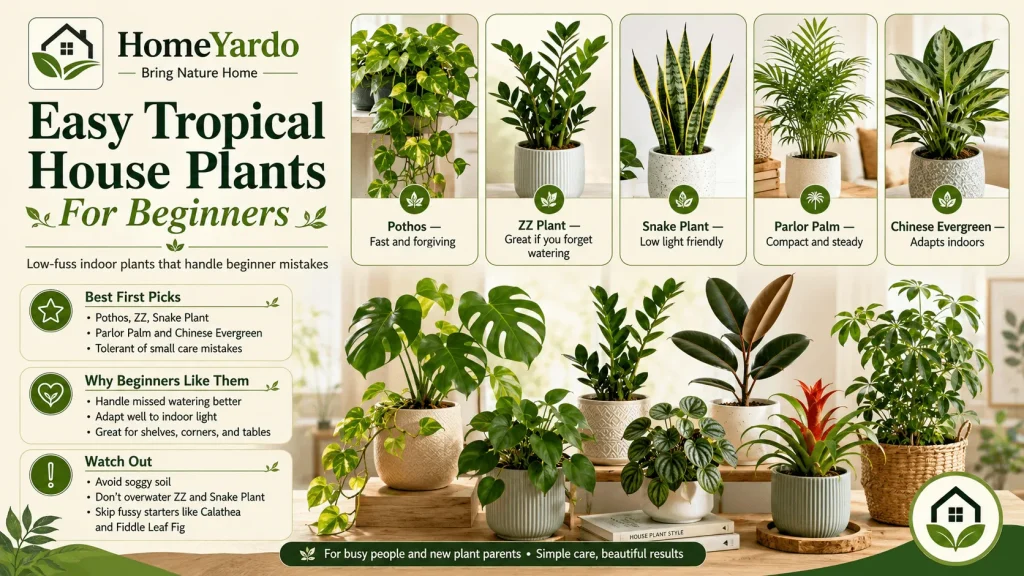
House plants that are tolerant of beginners will accept minor errors. They won’t collapse because of an untimely watering or an imperfect corner.
Begin with a sturdy foliage plant prior to trying plants sensitive to humidity. Pothos, Philodendron, ZZ Plant, Snake Plant, Parlor Palm, Chinese Evergreen, Rubber Plant, Peperomia, Bromeliad, and Schefflera are great first choices.
| Plant | Why It Works | Main Warning |
|---|---|---|
| Pothos | Forgiving and fast-growing | Avoid soggy soil |
| ZZ Plant | Handles missed watering | Do not water often |
| Snake Plant | Tolerates low light and dry soil | Root rot in wet soil |
| Parlor Palm | Compact and steady | Avoid dry extremes |
| Chinese Evergreen | Adapts to indoor light | Color forms need more light |
Avoid Calathea, Alocasia Majesty Palm, and Fiddle Leaf Fig as your first plant unless the space already is suitable for their needs. They’re gorgeous but they’re not as accommodating.
Low Light Tropical Plants For Indoors
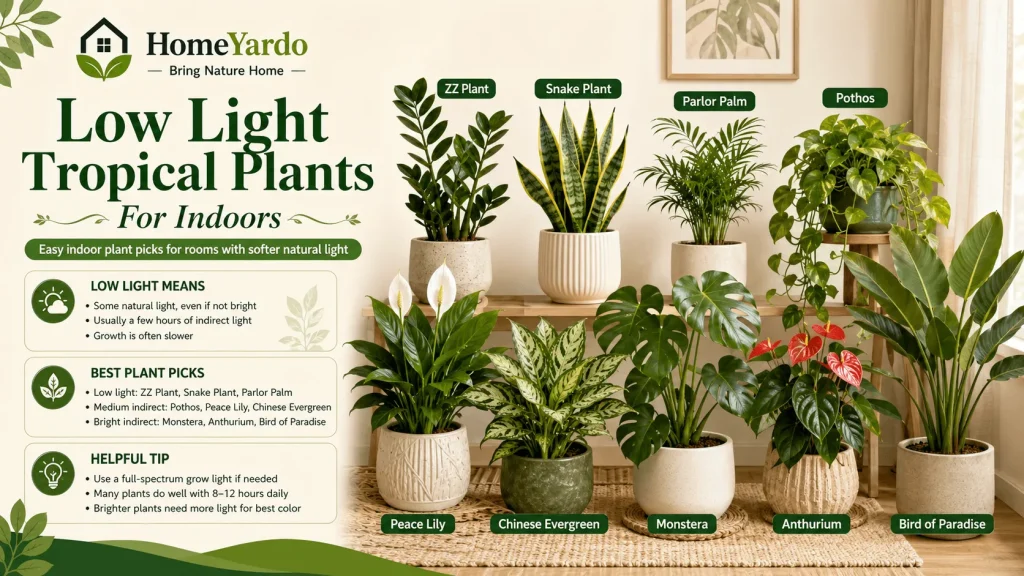
Low light does not mean lack of light. It is a sign that a room gets some natural light even if it’s not bright.
The tropical plants that require poor light typically grow slowly. Flowers and vibrant foliage plants typically require brighter lighting conditions for their appearance.
| Indoor Light Level | Meaning | Good Choices |
|---|---|---|
| Low light | A few hours of indirect light | ZZ Plant, Snake Plant, Parlor Palm |
| Medium indirect | Bright room without harsh sun | Pothos, Peace Lily, Chinese Evergreen |
| Bright indirect | Near a filtered bright window | Monstera, Anthurium, Bird of Paradise |
A full spectrum grow light could aid in determining if the space is not bright enough for constant growth. Many indoor plants respond with 8-12 hours of lighting per day, and are able to grow, which is influenced by plant response.
Large Tropical Indoor Plants And Indoor Tropical Trees
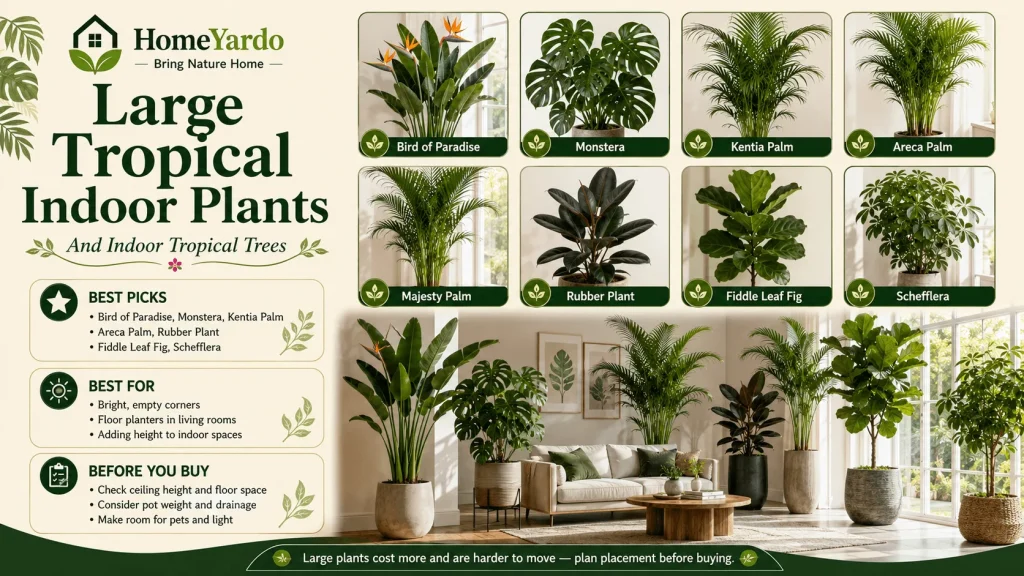
Large or tall tropical house plants are ideal for bright, empty living spaces and large spaces. They provide the height that small pots cannot.
The best options are Bird of Paradise, Monstera Deliciosa, Kentia Palm, Areca Palm, Majesty Palm, Rubber Plant, Fiddle Leaf Fig and Schefflera. Before purchasing one, make sure to check the height of the ceiling and floor space and window width, pot weight, access for pets and drainage.
| Plant | Indoor Size Potential | Best Placement |
|---|---|---|
| Bird of Paradise | Large and upright | Bright corner |
| Monstera | Wide and climbing | Living room with support |
| Kentia Palm | Tall and elegant | Floor planter |
| Rubber Plant | Upright tree form | Bright filtered window |
| Fiddle Leaf Fig | Tall tree shape | Stable bright location |
Large plants cost more and are harder to move. A little planning before buying can save a lot of awkward furniture shifting later.
Small Tropical House Plants For Small Spaces
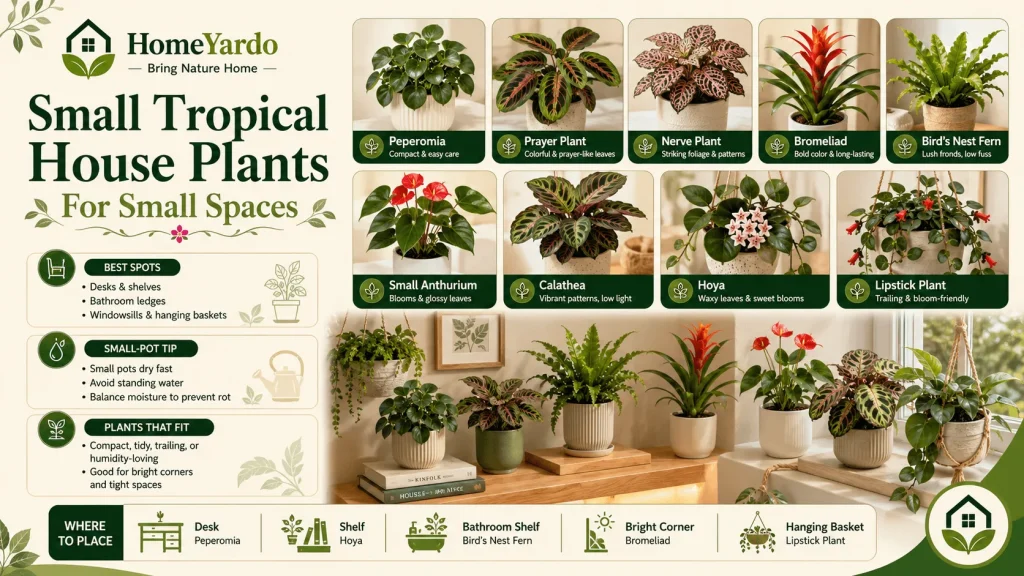
They are useful when space is tight. They bring color and texture to desks, shelves, bathroom ledges, windowsills, and hanging baskets.
Small pots dry fast, but they can also rot quickly if they sit in water. That balance is the small-pot challenge.
| Small Space | Best Plant | Why It Fits |
|---|---|---|
| Desk | Peperomia | Compact and tidy |
| Shelf | Hoya | Trailing habit |
| Bathroom shelf | Bird’s Nest Fern | Likes humidity |
| Small bright corner | Bromeliad | Color without large size |
| Hanging basket | Lipstick Plant | Flowers and trails |
Peperomia, Prayer Plant, Nerve Plant, Bromeliad, Bird’s Nest Fern, small Anthurium, Calathea, Hoya, and Lipstick Plant all work well in compact spaces. For an even smaller display, some compact tropical species can also work as terrarium plants when their mature size, humidity needs, airflow, and container conditions are suitable.
Flowering Tropical House Plants
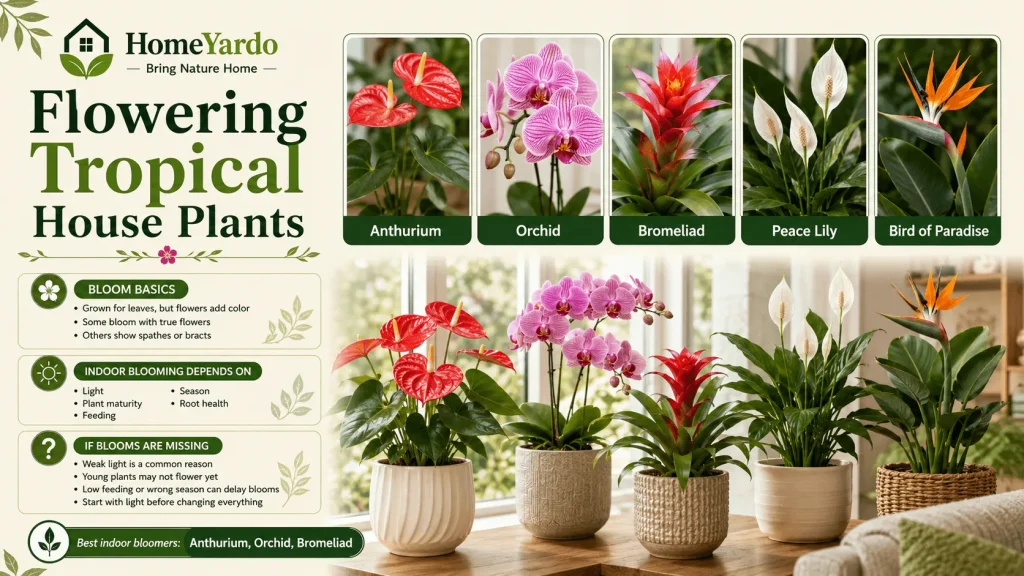
They are grown for leaves, but flowering types add color in a different way. Some produce true flowers, while others show off spathes or bracts.
Tropical flowering plants indoor blooming depends on light, plant maturity, feeding, season, and root health. A plant can be healthy and still not bloom if the conditions are not quite right.
| Plant | Indoor Bloom Chance | Best Condition |
|---|---|---|
| Anthurium | Good | Bright indirect light and humidity |
| Orchid | Good | Correct light and airy mix |
| Bromeliad | Good once per rosette | Bright filtered light |
| Peace Lily | Moderate | Brighter indirect light |
| Bird of Paradise | Harder indoors | Strong light and maturity |
A tropical plant may refuse to bloom because light is weak, the plant is young, the feeding is too low, the season is wrong, or the roots are stressed. Start with light before changing everything else.
Pet-Safe Tropical Houseplants
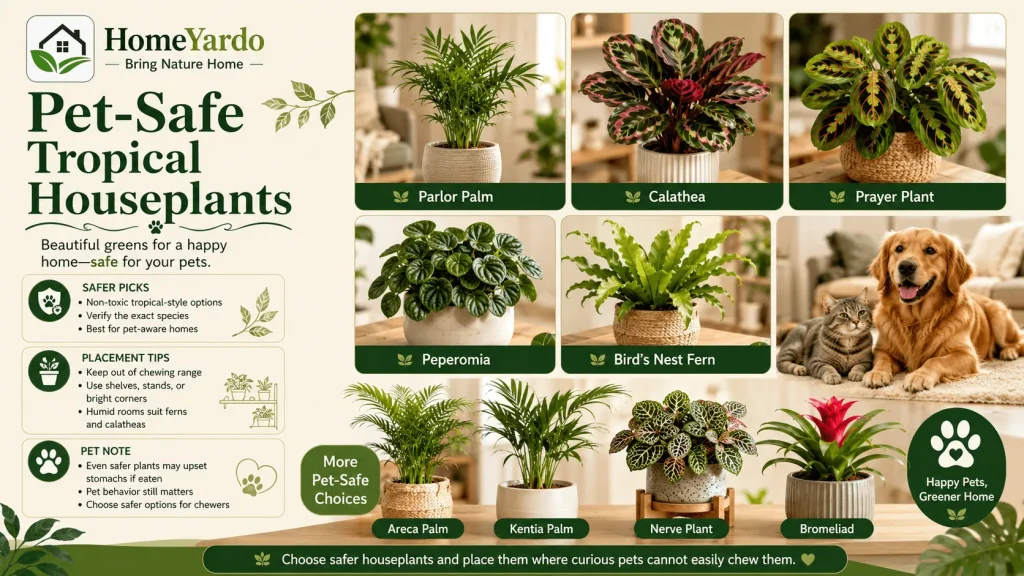
Pet-safe plant choices need careful wording. Even non-toxic plants can cause mild stomach upset if eaten in large amounts.
Safer tropical-style choices include Parlor Palm, Areca Palm, Kentia Palm, Calathea, Prayer Plant, Bird’s Nest Fern, Peperomia, Nerve Plant, and Bromeliad. Always verify the exact species when pets are involved.
| Plant | Cats | Dogs | Best Use | Placement Tip |
|---|---|---|---|---|
| Parlor Palm | Safer choice | Safer choice | Small palm looks | Floor or plant stand |
| Calathea | Safer choice | Safer choice | Patterned foliage | Humid room |
| Prayer Plant | Safer choice | Safer choice | Small shelves | Tabletop or shelf |
| Peperomia | Safer choice | Safer choice | Desks and tabletops | Small pot out of chewing range |
| Bird’s Nest Fern | Safer choice | Safer choice | Humid rooms | Bathroom with light |
Pet behavior matters. If a pet chews plants, choose safer options and keep all plants away from easy access.
Tropical House Plants To Keep Away From Pets
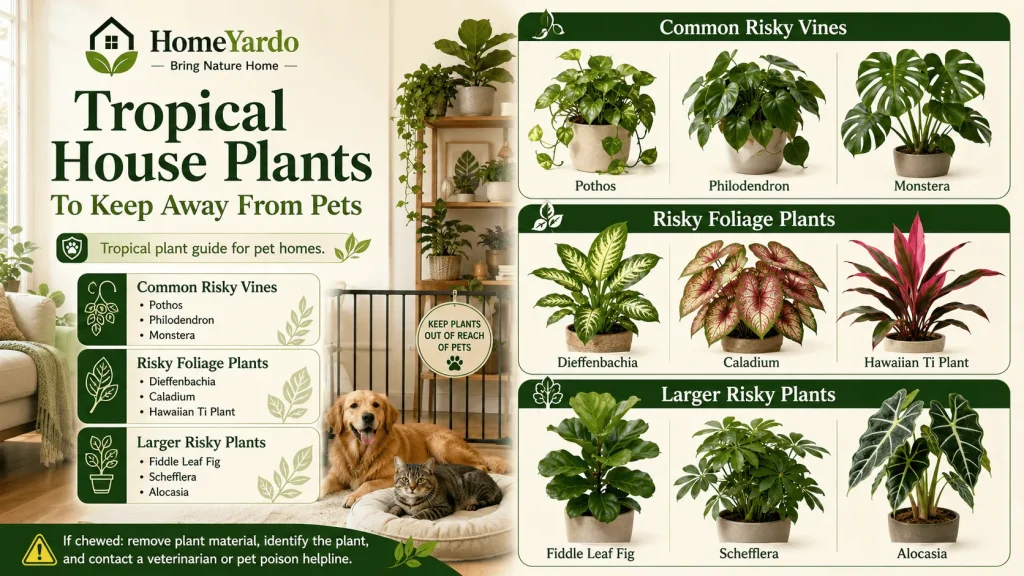
Some popular tropical house plants are better kept out of reach of cats and dogs. This matters most in homes with pets that chew leaves, dig in pots, or knock plants down like tiny chaos managers.
Common risky vines include Pothos, Philodendron, and Monstera. Colorful or risky foliage plants include Dieffenbachia, Caladium, and Hawaiian Ti Plant. Larger risky plants include Fiddle Leaf Fig, Schefflera, and Alocasia.
If a pet chews a plant, remove the plant material, identify the plant, and contact a veterinarian or pet poison helpline. Do not wait for severe symptoms if the plant is known to be toxic.
How To Care For Tropical Plants Indoors
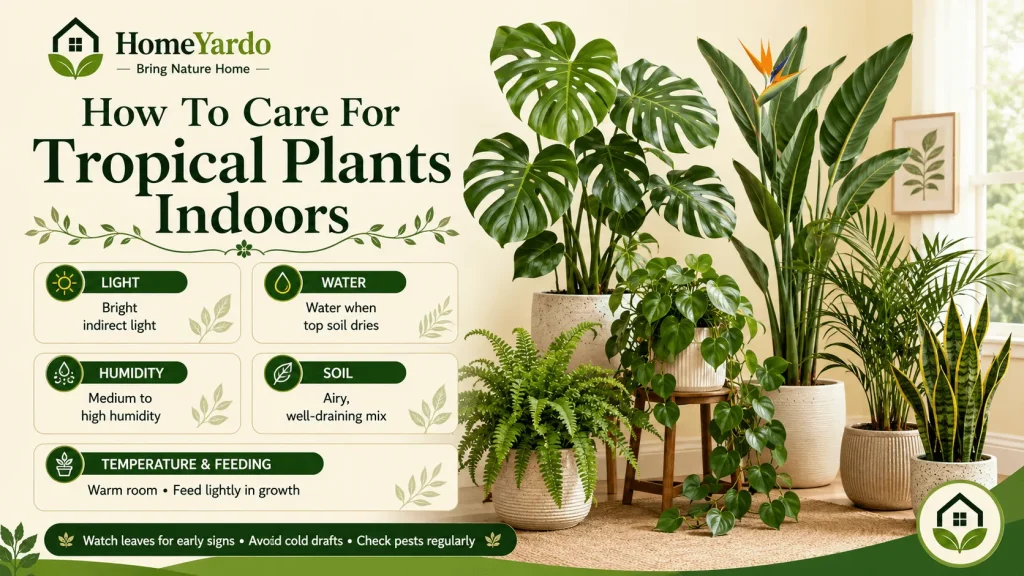
Good tropical plant care is not about doing more. It is about doing the right things at the right time.
Light, water, humidity, soil, temperature, feeding, and pest checks all work together. When one part is off, the leaves usually say something first.
| Care Area | General Rule | Common Mistake |
|---|---|---|
| Light | Bright indirect suits many | Direct sun scorch |
| Water | Check the soil first | Fixed weekly watering |
| Humidity | Medium-high helps many | Dry vent exposure |
| Soil | Airy and draining | Dense garden soil |
| Temperature | Warm and stable | Cold drafts |
| Feeding | Light during growth | Feeding stressed plants |
Light
Bright indirect light is the ideal location for most of these plants. This means it needs to be a bright room with no direct sunlight hitting the leaves during the day.
The light that enters from an east window is usually quite gentle in the morning. Distance (or sheer curtain) for south or west windows may be necessary. Plants that like low light will typically grow better in north windows.
If natural light is low, grow lights can be used. Keep them near but not too near to where they can be of assistance but not subject to excessive heat or bleaching.
Watering
It is okay to begin watering when the soil needs it instead of when it is on the calendar. A plant in a warm bright room will dry rapidly; a plant in a cool corner will remain moist for several days.
Most of these plants require watering when the top 1-2 inches of soil is dry. Water quality may also have an effect on sensitive plants; filtered or rested water may be beneficial if the edges of leaves continue to turn brown.
Soils are not necessarily wet in a tropical setting. Yellow leaves, fungus gnats and root rot can all result from the root being constantly moist.
Humidity
Medium to high humidity is desired for many tropical plants. Dry air can result in slow growth, crisp edges and brown tips.
A small hygrometer will provide an indication of whether the room is indeed dry or not. Guessing is easy. Humidity is more pleasant to all.
The most helpful humidity supports typically are: a humidifier, grouping plants, bathroom placement, pebble tray, and misting as a short term remedy. Be sure to avoid misting fuzzy leaves or plants that get too damp for long periods of time.
Soil
The majority of thesel house plants require a well draining indoor soil mix that has lots of room for air circulation. Garden soil is dense and will not fit in a container and tends to retain too much moisture near the roots.
Aroids like Monstera and Philodendron typically prefer a potting mix that has bark and perlite. Ferns prefer moist but well drained soil. Orchid mix should be composed of bark. A draining indoor palm mix is preferred by palms.
Most succulent tropical plants require more rapid drainage, like Peperomia or Snake Plant. At best, one universal mix will not work for all plants.
Temperature
The majority of these house plants thrive in warm, stable rooms (65-85°F) according to species. Sudden changes may result in stress, leaf drop or browning.
Cold windows can be an issue during the winter months even within the home. Leaves may also be dried or chilled by heater vents or AC blasts.
Fertilizer
Nourish these plants sparingly during the growing season. Many homes tend to feed more often in the spring and summer.
Decrease the feeding rate during the growth slowdown. A bonedry stressed or recently shocked plant should not be treated to heavy feeding. Adjust the growing conditions first before applying gentle feeding as per label instructions.
Repotting
Repot if roots circle pot, water dries out too fast, if soil breaks down or growth slows down without apparent cause. Spring or growth times are generally less stressful for the plant.
If possible, step 1-2 inches further apart. Large pots contain too much moisture and can cause a problem with the roots if they have to be repotted.
Leaf Cleaning
Tropical leaves are big and dust catchers. When there is dust on leaves, they look dull and can diminish the amount of light that hits the surface.
Gently mist plants like Monstera, Fiddle Leaf Fig, Rubber Plant and Bird of Paradise with a soft damp cloth. Excessive leaf shine will not be required and may cause residue to remain.
Pest Checks
Spider mites, mealybugs, scale, thrips and fungus gnats are common indoor pests. Problems are more easily dealt with when they are first checked.
Look for glued-on patches, webbing, cotton balls, spotted foliage, small flies around soil and broken new growth. Separate new plants for a temporary period before moving them near the other plants in the collection.
Common Tropical House Plant Problems
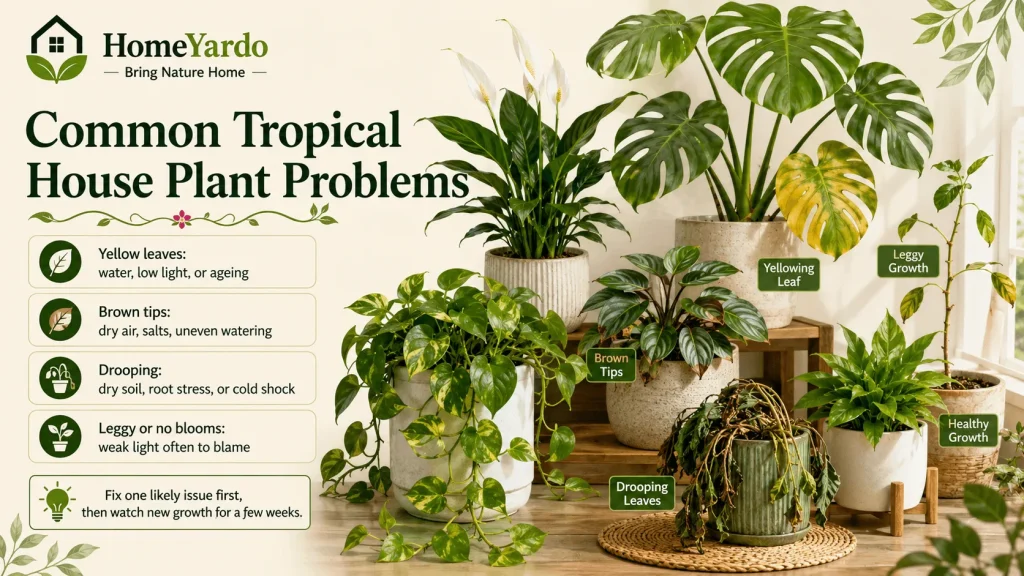
Light, water, humidity, or temperature are most often the initial causes of tropical plant problems. Leaves are the first sign in general.
If leaves are yellow, it’s likely a water, light, or natural ageing issue. Brown tips can be caused by dry air, salts or irregular watering. Drooping can be due to deficiency, excess or cold shock. If there are no blooms it will likely be weak light or a plant that is not mature.
| Problem | Likely Cause | What To Check | Fix | When To Worry |
|---|---|---|---|---|
| Yellow leaves | Overwatering, low light, and old leaves | Soil and roots | Improve drainage and light | Many leaves turn yellow at once |
| Brown tips | Dry air, salts, and inconsistent watering | Humidity and water quality | Raise the humidity and flush the soil | Tips spread into large brown patches |
| Drooping leaves | Dry soil, root stress, cold shock | Soil moisture and placement | Adjust water and warmth | Droop stays after care is fixed |
| Leggy growth | Not enough light | Distance from the window | Move closer to indirect light | Stems weaken badly |
| Faded color | Low light or harsh sun | Leaf color and scorch marks | Adjust the light slowly | New growth stays pale |
| No blooms | Low light, weak feeding, immaturity | Light and season | Increase bright filtered light | The plant also shows leaf decline |
Do not change every care habit at once. Fix the most likely issue first, then watch the next few weeks of growth.
How To Choose The Right Tropical House Plant
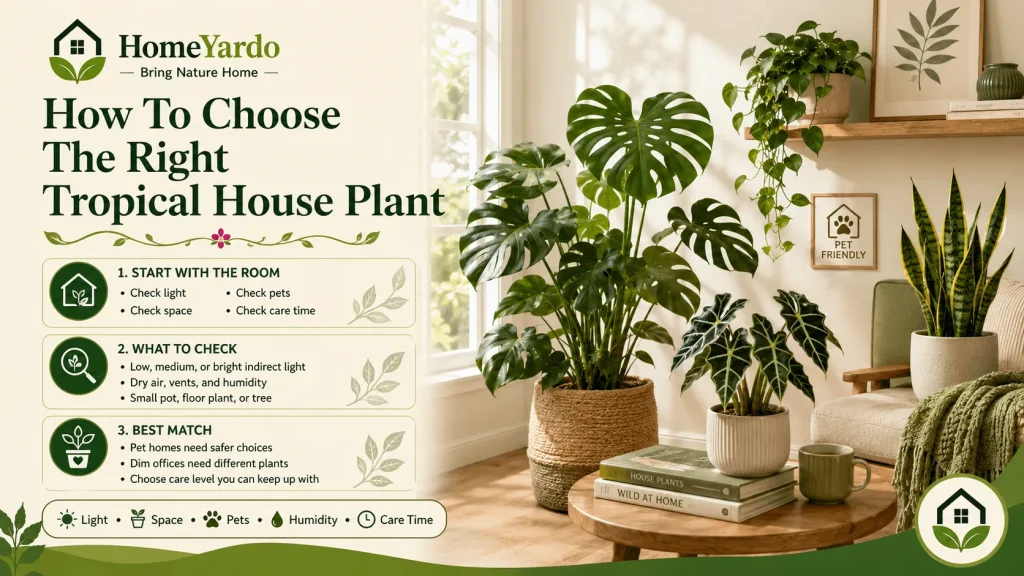
The right plant starts with the room, not the plant shop. Light, space, pets, humidity, and care time should guide the choice. Placement can also depend on how you want greenery to function within a room. If symbolism and room placement are part of your selection process, the guide to Feng Shui plants covers indoor choices commonly associated with different spaces and traditional Feng Shui uses.
A bright living room can handle different plants than a dim office. A pet home also needs a different plan than a closed plant room.
| Question | What To Check |
|---|---|
| How bright is the room? | Low, medium, or bright indirect |
| Is the room dry? | Check vents and humidity |
| Are pets present? | Choose safer plants |
| How much space is available? | Small pot, floor plant, or tree |
| How much care is realistic? | Easy, medium, or higher-care |
Tropical Plants For An Indoor Jungle Look
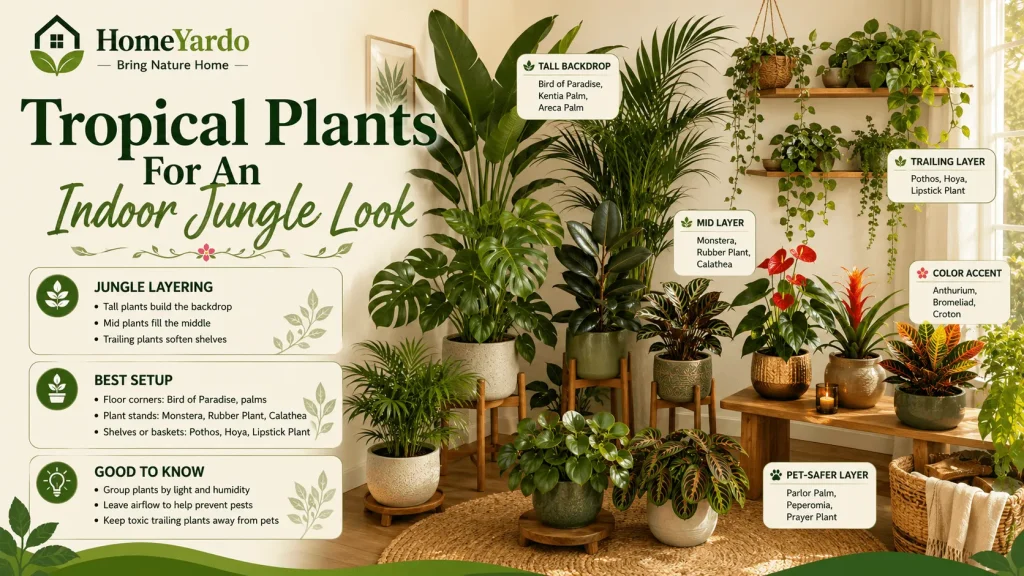
An indoor jungle look works best when plants are layered. Tall plants create the background, medium plants fill the middle, and trailing plants soften shelves and baskets.
Group plants with similar light and humidity needs. Give leaves space for airflow, because a crowded plant corner can look great for a photo and then invite pests.
| Layer | Plant Examples | Placement |
|---|---|---|
| Tall background | Bird of Paradise, Kentia Palm, Areca Palm | Floor corners |
| Mid layer | Monstera, Rubber Plant, Calathea | Plant stands |
| Trailing layer | Pothos, Hoya, Lipstick Plant | Shelves or baskets |
| Color accent | Anthurium, Bromeliad, Croton | Tabletops |
| Pet-safer layer | Parlor Palm, Peperomia, Prayer Plant | Accessible spaces |
A simple setup could place Bird of Paradise in a bright corner, Monstera on a plant stand, Pothos on a shelf, Anthurium on a side table, and Parlor Palm where pets can access the floor area. Keep toxic trailing plants away from curious mouths.
Tropical Plants Vs Succulents
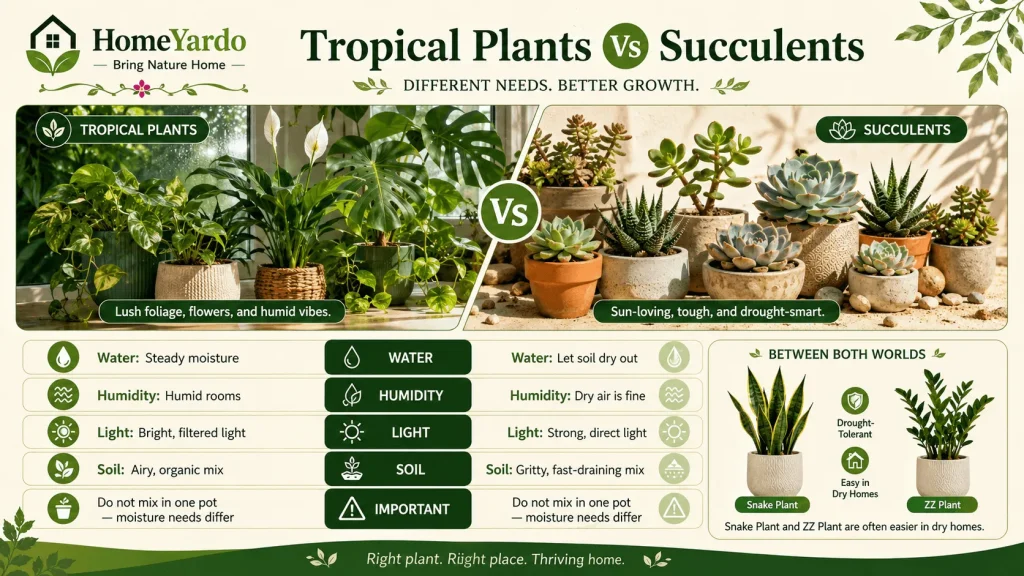
Tropical plants and succulents can both grow indoors, but their care needs are often very different. Mixing them in the same pot usually creates trouble because their roots want different moisture patterns.
Tropical plants are better for lush foliage, flowers, and humid rooms. Succulents are better for sunny, dry spaces where the soil can dry well.
| Feature | Tropical House Plants | Succulents |
|---|---|---|
| Water | Often need steadier watering | Prefer drying out |
| Humidity | Many prefer humidity | Usually prefer dry air |
| Light | Many like filtered light | Many need stronger light |
| Soil | Airy and organic | Gritty and fast-draining |
| Best for | Lush foliage and flowers | Sunny dry spaces |
Snake Plant and ZZ Plant behave closer to drought-tolerant plants than many leafy tropicals. That is why they are often easier in dry homes.
Monstera Vs Philodendron
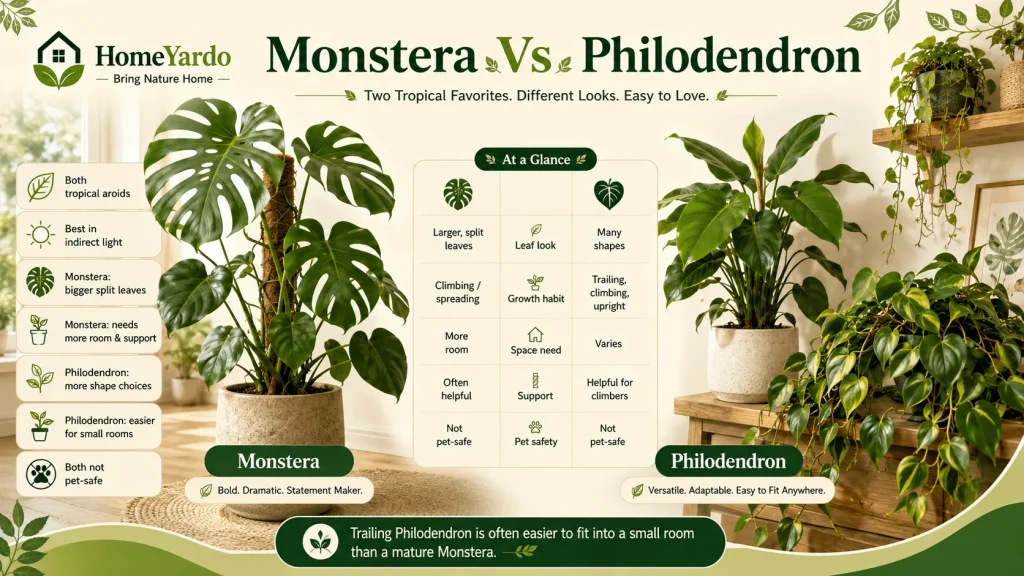
Monstera and Philodendron are both tropical-looking aroids, but they are not the same plant. Both can grow indoors and both usually prefer indirect light.
Monstera often needs more room and support. Philodendron offers more shape choices, from trailing vines to upright foliage plants.
| Feature | Monstera | Philodendron |
|---|---|---|
| Leaf look | Larger, split leaves | Many shapes |
| Growth habit | Climbing/spreading | Trailing, climbing, upright |
| Space need | More room | Varies |
| Support | Often helpful | Helpful for climbers |
| Pet safety | Not pet-safe | Not pet-safe |
Don’t allow pets to eat or touch both plants. A trailing Philodendron is generally easier to fit into a small room than a mature Monstera.
Are Tropical Plants Better Than Snake Plants?
Tropical plants do not necessarily do better than Snake plants. They have a different appearance and handling.
Select Snake Plant for low maintenance, lower light and dry areas. Select tropical foliage plantings for lush foliage, flowers, color and moisture laden rooms.
The better option depends on the space. It may be preferable to have a Snake Plant in the dark corner of an office than a tropical plant dying slowly near a printer.
Tropical House Plants To Avoid As A Beginner
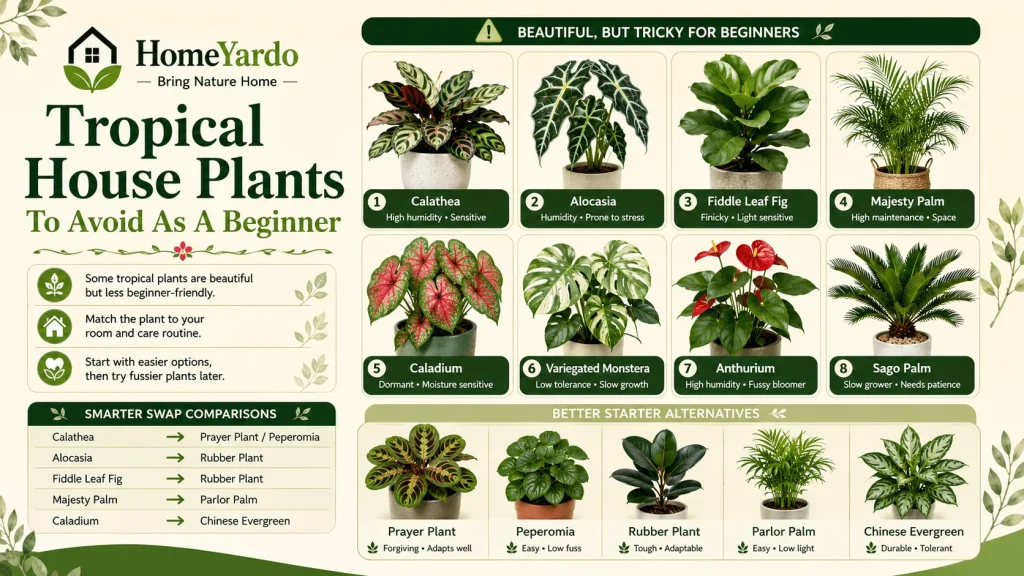
There are some tropical plants that are gorgeous and not quite so tolerant. They’re not bad plants but can be discouraging as a first choice.
The following table lists alternative plants that are easier to grow than the hard plants listed. It’s not a no-grower’s admonition. It’s a reminder to align ambition and room.
| Plant | Why It Can Be Hard | Better Starter Alternative |
|---|---|---|
| Calathea | Needs steady humidity | Prayer Plant or Peperomia |
| Alocasia | Sensitive to cold/dry air | Rubber Plant |
| Fiddle Leaf Fig | Dislikes changes | Rubber Plant |
| Majesty Palm | Needs humidity | Parlor Palm |
| Caladium | Dormancy confusion | Chinese Evergreen |
Other varieties that are not well suited to new plant owners include rare variegated Monstera, certain varieties of Anthurium, and Sago Palm. Try the easy ones first, learn to be confident, then the fussy beauties.
Can Tropical House Plants Go Outside In Summer?
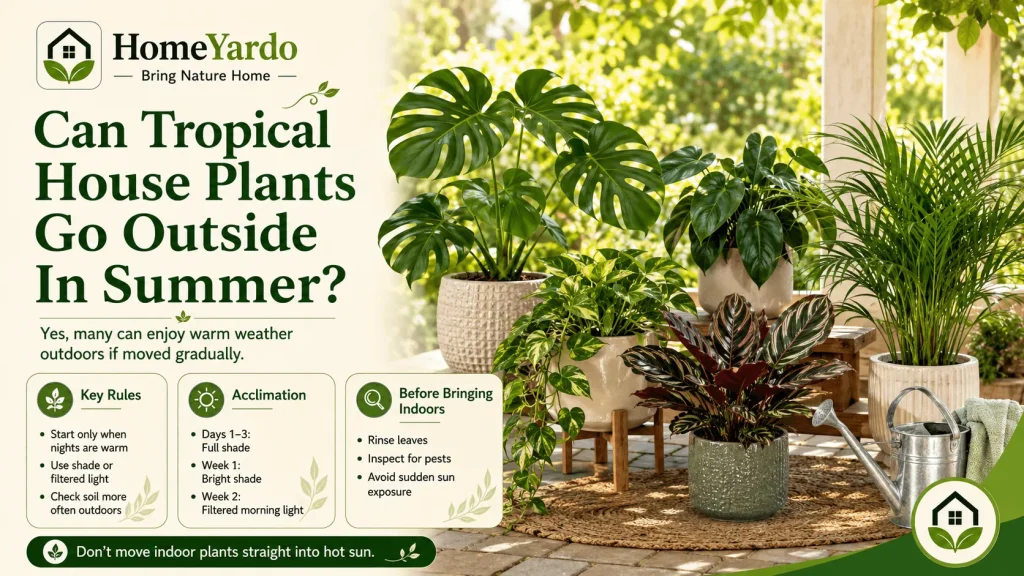
Numerous of them are able to enjoy warm weather outdoors in shady or filtered light. The action should be gradual as the leaves of the interior burn rapidly outdoors.
Begin when the nights are warm. Soil may dry out quicker outside, so monitor moisture levels more frequently. When returning interior plants, check for pests.
A simple acclimation schedule aids:
| Timing | What To Do |
|---|---|
| Days 1–3 | Place in full shade |
| Week 1 | Keep in bright shade |
| Week 2 | Try filtered morning light if suitable |
| Before return indoors | Rinse/check leaves and inspect for pests |
Do not move a plant from a quiet indoor corner straight into the hot sun. That is the plant version of stepping outside at noon without sunscreen.
Where To Buy Tropical House Plants
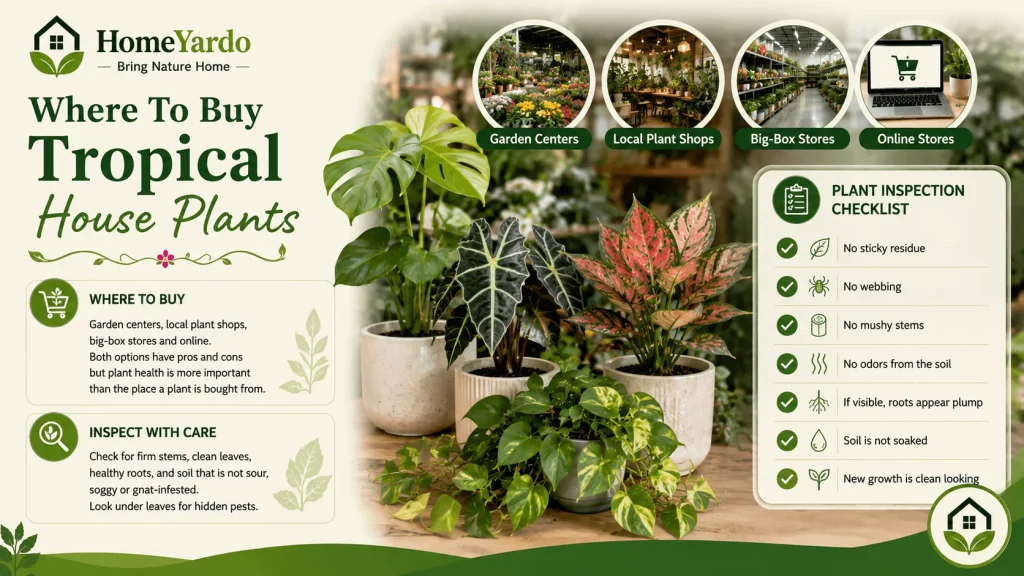
They can be purchased from garden centers, local plant shops, big-box stores and online. Both options have pros and cons but plant health is more important than the place a plant is bought from.
Inspect for firm stems with clean leaves, healthy roots, and not a sour, soggy or gnat-infested soil. If you can, look for pests on the underside of leaves as they love to hide there.
Plant inspection checklist:
- No sticky residue
- No webbing
- No mushy stems
- No odors from the soil
- If visible, roots appear plump
- Soil is not soaked
- New growth is clean looking.
Conclusion
Tropical house plants can thrive in the house when the plant is a good fit for the house. It is always best to decide on a leaf based on light, humidity, space, care level and pet safety before color or shape.
If you want an easy start, try Pothos, ZZ Plant, Snake Plant, Parlor Palm or Chinese Evergreen. When cared for correctly, Monstera, Bird of Paradise, Anthurium, Calathea and Alocasia can be great additions for a dramatic look.
Select the room and then select the plant. If it’s not a weekend hobby to create a plant hospital, allow one plant to settle before constructing the whole plant collection.
FAQ’s
Safer tropical-style plants for cats include Parlor Palm, Calathea, Prayer Plant, Peperomia, Bird’s Nest Fern, Nerve Plant, and many Bromeliads. Even safer plants can cause mild stomach upset if eaten, so keep plants away from cats that chew leaves.
Safer tropical-style plants for dogs include Parlor Palm, Areca Palm, Kentia Palm, Calathea, Prayer Plant, Peperomia, and Bird’s Nest Fern. Keep all plants out of reach if a dog likes chewing leaves, digging soil, or knocking pots over.
Non-toxic or pet-safe house plants include Parlor Palm, Areca Palm, Kentia Palm, Calathea, Prayer Plant, Peperomia, Bird’s Nest Fern, Nerve Plant, and many Bromeliads. Always check the exact plant species before placing it near pets.
Yellow leaves often come from overwatering, poor drainage, low light, cold stress, or natural older leaf loss. Check the soil moisture, pot drainage, roots, and plant placement before changing the care routine.
Large tropical plants for a living room include Bird of Paradise, Monstera Deliciosa, Kentia Palm, Areca Palm, Rubber Plant, Fiddle Leaf Fig, Majesty Palm, and Schefflera. Choose a plant based on light, ceiling height, floor space, and pet access.
ZZ Plant, Snake Plant, Parlor Palm, Chinese Evergreen, Pothos, Peace Lily, and some Philodendron types can tolerate lower indoor light. Low light does mean no light, and growth is usually slower than in bright indirect light.
Common non-toxic or pet-safer tropical house plants include Parlor Palm, Areca Palm, Kentia Palm, Calathea, Prayer Plant, Peperomia, Bird’s Nest Fern, Nerve Plant, and many Bromeliads. These plants are better choices for homes with cats and dogs. Still, non-toxic does not mean edible. Large amounts of plant material can still upset a pet’s stomach, so plant placement matters.
Yellow leaves on tropical plants often come from overwatering, poor drainage, low light, cold drafts, or natural older leaf loss. Check the soil before adding more water, because soggy roots are one of the most common causes. If the plant sits in a dim room, move it closer to bright indirect light. If many leaves turn yellow at once, inspect the roots, pot drainage, and recent changes in temperature.
Good large tropical plants for a living room include Bird of Paradise, Monstera Deliciosa, Kentia Palm, Areca Palm, Rubber Plant, Fiddle Leaf Fig, Majesty Palm, and Schefflera. These plants add height, broad leaves, and a strong indoor jungle look. Most large tropical plants need bright indirect light and enough space for their leaves to spread. Before buying, check ceiling height, floor space, pot weight, and pet access.
Tropical plants that tolerate lower light include ZZ Plant, Snake Plant, Parlor Palm, Chinese Evergreen, Pothos, Peace Lily, and some Philodendron types. Low light does not mean no light; these plants still need some indirect natural light or a grow light. Growth may be slower in darker rooms. Flowering plants and colorful foliage plants usually need brighter filtered light to look their best.
Tropical plants do not always need a lot of water. Many prefer evenly moist soil, but most do not like soggy roots. Water needs depend on the plant type, pot size, light, temperature, humidity, and season. A safer rule is to check the soil first, then water when the top layer begins to dry, unless the plant needs steadier moisture like Calathea, Ferns, or Nerve Plant.
References
- Competitor And SERP References
- https://www.thespruce.com/best-indoor-tropical-plants-1902919
- https://tropicalhouseplant.com/
- https://www.rainforest-alliance.org/everyday-actions/5-tropical-houseplants-that-bring-the-rainforest-indoors/
- https://plantsome.ca/collections/all-plants
- https://www.livelyroot.com/blogs/plant-care/tropical-plants-to-create-urban-jungle
- https://www.housebeautiful.com/lifestyle/gardening/g44446503/tropical-plants/
- https://www.housedigest.com/2195600/grow-tropical-dragon-fruit-at-home-in-pots/
- https://myperfectplants.com/blogs/blog/tropical-house-plants-to-grow-inside
- https://www.homesandgardens.com/gardens/tropical-indoor-plants
- https://www.fnp.com/blog/tropical-plants-that-can-be-grown-indoors
- https://www.gardenia.net/guide/tropical-flowers-for-your-garden-or-as-house-plants
- Pet Safety References
- https://www.aspca.org/pet-care/animal-poison-control/toxic-and-non-toxic-plants
- https://plants.ces.ncsu.edu/
- https://www.petpoisonhelpline.com/
- Care And Botanical References
- https://extension.umn.edu/find-plants/houseplants
- https://extension.psu.edu/houseplant-care
- https://gardeningsolutions.ifas.ufl.edu/plants/houseplants/