Tall Plants: 30 Best Flowering, Indoor, Outdoor, And Privacy Picks
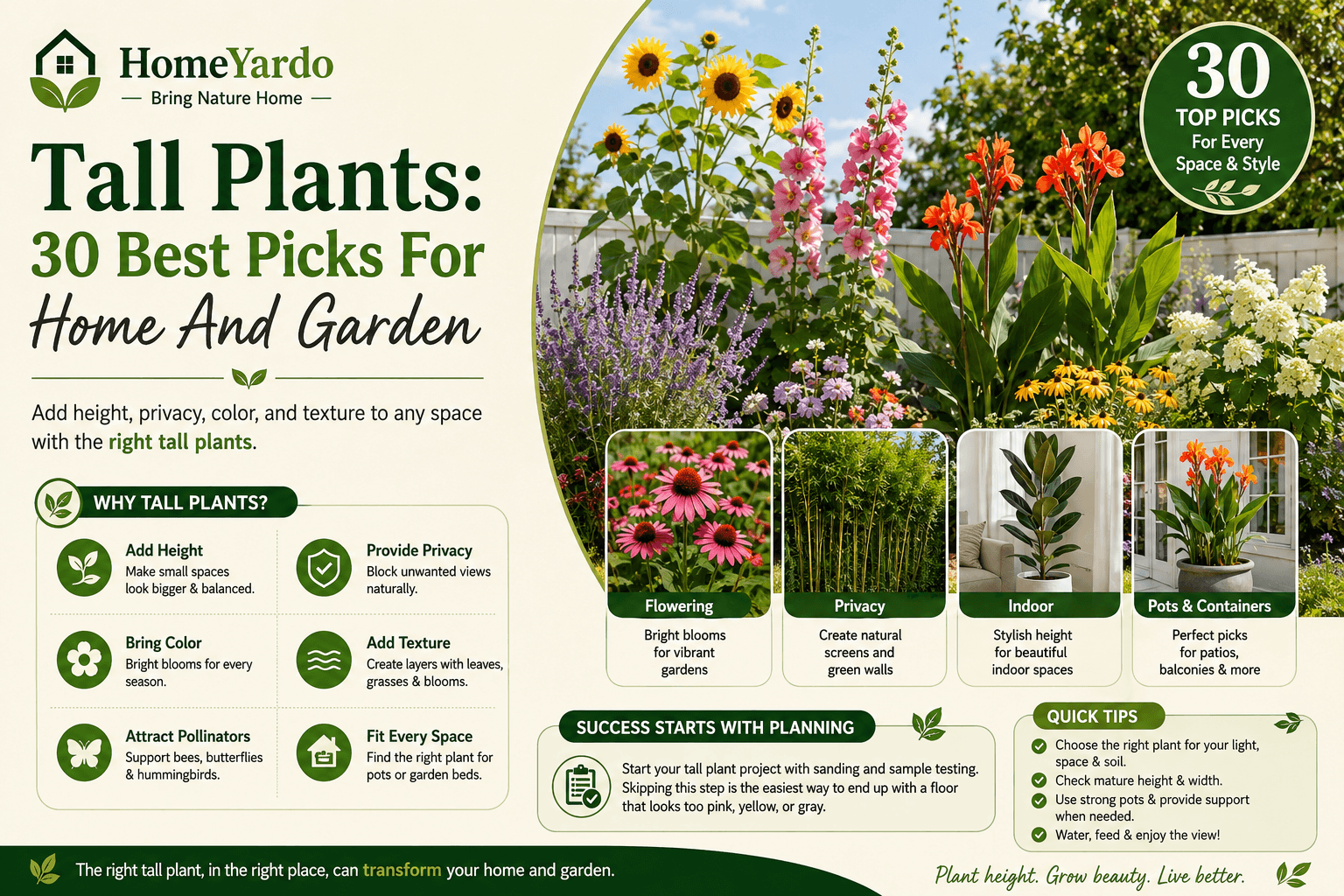
The garden may appear somewhat flat if every plant has to be in the exact same spot. Similar to what happens inside when a space appears empty, even when furniture is installed.
Tall plants can help fill that feeling of emptiness. They provide the appearance of height, privacy, flowers along with texture and some confidence to the space. Some stand like soft green walls. Other blooms are on tall stems, making an area feel alive.
This guide begins by introducing 30 flowering tall plants suitable for borders, gardens and privacy. Following that, it covers plants suitable for pots, containers, shade, narrow spaces, indoor spaces, rapid growth and gardens with a design. The aim is to select a plant that is suitable for the area now and is able to thrive later on.
What Counts As A Tall Plant?
A tall plant can be defined as any plant that is cultivated to provide height as well as structure, screening or vertical interest. In the outdoors, it could be an annual that is 5 feet tall at the rear of a bed. Indoors, it could be a houseplant that is at eye level and fills in an empty space.
The height is just one aspect of the equation. The root spread, width, sun exposure, wind exposure, soil moisture, and the size of the mature plant matter are equally important. A tiny pot for a nursery can conceal a large-scale plant.
Tall Plant Height Ranges
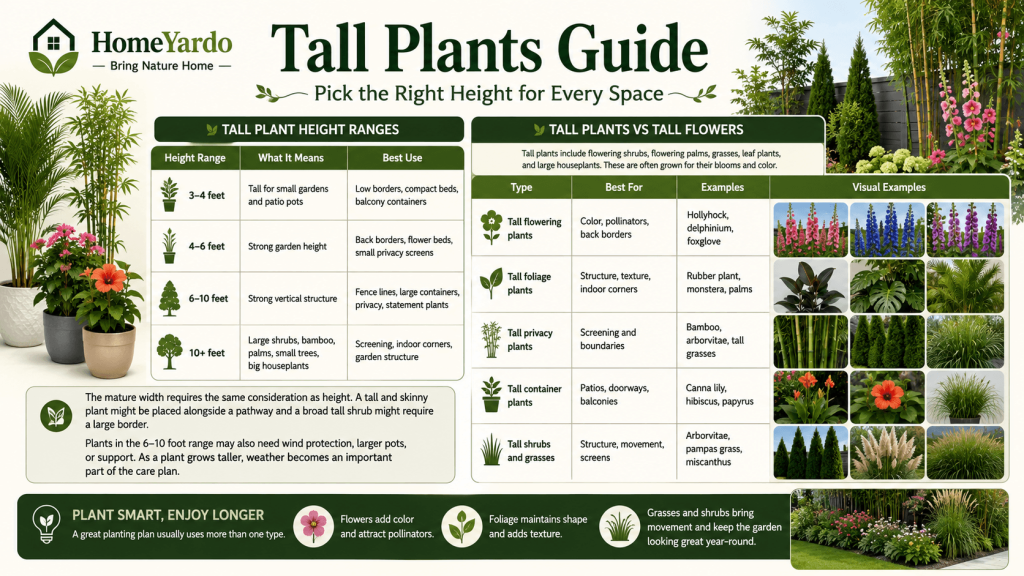
Larger plants are easier to pick when their height is determined according to the use. A plant that is 4 feet tall may appear high in a tiny pot for a patio, whereas an erect 4-foot plant next to a fence could barely be noticed.
| Height Range | What It Means | Best Use |
|---|---|---|
| 3–4 feet | Tall for small gardens and patio pots | Low borders, compact beds, balcony containers |
| 4–6 feet | Strong garden height | Back borders, flower beds, small privacy screens |
| 6–10 feet | Strong vertical structure | Fence lines, large containers, privacy, statement plants |
| 10+ feet | Large shrubs, bamboo, palms, small trees, big houseplants | Screening, indoor corners, garden structure |
The mature width requires the same consideration as height. A tall and skinny plant might be placed alongside a pathway and a broad, tall shrub might require a large border.
Plants that are in the 6-foot-to-10-foot range might also require protection from wind, a larger pot, or even support. When a plant grows taller, the weather is an essential part of the maintenance plan.
Tall Plants Vs Tall Flowers
Tall plants include flowering shrubs, flowering palms, grasses, leaf plants, and huge houseplants. These plants are usually grown for their blooms and color.
| Type | Best For | Examples |
|---|---|---|
| Tall flowering plants | Color, pollinators, back borders | Hollyhock, delphinium, foxglove |
| Tall foliage plants | Structure, texture, and indoor corners | Rubber plant, monstera, palms |
| Tall privacy plants | Screening and boundaries | Bamboo, arborvitae, tall grasses |
| Tall container plants | Patios, doorways, balconies | Canna lily, hibiscus, papyrus |
| Tall shrubs and grasses | Structure, movement, screens | Arborvitae, pampas grass, miscanthus |
A great planting plan usually employs more than one type of. Flowers add hue. Foliage maintains its shape. It is important to have grasses and shrubs that help to make the look of the garden more settled as the blooms die down.
Best Tall Plants At A Glance
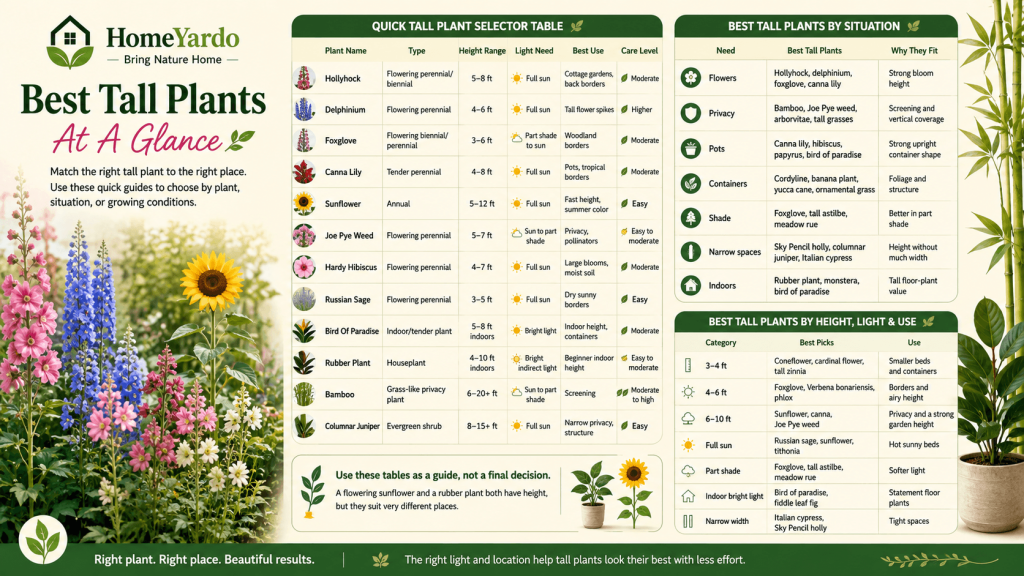
It is helpful to select a plant quickly when each plant tag begins to become appealing. One plant might be perfect for creating a sun-filled border, but it is not suitable for a narrow path. One plant may look stunning in a photograph, but it needs greater light levels than what the area will allow.
The following tables provide an easy method of matching tall plants to the correct task.
Quick Tall Plant Selector Table
| Plant Name | Type | Height Range | Light Need | Best Use | Care Level |
|---|---|---|---|---|---|
| Hollyhock | Flowering perennial/biennial | 5–8 ft | Full sun | Cottage gardens, back borders | Moderate |
| Delphinium | Flowering perennial | 4–6 ft | Full sun | Tall flower spikes | Higher |
| Foxglove | Flowering biennial/perennial | 3–6 ft | Part shade to sun | Woodland borders | Moderate |
| Canna Lily | Tender perennial | 4–8 ft | Full sun | Pots, tropical borders | Moderate |
| Sunflower | Annual | 5–12 ft | Full sun | Fast height, summer color | Easy |
| Joe Pye Weed | Flowering perennial | 5–7 ft | Sun to part shade | Privacy, pollinators | Easy to moderate |
| Hardy Hibiscus | Flowering perennial | 4–7 ft | Full sun | Large blooms, moist soil | Moderate |
| Russian Sage | Flowering perennial | 3–5 ft | Full sun | Dry sunny borders | Easy |
| Bird Of Paradise | Indoor/tender plant | 5–8 ft indoors | Bright light | Indoor height, containers | Moderate |
| Rubber Plant | Houseplant | 4–10 ft indoors | Bright indirect light | Beginner indoor height | Easy to moderate |
| Bamboo | Grass-like privacy plant | 6–20+ ft | Sun to part shade | Screening | Moderate to high |
| Columnar Juniper | Evergreen shrub | 8–15+ ft | Full sun | Narrow privacy, structure | Easy |
Make use of this table as an example, not as an ultimate decision. A flowering sunflower and a rubber plant both have height, but they are both suited to very distinct locations.
Best Tall Plants By Situation
Different areas require different types of height. A patio screen needs density. A cottage border needs flowers. The hallway requires plants that grow up and not down.
| Need | Best Tall Plants | Why They Fit |
|---|---|---|
| Flowers | Hollyhock, delphinium, foxglove, canna lily | Strong bloom height |
| Privacy | Bamboo, Joe Pye weed, arborvitae, tall grasses | Screening and vertical coverage |
| Pots | Canna lily, hibiscus, papyrus, bird of paradise | Strong upright container shape |
| Containers | Cordyline, banana plant, yucca cane, ornamental grass | Foliage and structure |
| Shade | Foxglove, tall astilbe, meadow rue | Better in part shade |
| Narrow spaces | Sky Pencil holly, columnar juniper, Italian cypress | Height without much width |
| Indoors | Rubber plant, monstera, bird of paradise | Tall floor-plant value |
The best plant is the one that matches the job. If the goal is to block an unwanted view or create a greener boundary, start with privacy plants suited to your available space, light conditions, and desired screening height. If the issue is an uninteresting border, select flowers. The plants are much easier to choose when the task is easy.
Best Tall Plants By Height, Light, And Use
It is possible to misinterpret height as a single factor. The light and the placement determine whether the plant that is tall plant looks sturdy or is struggling to keep up.
| Category | Best Picks | Use |
|---|---|---|
| 3–4 ft | Coneflower, cardinal flower, tall zinnia | Smaller beds and containers |
| 4–6 ft | Foxglove, Verbena bonariensis, phlox | Borders and airy height |
| 6–10 ft | Sunflower, canna, Joe Pye weed | Privacy and a strong garden height |
| Full sun | Russian sage, sunflower, tithonia | Hot sunny beds |
| Part shade | Foxglove, tall astilbe, meadow rue | Softer light |
| Indoor bright light | Bird of paradise, fiddle leaf fig | Statement floor plants |
| Narrow width | Italian cypress, Sky Pencil holly | Tight spaces |
A plant in the right light usually stands better, blooms better, and needs less rescuing. That is a small kindness to the plant and to the person watering it.
30 Tall Flowering Plants For Gardens, Borders, And Privacy
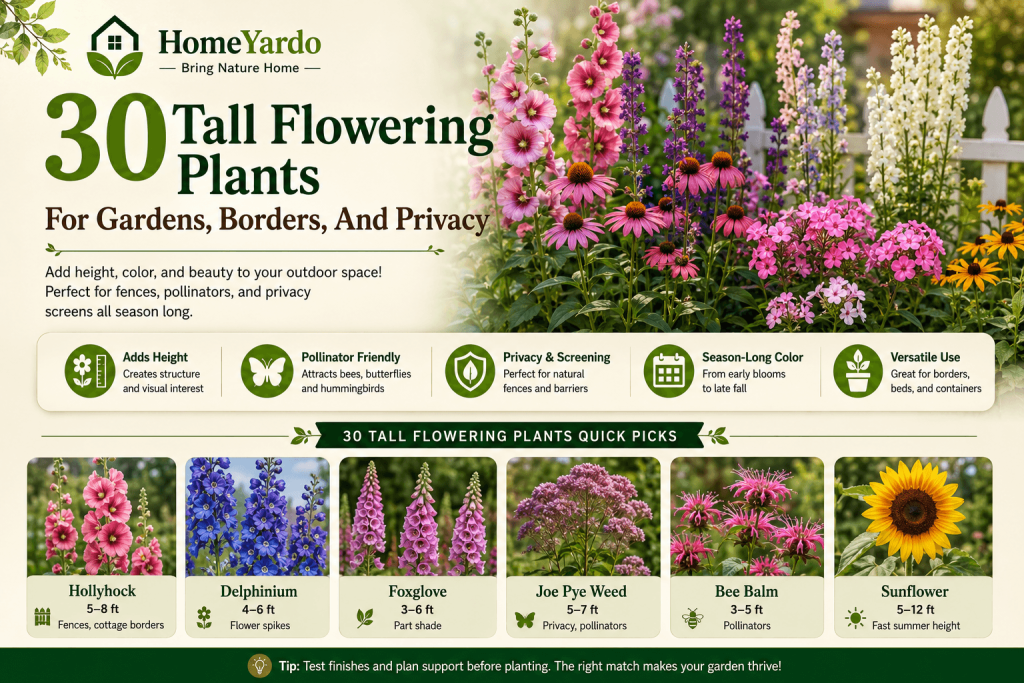
Tall flowering plants add height with a splash of color. They can soften the fence or a border. They can also lift it, make pollinators happy, or even form an annual enclosure around your patio.
Certain of these plants come back every year. Others provide rapid growth in just one season. They are both useful, particularly when they are paired with plants, grasses, weeds, and plant species.
30 Tall Flowering Plants Quick Picks
| Plant | Height | Best For | Watch-Out |
|---|---|---|---|
| Hollyhock | 5–8 ft | Fences, cottage borders | Rust, staking |
| Delphinium | 4–6 ft | Flower spikes | Needs support |
| Foxglove | 3–6 ft | Part shade | Toxic |
| Joe Pye Weed | 5–7 ft | Privacy, pollinators | Needs space |
| Bee Balm | 3–5 ft | Pollinators | Mildew risk |
| Garden Phlox | 3–5 ft | Summer borders | Needs airflow |
| Blazing Star | 3–5 ft | Sunny pollinator beds | Avoid soggy soil |
| Coneflower | 3–5 ft | Sunny borders | Shorter in poor soil |
| Helenium | 3–5 ft | Late summer color | May need division |
| New England Aster | 4–6 ft | Fall flowers | Can flop |
| Russian Sage | 3–5 ft | Dry sunny beds | Needs drainage |
| Lupine | 3–4 ft | Cottage spikes | Dislikes heat |
| Monkshood | 3–5 ft | Cool part shade | Highly toxic |
| Culver’s Root | 4–6 ft | Naturalistic beds | Needs moisture |
| Meadow Rue | 4–6 ft | Airy shade height | Needs shelter |
| Cardinal Flower | 3–4 ft | Moist soil | Needs moisture |
| Hardy Hibiscus | 4–7 ft | Large blooms | Late to emerge |
| Tall Astilbe | 3–5 ft | Moist shade | Dislikes dry soil |
| Japanese Anemone | 3–5 ft | Late flowers | Can spread |
| Gooseneck Loosestrife | 3–4 ft | White flower spikes | Spreading habit |
| Sunflower | 5–12 ft | Fast summer height | Wind support |
| Canna Lily | 4–8 ft | Pots, tropical beds | Winter care |
| Tithonia | 4–6 ft | Pollinators | Needs warmth |
| Cleome | 3–5 ft | Airy borders | Self-seeds |
| Tall Cosmos | 4–6 ft | Cottage gardens | Can lean |
| Tall Zinnia | 3–4 ft | Cut flowers | Mildew in damp air |
| Flowering Tobacco | 3–5 ft | Evening scent | Toxic if eaten |
| Amaranth | 4–8 ft | Drama, cutting | Can self-seed |
| Tall Dahlia | 4–6 ft | Cut flowers | Needs staking |
| Verbena Bonariensis | 4–6 ft | Airy height | Self-seeds |
The detailed plant cards below are easier to read on mobile. Each card gives the plant’s botanical name, light needs, bloom time, best use, and main caution without forcing a wide table across the screen.
Tall Flowering Perennials
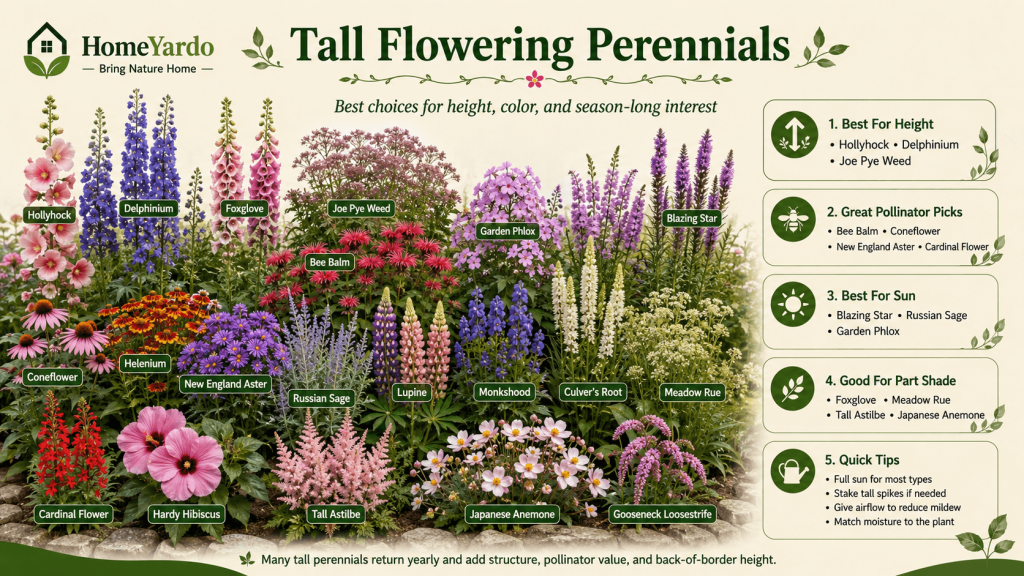
For borders that need more permanent height and woody structure, flowering bushes can be paired with tall perennials to provide seasonal blooms at several levels. Some are able to stand on their own, whereas others require staking, splitting or perhaps a bit of season-long flurry.
Hollyhock
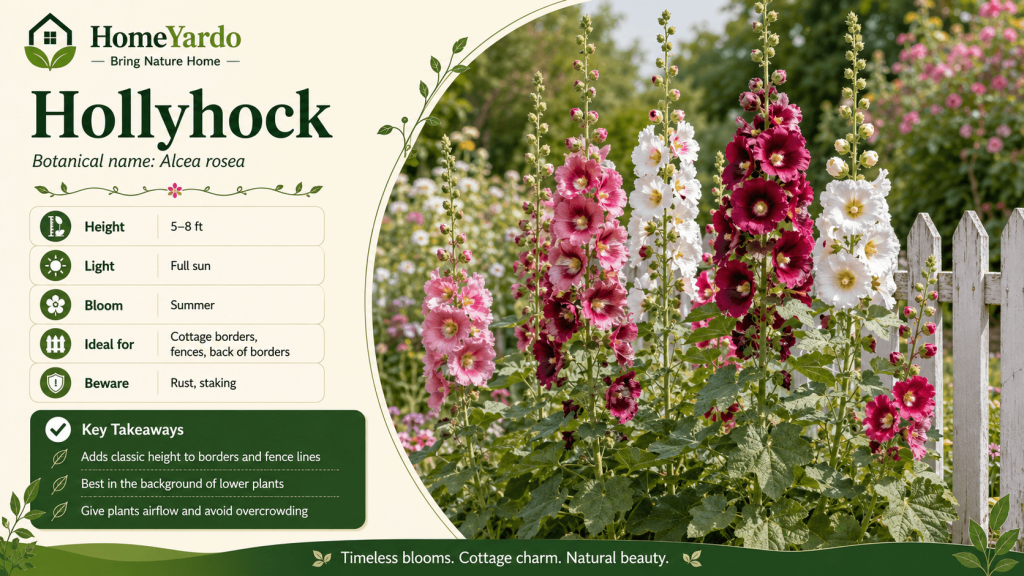
The botanical name is Alcea rosea
Height: 5-8 ft
Light: Full sun
Bloom: Summer
Ideal for: Cottage borders, fences and back-of-border, the height
Beware: Rust, staking
Hollyhocks provide old-fashioned height to beautiful borders and fence lines. Their long flower spikes are beautiful in the background of lower plants, and are particularly beautiful in garden designs with cottages.
They might require staking in areas with wind. Rust also appears on leaves. Therefore, allow them airflow, and try to avoid overcrowding.
Delphinium
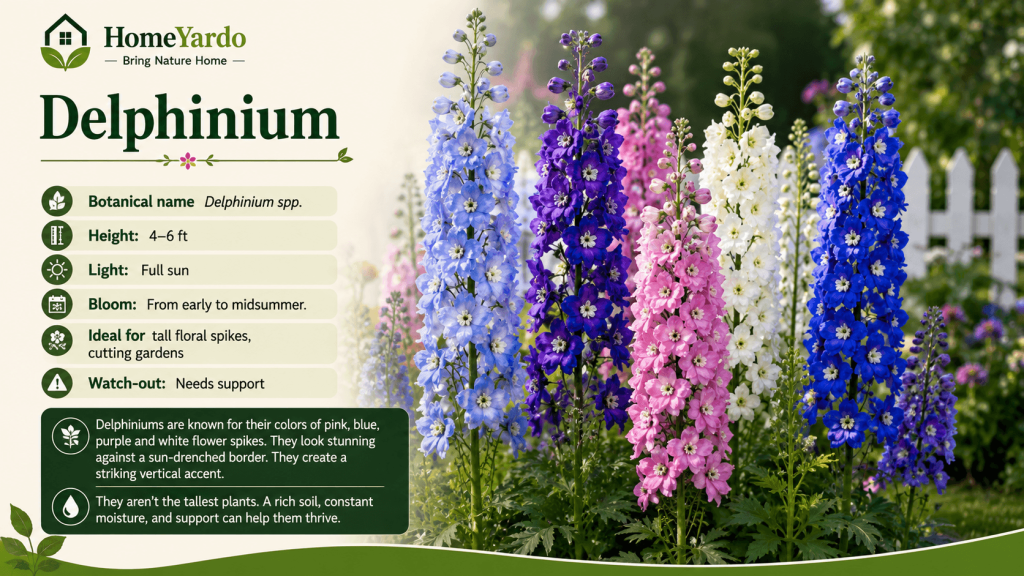
Botanical name: Delphinium spp.
Height: 4-6 ft
Light: Full sun
Bloom: From early to midsummer.
Ideal for tall floral spikes, cutting gardens
Watch out: Needs support
Delphiniums are known for their colors of pink, blue, purple and white flower spikes. They look stunning against a sun-drenched border. They create a striking vertical accent.
They aren’t the tallest plants. A rich soil, constant moisture, and support can help them thrive.
Foxglove
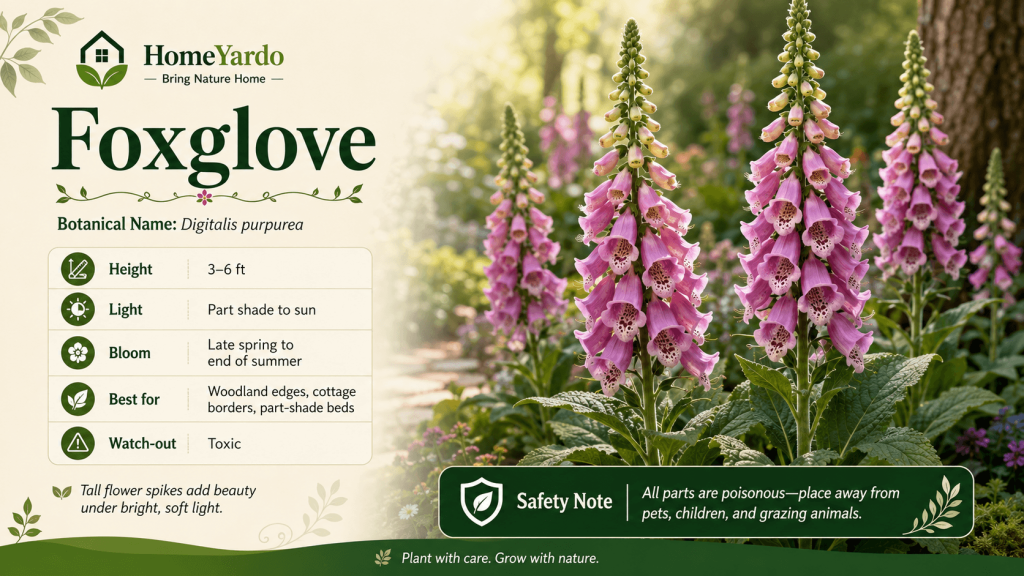
Botanical Name: Digitalis purpurea
Height: 3-6 ft
Light Part shade to sun
Bloom: Late spring until the end of summer.
The best for this are: woodland edges, cottage borders and part-shade beds
Watch out: Toxic
Foxglove produces tall spires of flowers that are perfect for part shade, woodland edges as well as the cottage garden. It is beautiful under trees when the light is bright but soft.
All of the components are poisonous. Place it in a safe area in the vicinity of pets, children and animals that graze.
Joe Pye Weed
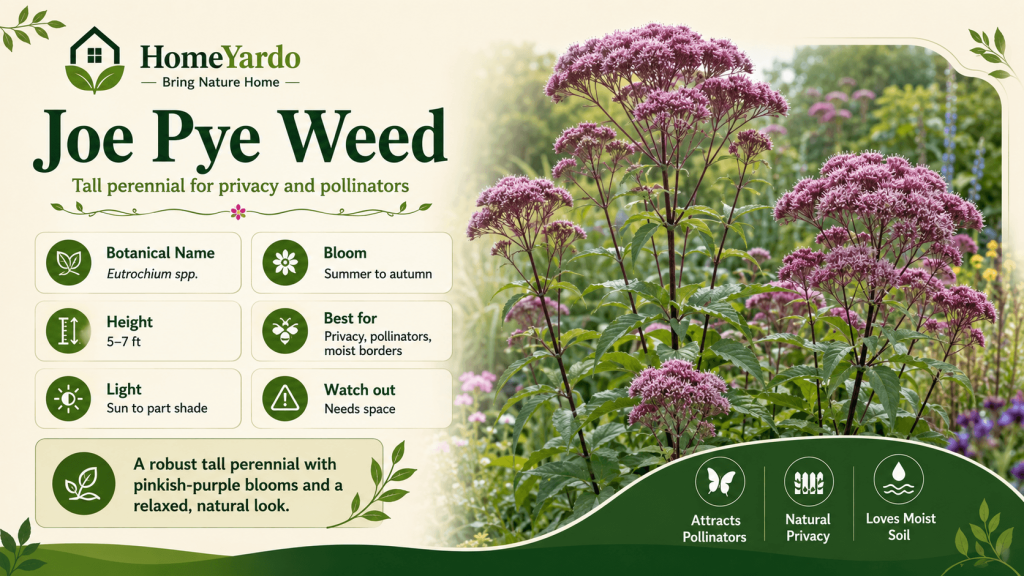
Botanical Name: Eutrochium spp.
Height: 5-7 ft
Light: Sun to part shade
Bloom: Summer to autumn
Best for: Privacy, pollinators, moist borders
Watch out: Space is needed.
Joe Pye weed is a robust, tall perennial suitable to be used in moist soils, for delicate privacy, and as a pollinator plant. The pinkish-purple flower clusters make it appear more relaxed than formal.
Give it some space. This is not a small border plant that is trying to appear nice.
Bee Balm
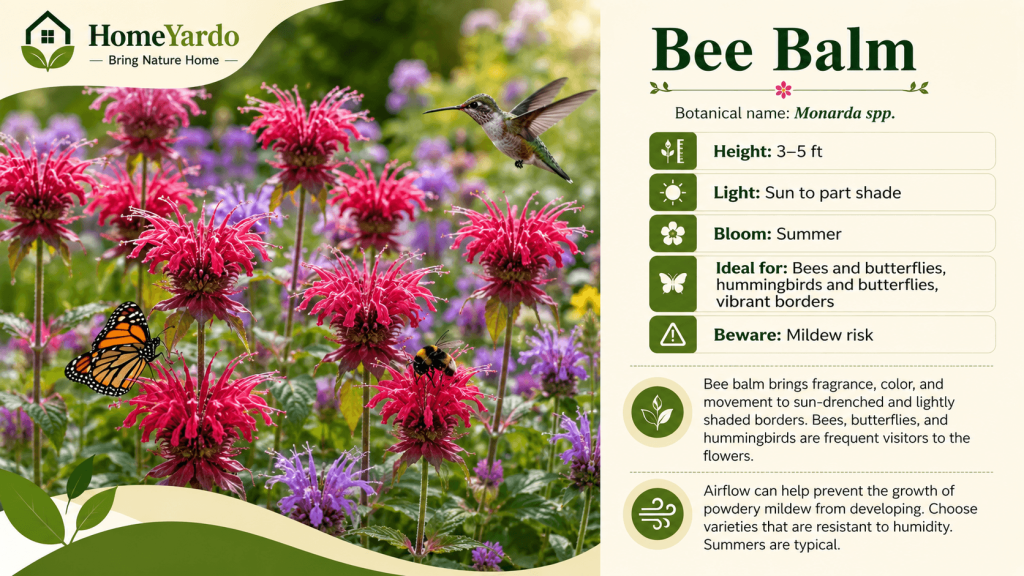
Botanical name Monarda spp.
Height: 3-5 ft
Light: Sun to part shade
Bloom: Summer
Ideal for: Bees and butterflies, hummingbirds and butterflies. vibrant borders
Beware: Mildew risk
Bee balm brings fragrance, color, and movement to sun-drenched and lightly shaded borders. Bees, butterflies, and hummingbirds are frequent visitors to the flowers.
Airflow can help prevent the growth of powdery mildew from developing. Choose varieties that are resistant to humidity. Summers are typical.
Garden Phlox
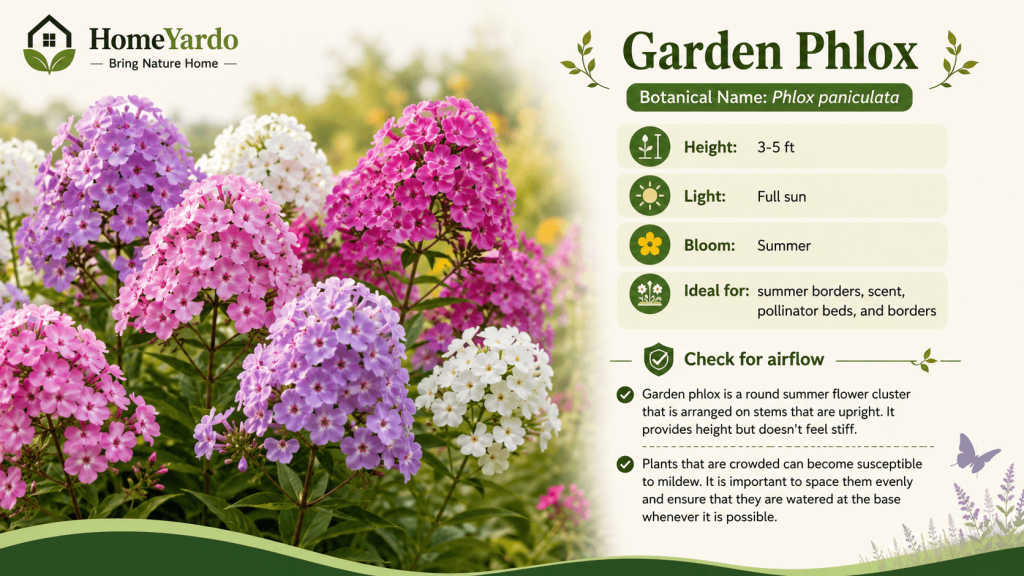
Botanical Name: Phlox paniculata
Height: 3-5 ft
Light: Full sun
Bloom: Summer
Ideal for: summer borders, scent, pollinator beds, and borders
Check for airflow
Garden phlox is a round summer flower cluster that is arranged on stems that are upright. It provides height but doesn’t feel stiff.
Plants that are crowded can become susceptible to mildew. It is important to space them evenly and ensure that they are watered at the base whenever it is possible.
Blazing Star
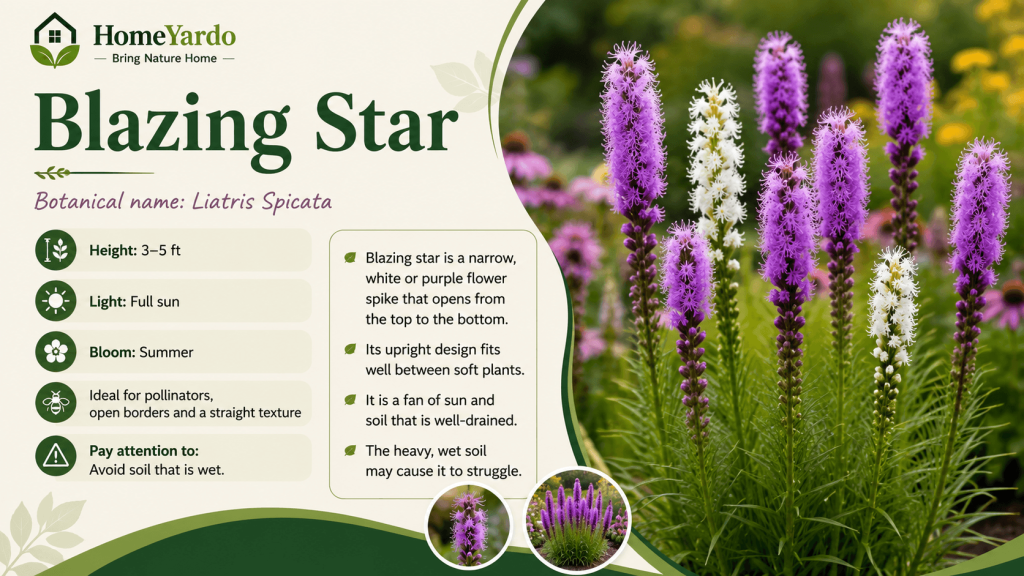
Botanical name Liatris Spicata
Height: 3-5 ft
Light: Full sun
Bloom: Summer
Ideal for pollinators, open borders and a straight texture
Pay attention to: Avoid soil that is wet.
Blazing star is a narrow, white or purple flower spike that opens from the top to the bottom. Its upright design fits well between soft plants.
It is a fan of sun and soil that is well-drained. The heavy, wet soil may cause it to struggle.
Coneflower
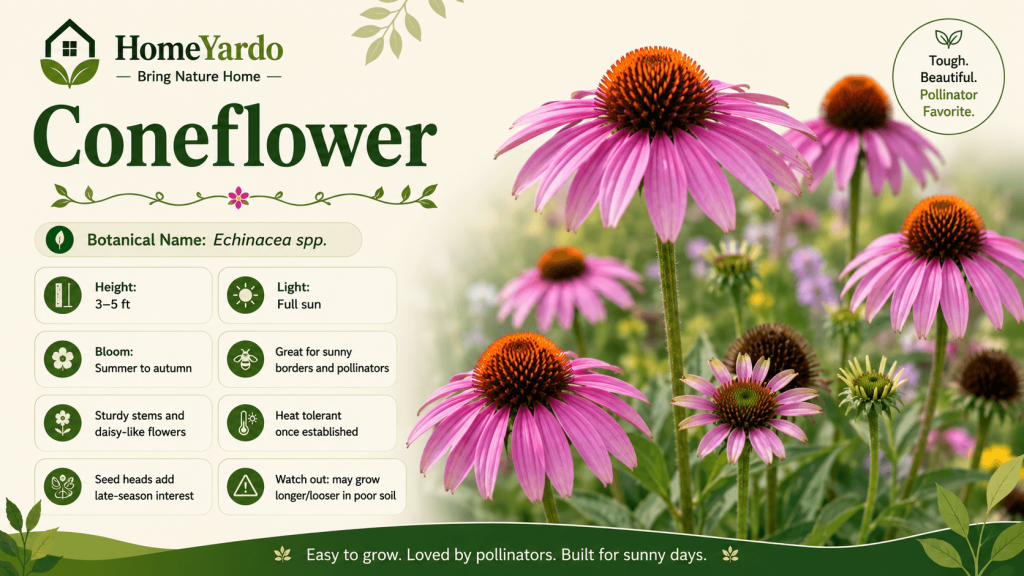
Botanical Name: Echinacea spp.
Height: 3-5 ft
Light: Full sun
Bloom: Summer to autumn
Ideal for sunny borders and pollinators. Seed heads, seed heads
Watch out: May be longer in soil that is poor
Coneflowers are sturdy stems that can be used as daisy-like flowers, as well as late-season seeds. The majority of them reach three to five feet.
They work well in sunny borders as well as pollinator plants. Once established, they can handle the heat of summer better than more flimsy flowers.
Helenium
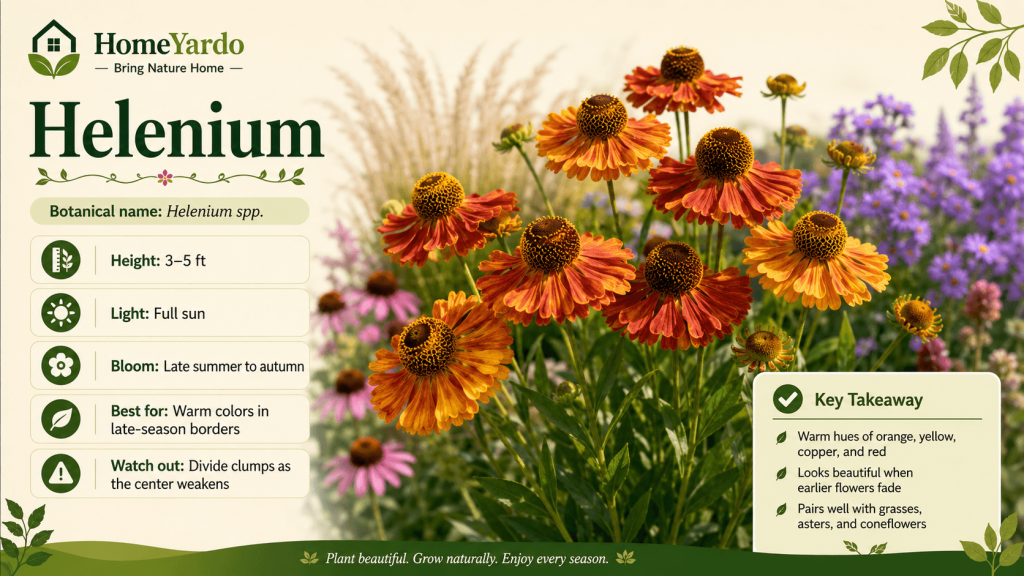
Botanical name Helenium spp.
Height: 3-5 ft
Light: Full sun
Bloom: From late summer until autumn
The best choice for warm colors, borders in late-season
Watch out: You may need division
Helenium offers warm hues of orange, yellow, copper and red. It is most beautiful in the summer months when earlier flowers start to fade.
It looks great with grasses, asters and coneflowers. Split clumps as they lose energy in the middle.
New England Aster
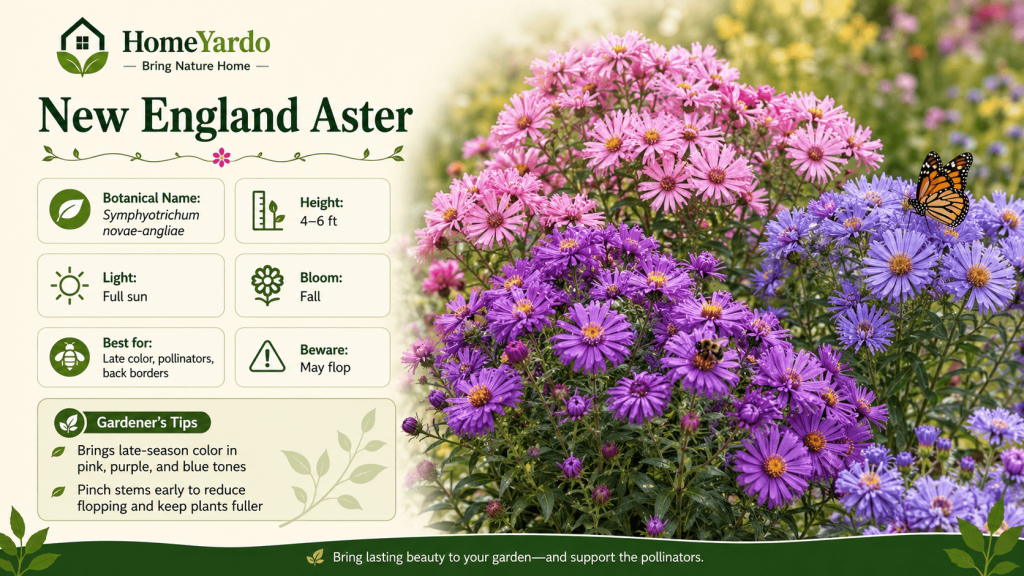
Botanical Name: Symphyotrichum novae-angliae
Height: 4-6 ft
Light: Full sun
Bloom: Fall
Best for: Late color, pollinators, back borders
Beware: It’s possible to flop.
New England asters bring late blooms of pink, purple and blue tones. They can grow up to 6 feet in height and aid in spreading color throughout the fall.
The earlier you start pinning stems in the season, the larger the size of the plants. It can also reduce the amount of flopping.
Russian Sage
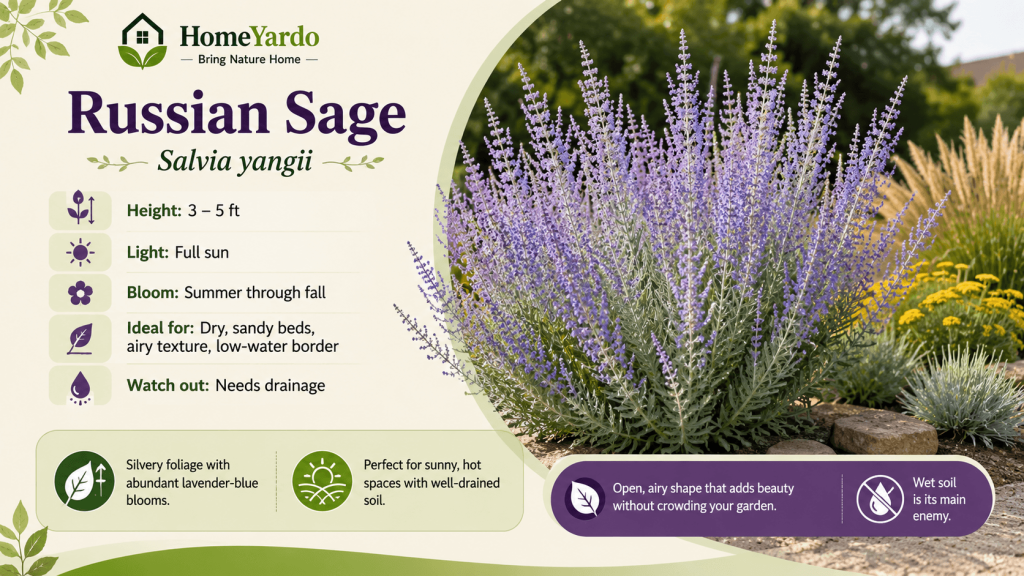
Botanical name: Salvia yangii
Height: 3-5 ft
Light: Full sun
Bloom: Summer through fall
Ideal for: Dry, sandy beds, airy texture, low-water border
Watch out: Needs drainage
Russian Sage has silvery leaves and abundant lavender-blue blooms. It’s great in places that are sunny and hot with well-drained soil.
Its shape is open, which prevents small gardens from being obstructed. The soil that is wet is its main opponent.
Lupine
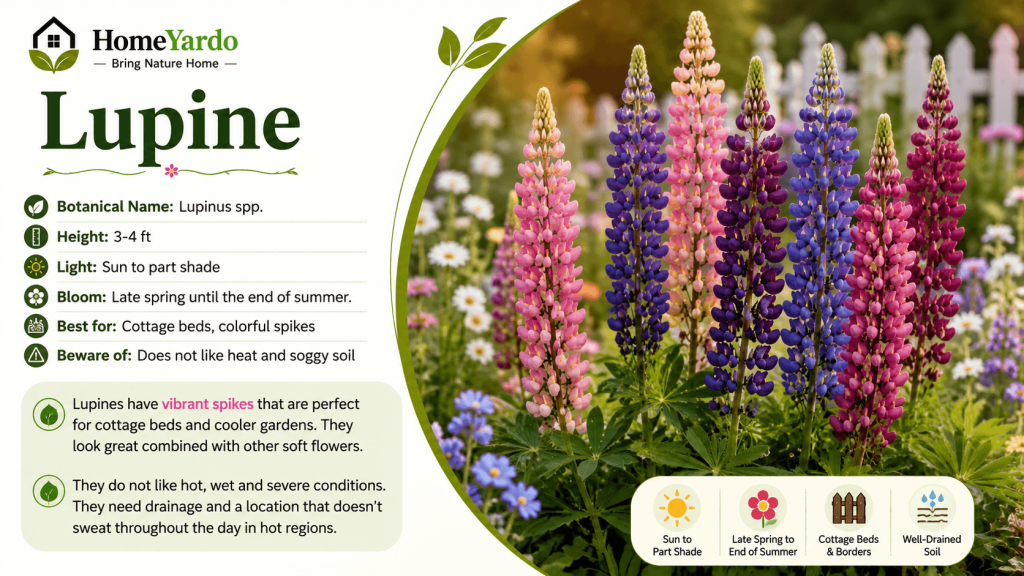
Botanical Name: Lupinus spp.
Height: 3-4 ft
Light: Sun to part shade
Bloom: Late spring until the end of summer.
Best for: Cottage beds, colorful spikes
Beware of: Does not like heat and soggy soil
Lupines have vibrant spikes that are perfect for cottage beds and cooler gardens. They look great combined with other soft flowers.
They do not like hot, wet and severe conditions. They need drainage and a location that doesn’t sweat throughout the day in hot regions.
Monkshood
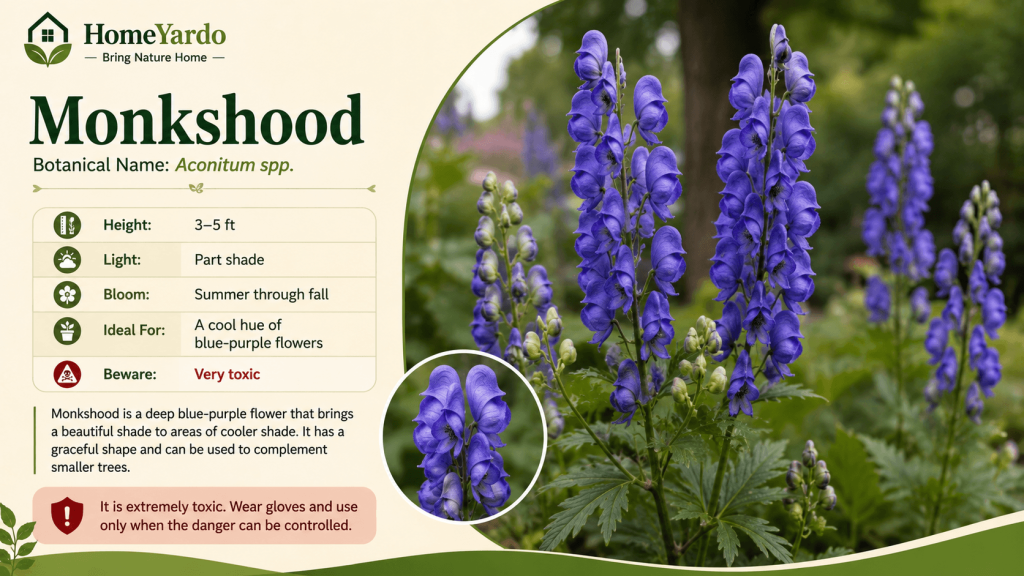
Botanical Name: Aconitum spp.
Height: 3-5 ft
Light Part shade
Bloom: Summer through fall
Ideal For: A cool hue of blue-purple flowers
Beware: Very toxic
Monkshood is a deep blue-purple flower that brings a beautiful shade to areas of cooler shade. It has a graceful shape and can be used to complement smaller trees.
It is extremely toxic. Wear gloves and use only when the danger can be controlled.
Culver’s Root
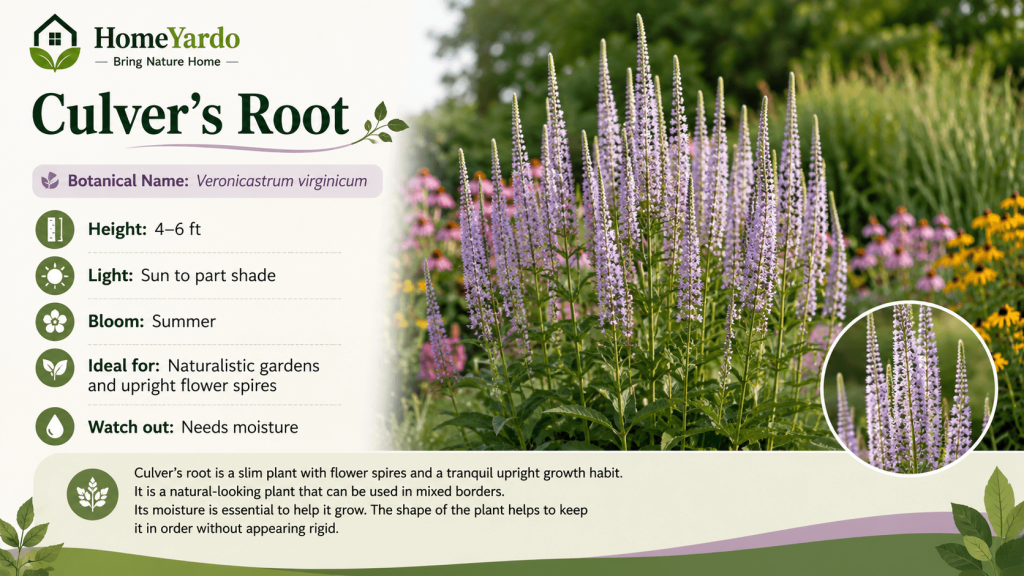
Botanical Name: Veronicastrum virginicum
Height: 4-6 ft
Light: Sun to part shade
Bloom: Summer
Ideal for: Naturalistic gardens and upright flower spires
Watch out: Needs moisture
Culver’s root is a slim plant with flower spires and a tranquil upright growth habit. It is a natural-looking plant that can be used in mixed borders.
Its moisture is essential to help it grow. The shape of the plant helps to keep it in order without appearing rigid.
Meadow Rue
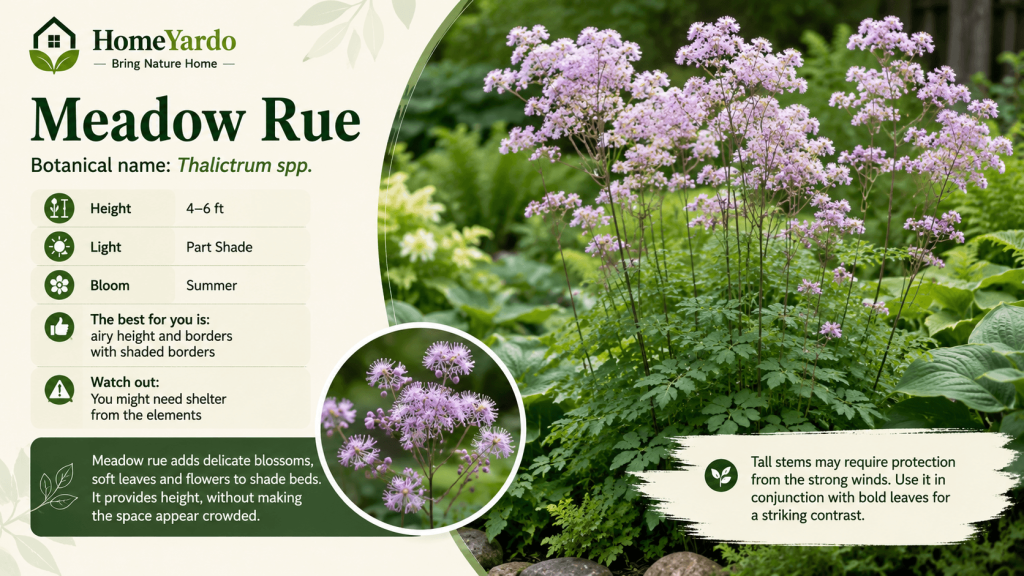
Botanical name Thalictrum spp.
Height: 4-6 ft
Light Part shade
Bloom: Summer
The best for you is: airy height and borders with shaded borders
Watch out: You might need shelter from the elements
Meadow rue adds delicate blossoms, soft leaves and flowers to shade beds. It provides height without making the space appear crowded.
Tall stems may require protection from the strong winds. Use it in conjunction with bold leaves for a striking contrast.
Cardinal Flower
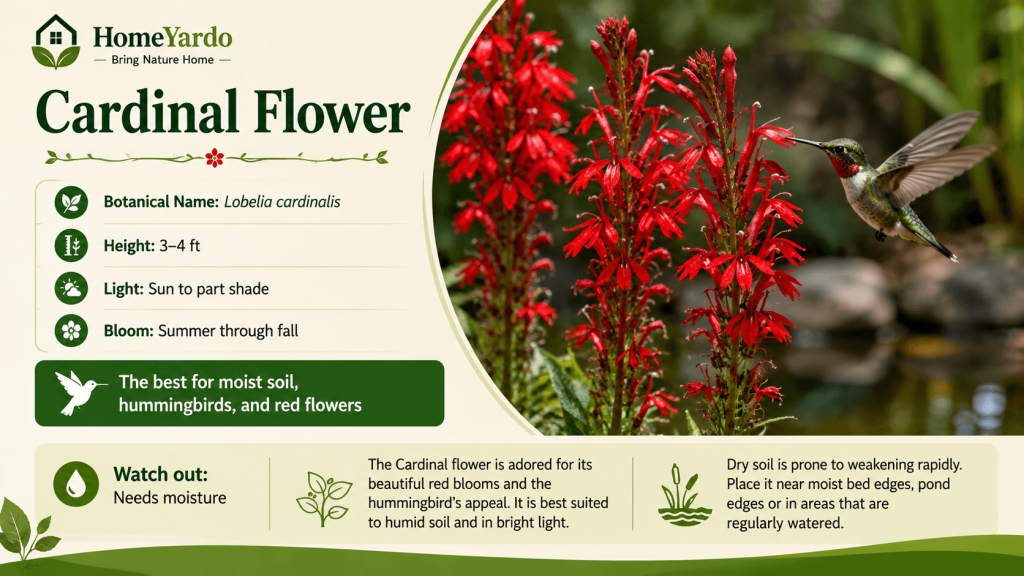
Botanical Name: Lobelia cardinalis
Height: 3-4 ft
Light: Sun to part shade
Bloom: Summer through fall
The best for moist soil, hummingbirds, and red flowers
Watch out: Needs moisture
The Cardinal flower is adored for its beautiful red blooms and the hummingbird’s appeal. It is best suited to humid soil and bright light.
Dry soil is prone to weakening rapidly. Place it near moist bed edges, pond edges or in areas that are regularly watered.
Hardy Hibiscus
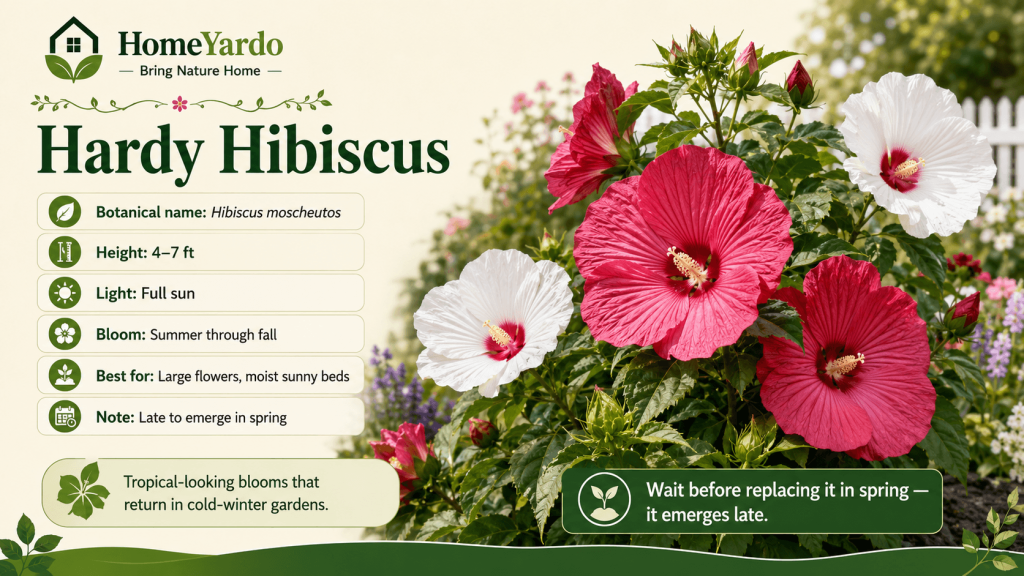
Botanical name: Hibiscus moscheutos
Height: 4-7 ft
Light: Full sun
Bloom: Summer through fall
Best for: Large flowers, moist, sunny beds
Be on the lookout for: late to emerge in spring
Hardy hibiscus blooms hugely on long stems. It has a tropical appearance; however, it can also be seen in cold winter gardens that are resilient.
It comes out later in the spring. It is best to wait until you are sure it didn’t make it.
Tall Astilbe
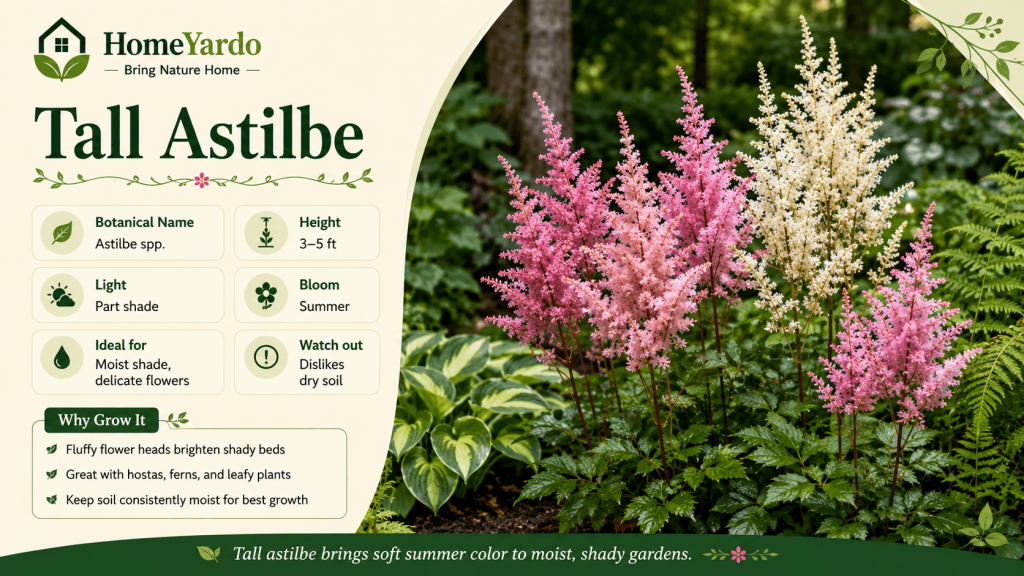
Botanical Name: Astilbe spp.
Height: 3-5 ft
Light Part shade
Bloom: Summer
Ideal for: A moist shade and delicate flowers
Watch out: Dislikes dry soil
Tall astilbes add fluffy flower heads to a moist shade. It’s a wonderful companion to hostas, ferns and other plants with leaves.
Dry soil causes it to turn into a sulk. Make sure that the moisture is constant to ensure better growth and healthier leaves.
Japanese Anemone
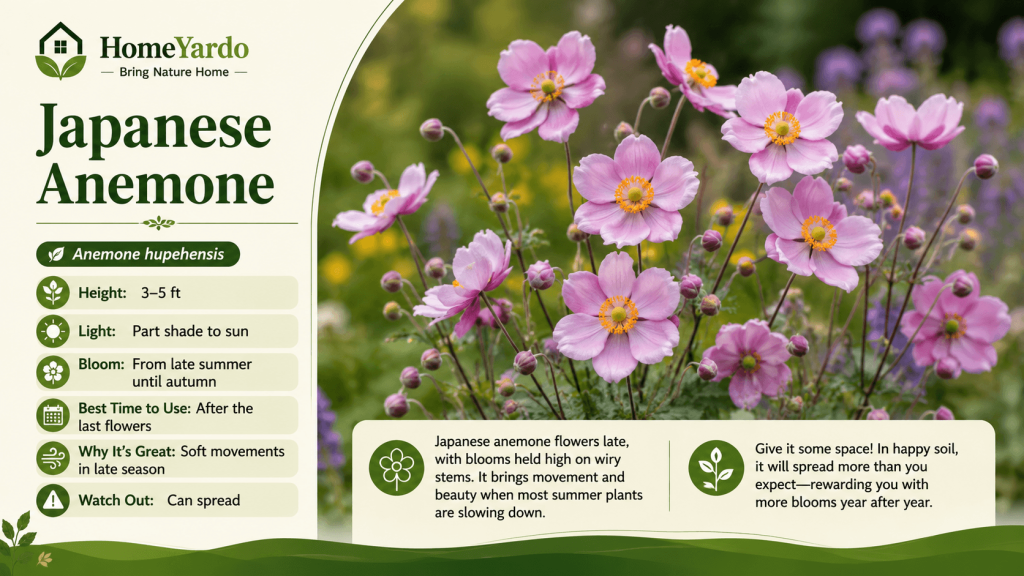
Name of the plant: Anemone hupehensis
Height: 3-5 ft
Light Part shade to sun
Bloom: From late summer until autumn
The best time to use them is after the last flowers. Soft movements
Watch out: Can spread
Japanese anemone flowers late, with blooms that are held on high wired stems. It provides movement during a time when most plants in summer are slowing down.
Give it some space. In a soil that is happy, it will spread further than was initially thought.
Gooseneck Loosestrife
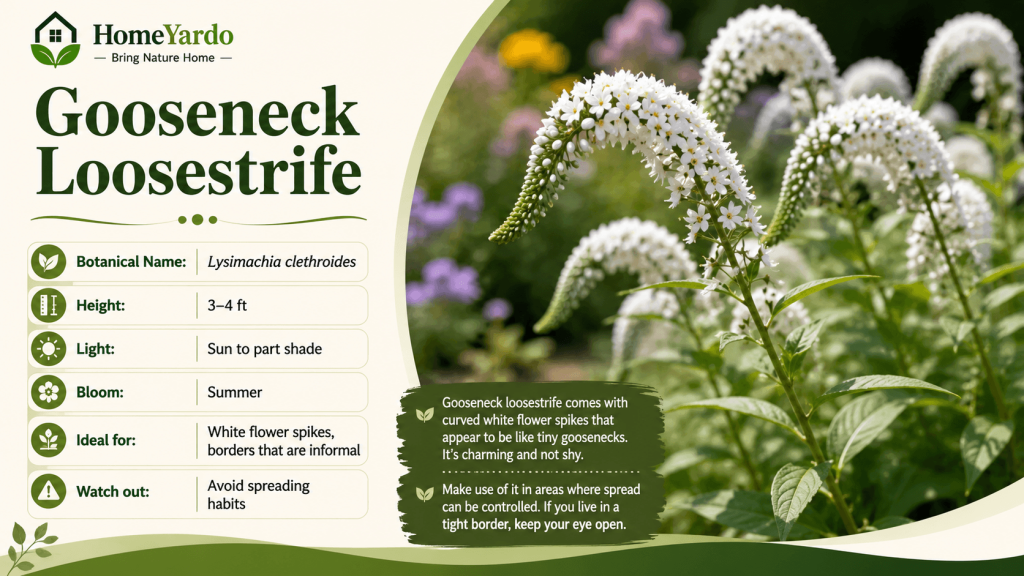
Botanical Name: Lysimachia clethroides
Height: 3-4 ft
Light: Sun to part shade
Bloom: Summer
Ideal for: White flower spikes, borders that are informal
Watch out to avoid spreading the habits
Gooseneck loosestrife comes with curved white flower spikes that appear to be like tiny goosenecks. It’s charming and not shy.
Make use of it in areas where spread can be controlled. If you live in a tight border, keep your eyes open.
Best Tall Perennials For Cut Flowers
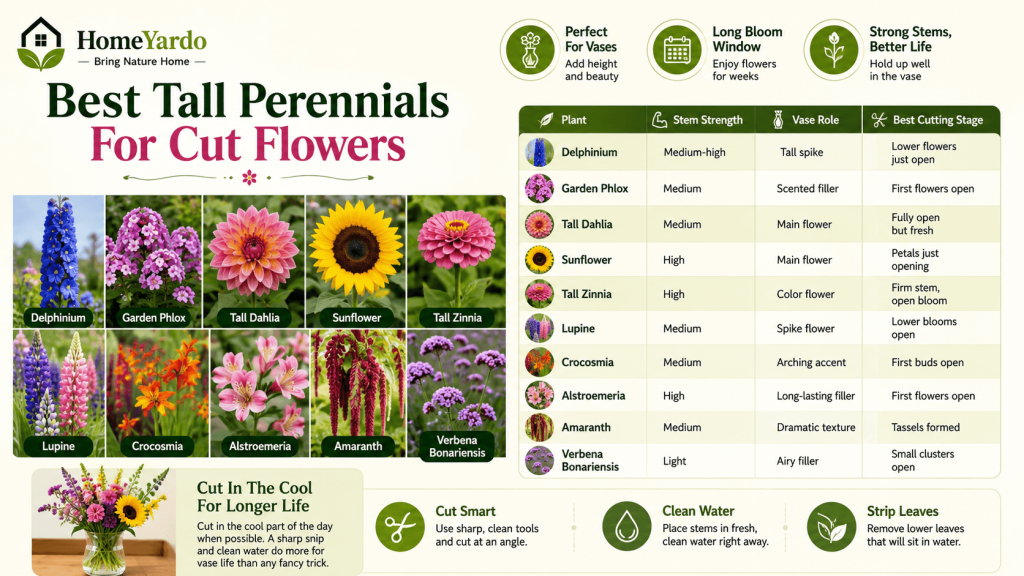
Tall perennials can also help fill a vase. Strong stems, long bloom windows, and interesting flower shapes make a big difference.
Delphinium, garden phlox, tall dahlia, sunflower, tall zinnia, lupine, crocosmia, alstroemeria, amaranth, and verbena bonariensis are useful choices for cutting gardens.
| Plant | Stem Strength | Vase Role | Best Cutting Stage |
|---|---|---|---|
| Delphinium | Medium-high | Tall spike | Lower flowers just open |
| Garden Phlox | Medium | Scented filler | First flowers open |
| Tall Dahlia | Medium | Main flower | Fully open but fresh |
| Sunflower | High | Main flower | Petals just opening |
| Tall Zinnia | High | Color flower | Firm stem, open bloom |
| Lupine | Medium | Spike flower | Lower blooms open |
| Crocosmia | Medium | Arching accent | First buds open |
| Alstroemeria | High | Long-lasting filler | First flowers open |
| Amaranth | Medium | Dramatic texture | Tassels formed |
| Verbena Bonariensis | Light | Airy filler | Small clusters open |
Cut in the cool part of the day when possible. A sharp snip and clean water do more for vase life than any fancy trick.
Tall Flowering Annuals And Tender Plants
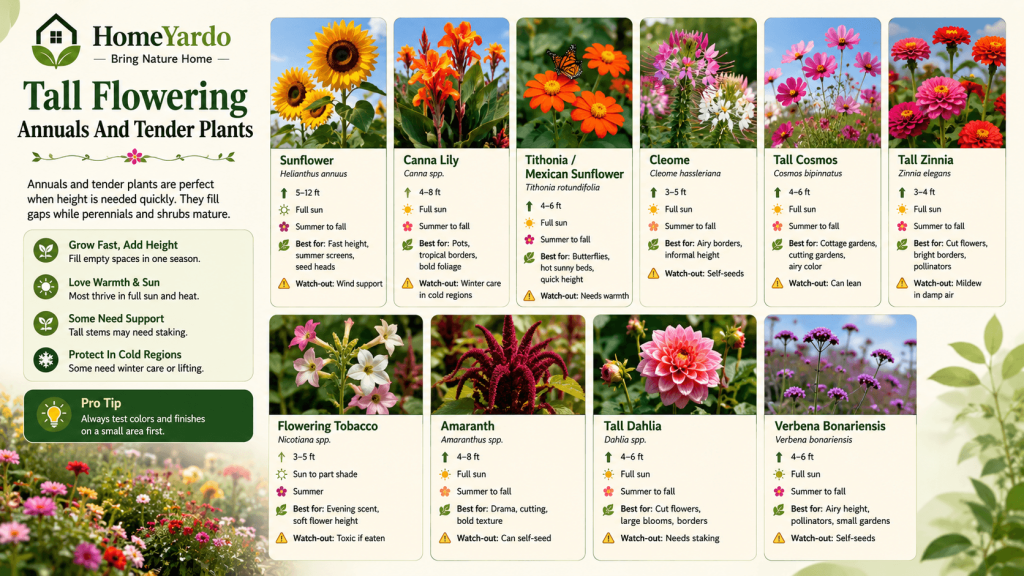
Annuals and tender plants are perfect when height is needed quickly. They fill gaps while perennials and shrubs mature.
Many of these plants grow fast in warm weather. Some self-seed, some need staking, and others need winter protection in cold regions.
Sunflower
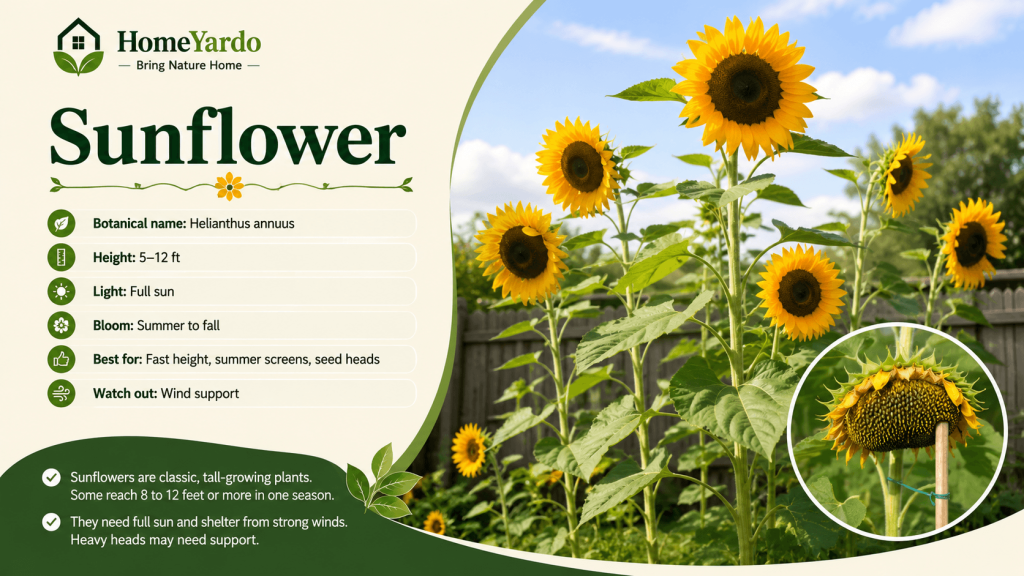
Botanical name: Helianthus annuus
Height: 5–12 ft
Light: Full sun
Bloom: Summer to fall
Best for: Fast height, summer screens, seed heads
Watch out: Wind support
Sunflowers are classic tall growing plants. Some reach 8 to 12 feet or more in one season.
They need full sun and shelter from strong winds. Heavy heads may need support.
Canna Lily
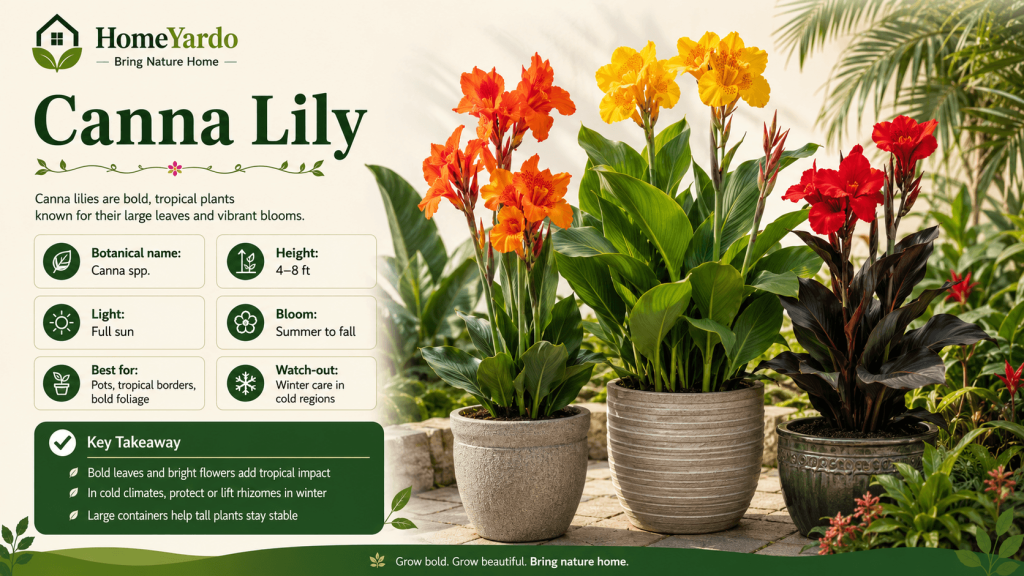
Botanical name: Canna spp.
Height: 4–8 ft
Light: Full sun
Bloom: Summer to fall
Best for: Pots, tropical borders, bold foliage
Watch out: Winter care in cold regions
Canna lilies bring bold leaves and bright flowers to pots and borders. Many grow 4 to 8 feet tall.
In cold climates, rhizomes often need lifting or winter protection. Large containers help them stay stable.
Tithonia
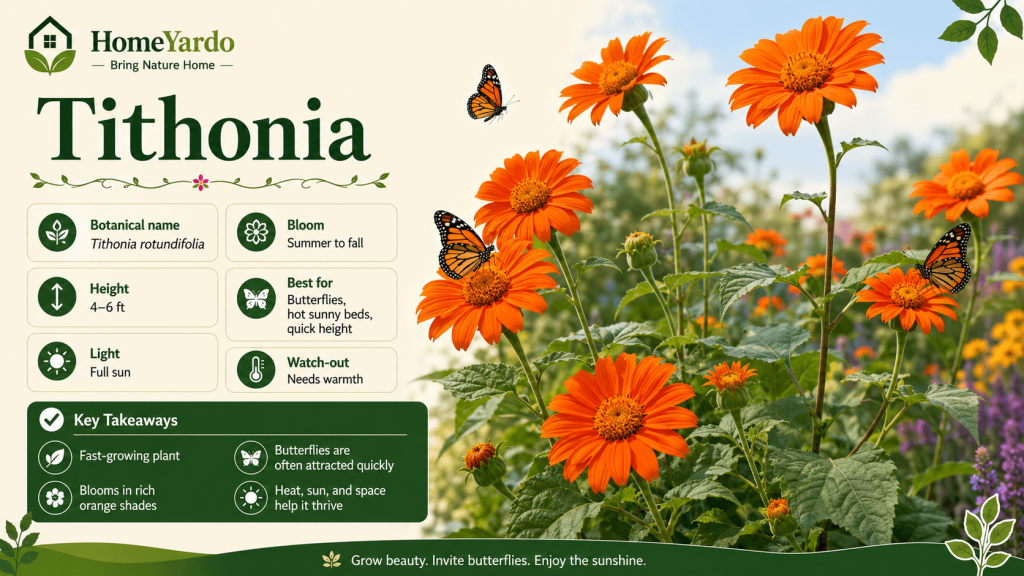
Botanical name: Tithonia rotundifolia
Height: 4–6 ft
Light: Full sun
Bloom: Summer to fall
Best for: Butterflies, hot sunny beds, quick height
Watch-out: Needs warmth
Tithonia grows quickly and blooms in rich orange shades. Butterflies often find it fast.
It likes heat, sun, and a room. Cold or shaded spots slow it down.
Cleome
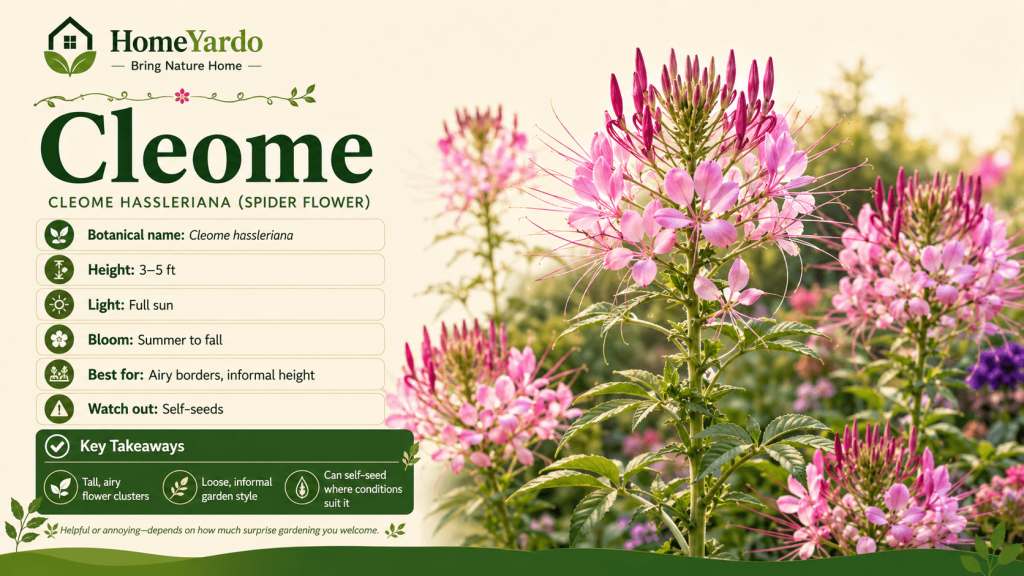
Botanical name: Cleome hassleriana
Height: 3–5 ft
Light: Full sun
Bloom: Summer to fall
Best for: Airy borders, informal height
Watch out: Self-seeds
Cleome has tall, airy flower clusters and a loose garden style. It can self-seed where conditions suit it.
That can be helpful or annoying. It depends on how much surprise gardening is welcome.
Tall Cosmos
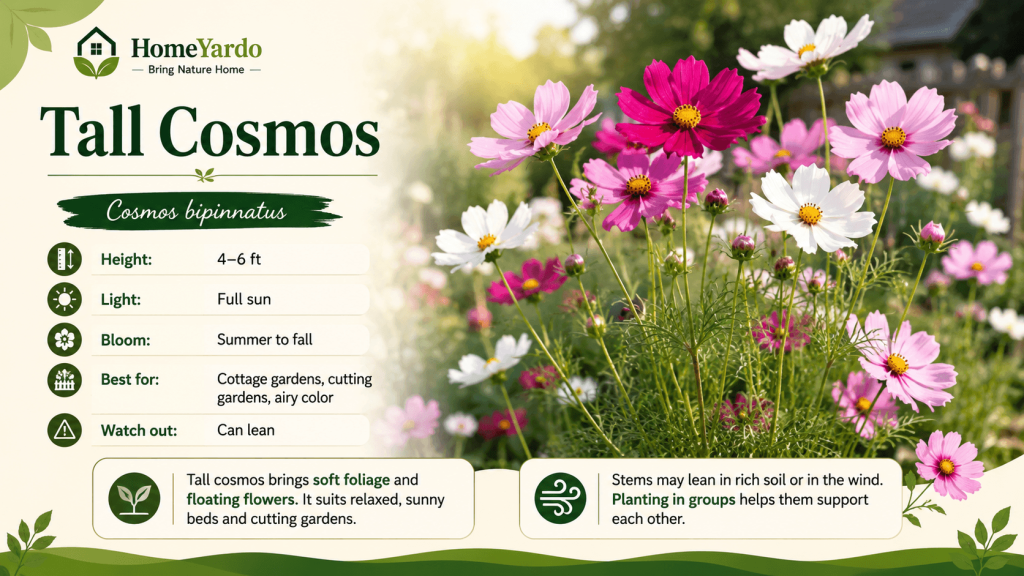
Botanical name: Cosmos bipinnatus
Height: 4–6 ft
Light: Full sun
Bloom: Summer to fall
Best for: Cottage gardens, cutting gardens, airy color
Watch out: Can lean
Tall cosmos brings soft foliage and floating flowers. It suits relaxed, sunny beds and cutting gardens.
Stems may lean in rich soil or in the wind. Planting in groups helps them support each other.
Tall Zinnia
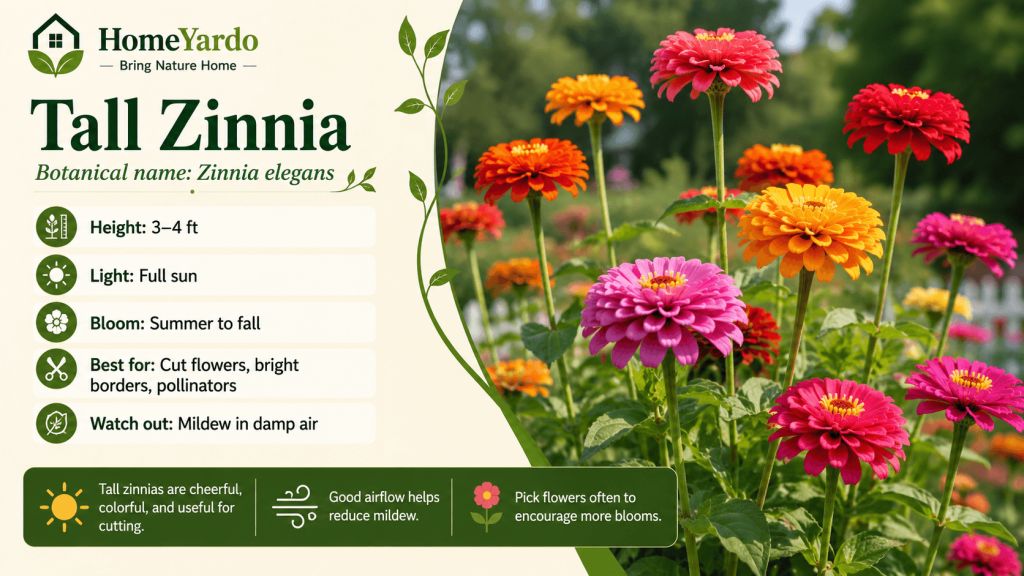
Botanical name: Zinnia elegans
Height: 3–4 ft
Light: Full sun
Bloom: Summer to fall
Best for: Cut flowers, bright borders, pollinators
Watch out: Mildew in damp air
Tall zinnias are cheerful, colorful, and useful for cutting. They grow best in full sun and warm weather.
Good airflow helps reduce mildew. Pick flowers often to encourage more blooms.
Flowering Tobacco
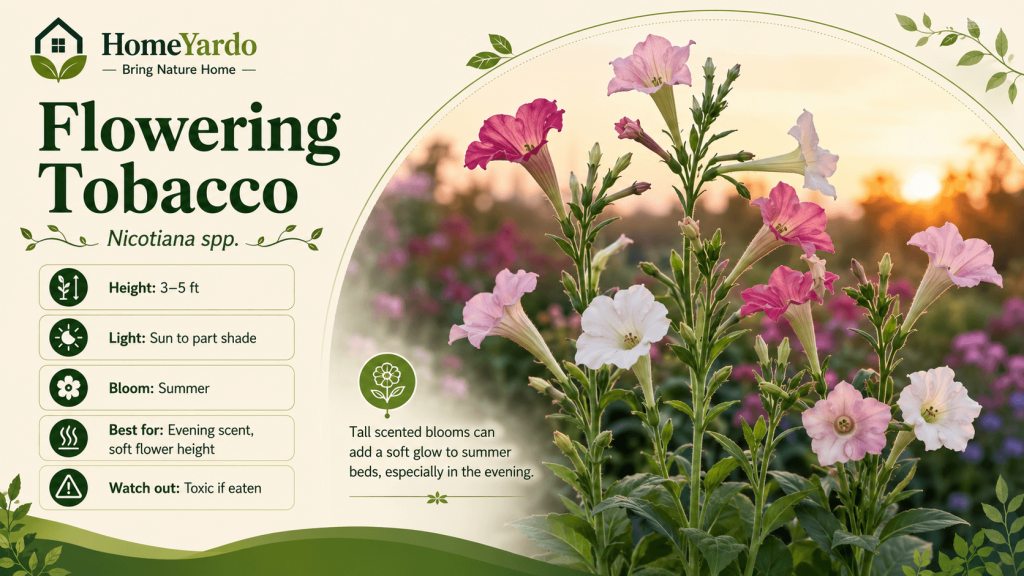
Botanical name: Nicotiana spp.
Height: 3–5 ft
Light: Sun to part shade
Bloom: Summer
Best for: Evening scent, soft flower height
Watch out: Toxic if eaten
Flowering tobacco has tall stems and scented blooms, often strongest in the evening. It can add a soft glow to summer beds.
Some types are tender. The plant is also toxic if eaten.
Amaranth
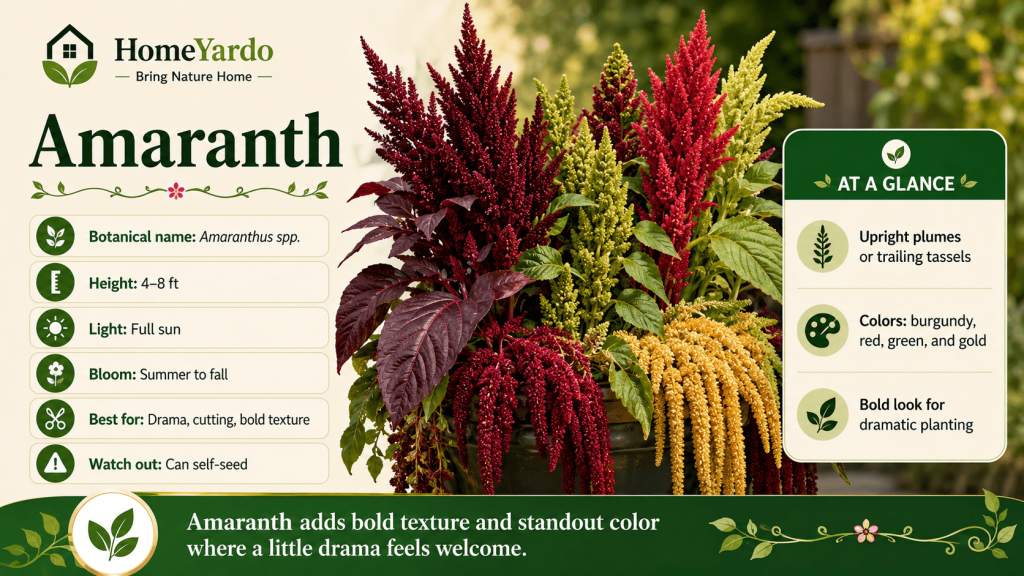
Botanical name: Amaranthus spp.
Height: 4–8 ft
Light: Full sun
Bloom: Summer to fall
Best for: Drama, cutting, bold texture
Watch out: Can self-seed
Amaranth brings drama with upright plumes or trailing tassels. Colors may include burgundy, red, green, and gold.
It is bold, not subtle. Use it where a little drama feels welcome.
Tall Dahlia
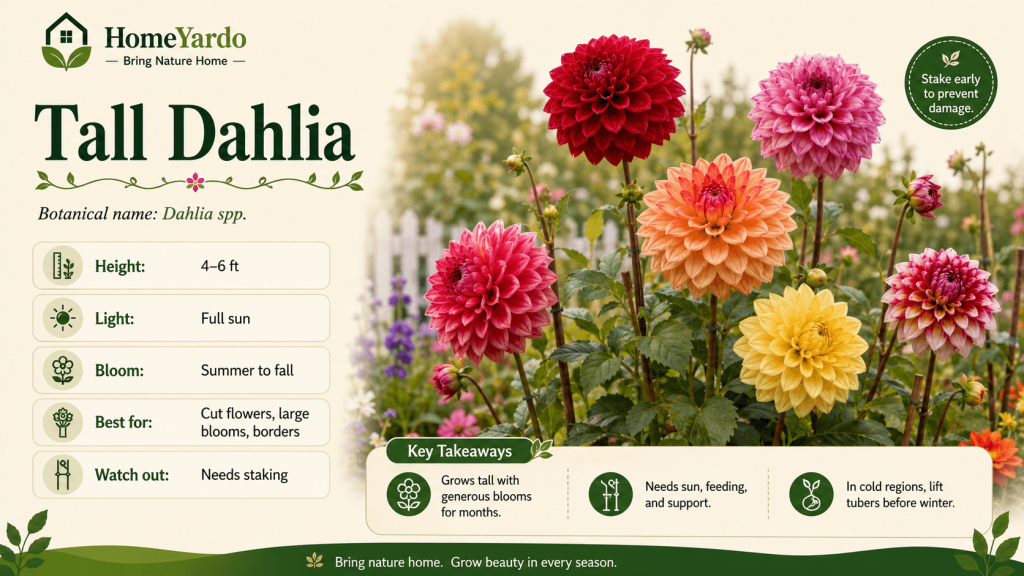
Botanical name: Dahlia spp.
Height: 4–6 ft
Light: Full sun
Bloom: Summer to fall
Best for: Cut flowers, large blooms, borders
Watch out: Needs staking
Tall dahlias can grow 4 to 6 feet and produce generous flowers for months. They need sun, feeding, and support.
In cold regions, tubers often need lifting before winter. Staking early saves heartbreak later.
Verbena Bonariensis
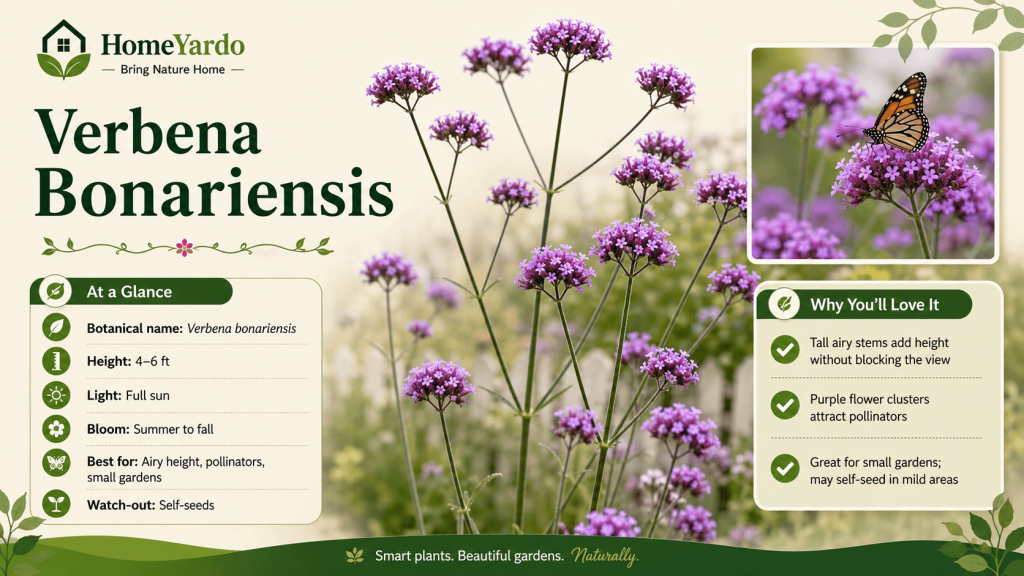
Botanical name: Verbena bonariensis
Height: 4–6 ft
Light: Full sun
Bloom: Summer to fall
Best for: Airy height, pollinators, small gardens
Watch out: Self-seeds
Verbena bonariensis grows on thin, upright stems with small purple flower clusters. It gives height without blocking the view.
It may self-seed in mild areas. Its airy style works beautifully in small gardens.
Best Tall Flowering Plants For Pollinators
Height does not need to come from the same flower shape throughout the border. Mixing tall structural blooms with unusual forms, seasonal flowers, and contrasting colors can create a more varied display; these beautiful and cool flowers provide more ideas for building that mix.
Joe Pye weed, bee balm, coneflower, blazing star, sunflower, tithonia, verbena bonariensis, New England aster, helenium, and garden phlox are strong choices.
| Season | Tall Pollinator Plants |
|---|---|
| Early summer | Foxglove, lupine, bee balm |
| Midsummer | Coneflower, blazing star, phlox, sunflower |
| Late summer/fall | Joe Pye weed, helenium, New England aster, verbena bonariensis |
A staggered bloom season keeps the garden useful for longer. It also avoids the sad “two perfect weeks, then nothing” problem.
Tall Perennial Plants For Back Of Border
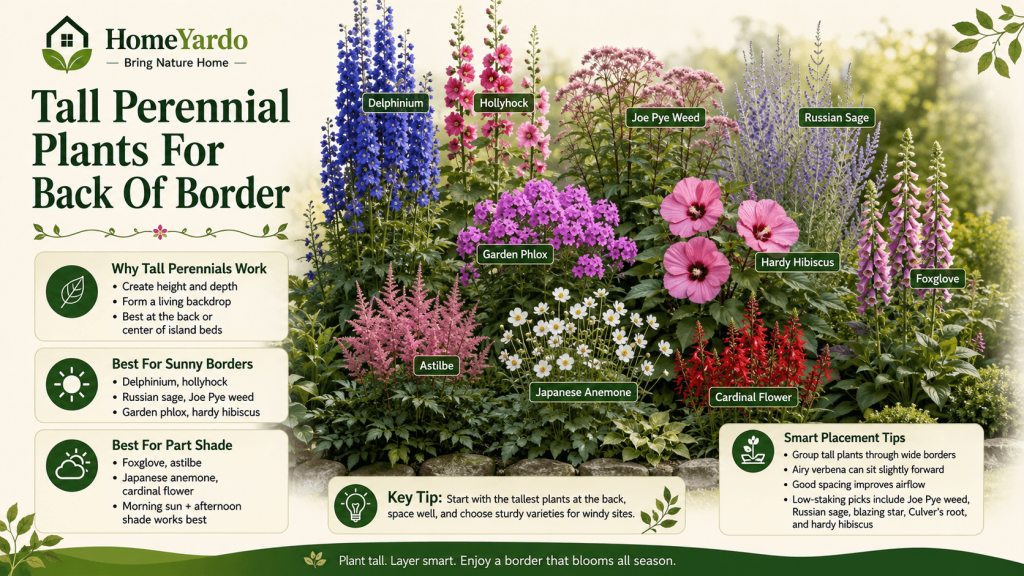
Tall perennial plants are natural back-of-border choices. They create a living background for shorter flowers and stop a bed from looking flat.
Placement matters. A 6-foot plant in the front row can hide everything behind it. Taller plants usually work best at the back, in the center of island beds, or repeated in groups through a wide border.
Best Tall Perennials For Sunny Borders
Sunny borders can handle many classic tall perennial flowers. Delphinium, hollyhock, Russian sage, Joe Pye weed, helenium, garden phlox, blazing star, hardy hibiscus, New England aster, and verbena bonariensis all fit well.
Use sturdy plants where wind is common. Airy plants like Verbena bonariensis can sit slightly forward because they do not block the view.
| Plant | Height | Spread | Bloom Season | Staking Need | Best Placement |
|---|---|---|---|---|---|
| Delphinium | 4–6 ft | 1–3 ft | Early-mid summer | High | Back border |
| Hollyhock | 5–8 ft | 1–2 ft | Summer | Medium | Fence/back border |
| Russian Sage | 3–5 ft | 2–4 ft | Summer-fall | Low | Middle-back |
| Joe Pye Weed | 5–7 ft | 2–4 ft | Summer-fall | Low-medium | Back border |
| Garden Phlox | 3–5 ft | 2–3 ft | Summer | Medium | Middle-back |
| Hardy Hibiscus | 4–7 ft | 3–5 ft | Summer-fall | Low-medium | Back border |
Good spacing helps flowers last longer and keeps leaves healthier. It also stops the border from looking like a plant traffic jam.
Best Tall Perennials For Part Shade
Part shade can be gentle and useful, especially where afternoon sun is harsh. Foxglove, tall astilbe, meadow rue, monkshood, Japanese anemone, cardinal flower, and Culver’s root can all work in softer light.
Morning sun with afternoon shade is often better than deep shade. Bright shade can grow lovely plants. Dense shade usually means fewer flowers.
Moisture matters too. Astilbe, cardinal flower, and meadow rue need more consistent water than dry-border plants. Foxglove and monkshood also need careful placement because of toxicity.
Tall Perennials That Need Less Staking
Some tall perennials stand better than others. Joe Pye weed, Russian sage, blazing star, Culver’s root, hardy hibiscus, and well-managed New England aster are usually steadier choices.
Wind, rich soil, and heavy rain can still bend stems. Early pinching can help asters and phlox grow bushier. Plant supports are easier to add early than after a storm has already flattened the bed.
Low-staking does not mean no care. It just means fewer emergency rescue missions with twine.
Tall Outdoor Plants For Privacy
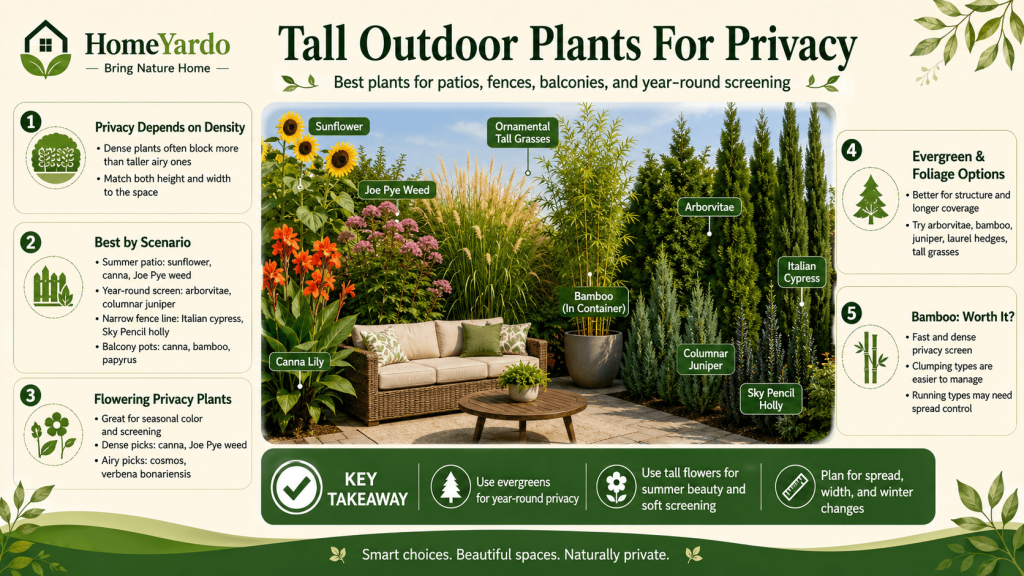
Tall outdoor plants can soften views, frame patios, and make a garden feel more private. Some create summer screenings. Others provide year-round cover.
Privacy depends on density as much as height. An airy 7-foot plant may only blur a view, while a dense 5-foot evergreen may block it better.
Privacy Need By Scenario
Different privacy problems need different plants. A rental balcony does not need the same solution as a boundary fence.
| Privacy Problem | Best Plant Type | Good Choices |
|---|---|---|
| Patio exposed in summer | Tall flowering plants | Sunflower, canna, Joe Pye weed |
| Year-round neighbor view | Evergreens | Arborvitae, columnar juniper |
| Narrow fence line | Columnar plants | Italian cypress, Sky Pencil holly |
| Rental balcony | Tall pots | Canna, bamboo in container, papyrus |
| Soft seasonal screen | Grasses and airy flowers | Verbena bonariensis, tall grasses |
Seasonal privacy is fine for a summer seating area. A window that needs screening all year needs a more permanent plant.
Tall Flowering Plants For Privacy
Flowering privacy plants are beautiful for seasonal screening. Sunflower, hollyhock, canna lily, Joe Pye weed, tithonia, hardy hibiscus, tall cosmos, amaranth, cleome, and garden phlox can all help soften exposed areas.
Dense plants like canna and Joe Pye weed give more coverage. Airy plants like cosmos and verbena bonariensis soften a view without fully blocking it.
Winter changes everything. Many flowering plants die back, so use evergreens or shrubs where year-round privacy is needed.
Tall Evergreen And Foliage Plants For Privacy
Evergreen and foliage plants give stronger structure than seasonal flowers. Bamboo, arborvitae, Italian cypress, columnar juniper, Sky Pencil holly, tall grasses, banana plant, elephant ear, and laurel-type hedging can all create height.
Width matters here. A plant that grows tall and wide may overwhelm a narrow fence line.
| Plant | Evergreen? | Height | Width | Best Use | Watch-Out |
|---|---|---|---|---|---|
| Bamboo | Often | 6–20+ ft | Varies widely | Fast screen | Spread control |
| Arborvitae | Yes | 8–20+ ft | 3–8 ft | Year-round privacy | Needs moisture |
| Italian Cypress | Yes | 20+ ft | 3–5 ft | Slim vertical screen | Needs a suitable climate |
| Columnar Juniper | Yes | 8–15+ ft | 2–4 ft | Narrow privacy | Needs sun |
| Sky Pencil Holly | Yes | 6–10 ft | 2–3 ft | Tight spaces | Needs drainage |
| Tall Grasses | Often seasonal | 4–8 ft | 2–5 ft | Soft screen | Cutback needed |
| Laurel-Type Hedging | Often | 6–15+ ft | 4–8 ft | Dense hedge | Pruning needed |
| Banana/Elephant Ear | No in cold areas | 4–10 ft | 3–6 ft | Tropical summer screen | Winter care |
Use foliage plants where flowers are not enough. A green screen may not be as colorful, but it usually works harder.
Bamboo Vs Other Tall Privacy Plants
Bamboo grows fast and creates a dense screen. That is the reason people love it. That is also the reason it needs planning.
Clumping bamboo is usually easier to manage than running bamboo. Running types may need barriers, containers, or a different plant choice altogether.
| Privacy Plant Type | Best Feature | Main Watch-Out |
|---|---|---|
| Bamboo | Fast dense screening | Some types spread aggressively |
| Arborvitae | Evergreen coverage | Needs room and steady moisture |
| Columnar Juniper | Narrow upright shape | Best in sun and well-drained soil |
| Tall Grasses | Soft movement and seasonal privacy | May die back or need cutting |
| Flowering Tall flowers | Color and summer screening | Usually not year-round privacy |
Choose bamboo only when spread control is part of the plan. Pick columnar evergreens for narrow year-round privacy. Use tall flowers for beauty and seasonal cover.
Tall Plants For Pots And Containers
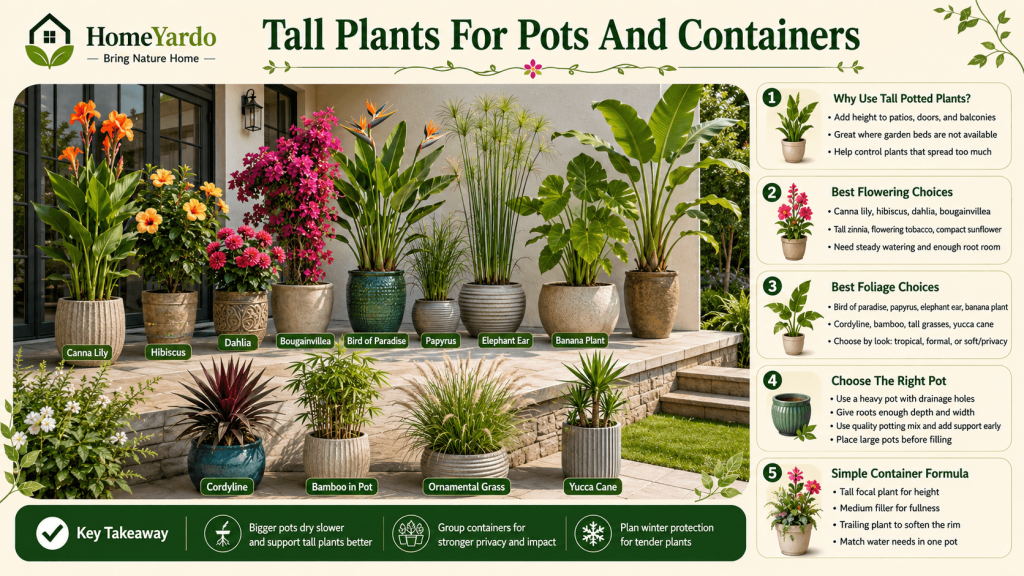
Pots and containers can frame doors, dress up patios, screen balconies, and add height where garden beds are not available. They also help control plants that might spread too much in open ground.
The pot matters as much as the plant. A tall plant in a light container can tip over. Drainage, weight, root room, and water all shape success.
Best Tall Flowering Plants For Pots
Canna lily, hibiscus, dahlia, bougainvillea, fuchsia standards, tall zinnia, flowering tobacco, verbena bonariensis, compact sunflower, and tall salvia can all work in large pots.
These tall potted plants need enough root room and steady watering. Containers dry faster than garden soil, especially in hot weather.
Tender plants may need winter protection. Dahlias may need lifting, while tropical plants may need moving into shelter.
Best Tall Foliage Plants For Containers
For containers, they look good even when nothing is blooming. Bird of paradise, papyrus, elephant ear, banana plant, cordyline, tall ornamental grass, bamboo in a container, and yucca cane all bring height.
Choose by look and care style. Tropical plants usually need more water. Yucca and cordyline give a sharper shape. Grasses feel softer.
| Style | Best Plants |
|---|---|
| Tropical | Bird of paradise, banana, elephant ear |
| Formal | Cordyline, yucca cane, Italian cypress |
| Soft/privacy | Tall grasses, bamboo in a container |
| Moisture-loving | Papyrus, canna, elephant ear |
Container bamboo can help control the spread, but it still needs attention. Roots, water, and winter exposure should be watched.
How To Choose The Right Pot For A Tall Plant
A tall plant needs a container that can support both roots and top growth. A pretty pot is nice. A pretty pot that falls over every windy afternoon is less charming.
Use this checklist before planting:
- Choose a heavy base for tall or top-heavy plants.
- Make sure the pot has drainage holes.
- Use enough depth for strong roots.
- Match pot width to mature plant size.
- Use a quality potting mix, not compact garden soil.
- Place the pot before filling if it will be heavy.
- Use a plant caddy for large patio containers.
- Add support early for dahlias, sunflowers, or tall flowering stems.
- Group pots for a stronger privacy screen.
- Plan winter storage for tender plants.
A larger pot dries more slowly than a small one. It also gives these plants a better chance to stand upright.
How To Design With Tall Plants In Containers
The easiest container formula is simple: tall plant, medium filler, trailing edge. It works because every layer has a job.
| Container Layer | What It Does | Examples |
|---|---|---|
| Tall focal plant | Creates height | Canna, hibiscus, papyrus, bird of paradise |
| Medium filler | Adds fullness | Coleus, salvia, begonias, compact grasses |
| Trailing plant | Softens the rim | Sweet potato vine, trailing verbena, ivy, calibrachoa |
Place the tallest plant in the center when the pot is viewed from all sides. Put it toward the back if the container sits against a wall.
Keep the water needs similar in one pot. A thirsty papyrus and a dry-loving plant will not make peaceful roommates.
Tall Narrow Plants For Tight Spaces
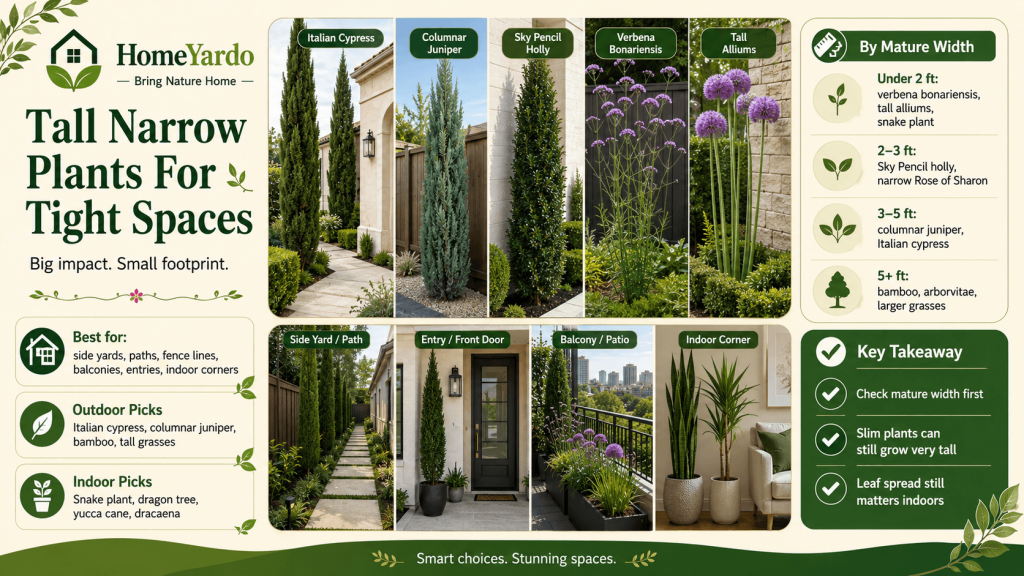
Tall, narrow plants are useful when height is welcome but width is not. They suit side yards, paths, fence lines, balconies, entries, and indoor corners.
The words narrow, thin, skinny, slim, and slender all point to the same need. The plant should grow upward without claiming too much floor or bed space.
Tall Narrow Plants By Mature Width
Width is the main detail to check with tall, narrow plants. A plant can look slim in a nursery pot and still grow wider than expected.
| Width Range | Best Plants | Best Use |
|---|---|---|
| Under 2 ft | Verbena bonariensis, tall alliums, snake plant | Airy height, indoor corners |
| 2–3 ft | Sky Pencil holly, narrow Rose of Sharon | Tight beds, entrances |
| 3–5 ft | Columnar juniper, Italian cypress | Narrow privacy |
| 5+ ft | Bamboo, arborvitae, larger grasses | Wider screening |
A slim plant is not always small. Some narrow trees and shrubs can grow very tall, so check both height and width.
Best Tall Skinny Plants Outdoor
Italian cypress, columnar juniper, narrow arborvitae, clumping bamboo, verbena bonariensis, tall ornamental grasses, Sky Pencil holly, narrow-trained Rose of Sharon, upright yew, and tall alliums are useful outdoor options.
Columnar evergreens work well near entries, fences, and formal spaces. Airy flowers fit cottage gardens and small beds where a solid wall of foliage would feel too heavy.
Some plants stay naturally slim. Others need pruning to keep their shape.
Best Tall Skinny Indoor Plants
Snake plant, dragon tree, yucca cane, kentia palm, corn plant, upright rubber plant, Ficus Audrey, and dracaena varieties fit indoor tight spaces well.
These plants work in apartments, office corners, hallways, and narrow bedrooms. The snake plant is especially handy because it grows up more than out.
Leaf spread still matters. A plant can have a slim base and wide leaves once it grows well.
Best Tall Indoor Plants
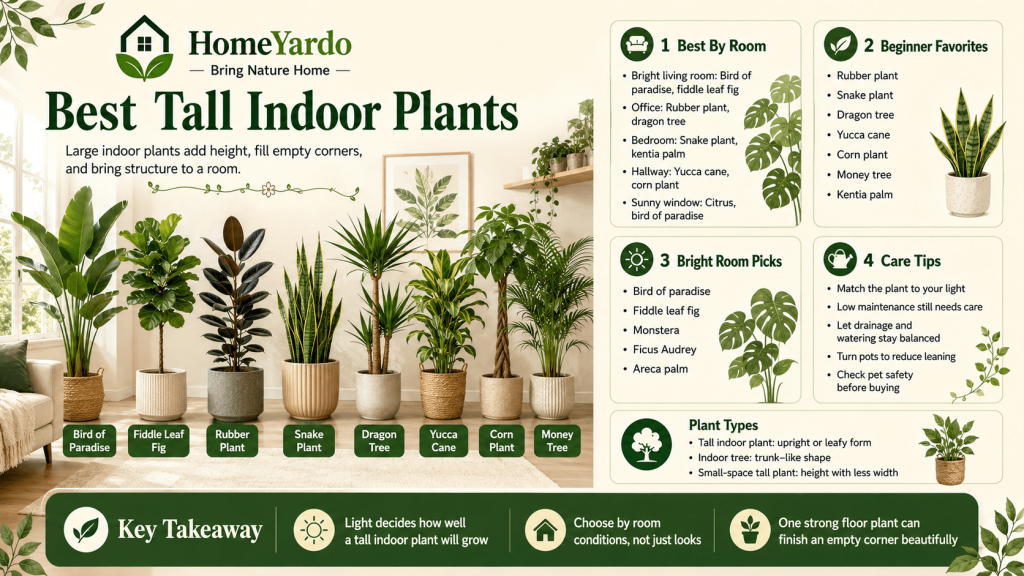
Tall indoor plants can change a room quickly. One strong floor plant can make an empty corner feel finished without adding another piece of furniture.
Indoor growth depends heavily on light. A plant that grows fast beside a bright window may barely move in a dim corner. Plants have their moods, but light usually explains most of them.
Tall Indoor Plants By Room And Light
Choose indoor plants by room conditions, not just by looks. A bright living room can handle bolder plants than a narrow hallway.
| Room/Spot | Best Tall Plants | Why |
|---|---|---|
| Bright living room | Bird of paradise, fiddle leaf fig | Statement foliage |
| Office | Rubber plant, dragon tree | Upright and tidy |
| Bedroom | Snake plant, kentia palm | Calm shape and compact width |
| Hallway | Yucca cane, corn plant | Upright growth |
| Sunny window area | Citrus, bird of paradise | Highlight plants |
| Pet-aware homes | Kentia palm, selected palms | Safer choices than many toxic houseplants |
Pet-aware does not mean every plant is safe. Check each plant before buying it if a pet likes to chew leaves.
Best Tall Indoor Plants For Beginners
Rubber plant, snake plant, dragon tree, yucca cane, corn plant, money tree, umbrella plant, and kentia palm are good beginner tall indoor plants.
They have upright habits and handle normal home conditions better than fussier options. They still need drainage, light, and careful watering.
| Plant | Light | Watering Style | Beginner Level | Pet Caution |
|---|---|---|---|---|
| Rubber Plant | Bright indirect | Let the topsoil dry | Easy-moderate | Yes |
| Snake Plant | Low-bright indirect | Dry between watering | Easy | Yes |
| Dragon Tree | Medium-bright indirect | Light, regular watering | Easy | Yes |
| Yucca Cane | Bright indirect/full sun indoors | Dry between watering | Easy | Yes |
| Corn Plant | Medium-bright indirect | Moderate watering | Easy | Yes |
| Money Tree | Bright indirect | Even moisture, not soggy | Easy-moderate | Usually lower concern |
| Umbrella Plant | Bright indirect | Moderate watering | Easy-moderate | Yes |
| Kentia Palm | Medium-bright indirect | Even moisture | Easy-moderate | Often pet-friendlier |
Low maintenance does not mean no care. It usually means the plant forgives the occasional missed watering.
Best Tall Indoor Plants For Bright Rooms
Bird of paradise, fiddle leaf fig, monstera, Ficus Audrey, areca palm, citrus tree, Norfolk Island pine, and large philodendron types can become striking tall indoor plants.
Bright indirect light is usually best. Direct sun through glass can burn leaves, especially during hot afternoons.
Turn pots every few weeks to reduce leaning. Wipe large leaves so they can use light well. Prune when needed to control height and shape.
Tall Indoor Plants Vs Indoor Trees
Tall indoor plants and indoor trees overlap, but they are not always the same. Indoor trees usually have a trunk-like form. Tall houseplants may grow from canes, palms, stems, or climbing vines.
| Type | Growth Style | Examples |
|---|---|---|
| Tall indoor plant | Upright, leafy, cane-like, palm-like, or climbing | Snake plant, monstera, bird of paradise |
| Indoor tree | Trunk or tree-like form | Fiddle leaf fig, Ficus Audrey, citrus tree |
| Tall floor plant | Any large plant placed on the floor | Kentia palm, rubber plant, corn plant |
| Small-space tall plant | Upright with limited width | Snake plant, dragon tree, yucca cane |
Both can fill empty rooms beautifully. The better choice depends on light, floor space, ceiling height, and leaf spread.
Tall Plants For Shade
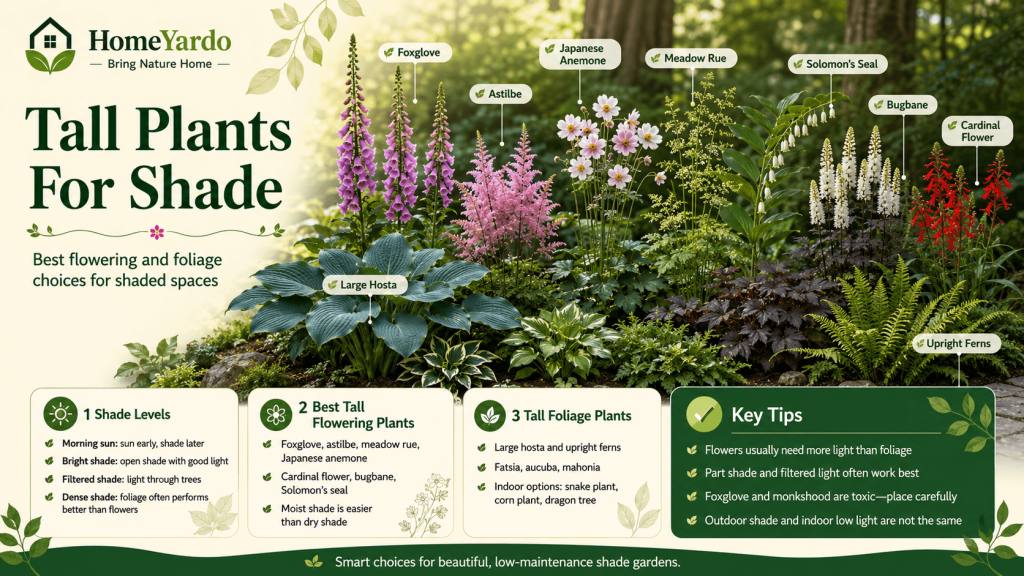
Shade is not one single condition. A bright north-facing bed, a woodland edge, and a dark corner under dense trees are very different places.
Shade loving tall plants usually perform best in part shade, filtered light, or morning sun. Dense shade often reduces flowering.
Shade Levels
Understanding shade helps prevent disappointment. Some plants bloom in bright shade, while others only survive in darker spots.
| Shade Type | What It Means | Best Tall Plants |
|---|---|---|
| Morning sun | Sun early, shade later | Foxglove, astilbe, Japanese anemone |
| Bright shade | Open shade with good light | Meadow rue, Culver’s root |
| Filtered shade | Light through trees | Solomon’s seal, ferns, bugbane |
| Dense shade | Very low direct light | Foliage plants over flowers |
Flowers usually need more light than foliage. When shade is heavy, leaves may give better results than blooms.
Tall Flowering Plants For Shade Or Part Shade
Foxglove, monkshood, meadow rue, tall astilbe, Japanese anemone, cardinal flower, bugbane, and Solomon’s seal can bring height to shaded beds.
Moist shade is easier than dry shade. Astilbe, cardinal flower, and meadow rue appreciate steady moisture.
Foxglove and monkshood need safety awareness because they are toxic. Place them where curious pets or children will not handle or nibble them.
Tall Foliage Plants For Shade
Large hosta, upright ferns, fatsia, aucuba, mahonia, bamboo in part shade, snake plant indoors, corn plant indoors, and dragon tree indoors can give height without relying on flowers.
Foliage can be just as satisfying in shade. Big leaves, glossy leaves, and upright stems create shape where flowers may be limited.
Outdoor shade and indoor low light are not the same. A shaded garden bed may still receive more usable light than a room far from a window.
Tall Growing Plants And Fast-Growing Tall Plants
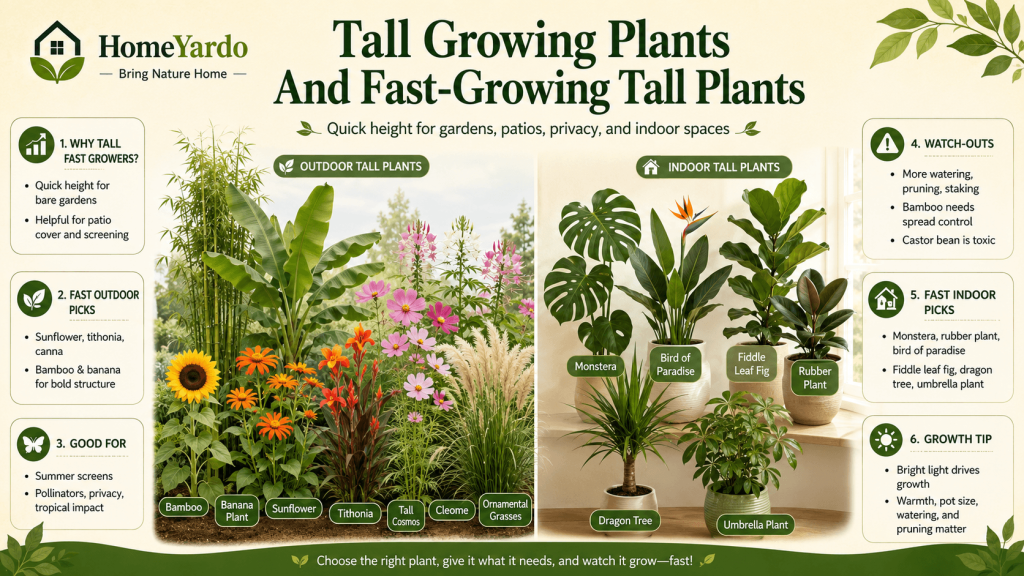
Tall growing plants help when a new garden looks bare or a patio needs quick cover. Fast growth feels rewarding, especially when a space needs height right away.
Fast growth can also bring extra watering, pruning, staking, or containment. Speed is lovely until a plant starts acting like it signed the deed.
Fast-Growing Tall Outdoor Plants
Annuals often give the fastest one-season height. Structural plants like bamboo and banana can grow quickly too, but they need more planning.
| Plant | Speed Type | Best Use | Watch-Out |
|---|---|---|---|
| Sunflower | One-season height | Summer screen | Wind support |
| Tithonia | One-season flower height | Pollinators | Warmth needed |
| Bamboo | Fast structural screen | Privacy | Spread control |
| Banana plant | Warm-season foliage | Tropical height | Winter protection |
| Canna | Seasonal height | Pots/borders | Winter care |
Sunflower, tithonia, amaranth, canna lily, bamboo, banana plant, tall cosmos, cleome, castor bean, and giant ornamental grasses can all build height quickly.
Castor bean is dramatic but toxic. Use it only where that risk makes sense.
Fast-Growing Tall Indoor Plants
Monstera, rubber plant, bird of paradise, dragon tree, fiddle leaf fig, umbrella plant, and Ficus Audrey can grow well indoors with the right care.
Bright light drives growth more than wishful thinking. Pot size, warmth, and regular watering also help.
Low light slows even naturally large plants. Pruning keeps fast growers balanced before they lean too far toward the window.
Tall Plants Vs Small Plants
Plants that are tall and small plants do different jobs. A garden made only from short plants can look flat. A garden made only from plants which is tall can feel crowded.
The best planting usually uses both. Plants that are tall create height and structure. Small plants soften edges, fill gaps, and hide bare lower stems.
Simple Tall And Small Plant Pairing Ideas
Pairing tall and small plants keeps the design balanced. The tall plant gives shape, while the smaller plant covers the base and adds texture or color.
| Tall Plant | Small Companion | Why It Works |
|---|---|---|
| Canna lily | Trailing sweet potato vine | Bold height with soft spill |
| Hollyhock | Low catmint | Cottage height with a tidy base |
| Joe Pye weed | Coneflower | Pollinator-friendly layers |
| Bird of paradise | Pothos | Indoor height with trailing greenery |
| Tall grass | Compact annual flowers | Movement with low color |
Choose companions with similar water and light needs. A thirsty plant and a dry-soil plant in one container will not stay friendly for long.
Tall Plants For Garden Design
Tall plants shape how a garden feels. They can make a border look deeper, soften a fence, and give a patio more privacy. They also work particularly well in a layered planting scheme, where taller plants form the background and shorter plants fill the middle and foreground. See this guide to garden aesthetic appeal for more on using plant height, form, and texture together.
The trick is using height with purpose. Random plants that are tall can look awkward. Repeated plants that are tall create rhythm.
How To Use Tall Plant In Flower Beds
Place the tallest plants toward the back of formal borders. In island beds viewed from all sides, put a plant that is tall near the center and step down toward the edges.
A simple border formula works well:
- Back: Plant which is tall for height.
- Middle: medium flowers and foliage.
- Front: low edging plants.
- Repeated groups for rhythm.
- Airy plants where views should stay open.
Mix shapes too. Spikes, round blooms, soft grasses, and broad leaves all create different effects.
Tall Plants For Small Gardens
Small gardens still need height. They just need careful height. Tall narrow plants, airy flowers, and upright containers are better than wide shrubs in tight spaces.
Use a one statement plant where space is limited. A single canna in a large pot or one slim evergreen near a doorway can do more than a crowded group.
If you also want to reduce pruning, watering, and routine yard work, use tall plants as part of a broader low-maintenance backyard landscaping plan that matches plants to the site’s sunlight, soil, drainage, and available space.
Tall Plants For Full Sun, Moist Soil, And Dry Soil
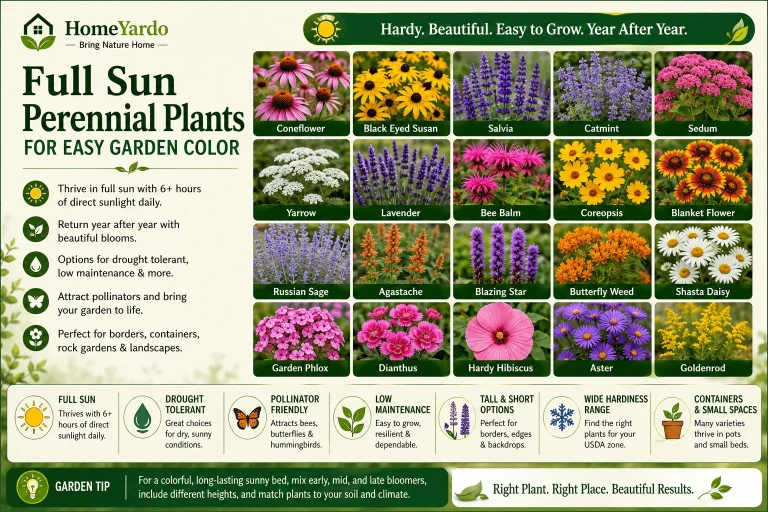
Site conditions decide whether these plants thrive or struggle. Sun, moisture, soil, and wind all matter. If most of your planting area receives direct sunlight, compare these choices with other full sun plants that are suited to bright, exposed garden beds, containers, and hot outdoor spaces.
| Condition | Best Tall Plants | Extra Note |
|---|---|---|
| Full sun | Sunflower, canna, Russian sage, tithonia | Water while establishing |
| Moist soil | Joe Pye weed, cardinal flower, hardy hibiscus | Avoid drying out |
| Dry soil | Russian sage, blazing star, grasses | Best after roots establish |
| Windy site | Sturdy grasses, Russian sage, columnar shrubs | Avoid top-heavy flowers |
| Hot patio | Canna, hibiscus, grasses | Larger pots dry slower |
Full sun beside paving can be hotter and drier than full sun in open soil. Young plants need water until roots settle.
Tall Shrubs Vs Tall Ornamental Grasses
Tall shrubs and tall grasses both add structure, but they do it differently. Shrubs feel more permanent. Grasses bring movement and softness.
| Type | Best For | Main Advantage | Main Limit |
|---|---|---|---|
| Tall shrubs | Permanent structure | Year-round shape | Need pruning and space |
| Tall ornamental grasses | Movement and softness | Texture and height | May die back |
| Tall flowering plants | Color and pollinators | Seasonal bloom | Often not year-round |
| Columnar evergreens | Narrow privacy | Slim structure | Less flower value |
Use shrubs when shape and screening matter most. Choose grasses when the garden needs movement. Add tall flowers when color is the main goal.
Common Mistakes With Tall Plants
These plants are very easy to adore in the nursery. They are like they are full of potential. The issues usually arise later, after the mature size and wind, spread or pot weight is not taken into consideration.
A little planning prevents most trouble. The perfect plant has a generous feel. The wrong plant feels like an everyday chore, with leaves.
Buying For Nursery Size Instead Of Mature Size
Young plants can look innocent. Small bamboo, a small shrub or houseplant could appear innocent in its pot for a nursery. However, the size of mature plants will reveal the truth.
Be sure to check the height and spread prior to making a decision to plant. A plant that is eight feet high and five feet wide won’t be able to thrive in a two-foot side bed.
Pots may limit the size of pots. However, they do not eliminate the need for care. Plants in tall pots still require space for root growth, water and the ability to hold their ground.
Ignoring Wind, Weight, And Staking
These plants catch the breeze. Large leaves break and bend, while flower spikes flex, and pots with light weights fall over. This isn’t drama for plants. This is just physics being rude.
Delphiniums, dahlias and large sunflowers usually require support. Lilies that grow in containers require big pots with drainage.
A rich soil can also cause stems to become soft and flexible. Sometimes, growth that is slightly slimmer is more sturdy.
Choosing The Wrong Tall Plant For Privacy
The tallest plants do not always provide privacy. A 6-foot flower can be able to soften the view, but not completely block it. Flowers that are seasonal tend to thin or fade in winter.
Utilize evergreens, bamboo or columnar conifers to provide all-year-round privacy. Flowers that are taller will provide summer’s color as well as a soft screen.
The plant should be matched to the privacy requirements. A patio screen in summer has different requirements than windows in the bedroom that need to be covered all times of the year.
Forgetting Local Spread, Toxicity, And Invasive Risk
Some plants with taller heights require additional analysis prior to planting. Bamboo may spread if the wrong species is chosen. Gooseneck loosestrife could move over the area it was planted in. Foxglove, castor bean and monkshood are poisonous.
Self-seeding plants might also be a surprise. Verbena bonariensis and cleome and amaranth could return to areas you did not intend to invite them.
Local climate changes plant behavior. A plant that is polite in one area may turn aggressive in another.
Conclusion
The tallest plants aren’t always the tallest that are listed on the label. An appropriate choice will depend on the size, lightness, the pot’s size, the width of the mature, the soil, safety requirements and the amount of care that is available.
Tall plants can enhance the look of a border. The tall houseplants can complete an area. The narrow evergreens can shade in a tiny space without consuming the room.
Begin with the task first. Shade, privacy, flower containers, narrow spaces or height indoors will all indicate a more attractive plant.
FAQ’s
In flower beds, a plant around 4 feet or taller is usually treated as tall. For privacy, 6 feet or more is more useful. Indoors, plants near eye level or taller are usually seen as tall houseplants. Mature height matters more than the size at purchase.
Bird of paradise, fiddle leaf fig, rubber plant, monstera, kentia palm, Norfolk Island pine, and ficus types can become tall indoors. Strong light, enough root space, and good pruning help them grow well. Low light usually slows growth, even for naturally large plants.
Bamboo, sunflowers, hollyhocks, Joe Pye weed, canna lilies, arborvitae, ornamental grasses, and hardy hibiscus can all add strong outdoor height. Some are seasonal, while others create lasting structure. Width and spread should be checked before planting.
Rubber plant, snake plant, dragon tree, corn plant, yucca cane, money tree, and kentia palm are good beginner tall indoor plants. They have upright habits and handle normal home conditions fairly well. Bright indirect light keeps them fuller and healthier.
Snake plants, corn plants, dragon trees, and some palms tolerate lower light better than many tall indoor plants. They may grow slowly in dim rooms, though. Bright indirect light is still better when strong growth and fuller leaves are the goal.
Monstera, rubber plant, bird of paradise, umbrella plant, fiddle leaf fig, and Ficus Audrey can grow quickly indoors in bright light. Growth also depends on warmth, watering, and pot size. In low light, even fast growers slow down.
Snake plant, rubber plant, peace lily, dragon tree, palms, and ficus plants are often grown as air-friendly houseplants. No plant replaces ventilation or regular cleaning. Still, large healthy leaves can make a room feel fresher and more comfortable.
Bamboo, arborvitae, columnar juniper, tall ornamental grasses, Joe Pye weed, sunflowers, canna lilies, and hardy hibiscus can help create privacy. Choose evergreen plants for year-round screening. Tall flowers work best for summer privacy and color.
Canna lily, hibiscus, dahlia, bird of paradise, papyrus, cordyline, banana plant, yucca cane, and tall ornamental grasses work well in large pots. Use a heavy container with drainage. Tall potted plants need regular watering because containers dry faster.
Strong tall container plants include canna, hibiscus, papyrus, bird of paradise, cordyline, bamboo, banana plant, and ornamental grasses. Match the plant to the container size and wind exposure. These plants need a stable base, not just a pretty pot.
Italian cypress, columnar juniper, narrow arborvitae, clumping bamboo, Sky Pencil holly, snake plant, dragon tree, and yucca cane are good tall narrow plants. They add height without using too much width. Always check mature spread before planting.
Sunflowers, canna lilies, Russian sage, hollyhocks, tithonia, blazing star, coneflower, verbena bonariensis, and many ornamental grasses handle full sun well. New plants still need steady water while roots establish. Hot walls and paving can make sunny spots harsher.
Foxglove, tall astilbe, meadow rue, monkshood, Japanese anemone, cardinal flower, large hosta, and upright ferns can grow in shade or part shade. Most flowering plants bloom better in bright shade. Dense shade often means fewer flowers.
Tall narrow plants are usually best for small gardens. Columnar juniper, Italian cypress, tall grasses, verbena bonariensis, snake plant, and upright container plants add height without taking too much space. Avoid wide or fast-spreading plants in tight beds.
These plants are better for height, privacy, back borders, and empty corners. Small plants are better for edging, groundcover, underplanting, and softening paths. The best planting usually uses both, with plants adding structure and small plants filling the base.
Some of these plants need staking, especially delphiniums, dahlias, hollyhocks, and heavy sunflowers. Sturdier plants like Joe Pye weed, Russian sage, and many grasses often need less support. Wind, rain, rich soil, and shade can still make stems lean.
Yes, many of them grow well in pots if the container is large, heavy, and well-drained. Canna lily, hibiscus, papyrus, bird of paradise, yucca cane, and ornamental grasses are good choices. Tall pots need regular watering and wind protection.
Sky Pencil holly, columnar juniper, Italian cypress, narrow arborvitae, snake plant, and dragon tree stay relatively narrow. These plants are useful beside paths, fences, doors, and indoor corners. Always check mature width before planting.
Delphinium, tall dahlia, sunflower, garden phlox, tall zinnia, lupine, and amaranth are useful tall cut flowers. Strong stems and repeated blooms make a big difference. Some need staking to keep stems straight.
Sunflowers, tithonia, amaranth, canna lilies, bamboo, banana plants, tall cosmos, and cleome are some of the fastest plants. Annuals usually give the quickest height in one season. Bamboo and banana plants can grow fast too, but they need more space and planning.
Sunflowers, canna lilies, Russian sage, hollyhocks, tithonia, blazing star, coneflower, verbena bonariensis, and many ornamental grasses handle full sun well. New plants still need regular water while roots settle. Hot patios, walls, and paving can make full sun even harsher.
Foxglove, tall astilbe, meadow rue, monkshood, Japanese anemone, cardinal flower, large hosta, and upright ferns can grow in shade or part shade. Most flowering plants bloom better in bright shade or morning sun. Dense shade usually gives fewer flowers, so foliage plants may work better there.
Tall narrow plants are best for small gardens because they add height without taking too much width. Good choices include columnar juniper, Italian cypress, Sky Pencil holly, verbena bonariensis, tall grasses, snake plant, and upright container plants. Avoid wide shrubs or aggressive spreaders in tight beds.
Snake plant, rubber plant, dragon tree, corn plant, yucca cane, money tree, and kentia palm are among the easiest tall indoor plants to maintain. They grow upright, handle normal home conditions well, and do not need constant attention. Bright indirect light and careful watering keep them healthier.
References
- https://www.rootsplants.co.uk/collections/tall-perennial-plants
- https://yardngardenland.com/ten-tall-skinny-plants-for-tight-spaces/
- https://www.ruralsprout.com/tall-flowers-for-privacy/
- https://www.thespruce.com/the-best-tall-plants-for-containers-4142017
- https://savvygardening.com/tall-perennials/
- https://green-bubble.com/en/collections/tall-plants
- https://www.familyhandyman.com/list/tall-outdoor-plants/
- http://www.perennialresource.com/photo_essay.php?ID=436
- https://www.houseplant.co.uk/collections/large-tall-plants
- https://gardenerspath.com/plants/houseplants/best-tall-houseplants/
- https://www.mydomaine.com/tall-indoor-plants-4774208
- https://www.provenwinners.com/learn/top-ten-lists/16-tall-annuals-middle-border
- https://www.thompson-morgan.com/flowers-plants-shrubs/plants/perennials/tall-perennials