
How to Read Your Water Meter and Catch Leaks Before They Explode Your Bill
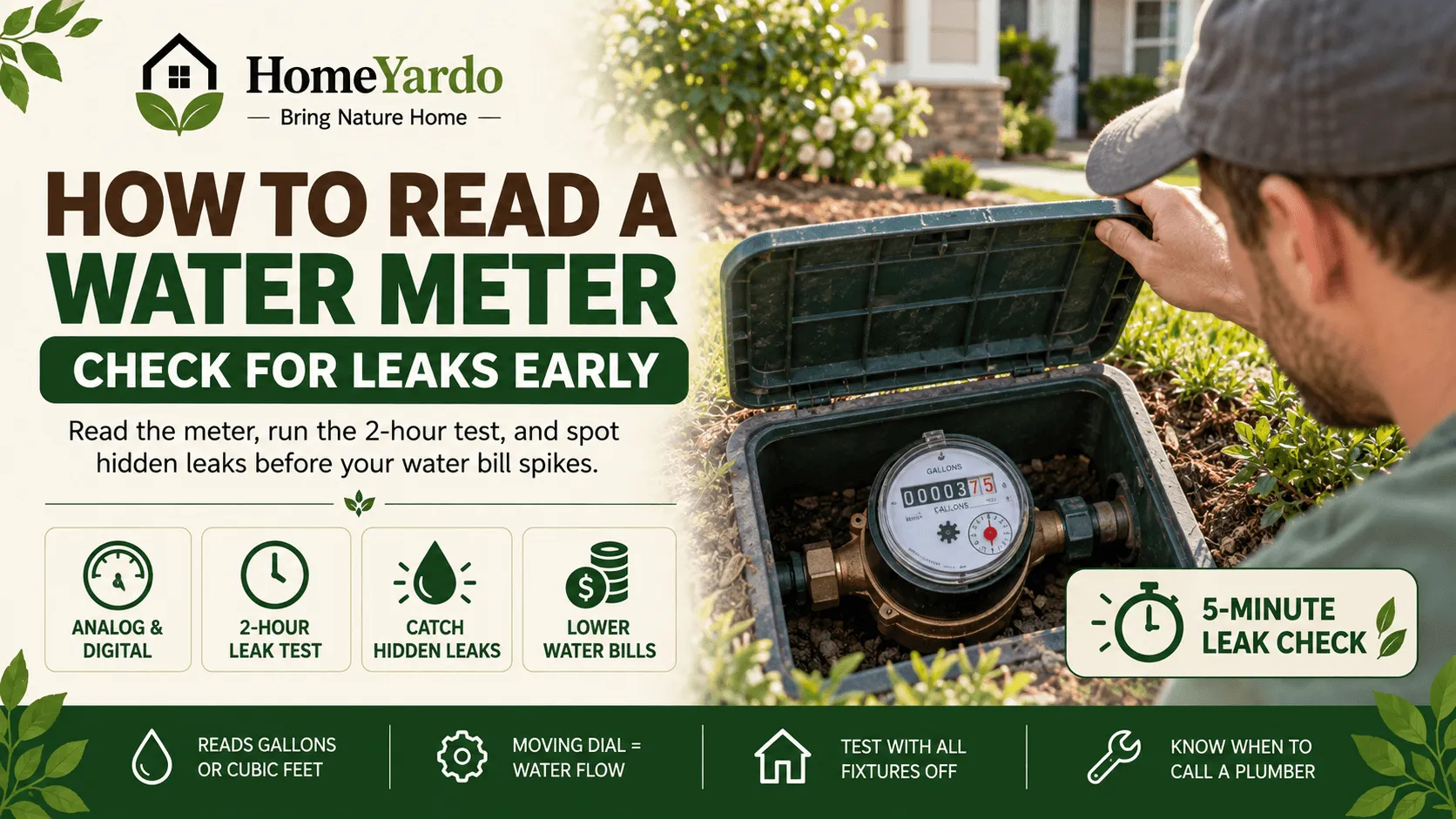
Most homeowners have walked past their water meter hundreds of times without ever reading it. That’s a costly habit. A single slow-running toilet or a pinhole pipe leak behind the wall can quietly drain thousands of gallons before you notice anything wrong on your water bill. The meter sitting outside your house, or under a small metal lid in your yard, is a free diagnostic tool that almost nobody uses. This guide walks you through reading it, running a simple two-hour test, and knowing exactly what the numbers mean for your home.
Why Your Meter Is Worth a Five-Minute Check Right Now
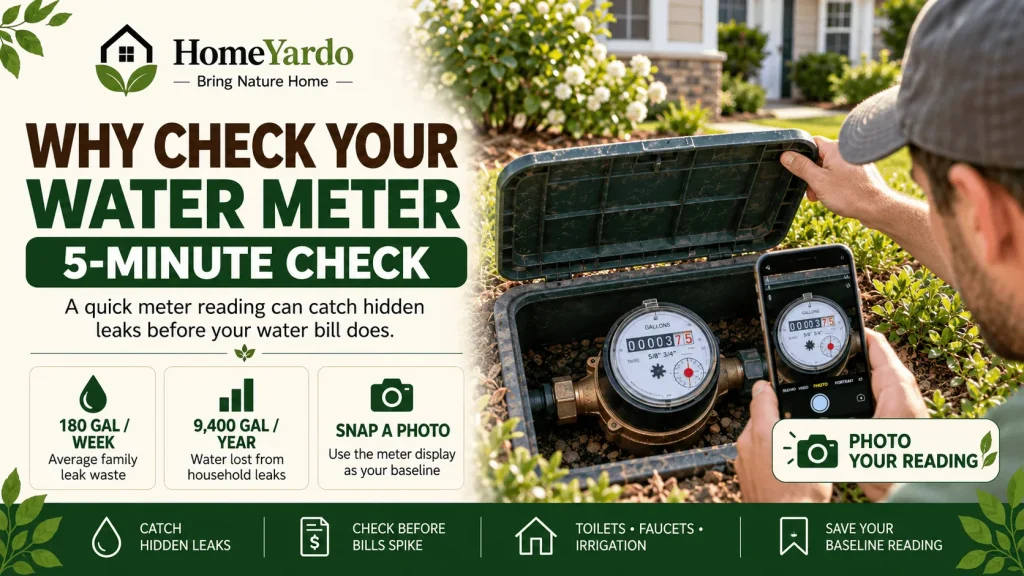
The numbers are hard to ignore once you see them. According to the EPA’s WaterSense program, the average family can waste 180 gallons per week, or 9,400 gallons of water annually, from household leaks. That’s not a dramatic pipe burst. That’s a dripping faucet, a toilet flapper that doesn’t seat properly, or an irrigation valve that never fully closes.
The frustrating part is that most of this is invisible until a bill arrives. By then you’ve already paid for water that went straight down a drain or soaked into a wall cavity. Your meter catches it before the bill does, if you know how to look.
Pull up the meter cover and take a photo of the display right now. You’ll use that number again in a couple of hours. That photo is your baseline.
What You’re Actually Looking At on the Meter Face
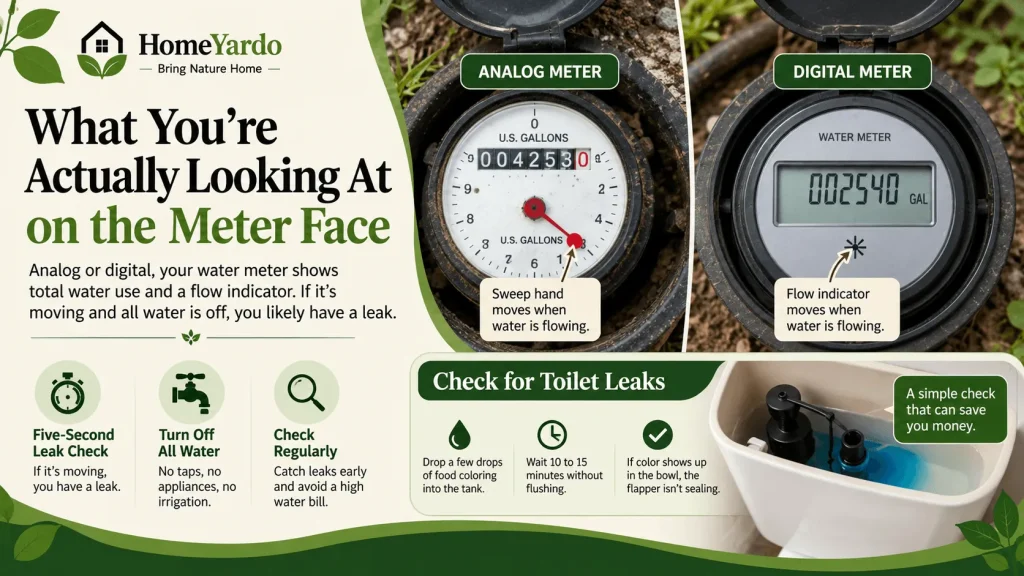
Analog meters have a large numerical display and a small red or black dial or sweep hand. The numbers count total water consumption in gallons or cubic feet since the meter was installed. The sweep hand moves whenever water is flowing. Anywhere in the home. Including a toilet that’s running silently between flushes.
Digital meters show a numeric readout, sometimes with a small triangle or star-shaped flow indicator. That indicator is the key. If it’s moving and every faucet in the house is off, water is going somewhere it shouldn’t.
The five-second leak check: shut off every tap, dishwasher, washing machine, and irrigation line. Walk to the meter. If the sweep hand or the flow indicator is moving at all, you have an active leak. Full stop. No further math required.
“Some leaks are sneaky and difficult to detect, especially toilet leaks,” as Susan Sampson, communications manager at Lehigh County Authority, noted in a 2025 Fix a Leak Week advisory. Silent toilet flappers are among the most common culprits, she explained, because they let water trickle past without making any audible sound.
Toilet leaks are worth checking first. Drop a few drops of food coloring into the tank, then wait 10 to 15 minutes without flushing. If color shows up in the bowl, the flapper isn’t sealing. A $6 replacement part at any hardware store fixes it in about 20 minutes.
The Two-Hour Test: A Reliable Method for Slower Leaks
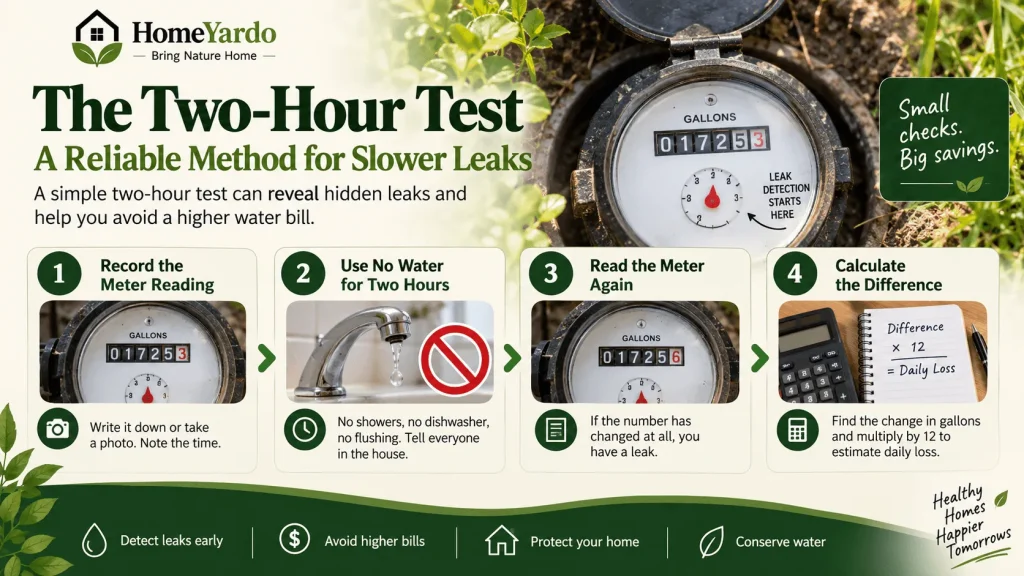
The sweep-hand check catches active, fast-moving leaks. But slower seeps, particularly in supply lines or outdoor irrigation runs, may not move the hand visibly in real time. That’s where the two-hour test becomes useful.
Here’s the process, using what plumbing professionals and utility agencies widely recommend:
- Record the exact meter reading. Write it down or photograph the display. Note the time.
- Use no water for two hours. Tell everyone in the house. No showers, no running the dishwasher, no flushing.
- Return and read the meter again. If the number has changed at all, you have a leak.
- Calculate the difference in gallons. Multiply by 12 to estimate a rough daily loss figure.
A tiny change, say three or four gallons over two hours, could point to an outdoor drip system with a leaky emitter. A change of 40 gallons or more suggests something more serious, often a slab leak or a supply line running behind drywall. The EPA reports that the average household’s leaks can account for more than 9,300 gallons of water wasted every year, and nine percent of homes have leaks that waste 50 gallons or more per day. If your two-hour test lands you in that range, the problem won’t fix itself.
Reading the Results: The DRIP Framework
Here’s a simple decision framework, built from how utility agencies and plumbers triage leak discoveries. Call it DRIP: Detect, Record, Isolate, Proceed.
Detect means the meter check you just did. You know whether water is moving when it shouldn’t be. Record means keeping your readings so you can describe the problem specifically when you call for help, not just “something seems wrong.” Isolate means narrowing it down: shut off supply valves to individual fixtures and re-run the test to find which zone of the house is bleeding water. Proceed means making a decision based on what you found.
| Two-Hour Meter Change | Likely Cause | Recommended Action |
|---|---|---|
| 0 gallons | No active leak detected | Recheck monthly, monitor bill |
| 1 to 10 gallons | Dripping faucet or toilet flapper | DIY inspection, replace flapper or washer |
| 11 to 30 gallons | Outdoor irrigation line or supply valve | Inspect visible pipes, irrigation heads |
| 31 to 100 gallons | Supply line, pipe joint, or slab issue | Call a licensed plumber for leak detection |
| 100+ gallons | Major line failure or slab leak | Shut main and call immediately |
The table above is a planning guide, not a diagnosis. Actual leak rates depend on water pressure, pipe age, and soil conditions. But it gives you a starting point for the conversation with whoever helps you fix it.
Why This Matters More on Maui Than Most Places
Water on the island isn’t free, and it isn’t cheap. Maui County bills residential water in tiered rates listed per 1,000 gallons, with the fiscal year beginning July 1, and rates applying to single-family homes and accessory dwellings served by their own water meter. Tiered billing means every gallon your leak wastes beyond your baseline tier costs more per unit than the one before it. A slow leak that pushes you into the next pricing bracket costs disproportionately more than the raw gallon count suggests.
Salt air and the island’s humidity also accelerate pipe corrosion in ways that mainland homeowners don’t deal with. Galvanized pipes in older Maui homes corrode from the inside out. Exposed outdoor fixtures see UV and moisture damage year-round. That’s why local knowledge matters when something turns up in your meter reading. Experienced plumbers in maui are familiar with the specific failure patterns that show up in island homes, which is a genuinely different diagnostic conversation than what a mainland technician would have.
The EPA notes that fixing easily corrected household water leaks can save homeowners about 10 percent on their water bills. On an island where utility costs run high across the board, that’s real money that stays in your pocket rather than flowing into a wall cavity.
Making This a Monthly Habit
The meter check takes under five minutes. So does the two-hour test if you plan it around a stretch when nobody needs water anyway, like a morning school run or an afternoon errand. Do it once a month and you’ll catch problems in their first weeks, not after the damage has compounded for a year.
Keep a simple log in a notes app or on a sticky note inside your utility closet: date, meter reading, test result. If you ever see that number change unexpectedly between checks, you’ll have a trend rather than a mystery. Plumbers and utility companies can do far more with a trend. “It jumped 40 gallons in two hours last Tuesday and again on Thursday” tells a professional exactly where to start looking.
Your water meter has been sitting outside, quietly counting, since the day this house was plumbed. The question is whether you’re going to start listening to it. Now you know how.
Make the Water Meter Part of Routine Home Maintenance
Your water meter is more than a billing device. It can serve as an early warning system for water consumption you cannot otherwise see.
Start with a quick no-use check. If you suspect a slow leak, run the two-hour test. If the reading changes, investigate common fixtures before moving toward concealed plumbing.
The important distinction is simple: the meter can tell you that water is moving, but it cannot always tell you where the problem is.
That is where systematic isolation—and professional leak detection when needed—can prevent a small plumbing problem from becoming a much larger repair.
FAQ’s
Turn off all intentional water use and record the meter reading. Check the flow or leak indicator, then read the meter again after a no-use period. If the reading changes without intentional water use, investigate for a leak.
EPA WaterSense recommends a two-hour no-use period. Make sure nobody uses faucets, toilets, appliances, irrigation, or other water-consuming equipment during the test.
It generally should not register ongoing household consumption when no water is being used. If a flow or leak indicator continues moving, check for intentional or automatic water use first and then investigate for leaks.
Yes. Water leaking from a toilet tank into the bowl still passes through the home’s water meter even though you may never see water on the floor.
No. A meter can confirm unexplained water consumption, but it normally cannot identify the exact fixture or pipe responsible. You need to isolate fixtures and plumbing zones to narrow down the source.
If absolutely no intentional or automatic water use occurred, a changed reading probably indicates a leak or another source of unexplained consumption.
Subtract your starting meter reading from the ending reading. Divide the difference by the number of test hours to estimate hourly consumption. Multiply that number by 24 for an estimated daily rate if the leak is continuous.
Start with toilets, dripping faucets, appliance connections, outdoor spigots, and irrigation. Toilets deserve particular attention because tank-to-bowl leaks can be nearly silent.
Call a qualified plumber when unexplained meter movement continues after accessible fixtures have been checked, when you suspect a concealed or underground pipe leak, or when water is actively damaging the property.
There is no universal required interval for homeowners, but periodic meter checks are a useful maintenance habit. Checking after an unexplained bill increase, before and after extended travel, or whenever you notice signs of moisture can help identify problems earlier.