How to Know When Your Home AC System Needs Replacing

Your AC stopped keeping up last August. You called a tech, paid for the repair, and told yourself it was a one-time thing. Then it happened again. If that story sounds familiar, you’re not dealing with bad luck. You’re dealing with a system that’s aging out, and the repairs are just the bill you’re running up on borrowed time.
Knowing when to replace rather than repair is the most useful decision a homeowner can make about their cooling system. Get it right, and you avoid emergency breakdowns, lower your energy bills, and sleep through July without waking up sweating at 2 a.m. Get it wrong and you keep funding a losing battle. This guide lays out the real signals, a simple decision tool, and what to actually do when the numbers stop working in your favor.
Why the Age of Your System Is the Starting Point
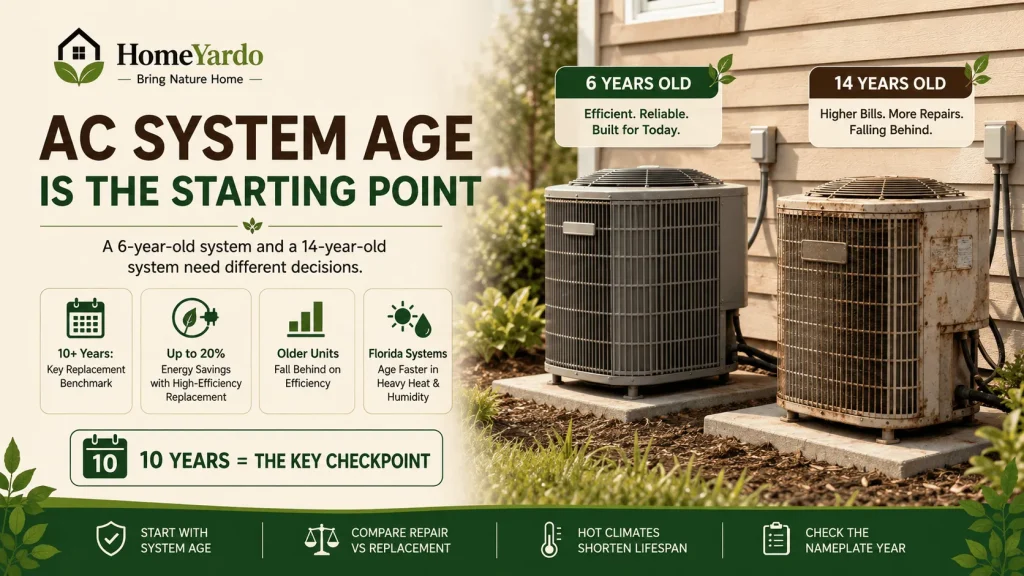
Age is not the whole story, but it’s where every conversation has to start. A 6-year-old system that’s failing is a different problem than a 14-year-old system that’s struggling. The two require completely different responses.
ENERGY STAR recommends that homeowners consider replacing any air conditioner that is more than 10 years old, noting that properly installed high-efficiency units can save up to 20 percent on heating and cooling costs compared to older equipment. That 10-year benchmark isn’t arbitrary. It maps to where efficiency ratings begin to fall significantly behind modern standards, and where compressor wear starts making costly failures more likely with each passing season.
In a mild climate, a well-maintained system might stretch to 15 or even 18 years. But Florida is not a mild climate. South Florida homes run their AC nearly year-round, which means compressors accumulate operating hours far faster than units in the Midwest or the Pacific Northwest. A Florida system that’s 10 years old has likely logged the equivalent mileage of a 13- or 14-year-old system in a cooler state. Keep that in mind when you’re reading the age on the nameplate.
The Electricity Bill Is Telling You Something
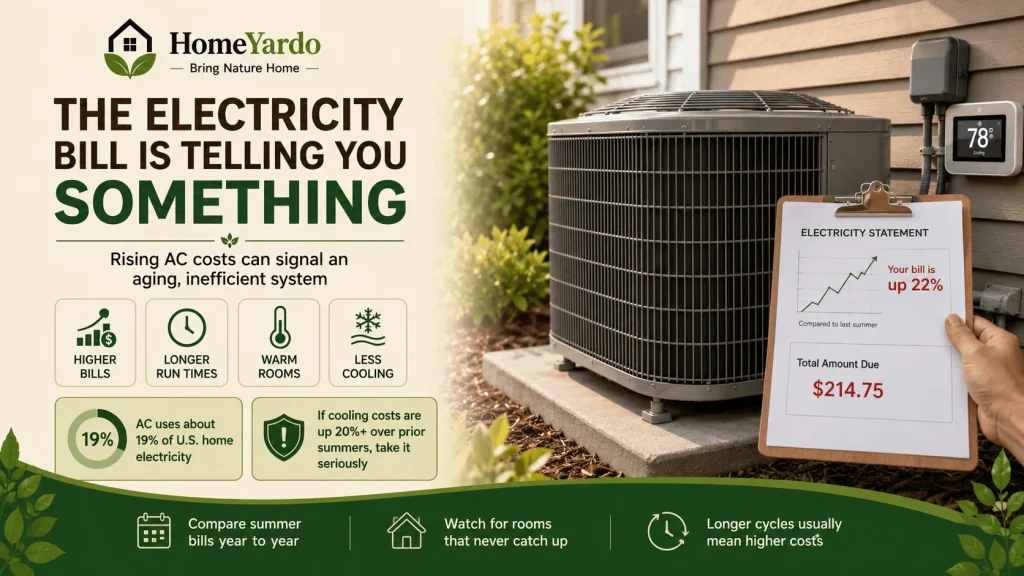
Most homeowners notice performance problems before they connect them to energy costs. The house feels warmer than the thermostat says. Certain rooms never catch up. The unit runs longer cycles but delivers less. Each of those symptoms has an energy cost attached to it.
Cooling accounts for a significant share of residential electricity use. According to the U.S. Energy Information Administration’s 2020 Residential Energy Consumption Survey, air conditioning represented about 19 percent of total electricity consumption in U.S. homes. In a warm-climate state like Florida, where systems run harder and longer, that share climbs higher.
An aging, inefficient system amplifies that cost every single month it stays in service.
If your electricity bills have climbed steadily over two or three summers without a clear cause like rate increases or a new appliance, your AC is the most likely culprit. Compare your bills to the same months two or three years ago. If cooling costs are up 20 percent or more with no change in usage habits, that’s a signal worth taking seriously.
The “Rule of Two-Plus” for Repair Decisions
Here’s a framework I find far more useful than the generic “repair vs. replace” advice you’ll read everywhere. Call it the Rule of Two-Plus: if your system meets two or more of the conditions below, replacement almost always wins financially within 24 months.
- The unit is 10 years old or older
- You’ve had at least two paid repair calls in the last 18 months
- A single repair estimate is more than 40 percent of the cost of a new system
- The system uses R-22 refrigerant (phased out federally in 2020, now expensive and scarce)
- Your home has rooms that consistently run 5 or more degrees warmer than the thermostat target
One of those alone might mean a repair makes sense. Two or more together, and you’re sinking money into an exit that’s already decided. The only real question becomes timing.
Florida Specifically: Why Your System Works Harder Than Most
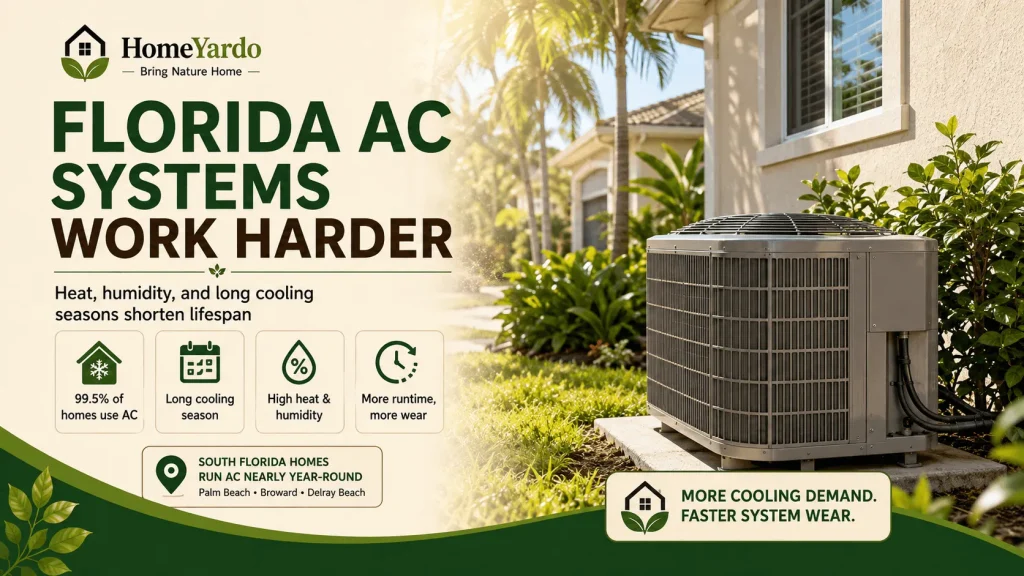
Context matters here, and the numbers are striking. According to the U.S. Census Bureau’s 2023 Local Air Conditioning Estimates, Florida tied for the highest rate of air-conditioned homes in the country at 99.5 percent, reflecting how completely non-optional cooling is in this climate. That saturation exists because Florida heat and humidity make AC less of a luxury and more of a basic function of a livable home.
The implication for your system’s lifespan is real. Units in Palm Beach County, Broward County, and the surrounding areas run on near-continuous cycles from April through October and still log meaningful runtime in the other months. That operating profile shortens the practical life of compressors, capacitors, and coils relative to what the manufacturer’s general lifespan estimate assumes. If you’ve had a local AC installation Kings Point homeowners and Delray Beach residents rely on, you already know that licensed contractors in this area factor local runtime and humidity into every sizing and equipment recommendation they make. The same calculation should shape your replacement timeline.
A Quick Decision Table
| System Age | Repair Cost vs. New System | Recommended Action |
|---|---|---|
| Under 8 years | Under 30% | Repair now, monitor closely |
| 8 to 11 years | 30% to 50% | Get a replacement quote before committing to repair |
| 11 to 14 years | Any repair over 25% | Strong case for replacement, plan timing |
| 15 years or older | Any repair cost | Replace; you’re past the system’s practical ceiling |
Use this as a starting point, not a verdict. A 13-year-old system that’s been maintained religiously and lives in a shaded installation spot might have more life left than one that’s been neglected and baked on a south-facing concrete pad for a decade.
What Good Replacement Timing Actually Looks Like
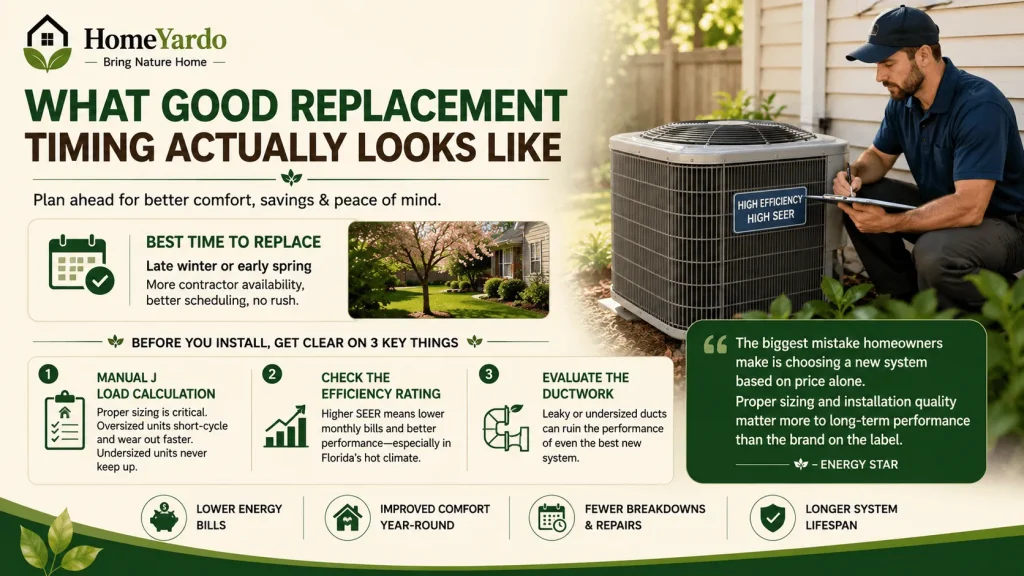
The worst time to replace an AC is when it fails on the hottest day of the year. You lose leverage, you lose scheduling choice, and you often pay a premium. The best window is late winter or early spring, before the cooling season begins, when contractors have more availability, and you have time to compare quotes without urgency driving the decision. A seasonal HVAC tune-up can also help identify maintenance or performance issues before you commit to replacing the system.
Before any installation appointment, get clear on three things. First, ask the contractor to perform a Manual J load calculation, not just a rule-of-thumb sizing based on square footage. An oversized unit short-cycles, leaves humidity problems behind, and wears out faster. An undersized unit never catches up. Second, ask about the efficiency rating. For Florida homes, going with a higher-SEER unit pays back in real monthly savings on a system that’s going to run hard for years. Third, understand what happens to the ductwork. A new, efficient unit paired with leaky or undersized ducts will still disappoint you.
“The biggest mistake homeowners make is choosing a new system based on price alone. Proper sizing and installation quality matter more to long-term performance than the brand on the label.” This reflects the consensus across the HVAC industry and the guidance published by ENERGY STAR for residential replacement projects.
One Last Check Before You Call Anyone
Pull out your most recent electricity bills and find the nameplate on your outdoor unit. Write down the installation year and the model number. Cross-check whether the refrigerant type is listed as R-22 or R-410A, since R-22 systems are now expensive and difficult to service. Then apply the Rule of Two-Plus. If your system clears two or more of those criteria, you have a real, data-supported reason to get a replacement quote rather than another repair order. You don’t have to make a decision this week. But you should make it on your schedule, not on the schedule your failing compressor sets for you.
FAQ’s
Consider the age of the system, maintenance history, how well the system cools, electricity consumption, kind of refrigerant used by the system and the cost of the next repair. It is more logical to replace when numerous problems occur together than due to one symptom only.
Not necessarily. ENERGY STAR suggests that you consider replacing an air conditioner if it is more than 10 years old, particularly if it needs frequent repairs, costs more to operate, or fails to keep your house pleasant.
A small fix to an otherwise reliable system can be worth it. If the unit is old and has had several breakdowns or requires a costly significant repair, get an estimate on the repair and compare it to the cost of a full replacement.
Depends on the malfunction and the state of the system. A little repair might be reasonable, but a compressor, coil, or other expensive breakdown on a 15-year-old system usually demands a replacement comparison before any money is committed.”
Not every time Electricity use might vary because of weather, utility rates, thermostat settings, duct leaks, insulation, unclean filters, and changes in the household. Better red flag would be increasing usage with decreasing AC performance.
Yes. Existing R-22 systems may continue to be maintained with legally accessible recovered, reclaimed, or previously generated refrigerant. Consider the age of the system, its condition, the cost to repair, and the availability of parts combined.
Not until we discover the reason of it. Unequal temperatures can be caused by the AC, but can also be caused by duct issues, insulation, air leakage, inadequate airflow or equipment sizing.
Ask about the diagnosis of the existing system, Manual J sizing, suggested equipment tonnage, SEER2 rating, ductwork condition, warranty, permits, installation work that will be done, commissioning, and the fully installed price.