How to Grow Wild flowers in Garden: Step-by-Step Planting Guide
The wild flower garden appears relaxed and serene, but it will flourish when the garden is planned prior to the seeds touching the soil. The most commonly made error is to scatter seeds across thick grass, hoping for a meadow of flowers to emerge. The majority of wildflower seeds require sunlight, soil contact with constant moisture and not a lot of competition when they are still young.
The best results are usually by making sure the seed mix is matched to the soil before planting. The sunny corner of the lawn front yard strip the border for a container, the edge of woodland and meadow patches in the backyard all require different options. Also, soil matters. A lot of meadow wildflowers flourish better in soil that is nutrient-rich rather than in fertile well-fed ground.
This guide explains how you can design the space, select plants or seeds and prepare the soil, sow wildflower seeds, control the weeds, create borders, transform lawn areas and keep the flowers in bloom after the planting. It also offers useful flower options for every kind of garden, so that the garden feels natural and doesn’t risk becoming messy or difficult to maintain.
Quick Answer
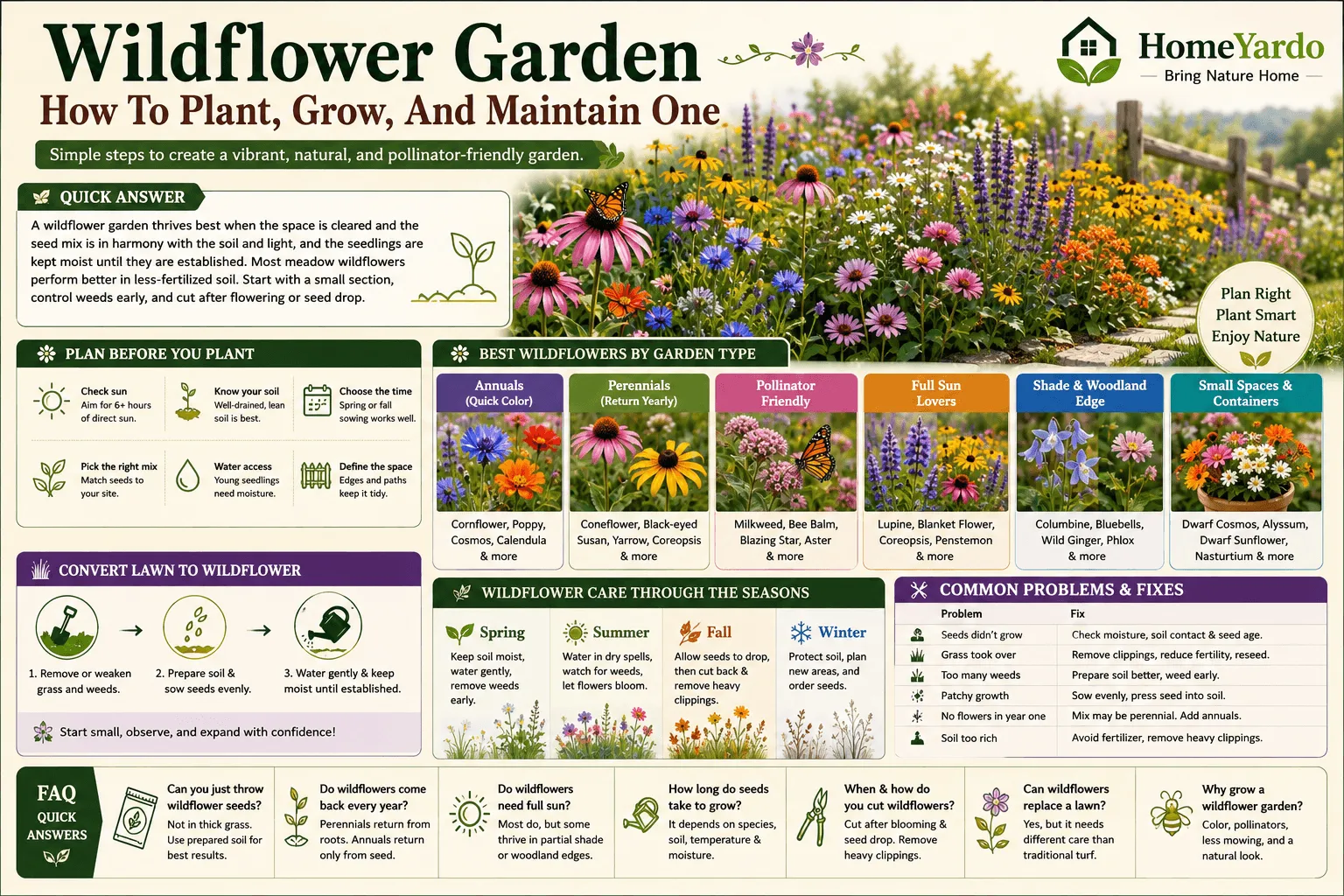
A wild flower garden thrives best when the space is cleared and the seed mix is in harmony with the soil and light and the seedlings are kept moist until they become they are established. The majority of meadow wildflowers perform better with a less-fertilized lawn. Start with a small section and then control the grass in the early morning, and trim after flowering or dropping seeds.
What Is A Wild Flower Garden?
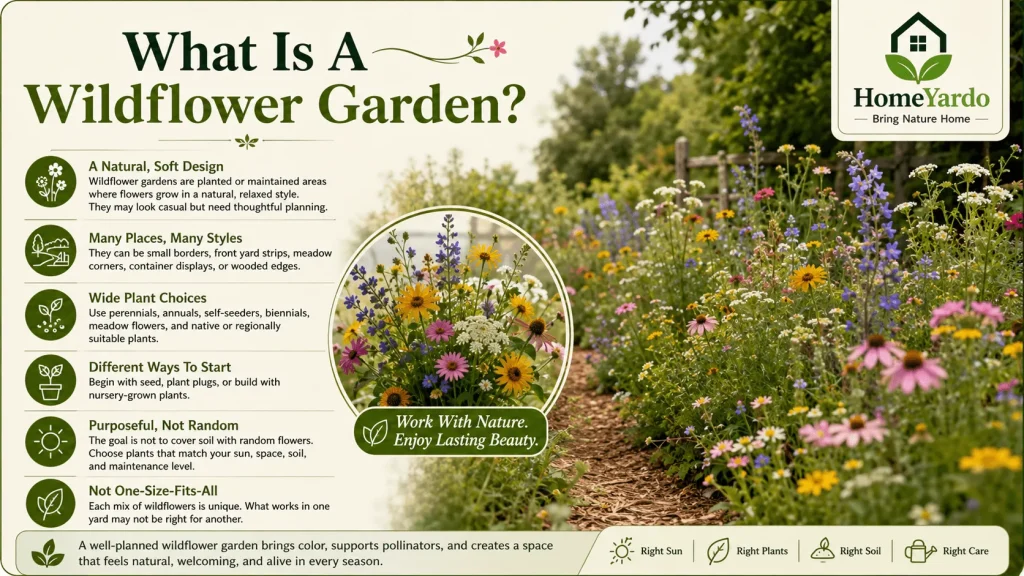
The wild flower gardens are an area that has been planted or maintained area in which flowers are cultivated in a natural, soft design. It might appear casual but it needs planning. The area could be a border that is small along an avenue or a front yard strip or a meadow corner or a container display or a wooded edge.
An ideal planting could include perennials, annuals, self-seeders, biennials, meadow flowers, as well as native plants or those that are suited to the region. It could be started by seed, then planted using plugs, or constructed by incorporating nursery-grown plants.
The aim is not to cover the soil with flowers that are random. The aim is to select plants that are in harmony with the sun and space, soil, and maintenance level. The mix of wildflowers is not suitable for each yard and certainly not every yard requires the same type of wildflowers.
Difference Between Lawn And Wildflower Garden
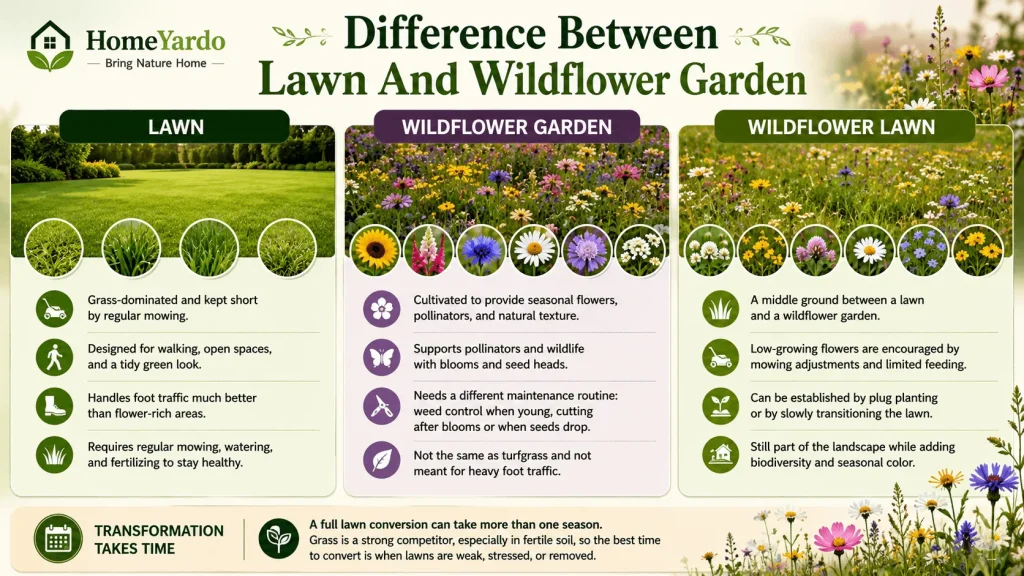
A lawn is typically grass-dominated and is kept short by regular mowing. It is designed to be used for walking, open spaces and a tidy green lawn. It can handle foot traffic better than a plant with a lot of flowers.
A garden is cultivated to provide seasonal flowers, pollinators and seed heads with natural texture and softer growing. It’s not the same as turfgrass. It also requires a distinct maintenance routine, such as the control of weeds while it is young, and cutting following blooms or when seeds drop.
A lawn of wildflowers is situated between the two ideas. It is still part of the landscaping. However, the flowers that are low growing are encouraged by mowing adjustments and feeding restrictions, or plug planting, or a slower lawn transformation.
A complete lawn change could require more than one season. The grass is a formidable adversary, especially in soils that are fertile, so the best way to convert is in the event that lawns are weak or removed.
Why Wildflower Gardens Are Worth Growing
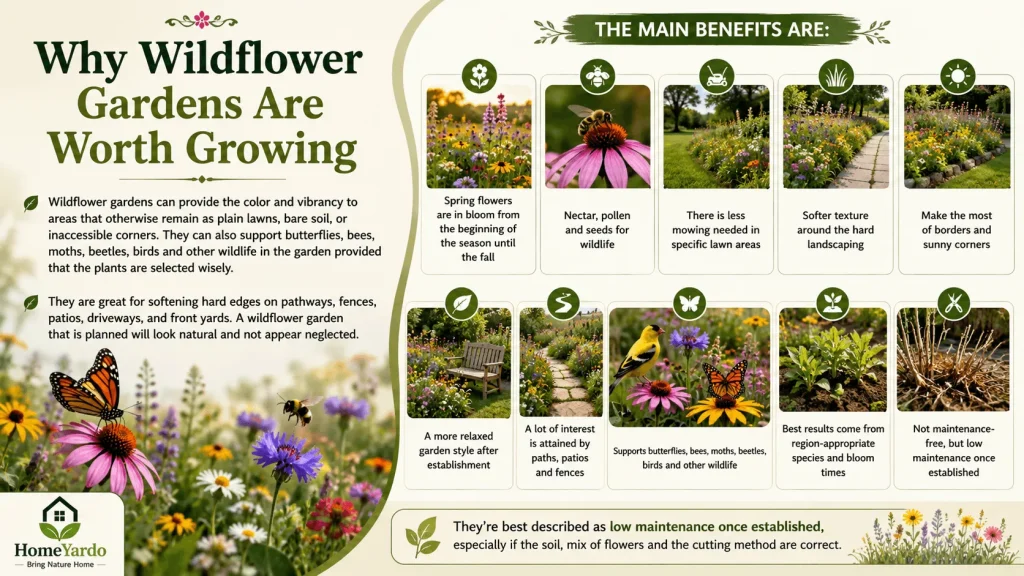
They can provide the color and vibrancy to areas that otherwise remain as plain lawns, bare soil, or inaccessible corners. They can also support butterflies, bees, moths beetles, birds and other wildlife in the garden provided that the plants are selected wisely.
They are great for softening hard edges on pathways, fences, patios, driveways, and front yards. A garden that is planned will look natural and not appear neglected.
The main benefits are:
- Spring flowers are in bloom from the beginning of the season until the fall
- Nectar, pollen and seeds for wildlife
- There is less mowing needed in specific lawn areas
- Softer texture around the hard landscaping
- Make the most of borders and sunny corners
- A more relaxed garden style after establishment
- A lot of interest is attained by paths, patios and fences
The most significant wildlife value typically comes from the species that are suitable to the region in which they are located and the blooming season. They are not maintenance-free. They’re best described as low maintenance once established, especially if the soil, mix of flowers and the cutting method are correct.
Plan Before Planting A Wildflower Garden
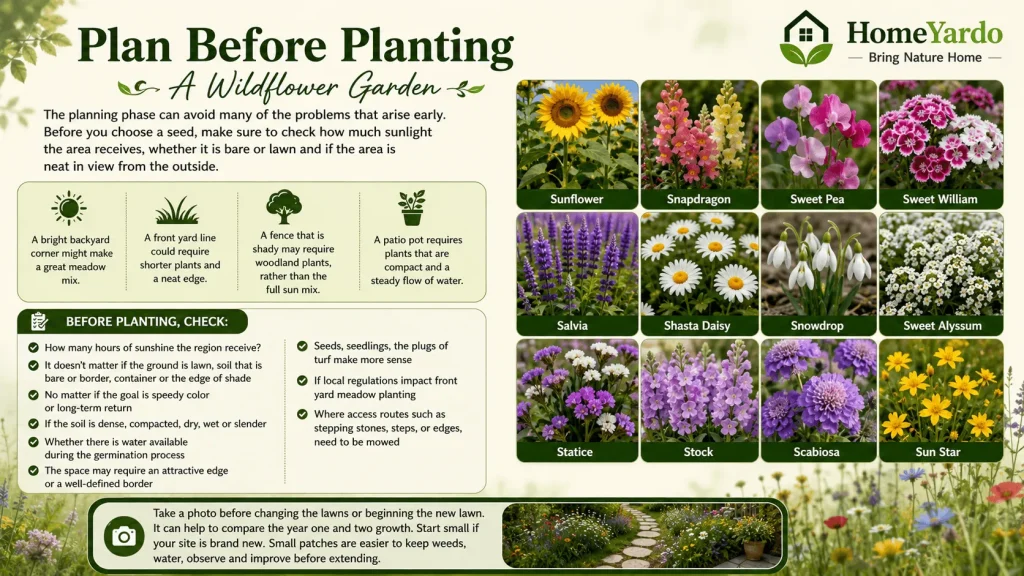
The planning phase can avoid many of the problems that arise early. Before you choose a seed, make sure to check how much sunlight the area receives, whether it is bare or lawn and if the area is neat in view from the outside.
A bright backyard corner might make a great meadow mix. A front yard line could require shorter plants and a neat edge. A fence that is shady may require woodland plants, rather than the full sun mix of seeds. A patio pot requires plants that are compact and a steady flow of water.
Before planting, check:
- How many hours of sunshine the region receive?
- It doesn’t matter if the ground is lawn, soil that is bare or border, container or the edge of shade
- No matter if the goal is speedy color or long-term return
- If the soil is dense, compacted, dry, wet or slender
- Whether there is water available during the germination process
- The space may require an attractive edge or a well-defined border
- Seeds, seedlings, and the plugs of turf make more sense
- If local regulations impact front yard meadow planting
- Where access routes such as stepping stones, steps, or edges, need to be mowed
Take a photo before changing the lawns or beginning the new lawn. It can help to compare the year one and two growth. Start small if your site is brand new. Small patches are easier to keep weeds, water, observe and improve before extending.
Annual Vs Perennial Wildflowers
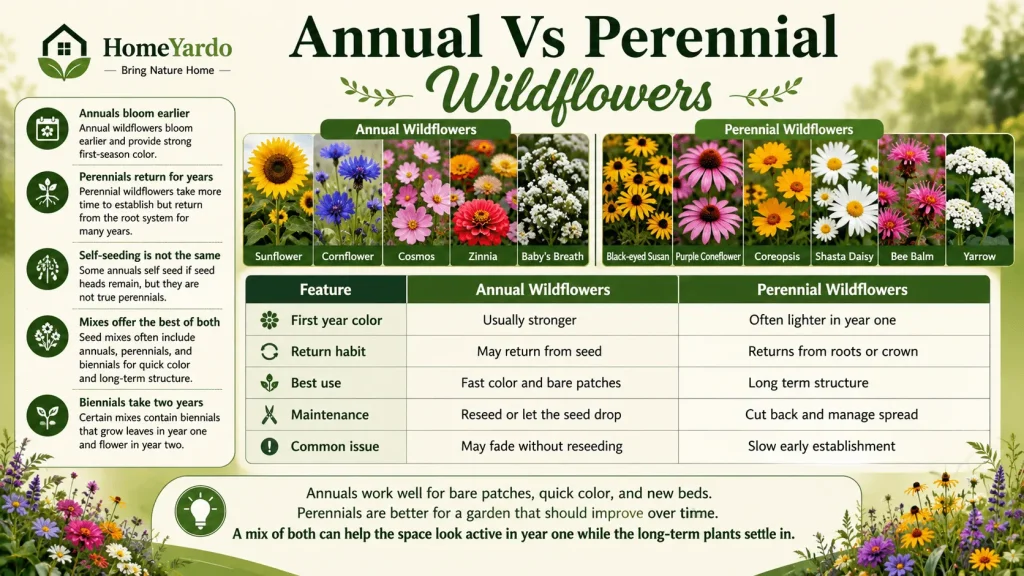
Wildflowers that are perennial and annual behave differently, and this decision should be made prior to purchasing seeds. The annual wildflowers usually bloom earlier and offer strong first-season colors. Perennial wildflowers typically require more time to develop; however, many of them return to the root system for a number of years.
Some annuals are able to self-seed in the event that seed heads remain in their place, self-seeding isn’t the same as being a perennial. Seed mixes usually contain perennials and annuals to provide quick colour and longer-term structure. Certain mixes also contain biennials that may develop leaves in the first year and flower in the second year.
| Feature | Annual Wildflowers | Perennial Wildflowers |
|---|---|---|
| First year color | Usually stronger | Often lighter in year one |
| Return habit | May return from seed | Returns from roots or crown |
| Best use | Fast color and bare patches | Long term structure |
| Maintenance | Reseed or let the seed drop | Cut back and manage spread |
| Common issue | May fade without reseeding | Slow early establishment |
Annuals work well for bare patches, quick color, and new beds. Perennials are better for a garden that should improve over time. A mix of both can help the space look active in year one while the long-term plants settle in.
Choose The Right Wildflower Seeds Or Plants
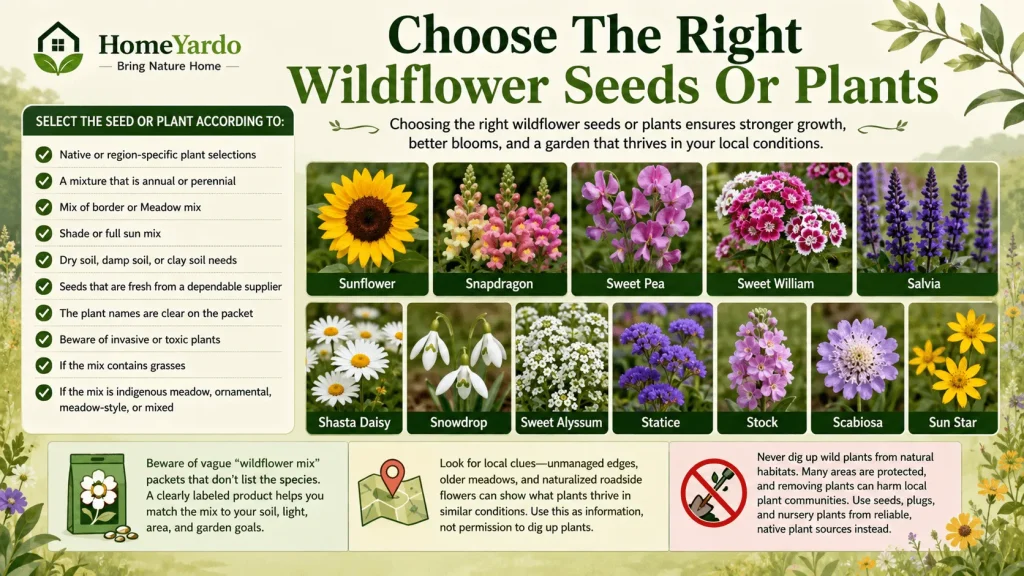
The choice of seeds should be in line with the area. A meadow that is full sun is not able to perform in similarly in shade. A soil that is damp won’t work well on dry slopes. A front yard’s border could require a shorter, neater plant rather than a sprawling backyard meadow.
Select the seed or plant according to:
- Native or region-specific plant selections
- A mixture that is annual or perennial
- Mix of border or Meadow mix
- Shade or full sun mix
- Dry soil, damp soil, or clay soil needs
- Seeds that are fresh from a dependable supplier
- The plant names are clear on the packet
- Beware of invasive or toxic plants
- If the mix contains grasses
- If the mix is indigenous meadow, ornamental, meadow-style, or mixed
Beware of the vague “wildflower mix” packets that don’t list the species. A clearly labeled product will help you determine if the mix is suitable for the soil, light, area, and the garden’s goal.
Local clues can also be helpful. The edges that are unmanaged, the older meadows, and naturalized roadside flowers can help determine what plants can handle similar conditions in light and soil. Use this as an information source, not for an authorization to dig up plants.
Don’t dig up wild plants out of natural habitats. There are many wild habitats that are protected and removing plants could damage the local community of plants. Make use of plugs, seeds and nursery plants or reliable native plant sources instead.
Wildflower Seeds Vs Seedlings, Plugs, And Turf
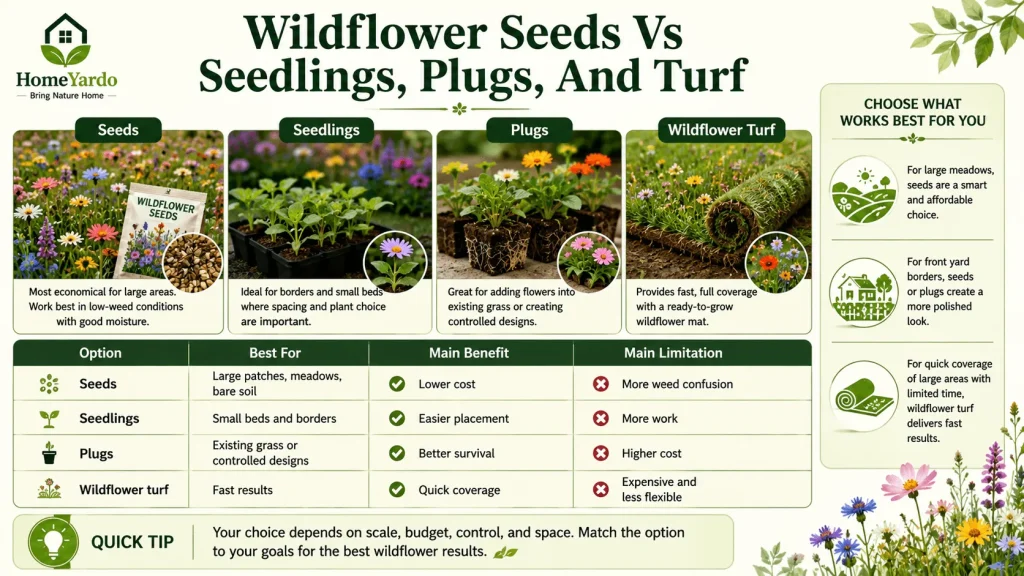
Seedlings or wildflowers are mostly a matter of scale, budget, control, and space. Seeds are typically the most economical choice for larger areas. They are effective when the soil is dry and weed pressure is minimal and the soil can be irrigated at the start of growth.
Seedlings and plugs work best for borders, small beds and zones where spacing is important. They are also more easily identified than the tiny seedlings that come from a mixed packet of seeds. Plugs are a great way to incorporate flowers to existing grass even if a complete lawn removal is not in the plans.
Wildflower turf provides greater coverage, but it also costs more and has less control over the mix of plants.
| Option | Best For | Main Benefit | Main Limitation |
|---|---|---|---|
| Seeds | Large patches, meadows, bare soil | Lower cost | More weed confusion |
| Seedlings | Small beds and borders | Easier placement | More work |
| Plugs | Existing grass or controlled designs | Better survival | Higher cost |
| Wildflower turf | Fast results | Quick coverage | Expensive and less flexible |
For a meadow that is large the seed can be a good option. If you want to create a border for your front yard seeds or plugs could provide a more attractive outcome. To cover a large area quickly in an area of a limited size grass can be used if you have the money.
Best Place To Start A Wildflower Garden
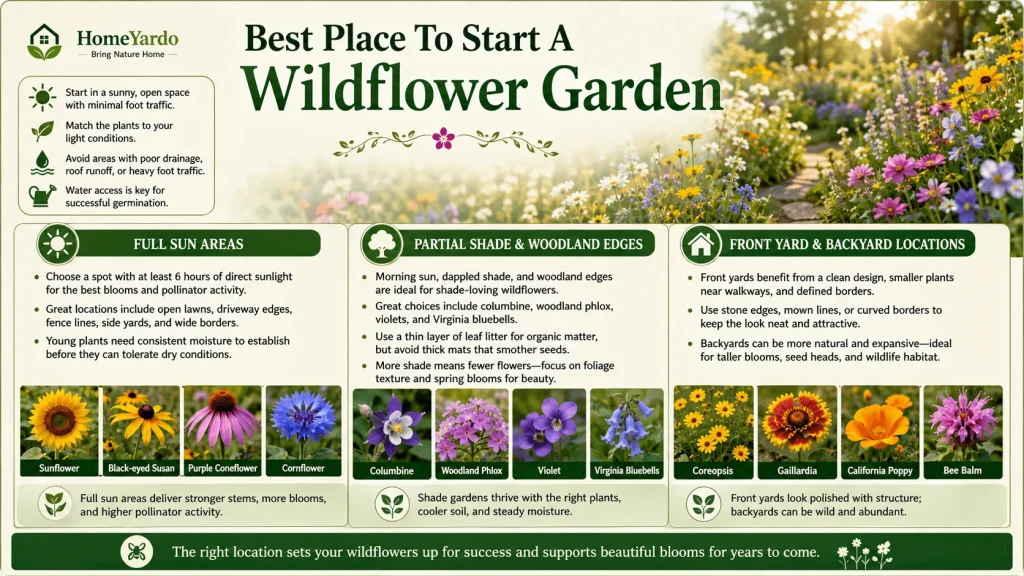
The best place to begin is typically a sunny, open space with minimal foot traffic and soil that is cleared prior to planting. A variety of meadow wildflowers require at least a few hours of direct sunlight to flower well.
Partially shade is still an option, but the plants need to be selected for the lighting conditions. The shade that is deep is more difficult to achieve and usually requires woodland plants instead of a typical meadow mix.
Avoid high-traffic zones in areas where roof runoff could remove seeds and in areas where water remains for a prolonged time. Access to the hose is also important in germination since young seedlings can’t dry out frequently.
Full Sun Areas
Areas with full sun are typically the most convenient places to start. Wide grass, stripe of driveway, sun-drenched fence lines side yards, as well as wide borders can all be effective provided the soil is well prepared.
The best practice is to choose a spot that receives at least 6 hours of direct sunlight for the most meadow-like seeds. A full-sun plant generally results in higher bloom densities, stronger stems and greater pollinator activity. If the site receives strong daily light, surrounding the patch with full sun plants can help the whole area look planned instead of isolated.
Young plants require moisture to establish. Even drought-tolerant wildflowers need time to develop roots before they can withstand dry days.
Partial Shade And Woodland Edges
Shade can support wildflowers when the plants are carefully selected. Morning sun, dappled tree shade as well as woodland edge are more beneficial than dark, heavy shade.
Columbine, woodland phlox, violets, Virginia bluebells and other similar species are excellent alternatives for soft shade than open meadow blooms. These plants require cooler soil and steady moisture.
The thin leaf litter is a great addition to an organic woodland plant. However, mats that are thick could drown tiny seeds. A lot of shade can produce less flowers. In areas that are shaded foliage texture as well as spring flowers and woodland-style growth are an integral part of the overall design.
Front Yard And Backyard Locations
The front yard wildflower garden should be designed to look professional. Make sure you have a clear design, smaller plants near the walkways, and an unobstructed border. This will help the look of the plant be designed, rather than overgrown.
A front yard could be required to comply with the local rules and regulations or neighborhood expectations. A neatly mown line, edge of stone or curved border may keep the appearance neat.
A backyard wildflower garden can be more open and more affluent. The meadow’s corner, fenceline or a pollinator island may provide more room for taller flowering plants, seed heads and shelter for wildlife.
Best Soil For Wildflowers
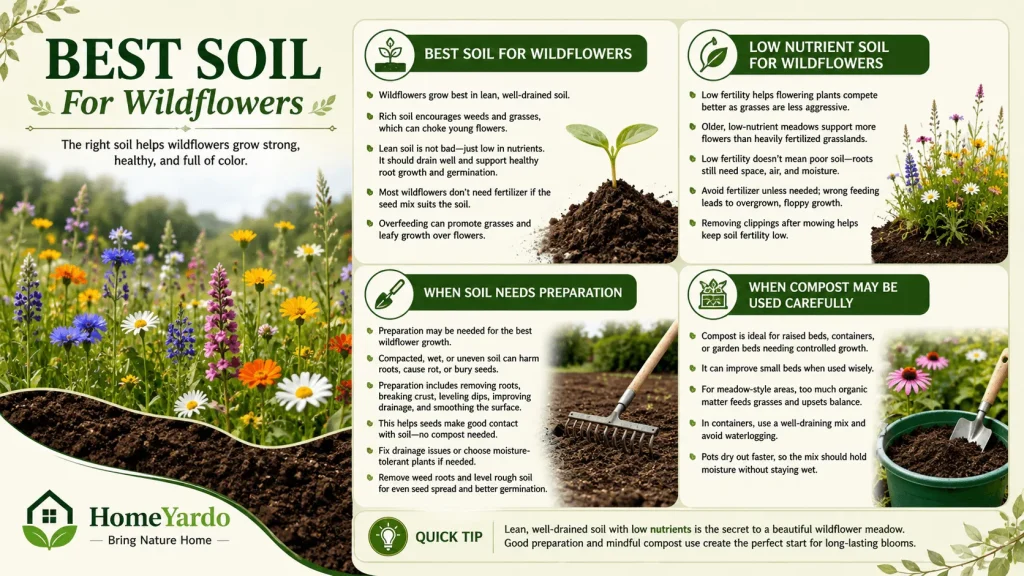
A variety of meadow wildflowers flourish best in a lean, well-drained soil. A rich soil usually gives the grasses and weeds a strong advantage, and can choke young flowers. Feeding meadows with seeds can make the meadow difficult to control.
Lean soil does not mean bad soil. It is a sign that the soil isn’t too abundant in nutrients. The soil should drain, allowing roots to grow and absorb enough moisture to support the germination process to take place.
Do Not Overfeed Meadow Soil: Most meadow wildflowers are not in need of fertilizer if the wildflower seed mix is suitable to the soil. Additional feeding may favor the growth of grass and leafy flowers.
Low Nutrient Soil For Wildflowers
The soil’s low fertility can aid in helping flowering plants compete since grasses are less aggressive when the soil isn’t well-fed. This is a reason why older meadows tend to have an array of flowers than lush grasslands that are regularly fertilized.
Low fertility doesn’t mean dry, compacted, or dead soil. The objective is to decrease the competition for nutrients, not to create poor soil conditions for root growth.
Do not apply fertilizer to a meadow-style seedbed unless you have an evident reason to do so in the soil and seed mix state. Incorrect feeding could result in an overgrown lawn with floppy growth and lower flowering. After a while, getting rid of the clippings following cutting may aid in keeping fertility low.
When Soil Needs Preparation
Preparing soil for wildflower seeds may be necessary. The soil that is compacted can prevent roots from growing properly. The soil that is wet can cause rot in seedlings. The soil that is sloppy can trap flower buds under more rapid growth.
Preparation may include cutting roots away, breaking the top crust or leveling dips, increasing drainage and forming a smooth surface to allow contact with seeds. This does not necessarily mean the addition of compost.
If drainage is not optimal, choose plants that are tolerant of moisture or fix the soil prior to planting. If there are weed roots, take them out first. When the soil is rough the seed may spread unevenly and the germination process may appear patchy.
When Compost May Be Used Carefully
Compost is a good option for raised beds, containers or garden beds in which the flowers you choose require an environment that is controlled for growth. It may also aid in improving the structure of a smaller bed if used with care.
For meadow-style areas, compost must be used with care. A lot of organic matter could provide nutrients to grasses, and can reduce the overall balance of the flowers.
In containers, choose a mix that drains easily and be sure to avoid waterlogging. Pots dry quicker than soil that is open, therefore the growing medium must hold some moisture but not be wet.
How To Prepare The Ground
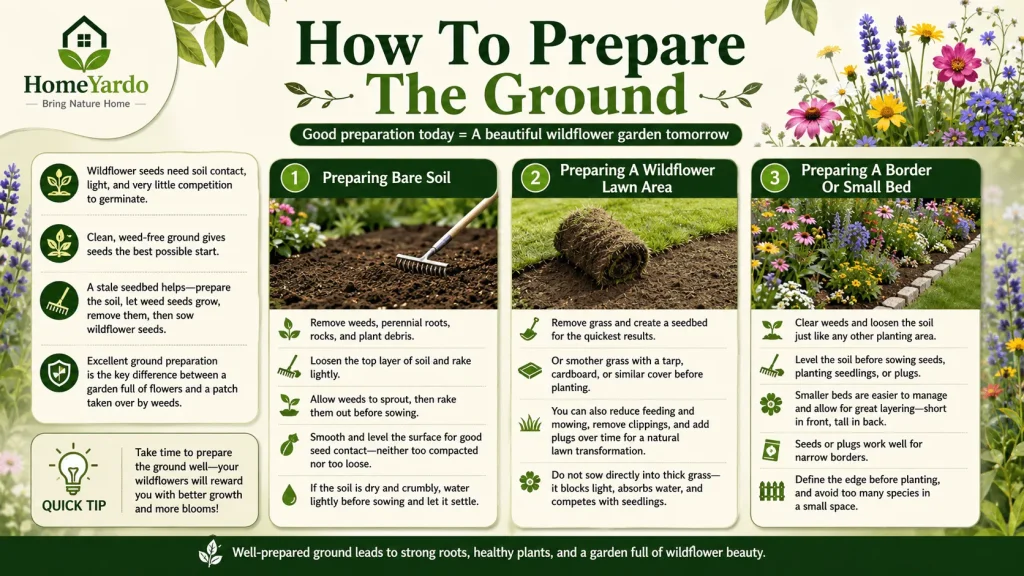
Wildflower seeds require contact with the soil, adequate light, and little competition to germinate. A thick lawn, roots of weeds that are old and a rough surface can all hinder success.
Excellent ground preparation is one of the major differences between a garden filled with flowers, and a patch that turns into dirt or is covered with weeds. A clean, weed-free ground provides seed with the cleanest starting point.
A seedbed that is rotten can aid. Make sure the soil is prepared, allow the seeds of weeds grow take them out, then trim the young weeds, and sow the seeds of wildflowers.
Preparing Bare Soil
Begin by eliminating visible weeds, root rocks, and other plants’ waste. Weed roots that are perennial should be taken care of as they could reseed through young wildflowers.
The top layer should be loosened slightly, then gently apply a rake to the soil. If you have time you, allow the soil to rest long enough to allow seeds of weeds to grow and then rake away those nascent seeds before planting.
Smooth the surface before planting. The soil must be smooth and level enough to allow seed contact but not compacted, powdery or waterlogged. If the soil is spongy and dry, lightly water the soil prior to sowing and allow the soil to become sluggish.
Preparing A Wildflower Lawn Area
A lawn requires more work since grass is a powerful adversary. The quickest method is to take away the grass and then create a seedbed. The other option is to cover the grass with a tarp, cardboard or another similar cover prior to planting.
Another option is to cut down on feeding, mowing and removing clippings, then add plugs as time goes on. This could result in a more natural lawn transformation but it isn’t without patience.
Don’t sow directly into the thick grass and anticipate an impressive flower show. It blocks light, absorbs water, and can compete with tiny seedlings.
Preparing A Border Or Small Bed
A bed or border should be cleared just like any other area of planting. Get rid of weeds, loosen the surface, and then level the soil prior to adding seeds, seedlings or plugs.
Smaller beds are simpler to manage than meadows with larger areas. They also work well in designs with smaller flowers at the front and larger flowers behind.
To create narrow borders, seeds or plugs could be more effective than mixed seeds. Be sure to define the edge prior to planting or sowing, but beware of excessively many species within an area that is tight.
When To Plant Wildflower Seeds?
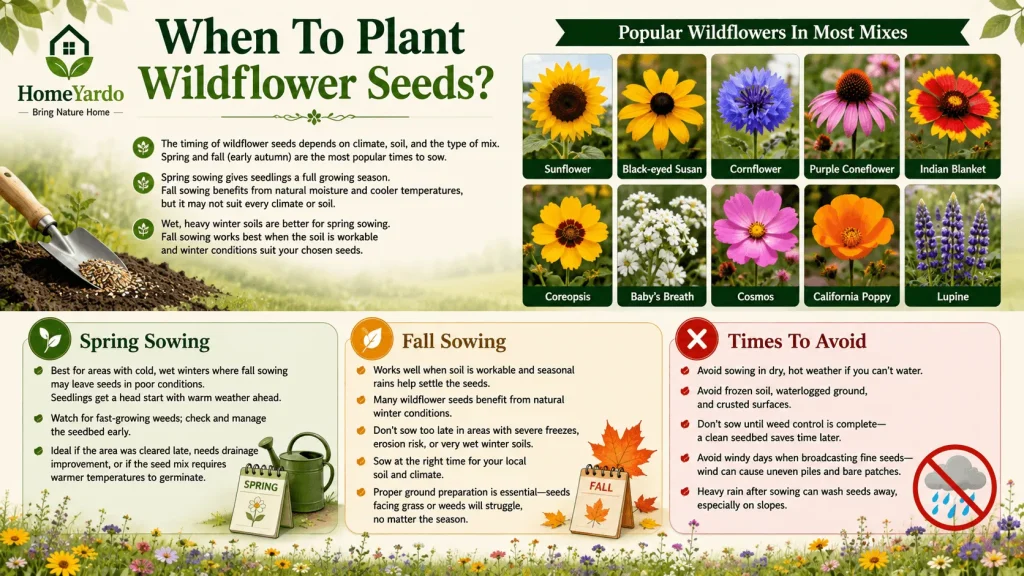
The timing of wildflower seeds is dependent on the climate, soil and the kind of mix. Spring and autumn in the early spring are the most popular time frames for sowing. Both are viable; they work in different climates.
Seedlings that are sown in the spring have an entire growing season. Fall sowing may benefit from natural humidity and cooler temperatures however it’s not the best choice for every climate or soil.
Wet winter soils usually suit more spring-time sowing. Sowing in the fall is more effective when the soil is able to work and winter conditions are suitable for the seed you choose.
Spring Sowing
Spring sowing is effective in areas where winters are heavy and wet soil is cold, and fall sowing could result in seeds being left to sit in poor conditions. Seedlings also get the chance to enjoy warm weather in the coming months.
The most significant issue is the emergence of weeds. The weeds that grow in spring germinate quickly, and the seedbed must be checked at the beginning of setting.
Spring can also be beneficial if the area of planting was cleared in the late stages, in cases where drainage needs to be corrected or if the seed mix requires warmer conditions for germination.
Fall Sowing
The fall sowing season can be successful when the soil is usable and the seasonal rain aids in the settling of seeds. Certain wildflower seeds respond well to winter’s natural conditions.
Do not plant too late in areas with extreme freezes, erosion danger or very moist winter soil. The seeds should be planted at a time that’s appropriate for the soil and climate of the area.
A fall-sown area requires proper ground preparation. Seeds that are scattered and turned into grass or weeds will struggle regardless of the time of year. is ideal.
Times To Avoid
Avoid sowing in dry, hot weather If you are not sure about watering. Do not freeze soils, water, and enlarged surfaces.
Don’t sow until the weed control process is completed. Cleanliness will help you work later.
Be aware of windy days when you broadcast fine seeds. Windy days can force seed into unbalanced piles and leave barren patches. The heavy rain that follows sowing could wash seeds away especially on slopes.
How To Plant A Wildflower In A Garden?
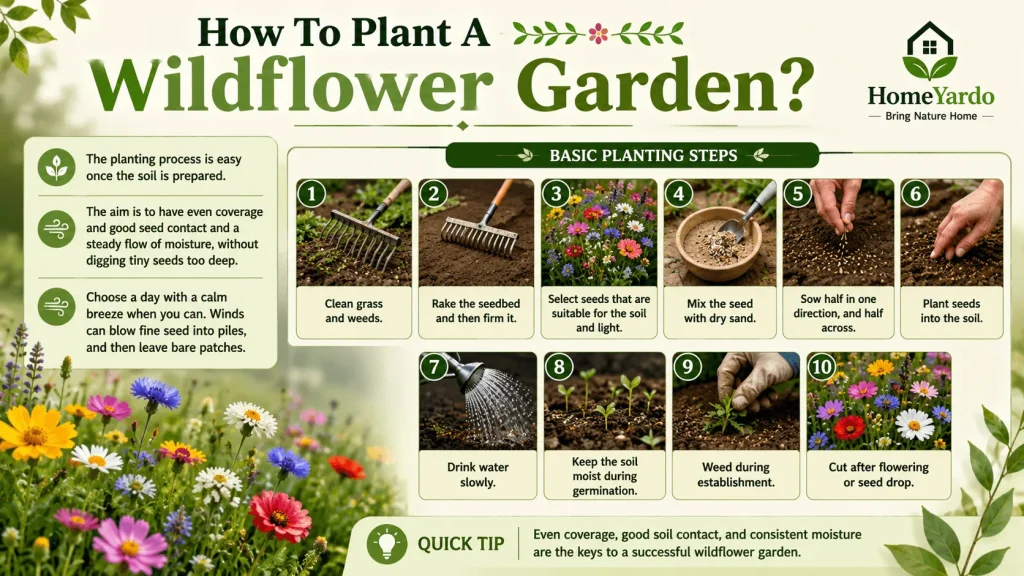
The planting process is easy once the soil is prepared. The aim is to have even coverage and good seed contact and a steady flow of moisture, without digging tiny seeds too deep.
Choose a day with a calm breeze when you can. Winds can blow fine seed into piles, and then leave bare patches.
How to Box: Basic Planting Steps
- Clean grass and weeds.
- Rake the seedbed and then firm it.
- Select seeds that are suitable for the soil and light.
- Mix the seed with dry sand.
- Sow half in one direction, and half across.
- Plant seeds into the soil.
- Drink water slowly.
- Keep the soil moist during germination.
- Weed during establishment.
- Cut after flowering or seed drop.
How To Sow Wildflower Seeds?
Take measurements of the area to plant before opening the packet of seeds. Utilize the seed rate suggested by the seller, since large sowings can result in an unbalanced, overcrowded growth.
Mixing fine seeds with sand that is dry will help spread the seed more uniformly. Sand makes it easier to determine the place where the seed has fallen. Spread half the mix in one direction and spread the remaining half over the entire area.
After sowing, push the seeds into the soil using the help of a roller, board, or gentle pressure from your feet. Be sure to water gently so that the seed isn’t sucked up into clumps. Keep the surface damp when germination is taking place, especially in dry conditions.
How Deep To Plant Wildflower Seeds?
A majority of wildflower seeds are tiny and shouldn’t be planted into the ground too deeply. A gentle pressing into the soil can be better than covering them in the soil in a thick layer.
If the seed is placed too deeply, it might not receive enough light or energy to grow. Always follow the directions on the packet for the particular mix.
Certain species have distinct needs. Therefore, you should not treat every seed the same. For a variety of mixed wildflowers small contact and consistent moisture is better than planting in deep.
Wildflower Germination And Wildflower Growth Stages
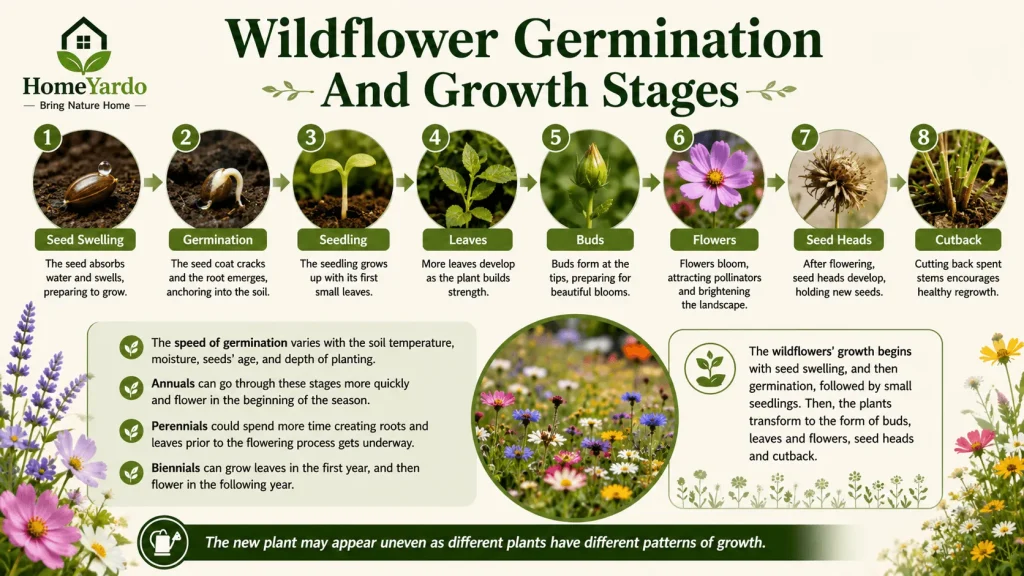
The wildflowers’ growth begins with seed swelling, and then germination, followed by small seedlings. Then, the plants transform to the form of buds, leaves and flowers, seed heads and cutback.
The speed of germination varies with the soil temperature, moisture, seeds’ age, and depth of planting. Annuals can go through these stages more quickly and flower in the beginning of the season. Perennials could spend more time creating roots and leaves prior to the flowering process gets underway.
Biennials can grow leaves in the first year, and then flower in the following year. The new plant may appear uneven as different plants have different patterns of growth.
Best Wildflowers To Plant By Garden Type
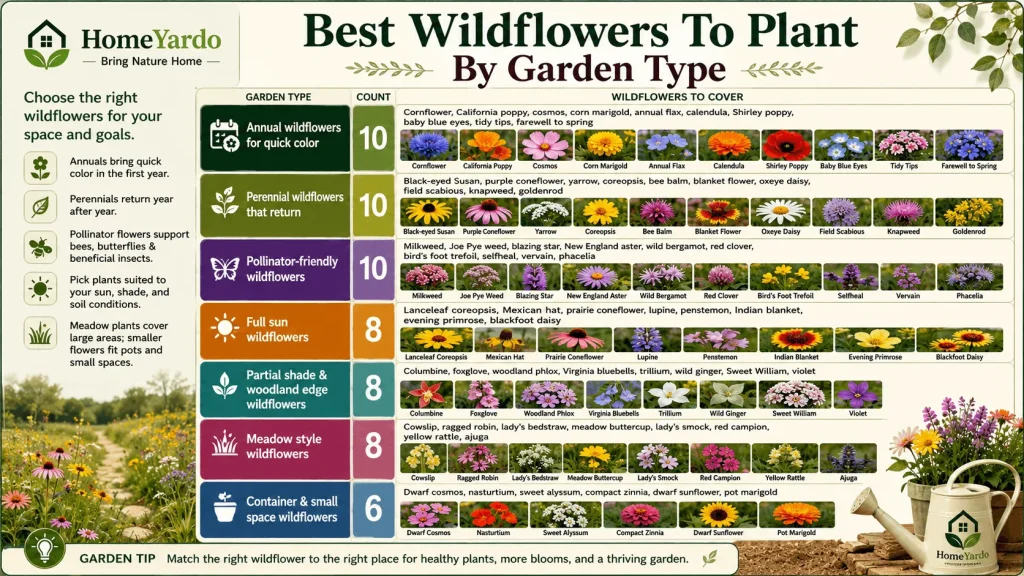
The choice of flowers should be based on the location and not the other way around. Small pots with a sunny meadow corner, the edge of a shaded tree, and pollinator borders all require various plants.
Annuals aid in the first year’s color. Perennials help to increase long-term returns. Flowers that pollinate support bees, butterflies, and beneficial insects. Shade and sun plants should be able to compete with the light that is available. Meadow plants are ideal for lawns, whereas smaller flowers work well in containers and smaller spaces.
The following options are classified according to garden usage, meaning it is possible to plant for rapid color change, long-term return pollinators, full-sun or partial shade, meadows and smaller spaces.
| Garden Type | Count | Wildflowers To Cover |
|---|---|---|
| Annual wildflowers for quick color | 10 | Cornflower, California poppy, cosmos, corn marigold, annual flax, calendula, Shirley poppy, baby blue eyes, tidy tips, farewell to spring |
| Perennial wildflowers that return | 10 | Black-eyed Susan, purple coneflower, yarrow, coreopsis, bee balm, blanket flower, oxeye daisy, field scabious, knapweed, goldenrod |
| Pollinator-friendly wildflowers | 10 | Milkweed, Joe Pye weed, blazing star, New England aster, wild bergamot, red clover, bird’s foot trefoil, selfheal, vervain, phacelia |
| Full sun wildflowers | 8 | Lanceleaf coreopsis, Mexican hat, prairie coneflower, lupine, penstemon, Indian blanket, evening primrose, blackfoot daisy |
| Partial shade and woodland edge wildflowers | 8 | Columbine, foxglove, woodland phlox, Virginia bluebells, trillium, wild ginger, Sweet William, violet |
| Meadow style wildflowers | 8 | Cowslip, ragged robin, lady’s bedstraw, meadow buttercup, lady’s smock, red campion, yellow rattle, ajuga |
| Container and small space wildflowers | 6 | Dwarf cosmos, nasturtium, sweet alyssum, compact zinnia, dwarf sunflower, pot marigold |
Annual Wildflowers For Quick Color
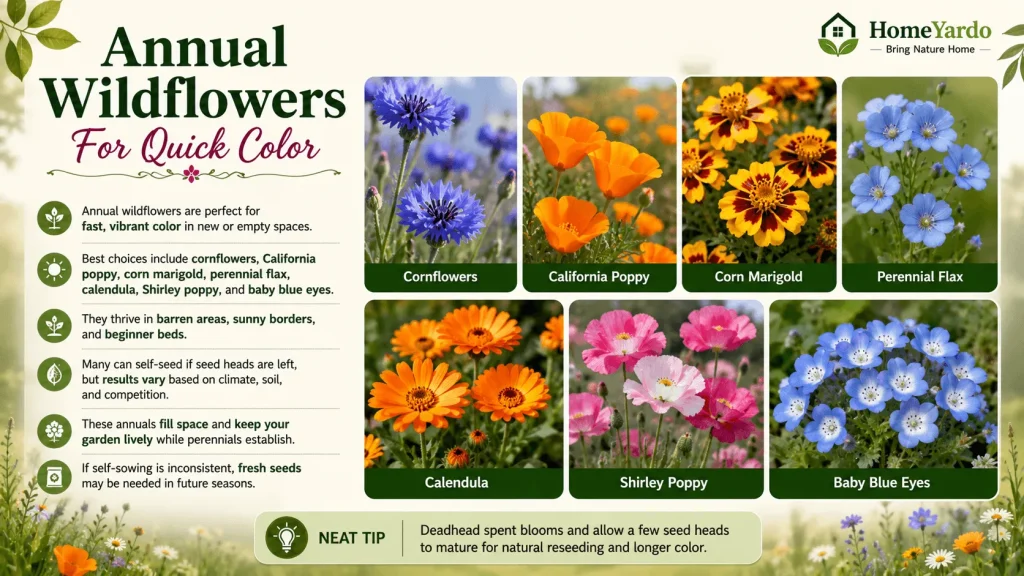
The annual wildflowers can be useful when you want to speed up blooming in a new area. It is a good idea to plant cornflowers. California poppy the corn marigold, perennial flax and calendula Shirley poppy and baby blue eyes. Neat tips, and a final goodbye to spring could help keep an active and fresh look to your plant during the initial season.
They do well in barren areas, with sunny borders and beginner beds. They can self-seed if the seed heads are left in however the results will vary based on the climate, soil and the competition.
The annuals can also fill up space while perennial wildflowers establish roots. If they fail to self-sow consistently, fresh seeds could be needed in future seasons. Fast blooming annuals can also be paired with summer flowers to keep the bed colorful after the earliest wildflowers begin to fade.
Perennial Wildflowers That Return Each Year
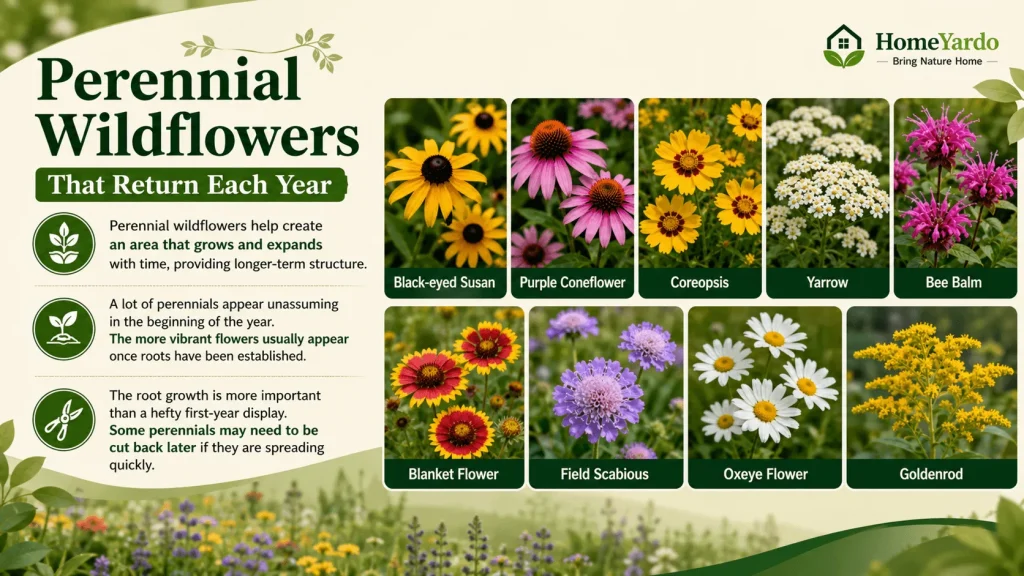
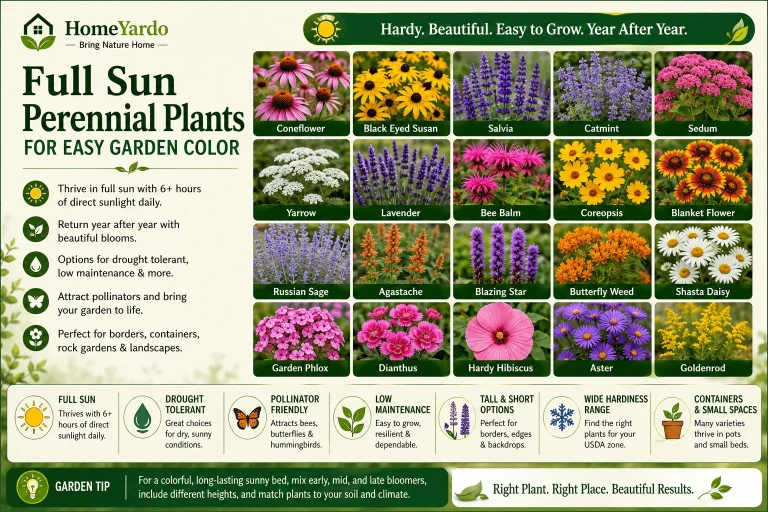
Perennial wildflowers can help create an area that grows and expands with time. Black-eyed Susan as well as purple coneflowers, coreopsis, yarrow, bee balm, blanket flowers, field scabious, oxeye flower and goldenrod. can provide longer-term structure. For a stronger returning border, mix wildflowers with full sun perennial plants that can handle the same open exposure and seasonal cutback routine.
A lot of perennials appear unassuming in the beginning of the year. The more vibrant flowers usually appear once roots have been established.
The root growth is more important than a hefty first-year display. Certain perennials may need to be cut back later if they are spreading quickly.
Pollinator Friendly Wildflowers
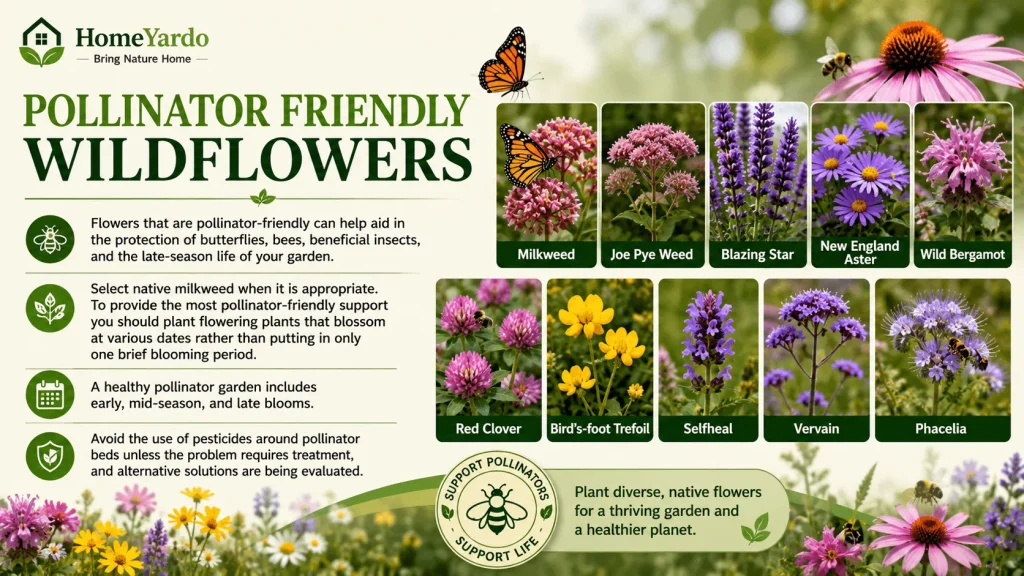
Flowers that are pollinator-friendly can help aid in the protection of butterflies, bees, beneficial insects, and the late-season life of your garden. Milkweed Joe Pye weed, the blazing star New England aster, wild bergamots, red clover, bird’s-foot trefoil, selfheal vervain, phacelia, and vervain all make good pollinator-friendly plants in the right conditions for the area.
Select native milkweed when it is appropriate. To provide the most pollinator-friendly support you should plant flowering plants that blossom at various dates rather than putting in only one brief blooming period. To support more nectar feeding visitors, add flowers for hummingbirds near the wildflower patch so the garden offers color and movement through more of the season.
A healthy pollinator garden includes mid-season, early, and late blooms if they are. Avoid the use of pesticides around pollinator beds unless the problem requires treatment, and alternative solutions are being evaluated.
Full Sun Wildflowers
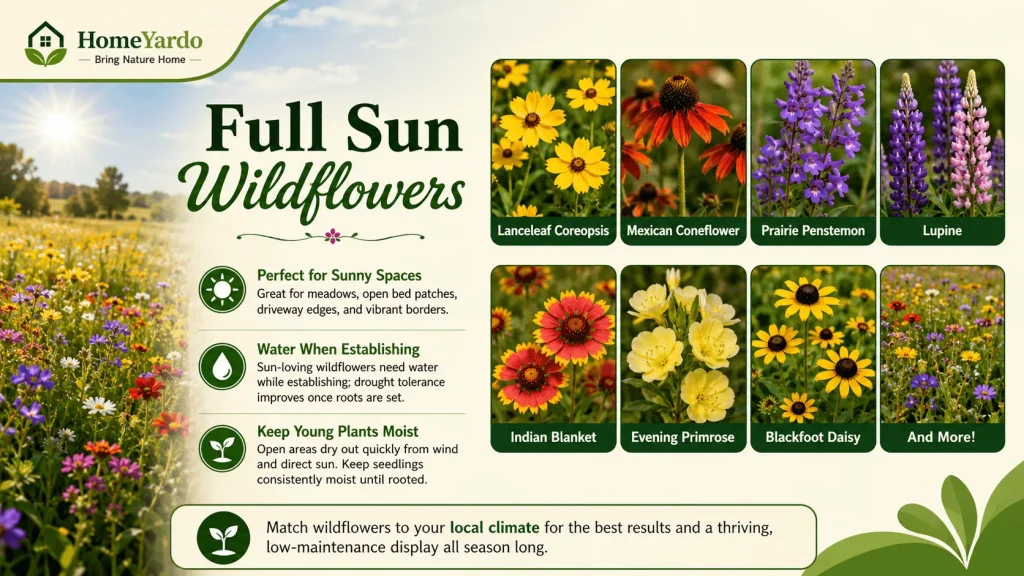
Full-sun wildflowers are great in meadows, open bed patch, edge of the driveway and vibrant borders. Lanceleaf coreopsis, Mexican coneflower, prairie penstemon, lupine Indian blanket evening primrose, as well as blackfoot daisies are suitable for locations with sunny weather, if they are matched to the local climate.
Sun-loving wildflowers require water during their establishment. The tolerance to drought usually improves once roots are established.
Open areas can dry out quicker due to the wind as well as direct sun. Make sure that young seedlings are kept humid until they’re rooted.
Partial Shade And Woodland Edge Wildflowers
Partially shaded areas and woodland edges require softer selections. Columbine, foxglove, woods Phlox, Virginia bluebells and trillium wild ginger Sweet William, and violet are all suitable if the area is dappled with light or early morning sun.
The shade that is heavy usually results in smaller flowers. In areas with shade the texture of leaves as well as spring flowers and woodland growth, becomes an integral part of the overall design.
The woodland edge plants usually prefer more shade and a steady flow of moisture. Avoid covering young plants with dense leaf mats, and anticipate a less dazzling display than a meadow with a sunny mix.
Meadow Style Wildflowers
Meadow-style wildflowers work well in large meadows, small meadows and lawn transformation projects. Cowslip as well as ragged robins lady’s bedstraw, lady’s smock yellow rattle, and ajuga are all able to provide a more natural meadow appearance as long as the area is suitable for them.
Yellow rattle is commonly used to weaken grass. However, it should fit the area and plant’s purpose. Meadow flowers must be selected according to the climate of the area and the surrounding soil.
Meadows require cutting and clipping removal in order to reduce grass pressure. If they don’t take care of it, stronger grasses could become dominant.
Container And Small Space Wildflowers
Small and compact gardens require smaller, more manageable options. Nasturtium, dwarf cosmos sweet alyssum and compact zinnia dwarf sunflower and pot marigolds are able to add a touch of wildflowers to patios, balconies, and smaller borders.
Containers require drainage holes, sufficient sunlight and a steady flow of water than ground-based plants. Smaller varieties generally are more attractive than meadows that are tall in pots.
Pots dry more quickly than open soil; make sure you check the moisture frequently in hot temperatures. Sorting pots by flower season will make a small area appear fuller for a longer period of time.
Wildflower Garden Ideas, Layout, And Landscaping
The wildflowers look best when the flower is clearly defined. Natural plants can be surrounded by paths, edges and flower groups that repeat, and also a clear path to access.
The aim is to create a garden that will look calm and organized. This is particularly important for front yards, close to walkways, and even in small areas.
A simple layout rule can work well:
- Determine the definition of edge.
- Repeat the process for 3 to five flower groups.
- Be sure to keep paths free of obstructions.
- Plant tall flowers away from the sidewalks.
- Make sure you have a focal point like a birdbath, benches, or a path.
Front Yard And Wildflower Backyard Ideas
For a front garden or front yard, create a neat line of fence along the driveway or sidewalk. Place shorter plants at the edges and larger plants further away. A bed with a curvature can appear more softer than a square patch.
For a backyard space, you can try a meadow corner or fence line patch the pollinator’s island or a side yard strip. A small bench, a birdbath or stepping stones, or even a path that is simple can make the garden feel like a as a part of the landscape instead of a patch that is unused.
The front yards require more structure since they’re more noticeable. Backyards can be a bit looser in size, taller, and dependent on wildlife, as long as the access for cutting and weeding is maintained.
Wildflower Garden Layout For Small Spaces
Smaller spaces require fewer varieties of plants. The excess of flowers and shapes can appear overcrowded. Mixing 5 to 7 well-matched flowers is usually enough for a modest border or edge of the patio. Repeating a few purple perennials can give a small wildflower border a calmer color pattern without making the planting feel crowded.
Utilize low-flowers in front, medium ones in the middle and higher flowers behind. Repeat the same plants in small groups so that the space feels serene and orderly.
Allow enough room to the plant for weeding, watering and cutting. A narrower wildflower strip is more manageable when the entire area is too far away from the border.
Wildflower Landscaping Around Paths, Fences, And Lawn Edges
Wildflower landscaping can soften hard edges. A gravel pathway through the flowers or a fence line or a walkway border or even a patio edge could create a space that feels more natural.
Small accents with rocks, a birdbath, an insect house or even a basic wooden bench could help to support the design without adding too much clutter to the garden. Make sure that access paths are clear so that maintenance can be done easily.
Set up insect houses near pollinator flowers. However, make sure they’re dry, stable and out of areas that are inundated. Simple paths through a larger area will make the area easier to appreciate and maintain.
Wildflower Garden Border
A wildflower border in your garden is among the simplest ways to begin. Borders are used to protect driveways or fences, patios and fences. They also work alongside paths, vegetable gardens along lawn borders.
Utilize smaller flowers close to the walkway edge, and larger plants further back. Repeat a few plants along the border to create a more streamlined design. A mowed edge or brick line, stone border or a metal edging can to define the plant.
A basic border formula is:
- Flowers in a small vase at the front
- Medium bloomers with a middle
- The taller wildflowers are at the back
- Multiple groups of people every couple of feet
- A sharp edge or mown to keep the line clear
Borders are usually more straightforward than converting a lawn to a full one due to the fact that the area is smaller, less controlled and is easier to manage.
How To Convert A Lawn Into A Wildflower Garden?
Converting a lawn into a wildflower requires patience since grass is a fierce competitor. The best approach is based on the speed at which results are required and how much grass is required to be left.
A complete lawn replacement isn’t the only option. A meadow corner, or a strip of fencing can be more convenient to manage and test.
Example small lawn corner conversion. A 15 x 20-foot lawn corner can be converted by removing the turf and raking the area then sowing an annual or perennial mix, while keeping a an edge mowed around the corner. Flowers from the year can give an initial season of color, whereas meadow and perennial plants grow slowly over time in the later seasons.
Fast Lawn Conversion
The fastest conversion begins by getting rid of the turf. After the grass is gone clean the soil and level it then sow the seed in a uniform way pressing it in and then gently water.
This method requires more work in the beginning; however, it provides seeds of wild flowers in the garden with a more streamlined start. It’s ideal when fast setting is needed and the area is cleared.
Slow Lawn Conversion
Slowly converting keeps an area of lawn in place while altering the way it is managed. Stop feeding the lawn and avoid using weedkillers, mow less frequently, and then remove the clippings that reduce fertility over time.
Plugs can be placed in the grass to create the appearance of the flowers slowly. This process is slower but it’s less disruptive.
You can expect gradual changes over the course of several seasons. The lawn might appear mixed for a few weeks before the flowers become a constant portion of the lawn.
Mini Meadow Corner
Mini meadow corners can be an excellent option for beginners. It makes the majority of the lawn accessible while testing the wildflowers’ performance on the space.
Draw the area in a clear way and maintain neat edges around the area. A clearly defined corner appears intentional and is easy for you to understand, keep and extend later.
If the first year is manageable, then the patch could be expanded the following year. If weeds or grass prevail, the smaller patch can be trimmed to make it easier.
How To Maintain A Wildflower Garden?
The maintenance schedule changes as the garden grows. The first phase is all about water and weed control. The next stage is about cutting, dropping seeds as well as thinning and stopping grass from gaining control.
A proper maintenance program can help the garden remain lush and flowering instead of transforming in weeds and tall grass. Maintenance in the first year could be different from what is recommended for an old meadow. So be aware of the plant rather than adhering to an exact schedule.
First 4 To 6 Weeks
Make sure the seedbed is kept damp until the seeds sprout. Water the seed gently, do not water it so that it forms piles. Please do not walk on the area.
Be on the lookout for weeds that grow rapidly and remove them before they cast a shadow over the young seedlings. Don’t fertilize at this phase.
A steady, light watering is preferable to hard watering. The objective is to stop the soil from drying out when seedlings are tiny.
First Summer
Hand-weed plants that are aggressive that are difficult to remove. In dry spells when seedlings are losing their vigor or the soil cracks.
Perennial seedlings can appear smaller in the initial summer. Don’t judge the entire planting by the first season’s flowering if the mix includes numerous perennials.
A dense perennial mix might appear more leafy than lush initially. Stop invasive weeds to avoid shading plants, and give root systems time to grow.
Autumn Cutback
After flowering, let the seed heads to mature in case reseeding is needed. Cut them back after the display is finished and the seed has been allowed to drop.
Cut the material for a few minutes when you wish to collect seeds and then take it off. Large pieces of material left on the ground could drown young plants and provide food for grass.
The meadows are often cut off after flowering and the seeds fall. Certain guidelines cut perennial meadows that are typically low, between 4 and 10 cm. However, timing and size should be based on the seed mix depending on the climate of the area and the type of garden.
Year Two And Beyond
Perennial wildflowers usually improve their second season. Cut at the proper moment, taking clippings off as well as thinning spreaders and overseeding areas that are bare when necessary.
Check for signs of grass buildup. If you notice that grass is becoming dominant the landscape, you can reduce fertility by removing clippings, and look into adding appropriate plugs.
Overseed the bare patches after you have determined the root of the problem. If the problem was due to poor drainage, shade and grass competition, new seeds alone won’t solve the problem.
Wildlife Safe Cutting
Large meadows are a good place to hide small animals. Prior to cutting or mowing, make sure you be sure to look for nesting birds and small mammals, amphibians and other animals.
Cut slowly and gradually, working from the center to the outside whenever possible, so that wildlife can have a chance to be able to move on. If you live in a larger area, be cautious about cutting during nesting season when it is appropriate.
A well-cut garden is protected by wildlife and keeps the plants healthy for the next cycle.
Common Wildflower Garden Problems And Fixes
The majority of wildflower issues stem from timing, soil, seeds, contact with water, weeds or a wrong choice of plant. The solution is typically simpler once the root cause is found earlier.
- The seeds didn’t grow. The soil could have been drained, or the seeds may be old, or it might be buried too deeply. Re-seed the seed with fresh seeds. Press it into the surface and ensure that the soil remains damp.
- The grass took over: space may be too fertile or the turf wasn’t weakened prior to planting. Take out clippings, stop feeding and look into plugs or reseeding areas that are bare.
- The seedbed was dominated by weeds: It might not have been properly prepared. Get rid of weeds with a strong odor early, and let a fresh flush of weeds to develop before sowing again.
- A patchy growth pattern was observed: uneven sowing winds, birds, or poor contact with the seed could be the reason. Mix the seeds with sand that is dry and push it down more uniformly.
- There were no flowers in the year one. The mix could be primarily perennial. Incorporate annuals to get the first color, while perennials get settled.
- The soil may have become too rich. The planting may be too dense or the flowers that are tall may not have enough support. Don’t feed and thin the crowded areas.
- The garden was messy. The space may not be well-formed. Make sure to trim the edges or border, a path or repeating flower groups.
- The wrong mix of seeds has been used. Shade moist soil or the local climate might not be in line with the seed mix. Replace the mix with plants that are suitable for the area.
- Cutting occurred too early. Seed heads might not have developed. Refrain from cutting if self seeding is a part of the strategy.
- The seed was not sown sufficiently. Seedlings with a lot of seedlings may grow weak. Be sure to follow the seed rate and packet coverage instructions.
Weed Or Wildflower: How To Tell The Difference
Wildflowers that are young and weeds that are old can appear similar. Weeds are usually plants that grow in places where it is not desired; however, certain plants that are aggressive could block the planned wildflower areas.
Keep seeds in seed packets, lists of plants as well as photos of your anticipated seeds. Photographs taken every week can aid in keeping track of the growth rate and at what speed. If you are unsure it is best to allow a few plants to grow long enough to allow for a clearer identification except for invasive plants.
Signs A Plant May Be Wanted
A plant might be desired when it is found in the area of sown that repeats in small groups and is a match to the seed packet or the list of plants. It might also look like well-known wildflower seedlings in the mix you choose.
Growth that is slow, even usually less noticeable than a sudden, aggressive growth. The majority of wanted flowers begin with a small size before they become more well-known.
A desired plant could be growing at a similar speed as seedlings that are nearby. It is more secure to match several indicators than to rely on the shape of a single leaf.
Signs A Plant May Be A Weed
A plant can be classified as an invasive plant if it grows more quickly than the nearby seedlings or clogs the bed, spreads out from roots that are long gone, or is out of the plant’s area.
The noxious or local invasive weeds must be eliminated as soon as they appear. If identification is not clear, local nurseries, an extension service or a regional plant group may be able to help.
Don’t let an unidentified aggressive plant spread seeds. One year of unintentional control of weeds could cause the next season to be more difficult.
How To Make A Wildflower Garden Look Tidy
A garden with wildflowers can appear natural, yet still be structured. The primary distinction between a planned garden and a neglected area is the shape.
Utilize a mown edge brick line, stone border, metal edging or a curving path to highlight the point at which your garden starts and ends. Plants that are taller should be kept away from walkways and smaller flowers should be placed in the vicinity of paths.
Repeated flower groups are also helpful. Instead of scattering numerous single plants around, you can repeat the same species or colors in small swaths. A birdbath, bench and stepping stones, or a simple pathway can help create a space that feels designed.
Clean edges, repeating flower groups, visible paths, smaller plants close to walkways, taller plants further from the edges, and the cutback of the season.
Cutbacks for the season are also important. A garden that has been cut in the right way and free of heavy debris will appear neater and perform better.
What Not To Do When Starting A Wildflower Garden
Little mistakes can impede the planting of wildflowers for the entire season. Be aware of the most common issues before planting.
- Don’t throw seeds into the thick grass.
- Do not add fertilizer to meadow soil without having a good reason.
- Don’t buy random seed mixes, without first checking the area and name of the plant.
- Don’t plant wildflowers that are invasive.
- Don’t cut the seed before the heads have matured unless following the specific plan for establishment.
- Do not cut off any large pieces on the plant.
- Don’t anticipate perennial meadows to reach their be at their best in the first year.
- Do not forget to water during germination.
- Don’t overlook the seeds’ area coverage and the rate of sowing.
An early start can save more time than attempting to fix grass, weeds, or patches of growth later.
Conclusion
A successful wildflower plantation begins with the perfect location, rather than just the seed pack. Sunlight soil, weed control, and the choice of seeds, as well as early watering all affect the final result.
Make sure the soil is well prepared. Avoid fertilizers that are not needed and sow at the correct timing, and keep the young plants moist until they are settling. When flowers have finished, trim the flowers at the right time, and then take away big pieces of foliage so that the plant can return to a more balanced state.
Begin with a small area and observe how it develops over the course of a season, and then grow it until the mixture is suited to the space. If the first garden is performing well, it can be expanded with better flower selections and fewer mistakes.
FAQ’s
You can scatter wildflower seeds on prepared bare soil, but throwing them into thick grass usually gives poor results. Prepared soil is different from a dense lawn. Seeds need soil contact, moisture, and low competition from turf or weeds.
Some wildflowers are perennials and return from the roots. Others are annuals that may return only when they drop seed and conditions allow those seeds to germinate. Biennials may grow leaves in year one and bloom in year two.
Wildflowers can be annuals, perennials, or biennials. Seed mixes often combine fast blooming annuals with slower perennials for both first year color and long term return. Check the packet if the return habit matters.
Most meadow style wildflowers grow best with several hours of direct sun. Partial shade can work when the mix includes shade tolerant plants such as columbine, violets, woodland phlox, or bluebells. Woodland choices suit shade better than standard meadow mixes.
A lawn is grass dominant and kept short with regular mowing. A wildflower is managed for flowering plants, pollinators, seasonal color, and a more natural growth pattern. It also does not tolerate foot traffic like turf.
Seeds are better for larger areas and lower budgets. Seedlings or plugs are better for small beds, borders, or places where spacing and plant choice need more control. Plugs can also help add flowers to existing grass.
Some wildflowers can grow in partial shade or woodland edge conditions. Dappled shade and morning sun usually perform better than deep shade. Full shade is harder and needs shade suited plants rather than a standard full sun meadow mix.
A garden can replace part or all of a lawn, but it will not act like turfgrass. It needs different care, including seasonal cutting, removing clippings, and managing grass competition. It is best started in a small test area.
Germination depends on species, soil temperature, moisture, seed age, and planting depth. Some annuals grow and bloom in the first season. Many perennials focus on roots and leaves before stronger flowering begins later.
Some wildflowers spread by seed, roots, or clumps. This can help fill bare areas, but strong spreaders may need thinning if they crowd slower plants. A balanced garden needs both return and control.
The easiest option is a small sunny patch with prepared bare soil, clear edges, and a suitable annual and perennial seed mix. It is easier than converting a whole lawn at once. A small start also makes watering and weeding simpler.
Wildflower seeds may fail if the soil dries out, the seed is old, the seed is buried too deeply, or grass and weeds compete too strongly. Most mixes need clean soil contact and steady moisture during germination. Reseeding works best after the original cause is fixed.
Most meadow-style wildflowers do not need fertilizer when the seed mix suits the soil. Fertilizer can encourage grass and leafy growth, which may crowd out flowers. Containers and raised beds are different and may need a controlled growing mix depending on the plants chosen.
Keep wildflowers alive by choosing plants that match the site’s sun, soil, and moisture. Water gently during germination and early growth, then reduce watering once roots are established unless the weather is very dry. Remove aggressive weeds early, avoid fertilizer in meadow-style areas, and cut back after flowering so the planting can return in balance.
Cut wildflowers after the main flowering period, especially if the seed heads have had time to mature and drop. Use shears, a trimmer, or a mower set high enough for the planting type. Let the cut material sit briefly if the seed still needs to fall, then remove heavy clippings so they do not smother young plants or feed grass.
Plant wildflowers in a field by removing or weakening existing grass and weeds before sowing. Choose a seed mix suited to the field’s soil, drainage, sunlight, and local climate. Broadcast the seed evenly, press it into the soil for contact, water gently if needed, and manage the field with seasonal cutting and clipping removal after flowering.
Wildflower care involves keeping the soil lightly moist while seeds germinate and removing fast-growing weeds early. Avoid fertilizer in meadow-style areas because rich soil can help grass outgrow the flowers. After blooming, let seed heads mature if reseeding is wanted, then cut back and remove heavy clippings.
Plant a wildflower field by clearing existing grass and weeds before sowing. Choose a seed mix suited to the field’s soil, drainage, sun exposure, and local climate. Broadcast the seed evenly, press it into the soil, water gently if needed, then cut after flowering and remove clippings.
The best time to plant wildflower seeds is usually early spring or fall, depending on the climate and seed mix. Spring works well in cold or wet-winter areas, while fall can work where soil stays workable and seasonal moisture helps. Avoid sowing during hot drought, frozen soil, waterlogged ground, or windy weather.
Small garden ideas include a patio border, fence-line strip, front yard patch, container group, or mini meadow. Use fewer flower types and repeat them in small groups so the space looks planned rather than crowded. Add a clean edge, stepping stones, a gravel path, or small birdbath to give the planting structure.
Referencs