Best Hanging Plants For Indoors: Best Picks for Baskets, Shelves, and Walls
Indoor hanging plants provide the greenery without taking up the flooring space. They are ideal for kitchens, bathrooms, apartment and, bedrooms, offices, shelves, and windows where a plant isn’t suitable.
The best option is determined by the humidity, light and pot weight, as well as the location of the room and the pet’s safety. Certain plants are tall trailing vines. Some plants are arching above the planter. Other designs look great in mounted plants, wall displays, or pots with small heights.
This guide will cover 25 names for plants including botanical names, care photos, room arrangement lighting options, low-light choices flowers as well as pet safety information, hanging ideas that don’t require drilling and the most common issues.
Begin with the lighting level first, and then align the plant with the room, the care level and the hanger setup.
Quick Answer: What Are Best Plants To Hang Indoors?
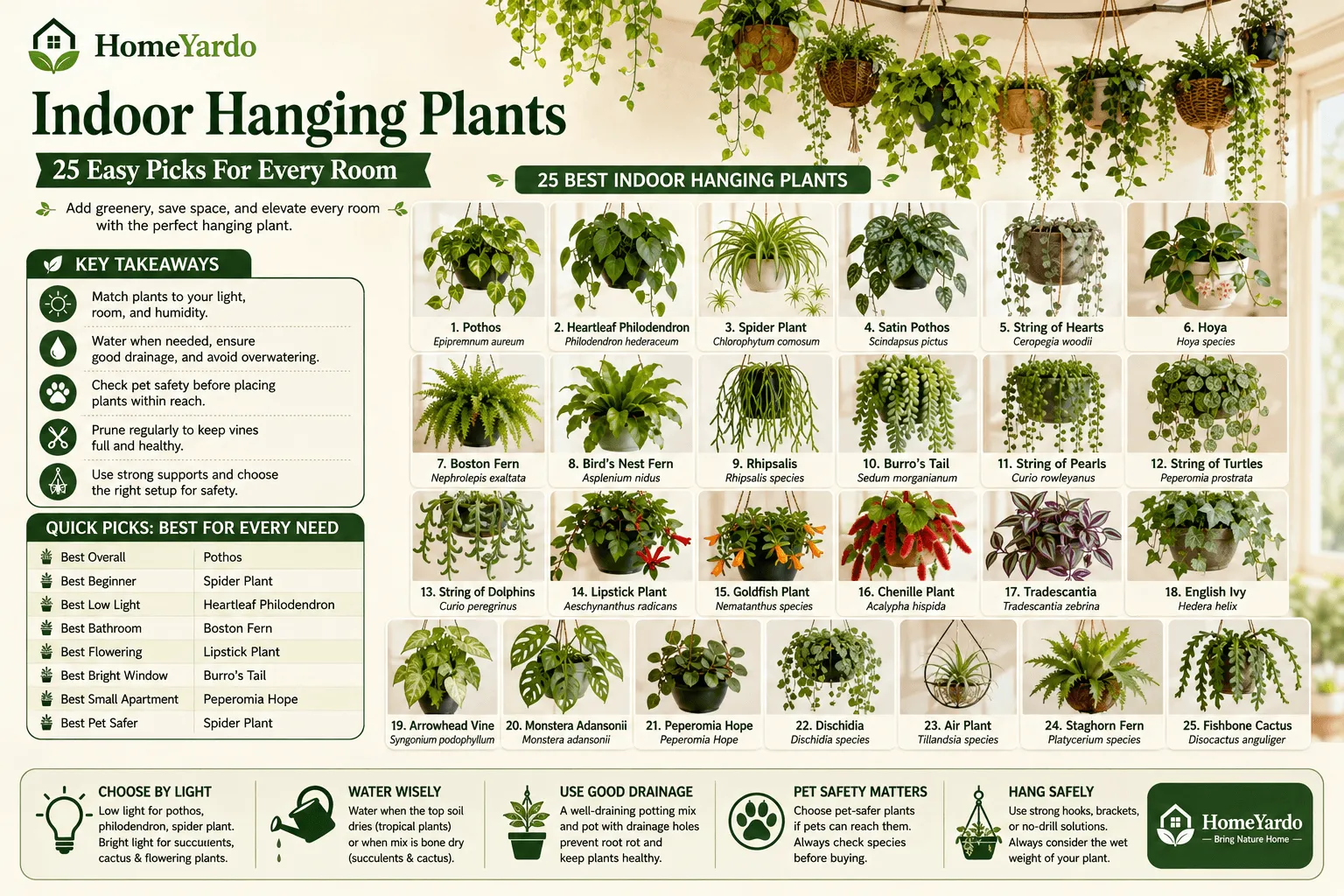
The most suitable indoor plants for the majority of homes are pothos, heartsleaf, spider plants, philodendron satin pothos string of hearts hoya Boston the fern, rhipsalis lipstick plant and the burro’s tail.
Pothos is the most effective all-round choice for growing trails. Spider plants are a great beginner plant and is a pet-safe option. Heartleaf philodendron handles lower indoor light well. Boston Fern is suitable for humid areas while burro’s tail as well as string of pearls require better lighting.
| Need | Best Pick |
|---|---|
| Best overall | Pothos |
| Best beginner plant | Spider plant |
| Best low light vine | Heartleaf philodendron |
| Best bathroom plant | Boston fern |
| Best flowering choice | Lipstick plant |
| Best bright window plant | Burro’s tail |
| Best small apartment plant | Peperomia Hope |
| Best pet safer choice | Spider plant |
Hanging Plants For Indoors: At A Glance
Make use of this information when choosing plants. The plant should be matched to the room first, and then examine the lighting and water levels, as well as the level of care and pet safety situations to stay clear of.
| Plant | Botanical Name | Best For | Light | Water | Care Level | Pet Safety | Best Room | Avoid If |
|---|---|---|---|---|---|---|---|---|
| Pothos | Epipremnum aureum | Best overall trailing plant | Low to bright indirect | Let the topsoil dry | Easy | Toxic if eaten | Living room, office | Pets chew plants |
| Heartleaf Philodendron | Philodendron hederaceum | Soft trailing vines | Low to medium indirect | Let top soil dry | Easy | Toxic if eaten | Bedroom, office | Pets reach vines |
| Spider Plant | Chlorophytum comosum | Beginner and pet safer homes | Bright indirect | Partly dry soil | Easy | Generally safer | Kitchen, bedroom | Very dark rooms |
| Satin Pothos | Scindapsus pictus | Silver patterned leaves | Medium to bright indirect | Partly dry soil | Easy | Toxic if eaten | Office, living room | Pets chew plants |
| String Of Hearts | Ceropegia woodii | Long delicate trails | Bright indirect | Partly dry soil | Easy to moderate | Check species | Bedroom, bright shelf | Wet soil |
| Hoya | Hoya species | Long lived waxy foliage | Bright indirect | Partly dry mix | Moderate | Check species | Living room, bedroom | Very low light |
| Boston Fern | Nephrolepis exaltata | Humid rooms | Bright indirect | Lightly moist | Moderate | Generally safer | Bathroom, kitchen | Dry air |
| Bird’s Nest Fern | Asplenium nidus | Arching foliage | Bright indirect | Lightly moist | Moderate | Generally safer | Bathroom | Water in crown |
| Rhipsalis | Rhipsalis species | Trailing cactus look | Medium to bright indirect | Partly dry mix | Easy | Check species | Office, bedroom | Heavy wet soil |
| Burro’s Tail | Sedum morganianum | Sunny hanging succulent | Bright light | Dry between watering | Moderate | Check species | Bright window | Basket gets bumped |
| String Of Pearls | Curio rowleyanus | Beaded trailing stems | Bright light | Dry between watering | Higher care | Toxic if eaten | Bright window | Dim rooms |
| String Of Turtles | Peperomia prostrata | Small hanging pots | Bright indirect | Partly dry soil | Moderate | Check species | Office, small room | Oversized pot |
| String Of Dolphins | Curio peregrinus | Novelty succulent | Bright light | Dry between watering | Moderate | Check species | Bright window | Low light |
| Lipstick Plant | Aeschynanthus radicans | Flowering hanging plant | Bright indirect | Slightly moist | Moderate | Check species | Living room | Cold rooms |
| Goldfish Plant | Nematanthus species | Orange flowers | Bright indirect | Slightly moist | Moderate | Check species | Kitchen, living room | Soggy soil |
| Chenille Plant | Acalypha hispida | Bold red hanging flowers | Bright light | Even moisture | Higher care | Check species | Bright room | Low light |
| Tradescantia | Tradescantia zebrina | Fast colorful growth | Bright indirect | Partly dry soil | Easy | Use caution | Living room | No pruning |
| English Ivy | Hedera helix | Classic trailing vine | Medium to bright indirect | Lightly moist | Moderate | Toxic if eaten | Cool bright room | Pets chew leaves |
| Arrowhead Vine | Syngonium podophyllum | Humid trailing growth | Medium to bright indirect | Partly dry soil | Easy | Toxic if eaten | Bathroom, kitchen | Pet access |
| Monstera Adansonii | Monstera adansonii | Bold trailing leaves | Bright indirect | Partly dry soil | Moderate | Toxic if eaten | Living room | Small pet areas |
| Peperomia Hope | Peperomia Hope | Compact trailing plant | Medium to bright indirect | Partly dry soil | Easy | Check species | Office, shelf | Frequent watering |
| Dischidia | Dischidia species | Small epiphyte display | Bright filtered | Partly dry medium | Moderate | Check species | Bright shelf | Dense wet soil |
| Air Plant | Tillandsia species | Soil free hanging display | Bright filtered | Soak or mist | Moderate | Check species | Kitchen, bathroom | No airflow |
| Staghorn Fern | Platycerium species | Mounted hanging plant | Bright indirect | Moist mount or basket | Moderate | Check species | Living room | Dark dry wall |
| Fishbone Cactus | Disocactus anguliger | Zigzag trailing stems | Bright indirect | Partly dry mix | Moderate | Check species | Bright room | Waterlogged mix |
What Are Hanging Plants Indoor?
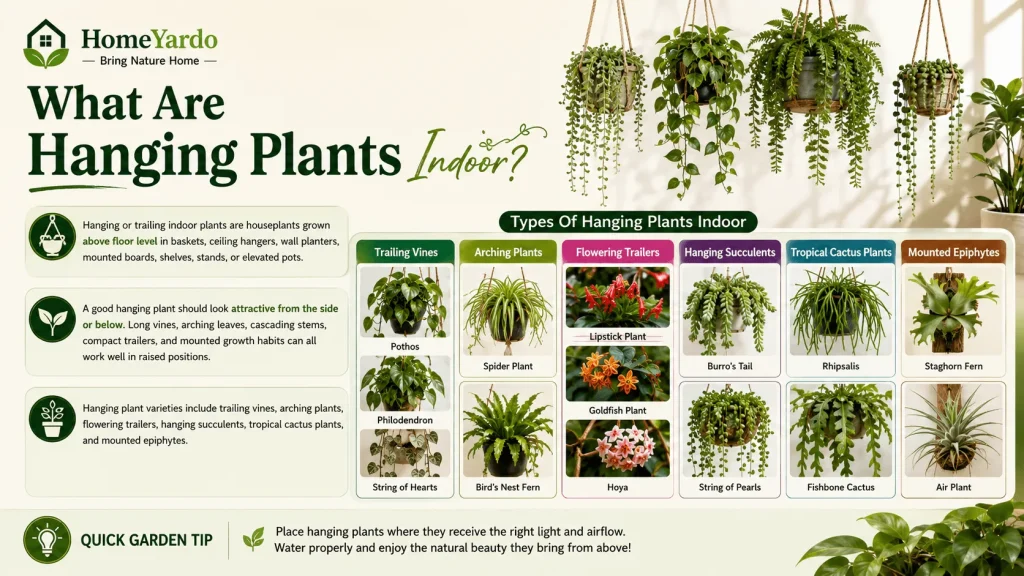
Plants that hang or trail in indoors are plants that are grown indoors above ground level in baskets or planters for the ceiling, wall hangers with shelves, boards mounted on a stand, or elevated pots.
A well-groomed hanging plant must be appealing on the sides or down below. The long vines, the arching foliage, cascading stems small trailers, and a variety of cultivars can all perform great in elevated positions.
The varieties of hanging plants include arching plants, trailing vines flowers, flowering trailers succulents tropical cactus plants and epiphytes that are mounted.
- Trailing vines can include pothos the philodendron and string of hearts.
- The arching plants are the spider plant as well as the bird’s nest Fern.
- The flowering trailers that are available include lipstick plants, goldfish plants and hoya.
- Succulents that hang include burro’s tail as well as string of pearls.
- The tropical cactus species include Rhipsalis and fishbone Cactus.
- Mounted epiphytes can include the staghorn fern and the air plant.
Types Of Indoor Hanging Plants
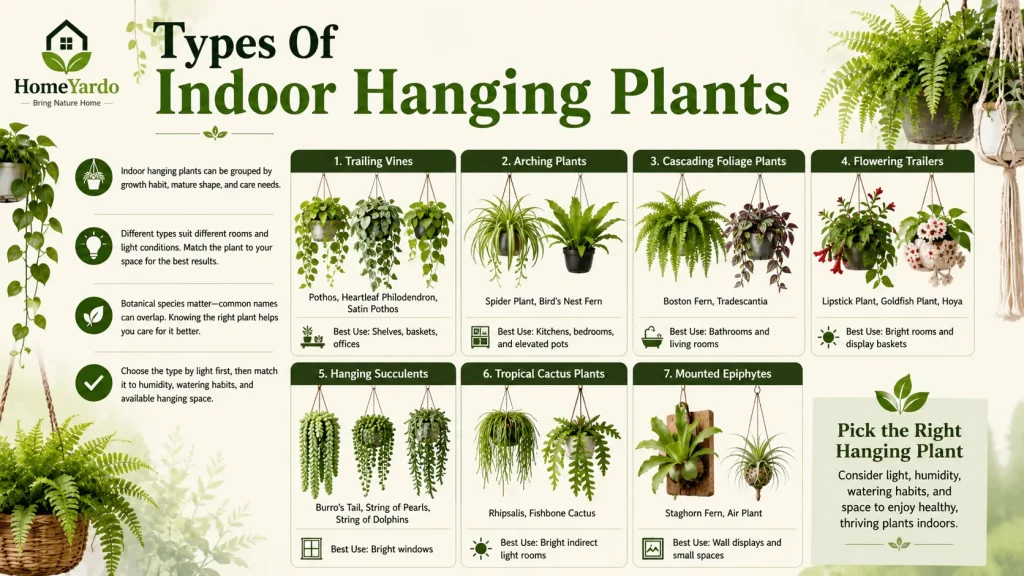
Indoor hanging plants are divided into groups based on growing habit, mature form and maintenance requirements. The primary plant types are arching plants, trailing vines as well as cascading plants for foliage, hanging succulents, flowering trailers as well as tropical cactus species, and epiphytes that are mounted.
Different hanging plant varieties suit different rooms. The ferns thrive in humid areas, succulents need more light and flowering trailers require more light, and small plants work well in offices or apartment buildings.
The species of hanging plants that are botanically cultivated are important because common names may overlap. As an example, pothos can be Epipremnum Aureum the heartleaf philodendron species is Philodendron Hederaceum and Spider plant Chlorophytum communum the lipstick plant Aeschynanthus Radicans.
| Hanging Plant Type | Common Hanging Plants | Best Use |
|---|---|---|
| Trailing vines | Pothos, heartleaf philodendron, satin pothos | Shelves, baskets, offices |
| Arching plants | Spider plant, bird’s nest fern | Kitchens, bedrooms, and elevated pots |
| Cascading foliage plants | Boston fern, Tradescantia | Bathrooms and living rooms |
| Flowering trailers | Lipstick plant, goldfish plant, hoya | Bright rooms and display baskets |
| Hanging succulents | Burro’s tail, string of pearls, string of dolphins | Bright windows |
| Tropical cactus plants | Rhipsalis, fishbone cactus | Bright indirect light rooms |
| Mounted epiphytes | Staghorn fern, air plant | Wall displays and small spaces |
These hanging types cover many popular hanging plant varieties and species used indoors. Choose the type by light first, then match it to room humidity, watering habits, and available hanging space.
Hanging, Trailing, Cascading, And Climbing Plants
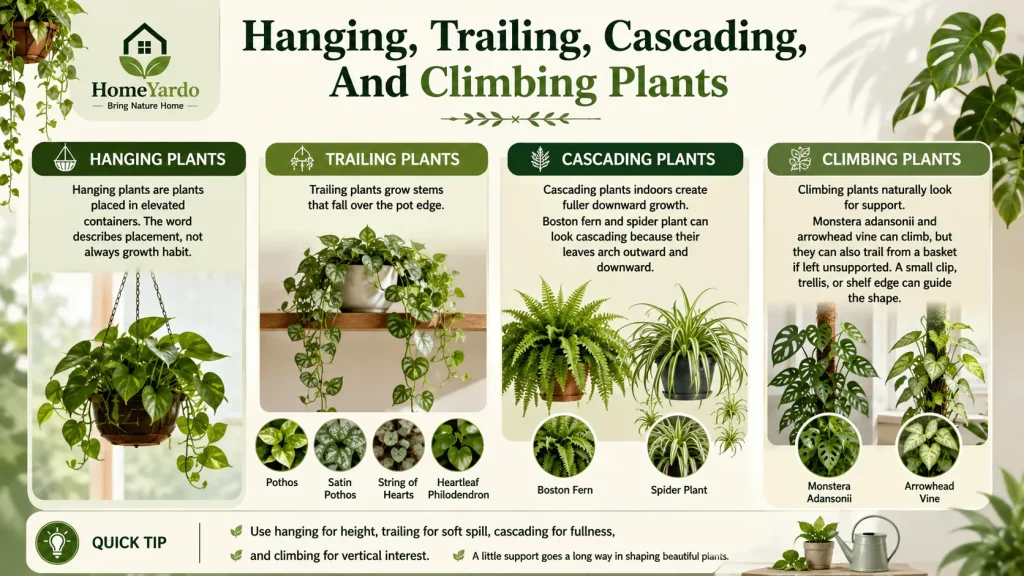
Hanging plants are plants that are placed in high-heeled containers. The term describes the location but not necessarily a growth habit.
The stems of trailing plants hang over the edge of the pot. Pothos satin pothos, string of hearts and heartleaf of Philodendron are all the most common varieties.
Cascading plants indoors can create a more lush downward growth. Boston Spider plant and fern appear to be cascading since their leaves are arching outward and down.
Climbing plants naturally search for support. Monstera Dansonii and the arrowhead vine are able to climb, however they may also trail behind the basket, if they are not supported. A tiny clip, trellis or edge of the shelf could aid in guiding the form.
Benefits Of Indoor Hanging Plants
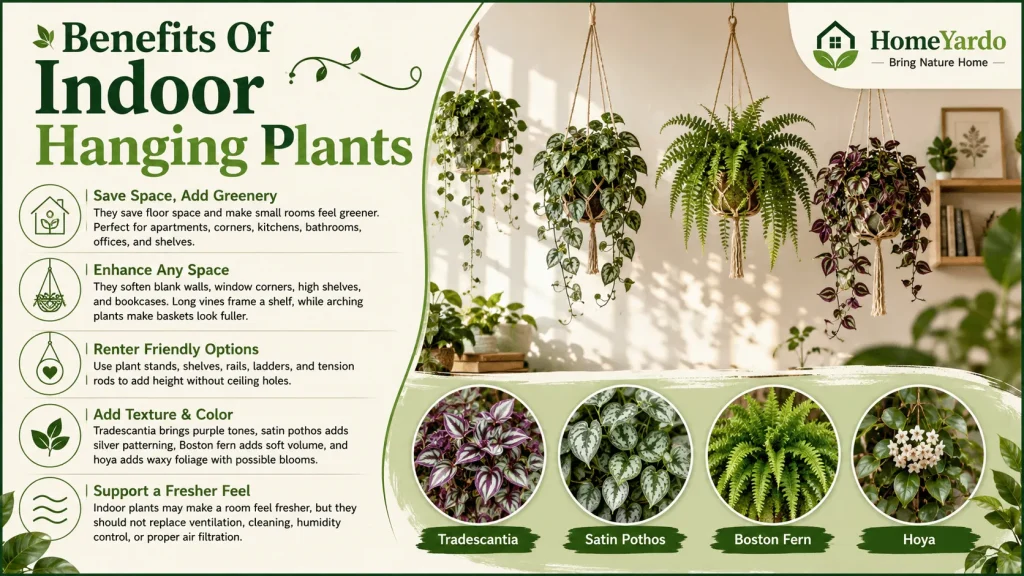
Indoor plants help save the floor and make small spaces feel greener, without the large pots that are in the floor. They can be used in rooms with narrow corners and bathrooms, kitchens, offices, and shelves.
They can soften windows, walls as well as high shelves and bookcases. Long vines frame shelves and can make baskets appear fuller.
Hanging structures are also rent-friendly. Plant shelves, stands rails, ladders and tension rods are a great way to increase height with no ceiling holes.
They add texture and colour. Tradescantia reveals purple tones and satin pothos provides silver patterning. Boston Fern adds soft volume and Hoya includes waxy foliage and the possibility of flowers.
Indoor plants can make rooms feel fresher however they shouldn’t be used to replace cleaning, ventilation and humidity control, or the proper air filtering.
25 Best Hanging Indoor Plants
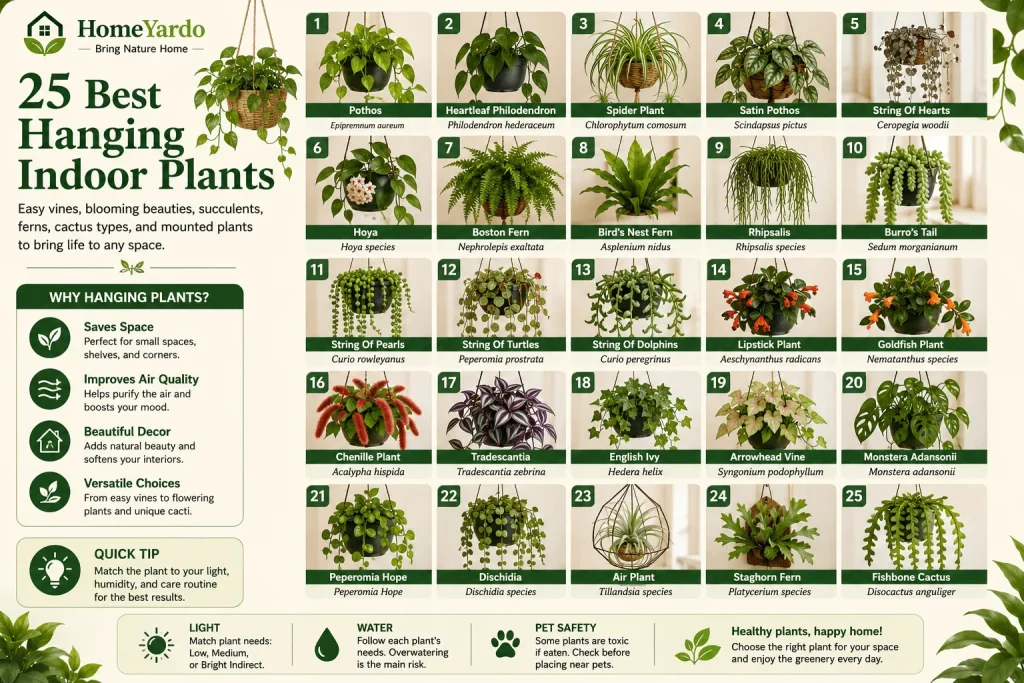
The best list includes easy vines, compact trailers, flowering choices, succulents, ferns, cactus types, and mounted plants. Each plant below includes a care snapshot for quick comparison.
Add images for each plant when publishing. Use clear plant photos with common name, botanical name, and descriptive alt text.
Pothos
Pothos is the easiest starting point for many homes because it trails quickly, tolerates normal indoor conditions, and stays attractive with basic pruning.
It works in hanging baskets, shelves, wall planters, and office corners. Brighter filtered light usually gives fuller growth, but pothos can handle lower light better than many houseplants.
- Botanical name: Epipremnum aureum
- Best for: Easy trailing growth
- Light: Low to bright indirect
- Water: Let the top soil dry
- Care level: Easy
- Pet note: Toxic if eaten
- Avoid if: Pets chew leaves or vines
Heartleaf Philodendron
Heartleaf philodendron has soft green leaves and thin, trailing stems. It gives a relaxed vine look without needing intense light.
It is useful for bedrooms, offices, shelves, and hanging pots where a softer plant shape is preferred. The vines can be trimmed and rooted back into the pot for a fuller plant.
- Botanical name: Philodendron hederaceum
- Best for: Low to medium light trailing growth
- Light: Low to medium indirect
- Water: Let the top layer dry
- Care level: Easy
- Pet note: Toxic if eaten
- Avoid if: Vines will hang within pet reach
Spider Plant
Spider plant is a dependable beginner plant with arching leaves and small plantlets that hang from long stems. It looks full even before it grows long vines.
It suits kitchens, bedrooms, shelves, and hanging baskets. Brown leaf tips can appear from dry air, mineral buildup, or inconsistent watering, but the plant usually keeps growing.
- Botanical name: Chlorophytum comosum
- Best for: Beginners and pet safer homes
- Light: Bright indirect
- Water: Let the soil partly dry
- Care level: Easy
- Pet note: Generally listed as safer, though chewing can upset pets
- Avoid if: The room has almost no light
Satin Pothos
Satin pothos has matte leaves with silver markings, giving it a softer look than common pothos. It trails well and looks best with regular trimming.
Despite the name, it is not the same plant as common pothos. Its silver markings are usually stronger in medium to bright indirect light.
- Botanical name: Scindapsus pictus
- Best for: Silver patterned foliage
- Light: Medium to bright indirect
- Water: Let the soil partly dry
- Care level: Easy
- Pet note: Toxic if eaten
- Avoid if: Pets chew trailing plants
String Of Hearts
String of hearts is a fine trailing plant with slim stems and small heart-shaped leaves. It creates long, delicate trails without taking much space.
It works well on shelves, narrow walls, and bright bedrooms. The plant stores some moisture, so wet soil is a common reason for decline.
- Botanical name: Ceropegia woodii
- Best for: Long, delicate trails
- Light: Bright indirect
- Water: Let the soil partly dry
- Care level: Easy to moderate
- Pet note: Check the exact species before placing near pets
- Avoid if: The potting mix stays wet
Hoya
Hoya is a long-lived plant with waxy foliage and trailing stems. Mature plants may produce flower clusters when light, age, and care are suitable.
It suits bright living rooms, bedrooms, and shelves. Many hoyas prefer drying slightly between watering and do not need oversized pots.
- Botanical name: Hoya species
- Best for: Waxy foliage and possible flowers
- Light: Bright indirect
- Water: Let the mix dry partly
- Care level: Moderate
- Pet note: Check exact species
- Avoid if: The room is very dark
Boston Fern
Boston fern creates a soft, full hanging basket with arching fronds. It is best for homes that can provide steady moisture and humidity.
Bright bathrooms and kitchens are good spots when they have enough light. Dry air, missed watering, and hot vents can make fronds turn crispy.
- Botanical name: Nephrolepis exaltata
- Best for: Humid rooms and lush baskets
- Light: Bright indirect
- Water: Keep lightly moist
- Care level: Moderate
- Pet note: Generally listed as safer
- Avoid if: The home air is very dry
Bird’s Nest Fern
Bird’s nest fern has wide, arching leaves that suit elevated pots and bathroom shelves. It does not trail like a vine, but it looks good from the side and below.
Keep water away from the center crown because trapped moisture can cause rot. Bright indirect light and humidity help it stay fresh.
- Botanical name: Asplenium nidus
- Best for: Arching foliage in humid rooms
- Light: Bright indirect
- Water: Keep lightly moist, not soggy
- Care level: Moderate
- Pet note: Generally listed as safer
- Avoid if: Water collects in the crown
Rhipsalis
Rhipsalis gives a hanging basket a soft, trailing cactus look. It is often easier indoors than string of pearls because it does not need the same strong sun.
It prefers drainage and indirect light. It needs more moisture than desert cactus plants, but heavy, wet soil can still harm the roots.
- Botanical name: Rhipsalis species
- Best for: Soft trailing cactus texture
- Light: Medium to bright indirect
- Water: Let mix partly dry
- Care level: Easy
- Pet note: Check exact species
- Avoid if: Soil stays dense and wet
Burro’s Tail
Burro’s tail is a bright light succulent with thick, trailing stems and plump leaves. It looks best where the stems can hang freely without being touched.
The leaves fall off easily when bumped. Mature baskets can also become heavy, so strong support matters.
- Botanical name: Sedum morganianum
- Best for: Sunny hanging succulent displays
- Light: Bright light
- Water: Let mix dry well
- Care level: Moderate
- Pet note: Check exact species
- Avoid if: The basket will be bumped often
String Of Pearls
String of pearls is valued for its bead-like leaves and long hanging stems. It needs brighter light and careful watering, so it is not the safest first plant.
Low light plus wet soil is the main failure pattern. Place it near a bright window and let the mix dry before watering again.
- Botanical name: Curio rowleyanus
- Best for: Beaded trailing stems
- Light: Bright light
- Water: Let mix dry well
- Care level: Higher care
- Pet note: Toxic if eaten
- Avoid if: The room is dim
String Of Turtles
String of turtles is a compact trailing plant with small, patterned leaves. It is a good choice for desks, shelves, small pots, and apartments.
It grows slower than pothos or Tradescantia. Use a small pot and avoid heavy soil that stays wet too long.
- Botanical name: Peperomia prostrata
- Best for: Small hanging pots
- Light: Bright indirect
- Water: Let the soil partly dry
- Care level: Moderate
- Pet note: Check exact species
- Avoid if: The pot is too large or too wet
String Of Dolphins
String of dolphins has curved succulent leaves that look like small jumping dolphins. It works best in bright rooms and window areas.
It needs fast-draining soil and careful watering. A dark room will usually lead to weak growth.
- Botanical name: Curio peregrinus
- Best for: Novelty succulent displays
- Light: Bright light
- Water: Let the soil dry
- Care level: Moderate
- Pet note: Check exact species
- Avoid if: Light is weak
Lipstick Plant
Lipstick plant is one of the best hanging plants with flowers. Its trailing stems and red tubular blooms make it useful in visible living spaces.
Flowers are more likely to thrive with bright indirect light, warmth, and steady care. It should not sit in cold drafts or soggy soil.
- Botanical name: Aeschynanthus radicans
- Best for: Red flowering trails
- Light: Bright indirect
- Water: Keep slightly moist, not soggy
- Care level: Moderate
- Pet note: Check exact species
- Avoid if: The room is cold or dim
Goldfish Plant
The goldfish plant has glossy leaves and orange flowers that resemble tiny fish. It offers color without needing a huge hanging basket.
It grows best with bright indirect light, stable warmth, and good drainage. Heavy, wet soil can damage the roots.
- Botanical name: Nematanthus species
- Best for: Orange flowers and glossy leaves
- Light: Bright indirect
- Water: Keep slightly moist
- Care level: Moderate
- Pet note: Check exact species
- Avoid if: Soil stays soggy
Chenille Plant
Chenille plant is grown for its long, fuzzy, red flower tassels. It makes a bold hanging display but needs more attention than basic foliage plants.
It requires bright light, warmth, and steady moisture. It is not a good fit for dark rooms or hard-to-reach baskets.
- Botanical name: Acalypha hispida
- Best for: Bold red hanging flowers
- Light: Bright light
- Water: Keep evenly moist
- Care level: Higher care
- Pet note: Check exact species
- Avoid if: The room is low-light or dry
Tradescantia
Tradescantia grows quickly and adds purple, silver, and green tones. It can fill a hanging basket fast when the light is good.
It needs regular trimming because older stems can become thin or bare. Cuttings root easily and can be placed back into the pot for fuller growth.
- Botanical name: Tradescantia zebrina
- Best for: Fast, colorful growth
- Light: Bright indirect
- Water: Let the soil partly dry
- Care level: Easy
- Pet note: Use caution around pets
- Avoid if: Regular pruning will be skipped
English Ivy
English ivy is a classic trailing vine for cooler, bright rooms. It can grow long and dense when conditions are steady.
It is toxic if eaten and can be invasive outdoors in some areas. Use it indoors with careful placement and responsible disposal of trimmings.
- Botanical name: Hedera helix
- Best for: Classic trailing vines
- Light: Medium to bright indirect
- Water: Keep lightly moist
- Care level: Moderate
- Pet note: Toxic if eaten
- Avoid if: Pets can reach the plant
Arrowhead Vine
Arrowhead vine begins more upright, then trails as it matures. It comes in green, cream, pink, and variegated forms.
It suits kitchens and bathrooms with enough light. Pruning helps keep the plant shaped and prevents vines from becoming sparse.
- Botanical name: Syngonium podophyllum
- Best for: Humid rooms and soft foliage
- Light: Medium to bright indirect
- Water: Let the topsoil dry
- Care level: Easy
- Pet note: Toxic if eaten
- Avoid if: Pets chew foliage
Monstera Adansonii
Monstera adansonii has bold leaves with natural holes. It can trail from a hanging basket or climb when given support.
It creates a stronger tropical look than smaller vines. Bright indirect light helps keep leaves larger and healthier.
- Botanical name: Monstera adansonii
- Best for: Bold trailing foliage
- Light: Bright indirect
- Water: Let the soil partly dry
- Care level: Moderate
- Pet note: Toxic if eaten
- Avoid if: Vines hang into pet areas
Peperomia Hope
Peperomia Hope is compact, rounded, and tidy. It works well where long vines would feel messy.
It suits shelves, desks, offices, small apartments, and lightweight hanging pots. Overwatering is the main risk.
- Botanical name: Peperomia Hope
- Best for: Compact trailing growth
- Light: Medium to bright indirect
- Water: Let the soil partly dry
- Care level: Easy
- Pet note: Check exact species
- Avoid if: Watering is frequent
Dischidia
Dischidia is a small epiphyte with rounded or coin-shaped leaves. It works well in small hanging baskets and mounted displays.
It prefers bright filtered light, airflow, and an airy growing medium. Dense soil that holds too much water is not ideal.
- Botanical name: Dischidia species
- Best for: Small epiphyte displays
- Light: Bright filtered
- Water: Let the medium partly dry
- Care level: Moderate
- Pet note: Check exact species
- Avoid if: The potting medium is dense and wet
Air Plant
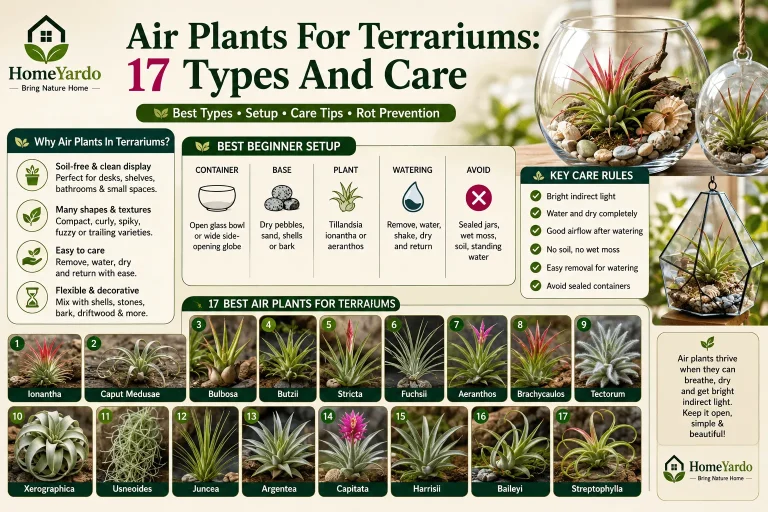
Air plants are soil-free plants that can hang in glass holders, wire frames, wooden mounts, or open baskets. For smaller glass displays, air plants for terrariums are also useful because they grow without soil and suit open, airy containers.
They still need water. After soaking or misting, they should dry well before being returned to the display.
- Botanical name: Tillandsia species
- Best for: Soil-free hanging displays
- Light: Bright filtered
- Water: Soak or mist, then dry fully
- Care level: Moderate
- Pet note: Check exact species
- Avoid if: Airflow is poor
Staghorn Fern
Staghorn fern is a mounted plant with antler-shaped fronds. It works well as a wall-mounted or hanging display.
Its care differs from that of a normal potted vine. The mount or root area needs moisture, but it should not stay constantly soaked.
- Botanical name: Platycerium species
- Best for: Mounted wall displays
- Light: Bright indirect
- Water: Keep the mouth lightly moist
- Care level: Moderate
- Pet note: Check exact species
- Avoid if: The wall is dark and dry
Fishbone Cactus
Fishbone cactus has zigzag stems that trail over the pot edge. It gives a basket a bold shape without long, thin vines.
It prefers bright indirect light and a draining mix. It may flower when light, maturity, and care are suitable.
- Botanical name: Disocactus anguliger
- Best for: Zigzag trailing stems
- Light: Bright indirect
- Water: Let mix partly dry
- Care level: Moderate
- Pet note: Check exact species
- Avoid if: Roots stay wet
Other Hanging Plants Worth Considering
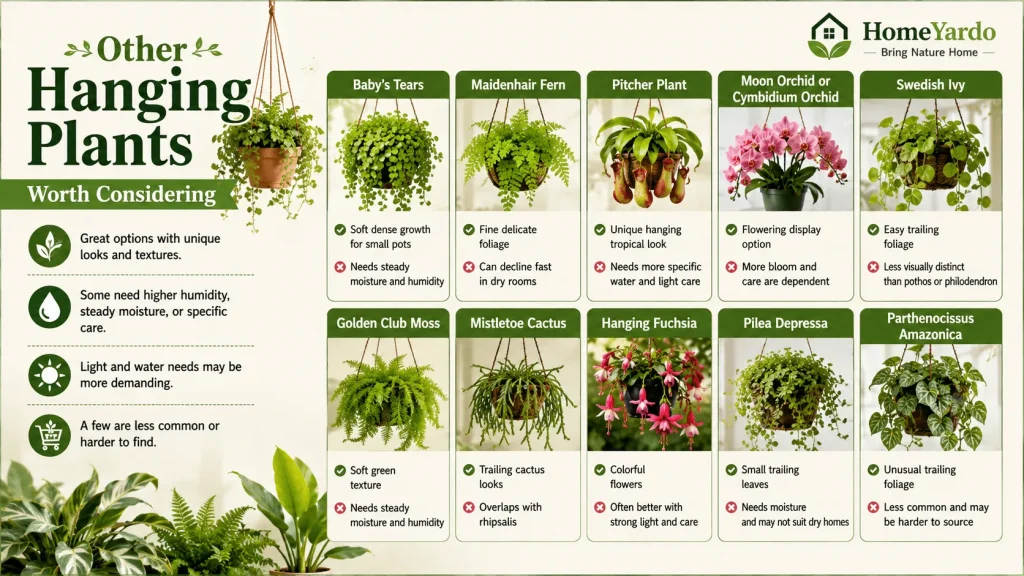
These plants are worth mentioning, but they do not need to replace the main 25 unless the article is expanded later.
| Plant | Why Consider It | Why It May Stay Outside The Main 25 |
|---|---|---|
| Baby’s Tears | Soft dense growth for small pots | Needs steady moisture and humidity |
| Maidenhair Fern | Fine delicate foliage | Can decline fast in dry rooms |
| Pitcher Plant | Unique hanging tropical look | Needs more specific water and light care |
| Moon Orchid Or Cymbidium Orchid | Flowering display option | More bloom and care dependent |
| Swedish Ivy | Easy trailing foliage | Less visually distinct than pothos or philodendron |
| Golden Club Moss | Soft green texture | Needs steady moisture and humidity |
| Mistletoe Cactus | Trailing cactus look | Overlaps with rhipsalis |
| Hanging Fuchsia | Colorful flowers | Often better with strong light and closer care |
| Pilea Depressa | Small trailing leaves | Needs moisture and may not suit dry homes |
| Parthenocissus Amazonica | Unusual trailing foliage | Less common and may be harder to source |
Some smaller humidity-loving choices may also work as terrarium plants when the container, light, airflow, and moisture level match the plant’s needs.
Best Indoor Hanging Plants For Beginners
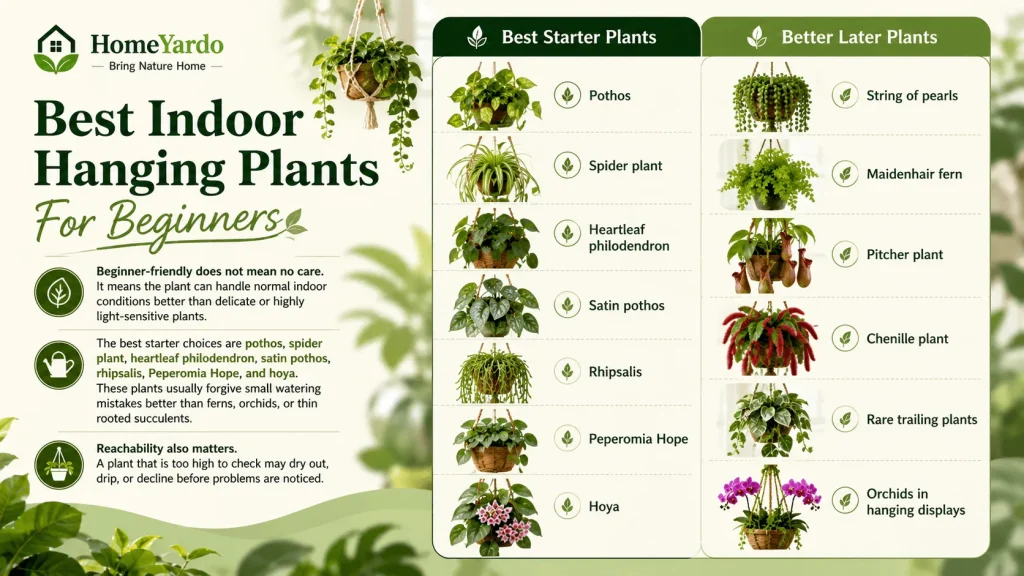
Beginner-friendly does not mean no care. It means the plant can handle normal indoor conditions better than delicate or highly light-sensitive plants.
The best starter choices are pothos, spider plant, heartleaf philodendron, satin pothos, rhipsalis, Peperomia Hope, and hoya. These plants usually forgive small watering mistakes better than ferns, orchids, or thin-rooted succulents.
Reachability also matters. A plant that is too high to check may dry out, drip, or decline before problems are noticed.
| Best Starter Plants | Better Later Plants |
|---|---|
| Pothos | String of pearls |
| Spider plant | Maidenhair fern |
| Heartleaf philodendron | Pitcher plant |
| Satin pothos | Chenille plant |
| Rhipsalis | Rare trailing plants |
| Peperomia Hope | Orchids in hanging displays |
Best Low-Light Hanging Plants
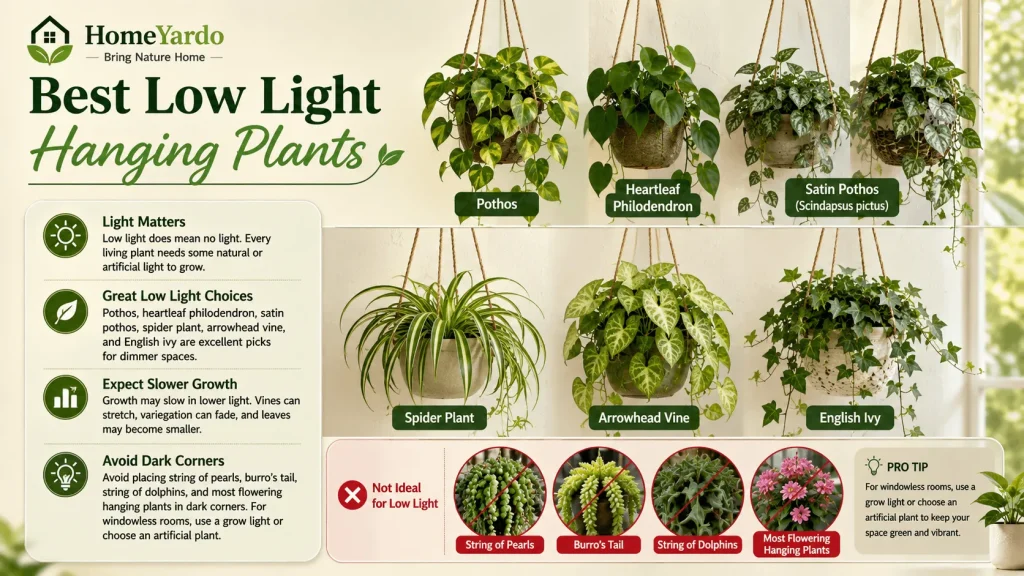
Low light does mean no light. Every living plant needs some natural or artificial light to grow.
Good lower light choices include pothos, heartleaf philodendron, satin pothos, spider plant, arrowhead vine, and English ivy. They can handle dimmer rooms better than succulents and flowering plants.
Growth may slow in lower light. Vines can stretch, variegation can fade, and leaves may become smaller.
Avoid placing string of pearls, burro’s tail, string of dolphins, and most flowering hanging plants in dark corners. For windowless rooms, use a grow light or choose an artificial plant.
Bright Light And Direct Sun Hanging Plants For Indoors
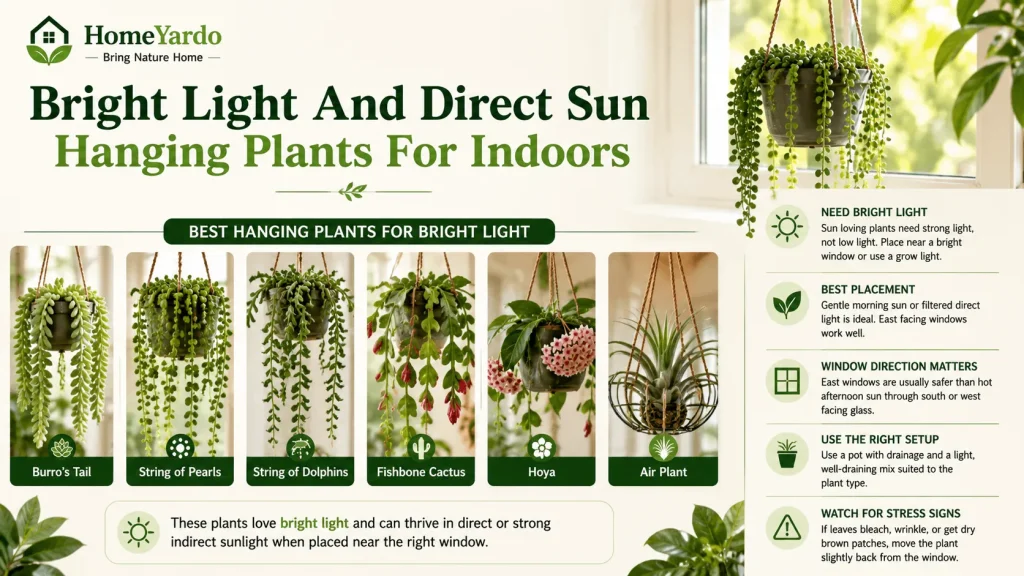
Bright rooms suit plants that need stronger light, especially hanging succulents, cactus types, hoyas, and some flowering trailers. These are different from hanging plants that don’t need sunlight, because low-light plants only tolerate dimmer rooms, while sun-loving choices need a brighter window or grow light.
Good options for direct sunlight include burro’s tail, string of pearls, string of dolphins, fishbone cactus, hoya, and air plant. These plants
Some varieties can handle gentle morning sun or filtered direct light indoors. Burro’s tail, string of pearls, and string of dolphins are better choices for this placement than ferns or thin-leaf tropical vines.
Window direction matters. East-facing windows are often easier than hot afternoon sun through south or west-facing glass. Even full sun hanging plants indoors should be moved into stronger light gradually to reduce leaf scorch.
For hanging plants for direct sunlight, use a pot with drainage, a light mix suited to the plant type, and a spot where leaves will not press against hot glass. If leaves bleach, wrinkle, or develop dry brown patches, move the plant slightly back from the window.
Flowering Hanging Plants
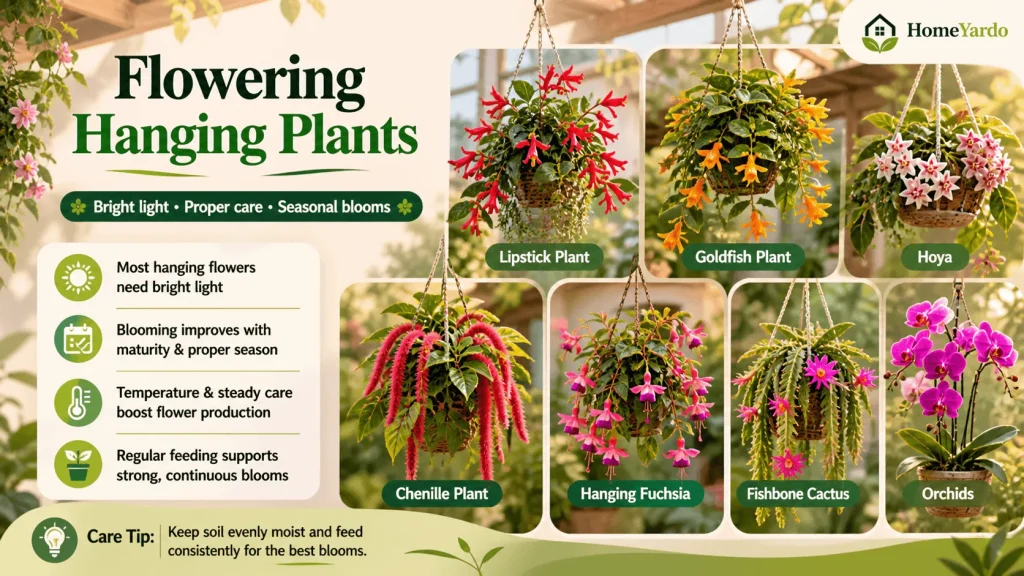
Flowers that hang down usually need brighter light than foliage plants. Blooming also depends on maturity, season, temperature, feeding, and steady care.
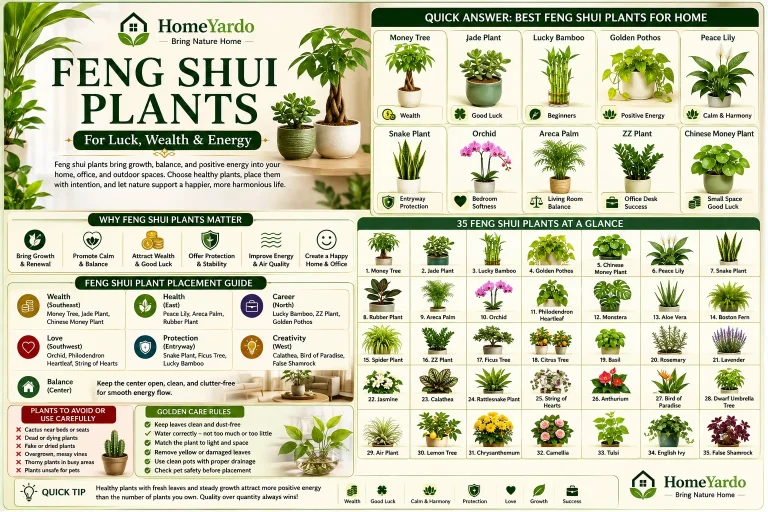
Lipstick plant is a strong flowering choice with red tubular flowers. The goldfish plant offers orange blooms and glossy foliage. Hoya can bloom in clusters once mature and well-placed. Hoya can bloom in clusters once mature and well-placed. For more unusual bloom shapes and colorful plant ideas, cool flowers can give readers more options beyond classic foliage baskets.
Chenille plant adds long red fuzzy flowers, but it needs brighter light and more attention. Fishbone cactus may also flower when conditions are good.
Other flowering options include hanging fuchsia and orchids, but they usually need stronger light, steadier watering, and closer care than beginner foliage plants.
Succulent And Cactus Hanging Plants
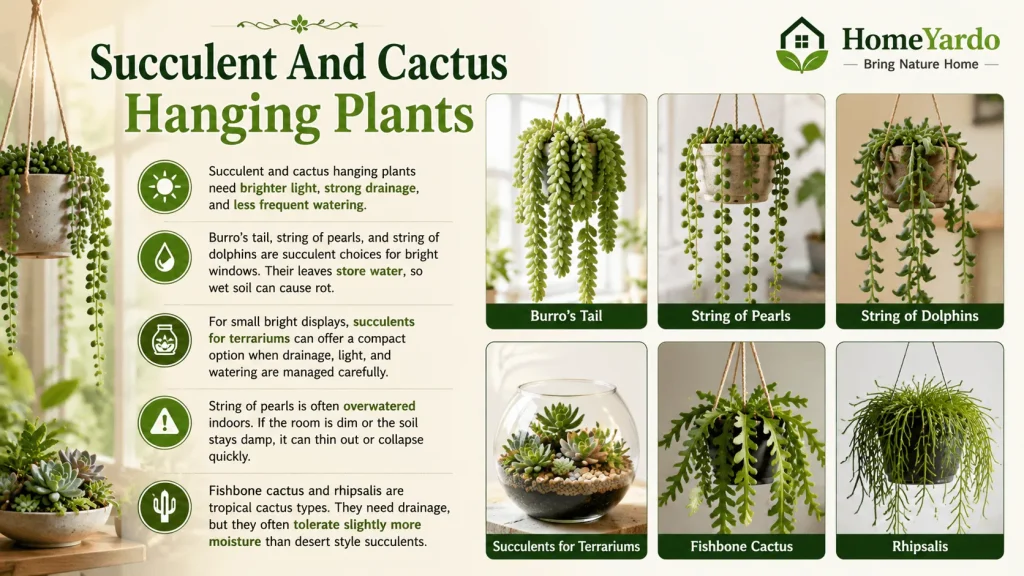
Succulent and cactus hanging plants need a different routine from tropical vines. Most require brighter light, strong drainage, and less frequent watering.
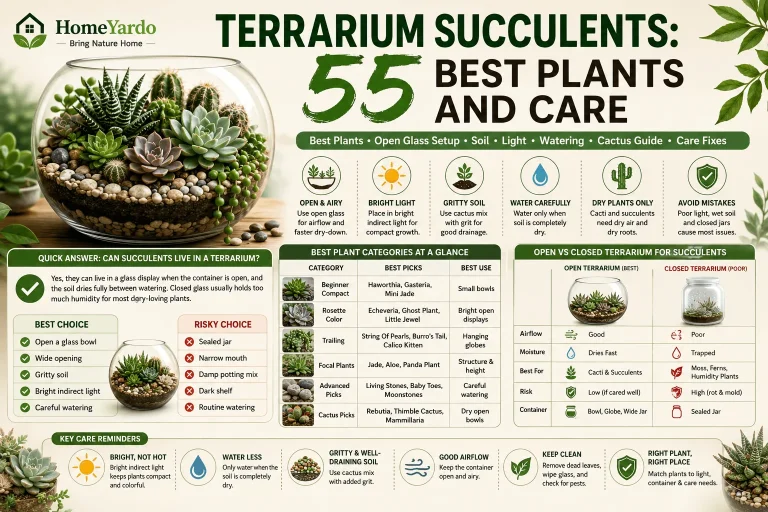
Burro’s tail, string of pearls, and string of dolphins are succulent choices for bright windows. Their leaves store water, so wet soil can cause rot. Their leaves store water, so wet soil can cause rot. For small bright displays, succulents for terrariums can offer a compact option when drainage, light, and watering are managed carefully.
String of pearls is often overwatered indoors. If the room is dim or the soil stays damp, it can thin out or collapse quickly.
Fishbone cactus and rhipsalis are tropical cactus types. They need drainage, but they often tolerate slightly more moisture than desert-style succulents.
Fast-Growing And Long-Trailing Plants
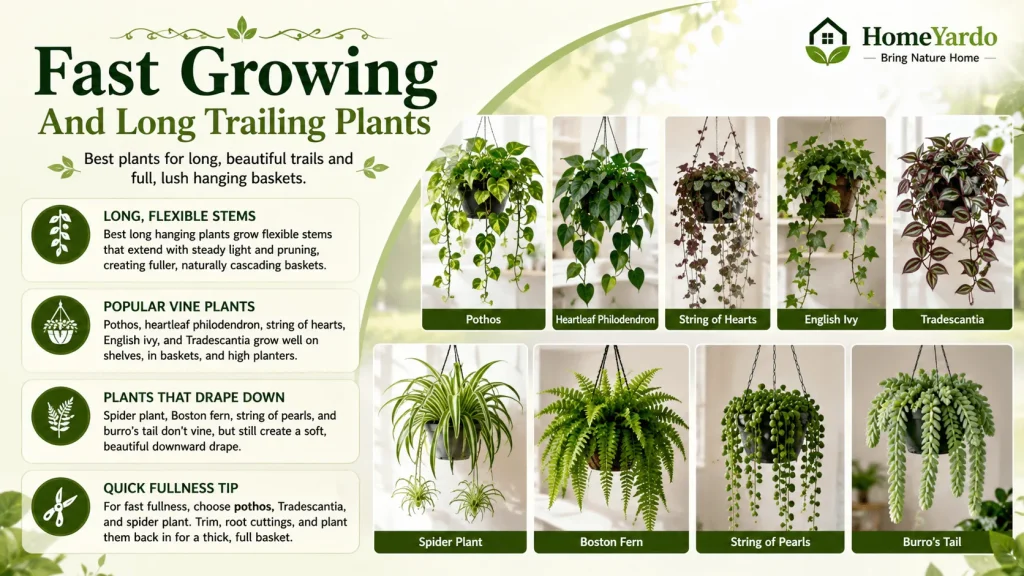
Some of the best long hanging plants develop flexible stems that keep extending with steady light and regular pruning. These are the best choices when the goal is a fuller basket with vines that fall naturally over the pot edge.
Popular indoor plants with long vines include pothos, heartleaf philodendron, string of hearts, English ivy, and Tradescantia. These plants grow well from shelves, baskets, and high planters when their stems have room to trail.
Other plants do not form long vines, but they still create a soft downward shape. Spider plant, Boston fern, string of pearls, and burro’s tail are examples of plants that drape down from a basket or raised pot.
For quick fullness, pothos, Tradescantia, and spider plant are strong choices. Trim long stems and root healthy cuttings back into the same pot to keep the basket full near the crown.
Best Indoor Trailing Plants By Room
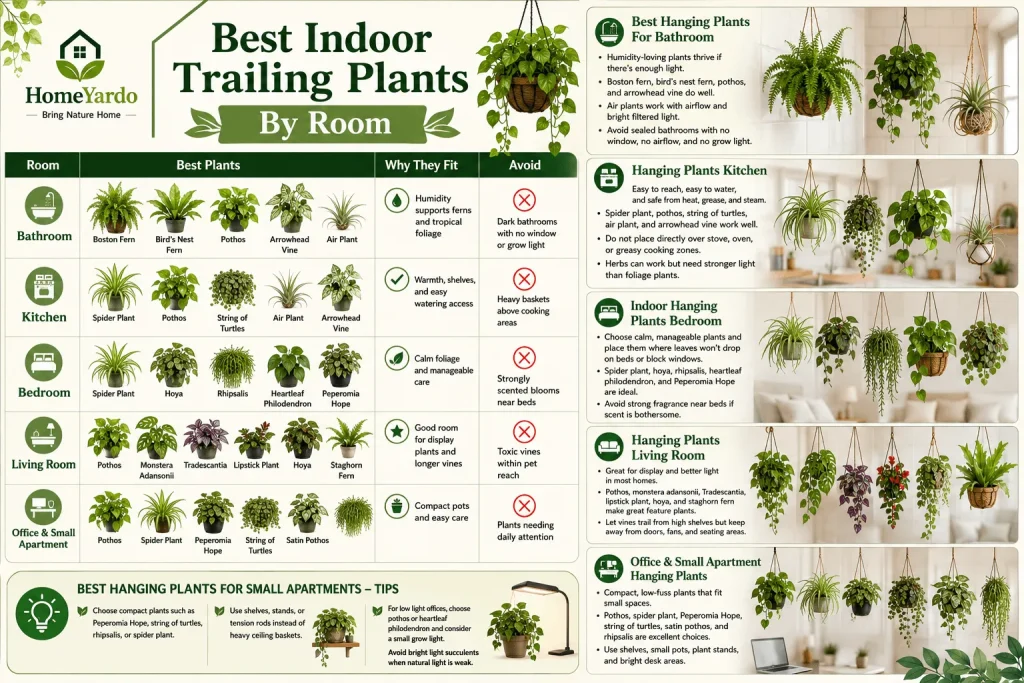
Room placement should be based on light first, then humidity, watering access, and safety. A plant that works in a bright bathroom may struggle in a dry, shaded bedroom.
| Room | Best Plants | Why They Fit | Avoid |
|---|---|---|---|
| Bathroom | Boston fern, bird’s nest fern, pothos, arrowhead vine, air plant | Humidity supports ferns and tropical foliage | Dark bathrooms with no window or grow light |
| Kitchen | Spider plant, pothos, string of turtles, air plant, arrowhead vine | Warmth, shelves, and easy watering access | Heavy baskets above cooking areas |
| Bedroom | Spider plant, hoya, rhipsalis, heartleaf philodendron, Peperomia Hope | Calm foliage and manageable care | Strongly scented blooms near beds |
| Living Room | Pothos, monstera adansonii, Tradescantia, lipstick plant, hoya, staghorn fern | Good room for display plants and longer vines | Toxic vines within pet reach |
| Office And Small Apartment | Pothos, spider plant, Peperomia Hope, string of turtles, satin pothos, rhipsalis | Compact pots and easy care | Plants needing daily attention |
Best Hanging Plants For Bathroom
Bathrooms can support humidity-loving plants if the room has enough light. Humidity alone is not enough for healthy growth.
Boston fern and bird’s nest fern are strong bathroom choices because they prefer moisture in the air. Pothos and arrowhead vine can also work well in bright bathrooms.
Air plants can work in bathrooms with airflow and bright filtered light. Avoid sealed bathrooms with no window, no airflow, and no grow light.
Hanging Plants Kitchen
Hanging plants in the kitchen should be easy to reach, easy to water, and safe from heat, grease, and steam.
Spider plant, pothos, string of turtles, air plant, and arrowhead vine can work well in bright kitchens. They fit shelves, wall planters, small baskets, and window areas.
Do not place hanging plants directly over a stove, oven, or greasy cooking zone. Herbs can also work in kitchen planters, but they usually need stronger light than foliage houseplants.
Indoor Hanging Plants Bedroom
Bedroom hanging plants should be calm, manageable, and placed where leaves will not drop onto beds or block windows.
Spider plant, hoya, rhipsalis, heartleaf philodendron, and Peperomia Hope are good choices. They stay manageable with simple pruning and steady care.
Avoid strong fragrance near beds if the scent is bothersome. Choose plants for greenery, softness, and space saving, not unsupported health claims.
Hanging Plants Living Room
Living rooms are good spaces for visible hanging plants because they often have more display room and better light.
Pothos, monstera adansonii, Tradescantia, lipstick plant, hoya, and staghorn fern can work as feature plants. A single basket in a bright corner can soften the room.
Shelf cascades also work well. Let pothos, philodendron, or string of hearts trail from a high shelf, but keep vines away from doors, fans, and seating areas.
Office And Small Apartment Hanging Plants
Offices and small apartments need compact, low-fuss plants that do not take over the room.
Pothos, spider plant, Peperomia Hope, string of turtles, satin pothos, and rhipsalis are good options. They work in shelves, small hanging pots, plant stands, and bright desk areas.
Best Hanging Plants For Small Apartments Tip: Choose compact plants such as Peperomia Hope, string of turtles, rhipsalis, or spider plant. Use shelves, stands, or tension rods instead of heavy ceiling baskets.
For low-light offices, choose pothos or heartleaf philodendron and consider a small grow light. Avoid bright light succulents when natural light is weak.
Pet Safer Indoor Plants
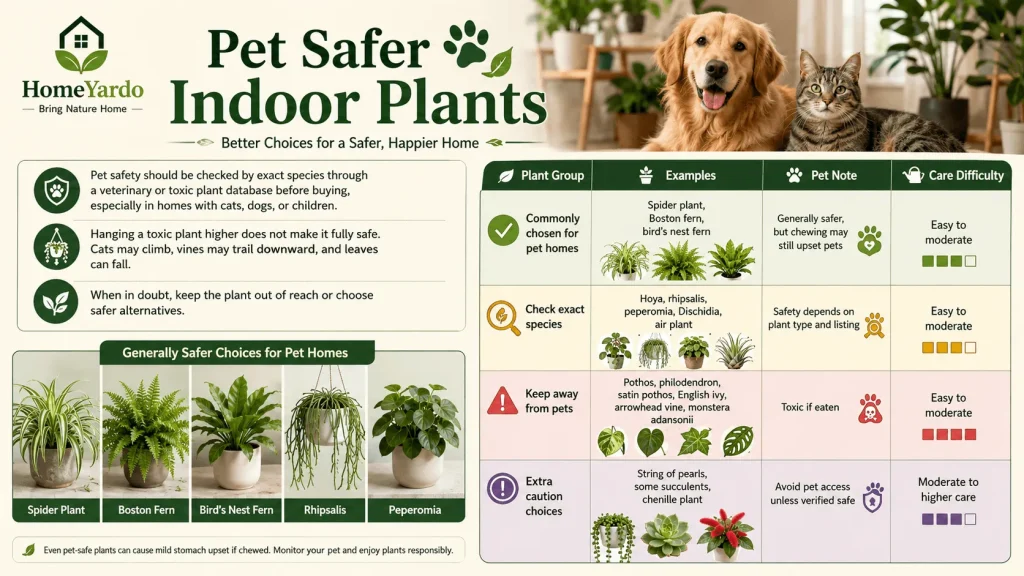
Pet safety should be checked by the exact species through a veterinary or toxic plant database before buying, especially in homes with cats, dogs, or children.
Hanging a toxic plant higher does not make it fully safe. Cats may climb, vines may trail downward, and leaves can fall.
Generally safer choices include spider plant, Boston fern, bird’s nest fern, rhipsalis, some hoyas, and some peperomias. Toxic if eaten, examples include pothos, heartleaf philodendron, satin pothos, English ivy, arrowhead vine, monstera adansonii, and string of pearls.
| Plant Group | Examples | Pet Note | Care Difficulty |
|---|---|---|---|
| Commonly chosen for pet homes | Spider plant, Boston fern, bird’s nest fern | Generally safer, but chewing may still upset pets | Easy to moderate |
| Check exact species | Hoya, rhipsalis, peperomia, Dischidia, air plant | Safety depends on plant type and listing | Easy to moderate |
| Keep away from pets | Pothos, philodendron, satin pothos, English ivy, arrowhead vine, monstera adansonii | Toxic if eaten | Easy to moderate |
| Extra caution choices | String of pearls, some succulents, chenille plant | Avoid pet access unless verified safe | Moderate to higher care |
How To Care For Hanging Plants
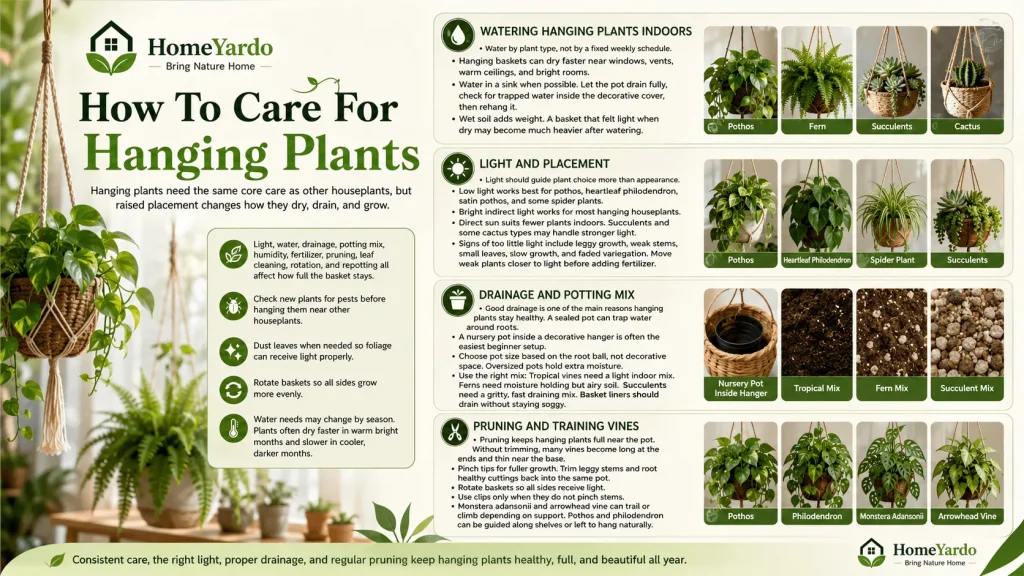
Hanging plants need the same core care as other houseplants, but raised placement changes how they dry, drain, and grow.
Light, water, drainage, potting mix, humidity, fertilizer, pruning, leaf cleaning, rotation, and repotting all affect how full the basket stays.
Check new plants for pests before hanging them near other houseplants. Dust leaves when needed so foliage can receive light properly. Rotate baskets so all sides grow more evenly.
Water needs may change by season. Plants often dry faster in warm, bright months and slower in cooler, darker months.
Watering Hanging Plants Indoors
Water by plant type, not by a fixed weekly schedule. Tropical vines, ferns, succulents, and cactus types do not dry at the same speed.
Hanging baskets can dry faster near windows, vents, warm ceilings, and bright rooms. They can also be hard to check if placed too high.
Water in a sink when possible. Let the pot drain fully, check for trapped water inside the decorative cover, then rehang it.
Wet soil adds weight. A basket that felt light when dry may become much heavier after watering.
Light And Placement
Light should guide plant choice more than appearance. A bright window plant will not stay healthy in a dark corner.
Low light works best for pothos, heartleaf philodendron, satin pothos, and some spider plants. Bright indirect light works for most hanging houseplants.
Direct sunlight suits fewer plants indoors. Succulents and some cactus types may handle stronger light, but hot glass can scorch leaves.
Signs of too little light include leggy growth, weak stems, small leaves, slow growth, and faded variegation. Move weak plants closer to the light before adding fertilizer.
Drainage And Potting Mix
Good drainage is one of the main reasons hanging plants stay healthy. A sealed pot can trap water around roots.
A nursery pot inside a decorative hanger is often the easiest beginner setup. The plant can be removed, watered, drained, and returned.
Choose pot size based on the root ball, not decorative space. Oversized pots hold extra moisture and can cause root issues.
Tropical vines need a light indoor potting mix. Ferns need moisture-holding but airy soil. Succulents need a gritty, fast-draining mix. Basket liners should drain without staying soggy.
Pruning And Training Vines
Pruning keeps hanging plants full near the pot. Without trimming, many vines become long at the ends and thin near the base.
Pinch tips for fuller growth. Trim leggy stems and root healthy cuttings back into the same pot when possible.
Rotate baskets so all sides receive light. Use clips only when they do not pinch stems.
Monstera adansonii and arrowhead vine can trail or climb depending on support. Pothos and philodendron can be guided along shelves or left to hang naturally.
How To Hang Plants Indoors Safely
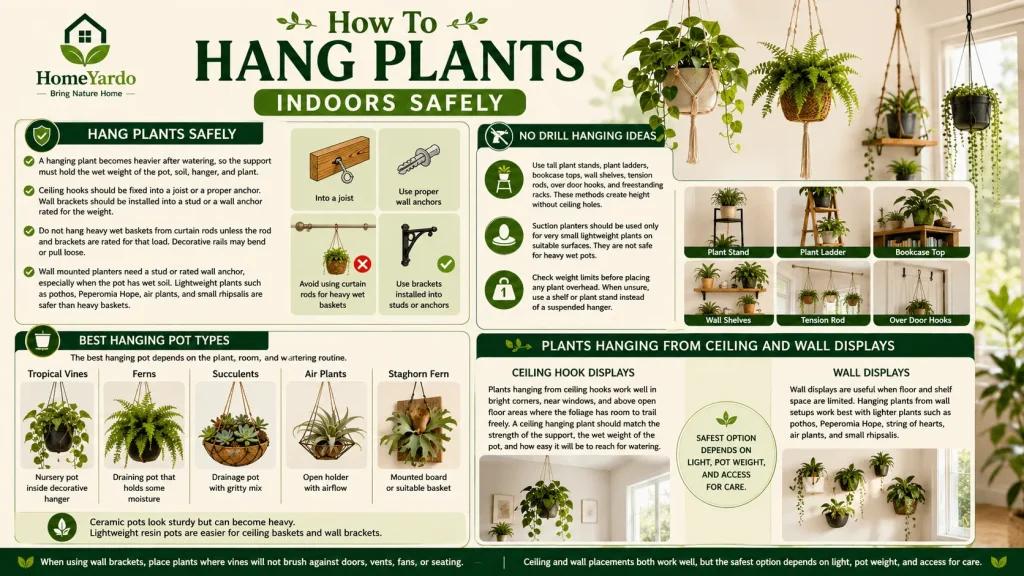
A hanging plant becomes heavier after watering, so the support must hold the wet weight of the pot, soil, hanger, and plant.
Ceiling hooks should be fixed to a joist or a proper anchor. Wall brackets should be installed into a stud or a wall anchor rated for the weight.
Do not hang heavy wet baskets from curtain rods unless the rod and brackets are rated for that load. Decorative rails may bend or pull loose.
Wall-mounted planters need a stud or rated wall anchor, especially when the pot has wet soil. Lightweight plants such as pothos, Peperomia Hope, air plants, and small rhipsalis are safer than heavy baskets.
No Drill Hanging Ideas
No drill options are useful for renters, apartments, offices, and dorms.
Use tall plant stands, plant ladders, bookcase tops, wall shelves, tension rods, over-door hooks, and freestanding racks. These methods create height without ceiling holes.
Suction planters should be used only for very small, lightweight plants on suitable surfaces. They are not safe for heavy, wet pots.
Check weight limits before placing any plant overhead. When unsure, use a shelf or plant stand instead of a suspended hanger.
Best Hanging Pot Types
The best hanging pot depends on the plant, room, and watering routine.
A nursery pot inside a decorative hanger is the safest beginner setup. It makes watering and drainage easier.
- Tropical vines: nursery pot inside decorative hanger
- Ferns: a draining pot that holds some moisture
- Succulents: drainage pot with gritty mix
- Air plants: open holder with airflow
- Staghorn fern: mounted board or suitable basket
Ceramic pots look sturdy but can become heavy. Lightweight resin pots are easier for ceiling baskets and wall brackets.
Plants Hanging From Ceiling And Wall Displays
Plants hanging from ceiling hooks work well in bright corners, near windows, and above open floor areas where the foliage has room to trail freely. A ceiling hanging plant should match the strength of the support, the wet weight of the pot, and how easy it will be to reach for watering.
Wall displays are useful when floor and shelf space are limited. Hanging plants from wall setups work best with lighter plants such as pothos, Peperomia Hope, string of hearts, air plants, and small rhipsalis.
When using wall brackets, place plants where vines will not brush against doors, vents, fans, or seating. Ceiling and wall placements both work well, but the safest option depends on light, pot weight, and access for care.
Decorating With Hanging Plants
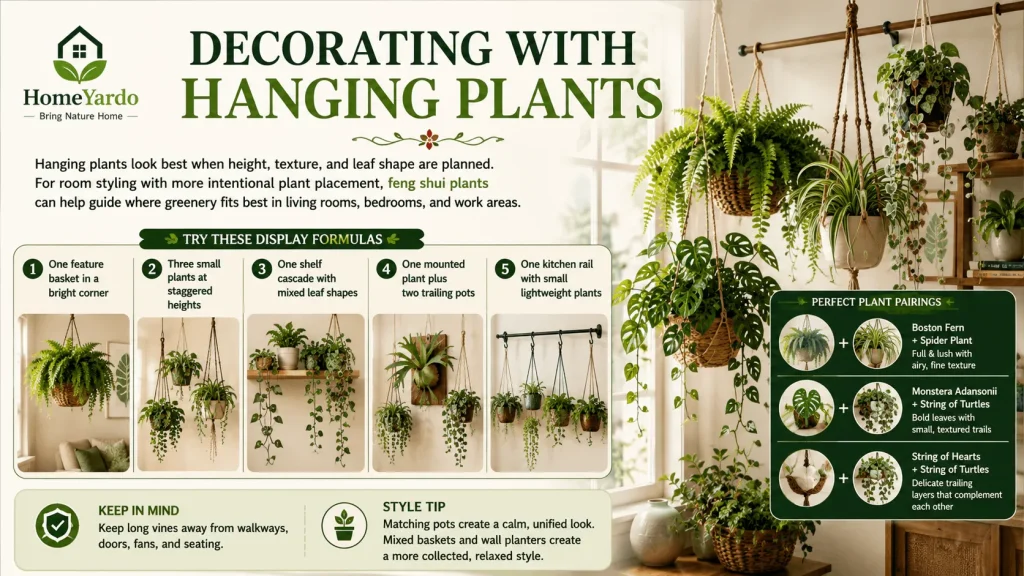
Hanging plants look best when height, texture, and leaf shape are planned. For room styling with more intentional plant placement, feng shui plants can help guide where greenery fits best in living rooms, bedrooms, and work areas.
Use fuller plants like Boston fern or spider plant with fine trailing plants like string of hearts. Pair bold leaves like monstera adansonii with smaller textured plants like string of turtles.
Try these display formulas:
- One feature basket in a bright corner
- Three small plants at staggered heights
- One shelf cascade with mixed leaf shapes
- One mounted plant plus two trailing pots
- One kitchen rail with small, lightweight plants
Keep long vines away from walkways, doors, fans, and seating. Matching pots create a calm look, while mixed baskets and wall planters create a more collected style.
Artificial Vs Real Hanging Plants Indoor
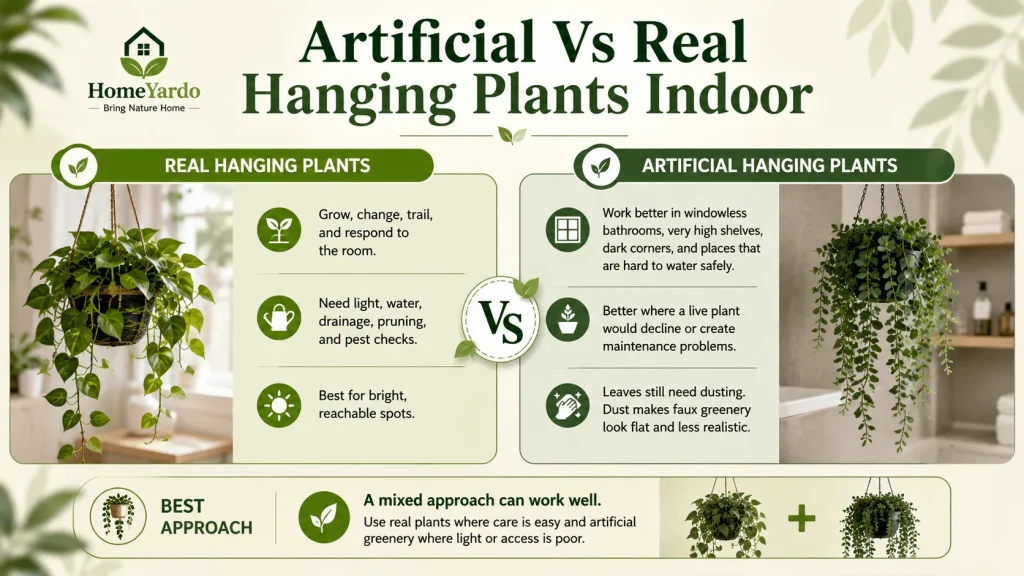
Real hanging plants grow, change, trail, and respond to the room. They need light, water, drainage, pruning, and pest checks.
Artificial hanging plants work better in windowless bathrooms, very high shelves, dark corners, and places that are hard to water safely.
Real plants are better for bright, reachable spots. Artificial plants are better where a live plant would decline or create maintenance problems.
Artificial leaves still need dusting. Dust makes faux greenery look flat and less realistic.
A mixed approach can work well. Use real plants where care is easy and artificial greenery where light or access is poor.
Common Problems With Hanging Plants
Most hanging plant problems come from light mismatch, watering mistakes, poor drainage, dry air, pests, or hard-to-reach placement.
| Problem | Likely Cause | Quick Fix |
|---|---|---|
| Yellow leaves | Overwatering, low light, old leaves, cold drafts | Check soil, drainage, roots, and light |
| Brown tips | Dry air, salts, uneven watering, heat vents | Trim tips, adjust watering, move from vents |
| Dropping leaves | Stress, watering swings, sudden move | Stabilize light and watering |
| Leggy vines | Not enough light or no pruning | Move brighter and trim stems |
| Root rot | Wet soil, oversized pot, no drainage | Remove damaged roots and improve drainage |
| Crispy fern fronds | Dry air or missed watering | Raise humidity and keep soil lightly moist |
| Pests | New plant carried insects or crowded plants | Isolate, inspect leaves, treat early |
| Water dripping | Pot not drained fully | Water in the sink and rehang after draining |
| Slow growth | Low light, cool room, root stress | Improve the light and check the roots |
| Faded variegation | Light too weak | Move to brighter indirect light |
| Mushy stems | Too much water | Let mix dry and check roots |
| Soil smells sour | Poor drainage or rot | Repot into fresh draining mix |
Check problems early. Hanging plants are easy to overlook when they are placed too high.
Buying Checklist For Trailing Houseplants
Pick the plant you want to use before deciding on the hanger. The beauty of a pot won’t solve poor lighting, improper watering or weak support.
Before you buy, be sure to review these tips:
- The plant should be matched to the room’s lighting.
- Verify the length of mature vines and the size of your basket.
- Make sure the plant is growing or if it is young.
- Verify pet safety on the specific plant.
- Check the leaves and stems for signs of pests.
- Select a pot with drainage.
- Find a location that is easily accessible to water.
- Beware of heavy pots that rest placed on support beams that are weak.
- Verify if the plant sheds leaves quickly.
- Make sure the hanger is able to support the weight.
- Make sure the leaves are firm and not mushy, or limp.
- Find healthy roots when the plant can be examined.
- Avoid soil that smells unpleasant or is rotten.
- Select compact plants for small office spaces and apartments.
- The plant should be matched to its watering habits.
- Make sure you have a brighter room to grow succulents and flowers.
Conclusion
The ideal hanging plant depends on the light, space as well as the level of care access to water, and security.
Pothos is the most common choice for the majority of homes. Spider plant is an excellent beginner option and is pet-friendly. Boston fern is suitable for humid areas. String of hearts makes soft trails and the hoya is a possibility of flowers in the long run.
Begin with the lighting level, then the room and then the level of care and finally pet security. Select a plant from the table and put it in a place where lighting and watering check-ups are easy.
FAQ’s
Pothos, spider plant, heartleaf philodendron, satin pothos, rhipsalis, and Peperomia Hope are strong beginner choices. They handle normal indoor conditions better than delicate ferns, orchids, and bright light succulents. Place them where watering and light checks are easy.
Pothos, heartleaf philodendron, satin pothos, spider plant, arrowhead vine, and English ivy can handle lower light. They still need some natural or artificial light to keep growing. In very dark rooms, use a grow light or artificial plant.
No live indoor hanging plant grows well in complete darkness. A windowless room usually needs a grow light for real plants. If light and watering access are poor, an artificial hanging plant may be the better choice.
Watering depends on plant type, light, pot size, temperature, and humidity. Check the soil first. Tropical plants often need water when the top layer dries, while succulents need the mix to dry more fully.
Pothos is usually the easiest choice for most homes. It tolerates low to bright indirect light, trails well, and recovers from small watering mistakes better than many hanging plants. Spider plant is another easy choice, especially for beginners.
Spider plant, Boston fern, bird’s nest fern, rhipsalis, and some hoyas are commonly chosen for pet homes. Always verify the exact species before placing any plant near cats, dogs, or children. Even pet safer plants can cause stomach upset if chewed.
Pothos, Tradescantia, heartleaf philodendron, arrowhead vine, and monstera adansonii can grow quickly in good light. Fast growth needs pruning. Trimming helps the basket stay full instead of becoming thin and tangled.
Use plant stands, ladders, shelves, tension rods, over-door hooks, or freestanding racks. Suction planters should be used only for very small, lightweight plants. Always check weight limits, especially after watering.
Indoor plants can make a room feel fresher, but a few hanging plants should not be treated as a full air-cleaning system. Ventilation, cleaning, and humidity control still matter. Use plants for greenery and comfort, not as a replacement for proper airflow.
Yellow leaves often come from overwatering, poor drainage, low light, cold drafts, old leaves, or root stress. Check soil moisture, pot drainage, roots, and light before adding fertilizer. Fertilizer will not fix a plant sitting in wet soil.
Water hanging plants in a sink, let the pot drain fully, then rehang it. A nursery pot inside a decorative cachepot can help control drips. Empty any standing water so the roots do not sit wet.
Lipstick plant, goldfish plant, hoya, chenille plant, and fishbone cactus are good hanging plants with flowers. Bloom depends on bright indirect light, maturity, season, and steady care. Flowering plants usually need more light than foliage vines.
References
ASPCA Toxic And Non Toxic Plants