
Best Real Estate Investment Markets in Texas

Choosing where to invest in real estate can matter almost as much as choosing the property itself. Investors need a market where housing demand, employment, population trends, purchase prices, rental potential, and long-term development make sense together.
Texas continues to attract attention because many of its metropolitan areas combine large populations with expanding employment centers and continued housing demand. U.S. Census Bureau estimates put the state’s population at more than 31.7 million in 2025, roughly 8.8% above its 2020 estimate base.
That growth does not make every Texas property a good investment. Houston, Dallas-Fort Worth, Austin, and San Antonio behave differently, and conditions can change considerably from one neighborhood or suburb to another.
For investors comparing the best real estate investment markets in Texas, the more useful question is not simply, “Which city is growing?” It is, “Which market best matches my investment strategy, budget, and tolerance for risk?”
Why Investors Continue to Consider Texas Real Estate

Texas benefits from something investors generally want to see: multiple sources of housing demand.
The state has large employment centers in energy, technology, healthcare, manufacturing, logistics, aerospace, education, financial services, and professional services. That diversity reduces dependence on a single type of employer across the state, although individual cities can still have greater exposure to certain sectors.
Population growth also matters. More residents can mean more households looking for apartments, single-family rentals, and homes to purchase.
Texas also contains several different types of real estate markets. Investors can compare expensive technology-oriented areas, established metropolitan neighborhoods, fast-growing suburbs, and more moderately priced cities without leaving the state.
Still, population growth alone should never determine a purchase. Investors also need to study housing supply, rents, taxes, insurance costs, maintenance expenses, financing, vacancy rates, and the actual property.
What Makes a Texas Market Attractive for Investment?
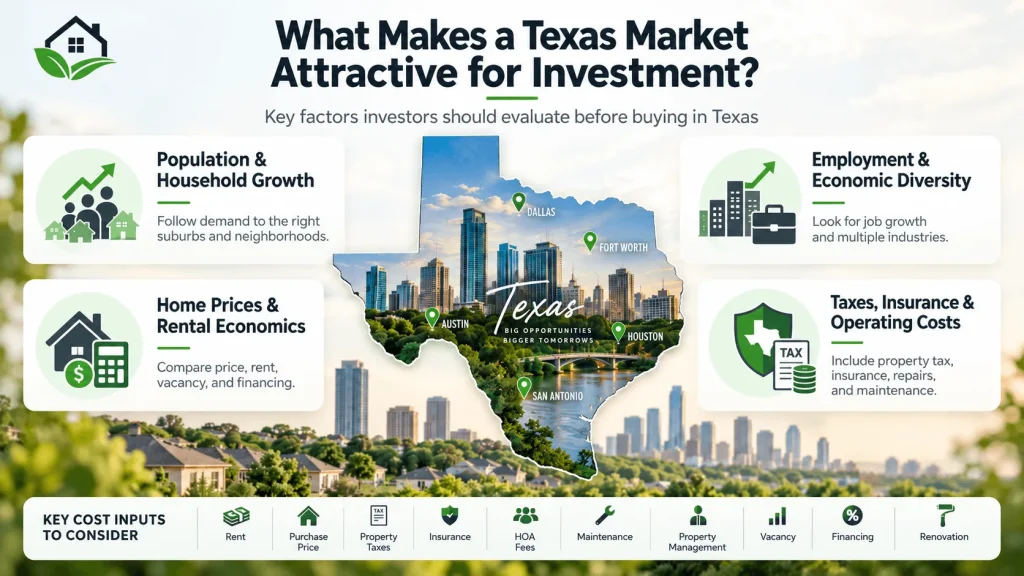
There is no single metric that identifies a strong investment market. Several factors need to work together.
Population and Household Growth
Population growth can increase housing demand, but investors should determine where that growth is occurring.
A metro may be expanding rapidly while its central city grows slowly. In Dallas-Fort Worth, for example, recent Census data show particularly strong growth occurring in outer suburbs and exurban communities.
This is why metro-level statistics should be followed by neighborhood and suburb research before buying.
Employment and Economic Diversity
Jobs help support both owner-occupied and rental housing.
Look for markets supported by several industries rather than one large employer or one economic sector. Employment growth can attract new residents, while a diversified economy may make a region more resilient when one industry slows.
Recent Bureau of Labor Statistics data show continued employment growth in several Texas metropolitan areas. Austin-Round Rock-San Marcos, for example, recorded year-over-year job growth during 2026.
Home Prices and Rental Economics
A rapidly appreciating city is not necessarily the best rental market.
Investors should compare the acquisition price with achievable rent and expected expenses. A lower-cost property can still perform poorly if vacancy is high, repairs are frequent, or rents are weak.
Depending on the strategy, useful measures can include:
- Monthly rent
- Purchase price
- Property taxes
- Insurance
- HOA fees
- Maintenance allowance
- Property management costs
- Expected vacancy
- Financing costs
- Potential renovation expenses
The objective is to evaluate the property’s likely performance rather than buying simply because a city appears on a growth list.
Property Taxes, Insurance, and Operating Costs
Texas has no state individual income tax, but investors should not interpret that as meaning property ownership is inexpensive.
Property taxes vary by location, and insurance can materially affect operating costs, particularly where properties face flood, wind, hail, or storm exposure.
A property that appears profitable based only on price and rent can look very different once taxes, insurance, repairs, and vacancy are included.
Best Real Estate Investment Markets in Texas

Houston: Large, Diverse, and Neighborhood-Dependent
Houston remains one of the most important property markets in Texas because of its scale.
The U.S. Census Bureau estimated Houston’s population at roughly 2.4 million in 2025, making it the largest city in Texas. Its economy extends beyond its traditional energy base into healthcare, aerospace, manufacturing, logistics, technology, and international trade.
That economic breadth helps create several sources of housing demand.
Houston also offers investors a wide selection of property types and price points. Depending on location and budget, investors may encounter single-family rentals, townhomes, multifamily properties, established neighborhoods, and expanding suburban communities.
The challenge is that Houston cannot sensibly be evaluated as one uniform market.
Flood exposure, property taxes, insurance expenses, school districts, employment access, construction activity, rental demand, and neighborhood conditions can vary considerably across the metropolitan area.
Investors researching the city often compare Houston investment neighborhoods before narrowing their search to individual properties.
Houston may suit: Investors who want a large market with multiple neighborhood and property-type options.
Watch closely: Flood risk, insurance, taxes, neighborhood-level demand, and local supply.
Dallas-Fort Worth: Strong Regional Growth and Suburban Expansion
Dallas-Fort Worth stands out because the investment story extends far beyond the urban cores of Dallas and Fort Worth.
According to recent Census Bureau analysis, the DFW metro reached around 8.5 million people in 2025, representing roughly 11% growth from April 2020. Much of that growth has occurred farther from the center of the region.
That creates an interesting environment for investors.
Established areas may provide access to mature employment and rental markets, while expanding suburbs can benefit from new housing, roads, retail centers, schools, and commercial development.
Cities on the outer edges of DFW have recorded particularly rapid growth. Celina, for example, was identified by the Census Bureau as the fastest-growing U.S. city with at least 20,000 residents between July 2024 and July 2025.
Rapid growth does not automatically mean strong investment returns, however. New construction can increase housing supply quickly, and investors buying in developing communities should examine future construction pipelines rather than relying only on current demand.
Dallas-Fort Worth may suit: Investors interested in both established rental markets and growing suburban corridors.
Watch closely: New housing supply, property taxes, commute patterns, infrastructure, and development plans.
Austin: Strong Economy but Higher Entry Costs
Austin has attracted investors for years because of its technology sector, employment base, universities, population growth, and appeal to younger professionals.
The broader Austin-Round Rock-San Marcos metropolitan economy continues to expand. Bureau of Labor Statistics figures for July 2026 showed employment about 1.7% higher than a year earlier.
That helps support long-term housing demand.
The difficulty is valuation.
Austin experienced dramatic housing growth earlier in the decade, leaving some properties with higher acquisition costs than investors may find in other Texas markets. Buyers therefore need to pay close attention to purchase price, current rents, housing inventory, and expected returns.
Investors should also think beyond Austin’s city limits. Communities connected economically to the Austin metro may offer different combinations of pricing and growth.
Georgetown is a good example of how quickly some surrounding communities have expanded. Census estimates put its 2025 population near 106,900, around 58.5% above its 2020 estimate base.
That does not make Georgetown or any Austin suburb an automatic buy. Rapid population increases can also bring heavy construction and competing rental inventory.
Austin may suit: Investors who prioritize employment growth and long-term regional demand over low acquisition costs.
Watch closely: Purchase price, inventory, rent-to-price relationships, and new construction.
San Antonio: Lower Entry Costs and Steady Housing Demand
San Antonio offers a different investment profile from Austin.
The city had an estimated population of roughly 1.55 million in 2025, making it one of the largest cities in the United States.
Its economy is supported by sectors including healthcare, military and defense activity, tourism, education, government, and professional services.
For investors, one attraction can be the ability to find properties at different price levels than in some higher-cost Texas markets.
That may make San Antonio worth comparing for investors who want rental properties without paying Austin-level acquisition prices.
Lower price alone is not a reason to buy, though. Investors still need to evaluate individual neighborhoods for tenant demand, property condition, employment access, schools, future development, and expected operating costs.
San Antonio may suit: Investors seeking a large metropolitan market where entry costs may be more approachable.
Watch closely: Neighborhood variation, rent levels, property condition, taxes, and tenant demand.
Emerging Texas Real Estate Markets Worth Watching
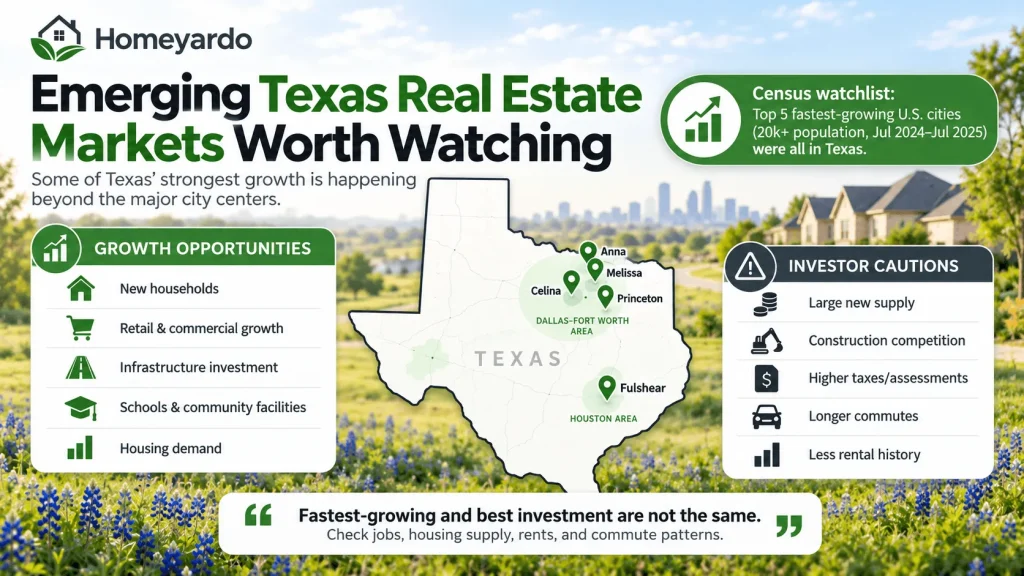
Some of Texas’ most striking population growth is occurring outside the four major city centers.
The Census Bureau reported that the five fastest-growing U.S. cities with populations above 20,000 between July 2024 and July 2025 were all in Texas. They included Celina, Fulshear, Princeton, Melissa, and Anna.
That makes suburban and exurban Texas worth watching.
But “fastest growing” and “best investment” mean different things.
Rapid-growth communities can bring:
- New households
- Retail and commercial development
- Infrastructure investment
- Schools and community facilities
- Expanding housing demand
They can also bring:
- Large amounts of new housing supply
- Construction competition
- Higher infrastructure-related taxes or assessments
- Longer commute times
- Less established rental histories
Investors considering emerging markets should therefore look beyond population percentages and ask why people are moving there, where they work, how much housing is being built, and whether rents support the purchase price.
Which Texas Market Fits Your Investment Strategy?
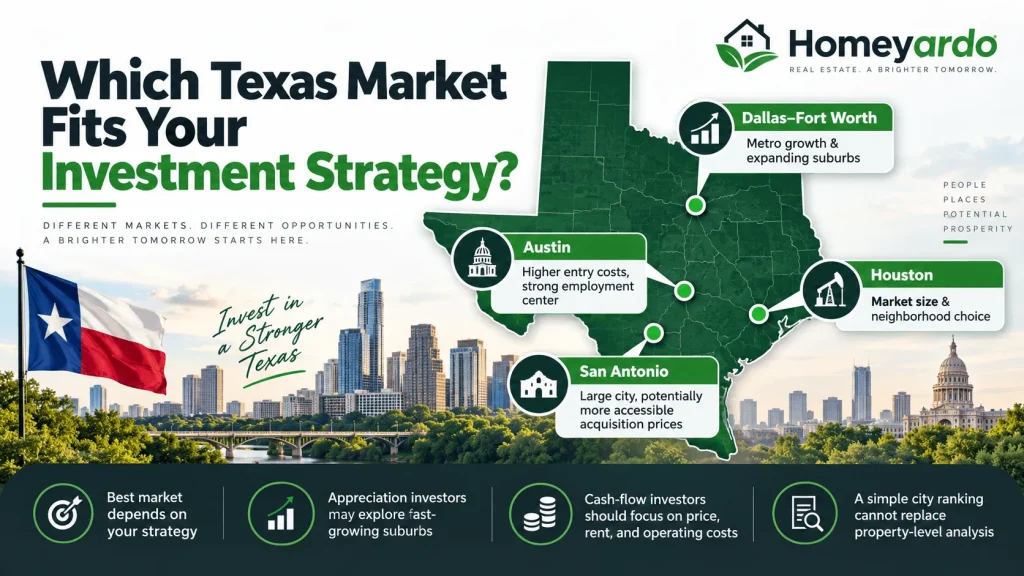
The strongest market depends on what you are trying to accomplish.
If your priority is market size and neighborhood choice, Houston may deserve a closer look.
If you want large-scale metro growth combined with expanding suburbs, Dallas-Fort Worth stands out.
If you are comfortable with higher entry costs in exchange for exposure to a strong employment center, Austin may fit your strategy.
If you prefer a large city with potentially more accessible acquisition prices, San Antonio may be worth comparing.
Investors interested in appreciation may also investigate fast-growing suburbs around these metropolitan areas, while investors focused on immediate cash flow should concentrate more heavily on purchase price, achievable rent, and operating costs.
A simple city ranking cannot replace property-level analysis.
What to Check Before Buying an Investment Property in Texas

Once you identify a market, the next step is to examine the actual property and neighborhood.
Start with the numbers. Calculate expected rent against the mortgage, property taxes, insurance, maintenance, vacancy, management expenses, HOA fees, and any immediate repairs.
Then look at the property itself.
Older homes may require HVAC, roofing, plumbing, electrical, foundation, or drainage work. Investors planning renovations should estimate their home improvement projects before treating potential upgrades as added property value.
Water management also deserves attention, especially when evaluating a house with grading or foundation concerns. Visible standing water or recurring yard drainage problems can signal expenses that should be understood before closing.
Other questions to investigate include:
- What are comparable homes actually renting for?
- How long are rental listings staying available?
- How much new housing is under construction nearby?
- Are property taxes changing quickly?
- Is the property in a flood-prone area?
- What will insurance cost for this exact address?
- Are major employers opening, expanding, or leaving?
- Is the area’s growth dependent on one employer or industry?
- What repairs will be needed during the first few years?
- Does the property still work financially under conservative rent and vacancy assumptions?
The city gets you onto the shortlist. The property’s numbers decide whether the deal deserves further consideration.
Final Thoughts
Texas gives real estate investors several very different markets to compare.
Houston offers scale and neighborhood variety. Dallas-Fort Worth combines a large employment base with substantial suburban expansion. Austin remains tied to one of the state’s strongest employment-growth stories but can require a higher entry price. San Antonio provides another large metropolitan market with a different affordability profile.
Fast-growing communities around these cities add another layer of opportunity, but rapid population growth should be treated as a starting point for research rather than proof that a property will perform well.
The best Texas real estate market is therefore not necessarily the city growing fastest or receiving the most attention.
It is the market where the purchase price, rental demand, operating costs, property condition, and long-term local fundamentals fit your specific investment strategy.
FAQ’s
Houston, Dallas-Fort Worth, Austin, and San Antonio are four of the main Texas markets investors commonly evaluate because of their population size, employment bases, and housing demand. The best choice depends on purchase price, rent potential, expenses, neighborhood conditions, and investment strategy.
Texas has several characteristics that attract property investors, including population growth, large employment centers, and numerous metropolitan and suburban markets. That does not mean every property will perform well. Property taxes, insurance, financing, maintenance, supply, and local rental demand must all be considered.
Neither city is automatically better. Houston offers a very large and diverse housing market, while Dallas-Fort Worth has experienced substantial metro and suburban growth. Investors should compare specific neighborhoods, prices, rents, taxes, insurance, and future housing supply.