How to Start a SaaS Business From Home
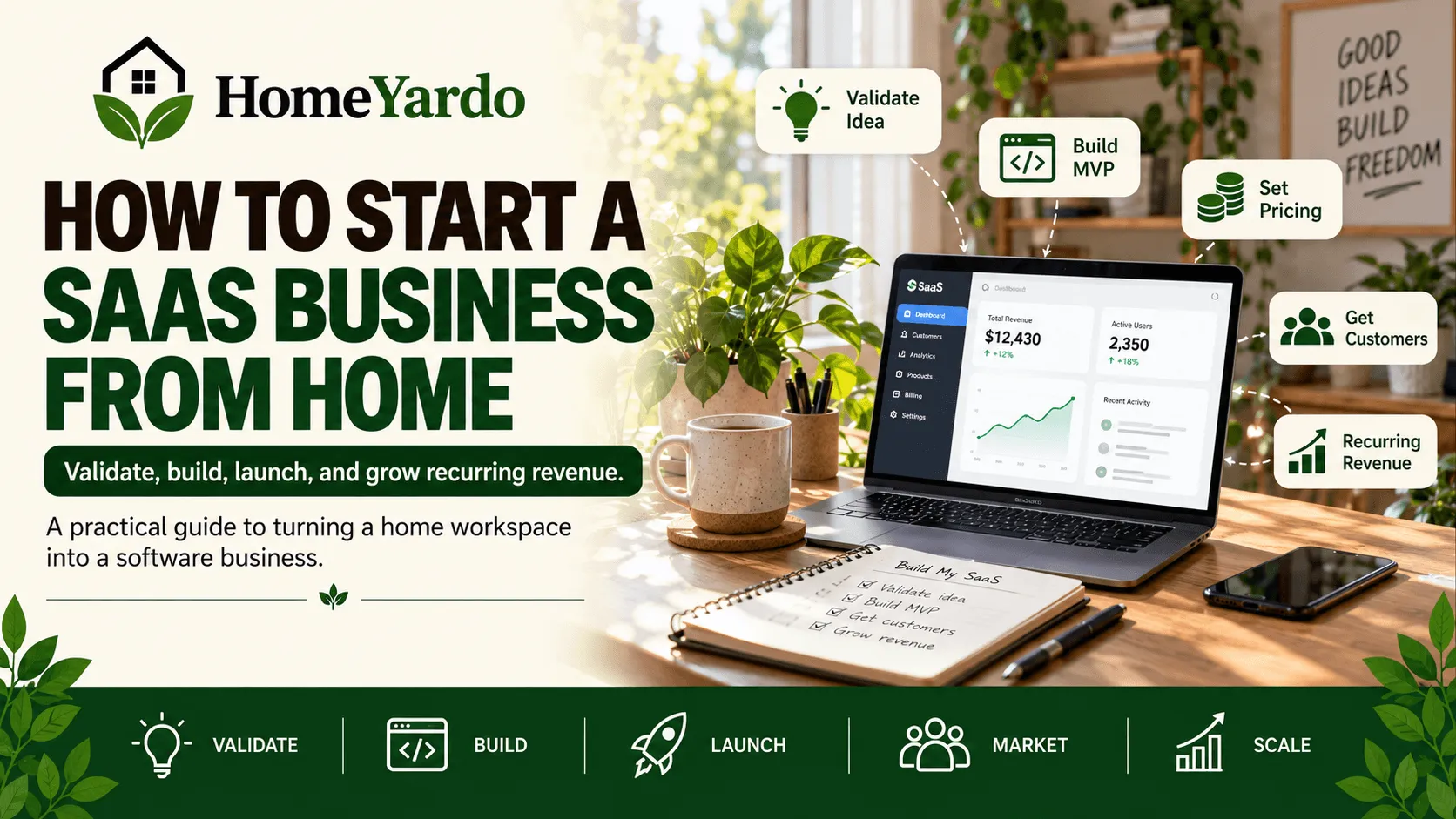
Starting a software business no longer requires renting an office, hiring a large team, or investing heavily before you have your first customer. Many founders can research an idea, build an early product, talk to users, and manage subscriptions from a home workspace.
That does not mean launching a SaaS company is as simple as owning a laptop and connecting to the internet. A successful product still needs to solve a real problem, reach the right users, generate recurring revenue, and provide enough value to keep customers subscribed.
If you want to start a SaaS business from home, begin with validation rather than development. Once you know people genuinely need what you want to build, you can move through product development, pricing, marketing, customer support, and ongoing improvement in a much more controlled way.
What Is a SaaS Business?
Software as a Service, or SaaS, is software that customers access online rather than buying and installing permanently on their own computers.
Customers commonly pay through:
- Monthly subscriptions
- Annual subscriptions
- Usage-based pricing
- Tiered plans
- Freemium plans with paid upgrades
Project-management platforms, email marketing tools, accounting software, appointment systems, customer relationship management platforms, and online design applications are common examples of the SaaS model.
One advantage for a home-based founder is that nearly every part of the business can be managed online. Development, customer communication, billing, analytics, marketing, and team collaboration can all be handled remotely.
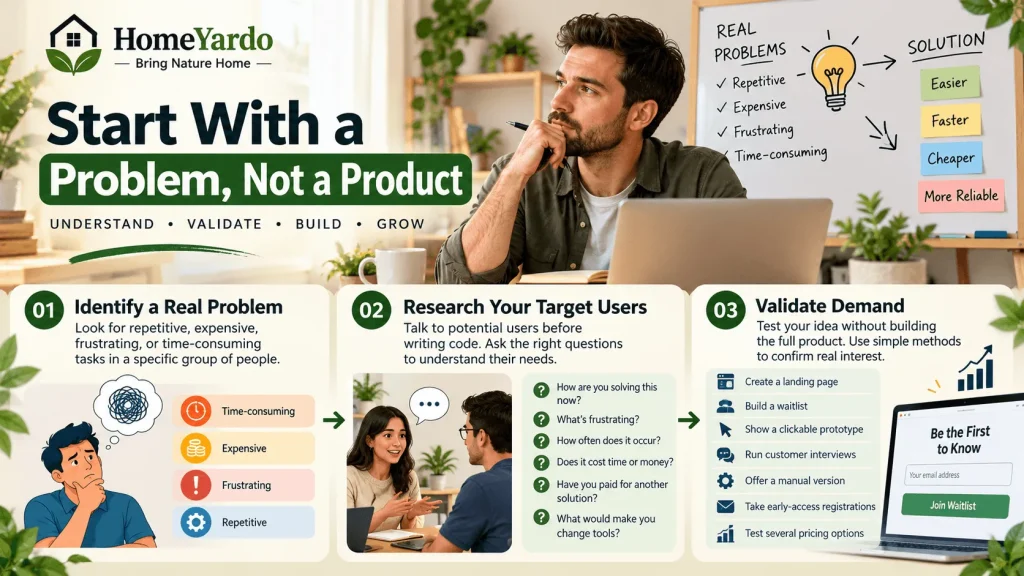
Start With a Problem, Not a Product
One of the easiest mistakes to make is building software simply because an idea sounds interesting.
A stronger starting point is a problem.
Look for repetitive, expensive, frustrating, or time-consuming tasks experienced by a specific group of people. Your potential SaaS product should make one of those tasks easier, faster, cheaper, or more reliable.
For example, instead of deciding to create another generic project-management application, you might discover that small construction companies struggle to organize job-site photographs and client approvals. That is a much narrower problem and gives you a clearer target customer.
Research Your Target Users
Before writing code, speak with potential users.
Ask questions such as:
- How are you solving this problem now?
- What is frustrating about your current solution?
- How often does the problem occur?
- Does the problem cost you money or time?
- Have you paid for another solution?
- What would make you change tools?
Avoid asking only whether someone “likes” your idea. Positive feedback does not automatically mean someone will pay for the product.
Evidence of an existing problem is more valuable than compliments about a proposed solution.
Validate Demand Before Building
You can test an idea without developing an entire application.
Possible validation methods include:
- Creating a simple landing page
- Building a waitlist
- Showing users a clickable prototype
- Running customer interviews
- Offering a manual version of the service
- Taking early-access registrations
- Testing several pricing options
Your aim is to answer a basic question: Will the target customer care enough about this problem to try or pay for a solution?
Create a Simple SaaS Business Plan
You do not necessarily need a lengthy traditional business plan at this stage. A short working document may be more useful.
Define:
- The problem you are solving
- Your ideal customer
- Your proposed solution
- Your main competitors
- Your competitive difference
- Your pricing model
- Customer acquisition channels
- Expected expenses
- Revenue targets
- Major development milestones
You should also estimate how much money you can reasonably invest before the business begins producing recurring revenue.
Software development, hosting, payment processing, domain registration, design tools, advertising, contractors, and support software can all create ongoing costs.
Set Up a Reliable Home Workspace
A SaaS company may be digital, but your working environment still affects how efficiently you can run it.
You need dependable internet access for development, cloud services, video meetings, customer support, backups, analytics, and software deployment.
Before choosing a provider, compare speed, upload performance, data restrictions, outage history in your area, and business requirements. Depending on availability at your address, you can also compare Xfinity Internet plans when evaluating home internet options.
A dedicated workspace can also help separate business activity from everyday home life.
If your office becomes uncomfortable during long working sessions, HomeYardo’s guide to planning a home office explains how room use, equipment, occupancy, and temperature can affect a remote workspace.
Build a Minimum Viable Product
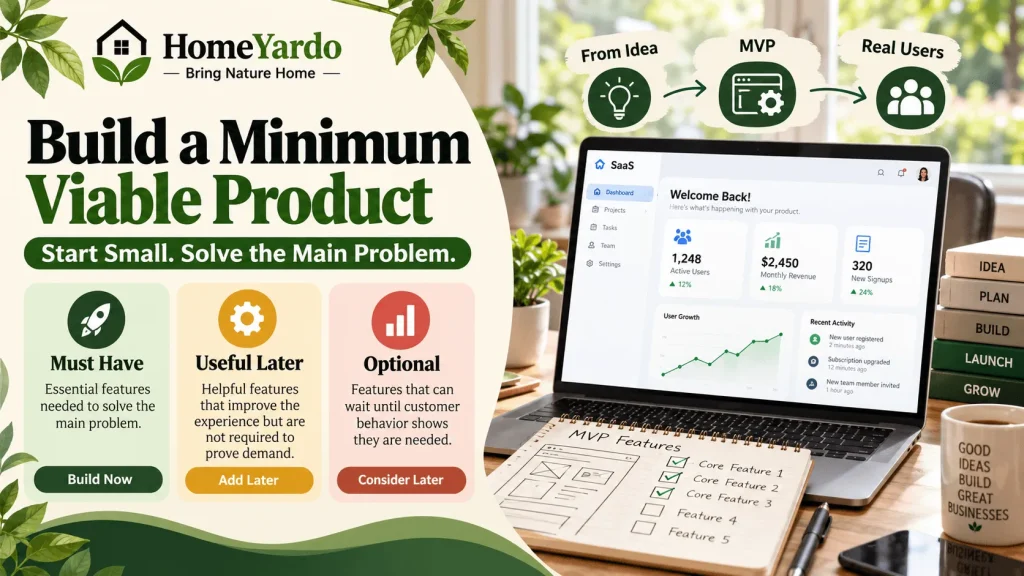
Once the idea has enough validation, create a Minimum Viable Product, or MVP.
An MVP is not simply an unfinished version of your eventual application. It should perform the smallest useful set of functions needed to solve the main customer problem.
Suppose your eventual product roadmap contains 20 features. Your initial users may only need three of them to receive meaningful value.
Start there.
Decide What Belongs in the MVP
Separate features into three groups:
- Must have:
The software cannot solve the main problem without them. - Useful later:
They improve the experience but are not required to prove demand. - Optional:
They can wait until customer behavior shows they are needed.
Keeping the first version narrow reduces development time and gives you feedback before too much money has been committed.
Choose How You Will Build the SaaS Product
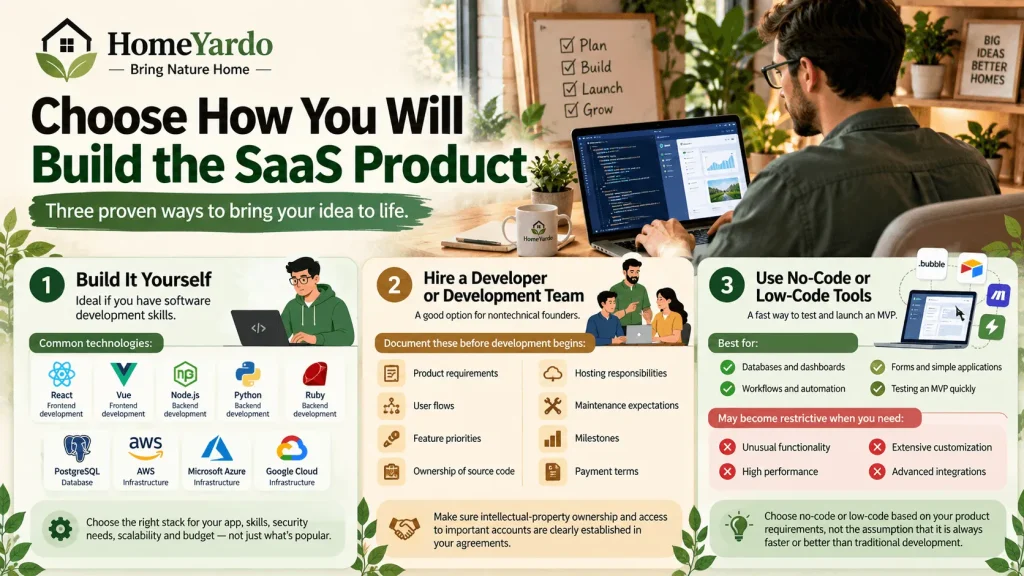
There are several development routes available.
Build It Yourself
If you already know software development, you may build the product independently.
Common technologies include:
- React or Vue for frontend development
- Node.js, Python, or Ruby for backend development
- PostgreSQL or similar databases
- AWS, Microsoft Azure, or Google Cloud for infrastructure
The correct technology stack depends on what the application does, your existing technical knowledge, security requirements, scalability needs, and available budget.
Avoid selecting technology simply because it is popular.
Hire a Developer or Development Team
A nontechnical founder can hire freelancers, contractors, or an agency.
Before development begins, document:
- Product requirements
- User flows
- Feature priorities
- Ownership of source code
- Hosting responsibilities
- Maintenance expectations
- Milestones
- Payment terms
Make sure intellectual-property ownership and access to important accounts are clearly established in your agreements.
Use No-Code or Low-Code Tools
Some SaaS concepts can be tested with no-code or low-code platforms.
These tools can reduce the time required to release an MVP, particularly when the product mainly involves databases, dashboards, workflows, forms, or simple automation.
They may become restrictive when the application requires unusual functionality, extensive customization, high performance, or advanced integrations.
Choose them based on product requirements rather than assuming no-code is always faster or traditional coding is always better.
Test the Product With Real Users
Do not wait until you believe the software is perfect.
Give a controlled version to a small group of target users and observe what actually happens.
Look for:
- Features users cannot understand
- Steps where people leave
- Bugs and performance problems
- Frequently requested capabilities
- Features nobody uses
- Tasks that take too many clicks
- Reasons users stop returning
What customers do inside the product is often more useful than what they say they want.
Combine interviews with actual usage data when deciding what to improve.
Set Your SaaS Pricing
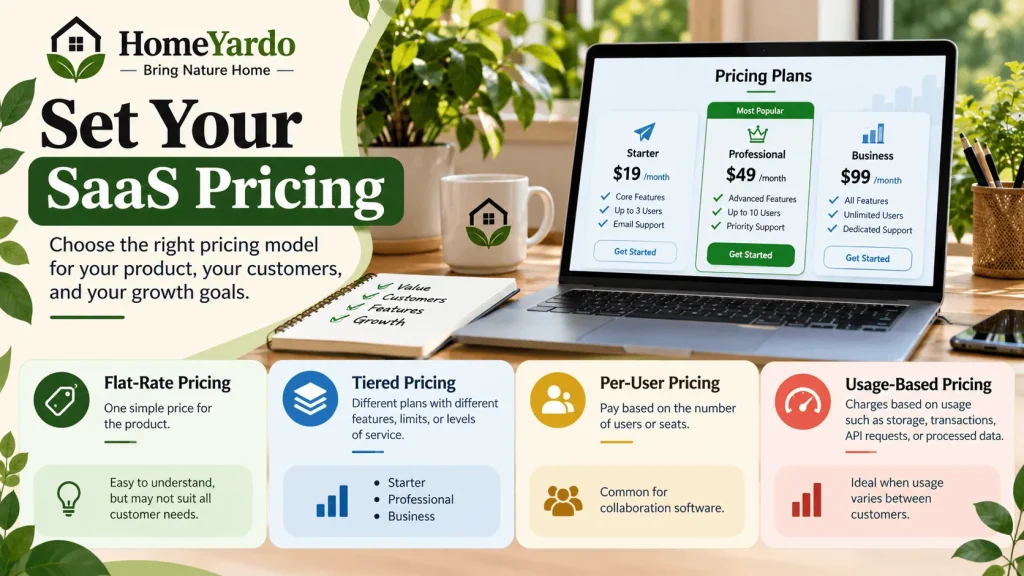
Pricing deserves its own strategy.
Some founders choose a number based largely on competitors. A better approach is to consider how much value the software provides and how different customers use it.
Common SaaS pricing models include:
Flat-Rate Pricing
Customers pay one price for the product.
This is simple to understand but may not work well when customers have very different needs.
Tiered Pricing
Different plans provide different features, limits, or levels of service.
For example:
- Starter
- Professional
- Business
This lets customers choose a plan that matches their requirements.
Per-User Pricing
Companies pay according to the number of users or seats.
This is common with collaboration software.
Usage-Based Pricing
The bill changes according to usage, such as storage, transactions, API requests, or processed data.
Whatever model you choose, explain clearly what customers receive and how charges are calculated.
Set Up Payments and Subscription Management
A subscription business needs a secure way to collect recurring payments.
Platforms such as Stripe can be used to manage subscriptions, invoices, payment methods, renewals, and other billing tasks.
You will also need processes for:
- Failed payments
- Plan upgrades
- Downgrades
- Cancellations
- Refunds
- Taxes
- Invoices
Test the entire billing process before opening the product to a larger customer base.
Protect Customer Data and Business Accounts
Security should be considered while the product is being built rather than added after launch.
Basic safeguards may include:
- Strong password policies
- Multi-factor authentication
- Encrypted connections
- Access controls
- Secure backups
- Software dependency updates
- Logging and monitoring
- Restricted administrative permissions
Your exact obligations depend on what information you collect and where your customers are located.
Create appropriate privacy policies, terms of service, and data-handling procedures. If the product processes regulated or sensitive information, obtain qualified legal and security advice relevant to your situation.
Create a SaaS Marketing Strategy
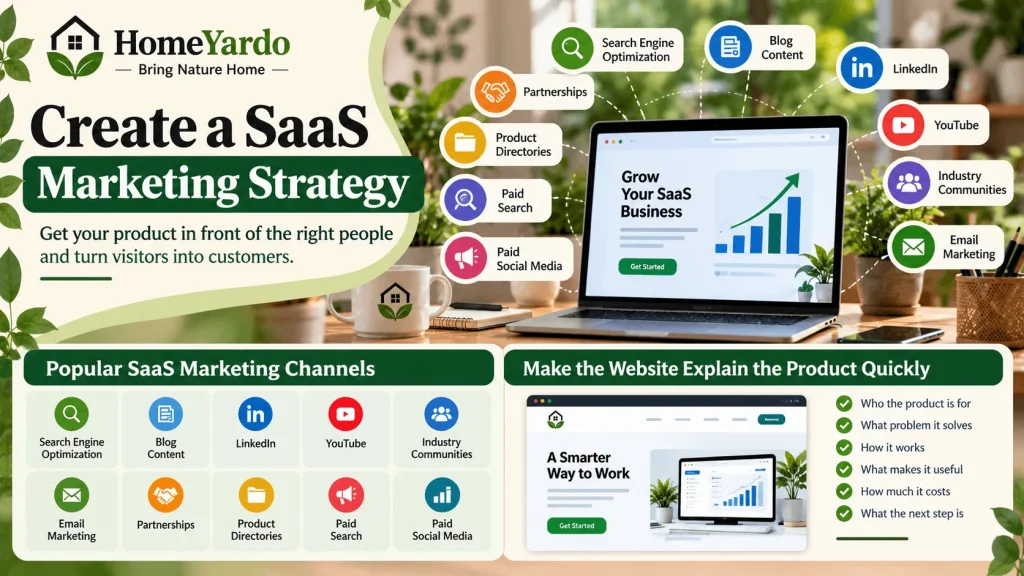
Building the application is only half the job. People need to discover it.
Start by understanding where your ideal customers already search for information.
Potential channels include:
- Search engine optimization
- Helpful blog content
- YouTube
- Industry communities
- Email marketing
- Partnerships
- Product directories
- Paid search
- Paid social media
You do not have to use every channel.
A small company usually gets better results by becoming good at one or two acquisition channels before spreading its budget across many of them.
Make the Website Explain the Product Quickly
A visitor should be able to understand within seconds:
- Who the product is for
- What problem it solves
- How it works
- What makes it useful
- How much it costs
- What the next step is
Screenshots, demonstrations, use cases, FAQs, testimonials, and transparent pricing can answer questions without requiring every visitor to speak with you.
Turn Early Users Into Long-Term Customers
Recurring revenue depends on retention.
A SaaS company that continually attracts new customers but loses them quickly has a difficult growth problem.
Help customers reach the product’s main benefit as quickly as possible.
That may involve:
- Better onboarding
- Setup checklists
- Tutorial videos
- Product tours
- Documentation
- Live chat
- Email guidance
- Responsive customer support
Track the questions customers repeatedly ask. They often reveal where the product or onboarding needs improvement.
Track the SaaS Metrics That Matter
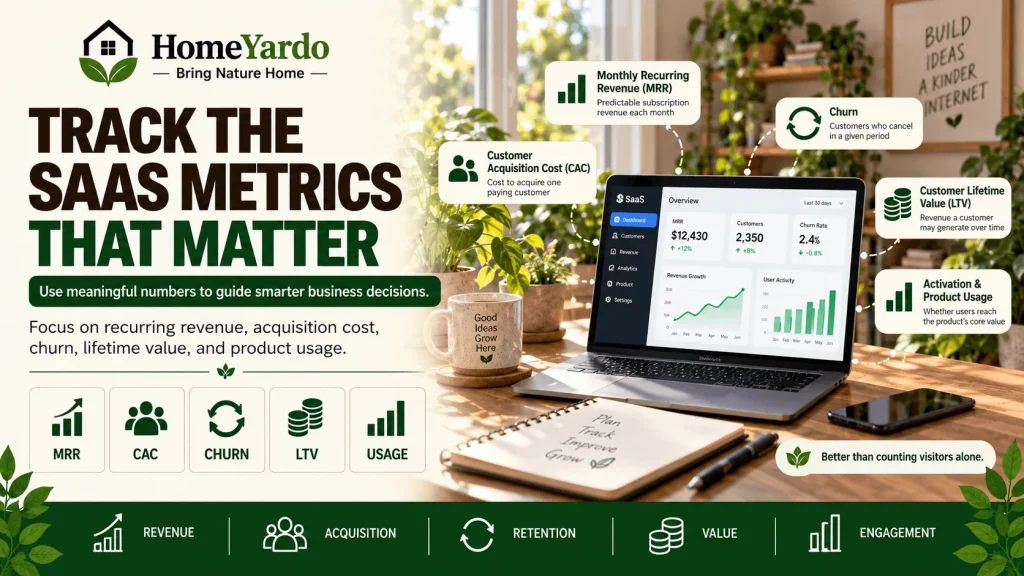
Running the business becomes easier when decisions are based on meaningful numbers.
Useful SaaS metrics include:
Monthly Recurring Revenue
Monthly recurring revenue, or MRR, shows predictable subscription revenue generated each month.
Customer Acquisition Cost
Customer acquisition cost, or CAC, estimates how much you spend to acquire a new paying customer.
Churn
Customer churn measures how many customers cancel within a particular period.
High churn can indicate problems with pricing, product value, onboarding, customer fit, or support.
Customer Lifetime Value
Customer lifetime value estimates how much revenue a customer may generate during their relationship with the company.
Activation and Product Usage
Track whether new customers complete the actions associated with receiving value from the product.
These metrics provide a more useful picture than simply counting website visitors or registrations.
Manage Operations as the SaaS Business Grows
Working from home keeps overhead relatively low, but growing software businesses still require organized operations.
Monitor:
- Revenue
- Operating expenses
- Cloud infrastructure costs
- Customer support workload
- Software performance
- Subscription cancellations
- Marketing performance
- Product usage
Automate repetitive tasks when automation saves meaningful time, but review important customer-facing and financial processes regularly.
Your physical workspace may also need to change as the business grows. If equipment, paperwork, or additional workstations begin taking over the room, using limited home space more efficiently can help keep a home-based operation organized.
Know When to Hire
You do not need a large staff when starting.
Many founders initially handle several functions themselves, including product management, customer communication, marketing, and administration.
Hiring becomes more reasonable when a task:
- Requires expertise you do not have
- Consumes too much founder time
- Directly limits customer growth
- Creates operational risk
- Cannot reasonably be automated
Developers, designers, support representatives, marketers, accountants, and other specialists can be added as the business requires them.
Common Mistakes to Avoid When Starting a SaaS Business From Home
Several mistakes can consume time and money before a product gains traction.
Avoid:
- Building before validating the problem
- Targeting everyone instead of a defined customer
- Adding too many MVP features
- Ignoring customer feedback
- Choosing pricing without testing it
- Treating security as an afterthought
- Relying completely on one marketing channel
- Tracking registrations but ignoring retention
- Increasing expenses before recurring revenue supports them
- Building requested features without checking whether enough customers need them
The aim is not to create the biggest application possible. It is to build the smallest useful product that can steadily become better.
Final Thoughts
You can start a SaaS business from home with relatively little physical infrastructure, but the business still needs disciplined execution.
Begin with a genuine customer problem. Validate demand before committing heavily to development. Build an MVP around the main use case, test it with real users, establish sensible pricing, and create a repeatable method for attracting and retaining customers.
Then watch the numbers.
A SaaS company becomes stronger when product decisions, marketing decisions, and spending decisions are connected to actual customer behavior rather than assumptions.
Starting small from home can be an advantage. It gives you room to test your idea without carrying the overhead of a traditional office while you work toward reliable recurring revenue.
FAQ’s
Yes. Many of the main SaaS activities—including development, hosting, marketing, customer support, analytics, billing, and team collaboration—can be managed remotely. You still need suitable business registration, tax arrangements, contracts, and data practices for your location and customer base.
There is no fixed amount. A founder who develops an MVP independently may spend mainly on hosting, software tools, domains, payment processing, and marketing. Hiring developers or an agency can increase initial costs substantially. Calculate expenses based on your product rather than relying on a universal startup estimate.
No. Technical knowledge can help, but founders can work with developers or use suitable no-code and low-code platforms. A nontechnical founder should still understand the product requirements well enough to evaluate development decisions.
Look for recurring problems experienced by a specific audience. Talk to potential customers, study existing solutions, examine complaints about current tools, and determine whether people are already spending time or money trying to solve the problem.
An MVP should contain only the features required to solve the main customer problem and test your core assumptions. Features that do not contribute directly to that objective can usually wait.
Most SaaS businesses generate recurring revenue through monthly or annual subscriptions. Others use per-user, usage-based, freemium, or tiered pricing models.
There is no standard timeline. Profitability depends on development costs, pricing, acquisition costs, customer retention, operating expenses, market demand, and growth rate. A better approach is to monitor revenue, churn, acquisition cost, and cash flow from the beginning.