How Much Does Water Damage Restoration Cost In Fort Worth? 2026 Price Ranges
Most water damage restoration jobs cost between about $1,300 and $5,700, based on national cost data from Angi and HomeAdvisor, which is a sound starting point for a typical one- or two-room leak in Fort Worth. Per square foot, expect roughly $3 to $4 for clean water from a supply line, $4 to $6.50 for gray water from an appliance or overflow, and $7 to $7.50 for contaminated water from sewage or floodwater. Those figures cover extraction and drying; rebuilding drywall, flooring and cabinets is a separate cost on top, and on serious losses it can be the larger share of the bill.
Here is what drives that number up or down, how long the work takes, and what your homeowners policy is likely to pay.
If water is still entering the property or materials remain wet, knowing how to handle a flooded home can help you prioritize water shutoff, documentation, extraction, drying, and professional assessment before focusing on the final repair bill.
2026 Cost Ranges At A Glance
| Item | Typical range | Source |
|---|---|---|
| Typical total project | $1,305 to $5,707 | Angi and HomeAdvisor, via Bob Vila |
| National average project | About $3,250 | LawnStarter 2026 cost guide |
| Category 1 (clean water) | $3 to $4 per sq ft | Angi and HomeAdvisor, via Bob Vila |
| Category 2 (gray water) | $4 to $6.50 per sq ft | Angi and HomeAdvisor, via Bob Vila |
| Category 3 (black water) | $7 to $7.50 per sq ft | Angi and HomeAdvisor, via Bob Vila |
| Drywall replacement | About $1.50 to $3 per sq ft | LawnStarter 2026 cost guide |
These are national figures. We found no public source for Fort Worth-specific restoration pricing, so treat the table as a yardstick for judging quotes rather than a promise.
What Drives The Price
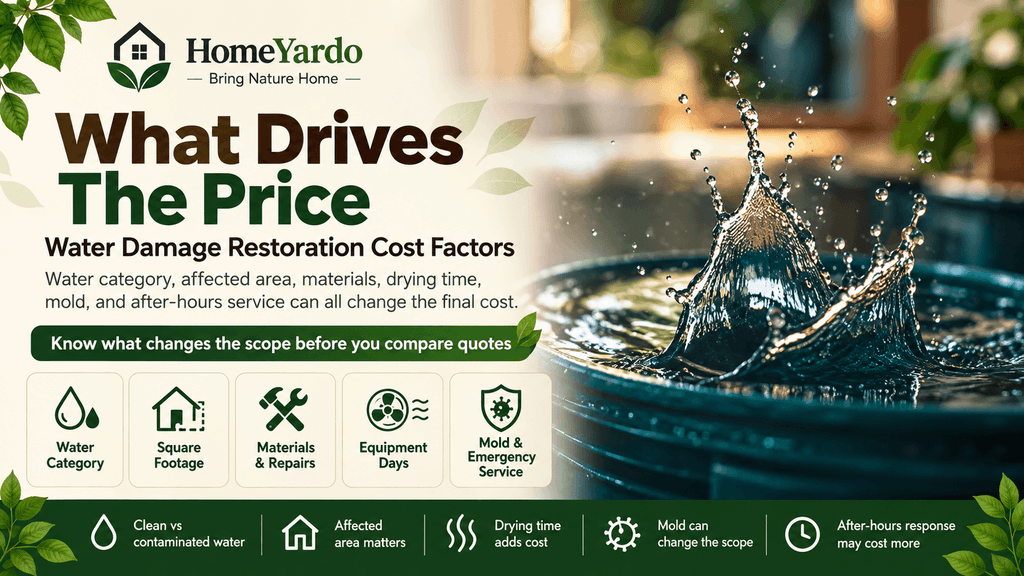
Water restoration companies do not normally price every loss the same way. The source and condition of the water, affected square footage, building materials, drying time, contamination, and repairs required after drying can all change the scope.
Water category
The single biggest factor is what kind of water you’re dealing with. As Bob Vila’s breakdown of water damage restoration costs explains, clean water is the cheapest to remove and dry, while black water from sewage or outdoor flooding roughly doubles the per-square-foot rate because porous materials it touches usually have to be thrown away. Time matters here too: clean water left standing can degrade into a dirtier category within a day or two, and the price goes up with it.
If the source of the water is not obvious and household water use seems unusually high, you can check your water meter for leaks to look for signs of continuing water flow before additional damage develops.
Square Footage And Materials
A wet bathroom floor and a flooded living room are different jobs. Carpet and pad, hardwood, and the bottom couple of feet of drywall are the materials that typically come out. LawnStarter’s 2026 water damage restoration cost guide puts drywall replacement at roughly $1.50 to $3 a square foot and subfloor repair at $250 to $700 for a 150-square-foot section.
How Long The Equipment Runs
Air movers and dehumidifiers are typically billed by the day, so drying time translates directly into cost. Rapid Restoration, an IICRC-certified company with offices in Mansfield and Fort Worth, publishes the timelines it works to: a minor clean-water loss in a single room takes about three to five days to dry plus three to seven days for repairs; damage spread across several rooms runs one to three weeks in total; and major flooding with structural damage can take four to eight weeks. Those ranges are a reasonable benchmark when a quote lists the number of equipment days.
Mold
If drying started late and mold has taken hold, remediation is a separate line item, and in Texas any area of 25 contiguous square feet or more must be handled by a state-licensed mold remediation contractor. That adds both cost and paperwork.
After-Hours And Storm-Surge Timing
Most restoration companies advertise 24/7 emergency service, but check how that is staffed. A directory listing for 24-7 Restoration and Roofing in Mansfield, for instance, shows posted hours of 6 a.m. to 10 p.m. despite the company’s name, so it’s worth confirming overnight availability before you rely on it. After a regional storm, demand spikes for every company in the Metroplex, and schedules stretch.
How Insurance Changes What You Pay

For many Fort Worth homeowners, the real out-of-pocket cost is the deductible. Even when insurance covers part of the loss, deductibles, excluded work, upgrades, or uncovered repairs can still leave the homeowner responsible for unexpected home repair costs. Most home policies cover sudden and accidental water damage, such as a burst pipe or a failed washing machine hose, but not slow leaks that developed over months, and not flooding from rising water, which needs a separate flood policy.
Burst pipes are the classic Texas case. After Winter Storm Uri in February 2021, the Texas Department of Insurance reported that Texans filed more than 450,000 claims and the storm caused over $8 billion in insured losses, much of it from broken pipes. Most home policies cover that kind of sudden pipe failure, and the department reminds policyholders to shut off the main and protect property right away, because an insurer can deny a claim if you let damage spread.
How a restoration company handles billing affects your cash flow. Some require payment from you and leave you to seek reimbursement; others work directly with the carrier. Restoration work is normally quoted after an on-site inspection rather than from a price list, and Rapid Restoration is no exception: it doesn’t publish rates, though it says it can bill your insurer directly.
Red Flags In A Water Damage Estimate
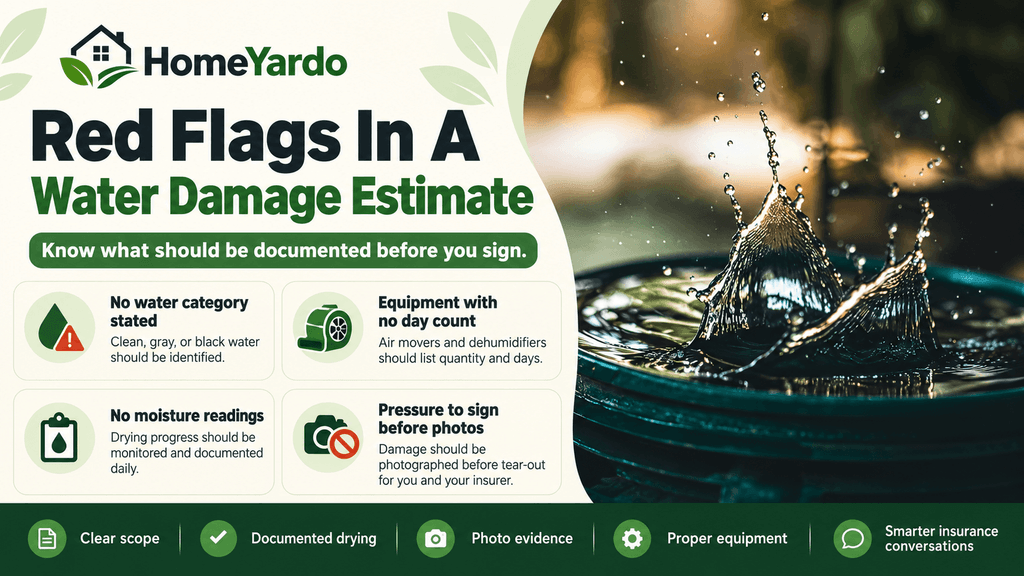
- No water category stated. If the estimate doesn’t say whether the water was clean, gray or black, you can’t tell whether the price fits the job.
- Equipment with no day count. You should see how many air movers and dehumidifiers, and for how many days.
- No moisture readings. Drying should be documented daily; an estimate without monitoring is a guess.
- Pressure to sign before photos. Damage should be photographed before tear-out, for your insurer’s sake as well as yours.
When Paying More Is Worth It

Paying more makes sense for contaminated water, for jobs that need thermal imaging to track water inside walls, and when the same company can handle both mitigation and reconstruction, which saves you from coordinating two contractors and two sets of paperwork. It rarely makes sense to pay extra for a brand name alone. A detailed, itemized estimate from an IICRC-certified company, compared against one or two others for the same scope, remains the most reliable way to know you are paying a fair price.
Bottom Line
National pricing data suggests that many water damage restoration jobs fall within several thousand dollars, but no single figure can predict the cost of a Fort Worth property loss. Water category, affected square footage, materials, drying time, mold, emergency response, and reconstruction can all move the final bill.
Use published prices as comparison points rather than quotes. For an actual loss, document the damage, stop the water source when it is safe to do so, contact the insurer if a claim may apply, and compare the restoration company’s itemized scope with the conditions found at the property.
FAQ’s
National cost data puts a lot of water damage restoration projects in the $1,300 to $5,700 range, but that should not be taken as a Fort Worth quote. Actual costs vary with water source, square footage affected, contamination, materials, drying needs, demolition, and reconstruction.
Published national ranges often increase with the water category because contaminated losses require more cleaning, disposal, and safety controls. Per-square-foot figures should be treated as planning benchmarks because local labor, materials, project conditions, and reconstruction can change the final cost.
Contaminated water losses are usually more expensive to remediate than clean water losses, as affected porous materials may have to be removed and the work can involve extensive cleaning and contamination controls.
Most homeowners policies will provide coverage for some sudden and accidental water damage such as a burst pipe or broken washer hose. Gradual leakage is generally not covered. Flood damage from rising water is not covered by regular homeowners insurance. Actual coverage depends on the individual policy.