Ground Cover Flowers: 45 Best Flowering Ground Covers For Sun, Shade, Slopes, And Bare Spots

Flowers that cover the ground can make a garden that is difficult to maintain seem more thoughtful. A dry patch along the path or a slope that is constantly being watered or a shaded area under bushes can look healthier and more well-maintained by planting the right low-growing plants.
The key is choosing the best location first. Flowers that look attractive are helpful, obviously, but sunlight, soil and moisture, traffic and spreading habits determine if the plant grows or gradually gives up.
This guide begins with a few quick choices and moves on to 45 flowers that can be used as ground cover that are suitable for full sun, shade, pathways, slopes, pollinators, grass replacement and low-maintenance plants. Some remain tidy. Others spread their wings with enthusiasm. Some require boundaries before they can act like they are the bosses of the entire place.
Best Ground Cover Flowers At A Glance
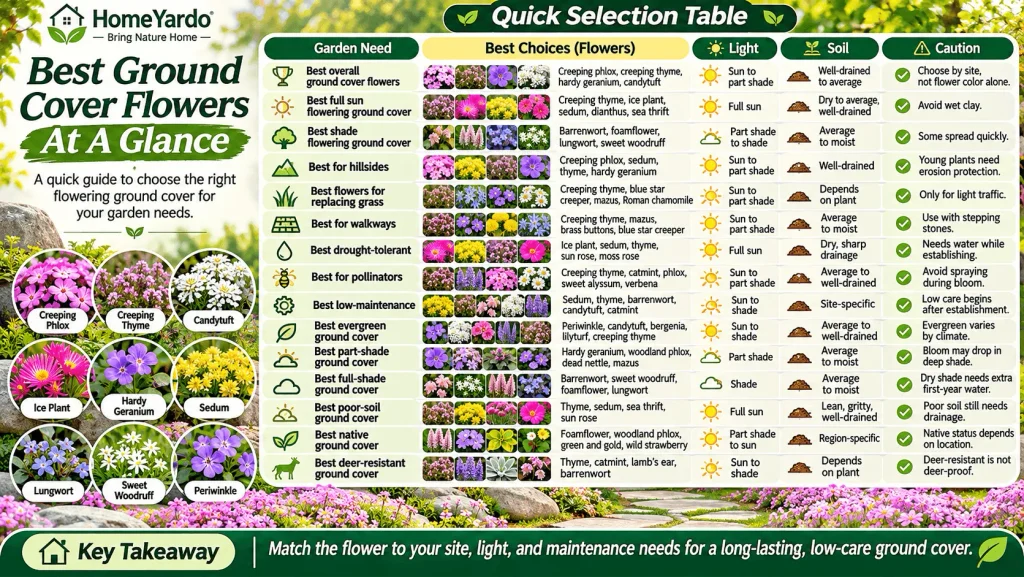
The easiest method to begin is by comparing the plant with the garden issue. Flowers that perform beautifully on a sunny and dry bank could struggle in the shade of trees. Shade-lovers may appear exhausted and wilted in the scorching afternoon sun.
This table will give you the most effective starting points. Consider it as a quick list prior to examining the complete information about the plant.
Quick Selection Table
| Garden Need | Best Choices | Light | Soil | Caution |
|---|---|---|---|---|
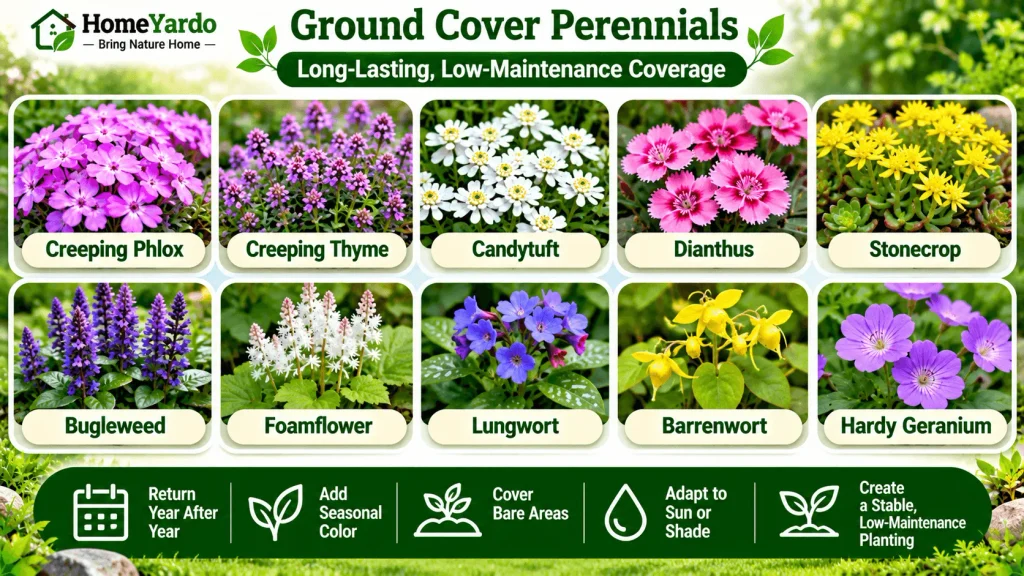
| Best overall ground cover flowers | Creeping phlox, creeping thyme, hardy geranium, candytuft | Sun to part shade | Well-drained to average | Choose by site, not flower color alone |
| Best full sun flowering ground cover | Creeping thyme, ice plant, sedum, dianthus, sea thrift | Full sun | Dry to average, well-drained | Avoid wet clay |
| Best shade flowering ground cover | Barrenwort, foamflower, lungwort, sweet woodruff | Part shade to shade | Average to moist | Some spread quickly |
| Best flowering ground cover for hillsides | Creeping phlox, sedum, thyme, hardy geranium | Sun to part shade | Well-drained | Young plants need erosion protection |
| Best flowers for replacing grass | Creeping thyme, blue star creeper, mazus, Roman chamomile | Sun to part shade | Depends on plant | Only for light traffic |
| Best flowering ground cover for walkways | Creeping thyme, mazus, brass buttons, blue star creeper | Sun to part shade | Average to moist | Use with stepping stones |
| Best drought-tolerant flowering ground cover | Ice plant, sedum, thyme, sun rose, moss rose | Full sun | Dry, sharp drainage | Needs water while establishing |
| Best flowering ground cover for pollinators | Creeping thyme, catmint, phlox, sweet alyssum, verbena | Sun to part shade | Average to well-drained | Avoid spraying during bloom |
| Best low-maintenance flowering ground cover | Sedum, thyme, barrenwort, candytuft, catmint | Sun to shade | Site-specific | Low care begins after establishment |
| Best evergreen flowering ground cover | Periwinkle, candytuft, bergenia, lilyturf, creeping thyme | Sun to shade | Average to well-drained | Evergreen varies by climate |
| Best part-shade flowering ground cover | Hardy geranium, woodland phlox, dead nettle, mazus | Part shade | Average to moist | Bloom may drop in deep shade |
| Best full-shade flowering ground cover | Barrenwort, sweet woodruff, foamflower, lungwort | Shade | Average to moist | Dry shade needs extra first-year water |
| Best poor-soil flowering ground cover | Thyme, sedum, sea thrift, sun rose | Full sun | Lean, gritty, well-drained | Poor soil still needs drainage |
| Best native flowering ground cover | Foamflower, woodland phlox, green and gold, wild strawberry | Part shade to sun | Region-specific | Native status depends on location |
| Best deer-resistant flowering ground cover | Thyme, catmint, lamb’s ear, barrenwort | Sun to shade | Depends on plant | Deer-resistant is not deer-proof |
Complete List Of 45 Ground Cover Flowers
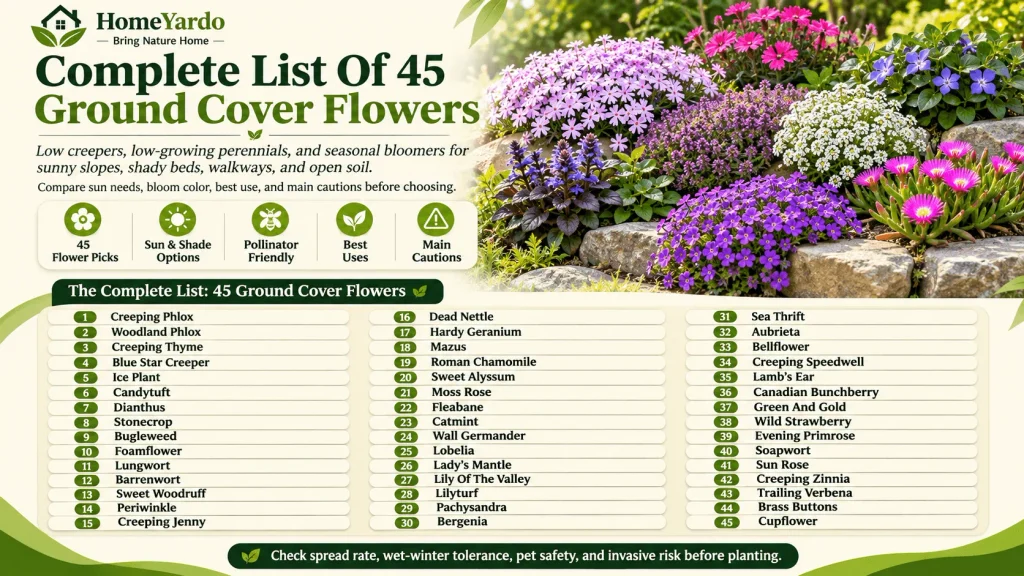
A complete list makes the selections easier to evaluate. Some of these are real low creepers. Other perennials are low-growing or annual flowers that cover open soil for part of the year.
Utilize the “Main Caution” column carefully. The speed of spreading, wetness in winter, safety of pets, and the local invasive risks can be more important than the color of the flowers.
| Flower | Botanical Name | Sun/Shade | Bloom Color | Best Use | Main Caution |
|---|---|---|---|---|---|
| Creeping Phlox | Phlox subulata | Full sun | Pink, purple, white, red | Slopes, rock gardens, spring carpets | Needs drainage |
| Woodland Phlox | Phlox stolonifera | Part shade | Blue, purple, pink, white | Woodland edges, under shrubs | Needs moisture while establishing |
| Creeping Thyme | Thymus praecox / Thymus serpyllum | Full sun | Pink, purple, white | Walkways, dry sun, pollinators | Not for heavy traffic |
| Blue Star Creeper | Isotoma fluviatilis | Sun to part shade | Pale blue | Stepping stones, lawn-style patches | It can spread in moist soil |
| Ice Plant | Delosperma spp. | Full sun | Pink, purple, yellow, orange, red | Hot dry beds, slopes | Avoid wet winter soil |
| Candytuft | Iberis sempervirens | Full sun | White | Edging, rock gardens | Trim after bloom |
| Dianthus | Dianthus spp. | Full sun | Pink, red, white | Sunny edges, fragrance | Wet crowns can rot |
| Stonecrop | Sedum spp. | Full sun | Yellow, pink, white | Dry soil, walls, gravel beds | Choose low types |
| Bugleweed | Ajuga reptans | Part shade to shade | Blue, purple, pink, white | Fast shade coverage | Can spread into lawns |
| Foamflower | Tiarella cordifolia | Part shade to shade | White, pale pink | Woodland beds, native-style gardens | Prefers even moisture |
| Lungwort | Pulmonaria spp. | Part shade to shade | Blue, pink, purple, white | Early shade flowers | Heat can roughen foliage |
| Barrenwort | Epimedium spp. | Part shade to shade | Yellow, pink, white, red | Dry shade, under trees | Slow to fill |
| Sweet Woodruff | Galium odoratum | Part shade to shade | White | Woodland carpet, moist shade | Can spread quickly |
| Periwinkle | Vinca minor | Part shade to shade | Blue-purple, white | Evergreen shade cover | Regionally aggressive |
| Creeping Jenny | Lysimachia nummularia | Sun to part shade | Yellow | Moist soil, containers, edges | Can be invasive |
| Dead Nettle | Lamium maculatum | Part shade to shade | Pink, purple, white | Shade, silver foliage | Can get loose |
| Hardy Geranium | Geranium spp. | Sun to part shade | Pink, purple, blue, white | Long bloom, mixed beds | Size varies by cultivar |
| Mazus | Mazus reptans | Sun to part shade | Purple, white | Path gaps, moist soil | Not for dry sites |
| Roman Chamomile | Chamaemelum nobile | Full sun | White, yellow centers | Fragrant lawn-style patches | Needs gentle traffic |
| Sweet Alyssum | Lobularia maritima | Sun to part shade | White, purple, pink | Fast seasonal edging | Annual in many climates |
| Moss Rose | Portulaca grandiflora | Full sun | Pink, red, yellow, orange, white | Hot annual color | Seasonal cover |
| Fleabane | Erigeron karvinskianus | Full sun to part shade | White, pink | Long-blooming edges | Can self-seed |
| Catmint | Nepeta spp. | Full sun | Lavender-blue | Pollinator borders | Some types grow taller |
| Wall Germander | Teucrium chamaedrys | Full sun | Pink-purple | Low edging, bees | Needs drainage |
| Lobelia | Lobelia erinus | Sun to part shade | Blue, white, purple | Seasonal edging, containers | Heat stress in hot areas |
| Lady’s Mantle | Alchemilla mollis | Sun to part shade | Chartreuse-yellow | Soft edging, cottage beds | Can self-seed |
| Lily Of The Valley | Convallaria majalis | Part shade to shade | White, pink | Fragrant shade cover | Toxic and aggressive |
| Lilyturf | Liriope muscari | Sun to shade | Purple, white | Evergreen grassy cover | Can spread in mild areas |
| Pachysandra | Pachysandra terminalis | Shade | White | Evergreen shade cover | More foliage than flower |
| Bergenia | Bergenia spp. | Part shade | Pink, white | Evergreen leaves, spring flowers | Avoid soggy crowns |
| Sea Thrift | Armeria maritima | Full sun | Pink, white | Poor soil, edging | Dislikes rich wet soil |
| Aubrieta | Aubrieta deltoidea | Full sun | Purple, pink | Walls, rock gardens | Needs sharp drainage |
| Bellflower | Campanula spp. | Sun to part shade | Blue, purple, white | Wall edges, trailing flowers | Some spread strongly |
| Creeping Speedwell | Veronica spp. | Sun to part shade | Blue, white | Low mat, path edges | Check local spread risk |
| Lamb’s Ear | Stachys byzantina | Full sun | Purple spikes | Silver texture, dry beds | Flowers are secondary |
| Canadian Bunchberry | Cornus canadensis | Part shade to shade | White bracts | Cool woodland gardens | Not for hot dry shade |
| Green And Gold | Chrysogonum virginianum | Part shade | Yellow | Native-style shade beds | Regional suitability varies |
| Wild Strawberry | Fragaria virginiana / Fragaria vesca | Sun to part shade | White | Edible cover, pollinators | Runners can spread |
| Evening Primrose | Oenothera spp. | Full sun | Yellow, pink | Sunny naturalized beds | Some species spread |
| Soapwort | Saponaria officinalis | Sun to part sun | Pink, white | Fast cover, cottage beds | Can spread freely |
| Sun Rose | Helianthemum spp. | Full sun | Yellow, pink, orange, red, white | Dry slopes, rock gardens | Short-lived in wet soil |
| Creeping Zinnia | Sanvitalia procumbens | Full sun | Yellow | Summer annual cover | Seasonal plant |
| Trailing Verbena | Verbena / Glandularia spp. | Full sun | Purple, pink, red, white | Long bloom, sunny edges | Hardiness varies |
| Brass Buttons | Leptinella squalida | Sun to part shade | Tiny yellow-green | Walkway texture | Needs moisture |
| Cupflower | Nierembergia repens | Sun to part shade | White, pale purple | Summer edging | Best in mild conditions |
What Are Ground Cover Flowers?
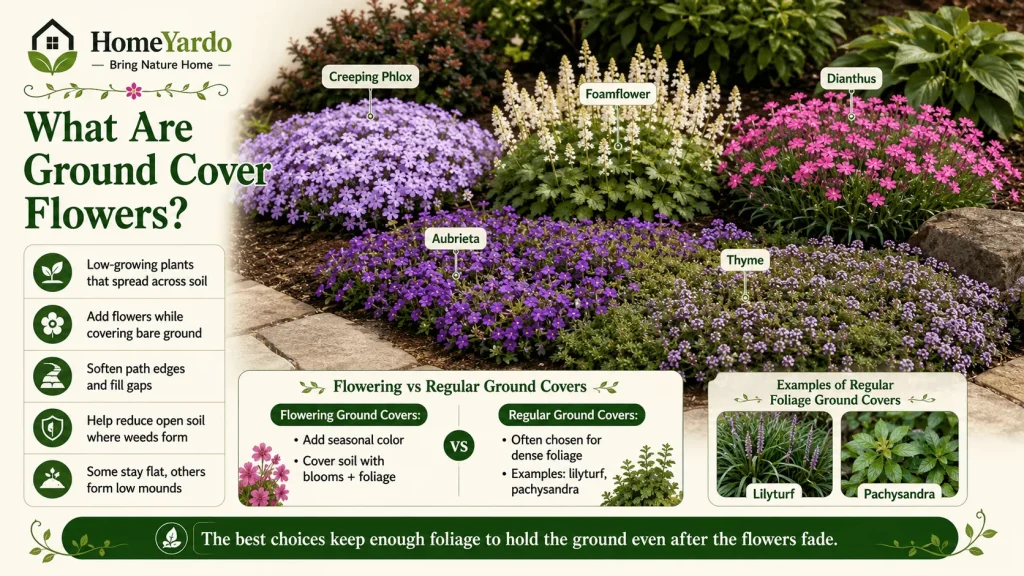
Flowers that cover the ground are small-growing plants that grow across the soil and produce flowers. They can soften the edges of paths and fill in gaps between shrubs, fill in difficult corners, and make a bed appear more aesthetically pleasing.
They’re not all tiny plants. Some remain close to the soil while others create low mounds or clumps that spread. The common task is to cover the ground, plant flowers, and cut back the area of open soil in which weeds typically form.
| Benefit | What It Means |
|---|---|
| Covers bare soil | Makes empty beds look planted and finished |
| Reduces weed space | Less exposed soil for weed seeds |
| Softens hard edges | Helps paths, walls, and borders look natural |
| Helps slopes | Roots can reduce surface erosion after establishment |
| Adds seasonal color | Flowers bring interest beyond foliage |
Ground Cover Flowers Vs Regular Ground Covers
The regular ground cover is usually picked for its foliage density or even evergreen cover. For example, lilyturf and pachysandra are two examples. They both have flowers; the majority of gardeners use them to produce foliage.
Ground covers that flower add seasonally appropriate color. Thyme, creeping phlox, foamflower, dianthus, and aubrieta are able to show visible flowers but also cover the soil. The best option is to provide enough leaves to keep the plant together when the flowers die.
Perennial Vs Annual Ground Cover Flowers
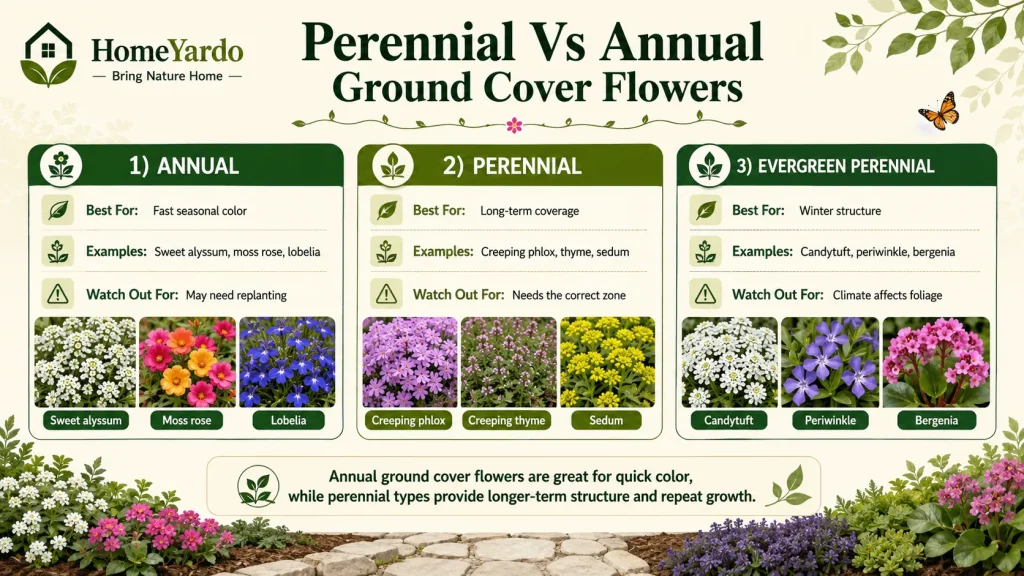
The annual flowers that cover the ground can be useful for beds that require quick color. Sweet alyssum and lobelia, the moss rose and creeping zinnia fill in the gaps, while slower perennials are settling in.
Perennial ground cover plants tend to be better for structure over time. Creeping Phlox, creeping Thyme, bugleweed, sedum barrenwort and foamflowers will bloom each year if they are placed in the appropriate climate.
| Type | Best For | Examples | Watch Out For |
|---|---|---|---|
| Annual | Fast seasonal color | Sweet alyssum, moss rose, lobelia | May need replanting |
| Perennial | Long-term coverage | Creeping phlox, thyme, and sedum | Needs the correct zone |
| Evergreen perennial | Winter structure | Candytuft, periwinkle, bergenia | Climate affects foliage |
Ground Cover Perennials
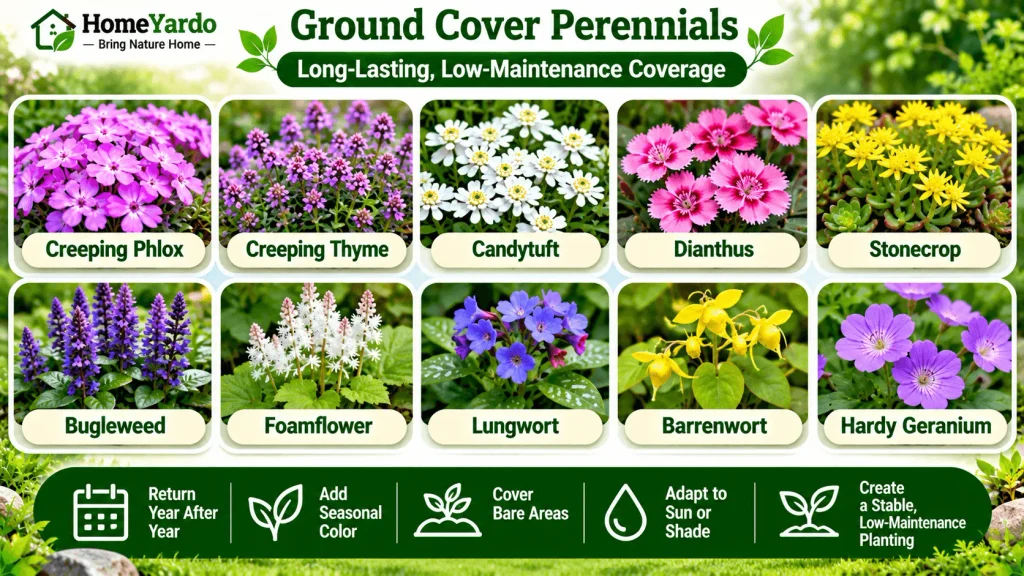
Groundcover perennials are the ideal option for long-lasting coverage. They return every year in a variety of conditions, which means that the plant grows more densely rather than starting over each year.
Certain perennial groundcovers bloom often for a short period of time. Other varieties offer lighter flowers that provide useful foliage throughout the rest of the year. The ideal choice will depend on the sun, shade, drainage, soil and how fast the space must be filled.
| Perennial Ground Cover | Best Site | Bloom Season | Main Strength | Caution |
|---|---|---|---|---|
| Creeping Phlox | Full sun | Spring | Bright flower carpet | Needs drainage |
| Creeping Thyme | Full sun | Late spring to summer | Fragrant, light foot traffic | Not for heavy walking |
| Candytuft | Full sun | Spring | Neat white edging | Trim after bloom |
| Dianthus | Full sun | Spring to summer | Fragrance and tidy foliage | Avoid wet crowns |
| Stonecrop | Full sun | Summer to fall | Dry-soil coverage | Choose low types |
| Bugleweed | Part shade to shade | Spring | Fast shade coverage | Can spread strongly |
| Foamflower | Part shade to shade | Spring | Woodland-style planting | Needs even moisture |
| Lungwort | Part shade to shade | Spring | Early bloom and patterned leaves | Heat can roughen foliage |
| Barrenwort | Part shade to shade | Spring | Dry shade coverage | Slow to fill |
| Hardy Geranium | Sun to part shade | Spring to summer | Long bloom and reliable spread | Size varies by cultivar |
Perennials are usually slower than annual fillers at first, but they provide lasting garden structure. A few well-chosen plants can gradually form a dense planting that needs less replanting over time. Creeping phlox, candytuft, and carpet bugle are useful examples, and you can discover more varieties in our guide to flowers that start with C.
Evergreen Vs Flowering Ground Cover
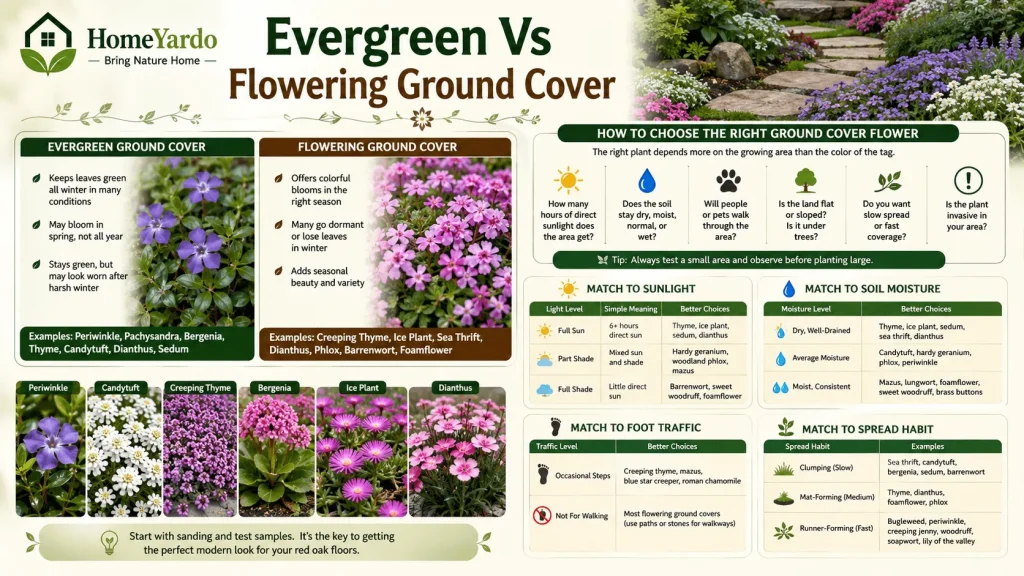
Evergreen ground covers maintain their foliage green throughout winter in arid conditions. This doesn’t mean they bloom throughout the year. The plant may appear green in January but bloom only in spring.
Periwinkle, candytuft, thyme, bergenia, pachysandra, a few dianthus and some sedums might remain either semi or evergreen. In colder climates, the leaves may appear worn-out following winter’s cold, snow, rain, or wet soil.
How To Choose The Right Ground Cover Flower
The correct plant will depend on the area more than the color of the tag. A groundcover that is fond of dry sunlight will not appreciate the shade of dampness. A shade plant may burn in the afternoon heat.
Before purchasing, examine the area of growth attentively. Just a few minutes of looking at soil, light and traffic could save you digging for a long time later.
- What is the average number of hours in direct sunlight the region gets?
- Do you find that the soil remains normal, dry, or moist or even wet?
- Are pets or people allowed to walk through the area?
- Is the land flat or sloped? Is it beneath trees?
- Do you want a slow-moving control or a rapid coverage?
- Are there invasive plants in your area?
Match Flowers That Cover Ground To Sunlight
Light is the primary filter. Full sun generally is at least 6 hours of direct light every day. Creeping thyme (also known as ice plant), sea thrift and dianthus are usually the most popular there.
Part shade allows plants to get some sunshine, but also provides some protection. Full shade gets less direct sunlight. Therefore, plants like barrenwort, sweet woodruff, foamflower and lungwort are a better choice.
| Light Level | Simple Meaning | Better Choices |
|---|---|---|
| Full sun | 6+ hours direct sun | Thyme, ice plant, sedum, dianthus |
| Part shade | Mixed sun and shade | Hardy geranium, woodland phlox, mazus |
| Full shade | Little direct sun | Barrenwort, sweet woodruff, foamflower |
Match Flowers That Cover Ground To Soil Moisture
Moisture in the soil can be a deceiving factor. The soil may appear clean in the spring, but it will be a mess in July. A different spot may appear innocent until winter rain makes it heavy and sour.
Creeping thyme and ice plants, sedum and sea thrift favor dry, sharply drained soil. The mazus, lungwort, foamflower, sweet woodruff, and brass buttons generally prefer steady moisture.
Match Flowers That Cover Ground To Foot Traffic
The majority of flowering groundcovers are not designed to be used for walking on a daily basis. They might be tall but that doesn’t create lawn grass.
Creeping Thyme, Blue Star creeper, Mazus buttons and Roman chamomile can take care of occasional steps in the right place. If you are walking regularly, take your time and let pavers, gravel or stepping stones take the burden.
Match Flowers That Cover Ground To Spread Habit
Spread habit determines how much control a plant will require. Plants that are clumping widen gradually. Plants that form mats creep along the soil. The runners-forming plants are faster and could grow roots as they move.
Bugleweed, periwinkle, woodruff, creeping Jenny, soapwort, and Lily of the Valley are all able to grow rapidly. Sea thrift, candytuft, barrenwort, bergenia, as well as other low sedums, tend to be less difficult to manage.
Which Flowering Ground Cover Is Best For Full Sun?
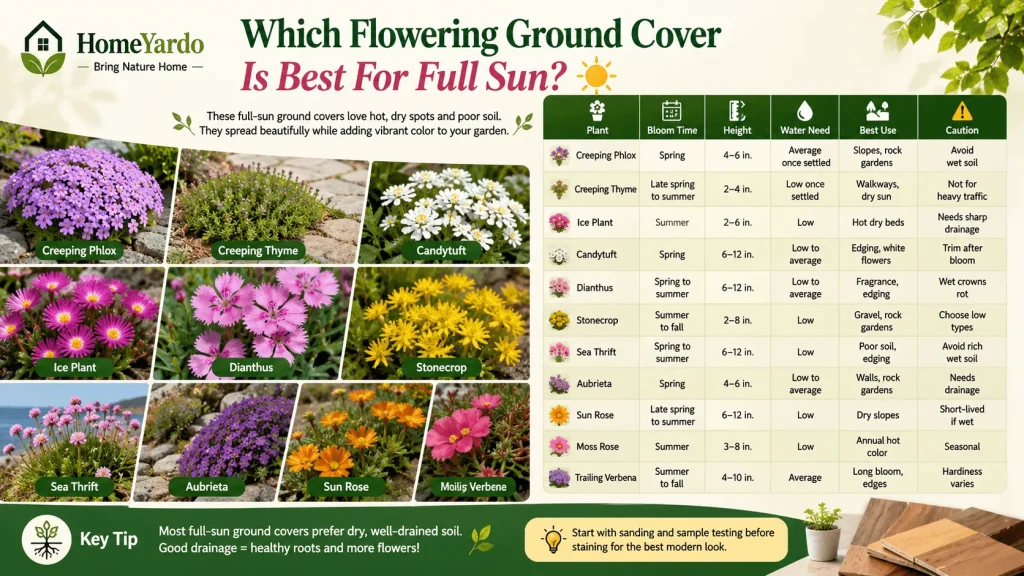
Creeping thyme, creeping Phlox, candytuft, and Sedum. Aubrieta, sea thrift sun roses, moss, as well as trailing Verbena, are amongst the best full-sun flowering groundcover selections. The majority of them require drainage.
Flowering ground covers for sunny locations often need to tolerate heat and periods of dry soil. Plants such as creeping thyme, ice plant, and sedum are useful where drainage is good. For more options beyond low-growing flowers, explore these low-maintenance full sun plants suited to bright garden beds and outdoor spaces.
| Plant | Bloom Time | Height | Water Need | Best Use | Caution |
|---|---|---|---|---|---|
| Creeping Phlox | Spring | 4–6 in. | Average once settled | Slopes, rock gardens | Avoid wet soil |
| Creeping Thyme | Late spring to summer | 2–4 in. | Low once settled | Walkways, dry sun | Not for heavy traffic |
| Ice Plant | Summer | 2–6 in. | Low | Hot dry beds | Needs sharp drainage |
| Candytuft | Spring | 6–12 in. | Low to average | Edging, white flowers | Trim after bloom |
| Dianthus | Spring to summer | 6–12 in. | Low to average | Fragrance, edging | Wet crowns rot |
| Stonecrop | Summer to fall | 2–8 in. | Low | Gravel, rock gardens | Choose low types |
| Sea Thrift | Spring to summer | 6–12 in. | Low | Poor soil, edging | Avoid rich wet soil |
| Aubrieta | Spring | 4–6 in. | Low to average | Walls, rock gardens | Needs drainage |
| Sun Rose | Late spring to summer | 6–12 in. | Low | Dry slopes | Short-lived if wet |
| Moss Rose | Summer | 3–8 in. | Low | Annual hot color | Seasonal |
| Trailing Verbena | Summer to fall | 4–10 in. | Average | Long bloom, edges | Hardiness varies |
Creeping Phlox
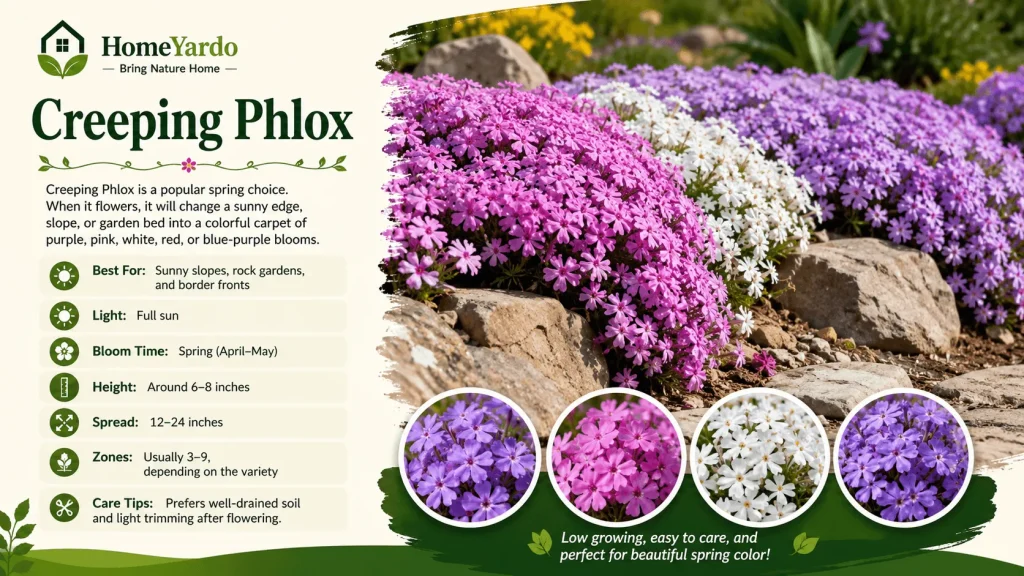
Creeping Phlox is a popular spring choice. When it flowers, it will change to a sunny edge and slope to a bed of purple, pink, white, red or blue-purple blooms.
The best for sunny slopes, rock gardens, and border fronts
Light: Full sun
Height: Around 6-8 inches
Spread: Between 12 and 24 inches
Zones: Usually 3-9, depending on the variety
Careful: Make sure to give it well-drained soil, and then trim it lightly after flowering.
Creeping Thyme
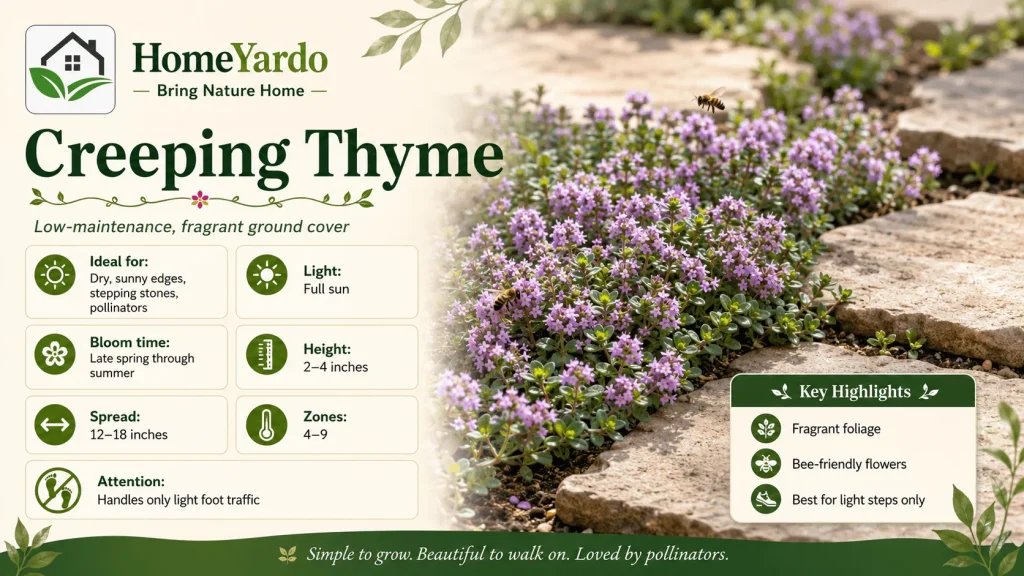
Creeping thyme is a low-maintenance plant that is fragrant and useful close to pathways. Bees are fond of the flowers, and people love walking past the leaves. It’s a tiny plant that has a lot of charm.
Ideal for: Dry, sunny edges such as stepping stones and pollinator gardens.
Light: Full sun
Bloom time: late spring through summer
Height: Approximately 2 to 4 inches
Spread: Between 12 and 18 inches
Zones: Often 4-9
Attention: It is designed to handle only light steps, not a lot of traffic.
Ice Plant
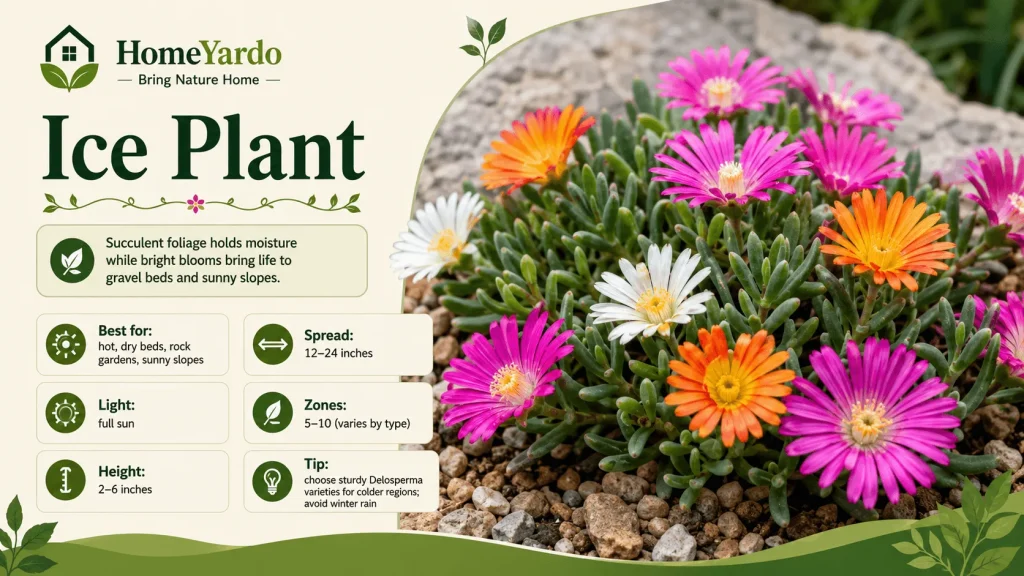
The ice plant was designed for warmth. The succulent foliage holds moisture and its bright flowers can make the gravel beds and sunny slopes feel more enjoyable than harsh.
Best for hot, dry beds or rock gardens, sunny slopes
Light: Full sun
Height: 2-6 inches
Spread: Between 12-24 inches
Zones: Typically 5-10, depending on the type
Avert: Select the sturdy Delosperma varieties for colder regions and avoid winter rain.
Candytuft
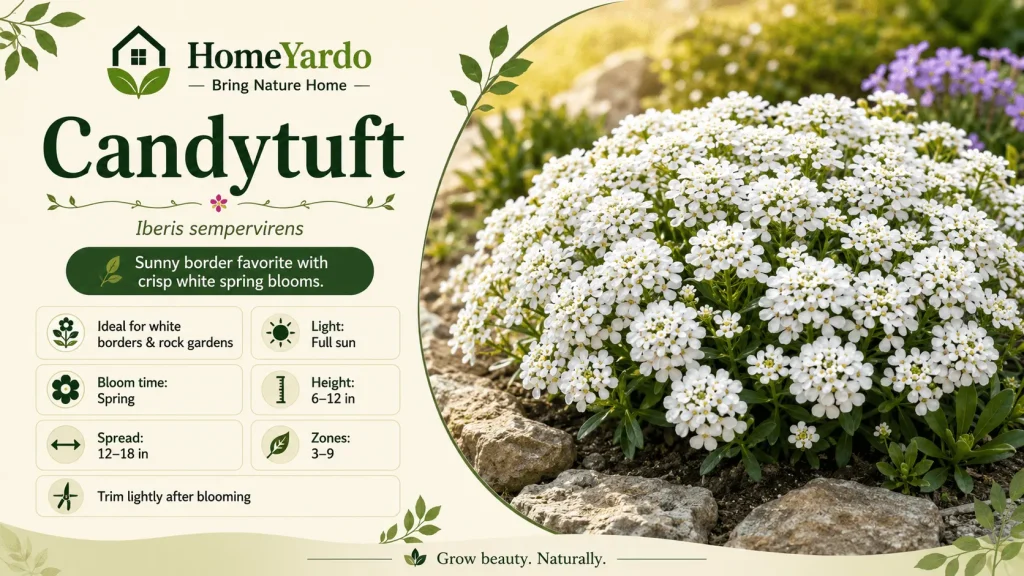
Candytuft creates a sunny border with and a crisp white springtime display. It’s particularly appealing on low walls, paths and along the edges of rock gardens.
Ideal for: White border garden, rock with sun-drenched borders
Light: Full sun
Bloom Time of Bloom
Height: Approximately 6-12 inches
Spread: Between 12 and 18 inches
Zones: Often 3-9
Be careful when trimming after blooming so that the mound remains neat.
Dianthus
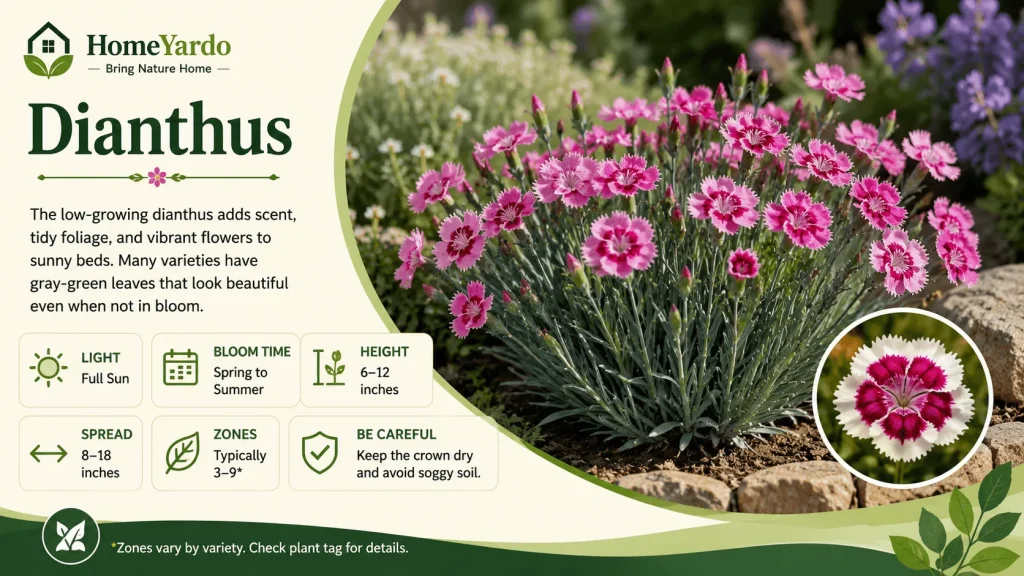
The dianthus that grows low adds scent, tidy foliage and vibrant flowers to beds of sunshine. A variety of varieties have leaves that are gray-green, which look great even when flowers aren’t in bloom.
Best for: Sunny edging, cottage gardens, fragrance
Light: Full sun
Bloom time: from spring to summer
Height: 6-12 inches
Spread: 8-18 inches
Zones: Typically 3-9, based on what
Be careful. Make sure the crown is dry and stays clear of soggy soil.
Stonecrop
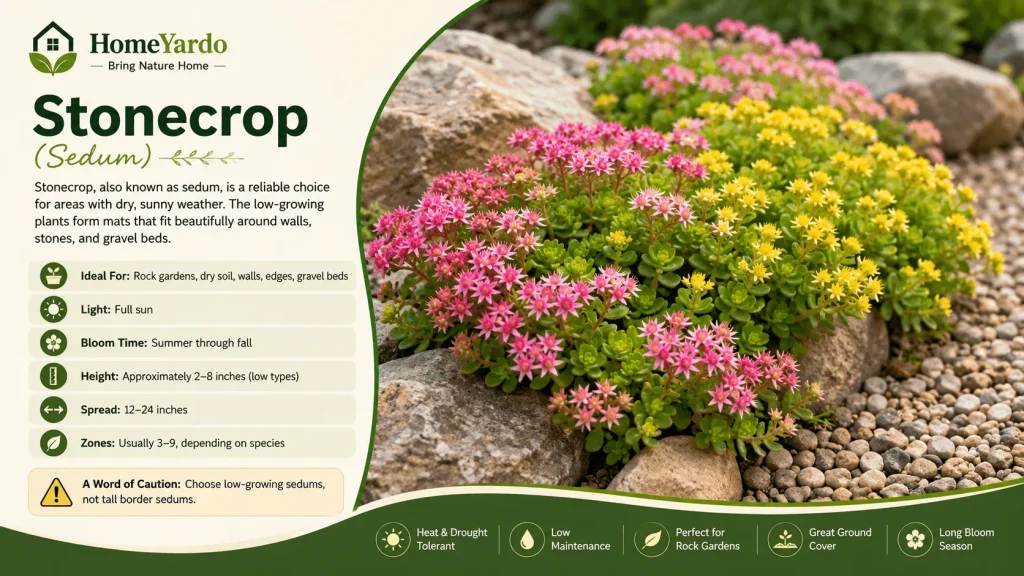
Stonecrop, also known as sedum, is a reliable choice for areas with dry, sunny weather. The plants that are low-growing make mats that are able to fit around walls, stones and gravel beds.
Ideal for: Rock gardens or dry soil walls, edges, dry soil
Light: Full sun
The bloom time is from summer through the fall
Height: Approximately 2-8 inches in low types.
Spread: 12-24 inches
Zones: Usually 3-9, depending on species
A word of caution: choose sedums that are low and not tall border sedums.
Which Flowering Ground Cover Is Best For Shade?
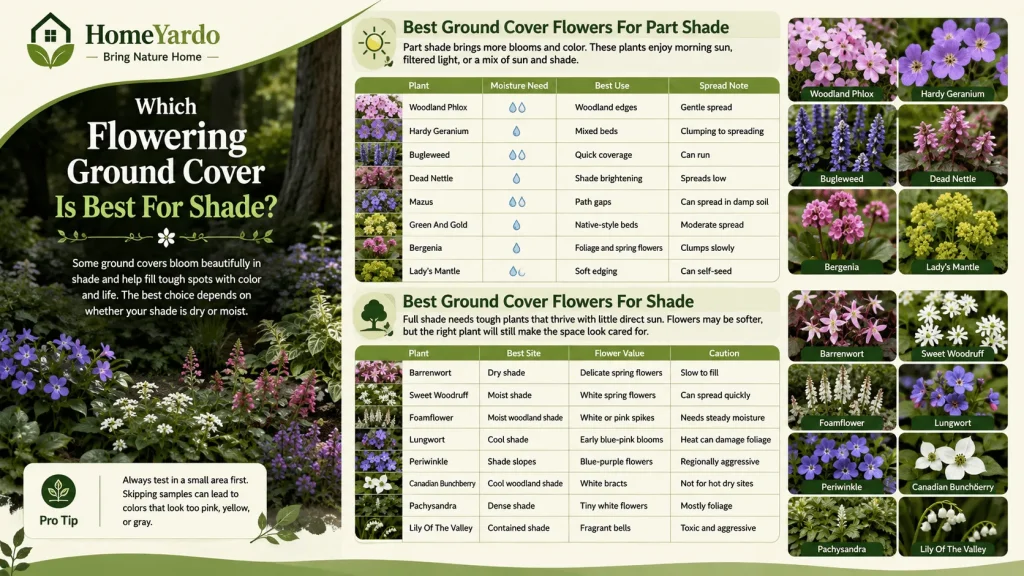
Barrenwort, lupinwort, foamflower, sweet woodruff, dead nettle, woodland Phlox, periwinkle, Canadian bunchberry, and both green and gold are great groundcovers that flower in shade. The most suitable choice is based on whether the shade is dry or wet.
Shade under trees is usually more difficult than shade along the wall. The roots of trees absorb water, and leaves can drown tiny plants if they’re piled over too much.
Best Ground Cover Flowers For Part Shade
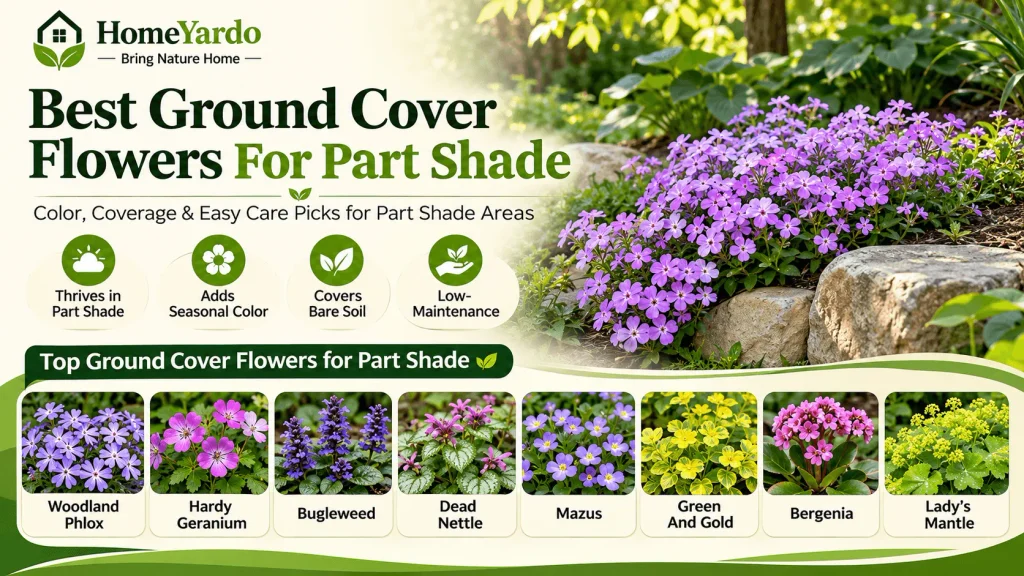
Part shade usually gives greater flowering power than full shade. They can withstand the morning sun, filtered light or even a mixture of sun and shade.
| Plant | Moisture Need | Best Use | Spread Note |
|---|---|---|---|
| Woodland Phlox | Average to moist | Woodland edges | Gentle spread |
| Hardy Geranium | Average | Mixed beds | Clumping to spreading |
| Bugleweed | Average to moist | Quick coverage | Can run |
| Dead Nettle | Average | Shade brightening | Spreads low |
| Mazus | Moist | Path gaps | It can spread in damp soil |
| Green And Gold | Average | Native-style beds | Moderate spread |
| Bergenia | Average | Foliage and spring flowers | Clumps slowly |
| Lady’s Mantle | Average | Soft edging | Can self-seed |
Best Ground Cover Flowers For Shade
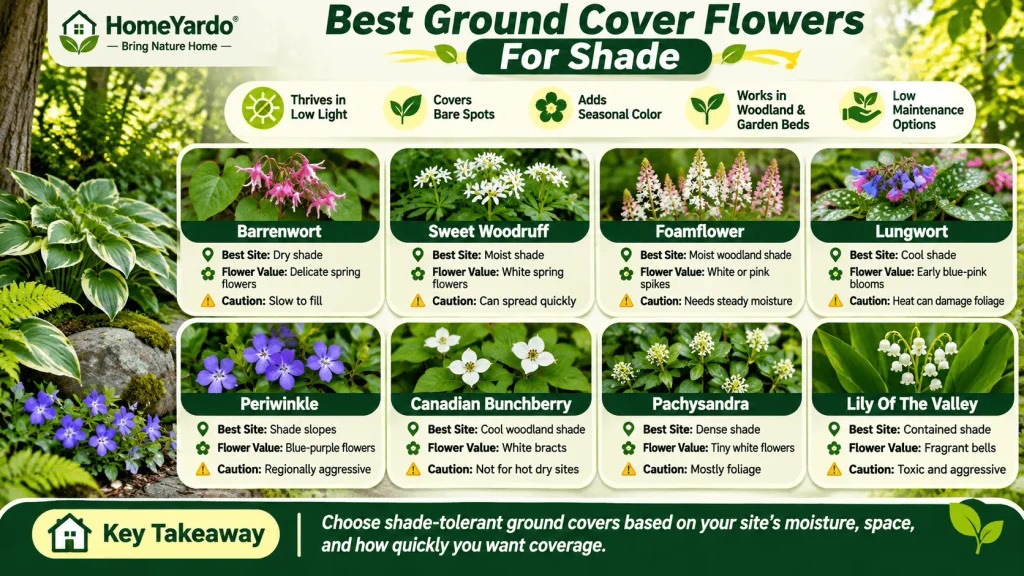
Full shade needs plants that can grow with little direct sun. Flowers may be softer or shorter-lived than in brighter spots, but the right plant can still make the area look cared for.
| Plant | Best Site | Flower Value | Caution |
|---|---|---|---|
| Barrenwort | Dry shade | Delicate spring flowers | Slow to fill |
| Sweet Woodruff | Moist shade | White spring flowers | Can spread quickly |
| Foamflower | Moist woodland shade | White or pink spikes | Needs steady moisture |
| Lungwort | Cool shade | Early blue-pink blooms | Heat can damage foliage |
| Periwinkle | Shade slopes | Blue-purple flowers | Regionally aggressive |
| Canadian Bunchberry | Cool woodland shade | White bracts | Not for hot dry sites |
| Pachysandra | Dense shade | Tiny white flowers | Mostly foliage |
| Lily Of The Valley | Contained shade | Fragrant bells | Toxic and aggressive |
Bugleweed
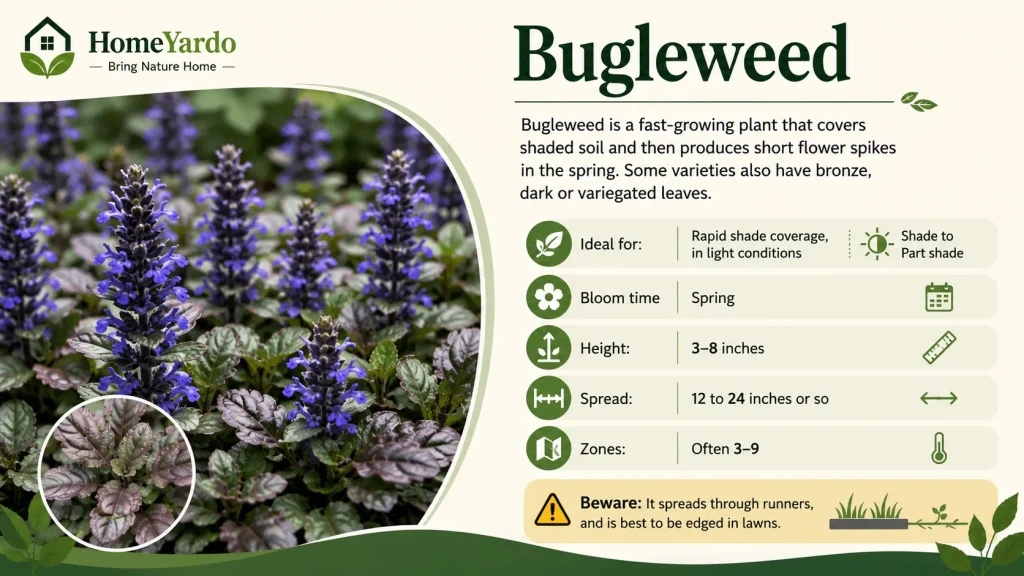
Bugleweed is a fast-growing plant that covers shaded soil and then produces short flower spikes in the spring. Some varieties also have bronze, dark or variegated leaves.
Ideal for: Rapid shade coverage, in light conditions, Shade to Part shade
Height: 3-8 inches
Spread: Between 12 and 24 inches or so
Zones: Often 3-9
Beware: It spreads through runners and is best to be edged in lawns.
Foamflower
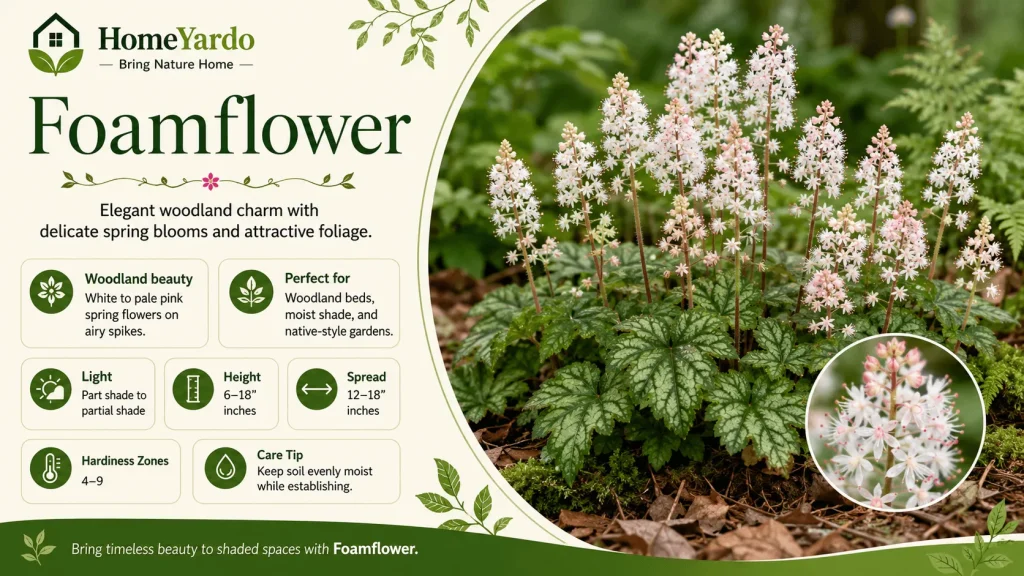
Foamflower gives an elegant woodland look thanks to delicate spring white or pale pink flowers. The foliage adds an extra dimension after the bloom.
Ideal for use in woodland beds, humid shade, and native-style gardens
Light: Partly shaded to partially shaded
Height: 6-18 inches
Spread: Between 12 and 18 inches
Zones: Often 4-9
Attention: Make sure that the soil is uniformly moist throughout its settling time.
Lungwort
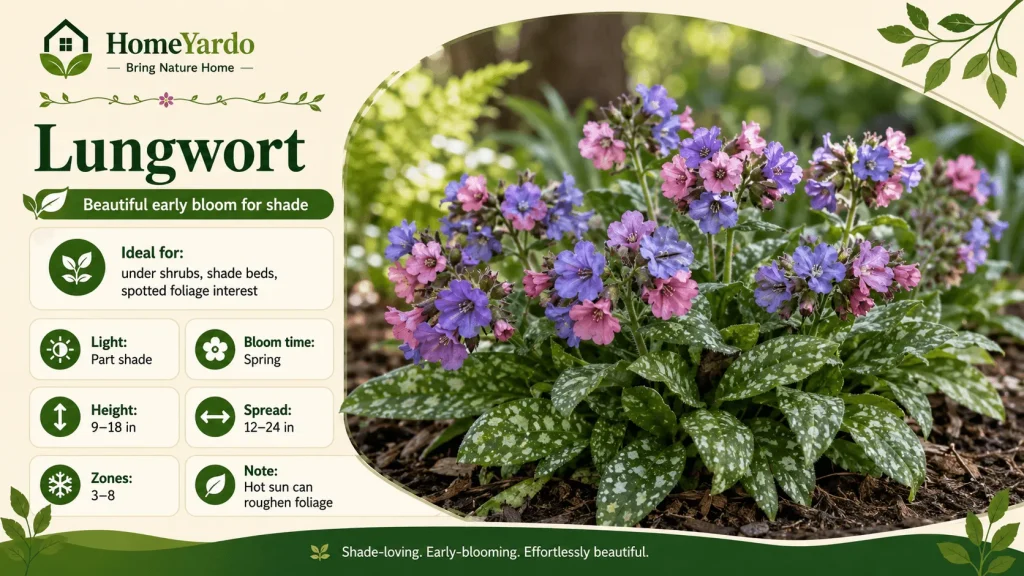
Lungwort is among the most beautiful early blooms for shade. The pink, blue or purple flowers appear before most beds are fully awake.
Ideal for: Early shade flowers, under the shrubs or the spotted foliage
Light: Partly shaded to partially shaded
Bloom time: The season of spring
Height: 9-18 inches
Spread: 12-24 inches
Zones: Often 3-8
Attention: The sun’s heat can make the foliage appear rough.
Barrenwort
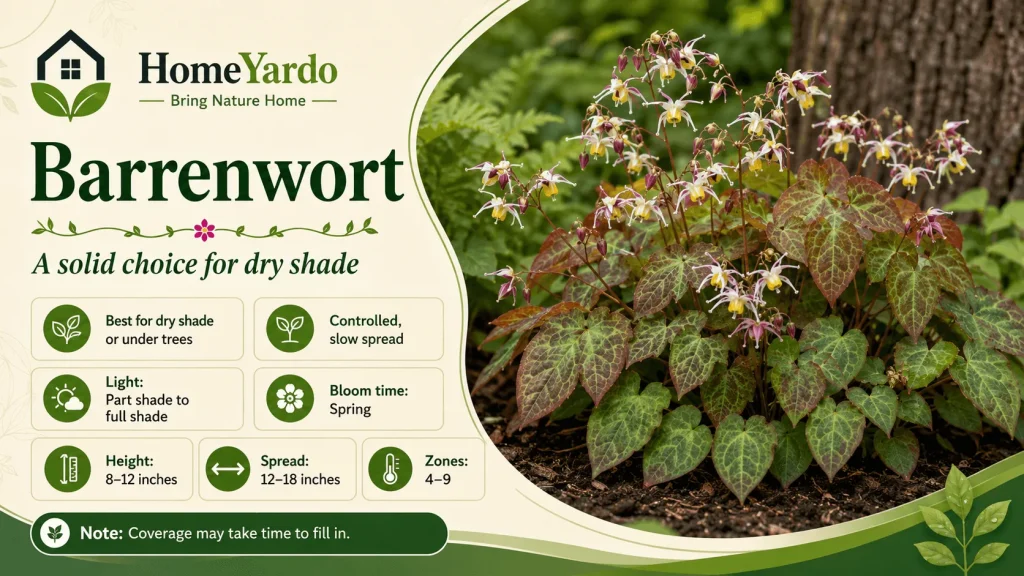
Barrenwort is a peaceful, solid plant suitable for dry shade. It is slow to spread, which could seem like a present if you’re tired of plants that are a mess.
Best for dry shade or under trees, with controlled coverage
Light: Partly shaded to partially shaded
Bloom time: The season of spring
Height: 8-12 inches
Spread: Between 12 and 18 inches
Zones: Often 4-9
The cover may require time to build a complete cover.
Sweet Woodruff
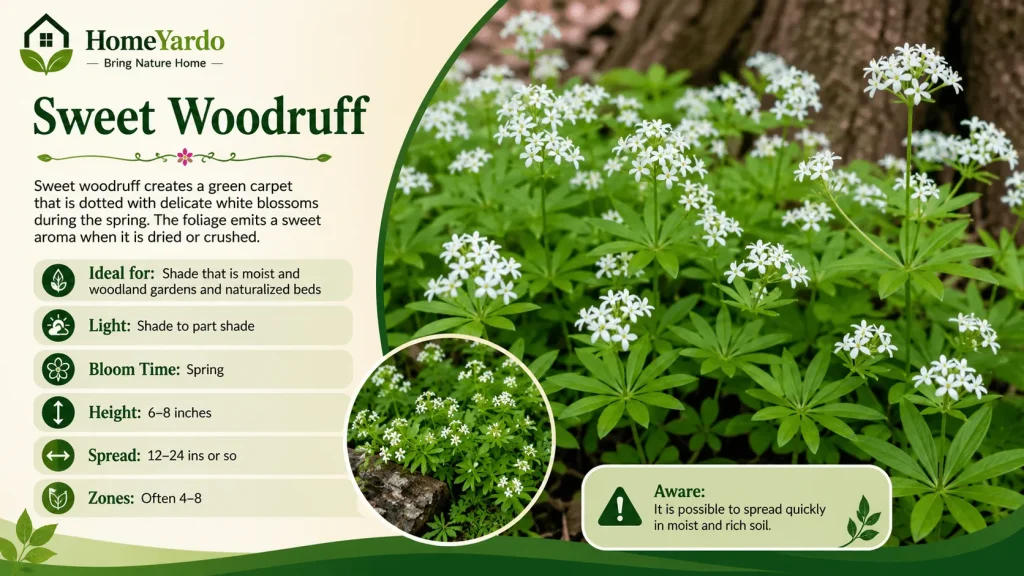
Sweet woodruff creates a green carpet that is dotted with delicate white blossoms during the spring. The foliage emits a sweet aroma when it is dried or crushed.
Ideal for: Shade that is moist and woodland gardens and naturalized beds
Light Shade to part shade
Height: 6-8 inches
Spread: 12–24 ins or so
Zones: Often 4-8
Aware: It is possible to spread quickly in moist and rich soil.
Periwinkle
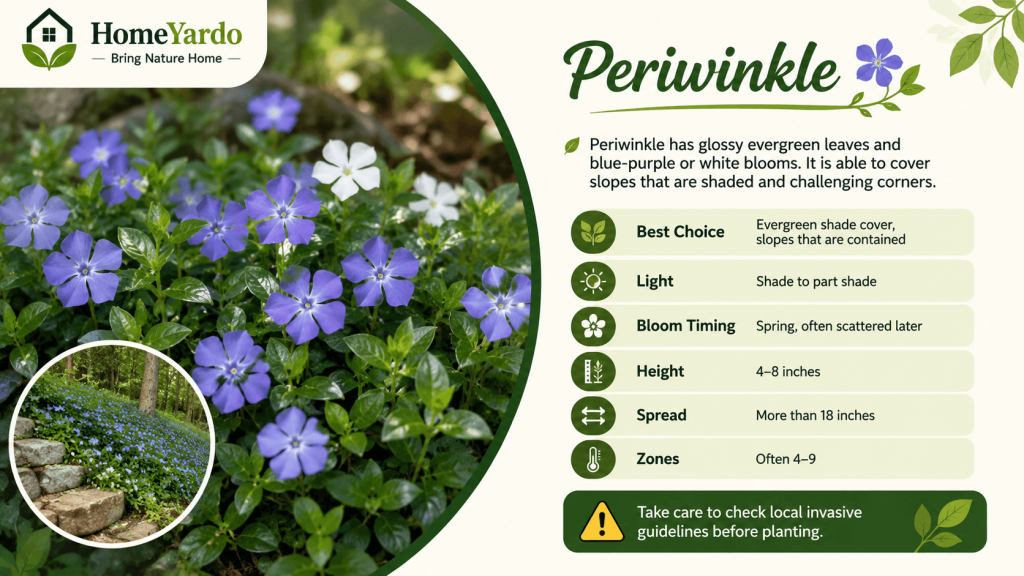
Periwinkle has glossy evergreen leaves and blue-purple or white blooms. It is able to cover slopes that are shaded and challenging corners.
The best choice is evergreen shade cover for slopes that are contained
Light Shade to part shade
Bloom timing: Spring, often scattered later
Height: 4-8 inches
Spread More than 18 inches
Zones: Often 4-9
Take care to check local invasive guidelines before planting.
What Are The Best Flowering Ground Covers For Slopes?
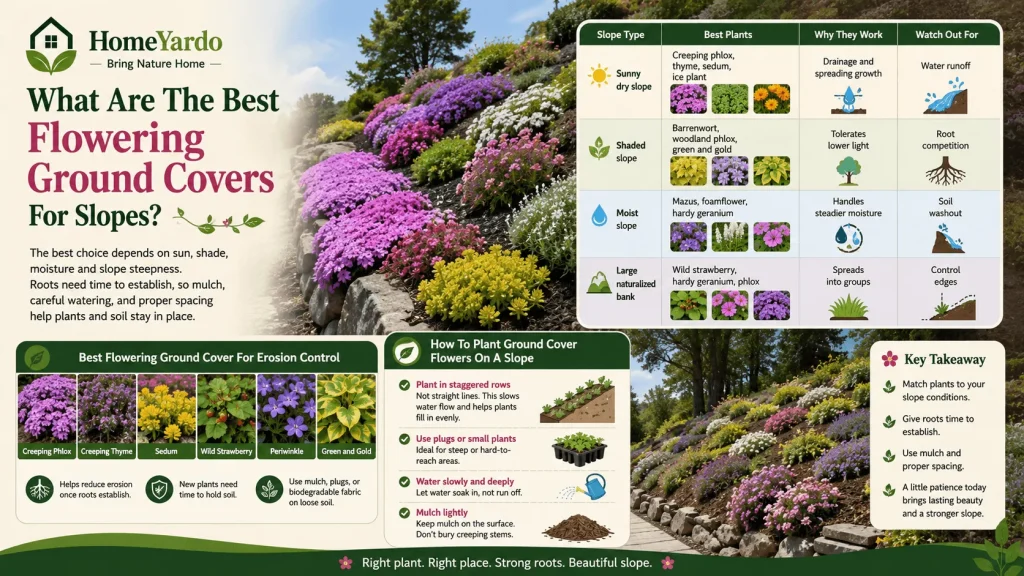
Creeping Phlox, creeping Thyme, Sedum, wild strawberry, hardy geranium, gold and green and even barnwort work well on slopes. The best choice is based on the amount of sun, shade, the amount of moisture and the degree of steepness. is.
A slope planting requires patience. The roots must establish themselves before they are able to hold soil properly. In the meantime, mulching, careful watering, and plants that are spaced out are a great way to have some quiet time.
| Slope Type | Best Plants | Why They Work | Watch Out For |
|---|---|---|---|
| Sunny dry slope | Creeping phlox, thyme, sedum, ice plant | Drainage and spreading growth | Water runoff |
| Shaded slope | Barrenwort, woodland phlox, green and gold | Tolerates lower light | Root competition |
| Moist slope | Mazus, foamflower, hardy geranium | Handles steadier moisture | Soil washout |
| Large naturalized bank | Wild strawberry, hardy geranium, phlox | Spreads into groups | Control edges |
Best Flowering Ground Cover For Erosion Control
Flowers that cover the ground are able to lessen erosion after roots are established. Creeping phlox and creeping thyme and sedum, as well as wild strawberry, Periwinkle, gold and green, are all effective in the right conditions.
New plants cannot support an elevation for long periods of time. If the soil is loose, you can use lightweight mulch, small plugs or biodegradable erosion fabrics as the plants weave together.
How To Plant Ground Cover Flowers On A Slope
Plant in rows that are staggered rather than straight lines of descent. This helps water flow more slowly and also helps the plants fill more evenly.
Use plugs or small plants for slopes that are difficult to access. Make sure to water slowly, so that it soaks in instead of flowing away. Keep the mulch low, and do not put it down on the ground or bury creeping stems.
What Flowering Ground Cover Can Replace Grass?
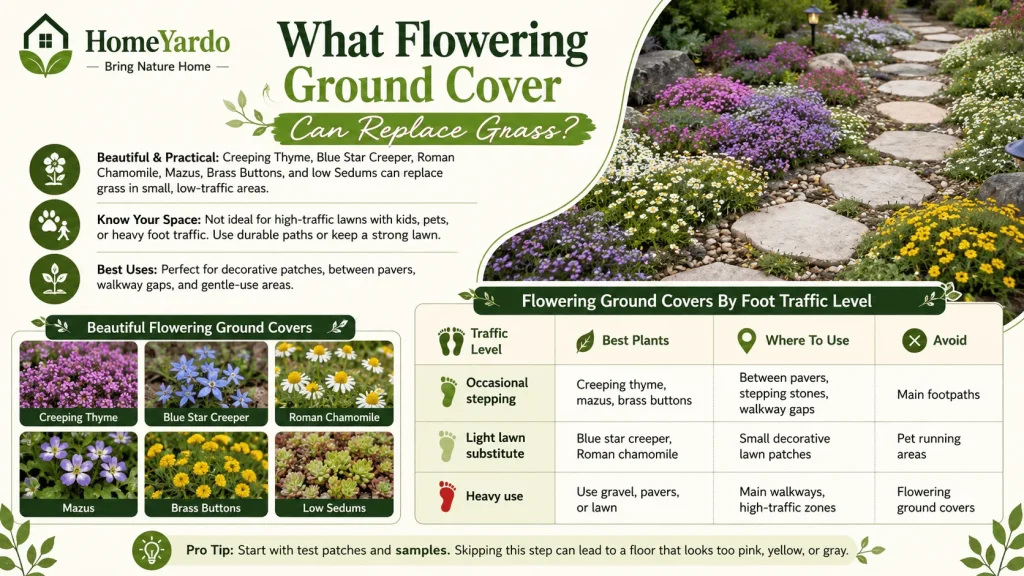
Flowers For Replacing Grass include Creeping Thyme, blue Star creeper, Roman Chamomile, Mazus, brass buttons and low sedums, which may be used to replace grass in smaller, low-traffic areas. They’re ideal as decorative patchwork, walkway gaps, and spaces for gentle use.
The flowering grass cover is not the best alternative for all lawns. If you have dogs running around and children playing there or people regularly cross it, make sure you have a path or maintain a durable lawn.
Flowering Ground Covers By Foot Traffic Level
Traffic volume is more important than people think. A plant that takes care of one unintentionally taken step might not be able to withstand the daily rigors of routines.
| Traffic Level | Best Plants | Where To Use | Avoid |
|---|---|---|---|
| Occasional stepping | Creeping thyme, mazus, brass buttons | Between pavers | Main footpaths |
| Light lawn substitute | Blue star creeper, Roman chamomile | Small decorative lawn patches | Pet running areas |
| Heavy use | Use gravel, pavers, or lawn | Main walkways | Flowering ground covers |
Which Ground Cover Flowers Bloom The Longest?
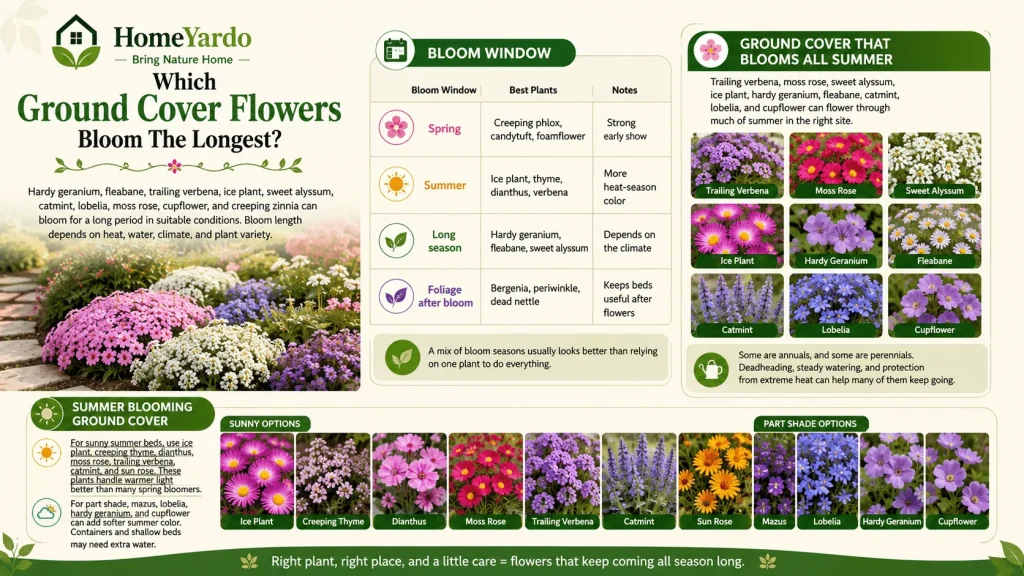
Hardy geranium, fleabane, trailing verbena, ice plant, sweet alyssum, catmint, lobelia, moss rose, cupflower, and creeping zinnia can bloom for a long period in suitable conditions. Bloom length depends on heat, water, climate, and plant variety.
Some ground covers give a big spring show. Others flower more lightly but for longer. A mix of bloom seasons usually looks better than relying on one plant to do everything.
| Bloom Window | Best Plants | Notes |
|---|---|---|
| Spring | Creeping phlox, candytuft, foamflower | Strong early show |
| Summer | Ice plant, thyme, dianthus, verbena | More heat-season color |
| Long season | Hardy geranium, fleabane, sweet alyssum | Depends on the climate |
| Foliage after bloom | Bergenia, periwinkle, dead nettle | Keeps beds useful after flowers |
Ground Cover That Blooms All Summer
Trailing verbena, moss rose, sweet alyssum, ice plant, hardy geranium, fleabane, catmint, lobelia, and cupflower can flower through much of summer in the right site.
Some are annuals, and some are perennials. Deadheading, steady watering, and protection from extreme heat can help many of them keep going.
Summer Blooming Ground Cover
For sunny summer beds, use ice plant, creeping thyme, dianthus, moss rose, trailing verbena, catmint, and sun rose. These plants handle warmer light better than many spring bloomers.
For part shade, mazus, lobelia, hardy geranium, and cupflower can add softer summer color. Containers and shallow beds may need extra water.
What Flowering Ground Cover Grows Fastest?
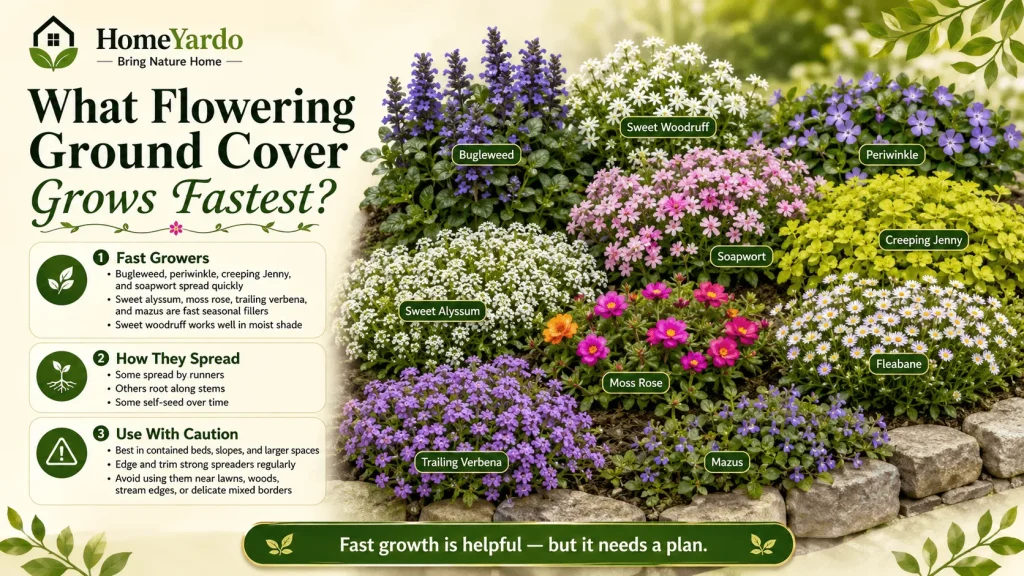
Bugleweed, sweet woodruff, periwinkle, creeping Jenny, soapwort, sweet alyssum, moss rose, fleabane, trailing verbena, and mazus are among the faster-flowering ground covers. Fast growth can be helpful, but it needs a plan.
A fast spreader is like a helpful guest who starts rearranging the furniture. Sometimes useful. Sometimes a lot.
Which Flowering Ground Cover Spreads Quickly?
Some plants spread by runners. Others root along stems or self-seed. Know the method, and control becomes much easier. Some flowering plants that spread quickly are listed below:
| Plant | Growth Speed | Best Site | Control Note |
|---|---|---|---|
| Bugleweed | Fast | Part shade, shade | Edge before it reaches lawns |
| Sweet Woodruff | Medium to fast | Moist shade | Best for naturalized beds |
| Periwinkle | Fast | Shade, slopes | Avoid near natural areas |
| Creeping Jenny | Fast | Moist soil | Can spread aggressively |
| Soapwort | Fast | Sun to part sun | Give it room |
| Sweet Alyssum | Fast seasonal | Sun to part sun | Often used as an annual |
| Mazus | Medium to fast | Moist path gaps | Keep out of tiny beds |
| Trailing Verbena | Fast seasonal | Full sun | Trim to refresh growth |
Fast Growers To Use With Caution
Bugleweed, periwinkle, creeping Jenny, sweet woodruff, soapwort, lily of the valley, creeping speedwell, and some bellflowers can move outside their original spot.
Use strong spreaders in contained beds, between hardscape, or in larger spaces where coverage is welcome. Avoid them near lawns, woods, stream edges, and delicate mixed borders.
What Is The Lowest Maintenance Flowering Ground Cover?
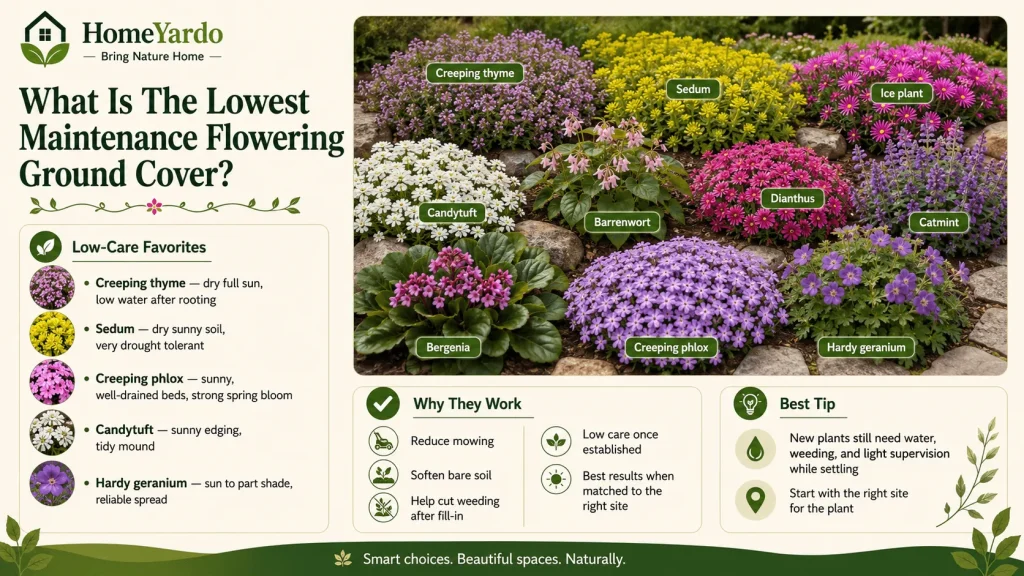
Creeping thyme, sedum, ice plant, candytuft, barrenwort, dianthus, catmint, and bergenia can be low-maintenance flowering ground covers when matched to the right site. The matching part matters.
Low care begins after establishment. New plants still need water, weeding, and a little supervision while they settle.
Easiest Flowering Ground Cover Plants
Creeping phlox is easy in sunny, well-drained beds. Creeping thyme suits dry sun. Sedum handles lean soil with very little drama.
Candytuft, dianthus, bugleweed, foamflower, hardy geranium, sweet alyssum, and moss rose can also be beginner-friendly. The common mistake is planting them where they cannot be happy.
| Plant | Best Site | Why Easy | Mistake To Avoid |
|---|---|---|---|
| Creeping Phlox | Sunny, well-drained soil | Strong spring bloom | Wet soil |
| Creeping Thyme | Dry full sun | Low water after rooting | Heavy traffic |
| Sedum | Dry sunny soil | Very drought tolerant | Wet shade |
| Candytuft | Sunny edging | Tidy mound | Skipping trim after bloom |
| Barrenwort | Dry shade | Slow and controlled | Expecting fast coverage |
| Hardy Geranium | Sun to part shade | Reliable spread | Choosing too-tall types |
Low Maintenance Ground Cover Flowers
Low-maintenance Flowers that cover the ground reduce mowing, soften bare soil, and can reduce weeding after they fill in. They still need care at the beginning.
Ground Cover Flowers For Beginners
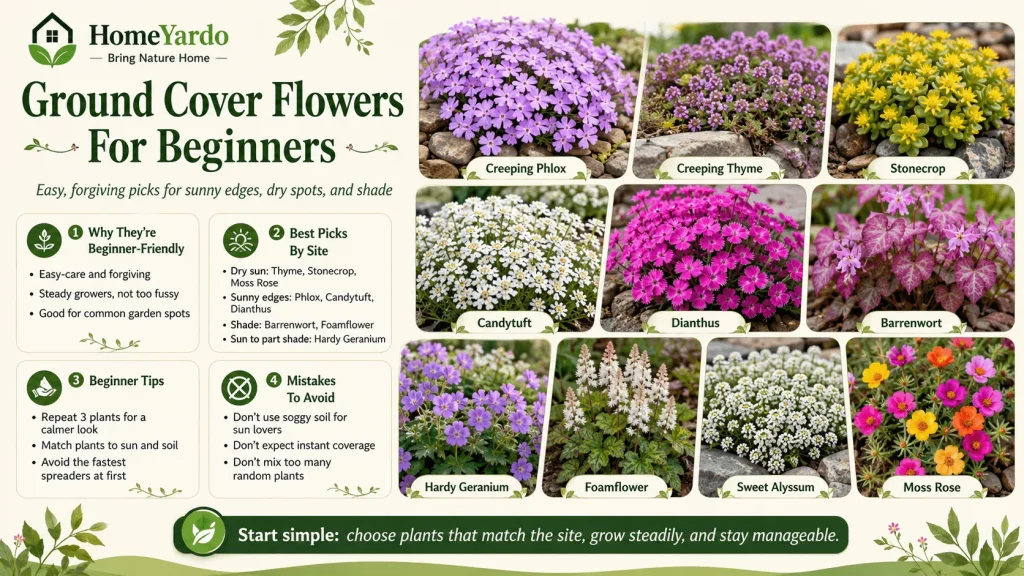
Flowers that cover ground for beginners should be forgiving, easy to understand, and not too fussy about daily care. The safest choices are plants that match common garden situations: dry sun, front edges, part shade, or bare soil that needs soft coverage.
A beginner-friendly plant is not always the fastest plant. Sometimes the best starter option is one that behaves well, grows steadily, and does not create a new problem by spreading everywhere.
| Beginner Choice | Best Site | Why It Is Beginner-Friendly | Mistake To Avoid |
|---|---|---|---|
| Creeping Phlox | Sunny slopes and edges | Strong spring color and easy growth | Planting in soggy soil |
| Creeping Thyme | Dry sunny paths | Fragrant, low, and useful near stones | Using it for heavy traffic |
| Stonecrop | Dry sunny soil | Handles heat and lean soil well | Planting in wet shade |
| Candytuft | Sunny front borders | Tidy shape and bright white flowers | Skipping light trimming after bloom |
| Dianthus | Sunny edging | Fragrant flowers and neat foliage | Letting crowns stay wet |
| Barrenwort | Dry shade | Slow, steady, and controlled | Expecting quick coverage |
| Hardy Geranium | Sun to part shade | Reliable bloom and spreading habit | Choosing a tall cultivar by mistake |
| Foamflower | Moist shade | Soft woodland look and spring flowers | Letting soil dry too much |
| Sweet Alyssum | Seasonal edging | Fast color from a small plant | Treating it as permanent everywhere |
| Moss Rose | Hot dry annual beds | Bright flowers with little fuss | Planting where soil stays wet |
For a first planting, keep the mix simple. Three repeated plants often look better than ten random ones. The garden will feel calmer, and maintenance will be easier too.
Which Flowering Ground Cover Is Drought Tolerant?
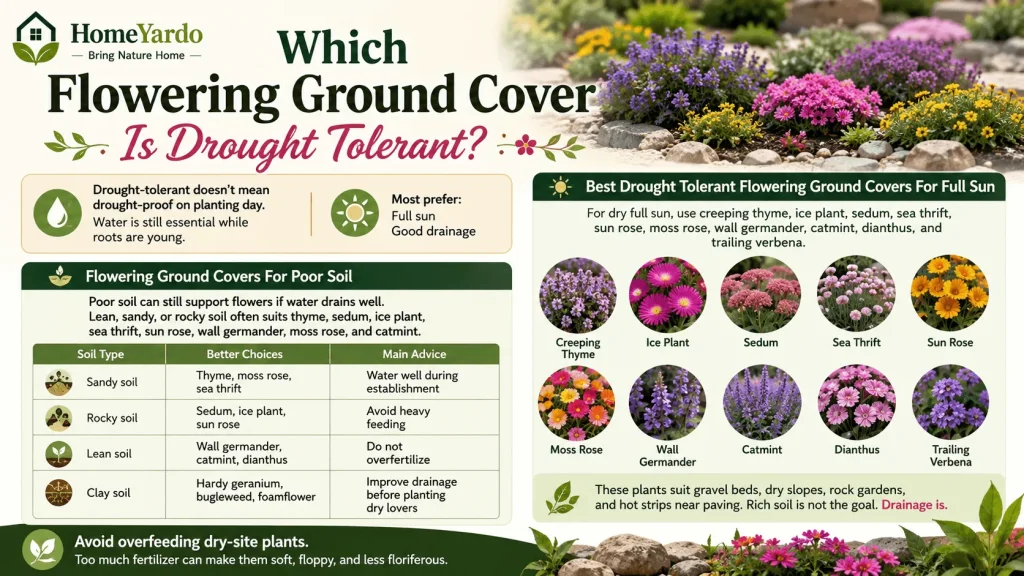
Creeping thyme, ice plant, sedum, sea thrift, sun rose, moss rose, wall germander, catmint, dianthus, and creeping zinnia are drought-tolerant flowering ground covers after establishment. Most prefer full sun and good drainage.
Drought-tolerant does not mean drought-proof on planting day. Even though plants need water while their roots are young.
Best Drought Tolerant Flowering Ground Covers For Full Sun
For dry full sun, use creeping thyme, ice plant, sedum, sea thrift, sun rose, moss rose, wall germander, catmint, dianthus, and trailing verbena.
These plants suit gravel beds, dry slopes, rock gardens, and hot strips near paving. Rich soil is not the goal. Drainage is.
Flowering Ground Covers For Poor Soil
Poor soil can still support flowers if water drains well. Lean, sandy, or rocky soil often suits thyme, sedum, ice plant, sea thrift, sun rose, wall germander, moss rose, and catmint.
| Soil Type | Better Choices | Main Advice |
|---|---|---|
| Sandy soil | Thyme, moss rose, sea thrift | Water well during establishment |
| Rocky soil | Sedum, ice plant, sun rose | Avoid heavy feeding |
| Lean soil | Wall germander, catmint, dianthus | Do not overfertilize |
| Clay soil | Hardy geranium, bugleweed, foamflower | Improve drainage before planting dry lovers |
Avoid overfeeding dry-site plants. Too much fertilizer can make them soft, floppy, and less floriferous.
What Flowering Ground Cover Stays Green All Year?
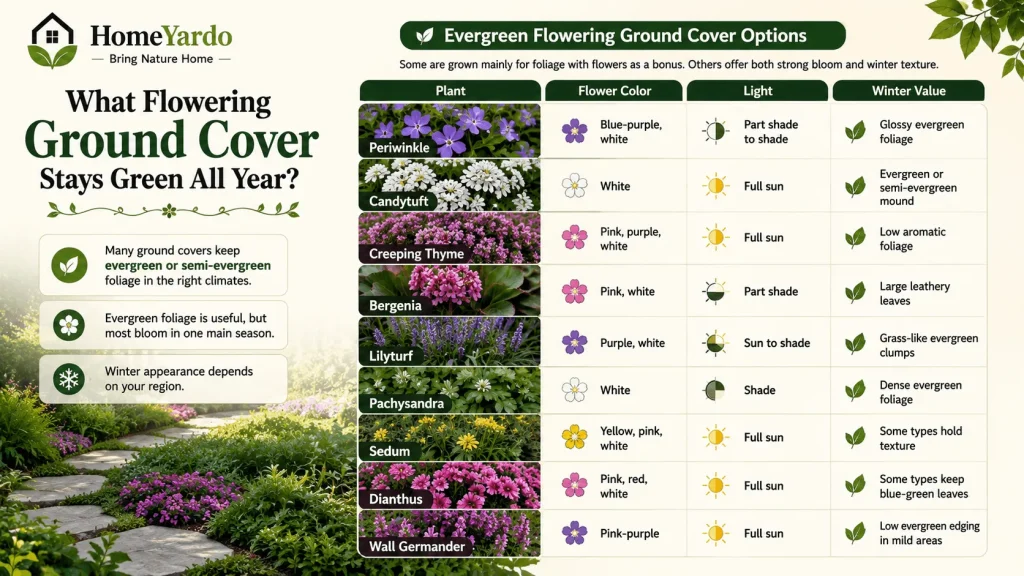
Periwinkle, candytuft, creeping thyme, bergenia, lilyturf, pachysandra, some sedums, some dianthus, and wall germander can stay evergreen or semi-evergreen in suitable climates. Winter appearance depends on the region.
Evergreen foliage is useful, but it does not mean year-round flowers. Most evergreen ground covers bloom during one main season.
Evergreen Flowering Ground Cover Options
Some evergreen ground covers are grown mostly for foliage with flowers as a bonus. Others offer both strong bloom and winter texture.
| Plant | Flower Color | Light | Winter Value |
|---|---|---|---|
| Periwinkle | Blue-purple, white | Part shade to shade | Glossy evergreen foliage |
| Candytuft | White | Full sun | Evergreen or semi-evergreen mound |
| Creeping Thyme | Pink, purple, white | Full sun | Low aromatic foliage |
| Bergenia | Pink, white | Part shade | Large leathery leaves |
| Lilyturf | Purple, white | Sun to shade | Grass-like evergreen clumps |
| Pachysandra | White | Shade | Dense evergreen foliage |
| Sedum | Yellow, pink, white | Full sun | Some types hold texture |
| Dianthus | Pink, red, white | Full sun | Some types keep blue-green leaves |
| Wall Germander | Pink-purple | Full sun | Low evergreen edging in mild areas |
What Flowering Ground Cover Attracts Pollinators?
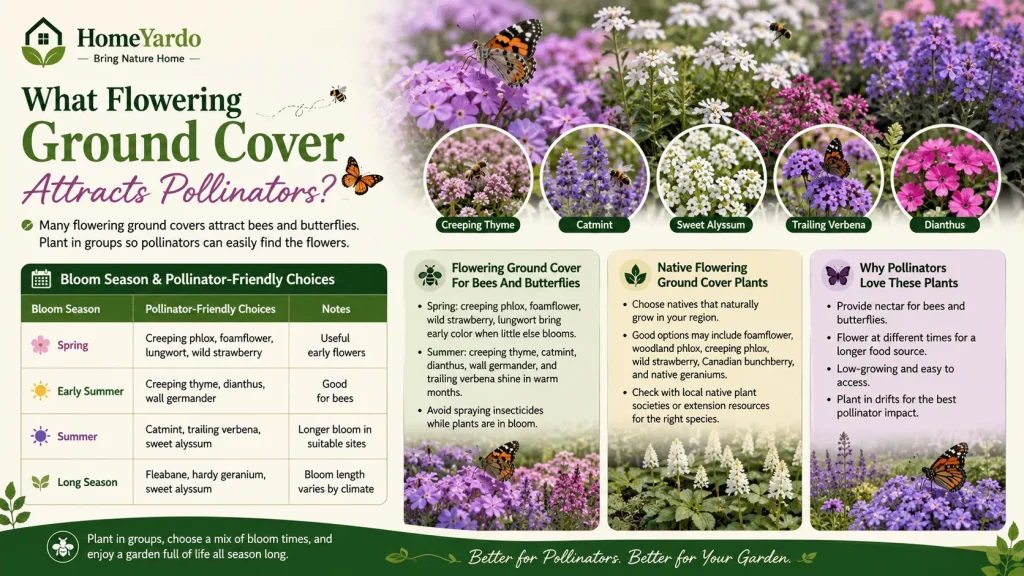
Creeping thyme, creeping phlox, catmint, foamflower, dianthus, wild strawberry, sweet alyssum, fleabane, wall germander, and trailing verbena can attract bees and butterflies. Planting in groups makes flowers easier for pollinators to find.
A single plant helps a little. A drift of the same flower is easier for bees to spot and visit.
| Bloom Season | Pollinator-Friendly Choices | Notes |
|---|---|---|
| Spring | Creeping phlox, foamflower, lungwort, wild strawberry | Useful early flowers |
| Early summer | Creeping thyme, dianthus, wall germander | Good for bees |
| Summer | Catmint, trailing verbena, sweet alyssum | Longer bloom in suitable sites |
| Long season | Fleabane, hardy geranium, sweet alyssum | Bloom length varies by climate |
Flowering Ground Cover For Bees And Butterflies
For spring, creeping phlox, foamflower, wild strawberry, and lungwort can help bring early flowers into the garden. These early blooms are helpful when little else is open.
For summer, creeping thyme, catmint, dianthus, wall germander, and trailing verbena offer valuable flowers for bees and other pollinators. Avoid spraying insecticides while plants are in bloom. To add more wildlife-friendly color above these low-growing plants, consider taller flowers for hummingbirds that provide nectar and variety throughout the growing season.
Native Flowering Ground Cover Plants
Native flowering ground covers depend on the region. Green and gold, foamflower, woodland phlox, creeping phlox, wild strawberry, Canadian bunchberry, and some native geraniums may be useful where they naturally belong.
Local native plant societies and extension resources can help confirm the right species. Native does not mean perfect for every yard, but locally adapted plants can support native insects and fit regional growing conditions. If you want to combine low-growing flowers with a more natural planting style, our guide on how to plant a wild flower garden explains site preparation, plant selection, and ongoing care.
Which Flowering Ground Cover Is Deer Resistant?
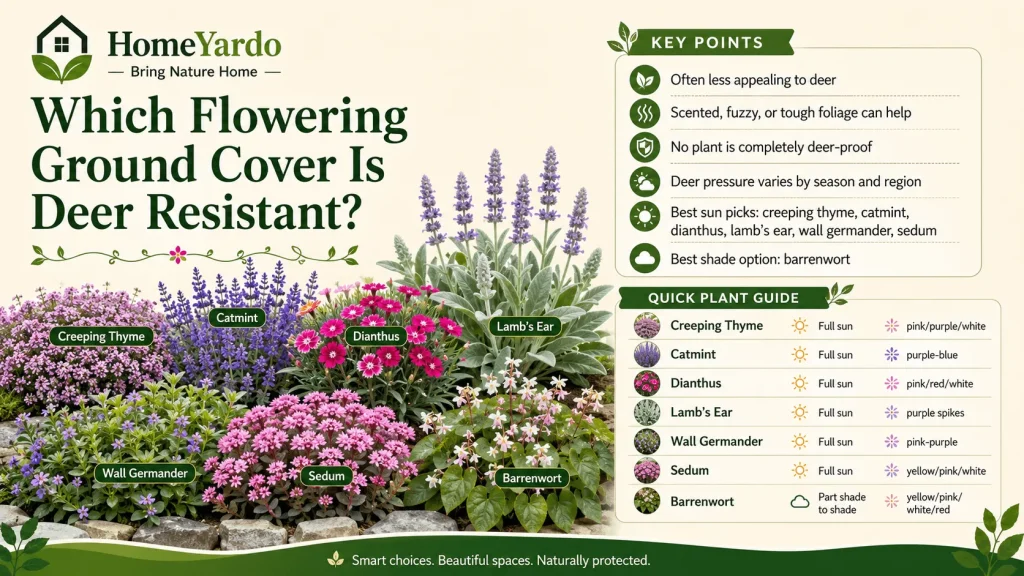
Creeping thyme, catmint, dianthus, lamb’s ear, wall germander, sedum, and barrenwort are often less appealing to deer. Scented, fuzzy, or tough foliage can help.
No plant is deer-proof. Hungry deer sometimes sample the menu anyway, which is rude but very on brand for deer.
Deer Resistant Flowering Ground Cover
Use deer resistance as a helpful clue, not a promise. Deer pressure changes by season, region, and available food.
| Plant | Light | Flower Color | Deer-Resistance Note |
|---|---|---|---|
| Creeping Thyme | Full sun | Pink, purple, white | Aromatic foliage helps deter browsing |
| Catmint | Full sun | Purple-blue | A strong scent is usually less appealing |
| Dianthus | Full sun | Pink, red, white | Often avoided but not guaranteed |
| Lamb’s Ear | Full sun | Purple spikes | Fuzzy leaves may reduce browsing |
| Wall Germander | Full sun | Pink-purple | Aromatic foliage helps |
| Sedum | Full sun | Yellow, pink, white | Often left alone in dry beds |
| Barrenwort | Part shade to shade | Yellow, pink, white, red | Useful for shaded deer-prone spots |
What Flowering Ground Cover Is Safe For Pets?
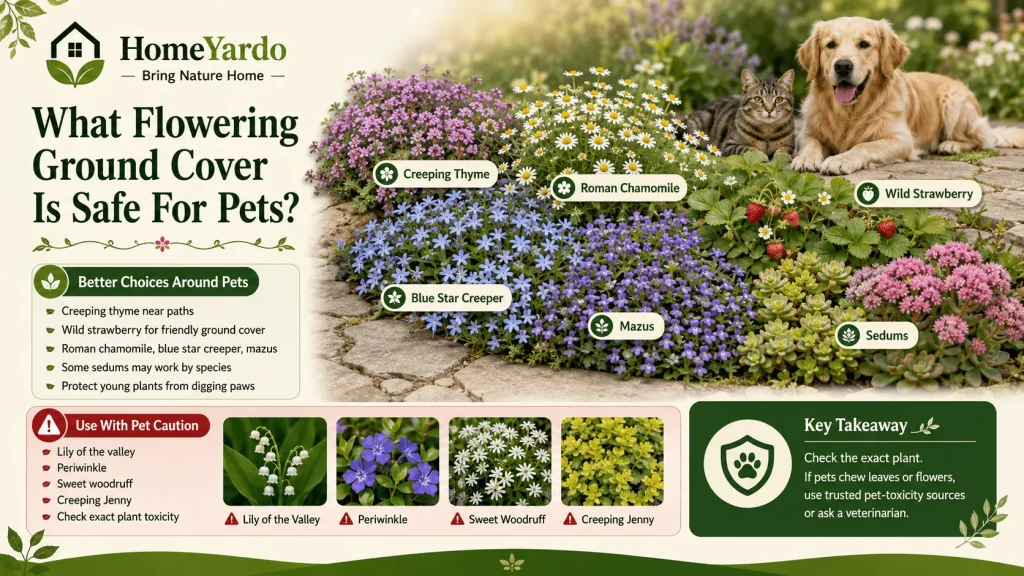
Pet-safe planting needs care because pets behave differently. One dog ignores plants. Another treats the border like a buffet.
Creeping thyme, Roman chamomile, wild strawberry, blue star creeper, mazus, and some sedums are often better candidates around pets, but always check the exact plant. Use trusted pet toxicity resources or ask a veterinarian when pets chew leaves or flowers.
Better Choices Around Pets
Creeping thyme is a common low option near paths. Wild strawberries can also be a friendly choice in many gardens.
Roman chamomile, blue star creeper, mazus, and some sedums may work depending on the species. Young plantings still need protection from digging paws, because enthusiasm can be harder on plants than shade or drought.
Ground Cover Flowers To Use With Pet Caution
Lily of the valley, periwinkle, sweet woodruff, creeping Jenny, and unknown ornamental cultivars deserve caution around chewing pets. Risks vary, but some plants can cause more than mild stomach upset.
If a pet grazes in the garden, do not plant risky flowers where they can reach them. Peace of mind is better than a prettier patch.
Best Colorful Flowering Ground Covers
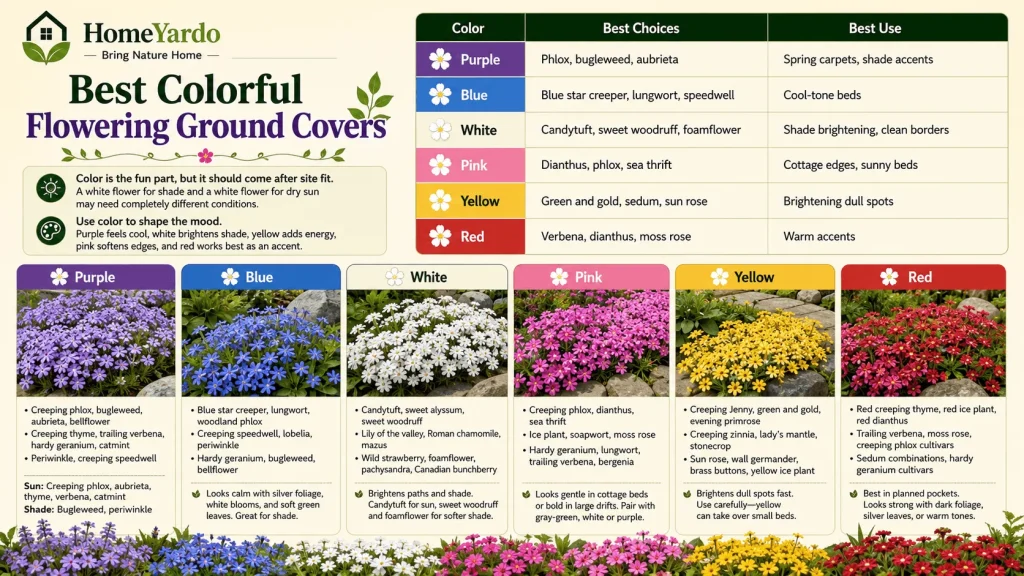
Color is the fun part, but it should come after site fit. A white flower for shade and a white flower for dry sun may need completely different conditions.
Use color to shape the mood. Purple feels cool, white brightens shade, yellow adds energy, pink softens edges, and red works best as an accent.
| Color | Best Choices | Best Use |
|---|---|---|
| Purple | Phlox, bugleweed, aubrieta | Spring carpets, shade accents |
| Blue | Blue star creeper, lungwort, speedwell | Cool-tone beds |
| White | Candytuft, sweet woodruff, foamflower | Shade brightening, clean borders |
| Pink | Dianthus, phlox, sea thrift | Cottage edges, sunny beds |
| Yellow | Green and gold, sedum, sun rose | Brightening dull spots |
| Red | Verbena, dianthus, moss rose | Warm accents |
Purple Ground Cover Flowers
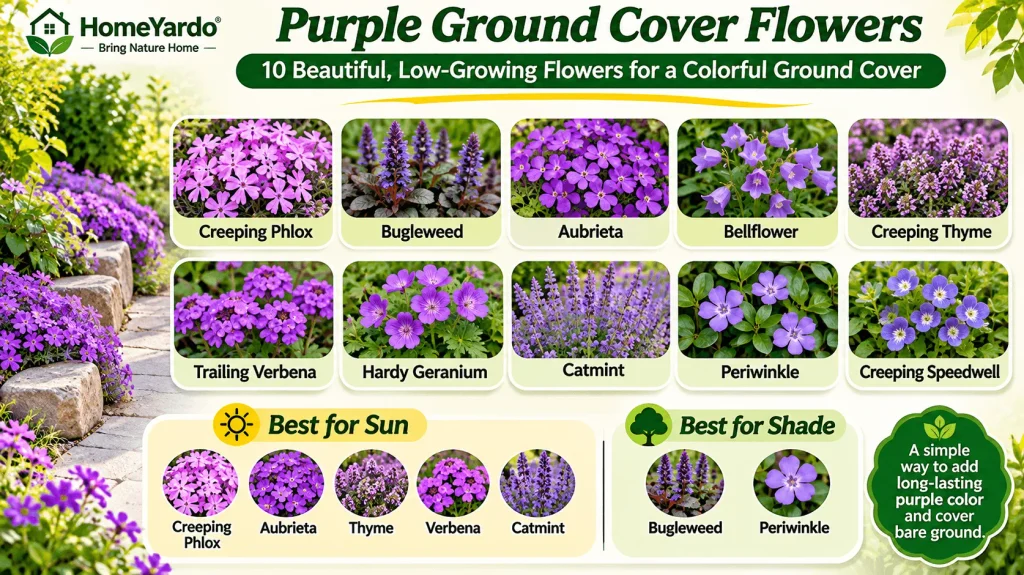
Ground cover with purple flowers includes creeping phlox, bugleweed, aubrieta, bellflower, creeping thyme, trailing verbena, hardy geranium, catmint, periwinkle, and creeping speedwell.
For sun, use creeping phlox, aubrieta, thyme, verbena, or catmint. For shade, bugleweed and periwinkle are better fits where they are safe to plant. If you want more purple blooms for different growing conditions, explore these purple perennials for sunny borders, shaded beds, and low-growing garden displays.
Blue Ground Cover Flowers
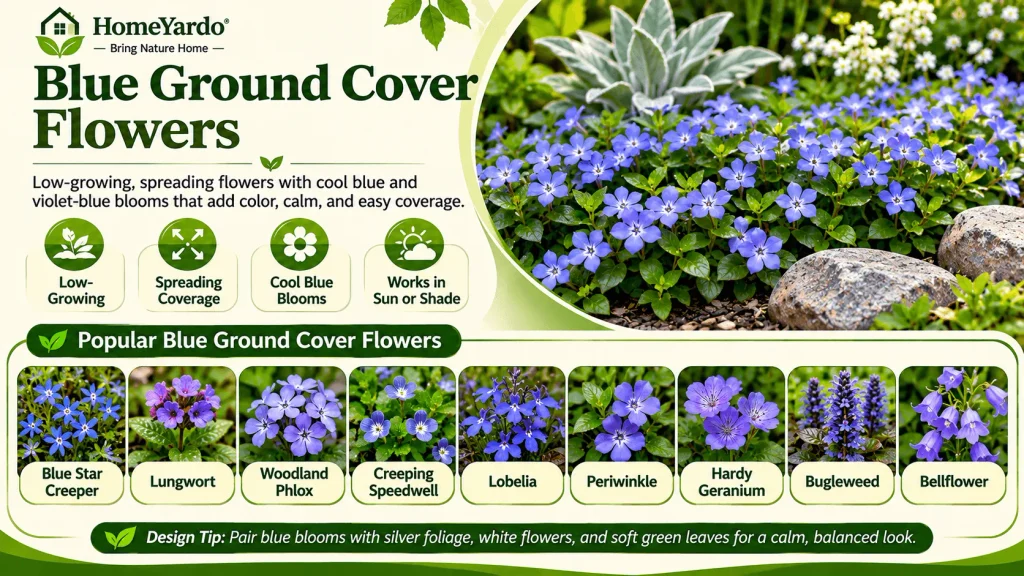
Blue flowering ground cover is often violet-blue rather than pure blue. Blue star creeper, lungwort, woodland phlox, creeping speedwell, lobelia, periwinkle, hardy geranium, bugleweed, and bellflower can bring cooler tones.
Blue flowers look especially calm with silver foliage, white blooms, and soft green leaves. In shade, they can make a bed feel less heavy.
White Ground Cover Flowers
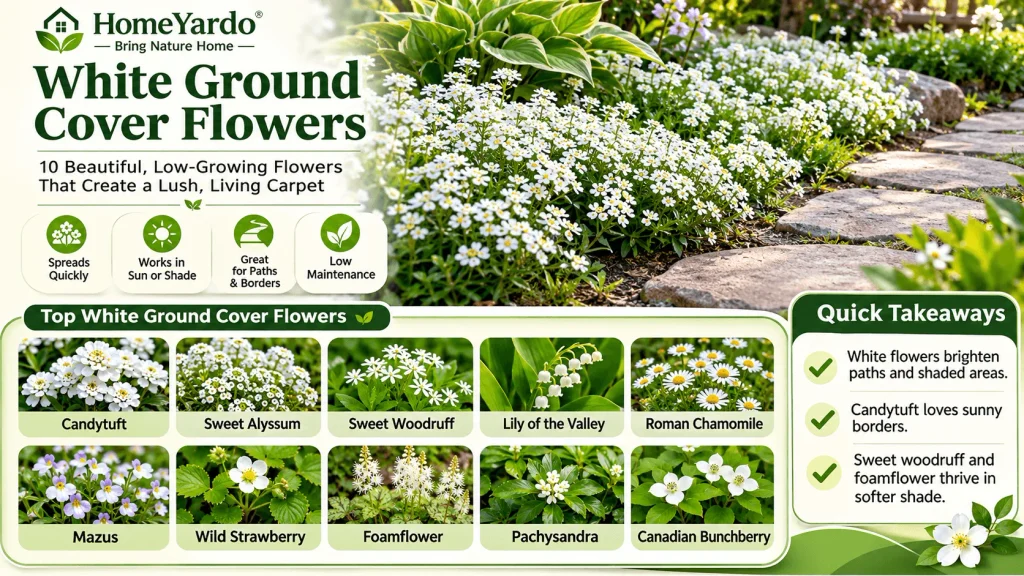
White Flowers that cover ground include candytuft, sweet alyssum, sweet woodruff, lily of the valley, Roman chamomile, mazus, wild strawberry, foamflower, pachysandra, and Canadian bunchberry.
White works well near paths and shaded areas because it catches the eye. Candytuft suits sunny borders, while sweet woodruff and foamflower suit softer shade.
Pink Ground Cover Flowers
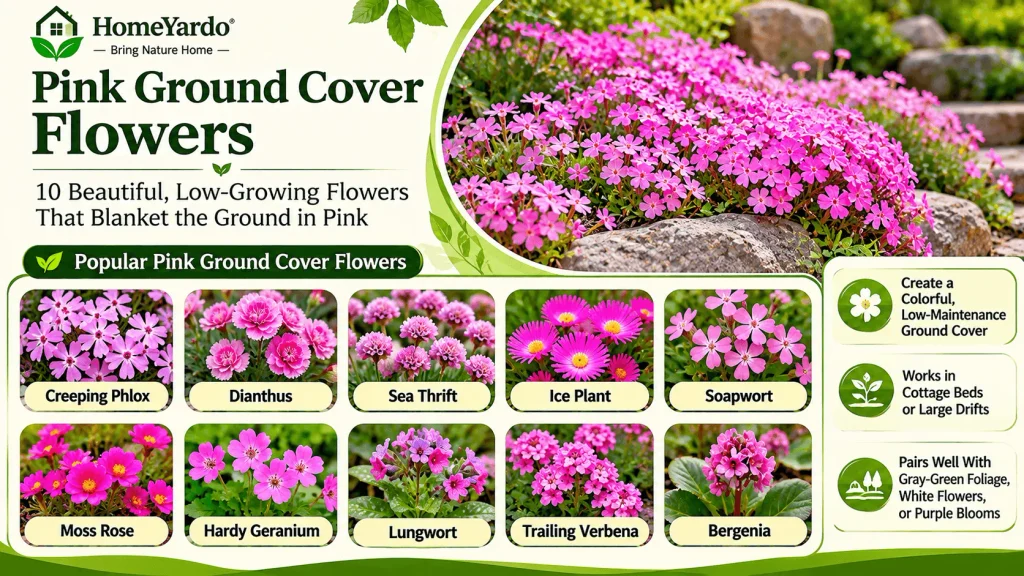
Pink Flowers that cover ground include creeping phlox, dianthus, sea thrift, ice plant, soapwort, moss rose, hardy geranium, lungwort, trailing verbena, and bergenia.
Pink can look gentle in cottage beds or bold in a larger drift. Pair it with gray-green foliage, white flowers, or purple blooms for a balanced look.
Yellow Ground Cover Flowers
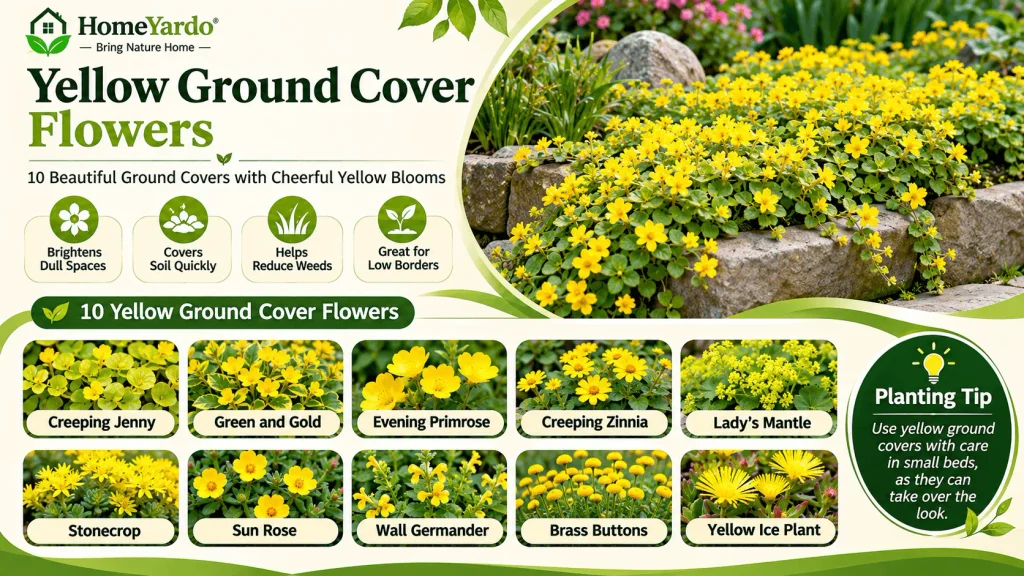
Yellow Flowers that cover ground include creeping Jenny, green and gold, evening primrose, creeping zinnia, lady’s mantle, stonecrop, sun rose, wall germander, brass buttons, and yellow ice plant.
Yellow brightens dull spaces quickly. In small beds, use it with care because bright yellow can take over the look of the planting.
Red Ground Cover Flowers
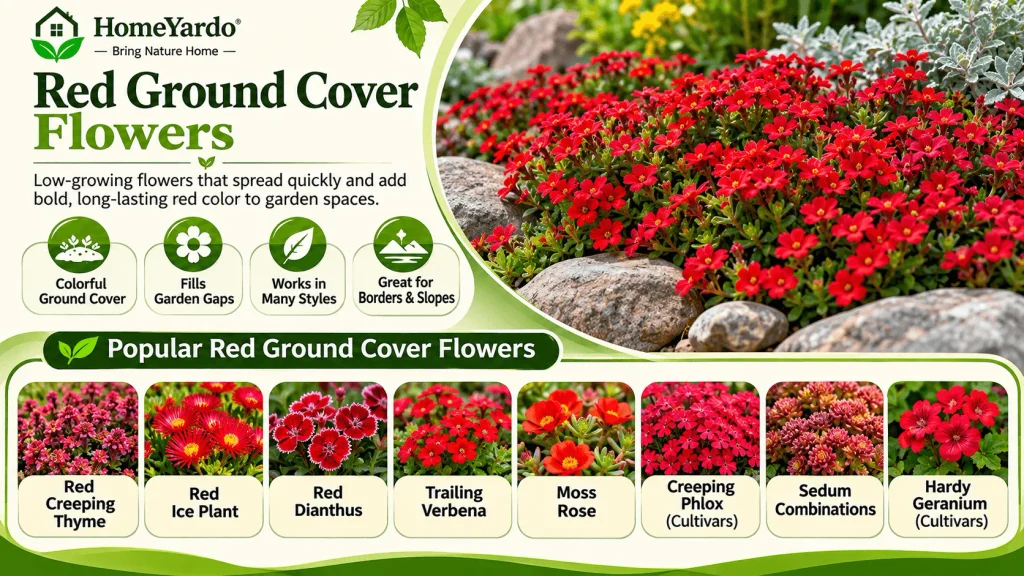
Red flowering ground cover is less common than pink, purple, or white. Look for red creeping thyme types, red ice plant, red dianthus, trailing verbena, moss rose, creeping phlox cultivars, sedum combinations, and some hardy geranium cultivars.
Red works best in planned pockets. It can look strong with dark foliage, silver leaves, or warm orange-yellow flowers.
Best Ground Cover Flowers By Garden Area
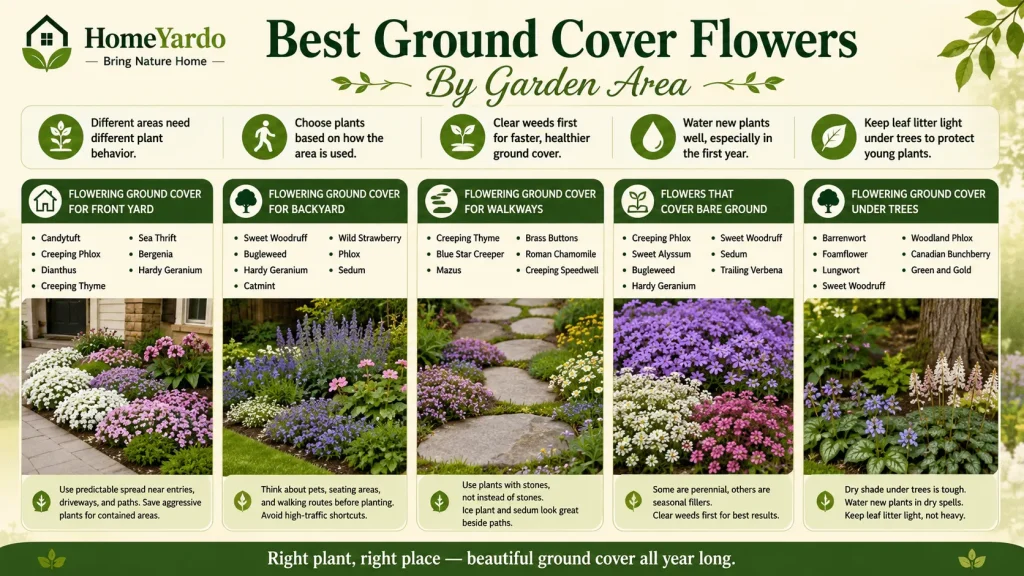
Different parts of a yard need different plant behavior. A front path needs tidy growth. A backyard bed may allow a looser, more natural look.
Pick plants based on how the area is used. A shortcut across the garden can ruin a delicate planting faster than any weather problem.
Flowering Ground Cover For Front Yard
Good flowering ground cover for front yard beds includes candytuft, creeping phlox, dianthus, creeping thyme, sea thrift, bergenia, and hardy geranium. These plants can look polished without asking for constant attention.
Use predictable spread near entries, driveways, and paths. Save aggressive plants for contained areas where they cannot run into the lawn.
Flowering Ground Cover For Backyard
Backyards can handle a more relaxed planting style. Sweet woodruff, bugleweed, hardy geranium, catmint, wild strawberry, phlox, and sedum can all work depending on sun and traffic.
Think about pets, seating areas, and walking routes before planting. A soft living carpet looks lovely until everyone chooses the same shortcut through it.
Flowering Ground Cover For Walkways
Creeping thyme, blue star creeper, mazus, brass buttons, Roman chamomile, and creeping speedwell can soften walkway gaps. Use them with stones, not instead of stones.
Plants beside a path can be more delicate than plants between pavers. Ice plant and sedum often look best near walkways rather than underfoot.
Flowers That Cover Bare Ground
Flowers that cover bare ground include creeping phlox, sweet alyssum, bugleweed, hardy geranium, sweet woodruff, sedum, and trailing verbena. Some are permanent perennials, while others are quick seasonal fillers.
Clear weeds first. Ground covers fill faster when they are not competing with turf roots or old weed crowns.
Flowering Ground Cover Under Trees
Barrenwort, foamflower, lungwort, sweet woodruff, woodland phlox, Canadian bunchberry, and green and gold can grow under trees in suitable conditions. Dry shade under tree roots is one of the toughest garden problems, so patience helps.
Water new plants during dry spells in the first year. Keep heavy leaf litter from smothering tiny plants, but leave a light natural layer where it does not bury crowns.
Best Flowers For Landscape Coverage
The best flowers for landscape coverage are plants that cover soil, look good in groups, and fit the space without constant correction. In a landscape bed, the plant has to do more than bloom. It should help shape the area.
For broad coverage, choose plants by purpose. A front border needs neat growth, a hillside benefits from established roots, and a woodland edge requires shade-tolerant varieties. Ground covers can also be combined with flowering bushes to create layered garden beds with seasonal blooms, varied heights, and a fuller landscape appearance.
Landscape coverage looks strongest when plants are repeated in groups. A drift of creeping phlox on a slope or a ribbon of thyme along a path feels more intentional than one plant sitting alone.
Good coverage also depends on spacing. If plants are placed too far apart, weeds will use the open soil. If they are packed too tightly, airflow drops and some plants may decline.
Ground Cover Flowers To Use With Caution
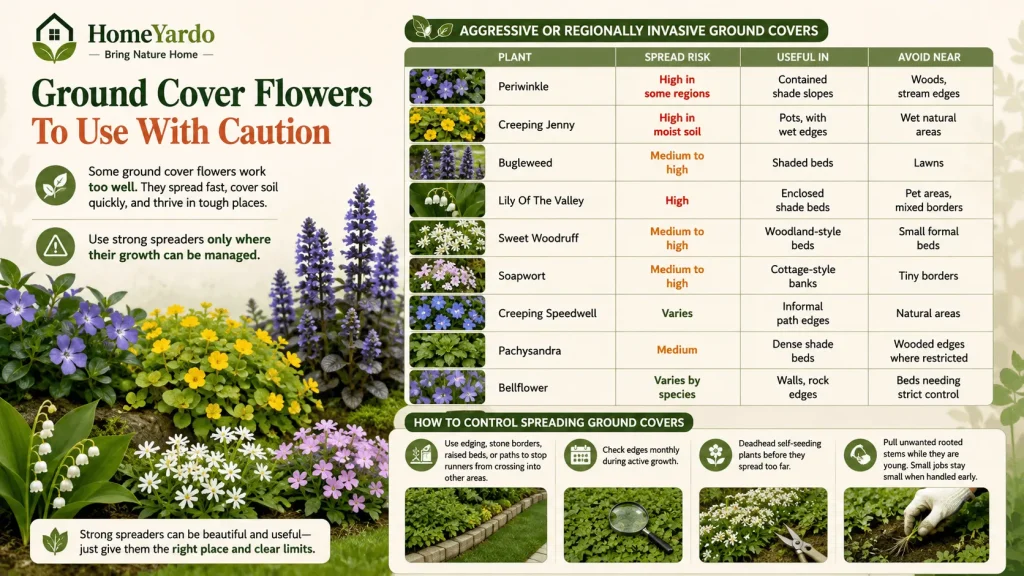
Some Flowers that cover ground are sold because they work very well. Sometimes too well. They can cover soil fast, spread through hard places, and survive where fussier plants fail.
That strength can cause trouble near lawns, woodland edges, streams, or small mixed beds. Use strong spreaders only where their growth can be managed.
Aggressive Or Regionally Invasive Ground Covers
Periwinkle, creeping Jenny, bugleweed, lily of the valley, sweet woodruff, soapwort, creeping speedwell, pachysandra, and some bellflowers can become aggressive in certain climates.
| Plant | Spread Risk | Useful In | Avoid Near |
|---|---|---|---|
| Periwinkle | High in some regions | Contained shade slopes | Woods, stream edges |
| Creeping Jenny | High in moist soil | Pots, with wet edges | Wet natural areas |
| Bugleweed | Medium to high | Shaded beds | Lawns |
| Lily Of The Valley | High | Enclosed shade beds | Pet areas, mixed borders |
| Sweet Woodruff | Medium to high | Woodland-style beds | Small formal beds |
| Soapwort | Medium to high | Cottage-style banks | Tiny borders |
| Creeping Speedwell | Varies | Informal path edges | Natural areas |
| Pachysandra | Medium | Dense shade beds | Wooded edges where restricted |
| Bellflower | Varies by species | Walls, rock edges | Beds needing strict control |
How To Control Spreading Ground Covers
Use edging, stone borders, raised beds, or paths to stop runners from crossing into other areas. Check edges monthly during active growth.
Deadhead self-seeding plants before they spread too far. Pull unwanted rooted stems while they are young. Small jobs stay small when handled early.
How To Plant Ground Cover Flowers
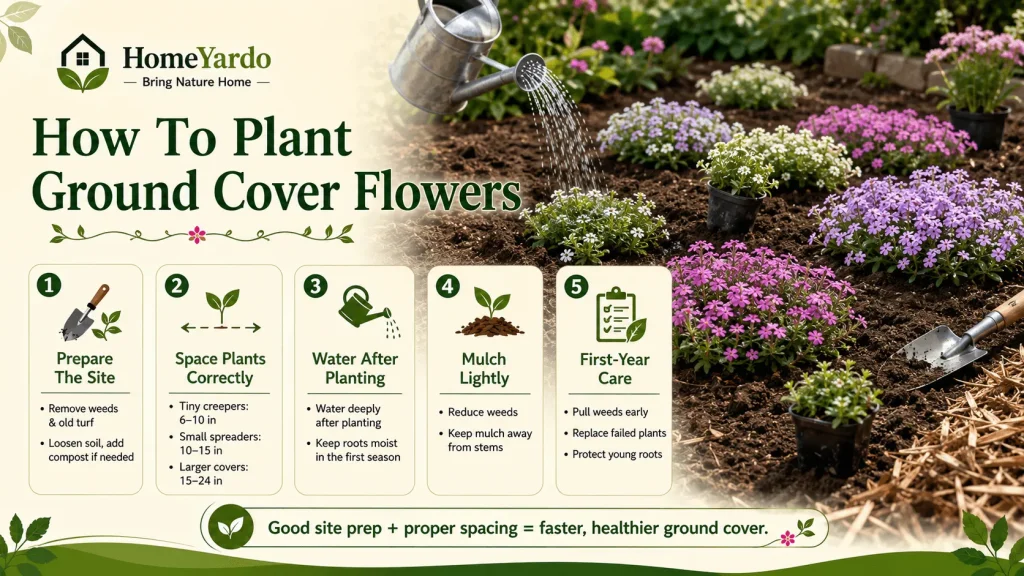
Flowers that cover the ground fill in faster when the planting area is prepared well. It is not the glamorous part, but it makes the finished bed look much better.
Weedy soil creates trouble later. A little effort before planting saves a lot of awkward pulling through tangled stems.
Tools And Supplies
Simple tools are enough for most ground cover planting. A slope or large area may need extra erosion support, but a small border usually does not.
- Garden fork or hand trowel
- Compost if needed
- Mulch
- Watering can or hose
- Gloves
- Plant labels
- Measuring tape
- Optional biodegradable erosion fabric for slopes
Prepare The Site
Remove weeds, grass roots, and old turf before planting. If the area is very weedy, clean it before buying plants so new roots are not competing from the start.
Loosen compacted soil and add compost where suitable. For dry-loving plants, fix drainage first. Wet roots are hard to rescue once rot begins.
Space Plants Correctly
Spacing depends on mature spread, plant size, and how quickly coverage is wanted. Close spacing fills faster but costs more. Wide spacing saves money but needs more early weeding.
| Plant Type | Common Spacing |
|---|---|
| Tiny creepers | 6–10 inches |
| Small spreading perennials | 10–15 inches |
| Larger ground covers | 15–24 inches |
Plant tags and cultivar details should guide the final spacing. A small pot can become much wider than it looks on planting day.
Water After Planting
Water deeply after planting so the soil settles around the roots. A shallow sprinkle may wet the surface while the root ball stays dry.
During the first season, water is more often in heat and drought. Once roots spread, watering can be reduced for drought-tolerant plants.
Mulch Between Young Plants
A light mulch layer helps reduce weeds while ground covers fill in. Keep mulch away from crowns and stems to prevent rot.
Tiny creeping plants need open contact with soil. Do not bury their stems under heavy mulch, or they may struggle to root.
First-Year Care Checklist
The first year decides how quickly a ground cover becomes useful. A little attention early can keep gaps from turning into weed patches.
| Task | Why It Helps |
|---|---|
| Water during dry spells | Helps roots establish |
| Pull weeds early | Reduces competition |
| Replace failed plants | Prevents bare gaps |
| Trim edges | Keeps the spread controlled |
| Watch for rot | Catches drainage problems early |
| Keep foot traffic off young plants | Protects shallow roots |
| Avoid heavy fertilizer | Prevents weak, floppy growth |
| Check gaps after 6–8 weeks | Helps fill weak spots early |
How To Maintain Flowering Ground Covers
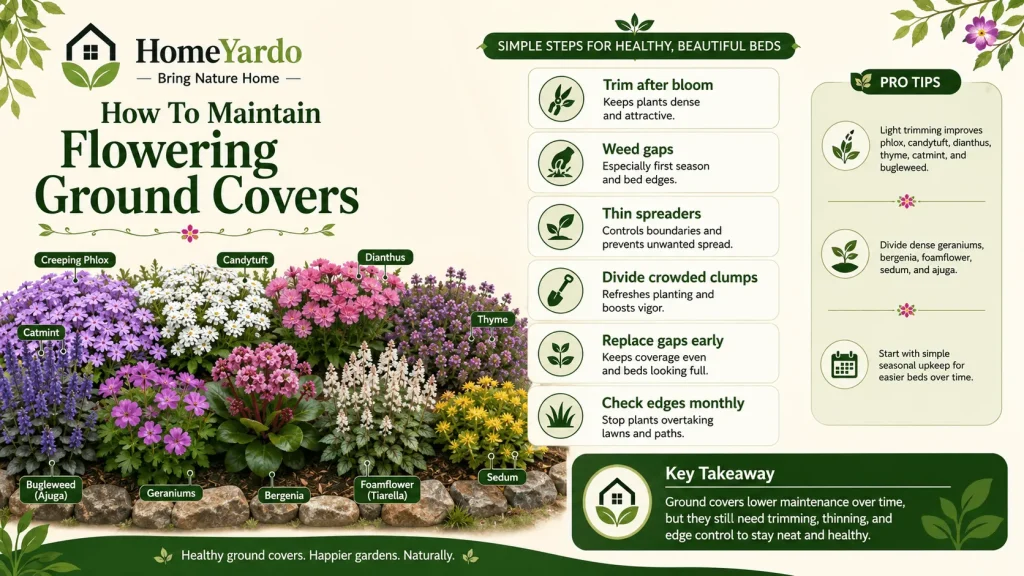
A good ground cover should reduce work over time. It will not remove every task, but it can make a bed easier than exposed soil or a struggling lawn.
Most maintenance is simple. Trim after bloom, weed the edges, thin crowded clumps, and keep fast spreaders inside their borders.
| Task | When To Do It | Why It Helps |
|---|---|---|
| Trim after bloom | After flowering | Keeps plants dense |
| Weed gaps | First season and edges | Stops competition |
| Thin spreaders | Active growth season | Controls boundaries |
| Divide clumps | Every few years if crowded | Refreshes planting |
| Replace gaps | Early season | Keeps coverage even |
Trim After Bloom
Creeping phlox and candytuft dianthus, thyme and catmint and bugleweed usually look better after a slight trimming. The removal of tired flowers can help keep plants looking denser.
Do not cut all plants in a hard way. Some require only an occasional tidying, while others may require a stronger shear.
Divide Or Thin Dense Plants
Geraniums, bergenias, hardy foamflower, sedum, and Ajuga can become crowded over time. The clumps that are dense may flower less or form barren centers.
The division of healthy pieces of plants in spring or early autumn can help refresh the plants. The extra rooted pieces can be useful to fill gaps in other areas.
Control Edges
The appearance of ground covers is improved when edges are properly managed. Cut them off from lawns, pathways and other smaller perennials prior to them overtaking the plants around them.
Runner-forming plants require greater focus than those that clump. A once-a-month edge check during growth activity is generally enough for a large number of beds.
Common Mistakes With Ground Cover Flowers
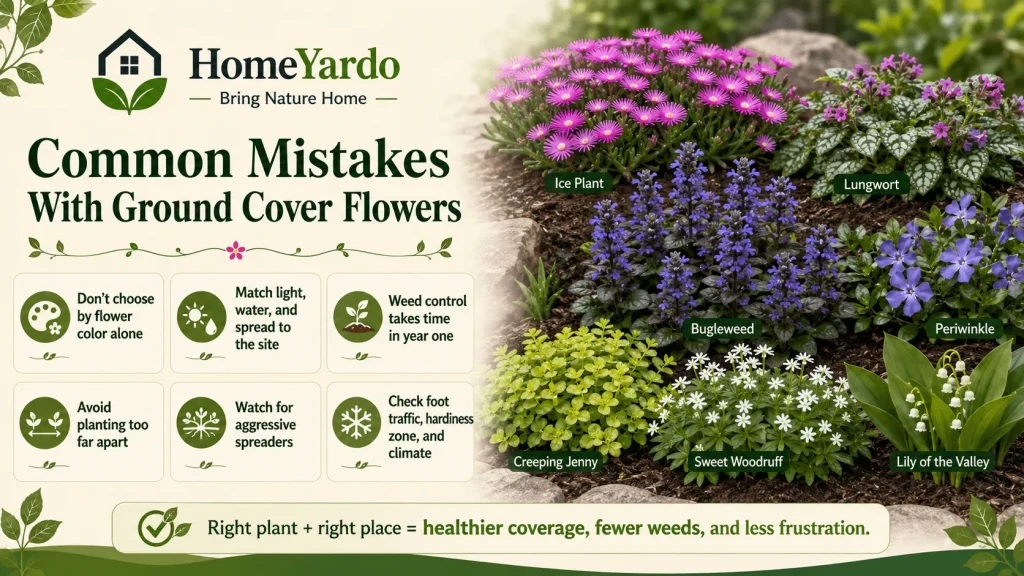
The majority of ground cover issues begin with an unintentional incompatibility. The plant appeared good. The tag seemed simple. The site had other ideas.
Avoiding some common mistakes can make the plant more enjoyable. It also helps save time, money and the sound of sighs when a plant is gone.
Choosing By Flower Color Only
The color of the flower should not be the sole factor in the final choice. Water, light and spread habits are more important.
The ice plant could be the perfect bright bloom; however, it won’t be able to enjoy the humid shade. The lungwort can look gorgeous on the label, but the scorching sun makes it miserable.
Expecting Instant Weed Control
Flowers that cover the ground can decrease the space weeds fill. They cannot erase weeds from the day after they were planted.
Young plants need water, weeding and time. Mulch aids but hand-pulling is an important part of the first year.
Planting Too Far Apart
Wide spacing is cheaper initially, but it also leaves more space for the soil. It also encourages weeds to grow and slows down the fill-in appearance.
Use the mature spread as a guideline. If you are looking for quick coverage, the spacing could be worth the additional plants.
Ignoring Aggressive Spread
The speedy spread can be beneficial for a bank with no money. With a limited area, it could turn into a tug-of-war.
Bugleweed, periwinkle, woodruff, creeping Jenny and Lily of the Valley all can be controlled. Choose plants with sharp edges or slow-growing plants.
Using The Wrong Plant For Foot Traffic
Growth that is low does not mean walking-friendly growth. Many flowering groundcovers crush or break under the pressure of regular steps.
Utilize stepping stones to create principal routes. Let the plants fill the gaps and sides.
Ignoring Hardiness Zone And Local Climate
The plant could grow in a perennial area but is seasonal elsewhere. The winter rain, summer heat and freeze-thaw cycles impact the survival of a plant.
Evergreen can also change with the seasons. The plant can look neat in a sunny garden but look ragged following a winter that is harsh elsewhere.
Suggested Planting Combinations
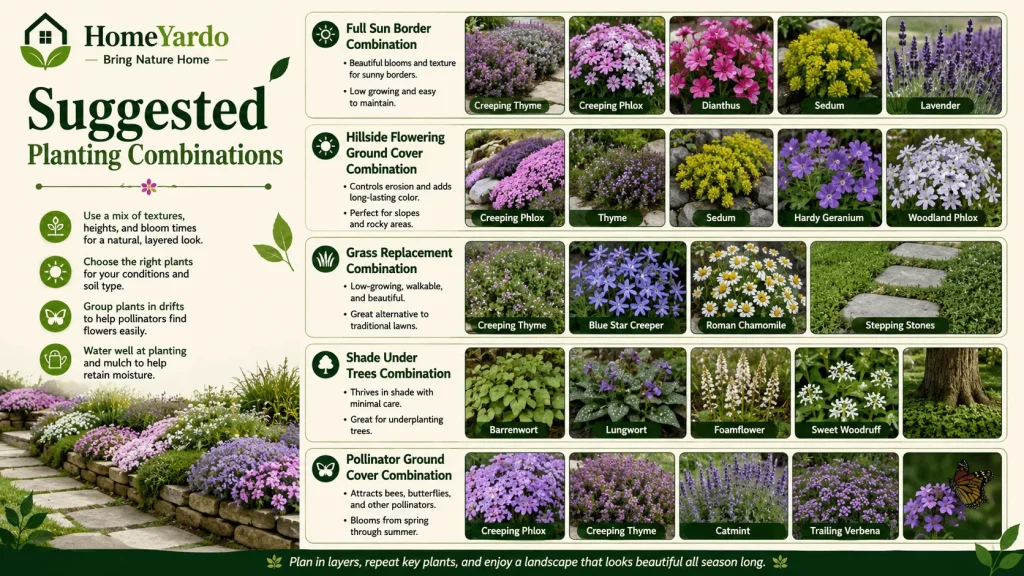
A well-planned mix makes the plant appear planned, rather than slapped together. The best mixes make use of several plants that are repeated but not all of them.
Consider edges as well as pockets, centers, and edges. A minimalist layout will look more professional than a large collection.
Full Sun Border Combination
Make use of creeping thyme along your front edge, where it will be splattered gently near the path. Plant creeping phlox plants in small drifts to give spring color.
Place dianthus a bit behind the plants with the tiniest of scents and to add more bloom. Tuck sedum into pockets in soil that is drier or hard and rocky.
Hillside Flowering Ground Cover Combination
For sunny hillsides, plant creeping phlox in staggered rows for spring colors. Include thyme or sedum in the driest pockets.
Geraniums that are hardy can fill up areas with soil that is deeper. In areas with slopes that are shaded, choose to use woodland phlox if roots and light are available.
Grass Replacement Combination
Use creeping thyme for the sun-dried patches, as well as blue star creeper in areas where soil remains moist. Roman Chamomile is a fragrant plant that can be used in areas of gentle use.
Install stepping stones throughout the plant to allow for walking. The plants will look more attractive when there is a safe area to rest.
Shade Under Trees Combination
Utilize barrenwort as a steady base layer beneath trees. Include lungwort in the front, where its patterned leaves are visible.
Foamflower thrives in moist areas and sweet woodruff is able to be used to shade larger spaces in which the spread of natural plants is encouraged. Keep the crowns free of large leaf piles.
Pollinator Ground Cover Combination
Start with creeping phlox as a spring bloom. Also add creeping thyme for spring blooms as well as bees.
Catmint is a great flower to extend the blooming season, and the trailing verbena can add warmer-season colors. Plant them in groups so that pollinators are able to find the flowers quickly.
Final Takeaway
Flowers that cover the ground can transform bare soil that is bare into something softer and brighter. They are also easier to maintain. The most suitable choice is based on the area and not just the prettiest bloom.
If you want to enjoy full sun, take a look at creeping thyme, creeping phlox and ice plants, sedum, and dianthus along with sea thrift. For shade, think about barrenwort, foamflower, sweet woodruff, and woodland phlox.
Select by site first, and color later. Set boundaries for spreaders that are quick, assist young plants in establishing the bed, and make it easier to take pleasure in.
FAQ’s
Creeping phlox is one of the best flowering ground covers for sunny slopes and border fronts. For shade, barrenwort, foamflower, and lungwort are stronger choices. The best plant depends on light, drainage, and spread.
Creeping thyme, creeping phlox, ice plant, candytuft, dianthus, sedum, sea thrift, and sun rose are strong full-sun choices. Most prefer well-drained soil and dislike soggy conditions.
Barrenwort, foamflower, lungwort, sweet woodruff, bugleweed, dead nettle, and woodland phlox are good shade choices. Dry shade under trees needs tougher plants and extra first-year watering
Creeping phlox, creeping thyme, sedum, hardy geranium, periwinkle, wild strawberry, and green and gold can help reduce erosion after establishment. Young slope plantings still need temporary soil protection.
Creeping thyme, blue star creeper, Roman chamomile, mazus, brass buttons, and low sedums can replace grass in small low-traffic areas. They are not good for heavy play or daily walking.
Creeping thyme, ice plant, sedum, sea thrift, sun rose, moss rose, wall germander, catmint, and dianthus are drought-tolerant after establishment. Most need full sun and sharp drainage.
Barrenwort, foamflower, lungwort, sweet woodruff, woodland phlox, Canadian bunchberry, and green and gold can grow under trees in suitable conditions. Tree roots compete for water, so new plants need care.
Yes, when the plant matches the site. Creeping phlox, thyme, sedum, candytuft, barrenwort, and hardy geranium are beginner-friendly choices in the right conditions.
Flowers that cover ground can reduce weeds after they fill in, but they do not stop weeds instantly. Early weeding, spacing, mulch, and watering help the planting become dense enough to compete.
The best flowering ground cover for landscaping depends on the area being planted. Creeping phlox works well for sunny slopes and spring color. Creeping thyme suits dry edges and walkway gaps. Barrenwort, foamflower, and lungwort are better for shaded beds. For a polished landscape, choose plants that repeat well and stay in scale with the bed. Candytuft, dianthus, sea thrift, hardy geranium, sedum, and creeping phlox are good for tidy borders. Sweet woodruff, wild strawberry, woodland phlox, and green and gold create a softer natural look.
Periwinkle, candytuft, creeping thyme, bergenia, lilyturf, pachysandra, some sedums, barrenwort, and some dianthus can survive winter in suitable zones. Some stay evergreen or semi-evergreen, while others die back and return in spring. Winter survival depends on cold hardiness, drainage, snow cover, and winter wetness. A plant may handle freezing temperatures but still fail if the soil stays soggy for too long.
Creeping thyme, sedum, ice plant, sea thrift, sun rose, moss rose, wall germander, catmint, and dianthus can work in poor soil if drainage is good. Many dry-site ground covers prefer lean soil over rich, heavy ground. Poor soil is not the same as wet soil. If the area is compacted clay or stays soggy, improve drainage before planting drought-tolerant flowers.
Trailing verbena, sweet alyssum, moss rose, ice plant, hardy geranium, fleabane, catmint, lobelia, cupflower, and creeping zinnia can bloom through much of summer in suitable conditions. Some are annuals, while others are perennials. Heat, watering, deadheading, and climate affect bloom length. For steady color, mix spring bloomers with summer bloomers instead of relying on one plant to carry the whole season.
How This List Was Chosen
This list focuses on flowering plants that can cover soil, soften edges, or fill low spaces in a garden. Some are true creeping plants, while others are low spreading perennials or annual fillers.
The plants were selected using these criteria:
- Low-growing or spreading habit
- Flowering value
- Ability to cover bare soil
- Usefulness in common garden problems
- Sun or shade adaptability
- Drought, slope, walkway, or pollinator value
- Spread risk and caution
- Availability to home gardeners
- Clear botanical identity
References
- https://blog.greatgardenplants.com/12-flowering-ground-cover-plants-for-sun-or-shade/
- https://plantura.garden/uk/gardening-tips/plant-overviews/groundcover-plants
- https://www.whiteflowerfarm.com/ground-covers-for-shade
- https://www.usperennials.com/perennials-by-collections/ground-cover-perennials/
- https://www.thepioneerwoman.com/home-lifestyle/gardening/g43280067/ground-cover-plants/
- https://www.gardens4you.ie/garden-plants/perennials/groundcovering-perennials
- https://www.finegardening.com/article/plants-you-can-walk-on
- https://naturehills.com/blogs/garden-blog/9-great-low-growing-flowering-plants
- https://www.realsimple.com/fast-growing-ground-cover-flowers-11953805
- https://www.midwestliving.com/garden/ideas/15-easy-midwest-groundcovers/
- https://www.rhs.org.uk/plants/for-places/ground-cover
- https://gardenbetty.com/shade-ground-covers/
- https://www.goodhousekeeping.com/home/gardening/g32440508/best-ground-cover-plants/
- https://extension.umd.edu/resource/groundcovers
- https://hort.extension.wisc.edu/articles/alternatives-to-lawn-groundcovers/
- https://plants.ces.ncsu.edu/
- https://www.aspca.org/pet-care/animal-poison-control/toxic-and-non-toxic-plants