Do Cockroaches Really Live Only A Few Weeks? What Homeowners Should Know
You pull the old, yellowed caulk from behind the kitchen sink, planning a quick reseal before the weekend. Then something brown and fast slips out of the gap and vanishes under the dishwasher.
One cockroach might seem like a small problem. Plenty of homeowners assume it will die within a few weeks and get back to whatever repair they were doing.
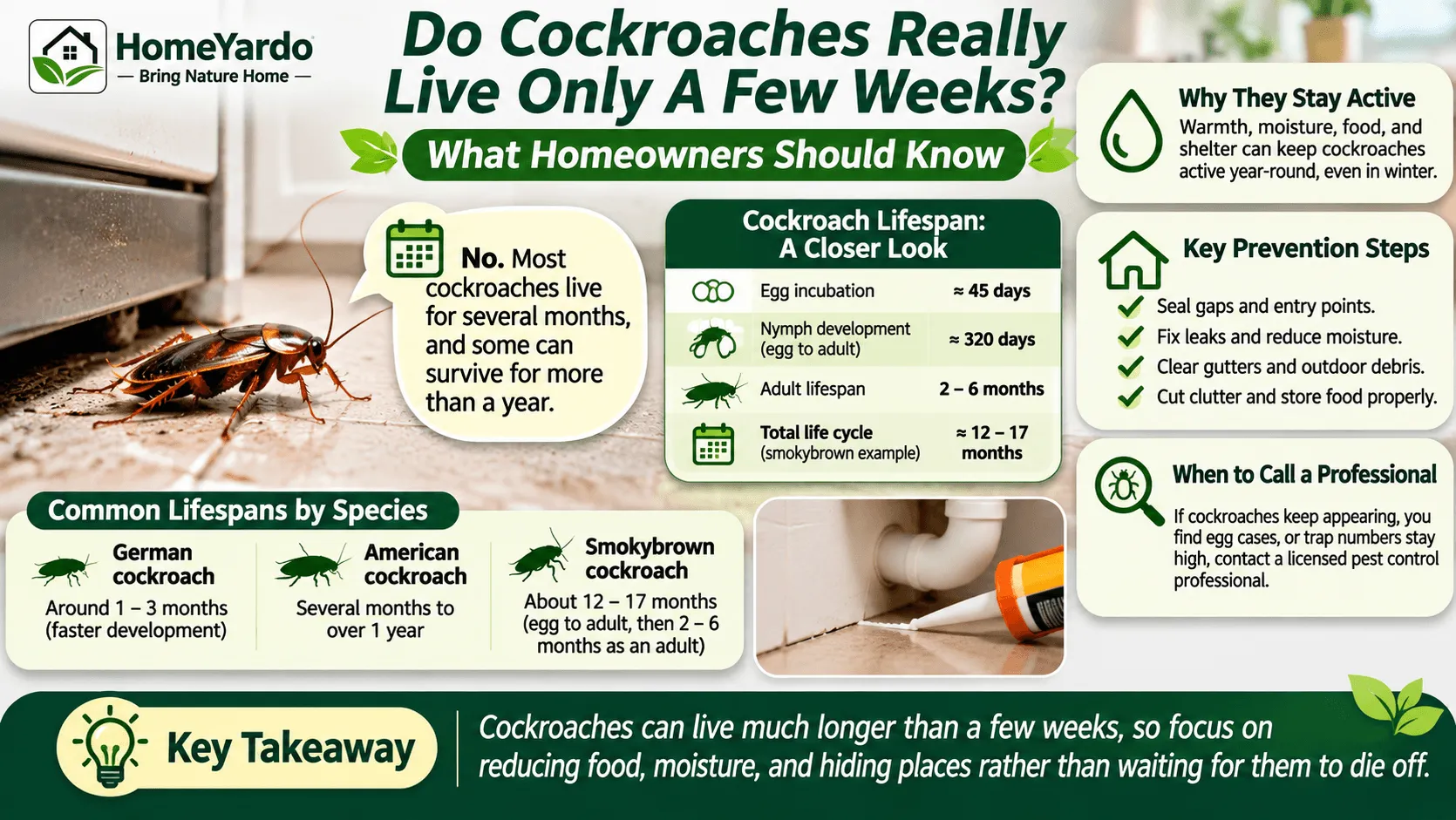
Unfortunately, cockroaches can survive much longer than that.
Most common household cockroach species live for several months, and some can survive for more than a year when their immature stages are included. Their lifespan depends on the species, temperature, food, moisture, and surrounding conditions.
Understanding the real cockroach lifespan changes how you approach prevention. Rather than waiting for a cockroach to die naturally, it makes more sense to address the conditions allowing it to survive.
And often, that starts with the same maintenance jobs already on your weekend checklist.
How Long Do Cockroaches Actually Live?
Cockroaches do not usually live for just a few weeks. Many common species survive for months, while some require nearly a year or longer to develop from egg to adult.
The important distinction is between an adult cockroach’s lifespan and its entire life cycle.
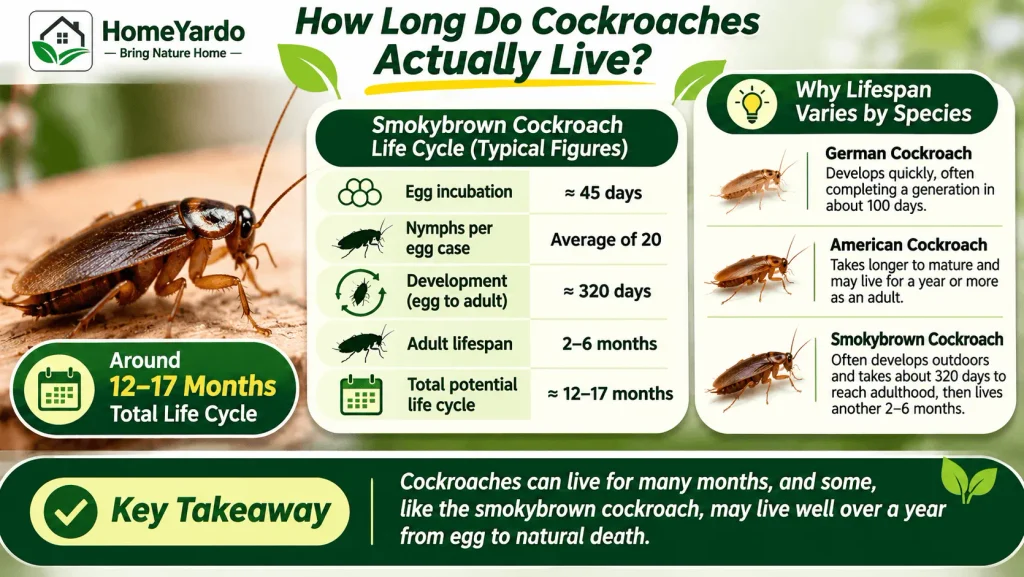
According to this article, a smokybrown cockroach takes approximately 320 days to develop from egg to adult. Once fully grown, adults typically survive another two to six months.
That means an individual smoky brown cockroach may live for well over a year from the egg stage to natural death.
What the Smokybrown Cockroach Life Cycle Tells Us
Oklahoma State University’s extension guidance provides the following figures for smoky brown cockroaches.
| Life stage | Typical figure |
|---|---|
| Egg incubation | Approximately 45 days |
| Nymphs per egg case | Average of 20 |
| Development from egg to adult | Approximately 320 days |
| Adult lifespan | 2–6 months |
| Total potential life cycle | Around 12–17 months using these typical figures |
These are species-specific estimates rather than fixed survival periods. Actual development and survival can vary with environmental conditions.
Why Cockroach Lifespan Varies by Species
Not every cockroach follows the same timeline.
German cockroaches, which commonly establish themselves in kitchens and bathrooms, can develop much faster than larger species. Under favorable conditions, they may complete a generation in roughly 100 days.
American cockroaches can take considerably longer to mature and may survive for a year or more as adults.
Smokybrown cockroaches often develop outdoors before entering garages, attics, or other sheltered parts of a property.
Knowing which species you are dealing with helps determine whether the insects are breeding indoors or entering from surrounding areas.
Why the Few-Weeks Cockroach Lifespan Myth Is Misleading
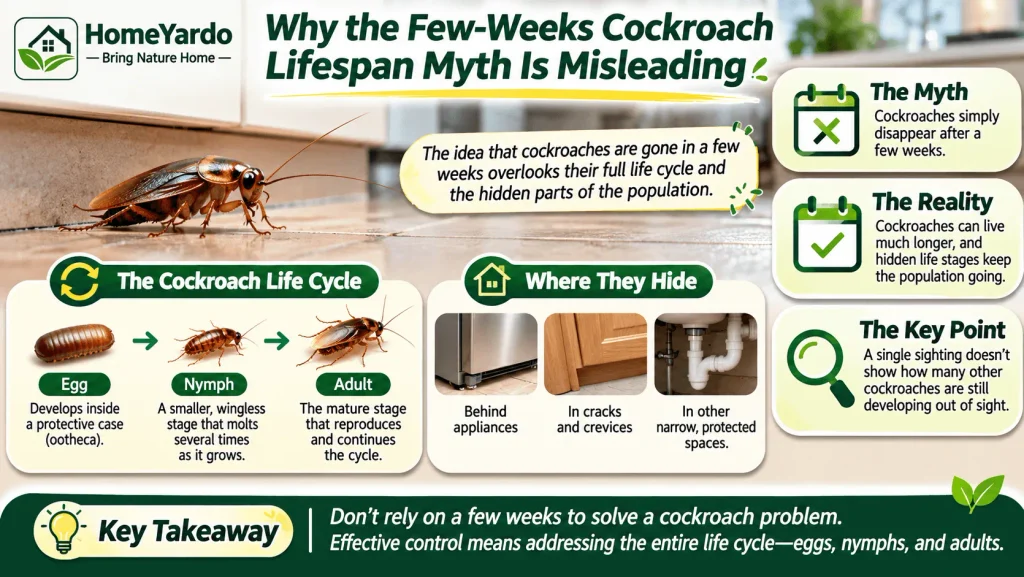
The belief that cockroaches disappear after a few weeks usually comes from observing only the insects that are visible.
A homeowner might find a dead adult behind the refrigerator, notice fewer cockroaches after applying a treatment, or see activity decline when the weather changes.
None of those observations reveals how long other cockroaches have been developing out of sight.
Adults Are Only One Part of the Population
Cockroaches pass through three stages: egg, nymph, and adult.
Nymphs resemble smaller versions of adults but lack fully developed wings. They grow through repeated molts until they reach maturity.
Egg cases and young cockroaches may remain hidden in protected areas, including cracks behind cabinets, appliance compartments, and other narrow spaces.
Even if an adult dies, younger cockroaches may continue developing nearby.
Why One Cockroach Does Not Tell the Whole Story
Finding one cockroach does not automatically mean your home has an infestation.
Some outdoor species occasionally wander indoors, particularly around garages, doors, and other openings.
Repeated sightings, however, deserve closer attention. Seeing cockroaches of different sizes, finding egg cases, or noticing activity during the daytime can indicate a larger population.
That is why waiting for an individual insect to reach the end of its natural lifespan is not a reliable pest-control strategy.
Why Waiting for Cockroaches to Die Naturally Doesn’t Work
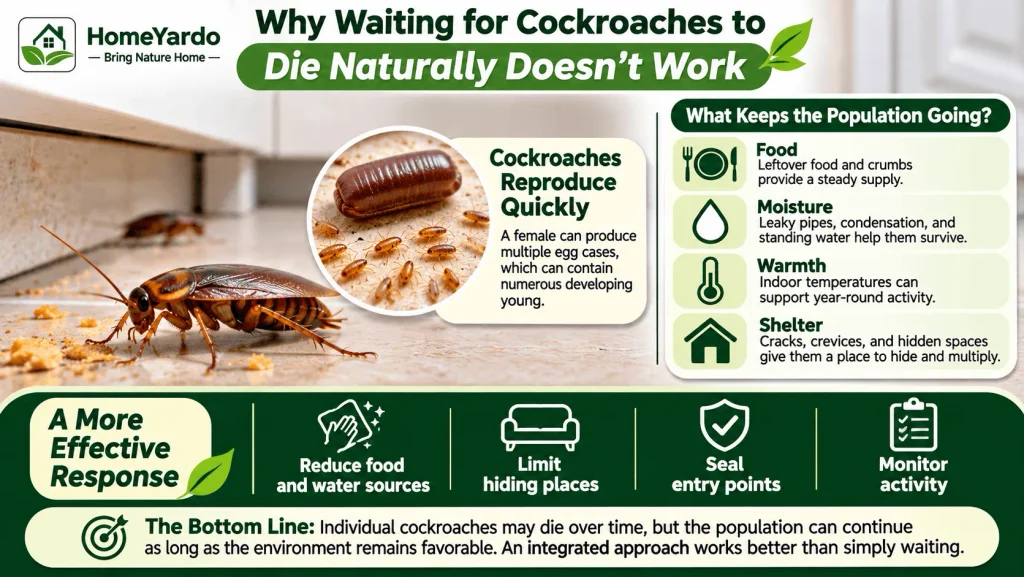
Cockroaches reproduce while favorable conditions remain available. Food, moisture, warmth, and sheltered spaces can allow successive generations to develop.
A female may produce multiple egg cases during her lifetime. Depending on the species, those cases can contain numerous developing young.
An individual adult may eventually die, but that does not stop another generation from taking its place.
The more useful question is not how long a cockroach has left to live. It is whether the surrounding environment allows the population to continue.
For homeowners, the response involves reducing available food and water, limiting hiding places, sealing entry points, and monitoring activity.
These measures are part of integrated pest management, which combines prevention, inspection, and appropriately targeted treatments.
Check Gutters, Wood Piles, and Garage Door Gaps
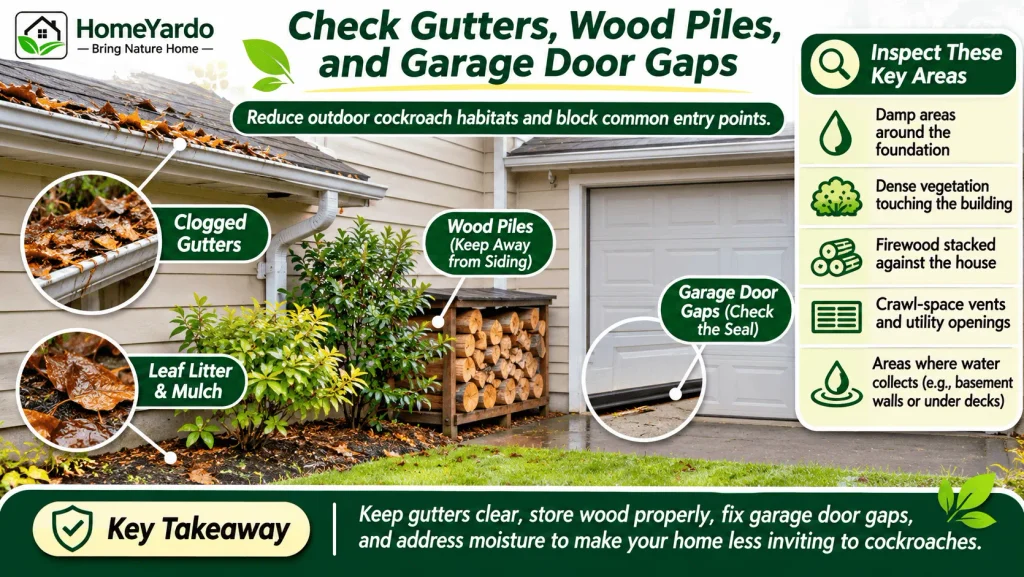
Some cockroach species spend much of their lives outdoors and enter houses when they encounter suitable openings.
Smokybrown cockroaches, for example, can inhabit leaf litter, wood piles, shrubs, gutters, garages, and crawl spaces.
A property with damp landscaping and several unsealed openings may provide both shelter and convenient access to the building.
Inspect Damp Areas Around the Foundation
Walk around the exterior after rainfall and look for conditions that could support cockroach activity.
Pay particular attention to:
- Clogged gutters holding wet leaves and organic debris.
- Firewood stacked directly against exterior siding.
- Dense vegetation touching the building.
- Mulch and leaf litter accumulating around foundation openings.
- Water collecting near basement walls or crawl-space entrances.
- Damp storage areas beneath porches and decks.
Removing unnecessary debris and correcting drainage problems can make these spaces less attractive to outdoor cockroaches.
Look Closely at Garage Doors and Crawl Spaces
Garages often provide an intermediate shelter between outdoor habitats and living areas.
Check the garage door’s bottom seal for cracks, missing sections, or gaps that remain when the door is closed.
Inspect crawl-space vents, utility openings, and damaged exterior screens as well.
These checks fit naturally into routine seasonal pest inspections, especially when weather changes make entry points and moisture problems easier to notice.
Seal The Gaps Cockroaches Can Enter Through
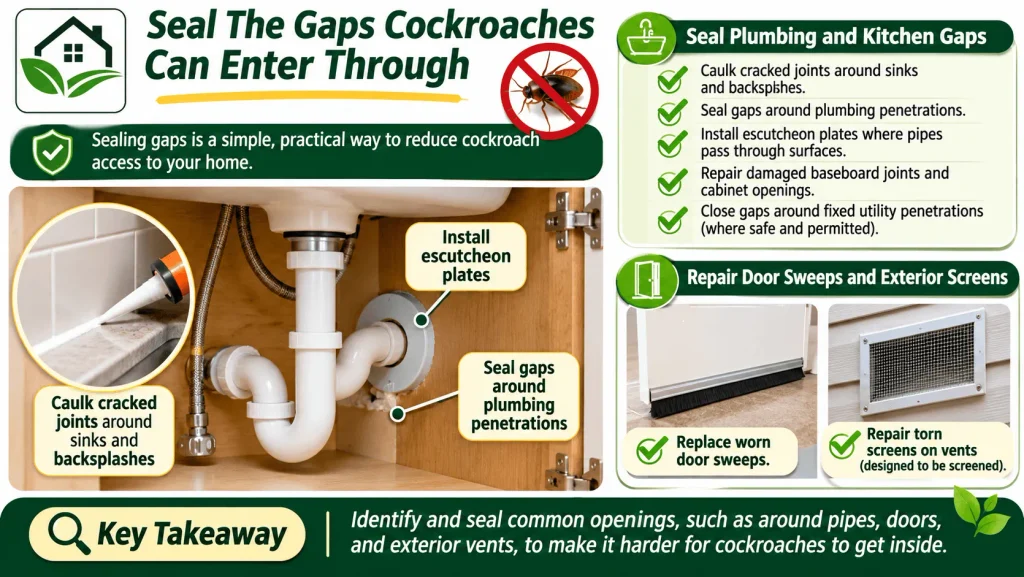
Sealing gaps is one of the simplest ways to reduce cockroach access to a home.
The work overlaps with ordinary weatherproofing and minor home repairs, particularly around doors, pipes, cabinets, and exterior wall openings.
Start by identifying openings rather than applying sealant indiscriminately.
Seal Plumbing and Kitchen Gaps
Under kitchen and bathroom sinks, check where plumbing passes through cabinets and walls.
Small spaces around pipes can provide routes between wall cavities and indoor storage areas.
Useful repairs include:
- Applying suitable silicone caulk to cracked joints around sinks and backsplashes.
- Sealing gaps around plumbing penetrations with an appropriate material.
- Installing escutcheon plates where pipes pass through finished surfaces.
- Repairing damaged baseboard joints and cabinet openings.
- Closing gaps around fixed utility penetrations where safe and permitted.
Do not seal active leaks, required access points, drainage openings, or areas that need ventilation.
Repair Door Sweeps and Exterior Screens
A worn door sweep can create a continuous opening beneath an exterior door.
Replace damaged sweeps and inspect the perimeter weatherstripping for missing or compressed sections.
Repair torn screens over vents that are designed to be screened, using materials appropriate to the vent’s specifications.
Never add ordinary fine mesh to a dryer exhaust or block equipment vents. Restricting required airflow can create safety and performance problems.
Exclusion work can reduce new arrivals, but it will not necessarily eliminate cockroaches already established indoors.
Remove Moisture That Helps Cockroaches Survive
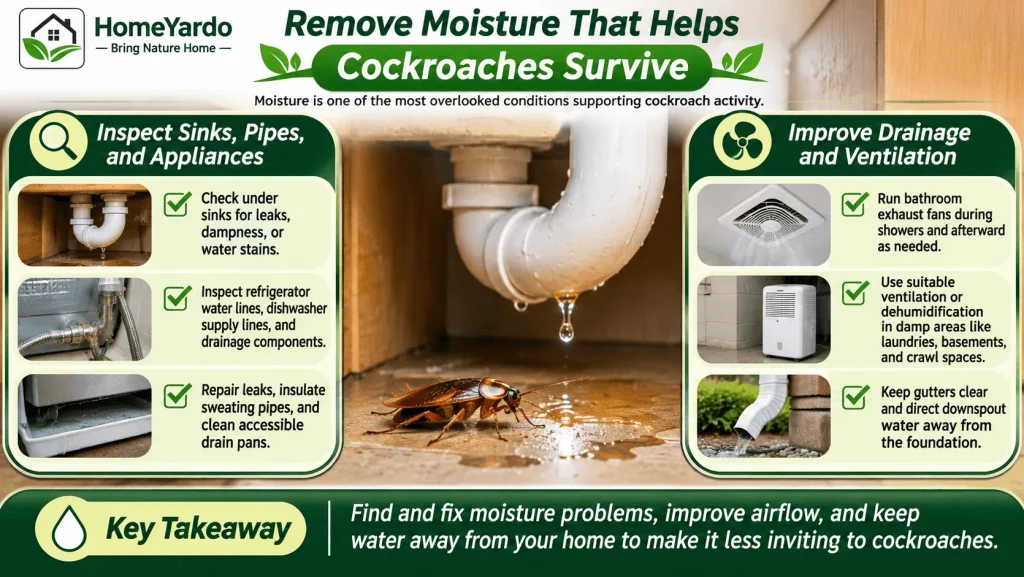
Moisture is one of the most overlooked conditions supporting cockroach activity.
A slow plumbing leak, damp cabinet, or poorly drained crawl space may provide a dependable water source even when the rest of the home appears clean.
Checking these areas regularly can reduce pest activity while helping prevent water-related damage.
Inspect Sinks, Pipes, and Appliances
Use a flashlight to examine the areas beneath bathroom and kitchen sinks.
Look for damp cabinet floors, water stains, leaking joints, and condensation around cold-water pipes.
Pay attention to refrigerator water connections, dishwasher supply lines, and accessible appliance drainage components.
Repair leaks promptly, insulate suitable sweating pipes, and clean accessible drain pans according to the appliance manufacturer’s instructions.
If moisture keeps returning, investigate the underlying plumbing issue instead of repeatedly drying the same surface.
Improve Drainage and Ventilation
Bathrooms, laundry areas, basements, and crawl spaces may remain humid long after visible water disappears.
Run bathroom exhaust fans during showers and afterward as needed to remove moisture.
Use suitable ventilation or dehumidification where indoor humidity remains excessive.
Outside, keep gutters clear and direct downspout water away from the foundation according to the property’s drainage conditions.
The goal is to remove persistent dampness, not simply make a wet area appear dry for a few hours.
Cut the Clutter Cockroaches Hide In
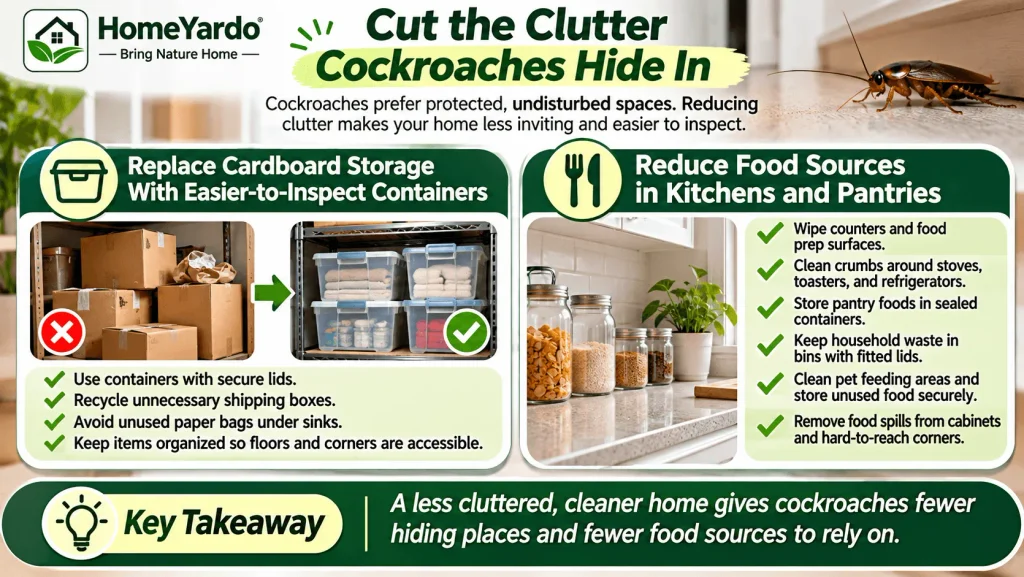
Cockroaches prefer protected spaces where they can avoid disturbance and light.
Cardboard boxes, paper bags, storage piles, and crowded cabinets can create numerous narrow hiding places.
A cluttered garage or utility room may also make it difficult to notice droppings, shed skins, and other early signs of activity.
Replace Cardboard Storage With Easier-to-Inspect Containers
Consider moving frequently stored items into containers with secure lids.
Recycle unnecessary shipping boxes instead of keeping large piles beside appliances or walls.
Avoid leaving unused paper bags under sinks, and keep stored belongings arranged so floors and corners remain accessible.
You do not need to strip your home of personality. You can maintain a warm, lived-in home while keeping storage areas organized and easy to clean.
Reduce Food Sources in Kitchens and Pantries
Clutter removal works better when combined with basic food sanitation.
Cockroaches can feed on crumbs, food residue, spilled pet food, and waste left in accessible containers.
Make a habit of:
- Wiping kitchen counters and food preparation surfaces.
- Cleaning crumbs around stoves, toasters, and refrigerators.
- Storing pantry foods in properly sealed containers.
- Keeping household waste in bins with fitted lids.
- Cleaning pet feeding areas and storing unused food securely.
- Removing food spills from cabinets and hard-to-reach corners.
These steps will not automatically remove an established infestation, but they reduce the resources that support it.
How to Tell Whether Cockroaches Are Still Active
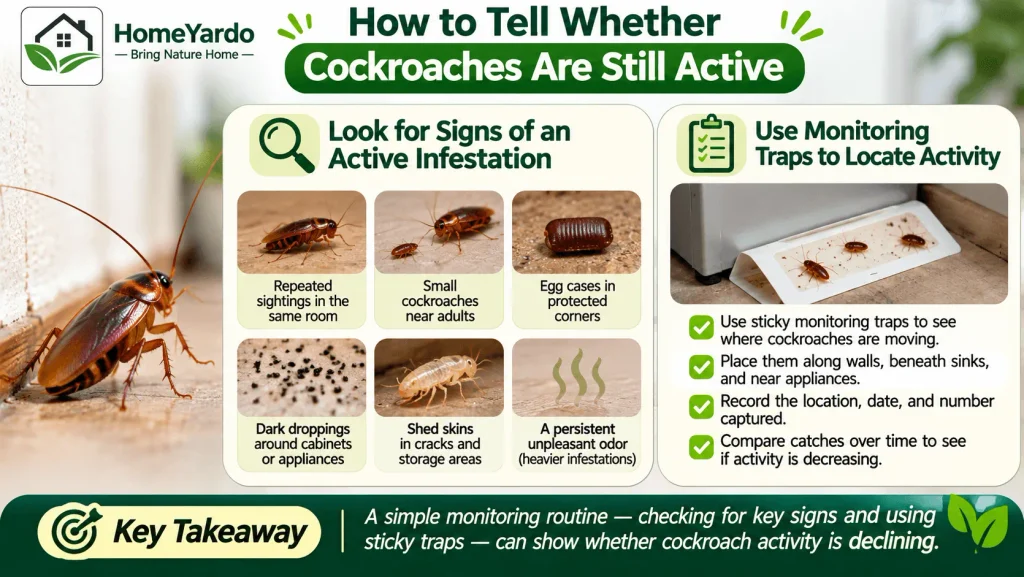
After making repairs and improving sanitation, homeowners need a way to determine whether cockroach activity is declining.
Relying only on occasional sightings can be misleading because many cockroaches remain hidden during daylight.
A simple monitoring routine can provide more useful information.
Look for Signs of an Active Infestation
Possible warning signs include:
- Repeated cockroach sightings in the same room.
- Small cockroaches appearing near adults.
- Egg cases in protected corners.
- Dark droppings around cabinets or appliances.
- Shed skins in cracks and storage areas.
- A persistent unpleasant odor associated with heavier infestations.
Some signs can resemble evidence left by other pests, so identification matters.
Use Monitoring Traps to Locate Activity
Sticky monitoring traps can help identify where cockroaches are moving.
Place suitable traps in accessible locations along walls, beneath sinks, and near appliances, following the product instructions.
Keep them away from children and pets.
Record the location, date, and number of insects captured. Comparing catches over time can show whether activity is decreasing or continuing.
Monitoring traps are useful for detection but should not be treated as a complete solution for a substantial infestation.
When Should Homeowners Call Professional Pest Control?
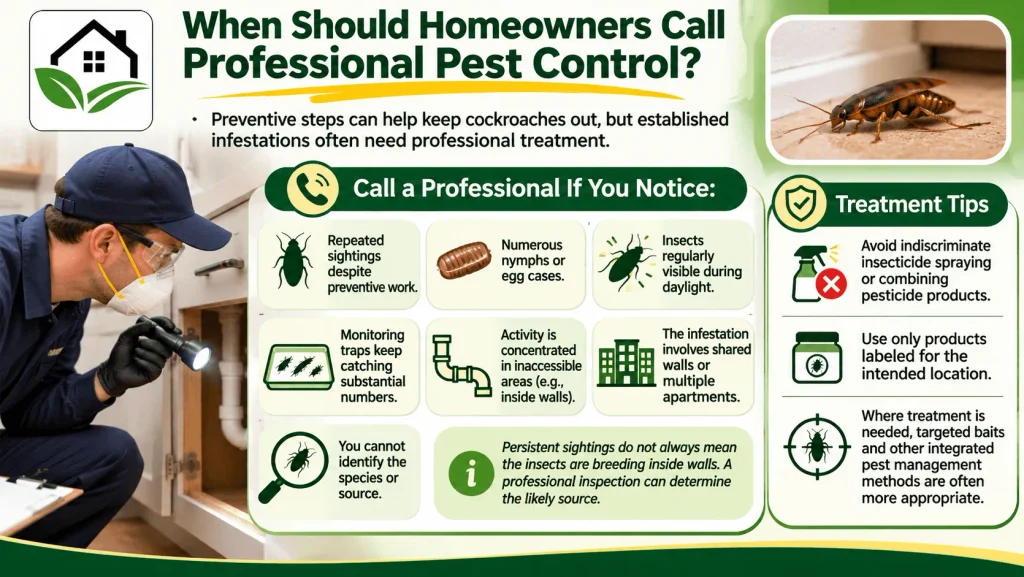
Routine cleaning, sealing, and moisture repairs can discourage cockroaches and prevent some new arrivals.
However, established indoor populations may require professional treatment.
Consider contacting a qualified pest management professional when:
- Cockroaches are repeatedly appearing despite preventive work.
- Numerous nymphs or egg cases are discovered.
- Insects are regularly visible during daylight.
- Monitoring traps continue catching substantial numbers.
- Activity is concentrated in inaccessible areas.
- The infestation involves shared walls or multiple apartments.
- You cannot identify the species or source.
Do not assume that persistent sightings prove the insects are breeding inside walls. They may be emerging from another indoor hiding place or repeatedly entering from outdoors.
A professional inspection can help establish which explanation fits the evidence.
Avoid indiscriminate insecticide spraying or combining pesticide products. Use only products labeled for the intended location and follow all safety instructions. Where treatment is necessary, targeted baits and other integrated pest management methods may be more appropriate than widespread spraying.
Final Takeaway
Cockroaches do not normally disappear after a few weeks. Depending on the species, they can live for months, and the full development period may extend well beyond a year.
That does not mean every cockroach sighting signals a serious infestation. But it does mean waiting for the insects to die naturally is not a dependable plan.
Start with the maintenance tasks you can control. Seal appropriate gaps, repair leaks, clear damp outdoor debris, organize storage, and keep food sources contained.
Then monitor the results. If cockroach activity continues, seek professional identification and targeted treatment rather than assuming the problem will eventually resolve itself.
Frequently Asked Questions
Cockroaches can live for several months inside a house, and some species survive considerably longer. Their lifespan depends on the species, temperature, food supply, moisture, and life stage.
Not usually. While individual cockroaches may die within weeks because of unfavorable conditions or treatment, many common species naturally survive for months. Their complete life cycle can be longer.
Yes. Some cockroaches can survive for a year or longer when their immature development stages are included. Certain larger species may also live for a year or more after reaching adulthood.
Hatching time varies by species and environmental conditions. Smokybrown cockroach egg cases take approximately 45 days to hatch on average, while German cockroach eggs generally develop more quickly.
An occasional outdoor cockroach may leave or die without establishing a population. However, an active indoor infestation is unlikely to disappear reliably without addressing food, water, shelter, and reproduction.
Not necessarily. A single outdoor cockroach may wander into a house. Repeated sightings, small nymphs, egg cases, or substantial monitoring-trap catches are stronger reasons to investigate an infestation.
Survival varies by species, life stage, temperature, and humidity. Some cockroaches can survive for extended periods without food, but access to water strongly affects survival. Removing food and moisture helps discourage them but is not a guaranteed standalone treatment.