AC Service Visit: A Complete Homeowner Checklist

An AC service visit is easier to manage when you know what to prepare, what questions to ask, and what information to keep once the technician leaves. Whether your air conditioner has stopped cooling properly or started making an unfamiliar noise, a little organization can help you make better decisions without trying to diagnose the equipment yourself.
When the house feels uncomfortable, it is natural to focus on getting the cooling restored as quickly as possible. However, an appointment also involves decisions about repair costs, work authorization, household arrangements, and any maintenance needed afterward.
The goal is to leave the appointment understanding what was found, what work was completed, and what happens next. Technical inspection and repair should remain with an appropriately qualified HVAC professional.
AC Service Visit Checklist: Before, During and After
A successful air conditioning appointment starts before the technician arrives and continues until any outstanding repairs or follow-up arrangements have been documented.
Use this checklist to keep the process organized.
| Stage | What Homeowners Should Do |
|---|---|
| Before scheduling | Record symptoms and when they started |
| When booking | Confirm diagnostic fees, access requirements, and arrival arrangements |
| Before arrival | Gather equipment records and clear the necessary work areas |
| During diagnosis | Ask what was found and how the technician identified the problem |
| Before approving repairs | Review the written estimate, scope, and applicable warranty |
| After repairs | Request an explanation of completed work and operating checks |
| After the appointment | Store invoices, warranty documents, and follow-up recommendations |
Not every appointment follows exactly the same process. The equipment type, reported problem, availability of replacement parts, and service company’s policies can all affect what happens.
Describe the AC Problem in Everyday Terms
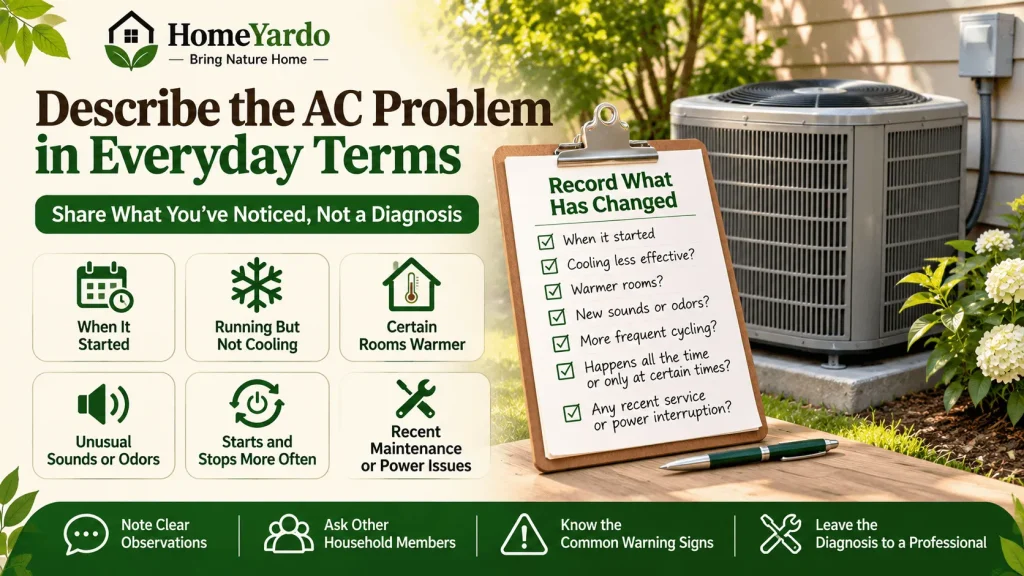
Start with what you noticed rather than what you think has failed. Clear observations often provide more useful information than a diagnosis based on something you read online.
Perhaps one bedroom feels warmer than the rest of the house, the system makes a sound you have not heard before, or the cooling becomes less effective in the afternoon.
Record What Has Changed
Write down the symptoms before contacting the service company. A short note can help you remember details that might otherwise get overlooked during the call.
Useful observations include:
- When the problem first appeared.
- Whether the system is running but cooling poorly.
- Which rooms feel warmer than usual.
- Whether unfamiliar sounds or odors occur.
- Whether the system starts and stops more often than normal.
- Whether the problem happens continuously or only at certain times.
- Whether any recent maintenance, repairs, or power interruptions occurred.
If more than one person lives in the home, ask whether they noticed the same pattern. Their observations may help establish when the problem started.
Understanding common HVAC warning signs can help you describe changes in equipment performance without assuming that a particular symptom points to one specific failure.
Separate Observations From Possible Causes
An air conditioner that runs without cooling properly may have several possible problems. Restricted airflow, thermostat issues, electrical faults, refrigerant problems, and other equipment conditions can produce similar symptoms.
Instead of telling the technician that the compressor has failed, explain what you observed: the system runs, the indoor temperature continues rising, and the problem began two days ago.
This gives the technician useful information while leaving the diagnosis to someone qualified to inspect the equipment.
Prepare for the AC Repair Appointment
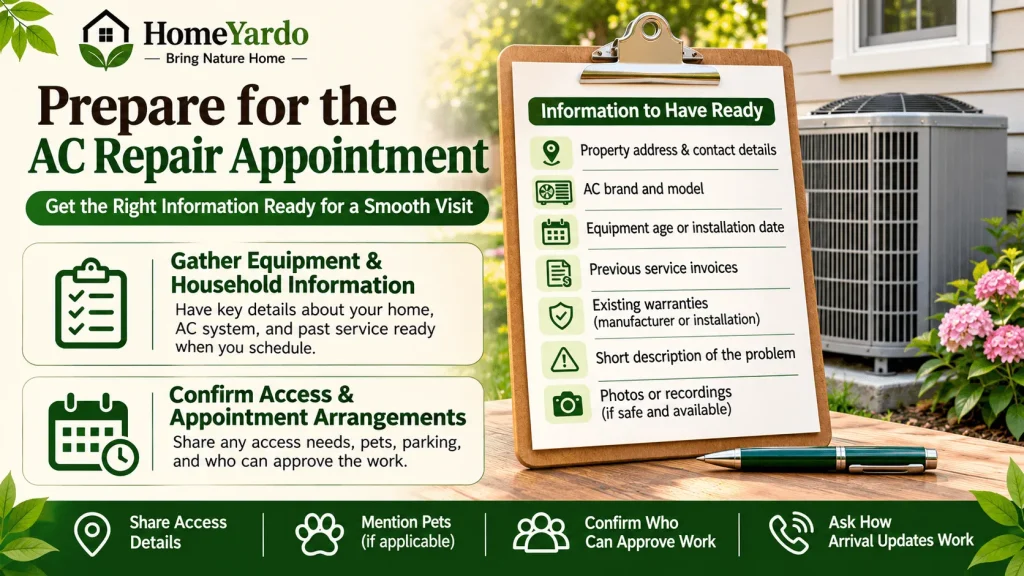
When arranging a visit, ask the service company what information it needs. Having these details ready can make scheduling easier and reduce confusion when the technician arrives.
Gather Equipment and Household Information
Keep the following information available if you already have it:
- Property address and contact details.
- Air conditioner brand and model.
- Approximate equipment age or installation date.
- Previous service invoices.
- Existing manufacturer or installation warranties.
- A short description of the reported problem.
- Any photos or recordings that can be obtained safely.
You do not need to remove equipment panels, enter an unsafe attic, or access electrical compartments to find a model number. Existing paperwork or an accessible equipment label may provide the necessary details.
Confirm Access and Appointment Arrangements
Explain practical circumstances that could affect the appointment, such as a locked gate, parking restrictions, pets, or a person who needs to be present to authorize work.
Ask how arrival updates will be communicated and whether the technician needs access to both the indoor and outdoor equipment.
If you rent the property, check with the landlord or property manager about who is responsible for scheduling and approving repairs. Avoid assuming that you have permission to authorize work that the property owner must approve.
What to Expect During an AC Service Visit

An air conditioning service appointment generally involves an assessment of the reported problem, an explanation of the findings, and a recommendation for maintenance or repair. The exact process depends on the equipment and the service requested.
Understanding these stages in advance can help homeowners avoid confusion about what is included in the appointment.
Understand the Diagnostic Process
Ask the company whether the initial appointment is for diagnosis, routine maintenance, an already-authorized repair, or a combination of these services.
A technician may need to evaluate system operation, airflow, temperatures, electrical components, controls, or other equipment conditions to understand the reported issue.
The purpose of those checks is to identify the problem rather than replace parts based only on symptoms.
For someone comparing AC repair services in Las Cruces, Air Control Services’ repair page outlines its diagnosis and written-estimate process. Use that as a starting point for questions about your own appointment, then confirm the arrangements directly when scheduling.
Clarify Service Fees Before the Visit
Ask whether there is a diagnostic or call-out charge and what that amount covers.
Some companies charge separately for the initial assessment, while others may apply part or all of the diagnostic fee toward an approved repair. Emergency appointments, after-hours visits, or additional work may have different pricing arrangements.
Knowing how charges are handled helps prevent an assumption that every possible repair is included in the original appointment fee.
Ask Questions Before Approving AC Repairs
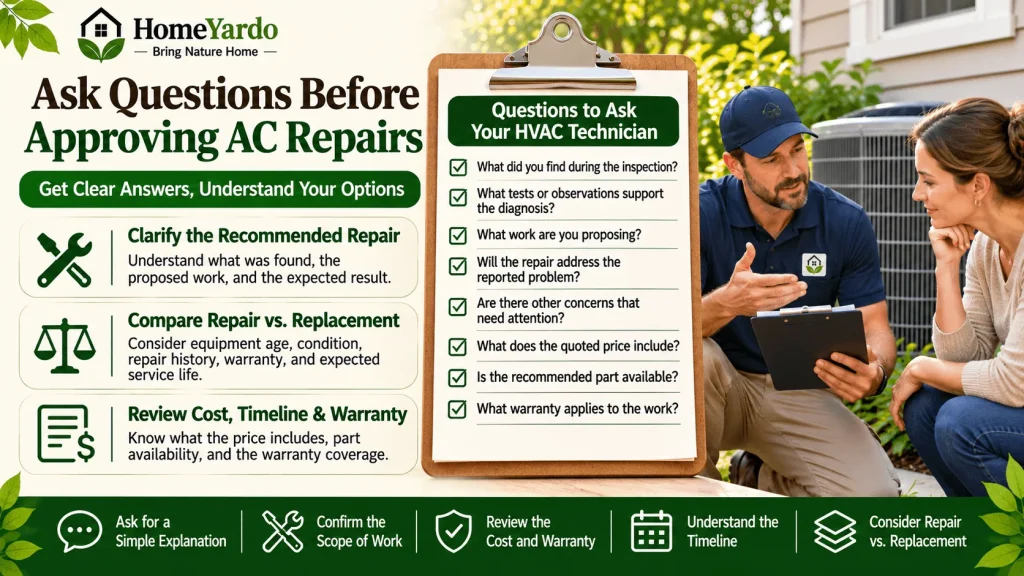
Once the assessment is complete, ask the technician to explain the findings in ordinary language. You do not need to understand every technical measurement, but you should understand why a particular repair is being recommended.
The conversation should make the proposed work clear enough for you to decide how to proceed.
Questions to Ask an HVAC Technician
| Question | Why It Matters |
|---|---|
| What did you find during the inspection? | Clarifies the identified problem |
| What tests or observations support the diagnosis? | Helps you understand the recommendation |
| What work are you proposing? | Defines the repair scope |
| Will the repair address the reported problem? | Establishes the intended result |
| Are there other concerns that need attention? | Separates immediate repairs from future recommendations |
| What does the quoted price include? | Reduces uncertainty about costs |
| Is the recommended part available? | Helps establish the expected timeline |
| What warranty applies to the work? | Clarifies protection after the repair |
Ask which questions have been resolved and whether anything remains uncertain.
If the technician needs further testing before confirming the cause, it is reasonable to ask what the next step involves and whether there will be an additional charge.
Understand the Difference Between Repair and Replacement
Sometimes a technician may recommend replacing a component rather than repairing it. In other cases, replacing the entire system may be presented as an option.
Ask how the equipment’s age, condition, repair history, warranty coverage, and expected remaining service life affect the recommendation.
A larger project should not be accepted simply because it appears more comprehensive. Likewise, the lowest-cost repair may not always offer the best long-term value.
If replacement becomes part of the discussion, understanding when your home AC system needs replacing can help you prepare for a more detailed conversation with your contractor.
For major work that is not urgent, obtaining another professional estimate may also be worthwhile.
Review the Written AC Repair Estimate
Before approving work, read the proposed repair description and make sure you understand what the price includes.
An estimate should help you distinguish between the work currently being authorized and any additional recommendations that may be considered later.
What Should an AC Repair Estimate Include?
The level of detail may vary depending on the contractor and the repair, but useful information generally includes:
- The equipment or system being serviced.
- A description of the recommended work.
- Parts and labor charges, whether combined or itemized.
- Applicable diagnostic charges.
- Taxes or other charges, where relevant.
- Any exclusions or conditions.
- Expected completion arrangements.
- Applicable parts and labor warranties.
Ask whether the amount is a fixed quote or an estimate that may change under specified conditions.
If the repair involves a substantial expense, reviewing your household plan for unexpected home repair costs may help you manage the decision without overlooking other financial responsibilities.
Agree on How Additional Work Will Be Authorized
Sometimes a technician discovers another problem after the initial work begins. Ask how additional findings will be communicated and whether you will receive a revised estimate before further work proceeds.
If another person will be present instead of you, establish whether they can authorize changes or need to contact you first.
Keep approved changes alongside the original estimate so you can distinguish the final repair scope from earlier options that were discussed but not selected.
Keep Household Logistics and Safety in Mind
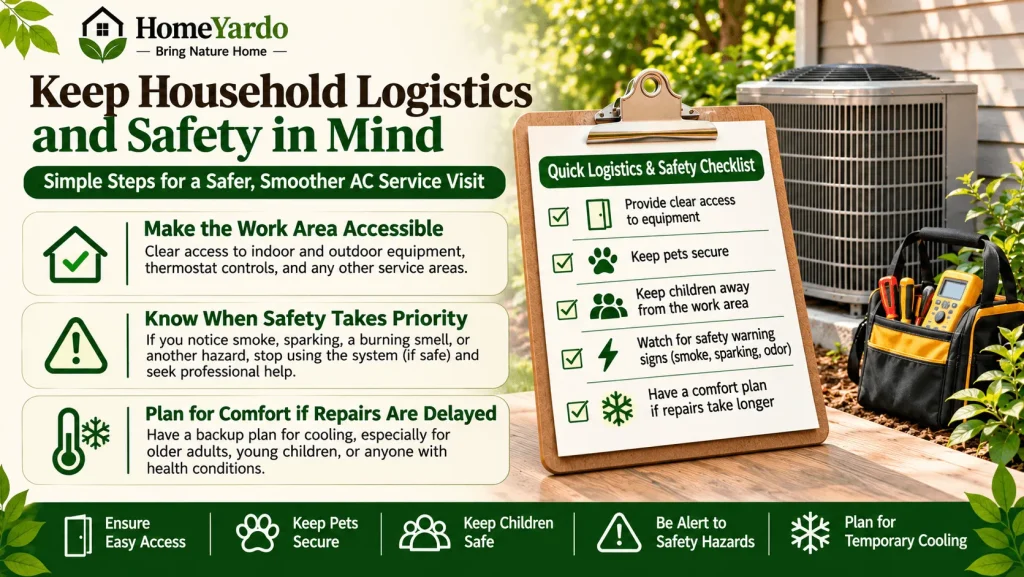
While the technician handles the equipment, household members can focus on practical arrangements that make the appointment easier and safer.
Clear access to the relevant areas, secure pets, and keep children away from the work space as instructed.
Make the Work Area Accessible
Depending on the system, the technician may need access to indoor equipment, the outdoor condenser, thermostat controls, or other service areas.
Move household belongings that block safe access when possible. Do not attempt to move heavy equipment, disconnect components, or enter an unsafe space to prepare for the appointment.
Ask which areas must remain clear and whether someone needs to stay at the property while the work is being completed.
Know When Safety Takes Priority
Certain conditions require more immediate attention than an ordinary service appointment.
If you notice smoke, active sparking, a strong burning smell, or another apparent electrical hazard, stop using the equipment if it is safe to do so and seek appropriate emergency assistance.
Do not repeatedly reset a tripping breaker, open electrical compartments, or handle refrigerant components to investigate the cause.
In the United States, technicians performing work that could release regulated refrigerants generally need the appropriate EPA Section 608 certification. Refrigerant handling and related technical repairs should be left to qualified professionals.
Plan for Comfort if Repairs Are Delayed
Not every repair can be completed during the initial appointment. A replacement part may need to be ordered, or further testing may be necessary.
If cooling will remain unavailable, make a separate plan for household comfort rather than relying on an estimated repair time.
Older adults, young children, and people with certain health conditions can be particularly vulnerable during extreme heat. Arrange access to a cooler environment when needed, and seek emergency medical assistance if someone develops signs of heat stroke.
Request a Clear Handover After AC Repairs
When the work is finished, ask what was completed and how the technician checked that the system was operating as intended.
This is also the right time to discuss any recommendations that remain open rather than assuming everything has been resolved.
Confirm the Work and Operating Checks
Ask the technician to explain:
- Which component or condition caused the reported problem, if confirmed.
- What was repaired, adjusted, or replaced.
- How the equipment was checked after the repair.
- Whether any operating limitations remain.
- Which symptoms should prompt another service call.
If the original problem occurred only under certain weather conditions or at particular times, ask whether further observation may be necessary after the appointment.
A completed repair can address the identified problem without guaranteeing that every unrelated equipment issue has been eliminated.
Request Warranty and Maintenance Information
Ask for the final invoice and any applicable warranty documents. Check whether the warranty covers the replacement part, labor, or both, and whether registration or other conditions apply.
Ask which maintenance responsibilities are appropriate for you as the homeowner. Following the manufacturer’s instructions and keeping up with suitable routine care can help prevent AC breakdowns caused by avoidable maintenance problems.
If the technician recommends another maintenance appointment, keep that recommendation separate from the repair already completed.
Make AC Service Records Easy to Find Later
Good recordkeeping makes future repairs and maintenance easier to manage. It also helps homeowners explain recurring problems without trying to remember details from months or years earlier.
Keep equipment records, invoices, estimates, and warranty documents together in a physical folder or a digital file.
What to Include in Your Household Service Record
| Record | Information to Keep |
|---|---|
| Appointment date | When the equipment was inspected or repaired |
| Reported problem | Symptoms that prompted the call |
| Diagnostic findings | The technician’s explanation of the problem |
| Approved work | Repairs or adjustments you authorized |
| Final invoice | The amount paid and completed work |
| Replacement parts | Relevant part information, when supplied |
| Warranty documents | Coverage, conditions, and applicable dates |
| Follow-up arrangements | Outstanding work, contact details, and expected next steps |
You can also use these records when arranging future seasonal HVAC tune-ups. A technician may find previous repair details useful when evaluating the system’s current condition.
Before closing the file, check whether any agreed follow-up remains outstanding. Record who is responsible and what information or work you are waiting for.
Final Takeaway
An AC service visit should leave you with more than a repaired air conditioner. It should also give you a clear understanding of the problem, the work completed, the amount charged, and any remaining maintenance or repair decisions.
Prepare by recording symptoms, gathering existing equipment information, and confirming the appointment arrangements. During the visit, ask questions about the diagnosis and review written estimates before approving work.
Once the appointment is complete, keep the service records and follow any agreed recommendations. This approach makes the next household maintenance decision easier without requiring you to become an HVAC technician.
FAQ’s
Record the symptoms, gather available equipment records, confirm diagnostic fees, and make sure the technician can safely access the equipment. Secure pets and arrange for someone authorized to approve work if you will not be home.
The technician generally discusses the reported problem, evaluates the equipment, explains the findings, and recommends maintenance or repair. Whether work is completed during the same appointment depends on the diagnosis, your approval, and the availability of necessary parts.
The duration depends on the equipment, the complexity of the problem, the testing required, and whether repair parts are available. Ask the service company for an estimated appointment length, but allow for changes if additional findings need investigation.
Ask the service company whether the equipment should remain on or be switched off. If there is smoke, sparking, a burning smell, or another apparent hazard, stop using it if safe and seek appropriate assistance rather than continuing to operate it for diagnostic purposes.
Yes. A written estimate helps clarify the proposed work, price, applicable charges, and warranty conditions. Ask how any additional findings or changes in cost will be communicated before further work is authorized.
Some repairs can be completed during the initial appointment. Others may require specialized parts, additional testing, or a return visit. Ask what the company expects after the problem has been assessed.
Not necessarily. Confirm the contractor’s access and authorization requirements. If another responsible person will be present, make sure they know whether they can approve repairs or must contact you before authorizing work.
Keep the written estimate, final invoice, diagnostic findings, replacement-part information, applicable warranties, and follow-up recommendations. These records can help with future maintenance, warranty claims, and recurring equipment problems.