How To Stop Pests From Taking Over Your Home, Yard, And Garden
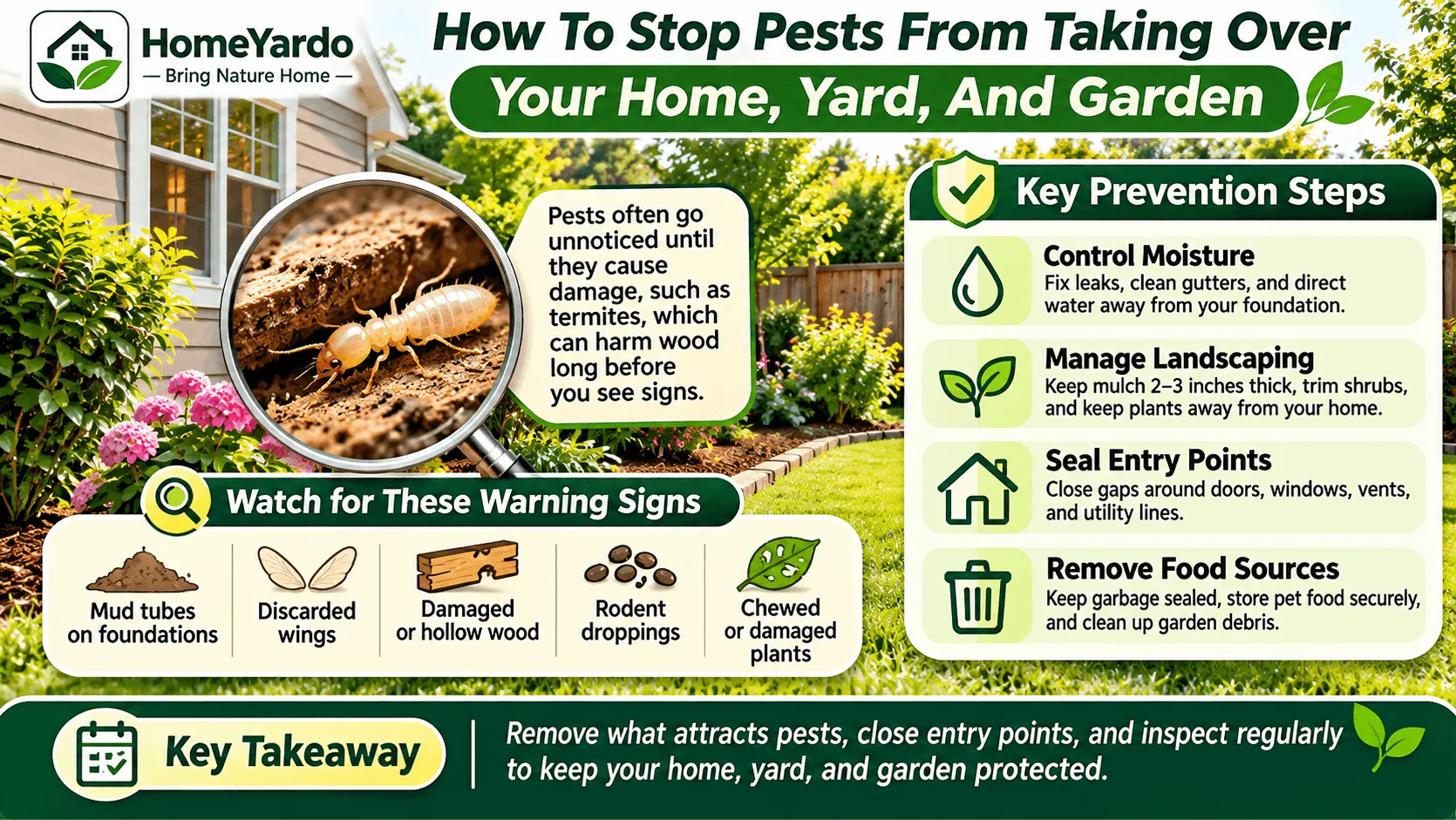
It usually starts with a weekend chore. You pull back the mulch along the foundation to edge a flower bed and find a pencil-thin tunnel of dried mud climbing the concrete. Or you notice a line of ants marching from the garden toward a gap beneath the siding. A week later, the tomato leaves have holes, and small droppings appear behind the garage shelving.
Individually, these signs might seem harmless. Together, they suggest pests have found food, shelter, moisture, or an easy way to move closer to your home.
The most effective way to prevent pests in your home and garden is to remove what attracts them, close possible entry points, and inspect vulnerable areas regularly. That means looking beyond the insects you can see and addressing the conditions that allow them to settle.
Deep mulch, overgrown foundation shrubs, standing water, and cluttered garages can create favorable conditions for insects and rodents. In central Ohio, where wet spring weather and poorly draining soil can leave foundations damp, homeowners who discover mud tubes or damaged insulation may turn to a residential service such as Green Shield Pest Pros in Columbus to inspect their property and identify potential infestations.
Whether you plan to handle basic prevention yourself or hire a professional, understanding what attracts pests is the best place to begin.
Why Pest Problems Often Go Unnoticed Until Damage Appears
Pests rarely announce their arrival. Many stay hidden beneath mulch, inside wall cavities, under porches, behind stored items, or in the soil surrounding a foundation.
Termites are a particularly concerning example because they can damage wood long before homeowners notice visible changes.
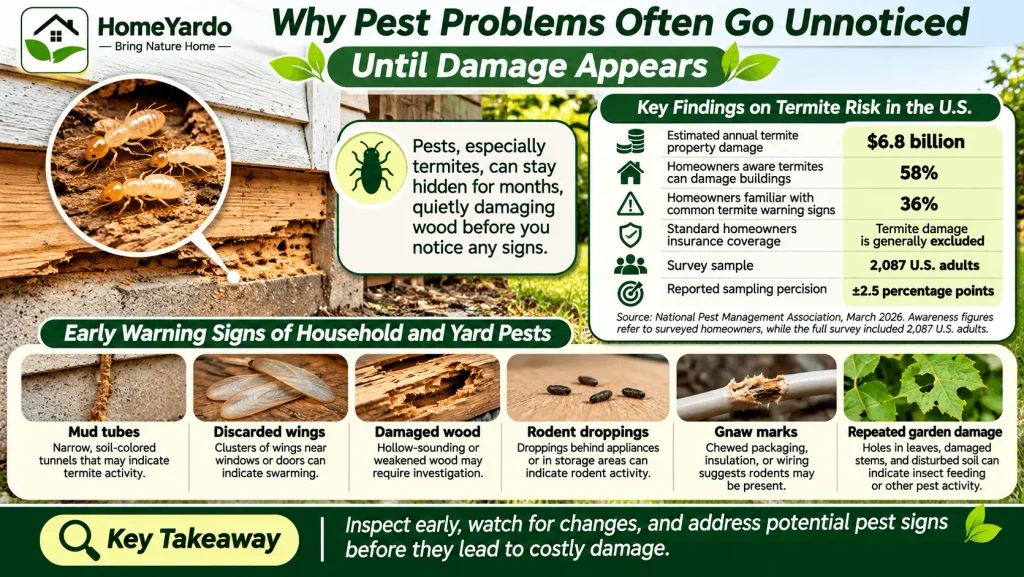
According to PestWorld, the National Pest Management Association estimates that termites cause approximately $6.8 billion in U.S. property damage annually.
A 2026 survey conducted by The Harris Poll on behalf of the association also found substantial gaps in homeowner awareness.
| Measure | Reported figure |
|---|---|
| Estimated annual U.S. termite property damage | $6.8 billion |
| U.S. homeowners aware termites can damage buildings | 58% |
| U.S. homeowners familiar with common termite warning signs | 36% |
| Standard homeowners insurance coverage | Termite damage is generally excluded |
| Survey sample | 2,087 U.S. adults |
| Reported sampling precision | ±2.5 percentage points |
Source: National Pest Management Association, March 2026. Awareness figures refer to surveyed homeowners, while the full survey included 2,087 U.S. adults.
The financial risk is worth taking seriously. Homeowners insurance generally excludes damage caused by termites, although individual policy wording determines coverage.
That is why it helps to inspect the property before visible damage develops. A small mud tube or recurring moisture problem may be easier to investigate than a damaged structural member discovered months later.
Early Warning Signs of Household and Yard Pests
Not every insect indicates an infestation. However, repeated activity, new damage, and unexplained droppings deserve attention.
Look for these warning signs:
- Mud tubes: Narrow, soil-colored tunnels along foundations or other surfaces may indicate subterranean termite activity.
- Discarded wings: Clusters of insect wings near windows or doors can indicate termite or ant swarming and warrant identification.
- Damaged wood: Hollow-sounding, weakened, or visibly damaged wood may require further investigation.
- Rodent droppings: Droppings behind appliances, along garage walls, or in storage areas can indicate rodent activity.
- Gnaw marks: Chewed packaging, insulation, or electrical wiring suggests rodents may be present.
- Repeated garden damage: Holes in leaves, damaged stems, and disturbed soil can indicate insect feeding or other pest activity.
These signs do not always identify the exact species. Photograph suspicious damage and avoid disturbing potential termite evidence before an inspection.
What Attracts Pests to Your Home, Yard, and Garden?
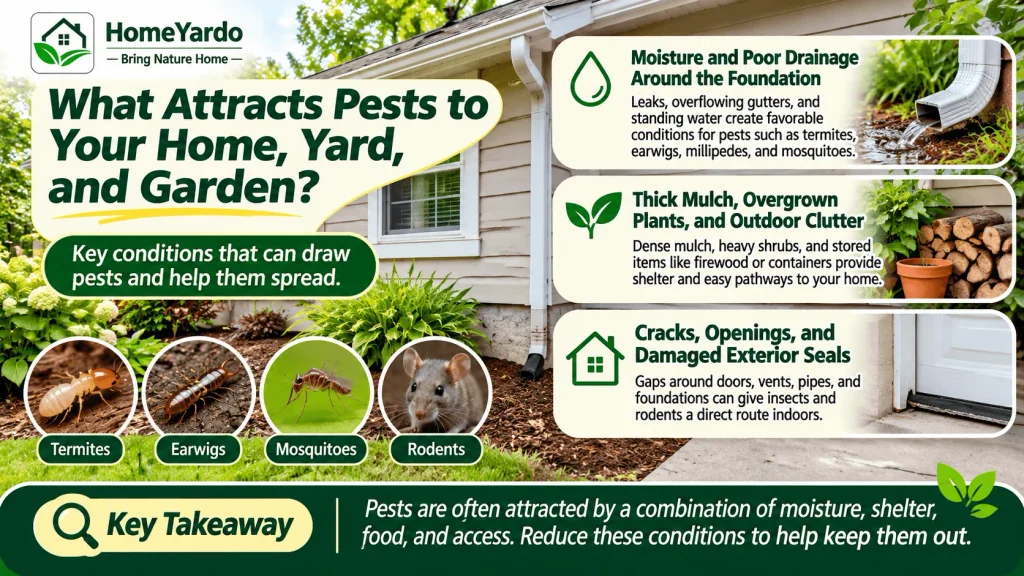
Most pest problems begin with a few favorable conditions rather than a single mistake.
Moisture, available food, sheltered hiding places, and accessible openings can all contribute to pest activity. Once those conditions overlap, insects and rodents may move between the yard, garage, and living spaces.
Moisture and Poor Drainage Around the Foundation
Water is one of the most common reasons pest activity increases around a property.
A leaking outdoor faucet, clogged gutter, poorly directed downspout, or constantly damp flower bed can create a favorable environment for moisture-dependent pests.
Subterranean termites rely on moisture, while earwigs and millipedes commonly shelter in damp areas. Standing water also creates breeding opportunities for mosquitoes.
Check whether:
- Downspouts release water too close to the foundation.
- Outdoor faucets or irrigation connections leak.
- Gutters overflow during rainfall.
- Garden beds stay saturated long after watering.
- Water collects in pots, buckets, or outdoor containers.
Correcting these conditions helps reduce pest-friendly environments while protecting the home’s exterior from unnecessary moisture exposure.
Thick Mulch, Overgrown Plants, and Outdoor Clutter
Landscaping can unintentionally create sheltered paths toward a house.
Mulch that sits directly against siding may conceal foundation areas and hold moisture near vulnerable wood. Thick shrubs can make exterior walls harder to inspect, while climbing vines may cover cracks or damaged surfaces.
The same problem appears with outdoor storage.
Firewood stacked against a wall, unused containers, cardboard boxes, and piles of garden supplies provide hiding places for rodents and insects.
Mulch itself does not automatically cause termite infestations. The concern increases when moisture, buried wood, and concealed access points occur together.
Homeowners interested in how landscaping conditions affect termite exposure can read HomeYardo’s guide to yard conditions that increase termite risk.
Cracks, Openings, and Damaged Exterior Seals
Even a well-maintained garden cannot compensate for open access points around the building.
Rodents and insects may enter through damaged vents, poorly fitted doors, utility penetrations, foundation cracks, and gaps around pipes.
Inspect areas where different materials meet, particularly around garage doors, siding, windows, and foundation walls.
A worn garage door seal is easy to overlook. Yet it can leave openings for insects, mice, moisture, and debris. HomeYardo’s garage door weather seal guide explains how to identify worn seals and determine when replacement is appropriate.
How to Prevent Pests in Your Home and Garden
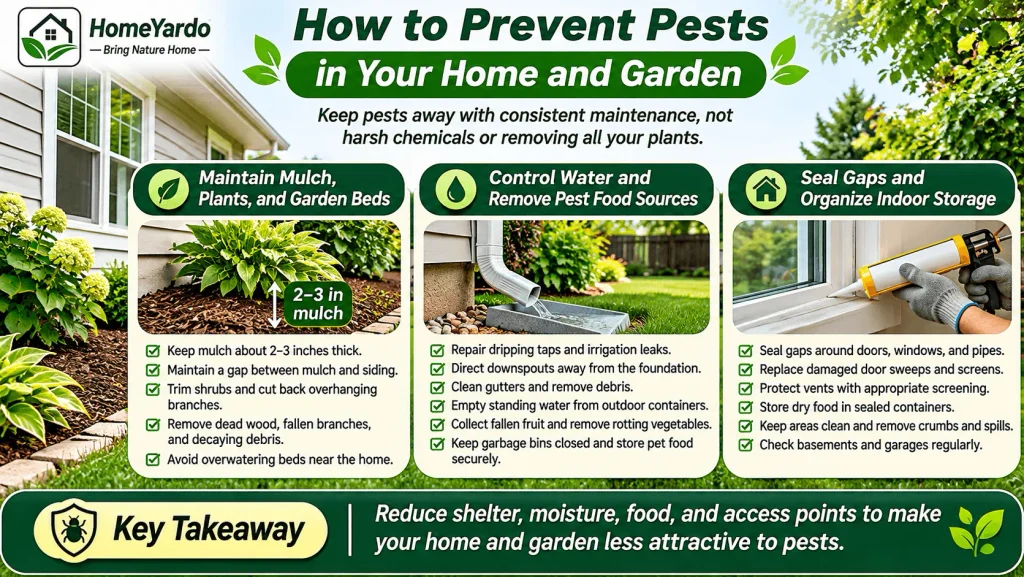
Keeping pests away is largely a matter of consistent property maintenance.
You do not need to strip your garden of plants or spray every corner of the yard. Start with the areas where shelter, moisture, food, and access points overlap.
Maintain Mulch, Plants, and Garden Beds
Healthy landscaping can coexist with effective pest prevention.
The goal is to keep vegetation manageable and maintain enough visibility around the home to identify potential problems.
Useful habits include:
- Keep most organic mulch layers approximately two to three inches thick, adjusting for plant needs.
- Maintain a visible gap between mulch and siding, especially near wooden building materials.
- Trim shrubs so branches do not press against exterior walls.
- Cut back branches that touch the roof or interfere with gutters.
- Remove unnecessary dead wood, fallen branches, and decaying debris near the foundation.
- Avoid repeatedly soaking planting beds directly beside the building.
Where termite exposure is a concern, maintain the foundation clearance recommended by local building or pest-management guidance.
Do not automatically remove beneficial groundcover or healthy plants. Focus on vegetation that hides structural problems, traps excessive moisture, or creates direct contact with vulnerable building materials.
Control Water and Remove Pest Food Sources
Reducing available food and moisture can make a property less attractive to household pests.
Start with routine tasks that are easy to overlook:
- Repair dripping taps and leaking irrigation connections.
- Direct downspout discharge away from the foundation without creating drainage problems elsewhere.
- Clean gutters and remove debris that blocks drainage.
- Empty standing water from outdoor containers.
- Collect fallen fruit and remove rotting vegetables.
- Keep outdoor garbage containers closed.
- Store pet food, birdseed, and other attractants in secure containers.
- Avoid leaving pet food outdoors overnight.
In vegetable beds, water according to soil conditions and plant needs rather than following an unnecessarily heavy daily schedule.
Morning irrigation can help foliage dry sooner in many growing conditions, although watering time alone will not prevent every insect problem.
Crop rotation, removal of infested plant material, and regular plant inspections can also help manage certain recurring garden pests.
Seal Gaps and Organize Indoor Storage
Pest prevention should continue inside the garage, basement, and living spaces.
Begin by identifying gaps around doors, windows, pipes, and utility lines. Small openings may be suitable for appropriate sealants, while larger rodent-access points often require durable, chew-resistant materials.
Use these basic practices:
- Replace damaged door sweeps and weatherstripping.
- Repair torn window screens.
- Seal suitable cracks and pipe openings with materials intended for the location.
- Protect vents with appropriate pest-resistant screening without blocking required ventilation.
- Move loose cardboard and stored materials away from vulnerable walls.
- Keep dry food in sealed containers.
- Clean crumbs and spills from kitchen and storage areas.
- Inspect accessible basement and garage corners regularly.
Avoid sealing active pest entry points without considering whether animals are trapped inside. Wildlife nesting areas and certain structural openings may require professional attention.
These steps reduce accessible shelter and entry opportunities, but they cannot guarantee that an established infestation will disappear.
Use Integrated Pest Management Instead of Relying on Sprays
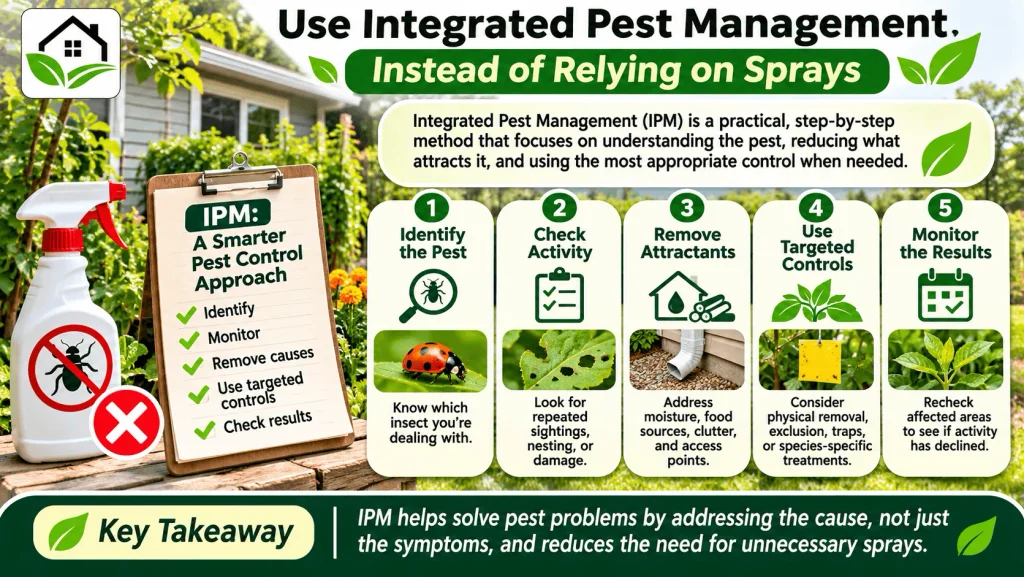
Spraying every insect you notice is rarely the best starting point.
A more practical approach is integrated pest management, often called IPM. This method focuses on identifying pests, monitoring activity, correcting environmental conditions, and choosing an appropriate control method when necessary.
For homeowners, that generally means:
- Identify the pest. Different insects require different responses, and many garden insects are harmless or beneficial.
- Check the extent of activity. Look for repeated sightings, nesting evidence, or ongoing damage.
- Remove attracting conditions. Address moisture, food sources, clutter, and access points.
- Choose targeted controls where necessary. Physical removal, exclusion, traps, or species-specific treatments may be appropriate.
- Monitor the results. Recheck affected areas to see whether activity has declined.
If a pesticide is needed, use only a product labeled for the pest and the treatment location. Follow its directions, including any requirements for children, pets, edible plants, and reentry.
Never assume that an outdoor pesticide is safe for use on vegetables or inside living spaces.
This approach helps avoid unnecessary chemical applications while addressing the conditions responsible for repeated pest problems.
When Should You Call a Residential Pest Control Professional?
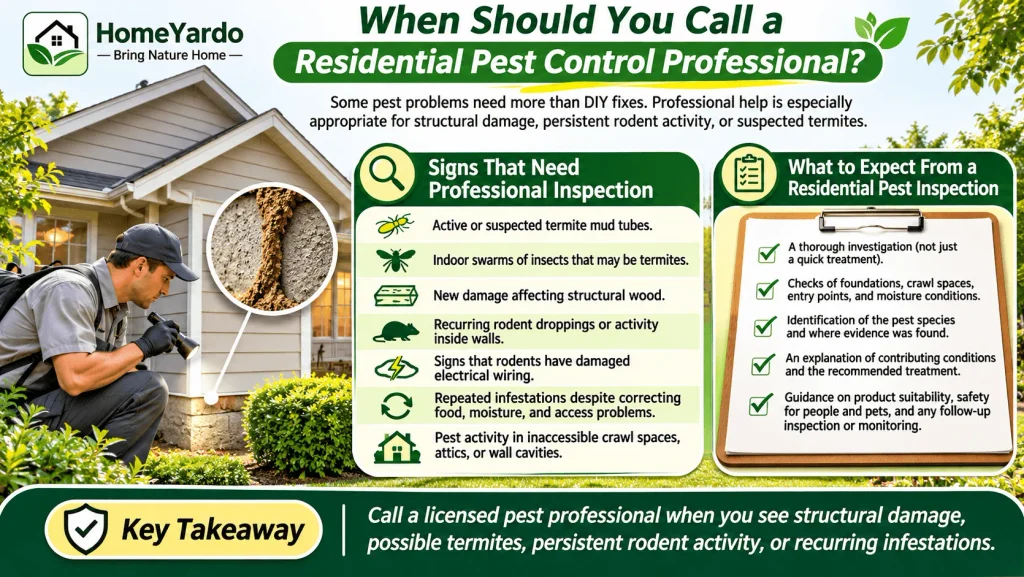
Some pest problems are manageable through maintenance and exclusion. Others require accurate identification, specialized equipment, or treatment beyond ordinary homeowner tasks.
Professional help is especially appropriate when there is evidence of structural damage, persistent rodent activity, or a suspected termite infestation.
Signs That Need Professional Inspection
Contact a qualified pest-management professional when you notice:
- Active or suspected termite mud tubes.
- Indoor swarms of insects that may be termites.
- New damage affecting structural wood.
- Recurring rodent droppings or activity inside walls.
- Signs that rodents have damaged electrical wiring.
- Repeated infestations despite correcting food, moisture, and access problems.
- Pest activity in inaccessible crawl spaces, attics, or wall cavities.
Do not rely on over-the-counter surface sprays to eliminate subterranean termites. Proper termite management often requires species identification, an inspection, and a suitable treatment strategy.
Rodent-contaminated areas also require care. Avoid sweeping or vacuuming dry droppings, which can create exposure to contaminated particles. Follow appropriate cleaning guidance or obtain professional assistance.
What To Expect From a Residential Pest Inspection
A qualified technician should investigate the problem rather than immediately recommending broad pesticide application.
An inspection may involve checking foundations, accessible crawl spaces, exterior entry points, moisture conditions, and areas showing activity.
Before approving treatment, ask:
- What pest species has been identified?
- Where was evidence found?
- What conditions are contributing to the problem?
- Which treatment is recommended, and why?
- Is the proposed product suitable for the treatment location?
- What precautions are necessary for people, pets, and garden plants?
- What follow-up inspection or monitoring is included?
Choose a properly licensed provider where licensing is required, and request a written explanation of the treatment plan.
Recurring perimeter treatments may be appropriate for some properties, but they should not replace sealing entry points, correcting moisture problems, and identifying the pest responsible.
Final Takeaway
Keeping pests from taking over your home, yard, and garden starts with ordinary maintenance.
Move mulch away from vulnerable exterior materials, trim vegetation, repair leaks, clear standing water, store food securely, and close entry points. Inspecting the property regularly gives you a better chance of noticing warning signs before an infestation becomes extensive.
This weekend, take a flashlight and walk around your foundation, garage, garden beds, and outdoor storage areas. Look for mud tubes, damaged wood, droppings, standing water, and visible openings.
If you find evidence of termites, significant rodent activity, or unexplained structural damage, document what you see and arrange a professional inspection.
The goal is not to eliminate every insect from your property. It is to keep unwanted pests from finding the conditions they need to settle inside your home.
Frequently Asked Questions
Start by trimming vegetation away from exterior walls, removing standing water, reducing clutter, and keeping mulch from covering vulnerable foundation areas. Seal suitable gaps around doors, windows, vents, and utility lines. Regular inspections help identify openings before pests begin using them.
Common attractants include moisture, accessible food, sheltered hiding places, and structural openings. Leaky faucets, overflowing gutters, garbage, pet food, dense vegetation, and outdoor clutter can make a property more suitable for pests.
Mulch does not automatically attract termites or cause an infestation. However, thick organic mulch can retain moisture and conceal activity near foundations. Keeping mulch away from structural wood and maintaining a visible inspection area can reduce these concerns.
Begin with nonchemical prevention, including sanitation, moisture control, and sealing entry points. If treatment becomes necessary, choose a method suitable for the identified pest and location. Follow all product labeling or professional safety instructions. No pesticide should be assumed harmless simply because it is advertised as natural.
Check commonly affected areas during routine cleaning and yard maintenance, and conduct a more thorough exterior inspection at least every spring and fall. Properties with previous termite problems or other risk factors may benefit from annual professional inspections.
Poor drainage can create damp conditions that favor several pests, including subterranean termites and moisture-associated insects. Standing water can also support mosquito breeding. Fixing drainage problems reduces these favorable conditions, although it does not guarantee that pests will disappear.
Possible signs include mud tubes along foundations, discarded wings, damaged wood, and unusual changes in wooden surfaces. These symptoms require identification because other insects and moisture problems can produce similar damage.
Seek professional help when you suspect termites, discover structural damage, find extensive rodent activity, or experience an infestation that continues after basic prevention measures. A qualified technician can identify the pest, assess the problem, and recommend an appropriate treatment.
Yes. New infestations can occur if moisture problems, food sources, access points, or other favorable conditions remain. Follow-up monitoring and regular property maintenance help reduce the likelihood of recurring problems.